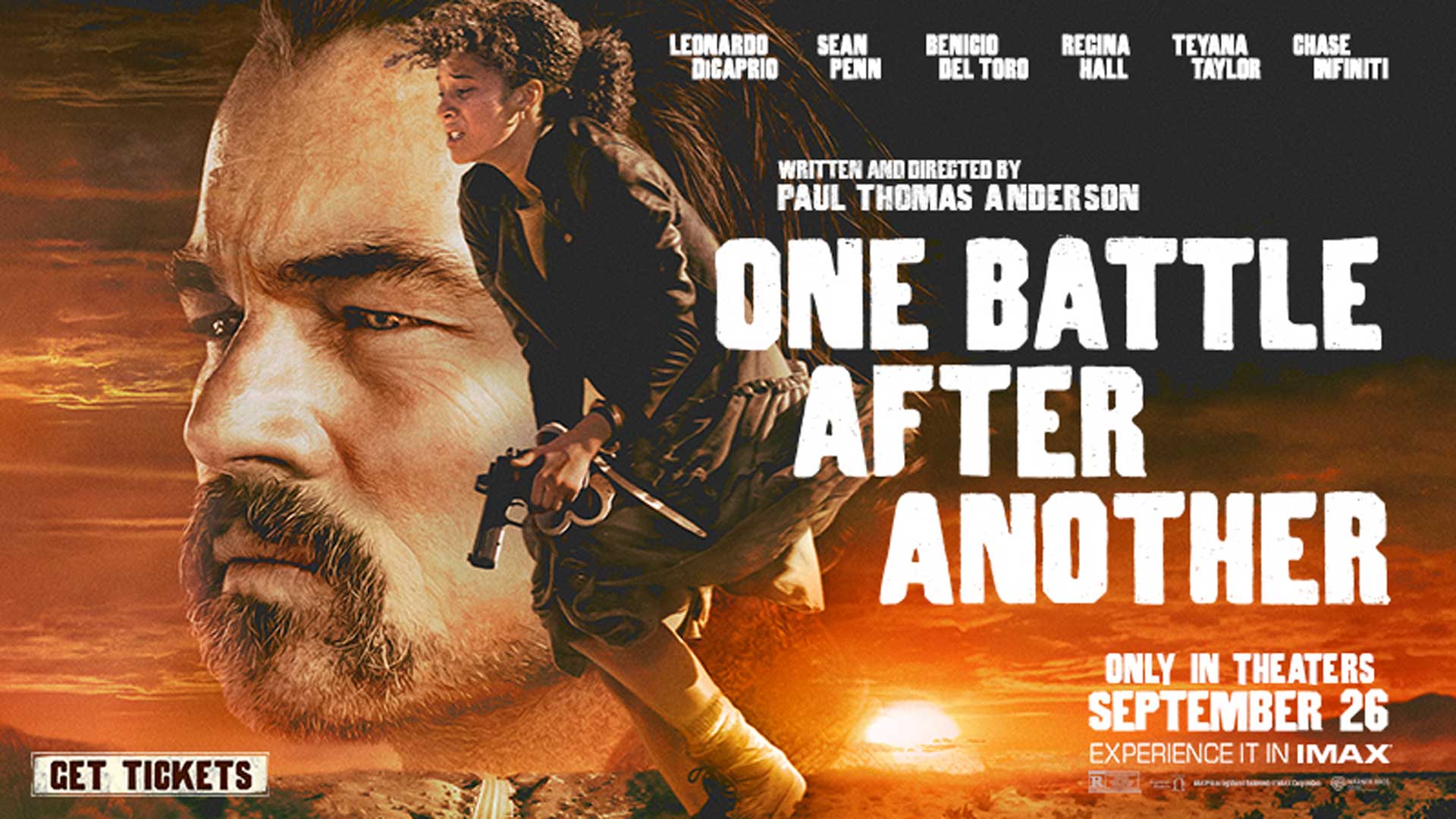
Prepared and shot before Trump’s reelection, [One Battle After Another] is something more than prescient; it seems to have won an existential gamble, on a high and devastating level, in staging scenes of a U.S. invasion of its own cities, scenes in which officials with guns occupy high schools and hospitals, all under an official pretext originating in a corrupt and insane commander’s personal vendetta.” - Jonathan Lethem
One Battle After Another (USA: Paul Thomas Anderson, 2025: 162 mins)
Bianchi, Pietro. "(Female) Enjoyment as a Political Factor in One Battle After Another." e-flux (October 17, 2025) ["The novelty of One Battle After Another is that the impossible totality—which no longer seems to have a dominant register and instead disperses into a thousand fragments, digressions, comic intermissions, and dramatic closures—has never revolved so insistently around an absent center. A center that perhaps constitutes both the allegory and the singular embodiment of the impossibility of totality. That absent center consists of the character who, in Vineland, was Frenesi, and who here goes by the name of Perfidia Beverly Hills, played by Teyana Taylor."]
Cira, Mark. "One Battle After Another." Letterboxd (September 30, 2025) ["In Tarantino's revisionism, he takes aim at the bullshit liberalism the hippy counterculture curdled into. Anderson’s target is more formidable: the military industrial complex. It’s a fairer fight, or at least a more honest one. As Hollywood's collaboration with the Pentagon and intelligence agencies deepened throughout the 2000s - Zero Dark Thirty, the Marvel military partnerships, the CIA's script consultations, Gen-X irony started to look less like detachment and more like complicity. The nihilism that seemed like coked-out swagger in the '90s needed some re-evaluation."]
Goi, Leonardo. "In Sunny Southland: Paul Thomas Anderson and Thomas Pynchon’s California." Notebook (November 24, 2025) ["By 1970, when Anderson was born in Studio City, Pynchon had quit his gig writing safety articles for Boeing in Seattle and decamped to Los Angeles. He landed in a small apartment in Manhattan Beach, which would appear in his books as the fictional Gordita Beach, a last resort for bums, drifters, punks, and drop-outs determined to steer clear of the straight life. And though his novels have journeyed far and wide—from New York City (V., 1963; Bleeding Edge, 2013) to Chicago (Against the Day, 2006); from the American colonies (Mason & Dixon, 1997) to Europe, Namibia, and Siberia (Gravity’s Rainbow, 1973)—Pynchon has become closely identified with the countercultural hangover that swept through post-Manson California and serves as backdrop for the two texts Anderson would go on to adapt, Inherent Vice (2009) and now Vineland (1990). Novelist and filmmaker are unmistakably smitten with the textures of “sunny Southland,” to use a phrase popularized in the late 1800s by newspaper editor Harrison Gray Otis (who incidentally lifted it from the Confederacy). But they reserve their deepest feeling for its eccentric residents—drifters who straddle the old and the new, who have only just started to realize how the changing of the guard is leaving them behind, who have seen their turf transform to the point they can barely recognize it. Still, neither artist has ever simplistically romanticized that bygone milieu. Their characters fumble as they navigate a world rife with signs, secrets, and conspiracies, a California candied not with “identifiable cit[ies]” but with “grouping[s] of concepts,” where everyone and everything suggests “a hieroglyphic sense of concealed meaning,” per The Crying of Lot 49. That novel came out in April 1966, just a few months before Reagan was elected governor, promising to crack down on the “filthy speech movement” fueled by the student protests at Berkeley and to send “the welfare bums back to work.” The repression and censorship that would dominate Reagan-era California (and eventually all of the United States under his presidency) permeate Vineland and Inherent Vice, in which the actor-turned-politico serves as an omnipresent specter, a kind of daemon ex machina restoring fascism at home and abroad. A mood of chronic paranoia permeates Pynchon’s prose and Anderson’s cinema; what binds them isn’t just some autobiographical affair with Los Angeles but an interest in its sinister side: In the words of Inherent Vice’s Detective Lieutenant “Bigfoot” Bjornsen, “The dark forces that are always there just out of the sunlight.”"]
Hudson, David. "One Rave After Another." Current (September 25, 2025) ["The hype is real,” announces Adam Nayman in his review of One Battle After Another at the Ringer. Currently the highest-ranked film of the year at Letterboxd, Paul Thomas Anderson’s tenth feature is also riding high at Metacritic with a score of ninety-five. “There are sequences here,” writes Nayman, “so fluid and lucid—so controlled in terms of composition, cutting, and the hurtling, all-in sensation theorized by film scholar David Bordwell as ‘intensified continuity’—that remaining skeptics may feel obliged to bend the knee.”"]
Irazuzta, Javier. "The Prop and the Production Designer." Notebook (October 3, 2025) ["Eight industry veterans discuss a single object or piece of scenery from their work and its role in the worlds of their films."]
Klion, David. "How One Battle After Another Imagines an Armed Left." The New Republic (October 3, 2025) ["The rebels in Paul Thomas Anderson’s movie resemble the Weather Underground less than the right’s conspiratorial image of 'antifa supersoldiers.'"]
Lewis, Josh. "One Battle After Another." Letterboxd (September 27, 2025)
Llinares, Dario. "One Critical Battle After Another: Ideology v Aesthetics." Cinema Body/Cinema Mind (October 6, 2025) ['Emerging from the cavernous majesty of the Waterloo IMAX, I stumbled out slightly disoriented, still trying to process the sheer scale of the audiovisual spectacle I had just witnessed. The vertigo-inducing final sequence, a slow-burn car chase across the Southern California desert, is so physically and sensually intense - its suspense gradually accumulating until the dénouement arrives with a crash (literally and figuratively) - that it left me feeling exhilarated, awestruck even."]
Smith, Nathaniel. "One Battle After Another is a masterful film about the melancholy of moral compromise." Premier Christianity (October 7, 2025) ["It’s the kind of art that demands attention, so by extension it’s the sort of cinema that Christians who want to engage with culture should rush to see."]

No comments:
Post a Comment