We live in the best of times in which we are able to learn about the world and its incredible diversity of cultures/beings/places/perspectives in a way never historically possible. We live in the worst of times when we are able to isolate ourselves completely from anything different from our own narrow view/conception of the world/reality. The choice is yours!
"In the wake of the critical and commercial success of One Battle After Another (2025), conservative pundits have denounced Paul Thomas Anderson’s latest film as an irresponsible ode to ideological violence. “You can make excuses for it, but basically the [film is] an apologia for radical left-wing terrorism,” said Ben Shapiro. In The National Review, Armond White writes that “Anderson intentionally provokes the bloodlust of his woke confreres (and Gen Z viewers who know nothing about the Sixties) by celebrating the insipid, heretical, and violent activities of the liberal past and present.”
"Diane Keaton has died at 79. The American actress began her career on the stage as an understudy in the original Broadway production of Hair (1968). She received a Tony nomination for Best Featured Actress for her supporting role in Woody Allen’s production of Play It Again, Sam (1969). In the 1970s, she rose to prominence with a string of acclaimed film performances in Francis Ford Coppola’s The Godfather (1972) and The Godfather: Part II (1974), as well as in six of Allen’s films, including her Oscar-winning turn as the eponymous Annie Hall (1977). Keaton garnered some of the strongest notices of her career for her performance as Louise Bryant in Warren Beatty’s historical epic Reds (1981). In the 1990s, she reunited with Coppola and Allen for The Godfather: Part III (1990) and Manhattan Murder Mystery (1993), respectively, and scored box-office success with comedies Father of the Bride (1991) and The First Wives Club (1996). With Something’s Gotta Give (2003) and The Family Stone (2005), Keaton proved herself to be both an enduring screen presence, and very few years passed without an acting credit to her name. “A few days ago the world was a place that included Diane Keaton,” remembered Allen. “Now it’s a world that does not. Hence, it’s a drearier world. Still, there are her movies. And her great laugh still echoes in my head.”"
... Eurocentrism ... is the view that enshrines the hierarchical stratifications inherited from Western colonial domination, assumed to be inevitable and even "progressive." Eurocentrism does not refer to Europe in its literal sense as a continent or a geopolitical unit but rather to an intellectual orientation rooted in colonial power, an interlocking network of buried premises, embedded narratives, and submerged tropes, that perceives Europe (and the neo-Europes around the world) as universally normative (4). - Stam, Robert. Keywords in Subversive Film/Media Aesthetics. Wiley/Blackwell, 2015.
Everard, Faith. "Gate of Flesh."Senses of Cinema #114 (July 2025) ["We are only temporarily set at ease by the opening shots of Suzuki Seijun’s explosive, avant-garde Nikutai no mon (Gate of Flesh, 1964), in which pristine skyscrapers and bleary-eyed sunsets quickly give way to utter carnage. Welcome – and beware! warns the inscription on the gate our heroine stumbles through, as a commotion nearby centres a poorly disguised cadaver: “Clear the path! Dead man coming through!” we are cautioned. This is the hellscape of postwar Tokyo."]
Lee, Soowhan. "A Decision to Leave, Yet Never to Part."Film Matters (October 23, 2025) ["Park Chan-wook is the director behind Oldboy, Thirst, and The Handmaiden, comparable to Bong Joon-ho. Whenever his new feature film is released, people jokingly – yet with a sense of expectation — ask, “Who’s going to die this time?” This demonstrates how unique and consistent Park’s cinematic universe is. However, his films also start with a simple, sensational opening. Inside that, human instinct, morality, desire, and guilt clash. Additionally, he constantly urges the audience to reflect on his message. Decision to Leave (2022) is Park’s eleventh feature film, and audiences were surprised by his new cinematic style. Many of Park’s fans choose this film as their favorite among his works. This movie, which could be seen as a watershed moment in his career, is a melodrama that explores the depths of people’s hearts without relying on provocative scenes. Still, I would prefer to call it a love story. "]
Loayza, Beatrice. "Sisters of Sacrilege."The Current (September 25, 2025) ["Religion relies on the formless logic of faith—belief that is felt in spite of tangible proof telling us otherwise—which the nuns of nunsploitation cinema routinely toy with to serve their own purposes. Paul Verhoeven’s Benedetta (2021)—which features a dildo carved to resemble the Virgin Mary, sensuous dream sequences of a jacked Jesus, and sapphic sex scenes on sacred grounds—understands this particularly well. If “God is not bound by a rule book,” as its rabble-rousing heroine, Benedetta (Virginie Efira), declares, then he’s also open to interpretation, his laws capable of being determined by mere human whims. Is Benedetta really perceiving divine signals, or is she faking her hallucinations to leverage her position in the Church? If the scene when Benedetta slices open her wrists to simulate the stigmata tells us she’s a fraud, her full-body commitment to the act tells us, at the very least, that the stakes are real. Nuns like Benedetta wager nothing less than their own bodies knowing that pain and pleasure are just two sides of the same coin. In nunsploitation, there is no such thing as good or bad girls. To paraphrase Linda Williams, these parameters remain, but within them our naughty nuns renegotiate their terms in liberating ways: good girls can pretend they don’t want to be pleasured; bad girls can pretend they don’t want to be punished. With a twinkle in their eyes, they’ll find holy release."]
Masciotra, David. "Why Honey Don't Is the Subversive Queer Private Eye Movie for Today's America."Crimereads (October 25, 2025) ["While having a lesbian in the role of protagonist separates Honey Don’t from its male-led influences, there is yet another connection to make. Joseph Hansen’s groundbreaking, rollicking, and often moving series of novels about David Brandsetter, a gay insurance agent investigating claims in a similarly downtrodden California throughout the 1970s, ‘80s, and ‘90s, shares the “queer world” of Honey Don’t, and presents the sexuality of the hero as an asset, rather than a liability. It enables Brandsetter, as it does Honey, to navigate professional and underground circles, often identifying characteristics and vices that elude the eyes of the detective who lives solely within the staid center of mainstream Americana. Because of the vicious homophobia of the 1970s, and the HIV-AIDS crisis of the 1980s and ‘90s, Brandsetter’s gay identity is very much a big deal. Honey Don’t, even if it greets audience amidst a reactionary backslide in American politics, measures the progress that enables storytellers to create queer characters without explanation, apology, or tragedy. "]
Yacavone, Peter. "Branded to Kill."Senses of Cinema #114 (July 2025) ["A case study of a man who is willing to die for his shoddy principles, Branded to Kill is precisely what its most distinguished admirers – Hasumi Shigehiko, Tony Rayns – have denied: a profoundly philosophical and ethical film comparable to Kurosawa Akira’s great triptych of Rashōmon (1950), Ikiru (To Live, 1952), and Shichinin no samurai (Seven Samurai, 1954). It asks, as they do, simply, “How to live”? Suitably enough for a film directed by a dissolute naval veteran and scripted by a cadre of young radicals, Branded to Kill puts the question in a negative form: “What is worth dying for?”: and then signals its orientation by reverting to 30 seconds of negative film exposure during a sequence in which the protagonist awaits his probable doom. What is worth dying for? It is a question that in post-war Japan had a kind of retrospective urgency to it, since hundreds of thousands of wartime soldiers, seamen, and pilots had rushed to their deaths chanting the “mantras” of Yamamoto Tsunetomo and other philosophers who advocated for the ethical and spiritual supremacy of self-willed death. Suzuki’s characters, as they relate to this central question, are almost Brechtian in their ideological purity. "]
Zoller, Debbie. "Debbie Zoller Drives Lost Highway."MUBI Podcast (October 16, 2025) ["Makeup and prosthetics artist Debbie Zoller first worked with David Lynch on Lost Highway (1997). She discusses their two decades of friendship and how she designed the looks for some of his most iconic femme fatales."]
"Written by Paddy Chayefsky (Network) and directed by Ken Russell (Women in Love), Altered States (1980), starring William Hurt as a psychopathologist seeking to unlock primal secrets, is “a textbook example of how a tug of war between writer and director can work in the film’s favor,” writes Budd Wilkins at Slant. “Perhaps it is oversimplistic to map out the movie’s split personality in terms of a battle between Chayefsky’s cerebralism and Russell’s corporeality,” writes Jessica Kiang. “But it’s also fun, so let’s indulge,” and she does. Altered States is “a series of bad trips burned from the brain onto celluloid,” writes Jacob Oller at the A.V. Club, but “the undeniable revelation sought by its fringe-dweller is the same as the one found in hackneyed romances—sometimes you just need to turn yourself into the universe’s throbbing fetus before you realize that we find our answers in each other.”"
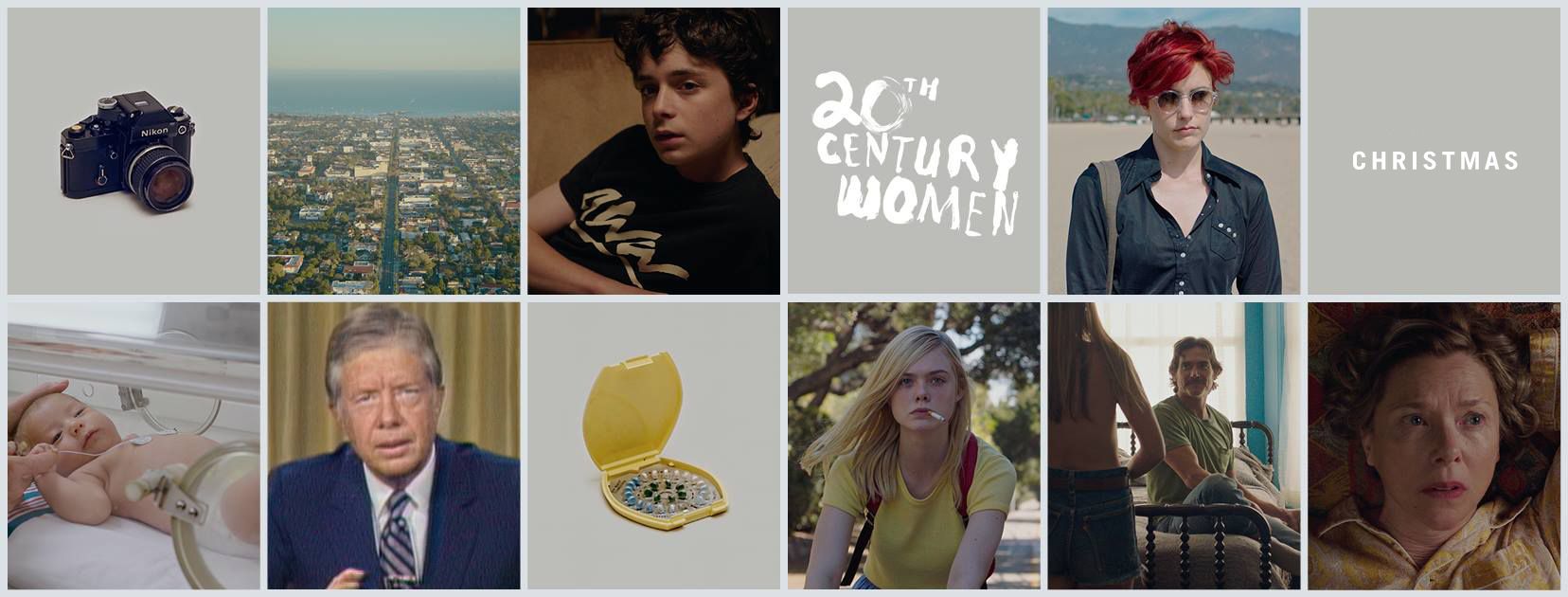
Alpert, Roger. "20th Century Women: Gender and Politics in History."Jump Cut #58 (Winter 2017-2018) ["Mike Mills scripted and directed 20th Century Women. It is both a personal “love letter” to Mills’ mother and sister who had raised him as well as an examination of gender inculture, an examination that Mills had already begun in his autobiographical Beginners (2010) about his terminally ill father. For those aware of its autobiographical elements, the movie sounds a personal note, teasing the viewer to differentiate between what’s “real” and what’s “fiction,” even as it examines broader cultural issues. For those unaware, it both possesses the emotional appeal of the classical Hollywood melodrama as well as evokes the independent, innovative filmmaking of such “women’s films” as Jeanne Dielman, 23, Quai du Commerce, 1080 Bruxelles (1975), Antonia’s Line (1995), and Certain Women (2016). The movie avoids the escapism of contemporary Hollywood fiction, and Mills has instead sought to partake of the independent New Hollywood cinema of the 1970s in which male directors, such as Robert Altman and Martin Scorsese, transcended through formal innovations the constraints of a conservative Hollywood. Like all of these independent, innovative film directors, Mills in 20th Century Women portrays a personal drama that is simultaneously political. The movie entertains even as it seeks to enlighten its audience about gender."]
Barton-Fumo, Margaret, Molly Haskell and Violet Lucca. "Women in New Hollywood."Film Comment Podcast (February 7, 2017) ["Road-tripping crises of masculinity soundtracked by classic rock, Harvey Keitel making up for his sins in the streets—a laundry list of 1970s New Hollywood highlights can tend to lack a nuanced female presence. But the ’70s also gave us Wanda, Puzzle of a Downfall Child, Girlfriends, A Woman Under the Influence, and even Five Easy Pieces, all of which explore female identity in the era of second-wave feminism. This episode of the Film Comment podcast spirals outwards from From Reverence to Rape author Molly Haskell’s essay on Mike Mills’s 20th Century Women and accompanying interview with Annette Bening, in the January/February issue, taking a closer look at depictions of women in New Hollywood. Some of these were “neo-women’s films,” dealing with disillusioned housewives fleeing the domestic sphere; others took on female friendship without turning a blind eye to its messiness, a line that runs through Thelma and Louise, Frances Ha, and Broad City."]
Crozer-De Rosa, Sharon. "What are the four waves of feminism? And what comes next?"University of Wollongong, Australia (March 8, 2024) ["In Western countries, feminist history is generally packaged as a story of “waves”. The so-called first wave lasted from the mid-19th century to 1920. The second wave spanned the 1960s to the early 1980s. The third wave began in the mid-1990s and lasted until the 2010s. Finally, some say we are experiencing a fourth wave, which began in the mid-2010s and continues now."]
Bray, Mark. "For Antifa, Not All Speech Should Be Free."On the Media (February 10, 2017) ["Those who subscribe to liberal values are supposed to “defend to the death” the rights of their enemies to speak their minds. But anti-fascist activists, or “antifa,” believe history demonstrates the perils of giving a platform to hate -- and they'll go to great lengths to suppress such views. Mark Bray, a visiting historian at Dartmouth College and author of Translating Anarchy: The Anarchism of Occupy Wall Street, talks with Brooke about the history, ideology, and recent resurgence of the anti-fascist movement."]
---. Antifa: The Antifascist Handbook. Melville House, 2017. ["In the wake of tragic events in Charlottesville, VA, and Donald Trump's initial refusal to denounce the white nationalists behind it all, the "antifa" opposition movement is suddenly appearing everywhere. But what is it, precisely? And where did it come from? As long as there has been fascism, there has been anti-fascism--also known as "antifa." Born out of resistance to Mussolini and Hitler in Europe during the 1920s and '30s, the antifa movement has suddenly burst into the headlines amidst opposition to the Trump administration and the alt-right. They could be seen in news reports, often clad all in black with balaclavas covering their faces, fighting police at the presidential inauguration, and on California college campuses protesting right-wing speakers, and most recently, on the streets of Charlottesville, VA. Simply, antifa aims to deny fascists the opportunity to promote their oppressive politics--by any means necessary. Critics say shutting down political adversaries is anti-democratic; antifa adherents argue that the horrors of fascism must never be allowed the slightest chance to triumph again. In a smart and gripping investigation, historian and former Occupy Wall Street organizer Mark Bray provides a one-of-a-kind look inside the movement, including a detailed survey of its history from its origins to the present day --the first transnational history of postwar anti-fascism in English. Based on interviews with anti-fascists from around the world, Antifa details the tactics of the movement and the philosophy behind it, offering insight into the growing but little understood resistance fighting back against the alt-right."]
---. "The New Power of Far Right Influencers."Uncanny Valley (October 16, 2025) ["History professor Mark Bray is no stranger to death threats. As the author of the book Antifa: The Anti-Fascist Handbook, published in 2017, he has received backlash and harassment from far-right circles for almost a decade. But things recently escalated after the Trump administration designated antifa as a “domestic terrorist organization,” and far-right influencers with a newfound power targeted Bray. Mike sits down with WIRED’s David Gilbert and Leah Feiger to discuss what went down, how the role of far-right influencers has expanded exponentially during the past year, and what responsibility tech companies carry."]
---. "Why a Scholar of Antifa Fled the Country."On the Media (October 17, 2025) ["Host Micah Loewinger speaks with Mark Bray, historian and author of Antifa: The Anti-Fascist Handbook, who left the country after being accused of being “antifa,” resulting in death threats and doxxing. Bray, a professor at Rutgers University, shares how his research is helping him to understand the harassment campaign led by conservative media against him."]
S.G. Goodman; Magdalena Bay; Pavement; Margo Price; Sierra Ferrell; Trombone Shorty; New Breed Brass Band; Bad Bad Hats; Hippo Campus; Gully Boys; Morrison Graves; Pink Floyd; David Gilmour; Romany Gilmour; Jenny Don't and the Spurs; Stereolab; Jay Som; Soft Glas; Self Improvement; Ty Segall; Wolf Alice; Joanne Shaw Taylor; Hozier; Republica; Blur; Tears for Fears; The Strokes; Laura Veirs; Matt Maeson; The Sines; Sylmar; Of Monsters and Men; Marcy Playground; Miranda Lambert; Big Wild; iDA HAWK; Chartreuse; Dummy; Ganser; Hawkwind
Campagna, Federico. "Myth, Nostalgia, and Liberation: Federico Campagna’s Otherworlds: Mediterranean Lessons On Escaping History."Lepht Hand (August 23, 2025) ["Can myth itself serve as a material force in struggles for liberation? Federico Campagna joins me to discuss how myth—too often dismissed as escapism or co-opted by reaction—can instead become a practice of imagination, solidarity, and survival. We look at myth’s place in anti-capitalist politics, its tension with materialism, and its role in resisting despair. What emerges is a vision of myth as a politics of possibility against history’s catastrophes."]
Ellison, Ian. " Politics on Trial 100th Anniversary Special: Franz Kafka’s The Trial."Past Present Future (August 25, 2025) ["Today’s episode in Politics on Trial is about the most famous trial in literature and one that never actually takes place. David talks to writer and literary scholar Ian Ellison about Franz Kafka’s The Trial, first published in 1925. What is the meaning of a book about a legal process that never happens? How was it inspired by Kafka’s failed love life? Why has it given rise to so many different understandings of what makes our world Kafkaesque? And how did a work of fiction that is full of weird and wonderful ideas get associated with mindless bureaucracy?"]
Fuentes, Agustín. "Sex is a Spectrum."Converging Dialogues (May 4, 2025) ["In this episode, Xavier Bonilla has a dialogue with Agustín Fuentes about biological sex. They talk about the history of sex evolution, the importance of gametes, intersex individuals, and history of sex binary. They talk about gonads and hormones, sex variation in the animal kingdom, spectrum question, gender, gender and sports, gender and bathrooms, and many other topics. Agustín Fuentes is an anthropologist and professor of anthropology at Princeton University. His research focuses on the entanglement of biological systems with the social and cultural lives of humans, our ancestors, and a few of the other animals with whom humanity shares close relations. He has his BA/BS in Anthropology and Zoology and his MA and PhD in Anthropology from UC Berkeley. He has conducted research across four continents, multiple species, and two-million years of human history. His current projects include exploring cooperation, creativity, and belief in human evolution, multispecies anthropologies, evolutionary theory and processes, and engaging race and racism. Fuentes is an active public scientist, a well-known blogger, lecturer, tweeter, and an explorer for National Geographic. Fuentes was recently awarded the Inaugural Communication & Outreach Award from the American Association of Physical Anthropologists, the President’s Award from the American Anthropological Association, and elected to the American Academy of Arts and Sciences. He is the author of numerous books including the most recent, Sex Is A Spectrum: The Biological Limits of the Binary."]
Lucke, Jamie. "‘Kind and generous,’ Gurney Norman, Kentucky writer and teacher, dies at 88."Lexington Times (October 14, 2025) [Norman’s legacy — “the tail of his comet” — will live on in “all the writers to whom he’s been tremendously influential,” said Willie Davis, a writer in Lexington and creative writing teacher at Kentucky State University. “He was kind and generous with his time.” Davis said reading Norman’s work, especially “Kinfolks,” opened his eyes by depicting Appalachia in ways more alive and vivid than common stereotypical treatments. “He writes with such precision. His characters are so full of life. It really enraptured me. I told him if everyone wrote about a mountain like you write about a mountain, no one would ever tear another mountain down.”]
McRobert, Neil. "My Four-Legged Ode to Bravery & Joy."Talking Scared #258 (October 8, 2025) ["Ah the arrogance of writers. Now I am one, officially, I thought I’d better do something fitting. So I set up a whole episode of my podcast to talk about my own book – Good Boy! My debut novella about small English towns, the bonds between men and dogs, and a battle between bravery and monsters. Thankfully, I have friends who will facilitate this type of nonsense, so thanks to Nat Cassidy and Rachel Harrison for asking me questions and flattering my ego. We talk about literary and personal inspirations, about what I’ve learned from 5 years of interviewing authors, about local folklore and the composition of monsters… and of course, about dogs!"Other books mentioned: IT (1986), by Stephen King; From a Buick 8 (2002), by Stephen King; The Fisherman (2016), by John Langan; Any Human Heart (2002), by William Boyd; The October Film Haunt (2025), by Michael Wehunt]
Rosson, Keith. "The Real V Word."Talking Scared #253 (September 16, 2025) ["Do you like your vampires slick and suave or rugged and raging? If it’s the latter, you’ll very much enjoy Keith Rosson’s Coffin Moon. It’s a 70s-set bareknuckle revenge road trip of a book, with some of the meanest vampires you’ll ever meet (and love). Keith is back in the show for the second time in a year, to talk all about it. We get into his problem with ‘classic’ vampires aesthetics, the lure of backstory, taking hard advice from editors, and violence… a whole lotta violence!" Other books mentioned: Fever House (2023), by Keith Rosson; The Devil By Name (2024), by Keith Rosson; Bury Our Bones in the Midnight Soil (2025), by V.E. Schwab; King Sorrow (2025), by Joe Hill]
Stanley, Jason. "Introduction: The Problem of Propaganda."How Propaganda Works. Princeton University Press, 2015: 1 - 26. ["Our democracy today is fraught with political campaigns, lobbyists, liberal media, and Fox News commentators, all using language to influence the way we think and reason about public issues. Even so, many of us believe that propaganda and manipulation aren't problems for us―not in the way they were for the totalitarian societies of the mid-twentieth century. In How Propaganda Works, Jason Stanley demonstrates that more attention needs to be paid. He examines how propaganda operates subtly, how it undermines democracy―particularly the ideals of democratic deliberation and equality―and how it has damaged democracies of the past. Focusing on the shortcomings of liberal democratic states, Stanley provides a historically grounded introduction to democratic political theory as a window into the misuse of democratic vocabulary for propaganda's selfish purposes. He lays out historical examples, such as the restructuring of the US public school system at the turn of the twentieth century, to explore how the language of democracy is sometimes used to mask an undemocratic reality. Drawing from a range of sources, including feminist theory, critical race theory, epistemology, formal semantics, educational theory, and social and cognitive psychology, he explains how the manipulative and hypocritical declaration of flawed beliefs and ideologies arises from and perpetuates inequalities in society, such as the racial injustices that commonly occur in the United States. How Propaganda Works shows that an understanding of propaganda and its mechanisms is essential for the preservation and protection of liberal democracies everywhere."]
West, Stephen. "Authenticity and the history of the self - Charles Taylor."Philosophize This! #239 (October 17, 2025) ["Today we talk about the work of the philosopher Charles Taylor. First, we trace the historical origins of how he views the modern self. From the Greeks to the Reformation. From Descartes to Rousseau. The modern self to him is something "irreconcilably multileveled". Then we talk about our modern focus on authenticity as a moral ideal and why Taylor thinks many people misunderstand what it requires." This episode focuses on ideas from Taylor's books The Ethics of Authenticity and Sources of the Self.]
---. "Byung Chul Han - The Crisis of Narration."Philosophize This! #232 (July 7, 2025) ["Today we talk about the book The Crisis of Narration by the philosopher Byung Chul Han. We talk about the history of storytelling. Walter Benjamin's distinction between a Paris fire and a revolution in Madrid. The effects of social media on memory. Story telling vs story selling. AI as pure Intelligenz lacking Geist. The ability for stories to give shape to suffering. The importance of boredom for self-discovery."]
---. "Susan Sontag - Do you criticize yourself the way you criticize a movie?"Philosophy This! (March 1, 2023) [A discussion of Susan Sontag's "Against Interpretation." "In this episode, we explore how Susan Sontag—a fierce cultural critic inspired by Simone Weil—challenged the modern obsession with interpretation, both in psychoanalysis and in art. Sontag admired Weil’s uncompromising stance against the status quo and echoed that same resistance by criticizing how analysis can distance us from the immediacy of lived experience. She warned that filtering emotions and art through normative theories often alienates people from their own reality, granting undue power to experts while reducing complex experiences to predictable patterns. Instead, Sontag called for an "erotics of art"—a renewed way of engaging with form and style that invites visceral, transformative encounters rather than detached interpretation. Through this lens, she argued, we open ourselves to art—and life—in ways that allow discomfort, openness, and even confusion to shape us. The episode closes by linking this sensibility to Sontag’s belief that truth demands sacrifice, and that progress requires voices from the margins, not just those who play by the rules of reason."]
Bächle, Thomas Christian and Jascha Bereis. "The Realities of Autonomous Weapons."New Books in Science, Technology, and Society (August 19, 2025) ["Autonomous weapons exist in a strange territory between Pentagon procurement contracts and Hollywood blockbusters, between actual military systems and speculative futures. For this week's Liminal Library, I spoke with Jascha Bareis, co-editor of The Realities of Autonomous Weapons (Bristol UP, 2025), about how these dual existences shape international relations and cultural imagination. The collection examines autonomous weapons not just as military hardware but as psychological tools that reshape power dynamics through their mere possibility. These systems epitomize what the editors call "the fluidity of violence"—warfare that dissolves traditional boundaries between human decision and machine action, between targeted strikes and algorithmic inevitability. Bareis and his contributors trace fascinating connections between fictional representations and military doctrine—how Terminator narratives influence Pentagon planning while actual weapons development feeds back into artistic imagination. The book wrestles with maintaining "meaningful human control" over systems designed to operate faster than human thought, a challenge that grows more urgent as militaries worldwide race toward greater autonomy. Each chapter reveals how thoroughly we need to rethink human-machine relationships in warfare, from the gendered coding of robot soldiers in film to the way AI imaginaries differ between Silicon Valley and New Delhi. Autonomous weapons force us to confront uncomfortable realities about agency, violence, and the increasingly blurred line between human judgment and algorithmic certainty."]
Castro, Collette de. "Great Actors: Tilda Swinton." Senses of Cinema #114 (July 2025) ["Tilda Swinton is forever changing before our eyes. While writing this article, I became aware of two new productions she starred in that haven’t been released yet. In one, she plays an egocentric New York artist with curly red hair, a favourite green suit, and a superiority complex. In the other, she embodies the paranoiac mother of a wealthy family, singing heartily to protect her family in a bunker as the world ends. And this is after she said that the film she made before both of these, The Room Next Door (Pedro Almodóvar, 2024), may be “the last film I make.” It could be that she’s goading me: “Just try to keep up!”"]
Koski, Genevieve, et al. "The Kids Aren't All Right, Pt. 2: Weapons." The Next Picture Show #489 (September 2, 2025) ["Zach Cregger’s WEAPONS overlaps with Atom Egoyan’s THE SWEET HEREAFTER in both its broad narrative setup — a town grapples with the sudden disappearance of a group of children — and its non-traditional structure, but diverges considerably in its tone. Then again, WEAPONS diverges considerably from its own tone as it goes on, artfully shifting gears as it makes its way through a story that prioritizes entertainment value over horror allegory. We’re joined once again by Vulture movie critic Alison Willmore to talk about why that approach worked so well on us, and less so on the film’s detractors, before bringing THE SWEET HEREAFTER back in to discuss how each film’s broken timeline serves to reveal the intricacies of a community shattered by grief and anger."]
O'Donoghue, Darragh. "The Sleeping Beast Within."Senses of Cinema #114 (July 2025) ["On paper, The Sleeping Beast Within is a straightforward detective story, complicated by elements of the newspaper exposé, the youth movie, the middle-class shōshimin-eiga (in particular the contemporary films of Ozu Yasujirō), and even the horror genre. Long-serving salaryman Ueke Junpei (Ashida Shinsuke) is sacked by his company and goes missing after a trip to Hong Kong. His distraught daughter Keiko (Yoshiyuki Kazuko) and her pushy reporter friend Kasei Shotaro (Nagato Hiroyuki) investigate. It transpires that Junpei, after a lifelong dedication to respectability and service resulting in emasculation, humiliation, and impoverishment, has opted for a more lucrative and empowering association with organised crime. Suzuki’s analysis is conducted entirely through genre – and the reversal of genre. The detective-journalists expose the father or surrogate father praised at the beginning. It is the adults and not the civic-minded youths who disrupt moral norms. The salarymen are criminal masterminds, not pitiable losers. The horror is an internal, not external threat. And although Suzuki himself would not be ‘discovered’ by the west for another three decades, he engages with the work of the most internationally celebrated Japanese filmmaker, Kurosawa Akira. The Sleeping Beast Within intriguingly echoes the same year’s Warui Yatsu Hodo Yoku Nemuru (The Bad Sleep Well), wherein Mifune Toshiro joins a company to investigate his father’s death; the latter film begins with a group of journalists discussing corporate corruption. The earlier Nora inu (Stray Dog, 1949) likewise used tropes of the American crime genre to explore post-war Japanese society. Suzuki’s Junpei could be Shimura Takashi’s terminally ill bureaucrat in Ikiru (1952) if he turned to crime instead of the public good."]
Skarsgård, Alexander and Harry Lighton. "On Pillion." Films at Lincoln Center (October 8, 2025) ["Harry Lighton and Alexander Skarsgård discuss Pillion with NYFF Artistic Director Dennis Lim at the 63rd New York Film Festival. In his unorthodox queer romance, Harry Lighton crafts a film about a sadomasochistic relationship that is both transgressive and disarming, starring Harry Melling and Alexander Skarsgård in fearless performances as a mild young man and his leather-clad dom lover." Pillion trailer]
Paul Thomas Anderson’s seventh film, Inherent Vice, is a straightforward page-to-screen adaptation of Pynchon’s late-career detective novel. Not immediately a particularly large critical or commercial success, its regard has grown over time (especially as Joaquin Phoenix has become a bigger and bigger star). I’ve seen this film half a dozen times, including at the recent 70mm revival at Film at Lincoln Center, and think it’s both Anderson’s best film and a significant improvement on the source material (which is source material that I quite like).
Unlike Perry, who simply substituted his own sense of humor for Pynchon’s, Anderson matches the layered humor of the novel; every frame has a visual joke and you want to laugh at every line twice. More than that, Anderson brings real depth to some of Pynchon’s more spiky characters. Owen Wilson as Coy Harlingen, Benicio Del Toro as Sauncho Smilax Esq.––both are more rounded and compelling in the film. Unlike in End of the Road where the ostentatious collaging distracts from and weakens the content, the images of Inherent Vice––the view of Manhattan Beach between two squat houses, the last supper scene, the curved and canine golden fang headquarters––add to the texture of the work. The music––Can, Neil Young, the Jonny Greenwood originals––is brilliant too. It’s a really accomplished piece of work. - Gideon Leek
The film editor who worked on The Social Network once told me that whenever he came across the name Mark Zuckerberg in the news, the face that flashed through his mind belonged to Jesse Eisenberg. I could relate: Sometimes, I have to remind myself that “If you guys were the inventors of Facebook, you’d have invented Facebook” is an inspired Aaron Sorkin–Eisenberg alley-oop and not, like, real-life Zuck footage that I must’ve come across on 60 Minutes once. Eisenberg’s bitter patter, clipped condescension, and wounded pride in The Social Network may not be an exact impersonation of Zuckerberg, but it’s something more lasting: the embodiment of both the guy and a generation.
Eisenberg had neither a Facebook account nor any familiarity with Zuckerberg when he took the role. (He was in the car driving to Facebook HQ unannounced to see whether he could stroll in and shake hands with the man himself when producer Scott Rudin and the studio’s legal department called off this pavement-pounding recon mission. Eisenberg settled for listening to a lot of Zuck interviews.) Director David Fincher’s advice? “Figure out a way to remain an enigma,” Fincher remembered. “Be more opaque,” Eisenberg recalled. The resulting character study is both intimate and aloof, curated and revealing. Even all these years later, that’s what a Facebook profile is all about. —Baker
Classical snobs love to point out that there seem to be as many influences on Williams’ “Star Wars” score as stars in the sky: Korngold, Copland, Holst, Dvořák, and Wagner just to name a few. Some — looking at you, Sirius XM “Symphony Hall” host Preston Trombley — all but allege theft. Yet the creation of the “Star Wars” score is much like the creation of Facebook: If any of those other composers had created the “Star Wars” score, they would have created the “Star Wars” score. Moreover, none of them created a melody somehow so lushly orchestral yet Top 40-ready that a disco remix of it went to #1 on the Billboard Hot 100. Something that could suit the London Symphony Orchestra and Studio 54.
Beyond the iconic main theme, there’s innovation all over the “Star Wars” score: The extraordinary repeated triple-beat as the Imperial Star Destroyer enters the frame like a leviathan in an opening shot that does more to establish scale than any other opening shot in movie history; the use of steel drums for a jazzy riff on “The Charleston” to create the famous “Mos Eisley Cantina” theme; the bassoon-driven “Darth Vader theme” (no composer of movie music has known what to do with bassoons better than Williams); the stuttery “Imperial Motif” (so good the “Imperial March” from “The Empire Strikes Back” is almost redundant); the thundering bass drums that resound shortly after Grand Moff Tarkin barks “Evacuate? In our moment of triumph?”; the four-note “Death Star” motif that captures the inherent pulp of “Star Wars” better than any other leitmotif and shows that this franchise exists much closer to ‘50s sci-fi than any franchise since. And then with “The Throne Room” somehow it out-Rockys the “Rocky” theme.
But if there’s a true Williams signature it’s his affinity for introducing a musical theme with minimal orchestration and then instantly repeating it with a full 110-piece orchestra chiming in, as heard on “Imperial Cruiser Pursuit.” It’s instant crescendo, the orchestral equivalent of turning the amp up to 11. And there’s almost nothing like it in movie music before Williams. —CB
"Amy Adams and Jeremy Renner play academics enlisted by the military to make contact when alien spacecraft land on Earth in Denis Villeneuve’s sci-fi drama… How refreshing to watch an alien contact movie in which no cities are destroyed or monuments toppled, and no adversarial squabbling distracts the human team from the challenges of their complex interspecies encounter. Anchored by an internalized performance from Amy Adams rich in emotional depth, this is a grownup sci-fi drama that sustains fear and tension while striking affecting chords on love and loss… ARRIVAL boldly snubs the standard alien-invasion vernacular of contemporary movies to explore a mood and language of its own. It may be a touch too subdued for the mainstream, but the movie has brains and originality, qualities these days too seldom valued in the genre." - David Rooney, The Hollywood Reporter
In a way, Edward Anhalt and John Milius’s script for “Jeremiah Johnson” crystallizes what Westerns have been chasing ever since: It’s spare, unfussy, and full of poetic character. But for all the ways in which “Jeremiah Johnson” has proven enduring and influential, this under-appreciated classic is a truly singular film at heart — a portrait of a true ‘70s loner who just happens to be living in the Rocky Mountains in the 1840s. Drawing inspiration from period vernacular and the poetry of Carl Sandburg, Anhalt and Milius’s script is laser-focused on the search for what really matters in life, and the search that happens within oneself. Director Sydney Pollack, proving his extraordinary range and gifts, opened himself up as well to find this movie in the edit, a seven-and-a-half month assembly process following a shoot all over the snowy wilds of Redford’s adopted state of Utah. Far more than “Butch Cassidy and the Sundance Kid,” “Jeremiah Johnson” is the real birth of Sundance — many of the landscapes here seem just a stone’s throw from Main Street in Park City. The result is both purposeful in the writing and loose enough to let in a real feeling of life, the kind of experiential rhythm that you can’t find in a studio. This is as quiet and most introspective as Westerns get.
It also has one of the ultimate ‘70s cinematic moments, an instant that sums up the spirit of the decade onscreen better than maybe any other bit of dialogue. While those opposed to the Vietnam War burned their draft cards, Jeremiah Johnson deserts the army altogether, who were then fighting the Mexican War. Sometime after his abandonment of the fight he encounters a patrol of soldiers and asks if the war is still going. So much time has passed that the patrol’s officer isn’t sure which war he means. “The war against the president of Mexico,” Jeremiah clarifies. “It’s over!” comes the response. So then Jeremiah asks, his tone of voice perfectly calibrated to convey a mix of mild curiosity and ultimate indifference: “Who won?” —CB
Even if Francis Ford Coppola’s opus had been content to be a simple gangster movie, a larger-than-life gravitas would still have been required properly play Vito Corleone. At its core, “The Godfather” is a story about the inexhaustible gravitational pull that our families have on us, and that force is initially derived from one man whose presence is so strong that he can bend his sons and soldiers to his will with the subtlest of facial expressions.
But “The Godfather” is not a simple gangster movie. From Amerigo Bonsera’s iconic opening declaration that “I believe in America,” Coppola made his ambitions nakedly clear: He was telling a story about the very fabric of the United States, using a family of immigrants who got very rich as a way to explore the country’s seemingly contradictory principles of family loyalty and unrepentant personal ambition. The tension between old and new ways of doing things intersected at one man, an all-powerful mafia Don who retained the loyalty of his community’s old-school traditionalists who frequently benefitted from the very norms he selectively followed himself as he prepared to pass a more dangerous world onto his children. The role could have only been played by someone woven into the fabric of America itself.
Enter: Marlon Brando. A former heartthrob who played some of the most significant protagonists of mid-century American drama on both stage and screen, he was an instantly recognizable figure with unimpeachable dramatic bona fides. With his ’50s and ’60s heyday firmly behind him, he entered the New Hollywood era with a new look and an earned calmness that reflected a lifetime’s worth of hard lessons. His take on the Corleone family patriarch was loving and sadistic in equal measure, but never allowed his poker face to slip and reveal his true intentions. It was a career-defining performance from an actor who had already given us two or three of them, filling every vacuum of power and energy that Coppola left in the frame for him and still leaving enough meat on the bone for a guy named Robert De Niro to win an Oscar telling his origin story. —CZ
From body to mind does Joaquin Phoenix map his maladjusted misfits. Is there an actor alive who can reveal more of a stunted psychology with the mere clench of a jaw or the jut of a bony shoulder? The Master is his master class, a profile of haunted, volatile postwar masculinity told in telltale alien mannerisms: the crooked, sideways curl of his mouth, the boyish impatience of how he stands, curvy as a question mark, hands clutching his sides. As Phoenix plays him, Freddie Quell is pure id, a creature (or “silly animal,” to quote Philip Seymour Hoffman’s charlatan religious guru, Lancaster Dodd) driven by his appetites and impulses. He farts, he fights, he fucks the beach, he smashes a toilet, but beneath these showboating outbursts of primitive emotion, the possibility of a deeper soul (or perhaps a thetan awaiting liberation) tantalizingly, even tragically glimmers. You look at this dog-loyal, half-mad disciple and want to unpack the enigma of his existence; he’s a Rorschach test, just like the one Freddie reads as a porno mag in the opening minutes of Paul Thomas Anderson’s enduringly mysterious character study. —Dowd
"The first film in eight years from the Taiwanese master Hou Hsiao-Hsien is an immaculate treasure box of light, texture and movement – though just when you think you’ve pinned it down, it slips your grasp as nimbly as its lead character darting through a silver birch grove. For the first time in his estimable 35-year career, Hou has made a wuxia, or period martial-arts film… If you’ve seen swordsmen and/or women bouncing through a bamboo forest, you’ve seen wuxia – yet you’ve almost certainly never seen it carried off with this degree of delicacy and refinement. There’s a little forest-bouncing here, but the fight scenes are few and far between." - Robbie Collin, The Telegraph
One of the great Upper East Side movies, Paul Mazursky’s feminist romantic dramedy “An Unmarried Woman” is also one of the most emotionally intelligent American movies of the 1970s: The story of Erica Benton (Jill Clayburgh), who must come to terms with her husband (Michael Murphy) leaving her for another, what-else-but much younger woman, and set out on the healing and hopeful path to reclaiming herself later in life. (While Clayburgh was in her mid-30s when Mazursky shot the movie, something about her feels older, wiser.) But “An Unmarried Woman” is also a sharp feminist text and richly lived-in-feeling portrait of New York City life.
Clayburgh’s superb performance, which was Best Actress-nominated at the 1979 Academy Awards after winning that prize at the 1978 Cannes Film Festival, has a deft and deceptive lightness that gives Erica a sort of floating-through-life, almost gossamer quality that makes her at times tricky to read (and so therefore more fascinating to watch). It’s also extremely cathartic for the audience. Though Erica, an art dealer, eventually gets acquainted with Alan Bates as an abstract painter, “An Unmarried Woman” isn’t a romantic comedy in search of a match for its leading character. It’s a more naturalistic, minor-key character study that feels closer in spirit to an indie, landing on a great punchline of an ending as Erica trudges with a giant oversized painting in her arms down the streets of SoHo, a painting given to her by Bates’ artist.
That Erica refuses to settle for an alternate relationship is what makes the empowering “An Unmarried Woman” so remarkable and even groundbreaking today. But just imagine that take in the 1970s, barely a few years into Women’s Liberation. —RL
In a decade that would dominate any list of Hollywood’s most iconic and enduring performances, Ellen Burstyn’s turn in “Alice Doesn’t Live Here Anymore” (1974) remains one of the most revolutionary. Under the direction of a young Martin Scorsese, Burstyn delivered a raw, emotionally charged performance that feels less like acting and more like life itself unfolding onscreen. It’s a portrait of female resilience that helped redefine what a “leading lady” could be in American cinema.
Burstyn plays Alice Hyatt, a recently widowed woman who packs up her life and hits the road with her young son, chasing the dream of becoming a singer while scraping by in a world that doesn’t make space for women like her. The film — part road movie, part character study — is grounded entirely in Burstyn’s layered, humane portrayal. She’s vulnerable, funny, furious, exhausted — often all in the same scene — and never once does it feel performative.
Burstyn fought to get this movie made, handpicking Scorsese after seeing his “Mean Streets,” and insisting on a more naturalistic, unvarnished take on a woman’s experience. The result is one of the most authentically female-centered studio films of the ’70s — and a performance that earned her a well-deserved Oscar.
What makes Burstyn’s Alice so compelling is her refusal to be boxed in by genre or archetype. She’s not a saint or a victim or a manic pixie dream girl, she’s just a woman trying to survive and maybe even thrive. In the process, Burstyn crafted one of the most fully realized characters of the New Hollywood era. “Alice Doesn’t Live Here Anymore” may be remembered as Scorsese’s early foray into female-driven storytelling, but it’s Burstyn’s film from start to finish, and her performance remains one of the decade’s most essential. —KE
Justine, the main character played by Kirsten Dunst in Lars von Trier’s Melancholia, is damned and beautiful, luminous and dolorous, spiraling and serene. At the center of the haute-doomsday film about worst-case scenarios, Justine is frustrating at first and freed at last, a bottomless well of whatever all the while. “I brought my own slant,” Dunst told British Elle in 2011 about the role, “but I am very much portraying Lars’s experience of depression. We met before I did the movie and talked about how the light goes out of your eyes.”For a time, Dunst’s expressive, depressive performance in Melancholia was overshadowed by a looming, destructive anomaly of sorts—in the form of von Trier’s unwelcome, viral ramblings during a 2011 Cannes press conference. But in the years since, as audiences have visited or returned to the film, it’s Justine who has proved to be Melancholia’s enduring gravitational force. Dunst successfully dims her radiance for the good of this role. Still, you can easily see she’s a star. —Baker
"It happened with regularity in the '70s, but every once in a while, a major studio accidentally produces a work of art like HE ASSASSINATION OF JESSE JAMES BY THE COWARD ROBERT FORD—a dark, iconoclastic Western that lacks clear heroes and villains, tucks its only shoot 'em up sequence in the opening reel, and closes on a note of profound ambiguity and regret. In look and tone, it recalls moody revisionist Westerns like MCCABE & MRS. MILLER and THE SHOOTING, but with a special attentiveness to the natural world that's closer to Terrence Malick. But perhaps its closest antecedent is Walter Hill's underrated WILD BILL, another story of an outlaw who had the misfortune of being a legend before his death, thus inviting fame-seekers to strike him down. Both films derive a sick sort of tension from the inevitable, as their paranoid anti-heroes wait for an end that they seem to know is coming." - Scott Tobias, A.V. Club
"Song Kang-ho is one of the world’s greatest actors, as well as the muse of one of its greatest filmmakers: Bong Joon-ho. Song easily could have (and perhaps should have) also made our list for his performance in Bong’s masterful Memories of Murder. But the South Korean actor gained international fame for his role in the Oscar-winning Parasite, the first non–English language film to ever win Best Picture. And while it may not be as flashy as his turn as detective Park Doo-man in Memories of Murder, Song’s subtle performance as Kim Ki-taek in Parasite is just as impactful and may be an even more impressive feat of acting.
In Kim Ki-taek, Song transforms himself into a man who is hilariously—and even dangerously—frugal. He’ll go to absurd lengths to save money or make some quick cash, always searching for a new scheme to help lift his desperate family out of poverty. Parasite begins as a more lighthearted satire that centers on class inequality before descending into a full-blown thriller. It’s a wild and unexpected shift, one that is anchored by Song’s performance.
“This film starts with a story of average neighbors and builds to something extreme,” Bong told The Atlantic in 2019. “To cover that wide range, I thought Song Kang-ho would be the best to handle it. Especially in the climax; his character doesn’t have any lines—it’s the subtle changes in his muscles, the subtle tremors, that have to convince the audience of the entire film. Song has that strength as an actor.”
Song exhibits a full spectrum of emotions through simple, measured movements and changes in facial expressions, whether he’s silently reacting to the shame of hearing his employers discuss his distinct stench or he’s watching his basement home flood around him in hopeless, painful defeat. Parasite is an extraordinary film that The New York Times recently named the best movie of the 21st century, and Song is crucial to its groundbreaking success." —Chin
"Zacharias Kunuk's first feature—as well as the first feature to be made in the Inuktitut language—is an epic account of an Inuit blood feud, shot on DV in northernmost Canada. Mysterious, bawdy, emotionally intense, and replete with virtuoso throat singing, this three-hour movie is engrossing from first image to last, so devoid of stereotype and cosmic in its vision it could suggest the rebirth of cinema. As the arctic light and landscape beggar description, so the performances go beyond acting, and the production itself seems little short of miraculous." - J. Hoberman, The Village Voice
An immensely, unstoppably, ecstatically demented fairy tale about female self-hatred, Coralie Fargeat’s “The Substance” will stop at nothing — and I mean nothing — to explode the ruthless beauty standards that society has inflicted upon women for thousands of years, a burden this camp-adjacent instant classic aspires to cast off with some of the most spectacularly disgusting body horror this side of “The Fly.”
If the “Revenge” director’s immaculately crafted debut tried to dismantle male toxicity with a shotgun blast square to the balls, Fargeat’s riotous follow-up turns that same attention inwards, allowing her to take aim at both the pointlessness she’s been conditioned to feel as a forty-something woman, and also at the resentment she’s been conditioned to feel toward her younger self. Squelching with fury at how a woman’s “fuckability’”is used as the ultimate measure of her worth, the result of Fargeat’s mad experiment is equal parts “Freaky Friday,” “All About Eve,” and Andrzej Żuławski’s “Possession” — simple enough for a child to understand, but gross enough to make squeamish adults spew out their lunch. Those with the stomach to stick it out were rewarded with the most sickly entertaining theatrical experience of the year, one carried by the kind of go-for-broke performance that Hollywood stars only tend to give after they reach a certain age and start running out of options.” —David Ehrlich
The Substance (UK/France: Coralie Fargeat, 2024: 141 mins)
Cunningham, Vinson, Naomi Fry, and Alexandra Schwartz. "The Substance and the New Horror of the Modified Body."Critics at Large (October 3, 2024) ["In “The Substance,” a darkly satirical horror movie directed by Coralie Fargeat, Demi Moore plays an aging Hollywood actress who strikes a tech-infused Faustian bargain to unleash a younger, “more perfect” version of herself. Gruesome side effects ensue. Fargeat’s film plays on the fact that female aging is often seen as its own brand of horror—and that we’ve devised increasingly extreme methods of combating it. On this episode of Critics at Large, Vinson Cunningham, Naomi Fry, and Alexandra Schwartz discuss “The Substance” and “A Different Man,” another new release that questions our culture’s obsession with perfecting our physical forms. In recent years, the smorgasbord of products and procedures promising to enhance our bodies and preserve our youth has only grown; social media has us looking at ourselves more than ever before. No wonder, then, that horror as a genre has been increasingly preoccupied with our uneasy relationship to our own exteriors. “We are embodied. It is a struggle. It is beautiful. It’s something to wrestle with forever. Just as you think that you’ve caught up to your current embodiment, something changes,” Schwartz says. “And so how do we make our peace with it?”"]
Elkin, Lauren. Art Monsters: Unruly Bodies in Feminist Art. Macmillan, 2023. ["What kind of art does a monster make? And what if monster is a verb? Noun or a verb, the idea is a dare: to overwhelm limits, to invent our own definitions of beauty. In this dazzlingly original reassessment of women’s stories, bodies, and art, Lauren Elkin—the celebrated author of Flâneuse—explores the ways in which feminist artists have taken up the challenge of their work and how they not only react against the patriarchy but redefine their own aesthetic aims. How do we tell the truth about our experiences as bodies? What is the language, what are the materials, that we need to transcribe them? And what are the unique questions facing those engaged with female bodies, queer bodies, sick bodies, racialized bodies? Encompassing with a rich genealogy of work across the literary and artistic landscape, Elkin makes daring links between disparate points of reference— among them Julia Margaret Cameron’s photography, Kara Walker’s silhouettes, Vanessa Bell’s portraits, Eva Hesse’s rope sculptures, Carolee Schneemann’s body art, Theresa Hak Kyung Cha’s trilingual masterpiece DICTEE—and steps into the tradition of cultural criticism established by Susan Sontag, Hélène Cixous, and Maggie Nelson. An erudite, potent examination of beauty and excess, sentiment and touch, the personal and the political, the ambiguous and the opaque, Art Monsters is a radical intervention that forces us to consider how the idea of the art monster might transform the way we imagine—and enact—our lives."]
Fargeat, Coralie. "6 Films That Inspired The Substance."IndieWire's Filmmaker Toolkit (February 14, 2025) ["Director Coralie Fargeat tells IndieWire how the films of David Lynch, Stanley Kubrick, the Coen Brothers, David Cronenberg, John Carpenter and Darren Aronofsky inspired her Oscar nominated body horror classic."]
---. "The Substance: Rips Beauty Standards to Gory Shreds."MUBI Podcast (September 19, 2024) ["Writer/Director Coralie Fargeat's Cannes-winning body-horror blitz THE SUBSTANCE features Demi Moore as an aging star who turns to a mystery drug in hopes of becoming a better, younger version of herself. Fargeat tells host Rico Gagliano about casting Moore, why blood and guts are great metaphors, and the pain of makeup removal."]
Galimi, Rossana. "The ageing female body between feminist video art and horror cinema." NECSUS(Autumn 2025) ["Contemporary horror cinema continues to construct the ageing female body as a privileged source of fear and repulsion, as seen in films such as The Visit (M. Night Shyamalan, 2015), Hereditary (Ari Aster, 2018), or X (Ti West, 2022), where what Dolan terms ‘designed abjection’ is employed to pathologise the ageing female body, underscoring the impermanence of youthful beauty. X, for instance, cast the same actress (Mia Goth) in the double role of Maxine, the film’s young and promiscuous Final Girl, and of the abject old killer, Pearl. As noted by Rose Steptoe, Maxine’s sexual activity and youthfulness are punished not by death, as required by the slasher formula, but by survival, which will inevitably lead her to age and embody that very abjection. Barbara Creed’s notion of the monstrous-feminine provides a productive framework for understanding the ageing female body as a locus of abjection: initially associated with the maternal and reproductive body, the monstrous-feminine embodies the threat to the symbolic order through its excess and proximity to death, and can therefore be extended to later life. The ageing female body, marked in horror cinema by material decay and loss of reproductive capacities, acts both as a reminder of mortality and, as underlined by Erin Harrington, ‘a threat to the phallocentric order that centralises reproduction as the use-value of the female subject’. Within this visual and discursive landscape came the release of The Substance in 2024, a film whose exceptional success in the realm of both female-directed cinema and body horror can be linked to its ability to capture the zeitgeist about women and ageing. Coralie Fargeat’s second film features Demi Moore as Elisabeth Sparkle, stunning and athletic fitness television star who is sidelined by her broadcasting network upon reaching her 50th birthday. Offered a chance to try the titular substance, a biotech formula that creates a younger, improved version of oneself, she sees it as an opportunity back to youth, beauty, and visibility. However, the process comes with strict rules: only one version of Elisabeth can live at a time, while the other lives in a sort of coma for a week, otherwise the system begins to collapse. Reflecting on the biomedical commodification of youth and the co-optation of ageing female bodies by biotechnologies and practices of self-monitoring, the film sparked discussion on beauty standards and ageism. It reinvigorated feminist debates around women’s discipline over their image, the beauty industry, and, not least, the commodification of feminism – being marketed as ‘feminist’ despite its controversial treatment of the female body."]
Heller-Nicholas, Alexandra. "The Substance is a Documentary."Film International (September 3, 2024) ["As far as emotional fidelity is concerned, The Substance is a documentary. No other film I have ever seen so perfectly captures my subjective experience of the culturally enforced dissociation that happens en masse when, as a woman, your body starts to age."]
Subissati, Andrea and Alexandra West. "Pump It Up: The Substance (2024) Live from Salem Horror Fest."The Faculty of Horror (May 21, 2025) ["Join Andrea and Alex live from Salem Horror Fest for feats of strength (!) and a discussion of the horrors of beauty standards, the weight of celebrity culture, and the algorithms that are out to get us."]
Hudson, David. "The Indomitable Claudia Cardinale."Current (September 24, 2025) ["In Luchino Visconti’s The Leopard (1963), set in the 1860s, Tancredi, the upstart nephew (Alain Delon) of a Sicilian prince (Burt Lancaster), insists that if the family is to survive the rise of a new middle class, it will have to change its ways. Surveying Visconti’s oeuvre in the Village Voice in 2018, Bilge Ebiri wrote about an “indelible moment” in The Leopard, the “breathtaking entrance of Claudia Cardinale.”"]
---. "Kelly Reichardt's The Mastermind." Current (September 23, 2025) ["Talking to the Hollywood Reporter’s Scott Roxborough back in May, Kelly Reichardt recalled the moment that she realized that The Mastermind—the first screenplay she’s written neither with a collaborator nor drawing on someone else’s story—“no longer has a structure to follow after the first quarter. From a heist movie, it kind of organically turns into another genre. For a while, I thought, ‘What have I done to myself?’ But I liked how it turned.”Critics do too. Seventeen of the best of them at Cannes, where The Mastermind premiered, rated every film they saw throughout the festival. All five of the top-ranked films on the Moirée grid will be screening at this year’s New York Film Festival, which opens on Friday. And the clear favorite is The Mastermind."]
Koski, Genevieve, et al. "'Til You Drop, Pt. 1 — They Shoot Horses, Don't They?"They Shoot Horses Don't They #492 (September 23, 2025) ["It took decades for THE LONG WALK to make it to the big screen, in part because the Stephen King novel on which it’s based is so unrelentingly grim — but as we discovered this week, it may actually be less so than the other half of this pairing, THEY SHOOT HORSES, DON’T THEY. Set during the Great Depression and featuring a protagonist who is greatly depressed, Sydney Pollack’s 1969 drama about a marathon dance contest has little room for uplift, but it’s nonetheless full of interesting characters and performances, evocative filmmaking choices, and one of cinema’s all-time downer endings."]
Rider, Benjamin. "Great Directors: Sembène, Ousmane."Sense of Cinema #114 (July 2025) ["Ousmane Sembène is primarily remembered for his milestone contribution to African film history. His early films represent a linguistic and cultural shift from telling the stories of Africans in colonial countries by colonial filmmakers or filmmakers who were descendants of colonials in their colonial languages to telling homegrown stories by Indigenous African filmmakers in Indigenous African languages. As the first to step behind the camera and achieve this shift in the history of African cinema, Sembène became known as the literal “father of African film”. Nonetheless, his cinema deserves appreciation from other perspectives. He is more than just ‘the father of African film’ and should be acknowledged as a great filmmaker in his own right. After all, his contribution to film history is greater than just a linguistic and cultural shift in the region’s represented cinematic language and imagery. Sembène’s work mostly stands out for its extreme elements compared to his cinematic peers. His films often explore radical global humanist experiences, earning him a place in the film history canon as a filmmaker committed to depicting various forms of liberation. As such, he is widely regarded as a ‘revolutionary cinema’ filmmaker, one whose films are political and directly influenced by Marxist-Leninist ideology, though at the same time, they are not to be considered part of “social realism”, nor films which he wanted to be considered the work of a filmmaker concerned with generating a “cinema of signs”. In this instance, interpretation is perhaps best for the audience to determine where his films truly align."]
Agnès Varda’s “One Sings, the Other Doesn’t” is a musical about women’s rights, at once both polemical in its borderline-Brechtian lyrics championing birth control and body autonomy, and also eternally playful and inquisitive in the naturalistic study of its central duo’s friendship over many years. Classmates Pauline and Suzanne drift together and apart through the vagaries of life, each following a wildly different path but always retaining a connection to the other. Among other things, it is one of the most gently observed movies ever made about female friendship. One of Varda’s boldest experiments, the film blends various genres and styles. Inspired by a real abortion case, the film incorporates neorealist traits to the extent it casts one of the actual lawyers to recreate the court proceedings, but Varda also sidesteps into gorgeous tableaux vivants and adopts immersive editing patterns to convey the characters’ sense of time passing. And the occasional bursts of song add a dash of whimsy to topics the director takes seriously, using humor and warmth to bring into the open subjects that were still largely taboo in French society. —JC
Gian Luca Farinelli, the director of the Cineteca and codirector of Il Cinema Ritrovato, tells Lane that he’s noticed that audiences are skewing younger. Especially after the pandemic, he’s sensed “a renewed interest in film, actual celluloid film.” Talking with programmers and organizers at several Chicago repertory hubs as the Music Box Theatre and the Gene Siskel Film Center, Newcity’s Ray Pride hears pretty much the same thing. “And it’s not just that they’re showing up,” says Facets’ Emma Greenleaf, “it’s that they’re returning, bringing friends, and becoming part of a larger culture of discovery.” Jake Isgar of the Alamo Drafthouse finds that the surge “feels a lot like a byproduct of Gen Z and Gen Alpha Letterboxd-centric film culture of the aughts and the last ten years.”
On his way into a review of Alexandre O. Philippe’s Chain Reactions—in which Stephen King, Patton Oswalt, Takashi Miike, Karyn Kusama, and critic Alexandra Heller-Nicholas discuss Tobe Hooper’s The Texas Chain Saw Massacre (1974)—A.V. Club film editor Jacob Oller takes a moment to issue a cri de coeur in the wake of the recent firings of several film critics at various prominent publications. “As many in my field have already written,” notes Oller, “it’s not for the normal reasons people lose their jobs. Film reviews from people who know what they’re doing haven’t gotten worse, nor has the appetite for them among moviegoers declined. Rather, studios have figured out that they can simply pay influencers for signal boosts to drown out voices that aren’t bought and paid for, while publications have determined that it’s actually a lot easier to sell ads to media monopolies when you’re not employing someone whose job often involves cutting through their bullshit.”