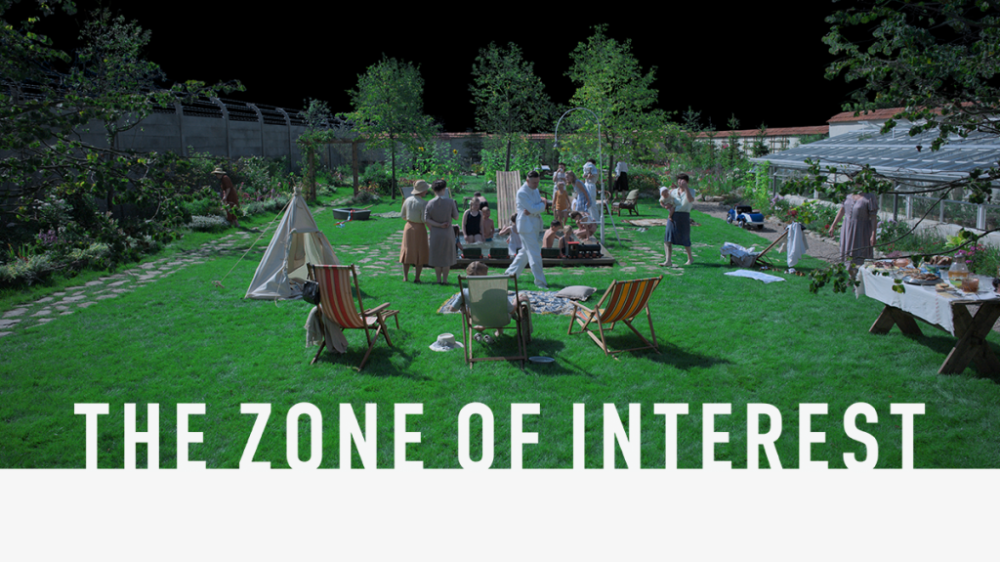
The Zone of Interest (USA/UK/Poland: Jonathan Glazer, 2023: 105 mins)
Ehrlich, David. "The Zone of Interest: Jonathan Glazer’s Holocaust Anti-Drama Is a Chilling Look at the Banality of Evil." IndieWire (May 19, 2023) ["A domestic still life about the commandant of Auschwitz, Glazer's first film since "Under the Skin" is another forensic analysis of human empathy."]
Flight, Thomas. "Why The Zone of Interest Does Not Let You See." (Posted on Youtube: May 2024) ["A look at how The Zone of Interest uses off-screen space and sound design in one of the most hauntingly powerful ways I've ever seen in a film. Featuring an interview with Johnnie Burn, sound designer who just won an Oscar for his work on this film."]
Friedel, Christian, et al. "The Zone of Interest." Film at Lincoln Center #490 (October 11, 2023)
Friedel, Christian, et al. "The Zone of Interest." Film at Lincoln Center #490 (October 11, 2023)
Goi, Leonardo. "Cannes Dispatch: The Obscenity of Evil." Notebook (May 23, 2023)
Greenwell, Garth. "An Unquiet House: Jonathan Glazer's The Zone of Interest." To a Green Thought (February 5, 2024) ["I wasn’t sure what I thought after seeing the film for the first time. All I knew was that something had happened to me: the film wouldn’t let me go, it was like a dark stain spreading in my interior. The film disquieted me in a way that felt more important than whether it was “good” or “bad,” certainly more important than any argument I might make justifying my response. I talked about it with friends. I bought the Martin Amis novel on which the film is putatively based (it’s also up for the Oscar for Best Adapted Screenplay, though it’s hardly an adaptation at all) and read it in a day. I went to the film again, this time not in a little art cinema but in the huge AMC in Times Square, my first time in that bizarre labyrinth of a space, where I felt a little like a lost figure in an Escher engraving, riding endless escalators up and up. Ten minutes into the movie—maybe it didn’t even take that long—I felt sure I was seeing something great."]
Hudson, David. "Jonathan Glazer's The Zone of Interest." Current (May 22, 2023)
Olney, Ian. "Empathy and Adaptation in Jonathan Glazer’s Under the Skin and The Zone of Interest." Literature/Film Quarterly 53.3 (Summer 2025) ["When The Zone of Interest (2023), a portrait of the domestic life of the Nazi Commandant of Auschwitz, won the Oscar for Best International Feature Film at the 96th Academy Awards, director Jonathan Glazer opted not to give the usual acceptance speech. Instead, flanked by producers James Wilson and Len Blavatnik, he read a statement linking the film with the war that had raged in Gaza since the attack on Israel launched by Hamas on October 7, 2023. It ran, in part:
All our choices were made to reflect and confront us in the present — not to say, “Look what they did then,” rather, “Look what we do now.” Our film shows where dehumanization leads at its worst. It shaped all of our past and present. Right now, we stand here as men who refute their Jewishness and the Holocaust being hijacked by an occupation, which has led to conflict for so many innocent people. Whether the victims of October the 7th in Israel or the ongoing attack on Gaza — all the victims of this dehumanization — how do we resist? Aleksandra Bystroń-Kołodziejczyk, the girl who glows in the film, as she did in life, chose to. I dedicate this to her memory and her resistance. (The 96th Academy Awards)Predictably, given the strong feelings around October 7th and its aftermath, controversy ensued. Glazer’s comments — deceptively quoted by several media outlets to create the impression that he and his team had renounced their Jewishness rather than denounced the way they felt it had been appropriated to justify Israel’s policies toward Gaza — were condemned by the President of the Holocaust Survivors’ Foundation USA and by hundreds of Jewish creatives and executives in Hollywood who signed an open letter responding to his speech. In turn, his remarks were defended by the Director of the Auschwitz Memorial and by dozens more Jewish artists in Hollywood who published an open letter of their own. Lost in the furor over the statement was something significant — and perhaps surprising — it revealed about Glazer’s view of his film: first, that it is about the dehumanization that can occur any time we refuse to recognize ourselves in others; and, moreover, that it advocates for a resistance to this dehumanization in the form of empathy — the kind embodied by Aleksandra Bystroń-Kołodziejczyk, a Polish woman who as a teenager risked death to secretly aid prisoners at Auschwitz."]
Romm, Jake. "We Never Left The Zone of Interest." Verso Books (June 28, 2024) ["Jonathan Glazer’s Zone of Interest was fated for an odd reception. Not simply because he has produced another of the always controversial films about the Shoah. Not only because the film was released while Israel, which has used the Shoah as both a shield and a bludgeon, is perpetrating its own genocide against the Palestinians. But because Glazer’s film is materialist, implicating not just the viewer but the world itself."]
Solly, Meilan. "The Real History Behind ‘The Zone of Interest’ and Rudolf Höss." The Smithsonian (January 4, 2024) ["Jonathan Glazer’s new film uses the Auschwitz commandant and his family as a vehicle for examining humans’ capacity for evil."]
Wilson, James. "The Zone of Interest: Oscar-Nominated Film Producer on the Holocaust, Gaza & 'Walls That Separate Us.'" Democracy Now (March 5, 2024) ["Ahead of the 96th Academy Awards, we’re joined by James Wilson, producer of the Oscar-nominated film The Zone of Interest, who raised Israel’s assault on Gaza in his BAFTA Award acceptance speech last month. The film follows the fictionalized family of real-life Nazi commandant Rudolf Höss as they live idyllically next to the Auschwitz concentration camp. Wilson says the film serves as a metaphor for the occlusion of “systemic violence, injustice, oppression, from our lives,” and challenges audiences’ complicity by asking them to identify with Höss and his wife Hedwig. “The idea of this film was to look for the similarities, rather than the differences, between us and the perpetrator,” says Wilson."]

No comments:
Post a Comment