Showing posts with label Illness. Show all posts

Tuesday, May 1, 2012

Rob White: Institutionalized

Institutionalized
by Rob White
Film Quarterly
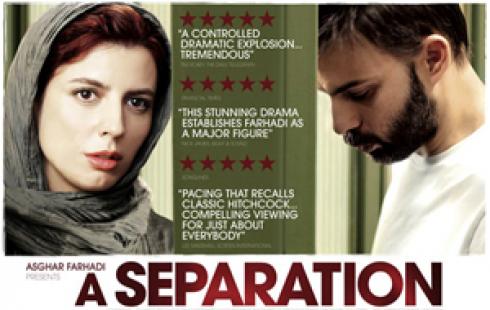


“Do you think we beat our wives and children like animals? I swear on this Quran, we’re humans just like you,” says unemployed cobbler Hodjat (Shahab Hosseini) to a schoolteacher (Merila Zare’i) at one point in A Separation, and it is tempting to think about both this Iranian arthouse thriller and Alexander Payne’s return in terms of fellow feeling across class, age, gender lines. Consider similar sad moments in each film. In Asghar Farhadi’s drama, bank worker Nader (Peyman Maadi) starts to quietly cry while he is spongewashing his Alzheimer’s-afflicted father. In The Descendants Scott (Robert Forster), a bullying patriarch (whose wife has Alzheimer’s too) softly kisses his comatose daughter in her hospital bed. We catch glimpses of proud men’s secret pain; their care for the incapacitated bodies of loved ones vouchsafes a fundamental compassionate humanity. Such scenes of solicitude trigger our own empathy—yet that same tender response is exactly what risks obscuring a sinister institutional dimension overshadowing the personal pathos.

A Separation begins with Simin (Leila Hatami) petitioning for divorce from Nader. He agrees, but with the impossible proviso that he retain custody of eleven-year-old Termeh (Sarina Farhadi, the director’s own daughter). The characters look to camera as they give their depositions: the initial viewpoint is the presiding judge’s and after the spouses move out of frame the director’s credit appears like a clerk’s endorsement of the record. The marital crisis escalates tragically afterwards when Nader argues with pregnant Razieh (Sareh Bayat), Hodjat’s wife. Employed to tend Nader’s taciturn, incontinent father, Razieh leaves the old man home alone because of an urgent doctor’s appointment. Nader is furious when he realizes, and thrusts Razieh out the door. She falls and later has a miscarriage. Bitter recriminations ensue: Nader vehemently denies that he was aware of Razieh’s condition when he mistreated her; the teacher (who had been in the apartment earlier) corroborates his claim, testimony that will eventually prompt Hodjat’s outburst about being human too. And so the dense, ingeniously regulated plot of A Separation goes on. The director has compared the narration to a crossword puzzle—a good analogy so long as it is understood that the mode is cryptic. Farhadi omits the most important incident of all, and information such as the reason for Razieh’s absence only emerges belatedly (and perhaps unreliably) in conversation. Vignettes such as the sponge-washing, filmed in a plausibly unsteady handheld style, are the pretenses of intimacy that distract from the storytelling’s iron grip.

To Read the Rest of the Essay


Sunday, February 5, 2012

Andrew O'Hehir: Surviving a parents’ nightmare, with wine and sex: A young couple faces their son's deadly illness, with Parisian flair, in Declaration of War

Surviving a parents’ nightmare, with wine and sex: A young couple faces their son's deadly illness, with Parisian flair, in "Declaration of War"
By Andrew O'Hehir
Salon


Channeling personal trauma into creative work is pretty much what artists do, as Dr. Freud and Vincent van Gogh could have told you. In the case of French actress and director Valérie Donzelli’s striking and imaginative film “Declaration of War,” the autobiographical element is so strong that the movie’s virtually a docudrama – but a dazzlingly strange docudrama with musical numbers, choreographed interludes and prodigious cinematic verve. What could have been a wrenching family tear-jerker, in which a young couple discovers that their infant son is dangerously ill, becomes a bittersweet tragicomedy in the classic French style, suggestive of Jacques Demy, Christophe Honoré or François Ozon. (“Declaration of War” opened the Critic’s Week at Cannes this year, and now reaches theaters just after its United States premiere at Sundance.)

Mind you, “Declaration of War” still is a profoundly affecting family drama, no matter how much artifice Donzelli piles on top of it. If you’re a parent of young children (as I am), you’ll have to use your own judgment about how much you can take. I understand why some people respond to the health catastrophes of other people’s kids by shutting them out, as if the bad juju might be infectious. That’s how the young father in the film (Jérémie Elkaïm, who is or was Donzelli’s real-life partner, and co-wrote the screenplay) reacts when another kid in their son’s hospital ward dies: Geez, that’s too bad; let’s move on. Let’s face it, every parent harbors these fears, and every time you’re waiting for a phone call from the doctor – even if it’s about allergy testing, or a strep-throat culture – you secretly prepare for the worst.

Although the story of “Declaration of War” apparently hews closely to the real-life saga that Donzelli and Elkaïm endured along with their son, Donzelli kicks it up to a mythic and slightly surreal level right away. When their two characters first meet, and click erotically, against the pounding dance-pop of a Parisian nightclub, they discover that their names are Roméo (Elkaïm) and Juliette (Donzelli). “Does this mean we’ll have a love story with a tragic ending?” he murmurs in her ear. You can view that choice as daring or way too precious; I kind of think it’s both, but by that point I had already been sucked in by the visual and auditory undertow of Donzelli’s style, and just went for the ride. (Full credit also to the spectacular cinematography of Sébastien Buchmann.)

To Read the Rest of the Review