Showing posts with label Drama. Show all posts

Sunday, January 12, 2014

Blue is the Warmest Color (France/Belgium/Spain: Abdellatif Kechiche, 2013)

“Few films dig so deeply (and with such sense of intimacy) into the complexities of human relations, the joys and pains of self discovery and the hurtful realisation that our bodies and mind can yearn opposite things.” — Fernanda Solórzano


Blue is the Warmest Color (France/Belgium/Spain: Abdellatif Kechiche, 2013: 179 mins)

Beauvoir, Simone de. The Second Sex (1949: PDF copy)

Bell, Nicholas. "Blue is the Color of My True Love’s Hair: Kechiche Takes Us Deep Sea, Baby." Ion Cinema (October 25, 2013)

Berger, John. The Ways of Seeing. (1972: Summary/outline of this important book that studied how we are position to observe people and objects in art)

Blue is the Warmest Color Critic's Roundup (No Date)

Blue is the Warmest Color (Graphic Novel) Wikipedia (No Date)

Dargis, Manohla. "Seeing You Seeing Me: The Trouble With Blue Is the Warmest Color." The New York Times (October 27, 2013)

Dayoub, Tony. "The 51st New York Film Festival #3." The Cinephiliacs (October 13, 2013)

Hudson, David. "Abdellatif Kechiche’s BLUE IS THE WARMEST COLOR: A coy coming-out drama this most definitely isn’t.” Keyframe (May 23, 2013)

---. "Abdellatif Kechiche’s BLUE IS THE WARMEST COLOR: 'The experience of the film transcends flaws both real and imagined.'" Keyframe (October 11, 2013)

Ildari, Max. "Blue Is the Warmest Color 2: A Response to Lorrie Moore’s Review in the New York Review of Books." Bright Lights After Dark (January 10, 2014)

Jones, Kristin M. ""Review: Blue Is the Warmest Color." Film Comment (2013)

Kennedy, A.L. "Sartre and the Individual." A History of Ideas (April 15, 2015) ["Writer AL Kennedy on Existentialist ideas about the individual. Jean Paul Sartre argued that, for humans, 'existence preceded essence'. This means that there is no blueprint or template from which to work - humans are free to make themselves up as they go along. Being an individual comes from the way you negotiate this freedom and the choices you make in the face of it."]
Lee, Janet. "'Blue Is The Warmest Color'." Neon Tommy (October 22, 2013)

Mayer, Sophie. "Blue is the Warmest Colour: This part-adaptation of Julie Maroh’s graphic-novel saga of a lesbian love affair trades a new voice for the same old male gaze." Sight and Sound (February 20, 2015)

McCahill, Mike. "21st Century Directors You Need to Know About: Abdellatif Kechiche." Movie Mail (May 2, 2014)

McNeil, Jeremiah. "Blue is the Warmest Color" Dialogic Cinephilia (December 21, 2013)

Moore, Lorrie. "Gazing at Love: Blue is the Warmest Color." The New York Review of Books (December 19, 2013)

Rich, B. Ruby. "Blue Is the Warmest Color: Feeling Blue." The Current (February 24, 2014)

Roberts, Soraya. "Blue Is the Warmest Color is about class, not just sex." Salon (November 3, 2013) ["Sex and sexuality are only half the film's story. It's also about lovers from different economic worlds."]

Sartre, Jean-Paul. "Existentialism is a Humanism." (Lecture given in 1946: published in Existentialism from Dostoyevsky to Sartre, ed. Walter Kaufman, Meridian Publishing Company, 1989) Marxist Archive (2005)

Stern, Marlowe. "‘Blue is the Warmest Color’: See What the Sex Scene Looks Like In the Graphic Novel." The Daily Beast (October 28, 2013)

Thompson, Martha. "Blue Is the Warmest Color 1: Unresolved Alienations of Class." Bright Lights After Dark (January 2014)

Zaman, Farihah. "The Pleasure Principle: Blue is the Warmest Color." Reverse Shot #33 (2013)


Wednesday, October 16, 2013

Werckmeister Harmonies (Hungary/Italy/Germany/France: Bela Tarr, 2000)


Werckmeister Harmonies (Hungary/Italy/Germany/France: Bela Tarr, 2000: 145 mins

Cutler, Aaron. "Multiple Vision: Deciphering the isolated gazes in the films of Béla Tarr." Multiple Image Source (February 2012)

Flanagan, Matthew. "Towards an Aesthetic of Slow in Contemporary Cinema." 16:9 (November 2008)

North, Dan. "“All a Man Can Do is Look Upon it”: What’s With the Werckmeister Whale?" Spectacular Attractions (December 3, 2009)

Romney, Jonathan. "Bela Tarr." Exile Cinema: Filmmakers at Work Beyond Hollywood ed. Michael Atkinson. Albany, NY: SUNY Press, 2008: 73-78. [Professor has copy]

Liza Bear: Christopher Boe on Love and Personal Identity in Reconstruction

Christopher Boe on Love and Personal Identity in "Reconstruction"
by Liza Bear
Indiewire


Inspired by a Jacques-Henri Lartigue photograph of a woman standing in a room with empty bookcases, Danish director Christoffer Boe's first feature "Reconstruction" fittingly won the prestigious Camera D'or at Cannes in 2003 and a Golden Plaque for Manuel Alberto Claro's luminous wide-screen cinematography. It brings closure to the exploration of themes of love and personal identity begun in three earlier shorts, "Obsession," "Virginity" and "Anxiety."

"They're all about a young male being obsessed by a beautiful woman and then being trapped in his own logic of what love is," says Boe, 30, a passionate still photographer as well as moviemaker. It's that logic which Boe dissects in "Reconstruction."

As its title suggests, Boe uses a fractured narrative and startling visuals to create a haunting rumination on the mysteries of desire (and the consequences of acting them out), rather than a romantic comedy. A kind of triangular square dance, "Reconstruction" sports excellent performances from its leads, with Nikolaj Lie Kaas playing Alex as a cypher and Maria Bonnevie doubling up as both Alex's steady girl-friend Simone and his new flame Aimee. It doesn't help Alex that Aimee is married to older man August (Krister Henriksson), who happens to be a writer. But it does give a few extra twists to the narrative. August is the film's narrator. There are echoes of Francois Ozon's cryptic thriller "Swimming Pool" here, though style and sensibility are poles apart. Having an attractive live-in girl-friend doesn't stop Alex from one day falling for Aimee, August's wife. A narrator who's also a character in the film naturally raises questions about what's real and what's imaginary. But then, so does being in love. The next day, Alex's world has changed, literally. His apartment has disappeared and so have his friends. An existential conundrum? Maybe. Or rather an attempt to create a metaphor for the paradigm shift that love induces.

To Read the Interview

Monday, September 23, 2013

David Bordwell - The Grandmaster: Moving forward, turning back

THE GRANDMASTER: Moving forward, turning back
by David Bordwell
Observations on Film Art


The summer has brought us two major films by the two leading Hong Kong directors. I’ve discussed Johnnie To’s fine Drug War earlier. Now it’s time for some ideas about The Grandmaster. Wong Kar-wai’s film displays, in fairly straightforward ways, some of his typical artistic and commercial strategies. Here he adapts his characteristic approach to style and form to a classic genre—and to the demands of the marketplace.

On kung-fu considered as one of the fine arts

Wing Chun is the best-known and most influential Chinese martial art in the world. It owes its renown to two women and two men. In the 1700s the Buddhist nun Ng Mui developed a style called Plum Flower Fist, and a young woman named Yim Wing Chun adapted it into something requiring less strength. Bruce Lee trained in the style, revised it according to his interests, and popularized it in films that reached millions of viewers. Lee’s teacher was Ip Man, a master who settled in Hong Kong after World War II and set up a school. Ip made public a Southern fighting technique that had previously been shared among families and friends.

As both a mainlander and a Hong Konger, Ip is a good symbol of the union of two Chinas. Given the stunning rise of China’s economic and cultural power since the 1980s, it’s not surprising that someone would come up with the idea of a film about him.

Wong Kar-wai claims to have had that idea in the late 1990s. In 2002, he announced that a film about Ip was on his agenda. After finishing 2046 (2004) and an episode for the portmanteau film Eros (2004), he seemed to move forward, slating Tony Leung Chiu-wai as the star and bringing Ip’s family aboard as consultants. But other activities intervened, including an ill-fated three-picture deal with Fox Searchlight. Wong continued to occupy himself with his other businesses, including his lucrative talent-management firm and his advertising unit, for which he made commercials for Dior, Lacote, Motorola, and other companies. He also directed My Blueberry Nights (2007) and recast Ashes of Time (1994) as Ashes of Time Redux (2008).

In 2009 he got to work on the Ip Man film, eventually bringing in funding from many sources, including mainland Chinese companies, Fortissimo, The Weinstein Company, and Annapurna Pictures. Scheduled for a premiere in late 2010, then late 2012, it didn’t appear until January of 2013. It seems that he was still doing postproduction in Thailand hours before its first press screening in Beijing.

During the ten years that The Grandmaster took to reach the screen, other filmmakers had seized on the great man’s life. Two popular Donnie Yen vehicles, Ip Man (2008) and Ip Man 2 (2010), were followed by a prequel The Legend Is Born: Ip Man (2010), and this year, after Wong’s film was released, Ip Man: The Final Fight.

However much Wong fiddles with his movies, in this case he kept the title fixed: Yi Dai Zong Shi. It literally means “The Grandmaster of That Era,” or—since Chinese doesn’t mark plurals in the noun—“The Grandmasters of That Era.” It’s significant that in early publicity, the project was known as The Grandmasters. Wong says his son talked him out of that title. Now, in non-Chinese-speaking countries, it’s The Grandmaster.

The ambiguity about the title takes on special relevance because we have several Grandmasters. After the Beijing premiere, The Grandmaster was released throughout China and in Hong Kong. It did good business, earning over US $47 million in those territories. Wong made a shorter version for the European market, and that was apparently the one premiered at the Berlin Film Festival in February. A still shorter version was prepared for the U.S., with The Weinstein Company as distributor. It opened in August, to mostly good reviews, and it has currently reaped about $6 million at the American box office. So far, the film’s worldwide gross is nearly $63 million, making it by far Wong’s most commercially successful theatrical release.

To Read the Rest

Monday, September 16, 2013

Haskell Wexler -- One Scene: The Cranes Are Flying

One Scene: The Cranes Are Flying
By Haskell Wexler
Current


I first saw Mikhail Kalatozov’s The Cranes Are Flying in Chicago in 1957. The film’s cinematography, by the great Sergei Urusevsky, has been a major influence on my career. The shot in the film that stands out most for me starts at about twenty-five minutes in. It begins handheld, when the character Veronica looks out the window of a bus, and continues out into a vast crowd of people. Then there’s a fast lateral movement going out of the bus and past a car, which could be just a great handheld move or was perhaps done on an improvised dolly. We can see a wide street through the crowd. Veronica stops for a beat of three seconds at the edge of the boulevard—at this moment, a crane seat was slipped under Sergei. The camera then cranes up to see the tanks and a wide view of the crowd.

To Read the Rest and to Watch a Video of the Shot

Sunday, September 8, 2013

Carl Freedman -- The Supplement of Coppola: Primitive Accumulation and the Godfather Trilogy

The Supplement of Coppola: Primitive Accumulation and the Godfather Trilogy
by Carl Freedman
Originally published in Film International #49 (2011): 8-41.

...

The first words uttered in The Godfather are, “I believe in America.” It is an audacious opening scene in several respects. The initial line is spoken over a completely dark screen. Then the light comes up to reveal, in extreme close-up, the speaker: a homely, nondescript middle-aged man who (as we will soon learn) is the undertaker Bonasera (Salvatore Corsitto). As the camera gradually zooms out from close-up to middle distance, Bonasera continues to talk, though it remains unclear for a brief while to whom he is speaking. He tells the story of his beautiful daughter, who had acquired a boyfriend, one not, as Bonasera is careful to make clear, of Italian background. While out on a drive with the boyfriend and another male friend, she found that she was expected to provide sexual favors to both boys; and, when she refused, they beat her viciously, disfiguring her for life (“Now she will never be beautiful again,” sobs Bonasera). Her father, “like a good American,” duly reported the crime to the police, and the boys were arrested, indicted, tried, and convicted—but given a suspended sentence. “Suspended the sentence!” says the undertaker in incredulity and disgust that the judge could have punished such a vile crime so lightly. Now he has come to the local crime boss, Don Vito Corleone, for justice. After some preliminary conversation between Bonasera and Corleone during which the camera remains behind the Don’s right shoulder, the angle of the shot reverses, and reveals, in a sumptuously lit medium close-up, Marlon Brando in his greatest role. Don Corleone chides and humiliates Bonasera for never having sought his friendship before; but he does finally agree to see to it that the two boys will be made to suffer (though not killed, as he judges that too harsh a punishment, since the undertaker’s daughter is still alive). Throughout most of the scene, Brando has been gently caressing a small cat that is squirming and playing in his lap.

Given the centrality of Bonasera and his story to this opening scene, the first-time viewer might well suppose, at this point, that the undertaker is to be one of the principal characters of The Godfather and that the story of his daughter and her attackers is to become one of the film’s main narrative strands. Such is not the case. In the nearly three hours (actually 175 minutes) of the film, Bonasera makes only one more, quite brief appearance, and the daughter and the attackers are never heard of again. It is, nonetheless, a sound cinematic strategy that leads Coppola to begin The Godfather as he does: for it is part and parcel of the film’s epic sweep that some of its major concerns can be introduced with a scene that is, at most, tangential to the main action. Precisely because the scene is of little intrinsic narrative significance, it helps to highlight how omnipresent and thematically important are the motifs that it introduces.

The most foregrounded of these motifs, the one announced in the first line of dialogue, is the theme of America and, more narrowly, the ambiguities of the American immigrant’s lifeworld. In his second line, Bonasera (whose first name is never mentioned in the film but is significantly given as Amerigo in Mario Puzo’s 1969 novel, The Godfather, on which the film is based) adds, “America has made my fortune.” The bourgeois commercial society of the United States has enabled him to become an evidently prosperous small businessman (he is wearing a well-tailored suit), whereas he would, perhaps, have been doing well to avoid starvation back in Italy. His belief in America has led him to raise his daughter “in the American fashion,” allowing her more freedom than would have been considered appropriate in the old country, and trusting, at first, to the institutionalized American system of law and justice. When this system fails him, he must turn to a much older and more personal kind of authority, one that derives from the almost pre-capitalist regime of rural Sicily that will be explored in detail in The Godfather, Part II (1974; hereafter referred to as The Godfather II). When Don Corleone chastises the undertaker, he does so not only for Bonasera’s prior aloofness to him personally but also for the naïve overinvestment in his adopted land that has led Bonasera to trust the American police and the American courts in the first place. “You found paradise in America,” says the Don sarcastically.

Yet there is a certain unconscious irony in Don Corleone’s sarcasm. It is, after all, he himself who has more triumphantly “found paradise in America” (after rising from beginnings that one would guess, in this film, to be unpromising and that are clearly shown, in The Godfather II, to be, indeed, about as unpromising as can easily be imagined). Amerigo Bonasera is a relatively affluent petty-bourgeois, but Vito Corleone is a member of the real ruling class: a man of immense wealth and power, who famously keeps judges and politicians in his pocket, and who, as we will soon see, is capable of winning a battle of will against one of the richest, most influential, and most determined studio bosses in Hollywood. Nonetheless, as an Italian immigrant, Don Corleone remains, like Bonasera, only ambiguously American. One suspects that the non-Italian boyfriend of Bonasera’s daughter has walked free at least in part because of a more unequivocally American identity (and in Puzo’s novel the judge, indeed, explicitly says that he is extending lenience partly because of the defendants’ “fine families,”5 a phrase that in context almost certainly denotes a WASP background). Likewise, though Vito can afford to put on a spectacular wedding celebration for his daughter on the grounds of his luxurious mansion—several outdoor scenes of the wedding immediately follow the indoor scene with Bonasera in the Don’s study—he must submit to the presence of FBI agents who mar the festivities by snooping around and writing down the license-plate numbers of the guests’ cars. True enough, the FBI’s interest is due to Don Corleone’s being a crime boss rather than an Italian immigrant as such. But, of course, it was his ethnicity and impoverished immigrant status that led him, indeed nearly compelled him, to exercise his skills of leadership and entrepreneurialism in the Mafia rather than, say, in such (then) WASP near-monopolies and “legitimate” enterprises as Wall Street or the CIA.

This ambiguity in the identity of the Italian Catholic immigrant—nominally American and yet not American in the strongest, most unqualified sense—interlocks with an even more important ambiguity concerning the nature of crime itself. What, really, is crime? Or, to put the question another way, what is the relation between the law and the justice that the law is meant to serve? Once again, the opening scene with the Don and Bonasera is exemplary. The judge who allows the attackers of Bonasera’s daughter to go free is almost certainly acting within the letter of the law; but the viewer must agree that the suspended sentence is far from just. Even more ironically, in order to seek the justice that the law has denied, the undertaker must go to a crime boss. Though Don Corleone’s power derives from illegal enterprises, his response to Bonasera—as he decides on corporal but not capital punishment for the two attackers—arguably displays not only a certain moral order but also quasi-judicial sobriety, restraint, and moderation.

The ambiguity that thus complicates any conventional axiological dichotomy between lawfulness and crime is intensified further after Don Corleone dismisses Bonasera and summons another supplicant into his study (there is quite a parade of them, all taking advantage of the Sicilian custom that prohibits one from refusing any favor on the day that one’s daughter is married). This is another successful petty-bourgeois, the baker Nazorine (Vito Scotti), who, like Bonasera, also has a daughter. The US immigration authorities are planning to deport his assistant Enzo (Gabriele Torrei), whom Nazorine wishes to stay in America so that he can marry Nazorine’s daughter and, presumably, eventually take over the family business. The Don promises to take care of things, and, after the baker and Enzo exit, tells Tom Hagen (Robert Duvall), his consigliere and adoptive son, to turn the matter over to “a Jew congressman in another district,” evidently one of the numerous office-holders who do the Don’s bidding. This is the first of many references to the Godfather’s political connections; and it presents us with the irony of a professional lawbreaker who not only gives orders to a professional lawmaker but who at least sometimes, as in the case of Enzo, does so in order to accomplish the right and just, if perhaps not strictly legal, thing. In addition, the overt reference to the unnamed congressman’s Jewishness obliquely announces that the theme of ethnicity is not restricted exclusively to Italian immigrants. The Las Vegas casino owner Moe Greene (Alex Rocco) constitutes a minor Jewish presence in the film; and, in The Godfather II, Hyman Roth (Lee Strasberg)—a powerful Mafia financier based on Meyer Lansky, as Greene is based on Bugsy Siegel—constitutes a major one. Moreover, Tom Hagen’s Irish background is given some importance as well (though less than in Puzo’s novel). The comparative marginalization, in WASP-dominated America, of more recent arrivals of non-WASP ethnicity, is of course unjust according to the universalistic Jeffersonian principles on which the US is officially founded; and so the resulting uncertainty as to whether Italian and Jewish—and even Irish—immigrants are “truly” American is integral to the larger indeterminacy that renders hopelessly fuzzy the officially clear-cut categories of law, justice, and criminality.

It is, then, here, in the opening scenes of The Godfather in Vito’s study, that primitive accumulation makes its first and most deeply allegorical appearance. For primitive accumulation is, after all, the necessary basis of any deconstruction of the binary opposition between legality and criminality as understood in bourgeois society. Capitalist legality attempts to draw an absolutely clear iron line between itself and the criminality to which it opposes itself, so that the legitimacy of private property and the right of contract can be grounded as securely as possible. But the attempt never quite succeeds—the line is always, in fact, a permeable membrane—because capitalist legality is itself based (in its origins but also, as we have seen, to some degree as an ongoing enterprise) on massive crime, on the unilateral abrogation of property and contractual rights as well as on brute physical force. Such is the intrinsic instability—the potential moral, conceptual, and physical anarchy—that afflicts the fundamental presuppositions of capitalist society. And Don Corleone enacts this instability, this tissue of ambiguities, in the calm and shadowy luxury of his study, whose furnishings—the large wooden desk, the Persian carpet, the leather-lined chairs—all bespeak affluent bourgeois solidity even though, or rather precisely because, they are all the fruits of crime.

To Read the Entire Essay

Monday, September 2, 2013

The Piano Teacher (Austria/France/Germany: Michael Haneke, 2001)


The Piano Teacher (Austria/France/Germany: Michael Haneke, 2001: 131 mins)

Bradley, S.A. "Killed by Death." Hellbent for Horror #33 (February 27, 2017)

Brunette, Peter. Michael Haneke. Urbana, IL: University of Illinois, 2010.

Frey, Mattias. "Great Directors: Michael Haneke." Senses of Cinema #57 (2010)

Grundman, Roy. A Companion to Michael Haneke. Malden, MA: Wiley Blackwell, 2010.

"Michael Haneke Studies: Videos, Podcasts and Article Links." Film Studies for Free (June 26, 2010)

Price, Brian and John David Rhodes, ed. On Michael Haneke. Detroit, MI: Wayne State University, 2010.

Sorfa, David. "Uneasy domesticity in the films of Michael Haneke." Studies in European Cinema 3.2 (2006)

Wheatley, Catherine. Michael Haneke's Cinema: The Ethic of the Image. NY: Bergahn Books, 2009. [BCTC Library PN 1998.3 H36 W44 2009]


Wednesday, August 21, 2013

Vlad Dima - Perpetual Motion: The Dardenne Brothers' The Kid with a Bike

Perpetual Motion: The Dardenne Brothers' The Kid with a Bike
by Vlad Dima
Bright Lights Film Journal


The latest film by Belgian brothers Jean-Pierre and Luc Dardenne is oddly both fast and slow. Cyril, the main character (played wonderfully by Thomas Douret), looks for his father who had abandoned him, but connects with a benevolent hairdresser, Samantha, who eventually becomes his legal guardian. The kid is moving constantly, mostly on his bicycle the English translation of the original title, "Le Gamin au vélo," misses out on a nuance, that of possession, which is under question at the beginning of the film; but it is his bike — "au vélo" — not "avec"/with a random bicycle). As Cyril's frenetic movement appears to up the tempo of the film, the directors drastically slow down the pace by using long takes, and as little cutting as possible. It is amid the two contrasting tendencies that Cyril's story finds the perfect narrative balance.

Naturally, even the mention of the word "bike" in a film makes us recall Vittorio de Sica's Bicycle Thief (1948): a kid, a bike, a father. De Sica's film indeed hovers over the narrative of The Kid with a Bike, but the latter goes in new directions. The stolen Italian bicycle is connected to the destinies of an entire family, while Cyril's bike evolves from signifying his lost connection to a father who does not want him to the object that offers him freedom. The theme of independence appears from the beginning when we witness Cyril attempting to escape the children's home in which he had been placed. In fact, in this instance we are reminded more of Antoine Doinel from Truffaut's 400 Blows (1959) than Antonio or Bruno from Bicycle Thief. The emblematic final run at the end of 400 Blows is essentially an interminable, uninterrupted travelling shot of Antoine running toward the sea. Cyril's story almost picks up where Truffaut had decided to open end Antoine's odyssey. The direction of Cyril's movement is rather significant, too. Antoine runs left to right, a direction associated with Western movement; he is headed toward a conclusion. Cyril's movement, conversely, is chaotic and goes both directions. Interestingly, when he is about to get into trouble (riding toward the gas station, running away etc.), he goes in the opposite direction, right to left. When the film reaches some sense of normality, and we see both Samantha and Cyril ride together, they go in the "correct" direction, left to right.

There are many other connections to Truffaut's film, and even to Godard's Breathless (1960). Cyril, like Antoine, lies about obvious truths; there are several references to a psychologist Cyril presumably talks with at the children's home, although we never see him or her. Truffaut's film famously chooses to show only Antoine during the conversation with the psychologist, completely ignoring the counter shot. When Samantha and Cyril are in a car, we often only see Cyril and hear Samantha's voice (the opposite happens in Godard's Breathless in which we see Patricia talk to Michel in the car, but we do not see the latter). Even though there are a few people influencing him, Cyril comes off as independent for the most part. Initially, though, he cannot think of anything but being reunited with his father (in another departure from Bicycle Thief, the father had sold his son's bicycle when he found himself financially strapped). At the crucial moment of acceptance that his father is no longer interested in taking care of him, Cyril finds himself on the other side of a metaphorical wall. However, this happens to be also an actual wall that he had to climb in order to get to his dad. When the father pushes him back to the other side, for a brief moment they are literally separated by a wall. For a moment, we fear for Cyril, for his fate, until we realize that he is on the open side of the wall, the side from which he can escape.

To Read the Rest

Saturday, August 17, 2013

A Beautiful Mind (USA: Ron Howard, 2001)


A Beautiful Mind (USA: Ron Howard, 2001: 135 mins)

Billings, Andrew C. "Biographical Omissions: The Case of A Beautiful Mind and the Search For Authenticity." The Film Journal #1 (May 2002)

Cassey, Joe. "Mental Illness." Understanding Representation. ed. Wendy Helsby. London: BFI, 2005: 99-114. [Available in BCTC Library PN 1995 U4977 2005]

Hansen, Per Krogh. " Unreliable Narration in Cinema: Facing the Cognitive Challenge Arising from Literary Studies." Amsterdam International Electronic Journal of Narratology #5 (Autumn 2009)

Wednesday, August 14, 2013

(Not) Love and Death: On Michael Haneke's Amour

(Not) Love and Death: On Michael Haneke's Amour
by Vlad Dima
Bright Lights Film Journal


Michael Haneke's latest film begins abruptly with the police breaking down the door to the apartment of the two octogenarian protagonists, Georges and Anne. The violent intrusion is underlined by the fact that we go, with no transition effect, from complete silence and black screen to noise and color. This type of intense narrative shift is common in Haneke's films. Long periods of apparent stability and quiet are followed by sudden spurts of incredible viciousness, in The White Ribbon (2009), Funny Games (2007, and 1997), or Caché (2005). I say "apparent" because violence lurks just beneath the narrative surface of Haneke's films, its presence felt constantly. So when it does emerge, it is not just for shock value. Oddly, it soothes us, providing momentary relief from the stress accumulated throughout the film. Child beatings, shootings, throat slashing are part of the director's repertoire that may force the audience into a sadistic position, but we avoid them in Amour. Or so it seems. Make no mistake, this is a violent film, but its ferocity comes from being forced to confront our own mortality. This is not a film about love, as the title purposely misleads us. This is a film about death, and worse, our death.

The inclusion of "us," the audience, in the film's thematic concerns commences immediately following the sequence in which the police find Anne's rotted body in the apartment. We begin with a flashback to a night when the couple went out to a classical music concert given by one of Anne's old students, Alexandre. In a beautiful fixed shot, we can see the spectators in the theater as they are waiting for the show to start. After a long moment, as the shot turns into a long take, we become aware of the missing reverse shot. The stage is never shown. We, the "real" audience, are suddenly facing the diegetic audience. We are the reverse shot. So we are pulled into the narrative through a counter-cinema artifice. The lack of reverse shot also points to the impossibility of suture; thus the very beginning of the film points to breakdowns, some literal (the door), some metaphorical (the apparatus of cinema and, by extension, life).

To Read the Rest

Tuesday, July 2, 2013

The Dreamers (France/UK/Italy: Bernardo Bertolucci, 2003)


The Dreamers (France/UK/Italy: Bernardo Bertolucci, 2003: 115 mins)

Buchanan, Ian. "Bernardo Bertolucci's The Dreamers; Kristin Ross' May 68 & Its Afterlives; Deleuze & Guattari's Anti-Oedipus." excerpt from Deleuze and Guattari's Anti-Oedipus. NY: Continuum, 2008: 13-19. Posted on Dialogic (July 2010)

Dyson, Jake. "The Dreamers (2003)." Film Matters (February 20, 2018)

Fletcher, Stephen Q. "The Dreamers: Revolution as a Gala Dinner and a Game." Metaphilm (May 4, 2008)

Hudson, David. "Sex in the Movies." Green Cine (2005)

Ross, Kristin. May '68 and Its Afterlives. Chicago: University of Chicago Press, 2002.

Saturday, June 29, 2013

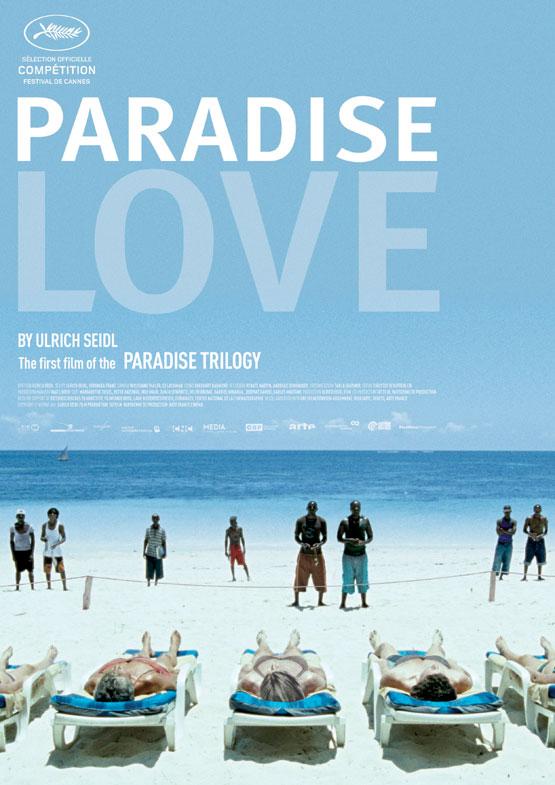
Critical Strands: On the Beach with Ulrich Seidl and Martin Parr

Critical Strands: On the Beach with Ulrich Seidl and Martin Parr
by retinalechoes
Notebook


Some films you watch. Others you live. In Ulrich Seidl's films you suffer. You suffer and laugh, and laugh and suffer, until tears pour from your eyes, until out from laughter arises guilt. Guilt for having suffered. Guilt for having laughed. And only then, when you emerge from the guilt, wipe the film from your eyes, do you realize that the naïve 200-pound quinquagenarian Austrian sex-tourist on holiday in Kenya is none other then yourself, if not your sister or perhaps mother. Only then does the comfort of guilt morph into the vexation of shame as you understand that the buffoon you saw on the screen was wearing what turned out to be your face for a mask.

But don’t say you weren’t forewarned. The ballsy and shameless opening scene of Paradise: Love, should have given notice enough. After all, away from the scrutinizing eyes of society it becomes too easy to indulge in the visual pleasure of watching warped grimaces twisting in glee and shock across the faces of the spasmodic, the abnormal, the mongoloid. Hidden behind the comfort of our screen (for it is always our screen, and never just yours or mine) it becomes all too simple to relish images of the rejected visages of the mentally retarded contorting themselves in farcical masks as their bumper cars smash into each other, watching Teresa, our fat Austrian heroine, watch them. Our white-winged socially-implanted moral warden hanging over our right shoulder like a wee angel warns us against laughter, but in the liberty and obscurity of the cinematic chamber, we let loose with a laughter poised on the razor's edge between discomfort and hilarity. Paradise: Love’s opening scene is a warning, a provocation, a contract of the film to come, and it reads: “I will force you to laugh at things not only which you do not want to laugh at, but which you know you should not.” But laugh we do, and in so doing become accomplices to the film. Seidl’s humor is not the innocent cathartic guffaw of slapstick, nor the healing chortle of satire. It is a blow aimed to crack open a chink in the armor of our self-righteousness to make way for the stiletto of shame to slide in more easily.

By naming our tender, pale, gullible heroine Teresa after the famed Mother Superior of Christian fame, Seidl sticks a knife in the back of the charitable West’s self-congratulatory sentiments for the aid it provides the (usually somewhat darker-skinned) third-world. (Do we hear the rational arguments of capitalist economics buzzing in the background? Business for the locals? Improvements to infrastructure? Exchange of goods?) The tourist, a missionary of modernity, never meets the third-world inhabitants on equal terms, never enters their world, but rather travels to other lands with the goal of extracting as many resources as possible, be it gold, souls or sex. The images of Teresa’s travels to this land of alterity in Paradise: Love are no reflections of a “mirror being carried along a high road,” but rather visions which barely pierce the thick and muggy waters of the aquarium in which her head is enclosed: Omnia mea mecum porto - when the European travels she takes her whole world with her wrapped around her head, aquarium, water and fish too. Teresa’s ‘omnia’, the civilized rectangular glassed cage is exemplified by the space of the European room (and the cinematic frame?). As Teresa prepares for her trip, she appears in one chamber after another in her Austrian apartment, preparing food, folding laundry, packing bags and the rectangle in which she moves is the one the camera will bring with her (and us) on holiday to Kenya, with its centralized perspective and weight, and its ordered compositions, signs of the European’s efficiency and rationality.

But no matter, for the tourist’s mission is not to see unseen landscapes but rather to ignore the distinctiveness of the travel destination so as to better wrench maximum ‘fun’ from the exotic (what else would make tourism the largest industry worldwide?). So, even when Teresa and her Austrian compatriots travel thousands of kilometers to reach a new panorama, the only landscape they can perceive is the one they brought with them, with its ordered lines, sparkling clean toilet bowls, and secure walled-off pleasures.

To Read the Rest

Sunday, June 23, 2013

The Passion of the Christ (USA: Mel Gibson, 2004)


The Passion of the Christ (USA: Mel Gibson, 2004: 127 mins)

Aslan, Reza. "Zealot." Radio West (October 18, 2013)

Deacy, Chris. "A Time to Kill?: Theological Perspectives on Violence and Film." Theology and Film: Challenging the Sacred/Secular Divide. ed. Christopher Deacy & Gaye Williams Oritz. Malden, MA: Blackwell, 2008: 123-142. [Professor has copy]

Hauka, David. "'Christ That Hurts': Rewriting the Jesus Narrative -- Violence and the Language of Action Cinema in Mel Gibson's The Passion of the Christ Cinephile #2 (March 2006)

Phillips, Kendall R. "Religion: Mel Gibson's The Passion of the Christ." Controversial Cinema: The Films That Outraged America. Westport, CT: Preager, 2008: 127-152.[in BCTC Library PN1995,9 S284P452008}

Koresky, Michael. "Consider the Source: The Passion of the Christ." Reverse Shot (Spring 2004)

Reichert, Jeff. Jesus Christ: Superman (or Every Man for Himself and Armond Against All)>" Reverse Shot (Spring 2004)

Walsh, David. "Why has The Passion of the Christ evoked such a popular response in America?" World Socialist Web Site (March 5, 2004)

Walter, Brian. "Love In The Time of Calvary: Romance and Family Values in Crucifixion Films." Cineaction #88 (2012)

Wednesday, May 15, 2013

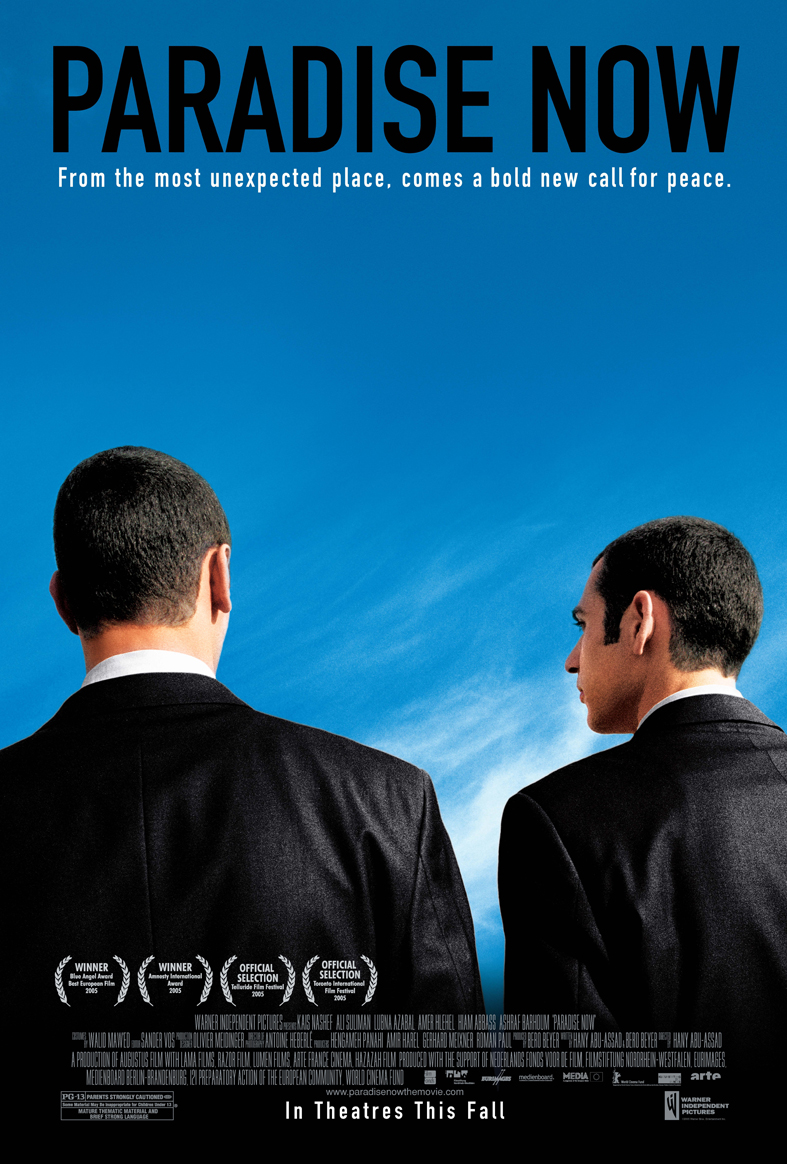
Paradise Now (Occupied Palestinian Territory/France/Germany/Netherlands/Israel: Hany Abu-Assad, 2005)


Paradise Now (Occupied Palestinian Territory/France/Germany/Netherlands/Israel: Hany Abu-Assad, 2005: 90 mins)

Bronstein, Phoebe. "Man-Made Martyrs in the Age of Mechanical Reproduction: Disturbing Manufactured Martyrdom in Paradise Now Jump Cut #52 (Summer 2010)

Jafaar, Ali. Paradise Now Sight and Sound (May 2006)

Ortiz, Gaye. "Dark Beauty: Theological Perspectives on War as Cinematic Mythology." Theology and Film: Challenging the Sacred/Secular Divide. ed. Christopher Deacy and Gaye Williams Ortiz. Malden, MA: Blackwell, 2008: 160-177.

Rich, B. Ruby. "Bomb Culture." Sight and Sound (April 2006)

Jose Teodoro -- Miss Bala: Nightmare State

Miss Bala: Nightmare State
Mexican director Gerardo Naranjo upends his filmmaking to show a country torn apart
by José Teodoro
Film Comment


Most existences on earth are marginal; the majority of people live on the edges of some kind of war. That the woman and man at the center of Miss Bala swing into each other’s orbit is itself no great coincidence. She’s Laura (Stephanie Sigman), the cheerful 23-year-old daughter of a Tijuana clothing merchant, and he’s Lino (Noe Hernandez), a taciturn, hard-eyed, soft-voiced drug trafficker about whose past we glean almost nothing. Both hail from humble if not desperate backgrounds; both aspire to transcend social determinism via archetypal routes to glamour and power: just as Lino asserts himself through terror and illegal commerce, Laura, however haphazardly, hopes to embody someone’s notion of the ideal woman by entering the Miss Baja California competition. Her first, fleeting encounter with him occurs when a dance party is turned into a massacre by Lino and his confederates. They meet again when she is so naïve as to seek out the police for help. In some perverse variation on the romantic comedy, the two keep crossing paths. Laura spends much of Miss Bala in a state of shock, while Lino seems to quickly intuit how best to exploit her allure while ostentatiously exchanging favors. He can ensure she wins the Miss Baja crown; she can serve as a gorgeous decoy in his criminal dealings.

A fascinating about-face for Mexican director Gerardo Naranjo, Miss Bala—co-written by Naranjo and Mauricio Katz and loosely based on actual events—surveys the current state of play in the drug war and offers commentary through a procession of absurdities, ironies, and largely uncontextualized mayhem. The gangsters and the DEA agents are equally menacing and seem to favor the same black SUVs; a beauty contest audience bursts into wild applause for a catatonic contestant; a flaming tire rolls by during an urban shoot-out as though it has emerged from a cartoon, traversing a stretch of asphalt covered in blood, bullet casings, and gasoline. Despite an incongruous, statistics-heavy closing title card, Miss Bala can no more be reduced to a hand-wringing docudrama about the escalation of Mexico’s drug-related violence than Take Shelter can be called a treatise on overcoming mental illness. These films are personal statements about individuals ceding control to forces beyond their comprehension—personal statements that just happen to dovetail nicely with urgent social issues.

“I’d arrived at a place where I felt like I wasn’t challenging myself that much,” says Naranjo, “so I decided to do something that I really didn’t know how to do. My previous films had a little bit of social commentary, but it was from a bourgeois point of view, trying to denounce commodification or conservatism. When I started to develop Miss Bala I felt I was responding to something far more urgent that’s in the air. To the fear.” Speaking during the Toronto International Film Festival last September, by which point Miss Bala had already seen its share of plaudits and detractors, Naranjo emphasized his latest film’s conspicuous shift in both style and content from his preceding work, whether the privileged teens playing out lovers-on-the-run melodrama under a mesh of Godardian alienation techniques (the deliriously stylish and witty 2008 I’m Gonna Explode) or privileged young adults negotiating disastrous relationships (the clever but flat 2006 Drama/Mex). “The directors I admire tend to change a lot between films,” says Naranjo. “Maybe not often with regards to form, but with subject matter for sure. Before, I felt that I was a filmmaker but had yet to really show it. I trusted so deeply in the present, in improvisation. I know I’m shifting. The question now, for me, has to do with whether or not I can maintain this.”

...

To Read the Rest