Showing posts with label Prostitution. Show all posts

Saturday, June 29, 2013

Critical Strands: On the Beach with Ulrich Seidl and Martin Parr

Critical Strands: On the Beach with Ulrich Seidl and Martin Parr
by retinalechoes
Notebook
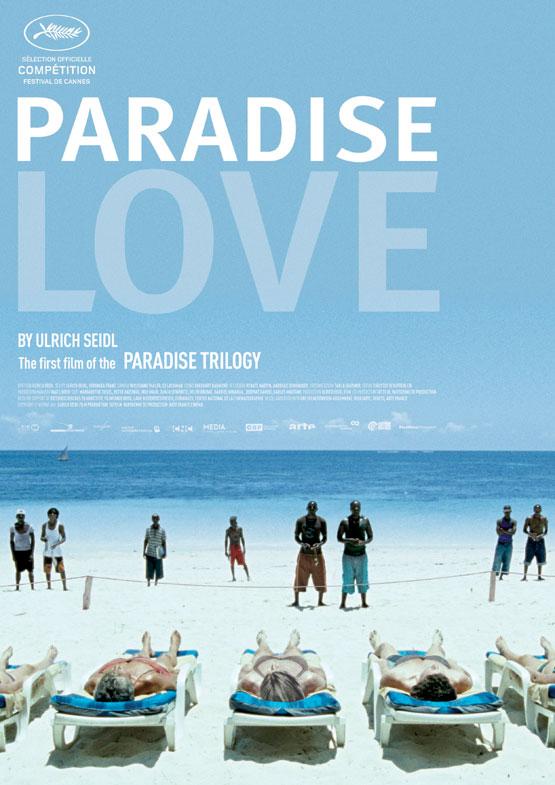


Some films you watch. Others you live. In Ulrich Seidl's films you suffer. You suffer and laugh, and laugh and suffer, until tears pour from your eyes, until out from laughter arises guilt. Guilt for having suffered. Guilt for having laughed. And only then, when you emerge from the guilt, wipe the film from your eyes, do you realize that the naïve 200-pound quinquagenarian Austrian sex-tourist on holiday in Kenya is none other then yourself, if not your sister or perhaps mother. Only then does the comfort of guilt morph into the vexation of shame as you understand that the buffoon you saw on the screen was wearing what turned out to be your face for a mask.

But don’t say you weren’t forewarned. The ballsy and shameless opening scene of Paradise: Love, should have given notice enough. After all, away from the scrutinizing eyes of society it becomes too easy to indulge in the visual pleasure of watching warped grimaces twisting in glee and shock across the faces of the spasmodic, the abnormal, the mongoloid. Hidden behind the comfort of our screen (for it is always our screen, and never just yours or mine) it becomes all too simple to relish images of the rejected visages of the mentally retarded contorting themselves in farcical masks as their bumper cars smash into each other, watching Teresa, our fat Austrian heroine, watch them. Our white-winged socially-implanted moral warden hanging over our right shoulder like a wee angel warns us against laughter, but in the liberty and obscurity of the cinematic chamber, we let loose with a laughter poised on the razor's edge between discomfort and hilarity. Paradise: Love’s opening scene is a warning, a provocation, a contract of the film to come, and it reads: “I will force you to laugh at things not only which you do not want to laugh at, but which you know you should not.” But laugh we do, and in so doing become accomplices to the film. Seidl’s humor is not the innocent cathartic guffaw of slapstick, nor the healing chortle of satire. It is a blow aimed to crack open a chink in the armor of our self-righteousness to make way for the stiletto of shame to slide in more easily.

By naming our tender, pale, gullible heroine Teresa after the famed Mother Superior of Christian fame, Seidl sticks a knife in the back of the charitable West’s self-congratulatory sentiments for the aid it provides the (usually somewhat darker-skinned) third-world. (Do we hear the rational arguments of capitalist economics buzzing in the background? Business for the locals? Improvements to infrastructure? Exchange of goods?) The tourist, a missionary of modernity, never meets the third-world inhabitants on equal terms, never enters their world, but rather travels to other lands with the goal of extracting as many resources as possible, be it gold, souls or sex. The images of Teresa’s travels to this land of alterity in Paradise: Love are no reflections of a “mirror being carried along a high road,” but rather visions which barely pierce the thick and muggy waters of the aquarium in which her head is enclosed: Omnia mea mecum porto - when the European travels she takes her whole world with her wrapped around her head, aquarium, water and fish too. Teresa’s ‘omnia’, the civilized rectangular glassed cage is exemplified by the space of the European room (and the cinematic frame?). As Teresa prepares for her trip, she appears in one chamber after another in her Austrian apartment, preparing food, folding laundry, packing bags and the rectangle in which she moves is the one the camera will bring with her (and us) on holiday to Kenya, with its centralized perspective and weight, and its ordered compositions, signs of the European’s efficiency and rationality.

But no matter, for the tourist’s mission is not to see unseen landscapes but rather to ignore the distinctiveness of the travel destination so as to better wrench maximum ‘fun’ from the exotic (what else would make tourism the largest industry worldwide?). So, even when Teresa and her Austrian compatriots travel thousands of kilometers to reach a new panorama, the only landscape they can perceive is the one they brought with them, with its ordered lines, sparkling clean toilet bowls, and secure walled-off pleasures.

To Read the Rest

Wednesday, April 10, 2013

Revanche (Austria: Götz Spielmann, 2008)


Revanche (Austria: Götz Spielmann, 2008: 121 mins)

Ashbury, Roy. "Prostitution." Understanding Representation. ed. Wendy Helsby. London: BFI, 2005: 115-142. [Available in BCTC Library PN 1995 U4977 2005]

Spielman, Götz. "DVD OF THE WEEK & PODCAST: Revanche (Gotz Spielmann)." Green Cine Daily (February 18, 2009)

Totaro, Donato. "Revanche (2008, Götz Spielman)-- A Matter of Stillness." Offscreen (February 28, 2010)

White, Armond. "Revanche:
Revival of the Fittest."
The Criterion Collection (February 11, 2010)

Friday, July 6, 2012

John Bredin: 2 or 3 Ways Godard Taught Us How to Speak and Live

2 or 3 Ways Godard Taught Us How to Speak and Live
by John Bredin
Acidemic


I highly recommend Jean Luc Godard's Two or Three Things I Know About Her to shy people. To those poor souls who, like my former self, have had their speaking agency crippled, reducing them to verbal mice. Such radical withdrawals from the speaking world are often the result of being smothered by a patriarchal, authoritative and oppressive family, school system, or society. In my case, it was all of the above.

Mindful of the healing and transformative power of art, for the reticent of speech I bring a message of radiant hope: a nugget of cinematic wisdom distilled from what critic J. Hoberman calls Godard's greatest masterpiece. (As founder of the French New Wave movement in modern cinema, Godard is, arguably, one of, if not the most important, avante garde filmmaker of all time.) Deciphering lessons from Two or Three Things which, in a burst of validation from the zeitgeist for its continuing relevance, Film Forum in New York City screened both last fall and this spring you might be inspired, like I was, with the epiphany that it's not too late for you to achieve the exalted state of verbal freedom; the intoxicating, liberating, yet simple pleasure of being able to share (in a calm, thoughtful and nuanced manner) the cognitive and affective music of your soul with others.

In Two or Three Things Godard offers humanity nothing less than a filmic template for bold and authentic communication in the world: an aesthetically rich and pedagogically fertile piece of language curriculum that bears repeated visits. Without exaggeration, I'd call it a Linguistic Declaration of Independence. Notice, if you will, how the film celebrates the miraculous potential of spoken language, while at the same time interrogating it in what linguists refer to as a meta-talk, or talk about talk fashion often through the power of amazingly simple, wonder-provoking phrases.

For example, whenever Juliette the bored housewife who moonlights as a prostitute addresses a person, the camera, or thin air with a random thought that just popped into her head (I know how to talk; Let's talk together; Together is a word I like.) or when Robert, Juliette's husband, engages in that remarkable see-saw dialogue with a strange woman in the café (Say words; Do you know what talking is? Talk about something interesting.); or the pretty girl at the bar, whose deer-in-the-headlights narration of the simple details of her life startles us with its unassuming transcendence (I like to take walks, ride my bike for fun, go to the cinema two or three times a month. I like books); or when Godard himself, intoning with his whispery, philosophical voiceover, decides to interject a thought or two because he's the auteur (filmmaker as author) and can talk whenever he damn well pleases we're treated to a model of the magical possibilities of human speech.

Shy people, take notice.

Sometimes we become shy (and I myself still feel shy at times, depending, naturally, on who I'm with, or the situation), better still, let me phrase it a different way: we say that we're shy, or inarticulate, or afraid to talk, when in reality we're simply numbed by over-exposure to the prepackaged speech of movies and television shows: talk that's fakely fluid in the Hollywood sense. After watching actors speak brilliantly, dashing off hilarious applause lines as if they were talking naturally when, in reality, they spent days or weeks memorizing a pre-written script by comparison, our own conversational offerings might appear flat and boring to us. Certainly too, in a media-saturated age such as ours, because of our overexposure to glib, slick, oily-tongued, sonorous anchor people and celebrities, one could easily see how a person might get the false, even monstrous impression that this is how real people should talk. Unable to achieve such a bizarre standard of faux eloquence in our own speech, we clam up.

Philosopher Maxine Greene, critiquing such indurations in the mundane, talks about the need to resist passivity, to, partly through reflective art encounters she says, escape submergence in the everyday, the routine, the banal. Such submergence ought to include our current mass drowning, if you will, in a sea of pop cultural and media kitsch: a filling up of our heads, like the white cream inside a Twinkie, with a combination of advertisements, pop cultural fluff, and the grave pronouncements of the talking heads. Might such an inexorable assault on our cognitive and aesthetic apparatus tamp down our capacity to generate our own unique and creative thoughts, disabling our ability to write (and speak) our own essays to the world?

Godard offers us a cure to such a paralysis of language in Two or Three Things: an extraordinary pastiche of verbal and visual images, philosophy, and politics, that many critics have likened to an essay on film. As essays go, of course, it's worth noting that the traditional, written kind from the celebrated classics of Montaigne (Of Experience) and Emerson (Self Reliance) right up through today's brilliant NY Times pieces by Paul Krugman, Bob Herbert, and occasionally I'll grant, David Brooks offers one of the most powerful and flexible vehicles to tell our stories and richly express the complexity of our thoughts, questions, wonderings, and theories on any given topic.

To Read the Rest of the Essay