Showing posts with label Work. Show all posts

Thursday, October 24, 2013

Cemetery Man (Italy/France/Germany: Michele Soavi, 1994)


Cemetery Man (Italy/France/Germany: Michele Soavi, 1994: 105 mins)
The excellently named Francesco Dellamorte (Rupert Everett, never better) is the moody caretaker of a small-town Italian cemetery where the dead just keep coming back to life, much to his annoyance. His everyday tedium of reading phone books and killing zombies is broken when he falls madly in love with a nameless beautiful widow. Unfortunately, she too perishes and returns as a zombie. A strange and entertaining erotic-horror-comedy, Cemetery Man (titled Dellamorte Dellamore in Italian) is required viewing for anyone of the sadboi persuasion. – Anna Bogutskaya
Dumas, Andre. "Cemetery Man: By Keeping Things the Same, We Can Change More Effectively." Horror Digest (March 30, 2011)

Kuersten, Erich. "The Shrouds of Soavi: Cemetery Man, The Devil's Daughter." Acidemic (September 8, 2016)

Seda, Alex. "Dellamorte Dellamore (a.k.a. Cemetery Man) Review." Midnight Showing (July 10, 2009)

"TGIF #5: CEMETERY MAN (aka DELLAMORTE DELLAMORE)" Adamantium Bullet (July 24, 2009)


Saturday, June 29, 2013

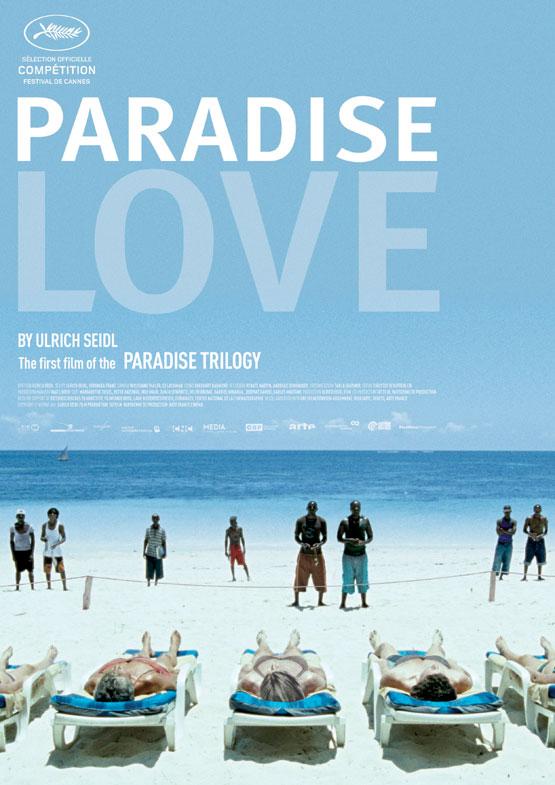
Critical Strands: On the Beach with Ulrich Seidl and Martin Parr

Critical Strands: On the Beach with Ulrich Seidl and Martin Parr
by retinalechoes
Notebook


Some films you watch. Others you live. In Ulrich Seidl's films you suffer. You suffer and laugh, and laugh and suffer, until tears pour from your eyes, until out from laughter arises guilt. Guilt for having suffered. Guilt for having laughed. And only then, when you emerge from the guilt, wipe the film from your eyes, do you realize that the naïve 200-pound quinquagenarian Austrian sex-tourist on holiday in Kenya is none other then yourself, if not your sister or perhaps mother. Only then does the comfort of guilt morph into the vexation of shame as you understand that the buffoon you saw on the screen was wearing what turned out to be your face for a mask.

But don’t say you weren’t forewarned. The ballsy and shameless opening scene of Paradise: Love, should have given notice enough. After all, away from the scrutinizing eyes of society it becomes too easy to indulge in the visual pleasure of watching warped grimaces twisting in glee and shock across the faces of the spasmodic, the abnormal, the mongoloid. Hidden behind the comfort of our screen (for it is always our screen, and never just yours or mine) it becomes all too simple to relish images of the rejected visages of the mentally retarded contorting themselves in farcical masks as their bumper cars smash into each other, watching Teresa, our fat Austrian heroine, watch them. Our white-winged socially-implanted moral warden hanging over our right shoulder like a wee angel warns us against laughter, but in the liberty and obscurity of the cinematic chamber, we let loose with a laughter poised on the razor's edge between discomfort and hilarity. Paradise: Love’s opening scene is a warning, a provocation, a contract of the film to come, and it reads: “I will force you to laugh at things not only which you do not want to laugh at, but which you know you should not.” But laugh we do, and in so doing become accomplices to the film. Seidl’s humor is not the innocent cathartic guffaw of slapstick, nor the healing chortle of satire. It is a blow aimed to crack open a chink in the armor of our self-righteousness to make way for the stiletto of shame to slide in more easily.

By naming our tender, pale, gullible heroine Teresa after the famed Mother Superior of Christian fame, Seidl sticks a knife in the back of the charitable West’s self-congratulatory sentiments for the aid it provides the (usually somewhat darker-skinned) third-world. (Do we hear the rational arguments of capitalist economics buzzing in the background? Business for the locals? Improvements to infrastructure? Exchange of goods?) The tourist, a missionary of modernity, never meets the third-world inhabitants on equal terms, never enters their world, but rather travels to other lands with the goal of extracting as many resources as possible, be it gold, souls or sex. The images of Teresa’s travels to this land of alterity in Paradise: Love are no reflections of a “mirror being carried along a high road,” but rather visions which barely pierce the thick and muggy waters of the aquarium in which her head is enclosed: Omnia mea mecum porto - when the European travels she takes her whole world with her wrapped around her head, aquarium, water and fish too. Teresa’s ‘omnia’, the civilized rectangular glassed cage is exemplified by the space of the European room (and the cinematic frame?). As Teresa prepares for her trip, she appears in one chamber after another in her Austrian apartment, preparing food, folding laundry, packing bags and the rectangle in which she moves is the one the camera will bring with her (and us) on holiday to Kenya, with its centralized perspective and weight, and its ordered compositions, signs of the European’s efficiency and rationality.

But no matter, for the tourist’s mission is not to see unseen landscapes but rather to ignore the distinctiveness of the travel destination so as to better wrench maximum ‘fun’ from the exotic (what else would make tourism the largest industry worldwide?). So, even when Teresa and her Austrian compatriots travel thousands of kilometers to reach a new panorama, the only landscape they can perceive is the one they brought with them, with its ordered lines, sparkling clean toilet bowls, and secure walled-off pleasures.

To Read the Rest

Wednesday, April 17, 2013

Brokeback Mountain (Canada/USA: Ang Lee, 2005)


Brokeback Mountain (Canada/USA: Ang Lee, 2005)

Benshoff, Harry M. "Brokering Brokeback Mountain — a local reception study." Jump Cut (2008)

Garrett, Daniel. "You Don't Know What Love Is." Film International #21 (2006)

Koziak, Barbara. "Shepherding Romance: Reviving the Politics of Romantic Love in Brokeback Mountain." Genders #50 (2009)

"Queer Cowboys: Alternative Space in "Brokeback Mountain." Film International (2006)

Schneider, Richard, Jr., et al. "Not Quitting Brokeback/Lost in Adaptation/The Hate Crime/Beyond the Mountain." Gay & Lesbian Review (May/June 2006): Reprinted in Annual Editions: Film 07/08 170-174 [Available in BCTC Library PN1993 A6285]

Sharrett, Christopher. "Death of the Strong, Silent Type: The Achievement of Brokeback Mountain." Film International 7.1 (February 2009)

Stamatopoulos, Irini. "Ang Lee's Cowboys: Fallen from Brokeback’s Paradise Lost." Offscreen (February 28, 2007)

Vicari, Justin. "Discovering America: Reflections on Brokeback Mountain." Jump Cut #49 (Spring 2007)

Still Life (China/Hong Kong: Jia Zhangke, 2006)


Still Life (China/Hong Kong: Jia Zhangke, 2006: 111 mins)

Dalle, Eric. "Narrating changes in topography: Still Life and the cinema of Jia Zhangke." Jump Cut #53 (Summer 2012)

Sukhdev, Sandhu. "'Slow cinema' fights back against Bourne's supremacy." The Guardian (March 9, 2012)

Xiao, Jiwei. "The Quest for Memory: Documentary and Fiction in Jia Zhangke’s Films." Senses of Cinema #59 (2011)

Thursday, April 4, 2013

J. Hoberman -- The Organizer: Description of a Struggle

The Organizer: Description of a Struggle
By J. Hoberman
Current


An unverifiable, if heartfelt, assertion: For the quarter century between 1945 and 1970 (or from Rome Open City to Fellini Satyricon), the world’s greatest popular cinema was produced in Italy—a realm of glamorous superstars, sensational comedians, and great genre flicks. A half dozen maestros were backed by a remarkably deep bench, including writer-director Mario Monicelli (1915–2010), whose 1963 strike drama I compagni (The Comrades), released in the U.S. as The Organizer, is popular cinema in the best sense.

The son of a political journalist who moved from socialism to anarcho-syndicalism to fascism (briefly) to antifascism, and who also founded Italy’s first film journal, Monicelli is best known for his socially aware tragi­comedies. Still, his oeuvre is not easily synopsized. He directed some sixty films and wrote or cowrote more than seventy over the course of a career that began in 1935 with a precocious 16 mm feature based (like Frank Borzage’s No Greater Glory, 1934) on Ferenc Molnár’s novel The Paul Street Boys and ended seven decades later, when he was ninety-one, with The Roses of the Desert (2006), a comedy about an Italian medical unit sent to Libya in 1940.

Monicelli characterized his first studio features, made in the early fifties and mainly starring the great sad-faced clown Totó, as “neorealist farce”—shot on location and affectionately satirizing the struggles of the urban poor. (“The themes that make one laugh always stem from poverty, hunger, misery, old age, sickness, and death,” the director maintained. “These are the themes that make Italians laugh, anyway.”) With the genially caustic A Hero of Our Times (1955), featuring the young Alberto Sordi as a craven lower-middle-class schemer, and Big Deal on Madonna Street (1958), an enormous international hit, not least in the U.S., Monicelli pioneered what would be called commedia all’italiana—tales of hapless schemers, in Big Deal played against type by matinee idols Vittorio Gassman and Marcello Mastroianni.

However cowardly or amoral, Monicelli’s protagonists are essentially sympathetic in their ineptitude—and their privation. The Great War (1959), cowritten, like Big Deal, with the team of Age-Scarpelli (Agenore Incrocci and Furio Scarpelli), paired Sordi and Gassman as dim-witted crooks dragooned into the Italian Army during World War I. Not simply antimilitarist but antipatriotic, it shared the Golden Lion with Rossellini’s World War II drama Il generale della Rovere at the 1959 Venice Film Festival. The Passionate Thief (1960), with Anna Magnani as a would-be con artist, followed, along with a contribution to the anthology film Boccaccio ’70, a frothy yet piquant comedy about the oppression, sexual and otherwise, of two young factory workers.

Monicelli always had an ambivalent relationship with engaged cinema. One of his last works documented the protests around the 2001 G8 summit in Genoa; late in his life, he thanked Prime Minister Silvio Berlusconi “for making me feel young again by joining in protests against him who has all the makings of a modern tyrant.” At the same time, his movies are characterized by a marked skepticism: “I always look at a group of people who want to attempt an enterprise greater than their means. They begin this enterprise, and they fail.” The bumbling burglars and botched heist of Big Deal on Madonna Street offer the purest example of such collective failure. The Organizer, a French-Italian coproduction made soon after Monicelli started his own production company, is a more complex dramatization of defeat.

Inspired, according to its director, by the revolutionary ghosts of Paris’s no longer extant Bastille and set in the slums of late-nineteenth-century Turin, The Organizer accepts what the influential Italian Marxist leader Antonio Gramsci saw as “the challenge of modernity,” namely, “to live without illusions and without becoming disillusioned.” Life is struggle, and to struggle against one’s lot is to flirt with futility. To that end, The Organizer is variously (and, for some, disconcertingly) jaunty, sentimental, comic, and baffling, as Monicelli applies the tonal shifts associated with the French New Wave to a straightforward saga of working-class solidarity. Stanley Kauffmann, who reviewed the movie for the New Republic when it opened in the U.S. in May 1964, found The Organizer “very interesting and very odd”—by which he meant anachronistic. Other critics who, like Kauffmann, had lived through the 1930s also saw The Organizer as a peculiar throwback to the socially significant movies of that period. “What prompted Mario Monicelli . . . to make this picture just now?” Kauffmann wondered. Hadn’t the struggle for workers’ rights long since been won?

Kauffmann was likely unaware of the convulsive autoworkers’ strike that had shaken Turin—and Fiat—in 1962, and yet his puzzlement is understandable. Notable for its period detail and Giuseppe Rotunno’s accomplished faux-daguerreotype cinema­tography, The Organizer is not so much a call to action as to recollection—both a historical monument and a taboo-breaking depiction of a specific moment. Monicelli meant to remind contemporary viewers that decent working conditions and wages were gained over time and at considerable cost. The Organizer, which had its Italian premiere at the 35th Congress of the Italian Socialist Party, is, above all, a movie about how difficult it is to organize collective action, set in a period when Italian unions barely existed.

To Read the Rest

Tuesday, April 2, 2013

Workers Unite: Mario Monicelli on The Organizer

Workers Unite: Mario Monicelli on The Organizer
The Current


The Organizer is a dramatically political statement from director Mario Monicelli. More commonly known for lighter films like Big Deal on Madonna Street, Monicelli created an expression of the necessity of collective action that is both gritty and entertaining. In making this period piece about a factory strike in turn-of-the-twentieth-century Turin (the rapidly industrializing Italian city that would come to be called “Italy’s Detroit”), Monicelli strove for the utmost realism, casting the film with actual workers and shooting on location in one of the area’s huge textile factories. In this 2006 interview, included as part of the film’s Criterion release, Monicelli (who died in 2010) talks about filming in the factory, along with the importance of creating an oppressive atmosphere and showing the reality of the working world.

To Watch the Clip

Wednesday, January 2, 2013

Erin Aubry Kaplan: 'Django' an unsettling experience for many blacks

'Django' an unsettling experience for many blacks
by Erin Aubry Kaplan
LA Times

Quentin Tarantino's slave-era spaghetti western has some questioning the propriety of using a still-festering period of U.S. history as a platform for a bloody, profanely comic pop entertainment.

Tracey White's initial impression of "Django Unchained," Quentin Tarantino's new slave-era shoot-'em-up extravaganza, could be summed up in three words: smart, funny and ugly. Sitting through a recent screening in Beverly Hills, the L.A. costume designer was mostly absorbed and found herself laughing aloud at particularly outrageous moments.

But White, who is black, said her feelings evolved significantly. Two days after reflecting on the matter of slavery and Tarantino's treatment, she pronounced the movie mostly ugly.

"He [Tarantino] gets a good product out of it in terms of wit and a visual look," said White. "But when it was over I found myself wondering, 'What is he trying to do?' I enjoyed the movie when I was in there, but I still have a problem with Tarantino when he deals with our race."

White will certainly not be alone among African Americans in her ambivalence about the gleefully outrageous film. While "Django" has nabbed almost uniformly warm reviews and four NAACP Image Award nominations (including for best picture), the fact is that it is an extremely Hollywood-ized vision of a critical black American experience.

Some blacks are already calling the revenge-fantasy movie, especially its graphic and highly stylized violence, insensitive, exploitative and ahistorical. Filmmaker Spike Lee, a longtime critic of Tarantino, said this month that he refuses to see the movie, and calls his spaghetti-western approach to slave history "disrespectful."

Many moviegoers will know something of what they're getting into. Violence and the liberal use of black idioms and so-called urban culture are Tarantino hallmarks, notably in early films such as "Pulp Fiction" and "Jackie Brown," and they've always stirred controversy. But this movie is different because it mines slavery, the complicated source material for so much black culture and fountain of violence in American history.

It is an institution whose horrors need no exaggerating, yet "Django" does exactly that, either to enlighten or entertain. A white director slinging around the n-word in a homage to '70s blaxploitation à la "Jackie Brown" is one thing, but the same director turning the savageness of slavery into pulp fiction is quite another.

To Read the Rest of the Article

Cecil Brown: Tarantino's Django: Unchained - Hollywood’s Nigger Joke

Tarantino's Django: Unchained: Hollywood’s Nigger Joke
by Cecil Brown
Counterpunch


In order for a joke to work, Mary Douglas, the eminent British anthropologist, wrote that one had to have a social context for it to operate in. “We must ask what are the social conditions for a joke to be both perceived and permitted,” she asked in her wonderful little essay, “Jokes.”

“My hypothesis,” she writes“is that a joke is seen and allowed when it offers a symbolic pattern of a social pattern occurring at the same time.”

With Django: Unchained, the symbolic pattern–I’d call it historical context–is Hollywood itself. “If there is no joke in the social structure,” Mrs Douglas observed, “no other joke can appear.” In Hollywood, there are lots of jokes in the system!

The social pattern that allows Quentin Tarantino’s “Nigger joke” to work is set in the South, two years before the Civil War, but my point is that this is only a pretext for Hollywood itself.

Some critics, like Betsy Sharkey in the Times, think this film is a masterpiece. Sharkey calls it, “the most articulate, intriguing, provoking, appalling, hilarious, exhilarating, scathing and downright entertaining film yet.”

African American critic Wesley Morris hated it. He called it “unrelenting tastelessness — [...] exclamatory kitsch — on a subject as loaded, gruesome, and dishonorable as American slavery.”

Ishmael Reed, the novelist, pointed out how the Weinstein Company promoted an advertising campaign to get a black audience by promoting Jamie Foxx as the star. In fact, Foxx is only one of the stars, along with Christoph Waltz and Leonardo DiCaprio. As Reed points out, Foxx spends most of his time looking at Mr.Waltz and then looking at Mr. DiCaprio, with a puzzled look on his face, as if to say, What’s dese white folks, talkin ‘bout?

My aim in his essay is to examine the way in which the symbolic system is a reflection of the social system. “What are the social conditions for a joke to be both perceived and permitted,” Mrs Douglass wrote in that little essay, “Jokes.”

What are the social conditions that would permit Django to be the big howling, empty nigger joke that it is?

One of these social conditions, certainly, involves the relationship between black actors and Hollywood as a symbol of the plantation system.

In his review of the film, for example, Mr. Reed said that Sam Jackson, in the role of the conniving, omnipresent, evil slave, is “playing himself.”

If Jackson had not dominated the Hollywood system in such a sly way, then his role as Stephen, the master-worshipping house slave to Calvin Candie (Leonardo DiCaprio) would not have its loaded, edgy, uncanny realism. The plantation is called CandieLand (Candyland) and is meant to refer to Hollywood itself as a producer of entertainment (Candy). Get it?

If Jamie Foxx is not known in Hollywood as a resourceful hustler, who will play almost any role, then his part as the “bad nigger” Django would not be so compelling (and lubricous). If he was not the “New nigger on the block,” then the confrontation between him and Sam Jackson’s character, Stephen, the off-the-hook house slave, the scene would not be powerful (and dumb) at the same time.

The dramatis persona forms a homology with the enacted characters on the screen. The key that unlocks Tarantino’s sensationalistic mosaic is that it reveals the inner game of how the Hollywood studio and the plantation slave institution exploited black people.

To Read the Rest of the Essay

Friday, September 21, 2012

Andrew O'Hehir: "I Was Just Following Orders"

“I was just following orders”: Why are we so eager to obey authority, whether the boss, the TSA or the president? A new movie has some answers
By Andrew O'Hehir
Salon


All of us believe that we possess the strength and willpower to resist evil. Perhaps we do; who is to say? Most of us are not likely to face life-or-death situations out of Holocaust movies or “Star Trek” episodes. But a more important question – not to mention a more practical and ultimately far more disturbing one — is whether we will recognize evil when we encounter it, especially when it claims to be something else. As a former research subject wrote to Yale psychologist Stanley Milgram in 1970, “Few people ever realize when they are acting according to their own beliefs and when they are meekly submitting to authority.”

Every time I take my shoes off at the airport, and permit my person and possessions to be invaded by intrusive technologies for unclear reasons – meekly submitting to authority in the name of getting on the damn plane – I think about Milgram. (I am not suggesting that the TSA is evil, exactly, although you couldn’t really call it good.) By the time he received that letter, Milgram had become one of the most famous and controversial figures in the social sciences. In the early ‘60s, he had crafted a notorious series of experiments that suggested that most people, most of the time, were willing to obey the instructions of an authority figure, even when they involved delivering electrical shocks to strangers as part of a patently ludicrous “teaching” exercise.

Various complaints have subsequently been aired about Milgram’s ethics and methodology; while the electrical shocks were fake, the distress of his research subjects was all too real. Unfortunately for the human species, his findings have been replicated many times and in many contexts, and are now generally regarded as valid. While his colleagues and students predicted that only a minuscule proportion of experimental subjects would deliver the full (if fictional) voltage, more than 60 percent of them pushed the final button as instructed. It isn’t that we lack empathy or a sense of morality; most people in the Milgram experiments felt terrible about administering the shocks, and quite a few began crying or laughing or otherwise behaving erratically. But they went ahead and did it anyway, because a guy in a white coat was telling them to. (I don’t know whether this is mostly hilarious or mostly horrifying, but one post-Milgram experiment involved having subjects deliver real electric shocks to a real puppy — and most people did that too!)

It may be impossible to exaggerate the historical and political ramifications of Milgram’s discoveries about humanity’s misplaced faith in authority, which would seem to shed light on everything from Auschwitz to Abu Ghraib to the fact that we’ve apparently all agreed in 2012 that it’s OK for the president of the United States to kill whoever he wants to without providing a reason. (Milgram was inspired by the widely publicized trial of Nazi war criminal and Holocaust engineer Adolf Eichmann, a mild-mannered fellow who claimed to have no particular antipathy for Jews.) But on an intimate level these ideas can still prove shocking or unacceptable, as they do in “Compliance,” a nail-biting thriller from indie writer-director Craig Zobel that has been dividing, energizing and alienating audiences since its Sundance premiere earlier this year.

On one level “Compliance” dramatizes a Milgram-like scenario, but more importantly it acts out a psychological experiment of its own, right there in the theater. This film is not set in Nazi Germany or Iraq or Gotham City under the rule of a supervillain. It takes place in an unidentified American suburb or exurb, almost entirely inside a fast food restaurant whose employees are cajoled and coerced by an official-sounding voice on the telephone into imprisoning, humiliating, strip-searching and finally abusing one of their co-workers. As a fictional premise that may sound outrageous, but some readers will surely remember that there was a wave of such real-life cases in the late 1990s and early 2000s. Zobel is drawing primarily on the last and most notorious of these, an April 2004 episode at a McDonald’s in Mt. Washington, Ky., where a young female employee was detained for several hours against her will and subjected to escalating and improbable levels of degradation.

To Read the Rest of the Essay

Saturday, May 12, 2012

Graham Fuller: Jean Vigo -- Artist of the floating world

Jean Vigo: Artist of the floating world
by Graham Fuller
Sight and Sound


Jean Vigo’s great work about a pair of troubled newly-weds and the crusty old mate with the Hapsburg jaw and unfettered imagination who travels with them aboard the Normandy freight barge L’Atalante was based on a one-page scenario by Jean Guinée. This was the pen name of Roger de Guichen, who had been intrigued by the sight of a woman helming a barge on the Seine, and had named his fictional vessel after a frigate commanded by one of his ancestors in the Seven Years War. Following the banning of Vigo’s Zéro de conduite in 1933, the director’s supportive producer Jacques-Louis Nounez sent him Guinée’s scenario hoping it would deter him from the kind of radical experimentation that had illuminated Vigo’s scabrous 42-minute satire of boarding-school life.

“What the fuck do you want me to do with this? It’s Sunday-school stuff,” was Vigo’s response when he read the scenario. It was workaday melodrama. Juliette, the young wife, bored with the monotony and domestic drudgery of her life on the barge after the initial erotic charge of her marriage has dwindled, runs away from her conservative husband Jean, the skipper, for an afternoon of window-shopping in Paris, only to find herself stranded when he angrily takes off in the barge. Her handbag is stolen, she’s propositioned, she fears for her survival. The husband languishes, despite the kindly attempts of the mate, le père Jules, to rouse him. In Guinée’s scenario, Juliette is found by the old salt in a church. Penitent, she returns to Jean, confirming she is faithful. But Guinée pessimistically concluded in his synopsis, “Happiness has fled the vessel.”

Despite his reservations, Vigo sensed he could tell the story imaginatively. Nounez struck a deal whereby he would cover the running costs while Gaumont provided studio space, cameras and distribution. Vigo and his co-writer Albert Riéra would eliminate Guinée’s moralising, take advantage of the on-shore plight of Juliette (Dita Parlo) to show the inroads of the Depression and expose the spite of the petit bourgeois mob and the brutality of the police – and use music and magic to bring her home to Jean (Jean Dasté). The genie-like le père Jules (Michel Simon), who discovers her working in a palais de chansons instead of telling her rosary in a church, carries her out on his shoulder, as if she were one of the many cats that cling to him on the barge.

In October 1933, just before shooting, Vigo told a Belgian journalist that he was using Guinée’s scenario “merely as a loose frame allowing me to work with images of the waterways, the environment of the canal-workers, and the actors”. He was as good as his word. The connecting thread of L’Atalante is the realist footage depicting the harsh, unremitting lives of the crew and the waterfront folk as the barge heads to Paris and, minus Juliette, on to Le Havre. Contrasting with the voyage sequences, however, are exquisitely sensual flights into surrealism. Jean, believing an old wives’ tale told him by Juliette in the first days of their marriage, dives into the icy river to seek a glimpse of her underwater, whereupon she is magically superimposed over him in her wedding dress as he swims. (Vigo drew on his 1931 short about a swimming champion, Taris ou la Natation.) Then Jean and Juliette, though miles apart, ‘make love’ by dreaming erotically of each other in parallel scenes, their bodies impressionistically speckled in unifying dots of shadow. L’Atalante.

To Read the Rest of the Essay

Monday, April 30, 2012

Ahead of May Day, David Harvey Details Urban Uprisings from Occupy Wall Street to the Paris Commune

Ahead of May Day, David Harvey Details Urban Uprisings from Occupy Wall Street to the Paris Commune
Democracy Now

On Tuesday, May 1st, known as May Day or International Workers’ Day, Occupy Wall Street protesters hope to mobilize tens of thousands of people across the country under the slogan, "General Strike. No Work. No Shopping. Occupy Everywhere." Events are planned in 125 cities. We speak with leading social theorist David Harvey, distinguished professor of anthropology at the Graduate Center of the City University of New York, about how Occupy Wall Street compares to other large-scale grassroots movements throughout modern history. "It’s struck a chord," Harvey says of the Occupy movement. "I hope tomorrow there will be a situation in which many more people will say, 'Look, things have got to change. Something different has to happen.'" Harvey’s most recent book is "Rebel Cities: From the Right to the City to the Urban Revolution."

Guest:

David Harvey, distinguished professor of anthropology at the Graduate Center of the City University of New York. His most recent book is Rebel Cities: From the Right to the City to the Urban Revolution.

To Watch the Interview

More Resources:


Saturday, February 11, 2012

Jessica Livingston: Global capital’s false choices in the films of Laurent Cantet

Global capital’s false choices in the films of Laurent Cantet
by Jessica Livingston
Jump Cut


Laurent Cantet has emerged as a major film director in the last decade, writing and directing Ressources humaines/Human Resources (1999), Emploi du Temps/Time Out (2001), Vers le Sud/Heading South (2005), and Entre Les Murs/The Class (2008). His films have received both critical and popular attention in France and globally, winning numerous awards on the international and art-house festival circuits and attracting attention for the political relevance of his subject matter. Cantet describes his films as dealing with “how the nature of intimacy and private life is shaped by social issues and the way social issues are connected to private life,” which is revealed through their consistent engagement with the subjects of work, class, and leisure.[1] [open endnotes in new window]

Film scholars Martin O’Shaughnessy in The New Face of Political Cinema and Will Higbee in “The Social-Realist Melodramas of Laurent Cantet” have included Cantet within a new generation of politically committed filmmakers in France.[2] Following the massive public sector strikes in 1995, films addressing the changing socioeconomic conditions of the country began emerging in the late 1990s and 2000s.[3] The term “New Realism” is loosely used to characterize these films that explore themes such as unemployment, immigration, and cultural exclusion and give voice to marginalized minorities.[4] Unlike the films of other New Realist filmmakers, Cantet’s films portray people both at the margins and at the center of the economic system. Interestingly, each of Cantet’s four films portrays a different sector of the global economy: a working-class factory in Human Resources; a laid-off, middle-class consultant in Time Out; the tourist industry in the Third World in Heading South; and Parisian multi-ethnic immigrant students in France in The Class. A trajectory throughout all these films is their understanding of global capital—more specifically, of neoliberalism, the political and economic philosophy of free markets and free trade that dominated conventional wisdom in the late twentieth century.

Stylistically, Cantet’s films share traits with other “New Realist” films. To varying degrees in his different films, Cantet uses a naturalized mis-en-scene, shoots on location and improvises dialogue throughout the filming process. He provides basic guidelines or a rough script to the actors, they improvise, and then he re-writes the script including their improvisations.[5] All of his films include both professional and non-professional actors. He states that some roles

“can be greatly enriched by the experience of the ‘real people’ who embody them…Non-professional actors walk on to the set carrying their own past, with a block of reality around them which the film must integrate. I’m interested in capturing things rather than in fabricating them.”[6]

New Realist films, however, do more than just “capture” reality. O’ Shaugnessy addresses the new use of melodrama in the contemporary context. While melodrama has typically not been used for radical purposes because of its focus on the individual and its emphasis on emotional involvement, O’Shaugnessy argues that its use is productive in the contemporary context because it “allows both for an acerbic critique of the individual and for a dramatization of the monstrosity of the current order.”[7] Both O’Shaugnessy and Higbee highlight the elements of melodrama in Cantet’s films.

To Read the Rest of the Essay


Tuesday, January 3, 2012

Donato Totaro: Flirting with the Fantasitic -- Kiyoshi Kurosawa's Tokyo Sonata (2008)

Tokyo Sonata: Flirting with the Fantastic ~ Kiyoshi Kurosawa, 2008 ~
by Donato Totaro
Offscreen


Kiyoshi Kurosawa has quietly (appropriately enough, given his aesthetic) become the master of the slow burn horror. His 1997 Cure marked his entry into the broad parameters of what could be called horror. With Cure Kurosawa tackled the serial killer film but steered from the moral or narrative clarity of predecessors like Seven or Silence of the Lambs. In Cure a series of bizarre killings take place where each victim is left scarred with an X on their chest (homage to Hawks’ Scarface?), and the killers are found with no memory of the murder or possible motive. The disconnected killings are eventually tied to a disturbed young man who seems to have the power to hypnotize people into killing. Kurosawa is less interested in solving the crimes or understanding them, than he is in tapping into the psychological underpinnings that the crimes bring out of the detective investigating the crimes, Takabe (played by Kurosawa’s favorite actor, Koji Yakusho). Kurosawa’s understated style (long takes, minimal use of music, ambient electronic sounds, autumnal lighting) builds toward an atmosphere of dread that grows as much from the underlying themes of identity loss, urban ennui, and alienation, as the actual murders. Kurosawa followed Cure with a slew of similarly themed and styled horror films, sometimes adding a hint of the supernatural. They are Charisma (1999), Seance (2000), Pulse (2001), Bright Future (2003), Doppelganger (2003), Loft (2005), and Retribution (2006). Although Kurosawa is rightly figured into the J-horror phenomena and is arguably its greatest practitioner –Cure was made one year before the breakthrough J-horror film, Hideo Nakata’s Ring– his horror films don’t fit perfectly into the J-horror mold, which perhaps explains why only one of his films has been turned into a US remake, Pulse. The point is not that his films are not frightening in the same way as J-horror (they are), but that they seem to have more invested in the human condition (lack of communication, breakdown of the family, loss of identity, technological dependency, alienation from nature, etc.) than the average J-horror film. Some of the other great J-horror films also touch on these issues (Ringu and Inugami, for example), but if Michelangelo Antonioni had been born in Japan forty years later and made J-horror films, they would be like Kurosawa’s!

With Tokyo Sonata Kiyoshi Kurosawa takes a partial step back from his traditionally contemplative horror Kammerspeils for the genre that the great Yasujiro Ozu made most of his films in, the gendaigeki (films dealing with contemporary life). In a sense, Tokyo Sonata is a reverberation on Ozu’s classic gendaigeki, Tokyo Story (1953), which looked at the changing social values in post-world war 2 Japan, using the family as a microcosm of the strains between tradition (a mother and father living in Onomichi) and modernity (their married children living in Tokyo). Kurosawa’s film ultimately looks at the same cracks and fissures that appear in the family fabric, but within the context of Japan’s current economic meltdown. Even though the film’s finale veers away from the realism of the gendaigeki, Ozu’s shadow is visible in the countless shots of passing commuter trains (or their off-screen sound).

The main protagonists of Tokyo Sonata comprise a “traditional” Japanese family: hard working salary man husband Ryuhei Sasaki (Teruyuki Kagawa), his dutiful, devoted wife Megumi Sasaki (Kyoko Koizumi) and their two sons, ten year oldish Kenji (Inowaki Kai) and teenager Takashi (Yû Koyanagi). Ryuhei becomes a victim of ‘downsizing’ and loses his company job. Rather than let his family know he pretends that nothing has changed and spends his day idling about in the city park or the local library with countless other salary men ‘in between’ jobs, recalling Laurent Cantet’s Time Out (L’Emploi du temps, 2001). Meanwhile, back at home Kenji pines for piano lessons after spotting the young, attractive piano teacher in his neighborhood; Takashi decides to join the US military; and Megumi eats away inside while her family slowly crumbles around her. Ryuhei is reduced to taking up menial jobs (including a lavatory attendant, which must be a veiled homage to Murnau’s The Last Laugh) and tries to hang on to his dignity in the only way he knows how: by enforcing his patriarchal discipline. He refuses to allow Kenji to take up piano lessons and forbids Takashi from joining the US army; but, like everything else, Ryuhei’s authority is undermined (which is one of the other themes of the film, clearly marked in the scene where Kenji embarrasses his school teacher by telling him in front of the class that he saw him reading ‘erotic manga’ on the subway) when Kenji swaps his lunch money for secret lessons and Takashi enlists with his mother’s tacit approval. The gendaigeki portion of the film comes to its dramatic apex in the scene where Ryuhei confronts Kenji over his illicit piano lessons. After Kenji raises his voice, Ryuhei slaps Kenji across the face. An angry Megumi sends Kenji to his room upstairs and tells Ryuhei that she knows he is unemployed (“Screw your authority,” she tells him). Kenji comes back down and throws his cheap Casio (which he found in the garbage) at Ryuhei. Ryuhei chases him up the stairs. We hear Kenji’s off-screen yell and the shot cuts to Kenji falling down the full flight of stairs. He is taken to the hospital, and leaves with only a few cuts and bruises.

To Read the Rest of the Response