Showing posts with label Hollywood. Show all posts

Friday, August 23, 2013

Jonathan Kirshner - The Whole World Is Watching: Haskell Wexler's Medium Cool

The Whole World Is Watching: Haskell Wexler's Medium Cool on DVD
by Jonathan Kirshner
Bright Lights Film Journal
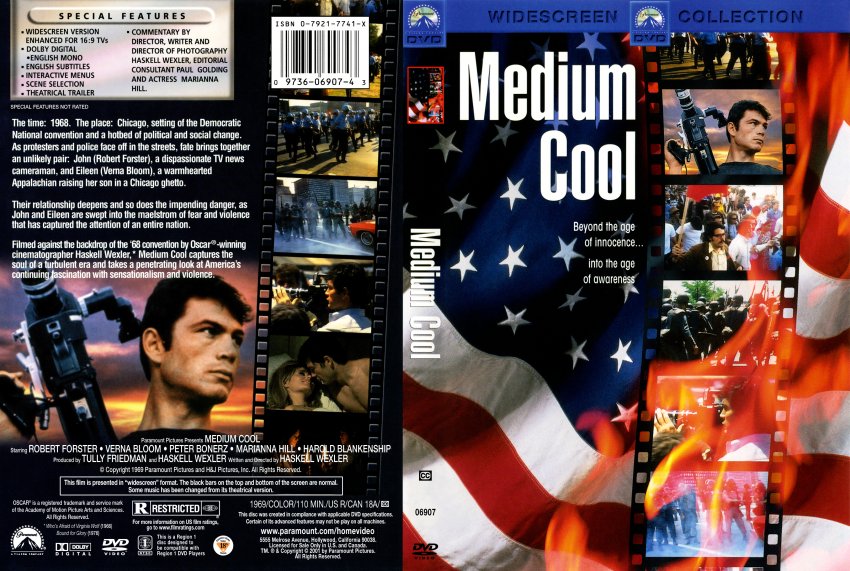


Medium Cool (1969) was a project shadowed by the FBI, saddled with a market-inhibiting X rating, and released with tepid support from a nervous studio. Not surprisingly, despite attracting very favorable reviews, it was not big hit at the box office. But over the years its reputation rose steadily, and eventually the movie found its proper place in the pantheon of the great films of the New Hollywood era. A worthy recipient, then, of the full Criterion Treatment, with a sparkling new special edition DVD and Blu-Ray; among its many features are a new interview with writer-director-cinematographer Haskell Wexler and the very welcome inclusion of (a slightly edited version of) the valuable but obscure 2001 BBC television documentary about the film, Look Out Haskell, It's Real."

As his triple-threat credits suggest, Medium Cool was very much Wexler's project. One of the hottest cinematographers in the business — just off an academy-award winning turn for Who's Afraid of Virginia Wolf (1966) and the big hit In the Heat of the Night (1967) — and with the emergence of a New American Cinema that took low-budget chances on new talent, Wexler was given a shot at the director's chair. And to his credit, the ambitious, confident cameraman didn't play it safe but threw everything he had into a risky project that he believed in.

With a background in documentary filmmaking, Wexler was influenced by a philosophy associated with the French New Wave (many of whose participants had similar apprenticeships), that challenged the reification of a divide between "fiction" and "non-fiction" films. Documentaries, they insisted, could not show an objective truth but offered only one interpretation of events, presented as a narrative following classical storytelling rules; realities that were, moreover, altered by the presence of cameras that produced self-consciousness and performance. Conversely, fiction films, especially those made on locations and with a new wave sensibility designed to reflect the personal experiences of their creators, were in many ways also documentary records of a certain type of reality. With Medium Cool, Wexler dove headlong into the blurry intersection between the two, embedding a fictional (and often improvised) story within very real situations. Often featuring non-actors going about their unscripted business, in many scenes only the principal players are aware that a movie is being made. At times those actors were exposed to real danger — placed, for example, in the midst of what the report of a National Commission would describe a few months afterwards as a "police riot." On the streets of Chicago, Wexler's camera became one among many that were capturing the events as they unfolded — and he was among those tear gassed, and was blinded for twenty-four hours.

The politically sensitive Wexler was irresistibly drawn from Hollywood back to his home town, Chicago, and the Democratic National Convention that would be held there in August 1968. Convinced that "something" would happen there — a violent confrontation, of some type, seemed certain — he crafted a story that could be interwoven into those events, unforeseeable in their specifics, as they unfolded. Wexler was later accused of incitement, but his cameras did little more than anticipate the inevitable explosion. Nineteen sixty-eight took care of the rest.

It was a very bad year. In January, the surprise Tet Offensive fundamentally altered the trajectory of the Vietnam War. The unprecedented communist strikes failed to achieve their military goals, but they made plain that no matter how many troops it poured in, the United States was not going to achieve its political objectives in the war, despite the unceasingly optimistic reports previously proffered by the Johnson Administration. (The U.S. would suffer over 4,700 combat deaths in the first three months of 1968. And with 500,000 American troops in the country, the war was being fought — at best — to a bloody stalemate.) In March, Johnson was embarrassed in the New Hampshire democratic primary by the strong showing of anti-war candidate Eugene McCarthy; within days, Robert Kennedy dropped into the race; within weeks, LBJ shocked the nation by dropping out. In April, Martin Luther King was assassinated. Kennedy, campaigning in Indianapolis, delivered the news to a stunned, mostly black audience, and delivered a short, moving speech appealing for calm. Scores of American cities erupted in riots that night, but Indianapolis was not one of them. In June, Kennedy would be assassinated moments after celebrating victory in the crucial California primary, his final words, "on to Chicago and let's win there," still hanging in the air as the shots rang out.

To Read the Rest

Thursday, May 23, 2013

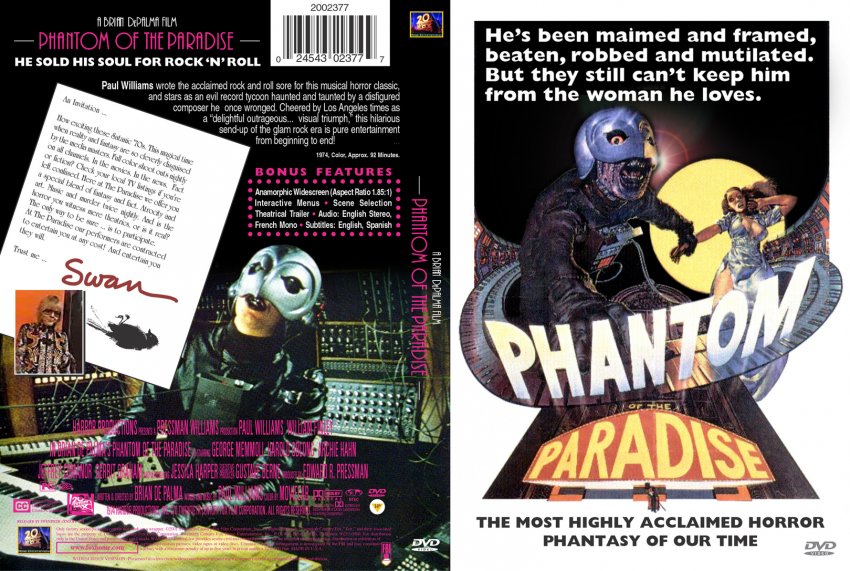
Roger Leatherwood -- The Phantom Archivist and The Phantom Archives: The Amateur Online Archive of Brian De Palma's Phantom of the Paradise (1974)

The Phantom Archivist and The Phantom Archives: The Amateur Online Archive of Brian De Palma's Phantom of the Paradise (1974)
by Roger Leatherwood
Bright Lights Film Journal


1. WHO CARES ABOUT NOSTALGIA ANYMORE?
Personal Archives in the Absence of a Corporate One

Prior to about 1980, Hollywood seemed perversely uninterested in its own history, inadvertently or intentionally neglecting its production materials (not to mention old film elements) that often were left rotting behind studio vault walls and taking up valuable real estate and given away or maybe dumped in the bay some foggy night. Since the advent of home video and the ever-increasing value of catalog titles, new digital (expensive to license, cheap to deliver) formats and the promise of the long tail, studios have increasingly strived to make their films and TV shows available to as wide an audience as possible for as long as possible, including offering merchandise that depicts the characters, graphics, and designs on any and all appropriate items from toys to smartphone cases. This constant upkeep of the presence of the brand of a filmed property in the culture keeps it in the public's memory, perhaps motivating sequels, spin-offs, and other ancillary revenue. And all this has to be archived and kept careful track of.

In some rare instances, producers have maintained archives, private or set up as museum spaces to display props, costumes, and other ephemera.1 But examples of industrial archival curation are sparse, and while the films themselves may enjoy an afterlife in repertory houses or at museum screenings, physical archives are seldom open and, unless they involve Stanley Kubrick or some other storied career, don't go on the road.2

Legacy production materials of motion pictures from draft scripts to set designs to production stills not intended for the public eye often end up forgotten, if they aren't purloined from under the noses of archivists who never notice them missing. The majority of productions dating from before the 1980s suffer from almost nonexistent archival profiles, and have no cultural presence. As a result they remain invisible to cultural memory. In the absence of digital or other marketing engagements now common to recent cross-platform franchise properties, marketing ephemera surrounding the releases ("collateral" to use the marketing term) gets fetishized as the proxy for favorite films, and authentic original posters for such films as King Kong (1933) to Star Wars (1977) go for thousands of dollars on auction sites,3 signifiers of the original and authentic industrial marketing impulse and of the cultural moment in which these were the only legitimate proxy outside of actual viewership.

Ari Kahan's website devoted to Phantom of the Paradise (1974), The Swan Archives (www.swanarchives.org),4 has curated a collection of marketing materials that reanimates the era of this forgotten film's release. Launched in 2006 with the results of 30 years of collecting posters, stills, and other materials, the site functions not only as a resource for the film's fan community but also as its only surviving archive that creates and even defines a new audience for the film. Made up of over 400 pictures of objects, screengrabs, and detailed narratives of the film's genesis, production, marketing, and editing variants adding up to over 75,000 words, as explications of the film's themes, subtexts, and historical context it presents a comprehensive, exhaustive, and passionately rendered archive of the history and reception of the film and a film of its type in the mid-'70s cultural landscape, all in the absence of any attempts by the corporate rightsholders to do so.

2. RECORDING LIVE FOR THE SWAN ARCHIVES
Objects, Their Meanings, and the Importance of Timing

Working online, within view but beyond the traditional reach of normal gatekeepers of intellectual property, Kahan illustrates a new mode of archival behavior and engagement possible in digital environments that revivifies obsolete (in this case, intellectual) property and curates and recontextualizes it. At the same time, Kahan's efforts reflect a rather conservative and closed approach to how an archive is built and functions, in large part by taking pains to protect the assets from promiscuous sharing as well as the context in which they're viewed. By dint of his existence in a landscape that is relatively unexplored, Kahan engages the tension between how audiences and corporate rightsholders control, negotiate, and create new meanings surrounding their properties. His site allows audiences to engage with artifacts outside traditional archival walls; investigates how archival activity affects digital, personal, and other casual engagements with film texts; and points the way in which such sites create new narratives around the texts themselves.

Phantom of the Paradise, written and directed by Brian De Palma and starring Paul Williams, William Finley, and Jessica Harper, was released by 20th Century-Fox in 1974. Appearing amid the rich cultural tapestry that also included The Godfather Part II, Chinatown, The Towering Inferno, and The Texas Chainsaw Massacre, it was largely unsuccessful in finding a wide audience and was relegated to relative obscurity on the second half of double bills before being remarketed to secondary markets with a revamped ad campaign six months later.

A quirky, stylized, and fleet-footed if unwieldy blend of horror and fantasy taking place in a rock-and-roll setting, Phantom of the Paradise attracted the attention of horror film and science fiction fans rather than a teenage rock music audience. Its plot borrows predominantly from the 1943 and 1962 film versions of Gaston Leroux's The Phantom of the Opera5 as well as the German legend of Faust (the music mogul Swan played by Williams sells his soul for success). By virtue of its pop sensibilities, its fanciful critique of corporate greed, and its stylized filmmaking techniques (a harbinger of the Grand Guignol style Brian De Palma would develop to greater effect in Carrie [1976] and Scarface [1983]), the film slowly built a cult following. As a meta-narrative about popular music as well as a satire of celebrity culture that parodies the very elements that audiences might enjoy about it (flashy rock production numbers, fan worship), the film likely alienated the audiences it expected to attract, until a revised ad campaign repositioned the film as a horror/thriller as opposed to a musical (the Style C poster tagline is "He's been maimed and framed, beaten, robbed, and mutilated. But they still can't keep him from the woman he loves"). Moderately more successful, it attracted enough attention to be written up in various science fiction and film magazines.

To Read the Rest

Wednesday, March 27, 2013

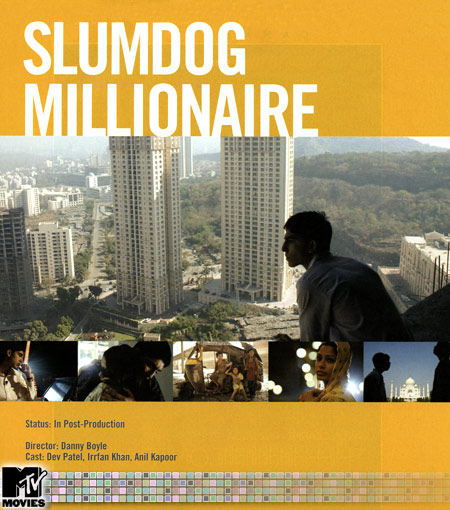
Anjali Pandey: The Million Dollar Question: How Do You Sell English on the Silver Screen? - A Socio-Linguistic Analysis of Slumdog Millionaire

The Million Dollar Question: How Do You Sell English on the Silver Screen? - A Socio-Linguistic Analysis of Slumdog Millionaire
by Anjali Pandey
Americana


Introduction

Years ago authors Barnet and Cavanagh portended: “The new world economy rests largely on global bazaars” (15). Today, India is a major economic promontory in the voyage of western filmic expansion into the East. As a “movie-mad country” (Chopra 18), with its own yearly production output of “over a thousand movies in Mumbai alone” (Beaufoy, Boyle and Feld 142) - numerically translated as “3 billion movie tickets per annum” (Lakshmi 8) - Bollywood unlike Hollywood boasts a 13% increase in movie ticket sales since 2007 (Chopra 18). Film scholars have for years tracked the so-called “economic moribundity” (Cowen 73) of European cinema. In contrast, “India’s film industry, now at $2.2 billion, is estimated to grow to 3.3 billion by 2013” (Lakshmi 8).

Cowen claims that the "English language, combined with America’s role as a world leader, has strengthened Hollywood exports” (75). In India, the linguistic “legacy of English” (Bhatia and Baumgardner 384) makes the economic venture eastward into “the prized Indian market” (Tyrrell 260) a viable option as increasing economic research confirms that “the global market has generated more dependable returns than the local market” (Dissanayake 405). Esteemed linguist, David Crystal calls India “a linguistic paradise” (173) with “a special place in the record books” as a country with “the largest English-speaking population in the world” (173) at “350 million speakers” (173). This figure is “far more than the combined English-speaking populations of Britain and the USA” (173). Two decades ago in a comprehensive analysis of Hollywood versus Bollywood, Tyrrell claimed that “Hollywood has not defined what makes a film work in India” (260). Twenty years later, Slumdog Millionaire has demonstrated that when it comes to “the battle of the dream factories” (Tyrrell 260), “Hollywood’s colonization of Bollywood” (Tyrrell 272) can indeed be achieved via a twin strategy of linguistic and cultural syncretism.

The filmic genius of Slumdog Millionaire lies in the meticulous manner in which the hybridity of language and lore of both West and East have been glocalized to suit “the viewing tastes and linguistic preferences” (Bhatia and Baumgardner 380) of cross-continental audiences. Film critics are unanimous in their praise: “Slumdog Millionaire is the film world’s first globalized masterpiece” (Morgenstern 1) raves the economically savvy Wall Street Journal. How did Slumdog Millionaire do it? The answer lies in the innovative use of verbal and visual English as cinematic strategy - as “an aural and visual spectacle” (Garwood 174) within the “diegetic space of film” (Garwood 179). Visual English consistently dominates screen-space in Slumdog. The film’s economic and aesthetic genius rests on the nuanced, multiplex manner in which visual English “functions in the ever-evolving techno-aesthetic space of cinema” (Dissanayake 406) - as a filmic device which reflects at the very same time as it sustains a place for global English evanescence. The effective incorporation of tokenized Hindi in the movie as a vehicle for highlighting verbal and visual English is accomplished in and through a plethora of potent filmic strategies including but not limited to: spotlighting, achieved via filmic prominence given to visual English; synchronization, accomplished via a savvy glocalization of tokenized local linguistic content in the service of linguistically dominant global interests; spectacularization, realized via an intelligent use of selective adaptation strategies which simultaneously translate and transliterate "Indian figurehead" novel-writing and music-making potential into globally appealing cultural products, and finally, syncretization - filmmaking strategies which “utilize an economic and cultural dynamic that combines both commercialism and creativity” (Cowen 101) - four cultural production strategies which use the local to sell the global. All four strategies are detailed below.

To Read the Rest of the Essay

Wednesday, March 6, 2013

Seth Rosenfeld: A Secret History of America in the 60s

Lynum had plenty of information to share. The FBI's files on Mario Savio, the brilliant philosophy student who was the spokesman for the Free Speech Movement, were especially detailed. Savio had a debilitating stutter when speaking to people in small groups, but when standing before a crowd and condemning his administration's latest injustice he spoke with divine fire. His words had inspired students to stage what was the largest campus protest in American history. Newspapers and magazines depicted him as the archetypal "angry young man," and it was true that he embodied a student movement fueled by anger at injustice, impatience for change, and a burning desire for personal freedom. Hoover ordered his agents to gather intelligence they could use to ruin his reputation or otherwise "neutralize" him, impatiently ordering them to expedite their efforts.

Hoover's agents had also compiled a bulging dossier on the man Savio saw as his enemy: Clark Kerr. As campus dissent mounted, Hoover came to blame the university president more than anyone else for not putting an end to it. Kerr had led UC to new academic heights, and he had played a key role in establishing the system that guaranteed all Californians access to higher education, a model adopted nationally and internationally. But in Hoover's eyes, Kerr confused academic freedom with academic license, coddled Communist faculty members, and failed to crack down on "young punks" like Savio. Hoover directed his agents to undermine the esteemed educator in myriad ways. He wanted Kerr removed from his post as university president. As he bluntly put it in a memo to his top aides, Kerr was "no good."

Reagan listened intently to Lynum's presentation, but he wanted more--much more. He asked for additional information on Kerr, for reports on liberal members of the Board of Regents who might oppose his policies, and for intelligence reports about any upcoming student protests. Just the week before, he had proposed charging tuition for the first time in the university's history, setting off a new wave of protests up and down the state. He told Lynum he feared subversives and liberals would attempt to misrepresent his efforts to establish fiscal responsibility, and that he hoped the FBI would share information about any upcoming demonstrations against him, whether on campus or at his press conferences. It was Reagan's fear, according to Lynum's subsequent report, "that some of his press conferences could be stacked with 'left wingers' who might make an attempt to embarrass him and the state government."

Lynum said he understood his concerns, but following Hoover's instructions he made no promises. Then he and Harter wished the ailing governor a speedy recovery, departed the mansion, slipped into their dark four-door Ford, and drove back to the San Francisco field office, where Lynum sent an urgent report to the director.

The bedside meeting was extraordinary, but so was the relationship between Reagan and Hoover. It had begun decades earlier, when the actor became an informer in the FBI's investigation of Hollywood Communists. When Reagan was elected president of the Screen Actors Guild, he secretly continued to help the FBI purge fellow actors from the union's rolls. Reagan's informing proved helpful to the House Un-American Activities Committee as well, since the bureau covertly passed along information that could help HUAC hold the hearings that wracked Hollywood and led to the blacklisting and ruin of many people in the film industry. Reagan took great satisfaction from his work with the FBI, which gave him a sense of security and mission during a period when his marriage to Jane Wyman was failing, his acting career faltering, and his faith in the Democratic Party of his father crumbling. In the following years, Reagan and FBI officials courted each other through a series of confidential contacts. And after Reagan emerged as a leading conservative spokesman in the fifties, Hoover went beyond the bounds of his jurisdiction and secretly gave him personal and political help. He even lent Reagan a hand in keeping track of his own wayward children, Maureen and Michael. Now the long courtship between the FBI director and the former movie star would pay off for them both.

The FBI would become deeply involved in the clash over free speech at Berkeley between the social forces represented by Reagan, Kerr, and Savio. Each of these men had a transforming vision of America and exerted extraordinary and lasting influence on the nation. By tracing the bureau's involvement with these iconic figures, this book reveals a secret history of America in the sixties. It shows how the FBI's dirty tricks at Berkeley helped fuel the student movement, damaged the Democratic Party, launched Ronald Reagan's political career, and exacerbate the nation's continuing culture wars. Above all, it illustrates the dangers that the combination of secrecy and power pose to democracy, especially during turbulent times. (7-8)

Rosenfeld, Seth. Subversives: The FBI's War on Student Radicals, and Reagan's Rise to Power. Farrar, Straus and Giroux, 2012.

Wednesday, January 2, 2013

Erin Aubry Kaplan: 'Django' an unsettling experience for many blacks

'Django' an unsettling experience for many blacks
by Erin Aubry Kaplan
LA Times

Quentin Tarantino's slave-era spaghetti western has some questioning the propriety of using a still-festering period of U.S. history as a platform for a bloody, profanely comic pop entertainment.

Tracey White's initial impression of "Django Unchained," Quentin Tarantino's new slave-era shoot-'em-up extravaganza, could be summed up in three words: smart, funny and ugly. Sitting through a recent screening in Beverly Hills, the L.A. costume designer was mostly absorbed and found herself laughing aloud at particularly outrageous moments.

But White, who is black, said her feelings evolved significantly. Two days after reflecting on the matter of slavery and Tarantino's treatment, she pronounced the movie mostly ugly.

"He [Tarantino] gets a good product out of it in terms of wit and a visual look," said White. "But when it was over I found myself wondering, 'What is he trying to do?' I enjoyed the movie when I was in there, but I still have a problem with Tarantino when he deals with our race."

White will certainly not be alone among African Americans in her ambivalence about the gleefully outrageous film. While "Django" has nabbed almost uniformly warm reviews and four NAACP Image Award nominations (including for best picture), the fact is that it is an extremely Hollywood-ized vision of a critical black American experience.

Some blacks are already calling the revenge-fantasy movie, especially its graphic and highly stylized violence, insensitive, exploitative and ahistorical. Filmmaker Spike Lee, a longtime critic of Tarantino, said this month that he refuses to see the movie, and calls his spaghetti-western approach to slave history "disrespectful."

Many moviegoers will know something of what they're getting into. Violence and the liberal use of black idioms and so-called urban culture are Tarantino hallmarks, notably in early films such as "Pulp Fiction" and "Jackie Brown," and they've always stirred controversy. But this movie is different because it mines slavery, the complicated source material for so much black culture and fountain of violence in American history.

It is an institution whose horrors need no exaggerating, yet "Django" does exactly that, either to enlighten or entertain. A white director slinging around the n-word in a homage to '70s blaxploitation à la "Jackie Brown" is one thing, but the same director turning the savageness of slavery into pulp fiction is quite another.

To Read the Rest of the Article

Cecil Brown: Tarantino's Django: Unchained - Hollywood’s Nigger Joke

Tarantino's Django: Unchained: Hollywood’s Nigger Joke
by Cecil Brown
Counterpunch


In order for a joke to work, Mary Douglas, the eminent British anthropologist, wrote that one had to have a social context for it to operate in. “We must ask what are the social conditions for a joke to be both perceived and permitted,” she asked in her wonderful little essay, “Jokes.”

“My hypothesis,” she writes“is that a joke is seen and allowed when it offers a symbolic pattern of a social pattern occurring at the same time.”

With Django: Unchained, the symbolic pattern–I’d call it historical context–is Hollywood itself. “If there is no joke in the social structure,” Mrs Douglas observed, “no other joke can appear.” In Hollywood, there are lots of jokes in the system!

The social pattern that allows Quentin Tarantino’s “Nigger joke” to work is set in the South, two years before the Civil War, but my point is that this is only a pretext for Hollywood itself.

Some critics, like Betsy Sharkey in the Times, think this film is a masterpiece. Sharkey calls it, “the most articulate, intriguing, provoking, appalling, hilarious, exhilarating, scathing and downright entertaining film yet.”

African American critic Wesley Morris hated it. He called it “unrelenting tastelessness — [...] exclamatory kitsch — on a subject as loaded, gruesome, and dishonorable as American slavery.”

Ishmael Reed, the novelist, pointed out how the Weinstein Company promoted an advertising campaign to get a black audience by promoting Jamie Foxx as the star. In fact, Foxx is only one of the stars, along with Christoph Waltz and Leonardo DiCaprio. As Reed points out, Foxx spends most of his time looking at Mr.Waltz and then looking at Mr. DiCaprio, with a puzzled look on his face, as if to say, What’s dese white folks, talkin ‘bout?

My aim in his essay is to examine the way in which the symbolic system is a reflection of the social system. “What are the social conditions for a joke to be both perceived and permitted,” Mrs Douglass wrote in that little essay, “Jokes.”

What are the social conditions that would permit Django to be the big howling, empty nigger joke that it is?

One of these social conditions, certainly, involves the relationship between black actors and Hollywood as a symbol of the plantation system.

In his review of the film, for example, Mr. Reed said that Sam Jackson, in the role of the conniving, omnipresent, evil slave, is “playing himself.”

If Jackson had not dominated the Hollywood system in such a sly way, then his role as Stephen, the master-worshipping house slave to Calvin Candie (Leonardo DiCaprio) would not have its loaded, edgy, uncanny realism. The plantation is called CandieLand (Candyland) and is meant to refer to Hollywood itself as a producer of entertainment (Candy). Get it?

If Jamie Foxx is not known in Hollywood as a resourceful hustler, who will play almost any role, then his part as the “bad nigger” Django would not be so compelling (and lubricous). If he was not the “New nigger on the block,” then the confrontation between him and Sam Jackson’s character, Stephen, the off-the-hook house slave, the scene would not be powerful (and dumb) at the same time.

The dramatis persona forms a homology with the enacted characters on the screen. The key that unlocks Tarantino’s sensationalistic mosaic is that it reveals the inner game of how the Hollywood studio and the plantation slave institution exploited black people.

To Read the Rest of the Essay

Friday, November 30, 2012

Connor Kilpatrick: The Night They Drove Old Dixie Down

The Night They Drove Old Dixie Down
by Connor Kilpatrick
Jacobin

Whatever Spielberg says — there’s no comparing an empty-suit like Obama to a radical like Lincoln.

I thought about writing a critique of Aaron Bady’s mostly very good review of Lincoln for a long time this morning. It was a tough call: I do have some enamel left on my teeth and I can think of nothing else that could threaten to grind it all down to dust than publicly saying anything —anything at all — that could be construed as a defense of either Steven Spielberg’s politics or Barack Obama.

So I don’t want to defend the movie, which I thought was fine for what it was. Actually, by the standards of Hollywood history flicks, I thought it was more than fine.

Bady’s right to call out Kushner and Spielberg as card-carrying Obamaphiles. And it’s more than clear, particularly through interviews, that Kushner and Spielberg want us to connect the dots they’ve carefully laid out between Abe and Barack. Obama himself has done everything possible to encourage the comparison—even being sworn into office on Lincoln’s very own bible.

In their shared liberal revisionism, the Thirteenth Amendment becomes ObamaCare. The Emancipation Proclamation becomes a return to the marginal tax rates of the Clinton era. Thaddeus Stevens morphs into a fantasy of Bernie Sanders “doing the right thing” and sitting down with the prez to cut healthcare for the poor and elderly.

It’s laughable. But instead of calling them out, too many leftists concede this characterization of Lincoln and the Republicans to the Obamaphiles. They seem to believe that the first crop of Republicans did little more than press an official rubber stamp on “history from below” which had already delivered its verdict across the land.

The argument seems to be: “Spielberg says Lincoln and Obama are rubber-stampers. They are. But he’s wrong when he says that such men are the true makers of history.” Then they go looking elsewhere for the real revolutionaries, who can’t possibly have anything to do with these mere ‘stampers.

The question is why are we letting Spielberg, Kushner, and Obama get away with this?

Abraham Lincoln and the early Republicans (to say nothing of the Liberty Party or Free Soilers before them) shared a vision of a radically different society. Wiping out slavery — either through immediate abolition or through the “cordon of freedom” policy of the Republican Party — was hardly a technocratic reform.

And when it became clear that the only way to get there would be through revolutionary means, they took it without flinching: slaves were being emancipated as “contraband” by the summer of 1861, with the first Confiscation Act — written and debated in Congress explicitly as an emancipation act — signed into law that August, less than four months after the start of the war. The endgame of military emancipation had long been on the minds of antislavery politicians, all the way back to John Quincy Adams who first laid out such a scenario in 1836.

To Read the Rest of the Essay

Thursday, November 29, 2012

Marilyn Adler Papayanis: Sex on the Beach - The Yin Yang of Female Sex Tourism in Two Films

Sex on the Beach: The Yin Yang of Female Sex Tourism in Two Films
by Marilyn Adler Papayanis
Bright Lights Film Journal


With the recent screening of Ulrich Seidl's Paradise: Love at the 2012 Cannes Film Festival, the spectacle of female sex tourism has washed up, once again, on the shoals of popular culture. According to reviewers, it is not a pretty sight. Women who travel to the spaces peripheral to "modernity" and, by the way, have sex with the natives are not rare; however, in the continuum of capital expansion that stretches from colonialism to globalization, such practices tend to lose their luster as a kind of radical cultural immersion. For men, of course, such sexual adventurism would hardly qualify as a narrative with anything new to say. The notion, however, that women would travel to remote or less developed parts of the world for the express purpose of having sex with men who are, in many cases, younger and poorer than they are seems to cut against the grain. Yet many studies show this to be the case. Whether characterized as "sex" tourism (commercial sex with the locals) or "romance" tourism (commercial sex with the trappings of a "real" relationship), this practice has inspired a good deal of academic research in the social sciences and in popular literature as well. In her 2006 book Romance on the Road: Traveling Women Who Love Foreign Men, journalist Jeanette Belliveau describes her subjects as "sex pilgrims." According to the Amazon review, her book is "the complete reference for anyone who wants to learn about a hidden phenomenon that affects hundreds of thousands of traveling women and foreign men: Instant vacation love affairs that banish loneliness, provide cultural insights, offer one-on-one, hand-to-hand foreign aid to the world's poor, create international children and sometimes even change the course of history."

Who can beat that? I believe, however, that the representation of female sex tourism in the cultural imagination is also worthy of study, as such depictions reveal a great deal about the anxieties aroused by the "aging" woman's sexuality. The staging of this cultural moment is explored in two radically different films, both, coincidentally, derived from works of fiction: the breezy How Stella Got Her Groove Back (1998), based on the book by Terry McMillan, and the far more disturbing French film Heading South (2005), based, in large part, on a short story by the Haitian writer Dany Laferrière. Both films indulge the notion that sex in the tropics with a dark-skinned exotic youth is all it takes to cure the malaise of the older woman. In one sense, the autonomy of the woman traveler is a real marker of progress. Sadly, though, the representation of female empowerment in these films is either complicit with racist attitudes still fraught with the lingering spirit of colonialism (Heading South) or in thrall to patriarchal norms (Stella.) In the former, sex tourism is punished; in the latter, it is celebrated.

We learn from the literature that women who sleep with the locals are not a uniform class. They vary in age and in their choice of destination; they vary in terms of their motivations and attitudes toward both their exotic partners and the imaginative geographies in which their partners are embedded. Improbably, for example, the Sinai is a popular venue for cross-cultural couplings. Some "ethnosexual" boundary crossings appear to pass unnoticed, while others are more disturbing, usually because they involve pairings between privileged white tourists of a certain age and marginal youths who navigate the interstices of the official institutions of tourism. Joane Nagel first used the term "ethnosexual" to describe "the intersection and interaction between ethnicity and sexuality and the ways each defines and depends on the other for its meaning and power" (10). In the Americas, Jamaica, the Dominican Republic, and Costa Rica are popular venues for the pursuit of ethnosexual adventurism. These are destinations where the opportunity for women to have sexual or romantic liaisons with exotic Others further complicates the shadowy social relations in the "contact zone" where, for centuries, sexual commerce between male travelers and the natives, male or female, have followed, roughly, the contours of imperial power. The term "contact zone" was coined by Mary Louise Pratt in her groundbreaking study Imperial Eyes: Travel Writing and Transculturation to describe "social spaces where disparate cultures meet, clash, and grapple with each other, often in highly asymmetrical relations of domination and subordination, like colonialism, slavery, or their aftermaths as they are lived out across the globe today" (3).

To Read the Rest of the Essay

Thursday, October 25, 2012

James Udden: Child of the Long Take: Alfonso Cuaron’s Film Aesthetics in the Shadow of Globalization

[Warning: the clip of the scene below gives away major plot details]

Child of the Long Take: Alfonso Cuaron’s Film Aesthetics in the Shadow of Globalization
by James Udden
Style


...

Given his Janus-faced career, it was hard to know what to expect stylistically from Cuaron in Children of Men given the direct involvement of Universal. He answers almost right away in the third shot of the opening scene as to how far he is now willing to go. Expertly introduced in this single shot is a grim, dying world in which the Clive Owen character is but one small, languid part. It is a tour de force in terms of its set design, lighting, camera movement and most of all its daringly intricate orchestration of multiple animate and inanimate elements. Yet the most telling sign is the duration of the shot: this is a long take of over fifty seconds, which with almost devious subtlety leads to a most unexpected denouement, an explosion segueing to a title shot with uncanny effect. It is an impressive beginning to a film which overall deeply impressed select viewers, critics and scholars alike. Alfonso Cuaron has accomplished the seemingly impossible: he proffers a dystopian message concerning globalization, yet he does it under the auspices of one of globalization’s key cultural players — Hollywood. Yet he also accomplishes this in indelible aesthetic terms. After seemingly reverting back to more conventional form with The Prisoner of Azkaban, the long take makes a roaring return in Children of Men, with an average shot length of just over sixteen seconds per, an astonishing figure for a present-day Hollywood feature which sometimes can average less than two seconds per shot (Hollywood 122). Moreover, even if slightly shorter on average than its Spanish-language predecessor a half a decade earlier, these long takes are more complex and more accomplished in their design. As we shall see, they are too good to be true. Indeed, these long takes are contrived spectacles in their own right.

There is an overall pattern for long take in Children of Men: the more action and violence a particular scene possesses, the longer the shot duration generally becomes. This does run counter to current Hollywood norms. Many have recently noted how big-budgeted, Hollywood action films in particular tend to lead the way in faster cutting rates which are often employed for maximum impact (Bordwell, Hollywood,122, 58-159; King, New Hollywood, 246). Children of Men, of course, is not a traditional action picture, but a science fiction work with deep philosophical underpinnings. Yet during its non-action scenes often involving conversations between characters, Cuaron is more likely to use conventional editing schemes, most of all the ever reliable shot/reverse shot. Cuaron saves his most audacious long takes for the sequences where violence and action are at their highest pitch, with the longest reserved for the prolonged battle at the refugee camp at the end. Despite their reliance on long takes in lieu of “impact” editing, it is these moments in the film which seem to be most memorable.

What is most telling is how these long takes give the appearance of taking place in “real” time and “continuous” space. Cleverly disguised is how they are often multiple shots melded together digitally in post-production. The above mentioned opening scene, for example, was shot over two days, the first day covering the indoor portion in the café, while the second day involved the complicated section outdoors. However, in the finished product, the third shot begins indoors and then proceeds seamlessly outdoors, meaning somehow a single, “continuous” long take was shot over two days time. Using the café doorframe at the moment Clive Owen leaves the frame, the camera is deviously slow to catch up, and the special effects crew disguised the cut digitally in post (Fordham 34). In short, the opening scene is not three shots, but four shots disguised as three with the last being a long take under false pretenses.

This is not an isolated instance in Children of Men. The now famous scene in the automobile took two months to plan, eight days to shoot on three separate locations. The camera’s impossibly free movements in the car were in fact impossible — they were only realized by being filmed in six separate sections where often not all of the actors were present at certain stages. Once again, this was all amalgamated into a single artificial long take by digital means (Fordham 39). Claiming to replicate the feel of a documentary, this shot is also impossibly precise for any documentary shooting as events transpire. True, they did use mostly available light in a real setting, allowing every flare and reflection on the glass to remain, much like in a documentary. But no documentarian has ever had the luxury of a twin-axis doggicam rigged above a missing car roof which is then digitally filled in during post-production. The resulting camera movements would also be impossible for a documentary — in fact in a way that has never been done by fictional filmmakers either. Particularly noteworthy is the powerful effect of that moment when the camera returns to the front and Julianne Moore reappears at the right edge of the frame, now undeniably no longer among the living. Documentarians are rarely able to be that measured, and are hardly that lucky.

The longest take in the film is over seven minutes in duration, occurring during the climatic battle at the refugee camp when Theo Faron attempts to rescue the kidnapped baby. Being one of the most complex long takes ever attempted, it is in fact too complicated to be a true “long take.” Instead, this was shot at two exterior locations plus a studio; the first major section was filmed at Bushey Hall, while the second part was shot two weeks later at Upper Heyford. This particular transition was digitally disguised using the corner of a building, much like what they had done with the doorframe of the café in the pre-credit sequence (Fordham 42). Additional elements added to the seemingly real but impossible spectacle: for example, no documentarian has been so fortuitous as to follow someone just as Theo Faron passes a soldier dying in his half-severed body, yet reaching out for him with one last moaning grasp at life. The three sections combined comprise a highly calculated, and remarkably well-orchestrated game of lost and found where Theo loses the mother and child to the engulfing chaos, only to find them again in that same chaos, all within this same faux long take. Meanwhile, by scanning this dense, dreary mise-en-scene, Cuaron and Lubezki not only disguise cuts, they continue a deeper strategy seen also in Y tu mama tambien: to show a much larger world than merely the characters themselves, a world that becomes almost hyper-real due to the careful construction of the long take coupled with other stylistic devices. So spectacular are these long takes that they become spectacles themselves which became endlessly talked about by reviewers, scholars and film aficionados alike. And that appears to have been precisely the reason why they are employed in the film during those particular sequences which proved to be the most challenging.

To Read the Entire Essay

Wednesday, October 3, 2012

Dennis Lim: Time Has Been Kind to Heaven's Gate

Time Has Been Kind to Heaven's Gate
by Dennis Lim
The New York Times


...

Lee Kline, the technical director at Criterion, said, “It wasn’t an option to go back to the original negative because that was what was cut down to the short version.” The original 70-millimeter prints were also in poor shape. So in a costly, complicated process, the restoration team scanned each color separation negative individually and recombined them.

“Heaven’s Gate” may be a subject Mr. Cimino has avoided for years, but once he gets going, the floodgates open. He spoke fondly of the performances of Kris Kristofferson, Christopher Walken and Isabelle Huppert, which he feels have never gotten their due. And he recalled the genesis of the project: Researching the history of barbed wire and the cattle industry, he came upon an incident known as the Johnson County War involving cattlemen, hired killers and local ranchers. He described the epilogue — the weary hero, James Averill (Mr. Kristofferson), on a yacht off the New England coast — as “a prelude to ‘The Great Gatsby,’ ” with Averill as the mogul awaiting the arrival of the young James Gatz.

Mr. Cimino also recalled his obsessive quest for authenticity that led many to characterize “Heaven’s Gate” as a runaway production. (First budgeted at less than $10 million, the film grew to a cost of $35 million, or $44 million including promotional costs, according to Mr. Bach’s book. Mr. Cimino maintains that it was “all in $32 million.”) As he put it, “Everything was problematical”: the locomotive that had to be transported to the Montana location from a Denver museum; a horse-drawn buggy whose spokes and upholstery had to be made in different states. “The movie could not be made today, even if you threw $300 million at it,” he said. “All of that is being lost. The wagons don’t exist, the skills are gone.”

Present-day viewers may well find that time has been kind to “Heaven’s Gate,” which plays more than ever like a fittingly bleak apotheosis of the New Hollywood, an eccentric yet elegiac rethinking of the myths of the West and the western, with an uncommonly blunt take on class in America. (“It’s getting dangerous to be poor in this country,” someone says. The rejoinder: “It always was.”) But this defiant last gasp of the downbeat ’70s, opening two weeks after Ronald Reagan was elected president, was plainly a movie at odds with its time.

Reached at his home in Hawaii, Mr. Kristofferson said he believes the themes of the film, with its grim view of American capitalism, were what made it so unpalatable. “It was a political assassination,” he said. He recalled getting word that Reagan’s first attorney general, William French Smith, had told studio heads that “there should be no more pictures made with a negative view of American history.”

Mr. Kristofferson, sounding more rueful than bitter, said that the reception to “Heaven’s Gate” knocked him off the Hollywood A-list for good. “I never really recovered from that,” he said, but he acknowledged that it was worse for Mr. Cimino. “It completely destroyed him.”

Mr. Cimino continued to work, albeit infrequently; he has made four features since “Heaven’s Gate,” the last one, “Sunchaser,” in 1996. A painter who began his directing career in advertising, he said that at home in Los Angeles he rarely watches movies now (and prefers to reread Pushkin and Flaubert). But he does have a film project in mind, which he hopes to shoot in digital soon.

Ms. Carelli, who was with Mr. Cimino in Venice, said that while there remain misconceptions about the making of “Heaven’s Gate,” “I don’t want to revisit old erroneous stories and try to correct them.” She added, “Now the film finally speaks for itself, and it has the final word.”

To Read the Entire Article

More Resources:

The Making and Unmaking of Heaven's Gate


Tuesday, October 2, 2012

Jeff Faux: Education Profiteering -- Wall Street's Next Big Thing?

Education Profiteering; Wall Street's Next Big Thing?
by Jeff Faux
The Real News Network

The end of the Chicago teachers' strike was but a temporary regional truce in the civil war that plagues the nation's public schools. There is no end in sight, in part because -- as often happens in wartime -- the conflict is increasingly being driven by profiteers.

The familiar media narrative tells us that this is a fight over how to improve our schools. On the one side are the self-styled reformers, who argue that the central problem with American K-12 education is low-quality teachers protected by their unions. Their solution is privatization, with its most common form being the privately run but publicly financed charter school. Because charter schools are mostly unregulated, nonunion and compete for students, their promoters claim they will, ipso facto, perform better than public schools.

On the other side are teachers and their unions who are cast as villains. The conventional plot line is that they resist change, blame poverty for their schools' failings and protect their jobs and turf.

It is well known, although rarely acknowledged in the press, that the reform movement has been financed and led by the corporate class. For over twenty years large business oriented foundations, such as Gates (Microsoft), Walton (Wal-Mart) and Broad (Sun Life) have poured billions into charter school start-ups, sympathetic academics and pundits, media campaigns (including Hollywood movies) and sophisticated nurturing of the careers of privatization promoters who now dominate the education policy debate from local school boards to the US Department of Education.

In recent years, hedge fund operators, leverage-buy-out artists and investment bankers have joined the crusade. They finance schools, sit on the boards of their associations and the management companies that run them, and -- most important -- have made support of charter schools one of the criteria for campaign giving in the post- Citizens United era. Since most Republicans are already on board for privatization, the political pressure has been mostly directed at Democrats.

Thus, for example, when Andrew Cuomo wanted to get the support of hedge fund managers for his run for governor of New York, he was told to talk to Joe Williams, director of Democrats for Education Reform, a group set up to lobby liberals on privatization. Cuomo is now a champion of charter schools. As Joanne Barkan noted in a Dissent Magazine report, privatizers are even targeting school board elections, in one case spending over $630,000 to elect two members in a local school board race last year in Colorado.

Wall Street's involvement in the charter school movement -- when the media acknowledges it -- is presented as an act of philanthropy. Perhaps, as critics claim, hedge funders are meddling in an area they know nothing about. But their motives are worthy. Indeed, since they send their own children to the best private schools, their concern for other people's children seems remarkably altruistic. "Wall Street has always put its money where its interests of beliefs lie," observed this New York Times article, "But it is far less common that so many financial heavyweights would adopt a social cause like charter schools and advance it with a laser like focus in the political realm."

Yet, with the wide variety of social causes and charitable needs -- poverty, health, housing, global warming, the arts, etc. -- why would so many Wall Streeters focus laser-like on this particular issue? The Times suggest two answers. One is that the money managers are hard-nosed, data-driven investors "drawn to the business-like way in which many charter schools are run; their focus on results primarily measured by test scores."

Twenty years ago, one might have reasonably believed that the private charter schools, which are managed to produce the numbers, would produce better outcomes -- as measured by the numbers. But the overwhelming evidence is that they do not. The single most comprehensive study, by researchers at Stanford University, found that 17 percent of charter school students performed better than their public school counterparts, 46 percent no better and 37 percent worse. Stanford's conclusions have been reinforced by virtually all of the serious research, including those at the University of California, the Economic Policy Institute and the policy research firm Mathematica.

Nor do charter schools seem more efficient. Those promoted as the most successful examples have been heavily subsidized by foundations and Wall Street donors. The film, Waiting for Superman that portrays a heroic charter school organizer fighting a selfish teachers union was widely hyped in the media -- including popular TV shows like Oprah Winfrey's. Yet, as Diane Ravitch, an assistant secretary of education under George H.W. Bush and a former charter school supporter turned critic, noted, the film neglected to report that the hero educator kicked out the entire first class of the school because their test scores were too low, that the school was heavily subsidized by the pro-reform foundations and that the hero took an annual salary of four hundred thousand dollars.

Neither do the data on international comparisons support either privatization in general or charter schools in particular. The foreign education systems that out score America's are government-run, unionized, monopolies. Ravitch asks: "I look around the world and I don't see any country doing this but us. Why is that?"

Good question. Although the data do not support the supposedly data-driven privatizers' claims, their enthusiasm is undiminished. In response to an op-ed by Bill Gates that crudely misrepresented the statistics on school performance, education policy analyst Richard Rothstein observed: "It is remarkable that someone associated with technology and progress should have such a careless disregard for accuracy when it comes to the education policy in which he is now so deeply involved."

The Times' other guess about Wall Street's motives was that hedge funders are attracted to the anti-union character of the charter schools. This is undoubtedly true; the attack on the pubic schools is clearly a part of the broad conservative campaign to discredit government.

Wall Street has always loathed the labor movement. And in the last decade it has had even more of a reason since corporate profits now depend more on cost cutting and less on the creation of new products. The Chief Finance Officer of JP Morgan reports that some 75% of the net increase in corporate profits between 2000 and 2007 -- before the financial crash -- was a result of cuts in workers' wages and benefits. Given that unions are the only serious vehicles for resistance to the corporate low-wage strategy, Wall Street's antipathy has become even stronger.

But today unions represent less than seven percent of private sector workers. And the influence of public sector unions on the bargaining position of workers in profit-making corporations is, certainly in the short run, negligible. So while hostility to unions plays a role, is it is not quite credible to believe that Wall Street profit maximizers would be spending so much of their time and money simply to beat up on a proxy for the private sector unions that they have already so beaten back.

As usual, when looking for what motivates capitalists in a market system, the answer is likely to have something to do with making money.

Having been rescued from the consequences of its own folly by the Bush/Obama bailouts with its de-regulated privileges intact, Wall Street is once more on the prowl for the new "big thing" -- a new source of potential profits upon which to build the next lucrative asset bubble.

To Read the Rest of the Essay

Wednesday, September 5, 2012

Lila Kitaeff: Three Kings -- Neocolonial Arab Representation

Three Kings: Neocolonial Arab Representation
by Lila Kitaeff
Jump Cut


...

Non-oppositional critique of the Gulf War

In general, Three Kings’ marketing and reception dwelt on its supposedly unconventional nature. By unconventional, I mean “oppositional” discourse and imagery in the sense of contrasting to those found in dominant cultural productions. Although I will argue that the film does not, in fact, deviate from a typical Hollywood film in its basic message and structure, Three Kings does occupy a somewhat tenuous position in terms of Hollywood-type unconventionality. At first glance, viewers might expect the film to be an action-packed adventure and war movie. The main actors are blockbuster action stars (with the exception of Spike Jonze, director of Being John Malkovich and several “Beastie Boys” videos). And director Russell’s previous films, Spanking the Monkey and Flirting with Disaster, were offbeat in their brand of dark comedy, if not particularly unconventional in form or plot.

Initially film reviewers considered the story original. They said this film had more to it than met the eye, that its message and structure differed from most Hollywood films. A typical review praised Three Kings for its “genre subversion, anarchic attitude and barbed political commentary… making cogent points about… America’s role as the world’s policeman.” This same reviewer even suggested that the film addressed “the amorality and lack of consistent principles in American foreign policy. No Hollywood film in memory has addressed such an issue” (McCarthy par. 4 and 18).

However, although Russell does make a certain social critique of the Gulf War, as I will explore below, it is based in mainstream rather than oppositional discourses. For example, he explained this as his goal:

Taking people’s perceptions of this war, and turning them on their head… all the assumptions that you had about this war need to be looked at and turned over, including the sense of satisfaction you had as a moral victor, as an American.


However, if one were to make an explanatory critique subverting mainstream perceptions of the Gulf War, one would have to take into account the struggle’s historical context and the economic and ideological interests behind U.S. intervention. Such an argument was made by Noam Chomsky and Michael Albert, for example, when they asserted that “the real reason for U.S. opposition to Iraqi occupation of Kuwait is… to keep Washington, Wall Street, and their allies in charge of setting oil prices” (par. 5). And as Chomsky and Albert further pointed out, the U.S. government also has an ideological interest in perpetuating militarism in order to maintain the status quo of military spending and interventionist foreign policy.

Three Kings does not offer this sort of explanatory critique. Instead, the film presents the protagonists as coming to a realization that the United States has failed to save Iraq and destroy Hussein’s regime. According to the film, the United States is mistaken not because it intervened in the Middle East but rather because it did not follow through in its mission to save the good Arabs and crush the bad Arabs, a mission perpetuating neocolonial ideals. The heroes of Three Kings, in terms of the film’s logic, right the wrongs of the United States by saving a small group of Iraqi civilians, thus reproducing “the [neo]colonialist structure of the heroes’ relation to the native… [to] sort out the problems of people who cannot sort things out for themselves” (Dyer 156).

Neocolonial themes and traditional cinematic themes

Neocolonial cinema encourages the spectator to identify with representations of the colonizing subject and, by partaking of the trajectory set up by the storyline, to posit the colonial project itself as desirable. For example, in the scene in which the U.S. soldier protagonists are shown first entering the village, the images largely present their point of view, inviting identification by literally allowing the spectator to see through their eyes. In this scene the Iraqi civilians are portrayed as dominated and submissive as they beg the Americans to stay and help them. Other Iraqis who want to fight seem incapable of acting on their own as they cry out, “The Americans are here. It’s okay to come out. We can fight Saddam!” Thus, all Iraqi civilians—those beaten down and those who are still resistant—are presented as entirely dependent on U.S. help.

As Shohat and Stam put it, such a scene functions to “mobilize” spectatorial desire to participate in the narrative line about the protagonists’successful “neo-colonial mission.” The mobilization of desire works in tandem with spectator positions. Just as the cinematic apparatus interpellates the viewer to identify with the characters and narrative, the desire for which the protagonists strive also becomes the viewer’s desire .

In its ties with other fictions, including novels, drama, and song lyrics, Three Kings integrates traditional U.S. cultural and cinematic themes, especially about the outlaw hero. The film also uses a common Hollywood script format for dealing with cultural crises, that of the “problem picture.” These script strategies further weaken the film’s critique of United States ideals. In terms of screenwriting, Robert Ray discusses narrative strategies common in Hollywood in which morally centered characters enact a drama against a background of contemporary social issues. This kind of script development is common in what Ray terms “problem pictures,” films that critique large social issues but ultimately have happy endings that belie those problems (147).

In films like these, the outlaw hero is a common character. Such a figure possesses his own moral code and works to “correct” socially unjust laws and authority figures (Ray 15). For example, as Richard Dyer describes the genre, in the Rambo movies that attempt to critique the Vietnam War, the protagonist Rambo is

doing the job… that the United States government should be doing. Thus he repeatedly upholds basic American values against the actuality of America” (Dyer 159-160).


In this way, Hollywood’s use of the outlaw hero as a solution to historical events distorts perceptions of those events as part of social history, that is, outside of their filmic portrayals (Ray 59-62).

To Read the Entire Essay

Wednesday, August 22, 2012

Ignatiy Vishnevetsky, Adam Cook, Mike Archibald and Josh Timmerman: The Big Murk - A Conversation About Christopher Nolan's The Dark Knight Rises

The Big Murk: A Conversation About Christopher Nolan's "The Dark Knight Rises"
by Ignatiy Vishnevetsky, Adam Cook, Mike Archibald and Josh Timmerman
Notebook (MUBI)

The Dark Knight Rises: a big pop-cultural event, the epicenter of a tragedy that has (unfortunately, inadvertently) become 24-hour news cycle fodder, an illustration of what is (and isn't) meant by the word "ambitious" in today's Hollywood, a much-anticipated sequel to a film that's popularly seen as the superhero-flick-to-end-all-superhero-flicks, a major talking point in the ongoing discussion of what film criticism means to audiences at large. It's easy to forget that it is, first and foremost, a movie. And as a movie, it happens to be a mess—long, loud, and full of seemingly contradictory ideas and plot threads.

In the following exchange, Adam Cook, Mike Archibald, Josh Timmermann, and I try to make sense of the film, its politics, and its director.

***

Ignatiy Vishnevetsky: Positives first. I liked the first half of the film the most. It has all of these different threads of intrigue going on: Jim Gordon hunting criminals down drainage pipes, Bane putting together his master plan, Bruce Wayne living as a doomed-romantic recluse in his mansion, Selina Kyle's burglaries, corporate skulduggery. I like the crazy-quilt way in which Nolan uses IMAX, switching aspect ratios shot to shot. I like the Revolutionary Tribunal-style courtroom scenes with Cillian Murphy's Scarecrow presiding as judge, even though the narrative context within which they appear leaves a sour taste in my mouth. I like the image—almost Monty Python material—of policemen living in sewers, huddling together, keeping their uniforms clean for the day when they can step out into the daylight again and arrest people. In other words, I like the silliest, cartooniest, most out-there things about the film. I like the detailing. The grand design is a totally different matter.

The three most common complaints about Christopher Nolan's movies that you're likely to hear are: (1) they have a shoddy grasp of space and time, despite always being centered around chronologies and intercut action; (2) they use political issues and reference-points and take contradictory stances on them (this point applies only to The Dark Knight and The Dark Knight Rises); and (3) most of them use personal traumas (more often than not, Nolan's "dead wife" motif, which appears twice in The Dark Knight Rises) and public tragedies as plot points, but have no sense of the emotional. I think Nolan's best movies are the ones that turn points 1 & 3 into strengths; to me, the appeal of The Prestige, my personal favorite of his films, rests in its which-story-within-a-story-is-being-told? spatial slipperiness and its coldness. In The Dark Knight Rises, however, all three of these points are liabilities.

Since it's specific to Nolan's Batman films, I'd like to start with point 2: the politics. I know that for some people, the ending of The Dark Knight was a big problem; it appears to celebrate surveillance and the necessity of lying to the general public for their good (through the Joker / Batman / Harvey Dent narrative thread) while at the same time preaching about the general goodness of people and the ability of a group to make the right decision (the "two boats, two detonators" dilemma).

The Dark Knight Rises is even more self-contradictory. The images of this film are constantly cancelling each other out. There is Bane's attack on the stock exchange, while plays out as an Occupy-era revenge fantasy—and yet, of course, Bane is the bad guy. Group solidarity is celebrated (the marching policemen, for example) and many jabs are taken at wealth and business, yet the hero is a lone billionaire. Batman operates outside the law, yet law enforcement is fetishized. Scarecrow's revolutionary court is presented as a sort of nightmare—yet it rightly convicts a slimy villain. You have the suggestion (which I actually think is a smart move on Nolan's part) that The Dark Knight's "print the legend" ending was a bad idea—and yet when the Joseph Gordon Levitt character essentially repeats the same "lie to give them hope" move late in the film (to a busload of orphans, no less!), it's presented as the right thing to do. Every image seems charged for maximum political impact—with references to the images and words of the French Revolution, fascist Italy, the Bush administration, the War on Terror, the Occupy movement—but there is nothing like a coherent ideology. Nolan strikes me as either apathetic—using whatever ideology fits for any given scene—or politically schizophrenic.

To Read the Rest of the Conversation

Tuesday, August 7, 2012

Christina Riley: Billy Wilder's A Foreign Affair -- Marlene Dietrich's Star Persona and American Interventionist Strategies in Postwar Berlin

Billy Wilder's A Foreign Affair: Marlene Dietrich's Star Persona and American Interventionist Strategies in Postwar Berlin
by Christina Riley
Bright Lights Film Journal


Marlene Dietrich's distance from the term "immigrant" represents her unique approach to conceptions of the home, nationalism, and citizenship. Throughout her life, the star moved as fluidly through countries as she did the screen. Upon Dietrich's arrival in Hollywood in 1930, her work with Josef Von Sternberg in The Blue Angel(1929) had been held back for its U.S. release due to Paramount's insistence that the star first be introduced to the public in an American production, ironically Sternberg's Morocco (1930). Dietrich starred as the ubiquitously "foreign" cabaret singer opposite America's hero Gary Cooper. Dietrich's star status quickly exploded, and when The Blue Angel was released that same year, audiences began to construct a composite picture of the actress: at once representative of Weimar Republic's decadence (Blue Angel) mixed with the connotations of the alien seductress (Morocco), while simultaneously acknowledging the star's new Hollywood home.

Along with Sternberg and Dietrich, another young cinema maverick fled Berlin for the safety of Hollywood: Billy Wilder. He arrived in 1934, and immediately began working as a screenwriter. Along with other émigrés, Wilder and company began to employ their alien influences across the American cinematic machine. Wilder first worked with Dietrich in A Foreign Affair (1948). The film focused on the American reconstruction of postwar Berlin, with Dietrich playing an ex-Nazi seductress opposite Frank Capra's girl next door, Jean Arthur, and Joseph Lund, a poor man's Gary Cooper. The film, with its manifold ur-texts and multinational insights, provides a cinematic exposé that attempts to deconstruct codified notions of nations and their people while exposing the jingoism of postwar U.S. interventionist policies. Revolutionary in its cinematic and historical context, A Foreign Affair wryly questions American interventionist policies in postwar Berlin, while Dietrich's Erika von Schlütow works as a tool to dislocate conceptions of a fixed national identity.

Wilder's film was born amidst the didactic rulings outlined in The Government Manual for the Motion Picture Industry released in 1942 by the Office of War Information. This document established ways in which American productions should and would uniformly applaud the U.S. war effort. Clayton R. Koppes and Gregory D. Blackexplore the OWI's disputes and persuasions with Hollywoodites, writing of the U.S. film industry under OWI influence, "Interwoven with economic realities, censorship laid the basis for an eventual resolution of the conflict between propaganda and mass entertainment" (112). The OWI's efforts to publicize Roosevelt's Four Freedoms in film began on the hope that pure patriotism would autonomously spur such cinematic devotion. The OWI's unrealized hopes quickly devolved into governmentally imposed censorship for Hollywood-produced pictures. If patriotic pictures would not naturally spring forth from the émigrés of Hollywood, then the OWI would un-surreptitiously thwart film productions that did not espouse the flag-waving of post-WWII America.

Upon Germany's collapse in WWII, the United States adopted the Marshall Plan, which focused on the economic reconstruction of Western European states. With the U.S. settlement in bombed-out Berlin, Americans attempted to usher in a new era in German-American film relations. Joseph Lowenstein and Lynne Tatlock's article "The Marshall Plan at the Movies" considers how American manipulation of Germany's postwar film industry proffered the transmission of American ideals to German audiences. Lowenstein and Tatlock write, "In place of German-made films, American movies flooded the German market, and Hollywood taught Germans about the American way of life, inculcating the values ostensibly necessary to the success of the Marshall Plan, the plan that this time would enable the Americans to save the Germans from themselves" (432). Thus, under the rubric of denazification, Americans set about disassembling the former Nazi state, focusing great attention on the now defunct German film industry.

Billy Wilder was given the task of returning to his former home of Berlin to aid the military in its reconstruction of the German cinema. Films that occupied Berlin's theaters carried two goals: to serve as diversions from the horrid conditions of Germany; and to provide educational, democratizing tools for the German public. Gerd Gemünden, a Wilder scholar, considered his role in Germany's cinematic restructuring, writing, "Wilder postponed his actual task . . . which was to write a report on the state of the production facilities and personnel available for use in the industry, and instead pitched his own idea about a film to the Office of Military Government in Germany" (58). What the director actually wrote became known as the "Wilder Memorandum," elucidating his beliefs regarding the politics of filmic propaganda. While discussing the shortcomings of Gene Kelly and Rita Hayworth's Cover Girl (1944), Wilder's profound understanding of the potentiality of filmic indoctrination was exhibited by his call for "an entertainment film with Rita Hayworth or Ingrid Bergman . . . with Gary Cooper if you wish . . . and with a love story — only with a very special love story, cleverly devised to sell us a few ideological items — such a film would provide us with a serious piece of propaganda" (58). Wilder then goes on to outline the plotline of what was to be A Foreign Affair — a film that was a commercially viable option while simultaneously incorporating Wilder's own brand of au courant propaganda.

To Read the Rest of the Essay

Wednesday, January 18, 2012

Robert Alpert: The Social Network: The Contemporary Pursuit of Happiness Through Social Connections

The Social Network: the contemporary pursuit of happiness through social connections
by Robert Alpert
Jump Cut


The United States’ myth of opportunity holds that those who work hard may achieve, and that history is a progressive, forward movement in which the country betters itself through such hard work. Yet such optimism has consistently been tempered by a sense that “life, liberty and the pursuit of happiness” inadequately define a satisfied life. Thus, the myth of individual success also frequently becomes a story about loss and failure. For example, based on the life of William Randolph Hearst, the owner of a nationwide chain of “yellow journalism” newspapers, Orson Welles’ Citizen Kane (1941) portrays Charles Foster Kane as having achieved material success at the cost of a life of dissatisfaction. Forcibly exiled from his childhood home, he remains consistently angry and alone as an adult. Even that champion of historical progress, John Ford, late in life enunciated the myth’s failure in The Man Who Shot Liberty Valance (1962). “When the legend becomes fact, print the legend,” grandly announces the newspaper editor. The successful lawyer, governor, senator and ambassador to Britain, played by James Stewart, is ashen-faced, however, when he realizes that the material progress he has cultivated on behalf of his country has masked the fact that Vera Miles, the love of his life whom he married, has never loved him. The myth maker Ford eulogizes instead the primitive John Wayne who has died penniless and alone in order to make way for that dream of “progress.”

This same disillusionment also runs through U.S. literature. For example, F. Scott Fitzgerald’s The Great Gatsby (1925) is the story of Jay Gatsby, who believed in the myth of achieving material success and thereby the promise of a better future only to learn the futility of his quest and his loss of a more Edenic past. Thus, the novel concludes:

“Gatsby believed in the green light, the orgastic future that year by year recedes before us. It eluded us then, but that’s no matter — tomorrow we will run faster, stretch out our arms farther…And one fine morning — So we beat on, boats against the current, borne back ceaselessly into the past.”[2]

The Social Network deals with that myth of material success and an historical shift in values in which that myth has come to be accepted as fact. It is a bleak portrayal of a male, adolescent-dominated world in which connections, not relationships, are all. The director, David Fincher, has worked with different screenwriters on all of his movies, and his movies prior to The Social Network — such as Se7en (1995), The Game (1997), Fight Club (1999), Zodiac (2007) and The Curious Case of Benjamin Button (2008) — have in common that nearly all have at their center a young man lost and wandering through a series of episodes in which he seeks to define a place for himself. For each of these characters the search is obsessively personal, and in each the character is mistakenly confident that his skills will enable him to triumph. For example, the newly married Brad Pitt as Detective David Mills in Se7en taunts killer Kevin Spacey only to become Spacey’s seventh victim. Michael Douglas, a wealthy financier in The Game, remains certain that he can outsmart those who run the Game only to “succeed” by the grace of those who control the game. Fincher’s characters are lost and angry, adolescents in the bodies of grown men. Even Panic Room (2002), whose main character is played by Jodie Foster, focuses on her illusion that she can acquire security through her ex-husband’s money. Aaron Sorkin, the creator of the TV series West Wing and the screenwriter of The Social Network, places Fincher’s central character in an historical context. As such, he elevates the individual failure of Fincher’s character to a cultural failure.

The Social Network bases its story on Mark Zuckerberg (Jesse Eisenberg), who, while an undergraduate student at Harvard University, developed Facebook. Through deposition testimony in two lawsuits brought against Mark — by Eduardo Savarin (Andrew Garfield) and by the Winkelvoss twins, Cameron and Tyler (both played by Armie Hammer) — the movie recounts how what is today a worldwide phenomenon began in Mark’s dorm room. Like other Fincher characters, Mark is no less brainy, no less confident that he can outsmart those around him, and yet he fails in the end to find any personal satisfaction in his seeming success. The Social Network is especially bleak in that Mark’s personal failure gain him financial rewards in a world in which Facebook is everywhere, including Bosnia where, as a young associate at the law firm defending Mark remarks in disbelief, there are not even any roads.

Mark’s obsessive creation of Facebook results in a worldwide network of “friending,” an exchange of electronic data by persons who are physically and emotionally at a distance from one another. As such, this kind of friending offers a parallel to Mark, who becomes increasingly isolated from those physically surrounding him. Mark Zuckerberg’s contemporary success in business, measured in billions of dollars, results in his personal failure to achieve anything of value. Ironically, it was never about the money for Mark; as a high school student, for example, he uploaded for free his idea of an application for an MP3 player, notwithstanding an offer from Microsoft. Later, in his quest for success, he is oblivious to and uncaring about the consequences to others of his commercial success. As a result, by the end of the film, his success has cost him personal growth, his friendship with his one friend, and the loss of an idealized love of his life. While inventing an online “social network,” Mark is consistently visually framed as a young man alone, whether in his law firm’s large conference room on the night that a settlement will be reached in the two lawsuits or in the loft-like space of the Facebook office on the night Facebook achieves one million members and its entire staff is out celebrating.

The Social Network deals with male adolescents, such as Mark, who should be in transition to manhood but never progress beyond their adolescence. Taught that individual achievement of “life, liberty and the pursuit of happiness” is all, they lack any genuine empathy with others and hence any sense of social obligation or responsibility for its own sake. While Harvard University has long been co-ed, the movie portrays the college as an historic relic: the exclusive domain of its male students. It equates the exclusivity of its “final clubs,” fraternity-like clubs, with the busloads of women brought in by those clubs to Animal House-like parties. Mark’s failed quest was to become a member of a final club at Harvard, which, in Mark’s view, would lead to a “better life,” the contours of which, though, were unknown to him. Likewise, both in Facebook’s early stage when housed in a rented, suburban home in Palo Alto and later when ensconced in its high tech office space, adolescent males run the organization plugged into their computers with women as sexually available and often intoxicated or drugged objects. Women exist solely for the pleasure of these male adolescents who feel nothing beyond themselves and who thereby are inevitably alone in the midst of their noisy, crowded clubs.

To Read the Rest of the Essay

Andrew C. Billings: Biographical Omissions - The Case of A Beautiful Mind and the Search For Authenticity

Biographical Omissions: The Case of A Beautiful Mind and the Search For Authenticity
By Andrew C. Billings
The Film Journal


On March 24, 2002, the Academy Awards concluded with a Best Picture statuette awarded to Ron Howard's A Beautiful Mind, a biopic of the schizophrenic mathematician John Forbes Nash. While Nash's real-life story is remarkable, another story of "overcoming the odds" has been built: the story of how A Beautiful Mind survived a whirlwind of negative publicity to gain the Best Picture award. The controversy stemmed from perceptions that Nash's life has been whitewashed for the silver screen, including the omission of (a) Nash's alleged anti-Semitism, (b) his homosexual leanings, and (c) his divorce and ultimate remarriage to current-wife Alicia Nash (Bunbury, 2002; Lyman, 2002; Mcginty, 2002). Detractors argued that A Beautiful Mind was being irresponsible to omit such large issues, yet Universal Pictures stood behind the film, arguing that no one's life can be portrayed in its entirety and that A Beautiful Mind had been as accurate as possible. The studio went on to say that there was clear evidence of an "orchestrated campaign" against the film that had more to do with winning an Oscar than achieving authenticity (Seiler, 2002, p. 4D). Film historian Pete Hammond argued that this was one of the nastiest campaigns in recent memory, stating that "to accuse the subject of a film of being Anti-Semitic when you know that a lot of the people who will be voting on the Oscars are Jewish, well, that's really down and dirty" (Lyman, 2002, p. 1A).

Within the entire battle over A Beautiful Mind, one can extract a larger question prevalent within the debate concerning the responsibility of a film to portray a historical person or event in an accurate way. How far must a director go to ensure authenticity? In the case of Howard's film, the questions became quite complex. Take, for instance, Nash's homosexual leanings. Giltz (2002b) writes that Nash was frequently referred to as a "homo" in college and also was arrested for public indecency in a men's restroom, ultimately losing his job at the Rand think tank because of the arrest. In fact, the book in which screenwriter Akiva Goldman adapted the movie contained over thirty references to homosexuality, yet all thirty instances were omitted for the movie (Giltz, 2002a). Thus, while no one was arguing that A Beautiful Mind was telling outright lies, they did argue the film was guilty by omission. Contrast this with the equally ugly controversy surrounding the 1996 film Ghosts of Mississippi, chronicling the murder of civil rights leader Medgar Evers and the subsequent trial to exact justice thirty years later. Critics all agreed that Ghosts of Mississippi was "85 to 90 percent true", but, as Medgar Evers' brother Charles states, "the bigger problem is that other 'true' facts are shunted to the background" (Wiltz, 1997). In the case of A Beautiful Mind, some were even arguing that the film was 100% true, but that the majority of the whole truth was left out. In the case of Nash's homosexuality, it was not even an overt choice, as Brian Grazer and Ron Howard were forced to sign a contract that guaranteed the omission of such leanings. Thus, A Beautiful Mind becomes not a case of a director making choices of what to keep and what to leave on the cutting room floor; instead, A Beautiful Mind can be equated with the television journalist who agrees to requests to keep certain topics "off-limits" before interviewing a major public figure.

Hardt (1993) states that the "question of authenticity remains one of the major issues underlying the critique of contemporary social thought" (p. 49). Yet, one must wonder: could anyone, even Nash himself or his wife Alicia, tell a story that is 100 percent true? More succinctly, is authenticity attainable? The latter question must be answered in the negative, as authenticity is an ideal that is unreachable and that American society should implement a new standard for measuring the "accuracy" of historical film narratives. A Beautiful Mind is just the most recent in a long line of films criticized for not being "accurate enough." The debate has been waged for decades.

It is a common notion within academia that nothing we ever say is truly authentic; everything is borrowed directly or indirectly from someone else. In essence, every story we tell is someone else's depiction or at least someone else's language that has been instilled within us through maturation. For instance, if a person were to tell the story of how their first day of school was, it would be their own story, yet their language would be influenced by their background and through other students' perceptions. Clearly, it is likely that a thousand people could each live the exact same day and still render a thousand different authentic stories. Thus, the moral contact with self that Trilling (1969) describes does not really make a story authentic, but it can make a story true. For instance, people who were present at the assassination of John F. Kennedy would all have a true story to tell that would depict their version of the true happenings. Still, as evidenced in the past 30 years, there were many different sides to the same "Truth", making absolute authenticity impossible, even for eyewitnesses of the assassination.

As a result, Visker (1995) argues that the "subject" of any story should be dropped from any argument pertaining to authenticity; the only important aspect of the story is the author/storyteller's ability to recall or retell the story to the best of his or her collective memory. So, in response to the question proposed in the introduction, Visker would argue that who tells the story in Schindler's List is not important; what is of vital importance is that the person telling the story has the ability to tell the story as closely as possible to collective memory found from witnesses and research. In the case of Spielberg's Holocaust epic, this proved to have obstacles of its own, as critics subsequently learned that key scenes, such as Liam Neeson's great "one more person" monologue, were inserted for dramatic effect rather than for historic accuracy.

Yet, beyond the question of the "right to tell a story" comes the larger question of the need to tell the story accurately, another historical Holy Grail. As previously argued, there is no way any director or film producer can tell a story that somehow is or becomes a historical event. Three hundred factually accurate films about the JFK assassination could be made; still they would have three hundred different contexts, equating to three hundred different stories.

To Read the Rest of the Essay

Tuesday, January 17, 2012

Jonathan Eig: A beautiful mind(fuck) - Hollywood structures of identity

A beautiful mind(fuck): Hollywood structures of identity
by Jonathan Eig
Jump Cut


It has been more than sixty years since Toto tore the cover off the Wizard of Oz and more than forty since Sam Loomis unmasked Norman Bates. Narrative surprises about the identity of major characters are not new in Hollywood film. But three characteristics distinguish movies like The Sixth Sense, Fight Club, Memento, Mulholland Drive, and Donnie Darko from past, more typical, Hollywood identity-surprises.

First, in these films the character with the surprise invariably is the protagonist, as opposed to a supporting character who affects a more “normal” hero. The next two characteristics work in tandem. The hero in question does not know the true nature of his identity and so is not simply keeping a secret from us. And the audience does not know the backstory either. We are not let in on a secret the hero does not know. A sudden boomlet of movies intentionally lie to the audience and manipulate viewers’ emotional investment in the heroes. In critical circles, these movies have developed a trendy name: mindfucks.

The two Davids—Lynch and Fincher—are the modern-day champions of the mindfuck film, but they certainly owe a large debt to Luis Buñuel, who made a career out of yanking the rug out from under his audience. From the avant-garde Un Chien Andalou and the “is it real?” documentary Land Without Bread early in his career, right up until the final shot of The Discreet Charm of the Bourgeoisie and the double female lead in That Obscure Object of Desire, Buñuel played with our perceptions of his characters, simultaneously involving us in fictional lives and reminding us that what we are seeing is flickering light in the image of actors—a representation of a representation.

The current crop of Hollywood mindfucks from 1999-2001 no doubt has been fertilized by several successful “surprise” movies from the recent past. Both Neil Jordan’s The Crying Game (1992) and Bryan Singer’s The Usual Suspects (1994) boasted Oscar-winning screenplays and significant profits; artistic and financial success mark them as more widely seen than previous cult favorites like Terry Gilliam’s Brazil (1985)and Adrian Lyne’s Jacob’s Ladder (1990). But the heavy hitter in this recent history is M. Night Shyamalan’s The Sixth Sense (1999).

The Sixth Sense employs a plot device characteristic of all the recent mindfuck movies. At some point in the first act, after a character’s life is threatened, the story is either interrupted for a flashback to show how we arrived at this point (Fight Club and Memento) or the character appears to survive the threat. In The Sixth Sense, we will come to learn that Malcolm Crowe did not in fact survive, that at least part of his subsequent story has been illusory. That will be the big climactic surprise.

Such a narrative device did not originate with Shyamalan. Modern drama has paid plenty of attention to the nature of man’s life and death, from the mainstream of Thornton Wilder’s Our Town to the absurdism of Samuel Becket’s Endgame. Two earlier films employ an identical device: Robert Enrico’s Oscar-winning short La Riviere du Hibou (based on Ambrose Bierce’s story An Occurrence at Owl Creek Bridge and initially shown to a large American audience as part of The Twilight Zone1 television show in 1964) as well as Lyne’s Jacob’s Ladder. But neither led to similarly constructed movies nor did they generate $300 million dollar ticket sales in initial release, as The Sixth Sense did.

To Read the Rest of the Essay


Wednesday, January 11, 2012

Girish: Difficult Cinema

Difficult Cinema
Girish


I've been wondering: What does it mean for a film to be difficult? Are there multiple ways in which films can be difficult? To put the question to myself in a more personal and subjective way: What are some films or filmmakers that I find difficult? And why?

I recently watched Andrei Rublev (1966), a remarkable and quintessential work of cinematic modernism. It can be called difficult for many reasons: it's three and a half hours long; the narrative is episodic and discontinuous; the film is structured in the form of chapters but often there is little idea of how much time has elapsed between them; there are dozens of characters, and the relationships between them are not always clear; to complicate matters, the same actors turn up in multiple roles through the film; Tarkovsky frequently drops narrative and character in order to focus on the elements (earth, air, water, fire) in an immersive, tactile way. In and beyond matters of plot, action, character and psychology, Tarkovsky poses challenges to interpretation, especially given the central theme of the spiritual -- the non-material, the intangible -- that runs through the film.

Robin Wood has a wonderful passage on the subject of difficult cinema in a 2004 essay on Claire Denis' I Can't Sleep. It appears in a section he titles "Confessions of an Incompetent Film Critic." Let me quote it at some length:

For people of my generation, who grew up in the 1940s/50s on an exclusive diet of classical Hollywood cinema (with the occasional British movie), the European ‘arthouse’ cinema always presented problems which linger on even today, a simple basic one being that of following the plot. This is not because the plot is necessarily complex or obscure, but, frequently, because of the way in which the characters are introduced and the action presented. When I grew up there was remarkably little serious criticism available (not much beyond the weekly reviews), and film studies courses in schools or universities were not even thought of. I was seventeen when I saw my first foreign language film (Torment/Frenzy [Hets, 1944], by Alf Sjöberg, from an early but already characteristic screenplay by Ingmar Bergman). I knew from the reviews that it would carry me far beyond anything I had seen previously, both in style and subject-matter, and my hand was trembling when I bought my ticket. I believe I had great difficulty following it (my first subtitles, not to mention extreme psychological disturbance). Fifty-five years later I still have the same problem when confronted with the films of Claire Denis (or Michael Haneke, or Hou Hsiao-Hsien…). The habits acquired during one’s formative years are never quite cast off; when I showed I Can’t Sleep to a graduate film group last year, my students corrected me over a number of details and pointed out many things I hadn’t noticed, although this was their first viewing of the film and I had already watched it three times. A classical Hollywood film – however intelligent and complex – is dependent on its surface level upon ‘popular’ appeal and its action must be fully comprehensible to a general audience at one viewing, covering all levels of educatedness from the illiterate to the university professor. (The same was of course true of the Elizabethan theatre – see, for example, the conventions of the soliloquy and the aside, wherein a character explains his/her motivation, reactions or thoughts to the audience). One of the cardinal rules was that every plot point must be doubly articulated, in both the action and the dialogue; another was the use of the cut to close-up that tells us ‘This character is important’; yet another, the presence of instantly recognizable stars or character actors. All of these Denis systematically denies us. It is a part of her great distinction that her films (and especially I Can’t Sleep, arguably her masterpiece to date) demand intense and continuous mental activity from the spectator: we are not to miss a single detail or to pass over a gesture or facial expression, even if it is shown in long shot within an ensemble, with no ‘helpful’ underlining and no 'spelling out' in dialogue.

To Read the Rest of the Essay