Showing posts with label Police. Show all posts

Monday, September 2, 2013

Jon Shenk - Playback: Errol Morris' The Thin Blue Line

Playback: Errol Morris' 'The Thin Blue Line'
by Jon Shenk
Documentary


I was a freshman in college when a friend asked me one night if I was interested in seeing a documentary film. "The director will be there," he said. "A guy named Errol Morris."

The screening was in a lecture hall, but when the lights dimmed, I immediately felt transported to another world. An electric blue line shot through the screen during the title sequence, and I remember thinking, I have no idea what this blue line is all about, but I'm drawn to it. I spent the rest of the film in a state of hypnosis.

The first lines, like so much of the interview material in The Thin Blue Line, come so effortlessly. This is America, I remember thinking, but a new kind of America where every spoken syllable is important. A man in jail tells us, "In October, my brother and I left Ohio... We arrived in Dallas on a Thursday." Another inmate begins by saying, "I ran away from home." The pace is patient and deliberate. In this alternate universe, engaging one another's stories feels like a sacred act.

At 19, I had never considered a career as a documentary filmmaker. I had never thought about what made a documentary a documentary, but with The Thin Blue Line, I was beholding a beautiful piece of art, full of drama, justice and humanity. I wondered, Could I ever be a part of something like this?

The Thin Blue Line is a study of truth. At one level, it is a collection of depositions, in life's cosmic courtroom, that serve as a giant "fuck you" to the Texas criminal justice system. During the Q&A that night, a student asked Morris how he felt about the death penalty. He responded that he never intended to make an anti-death penalty film, but that he found his subject, Randall Adams, by accident while researching a film focused on the court psychologist that assessed Adams' sanity. "However," Morris said, "if I was able to randomly uncover one innocent person on death row, I can't help but to think there might be a second one out there."

That response defines the relationship between documentaries and the potential activism around the issue that they approach. Morris is not so much an activist as he is an artist/storyteller unabashed by unimpeachable, first-hand knowledge about this particular subject matter.

To Read the Rest


Friday, August 23, 2013

Jonathan Kirshner - The Whole World Is Watching: Haskell Wexler's Medium Cool

The Whole World Is Watching: Haskell Wexler's Medium Cool on DVD
by Jonathan Kirshner
Bright Lights Film Journal
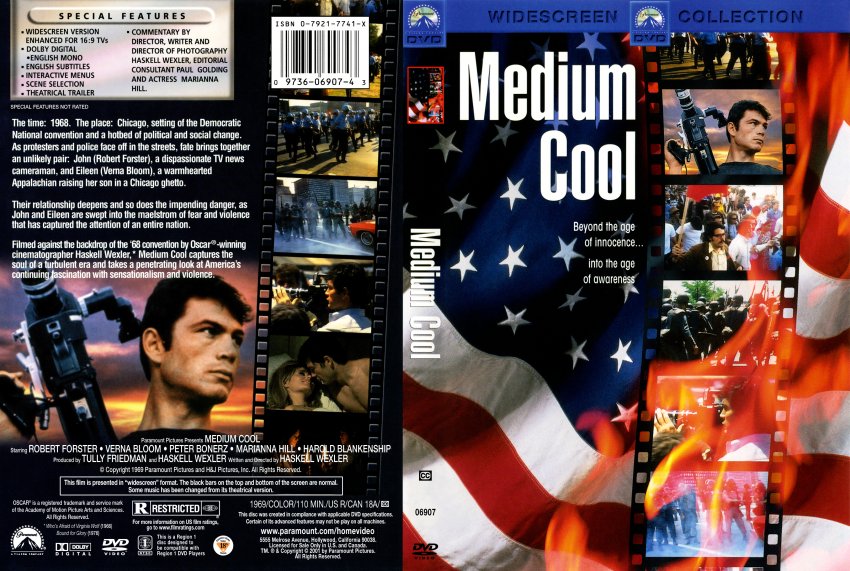


Medium Cool (1969) was a project shadowed by the FBI, saddled with a market-inhibiting X rating, and released with tepid support from a nervous studio. Not surprisingly, despite attracting very favorable reviews, it was not big hit at the box office. But over the years its reputation rose steadily, and eventually the movie found its proper place in the pantheon of the great films of the New Hollywood era. A worthy recipient, then, of the full Criterion Treatment, with a sparkling new special edition DVD and Blu-Ray; among its many features are a new interview with writer-director-cinematographer Haskell Wexler and the very welcome inclusion of (a slightly edited version of) the valuable but obscure 2001 BBC television documentary about the film, Look Out Haskell, It's Real."

As his triple-threat credits suggest, Medium Cool was very much Wexler's project. One of the hottest cinematographers in the business — just off an academy-award winning turn for Who's Afraid of Virginia Wolf (1966) and the big hit In the Heat of the Night (1967) — and with the emergence of a New American Cinema that took low-budget chances on new talent, Wexler was given a shot at the director's chair. And to his credit, the ambitious, confident cameraman didn't play it safe but threw everything he had into a risky project that he believed in.

With a background in documentary filmmaking, Wexler was influenced by a philosophy associated with the French New Wave (many of whose participants had similar apprenticeships), that challenged the reification of a divide between "fiction" and "non-fiction" films. Documentaries, they insisted, could not show an objective truth but offered only one interpretation of events, presented as a narrative following classical storytelling rules; realities that were, moreover, altered by the presence of cameras that produced self-consciousness and performance. Conversely, fiction films, especially those made on locations and with a new wave sensibility designed to reflect the personal experiences of their creators, were in many ways also documentary records of a certain type of reality. With Medium Cool, Wexler dove headlong into the blurry intersection between the two, embedding a fictional (and often improvised) story within very real situations. Often featuring non-actors going about their unscripted business, in many scenes only the principal players are aware that a movie is being made. At times those actors were exposed to real danger — placed, for example, in the midst of what the report of a National Commission would describe a few months afterwards as a "police riot." On the streets of Chicago, Wexler's camera became one among many that were capturing the events as they unfolded — and he was among those tear gassed, and was blinded for twenty-four hours.

The politically sensitive Wexler was irresistibly drawn from Hollywood back to his home town, Chicago, and the Democratic National Convention that would be held there in August 1968. Convinced that "something" would happen there — a violent confrontation, of some type, seemed certain — he crafted a story that could be interwoven into those events, unforeseeable in their specifics, as they unfolded. Wexler was later accused of incitement, but his cameras did little more than anticipate the inevitable explosion. Nineteen sixty-eight took care of the rest.

It was a very bad year. In January, the surprise Tet Offensive fundamentally altered the trajectory of the Vietnam War. The unprecedented communist strikes failed to achieve their military goals, but they made plain that no matter how many troops it poured in, the United States was not going to achieve its political objectives in the war, despite the unceasingly optimistic reports previously proffered by the Johnson Administration. (The U.S. would suffer over 4,700 combat deaths in the first three months of 1968. And with 500,000 American troops in the country, the war was being fought — at best — to a bloody stalemate.) In March, Johnson was embarrassed in the New Hampshire democratic primary by the strong showing of anti-war candidate Eugene McCarthy; within days, Robert Kennedy dropped into the race; within weeks, LBJ shocked the nation by dropping out. In April, Martin Luther King was assassinated. Kennedy, campaigning in Indianapolis, delivered the news to a stunned, mostly black audience, and delivered a short, moving speech appealing for calm. Scores of American cities erupted in riots that night, but Indianapolis was not one of them. In June, Kennedy would be assassinated moments after celebrating victory in the crucial California primary, his final words, "on to Chicago and let's win there," still hanging in the air as the shots rang out.

To Read the Rest

Monday, March 25, 2013

Radio Open Source -- Dennis Lehane: Between Dorchester Ave and Sunset Boulevard

Dennis Lehane: Between Dorchester Ave and Sunset Boulevard
Radio Open Source


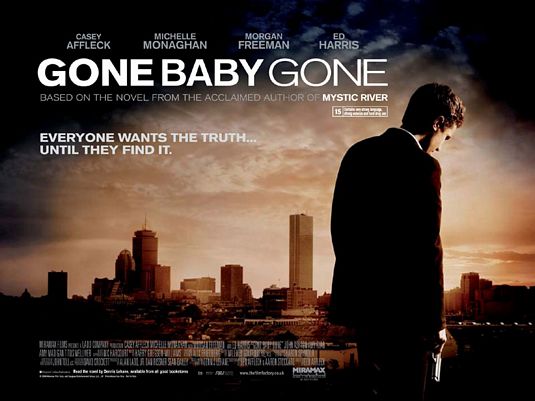
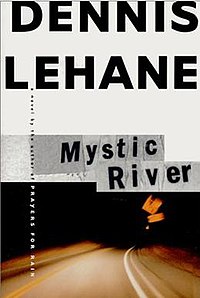
Dennis Lehane so rules the neighborhood of Noir (“Nwaaah,” as we say in Boston) that he gets street credit for work he didn’t write, like “The Departed” and “The Town.” But does the author of “Mystic River,” “Gone Baby Gone” and the new Moonlight Mile get credit enough for a body of artistic work now far beyond private-eye or “genre” of any kind — way beyond his gift for Boston-accented dialog?

Our conversation is about the murkier depths of his Gothic novel and movie “Shutter Island,” with Leonardo diCaprio as a U.S. Marshall apparently trapped in a Boston Harbor lock-up for the criminally insane in the 1950s. I think it’s Lehane’s version of the War on Terror. He says it’s more nearly his answer to the Patriot Act, his reliving of the Cold War and the repressions it licensed in America. “All past is prologue,” he remarks. “Noir is without a doubt the ultimate genre of ‘you cannot outrun the past’… That’s ‘Mystic River’: you cannot outrun your nature. You cannot escape the past.” “Shutter Island” in that sense turns out to be Dennis Lehane’s recapitulation of McCarthyism (an American Stalinism): those good old days when the CIA experimented with LSD and other psychotropic drugs on Federal prisoners and other unsuspecting guinea pigs. It was a time, he’s saying, that foreshadowed the suspension of habeas corpus and the tortures of Guantanamo and Abu Ghraib in the George Bush years.

To Read the Rest of the Introduction and to Listen to the Episode

Wednesday, March 6, 2013

Seth Rosenfeld: A Secret History of America in the 60s

Lynum had plenty of information to share. The FBI's files on Mario Savio, the brilliant philosophy student who was the spokesman for the Free Speech Movement, were especially detailed. Savio had a debilitating stutter when speaking to people in small groups, but when standing before a crowd and condemning his administration's latest injustice he spoke with divine fire. His words had inspired students to stage what was the largest campus protest in American history. Newspapers and magazines depicted him as the archetypal "angry young man," and it was true that he embodied a student movement fueled by anger at injustice, impatience for change, and a burning desire for personal freedom. Hoover ordered his agents to gather intelligence they could use to ruin his reputation or otherwise "neutralize" him, impatiently ordering them to expedite their efforts.

Hoover's agents had also compiled a bulging dossier on the man Savio saw as his enemy: Clark Kerr. As campus dissent mounted, Hoover came to blame the university president more than anyone else for not putting an end to it. Kerr had led UC to new academic heights, and he had played a key role in establishing the system that guaranteed all Californians access to higher education, a model adopted nationally and internationally. But in Hoover's eyes, Kerr confused academic freedom with academic license, coddled Communist faculty members, and failed to crack down on "young punks" like Savio. Hoover directed his agents to undermine the esteemed educator in myriad ways. He wanted Kerr removed from his post as university president. As he bluntly put it in a memo to his top aides, Kerr was "no good."

Reagan listened intently to Lynum's presentation, but he wanted more--much more. He asked for additional information on Kerr, for reports on liberal members of the Board of Regents who might oppose his policies, and for intelligence reports about any upcoming student protests. Just the week before, he had proposed charging tuition for the first time in the university's history, setting off a new wave of protests up and down the state. He told Lynum he feared subversives and liberals would attempt to misrepresent his efforts to establish fiscal responsibility, and that he hoped the FBI would share information about any upcoming demonstrations against him, whether on campus or at his press conferences. It was Reagan's fear, according to Lynum's subsequent report, "that some of his press conferences could be stacked with 'left wingers' who might make an attempt to embarrass him and the state government."

Lynum said he understood his concerns, but following Hoover's instructions he made no promises. Then he and Harter wished the ailing governor a speedy recovery, departed the mansion, slipped into their dark four-door Ford, and drove back to the San Francisco field office, where Lynum sent an urgent report to the director.

The bedside meeting was extraordinary, but so was the relationship between Reagan and Hoover. It had begun decades earlier, when the actor became an informer in the FBI's investigation of Hollywood Communists. When Reagan was elected president of the Screen Actors Guild, he secretly continued to help the FBI purge fellow actors from the union's rolls. Reagan's informing proved helpful to the House Un-American Activities Committee as well, since the bureau covertly passed along information that could help HUAC hold the hearings that wracked Hollywood and led to the blacklisting and ruin of many people in the film industry. Reagan took great satisfaction from his work with the FBI, which gave him a sense of security and mission during a period when his marriage to Jane Wyman was failing, his acting career faltering, and his faith in the Democratic Party of his father crumbling. In the following years, Reagan and FBI officials courted each other through a series of confidential contacts. And after Reagan emerged as a leading conservative spokesman in the fifties, Hoover went beyond the bounds of his jurisdiction and secretly gave him personal and political help. He even lent Reagan a hand in keeping track of his own wayward children, Maureen and Michael. Now the long courtship between the FBI director and the former movie star would pay off for them both.

The FBI would become deeply involved in the clash over free speech at Berkeley between the social forces represented by Reagan, Kerr, and Savio. Each of these men had a transforming vision of America and exerted extraordinary and lasting influence on the nation. By tracing the bureau's involvement with these iconic figures, this book reveals a secret history of America in the sixties. It shows how the FBI's dirty tricks at Berkeley helped fuel the student movement, damaged the Democratic Party, launched Ronald Reagan's political career, and exacerbate the nation's continuing culture wars. Above all, it illustrates the dangers that the combination of secrecy and power pose to democracy, especially during turbulent times. (7-8)

Rosenfeld, Seth. Subversives: The FBI's War on Student Radicals, and Reagan's Rise to Power. Farrar, Straus and Giroux, 2012.

Sunday, March 3, 2013

David Simon on The Wire (2002-2008)


Instead of the usual good-guys-chasing-bad-guys framework, questions would be raised about the very labels of good and bad, and, indeed, whether such distinctly moral notions were really the point. The show would instead be about untethered capitalism run amok, about how power and money actually root themselves in a postmodern American city, and, ultimately, about why we as an urban people are no longer able to solve our problems or heal our wounds. (36)

The Wire depicts a world in which capital has triumphed completely, labor has been marginalized and monied interests have purchased enough political infrastructure to prevent reform. It is a world in which the rules and values of the free market and maximized profit have been mistaken for a social framework, a world where institutions themselves are paramount and every day human beings matter less. (36)

But instead of the old gods, The Wire is a Greek Tragedy in which the postmodern institutions are the Olympian forces. It's the police department, or the drug economy, or the political structures, or the school administration, or the macroeconomic forces that are throwing the lightning bolts and hitting people in the ass for no decent reason. (37)

David Simon, quoted in Watson, Garry. "The Literary Critic, the Nineteenth Century Novel and The Wire." Cineaction #84 (2011): 32-40.

Wednesday, February 20, 2013

Democracy Now Headlines: Palestinian Filmmaker Behind "5 Broken Cameras" Detained at LAX Ahead of Oscars

Palestinian Filmmaker Behind "5 Broken Cameras" Detained at LAX Ahead of Oscars
Democracy Now


A Palestinian filmmaker and his family were detained at Los Angeles International Airport on Tuesday after arriving to attend this weekend’s Academy Awards. The filmmaker, Emad Burnat, is nominated in the Best Documentary category for "5 Broken Cameras," which documents the growth of a resistance movement to the Israeli separation wall in the West Bank village of Bil’in. In a series of Twitter messages, the filmmaker Michael Moore said immigration officers told Burnat he would not be allowed to enter the country even after he showed them his Oscar invite. Burnat and his family were eventually released after Moore phoned Academy attorneys. Moore quoted Burnat as saying: "It’s nothing I’m not already used to. When [you] live under occupation, with no rights, this is a daily occurrence."

Link to Today's Headlines

Wednesday, October 31, 2012

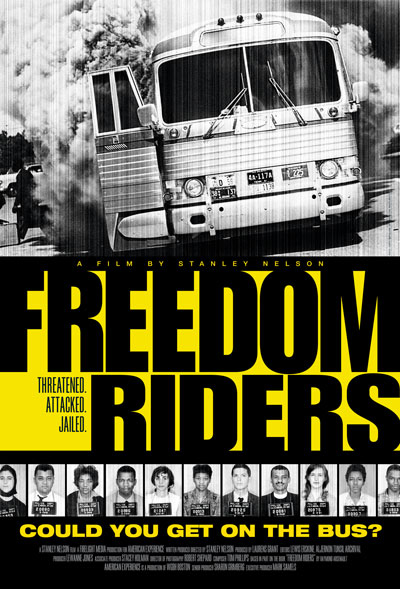
Freedom Rides (USA: Stanley Nelson, 2012: 117 mins)


I was working with this documentary with Peace Studies students last week and I was amazed, inspired and awed at the courage and passion of the students who participated in the Freedom Rides.

To watch it online