Showing posts with label Cinematography. Show all posts

Monday, October 28, 2013

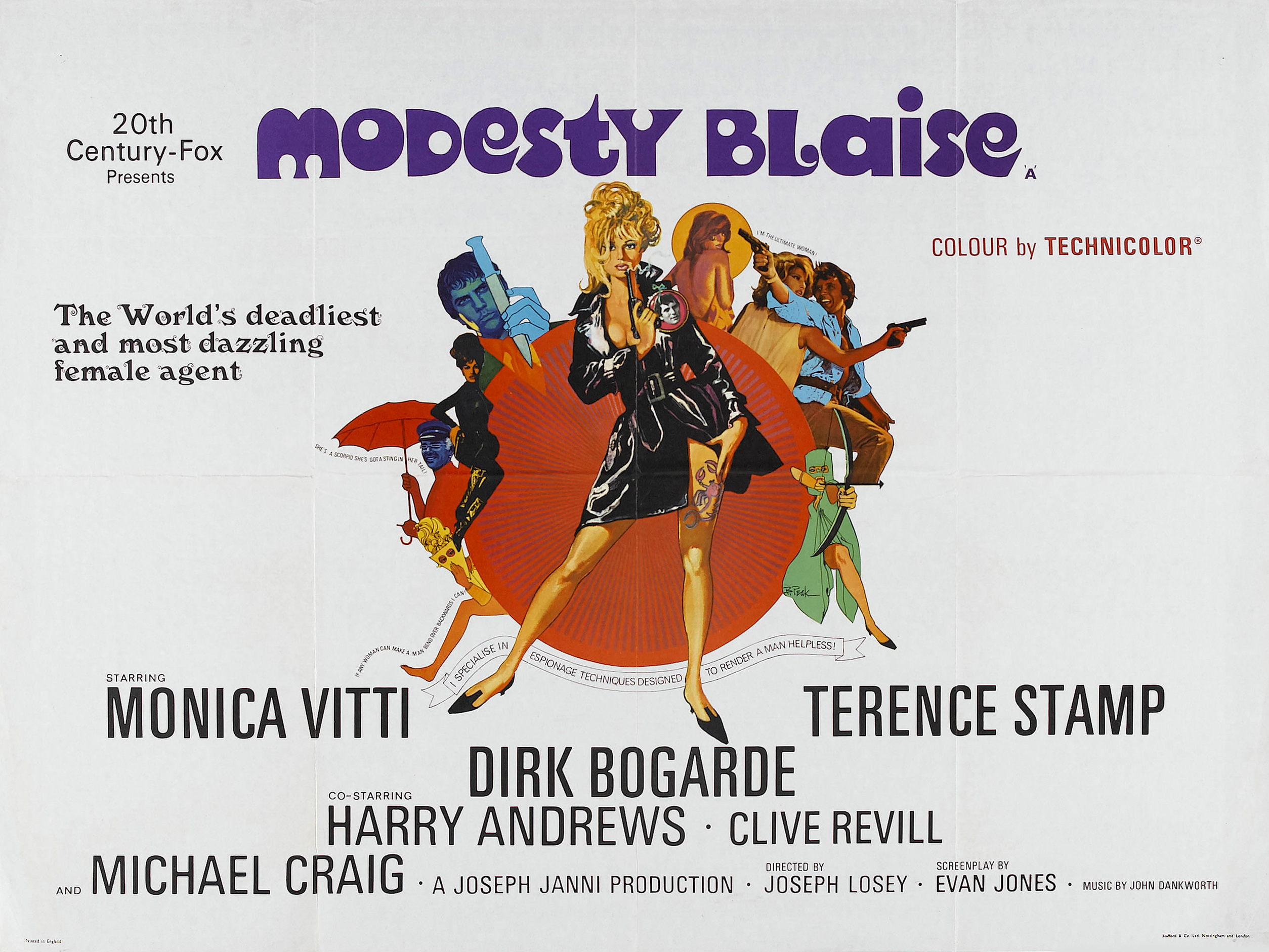
Catherine Grant: Notes on Mirror Visions in Modesty Blaise

Notes on Mirror Visions in Modesty Blaise
by Catherine Grant
La Furia Umana


Modesty Blaise (Joseph Losey, 1966) travels the cinematic distance between an opening shot of the seemingly contented sleeping face of its star Monica Vitti and an extreme close-up of her eponymous character’s over-stimulated, rapacious look directly at the camera in the film’s final frames. This is a deceptively simple journey, perhaps. But, while making it, what she and certainly we do with our eyes repeatedly involves mirrors, as is so often the case in Losey’s looking-glass cinema. What Losey and his cinematographer Jack Hildyard achieve with reflective surfaces in this pop and pop art spy film, a ‘remediation’ of Peter O’Donnell’s much loved comic strip (1963-1986), however, has not been nearly as well received as the director’s earlier signature experiments with those forms, for example in The Servant (1963), or in Eve (1962), another of his ‘cosmopolitan’ films. In the latter work, locations in Venice afforded him the challenge of photographing, for the first time, ‘reflected surfaces: mirrors – one of his most cherished symbols – and water, in baths, fountains, canals and the sea’ [Edith de Rham, Joseph Losey (London: André Deutsch, 1991), p. 133]. Are Modesty Blaise’s multiple mirrorings a symptom of unrestrained and muddled fetishism, or, integral to what Durgnat takes as Losey’s film poetry? The following notes, and an accompanying video essay, offer some specular reflections.

To Read the Rest of the Essay

Mirror Visions in MODESTY BLAISE (Joseph Losey, 1966) from Catherine Grant on Vimeo.

Wednesday, October 16, 2013

Werckmeister Harmonies (Hungary/Italy/Germany/France: Bela Tarr, 2000)


Werckmeister Harmonies (Hungary/Italy/Germany/France: Bela Tarr, 2000: 145 mins

Cutler, Aaron. "Multiple Vision: Deciphering the isolated gazes in the films of Béla Tarr." Multiple Image Source (February 2012)

Flanagan, Matthew. "Towards an Aesthetic of Slow in Contemporary Cinema." 16:9 (November 2008)

North, Dan. "“All a Man Can Do is Look Upon it”: What’s With the Werckmeister Whale?" Spectacular Attractions (December 3, 2009)

Romney, Jonathan. "Bela Tarr." Exile Cinema: Filmmakers at Work Beyond Hollywood ed. Michael Atkinson. Albany, NY: SUNY Press, 2008: 73-78. [Professor has copy]

Liza Bear: Christopher Boe on Love and Personal Identity in Reconstruction

Christopher Boe on Love and Personal Identity in "Reconstruction"
by Liza Bear
Indiewire


Inspired by a Jacques-Henri Lartigue photograph of a woman standing in a room with empty bookcases, Danish director Christoffer Boe's first feature "Reconstruction" fittingly won the prestigious Camera D'or at Cannes in 2003 and a Golden Plaque for Manuel Alberto Claro's luminous wide-screen cinematography. It brings closure to the exploration of themes of love and personal identity begun in three earlier shorts, "Obsession," "Virginity" and "Anxiety."

"They're all about a young male being obsessed by a beautiful woman and then being trapped in his own logic of what love is," says Boe, 30, a passionate still photographer as well as moviemaker. It's that logic which Boe dissects in "Reconstruction."

As its title suggests, Boe uses a fractured narrative and startling visuals to create a haunting rumination on the mysteries of desire (and the consequences of acting them out), rather than a romantic comedy. A kind of triangular square dance, "Reconstruction" sports excellent performances from its leads, with Nikolaj Lie Kaas playing Alex as a cypher and Maria Bonnevie doubling up as both Alex's steady girl-friend Simone and his new flame Aimee. It doesn't help Alex that Aimee is married to older man August (Krister Henriksson), who happens to be a writer. But it does give a few extra twists to the narrative. August is the film's narrator. There are echoes of Francois Ozon's cryptic thriller "Swimming Pool" here, though style and sensibility are poles apart. Having an attractive live-in girl-friend doesn't stop Alex from one day falling for Aimee, August's wife. A narrator who's also a character in the film naturally raises questions about what's real and what's imaginary. But then, so does being in love. The next day, Alex's world has changed, literally. His apartment has disappeared and so have his friends. An existential conundrum? Maybe. Or rather an attempt to create a metaphor for the paradigm shift that love induces.

To Read the Interview

Monday, September 16, 2013

Haskell Wexler -- One Scene: The Cranes Are Flying

One Scene: The Cranes Are Flying
By Haskell Wexler
Current


I first saw Mikhail Kalatozov’s The Cranes Are Flying in Chicago in 1957. The film’s cinematography, by the great Sergei Urusevsky, has been a major influence on my career. The shot in the film that stands out most for me starts at about twenty-five minutes in. It begins handheld, when the character Veronica looks out the window of a bus, and continues out into a vast crowd of people. Then there’s a fast lateral movement going out of the bus and past a car, which could be just a great handheld move or was perhaps done on an improvised dolly. We can see a wide street through the crowd. Veronica stops for a beat of three seconds at the edge of the boulevard—at this moment, a crane seat was slipped under Sergei. The camera then cranes up to see the tanks and a wide view of the crowd.

To Read the Rest and to Watch a Video of the Shot

Wednesday, September 4, 2013

Nick Schager - Stylized Realism: The Cinematography of Breaking Bad, Season 1

Stylized Realism: The Cinematography of Breaking Bad, Season 1
by Nick Schager
Roger Ebert


While cinematographer Michael Slovis has, since he came aboard in season two, helped define the visual signatures of "Breaking Bad," the show's aesthetics were firmly established from the beginning. Over the course of its maiden seven episodes, AMC's hit series set itself apart from much of its small-screen competition via a distinctive and daring look, one whose bracing realism evolved to include ever-more-inventive stylization.

That development grew out of its narrative, which details high-school chemistry teacher Walter White (Bryan Cranston) entering the criminal world of meth production and sales alongside former student-turned-dealer Jesse Pinkman (Aaron Paul). Like its protagonist, "Breaking Bad"'s style is one that regularly segues between the mundane and the outrageous, charting its various characters' emotional, psychological and logistical circumstances through an exciting blend of anxious handheld camerawork, tense spatial compositions, evocative visual angles, and vibrant use of shadow and light.

Those hallmarks are present from the pilot, in which Walt, shortly after his 50th birthday, learns that he has lung cancer and strikes up a meth-cooking partnership with Jesse. Directed by creator Vince Gilligan and shot—on film, per the show's custom—by John Toll ("Braveheart," "The Thin Red Line"), this first episode sets up much of the show's formal template, including a palette of burned-in colors, textured chiaroscuro, frequent use of natural (or natural-looking) light, and cinematography that's alternately tranquil and edgy.

It's an aesthetic founded on contrasts, and mirrors both Walt's own state of mind and his literal caught-between-different-worlds situation. When Walt and Jesse first meet in the pilot, their faces are half masked in shadow—an expression of their good/bad duality, as well as their two-sides-of-the-same-coin kinship. And when Walt confronts bullies mocking his cerebral palsy-afflicted son Walt Jr. (RJ Mitte), Gilligan and Toll utilize a series of straightforward camera set-ups to highlight the humdrum ordinariness of the locale as a means of making Walt's ensuing violent outburst all the more shocking.

Season one's first episodes are typified by the deft interplay between visual stasis and bumpiness. While there's a constant restlessness to "Breaking Bad"'s handheld cinematography, more static compositions often reflect a given on-screen character's confidence, power or suppressed rage. There's virtually no movement when Walt—newly empowered by getting away with murder—potently pounces on Skylar (Anna Gunn) in bed at the close of episode one, or when an angry Walt patiently sits through his relatives' pleas and outbursts, and then asserts his own agency, during episode five's intervention. The stationary camera is one of control.

To Read the Rest and To Watch the Video

Friday, August 23, 2013

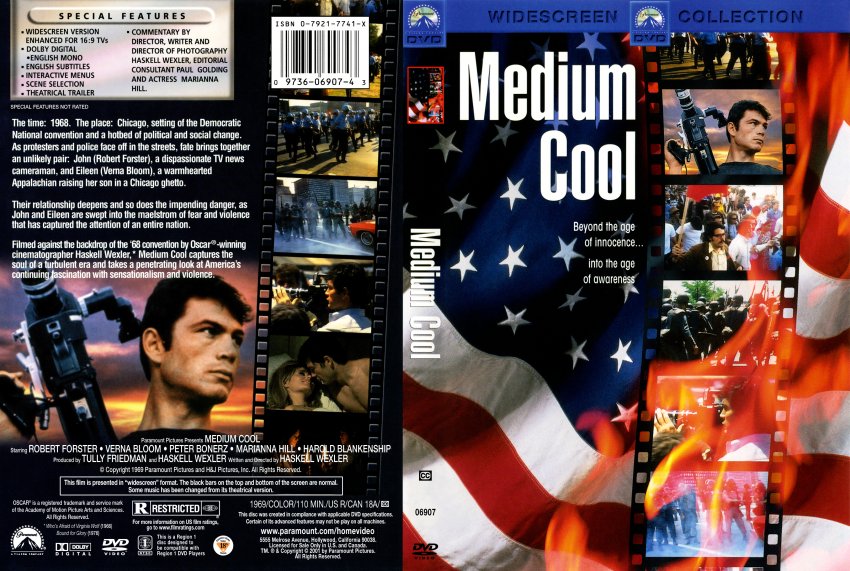
Jonathan Kirshner - The Whole World Is Watching: Haskell Wexler's Medium Cool

The Whole World Is Watching: Haskell Wexler's Medium Cool on DVD
by Jonathan Kirshner
Bright Lights Film Journal


Medium Cool (1969) was a project shadowed by the FBI, saddled with a market-inhibiting X rating, and released with tepid support from a nervous studio. Not surprisingly, despite attracting very favorable reviews, it was not big hit at the box office. But over the years its reputation rose steadily, and eventually the movie found its proper place in the pantheon of the great films of the New Hollywood era. A worthy recipient, then, of the full Criterion Treatment, with a sparkling new special edition DVD and Blu-Ray; among its many features are a new interview with writer-director-cinematographer Haskell Wexler and the very welcome inclusion of (a slightly edited version of) the valuable but obscure 2001 BBC television documentary about the film, Look Out Haskell, It's Real."

As his triple-threat credits suggest, Medium Cool was very much Wexler's project. One of the hottest cinematographers in the business — just off an academy-award winning turn for Who's Afraid of Virginia Wolf (1966) and the big hit In the Heat of the Night (1967) — and with the emergence of a New American Cinema that took low-budget chances on new talent, Wexler was given a shot at the director's chair. And to his credit, the ambitious, confident cameraman didn't play it safe but threw everything he had into a risky project that he believed in.

With a background in documentary filmmaking, Wexler was influenced by a philosophy associated with the French New Wave (many of whose participants had similar apprenticeships), that challenged the reification of a divide between "fiction" and "non-fiction" films. Documentaries, they insisted, could not show an objective truth but offered only one interpretation of events, presented as a narrative following classical storytelling rules; realities that were, moreover, altered by the presence of cameras that produced self-consciousness and performance. Conversely, fiction films, especially those made on locations and with a new wave sensibility designed to reflect the personal experiences of their creators, were in many ways also documentary records of a certain type of reality. With Medium Cool, Wexler dove headlong into the blurry intersection between the two, embedding a fictional (and often improvised) story within very real situations. Often featuring non-actors going about their unscripted business, in many scenes only the principal players are aware that a movie is being made. At times those actors were exposed to real danger — placed, for example, in the midst of what the report of a National Commission would describe a few months afterwards as a "police riot." On the streets of Chicago, Wexler's camera became one among many that were capturing the events as they unfolded — and he was among those tear gassed, and was blinded for twenty-four hours.

The politically sensitive Wexler was irresistibly drawn from Hollywood back to his home town, Chicago, and the Democratic National Convention that would be held there in August 1968. Convinced that "something" would happen there — a violent confrontation, of some type, seemed certain — he crafted a story that could be interwoven into those events, unforeseeable in their specifics, as they unfolded. Wexler was later accused of incitement, but his cameras did little more than anticipate the inevitable explosion. Nineteen sixty-eight took care of the rest.

It was a very bad year. In January, the surprise Tet Offensive fundamentally altered the trajectory of the Vietnam War. The unprecedented communist strikes failed to achieve their military goals, but they made plain that no matter how many troops it poured in, the United States was not going to achieve its political objectives in the war, despite the unceasingly optimistic reports previously proffered by the Johnson Administration. (The U.S. would suffer over 4,700 combat deaths in the first three months of 1968. And with 500,000 American troops in the country, the war was being fought — at best — to a bloody stalemate.) In March, Johnson was embarrassed in the New Hampshire democratic primary by the strong showing of anti-war candidate Eugene McCarthy; within days, Robert Kennedy dropped into the race; within weeks, LBJ shocked the nation by dropping out. In April, Martin Luther King was assassinated. Kennedy, campaigning in Indianapolis, delivered the news to a stunned, mostly black audience, and delivered a short, moving speech appealing for calm. Scores of American cities erupted in riots that night, but Indianapolis was not one of them. In June, Kennedy would be assassinated moments after celebrating victory in the crucial California primary, his final words, "on to Chicago and let's win there," still hanging in the air as the shots rang out.

To Read the Rest

Sunday, April 21, 2013

Rob White: Interview with Manuel Alberto Claro

Interview with Manuel Alberto Claro
by Rob White
Film Quarterly


Cinematographer for Lars von Trier’s Melancholia, Manuel Alberto Claro was born in Santiago, Chile in 1970. His family moved to Denmark in 1974, after the Pinochet coup. Having graduated from the European Design Institute, Milan, he worked in his twenties as a photographer’s assistant in Copenhagen and New York. At age 27, he changed tack and studied cinematography at the Danish National Film School. His second feature in his new professional capacity, Reconstruction (Christoffer Boe, 2003), gained the Caméra d’Or at Cannes, and Claro’s career has gone from strength to strength. Melancholia won the award for best film at the 2011 European Film Awards, with Claro taking the cinematography prize. He is due to collaborate again with von Trier on the director’s next project, The Nymphomaniac.

“My aim is to make images that are in love with the story and not with themselves,” Claro told Idol Magazine, adding that his professional role model is Harris Savides, whose credits include Margot at the Wedding (Noah Baumbach, 2007) and Last Days (Gus Van Sant, 2005): “If you can create poetic images, full of texture and emotional presence, out of something trivial, then you are good,” said Claro.

Melancholia has its own wedding and last day, and neither event ends in celebration. The marriage between Justine (Kirsten Dunst) and Michael (Alexander Skarsgård) goes off the rails before it can even be consummated (Justine prefers a roll in the golf-bunker sand with one of Michael’s colleagues), and Melancholia is bookended by slow-motion collisions between the eponymous renegade planet and Earth. Yet von Trier’s anti-disaster film is neither tragic nor miserable. “When I left the theater and exited out into Cannes, I felt light, rejuvenated and unconscionably happy,” wrote the Village Voice’s J. Hoberman after a festival screening. My own reaction was rather similar. Despite its chaotic nuptials and global wipeout, Melancholia does not induce melancholia, at least if Freud’s description of the state in “Mourning and Melancholia” is to be taken as gospel: “profoundly painful dejection, cessation of interest in the outside world, loss of the capacity to love.”

Von Trier’s wry DVD commentary (in conversation with University of Copenhagen professor Peter Schepelern, included on the U.K. edition published by Artificial Eye) often zeroes in on transient pleasures, such as the improvised moment when Udo Kier, in the role of the thin-skinned Wedding Planner, lumbers after a flaming paper lantern as if out of empathy for the object’s own flimsy epidermis. The director also rues small infelicities that most viewers would never notice, such as CGI complexion-smoothing (“skin fixes”) that he now considers unsatisfactory. Since he also admits to so-called Obsessive Compulsive Disorder, perhaps his focus on minutiae should be classed as pathological persnicketiness—but that would be to prefer armchair psychoanalysis to the beautiful variegation of Melancholia, to which Claro’s cinematography contributes so much.

It is an eccentric, rogue film that never obeys the usual rules of stylistic and emotional consistency. Paradoxes and incongruities abound from the start: the miniature drama of Justine opening her eyes against a background of avian rainfall is juxtaposed with a cosmic conflagration rendered as one liquescent heavenly body plunging into another. And if von Trier’s film embraces sci-fi, Wagner, uncanny tableaux, homages to Bergman and Tarkovsky, Dogme-style handheld jitteriness, there is also a long take of summer quiet as Claire (Charlotte Gainsbourg) dozes which is reminiscent, as Schepelern suggests during the commentary, of Rohmer’s bittersweet idylls. To dwell on such a detail, and to go further and think it more notable than the ensuing celestial firestorm, might after all involve a kind of melancholy, though one quite unfit for Freudianism.

To Read the Interview

Thursday, January 24, 2013

University of Kentucky: 2013 Greek Cinematography - Critical Approach and Discussion

The University of Kentucky and the College of Arts & Sciences, under the initiative of Prof. Haralambos Symeonidis, are inviting you to a series of Greek films with discussion, screened on 3 Sundays at 5.00 p.m. at the UK Athletic Association Auditorium of the William T. Young Library. The screenings are free of charge.

This event is sponsored by the UK College of Arts & Sciences and the Greek Orthodox Church of Lexington.

January 27th: Stella (Greece: Mihalis Kakogiannis, 1955: 90 mins)

February 24: A Touch of Spice (Greece: Tassos Boulmetis, 2003: 108 mins)

March 31: El Greco (Greece: Yannis Smaragdis, 2007: 119 mins)

Monday, November 26, 2012

Graham Daesler: Cutters' Way - The Mysterious Art of Film Editing

Cutters' Way: The Mysterious Art of Film Editing
by Graham Daesler
Bright Lights Film Journal

...

Porter's experiments, however fumbling they appear in hindsight, point us to a curious quandary at the heart of filmmaking: what is it that makes cutting work? How is it that we accept such a violent transition — whether it be from a wide shot to a close-up, from Paris to the Sahara desert, or from the seventeenth century to the present — as a cut? "Nothing in our day-to-day experience seems to prepare us for such a thing," Walter Murch observes. "From the moment we get up in the morning until we close our eyes at night, the visual reality we perceive is a continuous stream of linked images: In fact, for millions of years — tens, hundreds of millions of years — life on Earth has experienced the world in this way. Then suddenly, at the beginning of the twentieth century, human beings were confronted with something else — edited film."11 What prepared them for this? Not painting, not theater, not even literature, cinematic as some of Dickens's scenes now appear. Murch speculates that it was dreams. "We accept the cut because it resembles the way images are juxtaposed in our dreams," he writes. "In the darkness of the theater, we say to ourselves, in effect, 'This looks like reality, but it cannot be reality because it is so visually discontinuous; therefore, it must be a dream.'"12 Director John Huston saw it differently. Cinema, he said, was not just a reflection of our dream lives but the very essence of conscious thought, with its fitful jumble of visuals and sound: "To me the perfect film is as though it were unwinding behind your eyes, and your eyes were projecting it themselves, so that you were seeing what you wished to see. It's like thought. It's the closest to thought process of any art."13 Watch the final moments of his film The Dead (1987) and you'll have some idea of what he's talking about. As Gabriel Conroy (Donal McCann) gazes out the frosty filigree of his Dublin window, somberly musing on the emptiness of his life, the film, with no more than a few simple cuts, slips aboard his stream of consciousness as it glides from thought to thought: from past memories to future projections to the lonely churchyard on the hill where his wife's lover lies buried.

The first person to truly discover this cinematic language was D. W. Griffith, who was to early cinema what Jane Austen was to the English novel. He saw what Porter failed to see in The Life of an American Fireman: that you could crosscut between different points of view in a scene to create suspense. Perhaps his most signal technique, for which he is still remembered today, is the accelerated pace of cutting that he used during moments of heightened tension, as in The Lonely Villa (1909), The Lonedale Operator (1911), and The Birth of a Nation (1915), rapidly cutting between heroes and villains during chases and rescues. In this manner, he showed that, with some clever editing, he could subjugate time to his demands, either drawing it out for suspense or speeding it up for sudden denouement. Likewise, he dispensed with the custom, so reminiscent of the stage, of beginning a scene when a character enters a room, cutting instead at the moment of the important action, thereby accelerating the pace of the story. To show characters in thought, he used close-ups and cutaways (from a man's face, for example, to a shot of his sweetheart miles away) rather than the cartoonish dream balloons employed by previous filmmakers. Not only did this last technique prove that simple cuts could simulate consciousness, it established a dividing line between screen acting and stage acting that still exists to this day. In a tight close-up, a good actor need only think a thought to express it, rather than histrionically projecting to the back rows of the theater.

Early film cutting was a sometimes excruciating process. Editors viewed their movies in negative, making it difficult to tell one take from the next. Lacking any numbers on the film to guide them, they were forced to pore over millions of frames by hand, using minute alterations in the image to find their bearings. "Sometimes there'd be a tiny pinpoint on the negative and then you knew you were right," Margaret Booth recalls. "But it was very tedious work. Close-ups of Lillian Gish in Orphans of the Storm would go on for miles, and they'd be very similar."14 Most prohibitive, though, was the equipment, or rather the shocking lack of equipment. The essential tools of the trade consisted of a rewind bench, a magnifying glass, and an ordinary pair of scissors. The only way you could see the film in motion was to screen it, so editors took to pulling the film through their fingers to simulate movement. The work must have been exceedingly tiresome, yet it evokes a wonderful image, like some kind of strange tailor's shop, with reams of footage dangling from the walls and the editors, strands of film clenched in their teeth, unspooling bolts of celluloid before their eyes. If they wanted three seconds of footage, they held the film to the tip of their nose and pulled it out to the length of their arm. If they wanted to view it in progress, they hauled it into the projection room and screened it, then carried it back to the editing table to get chopped up some more.

All this changed with the invention of the Moviola in 1919. A chunky, frog-green machine with foot pedals to run the film and a four-inch spy hole to view it, the Moviola was the brainchild of Iwan Serrurier, a Dutch-born electrical engineer who designed the contraption on a whim, as a diversion from his job at the Southern Pacific Railroad Company in Pasadena. Originally, Serrurier tried to sell his gadget as a home-entertainment device (the name itself, Moviola, was chosen for its happy harmony with Victrola, the popular phonograph), but, at $600, it was too expensive for most families in 1920 to afford. Then in 1924, Serrurier ran across an editor at Douglas Fairbanks Studios who suggested he adapt it as an editing table for the movie industry. Serrurier "roughed together" a model that very weekend, turning it on its side and attaching a viewing lens and a hand crank he'd lifted from a clock.16 With that, the first editing machine was born. It arrived just in time, too. With the coming of sound, there was no way an editor, no matter how sharp-eyed, could sync sound to silent lips. To accomplish this aural feat, the Moviola was simply fitted with an additional sprocket for the soundtrack to run on, making possible the explosion of talkies that burst from Hollywood, beginning in 1927. After that, the device changed little. It was hefty, ugly, noisy (more than one editor compared the clanking it made to a sewing machine) and, because of its tilted viewer, required the user to sit hunched over all day at a forty-five-degree angle. Yet it remained the mainstay of the film industry for the next seventy years, an unequivocal, if curious, testament to its durability, almost as if the Model T had persisted as the car-of-choice until the new millennium.

To Read the Entire Essay

Monday, November 19, 2012

David Bordwell: Return to Paranormalcy

Return to Paranormalcy
by David Bordwell
Observations on Film Art

,,,

The broad task that Peli faced when he began work on Paranormal Activity was clear: How to make a diabolic-possession film different from the others? By then, and still, that variant of horror was pretty well-defined. And indeed the film Peli came up with wasn’t that original in outline. A couple is disturbed by mysterious noises and actions in their house. They call in experts and try to find the source of the disturbance. Eventually the woman becomes possessed and kills her lover.

Throughout, the conventions of the supernatural film rule: sudden blackouts, bone-shaking noises emitted by offscreen fiends, and characters exploring basements, closets, moonlit yards, and other scary spaces. Special effects are invoked to levitate victims or drag them by unseen hands. Occasionally we’re faked out by scares launched as pranks that some characters pull on others. As usual, normal, i.e. bourgeois American life, is devastated by supernatural forces. Cozy domestic surroundings, including an array of consumer goods, become menacing. Much of all this was pioneered by The Exorcist (1973), so the tradition has plenty of cobwebs on it.

Shooting in seven days on a small budget, Peli settled on a formal framework that borrowed from another tradition, that of the pseudo-documentary fiction film. This too goes far back, to This Is Spinal Tap (1984) and Bob Roberts (1992), and before to Stanton Kaye’s Georg (1964), Jim McBride’s David Holzman’s Diary (1967), and Mitchell Block’s No Lies (1972) , and Peter Watkins’ Culloden (1964) and The War Game (1965). More distant predecessors might be Welles’ 1938 War of the Worlds radio broadcast, or even the fake memoirs we find in the early years of the novel. Today the pseudo-documentary mode, used for comic or dramatic purposes, is familiar to us from television shows like The Office. This mode has its own conventions, such as to-camera interviews and the occasionally awkward framing, most noticeable in the recurring image of a fallen camera.

The pseudo-documentary approach had been tried in the horror film in the 1980s, but it gained attention at the end of the 1990s with The Last Broadcast (1998) and The Blair Witch Project (1999). No surprise: Horror films tend to be low-budget items, and shooting in a run-and-gun manner, with handheld shots and awkward sound, was both cheap and realistic-looking. A cycle emerged, exemplified most notably in the bigger-budget Cloverfield (2008).

The problem of the pseudo-documentary is to motivate the fact that someone is filming these dramas. Various solutions have been worked out. You might make the protagonist a filmmaker exploring a subject or creating a diary. Or you can pretend that the people being filmed are celebrities (as in Spinal Tap). Or make the act of filming an effort to document dramatic occurrences. Filmmakers face a second problem as well: motivating how the film has been made public. You can, for instance, present it as a TV or theatrical documentary, as Spinal Tap purports to be. More recently another solution has been found. You can suggest that this film has been discovered after the events were over.

Because of this rationale, the approach is sometimes called the “found-footage” treatment, or in Varietyese the “faux found-footage film.” I’m not delighted by this term because for a long time “found-footage” has referred to films like Bruce Conner’s A Movie or Christian Marclay’s The Clock, assembled out of existing footage scavenged from different sources. So I’ll call fictional movies like Blair Witch and Cloverfield “discovered footage” films.

One reason for this name is that these films hark back to an early tradition of literary fiction, that of the “topos of the discovered manuscript” or “the old oak chest.” Here a tale is presented as a manuscript found and prepared for publication by other hands. The purpose, at first blush, is to give the story an air of authenticity. The same urge prevails in the discovered-footage horror movies, which use this blatant artifice to play with the possibility that these weird happenings really took place. As the image surmounting this blog entry suggests, Peli linked his film to this tradition, even letting the all-too-real company Paramount Pictures attest to the veracity of what we’re going to see.

The development of the Paranormal series took place under the sign of rivalry. A great many horror films of the late 2000s and early 2010s used the pseudo-documentary approach, sometimes marking the footage as recovered. After the success of Peli’s original film, intense competition emerged. There was a blatant ripoff (Paranormal Entity, 2009), followed by many others, including the subtler pseudo-doc The Last Exorcism (2010), which seems to presume that we’ll take it as a found-footage item too.

Just as important, in making successors to the original film, Peli and his colleagues had to compete with themselves. So they freshened up their plots. Paranormal 2 features not a live-in couple but a family; Paranormal 3 centers on an unmarried mother, her live-in boyfriend, and her two daughters. Paranormal 4 features a family whose neighbors are a possessed mother and son.

Interestingly, the subsequent films supply relatively little mythical or doctrinal backstory. Although there are always one or two scenes in which the characters launch on some research, the plots mostly minimize exposition about the hows and whys of possession. (Contrast The Exorcist.) We get just enough hints to assume that there’s a demon who offers women worldly goods in exchange for innocent boys’ souls. Mostly the films concentrate on the characters’ responses, chiefly their quarrels about whether the weird happenings are supernaturally caused. Each film needs at least one blocking character, somebody whose skepticism, obstinacy, or cluelessness keeps the plot going and prevents the characters from simply getting the hell out.

The films also vary protagonists and the characters we’re attached to. Micah moves the plot forward in the first entry with his urge to document the weird happenings, while in the second, the father Daniel and his daughter Ali take turns probing what’s going on. In the third film, again it’s mostly a male filmmaker, Dennis, who propels the inquiry, while in the latest iteration, the narrative momentum is passed to the inquisitive teenage girl Alex.

Perhaps the most up- to-date way the filmmakers refresh the franchise is by making the various films interlock. The films set up a chronology that positions the original release as the third phase of a larger action. Paranormal 2 occurs just before the events of the first one, and Paranormal 3 flashes back eighteen years to supply some preconditions for the previous entries. Moreover, some portions of the plots overlap, so that scenes from one installment are replayed in another, explaining how the time frames mesh. This sort of shuffling with time and perspective is nowadays common both within films and across them; the second and third Bourne films offer good examples.

Above all, the filmmakers have created a new ecological niche by virtue of some initial stylistic choices Peli’s first film made. They were striking but exceptionally constraining. To produce more Paranormal films created a very specific set of problems: How to respect those initial constraints and yet rework them in unpredictable ways?

To Read the Entire Essay
Thursday, October 25, 2012

James Udden: Child of the Long Take: Alfonso Cuaron’s Film Aesthetics in the Shadow of Globalization

[Warning: the clip of the scene below gives away major plot details]

Child of the Long Take: Alfonso Cuaron’s Film Aesthetics in the Shadow of Globalization
by James Udden
Style


...

Given his Janus-faced career, it was hard to know what to expect stylistically from Cuaron in Children of Men given the direct involvement of Universal. He answers almost right away in the third shot of the opening scene as to how far he is now willing to go. Expertly introduced in this single shot is a grim, dying world in which the Clive Owen character is but one small, languid part. It is a tour de force in terms of its set design, lighting, camera movement and most of all its daringly intricate orchestration of multiple animate and inanimate elements. Yet the most telling sign is the duration of the shot: this is a long take of over fifty seconds, which with almost devious subtlety leads to a most unexpected denouement, an explosion segueing to a title shot with uncanny effect. It is an impressive beginning to a film which overall deeply impressed select viewers, critics and scholars alike. Alfonso Cuaron has accomplished the seemingly impossible: he proffers a dystopian message concerning globalization, yet he does it under the auspices of one of globalization’s key cultural players — Hollywood. Yet he also accomplishes this in indelible aesthetic terms. After seemingly reverting back to more conventional form with The Prisoner of Azkaban, the long take makes a roaring return in Children of Men, with an average shot length of just over sixteen seconds per, an astonishing figure for a present-day Hollywood feature which sometimes can average less than two seconds per shot (Hollywood 122). Moreover, even if slightly shorter on average than its Spanish-language predecessor a half a decade earlier, these long takes are more complex and more accomplished in their design. As we shall see, they are too good to be true. Indeed, these long takes are contrived spectacles in their own right.

There is an overall pattern for long take in Children of Men: the more action and violence a particular scene possesses, the longer the shot duration generally becomes. This does run counter to current Hollywood norms. Many have recently noted how big-budgeted, Hollywood action films in particular tend to lead the way in faster cutting rates which are often employed for maximum impact (Bordwell, Hollywood,122, 58-159; King, New Hollywood, 246). Children of Men, of course, is not a traditional action picture, but a science fiction work with deep philosophical underpinnings. Yet during its non-action scenes often involving conversations between characters, Cuaron is more likely to use conventional editing schemes, most of all the ever reliable shot/reverse shot. Cuaron saves his most audacious long takes for the sequences where violence and action are at their highest pitch, with the longest reserved for the prolonged battle at the refugee camp at the end. Despite their reliance on long takes in lieu of “impact” editing, it is these moments in the film which seem to be most memorable.

What is most telling is how these long takes give the appearance of taking place in “real” time and “continuous” space. Cleverly disguised is how they are often multiple shots melded together digitally in post-production. The above mentioned opening scene, for example, was shot over two days, the first day covering the indoor portion in the café, while the second day involved the complicated section outdoors. However, in the finished product, the third shot begins indoors and then proceeds seamlessly outdoors, meaning somehow a single, “continuous” long take was shot over two days time. Using the café doorframe at the moment Clive Owen leaves the frame, the camera is deviously slow to catch up, and the special effects crew disguised the cut digitally in post (Fordham 34). In short, the opening scene is not three shots, but four shots disguised as three with the last being a long take under false pretenses.

This is not an isolated instance in Children of Men. The now famous scene in the automobile took two months to plan, eight days to shoot on three separate locations. The camera’s impossibly free movements in the car were in fact impossible — they were only realized by being filmed in six separate sections where often not all of the actors were present at certain stages. Once again, this was all amalgamated into a single artificial long take by digital means (Fordham 39). Claiming to replicate the feel of a documentary, this shot is also impossibly precise for any documentary shooting as events transpire. True, they did use mostly available light in a real setting, allowing every flare and reflection on the glass to remain, much like in a documentary. But no documentarian has ever had the luxury of a twin-axis doggicam rigged above a missing car roof which is then digitally filled in during post-production. The resulting camera movements would also be impossible for a documentary — in fact in a way that has never been done by fictional filmmakers either. Particularly noteworthy is the powerful effect of that moment when the camera returns to the front and Julianne Moore reappears at the right edge of the frame, now undeniably no longer among the living. Documentarians are rarely able to be that measured, and are hardly that lucky.

The longest take in the film is over seven minutes in duration, occurring during the climatic battle at the refugee camp when Theo Faron attempts to rescue the kidnapped baby. Being one of the most complex long takes ever attempted, it is in fact too complicated to be a true “long take.” Instead, this was shot at two exterior locations plus a studio; the first major section was filmed at Bushey Hall, while the second part was shot two weeks later at Upper Heyford. This particular transition was digitally disguised using the corner of a building, much like what they had done with the doorframe of the café in the pre-credit sequence (Fordham 42). Additional elements added to the seemingly real but impossible spectacle: for example, no documentarian has been so fortuitous as to follow someone just as Theo Faron passes a soldier dying in his half-severed body, yet reaching out for him with one last moaning grasp at life. The three sections combined comprise a highly calculated, and remarkably well-orchestrated game of lost and found where Theo loses the mother and child to the engulfing chaos, only to find them again in that same chaos, all within this same faux long take. Meanwhile, by scanning this dense, dreary mise-en-scene, Cuaron and Lubezki not only disguise cuts, they continue a deeper strategy seen also in Y tu mama tambien: to show a much larger world than merely the characters themselves, a world that becomes almost hyper-real due to the careful construction of the long take coupled with other stylistic devices. So spectacular are these long takes that they become spectacles themselves which became endlessly talked about by reviewers, scholars and film aficionados alike. And that appears to have been precisely the reason why they are employed in the film during those particular sequences which proved to be the most challenging.

To Read the Entire Essay

Thursday, October 18, 2012

Current: Sight & Sound Poll 2012 -- Tokyo Story

Sight & Sound Poll 2012: Tokyo Story
Current

Not only was Yasujiro Ozu’s Tokyo Story ranked the third greatest film ever made in the critics’ poll (right below Vertigo and Citizen Kane), it came in first place in the directors’ poll. It’s clear: filmmakers continue to be influenced by Ozu, whose astonishing insights into the human condition are reflected in all his works. Tokyo Story, though, has long been held in particular esteem. Its every elegantly composed shot contains some poignant truth. Following an aging couple from the country as they visit their grown children in the city, only to be disillusioned by their offspring’s neglectful treatment of them, it’s a perfect distillation of Ozu’s pet theme of generational divide. Among its many filmmaking champions was the late Lindsay Anderson (If….), who in this 1993 interview (part of the documentary Talking with Ozu, available on our release of Tokyo Story) reminisces about first encountering Ozu in the fifties, thanks to a screening of Tokyo Story, and discusses the profound effect it had on him and on film itself.

To Read the rest and to watch video clips

Monday, October 15, 2012

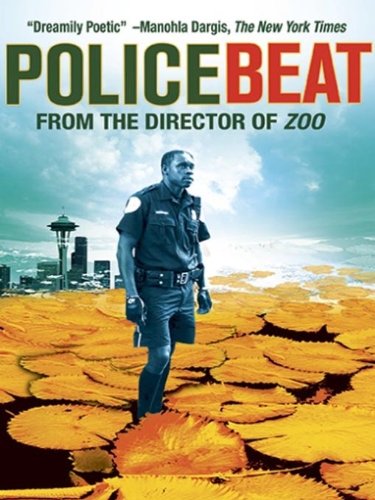
Spoiler Alert Radio: Sean Kirby - Cinematographer on Police Beat, Zoo, Lovely Still, Against The Current and The Tillman Story

Sean Kirby - Cinematographer - Police Beat, Zoo, Lovely Still, Against The Current, The Tillman Story
Spoiler Alert Radio


Cinematographer Sean Kirby shot the surreal film Police Beat, about an African-born bicycle cop encounters strange and mysterious situations on his police beat in urban Seattle.

In 2007, he re-teamed with writer/director team Robinson Devor and Charles Mudede and realized the controversial documentary Zoo about the life of an Enumclaw, Washington man who died as a result of an unusual encounter with a horse.

Some of his later credits include: Lovely Still, an emotionally moving holiday fable that tells the story of an elderly man discovering love for the first time, Against the Current, about a man, struggling with a tragic past, with an urgent calling who enlists two friends to help him swim the length of the Hudson River, starring Joseph Fiennes, and The Tillman Story, a documentary on the story of Pat Tillman.

To Listen to the Episode

Tuesday, September 11, 2012

Michael Goldman: Harsh Realms -- 5 cinematographers contribute to the new season of HBO’s fantasy-adventure series Game of Thrones

Harsh Realms: 5 cinematographers contribute to the new season of HBO’s fantasy-adventure series Game of Thrones.
by Michael Goldman
American Cinematographer

HBO’s series Game of Thrones documents the political, military and emotional entanglements between rival ancient kingdoms on a fictional continent. As such, it’s a period piece, a fantasy piece, an ensemble piece and a production that relies heavily on location, design and camerawork to pull off the illusion. The show is so big that it has required the efforts of multiple cinematographers; three shot season one, and five shot season two, which began airing last month.

After the production of its pilot, which involved some film capture, Game of Thrones evolved into the first hour-long HBO drama to be shot digitally. Every episode has been shot with Arri’s Alexa, and the cinematography team has relied on a state-of-the-art, data-centric workflow to shoot, process and assess imagery as the show traveled the globe from its home base in Northern Ireland to locations such as Malta, Croatia and Iceland.

“We were well into prep on season one [in the summer of 2010] before we decided to go with digital capture,” recalls co-producer Greg Spence. “After [cinematographers] Alik Sakharov [ASC] and Marco Pontecorvo [AIC] did three days of tests with 35mm, the Sony F35 and the Alexa, we chose the Alexa. Alik and Marco were impressed with its dynamic range and resolution, particularly in the highlights, and they felt it would pick up our costumes and textures nicely.”

For the show’s second season, the production switched to a file-based workflow. Footage was captured to Codex data recorders and taken to the dailies colorist and editors in the cutting room in Belfast, where most of the show was shot. (Season one was captured to HDCam-SR tape, and digital-imaging technicians did color correction on set.)

“We’ve had multiple cinematographers and DITs handling multiple units in different countries, so in season one we sometimes ended up with dailies that had divergent looks, which caused some confusion,” Spence explains. “Therefore, for season two, we brought [dailies colorist] Jon Reid to Belfast to operate alongside editorial at Yellowmoon, the post facility where the picture editors were based. Jon worked closely with our cinematographers during prep and shooting so they could get what they wanted, and we got a consistent look in the dailies.”

This season, Kramer Morgenthau, ASC shot the first two episodes and material featured in several others; P.J. Dillon shot episode three; Martin Kenzie shot episodes four through seven; and Jonathan Freeman, ASC shot episodes eight and ten. A stand-alone episode separate from the other locations (largely because of a major sea battle) became episode nine, shot by Sam McCurdy, BSC. This collection of cinematographers was necessary because extensive portions of the season were shot in Dubrovnik, Croatia, and Vatnajökull, Iceland, and that material was used for multiple episodes.

Therefore, says Morgenthau, the cinematographers did their best to “watch each other’s work and stay true to a cohesive look. No two directors of photography will shoot exactly the same way, but the material was so good, and there was such a consistent vision, that we were able to [maintain] a cohesive thread.” The cinematographers were frequently able to compare notes during prep before embarking on their separate shoots. They also used the Pix System online-dailies platform to view each other’s dailies through a secure connection, making Game of Thrones “a completely interconnected production” across the globe, in Morgenthau’s words.

To Read the Rest of the Article

Monday, September 10, 2012

American Cinematographer: Seamus McGarvey brings the Earth’s mightiest heroes to the big screen for Joss Whedon’s The Avengers

Seamus McGarvey, ASC, BSC brings the Earth’s mightiest heroes to the big screen for Joss Whedon’s The Avengers.
by Jon D. Witmer
American Cinematographer

Dirt and soot blanket six lanes of smoldering rubble that run the length of a city block, and burned husks of cars and trucks lie atop slabs of concrete jutting skyward in front of shattered storefronts. The street signs indicate this is what’s left of Manhattan’s 42nd Street and Vanderbilt Avenue intersection, but in actuality it’s East 9th Street in Cleveland, Ohio, on the 79th day of principal photography on The Avengers.

In a nearby alleyway, Captain America (Chris Evans) stands near a row of cameras amid the bustling crew, and not far away, director Joss Whedon is consulting with cinematographer Seamus McGarvey, ASC, BSC in video village. When both filmmakers come over to greet AC, Whedon says of his director of photography, “Seamus is very fast, which I love, and his style is very particular. It’s not over-thought, but it’s just hyperbolic enough for this kind of movie, which is insanity grounded in reality.”

The Avengers builds on the foundation laid by the Marvel Studios features Iron Man (AC May ’08), Iron Man 2 (AC May ’10), The Incredible Hulk, Thor (AC June ’11) and Captain America: The First Avenger (AC Aug. ’11), and takes its cues from the long-running Avengers comic-book series, which first hit newsstands in 1963. In the film, Strategic Homeland Intervention, Enforcement and Logistics Division leader Nick Fury (Samuel L. Jackson) assembles Captain America, Thor (Chris Hemsworth), Iron Man (Robert Downey Jr.), Hulk (Mark Ruffalo), Hawkeye (Jeremy Renner) and Black Widow (Scarlett Johansson) to face the global menace posed by Thor’s nefarious brother, Loki (Tom Hiddleston), who unleashes an extraterrestrial army in a bid to rule the world.

Principal photography began in April 2011 in New Mexico, and McGarvey says his three months of preproduction were “vital in terms of getting to grips with the scale of the project, and planning how we’d achieve certain sequences.” Shooting digitally was a given because of the extensive digital effects and the producers’ original plan to capture in 3-D. But when the crew tested a 3-D workflow by shooting the “tag” that followed the end titles of Thor with Red Epic cameras and Panavision Primo lenses in an Element Technica rig, “it was not a successful day of shooting,” says McGarvey.

“Although the native 3-D looked great, each setup took too long,” he explains. “I love when a crew picks up speed and creates its own inner dynamic. Joss, too, likes to keep the momentum up on the set. Shooting 3-D is like throwing treacle bombs into that beautiful élan. It wasn’t going to afford us the impetus and dynamism we needed.”

Marvel subsequently decided to capture in 2-D and convert to 3-D in post, and McGarvey abandoned the Epic for the Arri Alexa. “I preferred the look of the Alexa in terms of its range and its ‘roundness,’” he says. “I recognize [its image] as more akin to a film look.”

In fact, McGarvey was so impressed with the Alexa’s performance in his tests that he bought his own; christened “Schatzi de Bayer,” it served as the production’s A camera. The main unit also carried three Alexas (rented from Panavision Woodland Hills), one of which “was always rigged in Steadicam mode, and the other two were in studio mode and could easily be switched for handheld,” says the cinematographer.

“We shot with Primos, predominantly primes, but we also used 19-90mm and 24-270mm zooms, and occasionally we got a 3:1 long zoom,” he continues. “[With the zooms,] we tended to stay around 21mm and 27mm, or at the longer end, like 100mm.”

McGarvey typically maintained a T4 or T5.6 for day exteriors, and T2.8½ in other situations. “I shot everything at [the Alexa’s base ISO of] 800. When I tried to rate it lower, like at 400, it seemed to build up in the shadows, and I didn’t feel it had the same range. So I simply used IR neutral-density filters to bring down the stop for exteriors.”

The production also carried 10 Canon DSLR cameras, eight EOS 5D Mark IIs and two EOS 7Ds, all fitted with Canon EF lenses. Their footage was recorded to SanDisk Extreme Pro memory cards. “I prefer the 5D to the 7D,” McGarvey notes. “I like its larger sensor and the way the depth of field falls off quicker. But we used the 7Ds for any slow-motion work [that involved DSLRs].”

To Read the Rest of the Article