Showing posts with label Technology. Show all posts

Sunday, June 23, 2013

Moolaadé (Senegal/France/Burkina Faso/Cameroon/Morocco/Tunisia: Ousmane Sembene, 2004)


Moolaadé (Senegal/France/Burkina Faso/Cameroon/Morocco/Tunisia: Ousmane Sembene, 2004: 124 mins)

Bartlet, Olivier. "Adventures and Misadventures of African Cinema." Cinemas of the South (2006)

Borden, Amy. "At the global market: Ousmane Sembène’s Moolaadé and the economics of women’s rights." Jump Cut #53 (Summer 2011)

Bug Girl. Is My Vuvulzela Too Big?" Skepchick (June 20, 2010)

Coventry, Martha. "Making the Cut: It's a Girl! ... Or is it? When in doubt, why are surgeons calling the shots?" Ms. (Oct/Nov 2000)

Diop, Baba. "Ousmane Sembene: The Elder of Elders." Cinemas of the South (February 15, 2009)

Dotson-Newman, Nzinga. "Family Pressure on Young Girls for Genitalia Mutilation Continues in Kenya." Project Censored (2012)

Finney, Nikki. "The Greatest Show On Earth." (Read the poem/read an analysis of the poem/and listen to Nikki read it)

Halpern, Sue. "Breaking a Conspiracy of Silence." The New York Times Book Review 56.18 (November 19, 2009)

Marzana, Nicola. "The Art of Hunger: Re-Defining Third Cinema." 16:9 (November 2009)

Pride, Ray. "Woman is the Future of Man: Ousmane Sembene on Moolaade." Cinema Scope #21 (2004)

Santur, Hassan Ghedi. "On Being a Muslim in the West." Ideas (June 1, 2011)

Turkewitz, Julie. "Effects of Ancient Custom Present New Challenge to U.S. Doctors: Genital Cutting Cases Seen More as Immigration Rises." The New York Times (February 6, 2015)


Saturday, June 8, 2013

Film School: Who Killed the Electric Car

WHO KILLED THE ELECTRIC CAR
FilmSchool (KUCI)


An interview with Chris Paine director of Who Killed the Electric Car? — a documentary that investigates the birth and death of the electric car, as well as the role of renewable energy and sustainable living in the future.

To Listen to the Episode

Thursday, April 4, 2013

Dario Llinares -- Adapting an Askance Perspective: Philip K. Dick on Film

Adapting an Askance Perspective: Philip K. Dick on Film
by Dario Llinares
Alternate Takes


This summer’s remake of Total Recall extends the list of films inspired by the writing of Philip K. Dick. His novels and short stories offer some of the most eccentric and imaginative conceits in American literature, and are designed to question the fundamental metaphysical realities upon which our perception of the world is based. To define PKD as merely a science-fiction writer fails to capture the intricacy of thought and unlimited possibilities that his stories evoke.

Flow my Tears, the Policeman Said, like many of his novels, envisages a technologically advanced dystopia where genetic engineering is the main tool of a repressive police state. Ubik and Valis display PKD’s interest in the transcendental mind and the human interpretation of God, and the classic The Man in the High Castle re-imagines a post-World War II era if the Nazis had been triumphant. The very strangeness of his titles reflect an author who looked at the world askance. It is not over-praising to mention him in the same breadth as Orwell, Huxley, Bradbury and Burgess; but while those authors are ostensibly influenced by the tumultuous events of the first half of the 20th century, PKD was more an évocateur-du-jour of the cultural turn of the 1960s and what has come to be termed postmodernism.

PKD’s somewhat tortured life contained episodes of paranoia and psychological uncertainty, which played out in the characters he created and the ephemeral situations they inhabited. His own experiences of drug use, religion, romantic relationships (he was married five times), and the tumult of the Nixon administration helped him to capture the dissolving vicissitudes of a shifting cultural zeitgeist. Loss of identity in an increasingly schizophrenic, technologically-led, drug-infused, media-saturated world underpins his allegorical stories, with protagonists searching for ‘truths’ that seem diffuse and ineffable. If there is one central theme running through his oeuvre it is the constant questioning of what constitutes a human being.

Although he was lauded in the esoteric sci-fi world, his books never achieved mainstream success and, in an almost conspiratorial twist of ‘fate’, he died of a stroke in March 1982, three months before the release of Blade Runner. PKD’s cinematic legacy is found not only in specific adaptations, but a wider saturation of his ideas through contemporary postmodern film aesthetics. David Cronenburg, The Wachowskis, David Fincher, Spike Jonze, Michel Gondry and Christopher Nolan are just a few directors clearly influenced by the author’s writing.

In exalting such a visionary mind and its influence on contemporary cinema, however, a cautioning question somewhat inconveniently comes to mind. Why do so many PKD adaptations fail to live up to the intelligence, acerbic wit, strange imaginativeness or political insight of his original texts? For it is my contention that, even in the best examples of PKD-inspired cinema, much of the heteroclite themes, astute social representations and ambivalent outcomes are at best smoothed out, at worse omitted.

Of course, in the era of the CGI-laden blockbuster the futuristic speculative fictions of PKD are easily co-opted into the testosterone infused visual spectacle of event cinema. For example, John Woo’s Paycheck (2003) and Lee Tamahori’s Next (2007) would be highly contemptuous if they weren’t so forgettable. Both films, like most PKD stories, have the seed of an interesting scenario which links allegorically to contemporary issues. The former deals with intellectual property rights and industrial espionage, with corporations protecting knowledge by wiping the memory of employees who work for them. The latter deals with a staple PKD trope: the ability to see into the future and its consequences for free will and moral decision-making. Yet the ideas behind both films, rather than being explored with any philosophical imagination, are simply used as the skeleton for a premise, largely overlooked in favour of a series of formulaic and largely uninvolving action scenes.

Minority Report (2002), directed by Steven Spielberg and starring Tom Cruise, does fall into a similar category in reducing its interesting premise into formulaic action/chase movie. However, there is a subtle evocation of mood here, with the cool washed-out palette imbuing a neo-noir atmosphere, which fits well with the conspiratorial vision of the original short story. The film also works on the level of future prognosis regarding the impact of foreseeable technological advances. Yet the final morality tale invokes a notion that free will wins, with Jon Anderton (Cruise) making the existential decision not to execute the murderer of his son. In the short story there is a sense that the protagonist’s journey is a complex, morally relative maze, where free will’s relationship to morality is wholly arbitrary and contingent. This Hollywood adaptation prefers the security of Manichean heroism underpinned by physical action and easy use of violence, thus eliding any real sense of danger or weakness. PKD protagonists are often weak (in PKD's Minority Report Jon Anderton is a fat, balding 50-year-old), uncertain and insecure. This is often tied to the shadowy conspiratorial milieu that is woven around them, where agents of the state, sinister scientists and androids with artificial intelligence inhabit an often surreal external world. Such an environment feeds into the internal psychosis of his characters, often leading them (and the reader) to the point of asking “do I really exist”? You never get the sense that Cruise’s Jon Anderton suffers from such existential angst.

To Read the Rest of the Essay

Friday, February 22, 2013

Gabriella Coleman: Coding Freedom: The Ethics and Aesthetics of Hacking; Steve Vittoria: Long Distance Revolutionary: A Journey with Mumia Abu-Jamal

Law and Disorder Radio


Coding Freedom: The Ethics and Aesthetics of Hacking


In the past 2 years, we’ve discussed in many interviews and updates, the attacks on whistle-blowers and hackers. The emerging movement of programmers, hackers, open source software, online communities has challenged and exposed corporate and government control and surveillance, making them targets of prosecution. As many may know, our own Michael Ratner has represented whistle-blower Julian Assange, computer activist Jeremy Hammond, and has been a legal adviser to many others including the late Aaron Swartz. Today we talk with author Gabriella Coleman about her recently published book Encoding Freedom: The Ethics and Aesthetics of Hacking. It’s a good place to start for those learning about the political significance of free software, intellectual property and the morality of computer hacking.

Guest – Gabriella Coleman, Wolfe Chair in Scientific and Technological Literacy in the Art History and Communication Studies Department at McGill University. Trained as an anthropologist, she researches, writes, and teaches on hackers and digital activism.

Long Distance Revolutionary: A Journey with Mumia Abu-Jamal

The new documentary, “Long Distance Revolutionary: A Journey with Mumia Abu-Jamal,” is premiering across the country. The film includes interviews from Cornel West, Alice Walker, Ruby Dee, Dick Gregory, Amy Goodman, Michael Parenti, writers Tariq Ali, and Michelle Alexander. This film beautifully captures the importance of Mumia Abu-Jamal’s life as an American journalist, and radical. He published seven books in prison including the best selling “Live From Death Row.”

In Chris Hedges’ review he points out what Cornel West says in the film: “The state is very clever in terms of keeping track, especially [of] the courageous and visionary ones, the ones that are long-distance runners. You can keep track of them, absorb ’em, dilute ’em, or outright kill ’em—you don’t have to worry about opposition to ’em.”
Guest – Steve Vittoria, the writer, director, producer and editor of Long Distance Revolutionary: A Journey with Mumia Abu-Jamal. The film premiered in theaters in New York City earlier this month.

To Listen to the Episode

Monday, November 26, 2012

Graham Daesler: Cutters' Way - The Mysterious Art of Film Editing

Cutters' Way: The Mysterious Art of Film Editing
by Graham Daesler
Bright Lights Film Journal

...

Porter's experiments, however fumbling they appear in hindsight, point us to a curious quandary at the heart of filmmaking: what is it that makes cutting work? How is it that we accept such a violent transition — whether it be from a wide shot to a close-up, from Paris to the Sahara desert, or from the seventeenth century to the present — as a cut? "Nothing in our day-to-day experience seems to prepare us for such a thing," Walter Murch observes. "From the moment we get up in the morning until we close our eyes at night, the visual reality we perceive is a continuous stream of linked images: In fact, for millions of years — tens, hundreds of millions of years — life on Earth has experienced the world in this way. Then suddenly, at the beginning of the twentieth century, human beings were confronted with something else — edited film."11 What prepared them for this? Not painting, not theater, not even literature, cinematic as some of Dickens's scenes now appear. Murch speculates that it was dreams. "We accept the cut because it resembles the way images are juxtaposed in our dreams," he writes. "In the darkness of the theater, we say to ourselves, in effect, 'This looks like reality, but it cannot be reality because it is so visually discontinuous; therefore, it must be a dream.'"12 Director John Huston saw it differently. Cinema, he said, was not just a reflection of our dream lives but the very essence of conscious thought, with its fitful jumble of visuals and sound: "To me the perfect film is as though it were unwinding behind your eyes, and your eyes were projecting it themselves, so that you were seeing what you wished to see. It's like thought. It's the closest to thought process of any art."13 Watch the final moments of his film The Dead (1987) and you'll have some idea of what he's talking about. As Gabriel Conroy (Donal McCann) gazes out the frosty filigree of his Dublin window, somberly musing on the emptiness of his life, the film, with no more than a few simple cuts, slips aboard his stream of consciousness as it glides from thought to thought: from past memories to future projections to the lonely churchyard on the hill where his wife's lover lies buried.

The first person to truly discover this cinematic language was D. W. Griffith, who was to early cinema what Jane Austen was to the English novel. He saw what Porter failed to see in The Life of an American Fireman: that you could crosscut between different points of view in a scene to create suspense. Perhaps his most signal technique, for which he is still remembered today, is the accelerated pace of cutting that he used during moments of heightened tension, as in The Lonely Villa (1909), The Lonedale Operator (1911), and The Birth of a Nation (1915), rapidly cutting between heroes and villains during chases and rescues. In this manner, he showed that, with some clever editing, he could subjugate time to his demands, either drawing it out for suspense or speeding it up for sudden denouement. Likewise, he dispensed with the custom, so reminiscent of the stage, of beginning a scene when a character enters a room, cutting instead at the moment of the important action, thereby accelerating the pace of the story. To show characters in thought, he used close-ups and cutaways (from a man's face, for example, to a shot of his sweetheart miles away) rather than the cartoonish dream balloons employed by previous filmmakers. Not only did this last technique prove that simple cuts could simulate consciousness, it established a dividing line between screen acting and stage acting that still exists to this day. In a tight close-up, a good actor need only think a thought to express it, rather than histrionically projecting to the back rows of the theater.

Early film cutting was a sometimes excruciating process. Editors viewed their movies in negative, making it difficult to tell one take from the next. Lacking any numbers on the film to guide them, they were forced to pore over millions of frames by hand, using minute alterations in the image to find their bearings. "Sometimes there'd be a tiny pinpoint on the negative and then you knew you were right," Margaret Booth recalls. "But it was very tedious work. Close-ups of Lillian Gish in Orphans of the Storm would go on for miles, and they'd be very similar."14 Most prohibitive, though, was the equipment, or rather the shocking lack of equipment. The essential tools of the trade consisted of a rewind bench, a magnifying glass, and an ordinary pair of scissors. The only way you could see the film in motion was to screen it, so editors took to pulling the film through their fingers to simulate movement. The work must have been exceedingly tiresome, yet it evokes a wonderful image, like some kind of strange tailor's shop, with reams of footage dangling from the walls and the editors, strands of film clenched in their teeth, unspooling bolts of celluloid before their eyes. If they wanted three seconds of footage, they held the film to the tip of their nose and pulled it out to the length of their arm. If they wanted to view it in progress, they hauled it into the projection room and screened it, then carried it back to the editing table to get chopped up some more.

All this changed with the invention of the Moviola in 1919. A chunky, frog-green machine with foot pedals to run the film and a four-inch spy hole to view it, the Moviola was the brainchild of Iwan Serrurier, a Dutch-born electrical engineer who designed the contraption on a whim, as a diversion from his job at the Southern Pacific Railroad Company in Pasadena. Originally, Serrurier tried to sell his gadget as a home-entertainment device (the name itself, Moviola, was chosen for its happy harmony with Victrola, the popular phonograph), but, at $600, it was too expensive for most families in 1920 to afford. Then in 1924, Serrurier ran across an editor at Douglas Fairbanks Studios who suggested he adapt it as an editing table for the movie industry. Serrurier "roughed together" a model that very weekend, turning it on its side and attaching a viewing lens and a hand crank he'd lifted from a clock.16 With that, the first editing machine was born. It arrived just in time, too. With the coming of sound, there was no way an editor, no matter how sharp-eyed, could sync sound to silent lips. To accomplish this aural feat, the Moviola was simply fitted with an additional sprocket for the soundtrack to run on, making possible the explosion of talkies that burst from Hollywood, beginning in 1927. After that, the device changed little. It was hefty, ugly, noisy (more than one editor compared the clanking it made to a sewing machine) and, because of its tilted viewer, required the user to sit hunched over all day at a forty-five-degree angle. Yet it remained the mainstay of the film industry for the next seventy years, an unequivocal, if curious, testament to its durability, almost as if the Model T had persisted as the car-of-choice until the new millennium.

To Read the Entire Essay

Friday, August 24, 2012

Zadie Smith: Generation Why?

Generation Why?
by Zadie Smith
The New York Review of Books

How long is a generation these days? I must be in Mark Zuckerberg’s generation—there are only nine years between us—but somehow it doesn’t feel that way. This despite the fact that I can say (like everyone else on Harvard’s campus in the fall of 2003) that “I was there” at Facebook’s inception, and remember Facemash and the fuss it caused; also that tiny, exquisite movie star trailed by fan-boys through the snow wherever she went, and the awful snow itself, turning your toes gray, destroying your spirit, bringing a bloodless end to a squirrel on my block: frozen, inanimate, perfect—like the Blaschka glass flowers. Doubtless years from now I will misremember my closeness to Zuckerberg, in the same spirit that everyone in ’60s Liverpool met John Lennon.

At the time, though, I felt distant from Zuckerberg and all the kids at Harvard. I still feel distant from them now, ever more so, as I increasingly opt out (by choice, by default) of the things they have embraced. We have different ideas about things. Specifically we have different ideas about what a person is, or should be. I often worry that my idea of personhood is nostalgic, irrational, inaccurate. Perhaps Generation Facebook have built their virtual mansions in good faith, in order to house the People 2.0 they genuinely are, and if I feel uncomfortable within them it is because I am stuck at Person 1.0. Then again, the more time I spend with the tail end of Generation Facebook (in the shape of my students) the more convinced I become that some of the software currently shaping their generation is unworthy of them. They are more interesting than it is. They deserve better.

In The Social Network Generation Facebook gets a movie almost worthy of them, and this fact, being so unexpected, makes the film feel more delightful than it probably, objectively, is. From the opening scene it’s clear that this is a movie about 2.0 people made by 1.0 people (Aaron Sorkin and David Fincher, forty-nine and forty-eight respectively). It’s a talkie, for goodness’ sake, with as many words per minute as His Girl Friday. A boy, Mark, and his girl, Erica, sit at a little table in a Harvard bar, zinging each other, in that relentless Sorkin style made famous by The West Wing (though at no point does either party say “Walk with me”—for this we should be grateful).

But something is not right with this young man: his eye contact is patchy; he doesn’t seem to understand common turns of phrase or ambiguities of language; he is literal to the point of offense, pedantic to the point of aggression. (“Final clubs,” says Mark, correcting Erica, as they discuss those exclusive Harvard entities, “Not Finals clubs.”) He doesn’t understand what’s happening as she tries to break up with him. (“Wait, wait, this is real?”) Nor does he understand why. He doesn’t get that what he may consider a statement of fact might yet have, for this other person, some personal, painful import:

ERICA: I have to go study.

MARK: You don’t have to study.

ERICA: How do you know I don’t have to study?!

MARK: Because you go to B.U.!


Simply put, he is a computer nerd, a social “autistic”: a type as recognizable to Fincher’s audience as the cynical newshound was to Howard Hawks’s. To create this Zuckerberg, Sorkin barely need brush his pen against the page. We came to the cinema expecting to meet this guy and it’s a pleasure to watch Sorkin color in what we had already confidently sketched in our minds. For sometimes the culture surmises an individual personality, collectively. Or thinks it does. Don’t we all know why nerds do what they do? To get money, which leads to popularity, which leads to girls. Sorkin, confident of his foundation myth, spins an exhilarating tale of double rejection—spurned by Erica and the Porcellian, the Finaliest of the Final Clubs, Zuckerberg begins his spite-fueled rise to the top. Cue a lot of betrayal. A lot of scenes of lawyers’ offices and miserable, character-damning depositions. (“Your best friend is suing you!”) Sorkin has swapped the military types of A Few Good Men for a different kind of all-male community in a different uniform: GAP hoodies, North Face sweats.

At my screening, blocks from NYU, the audience thrilled with intimate identification. But if the hipsters and nerds are hoping for Fincher’s usual pyrotechnics they will be disappointed: in a lawyer’s office there’s not a lot for Fincher to do. He has to content himself with excellent and rapid cutting between Harvard and the later court cases, and after that, the discreet pleasures of another, less-remarked-upon Fincher skill: great casting. It’ll be a long time before a cinema geek comes along to push Jesse Eisenberg, the actor who plays Zuckerberg, off the top of our nerd typologies. The passive-aggressive, flat-line voice. The shifty boredom when anyone, other than himself, is speaking. The barely suppressed smirk. Eisenberg even chooses the correct nerd walk: not the sideways corridor shuffle (the Don’t Hit Me!), but the puffed chest vertical march (the I’m not 5'8”, I’m 5'9”!).

With rucksack, naturally. An extended four-minute shot has him doing exactly this all the way through the Harvard campus, before he lands finally where he belongs, the only place he’s truly comfortable, in front of his laptop, with his blog:

Erica Albright’s a bitch. You think that’s because her family changed their name from Albrecht or do you think it’s because all B.U. girls are bitches?


Oh, yeah. We know this guy. Overprogrammed, furious, lonely. Around him Fincher arranges a convincing bunch of 1.0 humans, by turns betrayed and humiliated by him, and as the movie progresses they line up to sue him. If it’s a three-act movie it’s because Zuckerberg screws over more people than a two-act movie can comfortably hold: the Winklevoss twins and Divya Navendra (from whom Zuckerberg allegedly stole the Facebook concept), and then his best friend, Eduardo Saverin (the CFO he edged out of the company), and finally Sean Parker, the boy king of Napster, the music-sharing program, although he, to be fair, pretty much screws himself. It’s in Eduardo—in the actor Andrew Garfield’s animate, beautiful face—that all these betrayals seem to converge, and become personal, painful. The arbitration scenes—that should be dull, being so terribly static—get their power from the eerie opposition between Eisenberg’s unmoving countenance (his eyebrows hardly ever move; the real Zuckerberg’s eyebrows never move) and Garfield’s imploring disbelief, almost the way Spencer Tracy got all worked up opposite Frederic March’s rigidity in another courtroom epic, Inherit the Wind.

To Read the Rest of the Essay

Monday, August 6, 2012

Caetlin Benson-Allott: Out of Sight

Out of Sight: Contagion (Steven Soderbergh)
by Caetlin Benson-Allott
Film Quarterly


Since Marey’s motion studies at the end of the nineteenth century, film has been a tool for providing visible evidence, a record of things seen. The development of digital imaging technology over the past twenty years has transformed that original empirical function. Advancements in CGI enable convincing depictions of things impossible to see in everyday life: dinosaurs, hobbits, viruses. It has become necessary to speak of “hypervisibility” to describe the way movies can realistically render such previously hard-to-envision phenomena. Steven Soderbergh’s Contagion tries to contest this prevailing logic by insisting on the limits of visibility.

Contagion begins with a black screen and a cough; someone somewhere is sick—and spreading it—but we cannot see who. Characters spend much of the rest of the film staring into monitors, feverishly studying colorful computer-generated models of the mysterious virus or digital video of its victims, but however hard they look, their screens reveal only biological explanations for the epidemic. They inevitably exclude macroeconomic and social forces, which are even harder to picture than the microscopic disease but causally every bit as important. To represent the limits of visual inquiry, Soderbergh’s movie keeps its computer-generated models on monitors and within frames. By separating digital visual aids from the rest of the characters’ environments, Contagion indicates that seeing the virus—or even the moment of its transmission—can never fully explain the catalysts behind the epidemic. Digital models may help halt the spread of an outbreak, but they cannot convey why the virus entered the population. Ironically, Soderbergh does try to show us the forces behind these images, but in so doing, he runs into the same explanatory limitations as his characters.

As a medical thriller, Contagion participates in the venerable filmic tradition of searching for visual pleasure on—and even within—the human body. Writing about Contagion‘s nineteenth-century precedents, Tom Gunning invokes “the gnostic (from gnosis, knowledge) mission of early cinema” that imbricated “new methods for investigating the visual world” with the joys of spectacle (“In Your Face: Physiognomy, Photography, and the Gnostic Mission of Early Film,” Modernism/Modernity, winter 1997, 1, 3). In addition to Marey’s motion studies, “Fred Ott’s Sneeze” (1894) provides another important example of this early mixture of scientific inquiry and visual pleasure. A forty-eight-frame close-up of a lab assistant’s involuntary expulsion, the movie’s appeal comes from its framing. The close-up of the sneezing face captures the “microphysiologies” of facial musculature at work and turns the body’s compulsions into spectacle.

These edifying delights inspired subsequent filmmakers to imagine visual pleasures hiding beneath the body’s surfaces. By the mid-1960s, playful science-fiction films were using special effects to depict extraordinary internal environments. Fantastic Voyage (1966) and Innerspace (1987) employ spectacular sets and production designs to take us inside internal organs as foreign and mysterious as outer space. CGI continued this tendency to turn flesh into fantasy. However, the ease with which digital artists can peek beneath the skin has made flesh part of the story in a much wider variety of genres. Fight Club (1999) famously begins inside the brain of its protagonist; unpleasantly organic burblings and squelches introduce the camera’s zoom backwards along a neural path across the cerebrum, out a hair follicle, and up the barrel of a gun nestled in the protagonist’s mouth. More recently, 127 Hours (2011) travels inside its protagonist’s arm to underscore the difficulty of amputating a limb with a utility tool. Framed by reaction shots that convey the character’s suffering, the virtual camera shows the knife blade sliding through muscle to detach bone and tendon. Although a digital fiction, the effect is horribly believable: this must be what it really looks like to sever an arm. The sequence furthers our expectation of what computer animation can make visible. Blade: Trinity (2004) and the recent remake of The Thing (2011) similarly exploit CGI to portray viruses and aliens penetrating human cells. These movies teach viewers that computers can render truths our senses cannot, a proposition Contagion openly questions.

To Read the Rest of the Essay

Thursday, July 19, 2012

Ken Chen: Chilly, Obstinate Memory -- Eternal Sunshine of the Spotless Mind

Chilly, Obstinate Memory: Eternal Sunshine of the Spotless Mind
by Ken Chen
Reverse Shot


Eternal Sunshine of the Spotless Mind could be one of those precious, necessarily rare things: like Breathless or 2001, a paradigmatic film for a generation. The film’s conceit is ingenious in its genre-ductility: Jim Carrey and Kate Winslet’s characters (respectively: boyfriend, memory-of-girlfriend) flee across the landscape of his memory while it’s being forcibly forgotten—thanks to Lacuna, a therapeutic brain surgery service that offers to erase all those unpleasant thought-crumbs of ex-boyfriends, ex-girlfriends, and the recently deceased. What makes screenwriter Charles Kaufman and director Michel Gondry’s film consequently so intimidating is how it is able to think like many different films simultaneously: a romantic comedy by Alain Resnais, a listlessly unbeautiful indie flick, a formalistic trick movie like Memento, a self-consciously aesthetic art film, suffused with strange imagery (the faceless people in Sunshine are straight out of Hiroshi Teshigahara’s The Face of Another), a hedonistic teen flick replete with inebriated, tank-topped girl, a screwball drama, a black comedy satirizing the intrusive efficiency of machines, and a love story whose characters brim with more reality than a reservoir of Mystic Rivers. Eternal Sunshine of the Spotless Mind’s willingness to trot across the borders of genre, its syncretistic way of unifying all these narrative modes—all these things make it at once poetic and spiritual. The film is a metaphysical chase movie—the villain we flee from is forgetting.

But what exactly about Eternal Sunshine is spiritual? This question demands another preliminary question: what becomes of spirituality in a scientific age? And if there can be a secular spirituality, how is it distinct from sociology or psychology? Once we become bereft of God, spirituality becomes privatized, shunts inward, molts off the social, longs for private rather than profound truths. Spirituality forks away from philosophy because (perhaps to philosophy’s credit) philosophy is too comprehensible; spirituality has no moving parts, no planks of argument: it is necessarily ineffable, interpretive and “intuitive” rather than analytical—it is the roadless road that arcs over chasms unbridgeable by syllogism. Instead, in a non-metaphysical age, the subject matter of secular spirituality ceases to be truth; the subject matter of spirituality becomes the self. As Richard Rorty writes in Contingency, Irony, and Solidarity, “The process of coming to know oneself, confronting one’s contingency, tracking one’s causes home, is identical with the process of inventing a new language—that is, of thinking up some new metaphors.” Our version of spirituality, therefore, asks us to interpret life—to invent our life’s own story, its unique descriptive language—rather than propose an answer for it. Our preexisting tools of interpretation—the rich cultural density of the novel and the abstracting truth of poems—thus becomes analogous to spiritual searching. Our life becomes a story and the supple, mystic emotions we associate with love and longing, regret and desire, start to seem somehow more profound than the puny omnipotence of God. This is why when D.H. Lawrence writes: “Sometimes life takes hold of one, carries the body along, accomplishes one’s history, and yet is not real, but leaves oneself as it were slurred over,” to describe the desperate life of a poor coal miner’s wife, he seems “spiritual” (though not theological) in a way that “Make a joyful noise unto God, all ye lands/ Sing forth the honor of his name/ make his praise glorious” (Psalm 66; King James) does not. What we require of our modern spirituality is intimate content—the wisdom of usefully idiosyncratic thought.

Eternal Sunshine of the Spotless Mind feels spiritual because of the way it imbues film with this specifically literary content. It is the foremost example of what could be called avant garde realism—which might also describe films such as Wong Kar-wai’s Ashes of Time and Tsai Ming-liang’s The Hole, a type of realism that solves, dissolves, and welds together the intellectual resources of surrealism and its opposite, cinema verité. The fault of surrealism is that its mysteriousness arises from its irrelevance—surrealist images have a hard time creeping into meaning, a hard time becoming pertinent to our identity, because they resist paraphrase and explicit meaning; the fault of cinema verité is that, while it is full of life, it is a factless life, a life jailed to the moment: this is the image- oriented psychology of film rather than the thought-dense introspection of novels. Eternal Sunshine solves these genre maladies through its conceit: the first two-thirds of the film occur within the protagonist’s memory, so the otherwise “realist” film can deploy any number of non-realist conventions (a character meta-fictionally aware that she is only a memory; people disappearing as they’re forgotten; Jim Carrey surrounded by giant furniture, stuck in the memory of his baby self) without them actually becoming non-realist: they are real to their context, the way that a dream is a real dream.

To Read the Rest of the Essay

Thursday, June 21, 2012

Surviving Progress (Canada: Mathieu Roy and Harold Crooks, 2011: 86 mins)

[via Documentary Heaven]

Film about the risks we pose to our own survival in the name of progress; connecting financial collapse, growing inequality and global oligarchy with the sustainability of mankind.


Monday, May 28, 2012

Joshua Clover: Fall and Rise

Fall and Rise
by Joshua Clover
Film Quarterly


...

But Toyota-ization too reached its limits. “Tokyo drift” describes a style of street racing where the cars are made to slide almost frictionlessly through corners, with the low impact grace of a tap dancer in a sandbox. It might just as well be a rubric for the Japanese economy of the ongoing “lost decade”—having avoided a massive economic crash, it is still unable to get back on track or restore profitability, and drifts endlessly through the long turn of late capitalism.

A consultation with reference materials suggests that Tokyo Drift was meant to be out of series and out of time; Fast Five, a less nimble film, takes place earlier. Looks like the present. So Han, a ghost of the Lost Decade, walks into a garage in the emerging economy of Brazil to take his place in the team assembled by Dom (Vin Diesel), who looks like a muscle car with legs, and Brian (Paul Walker), former federal agent. Our heroic band’s admixture of criminal and lawman is matched by the villains: the caper involves a crime lord who is also a political boss. All parties meet at money, obviously. The boss has $100 million socked away in a police station vault. Being street racers, our crew proposes to prise the vault forth from the station cabled to a couple of their vehicles, then flee through downtown Rio. But first they lay hands on an identical vault: a salute to the (remade) Ocean’s Eleven, where the team acquires a replica of the casino vault so as to practice their mechanics. In the event of it, eluding unencumbered pursuit while dragging an enormous steel oblong across pavement proves easier said than done. Call it Rio Friction, the very inverse of Tokyo Drift. Or call it Attack of the BRIC. Abandoning all hope of escape, Dom turns to use the vault as a weapon. Indeed, it has been functioning as such all along; the flight to safety, even before it becomes a demolition derby, has managed to obliterate considerable swaths of the world capital.

Not only is it impossible to imagine the characters thinking this was a good or even plausible idea for getting the dough, it is also impossible to imagine the screenwriters thinking this would make for a good caper. The ten-minute sequence is finally a bit dull; absurdity does have a way of turning to boredom.

But what if we have been thinking of this all wrong, and the entire movie is just a pretext for something else altogether? It may be narrative idiocy of the first water—but it is, we must admit, the single best cinematic representation of the global financial crisis yet contrived, immeasurably better than Inside Job or Capitalism: A Love Story.

A weaponized concentration of capital seems to be dragged about by supermen; it is in fact dragging them around, laying waste to the world before it, destroying houses and urban centers and bodies as it races for safety—before recognizing that there is no safety and it should just turn violently on its pursuers in a festival of destruction.

In the textbook definition, capital is generally self-valorizing value; in a crisis it is inverted, and becomes self-annihilating value. The supermoney that seemed to run the world is revealed as “fictitious capital,” unrealized and finally unrealizable, but still in its auto-destruction capable of laying low the world around it. Which explains what would otherwise be the most intolerable plot device. In the end, it turns out that Dom and Brian have been hauling the fake vault through the city, while the actual box is spirited away, loot enclosed. As a scheme, it’s ludicrous. As a reading of crisis in the world system, it’s immaculate—as if Hollywood had come to an intimate knowledge of volume 3 of Capital without reading, simply by bathing in the current of world money—and should complete the contemporary genre. I am seriously considering renaming this column “The Marx and the Furious.”

Now that we no longer want for figurations of the financial crisis, we can turn to what comes next, if anything, and how one imagines the vectors and contexts of an adequate response. In this arena apocalyptic pictures continue to hold us captive. The signal version this season is Contagion—arriving as an updating of the 1970s disaster flick, and bearing with it some backdated ideas indeed.

To Read the Entire Essay


Wednesday, May 16, 2012

Michael Atkinson: Archival Trouble -- The fiction-free science fiction of Adam Curtis

Archival Trouble: The fiction-free science fiction of Adam Curtis
by Michael Atkinson
Moving Image Source

...

Curtis's brand of deep politics isn't theorist Peter Dale Scott's—he's concerned less with deliberate conspiracy than with the cascade of sociopolitical dominoes, beginning somewhere mysteriously decades ago, tumbling in a semi-secret dialectical train of disaster since, and culminating in flat-out catastrophe, be it 9/11 or the world economic meltdown or merely the Reagan-era state of rampaging consumerist narcissism. Formally, Curtis manufactures his flowcharts with the simplest means available: archival footage, talking heads, calm but ominous narration, associative montage, a pervasive sense of doomsday. All Watched Over by Machines of Loving Grace is paradigmatic: Curtis begins, as his Richard Brautigan-quoting title suggests, with the familiar suspicion that the mechanization of our lives is winding inexorably toward a dystopian nightmare in which the matrix of microprocessors and A.I.'s will end up commanding us, not vice versa.

But right away it's clear that Curtis isn't hypothesizing about a terrifying future, but unearthing the hidden patterns that have created the present moment. The villains are not machines. Curtis trips backward, as is his wont, to the '50s and the rise of Ayn Rand, whose Objectivist creed in turn gave fitful birth to a spate of influential ideologies, all of which decided that both nature and human society were essentially self-sustaining, equilibrium-seeking logical mechanisms, and could be managed thus. "This is the story," Curtis intones, "of the rise of the dream of the self-organizing system, and the strange machine fantasy of nature that underpins it." The tales he tells to illustrate this harrowing and almost completely overlooked social saga all intertwine, and run from the "spaceship Earth" ideas of Buckminster Fuller, the communes that followed, the pessimistic forecasts of the Club of Rome, the rise and fall of Patrice Lumumba in the Congo, the genesis of the wholly fabricated Tutsi-Hutu dichotomy that turned Rwanda into a killing field more than once, the career of Dian Fossey, the late-century rollercoaster of economic feast and famine, and the work of theorist/geneticist George Price, who believed that humans were ultimately the slaves of their own genetic imperatives, and who demonstrated mathematically that both altruism and genocide were therefore rational acts, from "a gene's eye view" of things.

There's more, all of it reflecting back upon now; Curtis is nothing if not a staunch proselytizer for the idea of the past never being quite past. All Watched Over is more than a counter-story. Like all of Curtis's work it is approximately half well-circulated history and half "deep" background—that is, storylines and historical angles that have been pervasively and deliberately neglected by the gatekeepers of knowledge and information. The film feels something like a Craig Baldwin delusion-farce turned chillingly, menacingly factual, and the facts accrete into an interrogation of psychotic hubris. The Frankenstein monster constructed by the scientists and demagogues and politicians in All Watched Over is the last half-century or so of life on Earth, which in its ultimate tally amounts to a scoresheet of unimaginable injustice, mountains of bodies, and untold environmental ruin.

Curtis is in reality telling just one story, again and again in various threads and tangents and in dazzling three- or four-hour chunks, reaching back to the immediate postwar years and then forward to the present over and over, limning an infinitely complex genogram of our present existence. Ironically, for a history-rewriting filmmaker/producer boxing so much information into evenings of television, Curtis is fierce about the disastrous effects brought about by the artificial and intellectualized imposition of order. He began in his present mode with 1992's Pandora's Box, a massive autopsy on the worldwide cataclysms that unrolled as a result of every kind of postwar effort to systematize, organize, compel, and codify humanity, from Soviet over-industrialization to game-theory Cold War strategies to Keynesian economics to nuclear-power utopianism. Politically, this is a rocket targeted not at the Right per se, but upward, at the power elite, whose perpetual folly in trying to maximize profit and control leads ceaselessly to societal breakdown—a condition very often beside the point for the elite in question, once they've stood to benefit. The Century of the Self (2002) goes all attack-ad on this dynamic, specifically homing in on propagandist/marketing mahatma Edward Bernays, and how he used Freudian psychoanalytic insights to initiate the gold rush of institutionalized thought control—advertising, propaganda, public relations—that could be said to absolutely dominate 20th-century public discourse.

Curtis's vision seemed wholly formed at first, despite the fact that he's obviously digging up unknown connections with each new project. But it took the spiral mindquake of 9/11 for Curtis's reverse-engineered prophecies to gain a global profile. The Power of Nightmares (2004) follows the gunpowder trails from the mid-century (uniting Muslim Brotherhood messiah Sayyid Qutb and neocon pope-king Leo Strauss as complementary agents of desolation) to the attacks of 2001, and then maintains that, just as the farcical depiction of the USSR as a global spider kingdom of evil influence is destroyed by direct testimony from CIA agents and a lying Donald Rumsfeld in old news footage, the sudden postulation of Al Qaeda as a terrifying, organized worldwide threat was a manufactured myth used by Western governments and agencies to broaden and tighten their grip on international power systems and the profit to be gained therein.

To Read the Rest of the Essay

To watch Adam Curtis's documentaries online:

Pandora's Box: A Fable From the Age of Science (1992)

The Living Dead: Three Films About the Power of the Past (1995)

The Century of the Self (2002)

The Power of Nightmares: The Rise of the Politics of Fear (2004)

The Trap: What Happened to Our Dream of Freedom (2007)

All Watched Over by Machines of Loving Grace (2011)

Wednesday, May 9, 2012

Joshua Land: Migrating Forms - David Cronenberg and the challenge of the impossible adaptation

Migrating Forms: David Cronenberg and the challenge of the impossible adaptation
by Joshua Land
Moving Image Source


What makes a film a successful literary adaptation? Ask a random literate moviegoer, and they're likely to answer that a good film adaptation should be "like the book" (or play). In other words, a successful adaptation is a faithful adaptation. What then is a faithful adaptation? One that follows the story of the original text, of course. It's this fixation on story that prompts the common contention that most great modernist and postmodernist novels, which often either lack a traditional story or integrate story elements with discursive material, are "unfilmable." One possible strategy of adaptation is to "flatten out" the original by simply discarding everything that doesn't move the story along, as in Philip Kaufman and Jean-Claude Carrière's version of The Unbearable Lightness of Being, a conventional 1980s Euro-prestige picture that preserves the novel's plot line while eliding the philosophical digressions and ruminations on love and kitsch that are essential to its meaning. So is it a successful adaptation of Milan Kundera's novel? Well, that depends on what you mean by "successful."

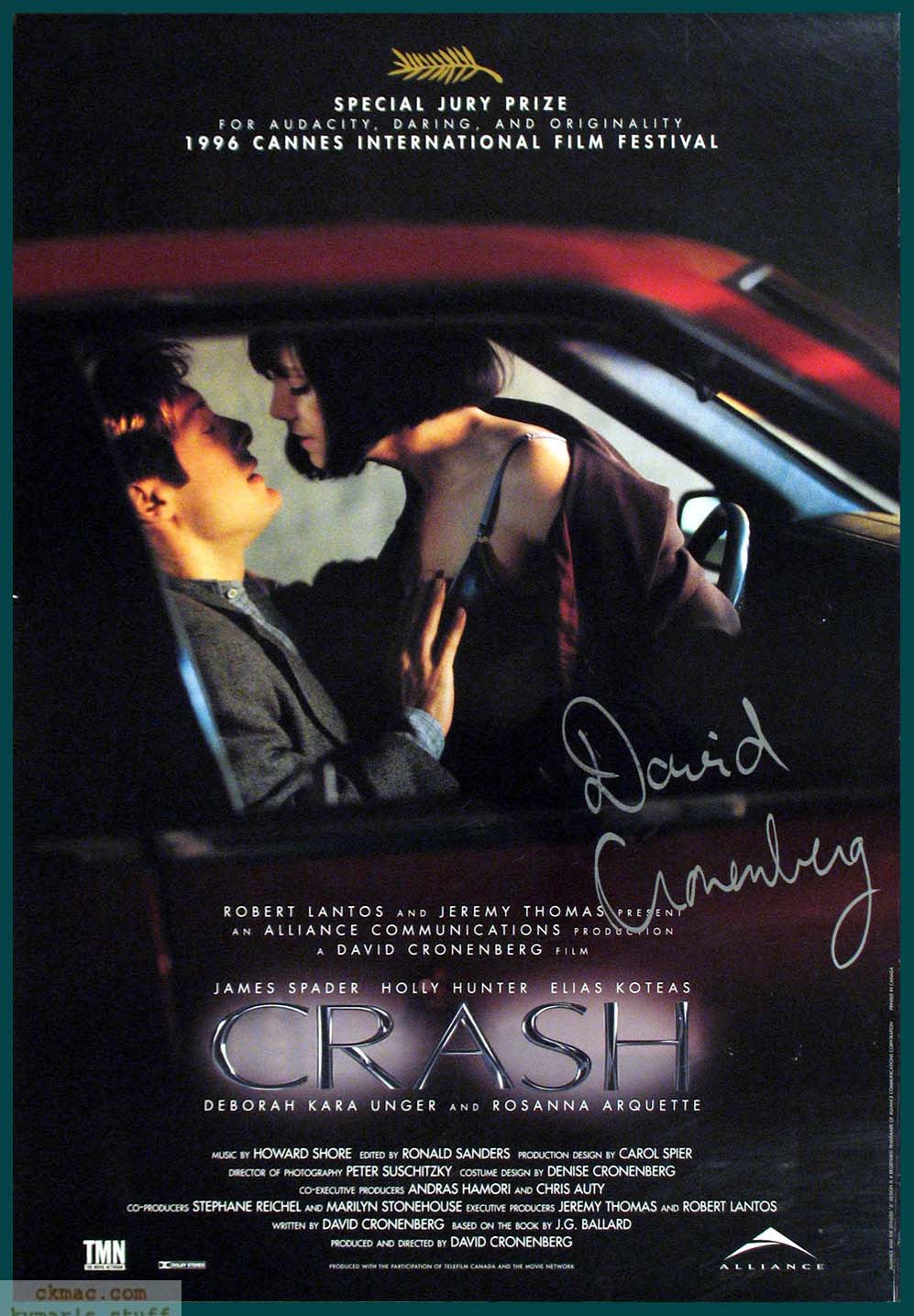
Over the latter half of his career, David Cronenberg has intervened in this tiresome discussion with a series of what have been termed "impossible adaptations." In films like Naked Lunch (1991) and Crash (1996), adaptations of novels once regarded as unfilmable, Cronenberg approaches the problem of adaptation from a different angle. One of these films closely follows the story of its source novel and one does not, but both could be described as successful—and even, after a fashion, faithful—adaptations.

Discussion of adaptations is often haunted by the unresolved question of whether a film should be regarded as merely the extension of a literary work into another form, or as a separate work entirely. Cronenberg's Naked Lunch takes that decision out of the viewer's hands to the extent that it's not really an adaptation of William S. Burroughs's novel at all—at least if adaptation is conceived primarily in terms of story. While most of the movie's major characters and settings (as well as the famous "talking asshole" anecdote) come from the Burroughs novel, it also draws from other Burroughs writings as well as the author's life. Seeing Naked Lunch is in no way a substitute for reading the book, or vice versa—which may be precisely the point.

Talking centipedes and organic typewriters notwithstanding, Naked Lunch is relatively restrained by the standards of Cronenberg's previous work, marking, along with Dead Ringers (1988), a transition between the director's visceral early films and the cooler, more formalist late work. The outré visual effects are played more for laughs than chills. Indeed, Naked Lunch might be Cronenberg's funniest film, beginning with the ironic casting of Robocop himself, Peter Weller, as the alter ego of the outlaw writer. Weller's stone-faced performance positions the film's protagonist, William Lee, as a straight man (pun intended) who takes its bizarre happenings in stride. Recounting a not atypical incident in which his Clark Nova typewriter kills and disembowels a potential rival instrument, Lee deadpans: "I understood writing could be dangerous. I didn't realize the danger came from the machinery."

To Read the Rest of the Essay


Tuesday, April 24, 2012

Tom McCormack: Laws of Desire -- What did David Cronenberg's Videodrome get right about us?

Laws of Desire: What did David Cronenberg's Videodrome get right about us?
by Tom McCormack
Moving Image Source


It can be both fun and necessary to revisit famously prescient works of art and take account of just what they got right.

In Nineteen Eighty-Four, George Orwell was right that the most successful authoritarian regimes of the future would limit dissent by using mass media to control our conceptual tools. He was wrong about how they would do it; instead of issuing messages through a unified voice, the most durable authoritarianism has flourished by dispersing control among a small set of global corporations that justify their outsized power through their success in the marketplace. In Brave New World, Aldous Huxley was right that sexual freedom and the triumph of therapy culture would develop alongside rigid class structures. The mainstream acceptance of casual sex and prescription pharmaceuticals really did happen alongside a consolidation of class power—a radical one we're still reeling from. But in Huxley this was accomplished through an exaggeration of class difference and an expanded language for class; in reality, the culture witnessed the atrophy of a language for class and an erasing of outward signs of class in terms of professed values, fashion, and manners of speech (hence "bourgeois bohemians" and "the millionaire next door").

David Cronenberg's Videodrome offered in 1983 a vision of dystopia that rivaled in ambition and sweep and foresight Orwell's and Huxley's more famous works. So what did Videodrome get right? And what, if anything, did it get wrong?

Cronenberg was right that new technologies would unleash a craving for scenes of increasingly extreme and increasingly realistic—if not just plain real—sexual violence. He was right about what this violence would look like ("No plot, no characters. Very realistic"); why the entertainment industry would turn to it ("I'm looking for something that will break through. Something tough!"); and how those in the media would talk about it ("It's absolutely brilliant. I mean look: there's almost no production cost!"). He was right that many people would experience these new products as addictive and would report a psychic bleed into the texture of their daily lives, frequently to their great concern.

Cronenberg was right, in a more subtle way, about what would cause the cultural turn to sexual violence. The movie isn't called "photodrome" or "cinemadrome"—it's not about the nature of mechanical reproduction or motion pictures but about the consequences of private access to public imagery. Professor Brian O'Blivion, Videodrome's resident philosopher, tells us that the television has become the "retina of the mind's eye"; that "the television screen is part of the physical structure of the brain." What he's talking about is what contemporary social scientists studying the Internet call—borrowing terms from psychoanalysis—"solipsistic introjection." This refers to the tendency of individuals to believe, on at least a semi-conscious level, that things happening on their electronic devices are actually happening inside their heads. Describing how this effect works in online chat rooms, John Suler writes:

Reading another person's message might be experienced as a voice within one's head, as if that person magically has been inserted or "introjected" into one's psyche... The online companion now becomes a character within our intrapsychic world, a character that is shaped partly by how the person actually presents him or herself via text communication, but also by our expectations, wishes, and needs... People fantasize about flirting, arguing with a boss, or very honestly confronting a friend about what they feel. In their imagination, where it's safe, people feel free to say and do all sorts of things that they wouldn't in reality. At that moment, reality IS one's imagination. Online text communication can become the psychological tapestry in which a person's mind weaves these fantasy role plays, usually unconsciously and with considerable disinhibition. All of cyberspace is a stage and we are merely players.


To Read the Rest of the Essay

Wednesday, January 18, 2012

Robert Alpert: The Social Network: The Contemporary Pursuit of Happiness Through Social Connections

The Social Network: the contemporary pursuit of happiness through social connections
by Robert Alpert
Jump Cut


The United States’ myth of opportunity holds that those who work hard may achieve, and that history is a progressive, forward movement in which the country betters itself through such hard work. Yet such optimism has consistently been tempered by a sense that “life, liberty and the pursuit of happiness” inadequately define a satisfied life. Thus, the myth of individual success also frequently becomes a story about loss and failure. For example, based on the life of William Randolph Hearst, the owner of a nationwide chain of “yellow journalism” newspapers, Orson Welles’ Citizen Kane (1941) portrays Charles Foster Kane as having achieved material success at the cost of a life of dissatisfaction. Forcibly exiled from his childhood home, he remains consistently angry and alone as an adult. Even that champion of historical progress, John Ford, late in life enunciated the myth’s failure in The Man Who Shot Liberty Valance (1962). “When the legend becomes fact, print the legend,” grandly announces the newspaper editor. The successful lawyer, governor, senator and ambassador to Britain, played by James Stewart, is ashen-faced, however, when he realizes that the material progress he has cultivated on behalf of his country has masked the fact that Vera Miles, the love of his life whom he married, has never loved him. The myth maker Ford eulogizes instead the primitive John Wayne who has died penniless and alone in order to make way for that dream of “progress.”

This same disillusionment also runs through U.S. literature. For example, F. Scott Fitzgerald’s The Great Gatsby (1925) is the story of Jay Gatsby, who believed in the myth of achieving material success and thereby the promise of a better future only to learn the futility of his quest and his loss of a more Edenic past. Thus, the novel concludes:

“Gatsby believed in the green light, the orgastic future that year by year recedes before us. It eluded us then, but that’s no matter — tomorrow we will run faster, stretch out our arms farther…And one fine morning — So we beat on, boats against the current, borne back ceaselessly into the past.”[2]

The Social Network deals with that myth of material success and an historical shift in values in which that myth has come to be accepted as fact. It is a bleak portrayal of a male, adolescent-dominated world in which connections, not relationships, are all. The director, David Fincher, has worked with different screenwriters on all of his movies, and his movies prior to The Social Network — such as Se7en (1995), The Game (1997), Fight Club (1999), Zodiac (2007) and The Curious Case of Benjamin Button (2008) — have in common that nearly all have at their center a young man lost and wandering through a series of episodes in which he seeks to define a place for himself. For each of these characters the search is obsessively personal, and in each the character is mistakenly confident that his skills will enable him to triumph. For example, the newly married Brad Pitt as Detective David Mills in Se7en taunts killer Kevin Spacey only to become Spacey’s seventh victim. Michael Douglas, a wealthy financier in The Game, remains certain that he can outsmart those who run the Game only to “succeed” by the grace of those who control the game. Fincher’s characters are lost and angry, adolescents in the bodies of grown men. Even Panic Room (2002), whose main character is played by Jodie Foster, focuses on her illusion that she can acquire security through her ex-husband’s money. Aaron Sorkin, the creator of the TV series West Wing and the screenwriter of The Social Network, places Fincher’s central character in an historical context. As such, he elevates the individual failure of Fincher’s character to a cultural failure.

The Social Network bases its story on Mark Zuckerberg (Jesse Eisenberg), who, while an undergraduate student at Harvard University, developed Facebook. Through deposition testimony in two lawsuits brought against Mark — by Eduardo Savarin (Andrew Garfield) and by the Winkelvoss twins, Cameron and Tyler (both played by Armie Hammer) — the movie recounts how what is today a worldwide phenomenon began in Mark’s dorm room. Like other Fincher characters, Mark is no less brainy, no less confident that he can outsmart those around him, and yet he fails in the end to find any personal satisfaction in his seeming success. The Social Network is especially bleak in that Mark’s personal failure gain him financial rewards in a world in which Facebook is everywhere, including Bosnia where, as a young associate at the law firm defending Mark remarks in disbelief, there are not even any roads.

Mark’s obsessive creation of Facebook results in a worldwide network of “friending,” an exchange of electronic data by persons who are physically and emotionally at a distance from one another. As such, this kind of friending offers a parallel to Mark, who becomes increasingly isolated from those physically surrounding him. Mark Zuckerberg’s contemporary success in business, measured in billions of dollars, results in his personal failure to achieve anything of value. Ironically, it was never about the money for Mark; as a high school student, for example, he uploaded for free his idea of an application for an MP3 player, notwithstanding an offer from Microsoft. Later, in his quest for success, he is oblivious to and uncaring about the consequences to others of his commercial success. As a result, by the end of the film, his success has cost him personal growth, his friendship with his one friend, and the loss of an idealized love of his life. While inventing an online “social network,” Mark is consistently visually framed as a young man alone, whether in his law firm’s large conference room on the night that a settlement will be reached in the two lawsuits or in the loft-like space of the Facebook office on the night Facebook achieves one million members and its entire staff is out celebrating.

The Social Network deals with male adolescents, such as Mark, who should be in transition to manhood but never progress beyond their adolescence. Taught that individual achievement of “life, liberty and the pursuit of happiness” is all, they lack any genuine empathy with others and hence any sense of social obligation or responsibility for its own sake. While Harvard University has long been co-ed, the movie portrays the college as an historic relic: the exclusive domain of its male students. It equates the exclusivity of its “final clubs,” fraternity-like clubs, with the busloads of women brought in by those clubs to Animal House-like parties. Mark’s failed quest was to become a member of a final club at Harvard, which, in Mark’s view, would lead to a “better life,” the contours of which, though, were unknown to him. Likewise, both in Facebook’s early stage when housed in a rented, suburban home in Palo Alto and later when ensconced in its high tech office space, adolescent males run the organization plugged into their computers with women as sexually available and often intoxicated or drugged objects. Women exist solely for the pleasure of these male adolescents who feel nothing beyond themselves and who thereby are inevitably alone in the midst of their noisy, crowded clubs.

To Read the Rest of the Essay