We live in the best of times in which we are able to learn about the world and its incredible diversity of cultures/beings/places/perspectives in a way never historically possible. We live in the worst of times when we are able to isolate ourselves completely from anything different from our own narrow view/conception of the world/reality. The choice is yours!
Coding Freedom: The Ethics and Aesthetics of Hacking
In the past 2 years, we’ve discussed in many interviews and updates, the attacks on whistle-blowers and hackers. The emerging movement of programmers, hackers, open source software, online communities has challenged and exposed corporate and government control and surveillance, making them targets of prosecution. As many may know, our own Michael Ratner has represented whistle-blower Julian Assange, computer activist Jeremy Hammond, and has been a legal adviser to many others including the late Aaron Swartz. Today we talk with author Gabriella Coleman about her recently published book Encoding Freedom: The Ethics and Aesthetics of Hacking. It’s a good place to start for those learning about the political significance of free software, intellectual property and the morality of computer hacking.
Guest – Gabriella Coleman, Wolfe Chair in Scientific and Technological Literacy in the Art History and Communication Studies Department at McGill University. Trained as an anthropologist, she researches, writes, and teaches on hackers and digital activism.
Long Distance Revolutionary: A Journey with Mumia Abu-Jamal
The new documentary, “Long Distance Revolutionary: A Journey with Mumia Abu-Jamal,” is premiering across the country. The film includes interviews from Cornel West, Alice Walker, Ruby Dee, Dick Gregory, Amy Goodman, Michael Parenti, writers Tariq Ali, and Michelle Alexander. This film beautifully captures the importance of Mumia Abu-Jamal’s life as an American journalist, and radical. He published seven books in prison including the best selling “Live From Death Row.”
In Chris Hedges’ review he points out what Cornel West says in the film: “The state is very clever in terms of keeping track, especially [of] the courageous and visionary ones, the ones that are long-distance runners. You can keep track of them, absorb ’em, dilute ’em, or outright kill ’em—you don’t have to worry about opposition to ’em.”
Guest – Steve Vittoria, the writer, director, producer and editor of Long Distance Revolutionary: A Journey with Mumia Abu-Jamal. The film premiered in theaters in New York City earlier this month.
Visions of the Other: The Return of the Abject in Roman Polanski's The Tenant
by Ingrid Fernandez Bright Lights Film Journal
Perhaps one of the highest achievements — and casualties — of Western philosophy lies in its complete denial of the body as a conduit for knowledge and self-discovery. The body has been excluded from discourse, always positioned as a threat to the higher instincts of the intellect. It is an unwanted part of the self: the polluted, the irrational, the animalistic that mars the path to enlightenment. It has thus been sentenced to represent the space of the abject, that which is always pushing the socially constructed subject to the edge of the abyss and hence threatens the law. However, a higher truth can be sought in the order of Nature. If we embrace the corporeal, we no longer negate death, decay, sickness — the filth burgeoning inside the self and forever constituting its powerful force. I accept my frailty, the instability of my identity, and I mourn for what I have lost when I achieved the status of subject. For that part of myself always creeps back into my existence as a shadow, a hidden desire I can never satisfy, that of life and death merging into pure being. I mourn the Other. I carry it within me but can never access it in life, for it might destroy me, I have been told; or perhaps it might complete me once it undoes all I have learned to be. Julia Kristeva describes fully experiencing the body as causing a rupture within signification, unacceptable because it eradicates the socially constructed boundaries regulating identity. She states:
A wound with blood and pus, or the sickly, acrid smell of sweat, does not signify death. In the presence of signified de'ath — a flat encephalograph, for instance — I would understand, react, or accept. No, as in true theater, without makeup or masks, refuse and corpses show me what I permanently thrust aside in order to live . . . My body extricates itself, as being alive, from that border . . . It is thus not lack of cleanliness or health that causes abjection but what disturbs identity, system, order. What does not respect borders, positions, rules. The in-between, the ambiguous, the composite. (Kristeva)
It is precisely in this foreign land, in this dark continent shunned by rational thought, that we might best find ourselves. The real truth of life is most acutely revealed at a corporeal level, where primal vulnerabilities such as the fear of illness and decay, the violated body, and the body in pain constitute the essence of being human, of being a part of a larger world where "the Other" is a reflection of the self. Moreover, our very physical existence and relation to others stem from a common bond of blood that predates the social apparatus. After all, social identity is easily stripped, uncovering a universal truth — the fact we are all mortal and subject to the violation of our physical space. At its most basic, the bond between humans is forged by the organic — sinews, muscle, bones, and the burden of the body. The instability of physical existence lies in its constant metamorphosis, its ability to simultaneously enrich and destroy intellectual activity, and the presence of elusive desire and the remnants of a fear that remain locked in the moment prior to our existence as social subjects. These concepts are best illustrated in cinema because of the power of the image to enter the viscera, elide intellectual resistance, and elicit an authentic and unmediated, sometimes even involuntary, reaction. The cinematic image penetrates the space of the abject and brings it to life. It is the return of the repressed and allows us to once again inhabit "uncomfortable spaces" we thought were closed off to our senses. Starting from these premises, I propose to revisit the concept of knowledge gained through the saturation of the body by outside stimuli, in this case film images, and how this experience results in a form of transcendence, a deeper understanding of our relation to ourselves and "the Other."
Roman Polanski's 1976 film The Tenant can be seen as a meditation on the fate of the abject body and how it is marked, regulated, and finally obliterated by the social apparatus. However, it also emphasizes how the repressed eludes the symbolic law and allows us to encounter its terrifying shadow, the periphery of existence that always manages to break through. Additionally, Polanski brings in the concept of bare life as stipulated by critics like Giorgio Agamben and Judith Butler, inquiring into the way a social subject is constituted and given a voice or utterly silenced and excluded from the circle of the human. The film's main focus remains on the body as undesirable, non-ideal, open to external aggression and pollution. In typical Polanski fashion, the audience is trapped in an "uncomfortable visual space" where the concept of a stable individual identity is never a matter of choice, but instead constituted by our surroundings and forces well beyond our grasp. The Tenant's crowning achievement is its use of the subjective camera, to the extent the audience is literally involved in the action through the vision of its main character, Trelkovsky. We see what he sees, fear what he fears, and eventually become him. Through this process, we experience the frailty of subjecthood and the ability of the cinematic image to rouse in us a dialogue with the innermost recesses of ourselves, the abject within us that, when we acknowledge it, sets us on the path to enlightenment and self-discovery.
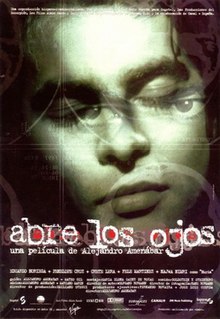
Epistemology: Dreams and Demons -- Abre los ojos (Open your eyes)
by James Mooney Film and Philosophy
My aim here is to examine the arguments of French philosopher René Descartes (1596-1650) through the contemporary viewfinder of Alejandro Amenábar’s Abre los Ojos (1997). The intention, however, is not to use the film as a mere vehicle for conveying Descartes’ thought, but rather to consider whether the particular context that Amenábar provides, and the nature of film itself, can enhance our understanding and and provide fresh insight into the issues that Descartes raises.
Descartes is writing at a time of scientific revolution and upheaval – many doctrines which have hitherto been accepted as most certain have been overturned and, as such, he is struck by the instability and unreliability of scientific ‘knowledge’. In his First Meditation, Descartes aims to sweep away all of his previously held opinions and start afresh. Descartes’ ‘method of doubt’ entails that if anything can be doubted, however slightly, then we are to treat it as if it is manifestly false and reject it outright. It is not, however, necessary that we subject each and every one of our opinions to this hyperbolic (exaggerated) doubt, as this would be a Sisyphean task. Rather, Descartes aims to test the ‘foundations’ of what we claim to know – ‘as the removal from below of the foundation necessarily involves the downfall of the whole edifice’.
Descartes’ claim is that one of these foundations is the senses – that is to say, if we can cast any doubt whatsoever on the reliability of the senses then we should reject as false whatever we learn from them:
All that I have, up to this moment, accepted as possessed of the highest truth and certainty, I received either from or through the senses. I observed, however, that these sometimes misled us; and it is the part of prudence not to place absolute confidence in that by which we have even once been deceived.
After briefly considering optical illusions and madness, Descartes goes on to provide one of the most famous arguments in philosophy: the dream hypothesis. What Descartes hopes to establish via this argument is that, given any particular experience, we can never know that that experience is not a dream.