Showing posts with label Spain. Show all posts
Showing posts with label Spain. Show all posts
Saturday, February 16, 2013

Tuesday, August 14, 2012
James Mooney: "Epistemology: Dreams and Demons -- Abre los ojos (Open your eyes)"
Epistemology: Dreams and Demons -- Abre los ojos (Open your eyes)
by James Mooney
Film and Philosophy
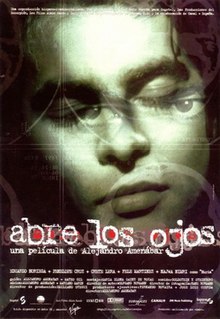
My aim here is to examine the arguments of French philosopher René Descartes (1596-1650) through the contemporary viewfinder of Alejandro Amenábar’s Abre los Ojos (1997). The intention, however, is not to use the film as a mere vehicle for conveying Descartes’ thought, but rather to consider whether the particular context that Amenábar provides, and the nature of film itself, can enhance our understanding and and provide fresh insight into the issues that Descartes raises.
Descartes is writing at a time of scientific revolution and upheaval – many doctrines which have hitherto been accepted as most certain have been overturned and, as such, he is struck by the instability and unreliability of scientific ‘knowledge’. In his First Meditation, Descartes aims to sweep away all of his previously held opinions and start afresh. Descartes’ ‘method of doubt’ entails that if anything can be doubted, however slightly, then we are to treat it as if it is manifestly false and reject it outright. It is not, however, necessary that we subject each and every one of our opinions to this hyperbolic (exaggerated) doubt, as this would be a Sisyphean task. Rather, Descartes aims to test the ‘foundations’ of what we claim to know – ‘as the removal from below of the foundation necessarily involves the downfall of the whole edifice’.
Descartes’ claim is that one of these foundations is the senses – that is to say, if we can cast any doubt whatsoever on the reliability of the senses then we should reject as false whatever we learn from them:
After briefly considering optical illusions and madness, Descartes goes on to provide one of the most famous arguments in philosophy: the dream hypothesis. What Descartes hopes to establish via this argument is that, given any particular experience, we can never know that that experience is not a dream.
To Read the Rest of the Essay


by James Mooney
Film and Philosophy
My aim here is to examine the arguments of French philosopher René Descartes (1596-1650) through the contemporary viewfinder of Alejandro Amenábar’s Abre los Ojos (1997). The intention, however, is not to use the film as a mere vehicle for conveying Descartes’ thought, but rather to consider whether the particular context that Amenábar provides, and the nature of film itself, can enhance our understanding and and provide fresh insight into the issues that Descartes raises.
Descartes is writing at a time of scientific revolution and upheaval – many doctrines which have hitherto been accepted as most certain have been overturned and, as such, he is struck by the instability and unreliability of scientific ‘knowledge’. In his First Meditation, Descartes aims to sweep away all of his previously held opinions and start afresh. Descartes’ ‘method of doubt’ entails that if anything can be doubted, however slightly, then we are to treat it as if it is manifestly false and reject it outright. It is not, however, necessary that we subject each and every one of our opinions to this hyperbolic (exaggerated) doubt, as this would be a Sisyphean task. Rather, Descartes aims to test the ‘foundations’ of what we claim to know – ‘as the removal from below of the foundation necessarily involves the downfall of the whole edifice’.
Descartes’ claim is that one of these foundations is the senses – that is to say, if we can cast any doubt whatsoever on the reliability of the senses then we should reject as false whatever we learn from them:
All that I have, up to this moment, accepted as possessed of the highest truth and certainty, I received either from or through the senses. I observed, however, that these sometimes misled us; and it is the part of prudence not to place absolute confidence in that by which we have even once been deceived.
After briefly considering optical illusions and madness, Descartes goes on to provide one of the most famous arguments in philosophy: the dream hypothesis. What Descartes hopes to establish via this argument is that, given any particular experience, we can never know that that experience is not a dream.
To Read the Rest of the Essay
Wednesday, August 1, 2012
Robert Castle: Two Cinematic Visions of the Inca Conquest -- The Royal Hunt of the Sun and Aguirre: Wrath of God
Two Cinematic Visions of the Inca Conquest: The Royal Hunt of the Sun and Aguirre: Wrath of God
by Robert Castle
Bright Lights Film Journal

...
The point of contact between Royal Hunt and Aguirre: Wrath of God is corresponding events: Atahualpa entering the courtyard in Cajamarca and an Indian approaching Aguirre's raft. The slaughter of the Inca king's imperial guard starts after the Spanish priest (Andrew Kier) has given him a Bible. Atahualpa is told that he holds the word of God, who speaks through the book. He puts the book to his ear and says that he hears nothing. Then he throws the Bible to the ground. The Spanish soldiers hidden around the courtyard emerge when the priest curses Atahualpa. The entire imperial guard, over a thousand men, are slaughtered without a single Spanish casualty.
In Aguirre, as the raft floats along a flaccid tributary of the Amazon River, Aguirre's soldiers spot a solitary canoe approaching. An old man and young woman are in the boat and subsequently brought aboard the raft. Brother Gaspar de Carvajal, just like Pizarro's priest, offers the Bible to the old man and tells him he holds the word of God. The old man, like Atahualpa, holds the Bible to his ear and then throws the book to the ground. The Spaniards, including Brother Gaspar, pierce the old man with several sword thrusts, killing him.
Aguirre, in Herzog's film, describes Cortes as his model for going against the Spanish authorities and conquering the land before him: "I am the great traitor. There must be no other. Anyone who even thinks about deserting this mission will be cut up into 198 pieces."
Aguirre views Cortes as a rebel who defied Velasquez, Spanish governor of Cuba who ordered Cortes not to go to Mexico, and the Spanish monarchy itself. When landing in Mexico, Cortes shackled all who were not with him and burned his ships to ensure no one could desert. The Spanish expedition over the Andes into the Amazon is led by Gonzalo Pizarro (Alejandro Repullés), Francisco's brother. The extreme conditions force Gonzalo to send a party of forty on rafts downriver in search of El Dorado, led by Don Pedro de Ursua (Ruy Guerra). After one raft is lost on a giant whirlpool and the others to a high tide, Ursua decides to return to the main force led by Pizarro. Aguirre and his henchmen take over, put Ursua on trial, and eventually hang him.
Where Pizarro sought his spiritual destiny through Atahualpa, Aguirre remains unaffected by the native Indians, who are portrayed as invisible antagonists with largely aggressive responses to the Spanish invaders (save for the two who came up to the raft in a canoe). What Aguirre finds is a world with no limits. Aguirre's world-weariness seems as inconsolable as Pizarro's in Royal Hunt, although Aguirre seeks the opposite form of meaning and fulfillment from his conquest. During his river expedition, Aguirre decrees all the land on both sides of the river theirs. His redemption comes in the form of personal empire-building. As the large raft comes to a halt in the dead waters, overrun by spider monkeys, Aguirre stands alone decrying himself the "Wrath of God" amidst the dead bodies of his followers. Aguirre seems to want to transpose his reality by this virtual conquest of the Amazon; likewise, Pizarro wants Atahualpa to resurrect himself after being strangled. Mutual delusions both.
Both films suggest Europe has run aground spiritually, as they both depict the Catholic Church and its representatives to be as bloodthirsty as the conquistadors. The Church sides cynically with the politically powerful. Brother Gaspar, for instance, does not try to save Ursua from execution. In Royal Hunt, Father Valverde signals the assault on the unarmed imperial guard. The films's respective responses to the spiritual crises divide their sensibilities. Aguirre: Wrath of God's postmodernist stance disdains psychological insight or drama. Royal Hunt of the Sun depicts Pizarro as a man torn between an old dead religion and the promise of a new revelation, an internal struggle that postmodernism rejects. Aguirre is driven by a single, narrow goal, albeit one that defines the Western sensibility. In this sense, the historicity of the film accurately gauges sixteenth-century psychology by denying Aguirre a modernist conscience. Cinematically, Herzog depicts the attitude of the Spaniards through the naturalistic settings. In particular, he holds one shot early in the film of the raging water flowing from the mountains symbolizing the power and the turmoil within the conquistadores.
To Read the Entire Essay

by Robert Castle
Bright Lights Film Journal
...
The point of contact between Royal Hunt and Aguirre: Wrath of God is corresponding events: Atahualpa entering the courtyard in Cajamarca and an Indian approaching Aguirre's raft. The slaughter of the Inca king's imperial guard starts after the Spanish priest (Andrew Kier) has given him a Bible. Atahualpa is told that he holds the word of God, who speaks through the book. He puts the book to his ear and says that he hears nothing. Then he throws the Bible to the ground. The Spanish soldiers hidden around the courtyard emerge when the priest curses Atahualpa. The entire imperial guard, over a thousand men, are slaughtered without a single Spanish casualty.
In Aguirre, as the raft floats along a flaccid tributary of the Amazon River, Aguirre's soldiers spot a solitary canoe approaching. An old man and young woman are in the boat and subsequently brought aboard the raft. Brother Gaspar de Carvajal, just like Pizarro's priest, offers the Bible to the old man and tells him he holds the word of God. The old man, like Atahualpa, holds the Bible to his ear and then throws the book to the ground. The Spaniards, including Brother Gaspar, pierce the old man with several sword thrusts, killing him.
Aguirre, in Herzog's film, describes Cortes as his model for going against the Spanish authorities and conquering the land before him: "I am the great traitor. There must be no other. Anyone who even thinks about deserting this mission will be cut up into 198 pieces."
Aguirre views Cortes as a rebel who defied Velasquez, Spanish governor of Cuba who ordered Cortes not to go to Mexico, and the Spanish monarchy itself. When landing in Mexico, Cortes shackled all who were not with him and burned his ships to ensure no one could desert. The Spanish expedition over the Andes into the Amazon is led by Gonzalo Pizarro (Alejandro Repullés), Francisco's brother. The extreme conditions force Gonzalo to send a party of forty on rafts downriver in search of El Dorado, led by Don Pedro de Ursua (Ruy Guerra). After one raft is lost on a giant whirlpool and the others to a high tide, Ursua decides to return to the main force led by Pizarro. Aguirre and his henchmen take over, put Ursua on trial, and eventually hang him.
Where Pizarro sought his spiritual destiny through Atahualpa, Aguirre remains unaffected by the native Indians, who are portrayed as invisible antagonists with largely aggressive responses to the Spanish invaders (save for the two who came up to the raft in a canoe). What Aguirre finds is a world with no limits. Aguirre's world-weariness seems as inconsolable as Pizarro's in Royal Hunt, although Aguirre seeks the opposite form of meaning and fulfillment from his conquest. During his river expedition, Aguirre decrees all the land on both sides of the river theirs. His redemption comes in the form of personal empire-building. As the large raft comes to a halt in the dead waters, overrun by spider monkeys, Aguirre stands alone decrying himself the "Wrath of God" amidst the dead bodies of his followers. Aguirre seems to want to transpose his reality by this virtual conquest of the Amazon; likewise, Pizarro wants Atahualpa to resurrect himself after being strangled. Mutual delusions both.
Both films suggest Europe has run aground spiritually, as they both depict the Catholic Church and its representatives to be as bloodthirsty as the conquistadors. The Church sides cynically with the politically powerful. Brother Gaspar, for instance, does not try to save Ursua from execution. In Royal Hunt, Father Valverde signals the assault on the unarmed imperial guard. The films's respective responses to the spiritual crises divide their sensibilities. Aguirre: Wrath of God's postmodernist stance disdains psychological insight or drama. Royal Hunt of the Sun depicts Pizarro as a man torn between an old dead religion and the promise of a new revelation, an internal struggle that postmodernism rejects. Aguirre is driven by a single, narrow goal, albeit one that defines the Western sensibility. In this sense, the historicity of the film accurately gauges sixteenth-century psychology by denying Aguirre a modernist conscience. Cinematically, Herzog depicts the attitude of the Spaniards through the naturalistic settings. In particular, he holds one shot early in the film of the raging water flowing from the mountains symbolizing the power and the turmoil within the conquistadores.
To Read the Entire Essay
Sunday, December 18, 2011
Mhairi Guild: The Skin We Live In -- The Mad, Bad World of Pedro Almodóvar
The skin we live in: the mad, bad world of Pedro Almodóvar
Remaining spooked and preoccupied, Mhairi Guild still appreciates density and creativity of Almodovar's latest grotesque fairytale of not-only-gender identity, desire and power
by Mhairi Guild
The F Word

We staggered out of Pedro Almodóvar's latest offering somewhat shell-shocked. There is a huge amount to get out of The Skin I Live In but goodness, is it profoundly dark. Generally well received, the film has nonetheless split critics, some seeing it as a fetishistic mess or empty stylistic exercise, others as a stunning horror of the mind. I think that your reception of the film is likely to depend on your prior relationship with Almodóvar and on how willing you are to go on this particular journey with him.
A dark alpha male Antonio Banderas plays the brooding, obsessive surgeon Robert Ledgard, bunkered in a grand Toledo mansion which offers a lush set for his initially unexplained experimentation on the beautiful captive Vera, played by the porcelain doll-like Elena Anaya. The perfection of Vera's flawless, synthetic skin and the charged secret of her relationship with Ledgard is the central riddle of a plot that weaves back and forth between earlier stages of the narrative and gradually takes us down to depths scarcely imaginable at the outset.
Despite not being familiar with Almodóvar's whole canon, his 2002 Talk To Her has long been one of my favourite films. I have also enjoyed - in different ways - All About My Mother (1999), Volver (2006) and some earlier works like 1990 Tie Me Up! Tie Me Down! (his last project with Banderas before the latter's defection to Hollywood).
One of the most striking things about The skin I live in is how it pulls together tropes and preoccupations from a number of the director's past films - being a sort of culmination of Almodóvar's body of work. A few of these themes were particularly resonant as the story developed.
Firstly, in Almodóvar's world there is normally an inherent brutality to the male sexual impulse, and it is present to such an extent that I was already squirming uncomfortably within the first half an hour of the film (little was I to know what Almodóvar had in store for me yet). The representation and frequent victory of this type of male sexuality, which is oft accompanied by casual violence, suggests that it is somehow a 'true' manifestation of male sexuality. Together with a forceful masculine possession of the female body, his male characters often exhibit an unreflective ignorance of the coercion present in their seductions. In the three central male figures in the film we get the full bleak spectrum: the boy (Vicente), the man (Ledgard) and the animal (Veco - the 'Tiger'). In this film Almodóvar more than insinuates the notion that heterosexual sex veers precipitously close to rape -, a particularly pessimistic and troubling theme.
More fundamentally, though, Almodóvar's work seems to suggest an impossibility of meaningful communication between the sexes within a certain society. This chasm between man and woman that can never be truly bridged lies at the centre of Talk To Her, where the one-sided relationship between the young coma patient Alicia and her besotted, delusional nurse Benigno is mirrored by the real relationship between Marco and injured bull-fighter Lydia. Almodóvar's men can only ever desire, fetishise and project onto their relations with women; women, in turn, in the male gaze are literally living dolls whose internal lives may be as real as theirs, but can never be truly apprehended. Women remain, as Simone de Beauvoir suggests, men's eternal 'others': an inherent mystery, in sharp distinction to the knowable Self of the male individual. This communication gap between the sexes - which after all has some undeniable, socialised roots - speaks in Almodóvar's work in dark and sometimes terrifying tones. It presents one of the most compelling and intriguing challenges posed by his films, seemingly portraying a gender dystopia we are prompted to remain ever-vigilant against.
To Read the Rest of the Essay
Remaining spooked and preoccupied, Mhairi Guild still appreciates density and creativity of Almodovar's latest grotesque fairytale of not-only-gender identity, desire and power
by Mhairi Guild
The F Word
We staggered out of Pedro Almodóvar's latest offering somewhat shell-shocked. There is a huge amount to get out of The Skin I Live In but goodness, is it profoundly dark. Generally well received, the film has nonetheless split critics, some seeing it as a fetishistic mess or empty stylistic exercise, others as a stunning horror of the mind. I think that your reception of the film is likely to depend on your prior relationship with Almodóvar and on how willing you are to go on this particular journey with him.
A dark alpha male Antonio Banderas plays the brooding, obsessive surgeon Robert Ledgard, bunkered in a grand Toledo mansion which offers a lush set for his initially unexplained experimentation on the beautiful captive Vera, played by the porcelain doll-like Elena Anaya. The perfection of Vera's flawless, synthetic skin and the charged secret of her relationship with Ledgard is the central riddle of a plot that weaves back and forth between earlier stages of the narrative and gradually takes us down to depths scarcely imaginable at the outset.
Despite not being familiar with Almodóvar's whole canon, his 2002 Talk To Her has long been one of my favourite films. I have also enjoyed - in different ways - All About My Mother (1999), Volver (2006) and some earlier works like 1990 Tie Me Up! Tie Me Down! (his last project with Banderas before the latter's defection to Hollywood).
One of the most striking things about The skin I live in is how it pulls together tropes and preoccupations from a number of the director's past films - being a sort of culmination of Almodóvar's body of work. A few of these themes were particularly resonant as the story developed.
Firstly, in Almodóvar's world there is normally an inherent brutality to the male sexual impulse, and it is present to such an extent that I was already squirming uncomfortably within the first half an hour of the film (little was I to know what Almodóvar had in store for me yet). The representation and frequent victory of this type of male sexuality, which is oft accompanied by casual violence, suggests that it is somehow a 'true' manifestation of male sexuality. Together with a forceful masculine possession of the female body, his male characters often exhibit an unreflective ignorance of the coercion present in their seductions. In the three central male figures in the film we get the full bleak spectrum: the boy (Vicente), the man (Ledgard) and the animal (Veco - the 'Tiger'). In this film Almodóvar more than insinuates the notion that heterosexual sex veers precipitously close to rape -, a particularly pessimistic and troubling theme.
More fundamentally, though, Almodóvar's work seems to suggest an impossibility of meaningful communication between the sexes within a certain society. This chasm between man and woman that can never be truly bridged lies at the centre of Talk To Her, where the one-sided relationship between the young coma patient Alicia and her besotted, delusional nurse Benigno is mirrored by the real relationship between Marco and injured bull-fighter Lydia. Almodóvar's men can only ever desire, fetishise and project onto their relations with women; women, in turn, in the male gaze are literally living dolls whose internal lives may be as real as theirs, but can never be truly apprehended. Women remain, as Simone de Beauvoir suggests, men's eternal 'others': an inherent mystery, in sharp distinction to the knowable Self of the male individual. This communication gap between the sexes - which after all has some undeniable, socialised roots - speaks in Almodóvar's work in dark and sometimes terrifying tones. It presents one of the most compelling and intriguing challenges posed by his films, seemingly portraying a gender dystopia we are prompted to remain ever-vigilant against.
To Read the Rest of the Essay
Subscribe to:
Posts (Atom)