We live in the best of times in which we are able to learn about the world and its incredible diversity of cultures/beings/places/perspectives in a way never historically possible. We live in the worst of times when we are able to isolate ourselves completely from anything different from our own narrow view/conception of the world/reality. The choice is yours!
Frederick Wiseman's "Crazy Horse"
By Doug Fabrizio Radio West
Tuesday, Doug is joined by legendary filmmaker Frederick Wiseman. A year ago, RadioWest and the Utah Film Center began our Through the Lens documentary film series with a conversation with Wiseman. His latest work is set to open later this month around the country. It's called "Crazy Horse," and it's a spare, unfiltered look inside a Parisian nude cabaret. Doug talks to Wiseman and others about his 44 year career and what the new film reveals about Wiseman's unique process.
Critical Strands: On the Beach with Ulrich Seidl and Martin Parr
by retinalechoes Notebook
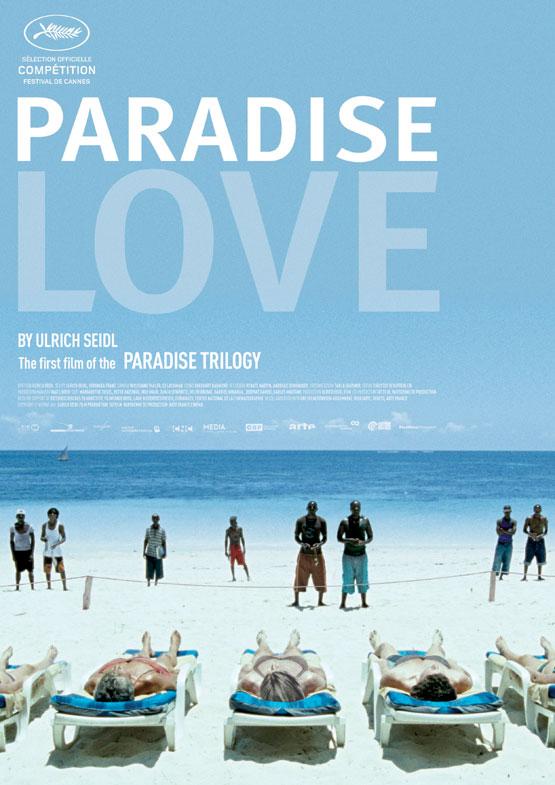
Some films you watch. Others you live. In Ulrich Seidl's films you suffer. You suffer and laugh, and laugh and suffer, until tears pour from your eyes, until out from laughter arises guilt. Guilt for having suffered. Guilt for having laughed. And only then, when you emerge from the guilt, wipe the film from your eyes, do you realize that the naïve 200-pound quinquagenarian Austrian sex-tourist on holiday in Kenya is none other then yourself, if not your sister or perhaps mother. Only then does the comfort of guilt morph into the vexation of shame as you understand that the buffoon you saw on the screen was wearing what turned out to be your face for a mask.
But don’t say you weren’t forewarned. The ballsy and shameless opening scene of Paradise: Love, should have given notice enough. After all, away from the scrutinizing eyes of society it becomes too easy to indulge in the visual pleasure of watching warped grimaces twisting in glee and shock across the faces of the spasmodic, the abnormal, the mongoloid. Hidden behind the comfort of our screen (for it is always our screen, and never just yours or mine) it becomes all too simple to relish images of the rejected visages of the mentally retarded contorting themselves in farcical masks as their bumper cars smash into each other, watching Teresa, our fat Austrian heroine, watch them. Our white-winged socially-implanted moral warden hanging over our right shoulder like a wee angel warns us against laughter, but in the liberty and obscurity of the cinematic chamber, we let loose with a laughter poised on the razor's edge between discomfort and hilarity. Paradise: Love’s opening scene is a warning, a provocation, a contract of the film to come, and it reads: “I will force you to laugh at things not only which you do not want to laugh at, but which you know you should not.” But laugh we do, and in so doing become accomplices to the film. Seidl’s humor is not the innocent cathartic guffaw of slapstick, nor the healing chortle of satire. It is a blow aimed to crack open a chink in the armor of our self-righteousness to make way for the stiletto of shame to slide in more easily.
By naming our tender, pale, gullible heroine Teresa after the famed Mother Superior of Christian fame, Seidl sticks a knife in the back of the charitable West’s self-congratulatory sentiments for the aid it provides the (usually somewhat darker-skinned) third-world. (Do we hear the rational arguments of capitalist economics buzzing in the background? Business for the locals? Improvements to infrastructure? Exchange of goods?) The tourist, a missionary of modernity, never meets the third-world inhabitants on equal terms, never enters their world, but rather travels to other lands with the goal of extracting as many resources as possible, be it gold, souls or sex. The images of Teresa’s travels to this land of alterity in Paradise: Love are no reflections of a “mirror being carried along a high road,” but rather visions which barely pierce the thick and muggy waters of the aquarium in which her head is enclosed: Omnia mea mecum porto - when the European travels she takes her whole world with her wrapped around her head, aquarium, water and fish too. Teresa’s ‘omnia’, the civilized rectangular glassed cage is exemplified by the space of the European room (and the cinematic frame?). As Teresa prepares for her trip, she appears in one chamber after another in her Austrian apartment, preparing food, folding laundry, packing bags and the rectangle in which she moves is the one the camera will bring with her (and us) on holiday to Kenya, with its centralized perspective and weight, and its ordered compositions, signs of the European’s efficiency and rationality.
But no matter, for the tourist’s mission is not to see unseen landscapes but rather to ignore the distinctiveness of the travel destination so as to better wrench maximum ‘fun’ from the exotic (what else would make tourism the largest industry worldwide?). So, even when Teresa and her Austrian compatriots travel thousands of kilometers to reach a new panorama, the only landscape they can perceive is the one they brought with them, with its ordered lines, sparkling clean toilet bowls, and secure walled-off pleasures.
A singular and highly accomplished independent film, Upstream Color is philosophical science fiction in the tradition of the French nouvelle vague, seasoned with a dash of Cronenbergian body horror. Like the SF films that emerged from the nouvelle vague – Chris Marker’s La Jetée, Alain Resnais’s Je t'aime je t'aime, Godard’s Alphaville, Bertrand Tavernier’s Death Watch – Upstream Color foregoes studio sets and elaborate special effects in favor of real locations and a concern with fundamental existential issues like the nature of free will, memory, perception, and time – what Raymond Durgnat once called the science fiction of “inner space.”
The body horror, reminiscent of early Cronenberg films like Rabid and Shivers (aka They Came From Within), comes from the film’s MacGuffin, a worm or grub found in the roots of orchids that secretes a drug, prized in certain circles for its psychotropic properties. If the worm is implanted in a victim, he or she becomes a virtual zombie, susceptible to any suggestion, obeying any command.
To say the film is enigmatic is an understatement. This might be the WTF film of 2013. Its complex story is told almost entirely through its visuals. There is minimal dialogue, and what there is of it is fragmentary, heard – or overhead – in bits and pieces. The visuals themselves are elliptical – we might be shown only the beginning, the middle, or the end of an action and have to infer the rest of it. Sometimes it is uncertain whether what we are looking at is literal or metaphoric. Chronology is scrambled. But the effect is not off-putting. On the contrary, this is an extraordinarily compelling film. Because we have to piece the narrative together ourselves, we pay closer attention.
Moreover, there is a sound basis for the film’s peculiarities of style. The two main characters, Kris (Amy Seimetz) and Jeff (writer/director Shane Carruth) are both victims of the worm – both brain-damaged. Consequently, we experience reality as they do.
Exclusive: Dying Iraq War Veteran Tomas Young Explains Decision to End His Life Democracy Now
In the week marking the 10th anniversary of the U.S. invasion of Iraq, we spend the hour looking at the remarkable life and imminent death of Iraq War veteran Tomas Young. Citing his overwhelming physical pain from wounds that left him paralyzed in Iraq, Young recently announced he has decided to end his life by discontinuing his medicine and nourishment, which comes in the form of liquid through a feeding tube. Young joins to explain his decision from his home in Kansas City, along with his wife Claudia Cuellar. We’re also joined by Phil Donahue, the legendary TV talk show host, whose 2007 documentary, "Body of War," follows Tomas’ rehabilitation and his political awakening to become one of the most prominent antiwar U.S. veterans speaking out against the invasion and occupation of Iraq. "I am, on one hand, sick and tired of being sick and tired," Young says. "And on the other, I don’t want to watch my body waste away." Donahue calls Tomas’ announcement "a very unusual act of moral courage. He wants people to see this, because he came home from the most sanitized war of my lifetime. We don’t see this. But less than 5 percent of us, maybe 1 percent ... have made a personal sacrifice for this war. And Tomas is one of them."
Guests:
Tomas Young, Iraq War veteran and the main subject of the documentary, Body of War. On April 4, 2004, his fifth day in Iraq, Young’s unit came under fire in the Sadr City neighborhood of Baghdad. Young was left paralyzed, never to walk again. Released from medical care three months later, Young returned home to become an active member in Iraq Veterans Against the War. He recently announced that he will stop his nourishment, which comes in the form of liquid through a feeding tube — a decision which will hasten his death.
Phil Donahue, one of the best-known talk show hosts in U.S. television history, his show was on the air for more than 29 years. In 2002, he returned to the airwaves, but he was fired in 2003 on the eve of the war by MSNBC because he was allowing antiwar voices on the air. Along with Ellen Spiro, he directed the documentary, Body of War, which tells the story of Tomas Young, an Iraq War veteran paralyzed from a bullet to the spine. Now, at the age of 33, Tomas has decided to end his life.
Claudia Cuellar, the wife and primary caregiver of Tomas Young.
Visions of the Other: The Return of the Abject in Roman Polanski's The Tenant
by Ingrid Fernandez Bright Lights Film Journal
Perhaps one of the highest achievements — and casualties — of Western philosophy lies in its complete denial of the body as a conduit for knowledge and self-discovery. The body has been excluded from discourse, always positioned as a threat to the higher instincts of the intellect. It is an unwanted part of the self: the polluted, the irrational, the animalistic that mars the path to enlightenment. It has thus been sentenced to represent the space of the abject, that which is always pushing the socially constructed subject to the edge of the abyss and hence threatens the law. However, a higher truth can be sought in the order of Nature. If we embrace the corporeal, we no longer negate death, decay, sickness — the filth burgeoning inside the self and forever constituting its powerful force. I accept my frailty, the instability of my identity, and I mourn for what I have lost when I achieved the status of subject. For that part of myself always creeps back into my existence as a shadow, a hidden desire I can never satisfy, that of life and death merging into pure being. I mourn the Other. I carry it within me but can never access it in life, for it might destroy me, I have been told; or perhaps it might complete me once it undoes all I have learned to be. Julia Kristeva describes fully experiencing the body as causing a rupture within signification, unacceptable because it eradicates the socially constructed boundaries regulating identity. She states:
A wound with blood and pus, or the sickly, acrid smell of sweat, does not signify death. In the presence of signified de'ath — a flat encephalograph, for instance — I would understand, react, or accept. No, as in true theater, without makeup or masks, refuse and corpses show me what I permanently thrust aside in order to live . . . My body extricates itself, as being alive, from that border . . . It is thus not lack of cleanliness or health that causes abjection but what disturbs identity, system, order. What does not respect borders, positions, rules. The in-between, the ambiguous, the composite. (Kristeva)
It is precisely in this foreign land, in this dark continent shunned by rational thought, that we might best find ourselves. The real truth of life is most acutely revealed at a corporeal level, where primal vulnerabilities such as the fear of illness and decay, the violated body, and the body in pain constitute the essence of being human, of being a part of a larger world where "the Other" is a reflection of the self. Moreover, our very physical existence and relation to others stem from a common bond of blood that predates the social apparatus. After all, social identity is easily stripped, uncovering a universal truth — the fact we are all mortal and subject to the violation of our physical space. At its most basic, the bond between humans is forged by the organic — sinews, muscle, bones, and the burden of the body. The instability of physical existence lies in its constant metamorphosis, its ability to simultaneously enrich and destroy intellectual activity, and the presence of elusive desire and the remnants of a fear that remain locked in the moment prior to our existence as social subjects. These concepts are best illustrated in cinema because of the power of the image to enter the viscera, elide intellectual resistance, and elicit an authentic and unmediated, sometimes even involuntary, reaction. The cinematic image penetrates the space of the abject and brings it to life. It is the return of the repressed and allows us to once again inhabit "uncomfortable spaces" we thought were closed off to our senses. Starting from these premises, I propose to revisit the concept of knowledge gained through the saturation of the body by outside stimuli, in this case film images, and how this experience results in a form of transcendence, a deeper understanding of our relation to ourselves and "the Other."
Roman Polanski's 1976 film The Tenant can be seen as a meditation on the fate of the abject body and how it is marked, regulated, and finally obliterated by the social apparatus. However, it also emphasizes how the repressed eludes the symbolic law and allows us to encounter its terrifying shadow, the periphery of existence that always manages to break through. Additionally, Polanski brings in the concept of bare life as stipulated by critics like Giorgio Agamben and Judith Butler, inquiring into the way a social subject is constituted and given a voice or utterly silenced and excluded from the circle of the human. The film's main focus remains on the body as undesirable, non-ideal, open to external aggression and pollution. In typical Polanski fashion, the audience is trapped in an "uncomfortable visual space" where the concept of a stable individual identity is never a matter of choice, but instead constituted by our surroundings and forces well beyond our grasp. The Tenant's crowning achievement is its use of the subjective camera, to the extent the audience is literally involved in the action through the vision of its main character, Trelkovsky. We see what he sees, fear what he fears, and eventually become him. Through this process, we experience the frailty of subjecthood and the ability of the cinematic image to rouse in us a dialogue with the innermost recesses of ourselves, the abject within us that, when we acknowledge it, sets us on the path to enlightenment and self-discovery.
[Discussion in another forum:
JV: Goddamn, what a fucking hero. It's not just the act but that she took the time to frame the social, ideological problem in such a vivid and remarkable way. One more [quote] I can't stop turning over: "the fundament upon which all our knowledge and learning rests is the inexplicable."
MB: That brief quote you highlight hits on what I have long been wrestling with in my own thoughts and writing. Developing the ability, creativity and courage to not fear the inexplicable (different), but instead engage with it to learn news ways of perceiving the world and as a method of making strange that which is familiar to me.
I see a lot of the world's pain/violence as an inability to grapple with the inexplicable/different, especially when the reaction is fear/angry.... I really hope people take the time to listen to this whole acceptance speech -- it is very important.
" Invisibility is indivisible from visibility. For the transgendered this is not merely a philosophical conundrum, it can be the difference between life and death.
I am here because when I was young I wanted very badly to be a writer. I wanted to be a filmmaker but I couldn't find anyone like me in the world and it felt like my dreams were foreclosed simply because my gender was less typical than others.
If I can be that person for someone else then the sacrifice of my private civic life may have value."
Shortbus (USA: John Cameron Mitchell, 2006: 101 mins)
"In the old days, when you couldn't show sex on film, directors like Hitchcock had metaphors for sex (trains going into tunnels, etc). When you can show more realistic sex, the sex itself can be a metaphor for other parts of the character's lives. The way people express themselves sexually can tell you a lot about who they are. Some people ask me, 'Couldn't you have told the same story without the explicitness?'. They don't ask whether I could've done Hedwig without the songs. Why not be allowed to use every paint in the paintbox?"
--John Cameron Mitchell, "How to Shoot Sex: A Docu-Primer" (2007): Shortbus Region 1 DVD release (Th!nk Film)
Foucault, Michel. "Of Other Spaces." (This text, entitled "Des Espace Autres," and published by the French journal Architecture /Mouvement/ Continuité in October, 1984, was the basis of a lecture given by Michel Foucault in March 1967.)
Sex is a Hen Decapitated: Bluebeard and the Eroticism of Catherine Breillat
by Erich Kuersten Acidemic
The ancient tale of Bluebeard is rife with archetypal resonance for the budding feminine psyche: it's a rite of passage myth, a map of patriarchal oppression's mine field, an initiation into sexual maturity, where the fear of pain is enough to make actual pain a relief in contrast; a color-symbolic dream where the blood of menstruation anxiety (the redness of the clitoral "riding" hood) and the swollen purples of honeymoon savagery (the black and blueness of the groom's bristly beard) mix and match. Like many fairy tales centered on a young girl, it encodes the onset of menstruation into a Pandora's Box moment of discovery, from which innocence can never return, leading inexorably into the scary rites of the marital bed, the agonies of childbirth, and so forth. Do we not, in associating white for virginity and purity, forget that red means the alchemical opening up of that purity into the raw violence of procreation? So what does that third color of the French flag--blue--represent? Naturally, the cooling rescue of death--or rather as symbolized in the 'bloody chamber' where all the previous brides are stored, a suspended animation, a sleeping beauty status wherein the enslaving agonies of childbirth and old age are forever kept at bay, in short, the blue represents frozen death and timeless decadence, pleasure and a disruption of the natural enslavement process of patriarchy. Bluebeard postpones sexual relations in order to keep romance forever young.
The coming of age girl myth tends to focus on the moment of the first dripping eradicable red stain, one that no amount of Clorox will undo. Such a moment--loss and gain coagulated into one crimson blotch --seems to obsess French director Catherine Breillat, a female auteur as detached and horrified in her existential search for meaning as her fellow Frenchmen Gasper Noe, Jean-Paul Sartre, and Claire Denis [note from Michael Benton: Denis is a French woman]. But as Breillat is a woman, her take on femininity is free to delve much much deeper into waters too cold and dangerous to ever be known to men. Eagerly complicit with the grotesque truths of feminine sexuality, Breillat's eyes are not blurred by the glamor and beauty that hypnotize most male directors. Rather than 'fall' for the genetic con job of desire, she focuses on her gender's fascination with the gross otherness of the male body, and vice versa - she wants to explore her own body--stripped of its veils and glamor-- through male eyes. Men after all aren't as obligated to be beautiful. They're position as desirable or beautiful is seldom considered in a marriage. If a woman can't learn to love ugliness, she never gets a prince and stays forever turned off; the beast stays a beast.
For his part, when Bluebeard spots the telltale blood stain on the key to the forbidden chamber, he is sad and disappointed, once again his bride has been unable to remain 'unopened' and so must be literally opened, as in decapitated. But Breillat's crafty beauty knows to stall, to feign compliance with her impending death on certain conditions, and to seek help from the passing musketeer/woodsman(the woodsman gets all the girls because he's already 'slain' his own wolf). If she merely screams and cringes, she's devoured. This is a valuable honeymoon lesson considering the absurdly young marriage ages of our forebears, one surely told by moms of old: do not resist or cringe when your new husband advance; instead, flatter, and stall him. If he will but relent today he shall get double tomorrow, and so on until a nice woodsman can rescue her, or she can develop enough that her deflowering is less of a painful, traumatizing violation.
The patriarchal readings of these tales runs counter to this approach, flipping the beast into a prince with a magic (phallic) wand and happily ever aftering the story before the children reading can learn that the magic wand's spell fades in a matter of hours. Soon enough the hair begins to creep back on their prince and his fangs grow long with the full moon. He seems to get uglier and more ill-tempered as the marriage marches on; that's the part Disney rolls its credits over. Only Breillat dares see not just the beast, but the frog, the vile toad still dwelling behind the sparkly eyes of the prince, and only Breillat nonetheless finds a way to love the thing, proverbial warts and all.
In her fearless approach towards this taboo subject, Breillat seems to possess an ambivalent--if not outright hostile--attitude towards sex. Her liberated female characters are often accused of being masochist subjects. But we have to dig deeper for her real reaction, perhaps a way would be to see her as the French female version of Lars Von Trier. But where Lars uses the D.W. Griffith / Sirkian soap opera woman's story in his savage deconstruction of innocence, purity, deflowering and sex, Breillat eschews any direct relation with 'woman's picture' trappings, to shoot for pure myth, looking past Griffith all the way back to the dawn of the printing press. Her cinema is--in Bluebeard literally--like the pages of a storybook that shows everything the normal books do not.
They Came From Within: Yonic symbolism in the films of David Cronenberg
by Miriam Bale Moving Image
...
Cronenberg’s early career coincides with the publication of some significant feminist criticism on sexual difference. "A new morning of and for the world?" wrote Luce Irigaray in 1984. "A remaking of immanence and transcendence, notably through this threshold which has never been examined as such: the female sex. The threshold that gives access to the mucous...a threshold that is always half-open."
A more direct connection to Cronenberg's explorations on sexuality: the first test tube baby was born in 1978, three years after his first commercial film was released. Cronenberg commented later on this connection: "Well, I think, with Crash it was getting very focused on the idea that we are re-inventing sex. We are at a major epoch in human history, which is that we don’t need sex to recreate the race. You can have babies without sex. This is the first time in human history that has been true." In Crash, the yonic bleeding-wound symbolism takes on new significance, no longer the wound from penetration but a site of new pleasures, when a character has sexual intercourse with a gash in another character’s leg.
While Cronenberg has worked repeatedly with ideas about the awe and horrors of reproduction—most notably in The Brood and The Fly—more interesting are his explorations of a woman’s sex that have no connection to her womb, that are instead about complex pleasures, power, and fear. The most basic fact of horror is that we fear what we cannot see; Cronenberg has made a career of this vertiginous relationship to the abyss of the yonic. The most haunting scare scene in his first major movie, Shivers (or They Came From Within), which was also the poster image, is of a woman naked in a bathtub with her legs casually open and bent in the water. A slimy phallus-y horror invader crawls through the pipes of the haunted apartment building and exits through the hole of the bathtub drain, obviously heading toward the next opening. It is a terrifying reminder that there is no door to shut out entry to a woman’s body. Cronenberg’s fascination in this film is with these exposed openings to a closed system, where internal meets external. Where does the body end and the outside world begin? This fascination was taken further in eXistenZ. "How come bio-ports don’t get infected? They open right into your body," the inexperienced man played by Jude Law asks the woman—the expert—about the anus-like bio-port openings that are the site for head-fucking games for two. "Listen to what you’re saying, Pikul. Don't be ludicrous," she answers, as she opens her mouth and sticks out her tongue.
Cronenberg followed Shivers with Rabid, which starred porn star Marilyn Chambers as an affectionate woman with an anal opening in her armpit that hides a killer clit. Not since "Little Red Riding Hood" has the clitoris found a better metaphor: a small and pointed red appendage that pops out of hiding in an embrace to stab its victims and turn them into vampiric sex zombies. The film is an awestruck examination of the insatiability of female sexuality. "Do you feel weak?" Chambers is asked by a doctor after a string of attacks. "I feel strong. I feel very strong," she says slowly with a postcoital grin. But the film also addresses her guilt once this insatiability has been awakened. "It's your fault!" she screams at her boyfriend who caused this mutation, a surprising glimpse of rage in an appropriately flat performance. "I’m crazy, I’m a monster," she says later, the woman with girl-next-door looks who locks herself in a room with a victim to prove that she’s still innocent.
In underestimating the clitoris, this "obviously inferior" organ that has no purpose but pleasure, Freud confused size with power, not taking into account the limitless pleasure possible in that "little penis," nor realizing that it has 4,000 nerve endings to the 2,000 nerve endings spread out over a larger space in the male anatomy. (It’s notable, too that a Freud paperback makes an appearance early in Rabid, when a woman wants to know what her father’s interest in her nose symbolizes.)
In eXistenZ, Cronenberg creates one of cinema’s only visual metaphors for the next section of a woman’s sexual anatomy, the lower region of the vagina (the knobby section that contains the woman’s G-spot and other tender buttons) turned inside out, in horseshoe-shaped game pods used as remote controls for sexually metaphoric, virtual-reality games. Made of metaflesh, the pods are pink and wrinkled and make squishy little noises of their own accord once activated. "That's ugly even for a pod," says Jude Law’s character of a diseased pod. One person can play alone with the pod, but it’s no fun, says the gaming female cult leader played by Jennifer Jason Leigh. "Then you’re just a tourist." It takes two to play. "The only way I can tell if everything is OK is to play eXistenZ with somebody friendly. Are you friendly?" Leigh asks the uptight Law. But he is resistant to having a bio-port opening (complete with "Umbi-cord") installed in his lower back.
David Cronenberg’s “A Dangerous Method”
by Megan Ratner Film Quarterly
At the center of the emotional and intellectual geometry of A Dangerous Method are Carl Jung (Michael Fassbender) and his patient Sabina Spielrein (Keira Knightley), a woman so afflicted when she first consults Jung that she can only speak with effort. But she responds to Jung’s prototype of psychoanalysis, and, emboldened by his success, Jung contacts Freud (Viggo Mortensen), his mentor and (as the younger man sometimes puts it) father figure. Meanwhile Spielrein graduates from Jung’s patient to his assistant, and they embark on an affair that threatens both to cause a scandal and to discredit the psychoanalytic movement.
The actors bring an understated subtlety to the material: Mortensen is surprisingly laconic and light in the role of Freud, a far cry from the aggressive protagonists he played in previous outings with Cronenberg, A History of Violence (2005) and Eastern Promises (2007). Unhurried and assured, his portrayal of Freud reveals a man convinced of his own greatness but fretfully protective of the future of his intellectual creation. This undercurrent serves him particularly well in his single scene with Spielrein, in which their shared devotion to the movement eclipses even their shared affection for Jung.
In the role of Spielrein, Knightley is initially startling. Though her writhing and grimaces are credible, it’s her consistently spooked expression, electrified and unpredictable, that makes her performance more than bravado. Even sitting relatively still during her initial session with Jung, Spielrein seems just this side of chaos. Cronenberg explained to me that Christopher Hampton studied Jung’s own notes about Spielrein during a research trip to Geneva. Additionally, Cronenberg viewed early actuality films of women with similar symptoms. “They’re very difficult to watch,” he said, “because it’s sort of a willed deforming.” He worked with the actress to go as far as possible toward depicting such self-disfigurements without getting to the point that it would become too uncomfortable for the audience. By channeling Spielrein’s mania into keen focus, as in the scene where she and Jung measure word-association reaction times (on his wife), Knightley effects a delicate transformation from madwoman to rising analyst. From the outset, she looks for no sympathy, playing Spielrein as an experimenter, unafraid of risk to her body or mind.
The skin we live in: the mad, bad world of Pedro Almodóvar
Remaining spooked and preoccupied, Mhairi Guild still appreciates density and creativity of Almodovar's latest grotesque fairytale of not-only-gender identity, desire and power
We staggered out of Pedro Almodóvar's latest offering somewhat shell-shocked. There is a huge amount to get out of The Skin I Live In but goodness, is it profoundly dark. Generally well received, the film has nonetheless split critics, some seeing it as a fetishistic mess or empty stylistic exercise, others as a stunning horror of the mind. I think that your reception of the film is likely to depend on your prior relationship with Almodóvar and on how willing you are to go on this particular journey with him.
A dark alpha male Antonio Banderas plays the brooding, obsessive surgeon Robert Ledgard, bunkered in a grand Toledo mansion which offers a lush set for his initially unexplained experimentation on the beautiful captive Vera, played by the porcelain doll-like Elena Anaya. The perfection of Vera's flawless, synthetic skin and the charged secret of her relationship with Ledgard is the central riddle of a plot that weaves back and forth between earlier stages of the narrative and gradually takes us down to depths scarcely imaginable at the outset.
Despite not being familiar with Almodóvar's whole canon, his 2002 Talk To Her has long been one of my favourite films. I have also enjoyed - in different ways - All About My Mother (1999), Volver (2006) and some earlier works like 1990 Tie Me Up! Tie Me Down! (his last project with Banderas before the latter's defection to Hollywood).
One of the most striking things about The skin I live in is how it pulls together tropes and preoccupations from a number of the director's past films - being a sort of culmination of Almodóvar's body of work. A few of these themes were particularly resonant as the story developed.
Firstly, in Almodóvar's world there is normally an inherent brutality to the male sexual impulse, and it is present to such an extent that I was already squirming uncomfortably within the first half an hour of the film (little was I to know what Almodóvar had in store for me yet). The representation and frequent victory of this type of male sexuality, which is oft accompanied by casual violence, suggests that it is somehow a 'true' manifestation of male sexuality. Together with a forceful masculine possession of the female body, his male characters often exhibit an unreflective ignorance of the coercion present in their seductions. In the three central male figures in the film we get the full bleak spectrum: the boy (Vicente), the man (Ledgard) and the animal (Veco - the 'Tiger'). In this film Almodóvar more than insinuates the notion that heterosexual sex veers precipitously close to rape -, a particularly pessimistic and troubling theme.
More fundamentally, though, Almodóvar's work seems to suggest an impossibility of meaningful communication between the sexes within a certain society. This chasm between man and woman that can never be truly bridged lies at the centre of Talk To Her, where the one-sided relationship between the young coma patient Alicia and her besotted, delusional nurse Benigno is mirrored by the real relationship between Marco and injured bull-fighter Lydia. Almodóvar's men can only ever desire, fetishise and project onto their relations with women; women, in turn, in the male gaze are literally living dolls whose internal lives may be as real as theirs, but can never be truly apprehended. Women remain, as Simone de Beauvoir suggests, men's eternal 'others': an inherent mystery, in sharp distinction to the knowable Self of the male individual. This communication gap between the sexes - which after all has some undeniable, socialised roots - speaks in Almodóvar's work in dark and sometimes terrifying tones. It presents one of the most compelling and intriguing challenges posed by his films, seemingly portraying a gender dystopia we are prompted to remain ever-vigilant against.