Showing posts with label Austria. Show all posts

Monday, September 2, 2013

The Piano Teacher (Austria/France/Germany: Michael Haneke, 2001)


The Piano Teacher (Austria/France/Germany: Michael Haneke, 2001: 131 mins)

Bradley, S.A. "Killed by Death." Hellbent for Horror #33 (February 27, 2017)

Brunette, Peter. Michael Haneke. Urbana, IL: University of Illinois, 2010.

Frey, Mattias. "Great Directors: Michael Haneke." Senses of Cinema #57 (2010)

Grundman, Roy. A Companion to Michael Haneke. Malden, MA: Wiley Blackwell, 2010.

"Michael Haneke Studies: Videos, Podcasts and Article Links." Film Studies for Free (June 26, 2010)

Price, Brian and John David Rhodes, ed. On Michael Haneke. Detroit, MI: Wayne State University, 2010.

Sorfa, David. "Uneasy domesticity in the films of Michael Haneke." Studies in European Cinema 3.2 (2006)

Wheatley, Catherine. Michael Haneke's Cinema: The Ethic of the Image. NY: Bergahn Books, 2009. [BCTC Library PN 1998.3 H36 W44 2009]


Wednesday, July 3, 2013

Time of the Wolf (France/Austria/Germany: Michael Haneke, 2003)


Time of the Wolf (France/Austria/Germany: Michael Haneke, 2003: 113 mins)

Bingham, Adam. "Long Night's Journey Into Day." Kinoeye 4.1 (March 2004)

Brunette, Peter. Michael Haneke. Urbana, IL: University of Illinois, 2010.

Frey, Mattias. "Great Directors: Michael Haneke." Senses of Cinema #57 (2010)

Grundman, Roy. A Companion to Michael Haneke. Malden, MA: Wiley Blackwell, 2010.

"Michael Haneke Studies: Videos, Podcasts and Article Links." Film Studies for Free (June 26, 2010)

Price, Brian and John David Rhodes, ed. On Michael Haneke. Detroit, MI: Wayne State University, 2010.

Sorfa, David. "Uneasy domesticity in the films of Michael Haneke." Studies in European Cinema 3.2 (2006)

Wheatley, Catherine. Michael Haneke's Cinema: The Ethic of the Image. NY: Bergahn Books, 2009. [BCTC Library PN 1998.3 H36 W44 2009]


Saturday, June 29, 2013

Critical Strands: On the Beach with Ulrich Seidl and Martin Parr

Critical Strands: On the Beach with Ulrich Seidl and Martin Parr
by retinalechoes
Notebook
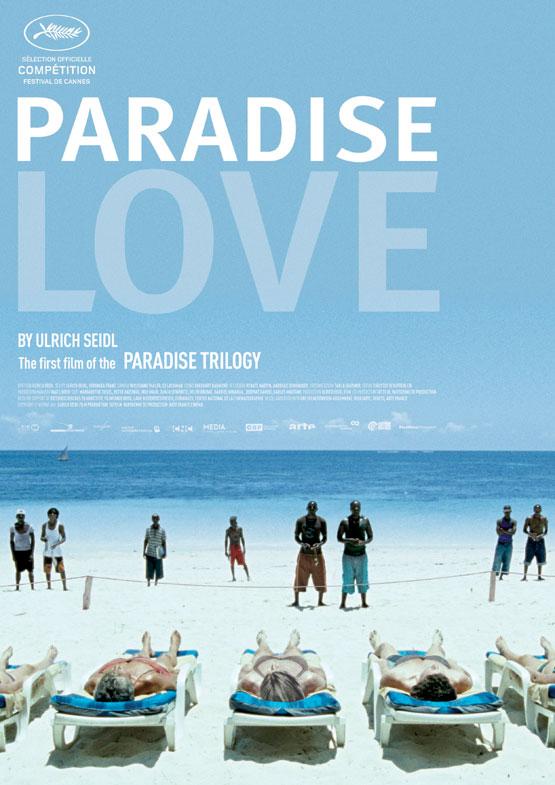


Some films you watch. Others you live. In Ulrich Seidl's films you suffer. You suffer and laugh, and laugh and suffer, until tears pour from your eyes, until out from laughter arises guilt. Guilt for having suffered. Guilt for having laughed. And only then, when you emerge from the guilt, wipe the film from your eyes, do you realize that the naïve 200-pound quinquagenarian Austrian sex-tourist on holiday in Kenya is none other then yourself, if not your sister or perhaps mother. Only then does the comfort of guilt morph into the vexation of shame as you understand that the buffoon you saw on the screen was wearing what turned out to be your face for a mask.

But don’t say you weren’t forewarned. The ballsy and shameless opening scene of Paradise: Love, should have given notice enough. After all, away from the scrutinizing eyes of society it becomes too easy to indulge in the visual pleasure of watching warped grimaces twisting in glee and shock across the faces of the spasmodic, the abnormal, the mongoloid. Hidden behind the comfort of our screen (for it is always our screen, and never just yours or mine) it becomes all too simple to relish images of the rejected visages of the mentally retarded contorting themselves in farcical masks as their bumper cars smash into each other, watching Teresa, our fat Austrian heroine, watch them. Our white-winged socially-implanted moral warden hanging over our right shoulder like a wee angel warns us against laughter, but in the liberty and obscurity of the cinematic chamber, we let loose with a laughter poised on the razor's edge between discomfort and hilarity. Paradise: Love’s opening scene is a warning, a provocation, a contract of the film to come, and it reads: “I will force you to laugh at things not only which you do not want to laugh at, but which you know you should not.” But laugh we do, and in so doing become accomplices to the film. Seidl’s humor is not the innocent cathartic guffaw of slapstick, nor the healing chortle of satire. It is a blow aimed to crack open a chink in the armor of our self-righteousness to make way for the stiletto of shame to slide in more easily.

By naming our tender, pale, gullible heroine Teresa after the famed Mother Superior of Christian fame, Seidl sticks a knife in the back of the charitable West’s self-congratulatory sentiments for the aid it provides the (usually somewhat darker-skinned) third-world. (Do we hear the rational arguments of capitalist economics buzzing in the background? Business for the locals? Improvements to infrastructure? Exchange of goods?) The tourist, a missionary of modernity, never meets the third-world inhabitants on equal terms, never enters their world, but rather travels to other lands with the goal of extracting as many resources as possible, be it gold, souls or sex. The images of Teresa’s travels to this land of alterity in Paradise: Love are no reflections of a “mirror being carried along a high road,” but rather visions which barely pierce the thick and muggy waters of the aquarium in which her head is enclosed: Omnia mea mecum porto - when the European travels she takes her whole world with her wrapped around her head, aquarium, water and fish too. Teresa’s ‘omnia’, the civilized rectangular glassed cage is exemplified by the space of the European room (and the cinematic frame?). As Teresa prepares for her trip, she appears in one chamber after another in her Austrian apartment, preparing food, folding laundry, packing bags and the rectangle in which she moves is the one the camera will bring with her (and us) on holiday to Kenya, with its centralized perspective and weight, and its ordered compositions, signs of the European’s efficiency and rationality.

But no matter, for the tourist’s mission is not to see unseen landscapes but rather to ignore the distinctiveness of the travel destination so as to better wrench maximum ‘fun’ from the exotic (what else would make tourism the largest industry worldwide?). So, even when Teresa and her Austrian compatriots travel thousands of kilometers to reach a new panorama, the only landscape they can perceive is the one they brought with them, with its ordered lines, sparkling clean toilet bowls, and secure walled-off pleasures.

To Read the Rest

Wednesday, April 10, 2013

Revanche (Austria: Götz Spielmann, 2008)


Revanche (Austria: Götz Spielmann, 2008: 121 mins)

Ashbury, Roy. "Prostitution." Understanding Representation. ed. Wendy Helsby. London: BFI, 2005: 115-142. [Available in BCTC Library PN 1995 U4977 2005]

Spielman, Götz. "DVD OF THE WEEK & PODCAST: Revanche (Gotz Spielmann)." Green Cine Daily (February 18, 2009)

Totaro, Donato. "Revanche (2008, Götz Spielman)-- A Matter of Stillness." Offscreen (February 28, 2010)

White, Armond. "Revanche:
Revival of the Fittest."
The Criterion Collection (February 11, 2010)

Sunday, April 7, 2013

The White Ribbon (Austria/Germany/France/Italy: Michael Haneke, 2009)


The White Ribbon (Austria/Germany/France/Italy: Michael Haneke, 2009: 144 mins)

Brunette, Peter. Michael Haneke. Urbana, IL: University of Illinois, 2010.

Frey, Mattias. "Great Directors: Michael Haneke." Senses of Cinema #57 (2010)

Grant, Catherine. "Michael Haneke: A Ribbon of Links." Film Studies for Free (October 6, 2009)

Grundman, Roy. A Companion to Michael Haneke. Malden, MA: Wiley Blackwell, 2010.

Horner, Kierran. The White Ribbon Film International (May 10, 2011)

Horwath, Alexander. "Michael Haneke Uncut: Talking shop, theory, and practice with the director of The White Ribbon." Film Comment (November/December 2009)

Lim, Sandra E. "Cinema of Reflexivity: Hegemonic Masculinity and the Logic of Terror in Haneke’s The White Ribbon." Senses of Cinema #113 (March 2025) ["Haneke asserts that the film is not solely about the origins of German Fascism, but rather an exploration of “…the roots of all kinds of terrorism – whether politically right, politically left or religious.”1 His framing of violence as universal and recurring opens the door for readings of the film beyond historical accounts. Magdalena Zolkos builds on Haneke’s assertion, offering that The White Ribbon also moves beyond the usual psycho-historical reading of authoritarianism as generational and transmitted through repressive child-rearing. Instead, she suggests that the children internalise the rigid morality and logic of the dominant male figures in the village. If the children are at the root of the terror, as the school teacher suggests, their violent acts do not resist patriarchal rule but instead mutate and turn back on themselves, becoming something more terrifying."]

"Michael Haneke Studies: Videos, Podcasts and Article Links." Film Studies for Free (June 26, 2010)

Ogrodnik, Benjamin. "Deep Cuts." Film International 7.1 (Feb 2009)

Price, Brian and John David Rhodes, ed. On Michael Haneke. Detroit, MI: Wayne State University, 2010.

Wheatley, Catherine. Michael Haneke's Cinema: The Ethic of the Image. NY: Bergahn Books, 2009. [BCTC Library PN 1998.3 H36 W44 2009]


Saturday, April 6, 2013

A Dangerous Method (UK/Canada/Switzerland: David Cronenberg, 2011)


A Dangerous Method (UK/Canada/Germany/Switzerland: David Cronenberg, 2011: 99 mins)

Bale, Miriam. "They Came From Within: Yonic symbolism in the films of David Cronenberg." Moving Image (January 20, 2012)

Bowen, Chuck. "The Films of David Cronenberg Ranked." Slant (February 24, 2015)

Chemaly, Soraya. "Virgins, Bondage and A Shameful Media Fail." Huffington Post (April 20, 2012)

"Explore the Making of ‘Cosmopolis,’ ‘Naked Lunch,’ ‘Spider,’ ‘Eastern Promises,’ and More." The Film Stage (January 13, 2016)

Flores, Steven. "The Auteurs: David Cronenberg (Part 1)." Cinema Axis (October 28, 2013)

---. "The Auteurs: David Cronenberg (Part 2)." Cinema Axis (October 30, 2013)

Heath, Roderick. "A Dangerous Method (2011)." Ferdy on Films (December 18, 2011)

"Intersubjectivity." Wikipedia (No Date)

Kuersten Erich. "CinemArchetype #6: The Intimidating Nymph." Acidemic (March 2, 2012)

Porton, Richard. "A Dangerous Method." Cinema-Scope #48 (Fall 2011)

Ratner, Megan. "David Cronenberg’s A Dangerous Method." Film Quarterly (November 2011)


Tuesday, October 23, 2012

Richard Porton: A Dangerous Method

The Dangerous Method
by Richard Porton
Cinema Scope


The title of Russell Jacoby’s 1983 polemic, The Repression of Psychoanalysis, suggests that the radical implications of the Freudian tradition have become muddled in an era where nothing seems more safely middle-class than a session on the couch with the shrink of one’s choice. In evoking a juncture at the turn of the 20th century when psychoanalysis still seemed subversive and a riposte to bourgeois complacency, David Cronenberg’s A Dangerous Method, with its curious tone pitched between placid costume drama and the threat of domestic horror, also seeks to rehabilitate the “talking cure” as a radical, even potentially incendiary, concept.

Inspired by John Kerr’s A Most Dangerous Method, a study of the complex relationship between Carl Jung, his patient (and mistress) Sabina Spielrein, and Jung’s mentor, and eventual adversary, Sigmund Freud—and more directly based on screenwriter Christopher Hampton’s play The Talking Cure—Cronenberg tackles one of his favourite themes: the toll exacted by sexual repression and the danger, as well as frisson, of shedding the weight of such repression. Just as these themes were delineated with the aid of generic horror tropes in Shivers (1975), A Dangerous Method reveals the emotional violence that bubbles below the surface of Hampton’s witty repartee.

It’s no secret that intellectual controversies often escalate into verbal sparring that mimics actual warfare. From the outset, the theoretical challenges posed to young Dr. Jung by the beautiful and brilliant Spielrein’s bout of “hysteria” (the Victorians’ favorite diagnosis for troubled women) take on a quality that is almost as feral and uncontrollable as the effects of those notorious parasites in Shivers. When the Russian-Jewish Spielrein (Keira Knightley) arrives by coach at Dr. Jung’s (Michael Fassbender) Zurich clinic in 1904, she might as well be the reincarnation of Jane Eyre’s madwoman in the attic. Yet as we soon learn, she’s sophisticated and erudite—as well as the intellectual equal of her rather stuffy doctor and mentor.

Spielrein’s journey from apparent lunatic to autonomous woman (and eventually to a career as a distinguished analyst in her own right) encourages Cronenberg to impose a deceptively restrained classical style (large swatches of shot-reverse shot) on feverish subject matter. The film mixes genres so unobtrusively that it’s barely noticeable. As the origins of Spielrein’s physical and psychological symptoms gradually emerge, we are lulled into believing that Cronenberg is dispassionately preoccupied with an intellectual detective story: locating the source of the patient’s trauma (a struggle with painful, as well as pleasurable, memories of her father’s beatings) and moving on to a satisfyingly dramatic “abreaction.” Yet when Jung plunges into an affair with Spielrein (professional ethics were less codified in the early days of psychoanalysis), a brief shot of the besotted doctor engaging in sadomasochistic sex with his corseted patient resembles an outtake from a Liliana Cavani film. The uptight analyst’s surface rectitude is unmasked with one succinct image.

For those of us who prefer Freudian rigour to Jung’s proto-New Age wooliness, it’s heartening that Viggo Mortensen’s portrayal of Freud is endearingly complex. If Mortensen’s cigar-puffing Freud at times seems inordinately stiff (perhaps reinforced by the fact that Hampton’s script has Jung accusing him of “rigid pragmatism”), he’s at least witty. Although Freud’s initial meetings with Jung are cordial, there are certainly intimations of their epochal rupture. When Jung claims not to understand why the Viennese psychoanalysts are vulnerable to criticism because of their Jewish origins, Freud terms his friend’s demurral “an exquisitely Protestant remark.” In Cronenberg on Cronenberg, the director remarks that his parents, who celebrated Christmas, “invented their own version of what it is to be Jewish.” The same could well be said of Freud, a defiantly secular Jew, whose claustrophobic, cluttered home presents a sharp contrast to Jung’s relatively palatial digs.

To Read the Rest

Monday, December 26, 2011

Megan Ratner: David Cronenberg’s A Dangerous Method

David Cronenberg’s “A Dangerous Method”
by Megan Ratner
Film Quarterly


At the center of the emotional and intellectual geometry of A Dangerous Method are Carl Jung (Michael Fassbender) and his patient Sabina Spielrein (Keira Knightley), a woman so afflicted when she first consults Jung that she can only speak with effort. But she responds to Jung’s prototype of psychoanalysis, and, emboldened by his success, Jung contacts Freud (Viggo Mortensen), his mentor and (as the younger man sometimes puts it) father figure. Meanwhile Spielrein graduates from Jung’s patient to his assistant, and they embark on an affair that threatens both to cause a scandal and to discredit the psychoanalytic movement.

The actors bring an understated subtlety to the material: Mortensen is surprisingly laconic and light in the role of Freud, a far cry from the aggressive protagonists he played in previous outings with Cronenberg, A History of Violence (2005) and Eastern Promises (2007). Unhurried and assured, his portrayal of Freud reveals a man convinced of his own greatness but fretfully protective of the future of his intellectual creation. This undercurrent serves him particularly well in his single scene with Spielrein, in which their shared devotion to the movement eclipses even their shared affection for Jung.

In the role of Spielrein, Knightley is initially startling. Though her writhing and grimaces are credible, it’s her consistently spooked expression, electrified and unpredictable, that makes her performance more than bravado. Even sitting relatively still during her initial session with Jung, Spielrein seems just this side of chaos. Cronenberg explained to me that Christopher Hampton studied Jung’s own notes about Spielrein during a research trip to Geneva. Additionally, Cronenberg viewed early actuality films of women with similar symptoms. “They’re very difficult to watch,” he said, “because it’s sort of a willed deforming.” He worked with the actress to go as far as possible toward depicting such self-disfigurements without getting to the point that it would become too uncomfortable for the audience. By channeling Spielrein’s mania into keen focus, as in the scene where she and Jung measure word-association reaction times (on his wife), Knightley effects a delicate transformation from madwoman to rising analyst. From the outset, she looks for no sympathy, playing Spielrein as an experimenter, unafraid of risk to her body or mind.

To Read the Rest of the Review