Showing posts with label Images. Show all posts

Wednesday, October 16, 2013

Werckmeister Harmonies (Hungary/Italy/Germany/France: Bela Tarr, 2000)


Werckmeister Harmonies (Hungary/Italy/Germany/France: Bela Tarr, 2000: 145 mins

Cutler, Aaron. "Multiple Vision: Deciphering the isolated gazes in the films of Béla Tarr." Multiple Image Source (February 2012)

Flanagan, Matthew. "Towards an Aesthetic of Slow in Contemporary Cinema." 16:9 (November 2008)

North, Dan. "“All a Man Can Do is Look Upon it”: What’s With the Werckmeister Whale?" Spectacular Attractions (December 3, 2009)

Romney, Jonathan. "Bela Tarr." Exile Cinema: Filmmakers at Work Beyond Hollywood ed. Michael Atkinson. Albany, NY: SUNY Press, 2008: 73-78. [Professor has copy]

Sunday, September 1, 2013

Martin Scorsese - The Persisting Vision: Reading the Language of Cinema

The Persisting Vision: Reading the Language of Cinema
by Martin Scorsese
The New York Review of Books


...

Frank Capra said, “Film is a disease.” I caught the disease early on. I felt it whenever I walked up to the ticket booth with my mother or my father or my brother. You’d go through the doors, up the thick carpet, past the popcorn stand that had that wonderful smell—then to the ticket taker, and then in some of the old theaters there would be another set of doors with little windows and you’d get a glimpse of something magical happening up there on the screen, something special. And as we entered, for me it was like entering a sacred space, a kind of sanctuary where the living world around me seemed to be recreated and played out.

What was it about cinema? What was so special about it? I think I’ve discovered some of my own answers to that question a little bit at a time over the years.

First of all, there’s light.

Light is at the beginning of cinema, of course. It’s fundamental—because cinema is created with light, and it’s still best seen projected in dark rooms, where it’s the only source of light. But light is also at the beginning of everything. Most creation myths start with darkness, and then the real beginning comes with light—which means the creation of forms. Which leads to distinguishing one thing from another, and ourselves from the rest of the world. Recognizing patterns, similarities, differences, naming things—interpreting the world. Metaphors—seeing one thing “in light of” something else. Becoming “enlightened.” Light is at the core of who we are and how we understand ourselves.

And then, there’s movement…

I remember when I was about five or six, someone projected a 16mm cartoon and I was allowed to look inside the projector. I saw these little still images passing mechanically through the gate at a very steady rate of speed. In the gate they were upside down, but they were moving, and on the screen they came out right side up, moving. At least there was the sensation of movement. But it was more than that. Something clicked, right then and there. “Pieces of time”—that’s how James Stewart defined movies in a conversation with Peter Bogdanovich. That wonder I felt when I saw these little figures move—that’s what Laurence Olivier feels when he watches those first moving images in that scene from The Magic Box.

The desire to make images move, the need to capture movement, seemed to be with us 30,000 years ago in the cave paintings at Chauvet—in one image a bison appears to have multiple sets of legs, and perhaps that was the artist’s way of creating the impression of movement. I think this need to recreate movement is a mystical urge. It’s an attempt to capture the mystery of who and what we are, and then to contemplate that mystery.

...

Does cinema really begin with Muybridge? Should we go all the way back to the cave paintings? In his novel Joseph and His Brothers, Thomas Mann writes:

The deeper we sound, the further down into the lower world of the past we probe and press, the more do we find that the earliest foundations of humanity, its history and culture, reveal themselves unfathomable.


All beginnings are unfathomable—the beginning of human history, the beginning of cinema.

A film by the Lumière brothers of a train arriving at a station in France is commonly recognized as the first publicly projected film. It was shot in 1895. When you watch it, it really is 1895. The way they dress and the way they move—it’s now and it’s then, at the same time. And that’s the third aspect of cinema that makes it so uniquely powerful—it’s the element of time. Again, pieces of time.

When we made the movie Hugo (2011), we went back and tried to recreate that first screening, when people were so startled by the image of an oncoming train that they jumped back. They thought the train was going to hit them.

When we studied the Lumière film, we could see right away that it was very different from the Edison films. The Lumière brothers weren’t just setting up the camera to record events or scenes. This film is composed. When you study it, you can see how carefully they placed the camera, the thought that went into what was in the frame and what was left out of the frame, the distance between the camera and the train, the height of the camera, the angle of the camera—what’s interesting is that if the camera had been placed even a little bit differently, the audience probably wouldn’t have reacted the way it did.

To Read the Rest

Wednesday, July 3, 2013

Time of the Wolf (France/Austria/Germany: Michael Haneke, 2003)


Time of the Wolf (France/Austria/Germany: Michael Haneke, 2003: 113 mins)

Bingham, Adam. "Long Night's Journey Into Day." Kinoeye 4.1 (March 2004)

Brunette, Peter. Michael Haneke. Urbana, IL: University of Illinois, 2010.

Frey, Mattias. "Great Directors: Michael Haneke." Senses of Cinema #57 (2010)

Grundman, Roy. A Companion to Michael Haneke. Malden, MA: Wiley Blackwell, 2010.

"Michael Haneke Studies: Videos, Podcasts and Article Links." Film Studies for Free (June 26, 2010)

Price, Brian and John David Rhodes, ed. On Michael Haneke. Detroit, MI: Wayne State University, 2010.

Sorfa, David. "Uneasy domesticity in the films of Michael Haneke." Studies in European Cinema 3.2 (2006)

Wheatley, Catherine. Michael Haneke's Cinema: The Ethic of the Image. NY: Bergahn Books, 2009. [BCTC Library PN 1998.3 H36 W44 2009]


Saturday, May 25, 2013

C. Jerry Kutner: Cinema du WTF – Upstream Color (Shane Carruth 2013)

Cinema du WTF – UPSTREAM COLOR (Shane Carruth 2013)
by C. Jerry Kutner
Bright Lights Film Journal


A singular and highly accomplished independent film, Upstream Color is philosophical science fiction in the tradition of the French nouvelle vague, seasoned with a dash of Cronenbergian body horror. Like the SF films that emerged from the nouvelle vague – Chris Marker’s La Jetée, Alain Resnais’s Je t'aime je t'aime, Godard’s Alphaville, Bertrand Tavernier’s Death Watch – Upstream Color foregoes studio sets and elaborate special effects in favor of real locations and a concern with fundamental existential issues like the nature of free will, memory, perception, and time – what Raymond Durgnat once called the science fiction of “inner space.”

The body horror, reminiscent of early Cronenberg films like Rabid and Shivers (aka They Came From Within), comes from the film’s MacGuffin, a worm or grub found in the roots of orchids that secretes a drug, prized in certain circles for its psychotropic properties. If the worm is implanted in a victim, he or she becomes a virtual zombie, susceptible to any suggestion, obeying any command.

To say the film is enigmatic is an understatement. This might be the WTF film of 2013. Its complex story is told almost entirely through its visuals. There is minimal dialogue, and what there is of it is fragmentary, heard – or overhead – in bits and pieces. The visuals themselves are elliptical – we might be shown only the beginning, the middle, or the end of an action and have to infer the rest of it. Sometimes it is uncertain whether what we are looking at is literal or metaphoric. Chronology is scrambled. But the effect is not off-putting. On the contrary, this is an extraordinarily compelling film. Because we have to piece the narrative together ourselves, we pay closer attention.

Moreover, there is a sound basis for the film’s peculiarities of style. The two main characters, Kris (Amy Seimetz) and Jeff (writer/director Shane Carruth) are both victims of the worm – both brain-damaged. Consequently, we experience reality as they do.

To Read the Rest

Sunday, April 21, 2013

Rob White: Interview with Manuel Alberto Claro

Interview with Manuel Alberto Claro
by Rob White
Film Quarterly


Cinematographer for Lars von Trier’s Melancholia, Manuel Alberto Claro was born in Santiago, Chile in 1970. His family moved to Denmark in 1974, after the Pinochet coup. Having graduated from the European Design Institute, Milan, he worked in his twenties as a photographer’s assistant in Copenhagen and New York. At age 27, he changed tack and studied cinematography at the Danish National Film School. His second feature in his new professional capacity, Reconstruction (Christoffer Boe, 2003), gained the Caméra d’Or at Cannes, and Claro’s career has gone from strength to strength. Melancholia won the award for best film at the 2011 European Film Awards, with Claro taking the cinematography prize. He is due to collaborate again with von Trier on the director’s next project, The Nymphomaniac.

“My aim is to make images that are in love with the story and not with themselves,” Claro told Idol Magazine, adding that his professional role model is Harris Savides, whose credits include Margot at the Wedding (Noah Baumbach, 2007) and Last Days (Gus Van Sant, 2005): “If you can create poetic images, full of texture and emotional presence, out of something trivial, then you are good,” said Claro.

Melancholia has its own wedding and last day, and neither event ends in celebration. The marriage between Justine (Kirsten Dunst) and Michael (Alexander Skarsgård) goes off the rails before it can even be consummated (Justine prefers a roll in the golf-bunker sand with one of Michael’s colleagues), and Melancholia is bookended by slow-motion collisions between the eponymous renegade planet and Earth. Yet von Trier’s anti-disaster film is neither tragic nor miserable. “When I left the theater and exited out into Cannes, I felt light, rejuvenated and unconscionably happy,” wrote the Village Voice’s J. Hoberman after a festival screening. My own reaction was rather similar. Despite its chaotic nuptials and global wipeout, Melancholia does not induce melancholia, at least if Freud’s description of the state in “Mourning and Melancholia” is to be taken as gospel: “profoundly painful dejection, cessation of interest in the outside world, loss of the capacity to love.”

Von Trier’s wry DVD commentary (in conversation with University of Copenhagen professor Peter Schepelern, included on the U.K. edition published by Artificial Eye) often zeroes in on transient pleasures, such as the improvised moment when Udo Kier, in the role of the thin-skinned Wedding Planner, lumbers after a flaming paper lantern as if out of empathy for the object’s own flimsy epidermis. The director also rues small infelicities that most viewers would never notice, such as CGI complexion-smoothing (“skin fixes”) that he now considers unsatisfactory. Since he also admits to so-called Obsessive Compulsive Disorder, perhaps his focus on minutiae should be classed as pathological persnicketiness—but that would be to prefer armchair psychoanalysis to the beautiful variegation of Melancholia, to which Claro’s cinematography contributes so much.

It is an eccentric, rogue film that never obeys the usual rules of stylistic and emotional consistency. Paradoxes and incongruities abound from the start: the miniature drama of Justine opening her eyes against a background of avian rainfall is juxtaposed with a cosmic conflagration rendered as one liquescent heavenly body plunging into another. And if von Trier’s film embraces sci-fi, Wagner, uncanny tableaux, homages to Bergman and Tarkovsky, Dogme-style handheld jitteriness, there is also a long take of summer quiet as Claire (Charlotte Gainsbourg) dozes which is reminiscent, as Schepelern suggests during the commentary, of Rohmer’s bittersweet idylls. To dwell on such a detail, and to go further and think it more notable than the ensuing celestial firestorm, might after all involve a kind of melancholy, though one quite unfit for Freudianism.

To Read the Interview

Thursday, September 6, 2012

ENG 281 Ethics/Film: Week 4 -- Beyond the Standard Feature Film

Wisconsin "Budget Repair Bill" Protest from Matt Wisniewski on Vimeo.


Wikipedia: 2011 Wisconsin Protests

"Background Materials for John Bellamy Foster's "Education and the Structural Crisis of Capital" Dialogic (September 7, 2011)

Benton, Michael. "Bill O'Reilly and FOX News: Propaganda Fails Miserably." Dialogic (March 2, 2011)

Burke, Mike and Harriet Brown Rowan. "Wisconsin’s Uprising: A Guided Tour of the 11-Day Protest Encampment Inside the State Capitol in Madison." Democracy Now (February 25, 2011)

Burke, Mike and Nicole Salazar. "Walkouts, Bank Boycotts and Recalls: Wisconsin Protests Intensify as Union-Busting Legislation Pushed through State Assembly." Democracy Now (March 11, 2011)

Dennis, Brady and Peter Wallenstein. "Wisconsin governor urging others to take stands against unions." Washington Post (February 23, 2011)

Graves, Lisa. "A CMD Special Report: Scott Walker Runs on Koch Money ." PR Watch (February 19, 2011)

Hudson, Michael and Jeffrey Sommers. "Wisconsin Death Trip: The Plan to Steal Everything and Sell the People into Slavery." Counterpunch (March 11, 2011)

"Lawmakers Flee Wisconsin Capitol, State Police Pursue; Protests Swell to 30,000." AlterNet (February 17, 2011)

Meyerson, Harold. "Workers toppled a dictator in Egypt, but might be silenced in Wisconsin." The Washington post (February 15, 2011)

Nichols, John. "Why a Wisconsin Sheriff Refuses to Serve as Governor Walker's 'Palace Guard'." The Nation (March 2, 2011)

Rickman, Peter, Chris Larson and Kelda Helen Roys. "Outrage in Wisconsin: Thousands Flood Capitol After GOP Strips Public Workers of Bargaining Rights in Surprise Senate Vote." Democracy Now (March 3, 2010)

Zirin, Dave. "Wisconsin: Solidarity Among Workers … And Football Players." Yes! (February 17, 2011)


La Jetée (1962) from Augustus Brightman on Vimeo.


Bullock, Tori. "La Jetee Film Analysis." Film and History (May 4, 2011)

Christley, Jamie N. "Great Directors: Chris Marker Senses of Cinema (July 19, 2002)

Dillon, Brian. "Fade away: Chris Marker's La Jetée, a half-hour futuristic film that explores time and memory, seems to conjure an entire century's romance with the moving image." The Guardian (March 28, 2009)

"Listening to La Jetee." The Current (June 21, 2012)

Perry, Canaan. "Time, Memory and Time Travel in Chris Marker’s La Jetée." Space Zoetrope (2007)

Rowan-Legg, Shelah M. "Chris Marker, Filmmaker Behind LA JETÉE, Dies at 91." Twitch (July 30, 2012)

Schefer, Jean-Louis. "On La Jetee." Passages of the Image (1991: hosted on Paul Smith's Website)

Sellars, Simon. "Retrospecto: La Jetee." Ballardian (October 7, 2005)


The Universal Clock - The Resistance of Peter Watkins by Geoff Bowie, National Film Board of Canada


Biographical Sites and Official Websites:

Wikipedia: Peter Watkins

Peter Watkins: Filmmaker/Media Critic (Official Site)

British Film Institute: Peter Watkins


Resources by and about Peter Watkins and his films:

Estrin, Marc. "Peter Watkins' La Commune." The Rag Blog (March 29, 2010)

Keser, Robert. "Edvard Munch." Senses of Cinema (February 7, 2006)

La Commune (Paris, 1871) (France: Peter Watkins, 2000: available on Google video in multiple parts)

"Peter Watkins: La Commune." Chtodelat (October 31, 2008)

Peter Watkins: The Media Crisis Dialogic (October 3, 2007)

Rapfogel, Jared. "The Cinema of Peter Watkins." Cineaste 32.2 (Spring 2007)

Rosenbaum, Jonathan. "The Revolution Has Been Televised [Peter Watkins’ LA COMMUNE]." Chicago Reader (May 17, 2002)

Watkins, Peter. "Notes on the Making of La Commune (Paris, 1871)." Peter Watkins: Filmmaker/Critic (2000)

---. "Notes on the Media Crisis." Barcelona, Spain: Quaderns portàtils, 2010.


Tuesday, July 31, 2012

Reverse Shot: Deep Red -- Joanne Nucho on The Color of Pomegranates

Deep Red: Joanne Nucho on The Color of Pomegranates
Reverse Shot

Steeped in religious iconography, The Color of Pomegranates is a deeply spiritual testament to director Sergei Parajanov’s fascination with Armenian folk art and culture. It is also a controversial work, which, coupled with another of his films, Shadows of our Forgotten Ancestors, led to his arrest and imprisonment in a Soviet Gulag for four years. The Soviets insisted he was guilty of selling gold and icons illegally and committing “homosexual acts.” In reality, his only crime was offending the tenets of socialist realism, both in his daring surrealistic form and in his choice of subject matter. While many of the popular films of this era in Soviet cinema were largely propaganda designed to serve the ideological interests of the regime, Parajanov chose to focus on the ethnography and spirituality of the Ukraine, Armenia, and Georgia.
The Color of Pomegranates is a poetic, dreamlike film that sought to portray the life of Armenian troubadour Sayat Nova through images inspired by his life and poetry. Born Haroutiun Sayakian, he is remembered as Sayat Nova or “king of songs.” Raised in the Georgian city of Tiflis (as was Sergei Parajanov himself), Sayat Nova performed in the Armenian, Azerbaijani, and Persian languages. This brought him fame beyond the Armenian community and he was summoned to serve as Court Musician and Poet by Heracle II, the 18th- century king of Georgia. After falling in love with the king’s sister, Princess Anna, he was expelled from the court. He spent the rest of his life as a monk where he continued to write poetry and music. To the Armenian people, Sayat Nova is considered a martyr because he was executed by the invading Persians for refusing to renounce his Christian faith.

Parajanov’s decision to make a film about the life of an Armenian poet and martyr was a dangerous one. Armenian national identity was not to be prioritized—it was viewed as only a part of the Soviet Union. The idea of Armenian independence and secession from the Soviet Union was still dangerous and punishable by death. The lack of a Soviet presence, or any other typical themes of the propaganda films of the time, marked The Color of Pomegranates as a subversive work.

The text of the film, the poetry of Sayat Nova, and the life of director Sergei Parajanov are all reflections of the Armenian national identity, which is itself deeply connected to the Christian faith, as they were the first “nation” in the world to adopt the religion, in the year 301. Surrounded by largely Muslim populations, they were an easy target for invasion and subjugation by their neighbors. The paradigm of Christianity, the images of the suffering of Christ and subsequent salvation—most recently exacerbated by the Armenian genocide perpetrated by Turkey at the beginning of the last century—are at the core of Armenian individuality.

So what is the color of pomegranates? As the film opens, we see thorns intercut with images of pomegranates soaking a white cloth with their juice, a deep blood red. Then we see a dagger resting upon this same, stained cloth. A voice reads from the poetry of Sayat Nova: “I am a man whose soul is tormented.” In Armenian mythology, the pomegranate was a symbol of fertility, literally fruitfulness—it is said that a ripe pomegranate contains 365 seeds, one for each day of the year. The thorns are those of the crown that Christ wore as he suffered on the cross. The two are inseparable, bound closely by the image of bloodshed, the inevitable fate of the Armenian people—here there is only sacrifice and suffering. Later in the film a priest wearing the traditional black garb of the Armenian apostolic church utters “heaven has deemed that sorrow be our lot.” With the camera set at a distance, the monks gather before him, also cloaked in black, shroud-like robes fall on their knees. Everywhere there is death, darkness, disaster—and yet, a feeling that the biggest disaster, the ultimate catastrophe is still to come.

To Read the Rest of the Essay

Friday, July 20, 2012

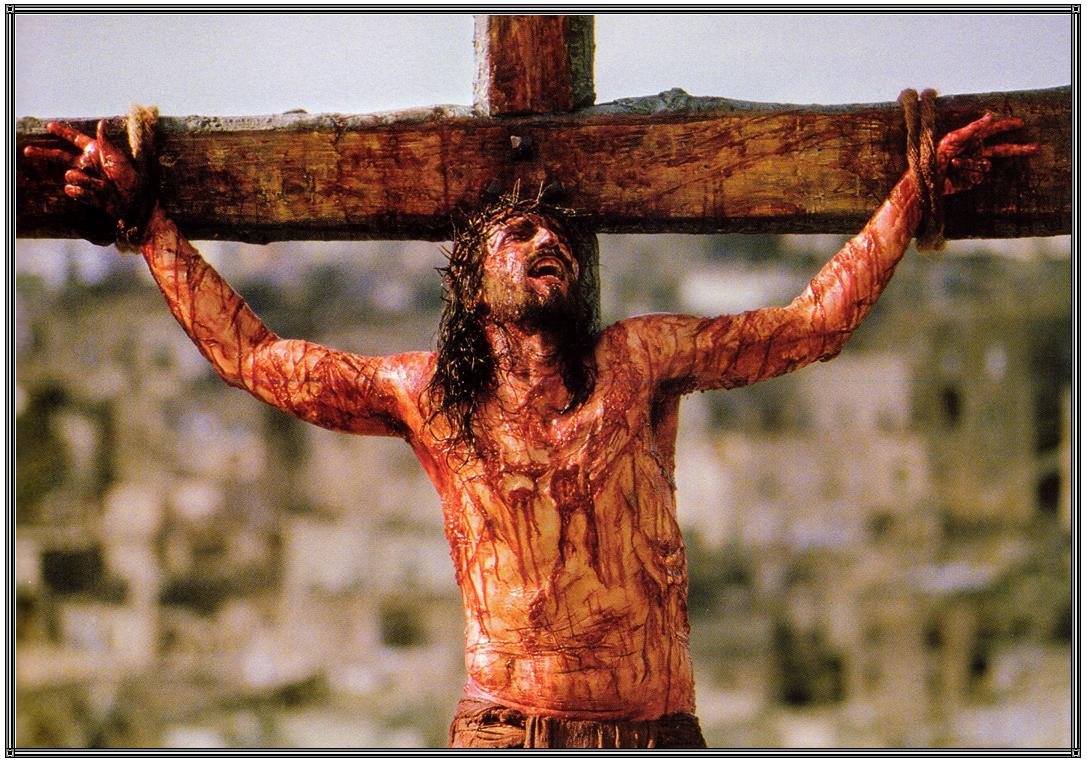
Michael Koresky: Consider the Source -- On The Passion of the Christ

Consider the Source: On The Passion of the Christ
by Michael Koresky
Reverse Shot


I opened my wallet for Jesus. And then, after paying the ten dollars and twenty-five cents, sitting through the ear-splitting, retina-scalding Regal Cinemas’ 2wenty (“Remember to arrive at the theater early!”), ads for Eclipse breath-freshener and Coca-Cola, bulbous oversized M&M men and a TNT “We Know Drama” sensory overload, I was ready to be saved. Lifted out of my seat, perhaps, and brought back down into my chair just in time for the beginning of lent.

Alas, in the end, it was a movie. A mere movie. Mel Gibson’s brilliantly cynical marketing strategy, buoyed by the ADL’s advance work, lured even us non-believers (sinners) into the theater; certainly we didn’t expect to emerge as right-wing Christian fundamentalist converts, but we had every right to think we would be witnessing an honest representation of human and artistic faith, a spiritual roadmap to the psyche of a filmmaker and actor who felt driven, even instructed by God, as he has claimed, to create a cinematic likeness of the divine. It’s not essential that a moviegoer agrees with the political or religious implications of the images emblazoned on the screen, but that the images translate as a response from the filmmaker’s soul, that we believe we are witnessing the gospels as Mel himself sees them. The sheer divine force offered by Pasolini, Scorsese, by Bresson and Burnett and Spielberg, by Alexanders Payne and Sokurov, manifest in images that relinquish themselves to whatever artistic means necessary, not in shameless grandiosity that wishes to pummel the viewer into submission, into terrified acceptance. Gibson may find disingenuous the earthy benevolence of Pasolini’s Christ and the psychological torment of Scorsese’s, the lyrical allegory of Bresson’s Balthazar and Spielberg’s E.T., the spiritual personification of Payne’s Warren Schmidt or Sokurov’s cancer-ravaged saint-mother; he wants a more direct address, to make you feel every thrust of the rusty nail as it’s hammered into Jesus’s palms, to clutch your own shoulders as Jesus’s arm is ripped out of its socket, to cover your eyes in gratitude when the crucified thief’s eye is plucked out by a vengeful crow, to reverently ooh, aah, and shriek when Jesus is scourged, his back torn and ripped open into a hundred fleshy strips. Apparently to Gibson, there is no metaphor in religion; faith manifests itself as a spiritual dead-end, a believe-it-or-be-damned expression of finality. Of course Gibson, progeny of his fundamentalist missionary father’s terrifyingly stubborn outmoded beliefs, ended up a Hollywood actor—that particular “dream factory” churns out endless expressions of American complacency every year, cheerless damning spectacles of moral righteousness and unambigious carnal pleasures. Of course Mel Gibson, though a self-avowed man of endless spiritual vitality, can only depict the divine through the employment of hundreds of buckets of stage-blood. With its ludicrous, Hollywood-fortified conviction (not the same thing as faith, incidentally), Passion may be the world’s first completely banal Jesus Christ film. And though it’s remarkably, hopelessly literal, it was certainly waiting to happen. It had to happen.

If 2000’s Gladiator ushered in the new Bush regime, then perhaps Gibson’s blockbuster is the new 21st-century’s first true coercively conservative “classic.” Rarely has a film with a fundamentalist core been so blatantly conceived, so forthright in its admissions. Every decade of American film, though never preoccupied with anything grander than itself, nonetheless ends up a product of its own political backdrop. First Blood and its subsequent sequels became emblematic of the Reagan era, literally winning Vietnam back from the liberals, reasserting the swaggering machismo of the American hero that Seventies Hollywood attempted to all but decimate. And just as Stallone enacted Reagan’s cloudy-headed right-wing version of recent history, Gibson’s Christ—“compassionate” Conservative, deliverer of that old-tyme religion—emerges from the tomb at just the moment of the Bush administration’s attack on civil liberties, and the attack on the Civil Rights of American gays launched by Dubya himself with full-on, unabashed old-testament condemnation. Those who speak out against Gibson’s film are automatically stigmatized as leftist rabble-rousers and hapless atheists; to deny its physical impact or so-called technical grandeur is to supposedly denounce Gibson’s personal belief system. What’s more essential is to realize that when Gibson’s savvy propaganda piece, meant to inflict a tough-love Jesus on the nation’s wayward souls, floods into 4,000 screens, another dam between Church and State begins to crumble. The youngsters of the Clintonian Nineties, finding solace in the emergence of a truly multicultural pop mainstream, need to be reclaimed by the right, shorn of their piercings and tattoos, and brought back to Sunday school; who better to do that than Jesus himself, this time, like Rambo, stripped to the waist, chained and whipped, flesh torn and limbs broken, but never down for the count?

To Read the Rest of the Essay More: Jeff Reichert: Jesus Christ Superman

Tuesday, April 24, 2012

Tom McCormack: Laws of Desire -- What did David Cronenberg's Videodrome get right about us?

Laws of Desire: What did David Cronenberg's Videodrome get right about us?
by Tom McCormack
Moving Image Source


It can be both fun and necessary to revisit famously prescient works of art and take account of just what they got right.

In Nineteen Eighty-Four, George Orwell was right that the most successful authoritarian regimes of the future would limit dissent by using mass media to control our conceptual tools. He was wrong about how they would do it; instead of issuing messages through a unified voice, the most durable authoritarianism has flourished by dispersing control among a small set of global corporations that justify their outsized power through their success in the marketplace. In Brave New World, Aldous Huxley was right that sexual freedom and the triumph of therapy culture would develop alongside rigid class structures. The mainstream acceptance of casual sex and prescription pharmaceuticals really did happen alongside a consolidation of class power—a radical one we're still reeling from. But in Huxley this was accomplished through an exaggeration of class difference and an expanded language for class; in reality, the culture witnessed the atrophy of a language for class and an erasing of outward signs of class in terms of professed values, fashion, and manners of speech (hence "bourgeois bohemians" and "the millionaire next door").

David Cronenberg's Videodrome offered in 1983 a vision of dystopia that rivaled in ambition and sweep and foresight Orwell's and Huxley's more famous works. So what did Videodrome get right? And what, if anything, did it get wrong?

Cronenberg was right that new technologies would unleash a craving for scenes of increasingly extreme and increasingly realistic—if not just plain real—sexual violence. He was right about what this violence would look like ("No plot, no characters. Very realistic"); why the entertainment industry would turn to it ("I'm looking for something that will break through. Something tough!"); and how those in the media would talk about it ("It's absolutely brilliant. I mean look: there's almost no production cost!"). He was right that many people would experience these new products as addictive and would report a psychic bleed into the texture of their daily lives, frequently to their great concern.

Cronenberg was right, in a more subtle way, about what would cause the cultural turn to sexual violence. The movie isn't called "photodrome" or "cinemadrome"—it's not about the nature of mechanical reproduction or motion pictures but about the consequences of private access to public imagery. Professor Brian O'Blivion, Videodrome's resident philosopher, tells us that the television has become the "retina of the mind's eye"; that "the television screen is part of the physical structure of the brain." What he's talking about is what contemporary social scientists studying the Internet call—borrowing terms from psychoanalysis—"solipsistic introjection." This refers to the tendency of individuals to believe, on at least a semi-conscious level, that things happening on their electronic devices are actually happening inside their heads. Describing how this effect works in online chat rooms, John Suler writes:

Reading another person's message might be experienced as a voice within one's head, as if that person magically has been inserted or "introjected" into one's psyche... The online companion now becomes a character within our intrapsychic world, a character that is shaped partly by how the person actually presents him or herself via text communication, but also by our expectations, wishes, and needs... People fantasize about flirting, arguing with a boss, or very honestly confronting a friend about what they feel. In their imagination, where it's safe, people feel free to say and do all sorts of things that they wouldn't in reality. At that moment, reality IS one's imagination. Online text communication can become the psychological tapestry in which a person's mind weaves these fantasy role plays, usually unconsciously and with considerable disinhibition. All of cyberspace is a stage and we are merely players.


To Read the Rest of the Essay