Showing posts with label Culture. Show all posts
Showing posts with label Culture. Show all posts
Sunday, August 25, 2013

Thursday, August 15, 2013
Harvard University Press Blog: Catherine MacKinnon on Lovelace
Catharine MacKinnon on Lovelace
Harvard University Press

The pornographic film Deep Throat, released in 1972, was a cultural sensation whose star, “Linda Lovelace,” was said to put a girl-next-door face on the sexual revolution. But the actual life of Linda Boreman, as depicted in the new biopic Lovelace, was one of beatings, rape, and terror. Feminist legal scholar Catharine MacKinnon, author of such works as Toward a Feminist Theory of the State and Only Words, represented Boreman after she came forward with her story, and later, with Andrea Dworkin, pursued civil rights litigation as a means to fight pornography. We asked MacKinnon about Boreman, Lovelace, and the potential impact of the film.
To Read the Interview
Harvard University Press
The pornographic film Deep Throat, released in 1972, was a cultural sensation whose star, “Linda Lovelace,” was said to put a girl-next-door face on the sexual revolution. But the actual life of Linda Boreman, as depicted in the new biopic Lovelace, was one of beatings, rape, and terror. Feminist legal scholar Catharine MacKinnon, author of such works as Toward a Feminist Theory of the State and Only Words, represented Boreman after she came forward with her story, and later, with Andrea Dworkin, pursued civil rights litigation as a means to fight pornography. We asked MacKinnon about Boreman, Lovelace, and the potential impact of the film.
To Read the Interview
Sunday, June 30, 2013
Yes (UK: Sally Potter, 2004)

Yes (UK: Sally Potter, 2004: 100 mins)
"Angelism and Rage: Sally Potter Links." Film Studies for Free (September 21, 2009)
Mayer, Sophie. "The Films of Sally Potter." Electric Sheep Magazine (October 1, 2009)
McKim, Kristi. "Great Directors: Sally Potter." Senses of Cinema #40 (July 2006)
"Please go in two by two! Sally Potter's Fabulous Ark." Film Studies for Free (November 4, 2008)
Thursday, April 4, 2013
Saturday, February 16, 2013
Matte Hjort: Film ... has an extraordinary capacity to expand our reality
Film matters, among other things, because it has an extraordinary capacity to expand our reality, to deepen our moral sensibility, and to shape our self-understandings, sometimes by moving us closer to cultures, problems, and realities that are distant from those we know well. That said, I think it is far from being the case that all films matter. The task, I think, for film scholars in the future will be to help to ensure that films that genuinely do matter continue to get made, and that they receive the attention they deserve.
Matte Hjort, "Film ... has an extraordinary capacity to expand our reality." Why Does Film Matter (Intellect Books, 2008)
Matte Hjort, "Film ... has an extraordinary capacity to expand our reality." Why Does Film Matter (Intellect Books, 2008)
Tuesday, July 31, 2012
Reverse Shot: Deep Red -- Joanne Nucho on The Color of Pomegranates
Deep Red: Joanne Nucho on The Color of Pomegranates
Reverse Shot
 Steeped in religious iconography, The Color of Pomegranates is a deeply spiritual testament to director Sergei Parajanov’s fascination with Armenian folk art and culture. It is also a controversial work, which, coupled with another of his films, Shadows of our Forgotten Ancestors, led to his arrest and imprisonment in a Soviet Gulag for four years. The Soviets insisted he was guilty of selling gold and icons illegally and committing “homosexual acts.” In reality, his only crime was offending the tenets of socialist realism, both in his daring surrealistic form and in his choice of subject matter. While many of the popular films of this era in Soviet cinema were largely propaganda designed to serve the ideological interests of the regime, Parajanov chose to focus on the ethnography and spirituality of the Ukraine, Armenia, and Georgia.
The Color of Pomegranates is a poetic, dreamlike film that sought to portray the life of Armenian troubadour Sayat Nova through images inspired by his life and poetry. Born Haroutiun Sayakian, he is remembered as Sayat Nova or “king of songs.” Raised in the Georgian city of Tiflis (as was Sergei Parajanov himself), Sayat Nova performed in the Armenian, Azerbaijani, and Persian languages. This brought him fame beyond the Armenian community and he was summoned to serve as Court Musician and Poet by Heracle II, the 18th- century king of Georgia. After falling in love with the king’s sister, Princess Anna, he was expelled from the court. He spent the rest of his life as a monk where he continued to write poetry and music. To the Armenian people, Sayat Nova is considered a martyr because he was executed by the invading Persians for refusing to renounce his Christian faith.
Parajanov’s decision to make a film about the life of an Armenian poet and martyr was a dangerous one. Armenian national identity was not to be prioritized—it was viewed as only a part of the Soviet Union. The idea of Armenian independence and secession from the Soviet Union was still dangerous and punishable by death. The lack of a Soviet presence, or any other typical themes of the propaganda films of the time, marked The Color of Pomegranates as a subversive work.
The text of the film, the poetry of Sayat Nova, and the life of director Sergei Parajanov are all reflections of the Armenian national identity, which is itself deeply connected to the Christian faith, as they were the first “nation” in the world to adopt the religion, in the year 301. Surrounded by largely Muslim populations, they were an easy target for invasion and subjugation by their neighbors. The paradigm of Christianity, the images of the suffering of Christ and subsequent salvation—most recently exacerbated by the Armenian genocide perpetrated by Turkey at the beginning of the last century—are at the core of Armenian individuality.
So what is the color of pomegranates? As the film opens, we see thorns intercut with images of pomegranates soaking a white cloth with their juice, a deep blood red. Then we see a dagger resting upon this same, stained cloth. A voice reads from the poetry of Sayat Nova: “I am a man whose soul is tormented.” In Armenian mythology, the pomegranate was a symbol of fertility, literally fruitfulness—it is said that a ripe pomegranate contains 365 seeds, one for each day of the year. The thorns are those of the crown that Christ wore as he suffered on the cross. The two are inseparable, bound closely by the image of bloodshed, the inevitable fate of the Armenian people—here there is only sacrifice and suffering. Later in the film a priest wearing the traditional black garb of the Armenian apostolic church utters “heaven has deemed that sorrow be our lot.” With the camera set at a distance, the monks gather before him, also cloaked in black, shroud-like robes fall on their knees. Everywhere there is death, darkness, disaster—and yet, a feeling that the biggest disaster, the ultimate catastrophe is still to come.
To Read the Rest of the Essay
Reverse Shot
Steeped in religious iconography, The Color of Pomegranates is a deeply spiritual testament to director Sergei Parajanov’s fascination with Armenian folk art and culture. It is also a controversial work, which, coupled with another of his films, Shadows of our Forgotten Ancestors, led to his arrest and imprisonment in a Soviet Gulag for four years. The Soviets insisted he was guilty of selling gold and icons illegally and committing “homosexual acts.” In reality, his only crime was offending the tenets of socialist realism, both in his daring surrealistic form and in his choice of subject matter. While many of the popular films of this era in Soviet cinema were largely propaganda designed to serve the ideological interests of the regime, Parajanov chose to focus on the ethnography and spirituality of the Ukraine, Armenia, and Georgia.The Color of Pomegranates is a poetic, dreamlike film that sought to portray the life of Armenian troubadour Sayat Nova through images inspired by his life and poetry. Born Haroutiun Sayakian, he is remembered as Sayat Nova or “king of songs.” Raised in the Georgian city of Tiflis (as was Sergei Parajanov himself), Sayat Nova performed in the Armenian, Azerbaijani, and Persian languages. This brought him fame beyond the Armenian community and he was summoned to serve as Court Musician and Poet by Heracle II, the 18th- century king of Georgia. After falling in love with the king’s sister, Princess Anna, he was expelled from the court. He spent the rest of his life as a monk where he continued to write poetry and music. To the Armenian people, Sayat Nova is considered a martyr because he was executed by the invading Persians for refusing to renounce his Christian faith.
Parajanov’s decision to make a film about the life of an Armenian poet and martyr was a dangerous one. Armenian national identity was not to be prioritized—it was viewed as only a part of the Soviet Union. The idea of Armenian independence and secession from the Soviet Union was still dangerous and punishable by death. The lack of a Soviet presence, or any other typical themes of the propaganda films of the time, marked The Color of Pomegranates as a subversive work.
The text of the film, the poetry of Sayat Nova, and the life of director Sergei Parajanov are all reflections of the Armenian national identity, which is itself deeply connected to the Christian faith, as they were the first “nation” in the world to adopt the religion, in the year 301. Surrounded by largely Muslim populations, they were an easy target for invasion and subjugation by their neighbors. The paradigm of Christianity, the images of the suffering of Christ and subsequent salvation—most recently exacerbated by the Armenian genocide perpetrated by Turkey at the beginning of the last century—are at the core of Armenian individuality.
So what is the color of pomegranates? As the film opens, we see thorns intercut with images of pomegranates soaking a white cloth with their juice, a deep blood red. Then we see a dagger resting upon this same, stained cloth. A voice reads from the poetry of Sayat Nova: “I am a man whose soul is tormented.” In Armenian mythology, the pomegranate was a symbol of fertility, literally fruitfulness—it is said that a ripe pomegranate contains 365 seeds, one for each day of the year. The thorns are those of the crown that Christ wore as he suffered on the cross. The two are inseparable, bound closely by the image of bloodshed, the inevitable fate of the Armenian people—here there is only sacrifice and suffering. Later in the film a priest wearing the traditional black garb of the Armenian apostolic church utters “heaven has deemed that sorrow be our lot.” With the camera set at a distance, the monks gather before him, also cloaked in black, shroud-like robes fall on their knees. Everywhere there is death, darkness, disaster—and yet, a feeling that the biggest disaster, the ultimate catastrophe is still to come.
To Read the Rest of the Essay
Sunday, June 24, 2012
Severine Benzimra: French Cinema and French Sexual Attitudes and Culture
State of French Cinema: French cinema and French sexual attitudes and culture
by Severine Benzimra
Acidemic

French sexual attitudes and culture have wildly evolved within the last 20 years. A TV documentary which premiered on June 14th on M6, one of the free French channels, should help us grasp the breadth of the evolution.
Les Français, lamour et le sexe (French people, love and sex) is based on the latest statistics, interviews, and the analysis of sexologist Pascal de Sutter. The first episodes deal with the way French people make love: seduction, preliminaries, and positions; orgasm and fantasm. In the midst of the evening, more than 3 million people were watching - about 21% of the audience.
French cinema naturally mirrors these evolutions, sometimes in a confused way. Sexual repression provokes artistic provocation; cinema might seem less "advanced" (especially to people claiming for an equal treatment of teenagers and grown-ups, gays/lesbians and heterosexual people) in France than in the USA for this reason. Globalization can lead to self-reflection but also to some alienation. When watching US movies, French people often ignore that some scenes were censored in the USA or that a movie was X-rated. Some might consider a kind of race toward freedom is open.
Censorship officially disappeared in French cinema in 1974. It was the end of the Gaullist period and the first year of the presidency of Valéry Giscard d'Estaing; the government wasn't so liberal yet. At the end of 1975 a law was adopted concernng pornographic and extremely violent movies. Porno movies couldn't be shown in traditional movie theaters; they were reserved for specialized theaters. The next major move was made in 2000 with the restriction of some movies to those over 18 (after the Baise-moi affair). Before this, movies could be forbidden to viewers either under age 16 or 12.
French directors aren't interested in making familial movies, lets admit it. Movies for kids are mostly animated or made for TV. Beware if you want to take the pony-club class to see Dance with Him; they might leave laughing about the effects of some perfumes on a stallion or of a lady training with a mechanical horse, or the heated discussion of gluteal muscles. Some parents will consider these better topics than others, but there's no consensus. What Americans call family movies are called kid's movies or --exceptionally-- all-audience movies in France (for movies about nature especially, like Jacques Perrins' Peuple migrateur). In December 2009, the town of Libourne organized an election of the best family movie. Seven of the 16 selected films were foreign movies: Star Trek, Ice age 3, Slumdog millionnaire, Harry Potter and the half-blood prince, Up, the Imaginarium of Doctor Parnassus, and Gran Torino. The French movies selected were two movies on nature (Home, Loup), two movies inspired by mythical books (Le Petit Nicolas, Lucky-Lucke), some comedies (Neuilly ta mère, Rose et noir), the very funny French James Bond (OSS 117, Rio ne répond plus), a Jeunet movie (Micmacs à Tire-Larigot), and the very commercial Arthur et la vengeance de Malthazar (produced by Luc Besson).
The French approach to onscreen sex differs from the American approach mainly through its form rather than its content. American directors tend to make "pretty" scenes, while French people shoot them more naturally (less filters, music, cuts). An exception: love scenes in Claude Brisseaus movies, like between the actresses of Les anges exterminateurs.
Americans tend to shoot very handsome and young actors, which isn't the case in France. On the contrary, the representation of teenagers having sexual intercourse is considered more shocking. Ken Park was forbidden to the under-18, an exceptional measure: the sexual scenes were considered a bad encouragement for teenagers (risk of AIDS contamination, etc.) as for adults (pedophilia, etc.). Shouldn't sex be attractive? Oh, no but it must be personal. Sexual scenes aren't supposed to, on this side of the ocean, attract the audience. They represent a part of the life of the character that it is necessary to represent. They aren't meant to excite. Sexual excitation is linked to imagination to be provided by all-audience movies (meaning not the audience of pornographic/erotic movies) if it can be provided by a movie, an idea on which French people wildly discuss and disagree. Most French people would tell you that the image neutralizes the imagination in this field and suggest you to read, or ask someone to read you erotic littérature. It might seem that the subjectivity of beauty (its effect on libido) is much more emphasized in the USA. French actors and actresses don't wish to be called sex symbols. To be "attractive", "sexy", or "hot" is not a compliment in France - traduce it and it might well be received as an insult. Especially "hot." If you look hot because you want it, you are vulgar (and thus not so hot). If you're an actor/actress who looks hot without wanting it, you're a bad actor/actress. Cold can be hotter - see Grace Kelly in Hitchcock's movies, Romy Schneider in any movie, or Catherine Deneuve - they strike one's imagination. A perfect body is cold, secretive, tends to hide itself, while an overweighted, underweighted, aged body is seen as much hotter. The hero of Le roi de l'Evasion (below), a 2009 movie by Alain Guiraudie, a large 43 year old man, had four partners: a "beur" (French-North African) girl, and several elder men.
To Read the Rest of the Essay
by Severine Benzimra
Acidemic
French sexual attitudes and culture have wildly evolved within the last 20 years. A TV documentary which premiered on June 14th on M6, one of the free French channels, should help us grasp the breadth of the evolution.
Les Français, lamour et le sexe (French people, love and sex) is based on the latest statistics, interviews, and the analysis of sexologist Pascal de Sutter. The first episodes deal with the way French people make love: seduction, preliminaries, and positions; orgasm and fantasm. In the midst of the evening, more than 3 million people were watching - about 21% of the audience.
French cinema naturally mirrors these evolutions, sometimes in a confused way. Sexual repression provokes artistic provocation; cinema might seem less "advanced" (especially to people claiming for an equal treatment of teenagers and grown-ups, gays/lesbians and heterosexual people) in France than in the USA for this reason. Globalization can lead to self-reflection but also to some alienation. When watching US movies, French people often ignore that some scenes were censored in the USA or that a movie was X-rated. Some might consider a kind of race toward freedom is open.
Censorship officially disappeared in French cinema in 1974. It was the end of the Gaullist period and the first year of the presidency of Valéry Giscard d'Estaing; the government wasn't so liberal yet. At the end of 1975 a law was adopted concernng pornographic and extremely violent movies. Porno movies couldn't be shown in traditional movie theaters; they were reserved for specialized theaters. The next major move was made in 2000 with the restriction of some movies to those over 18 (after the Baise-moi affair). Before this, movies could be forbidden to viewers either under age 16 or 12.
French directors aren't interested in making familial movies, lets admit it. Movies for kids are mostly animated or made for TV. Beware if you want to take the pony-club class to see Dance with Him; they might leave laughing about the effects of some perfumes on a stallion or of a lady training with a mechanical horse, or the heated discussion of gluteal muscles. Some parents will consider these better topics than others, but there's no consensus. What Americans call family movies are called kid's movies or --exceptionally-- all-audience movies in France (for movies about nature especially, like Jacques Perrins' Peuple migrateur). In December 2009, the town of Libourne organized an election of the best family movie. Seven of the 16 selected films were foreign movies: Star Trek, Ice age 3, Slumdog millionnaire, Harry Potter and the half-blood prince, Up, the Imaginarium of Doctor Parnassus, and Gran Torino. The French movies selected were two movies on nature (Home, Loup), two movies inspired by mythical books (Le Petit Nicolas, Lucky-Lucke), some comedies (Neuilly ta mère, Rose et noir), the very funny French James Bond (OSS 117, Rio ne répond plus), a Jeunet movie (Micmacs à Tire-Larigot), and the very commercial Arthur et la vengeance de Malthazar (produced by Luc Besson).
The French approach to onscreen sex differs from the American approach mainly through its form rather than its content. American directors tend to make "pretty" scenes, while French people shoot them more naturally (less filters, music, cuts). An exception: love scenes in Claude Brisseaus movies, like between the actresses of Les anges exterminateurs.
Americans tend to shoot very handsome and young actors, which isn't the case in France. On the contrary, the representation of teenagers having sexual intercourse is considered more shocking. Ken Park was forbidden to the under-18, an exceptional measure: the sexual scenes were considered a bad encouragement for teenagers (risk of AIDS contamination, etc.) as for adults (pedophilia, etc.). Shouldn't sex be attractive? Oh, no but it must be personal. Sexual scenes aren't supposed to, on this side of the ocean, attract the audience. They represent a part of the life of the character that it is necessary to represent. They aren't meant to excite. Sexual excitation is linked to imagination to be provided by all-audience movies (meaning not the audience of pornographic/erotic movies) if it can be provided by a movie, an idea on which French people wildly discuss and disagree. Most French people would tell you that the image neutralizes the imagination in this field and suggest you to read, or ask someone to read you erotic littérature. It might seem that the subjectivity of beauty (its effect on libido) is much more emphasized in the USA. French actors and actresses don't wish to be called sex symbols. To be "attractive", "sexy", or "hot" is not a compliment in France - traduce it and it might well be received as an insult. Especially "hot." If you look hot because you want it, you are vulgar (and thus not so hot). If you're an actor/actress who looks hot without wanting it, you're a bad actor/actress. Cold can be hotter - see Grace Kelly in Hitchcock's movies, Romy Schneider in any movie, or Catherine Deneuve - they strike one's imagination. A perfect body is cold, secretive, tends to hide itself, while an overweighted, underweighted, aged body is seen as much hotter. The hero of Le roi de l'Evasion (below), a 2009 movie by Alain Guiraudie, a large 43 year old man, had four partners: a "beur" (French-North African) girl, and several elder men.
To Read the Rest of the Essay
Thursday, February 2, 2012
Amy E. Borden: At the global market -- Ousmane Sembène’s Moolaadé and the economics of women’s rights
At the global market: Ousmane Sembène’s Moolaadé and the economics of women’s rights
by Amy E. Borden
Jump Cut

In Moolaadé Sembène considers how women may effect change in their communities and families if given access to the economic and cultural power that had in previous generations been reserved for men. Focusing on both Moolaadé’s narrative and its funding history, I argue that Sembène uses a narrative form that features the development from individual activist to collective force to depict the potentially liberating force of internationally defined human rights in a West African context when used by local activists. His depiction of women as collective and individual forces for change touches on questions of the libratory potential of capitalism and media as modernizing forces for a contemporary generation of African community leaders.
The depiction of modern activism within the Islamic, West African community depicted in the film is presented diegetically via the narrative construction of the film’s main character, Collé, played by renowned Malian women’s rights activist, Fatoumata Coulibaly. Collé is constructed as an individual whose personal experiences offer an interiorized psychological depiction and history of a woman now advocating for cultural change; she uses her personal experiences to change community practice and belief. In the script, Collé’s ability to assert her personal experiences and values within the community may best be understood as a staging of the drama of human rights activism. In some ways, the character exemplifies ways in which contemporary human rights declarations and proclamations issued by, for example, the United Nations; additional NGOs, such as Tostan — a Senegalese women’s rights NGO; and various African continental human rights treaties, such as the African Banjul Charter, may be translated into local action on the part of activists and grass-roots campaigns aimed at ending FGC, and, by extension, advance West African women’s rights.[10]
J. Hoberman describes the film as “diagrammatic” in its approach to women’s rights in a review prior to the film’s New York theatrical run (“Auteurs”). He particularly cites the rousing rally staged in front of the community’s male elders at the end of the film where the majority of the village women adopt Collé’s position against genital cutting. The rally is staged and shot as a public performance; it mimics events sponsored by anti-FGC NGO Tostan, which has held rallies celebrating the decision by local women to end FGC in communities throughout Senegal.[11] In the scene’s staging, the village elders occupy one third of the on-screen space, the pro-Collé supporters another third, and the salindana occupy the final third, eventually joining the community’s women creating a division between the sexes in the blocking of the sequence. The lesson of this rally is bolstered by a mother, Salba, who holds her infant godchild in the air while chanting alongside the other village women that this girl will not be “cut,” that no girls will ever be “cut” again.
In addition to the film’s conclusion, Hoberman is perhaps more correct in his reading than he imagined. As I will argue, the plot of Sembène’s final feature film strongly resonates with articles inscribed in the 1948 United Nations Universal Declaration of Human Rights as well as the 1980 establishment and 1993 strengthening of provisions for the rights of women in the UN the Convention on the Elimination of Discrimination Against Women (CEDAW).[12] The entire premise of the film — the right of protection or moolaadé — is specifically covered in the UN Universal Human Rights Declaration as the right of seeking and enjoying in other countries “asylum from persecution.”[13] If one accepts the film’s central thesis that ritual “purification” is a form of persecution, Collé is justified in creating a free space beyond the rules confining conduct in the village (Moolaadé). The sanctuary she creates via the moolaadé is akin to a nation-state with its distinct but permeable boundary — members of the community may move between it and the village at large. They may not, however, remove the young girls who have sought sanctuary from the space without Collé’s permission. Much like a sovereign authority, it is only Collé’s “word” that may release the girls from their protected space (Moolaadé). Additionally, the space Collé creates emerges from a historical tradition understood as juridical within the village because of its ability to punish or allow clemency. This tradition is substantiated in the community via the cultural memory marked in the village by the termite mound.
Sembène’s career-long critique of nation as a corrupted patriarchal institution that denies equal rights to women complicates the idea that a sovereign space akin to a nation-state may provide safety. The fact, then, that this asylum is enacted by and controlled by Collé, a woman, is significant because it asserts the ability of women to claim sovereign power from local, cultural traditions. Collé’s ability to provide asylum and to assert that ability within the community may be seen as a performance of the provision in the UN human rights’ declaration that states, “Everyone has the right freely to participate in the cultural life of the community” and guarantees “the right to…security of person.”[14] The fact that both the men and women of the community respect the sanctity of the moolaadé regardless of the gender of its enactor points to local cultural traditions on which activists may build in the pursuit of women’s rights.
Anthropologist Ellen Gruenbaum describes how asylum has become an effective means for women to remain in first world countries — “Canada, Australia, Sweden, and others” to avoid FGC in their home nation.[15] It is an increasingly useful tool for women to gain protection for themselves and for parents to gain protection for their female children. While limited, the practice has received a lot of press coverage, particularly following Togo citizen Fauziya Kassindja’s and Ghanian citizen Adelaide Abankwah’s applications for US asylum in the late-1990s and Malian Aminata Diop’s application for asylum in France in the early-1990s.[16] Citing the increased recognition of cultural practices as a basis for asylum, Gruenbaum argues,
“The use of asylum provisions for cultural, rather than strictly political, risks is a remarkable development, giving new stature to the human rights of women and children to be protected from the effects of their social and economic disempowerment. The basis for such claims to asylum is the 1951 UN Refugee Convention, on the grounds that these women would be at risk of grievous harm in the forms of FGM [female genital mutilation] if they were to return home.” (217)
By enacting a local cultural custom to create an asylum within the community, Collé effectively relocates an international anti-FGC human rights tool at the local level. This staging allows Sembène to provide an argument for local change that does not draw directly on the authority of the laws of other nations, as is the case with the asylum cases mentioned previously, nor directly on international conventions, such as the UN Refugee Convention Gruenbaum cites. Sembène’s use of asylum as a juridical form of protection indirectly draws from the discourse surrounding international efforts to end FGC, yet forcefully argues for local, community-driven actions.
To Read the Rest of the Essay
by Amy E. Borden
Jump Cut
In Moolaadé Sembène considers how women may effect change in their communities and families if given access to the economic and cultural power that had in previous generations been reserved for men. Focusing on both Moolaadé’s narrative and its funding history, I argue that Sembène uses a narrative form that features the development from individual activist to collective force to depict the potentially liberating force of internationally defined human rights in a West African context when used by local activists. His depiction of women as collective and individual forces for change touches on questions of the libratory potential of capitalism and media as modernizing forces for a contemporary generation of African community leaders.
The depiction of modern activism within the Islamic, West African community depicted in the film is presented diegetically via the narrative construction of the film’s main character, Collé, played by renowned Malian women’s rights activist, Fatoumata Coulibaly. Collé is constructed as an individual whose personal experiences offer an interiorized psychological depiction and history of a woman now advocating for cultural change; she uses her personal experiences to change community practice and belief. In the script, Collé’s ability to assert her personal experiences and values within the community may best be understood as a staging of the drama of human rights activism. In some ways, the character exemplifies ways in which contemporary human rights declarations and proclamations issued by, for example, the United Nations; additional NGOs, such as Tostan — a Senegalese women’s rights NGO; and various African continental human rights treaties, such as the African Banjul Charter, may be translated into local action on the part of activists and grass-roots campaigns aimed at ending FGC, and, by extension, advance West African women’s rights.[10]
J. Hoberman describes the film as “diagrammatic” in its approach to women’s rights in a review prior to the film’s New York theatrical run (“Auteurs”). He particularly cites the rousing rally staged in front of the community’s male elders at the end of the film where the majority of the village women adopt Collé’s position against genital cutting. The rally is staged and shot as a public performance; it mimics events sponsored by anti-FGC NGO Tostan, which has held rallies celebrating the decision by local women to end FGC in communities throughout Senegal.[11] In the scene’s staging, the village elders occupy one third of the on-screen space, the pro-Collé supporters another third, and the salindana occupy the final third, eventually joining the community’s women creating a division between the sexes in the blocking of the sequence. The lesson of this rally is bolstered by a mother, Salba, who holds her infant godchild in the air while chanting alongside the other village women that this girl will not be “cut,” that no girls will ever be “cut” again.
In addition to the film’s conclusion, Hoberman is perhaps more correct in his reading than he imagined. As I will argue, the plot of Sembène’s final feature film strongly resonates with articles inscribed in the 1948 United Nations Universal Declaration of Human Rights as well as the 1980 establishment and 1993 strengthening of provisions for the rights of women in the UN the Convention on the Elimination of Discrimination Against Women (CEDAW).[12] The entire premise of the film — the right of protection or moolaadé — is specifically covered in the UN Universal Human Rights Declaration as the right of seeking and enjoying in other countries “asylum from persecution.”[13] If one accepts the film’s central thesis that ritual “purification” is a form of persecution, Collé is justified in creating a free space beyond the rules confining conduct in the village (Moolaadé). The sanctuary she creates via the moolaadé is akin to a nation-state with its distinct but permeable boundary — members of the community may move between it and the village at large. They may not, however, remove the young girls who have sought sanctuary from the space without Collé’s permission. Much like a sovereign authority, it is only Collé’s “word” that may release the girls from their protected space (Moolaadé). Additionally, the space Collé creates emerges from a historical tradition understood as juridical within the village because of its ability to punish or allow clemency. This tradition is substantiated in the community via the cultural memory marked in the village by the termite mound.
Sembène’s career-long critique of nation as a corrupted patriarchal institution that denies equal rights to women complicates the idea that a sovereign space akin to a nation-state may provide safety. The fact, then, that this asylum is enacted by and controlled by Collé, a woman, is significant because it asserts the ability of women to claim sovereign power from local, cultural traditions. Collé’s ability to provide asylum and to assert that ability within the community may be seen as a performance of the provision in the UN human rights’ declaration that states, “Everyone has the right freely to participate in the cultural life of the community” and guarantees “the right to…security of person.”[14] The fact that both the men and women of the community respect the sanctity of the moolaadé regardless of the gender of its enactor points to local cultural traditions on which activists may build in the pursuit of women’s rights.
Anthropologist Ellen Gruenbaum describes how asylum has become an effective means for women to remain in first world countries — “Canada, Australia, Sweden, and others” to avoid FGC in their home nation.[15] It is an increasingly useful tool for women to gain protection for themselves and for parents to gain protection for their female children. While limited, the practice has received a lot of press coverage, particularly following Togo citizen Fauziya Kassindja’s and Ghanian citizen Adelaide Abankwah’s applications for US asylum in the late-1990s and Malian Aminata Diop’s application for asylum in France in the early-1990s.[16] Citing the increased recognition of cultural practices as a basis for asylum, Gruenbaum argues,
“The use of asylum provisions for cultural, rather than strictly political, risks is a remarkable development, giving new stature to the human rights of women and children to be protected from the effects of their social and economic disempowerment. The basis for such claims to asylum is the 1951 UN Refugee Convention, on the grounds that these women would be at risk of grievous harm in the forms of FGM [female genital mutilation] if they were to return home.” (217)
By enacting a local cultural custom to create an asylum within the community, Collé effectively relocates an international anti-FGC human rights tool at the local level. This staging allows Sembène to provide an argument for local change that does not draw directly on the authority of the laws of other nations, as is the case with the asylum cases mentioned previously, nor directly on international conventions, such as the UN Refugee Convention Gruenbaum cites. Sembène’s use of asylum as a juridical form of protection indirectly draws from the discourse surrounding international efforts to end FGC, yet forcefully argues for local, community-driven actions.
To Read the Rest of the Essay
Sunday, January 8, 2012
Timothy Garton Ash: The Stasi On Our Minds
The Stasi on Our Minds
Timothy Garton Ash
The New York Review of Books
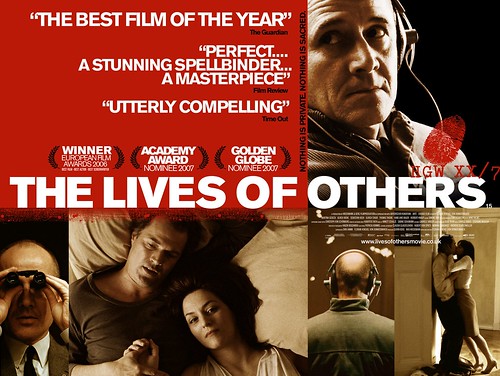
The Lives of Others
a film directed by Florian Henckel von Donnersmarck
Das Leben der anderen: Filmbuch
by Florian Henckel von Donnersmarck
Frankfurt: Suhrkamp, 216 pp., Ä8.50 (paper)
One of Germany’s most singular achievements is to have associated itself so intimately in the world’s imagination with the darkest evils of the two worst political systems of the most murderous century in human history. The words “Nazi,” “SS,” and “Auschwitz” are already global synonyms for the deepest inhumanity of fascism. Now the word “Stasi” is becoming a default global synonym for the secret police terrors of communism. The worldwide success of Florian Henckel von Donnersmarck’s deservedly Oscar- winning film The Lives of Others will strengthen that second link, building as it does on the preprogramming of our imaginations by the first. Nazi, Stasi: Germany’s festering half-rhyme.
It was not always thus. When I went to live in Berlin in the late 1970s, I was fascinated by the puzzle of how Nazi evil had engulfed this homeland of high culture. I set out to discover why the people of Weimar Berlin behaved as they did after Adolf Hitler came to power. One question above all obsessed me: What quality was it, what human strain, that made one person a dissident or resistance fighter and another a collaborator in state-organized crime, one a Claus von Stauffenberg, sacrificing his life in the attempt to assassinate Hitler, another an Albert Speer?
I soon discovered that the men and women living behind the Berlin Wall, in East Germany, were facing similar dilemmas in another German dictatorship, albeit with less physically murderous consequences. I could study that human conundrum not in dusty archives but in the history of the present. So I went to live in East Berlin and ended up writing a book about the Germans under the communist leader Erich Honecker, rather than under Adolf Hitler.1 As I traveled around the other Germany, I was again and again confronted with the fear of the Stasi. Walking back to the apartment of an actor who had just taken the lead role in a production of Goethe’s Faust, a friend whispered to me, “Watch out, Faust is working for the Stasi.” After my very critical account of communist East Germany appeared in West Germany, a British diplomat was summoned to receive an official protest from the East German foreign ministry (one of the nicest book reviews a political writer could ever hope for) and I was banned from reentering the country.
Yet this view of East Germany as another evil German dictatorship was by no means generally accepted in the West at that time. Even to suggest a Nazi–Stasi comparison was regarded in many parts of the Western left as outmoded, reactionary cold war hysteria, harmful to the spirit of détente. The Guardian journalist Jonathan Steele concluded in 1977 that the German Democratic Republic was “a presentable model of the kind of authoritarian welfare states which Eastern European nations have now become.” Even self-styled “realist” conservatives talked about communist East Germany in tones very different from those they adopt today. Back then, the word “Stasi” barely crossed their lips.
Two developments ended this chronic myopia. In 1989 the people of East Germany themselves finally rose up and denounced the Stasi as the epitome of their previous repression. That they often repressed at the same time—in the crypto-Freudian sense of the word “repression”—the memory of their own everyday compromises and personal responsibility for the stability of the communist regime was but the other side of the same coin. After 1990, the total takeover of the former East Germany by the Federal Republic meant that, unlike in all other post-communist states, there was no continuity from old to new security services and no hesitation about exposing the evils of the previous secret police state. Quite the reverse.
In the land of Martin Luther and Leopold von Ranke, driven by a distinctly Protestant passion to confront past sins, the forcefully stated wish of a few East German dissidents to expose the crimes of the regime, and the desire of many West Germans (especially those from the class of ‘68) not to repeat the mistakes made in covering up and forgetting the evils of Nazism after 1949, we saw an unprecedentedly swift, far-reaching, and systematic opening of the more than 110 miles of Stasi files. The second time around, forty years on, Germany was bent on getting its Vergangenheitsbewältigung, its past-beating, just right. Of course Russia’s KGB, the big brother of East Germany’s big brother, did nothing of the kind.
After some hesitation, I decided to go back and see if I had a Stasi file. I did. I read it and was deeply stirred by its minute-by-minute record of my past life: 325 pages of poisoned madeleine. Helped by the apparatus of historical enlightenment that Germany had erected, I was able to study in incomparable detail the apparatus of political intimidation that had produced this file. Then, working like a detective, I tracked down the acquaintances who had informed on me and the Stasi officers involved in my case. All but one agreed to talk. They told me their life stories, and explained how they had come to do what they had done. In every case, the story was understandable, all too understandable; human, all too human. I wrote a book about the whole experience, calling it The File.
It was therefore with particular interest that I recently sat down to watch The Lives of Others, this already celebrated film about the Stasi, made by a West German director who was just sixteen when the Berlin Wall came down. Set in the Orwellian year of 1984, it shows a dedicated Stasi captain, Gerd Wiesler, conducting a full-scale surveillance operation on a playwright in good standing with the regime, Georg Dreyman, and his beautiful, highly strung actress girlfriend, Christa-Maria Sieland. As the case progresses, we see the Stasi captain becoming disillusioned with his task. He realizes that the whole operation has been set up simply to allow the culture minister, who is exploiting his position to extract sexual favors from the lovely Christa, to get his playwright rival out of his way. “Was it for this we joined up?” Wiesler asks his cynical superior, Colonel Anton Grubitz.
At the same time, he becomes curiously enchanted with what he hears through his headphones, connected to the bugs concealed behind the wallpaper of the playwright’s apartment: that rich world of literature, music, friendship, and tender sex, so different from his own desiccated, solitary life in a dreary tower-block, punctuated only by brief, mechanical relief between the outsize mutton thighs of a Stasi-commissioned prostitute. In his snooper’s hideaway in the attic of the apartment building, Wiesler sits transfixed by Dreyman’s rendition of a piano piece called “The Sonata of the Good Man”—a birthday present to the playwright from a dissident theater director who, banned by the culture minister from pursuing his vocation, subsequently commits suicide. Violating all the rules that he himself teaches at the Stasi’s own university, the secret watcher slips into the apartment and steals a volume of poems by Bertolt Brecht. Then we see him lying on a sofa, entranced by one of Brecht’s more elegiac verses.
To Read the Rest of the Essay
"‘The Stasi on Our Minds’: An Exchange -- Harvey Cox and Jonathan Steele, reply by Timothy Garton Ash."
Timothy Garton Ash
The New York Review of Books
The Lives of Others
a film directed by Florian Henckel von Donnersmarck
Das Leben der anderen: Filmbuch
by Florian Henckel von Donnersmarck
Frankfurt: Suhrkamp, 216 pp., Ä8.50 (paper)
One of Germany’s most singular achievements is to have associated itself so intimately in the world’s imagination with the darkest evils of the two worst political systems of the most murderous century in human history. The words “Nazi,” “SS,” and “Auschwitz” are already global synonyms for the deepest inhumanity of fascism. Now the word “Stasi” is becoming a default global synonym for the secret police terrors of communism. The worldwide success of Florian Henckel von Donnersmarck’s deservedly Oscar- winning film The Lives of Others will strengthen that second link, building as it does on the preprogramming of our imaginations by the first. Nazi, Stasi: Germany’s festering half-rhyme.
It was not always thus. When I went to live in Berlin in the late 1970s, I was fascinated by the puzzle of how Nazi evil had engulfed this homeland of high culture. I set out to discover why the people of Weimar Berlin behaved as they did after Adolf Hitler came to power. One question above all obsessed me: What quality was it, what human strain, that made one person a dissident or resistance fighter and another a collaborator in state-organized crime, one a Claus von Stauffenberg, sacrificing his life in the attempt to assassinate Hitler, another an Albert Speer?
I soon discovered that the men and women living behind the Berlin Wall, in East Germany, were facing similar dilemmas in another German dictatorship, albeit with less physically murderous consequences. I could study that human conundrum not in dusty archives but in the history of the present. So I went to live in East Berlin and ended up writing a book about the Germans under the communist leader Erich Honecker, rather than under Adolf Hitler.1 As I traveled around the other Germany, I was again and again confronted with the fear of the Stasi. Walking back to the apartment of an actor who had just taken the lead role in a production of Goethe’s Faust, a friend whispered to me, “Watch out, Faust is working for the Stasi.” After my very critical account of communist East Germany appeared in West Germany, a British diplomat was summoned to receive an official protest from the East German foreign ministry (one of the nicest book reviews a political writer could ever hope for) and I was banned from reentering the country.
Yet this view of East Germany as another evil German dictatorship was by no means generally accepted in the West at that time. Even to suggest a Nazi–Stasi comparison was regarded in many parts of the Western left as outmoded, reactionary cold war hysteria, harmful to the spirit of détente. The Guardian journalist Jonathan Steele concluded in 1977 that the German Democratic Republic was “a presentable model of the kind of authoritarian welfare states which Eastern European nations have now become.” Even self-styled “realist” conservatives talked about communist East Germany in tones very different from those they adopt today. Back then, the word “Stasi” barely crossed their lips.
Two developments ended this chronic myopia. In 1989 the people of East Germany themselves finally rose up and denounced the Stasi as the epitome of their previous repression. That they often repressed at the same time—in the crypto-Freudian sense of the word “repression”—the memory of their own everyday compromises and personal responsibility for the stability of the communist regime was but the other side of the same coin. After 1990, the total takeover of the former East Germany by the Federal Republic meant that, unlike in all other post-communist states, there was no continuity from old to new security services and no hesitation about exposing the evils of the previous secret police state. Quite the reverse.
In the land of Martin Luther and Leopold von Ranke, driven by a distinctly Protestant passion to confront past sins, the forcefully stated wish of a few East German dissidents to expose the crimes of the regime, and the desire of many West Germans (especially those from the class of ‘68) not to repeat the mistakes made in covering up and forgetting the evils of Nazism after 1949, we saw an unprecedentedly swift, far-reaching, and systematic opening of the more than 110 miles of Stasi files. The second time around, forty years on, Germany was bent on getting its Vergangenheitsbewältigung, its past-beating, just right. Of course Russia’s KGB, the big brother of East Germany’s big brother, did nothing of the kind.
After some hesitation, I decided to go back and see if I had a Stasi file. I did. I read it and was deeply stirred by its minute-by-minute record of my past life: 325 pages of poisoned madeleine. Helped by the apparatus of historical enlightenment that Germany had erected, I was able to study in incomparable detail the apparatus of political intimidation that had produced this file. Then, working like a detective, I tracked down the acquaintances who had informed on me and the Stasi officers involved in my case. All but one agreed to talk. They told me their life stories, and explained how they had come to do what they had done. In every case, the story was understandable, all too understandable; human, all too human. I wrote a book about the whole experience, calling it The File.
It was therefore with particular interest that I recently sat down to watch The Lives of Others, this already celebrated film about the Stasi, made by a West German director who was just sixteen when the Berlin Wall came down. Set in the Orwellian year of 1984, it shows a dedicated Stasi captain, Gerd Wiesler, conducting a full-scale surveillance operation on a playwright in good standing with the regime, Georg Dreyman, and his beautiful, highly strung actress girlfriend, Christa-Maria Sieland. As the case progresses, we see the Stasi captain becoming disillusioned with his task. He realizes that the whole operation has been set up simply to allow the culture minister, who is exploiting his position to extract sexual favors from the lovely Christa, to get his playwright rival out of his way. “Was it for this we joined up?” Wiesler asks his cynical superior, Colonel Anton Grubitz.
At the same time, he becomes curiously enchanted with what he hears through his headphones, connected to the bugs concealed behind the wallpaper of the playwright’s apartment: that rich world of literature, music, friendship, and tender sex, so different from his own desiccated, solitary life in a dreary tower-block, punctuated only by brief, mechanical relief between the outsize mutton thighs of a Stasi-commissioned prostitute. In his snooper’s hideaway in the attic of the apartment building, Wiesler sits transfixed by Dreyman’s rendition of a piano piece called “The Sonata of the Good Man”—a birthday present to the playwright from a dissident theater director who, banned by the culture minister from pursuing his vocation, subsequently commits suicide. Violating all the rules that he himself teaches at the Stasi’s own university, the secret watcher slips into the apartment and steals a volume of poems by Bertolt Brecht. Then we see him lying on a sofa, entranced by one of Brecht’s more elegiac verses.
To Read the Rest of the Essay
"‘The Stasi on Our Minds’: An Exchange -- Harvey Cox and Jonathan Steele, reply by Timothy Garton Ash."
Subscribe to:
Posts (Atom)