Kahsatstenhsera: Indigenous Resistance to Tar Sands Pipelines
Films For Action
Kahsatstenhsera (gah-sad-sdanh-se-ra) is a Kanienkeha:ka (Mohawk) word that means Strength in Unity. This short documentary details contemporary Indigenous resistance to tar sands pipeline expansion, in particular the Line 9 and Energy East pipelines, which threaten the health of our territories in the northeast of Turtle Island. This was a co-production with Amanda Lickers of Reclaim Turtle Island and subMedia.tv
Source link
Showing posts with label Canada. Show all posts
Showing posts with label Canada. Show all posts
Sunday, October 20, 2013

Saturday, April 6, 2013
A Dangerous Method (UK/Canada/Switzerland: David Cronenberg, 2011)

A Dangerous Method (UK/Canada/Germany/Switzerland: David Cronenberg, 2011: 99 mins)
Bale, Miriam. "They Came From Within: Yonic symbolism in the films of David Cronenberg." Moving Image (January 20, 2012)
Bowen, Chuck. "The Films of David Cronenberg Ranked." Slant (February 24, 2015)
Chemaly, Soraya. "Virgins, Bondage and A Shameful Media Fail." Huffington Post (April 20, 2012)
"Explore the Making of ‘Cosmopolis,’ ‘Naked Lunch,’ ‘Spider,’ ‘Eastern Promises,’ and More." The Film Stage (January 13, 2016)
Flores, Steven. "The Auteurs: David Cronenberg (Part 1)." Cinema Axis (October 28, 2013)
---. "The Auteurs: David Cronenberg (Part 2)." Cinema Axis (October 30, 2013)
"Intersubjectivity." Wikipedia (No Date)
Kuersten Erich. "CinemArchetype #6: The Intimidating Nymph." Acidemic (March 2, 2012)
Ratner, Megan. "David Cronenberg’s A Dangerous Method." Film Quarterly (November 2011)
Thursday, April 4, 2013
Saturday, February 16, 2013
Tuesday, January 22, 2013
Thursday, November 29, 2012
Marilyn Adler Papayanis: Sex on the Beach - The Yin Yang of Female Sex Tourism in Two Films
Sex on the Beach: The Yin Yang of Female Sex Tourism in Two Films
by Marilyn Adler Papayanis
Bright Lights Film Journal

With the recent screening of Ulrich Seidl's Paradise: Love at the 2012 Cannes Film Festival, the spectacle of female sex tourism has washed up, once again, on the shoals of popular culture. According to reviewers, it is not a pretty sight. Women who travel to the spaces peripheral to "modernity" and, by the way, have sex with the natives are not rare; however, in the continuum of capital expansion that stretches from colonialism to globalization, such practices tend to lose their luster as a kind of radical cultural immersion. For men, of course, such sexual adventurism would hardly qualify as a narrative with anything new to say. The notion, however, that women would travel to remote or less developed parts of the world for the express purpose of having sex with men who are, in many cases, younger and poorer than they are seems to cut against the grain. Yet many studies show this to be the case. Whether characterized as "sex" tourism (commercial sex with the locals) or "romance" tourism (commercial sex with the trappings of a "real" relationship), this practice has inspired a good deal of academic research in the social sciences and in popular literature as well. In her 2006 book Romance on the Road: Traveling Women Who Love Foreign Men, journalist Jeanette Belliveau describes her subjects as "sex pilgrims." According to the Amazon review, her book is "the complete reference for anyone who wants to learn about a hidden phenomenon that affects hundreds of thousands of traveling women and foreign men: Instant vacation love affairs that banish loneliness, provide cultural insights, offer one-on-one, hand-to-hand foreign aid to the world's poor, create international children and sometimes even change the course of history."
Who can beat that? I believe, however, that the representation of female sex tourism in the cultural imagination is also worthy of study, as such depictions reveal a great deal about the anxieties aroused by the "aging" woman's sexuality. The staging of this cultural moment is explored in two radically different films, both, coincidentally, derived from works of fiction: the breezy How Stella Got Her Groove Back (1998), based on the book by Terry McMillan, and the far more disturbing French film Heading South (2005), based, in large part, on a short story by the Haitian writer Dany Laferrière. Both films indulge the notion that sex in the tropics with a dark-skinned exotic youth is all it takes to cure the malaise of the older woman. In one sense, the autonomy of the woman traveler is a real marker of progress. Sadly, though, the representation of female empowerment in these films is either complicit with racist attitudes still fraught with the lingering spirit of colonialism (Heading South) or in thrall to patriarchal norms (Stella.) In the former, sex tourism is punished; in the latter, it is celebrated.
We learn from the literature that women who sleep with the locals are not a uniform class. They vary in age and in their choice of destination; they vary in terms of their motivations and attitudes toward both their exotic partners and the imaginative geographies in which their partners are embedded. Improbably, for example, the Sinai is a popular venue for cross-cultural couplings. Some "ethnosexual" boundary crossings appear to pass unnoticed, while others are more disturbing, usually because they involve pairings between privileged white tourists of a certain age and marginal youths who navigate the interstices of the official institutions of tourism. Joane Nagel first used the term "ethnosexual" to describe "the intersection and interaction between ethnicity and sexuality and the ways each defines and depends on the other for its meaning and power" (10). In the Americas, Jamaica, the Dominican Republic, and Costa Rica are popular venues for the pursuit of ethnosexual adventurism. These are destinations where the opportunity for women to have sexual or romantic liaisons with exotic Others further complicates the shadowy social relations in the "contact zone" where, for centuries, sexual commerce between male travelers and the natives, male or female, have followed, roughly, the contours of imperial power. The term "contact zone" was coined by Mary Louise Pratt in her groundbreaking study Imperial Eyes: Travel Writing and Transculturation to describe "social spaces where disparate cultures meet, clash, and grapple with each other, often in highly asymmetrical relations of domination and subordination, like colonialism, slavery, or their aftermaths as they are lived out across the globe today" (3).
To Read the Rest of the Essay

by Marilyn Adler Papayanis
Bright Lights Film Journal
With the recent screening of Ulrich Seidl's Paradise: Love at the 2012 Cannes Film Festival, the spectacle of female sex tourism has washed up, once again, on the shoals of popular culture. According to reviewers, it is not a pretty sight. Women who travel to the spaces peripheral to "modernity" and, by the way, have sex with the natives are not rare; however, in the continuum of capital expansion that stretches from colonialism to globalization, such practices tend to lose their luster as a kind of radical cultural immersion. For men, of course, such sexual adventurism would hardly qualify as a narrative with anything new to say. The notion, however, that women would travel to remote or less developed parts of the world for the express purpose of having sex with men who are, in many cases, younger and poorer than they are seems to cut against the grain. Yet many studies show this to be the case. Whether characterized as "sex" tourism (commercial sex with the locals) or "romance" tourism (commercial sex with the trappings of a "real" relationship), this practice has inspired a good deal of academic research in the social sciences and in popular literature as well. In her 2006 book Romance on the Road: Traveling Women Who Love Foreign Men, journalist Jeanette Belliveau describes her subjects as "sex pilgrims." According to the Amazon review, her book is "the complete reference for anyone who wants to learn about a hidden phenomenon that affects hundreds of thousands of traveling women and foreign men: Instant vacation love affairs that banish loneliness, provide cultural insights, offer one-on-one, hand-to-hand foreign aid to the world's poor, create international children and sometimes even change the course of history."
Who can beat that? I believe, however, that the representation of female sex tourism in the cultural imagination is also worthy of study, as such depictions reveal a great deal about the anxieties aroused by the "aging" woman's sexuality. The staging of this cultural moment is explored in two radically different films, both, coincidentally, derived from works of fiction: the breezy How Stella Got Her Groove Back (1998), based on the book by Terry McMillan, and the far more disturbing French film Heading South (2005), based, in large part, on a short story by the Haitian writer Dany Laferrière. Both films indulge the notion that sex in the tropics with a dark-skinned exotic youth is all it takes to cure the malaise of the older woman. In one sense, the autonomy of the woman traveler is a real marker of progress. Sadly, though, the representation of female empowerment in these films is either complicit with racist attitudes still fraught with the lingering spirit of colonialism (Heading South) or in thrall to patriarchal norms (Stella.) In the former, sex tourism is punished; in the latter, it is celebrated.
We learn from the literature that women who sleep with the locals are not a uniform class. They vary in age and in their choice of destination; they vary in terms of their motivations and attitudes toward both their exotic partners and the imaginative geographies in which their partners are embedded. Improbably, for example, the Sinai is a popular venue for cross-cultural couplings. Some "ethnosexual" boundary crossings appear to pass unnoticed, while others are more disturbing, usually because they involve pairings between privileged white tourists of a certain age and marginal youths who navigate the interstices of the official institutions of tourism. Joane Nagel first used the term "ethnosexual" to describe "the intersection and interaction between ethnicity and sexuality and the ways each defines and depends on the other for its meaning and power" (10). In the Americas, Jamaica, the Dominican Republic, and Costa Rica are popular venues for the pursuit of ethnosexual adventurism. These are destinations where the opportunity for women to have sexual or romantic liaisons with exotic Others further complicates the shadowy social relations in the "contact zone" where, for centuries, sexual commerce between male travelers and the natives, male or female, have followed, roughly, the contours of imperial power. The term "contact zone" was coined by Mary Louise Pratt in her groundbreaking study Imperial Eyes: Travel Writing and Transculturation to describe "social spaces where disparate cultures meet, clash, and grapple with each other, often in highly asymmetrical relations of domination and subordination, like colonialism, slavery, or their aftermaths as they are lived out across the globe today" (3).
To Read the Rest of the Essay
Tuesday, October 23, 2012
Richard Porton: A Dangerous Method
The Dangerous Method
by Richard Porton
Cinema Scope

The title of Russell Jacoby’s 1983 polemic, The Repression of Psychoanalysis, suggests that the radical implications of the Freudian tradition have become muddled in an era where nothing seems more safely middle-class than a session on the couch with the shrink of one’s choice. In evoking a juncture at the turn of the 20th century when psychoanalysis still seemed subversive and a riposte to bourgeois complacency, David Cronenberg’s A Dangerous Method, with its curious tone pitched between placid costume drama and the threat of domestic horror, also seeks to rehabilitate the “talking cure” as a radical, even potentially incendiary, concept.
Inspired by John Kerr’s A Most Dangerous Method, a study of the complex relationship between Carl Jung, his patient (and mistress) Sabina Spielrein, and Jung’s mentor, and eventual adversary, Sigmund Freud—and more directly based on screenwriter Christopher Hampton’s play The Talking Cure—Cronenberg tackles one of his favourite themes: the toll exacted by sexual repression and the danger, as well as frisson, of shedding the weight of such repression. Just as these themes were delineated with the aid of generic horror tropes in Shivers (1975), A Dangerous Method reveals the emotional violence that bubbles below the surface of Hampton’s witty repartee.
It’s no secret that intellectual controversies often escalate into verbal sparring that mimics actual warfare. From the outset, the theoretical challenges posed to young Dr. Jung by the beautiful and brilliant Spielrein’s bout of “hysteria” (the Victorians’ favorite diagnosis for troubled women) take on a quality that is almost as feral and uncontrollable as the effects of those notorious parasites in Shivers. When the Russian-Jewish Spielrein (Keira Knightley) arrives by coach at Dr. Jung’s (Michael Fassbender) Zurich clinic in 1904, she might as well be the reincarnation of Jane Eyre’s madwoman in the attic. Yet as we soon learn, she’s sophisticated and erudite—as well as the intellectual equal of her rather stuffy doctor and mentor.
Spielrein’s journey from apparent lunatic to autonomous woman (and eventually to a career as a distinguished analyst in her own right) encourages Cronenberg to impose a deceptively restrained classical style (large swatches of shot-reverse shot) on feverish subject matter. The film mixes genres so unobtrusively that it’s barely noticeable. As the origins of Spielrein’s physical and psychological symptoms gradually emerge, we are lulled into believing that Cronenberg is dispassionately preoccupied with an intellectual detective story: locating the source of the patient’s trauma (a struggle with painful, as well as pleasurable, memories of her father’s beatings) and moving on to a satisfyingly dramatic “abreaction.” Yet when Jung plunges into an affair with Spielrein (professional ethics were less codified in the early days of psychoanalysis), a brief shot of the besotted doctor engaging in sadomasochistic sex with his corseted patient resembles an outtake from a Liliana Cavani film. The uptight analyst’s surface rectitude is unmasked with one succinct image.
For those of us who prefer Freudian rigour to Jung’s proto-New Age wooliness, it’s heartening that Viggo Mortensen’s portrayal of Freud is endearingly complex. If Mortensen’s cigar-puffing Freud at times seems inordinately stiff (perhaps reinforced by the fact that Hampton’s script has Jung accusing him of “rigid pragmatism”), he’s at least witty. Although Freud’s initial meetings with Jung are cordial, there are certainly intimations of their epochal rupture. When Jung claims not to understand why the Viennese psychoanalysts are vulnerable to criticism because of their Jewish origins, Freud terms his friend’s demurral “an exquisitely Protestant remark.” In Cronenberg on Cronenberg, the director remarks that his parents, who celebrated Christmas, “invented their own version of what it is to be Jewish.” The same could well be said of Freud, a defiantly secular Jew, whose claustrophobic, cluttered home presents a sharp contrast to Jung’s relatively palatial digs.
To Read the Rest
by Richard Porton
Cinema Scope
The title of Russell Jacoby’s 1983 polemic, The Repression of Psychoanalysis, suggests that the radical implications of the Freudian tradition have become muddled in an era where nothing seems more safely middle-class than a session on the couch with the shrink of one’s choice. In evoking a juncture at the turn of the 20th century when psychoanalysis still seemed subversive and a riposte to bourgeois complacency, David Cronenberg’s A Dangerous Method, with its curious tone pitched between placid costume drama and the threat of domestic horror, also seeks to rehabilitate the “talking cure” as a radical, even potentially incendiary, concept.
Inspired by John Kerr’s A Most Dangerous Method, a study of the complex relationship between Carl Jung, his patient (and mistress) Sabina Spielrein, and Jung’s mentor, and eventual adversary, Sigmund Freud—and more directly based on screenwriter Christopher Hampton’s play The Talking Cure—Cronenberg tackles one of his favourite themes: the toll exacted by sexual repression and the danger, as well as frisson, of shedding the weight of such repression. Just as these themes were delineated with the aid of generic horror tropes in Shivers (1975), A Dangerous Method reveals the emotional violence that bubbles below the surface of Hampton’s witty repartee.
It’s no secret that intellectual controversies often escalate into verbal sparring that mimics actual warfare. From the outset, the theoretical challenges posed to young Dr. Jung by the beautiful and brilliant Spielrein’s bout of “hysteria” (the Victorians’ favorite diagnosis for troubled women) take on a quality that is almost as feral and uncontrollable as the effects of those notorious parasites in Shivers. When the Russian-Jewish Spielrein (Keira Knightley) arrives by coach at Dr. Jung’s (Michael Fassbender) Zurich clinic in 1904, she might as well be the reincarnation of Jane Eyre’s madwoman in the attic. Yet as we soon learn, she’s sophisticated and erudite—as well as the intellectual equal of her rather stuffy doctor and mentor.
Spielrein’s journey from apparent lunatic to autonomous woman (and eventually to a career as a distinguished analyst in her own right) encourages Cronenberg to impose a deceptively restrained classical style (large swatches of shot-reverse shot) on feverish subject matter. The film mixes genres so unobtrusively that it’s barely noticeable. As the origins of Spielrein’s physical and psychological symptoms gradually emerge, we are lulled into believing that Cronenberg is dispassionately preoccupied with an intellectual detective story: locating the source of the patient’s trauma (a struggle with painful, as well as pleasurable, memories of her father’s beatings) and moving on to a satisfyingly dramatic “abreaction.” Yet when Jung plunges into an affair with Spielrein (professional ethics were less codified in the early days of psychoanalysis), a brief shot of the besotted doctor engaging in sadomasochistic sex with his corseted patient resembles an outtake from a Liliana Cavani film. The uptight analyst’s surface rectitude is unmasked with one succinct image.
For those of us who prefer Freudian rigour to Jung’s proto-New Age wooliness, it’s heartening that Viggo Mortensen’s portrayal of Freud is endearingly complex. If Mortensen’s cigar-puffing Freud at times seems inordinately stiff (perhaps reinforced by the fact that Hampton’s script has Jung accusing him of “rigid pragmatism”), he’s at least witty. Although Freud’s initial meetings with Jung are cordial, there are certainly intimations of their epochal rupture. When Jung claims not to understand why the Viennese psychoanalysts are vulnerable to criticism because of their Jewish origins, Freud terms his friend’s demurral “an exquisitely Protestant remark.” In Cronenberg on Cronenberg, the director remarks that his parents, who celebrated Christmas, “invented their own version of what it is to be Jewish.” The same could well be said of Freud, a defiantly secular Jew, whose claustrophobic, cluttered home presents a sharp contrast to Jung’s relatively palatial digs.
To Read the Rest
Thursday, September 6, 2012
ENG 281 Ethics/Film: Week 4 -- Beyond the Standard Feature Film
Wisconsin "Budget Repair Bill" Protest from Matt Wisniewski on Vimeo.
Wikipedia: 2011 Wisconsin Protests
"Background Materials for John Bellamy Foster's "Education and the Structural Crisis of Capital" Dialogic (September 7, 2011)
Benton, Michael. "Bill O'Reilly and FOX News: Propaganda Fails Miserably." Dialogic (March 2, 2011)
Burke, Mike and Harriet Brown Rowan. "Wisconsin’s Uprising: A Guided Tour of the 11-Day Protest Encampment Inside the State Capitol in Madison." Democracy Now (February 25, 2011)
Burke, Mike and Nicole Salazar. "Walkouts, Bank Boycotts and Recalls: Wisconsin Protests Intensify as Union-Busting Legislation Pushed through State Assembly." Democracy Now (March 11, 2011)
Dennis, Brady and Peter Wallenstein. "Wisconsin governor urging others to take stands against unions." Washington Post (February 23, 2011)
Graves, Lisa. "A CMD Special Report: Scott Walker Runs on Koch Money ." PR Watch (February 19, 2011)
Hudson, Michael and Jeffrey Sommers. "Wisconsin Death Trip: The Plan to Steal Everything and Sell the People into Slavery." Counterpunch (March 11, 2011)
"Lawmakers Flee Wisconsin Capitol, State Police Pursue; Protests Swell to 30,000." AlterNet (February 17, 2011)
Meyerson, Harold. "Workers toppled a dictator in Egypt, but might be silenced in Wisconsin." The Washington post (February 15, 2011)
Nichols, John. "Why a Wisconsin Sheriff Refuses to Serve as Governor Walker's 'Palace Guard'." The Nation (March 2, 2011)
Rickman, Peter, Chris Larson and Kelda Helen Roys. "Outrage in Wisconsin: Thousands Flood Capitol After GOP Strips Public Workers of Bargaining Rights in Surprise Senate Vote." Democracy Now (March 3, 2010)
Zirin, Dave. "Wisconsin: Solidarity Among Workers … And Football Players." Yes! (February 17, 2011)
La Jetée (1962) from Augustus Brightman on Vimeo.
Bullock, Tori. "La Jetee Film Analysis." Film and History (May 4, 2011)
Christley, Jamie N. "Great Directors: Chris Marker Senses of Cinema (July 19, 2002)
Dillon, Brian. "Fade away: Chris Marker's La Jetée, a half-hour futuristic film that explores time and memory, seems to conjure an entire century's romance with the moving image." The Guardian (March 28, 2009)
"Listening to La Jetee." The Current (June 21, 2012)
Perry, Canaan. "Time, Memory and Time Travel in Chris Marker’s La Jetée." Space Zoetrope (2007)
Rowan-Legg, Shelah M. "Chris Marker, Filmmaker Behind LA JETÉE, Dies at 91." Twitch (July 30, 2012)
Schefer, Jean-Louis. "On La Jetee." Passages of the Image (1991: hosted on Paul Smith's Website)
Sellars, Simon. "Retrospecto: La Jetee." Ballardian (October 7, 2005)
The Universal Clock - The Resistance of Peter Watkins by Geoff Bowie, National Film Board of Canada
Biographical Sites and Official Websites:
Wikipedia: Peter Watkins
Peter Watkins: Filmmaker/Media Critic (Official Site)
British Film Institute: Peter Watkins
Resources by and about Peter Watkins and his films:
Estrin, Marc. "Peter Watkins' La Commune." The Rag Blog (March 29, 2010)
Keser, Robert. "Edvard Munch." Senses of Cinema (February 7, 2006)
La Commune (Paris, 1871) (France: Peter Watkins, 2000: available on Google video in multiple parts)
"Peter Watkins: La Commune." Chtodelat (October 31, 2008)
Peter Watkins: The Media Crisis Dialogic (October 3, 2007)
Rapfogel, Jared. "The Cinema of Peter Watkins." Cineaste 32.2 (Spring 2007)
Rosenbaum, Jonathan. "The Revolution Has Been Televised [Peter Watkins’ LA COMMUNE]." Chicago Reader (May 17, 2002)
Watkins, Peter. "Notes on the Making of La Commune (Paris, 1871)." Peter Watkins: Filmmaker/Critic (2000)
---. "Notes on the Media Crisis." Barcelona, Spain: Quaderns portàtils, 2010.

Thursday, June 21, 2012
Surviving Progress (Canada: Mathieu Roy and Harold Crooks, 2011: 86 mins)
[via Documentary Heaven]
Film about the risks we pose to our own survival in the name of progress; connecting financial collapse, growing inequality and global oligarchy with the sustainability of mankind.
Wednesday, May 9, 2012
Joshua Land: Migrating Forms - David Cronenberg and the challenge of the impossible adaptation
Migrating Forms: David Cronenberg and the challenge of the impossible adaptation
by Joshua Land
Moving Image Source


What makes a film a successful literary adaptation? Ask a random literate moviegoer, and they're likely to answer that a good film adaptation should be "like the book" (or play). In other words, a successful adaptation is a faithful adaptation. What then is a faithful adaptation? One that follows the story of the original text, of course. It's this fixation on story that prompts the common contention that most great modernist and postmodernist novels, which often either lack a traditional story or integrate story elements with discursive material, are "unfilmable." One possible strategy of adaptation is to "flatten out" the original by simply discarding everything that doesn't move the story along, as in Philip Kaufman and Jean-Claude Carrière's version of The Unbearable Lightness of Being, a conventional 1980s Euro-prestige picture that preserves the novel's plot line while eliding the philosophical digressions and ruminations on love and kitsch that are essential to its meaning. So is it a successful adaptation of Milan Kundera's novel? Well, that depends on what you mean by "successful."
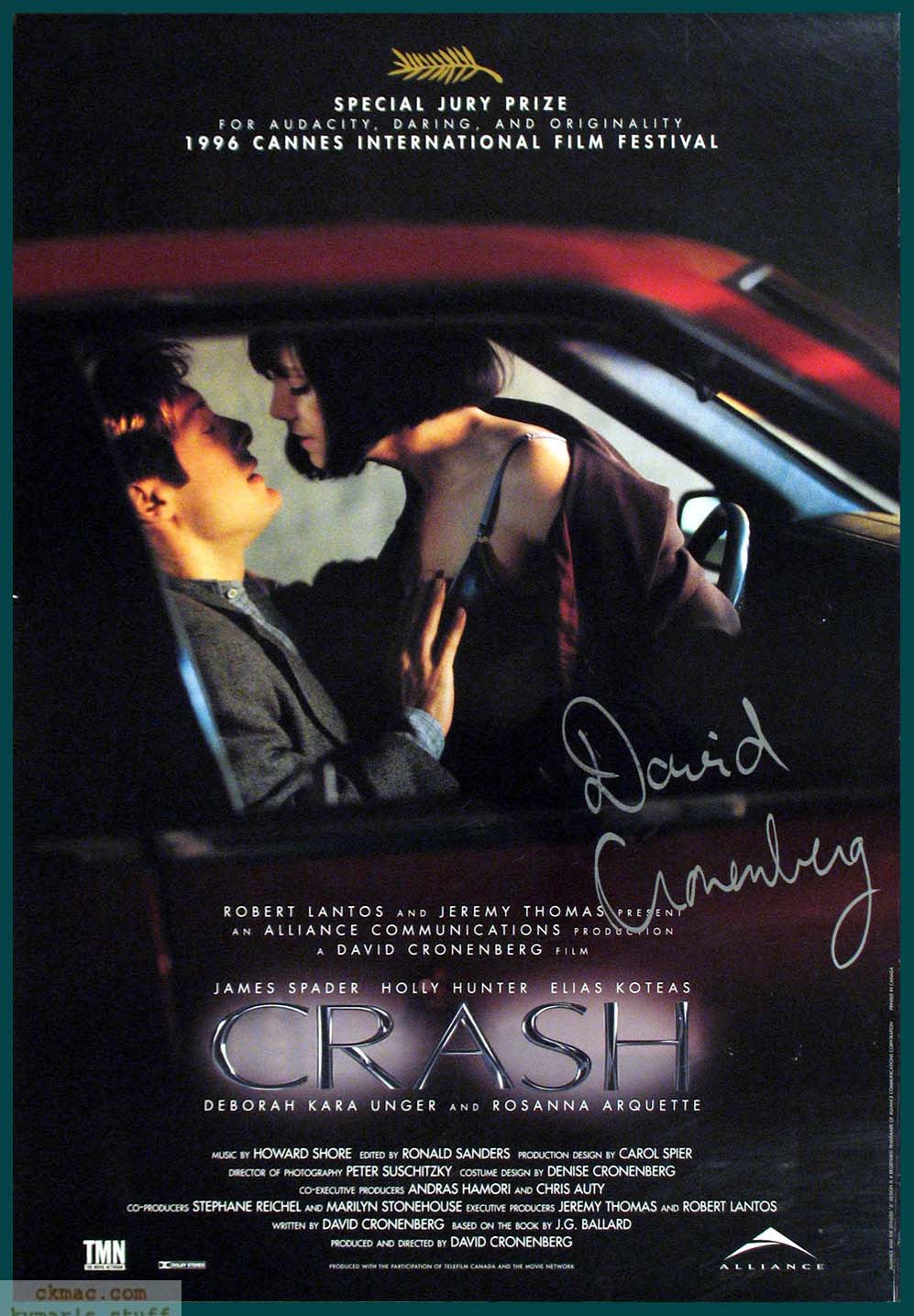
Over the latter half of his career, David Cronenberg has intervened in this tiresome discussion with a series of what have been termed "impossible adaptations." In films like Naked Lunch (1991) and Crash (1996), adaptations of novels once regarded as unfilmable, Cronenberg approaches the problem of adaptation from a different angle. One of these films closely follows the story of its source novel and one does not, but both could be described as successful—and even, after a fashion, faithful—adaptations.
Discussion of adaptations is often haunted by the unresolved question of whether a film should be regarded as merely the extension of a literary work into another form, or as a separate work entirely. Cronenberg's Naked Lunch takes that decision out of the viewer's hands to the extent that it's not really an adaptation of William S. Burroughs's novel at all—at least if adaptation is conceived primarily in terms of story. While most of the movie's major characters and settings (as well as the famous "talking asshole" anecdote) come from the Burroughs novel, it also draws from other Burroughs writings as well as the author's life. Seeing Naked Lunch is in no way a substitute for reading the book, or vice versa—which may be precisely the point.
Talking centipedes and organic typewriters notwithstanding, Naked Lunch is relatively restrained by the standards of Cronenberg's previous work, marking, along with Dead Ringers (1988), a transition between the director's visceral early films and the cooler, more formalist late work. The outré visual effects are played more for laughs than chills. Indeed, Naked Lunch might be Cronenberg's funniest film, beginning with the ironic casting of Robocop himself, Peter Weller, as the alter ego of the outlaw writer. Weller's stone-faced performance positions the film's protagonist, William Lee, as a straight man (pun intended) who takes its bizarre happenings in stride. Recounting a not atypical incident in which his Clark Nova typewriter kills and disembowels a potential rival instrument, Lee deadpans: "I understood writing could be dangerous. I didn't realize the danger came from the machinery."
To Read the Rest of the Essay

by Joshua Land
Moving Image Source
What makes a film a successful literary adaptation? Ask a random literate moviegoer, and they're likely to answer that a good film adaptation should be "like the book" (or play). In other words, a successful adaptation is a faithful adaptation. What then is a faithful adaptation? One that follows the story of the original text, of course. It's this fixation on story that prompts the common contention that most great modernist and postmodernist novels, which often either lack a traditional story or integrate story elements with discursive material, are "unfilmable." One possible strategy of adaptation is to "flatten out" the original by simply discarding everything that doesn't move the story along, as in Philip Kaufman and Jean-Claude Carrière's version of The Unbearable Lightness of Being, a conventional 1980s Euro-prestige picture that preserves the novel's plot line while eliding the philosophical digressions and ruminations on love and kitsch that are essential to its meaning. So is it a successful adaptation of Milan Kundera's novel? Well, that depends on what you mean by "successful."
Over the latter half of his career, David Cronenberg has intervened in this tiresome discussion with a series of what have been termed "impossible adaptations." In films like Naked Lunch (1991) and Crash (1996), adaptations of novels once regarded as unfilmable, Cronenberg approaches the problem of adaptation from a different angle. One of these films closely follows the story of its source novel and one does not, but both could be described as successful—and even, after a fashion, faithful—adaptations.
Discussion of adaptations is often haunted by the unresolved question of whether a film should be regarded as merely the extension of a literary work into another form, or as a separate work entirely. Cronenberg's Naked Lunch takes that decision out of the viewer's hands to the extent that it's not really an adaptation of William S. Burroughs's novel at all—at least if adaptation is conceived primarily in terms of story. While most of the movie's major characters and settings (as well as the famous "talking asshole" anecdote) come from the Burroughs novel, it also draws from other Burroughs writings as well as the author's life. Seeing Naked Lunch is in no way a substitute for reading the book, or vice versa—which may be precisely the point.
Talking centipedes and organic typewriters notwithstanding, Naked Lunch is relatively restrained by the standards of Cronenberg's previous work, marking, along with Dead Ringers (1988), a transition between the director's visceral early films and the cooler, more formalist late work. The outré visual effects are played more for laughs than chills. Indeed, Naked Lunch might be Cronenberg's funniest film, beginning with the ironic casting of Robocop himself, Peter Weller, as the alter ego of the outlaw writer. Weller's stone-faced performance positions the film's protagonist, William Lee, as a straight man (pun intended) who takes its bizarre happenings in stride. Recounting a not atypical incident in which his Clark Nova typewriter kills and disembowels a potential rival instrument, Lee deadpans: "I understood writing could be dangerous. I didn't realize the danger came from the machinery."
To Read the Rest of the Essay
Monday, April 30, 2012
Ahead of May Day, David Harvey Details Urban Uprisings from Occupy Wall Street to the Paris Commune
Ahead of May Day, David Harvey Details Urban Uprisings from Occupy Wall Street to the Paris Commune
Democracy Now
On Tuesday, May 1st, known as May Day or International Workers’ Day, Occupy Wall Street protesters hope to mobilize tens of thousands of people across the country under the slogan, "General Strike. No Work. No Shopping. Occupy Everywhere." Events are planned in 125 cities. We speak with leading social theorist David Harvey, distinguished professor of anthropology at the Graduate Center of the City University of New York, about how Occupy Wall Street compares to other large-scale grassroots movements throughout modern history. "It’s struck a chord," Harvey says of the Occupy movement. "I hope tomorrow there will be a situation in which many more people will say, 'Look, things have got to change. Something different has to happen.'" Harvey’s most recent book is "Rebel Cities: From the Right to the City to the Urban Revolution."
Guest:
David Harvey, distinguished professor of anthropology at the Graduate Center of the City University of New York. His most recent book is Rebel Cities: From the Right to the City to the Urban Revolution.
To Watch the Interview
More Resources:

Democracy Now
On Tuesday, May 1st, known as May Day or International Workers’ Day, Occupy Wall Street protesters hope to mobilize tens of thousands of people across the country under the slogan, "General Strike. No Work. No Shopping. Occupy Everywhere." Events are planned in 125 cities. We speak with leading social theorist David Harvey, distinguished professor of anthropology at the Graduate Center of the City University of New York, about how Occupy Wall Street compares to other large-scale grassroots movements throughout modern history. "It’s struck a chord," Harvey says of the Occupy movement. "I hope tomorrow there will be a situation in which many more people will say, 'Look, things have got to change. Something different has to happen.'" Harvey’s most recent book is "Rebel Cities: From the Right to the City to the Urban Revolution."
Guest:
David Harvey, distinguished professor of anthropology at the Graduate Center of the City University of New York. His most recent book is Rebel Cities: From the Right to the City to the Urban Revolution.
To Watch the Interview
More Resources:
Tuesday, April 24, 2012
Tom McCormack: Laws of Desire -- What did David Cronenberg's Videodrome get right about us?
Laws of Desire: What did David Cronenberg's Videodrome get right about us?
by Tom McCormack
Moving Image Source

It can be both fun and necessary to revisit famously prescient works of art and take account of just what they got right.
In Nineteen Eighty-Four, George Orwell was right that the most successful authoritarian regimes of the future would limit dissent by using mass media to control our conceptual tools. He was wrong about how they would do it; instead of issuing messages through a unified voice, the most durable authoritarianism has flourished by dispersing control among a small set of global corporations that justify their outsized power through their success in the marketplace. In Brave New World, Aldous Huxley was right that sexual freedom and the triumph of therapy culture would develop alongside rigid class structures. The mainstream acceptance of casual sex and prescription pharmaceuticals really did happen alongside a consolidation of class power—a radical one we're still reeling from. But in Huxley this was accomplished through an exaggeration of class difference and an expanded language for class; in reality, the culture witnessed the atrophy of a language for class and an erasing of outward signs of class in terms of professed values, fashion, and manners of speech (hence "bourgeois bohemians" and "the millionaire next door").
David Cronenberg's Videodrome offered in 1983 a vision of dystopia that rivaled in ambition and sweep and foresight Orwell's and Huxley's more famous works. So what did Videodrome get right? And what, if anything, did it get wrong?
Cronenberg was right that new technologies would unleash a craving for scenes of increasingly extreme and increasingly realistic—if not just plain real—sexual violence. He was right about what this violence would look like ("No plot, no characters. Very realistic"); why the entertainment industry would turn to it ("I'm looking for something that will break through. Something tough!"); and how those in the media would talk about it ("It's absolutely brilliant. I mean look: there's almost no production cost!"). He was right that many people would experience these new products as addictive and would report a psychic bleed into the texture of their daily lives, frequently to their great concern.
Cronenberg was right, in a more subtle way, about what would cause the cultural turn to sexual violence. The movie isn't called "photodrome" or "cinemadrome"—it's not about the nature of mechanical reproduction or motion pictures but about the consequences of private access to public imagery. Professor Brian O'Blivion, Videodrome's resident philosopher, tells us that the television has become the "retina of the mind's eye"; that "the television screen is part of the physical structure of the brain." What he's talking about is what contemporary social scientists studying the Internet call—borrowing terms from psychoanalysis—"solipsistic introjection." This refers to the tendency of individuals to believe, on at least a semi-conscious level, that things happening on their electronic devices are actually happening inside their heads. Describing how this effect works in online chat rooms, John Suler writes:
To Read the Rest of the Essay
by Tom McCormack
Moving Image Source
It can be both fun and necessary to revisit famously prescient works of art and take account of just what they got right.
In Nineteen Eighty-Four, George Orwell was right that the most successful authoritarian regimes of the future would limit dissent by using mass media to control our conceptual tools. He was wrong about how they would do it; instead of issuing messages through a unified voice, the most durable authoritarianism has flourished by dispersing control among a small set of global corporations that justify their outsized power through their success in the marketplace. In Brave New World, Aldous Huxley was right that sexual freedom and the triumph of therapy culture would develop alongside rigid class structures. The mainstream acceptance of casual sex and prescription pharmaceuticals really did happen alongside a consolidation of class power—a radical one we're still reeling from. But in Huxley this was accomplished through an exaggeration of class difference and an expanded language for class; in reality, the culture witnessed the atrophy of a language for class and an erasing of outward signs of class in terms of professed values, fashion, and manners of speech (hence "bourgeois bohemians" and "the millionaire next door").
David Cronenberg's Videodrome offered in 1983 a vision of dystopia that rivaled in ambition and sweep and foresight Orwell's and Huxley's more famous works. So what did Videodrome get right? And what, if anything, did it get wrong?
Cronenberg was right that new technologies would unleash a craving for scenes of increasingly extreme and increasingly realistic—if not just plain real—sexual violence. He was right about what this violence would look like ("No plot, no characters. Very realistic"); why the entertainment industry would turn to it ("I'm looking for something that will break through. Something tough!"); and how those in the media would talk about it ("It's absolutely brilliant. I mean look: there's almost no production cost!"). He was right that many people would experience these new products as addictive and would report a psychic bleed into the texture of their daily lives, frequently to their great concern.
Cronenberg was right, in a more subtle way, about what would cause the cultural turn to sexual violence. The movie isn't called "photodrome" or "cinemadrome"—it's not about the nature of mechanical reproduction or motion pictures but about the consequences of private access to public imagery. Professor Brian O'Blivion, Videodrome's resident philosopher, tells us that the television has become the "retina of the mind's eye"; that "the television screen is part of the physical structure of the brain." What he's talking about is what contemporary social scientists studying the Internet call—borrowing terms from psychoanalysis—"solipsistic introjection." This refers to the tendency of individuals to believe, on at least a semi-conscious level, that things happening on their electronic devices are actually happening inside their heads. Describing how this effect works in online chat rooms, John Suler writes:
Reading another person's message might be experienced as a voice within one's head, as if that person magically has been inserted or "introjected" into one's psyche... The online companion now becomes a character within our intrapsychic world, a character that is shaped partly by how the person actually presents him or herself via text communication, but also by our expectations, wishes, and needs... People fantasize about flirting, arguing with a boss, or very honestly confronting a friend about what they feel. In their imagination, where it's safe, people feel free to say and do all sorts of things that they wouldn't in reality. At that moment, reality IS one's imagination. Online text communication can become the psychological tapestry in which a person's mind weaves these fantasy role plays, usually unconsciously and with considerable disinhibition. All of cyberspace is a stage and we are merely players.
To Read the Rest of the Essay
Wednesday, April 18, 2012
Miriam Bale: They Came From Within -- Yonic symbolism in the films of David Cronenberg
They Came From Within: Yonic symbolism in the films of David Cronenberg
by Miriam Bale
Moving Image

...
Cronenberg’s early career coincides with the publication of some significant feminist criticism on sexual difference. "A new morning of and for the world?" wrote Luce Irigaray in 1984. "A remaking of immanence and transcendence, notably through this threshold which has never been examined as such: the female sex. The threshold that gives access to the mucous...a threshold that is always half-open."
A more direct connection to Cronenberg's explorations on sexuality: the first test tube baby was born in 1978, three years after his first commercial film was released. Cronenberg commented later on this connection: "Well, I think, with Crash it was getting very focused on the idea that we are re-inventing sex. We are at a major epoch in human history, which is that we don’t need sex to recreate the race. You can have babies without sex. This is the first time in human history that has been true." In Crash, the yonic bleeding-wound symbolism takes on new significance, no longer the wound from penetration but a site of new pleasures, when a character has sexual intercourse with a gash in another character’s leg.
While Cronenberg has worked repeatedly with ideas about the awe and horrors of reproduction—most notably in The Brood and The Fly—more interesting are his explorations of a woman’s sex that have no connection to her womb, that are instead about complex pleasures, power, and fear. The most basic fact of horror is that we fear what we cannot see; Cronenberg has made a career of this vertiginous relationship to the abyss of the yonic. The most haunting scare scene in his first major movie, Shivers (or They Came From Within), which was also the poster image, is of a woman naked in a bathtub with her legs casually open and bent in the water. A slimy phallus-y horror invader crawls through the pipes of the haunted apartment building and exits through the hole of the bathtub drain, obviously heading toward the next opening. It is a terrifying reminder that there is no door to shut out entry to a woman’s body. Cronenberg’s fascination in this film is with these exposed openings to a closed system, where internal meets external. Where does the body end and the outside world begin? This fascination was taken further in eXistenZ. "How come bio-ports don’t get infected? They open right into your body," the inexperienced man played by Jude Law asks the woman—the expert—about the anus-like bio-port openings that are the site for head-fucking games for two. "Listen to what you’re saying, Pikul. Don't be ludicrous," she answers, as she opens her mouth and sticks out her tongue.
Cronenberg followed Shivers with Rabid, which starred porn star Marilyn Chambers as an affectionate woman with an anal opening in her armpit that hides a killer clit. Not since "Little Red Riding Hood" has the clitoris found a better metaphor: a small and pointed red appendage that pops out of hiding in an embrace to stab its victims and turn them into vampiric sex zombies. The film is an awestruck examination of the insatiability of female sexuality. "Do you feel weak?" Chambers is asked by a doctor after a string of attacks. "I feel strong. I feel very strong," she says slowly with a postcoital grin. But the film also addresses her guilt once this insatiability has been awakened. "It's your fault!" she screams at her boyfriend who caused this mutation, a surprising glimpse of rage in an appropriately flat performance. "I’m crazy, I’m a monster," she says later, the woman with girl-next-door looks who locks herself in a room with a victim to prove that she’s still innocent.
In underestimating the clitoris, this "obviously inferior" organ that has no purpose but pleasure, Freud confused size with power, not taking into account the limitless pleasure possible in that "little penis," nor realizing that it has 4,000 nerve endings to the 2,000 nerve endings spread out over a larger space in the male anatomy. (It’s notable, too that a Freud paperback makes an appearance early in Rabid, when a woman wants to know what her father’s interest in her nose symbolizes.)
In eXistenZ, Cronenberg creates one of cinema’s only visual metaphors for the next section of a woman’s sexual anatomy, the lower region of the vagina (the knobby section that contains the woman’s G-spot and other tender buttons) turned inside out, in horseshoe-shaped game pods used as remote controls for sexually metaphoric, virtual-reality games. Made of metaflesh, the pods are pink and wrinkled and make squishy little noises of their own accord once activated. "That's ugly even for a pod," says Jude Law’s character of a diseased pod. One person can play alone with the pod, but it’s no fun, says the gaming female cult leader played by Jennifer Jason Leigh. "Then you’re just a tourist." It takes two to play. "The only way I can tell if everything is OK is to play eXistenZ with somebody friendly. Are you friendly?" Leigh asks the uptight Law. But he is resistant to having a bio-port opening (complete with "Umbi-cord") installed in his lower back.
To Read the Entire Essay
by Miriam Bale
Moving Image
...
Cronenberg’s early career coincides with the publication of some significant feminist criticism on sexual difference. "A new morning of and for the world?" wrote Luce Irigaray in 1984. "A remaking of immanence and transcendence, notably through this threshold which has never been examined as such: the female sex. The threshold that gives access to the mucous...a threshold that is always half-open."
A more direct connection to Cronenberg's explorations on sexuality: the first test tube baby was born in 1978, three years after his first commercial film was released. Cronenberg commented later on this connection: "Well, I think, with Crash it was getting very focused on the idea that we are re-inventing sex. We are at a major epoch in human history, which is that we don’t need sex to recreate the race. You can have babies without sex. This is the first time in human history that has been true." In Crash, the yonic bleeding-wound symbolism takes on new significance, no longer the wound from penetration but a site of new pleasures, when a character has sexual intercourse with a gash in another character’s leg.
While Cronenberg has worked repeatedly with ideas about the awe and horrors of reproduction—most notably in The Brood and The Fly—more interesting are his explorations of a woman’s sex that have no connection to her womb, that are instead about complex pleasures, power, and fear. The most basic fact of horror is that we fear what we cannot see; Cronenberg has made a career of this vertiginous relationship to the abyss of the yonic. The most haunting scare scene in his first major movie, Shivers (or They Came From Within), which was also the poster image, is of a woman naked in a bathtub with her legs casually open and bent in the water. A slimy phallus-y horror invader crawls through the pipes of the haunted apartment building and exits through the hole of the bathtub drain, obviously heading toward the next opening. It is a terrifying reminder that there is no door to shut out entry to a woman’s body. Cronenberg’s fascination in this film is with these exposed openings to a closed system, where internal meets external. Where does the body end and the outside world begin? This fascination was taken further in eXistenZ. "How come bio-ports don’t get infected? They open right into your body," the inexperienced man played by Jude Law asks the woman—the expert—about the anus-like bio-port openings that are the site for head-fucking games for two. "Listen to what you’re saying, Pikul. Don't be ludicrous," she answers, as she opens her mouth and sticks out her tongue.
Cronenberg followed Shivers with Rabid, which starred porn star Marilyn Chambers as an affectionate woman with an anal opening in her armpit that hides a killer clit. Not since "Little Red Riding Hood" has the clitoris found a better metaphor: a small and pointed red appendage that pops out of hiding in an embrace to stab its victims and turn them into vampiric sex zombies. The film is an awestruck examination of the insatiability of female sexuality. "Do you feel weak?" Chambers is asked by a doctor after a string of attacks. "I feel strong. I feel very strong," she says slowly with a postcoital grin. But the film also addresses her guilt once this insatiability has been awakened. "It's your fault!" she screams at her boyfriend who caused this mutation, a surprising glimpse of rage in an appropriately flat performance. "I’m crazy, I’m a monster," she says later, the woman with girl-next-door looks who locks herself in a room with a victim to prove that she’s still innocent.
In underestimating the clitoris, this "obviously inferior" organ that has no purpose but pleasure, Freud confused size with power, not taking into account the limitless pleasure possible in that "little penis," nor realizing that it has 4,000 nerve endings to the 2,000 nerve endings spread out over a larger space in the male anatomy. (It’s notable, too that a Freud paperback makes an appearance early in Rabid, when a woman wants to know what her father’s interest in her nose symbolizes.)
In eXistenZ, Cronenberg creates one of cinema’s only visual metaphors for the next section of a woman’s sexual anatomy, the lower region of the vagina (the knobby section that contains the woman’s G-spot and other tender buttons) turned inside out, in horseshoe-shaped game pods used as remote controls for sexually metaphoric, virtual-reality games. Made of metaflesh, the pods are pink and wrinkled and make squishy little noises of their own accord once activated. "That's ugly even for a pod," says Jude Law’s character of a diseased pod. One person can play alone with the pod, but it’s no fun, says the gaming female cult leader played by Jennifer Jason Leigh. "Then you’re just a tourist." It takes two to play. "The only way I can tell if everything is OK is to play eXistenZ with somebody friendly. Are you friendly?" Leigh asks the uptight Law. But he is resistant to having a bio-port opening (complete with "Umbi-cord") installed in his lower back.
To Read the Entire Essay
Tuesday, January 17, 2012
Roderick Heath: A Dangerous Method (2011)
A Dangerous Method (2011)
By Roderick Heath
Ferdy on Films

I tend to blow hot and cold on David Cronenberg’s oeuvre, filled as it is with works such as Videodrome (1982), Naked Lunch (1991), and A History of Violence (2004) that strike me more as catalogues of interesting moments and ideas rather than completely coherent films. But it’s impossible to deny that the Canadian auteur has been one of modern mainstream cinema’s most consistently visceral, intelligent, and original fountainheads, and at his best, can be a fearsome artist of psychological straits and the overflowing id. Cronenberg’s reputation is still often immediately associated with his early, overtly horrifying essays in body distortion and corruption; thus, A Dangerous Method, his latest and one of his most subtle films, seems, in abstract, like an outlier. But A Dangerous Method’s guardedly realistic approach to character and historical setting revolves around some very Cronenbergian motifs, not the least of which is the strange and often perverse manner the inner self and the outer self relate.
The film’s early scenes are fixated on Keira Knightley’s unhinged performance as Sabina Spielrein, a young Russian Jewish woman who suffers from an overwhelming, physically manifest neurosis. Sabina, dragged out of the carriage that brings her to the Burghölzli Clinic in Switzerland in 1904, is placed into the care of Carl Jung (Michael Fassbender), a young, brilliant doctor at the clinic. He decides to employ Dr. Sigmund Freud’s theoretical and almost untested “talking cure” on her. Sabina, in the extremes of her disease, contorts and buckles and twists, her jaw elongating as things push about inside her, looking as if she’s about to explode like a character out of Scanners (1980) or undergo a transformation similar to Jeff Goldblum’s in The Fly (1986).
Sabina’s pathological pain and rage prove to have two sources: her hatred for her father, the kind of authoritarian who’d make her and her siblings kiss his hand after he struck them, and her powerful masochistic urges, partly imbued by that cruelty, that she can’t assimilate in any form other than as a kind demonic aberration. As Jung works with her, she slowly begins to return to a functioning state, and as part of her therapy, is encouraged to pursue her interest in studying medicine. Two male figures overtly and covertly influence her fate: Jung and his medical field’s unchallenged leader and guru, Freud (Viggo Mortensen). Not long after Sabina becomes Jung’s patient, the peculiarities of her case and Jung’s success in putting Freud’s method into practice becomes a catalyst for the two men to meet, form an initially powerful accord, and then slowly but surely break apart.
Freud, proud and fully aware of his virtually imperial position in a nascent realm of medicine, is actively searching for heirs apparent, and he soon declares Jung one. He entrusts to Jung’s care another of his potential heirs, Otto Gross (Vincent Cassell), a cocaine-sniffing libertine who begins to preach total liberation from traditional familial and social forms, and who is considered insane by his own authoritarian father. His egocentric arguments coincide with a time in Jung’s life when his rich wife Emma (Sarah Gadon) is pregnant, and their marriage is strained, leading Jung to capitulate to his attraction to Sabina.
We live in a world where the catchphrases and oversimplified versions of psychoanalytic theory have gone through phases of utter disdain, near-religious acceptance, and back again. A Dangerous Method sets out to portray a window in not-so-distant history when ideas of the self and society seemed set for a radical change, and the consequences of that change were still potentially inexhaustible, but the people offering the change were still irrevocably tethered to the world as it was. Freud and Jung are portrayed as men caged by their worldly concerns. It’s not the first film to look at the formative years of psychiatry and its figures: John Huston’s amazingly undervalued Freud (1962) pitched the tale of Freud’s speculative development as an expressionist detective story where the younger hero fights through his own neuroses to uncover experiences and epiphanies that he converts into his classic theories. Cronenberg’s film takes a calmer tack and comments wryly on the way Freud, Jung, and Spielrein each in their way turn a fierce personal intelligence in on itself with analytical daring, and yet still constantly give in to bad judgment and behaviours they would reject and criticise in others. Freud proves a fascinating mixture of wisdom, moral rectitude, and a powerful circumspection, even timidity, in the face of disrupting social assumptions and straying beyond immediate scientific rationales.
To Read the Rest of the Essay
By Roderick Heath
Ferdy on Films
I tend to blow hot and cold on David Cronenberg’s oeuvre, filled as it is with works such as Videodrome (1982), Naked Lunch (1991), and A History of Violence (2004) that strike me more as catalogues of interesting moments and ideas rather than completely coherent films. But it’s impossible to deny that the Canadian auteur has been one of modern mainstream cinema’s most consistently visceral, intelligent, and original fountainheads, and at his best, can be a fearsome artist of psychological straits and the overflowing id. Cronenberg’s reputation is still often immediately associated with his early, overtly horrifying essays in body distortion and corruption; thus, A Dangerous Method, his latest and one of his most subtle films, seems, in abstract, like an outlier. But A Dangerous Method’s guardedly realistic approach to character and historical setting revolves around some very Cronenbergian motifs, not the least of which is the strange and often perverse manner the inner self and the outer self relate.
The film’s early scenes are fixated on Keira Knightley’s unhinged performance as Sabina Spielrein, a young Russian Jewish woman who suffers from an overwhelming, physically manifest neurosis. Sabina, dragged out of the carriage that brings her to the Burghölzli Clinic in Switzerland in 1904, is placed into the care of Carl Jung (Michael Fassbender), a young, brilliant doctor at the clinic. He decides to employ Dr. Sigmund Freud’s theoretical and almost untested “talking cure” on her. Sabina, in the extremes of her disease, contorts and buckles and twists, her jaw elongating as things push about inside her, looking as if she’s about to explode like a character out of Scanners (1980) or undergo a transformation similar to Jeff Goldblum’s in The Fly (1986).
Sabina’s pathological pain and rage prove to have two sources: her hatred for her father, the kind of authoritarian who’d make her and her siblings kiss his hand after he struck them, and her powerful masochistic urges, partly imbued by that cruelty, that she can’t assimilate in any form other than as a kind demonic aberration. As Jung works with her, she slowly begins to return to a functioning state, and as part of her therapy, is encouraged to pursue her interest in studying medicine. Two male figures overtly and covertly influence her fate: Jung and his medical field’s unchallenged leader and guru, Freud (Viggo Mortensen). Not long after Sabina becomes Jung’s patient, the peculiarities of her case and Jung’s success in putting Freud’s method into practice becomes a catalyst for the two men to meet, form an initially powerful accord, and then slowly but surely break apart.
Freud, proud and fully aware of his virtually imperial position in a nascent realm of medicine, is actively searching for heirs apparent, and he soon declares Jung one. He entrusts to Jung’s care another of his potential heirs, Otto Gross (Vincent Cassell), a cocaine-sniffing libertine who begins to preach total liberation from traditional familial and social forms, and who is considered insane by his own authoritarian father. His egocentric arguments coincide with a time in Jung’s life when his rich wife Emma (Sarah Gadon) is pregnant, and their marriage is strained, leading Jung to capitulate to his attraction to Sabina.
We live in a world where the catchphrases and oversimplified versions of psychoanalytic theory have gone through phases of utter disdain, near-religious acceptance, and back again. A Dangerous Method sets out to portray a window in not-so-distant history when ideas of the self and society seemed set for a radical change, and the consequences of that change were still potentially inexhaustible, but the people offering the change were still irrevocably tethered to the world as it was. Freud and Jung are portrayed as men caged by their worldly concerns. It’s not the first film to look at the formative years of psychiatry and its figures: John Huston’s amazingly undervalued Freud (1962) pitched the tale of Freud’s speculative development as an expressionist detective story where the younger hero fights through his own neuroses to uncover experiences and epiphanies that he converts into his classic theories. Cronenberg’s film takes a calmer tack and comments wryly on the way Freud, Jung, and Spielrein each in their way turn a fierce personal intelligence in on itself with analytical daring, and yet still constantly give in to bad judgment and behaviours they would reject and criticise in others. Freud proves a fascinating mixture of wisdom, moral rectitude, and a powerful circumspection, even timidity, in the face of disrupting social assumptions and straying beyond immediate scientific rationales.
To Read the Rest of the Essay
Monday, December 26, 2011
Megan Ratner: David Cronenberg’s A Dangerous Method
David Cronenberg’s “A Dangerous Method”
by Megan Ratner
Film Quarterly

At the center of the emotional and intellectual geometry of A Dangerous Method are Carl Jung (Michael Fassbender) and his patient Sabina Spielrein (Keira Knightley), a woman so afflicted when she first consults Jung that she can only speak with effort. But she responds to Jung’s prototype of psychoanalysis, and, emboldened by his success, Jung contacts Freud (Viggo Mortensen), his mentor and (as the younger man sometimes puts it) father figure. Meanwhile Spielrein graduates from Jung’s patient to his assistant, and they embark on an affair that threatens both to cause a scandal and to discredit the psychoanalytic movement.
The actors bring an understated subtlety to the material: Mortensen is surprisingly laconic and light in the role of Freud, a far cry from the aggressive protagonists he played in previous outings with Cronenberg, A History of Violence (2005) and Eastern Promises (2007). Unhurried and assured, his portrayal of Freud reveals a man convinced of his own greatness but fretfully protective of the future of his intellectual creation. This undercurrent serves him particularly well in his single scene with Spielrein, in which their shared devotion to the movement eclipses even their shared affection for Jung.
In the role of Spielrein, Knightley is initially startling. Though her writhing and grimaces are credible, it’s her consistently spooked expression, electrified and unpredictable, that makes her performance more than bravado. Even sitting relatively still during her initial session with Jung, Spielrein seems just this side of chaos. Cronenberg explained to me that Christopher Hampton studied Jung’s own notes about Spielrein during a research trip to Geneva. Additionally, Cronenberg viewed early actuality films of women with similar symptoms. “They’re very difficult to watch,” he said, “because it’s sort of a willed deforming.” He worked with the actress to go as far as possible toward depicting such self-disfigurements without getting to the point that it would become too uncomfortable for the audience. By channeling Spielrein’s mania into keen focus, as in the scene where she and Jung measure word-association reaction times (on his wife), Knightley effects a delicate transformation from madwoman to rising analyst. From the outset, she looks for no sympathy, playing Spielrein as an experimenter, unafraid of risk to her body or mind.
To Read the Rest of the Review
by Megan Ratner
Film Quarterly
At the center of the emotional and intellectual geometry of A Dangerous Method are Carl Jung (Michael Fassbender) and his patient Sabina Spielrein (Keira Knightley), a woman so afflicted when she first consults Jung that she can only speak with effort. But she responds to Jung’s prototype of psychoanalysis, and, emboldened by his success, Jung contacts Freud (Viggo Mortensen), his mentor and (as the younger man sometimes puts it) father figure. Meanwhile Spielrein graduates from Jung’s patient to his assistant, and they embark on an affair that threatens both to cause a scandal and to discredit the psychoanalytic movement.
The actors bring an understated subtlety to the material: Mortensen is surprisingly laconic and light in the role of Freud, a far cry from the aggressive protagonists he played in previous outings with Cronenberg, A History of Violence (2005) and Eastern Promises (2007). Unhurried and assured, his portrayal of Freud reveals a man convinced of his own greatness but fretfully protective of the future of his intellectual creation. This undercurrent serves him particularly well in his single scene with Spielrein, in which their shared devotion to the movement eclipses even their shared affection for Jung.
In the role of Spielrein, Knightley is initially startling. Though her writhing and grimaces are credible, it’s her consistently spooked expression, electrified and unpredictable, that makes her performance more than bravado. Even sitting relatively still during her initial session with Jung, Spielrein seems just this side of chaos. Cronenberg explained to me that Christopher Hampton studied Jung’s own notes about Spielrein during a research trip to Geneva. Additionally, Cronenberg viewed early actuality films of women with similar symptoms. “They’re very difficult to watch,” he said, “because it’s sort of a willed deforming.” He worked with the actress to go as far as possible toward depicting such self-disfigurements without getting to the point that it would become too uncomfortable for the audience. By channeling Spielrein’s mania into keen focus, as in the scene where she and Jung measure word-association reaction times (on his wife), Knightley effects a delicate transformation from madwoman to rising analyst. From the outset, she looks for no sympathy, playing Spielrein as an experimenter, unafraid of risk to her body or mind.
To Read the Rest of the Review
Subscribe to:
Posts (Atom)