“To the leaders of the cinema still to come, I can offer only a few words drawn from my modest experience. You must ceaselessly formulate and sharpen your critical views, both of others and of yourselves.” -- Nagisa Oshima
V for Vendetta (USA/UK/Germany: James McTeigue, 2005: 132 mins)
"Another pro-terrorism film: V for Vendetta."The Anti-Jihad Pundit (March 22, 2006) [This is an anonymous rant that provides a lot of other anonymous rants -- I usually don't use unsubstantiated or unverifiable sources, but I felt that this one was a good example of extreme right-wing reactions to the film]
Paik, Peter Y. Excerpt from From Utopia to Apocalypse: Science Fiction and the Politics of Catastrophe. Minneapolis: University of Minnesota Press, 2010: 150-184. [Available in BCTC Library PN3433.6 P35 2010]
Williams, Tony. “Assessing V for Vendetta.” CineAction #70 (2006): 16-23. [Professor has copy of this]
LoBrutto, Vincent. "Multiple Point-Of-View-Narrative: Rashomon." Becoming Film Literate: The Art and Craft of Motion Pictures. Westport, CT: Praeger, 2005: 243-248. [BCTC Library: PN1994 L595 2005]
Schneider, Richard, Jr., et al. "Not Quitting Brokeback/Lost in Adaptation/The Hate Crime/Beyond the Mountain." Gay & Lesbian Review (May/June 2006): Reprinted in Annual Editions: Film 07/08 170-174 [Available in BCTC Library PN1993 A6285]
Adapting an Askance Perspective: Philip K. Dick on Film
by Dario Llinares Alternate Takes
This summer’s remake of Total Recall extends the list of films inspired by the writing of Philip K. Dick. His novels and short stories offer some of the most eccentric and imaginative conceits in American literature, and are designed to question the fundamental metaphysical realities upon which our perception of the world is based. To define PKD as merely a science-fiction writer fails to capture the intricacy of thought and unlimited possibilities that his stories evoke.
Flow my Tears, the Policeman Said, like many of his novels, envisages a technologically advanced dystopia where genetic engineering is the main tool of a repressive police state. Ubik and Valis display PKD’s interest in the transcendental mind and the human interpretation of God, and the classic The Man in the High Castle re-imagines a post-World War II era if the Nazis had been triumphant. The very strangeness of his titles reflect an author who looked at the world askance. It is not over-praising to mention him in the same breadth as Orwell, Huxley, Bradbury and Burgess; but while those authors are ostensibly influenced by the tumultuous events of the first half of the 20th century, PKD was more an évocateur-du-jour of the cultural turn of the 1960s and what has come to be termed postmodernism.
PKD’s somewhat tortured life contained episodes of paranoia and psychological uncertainty, which played out in the characters he created and the ephemeral situations they inhabited. His own experiences of drug use, religion, romantic relationships (he was married five times), and the tumult of the Nixon administration helped him to capture the dissolving vicissitudes of a shifting cultural zeitgeist. Loss of identity in an increasingly schizophrenic, technologically-led, drug-infused, media-saturated world underpins his allegorical stories, with protagonists searching for ‘truths’ that seem diffuse and ineffable. If there is one central theme running through his oeuvre it is the constant questioning of what constitutes a human being.
Although he was lauded in the esoteric sci-fi world, his books never achieved mainstream success and, in an almost conspiratorial twist of ‘fate’, he died of a stroke in March 1982, three months before the release of Blade Runner. PKD’s cinematic legacy is found not only in specific adaptations, but a wider saturation of his ideas through contemporary postmodern film aesthetics. David Cronenburg, The Wachowskis, David Fincher, Spike Jonze, Michel Gondry and Christopher Nolan are just a few directors clearly influenced by the author’s writing.
In exalting such a visionary mind and its influence on contemporary cinema, however, a cautioning question somewhat inconveniently comes to mind. Why do so many PKD adaptations fail to live up to the intelligence, acerbic wit, strange imaginativeness or political insight of his original texts? For it is my contention that, even in the best examples of PKD-inspired cinema, much of the heteroclite themes, astute social representations and ambivalent outcomes are at best smoothed out, at worse omitted.
Of course, in the era of the CGI-laden blockbuster the futuristic speculative fictions of PKD are easily co-opted into the testosterone infused visual spectacle of event cinema. For example, John Woo’s Paycheck (2003) and Lee Tamahori’s Next (2007) would be highly contemptuous if they weren’t so forgettable. Both films, like most PKD stories, have the seed of an interesting scenario which links allegorically to contemporary issues. The former deals with intellectual property rights and industrial espionage, with corporations protecting knowledge by wiping the memory of employees who work for them. The latter deals with a staple PKD trope: the ability to see into the future and its consequences for free will and moral decision-making. Yet the ideas behind both films, rather than being explored with any philosophical imagination, are simply used as the skeleton for a premise, largely overlooked in favour of a series of formulaic and largely uninvolving action scenes.
Minority Report (2002), directed by Steven Spielberg and starring Tom Cruise, does fall into a similar category in reducing its interesting premise into formulaic action/chase movie. However, there is a subtle evocation of mood here, with the cool washed-out palette imbuing a neo-noir atmosphere, which fits well with the conspiratorial vision of the original short story. The film also works on the level of future prognosis regarding the impact of foreseeable technological advances. Yet the final morality tale invokes a notion that free will wins, with Jon Anderton (Cruise) making the existential decision not to execute the murderer of his son. In the short story there is a sense that the protagonist’s journey is a complex, morally relative maze, where free will’s relationship to morality is wholly arbitrary and contingent. This Hollywood adaptation prefers the security of Manichean heroism underpinned by physical action and easy use of violence, thus eliding any real sense of danger or weakness. PKD protagonists are often weak (in PKD's Minority Report Jon Anderton is a fat, balding 50-year-old), uncertain and insecure. This is often tied to the shadowy conspiratorial milieu that is woven around them, where agents of the state, sinister scientists and androids with artificial intelligence inhabit an often surreal external world. Such an environment feeds into the internal psychosis of his characters, often leading them (and the reader) to the point of asking “do I really exist”? You never get the sense that Cruise’s Jon Anderton suffers from such existential angst.
Greenburg, Kathryn Elizabeth. "Rewriting Historical Neorealism in Matteo Garrone's Gomorrah." (A thesis submitted to the faculty of the University of North Carolina at Chapel Hill in partial fulfillment of the requirements for the degree of Master of Arts in the Department of Romance Languages, 2010.)
Ming, Wu. "The New Italian Epic." Opening talk @ the conference "The Italian Perspective on Metahistorical Fiction: The New Italian Epic." Institute of Germanic and Romance Studies, University of London, UK. (October 2, 2008)
[Michael: I'm currently working on two guest lectures for the coming week (on the Civil Rights Movement and Biotechnology/Ethics). When I come up for air I will start collecting the wave of thoughts, associations and impressions I have about this brilliant film. In the spirit of the film please share your thoughts and engage us across time/space.]
Alice Walker on 30th Anniv. of "The Color Purple": Racism, Violence Against Women Are Global Issues
On the 30th anniversary of the publication of "The Color Purple," we speak with author, poet and activist Alice Walker about her groundbreaking novel and its enduring legacy. Set mainly in rural Georgia in the 1930s, the book tells the story of a young, poor African-American woman named Celie and her struggle for empowerment in a world marked by sexism, racism and patriarchy. The novel earned Walker a Pulitzer Prize in 1983, making her the first African-American woman to win the Pulitzer for fiction. Walker explains the origin of the book’s title and explores some of its central characters and their connection to her own family history.
Alice Walker, award-winning author, poet and activist. Her book The Color Purple was published 30 years ago. It won the 1983 Pulitzer Prize for Fiction and the National Book Award for Fiction, and was later adapted into a film directed by Steven Spielberg, starring Whoopi Goldberg and Oprah Winfrey, and into a musical of the same name. Her latest book is The Chicken Chronicles, and before that, Overcoming Speechlessness: A Poet Encounters the Horror in Rwanda, Eastern Congo and Palestine/Israel. She is set to participate next week in the fourth session of the Russell Tribunal on Palestine.
Palestine Conditions "More Brutal" Than in U.S. South of 50 Years Ago, Says Author Alice Walker
We continue our conversation with the legendary poet, author and activist, Alice Walker, who has also been a longtime advocate for the rights of Palestinians. Last summer, she was one of the activists on the U.S. ship that attempted to sail to Gaza as part of the Freedom Flotilla aimed at challenging Israel’s embargo of the Gaza Strip. Alice Walker also serves on the jury of the Russell Tribunal on Palestine, an international people’s tribunal created in 2009 to bring attention to the responsibility other states bear for Israel’s violations of international law. Walker describes her upbringing in the segregated South, then goes on to discuss today’s segregation in the Occupied Territories. "The unfairness of it is so much like the South. It’s so much like the South of 50 years ago, really, and actually more brutal, because in Palestine so many more people are wounded, shot, shot, killed, imprisoned. You know, there are thousands of Palestinians in prison virtually for no reason,” Walker says
"Democratic Womanism": Poet and Activist Alice Walker on Women Rising, Obama and the 2012 Election
With less than 40 days to go before the 2012 presidential election, poet and activist Alice Walker reads her new poem, "Democratic Womanism," and discusses her thoughts on President Obama’s legacy, including his use of drone strikes. "You ask me why I smile when you tell me you intend in the coming national elections to hold your nose and vote for the lesser of two evils," reads Walker. "There are more than two evils out there, is one reason I smile."
Consider the Source: On The Passion of the Christ
by Michael Koresky Reverse Shot
I opened my wallet for Jesus. And then, after paying the ten dollars and twenty-five cents, sitting through the ear-splitting, retina-scalding Regal Cinemas’ 2wenty (“Remember to arrive at the theater early!”), ads for Eclipse breath-freshener and Coca-Cola, bulbous oversized M&M men and a TNT “We Know Drama” sensory overload, I was ready to be saved. Lifted out of my seat, perhaps, and brought back down into my chair just in time for the beginning of lent.
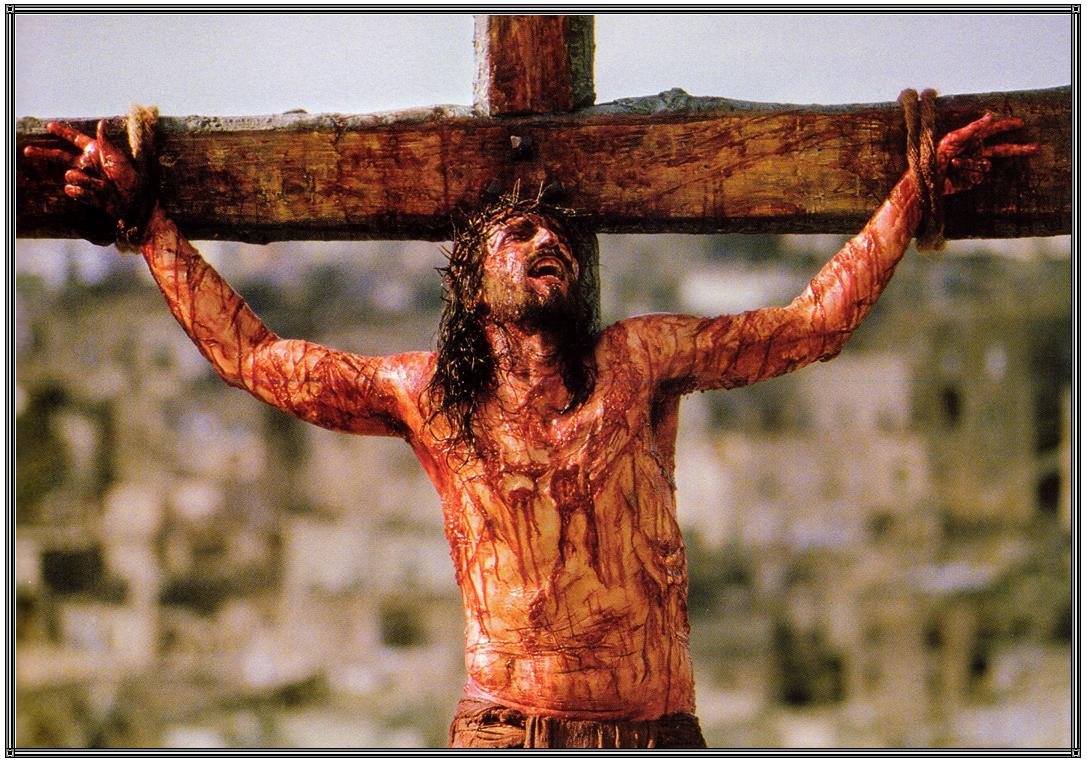
Alas, in the end, it was a movie. A mere movie. Mel Gibson’s brilliantly cynical marketing strategy, buoyed by the ADL’s advance work, lured even us non-believers (sinners) into the theater; certainly we didn’t expect to emerge as right-wing Christian fundamentalist converts, but we had every right to think we would be witnessing an honest representation of human and artistic faith, a spiritual roadmap to the psyche of a filmmaker and actor who felt driven, even instructed by God, as he has claimed, to create a cinematic likeness of the divine. It’s not essential that a moviegoer agrees with the political or religious implications of the images emblazoned on the screen, but that the images translate as a response from the filmmaker’s soul, that we believe we are witnessing the gospels as Mel himself sees them. The sheer divine force offered by Pasolini, Scorsese, by Bresson and Burnett and Spielberg, by Alexanders Payne and Sokurov, manifest in images that relinquish themselves to whatever artistic means necessary, not in shameless grandiosity that wishes to pummel the viewer into submission, into terrified acceptance. Gibson may find disingenuous the earthy benevolence of Pasolini’s Christ and the psychological torment of Scorsese’s, the lyrical allegory of Bresson’s Balthazar and Spielberg’s E.T., the spiritual personification of Payne’s Warren Schmidt or Sokurov’s cancer-ravaged saint-mother; he wants a more direct address, to make you feel every thrust of the rusty nail as it’s hammered into Jesus’s palms, to clutch your own shoulders as Jesus’s arm is ripped out of its socket, to cover your eyes in gratitude when the crucified thief’s eye is plucked out by a vengeful crow, to reverently ooh, aah, and shriek when Jesus is scourged, his back torn and ripped open into a hundred fleshy strips. Apparently to Gibson, there is no metaphor in religion; faith manifests itself as a spiritual dead-end, a believe-it-or-be-damned expression of finality. Of course Gibson, progeny of his fundamentalist missionary father’s terrifyingly stubborn outmoded beliefs, ended up a Hollywood actor—that particular “dream factory” churns out endless expressions of American complacency every year, cheerless damning spectacles of moral righteousness and unambigious carnal pleasures. Of course Mel Gibson, though a self-avowed man of endless spiritual vitality, can only depict the divine through the employment of hundreds of buckets of stage-blood. With its ludicrous, Hollywood-fortified conviction (not the same thing as faith, incidentally), Passion may be the world’s first completely banal Jesus Christ film. And though it’s remarkably, hopelessly literal, it was certainly waiting to happen. It had to happen.
If 2000’s Gladiator ushered in the new Bush regime, then perhaps Gibson’s blockbuster is the new 21st-century’s first true coercively conservative “classic.” Rarely has a film with a fundamentalist core been so blatantly conceived, so forthright in its admissions. Every decade of American film, though never preoccupied with anything grander than itself, nonetheless ends up a product of its own political backdrop. First Blood and its subsequent sequels became emblematic of the Reagan era, literally winning Vietnam back from the liberals, reasserting the swaggering machismo of the American hero that Seventies Hollywood attempted to all but decimate. And just as Stallone enacted Reagan’s cloudy-headed right-wing version of recent history, Gibson’s Christ—“compassionate” Conservative, deliverer of that old-tyme religion—emerges from the tomb at just the moment of the Bush administration’s attack on civil liberties, and the attack on the Civil Rights of American gays launched by Dubya himself with full-on, unabashed old-testament condemnation. Those who speak out against Gibson’s film are automatically stigmatized as leftist rabble-rousers and hapless atheists; to deny its physical impact or so-called technical grandeur is to supposedly denounce Gibson’s personal belief system. What’s more essential is to realize that when Gibson’s savvy propaganda piece, meant to inflict a tough-love Jesus on the nation’s wayward souls, floods into 4,000 screens, another dam between Church and State begins to crumble. The youngsters of the Clintonian Nineties, finding solace in the emergence of a truly multicultural pop mainstream, need to be reclaimed by the right, shorn of their piercings and tattoos, and brought back to Sunday school; who better to do that than Jesus himself, this time, like Rambo, stripped to the waist, chained and whipped, flesh torn and limbs broken, but never down for the count?
Swedish Death, American Style
by Erich Kuersten Acidemic
"A film by Matt Reeves" (Cloverfield), Let Me In (2010) barely even acknowledges it's a remake of a 2008 Swedish film, Let the Right One In (dir. Thomas Alfredson), which was an adaptation of a book by John Ajvide Lindqvist, also from Sweden. The American version keeps the snowy, desolate, alien mood via wintry Los Alamos, New Mexico, with Kodi Smith McPhee as the human boy, and the startling Chloe Grace Moretz as the vampire. One of the changes from the original are scenes were Moretz morphs into the CGI silhouette of a flying pit bull. In quieter moments she's startlingly ageless and we're forced to contend with the idea that she could be five or five hundred; she may have picked her young girl form the way a Venus flytrap picks its sticky sweet scent. In the book, I'm told, she's not even a real girl, but a castrated boy. She could be a thousand year old shapeshifting venus fly cactus. This mystery enhances the bizarre love story at the film's heart. It's one we all know- the old lover making way for the new - but in this case, oh man, we're talking some serious age differences.
Perhaps I mention all this to show how having a Swedish original to work from enables American filmmakers to explore the darker side of childhood, the place where empathy is easily drowned by the desire for companionship, safety, validation, power, and revenge against one's enemies. If the motivation for these remakes boils down to middle America's hatred of subtitles, the ability to depict things American films never could otherwise is surely a close, unspoken second. Ever since Spielberg's E.T. set the tone for the 1980s, movie audiences have reveled in their horror over child abuse scandals and as a result have shied away from portraying kids as anything but saints or, occasionally, evil demons... but either way beset on all sides by skeevy male abductors. Never are they allowed to be sexual and/or ignored - is neglect 'worse' than 'physical' abuse? Is there even a difference?
Having these topics come from Sweden washes the blood off our hands as nervous Yanks. We can do more dark stuff with kids, because hey, it's a remake, of a Swedish film. I have a feeling the same marker of moral responsibility exemption will accompany the sexual violence in Fincher's Girl with the Dragon Tattoo remake. Thus the Swedish cinema has re-attained its status as America's go-to taboo breaker, a status it won back in 1967 with I am Curious... Yellow, a film that dared to not just show sex, but to show realistic sex, as part of the experiences of a young leftist blonde girl and her older lover filmmaker. The protagonist's sexual openness isn't 'titillating' as much as a provocation . Americans were allowed to see it as 'art' and since it made money, the stage was set for the XXX boom. The leftist politics and new wave handheld style was forgotten but the sex was kept. The phrase 'Swedish erotica' became a redundancy, like American jazz, or Argentine tango.
The original Let the Right One In (2008) dared to assume the American art house market would abandon prurience and moral outrage over the whole child sexuality angle and remember instead the mix of loneliness and exalted terror that is being a child, those pre-empathic Lord of the Flies, Over the Edge kind of feelings from the days when we were sent to our rooms for trying to rebel, and we rolled around in bed and wished we could just kill our parents and be free to eat candy all the time; the agony of being called in by your parents, right when you were about to play a game of 'doctor' with your hot neighbor. When you ran outside after wolfing down your warm milk and yucky vegetables, she was gone.
Archive Fighter: The Girl with the Dragon Tattoo (David Fincher)
by J.M. Tyree Film Quarterly
The Girl with the Dragon Tattoo, David Fincher’s latest antiblockbuster, is a baroque rethink of the serial-killer subgenre; a subtly retuned adaptation of the first novel in Stieg Larsson’s penny-dreadful Millennium trilogy; a technical achievement of narrative compression and pacing in a mainstream thriller; and the most recent proof of the director’s trademark habit of unleashing bad vibes in the multiplex. It’s a sick kind of holiday movie. The story is bookended by two Christmases—a year its two protagonists pass among murderers, sexual predators, and a wealthy family with a history of sadistic brutality (and Nazi sympathies), all stirred up by a cold case involving the disappearance of a sixteen-year-old girl from a private island. With good reason, Fincher called The Girl with the Dragon Tattoo “the feel-bad movie of the season.” The director renders its source material in the coolly droll yet fundamentally shocking and disturbing style of his previous films about psychos, Seven (1995), Fight Club (1999), and Zodiac (2007). In the manner of Tod Browning’s subversive 1931 take on Dracula, The Girl with the Dragon Tattoo frightens the viewer while injecting grimly fiendish jokes into an earnest literary artifact with an intractably complicated storyline.
Like Zodiac, The Curious Case of Benjamin Button (2008), and The Social Network (2010), The Girl with the Dragon Tattoo is a movie subdivided into dozens of impeccable segments, some lavishly arranged shots lasting no more than a flashing second or two. Among the first in this series of mini-films is the peculiar titles sequence that recalls both Fincher’s early days as a director of music videos and the James Bond movies’ graphic set pieces. It features a fittingly icy cover of Led Zeppelin’s “Immigrant Song,” vocalized by the Yeah Yeah Yeahs’ Karen O. Along with this gender-bending, the song’s lyrics provide signposts for interpretation of a film that will “whisper tales of gore” set in remixed Viking landscapes. The sequence’s images of black sludge dripping from motorcycle tires, laptop keyboards, electronic wires, deadly flowers, dark phoenixes, and faces vomiting coins and stinging insects (a reference to the pseudonym, Wasp, of the eponymous hacker in Larsson’s novel) suggest the stylized iconography of a world drowning in liquid evil. These and other touches of deliberate artifice—Polaroid-tinted flashbacks, talking text from the primary victim’s diary, establishing shots of moving trains and snowbound houses that turn landscapes into glimpses from nightmares, multitasking montages that playfully detach sight and sound, and Fincher’s toxic light filters—at once encapsulate and provide layers of chill to distance the awful horrors in store. The movie’s sound design often intrudes, consistently and violently, in ways that lend a surreal aura to the noise of passing trains, closing doors, and moving elevators.
These reminders of unreality also might serve as annotations to a story that is about acts of reading and misreading. Both the novel and the movie begin with a major interpretative mistake. Harriet Vanger (Moa Garpendal), missing for forty years from her wealthy family’s enclave, is presumed murdered. Her uncle, Henrik Vanger (Christopher Plummer), has been receiving mysterious packages each year containing pressed flowers, posted from around the world. He hires a disgraced investigative journalist, Mikael Blomkvist (Daniel Craig), to look into Harriet’s case, and Blomkvist takes on freelance security consultant and computer hacker Lisbeth Salander (Rooney Mara) as his research assistant. Together, they uncover what Blomkvist describes as a story of “rape, torture, fire, animals, religion— am I missing anything?” Of course, everyone is missing something in this thriller, namely that the flowers are being sent by Harriet herself to let her beloved uncle know that she remains alive, rather than by a clever killer attempting to torment Henrik.
Why the most obvious assumption about these secret messages is never made could be the focus of a Derridean highlight reel about the slipperiness of writing, from the expanded definition of the word in 1967′s Of Grammatology (the flowers form a kind of living hieroglyph) to the games about letters in 1980′s The Post Card (Harriet’s flowers are messages mailed but not adequately received). Fincher’s emphasis on textual instability and the control of documents intersects with what Derrida calls the “politics of the archive” in his 1995 essay Archive Fever: A Freudian Impression (translated by Eric Prenowitz, University of Chicago Press, 1996, 4). In Melancholy and the Archive (Continuum, 2011), Jonathan Boulter calls archive fever “an addiction to past events which transforms the subject into a crypt” (141), and in Fincher’s film all manner of often macabre texts, images, and objects entomb as much as they disclose, as if attesting to a semantic death drive and to haunted memory. Newspaper clippings, crime-scene pictures, binders of family snapshots or tourist photographs, corporate files and libraries, Bible codes, encrypted documents, video surveillance clips, scars, and of course tattoos record—even if they do not always spell out—nightmare crimes. Larsson’s novel mentions a “death book” that Martin Vanger (Stellan Skarsgård) fills with research on his potential victims, but in a way the whole story is an elaborate memento mori.
All Tomorrow's Playground Narratives: Stanley Kubrick's Lolita
by Erich Kuersten Bright Lights Film Journal
One of the many things that make Stanley Kubrick's best films so endlessly re-watchable is how he makes cultural artifacts (hairstyles, wallpapers, furniture, etc.) that might normally date the film archetypal and uncanny. In his insane formal rigor he warps what passes for "normal" until the word loses meaning. He does this through circular movement: from strange to familiar and back again, slowly like the various orbits in 2001: A Space Odyssey (1967), In the ever-widening gap of time since that film's release, our judgment of the red and white space station decor, such as the pop-art red furniture, has revolved all the way around from cool and contemporary (for 1967) to joltingly anachronistic (1980s) to back in retro Urban Outfitters-style vogue all over again (1990s), and now (2009) on its way into postmodern super breakdown overdrive; everything is now both in and out, all the time.
DVDs have put all of the century at our disposal — as Marlene Dietrich said to Orson Welles in Touch of Evil: "It's so old it's new." Kids are becoming infatuated with manual typewriters and LPs. Having been born in 1967 myself, I now get a weird pang of nostalgic warmth from 2001's 1960s decor, as if revisiting the cosmic playground of youth, wherein parents and monkey bars loomed tall as obelisks and one wasn't expected to understand anything in any adult movie, let alone 2001. The very title of the film reverberates with this weird time loop frisson when you examine it in 2009, wherein humans may not be traveling to Jupiter, but we've got cool stuff Bowman and Arthur C. Clarke never dreamt of, like video camera-cell phones the size of a credit card. But with Kubrick, a 1970s sweater — even seen in the 1970s — or period modular furniture are as alien as if they were from the distant future or prehistoric past. Kubrick gives us nothing that is coincidental; everything is made frisson-laden, down to the last prop. Everything becomes referential to itself, or what Lacan calls a sinthom.
As with a child's misinterpretations of real-life adult symbols and signifiers (why is daddy hurting mommy in the primal scene, etc.), childhood misunderstandings of popular movies form the basis of our pop mythology, much more than the actual films' intended meanings. As a child, my friends and I regularly synopsized R-rated movies to each other, freaking ourselves out as films like Carrie, the Exorcist, Jaws, The Sentinel, Texas Chainsaw Massacre or The Omen grew scarier with each embellished telling. That may have changed now that kids can call up any movie anytime on their wristwatches, but in the pre-VCR 1970s, to kids like me, these rehashes of R-rated films were urban myths, campfire ghost stories (which survives to some extent in the whistling in the dark horror blog approach of, say, Stacie Ponder or Tenebrous Kate). If you saw the movies in person, an inevitable initial disappointment was bound to occur. No amount of special effects can measure up to the full lurid breadth of a child's imagination when told of a glass pane slicing a guy's head off in The Omen (above). The actual Omen itself doesn't come close; it's quite laughably fake, actually.
In a land before VCRs and political correctness, these kinds of imagined fears were a great turn-on, the sublimated jouissance that was once focused around the threat of spankings, the sadomasochistic pulls of infantile sexual dread/desire. The myths of this age are the urban legends (the LSD babysitter microwave infant combo) and the R-rated horror movies. These films had a role in our lives, a giddy terror of inevitable initiation-style rites of pain and passage; they needed to seem terrifying, like a rollercoaster that sends an electric charge up your spine even while waiting in line. But once you rode it or saw the film, you were cool for life. The reality always turned out to be not scary or traumatizing after all; it was just a spook show.
"Nun-Lust, Torture-Porn, Church-Desecration and Bad Taste": Reconnecting with Ken Russell's The Devils
by Gordon Thomas Bright Lights Film Journal
Back in 1971, if you were lucky enough to see Ken Russell's The Devils — and not that many did, or if they did, felt themselves lucky — you might've wondered: am I expected to take this film seriously? While shooting the film and over the years, Russell, who died in November 2011 at 84, insisted that he was very serious in his film adaptation of Aldous Huxley's 1952 book The Devils of Loudun, a semi-fictional, intensely researched treatment of the real-life, medieval witch-hunting circus that led to the execution of the secular priest Urbain Grandier in 1634. But when the film premiered first in the UK in a censored cut authorized reluctantly by Russell, and then in a more heavily cut version in the US, few people, especially critics, were disinclined to accept the film as anything more than sensationalist or — even worse — dastardly conceived, pornographic garbage.
Were these knee-jerk reactions? Since its theatrical run, it's not been easy to take a fresh look at the film. In the earlier days of home video, Warner Bros., the studio that owns the film, allowed VHS releases of The Devils in the UK and US, but these issues were transfers of the heavily censored American cut, hardly the version with which to revisit Russell's original intentions. With the advent of DVD and Blu-ray, much of Russell's catalog has gone to disc, but, other than on execrable bootlegs, not The Devils — until this year.
Through some sort of finagling, which must've resembled the US negotiating arms reduction with Leonid Brezhnev, the British Film Institute has been able to license from Warner Bros. the original, X-rated British theatrical release cut of The Devils. Not, mind you, the director's cut, recently reassembled by the late Russell himself and shown theatrically, once, in 2010; nor was the BFI allowed to issue the film on Blu-ray. The resultant two-disc, Region 2 DVD appeared in late March 2012, and the film looks many times better than the wretched bootleg from Euro Cult, made available in the US in 2011. The bootleg does, however, contain the rape of Christ sequence, which, along with a segment of another provocative scene, Warner Bros. would not allow for inclusion on BFI's release.
With the passage of over forty years — and the reasonable assumption that these scenes would not, at this late date, scorch a reasonable person's eyeballs — the whys and wherefores of Warners' timidity are difficult to understand. The British X-rated version hasn't been seen since the initial theatrical run in the UK, and thus far, Warner has steadfastly refused to release The Devils on disc, in any version, in the US. Apparently, their somewhat admirable goal — to make their entire catalog of films eventually available via the made-on-demand service, the Archive Collection — will fall short, with one title slated to be cast into a lake of fire.
In '71, I knew nothing of The Devils' entanglement with censorship and controversy, and, enjoying the film tremendously, made sure to see it more than once, if only to be certain that the sets (designed by Derek Jarman) were really as strangely beautiful as I'd first thought (they were). At the time, transgressive filmmaking was in the air, or about to be: its harbinger, I Am Curious (Yellow), had arrived back in 1967, Fellini Satyricon in 1969, Jodorowsky's El Topo in 1970; Bertolucci's Last Tango in Paris was to come in 1972, Pasolini's Salo in 1975, Oshima's In the Realm of the Senses in 1976, and Lynch's Blue Velvet a decade later. Yet Russell, with just one film, seemed to want to break more taboos than all of the others combined.
In Russell's case, though, it isn't just a matter of provocative content. Beyond frontal nudity and nuns masturbating against the toes of Christ's nailed foot, The Devils combines its transgressive content with transgressions in tone, a standard operating procedure for most the director's oeuvre, and one that has consistently gotten him in trouble critically. In The Devils, where Russell amps up the sex and nudity, mixing it all in with a mockery of organized religion — plus scenes of physical torture and degradation enacted on nuns and priests — the film's tone refuses to remain constant, often from scene to scene, creating an apparent confusion of intent.
With certain mindsets in place in 1971, though, was anybody really surprised when the British Board of Film Classification (BBFC) adjudged the original cut a nasty free-for-all and thus — with its provocative elements presented in an in-your-face, sometimes confusing style — a film made in shockingly bad taste? It's the "shockingly bad taste" that I believe resulted in the extremity of the censorship, and not, per se, the pubic hair, violence, and rough treatment of organized religion.
Partly, I think, the bad boy in Russell always enjoyed deliberately taunting the unimaginative or conservative viewer. By no means should we consider this his only motivation behind the extreme content and apparently confused intent — I'll get to other, more laudable motivations later — but I'm sure he could anticipate how these factors might cause the BBFC to question the seriousness of his film. Any claims by Russell to the contrary I might consider disingenuous.
Besides shattering the narrative frame with numerous anachronisms in The Devils, Russell more than once inserts a sequence of deliberate, low-down burlesque that appears to undercut the seriousness of the drama. The film's biggest set-piece, the orgiastic possession scene in the cathedral, plays more like gleeful soft porn than the disturbing brainwashed display of blasphemy that Russell has said he intended. When the BBFC screened The Devils, they likely foresaw a potential obscenity case, with accompanying legal ramifications and liability.
Migrating Forms: David Cronenberg and the challenge of the impossible adaptation
by Joshua Land Moving Image Source
What makes a film a successful literary adaptation? Ask a random literate moviegoer, and they're likely to answer that a good film adaptation should be "like the book" (or play). In other words, a successful adaptation is a faithful adaptation. What then is a faithful adaptation? One that follows the story of the original text, of course. It's this fixation on story that prompts the common contention that most great modernist and postmodernist novels, which often either lack a traditional story or integrate story elements with discursive material, are "unfilmable." One possible strategy of adaptation is to "flatten out" the original by simply discarding everything that doesn't move the story along, as in Philip Kaufman and Jean-Claude Carrière's version of The Unbearable Lightness of Being, a conventional 1980s Euro-prestige picture that preserves the novel's plot line while eliding the philosophical digressions and ruminations on love and kitsch that are essential to its meaning. So is it a successful adaptation of Milan Kundera's novel? Well, that depends on what you mean by "successful."
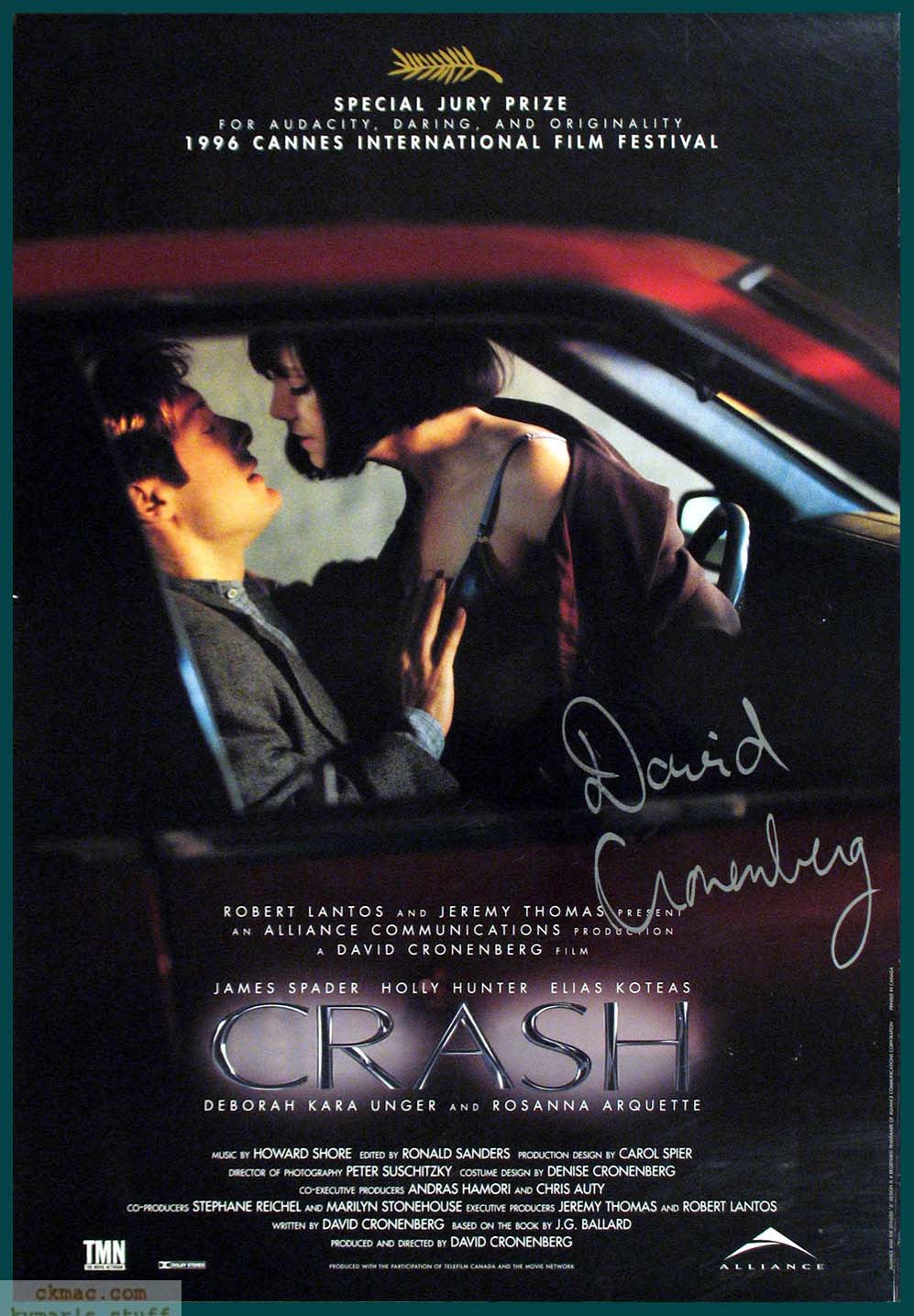
Over the latter half of his career, David Cronenberg has intervened in this tiresome discussion with a series of what have been termed "impossible adaptations." In films like Naked Lunch (1991) and Crash (1996), adaptations of novels once regarded as unfilmable, Cronenberg approaches the problem of adaptation from a different angle. One of these films closely follows the story of its source novel and one does not, but both could be described as successful—and even, after a fashion, faithful—adaptations.
Discussion of adaptations is often haunted by the unresolved question of whether a film should be regarded as merely the extension of a literary work into another form, or as a separate work entirely. Cronenberg's Naked Lunch takes that decision out of the viewer's hands to the extent that it's not really an adaptation of William S. Burroughs's novel at all—at least if adaptation is conceived primarily in terms of story. While most of the movie's major characters and settings (as well as the famous "talking asshole" anecdote) come from the Burroughs novel, it also draws from other Burroughs writings as well as the author's life. Seeing Naked Lunch is in no way a substitute for reading the book, or vice versa—which may be precisely the point.
Talking centipedes and organic typewriters notwithstanding, Naked Lunch is relatively restrained by the standards of Cronenberg's previous work, marking, along with Dead Ringers (1988), a transition between the director's visceral early films and the cooler, more formalist late work. The outré visual effects are played more for laughs than chills. Indeed, Naked Lunch might be Cronenberg's funniest film, beginning with the ironic casting of Robocop himself, Peter Weller, as the alter ego of the outlaw writer. Weller's stone-faced performance positions the film's protagonist, William Lee, as a straight man (pun intended) who takes its bizarre happenings in stride. Recounting a not atypical incident in which his Clark Nova typewriter kills and disembowels a potential rival instrument, Lee deadpans: "I understood writing could be dangerous. I didn't realize the danger came from the machinery."