Showing posts with label Serial Killers. Show all posts

Monday, June 18, 2012

J.M. Tyree: Archive Fighter

Archive Fighter: The Girl with the Dragon Tattoo (David Fincher)
by J.M. Tyree
Film Quarterly
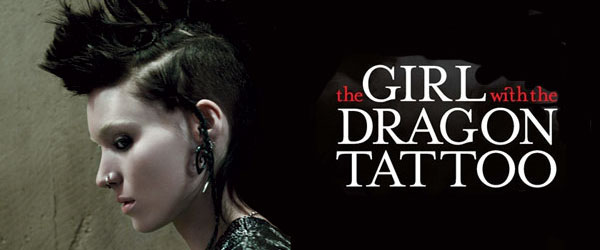


The Girl with the Dragon Tattoo, David Fincher’s latest antiblockbuster, is a baroque rethink of the serial-killer subgenre; a subtly retuned adaptation of the first novel in Stieg Larsson’s penny-dreadful Millennium trilogy; a technical achievement of narrative compression and pacing in a mainstream thriller; and the most recent proof of the director’s trademark habit of unleashing bad vibes in the multiplex. It’s a sick kind of holiday movie. The story is bookended by two Christmases—a year its two protagonists pass among murderers, sexual predators, and a wealthy family with a history of sadistic brutality (and Nazi sympathies), all stirred up by a cold case involving the disappearance of a sixteen-year-old girl from a private island. With good reason, Fincher called The Girl with the Dragon Tattoo “the feel-bad movie of the season.” The director renders its source material in the coolly droll yet fundamentally shocking and disturbing style of his previous films about psychos, Seven (1995), Fight Club (1999), and Zodiac (2007). In the manner of Tod Browning’s subversive 1931 take on Dracula, The Girl with the Dragon Tattoo frightens the viewer while injecting grimly fiendish jokes into an earnest literary artifact with an intractably complicated storyline.

Like Zodiac, The Curious Case of Benjamin Button (2008), and The Social Network (2010), The Girl with the Dragon Tattoo is a movie subdivided into dozens of impeccable segments, some lavishly arranged shots lasting no more than a flashing second or two. Among the first in this series of mini-films is the peculiar titles sequence that recalls both Fincher’s early days as a director of music videos and the James Bond movies’ graphic set pieces. It features a fittingly icy cover of Led Zeppelin’s “Immigrant Song,” vocalized by the Yeah Yeah Yeahs’ Karen O. Along with this gender-bending, the song’s lyrics provide signposts for interpretation of a film that will “whisper tales of gore” set in remixed Viking landscapes. The sequence’s images of black sludge dripping from motorcycle tires, laptop keyboards, electronic wires, deadly flowers, dark phoenixes, and faces vomiting coins and stinging insects (a reference to the pseudonym, Wasp, of the eponymous hacker in Larsson’s novel) suggest the stylized iconography of a world drowning in liquid evil. These and other touches of deliberate artifice—Polaroid-tinted flashbacks, talking text from the primary victim’s diary, establishing shots of moving trains and snowbound houses that turn landscapes into glimpses from nightmares, multitasking montages that playfully detach sight and sound, and Fincher’s toxic light filters—at once encapsulate and provide layers of chill to distance the awful horrors in store. The movie’s sound design often intrudes, consistently and violently, in ways that lend a surreal aura to the noise of passing trains, closing doors, and moving elevators.

These reminders of unreality also might serve as annotations to a story that is about acts of reading and misreading. Both the novel and the movie begin with a major interpretative mistake. Harriet Vanger (Moa Garpendal), missing for forty years from her wealthy family’s enclave, is presumed murdered. Her uncle, Henrik Vanger (Christopher Plummer), has been receiving mysterious packages each year containing pressed flowers, posted from around the world. He hires a disgraced investigative journalist, Mikael Blomkvist (Daniel Craig), to look into Harriet’s case, and Blomkvist takes on freelance security consultant and computer hacker Lisbeth Salander (Rooney Mara) as his research assistant. Together, they uncover what Blomkvist describes as a story of “rape, torture, fire, animals, religion— am I missing anything?” Of course, everyone is missing something in this thriller, namely that the flowers are being sent by Harriet herself to let her beloved uncle know that she remains alive, rather than by a clever killer attempting to torment Henrik.

Why the most obvious assumption about these secret messages is never made could be the focus of a Derridean highlight reel about the slipperiness of writing, from the expanded definition of the word in 1967′s Of Grammatology (the flowers form a kind of living hieroglyph) to the games about letters in 1980′s The Post Card (Harriet’s flowers are messages mailed but not adequately received). Fincher’s emphasis on textual instability and the control of documents intersects with what Derrida calls the “politics of the archive” in his 1995 essay Archive Fever: A Freudian Impression (translated by Eric Prenowitz, University of Chicago Press, 1996, 4). In Melancholy and the Archive (Continuum, 2011), Jonathan Boulter calls archive fever “an addiction to past events which transforms the subject into a crypt” (141), and in Fincher’s film all manner of often macabre texts, images, and objects entomb as much as they disclose, as if attesting to a semantic death drive and to haunted memory. Newspaper clippings, crime-scene pictures, binders of family snapshots or tourist photographs, corporate files and libraries, Bible codes, encrypted documents, video surveillance clips, scars, and of course tattoos record—even if they do not always spell out—nightmare crimes. Larsson’s novel mentions a “death book” that Martin Vanger (Stellan Skarsgård) fills with research on his potential victims, but in a way the whole story is an elaborate memento mori.

To Read the Rest of the Essay

Thursday, April 5, 2012

David Kalat: Kiyoshi Kurosawa is the Cure

Kiyoshi Kurosawa is the Cure
by David Kalat
Movie Morlocks


One day, Japanese pulp cinema auteur Kiyoshi Kurosawa was watching TV. A killer had been apprehended, and the TV newscasters mobbed the perp’s neighbors to ask all the familiar questions: what was he like? Did he act unusual? Did you ever suspect you were living next door to a monster? And the answers to these inevitable questions are inevitably frustrating: he was just a nice, quiet man who never aroused any suspicions. He must have been a monster disguised as a man.

People want to be able to explain away crime as something aberrant. The press tries to meet this need, to package the reporting of crime in ways that pit us versus them. But Kurosawa, a cynical man who studied sociology before becoming a moviemaker, recognized these impulses as delusional. The killer, his neighbors, his victims, the detectives who caught him, and the reporters who covered the tale are all made of the same stuff. Kurosawa saw the disquieting truth: anyone can be a monster. Even you.

This was in the mid 1990s, a period when the world’s cinemas were clogged with serial killer dramas all hoping to be the next Silence of the Lambs, or Se7en. That, or at least hitch a short ride on their coattails. Most remained just that—wanna bes, never weres, nots. This is the story of the film that did become the Next Big Thing, and along with Hideo Nakata’s 1998 Ring invented J-Horror.

Kurosawa had, by this time, spent most of the last fifteen years toiling in Japan’s B-movie industry. The rules of the game were simple, if brutal. To make a living making movies in Japan, you had to make lots of movies, make them fast, and make them cheap. The theaters were dominated by American imports (if not for protectionist policies by Japan’s exhibitors, there would be no room at all for domestic productions), so movies had to have a viable life on video. Certain genres became entrenched as the prevailing mode of commercial filmmaking: pornos, yakuza shoot ‘em ups, and horror movies.

Kiyoshi Kurosawa was capable of playing this game very well. Low budgets didn’t discourage him at all, and indeed he considered them something of an advantage. When he was hired to direct Bright Future in 2003, the first thing he told producer Takashi Asai was, “I’ll come in on time and on budget.” Asai was little taken aback by this promise: “A director who before saying I’ll make a great film or a compelling film says, ‘I’ll come in one budget and schedule,’ a director who announces this to the producer is either really great, or I don’t know… I don’t know really know what to make of it.”

Furthermore, Kurosawa eagerly embraced genre limitations. “I am a genre director,” he proudly described himself.

To Read the Rest of the Essay

Thomas Doherty: Portraits of a Serial Killer -- A time-honored public enemy, from Dirty Harry to Zodiac

Portraits of a Serial Killer: A time-honored public enemy, from Dirty Harry to Zodiac
by Thomas Doherty
Moving Image Source


In Adaptation (2002), screenwriter Charlie Kaufman, the voice of weary experience, remarks that the serial killer is Hollywood’s hoariest cliché, the overexposed go-to-guy for the inspiration-impaired hack. Point taken—but the perp has certainly earned his star billing on the multiplex marquee. The serendipitous release in recent months of two serial-killer-centric DVDs—Don Siegel’s Dirty Harry (a two-disc edition and an "ultimate collector's edition" from Warner Home Video) and David Fincher’s Zodiac (Paramount Home Entertainment), a film from the 1970s and a film about the 1970s, both stalked by the same serial killer—traces the emergence of a predator whose criminal profile, once a blurry police sketch, has sharpened into a wanted poster more photogenic than the western outlaw, urban gangster, or corporate mobster.

The common source for both films—deep backstory for Dirty Harry (1971), narrative arc for Zodiac (2007)—is the Zodiac killer. In 1969, the Zodiac began a slow burn spree that claimed five (confirmed) murder victims in and around San Francisco, a relatively low body count that belies the city-wide terror incited by a territorial predator with a penchant for epistolary expression. Taking a page from Jack the Ripper, the self-christened Zodiac sent ominous ravings and coded messages to Bay Area newspapers, bragging of his homicides and threatening, in his most chilling taunt, to shoot children on school buses, or, as he phrased it, to "pick off kiddies as they come bouncing out.” Going on hiatus as suddenly as he opened fire, the Zodiac eluded capture and denied the reassurance of a case closed.

The investigation came to a more pleasing conclusion at the movies. In Dirty Harry, the opening salvo in what turned out to be a bellwether franchise for both Hollywood and Washington, a squinty, flinty Clint Eastwood incarnated a vigilante detective whose fidelity to Fourth Amendment niceties was retro even by 1972 standards. “Does Escobedo ring a bell? Miranda?” barks the exasperated DA after Harry tortures a confession out of his suspect-nemesis, a frothing psychopath named Scorpio (played with rabid relish by Andy Robinson), a Zodiac stand-in whose nom de plume also elegized an Age of Aquarius-Haight Ashbury scene gone bad. Though ripped from contemporary headlines, Scorpio could claim a long lineage in American cinema, from the psycho who pushed old ladies in wheelchairs down staircases (Richard Widmark in Kiss of Death, 1947) to the psycho who played old ladies in wheel chairs (Anthony Perkins in Psycho, 1960). In terms of temperament, MO, and clinical termscondition, Scorpio was a wack job, or, as Detective Callahan famously tagged him, a punk.

Yet even as Harry fired his .44 caliber Magnum into Scorpio’s chest, the smirking psychopath was being supplanted by a more lethal criminal type. Abetted by the mobility and anonymity of urban life, a feeding ground teeming with hapless prey (typically, young female hitchhikers), and a police force not yet equipped with computer databases, a cohort of less literary, publicity-shy serial killers thrived throughout the 1970s.

To Read the Rest of the Essay