The Square, Egypt's Revolution Doc with Sundance Winner Dir Jehane Noujaim
Bring Your Own Doc
Fresh from winning the best World Documentary award at Sundance, The Square director Jehane Noujaim comes to BYOD to discuss her background in film and the process of telling the story of the Egyptian revolution.
Jehane also shares the feeling she had of crawling through the dark while filming, and still managing to make a film that is recognized and appreciated.
GUEST BIO:
Jehane Noujaim is an Egyptian-American filmmaker who began her career with the MTV documentary series, Unfiltered. She left her post as segment producer to work with the legendary Chris Hegedus and D.A. Pennebaker on the film STARTUP.COM, which led to numerous nominations and won awards at The International Documentary Association, Philadelphia, Doubletake Documentary Film Festival, and a DGA Award.
Jehane followed the success of the film with the equally acclaimed CONTROL ROOM, which won awards at Full Frame, Boston Society of Film Critics, International Documentary Association, Seattle Film Critics, and Sydney Film Festival.
Continuing her work in both the United States and The Middle East, Jehane is back with a new film, THE SQUARE, depicting the revolution in Egypt's famous Tahrir Square. She is back, fresh from Park City, where she was awarded the World Documentary Audience Award at Sundance for her magnificent work on this film.
Showing posts with label Narrative. Show all posts
Showing posts with label Narrative. Show all posts
Thursday, October 24, 2013

Wednesday, October 16, 2013
Liza Bear: Christopher Boe on Love and Personal Identity in Reconstruction
Christopher Boe on Love and Personal Identity in "Reconstruction"
by Liza Bear
Indiewire

Inspired by a Jacques-Henri Lartigue photograph of a woman standing in a room with empty bookcases, Danish director Christoffer Boe's first feature "Reconstruction" fittingly won the prestigious Camera D'or at Cannes in 2003 and a Golden Plaque for Manuel Alberto Claro's luminous wide-screen cinematography. It brings closure to the exploration of themes of love and personal identity begun in three earlier shorts, "Obsession," "Virginity" and "Anxiety."
"They're all about a young male being obsessed by a beautiful woman and then being trapped in his own logic of what love is," says Boe, 30, a passionate still photographer as well as moviemaker. It's that logic which Boe dissects in "Reconstruction."
As its title suggests, Boe uses a fractured narrative and startling visuals to create a haunting rumination on the mysteries of desire (and the consequences of acting them out), rather than a romantic comedy. A kind of triangular square dance, "Reconstruction" sports excellent performances from its leads, with Nikolaj Lie Kaas playing Alex as a cypher and Maria Bonnevie doubling up as both Alex's steady girl-friend Simone and his new flame Aimee. It doesn't help Alex that Aimee is married to older man August (Krister Henriksson), who happens to be a writer. But it does give a few extra twists to the narrative. August is the film's narrator. There are echoes of Francois Ozon's cryptic thriller "Swimming Pool" here, though style and sensibility are poles apart. Having an attractive live-in girl-friend doesn't stop Alex from one day falling for Aimee, August's wife. A narrator who's also a character in the film naturally raises questions about what's real and what's imaginary. But then, so does being in love. The next day, Alex's world has changed, literally. His apartment has disappeared and so have his friends. An existential conundrum? Maybe. Or rather an attempt to create a metaphor for the paradigm shift that love induces.
To Read the Interview
by Liza Bear
Indiewire
Inspired by a Jacques-Henri Lartigue photograph of a woman standing in a room with empty bookcases, Danish director Christoffer Boe's first feature "Reconstruction" fittingly won the prestigious Camera D'or at Cannes in 2003 and a Golden Plaque for Manuel Alberto Claro's luminous wide-screen cinematography. It brings closure to the exploration of themes of love and personal identity begun in three earlier shorts, "Obsession," "Virginity" and "Anxiety."
"They're all about a young male being obsessed by a beautiful woman and then being trapped in his own logic of what love is," says Boe, 30, a passionate still photographer as well as moviemaker. It's that logic which Boe dissects in "Reconstruction."
As its title suggests, Boe uses a fractured narrative and startling visuals to create a haunting rumination on the mysteries of desire (and the consequences of acting them out), rather than a romantic comedy. A kind of triangular square dance, "Reconstruction" sports excellent performances from its leads, with Nikolaj Lie Kaas playing Alex as a cypher and Maria Bonnevie doubling up as both Alex's steady girl-friend Simone and his new flame Aimee. It doesn't help Alex that Aimee is married to older man August (Krister Henriksson), who happens to be a writer. But it does give a few extra twists to the narrative. August is the film's narrator. There are echoes of Francois Ozon's cryptic thriller "Swimming Pool" here, though style and sensibility are poles apart. Having an attractive live-in girl-friend doesn't stop Alex from one day falling for Aimee, August's wife. A narrator who's also a character in the film naturally raises questions about what's real and what's imaginary. But then, so does being in love. The next day, Alex's world has changed, literally. His apartment has disappeared and so have his friends. An existential conundrum? Maybe. Or rather an attempt to create a metaphor for the paradigm shift that love induces.
To Read the Interview
Sunday, October 13, 2013
La Commune (Paris 1871) (France: Peter Watkins, 2000)

La Commune (Paris 1871) (France: Peter Watkins, 2000: 345 mins)
Ford, Hamish. "Producing revolutionary history on film: Henri Lefebvre’s urban space and Peter Watkins’ La Commune (Paris, 1871)." Jump Cut #57 (Fall 2016)
La Commune (Paris, 1871) (France: Peter Watkins, 2000: available on Google video in multiple parts)
"Peter Watkins: La Commune." Chtodelat (October 31, 2008)
Peter Watkins: The Media Crisis Dialogic (October 3, 2007)
Peter Watkins: Filmmaker/Media Critic." Dialogic (September 7, 2012)
Rapfogel, Jared. "The Cinema of Peter Watkins." Cineaste 32.2 (Spring 2007)
Rosenbaum, Jonathan. "The Revolution Has Been Televised [Peter Watkins’ LA COMMUNE]." Chicago Reader (May 17, 2002)
Watkins, Peter. "Notes on the Making of La Commune (Paris, 1871)." Peter Watkins: Filmmaker/Critic (2000)
---. "Notes on the Media Crisis." Barcelona, Spain: Quaderns portàtils, 2010.
Thursday, September 26, 2013
Sean Smithson: We Are What We Are, Tastefully Macabre
WE ARE WHAT WE ARE, Tastefully Macabre
by Sean Smithson
Twitch

Let's get this out of the way right off the bat: We Are What We Are is not a remake. Differing greatly from the original Jorge Michel Grau Spanish-language version, the creative team of Jim Mickle (writer/director) and Nick Damici (writer/co-star) have taken the original concept of ritual cannibalism and inverted it, switching almost every trope in the initial version, and spinning it into something completely their own.
In this Americanized take, Iris and Rose Parker (Ambyr Childers and Julia Garner) are two young girls living in a rural community who have recently lost their mother, and are now left to tend to the needs of their little brother Rory, and ailing father Frank (Jack Gore and Bill Sage). Stand-offish and a mystery to the local citizens, the Parkers have kept to themselves, labelled strange, eccentric, and a bit fanatical by their neighbors and fellow townsfolk. As an on-going storm rages, causing flooding and immobility, slowly the long standing mystery of a number of disappearances in the area begins to unravel.
A local coroner, Doc Barrow (played by scene stealer extraordinaire Michael Parks), whose daughter had gone missing the season before, slowly begins to suspect the anti-social Parker family of being involved, and tells the local sheriff (Nick Damici) of his feelings. Young Deputy Anders (Wyatt Russell, son of Kurt) meanwhile has an infatuation with the beautiful Iris, who obviously wants to return his affections but keeps her suitor at a distance because of her duty to her family. When a human finger bone is discovered, evidence starts pointing to foul play in the small community, and the tourniquet on the Parkers slowly tightens, as dark secrets (and worse) are threatened to be revealed. Plot elements are deftly juggled by Mickle, as the storm worsens, the clues amass, and tensions mount.
The raging storm brings flood waters that threaten to literally dig up long-buried secrets. Caught in the spiral is caring neighbor Marge (Kelly McGillis) a bit of an old maid who has taken to watching over the girls and their little brother, and helping them through the trial of losing their mother. Let me say here, it's so great to see McGillis become a Mickle cast regular, this being her second film with him, and proves that real screen talent elevates material (which the genre sorely needs right now).
This is a horror movie, so it goes without saying, things don't end well for many of the characters in We Are What We Are. Thankfully, director Mickle never goes for the cheap shot or easy gore, instead methodically building a tale of a family in pain and turmoil, who happen to have some very strange practices and ideas of what worship is.
The most overt change is the family structure being shifted from young teenaged boys, a little sister, and a mother trying to keep things together (as in the original) to a literal "flip," where now we have a widowed father, his two young daughters on the verge of womanhood, and their little brother. It seems a bit literal on paper, but in the context of Mickle's vision it's actually a revelation. Changing the setting from a city to a small almost Norman Rockwell-esque Any Town, America strengthens the backstory and brings it all "home," so to speak.
To Read the Rest of the Review
by Sean Smithson
Twitch
Let's get this out of the way right off the bat: We Are What We Are is not a remake. Differing greatly from the original Jorge Michel Grau Spanish-language version, the creative team of Jim Mickle (writer/director) and Nick Damici (writer/co-star) have taken the original concept of ritual cannibalism and inverted it, switching almost every trope in the initial version, and spinning it into something completely their own.
In this Americanized take, Iris and Rose Parker (Ambyr Childers and Julia Garner) are two young girls living in a rural community who have recently lost their mother, and are now left to tend to the needs of their little brother Rory, and ailing father Frank (Jack Gore and Bill Sage). Stand-offish and a mystery to the local citizens, the Parkers have kept to themselves, labelled strange, eccentric, and a bit fanatical by their neighbors and fellow townsfolk. As an on-going storm rages, causing flooding and immobility, slowly the long standing mystery of a number of disappearances in the area begins to unravel.
A local coroner, Doc Barrow (played by scene stealer extraordinaire Michael Parks), whose daughter had gone missing the season before, slowly begins to suspect the anti-social Parker family of being involved, and tells the local sheriff (Nick Damici) of his feelings. Young Deputy Anders (Wyatt Russell, son of Kurt) meanwhile has an infatuation with the beautiful Iris, who obviously wants to return his affections but keeps her suitor at a distance because of her duty to her family. When a human finger bone is discovered, evidence starts pointing to foul play in the small community, and the tourniquet on the Parkers slowly tightens, as dark secrets (and worse) are threatened to be revealed. Plot elements are deftly juggled by Mickle, as the storm worsens, the clues amass, and tensions mount.
The raging storm brings flood waters that threaten to literally dig up long-buried secrets. Caught in the spiral is caring neighbor Marge (Kelly McGillis) a bit of an old maid who has taken to watching over the girls and their little brother, and helping them through the trial of losing their mother. Let me say here, it's so great to see McGillis become a Mickle cast regular, this being her second film with him, and proves that real screen talent elevates material (which the genre sorely needs right now).
This is a horror movie, so it goes without saying, things don't end well for many of the characters in We Are What We Are. Thankfully, director Mickle never goes for the cheap shot or easy gore, instead methodically building a tale of a family in pain and turmoil, who happen to have some very strange practices and ideas of what worship is.
The most overt change is the family structure being shifted from young teenaged boys, a little sister, and a mother trying to keep things together (as in the original) to a literal "flip," where now we have a widowed father, his two young daughters on the verge of womanhood, and their little brother. It seems a bit literal on paper, but in the context of Mickle's vision it's actually a revelation. Changing the setting from a city to a small almost Norman Rockwell-esque Any Town, America strengthens the backstory and brings it all "home," so to speak.
To Read the Rest of the Review
Monday, September 16, 2013
Monday, September 2, 2013
Jon Shenk - Playback: Errol Morris' The Thin Blue Line
Playback: Errol Morris' 'The Thin Blue Line'
by Jon Shenk
Documentary

I was a freshman in college when a friend asked me one night if I was interested in seeing a documentary film. "The director will be there," he said. "A guy named Errol Morris."
The screening was in a lecture hall, but when the lights dimmed, I immediately felt transported to another world. An electric blue line shot through the screen during the title sequence, and I remember thinking, I have no idea what this blue line is all about, but I'm drawn to it. I spent the rest of the film in a state of hypnosis.
The first lines, like so much of the interview material in The Thin Blue Line, come so effortlessly. This is America, I remember thinking, but a new kind of America where every spoken syllable is important. A man in jail tells us, "In October, my brother and I left Ohio... We arrived in Dallas on a Thursday." Another inmate begins by saying, "I ran away from home." The pace is patient and deliberate. In this alternate universe, engaging one another's stories feels like a sacred act.
At 19, I had never considered a career as a documentary filmmaker. I had never thought about what made a documentary a documentary, but with The Thin Blue Line, I was beholding a beautiful piece of art, full of drama, justice and humanity. I wondered, Could I ever be a part of something like this?
The Thin Blue Line is a study of truth. At one level, it is a collection of depositions, in life's cosmic courtroom, that serve as a giant "fuck you" to the Texas criminal justice system. During the Q&A that night, a student asked Morris how he felt about the death penalty. He responded that he never intended to make an anti-death penalty film, but that he found his subject, Randall Adams, by accident while researching a film focused on the court psychologist that assessed Adams' sanity. "However," Morris said, "if I was able to randomly uncover one innocent person on death row, I can't help but to think there might be a second one out there."
That response defines the relationship between documentaries and the potential activism around the issue that they approach. Morris is not so much an activist as he is an artist/storyteller unabashed by unimpeachable, first-hand knowledge about this particular subject matter.
To Read the Rest
by Jon Shenk
Documentary
I was a freshman in college when a friend asked me one night if I was interested in seeing a documentary film. "The director will be there," he said. "A guy named Errol Morris."
The screening was in a lecture hall, but when the lights dimmed, I immediately felt transported to another world. An electric blue line shot through the screen during the title sequence, and I remember thinking, I have no idea what this blue line is all about, but I'm drawn to it. I spent the rest of the film in a state of hypnosis.
The first lines, like so much of the interview material in The Thin Blue Line, come so effortlessly. This is America, I remember thinking, but a new kind of America where every spoken syllable is important. A man in jail tells us, "In October, my brother and I left Ohio... We arrived in Dallas on a Thursday." Another inmate begins by saying, "I ran away from home." The pace is patient and deliberate. In this alternate universe, engaging one another's stories feels like a sacred act.
At 19, I had never considered a career as a documentary filmmaker. I had never thought about what made a documentary a documentary, but with The Thin Blue Line, I was beholding a beautiful piece of art, full of drama, justice and humanity. I wondered, Could I ever be a part of something like this?
The Thin Blue Line is a study of truth. At one level, it is a collection of depositions, in life's cosmic courtroom, that serve as a giant "fuck you" to the Texas criminal justice system. During the Q&A that night, a student asked Morris how he felt about the death penalty. He responded that he never intended to make an anti-death penalty film, but that he found his subject, Randall Adams, by accident while researching a film focused on the court psychologist that assessed Adams' sanity. "However," Morris said, "if I was able to randomly uncover one innocent person on death row, I can't help but to think there might be a second one out there."
That response defines the relationship between documentaries and the potential activism around the issue that they approach. Morris is not so much an activist as he is an artist/storyteller unabashed by unimpeachable, first-hand knowledge about this particular subject matter.
To Read the Rest
Christopher Falzon: Philosophy Through Film
Philosophy Through Film
by Christopher Falzon
Internet Encyclopedia of Philosophy
This article introduces the main perspectives concerning philosophy through film. Film is understood not so much as an object of philosophical reflection but as a medium for engaging in philosophy. Contributions to the area have flourished since the beginning of the 21st century, along with debates over the extent to which film can really be understood to be “doing” philosophy, as opposed to merely serving as a source of illustration or example for philosophical reflection. A number of objections have their origins in perceived similarities between the cinema and Plato’s cave; other objections have their origins in more general Platonic criticisms of fictive art’s capacity to reveal truth. Against these objections are some surprisingly bold views of film’s capacity to do philosophy, to the effect that much of what can be done in the verbal medium can also be done in the cinematic one; or that there is a distinctive kind of cinematic thinking that resists paraphrasing in traditional philosophical terms. There are also more moderate views, to the effect that film can be seen as engaging in certain recognizably philosophical activities, such as the thought experiment; or that they are able to present certain kinds of philosophical material better than standard philosophical genres. This article considers these views for and against the idea of philosophy through film. It also considers the “imposition” objection—that while film may serve to provide useful illustration, any philosophizing is in fact being done by the philosopher using the film.
1. What is Philosophy through Film?
This article introduces the main perspectives concerning the idea of doing philosophy through film. By film here is meant, primarily, narrative fiction film. The idea of doing, or at least engaging in some way with, philosophy through film can mean at least two things. Firstly, it may mean using film as a resource, a source of example and illustration, in order to illuminate philosophical positions, ideas and questions. Secondly, it may mean that film itself is to be understood as a medium for philosophising—doing philosophy in film or philosophy as film. The latter implies a more robust engagement of film with philosophy. The extent to which a film can be philosophical or contribute to philosophical knowledge has itself been a matter of some debate. However, what is broadly accepted is that many films ‘resonate in fruitful ways with traditional and contemporary philosophical issues’ (Livingston and Plantinga 2009: xi).
Consideration of film in its philosophical significance, and of philosophical issues through film, can be distinguished from more traditional philosophy of film, though in practice the two activities overlap. Both are subfields in the area of philosophical aesthetics. Philosophy of film traditionally concerns itself with the reflective study of the nature of film, aiming to spell out what film is, whether it is an art, how it differs from other arts, and so on. It is philosophy about film. Contrasted with this is the idea of film serving as a resource, means or medium for the illumination and exploration of philosophical ideas and questions. This is philosophy through film. Historically, philosophy through film is of a more recent vintage than philosophy of film, which enjoyed significant development in the 1980s. Philosophy through film has flourished mostly since 2000, although there were a number of important forerunners who promoted the idea that film can contribute to philosophy, including Cavell (1979), Jarvie (1987), Kupfer (1999) and Freeland (2000).
Since the turn of the century a significant amount of literature has emerged, devoted to the exploration of philosophical themes and questions through narrative films or genres of narrative film. The literature in this area includes more or less popular explorations of the philosophical dimensions of particular films and genres, and of the work of specific directors or writers (for example, Irwin 2002, Abrams 2007, Sanders 2007, Eaton 2008, LaRocca 2011). Along with them there are more pedagogically-oriented introductions to philosophy through film (for example, Litch 2002, Rowlands 2004, Falzon 2007, Cox and Levine 2012). There are also the more theoretical discussions defending the idea of philosophy through film (for example, Mulhall 2002, Wartenberg 2007, Sinnerbrink 2011), or criticising it (for example, Russell 2000, Smith 2006, Livingston 2009).
This article will discuss a range of philosophical positions that have emerged both for and against the idea of philosophy through film. It will proceed by considering a number of objections to the idea.
To Read the Rest
by Christopher Falzon
Internet Encyclopedia of Philosophy
This article introduces the main perspectives concerning philosophy through film. Film is understood not so much as an object of philosophical reflection but as a medium for engaging in philosophy. Contributions to the area have flourished since the beginning of the 21st century, along with debates over the extent to which film can really be understood to be “doing” philosophy, as opposed to merely serving as a source of illustration or example for philosophical reflection. A number of objections have their origins in perceived similarities between the cinema and Plato’s cave; other objections have their origins in more general Platonic criticisms of fictive art’s capacity to reveal truth. Against these objections are some surprisingly bold views of film’s capacity to do philosophy, to the effect that much of what can be done in the verbal medium can also be done in the cinematic one; or that there is a distinctive kind of cinematic thinking that resists paraphrasing in traditional philosophical terms. There are also more moderate views, to the effect that film can be seen as engaging in certain recognizably philosophical activities, such as the thought experiment; or that they are able to present certain kinds of philosophical material better than standard philosophical genres. This article considers these views for and against the idea of philosophy through film. It also considers the “imposition” objection—that while film may serve to provide useful illustration, any philosophizing is in fact being done by the philosopher using the film.
1. What is Philosophy through Film?
This article introduces the main perspectives concerning the idea of doing philosophy through film. By film here is meant, primarily, narrative fiction film. The idea of doing, or at least engaging in some way with, philosophy through film can mean at least two things. Firstly, it may mean using film as a resource, a source of example and illustration, in order to illuminate philosophical positions, ideas and questions. Secondly, it may mean that film itself is to be understood as a medium for philosophising—doing philosophy in film or philosophy as film. The latter implies a more robust engagement of film with philosophy. The extent to which a film can be philosophical or contribute to philosophical knowledge has itself been a matter of some debate. However, what is broadly accepted is that many films ‘resonate in fruitful ways with traditional and contemporary philosophical issues’ (Livingston and Plantinga 2009: xi).
Consideration of film in its philosophical significance, and of philosophical issues through film, can be distinguished from more traditional philosophy of film, though in practice the two activities overlap. Both are subfields in the area of philosophical aesthetics. Philosophy of film traditionally concerns itself with the reflective study of the nature of film, aiming to spell out what film is, whether it is an art, how it differs from other arts, and so on. It is philosophy about film. Contrasted with this is the idea of film serving as a resource, means or medium for the illumination and exploration of philosophical ideas and questions. This is philosophy through film. Historically, philosophy through film is of a more recent vintage than philosophy of film, which enjoyed significant development in the 1980s. Philosophy through film has flourished mostly since 2000, although there were a number of important forerunners who promoted the idea that film can contribute to philosophy, including Cavell (1979), Jarvie (1987), Kupfer (1999) and Freeland (2000).
Since the turn of the century a significant amount of literature has emerged, devoted to the exploration of philosophical themes and questions through narrative films or genres of narrative film. The literature in this area includes more or less popular explorations of the philosophical dimensions of particular films and genres, and of the work of specific directors or writers (for example, Irwin 2002, Abrams 2007, Sanders 2007, Eaton 2008, LaRocca 2011). Along with them there are more pedagogically-oriented introductions to philosophy through film (for example, Litch 2002, Rowlands 2004, Falzon 2007, Cox and Levine 2012). There are also the more theoretical discussions defending the idea of philosophy through film (for example, Mulhall 2002, Wartenberg 2007, Sinnerbrink 2011), or criticising it (for example, Russell 2000, Smith 2006, Livingston 2009).
This article will discuss a range of philosophical positions that have emerged both for and against the idea of philosophy through film. It will proceed by considering a number of objections to the idea.
To Read the Rest
Friday, August 23, 2013
Jonathan Kirshner - The Whole World Is Watching: Haskell Wexler's Medium Cool
The Whole World Is Watching: Haskell Wexler's Medium Cool on DVD
by Jonathan Kirshner
Bright Lights Film Journal
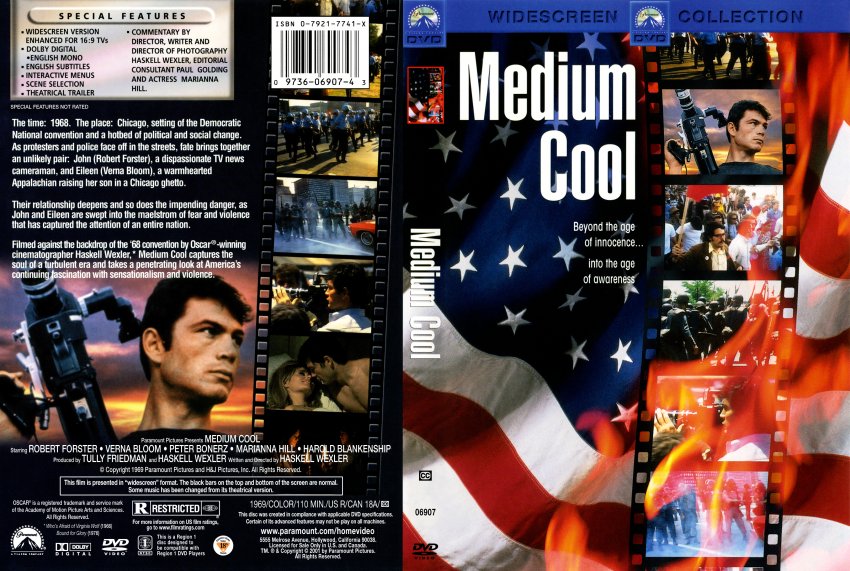
Medium Cool (1969) was a project shadowed by the FBI, saddled with a market-inhibiting X rating, and released with tepid support from a nervous studio. Not surprisingly, despite attracting very favorable reviews, it was not big hit at the box office. But over the years its reputation rose steadily, and eventually the movie found its proper place in the pantheon of the great films of the New Hollywood era. A worthy recipient, then, of the full Criterion Treatment, with a sparkling new special edition DVD and Blu-Ray; among its many features are a new interview with writer-director-cinematographer Haskell Wexler and the very welcome inclusion of (a slightly edited version of) the valuable but obscure 2001 BBC television documentary about the film, Look Out Haskell, It's Real."
As his triple-threat credits suggest, Medium Cool was very much Wexler's project. One of the hottest cinematographers in the business — just off an academy-award winning turn for Who's Afraid of Virginia Wolf (1966) and the big hit In the Heat of the Night (1967) — and with the emergence of a New American Cinema that took low-budget chances on new talent, Wexler was given a shot at the director's chair. And to his credit, the ambitious, confident cameraman didn't play it safe but threw everything he had into a risky project that he believed in.
With a background in documentary filmmaking, Wexler was influenced by a philosophy associated with the French New Wave (many of whose participants had similar apprenticeships), that challenged the reification of a divide between "fiction" and "non-fiction" films. Documentaries, they insisted, could not show an objective truth but offered only one interpretation of events, presented as a narrative following classical storytelling rules; realities that were, moreover, altered by the presence of cameras that produced self-consciousness and performance. Conversely, fiction films, especially those made on locations and with a new wave sensibility designed to reflect the personal experiences of their creators, were in many ways also documentary records of a certain type of reality. With Medium Cool, Wexler dove headlong into the blurry intersection between the two, embedding a fictional (and often improvised) story within very real situations. Often featuring non-actors going about their unscripted business, in many scenes only the principal players are aware that a movie is being made. At times those actors were exposed to real danger — placed, for example, in the midst of what the report of a National Commission would describe a few months afterwards as a "police riot." On the streets of Chicago, Wexler's camera became one among many that were capturing the events as they unfolded — and he was among those tear gassed, and was blinded for twenty-four hours.
The politically sensitive Wexler was irresistibly drawn from Hollywood back to his home town, Chicago, and the Democratic National Convention that would be held there in August 1968. Convinced that "something" would happen there — a violent confrontation, of some type, seemed certain — he crafted a story that could be interwoven into those events, unforeseeable in their specifics, as they unfolded. Wexler was later accused of incitement, but his cameras did little more than anticipate the inevitable explosion. Nineteen sixty-eight took care of the rest.
It was a very bad year. In January, the surprise Tet Offensive fundamentally altered the trajectory of the Vietnam War. The unprecedented communist strikes failed to achieve their military goals, but they made plain that no matter how many troops it poured in, the United States was not going to achieve its political objectives in the war, despite the unceasingly optimistic reports previously proffered by the Johnson Administration. (The U.S. would suffer over 4,700 combat deaths in the first three months of 1968. And with 500,000 American troops in the country, the war was being fought — at best — to a bloody stalemate.) In March, Johnson was embarrassed in the New Hampshire democratic primary by the strong showing of anti-war candidate Eugene McCarthy; within days, Robert Kennedy dropped into the race; within weeks, LBJ shocked the nation by dropping out. In April, Martin Luther King was assassinated. Kennedy, campaigning in Indianapolis, delivered the news to a stunned, mostly black audience, and delivered a short, moving speech appealing for calm. Scores of American cities erupted in riots that night, but Indianapolis was not one of them. In June, Kennedy would be assassinated moments after celebrating victory in the crucial California primary, his final words, "on to Chicago and let's win there," still hanging in the air as the shots rang out.
To Read the Rest
by Jonathan Kirshner
Bright Lights Film Journal
Medium Cool (1969) was a project shadowed by the FBI, saddled with a market-inhibiting X rating, and released with tepid support from a nervous studio. Not surprisingly, despite attracting very favorable reviews, it was not big hit at the box office. But over the years its reputation rose steadily, and eventually the movie found its proper place in the pantheon of the great films of the New Hollywood era. A worthy recipient, then, of the full Criterion Treatment, with a sparkling new special edition DVD and Blu-Ray; among its many features are a new interview with writer-director-cinematographer Haskell Wexler and the very welcome inclusion of (a slightly edited version of) the valuable but obscure 2001 BBC television documentary about the film, Look Out Haskell, It's Real."
As his triple-threat credits suggest, Medium Cool was very much Wexler's project. One of the hottest cinematographers in the business — just off an academy-award winning turn for Who's Afraid of Virginia Wolf (1966) and the big hit In the Heat of the Night (1967) — and with the emergence of a New American Cinema that took low-budget chances on new talent, Wexler was given a shot at the director's chair. And to his credit, the ambitious, confident cameraman didn't play it safe but threw everything he had into a risky project that he believed in.
With a background in documentary filmmaking, Wexler was influenced by a philosophy associated with the French New Wave (many of whose participants had similar apprenticeships), that challenged the reification of a divide between "fiction" and "non-fiction" films. Documentaries, they insisted, could not show an objective truth but offered only one interpretation of events, presented as a narrative following classical storytelling rules; realities that were, moreover, altered by the presence of cameras that produced self-consciousness and performance. Conversely, fiction films, especially those made on locations and with a new wave sensibility designed to reflect the personal experiences of their creators, were in many ways also documentary records of a certain type of reality. With Medium Cool, Wexler dove headlong into the blurry intersection between the two, embedding a fictional (and often improvised) story within very real situations. Often featuring non-actors going about their unscripted business, in many scenes only the principal players are aware that a movie is being made. At times those actors were exposed to real danger — placed, for example, in the midst of what the report of a National Commission would describe a few months afterwards as a "police riot." On the streets of Chicago, Wexler's camera became one among many that were capturing the events as they unfolded — and he was among those tear gassed, and was blinded for twenty-four hours.
The politically sensitive Wexler was irresistibly drawn from Hollywood back to his home town, Chicago, and the Democratic National Convention that would be held there in August 1968. Convinced that "something" would happen there — a violent confrontation, of some type, seemed certain — he crafted a story that could be interwoven into those events, unforeseeable in their specifics, as they unfolded. Wexler was later accused of incitement, but his cameras did little more than anticipate the inevitable explosion. Nineteen sixty-eight took care of the rest.
It was a very bad year. In January, the surprise Tet Offensive fundamentally altered the trajectory of the Vietnam War. The unprecedented communist strikes failed to achieve their military goals, but they made plain that no matter how many troops it poured in, the United States was not going to achieve its political objectives in the war, despite the unceasingly optimistic reports previously proffered by the Johnson Administration. (The U.S. would suffer over 4,700 combat deaths in the first three months of 1968. And with 500,000 American troops in the country, the war was being fought — at best — to a bloody stalemate.) In March, Johnson was embarrassed in the New Hampshire democratic primary by the strong showing of anti-war candidate Eugene McCarthy; within days, Robert Kennedy dropped into the race; within weeks, LBJ shocked the nation by dropping out. In April, Martin Luther King was assassinated. Kennedy, campaigning in Indianapolis, delivered the news to a stunned, mostly black audience, and delivered a short, moving speech appealing for calm. Scores of American cities erupted in riots that night, but Indianapolis was not one of them. In June, Kennedy would be assassinated moments after celebrating victory in the crucial California primary, his final words, "on to Chicago and let's win there," still hanging in the air as the shots rang out.
To Read the Rest
Wednesday, August 21, 2013
Vlad Dima - Perpetual Motion: The Dardenne Brothers' The Kid with a Bike
Perpetual Motion: The Dardenne Brothers' The Kid with a Bike
by Vlad Dima
Bright Lights Film Journal

The latest film by Belgian brothers Jean-Pierre and Luc Dardenne is oddly both fast and slow. Cyril, the main character (played wonderfully by Thomas Douret), looks for his father who had abandoned him, but connects with a benevolent hairdresser, Samantha, who eventually becomes his legal guardian. The kid is moving constantly, mostly on his bicycle the English translation of the original title, "Le Gamin au vélo," misses out on a nuance, that of possession, which is under question at the beginning of the film; but it is his bike — "au vélo" — not "avec"/with a random bicycle). As Cyril's frenetic movement appears to up the tempo of the film, the directors drastically slow down the pace by using long takes, and as little cutting as possible. It is amid the two contrasting tendencies that Cyril's story finds the perfect narrative balance.
Naturally, even the mention of the word "bike" in a film makes us recall Vittorio de Sica's Bicycle Thief (1948): a kid, a bike, a father. De Sica's film indeed hovers over the narrative of The Kid with a Bike, but the latter goes in new directions. The stolen Italian bicycle is connected to the destinies of an entire family, while Cyril's bike evolves from signifying his lost connection to a father who does not want him to the object that offers him freedom. The theme of independence appears from the beginning when we witness Cyril attempting to escape the children's home in which he had been placed. In fact, in this instance we are reminded more of Antoine Doinel from Truffaut's 400 Blows (1959) than Antonio or Bruno from Bicycle Thief. The emblematic final run at the end of 400 Blows is essentially an interminable, uninterrupted travelling shot of Antoine running toward the sea. Cyril's story almost picks up where Truffaut had decided to open end Antoine's odyssey. The direction of Cyril's movement is rather significant, too. Antoine runs left to right, a direction associated with Western movement; he is headed toward a conclusion. Cyril's movement, conversely, is chaotic and goes both directions. Interestingly, when he is about to get into trouble (riding toward the gas station, running away etc.), he goes in the opposite direction, right to left. When the film reaches some sense of normality, and we see both Samantha and Cyril ride together, they go in the "correct" direction, left to right.
There are many other connections to Truffaut's film, and even to Godard's Breathless (1960). Cyril, like Antoine, lies about obvious truths; there are several references to a psychologist Cyril presumably talks with at the children's home, although we never see him or her. Truffaut's film famously chooses to show only Antoine during the conversation with the psychologist, completely ignoring the counter shot. When Samantha and Cyril are in a car, we often only see Cyril and hear Samantha's voice (the opposite happens in Godard's Breathless in which we see Patricia talk to Michel in the car, but we do not see the latter). Even though there are a few people influencing him, Cyril comes off as independent for the most part. Initially, though, he cannot think of anything but being reunited with his father (in another departure from Bicycle Thief, the father had sold his son's bicycle when he found himself financially strapped). At the crucial moment of acceptance that his father is no longer interested in taking care of him, Cyril finds himself on the other side of a metaphorical wall. However, this happens to be also an actual wall that he had to climb in order to get to his dad. When the father pushes him back to the other side, for a brief moment they are literally separated by a wall. For a moment, we fear for Cyril, for his fate, until we realize that he is on the open side of the wall, the side from which he can escape.
To Read the Rest
by Vlad Dima
Bright Lights Film Journal
The latest film by Belgian brothers Jean-Pierre and Luc Dardenne is oddly both fast and slow. Cyril, the main character (played wonderfully by Thomas Douret), looks for his father who had abandoned him, but connects with a benevolent hairdresser, Samantha, who eventually becomes his legal guardian. The kid is moving constantly, mostly on his bicycle the English translation of the original title, "Le Gamin au vélo," misses out on a nuance, that of possession, which is under question at the beginning of the film; but it is his bike — "au vélo" — not "avec"/with a random bicycle). As Cyril's frenetic movement appears to up the tempo of the film, the directors drastically slow down the pace by using long takes, and as little cutting as possible. It is amid the two contrasting tendencies that Cyril's story finds the perfect narrative balance.
Naturally, even the mention of the word "bike" in a film makes us recall Vittorio de Sica's Bicycle Thief (1948): a kid, a bike, a father. De Sica's film indeed hovers over the narrative of The Kid with a Bike, but the latter goes in new directions. The stolen Italian bicycle is connected to the destinies of an entire family, while Cyril's bike evolves from signifying his lost connection to a father who does not want him to the object that offers him freedom. The theme of independence appears from the beginning when we witness Cyril attempting to escape the children's home in which he had been placed. In fact, in this instance we are reminded more of Antoine Doinel from Truffaut's 400 Blows (1959) than Antonio or Bruno from Bicycle Thief. The emblematic final run at the end of 400 Blows is essentially an interminable, uninterrupted travelling shot of Antoine running toward the sea. Cyril's story almost picks up where Truffaut had decided to open end Antoine's odyssey. The direction of Cyril's movement is rather significant, too. Antoine runs left to right, a direction associated with Western movement; he is headed toward a conclusion. Cyril's movement, conversely, is chaotic and goes both directions. Interestingly, when he is about to get into trouble (riding toward the gas station, running away etc.), he goes in the opposite direction, right to left. When the film reaches some sense of normality, and we see both Samantha and Cyril ride together, they go in the "correct" direction, left to right.
There are many other connections to Truffaut's film, and even to Godard's Breathless (1960). Cyril, like Antoine, lies about obvious truths; there are several references to a psychologist Cyril presumably talks with at the children's home, although we never see him or her. Truffaut's film famously chooses to show only Antoine during the conversation with the psychologist, completely ignoring the counter shot. When Samantha and Cyril are in a car, we often only see Cyril and hear Samantha's voice (the opposite happens in Godard's Breathless in which we see Patricia talk to Michel in the car, but we do not see the latter). Even though there are a few people influencing him, Cyril comes off as independent for the most part. Initially, though, he cannot think of anything but being reunited with his father (in another departure from Bicycle Thief, the father had sold his son's bicycle when he found himself financially strapped). At the crucial moment of acceptance that his father is no longer interested in taking care of him, Cyril finds himself on the other side of a metaphorical wall. However, this happens to be also an actual wall that he had to climb in order to get to his dad. When the father pushes him back to the other side, for a brief moment they are literally separated by a wall. For a moment, we fear for Cyril, for his fate, until we realize that he is on the open side of the wall, the side from which he can escape.
To Read the Rest
Saturday, August 17, 2013
A Beautiful Mind (USA: Ron Howard, 2001)

A Beautiful Mind (USA: Ron Howard, 2001: 135 mins)
Billings, Andrew C. "Biographical Omissions: The Case of A Beautiful Mind and the Search For Authenticity." The Film Journal #1 (May 2002)
Cassey, Joe. "Mental Illness." Understanding Representation. ed. Wendy Helsby. London: BFI, 2005: 99-114. [Available in BCTC Library PN 1995 U4977 2005]
Hansen, Per Krogh. " Unreliable Narration in Cinema: Facing the Cognitive Challenge Arising from Literary Studies." Amsterdam International Electronic Journal of Narratology #5 (Autumn 2009)
Wednesday, August 14, 2013
(Not) Love and Death: On Michael Haneke's Amour
(Not) Love and Death: On Michael Haneke's Amour
by Vlad Dima
Bright Lights Film Journal

Michael Haneke's latest film begins abruptly with the police breaking down the door to the apartment of the two octogenarian protagonists, Georges and Anne. The violent intrusion is underlined by the fact that we go, with no transition effect, from complete silence and black screen to noise and color. This type of intense narrative shift is common in Haneke's films. Long periods of apparent stability and quiet are followed by sudden spurts of incredible viciousness, in The White Ribbon (2009), Funny Games (2007, and 1997), or Caché (2005). I say "apparent" because violence lurks just beneath the narrative surface of Haneke's films, its presence felt constantly. So when it does emerge, it is not just for shock value. Oddly, it soothes us, providing momentary relief from the stress accumulated throughout the film. Child beatings, shootings, throat slashing are part of the director's repertoire that may force the audience into a sadistic position, but we avoid them in Amour. Or so it seems. Make no mistake, this is a violent film, but its ferocity comes from being forced to confront our own mortality. This is not a film about love, as the title purposely misleads us. This is a film about death, and worse, our death.
The inclusion of "us," the audience, in the film's thematic concerns commences immediately following the sequence in which the police find Anne's rotted body in the apartment. We begin with a flashback to a night when the couple went out to a classical music concert given by one of Anne's old students, Alexandre. In a beautiful fixed shot, we can see the spectators in the theater as they are waiting for the show to start. After a long moment, as the shot turns into a long take, we become aware of the missing reverse shot. The stage is never shown. We, the "real" audience, are suddenly facing the diegetic audience. We are the reverse shot. So we are pulled into the narrative through a counter-cinema artifice. The lack of reverse shot also points to the impossibility of suture; thus the very beginning of the film points to breakdowns, some literal (the door), some metaphorical (the apparatus of cinema and, by extension, life).
To Read the Rest
by Vlad Dima
Bright Lights Film Journal
Michael Haneke's latest film begins abruptly with the police breaking down the door to the apartment of the two octogenarian protagonists, Georges and Anne. The violent intrusion is underlined by the fact that we go, with no transition effect, from complete silence and black screen to noise and color. This type of intense narrative shift is common in Haneke's films. Long periods of apparent stability and quiet are followed by sudden spurts of incredible viciousness, in The White Ribbon (2009), Funny Games (2007, and 1997), or Caché (2005). I say "apparent" because violence lurks just beneath the narrative surface of Haneke's films, its presence felt constantly. So when it does emerge, it is not just for shock value. Oddly, it soothes us, providing momentary relief from the stress accumulated throughout the film. Child beatings, shootings, throat slashing are part of the director's repertoire that may force the audience into a sadistic position, but we avoid them in Amour. Or so it seems. Make no mistake, this is a violent film, but its ferocity comes from being forced to confront our own mortality. This is not a film about love, as the title purposely misleads us. This is a film about death, and worse, our death.
The inclusion of "us," the audience, in the film's thematic concerns commences immediately following the sequence in which the police find Anne's rotted body in the apartment. We begin with a flashback to a night when the couple went out to a classical music concert given by one of Anne's old students, Alexandre. In a beautiful fixed shot, we can see the spectators in the theater as they are waiting for the show to start. After a long moment, as the shot turns into a long take, we become aware of the missing reverse shot. The stage is never shown. We, the "real" audience, are suddenly facing the diegetic audience. We are the reverse shot. So we are pulled into the narrative through a counter-cinema artifice. The lack of reverse shot also points to the impossibility of suture; thus the very beginning of the film points to breakdowns, some literal (the door), some metaphorical (the apparatus of cinema and, by extension, life).
To Read the Rest
Friday, August 9, 2013
Adaptation (USA: Spike Jonze, 2002)
"Spike Jonze and the screenwriter Charlie Kaufman concoct an intricate, scrambled parallel universe populated by anxious, itchy people, some appearing really to exist. The hero is Mr. Kaufman himself (Cage), a screenwriter struggling to adapt THE ORCHID THIEF, Susan Orlean's nonfiction meditation on flowers, obsession and Darwinian theory. He is tormented by writer's block and by his twin brother, Donald (also Mr. Cage)… This is a remarkable, impossible movie — about itself but also about its own nonexistence — and one of the most formally audacious, intellectually charged American movies in quite some time." - A.O. Scott, The New York Times"I didn’t expect to be as taken as I was. [Michael] Fried’s books are sometimes obsessively focused on quite esoteric propositions about a specific painting or photograph, but perhaps because of that are often spellbinding. I never thought I’d sit through 45 minutes of silent footage of Zidane running across a soccer field and come away enthralled, or find myself standing in front of a wall for hours thinking about the direction a figure is facing in a seventeenth-century painting or a 21st-century photograph. Fried can get carried away: once you see the absorption-theatricality distinction, it becomes tempting to see it everywhere. But even if it is not everywhere, it is in a lot of places. And once I started rereading Houellebecq, it was there too.
Fried’s basic insight is as follows: If you look at the tradition of high European art painting (he then expands to photography and novels), you will notice that many paintings seek to show figures as if they were not aware of being looked at by an audience. This could come through absorption in work, such as artisanal craftsmanship, or immersion in sociality with others. But in any case, the figures are oriented away from the audience, and pulled into the distinct world of the painting. This “pulling in” is crucial, since it sets up the painting as somehow standing outside and beyond our own wishes, with its own inner solidity. Because it pulls them away from us and into it, the figures and their world become objects that we look at and learn from, not mere projections of our desires.
And yet, they are inescapably there to be looked at by us. This fact means that in one way or another the painting must acknowledge that its scenes were created to be part of a scene, and therefore the figures are never fully independent of some kind of performance for their imagined audience. The independence they gain through being pulled into the inner world of the painting is taken back through being drawn back to their dependence for their existence on the desires of their audience. In Fried’s interpretation, this dependence shows up in subtle indications, such as a playing card turned outward toward the viewer, or one figure who breaks the spell of the absorbing scene to look out of the painting’s scene into the eye of the beholder.
What makes this relationship between theatricality and absorption especially potent is that it is not only descriptive but dynamic. It is an engine that drives artistic creativity, and much of Fried’s criticism is devoted to examining escalating attempts to deal with it. The most important dynamic involves various efforts to defeat the threat of theatricality and mannerism. This can happen in many ways, and no doubt many more will be discovered. One variant involves representations of figures caught up in war and violence: What could be more absorbing than that? There is no time to look away in the midst of battle. This is Fried’s interpretation of Jacques-Louis David, for example. Another variant is depictions of simple peasants, lost in everyday activities such as picking crops, oblivious to anything else but the task at hand. This is Fried’s interpretation of Millet’s The Gleaners.
But that very escalating depiction of violence or simplicity is unstable, in Fried’s reading. They inevitably become cliché and overdone, oscillating between shock for shock’s sake as the demands for the intensity of violence become greater on the one hand, and the brutalization and oversimplification of uneducated lower classes or nonintellectuals becomes too overt to ignore. In this and similar cases, the artist’s independence is the one threatened by theatricality. The peasants or soldiers may be absorbed in their work in the fields or bloody battles, but only an attention-seeking artist would put them in large-format canvases in front of crowds of the bourgeois public as a surefire way to gain their applause.
The dialectic begins anew, and artists begin finding ways to defeat the impression that they are painting in order to be seen painting but are themselves absorbed in the world of the painting as it unfolds, as if on its own, beyond their will. Fried takes this thought very far and in many directions, but his book on Courbet develops it directly. Courbet, in his view, hits on a very potent technique, which involves dispersing his own artistic consciousness throughout the painting, creating an impression that he is everywhere in it, and therefore somehow has merged with each and every aspect of it. In that way, the audience sees the painting and the painter immersed in it all at once.
This too ultimately proves unstable, in ways I will not get into now, eventually leading to the undoing from within of this line of painting in Manet. The last point I do want to emphasize is that while Fried often highlights painterly concerns around how to represent absorbed figures and defeat the impression of mannerism, this concern has roots in a conviction that the desire for some kind of absorption is present in the culture. Here too he has a point. Think of Charlie Kaufman films, such as Adaptation. These are animated by the sense that “we” have lost the ability to have intense, unmediated direct experience, that we are always somehow, even in the most seemingly intimate moments, acting with a view to how it will look to somebody else: how it will play on your feed, in the article you might write, in the story you might tell at a party.
Taken far enough, this thought leads to a kind of lament with language itself and a corresponding desire for prelinguistic immersion in instincts. But we don’t have to go so far to get the point. Just think of moments when you have felt like the line between you and the world disappeared: running down a hill so fast you can’t think but just must react; working on an essay and looking up two hours later as if it were no time at all; laughing with family and friends as each says exactly the right next thing that everybody understands without having to make any inferences; escaping or inflicting violence; and, yes, orgasm. The larger point behind Fried’s project is twofold: that painters try to depict absorption because this is how to absorb audiences who crave that very absorption, but that this very act creates the self-reinforcing oscillation between victories for theatricality and momentary reclamations of absorption." - Dan Silver
Adaptation (USA: Spike Jonze, 2002: 114 mins)
Bean, Henry. "Self Made Heroes: Adaptation puts the self-obsession of the screenwriter centre stage." Sight and Sound (March 2003)
D., Margo and Margo P. "The Orchid Thief vs. Adaptation." Book vs Movie (June 30, 2017) ["The Margos are back and taking on their most interesting episode yet with a compare and contrast of the Susan Orlean novel The Orchid Thief (which began as a New Yorker article) and the hit Charlie Kaufman/Spike Jones movie Adaptation. If there has ever been a reason for this podcast to exist --this material is the one to tackle!So many differences between the book and movie here, we are not quite sure where to begin but let us give it a try."]
Edwards, Gile. "Adaptation (2002)." 366 Weird Movies (January 13, 2016)
Evans, Kim. "Charlie Kauffman, Screenwriter." To the Best of Our Knowledge (November 10, 2013)
Kozak, Oktay Ege, Erik McClanahan and Ryan Oliver. "Lost in Charlie Kaufman’s Eternal Sunshine Of The Spotless Mind & Adaptation." Over/Under Movies (June 20, 2016)
Koski, Genevieve, et al. "Cage Match, Pt. 1 — Adaptation." The Next Picture Show (April 26, 2022) ["We’re offering four Nicolas Cages for the price of two with this week’s pairing, inspired by Cage’s latest, THE UNBEARABLE WEIGHT OF MASSIVE TALENT, which finds the actor playing two connected versions of himself. But before entering that hall of mirrors, we’re heading back to 2002’s ADAPTATION for a different strain of meta exercise centered on another set of Nicolas Cages, this one playing the film’s screenwriter, Charlie Kaufman, as well as his twin brother/personification of his own self-loathing, Donald. The exact nature of Donald’s character and how it shapes the film’s third act is a big point of discussion this week, as is how literally we are meant to take the film’s title when it comes to its literary source material."]
---. "Cage Match, Pt. 2 — The Unbearable Weight of Massive Talent." The Next Picture Show (May 3, 2022) ["The new THE UNBEARABLE WEIGHT OF MASSIVE TALENT contains a lot of the same DNA as ADAPTATION, but instead of screenwriter Charlie Kaufman, the film’s meta energy is focused on star Nicolas Cage, once again playing two competing sides of the same tortured talent. This week we get into how the confluence of actor, persona, and screenplay works differently in each film, but first we process UNBEARABLE WEIGHT’s lighthearted excavation of its central talent, and consider whether we may have already moved past the stage of Cage’s career that the film is commenting on."]
Sunday, June 30, 2013
Yes (UK: Sally Potter, 2004)

Yes (UK: Sally Potter, 2004: 100 mins)
"Angelism and Rage: Sally Potter Links." Film Studies for Free (September 21, 2009)
Mayer, Sophie. "The Films of Sally Potter." Electric Sheep Magazine (October 1, 2009)
McKim, Kristi. "Great Directors: Sally Potter." Senses of Cinema #40 (July 2006)
"Please go in two by two! Sally Potter's Fabulous Ark." Film Studies for Free (November 4, 2008)
Sunday, June 23, 2013
The Passion of the Christ (USA: Mel Gibson, 2004)

The Passion of the Christ (USA: Mel Gibson, 2004: 127 mins)
Aslan, Reza. "Zealot." Radio West (October 18, 2013)
Deacy, Chris. "A Time to Kill?: Theological Perspectives on Violence and Film." Theology and Film: Challenging the Sacred/Secular Divide. ed. Christopher Deacy & Gaye Williams Oritz. Malden, MA: Blackwell, 2008: 123-142. [Professor has copy]
Hauka, David. "'Christ That Hurts': Rewriting the Jesus Narrative -- Violence and the Language of Action Cinema in Mel Gibson's The Passion of the Christ Cinephile #2 (March 2006)
Phillips, Kendall R. "Religion: Mel Gibson's The Passion of the Christ." Controversial Cinema: The Films That Outraged America. Westport, CT: Preager, 2008: 127-152.[in BCTC Library PN1995,9 S284P452008}
Koresky, Michael. "Consider the Source: The Passion of the Christ." Reverse Shot (Spring 2004)
Reichert, Jeff. Jesus Christ: Superman (or Every Man for Himself and Armond Against All)>" Reverse Shot (Spring 2004)
Walsh, David. "Why has The Passion of the Christ evoked such a popular response in America?" World Socialist Web Site (March 5, 2004)
Walter, Brian. "Love In The Time of Calvary: Romance and Family Values in Crucifixion Films." Cineaction #88 (2012)
Saturday, May 25, 2013
C. Jerry Kutner: Cinema du WTF – Upstream Color (Shane Carruth 2013)
Cinema du WTF – UPSTREAM COLOR (Shane Carruth 2013)
by C. Jerry Kutner
Bright Lights Film Journal

A singular and highly accomplished independent film, Upstream Color is philosophical science fiction in the tradition of the French nouvelle vague, seasoned with a dash of Cronenbergian body horror. Like the SF films that emerged from the nouvelle vague – Chris Marker’s La Jetée, Alain Resnais’s Je t'aime je t'aime, Godard’s Alphaville, Bertrand Tavernier’s Death Watch – Upstream Color foregoes studio sets and elaborate special effects in favor of real locations and a concern with fundamental existential issues like the nature of free will, memory, perception, and time – what Raymond Durgnat once called the science fiction of “inner space.”
The body horror, reminiscent of early Cronenberg films like Rabid and Shivers (aka They Came From Within), comes from the film’s MacGuffin, a worm or grub found in the roots of orchids that secretes a drug, prized in certain circles for its psychotropic properties. If the worm is implanted in a victim, he or she becomes a virtual zombie, susceptible to any suggestion, obeying any command.
To say the film is enigmatic is an understatement. This might be the WTF film of 2013. Its complex story is told almost entirely through its visuals. There is minimal dialogue, and what there is of it is fragmentary, heard – or overhead – in bits and pieces. The visuals themselves are elliptical – we might be shown only the beginning, the middle, or the end of an action and have to infer the rest of it. Sometimes it is uncertain whether what we are looking at is literal or metaphoric. Chronology is scrambled. But the effect is not off-putting. On the contrary, this is an extraordinarily compelling film. Because we have to piece the narrative together ourselves, we pay closer attention.
Moreover, there is a sound basis for the film’s peculiarities of style. The two main characters, Kris (Amy Seimetz) and Jeff (writer/director Shane Carruth) are both victims of the worm – both brain-damaged. Consequently, we experience reality as they do.
To Read the Rest
by C. Jerry Kutner
Bright Lights Film Journal
A singular and highly accomplished independent film, Upstream Color is philosophical science fiction in the tradition of the French nouvelle vague, seasoned with a dash of Cronenbergian body horror. Like the SF films that emerged from the nouvelle vague – Chris Marker’s La Jetée, Alain Resnais’s Je t'aime je t'aime, Godard’s Alphaville, Bertrand Tavernier’s Death Watch – Upstream Color foregoes studio sets and elaborate special effects in favor of real locations and a concern with fundamental existential issues like the nature of free will, memory, perception, and time – what Raymond Durgnat once called the science fiction of “inner space.”
The body horror, reminiscent of early Cronenberg films like Rabid and Shivers (aka They Came From Within), comes from the film’s MacGuffin, a worm or grub found in the roots of orchids that secretes a drug, prized in certain circles for its psychotropic properties. If the worm is implanted in a victim, he or she becomes a virtual zombie, susceptible to any suggestion, obeying any command.
To say the film is enigmatic is an understatement. This might be the WTF film of 2013. Its complex story is told almost entirely through its visuals. There is minimal dialogue, and what there is of it is fragmentary, heard – or overhead – in bits and pieces. The visuals themselves are elliptical – we might be shown only the beginning, the middle, or the end of an action and have to infer the rest of it. Sometimes it is uncertain whether what we are looking at is literal or metaphoric. Chronology is scrambled. But the effect is not off-putting. On the contrary, this is an extraordinarily compelling film. Because we have to piece the narrative together ourselves, we pay closer attention.
Moreover, there is a sound basis for the film’s peculiarities of style. The two main characters, Kris (Amy Seimetz) and Jeff (writer/director Shane Carruth) are both victims of the worm – both brain-damaged. Consequently, we experience reality as they do.
To Read the Rest
Wednesday, April 17, 2013
Still Life (China/Hong Kong: Jia Zhangke, 2006)

Still Life (China/Hong Kong: Jia Zhangke, 2006: 111 mins)
Dalle, Eric. "Narrating changes in topography: Still Life and the cinema of Jia Zhangke." Jump Cut #53 (Summer 2012)
Sukhdev, Sandhu. "'Slow cinema' fights back against Bourne's supremacy." The Guardian (March 9, 2012)
Xiao, Jiwei. "The Quest for Memory: Documentary and Fiction in Jia Zhangke’s Films." Senses of Cinema #59 (2011)
Sunday, April 14, 2013
Waltz With Bashir (Israel/France/Germany/USA/Finland/Switzerland/Belgium/Australia: Ari Folman, 2008)

Waltz With Bashir (Israel/France/Germany/USA/Finland/Switzerland/Belgium/Australia: Ari Folman, 2008: 90 Mins)
Baker, Nicholson, et al. "Autobiography/Biography: Narrating the Self." Philoctetes (December 13, 2008)
Barker, Jennifer Lynne. The Aesthetics of Antifascist Film: Radical Projection. Routledge, 2013. [Get through interlibrary loan]
Fainaru, Dan. "A Changing Landscape." International Film Guide: 2009. London: Wallflower Press, 2009: 53-63. [Available in BCTC Library PN1993.3 I544 2009]
Folman, Ari. "Waltz with Bashir." Worldview (January 23, 2009)
Hallinan, Chris. "The Lebanon Border: "Uniquely" Dangerous." Foreign Policy in Focus (September 1, 2010)
Kamiya, Gary. "What Waltz With Bashir can teach us about Gaza: The stunning new Israeli film reveals painful parallels between one of Israel's darkest moments and the current conflict." Salon (January 13, 2009)
Kinder, Bill. "When Soldiers Come Home in the Movies: The post-war experience as told in tropes." Keyframe (November 11, 2015)
Polonsky, David, et al. Waltz with Bashir: The Art Director’s Cut at War. Open Source (April 17, 2009)
Rozenkrantz, Jonathan. "Colourful Claims: towards a theory of animated documentary." Film International (May 6, 2011)
Sunday, April 7, 2013
Thursday, April 4, 2013
Sunday, March 3, 2013
David Simon on The Wire (2002-2008)
Instead of the usual good-guys-chasing-bad-guys framework, questions would be raised about the very labels of good and bad, and, indeed, whether such distinctly moral notions were really the point. The show would instead be about untethered capitalism run amok, about how power and money actually root themselves in a postmodern American city, and, ultimately, about why we as an urban people are no longer able to solve our problems or heal our wounds. (36)
The Wire depicts a world in which capital has triumphed completely, labor has been marginalized and monied interests have purchased enough political infrastructure to prevent reform. It is a world in which the rules and values of the free market and maximized profit have been mistaken for a social framework, a world where institutions themselves are paramount and every day human beings matter less. (36)
But instead of the old gods, The Wire is a Greek Tragedy in which the postmodern institutions are the Olympian forces. It's the police department, or the drug economy, or the political structures, or the school administration, or the macroeconomic forces that are throwing the lightning bolts and hitting people in the ass for no decent reason. (37)
David Simon, quoted in Watson, Garry. "The Literary Critic, the Nineteenth Century Novel and The Wire." Cineaction #84 (2011): 32-40.
Subscribe to:
Posts (Atom)