Showing posts with label Audience. Show all posts

Monday, September 2, 2013

Jon Shenk - Playback: Errol Morris' The Thin Blue Line

Playback: Errol Morris' 'The Thin Blue Line'
by Jon Shenk
Documentary


I was a freshman in college when a friend asked me one night if I was interested in seeing a documentary film. "The director will be there," he said. "A guy named Errol Morris."

The screening was in a lecture hall, but when the lights dimmed, I immediately felt transported to another world. An electric blue line shot through the screen during the title sequence, and I remember thinking, I have no idea what this blue line is all about, but I'm drawn to it. I spent the rest of the film in a state of hypnosis.

The first lines, like so much of the interview material in The Thin Blue Line, come so effortlessly. This is America, I remember thinking, but a new kind of America where every spoken syllable is important. A man in jail tells us, "In October, my brother and I left Ohio... We arrived in Dallas on a Thursday." Another inmate begins by saying, "I ran away from home." The pace is patient and deliberate. In this alternate universe, engaging one another's stories feels like a sacred act.

At 19, I had never considered a career as a documentary filmmaker. I had never thought about what made a documentary a documentary, but with The Thin Blue Line, I was beholding a beautiful piece of art, full of drama, justice and humanity. I wondered, Could I ever be a part of something like this?

The Thin Blue Line is a study of truth. At one level, it is a collection of depositions, in life's cosmic courtroom, that serve as a giant "fuck you" to the Texas criminal justice system. During the Q&A that night, a student asked Morris how he felt about the death penalty. He responded that he never intended to make an anti-death penalty film, but that he found his subject, Randall Adams, by accident while researching a film focused on the court psychologist that assessed Adams' sanity. "However," Morris said, "if I was able to randomly uncover one innocent person on death row, I can't help but to think there might be a second one out there."

That response defines the relationship between documentaries and the potential activism around the issue that they approach. Morris is not so much an activist as he is an artist/storyteller unabashed by unimpeachable, first-hand knowledge about this particular subject matter.

To Read the Rest


Wednesday, August 14, 2013

(Not) Love and Death: On Michael Haneke's Amour

(Not) Love and Death: On Michael Haneke's Amour
by Vlad Dima
Bright Lights Film Journal


Michael Haneke's latest film begins abruptly with the police breaking down the door to the apartment of the two octogenarian protagonists, Georges and Anne. The violent intrusion is underlined by the fact that we go, with no transition effect, from complete silence and black screen to noise and color. This type of intense narrative shift is common in Haneke's films. Long periods of apparent stability and quiet are followed by sudden spurts of incredible viciousness, in The White Ribbon (2009), Funny Games (2007, and 1997), or Caché (2005). I say "apparent" because violence lurks just beneath the narrative surface of Haneke's films, its presence felt constantly. So when it does emerge, it is not just for shock value. Oddly, it soothes us, providing momentary relief from the stress accumulated throughout the film. Child beatings, shootings, throat slashing are part of the director's repertoire that may force the audience into a sadistic position, but we avoid them in Amour. Or so it seems. Make no mistake, this is a violent film, but its ferocity comes from being forced to confront our own mortality. This is not a film about love, as the title purposely misleads us. This is a film about death, and worse, our death.

The inclusion of "us," the audience, in the film's thematic concerns commences immediately following the sequence in which the police find Anne's rotted body in the apartment. We begin with a flashback to a night when the couple went out to a classical music concert given by one of Anne's old students, Alexandre. In a beautiful fixed shot, we can see the spectators in the theater as they are waiting for the show to start. After a long moment, as the shot turns into a long take, we become aware of the missing reverse shot. The stage is never shown. We, the "real" audience, are suddenly facing the diegetic audience. We are the reverse shot. So we are pulled into the narrative through a counter-cinema artifice. The lack of reverse shot also points to the impossibility of suture; thus the very beginning of the film points to breakdowns, some literal (the door), some metaphorical (the apparatus of cinema and, by extension, life).

To Read the Rest

Tuesday, August 13, 2013

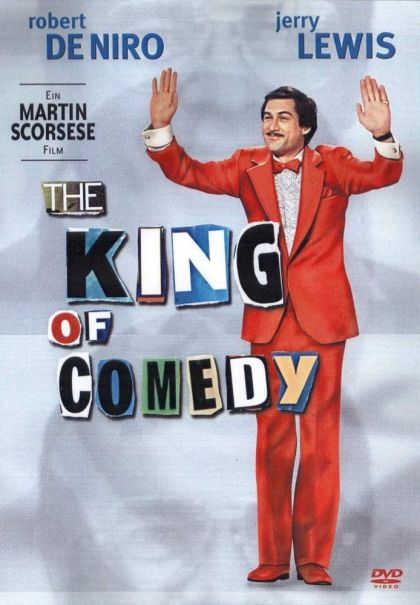
Christina Marie Newland -- Satirical Excess and Empty Vessels: Martin Scorsese's The King of Comedy

Satirical Excess and Empty Vessels: Martin Scorsese's The King of Comedy
by Christina Marie Newland
Bright Lights Film Journal


Robert De Niro as delusional acolyte to the stars, Rupert Pupkin, and Jerry Lewis as a mirror-image of his own talk-show comedian persona, Jerry Langford. Sandra Bernhard plays a supporting role as another hyperactive super-fan, Masha. The King of Comedy, written by Paul D. Zimmerman, does not resemble a typical Scorsese picture; the camera is pinned in place instead of roving around. This is seemingly to facilitate our unflinching stare into the lives and behaviour of the characters, when often we want nothing more than to look away. Scorsese's films usually teem with passion and activity, but Pupkin's world is more sedate, colder. Scorsese's go-to director of photography, Michael Chapman, turned down work on the film because of the director's choice of style: "His plan was to use largely empty sets, flat lighting, and old-fashioned box-like framing" (Rausch 102). Essentially, it was filmed to look like television.

Scorsese once again deals with an obsessional pursuit, a common theme in his work. Rupert Pupkin's obsession is particularly emblematic of the twenty-first century; it extends beyond the traditional pursuits of money and power, pursuing instead something more fleeting and all too modern: fame. More specifically, fame for fame's sake: fame predicated not on riches nor on talent but merely on the desire to be seen and idolized. This desire is what consumes De Niro's Rupert, a twitchy, perennially polite wannabe comedian who refuses to take no for answer when he meets his idol, Jerry Langford. He misunderstands Langford and his entourage's continual brush-offs, revealing his desire not merely to be around Jerry but to emulate him and eventually usurp him. He begs Langford for a guest spot on his hit television show, fantasises about Langford deferring to his ego, and eventually becomes deluded enough to appear uninvited at the celebrity's country house, only to be humiliatingly turned away in front of his crush, Rita (Diahnne Abbott). He and Masha then decide to take matters into their own hands and kidnap Jerry with a toy gun, demanding a spot on the show in exchange for Jerry's safety. Rupert is then allowed to perform his comedy routine on television. With startling irony, Rupert's bid for fame works, and although he is sentenced to prison for kidnapping, he is given a short sentence and comes out of prison famous, writing a best-selling book and receiving his own television show. The ironic conclusion to the film emphasizes its satirical look at the American obsession with empty fame, owing some debt to the 1976 Sidney Lumet film, Network.

The rise of consumerism and tabloid celebrity culture in the late 1970s and '80s is dealt with in both Network and The King of Comedy, but they become uncannily more accurate as time has passed, predicting the rise of reality television, social networking, and the disposable celebrity. Rupert simply decides, in the same aggressive manner as his Scorsesean compatriots, that his 15 minutes will be gained at any and all costs. The overnight celebrity becomes the new fixation of the American dream. The King of Comedy was poorly received, both by audiences and critics. "Unlike the context for Scorsese's earlier films, by the time of The King of Comedy, there was no longer an American film culture that encouraged or even allowed for challenging work" (Raymond 30). Considering the context of 1980s Hollywood and its "Reaganite entertainment" — escapist, often anti-intellectual blockbusters that provided happy endings and visceral enjoyment, it is easy to understand why the vulnerability and discomfort in The King of Comedy missed the mark with audiences. The overall cost of the film was recorded at $20 million; its domestic gross was roughly $2.5 million. It didn't do the film any favors that it was marketed as an outright comedy; it certainly is not that, though it has many darkly comic moments. Critics were more generous than audiences, but also offered some intriguing clues as to why the film flopped. Roger Ebert, for example (typically a Scorsese enthusiast), called the movie, "unsatisfying," "frustrating," and an "emotional desert," though he goes on to say that it is not by any means a "bad movie." Pauline Kael called it precisely that, going on to say that it gave her "cold creeps" and that it was "empty" (458). It is interesting that there seems to be a level of discomfort with both critics about the feelings the film evokes; both rightly refer to its unexpected coldness and the emotional distance of its characters, but another aspect also seems at play, one that William Ian Miller suggests: "the unfunny comedian humiliates himself and one of the sure indications that you are watching someone humiliate himself is that you will be embarrassed by the display" (329).

To Read the Rest

Sunday, June 23, 2013

The Passion of the Christ (USA: Mel Gibson, 2004)


The Passion of the Christ (USA: Mel Gibson, 2004: 127 mins)

Aslan, Reza. "Zealot." Radio West (October 18, 2013)

Deacy, Chris. "A Time to Kill?: Theological Perspectives on Violence and Film." Theology and Film: Challenging the Sacred/Secular Divide. ed. Christopher Deacy & Gaye Williams Oritz. Malden, MA: Blackwell, 2008: 123-142. [Professor has copy]

Hauka, David. "'Christ That Hurts': Rewriting the Jesus Narrative -- Violence and the Language of Action Cinema in Mel Gibson's The Passion of the Christ Cinephile #2 (March 2006)

Phillips, Kendall R. "Religion: Mel Gibson's The Passion of the Christ." Controversial Cinema: The Films That Outraged America. Westport, CT: Preager, 2008: 127-152.[in BCTC Library PN1995,9 S284P452008}

Koresky, Michael. "Consider the Source: The Passion of the Christ." Reverse Shot (Spring 2004)

Reichert, Jeff. Jesus Christ: Superman (or Every Man for Himself and Armond Against All)>" Reverse Shot (Spring 2004)

Walsh, David. "Why has The Passion of the Christ evoked such a popular response in America?" World Socialist Web Site (March 5, 2004)

Walter, Brian. "Love In The Time of Calvary: Romance and Family Values in Crucifixion Films." Cineaction #88 (2012)

Saturday, February 25, 2012

Michael Dean Benton: City of God, Schindler's List and Contextual Viewings

This is the tenth time that I have seen Cidade de Deus (City of God) Directed by Fernando Meirelles and Katia Lund. Brazil: 2002, 130 minutes.


The first time I watched it was like a rollercoaster ride in which the story washed over me and left me somewhat breathless. It was a personal viewing and my critical lense was not fully engaged. Later viewings were different, where before I watched it in the privacy of my home, the later viewings were in communal settings with a larger screen. Although it is often claimed that the theater encourages the "voyeur's gaze" (Norman K. Denzin), I find that watching a movie at home is much more voyeuristic in that one can simply watch without thoughts of others impeding on your experience, on the other hand, a public theater involves one in a communal experience in which you interact with the narrative on the screen while experiencing the reactions of your fellow filmgoers. You may think why is someone laughing at this point, or watch as someone flees the theater, or wonder if anyone can see the tears streaming down your face as you recognize some hidden part of yourself in a cinematic moment. While the darkened theater does allow the viewer to easily slip into a dream-like state, it is a much more "restless" communal state than watching a dvd in the privacy of one's home.

This time I watched City of God with the knowledge of where the story would end and it forced me to deal more directly with my responses to the violent spectacle of the narrative. This is one of the reasons I value rewatching films in different contexts because it forces different perspectives (at least in me, I also feel very fortunate to be a teacher of film in that new generations of film students confront me with their experiences and responses, causing, nay forcing me, to revisit my own intepretations in light of their own responses and comments).


One example of a film changing through different contextual viewings is the case of the grand cinematic spectacle of Schindler's List (1993). The first time I watched it was in its second week of release in a crowded megaplex theater in Belleville, IL. The theater was overcrowded, people were sitting in the aisles, and the stench of movie popcorn was overwhelming. It sickened me to watch this portrayal of the Holocaust with people munching on buckets of popcorn and slurping at their quarts of soda. Even though I was revolted by the spectacle of the gorging while starving people were being represented on the screen, there was a moving point when I noticed an elderly couple sobbing and I wondered who they knew that had tragically been lost in the Holocaust. I left the theater disgusted, at humanity, at the gross displays of consumerism, and at myself for not knowing how to make things better.

The second time I watched Schindler's List it was during the special showing of the film on television free of commercial interruption (February 26, 1997). The network that was showing it, with funding from the Ford company (if memory serves me correctly), declared that this was a cultural artifact that demanded to be shown uninterrupted and that it should not be sullied with the dirtiness of commercial concerns (OK, those are my words, but that was the sentiment of the time, but this should also cause us to pause and think about commercials and commercial TV in general). I was a master's student in the Popular Culture Department at Bowling Green State University (Ohio). A wonderful, nurturing, small environment of scholars seeking to glimpse outside the fishbowl. We gathered at a professor's house to watch the event and analyze the film as well as the cultural moment. Again, food was abundant, but it was the food that is cooked with one's own hands, thoughtfully prepared, and shared communally. Somehow this did not disturb me in the way that the popcorn/candy/soda of the movie theater did. We sat in a circle aound the TV, lights on, and discussed all aspects of the film, the historical period and the significance of a large percentage of Americans tuning in that night to watch the film. The experience provided distance from the cinematic experience, yet at the same time enhanced my engagement with the film. It forced me to think about the (re)presentation of the historical facts, to compare the film with other films/histories presented by the audience and to revisit my first distasteful communal experience of the film. Another aspect of the discussion was the protest of fundamentalist Christian groups who believed the film shouldn't be shown unedited on TV and conservative Oklahoma congressman Tom Coburn's statement that the airing of the film was an affront to "decent-minded individuals everywhere."

The third time I watched Schindler's List was during another equally powerful historical moment that exposed some of the worst aspects of human cruelty. It was the following academic year after the commercial-free broadcast and I was teaching Introduction to Popular Culture/Mass Media courses for Bowling Green State University. During the early part of the semester a student group did a presentation on the film Schindler's List and claimed that it was unique document because it provided insight to a unique event in human history and that it let us understand this isolated example of evil. The Holocaust because of its increasing historical example as the ultimate "evil" of humanity had become, for many people, an isolated example that they could point to as a place humanity was once at, but never would return to again. I attemted to get my students to understand that this was not an isolated event and that there were many examples of similar collective acts of violent genocide throughout history and the present time. I was struggling to somehow break through their assumption that it could never happen again because we "know" better. I fell into a state of bewildered despair for the next couple of weeks as I struggled with how I could bring a new perspective to their understanding of Schindler's List and the Holocaust--to provide a context that would combat the sense of it being an isolated, special circumstance, caused by depraved monsters, rather than the self-interested actions of everyday humans. Then, as sometimes happens, events provided another opportunity for revisiting the film.

During the middle of the semester Dr. Lisa Wolford, a performance scholar, hosted an interactive performance piece "El Mexterminator", featuring Guillermo Gomez-Peña and Roberto Sifuentes, as part of an ongoing series on campus. I heard that the performance was going to address stereotyped and racist representations of Chicano/as and Latino/as. Sensing that this would provide a good opportunity to introduce my students to a different cultural sensibility and to open up the spatial environment of the sealed classroom I decided to bring my entire class to the performance.

This performance opened up a new world for me and the students. It forced us to examine our American history from the eyes/perspective of (an)other culture and irrevocably altered my understanding of education. A week later after this powerful performative event, the South African Truth and Reconciliation committee was holding public hearings and parts of their video broadcasts of amnesty confessions were aired on 60 Minutes. The Post-Apartheid government of South Africa had decided that a full public exposure of the crimes carried out under the Apartheid government would ensure that the world would never forget what had happened. 60 Minutes broadcast an episode that featured men discussing in detail the everyday tasks of disposing and hiding bodies, including the difficulties of completely incinerating a human body. My class watched these historical broadcasts and developed a new understanding of the problems of isolating the Holocaust, or any collective violence, as a unique event, that has never happened before, or will never happen again. My class asked if we could watch Schindler's List and I agreed with the understanding that we would all research the broader historical background of the event. The experience of watching students watch this film, actively taking notes, and later debating the history of the Holocaust, with a deeper awareness of its development and its future ramifications, was an amazing experience. It completely transformed my understanding of the film and the potential for teaching about the politics/aesthetics of the film.

So, why do I bring all of this up after watching City of God? Because in talking with colleagues/students that have seen this film it often seems that the rollercoaster ride of the quick editing and the violent spectacle of the fast-paced narrative keeps us from engaging with the reality of the people who live in dangerous environments like this, in Brazil, in other countries, and definitely in our own country. I think this is a good film, but something keeps nagging at me, perhaps there is more to the story, why the focus only on criminals, why are women just backdrops for the actions of violent men, is there more to the story--why does the main character Rocket seem so lifeless and undeveloped (it was his story? yet it became the tale of Little Ze)?

On the DVD edition of City of God there is an amazing documentary by Katia Lund (co-director with Fernando Meirelles of City of God) called News From a Personal War that examines the lives of the poor people who live in the favelas, including the working class striving to better themselves, and the police/politicians who view the place as a dumping ground for society's undesirables. Everyone interviewed in the documentary from the street level gangsters, to the workers, to militia-style policeman, to the wealthy politicians, are brutally honest about their motivations/intent in a way that we rarely see discussed in the U.S. For example this quote from a high-ranking police officer:

Hélio Luz: I'll say it myself. The police are corrupt. The institution was designed to be violent and corrupt. And the people think that's odd. Why do I say it was designed this way? Because it was created to protect the State and the elite. I practice law enforcement to protect and serve the status quo; no beating around the bush. It keeps the favela under control. How do you keep two million people under control; people who make R$112 a month, when they make any? How do you keep the underprivileged under control and calm?

interviewer: With repression?

Hélio Luz: Of course! How else would it be?


In the last week I have talked to four people who own a copy of the DVD in their home, yet they have never seen the documentary... perhaps this is what I should have shown last night? Once again, City of God is an amazing film, but this cannot stop us from asking questions about lessons-learned and lessons-hidden in the films we watch, most importantly we should question the films we enjoy the most and challenge ourselves to ask hard questions.
------------------------------------------


Ryan Mottesheard: Fernando Meirelles' visceral Brazilian crime epic, City of God

City of Gods: An Interview with Fernando Meirelles

Joanne Laurier: Sincere, but avoiding difficult questions

Cinema of Brazil

Saturday, February 18, 2012

Michael Dean Benton: Response to Jarhead (2005: Sam Mendes)

[Originally posted at the defunct website Bluegrass Film Society: November 6, 2005]


I went to see Jarhead on friday afternoon after reading the recent Harper's magazine profile essay on the film and the problems associated with anti-war films. I first became familiar with Swofford's memoirs about his service in the first Iraq War primarily because of Swofford's legendary party-session with University of Kentucky grad-students after a Lexington reading.

The setting:

I showed up at the 3:20 pm showing at the Regal theater (a typical shopping area multiplex). Arriving somewhat early, there were only two other people in the screening area and I thought that this might be a typical early-friday screening (the last afternoon showing we had experienced was The Constant Gardener which had only six people in the audience).

Slowly groups of 2-4 people filed into the theater until there was about 20+ people. At about 10 minutes before the showing three groups of 12+ people showed up, obviously, from overheard conversation and their collective-huddling, they were the local fraternities come to check out the latest war film.

The audience was easily 90% male and, as my companion noted, the testosterone blanketed the theater. One could sense that they were there for some action and some butt-kicking. In my imagination I heard them rallying the guys to go see the film: "Enough of the daily reports of violence and death in the current Iraq-war, lets go see a film about the one where we kicked some serious ass!"

The film (general comments because I don't want to ruin the plot):

This film is going to produce extreme reactions. It will be one of those polarizing films that will be an ideological litmus-test of the people who watch it (like Spike Lee's Do The Right Thing) because it doesn't make an explicit stand either way on this war, or war in general. It simply presents Swofford's personal story of training to be a Marine scout and his experiences in the first Gulf War.

A lot of commentary I have seen is that this film (and Swofford's book) is anti-military. I don't see it... yes it exposes the cruelties of collective male-bonding that is centered around the hatred of an "enemy-other," but is that really shocking to anyone? It portrays the insanity and dehumanization of contemporary warfare in which buttons are pushed and hundreds of people are immediately incinerated/blown-up, but is this unrealistic? It depicts the trauma experienced by those who serve in the military, but one only has to read studies of post-traumatic syndrome all the way back to WWI to realize this reality.

What I think is disturbing about this film for many of the people attacking it is that it de-mythologizes the glorification of personal combat--the individualistic hero-figure who rises above even the scewed-up absurdity of the military situation, bringing order to the madness. In this film there are no heroes. Even Apocalypse Now and Full Metal Jacket, perceived as anti-war films, allow us points of identification and characters we can "root" for in their quest to make sense of the insanity of war. In Jarhead, there are no places we can rest, we are kept disturbed, we are uneasy, we really don't know what is going on, perhaps the military terminology best suited to the atmosphere of the film is FUBAR.

The audience afterwards:

As we walked out you could sense the frustration of the bands of fraternity-boys who had sought the glories of represented warfare. They complained loudly that the film lacked the spectacle they had come to experience. I wondered, how many of these boys, from their fraternity-association and position of privilege in our society, would ever have to worry about serving in the military. Why, if they were so lucky to escape this service, unlike their less-fortunate peers in Iraq, Afghanistan and other parts of the world, was it so necessary for them to feel a part of the rituals of war, even if it was through the spectacle of a Hollywood film. As we walked out many of them were on phones planning the night's parties, their frustration so evident, I wondered how it would manifest in the night to come.
----------------------------------------------------------------

Since we are coming up on a week devoted to the military film I assigned Jarhead as an extra credit opportunity for my students. I will post some of the more interesting responses:

Leanne Harvey

Lance Cutshall