Showing posts with label Authenticity/Truth. Show all posts
Showing posts with label Authenticity/Truth. Show all posts
Monday, September 16, 2013

Monday, September 2, 2013
Jon Shenk - Playback: Errol Morris' The Thin Blue Line
Playback: Errol Morris' 'The Thin Blue Line'
by Jon Shenk
Documentary

I was a freshman in college when a friend asked me one night if I was interested in seeing a documentary film. "The director will be there," he said. "A guy named Errol Morris."
The screening was in a lecture hall, but when the lights dimmed, I immediately felt transported to another world. An electric blue line shot through the screen during the title sequence, and I remember thinking, I have no idea what this blue line is all about, but I'm drawn to it. I spent the rest of the film in a state of hypnosis.
The first lines, like so much of the interview material in The Thin Blue Line, come so effortlessly. This is America, I remember thinking, but a new kind of America where every spoken syllable is important. A man in jail tells us, "In October, my brother and I left Ohio... We arrived in Dallas on a Thursday." Another inmate begins by saying, "I ran away from home." The pace is patient and deliberate. In this alternate universe, engaging one another's stories feels like a sacred act.
At 19, I had never considered a career as a documentary filmmaker. I had never thought about what made a documentary a documentary, but with The Thin Blue Line, I was beholding a beautiful piece of art, full of drama, justice and humanity. I wondered, Could I ever be a part of something like this?
The Thin Blue Line is a study of truth. At one level, it is a collection of depositions, in life's cosmic courtroom, that serve as a giant "fuck you" to the Texas criminal justice system. During the Q&A that night, a student asked Morris how he felt about the death penalty. He responded that he never intended to make an anti-death penalty film, but that he found his subject, Randall Adams, by accident while researching a film focused on the court psychologist that assessed Adams' sanity. "However," Morris said, "if I was able to randomly uncover one innocent person on death row, I can't help but to think there might be a second one out there."
That response defines the relationship between documentaries and the potential activism around the issue that they approach. Morris is not so much an activist as he is an artist/storyteller unabashed by unimpeachable, first-hand knowledge about this particular subject matter.
To Read the Rest
by Jon Shenk
Documentary
I was a freshman in college when a friend asked me one night if I was interested in seeing a documentary film. "The director will be there," he said. "A guy named Errol Morris."
The screening was in a lecture hall, but when the lights dimmed, I immediately felt transported to another world. An electric blue line shot through the screen during the title sequence, and I remember thinking, I have no idea what this blue line is all about, but I'm drawn to it. I spent the rest of the film in a state of hypnosis.
The first lines, like so much of the interview material in The Thin Blue Line, come so effortlessly. This is America, I remember thinking, but a new kind of America where every spoken syllable is important. A man in jail tells us, "In October, my brother and I left Ohio... We arrived in Dallas on a Thursday." Another inmate begins by saying, "I ran away from home." The pace is patient and deliberate. In this alternate universe, engaging one another's stories feels like a sacred act.
At 19, I had never considered a career as a documentary filmmaker. I had never thought about what made a documentary a documentary, but with The Thin Blue Line, I was beholding a beautiful piece of art, full of drama, justice and humanity. I wondered, Could I ever be a part of something like this?
The Thin Blue Line is a study of truth. At one level, it is a collection of depositions, in life's cosmic courtroom, that serve as a giant "fuck you" to the Texas criminal justice system. During the Q&A that night, a student asked Morris how he felt about the death penalty. He responded that he never intended to make an anti-death penalty film, but that he found his subject, Randall Adams, by accident while researching a film focused on the court psychologist that assessed Adams' sanity. "However," Morris said, "if I was able to randomly uncover one innocent person on death row, I can't help but to think there might be a second one out there."
That response defines the relationship between documentaries and the potential activism around the issue that they approach. Morris is not so much an activist as he is an artist/storyteller unabashed by unimpeachable, first-hand knowledge about this particular subject matter.
To Read the Rest
Christopher Falzon: Philosophy Through Film
Philosophy Through Film
by Christopher Falzon
Internet Encyclopedia of Philosophy
This article introduces the main perspectives concerning philosophy through film. Film is understood not so much as an object of philosophical reflection but as a medium for engaging in philosophy. Contributions to the area have flourished since the beginning of the 21st century, along with debates over the extent to which film can really be understood to be “doing” philosophy, as opposed to merely serving as a source of illustration or example for philosophical reflection. A number of objections have their origins in perceived similarities between the cinema and Plato’s cave; other objections have their origins in more general Platonic criticisms of fictive art’s capacity to reveal truth. Against these objections are some surprisingly bold views of film’s capacity to do philosophy, to the effect that much of what can be done in the verbal medium can also be done in the cinematic one; or that there is a distinctive kind of cinematic thinking that resists paraphrasing in traditional philosophical terms. There are also more moderate views, to the effect that film can be seen as engaging in certain recognizably philosophical activities, such as the thought experiment; or that they are able to present certain kinds of philosophical material better than standard philosophical genres. This article considers these views for and against the idea of philosophy through film. It also considers the “imposition” objection—that while film may serve to provide useful illustration, any philosophizing is in fact being done by the philosopher using the film.
1. What is Philosophy through Film?
This article introduces the main perspectives concerning the idea of doing philosophy through film. By film here is meant, primarily, narrative fiction film. The idea of doing, or at least engaging in some way with, philosophy through film can mean at least two things. Firstly, it may mean using film as a resource, a source of example and illustration, in order to illuminate philosophical positions, ideas and questions. Secondly, it may mean that film itself is to be understood as a medium for philosophising—doing philosophy in film or philosophy as film. The latter implies a more robust engagement of film with philosophy. The extent to which a film can be philosophical or contribute to philosophical knowledge has itself been a matter of some debate. However, what is broadly accepted is that many films ‘resonate in fruitful ways with traditional and contemporary philosophical issues’ (Livingston and Plantinga 2009: xi).
Consideration of film in its philosophical significance, and of philosophical issues through film, can be distinguished from more traditional philosophy of film, though in practice the two activities overlap. Both are subfields in the area of philosophical aesthetics. Philosophy of film traditionally concerns itself with the reflective study of the nature of film, aiming to spell out what film is, whether it is an art, how it differs from other arts, and so on. It is philosophy about film. Contrasted with this is the idea of film serving as a resource, means or medium for the illumination and exploration of philosophical ideas and questions. This is philosophy through film. Historically, philosophy through film is of a more recent vintage than philosophy of film, which enjoyed significant development in the 1980s. Philosophy through film has flourished mostly since 2000, although there were a number of important forerunners who promoted the idea that film can contribute to philosophy, including Cavell (1979), Jarvie (1987), Kupfer (1999) and Freeland (2000).
Since the turn of the century a significant amount of literature has emerged, devoted to the exploration of philosophical themes and questions through narrative films or genres of narrative film. The literature in this area includes more or less popular explorations of the philosophical dimensions of particular films and genres, and of the work of specific directors or writers (for example, Irwin 2002, Abrams 2007, Sanders 2007, Eaton 2008, LaRocca 2011). Along with them there are more pedagogically-oriented introductions to philosophy through film (for example, Litch 2002, Rowlands 2004, Falzon 2007, Cox and Levine 2012). There are also the more theoretical discussions defending the idea of philosophy through film (for example, Mulhall 2002, Wartenberg 2007, Sinnerbrink 2011), or criticising it (for example, Russell 2000, Smith 2006, Livingston 2009).
This article will discuss a range of philosophical positions that have emerged both for and against the idea of philosophy through film. It will proceed by considering a number of objections to the idea.
To Read the Rest
by Christopher Falzon
Internet Encyclopedia of Philosophy
This article introduces the main perspectives concerning philosophy through film. Film is understood not so much as an object of philosophical reflection but as a medium for engaging in philosophy. Contributions to the area have flourished since the beginning of the 21st century, along with debates over the extent to which film can really be understood to be “doing” philosophy, as opposed to merely serving as a source of illustration or example for philosophical reflection. A number of objections have their origins in perceived similarities between the cinema and Plato’s cave; other objections have their origins in more general Platonic criticisms of fictive art’s capacity to reveal truth. Against these objections are some surprisingly bold views of film’s capacity to do philosophy, to the effect that much of what can be done in the verbal medium can also be done in the cinematic one; or that there is a distinctive kind of cinematic thinking that resists paraphrasing in traditional philosophical terms. There are also more moderate views, to the effect that film can be seen as engaging in certain recognizably philosophical activities, such as the thought experiment; or that they are able to present certain kinds of philosophical material better than standard philosophical genres. This article considers these views for and against the idea of philosophy through film. It also considers the “imposition” objection—that while film may serve to provide useful illustration, any philosophizing is in fact being done by the philosopher using the film.
1. What is Philosophy through Film?
This article introduces the main perspectives concerning the idea of doing philosophy through film. By film here is meant, primarily, narrative fiction film. The idea of doing, or at least engaging in some way with, philosophy through film can mean at least two things. Firstly, it may mean using film as a resource, a source of example and illustration, in order to illuminate philosophical positions, ideas and questions. Secondly, it may mean that film itself is to be understood as a medium for philosophising—doing philosophy in film or philosophy as film. The latter implies a more robust engagement of film with philosophy. The extent to which a film can be philosophical or contribute to philosophical knowledge has itself been a matter of some debate. However, what is broadly accepted is that many films ‘resonate in fruitful ways with traditional and contemporary philosophical issues’ (Livingston and Plantinga 2009: xi).
Consideration of film in its philosophical significance, and of philosophical issues through film, can be distinguished from more traditional philosophy of film, though in practice the two activities overlap. Both are subfields in the area of philosophical aesthetics. Philosophy of film traditionally concerns itself with the reflective study of the nature of film, aiming to spell out what film is, whether it is an art, how it differs from other arts, and so on. It is philosophy about film. Contrasted with this is the idea of film serving as a resource, means or medium for the illumination and exploration of philosophical ideas and questions. This is philosophy through film. Historically, philosophy through film is of a more recent vintage than philosophy of film, which enjoyed significant development in the 1980s. Philosophy through film has flourished mostly since 2000, although there were a number of important forerunners who promoted the idea that film can contribute to philosophy, including Cavell (1979), Jarvie (1987), Kupfer (1999) and Freeland (2000).
Since the turn of the century a significant amount of literature has emerged, devoted to the exploration of philosophical themes and questions through narrative films or genres of narrative film. The literature in this area includes more or less popular explorations of the philosophical dimensions of particular films and genres, and of the work of specific directors or writers (for example, Irwin 2002, Abrams 2007, Sanders 2007, Eaton 2008, LaRocca 2011). Along with them there are more pedagogically-oriented introductions to philosophy through film (for example, Litch 2002, Rowlands 2004, Falzon 2007, Cox and Levine 2012). There are also the more theoretical discussions defending the idea of philosophy through film (for example, Mulhall 2002, Wartenberg 2007, Sinnerbrink 2011), or criticising it (for example, Russell 2000, Smith 2006, Livingston 2009).
This article will discuss a range of philosophical positions that have emerged both for and against the idea of philosophy through film. It will proceed by considering a number of objections to the idea.
To Read the Rest
Friday, August 23, 2013
Jonathan Kirshner - The Whole World Is Watching: Haskell Wexler's Medium Cool
The Whole World Is Watching: Haskell Wexler's Medium Cool on DVD
by Jonathan Kirshner
Bright Lights Film Journal
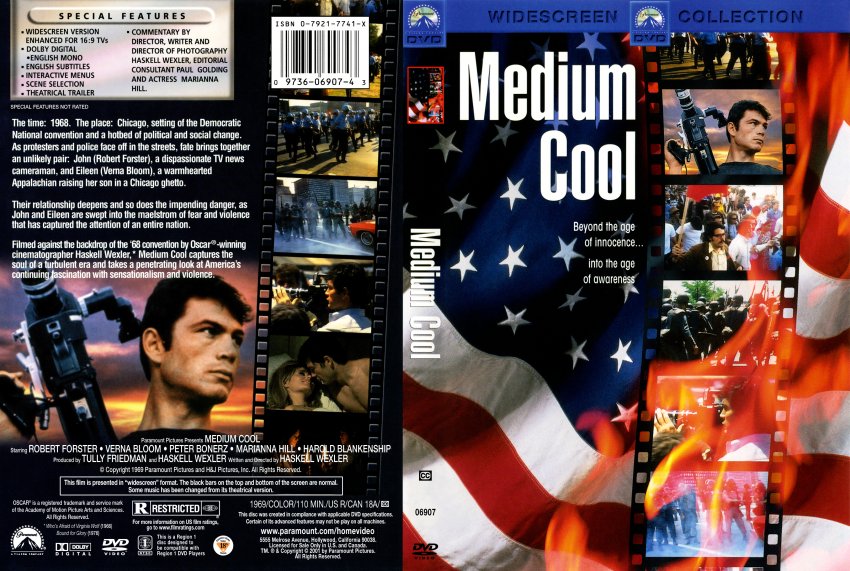
Medium Cool (1969) was a project shadowed by the FBI, saddled with a market-inhibiting X rating, and released with tepid support from a nervous studio. Not surprisingly, despite attracting very favorable reviews, it was not big hit at the box office. But over the years its reputation rose steadily, and eventually the movie found its proper place in the pantheon of the great films of the New Hollywood era. A worthy recipient, then, of the full Criterion Treatment, with a sparkling new special edition DVD and Blu-Ray; among its many features are a new interview with writer-director-cinematographer Haskell Wexler and the very welcome inclusion of (a slightly edited version of) the valuable but obscure 2001 BBC television documentary about the film, Look Out Haskell, It's Real."
As his triple-threat credits suggest, Medium Cool was very much Wexler's project. One of the hottest cinematographers in the business — just off an academy-award winning turn for Who's Afraid of Virginia Wolf (1966) and the big hit In the Heat of the Night (1967) — and with the emergence of a New American Cinema that took low-budget chances on new talent, Wexler was given a shot at the director's chair. And to his credit, the ambitious, confident cameraman didn't play it safe but threw everything he had into a risky project that he believed in.
With a background in documentary filmmaking, Wexler was influenced by a philosophy associated with the French New Wave (many of whose participants had similar apprenticeships), that challenged the reification of a divide between "fiction" and "non-fiction" films. Documentaries, they insisted, could not show an objective truth but offered only one interpretation of events, presented as a narrative following classical storytelling rules; realities that were, moreover, altered by the presence of cameras that produced self-consciousness and performance. Conversely, fiction films, especially those made on locations and with a new wave sensibility designed to reflect the personal experiences of their creators, were in many ways also documentary records of a certain type of reality. With Medium Cool, Wexler dove headlong into the blurry intersection between the two, embedding a fictional (and often improvised) story within very real situations. Often featuring non-actors going about their unscripted business, in many scenes only the principal players are aware that a movie is being made. At times those actors were exposed to real danger — placed, for example, in the midst of what the report of a National Commission would describe a few months afterwards as a "police riot." On the streets of Chicago, Wexler's camera became one among many that were capturing the events as they unfolded — and he was among those tear gassed, and was blinded for twenty-four hours.
The politically sensitive Wexler was irresistibly drawn from Hollywood back to his home town, Chicago, and the Democratic National Convention that would be held there in August 1968. Convinced that "something" would happen there — a violent confrontation, of some type, seemed certain — he crafted a story that could be interwoven into those events, unforeseeable in their specifics, as they unfolded. Wexler was later accused of incitement, but his cameras did little more than anticipate the inevitable explosion. Nineteen sixty-eight took care of the rest.
It was a very bad year. In January, the surprise Tet Offensive fundamentally altered the trajectory of the Vietnam War. The unprecedented communist strikes failed to achieve their military goals, but they made plain that no matter how many troops it poured in, the United States was not going to achieve its political objectives in the war, despite the unceasingly optimistic reports previously proffered by the Johnson Administration. (The U.S. would suffer over 4,700 combat deaths in the first three months of 1968. And with 500,000 American troops in the country, the war was being fought — at best — to a bloody stalemate.) In March, Johnson was embarrassed in the New Hampshire democratic primary by the strong showing of anti-war candidate Eugene McCarthy; within days, Robert Kennedy dropped into the race; within weeks, LBJ shocked the nation by dropping out. In April, Martin Luther King was assassinated. Kennedy, campaigning in Indianapolis, delivered the news to a stunned, mostly black audience, and delivered a short, moving speech appealing for calm. Scores of American cities erupted in riots that night, but Indianapolis was not one of them. In June, Kennedy would be assassinated moments after celebrating victory in the crucial California primary, his final words, "on to Chicago and let's win there," still hanging in the air as the shots rang out.
To Read the Rest
by Jonathan Kirshner
Bright Lights Film Journal
Medium Cool (1969) was a project shadowed by the FBI, saddled with a market-inhibiting X rating, and released with tepid support from a nervous studio. Not surprisingly, despite attracting very favorable reviews, it was not big hit at the box office. But over the years its reputation rose steadily, and eventually the movie found its proper place in the pantheon of the great films of the New Hollywood era. A worthy recipient, then, of the full Criterion Treatment, with a sparkling new special edition DVD and Blu-Ray; among its many features are a new interview with writer-director-cinematographer Haskell Wexler and the very welcome inclusion of (a slightly edited version of) the valuable but obscure 2001 BBC television documentary about the film, Look Out Haskell, It's Real."
As his triple-threat credits suggest, Medium Cool was very much Wexler's project. One of the hottest cinematographers in the business — just off an academy-award winning turn for Who's Afraid of Virginia Wolf (1966) and the big hit In the Heat of the Night (1967) — and with the emergence of a New American Cinema that took low-budget chances on new talent, Wexler was given a shot at the director's chair. And to his credit, the ambitious, confident cameraman didn't play it safe but threw everything he had into a risky project that he believed in.
With a background in documentary filmmaking, Wexler was influenced by a philosophy associated with the French New Wave (many of whose participants had similar apprenticeships), that challenged the reification of a divide between "fiction" and "non-fiction" films. Documentaries, they insisted, could not show an objective truth but offered only one interpretation of events, presented as a narrative following classical storytelling rules; realities that were, moreover, altered by the presence of cameras that produced self-consciousness and performance. Conversely, fiction films, especially those made on locations and with a new wave sensibility designed to reflect the personal experiences of their creators, were in many ways also documentary records of a certain type of reality. With Medium Cool, Wexler dove headlong into the blurry intersection between the two, embedding a fictional (and often improvised) story within very real situations. Often featuring non-actors going about their unscripted business, in many scenes only the principal players are aware that a movie is being made. At times those actors were exposed to real danger — placed, for example, in the midst of what the report of a National Commission would describe a few months afterwards as a "police riot." On the streets of Chicago, Wexler's camera became one among many that were capturing the events as they unfolded — and he was among those tear gassed, and was blinded for twenty-four hours.
The politically sensitive Wexler was irresistibly drawn from Hollywood back to his home town, Chicago, and the Democratic National Convention that would be held there in August 1968. Convinced that "something" would happen there — a violent confrontation, of some type, seemed certain — he crafted a story that could be interwoven into those events, unforeseeable in their specifics, as they unfolded. Wexler was later accused of incitement, but his cameras did little more than anticipate the inevitable explosion. Nineteen sixty-eight took care of the rest.
It was a very bad year. In January, the surprise Tet Offensive fundamentally altered the trajectory of the Vietnam War. The unprecedented communist strikes failed to achieve their military goals, but they made plain that no matter how many troops it poured in, the United States was not going to achieve its political objectives in the war, despite the unceasingly optimistic reports previously proffered by the Johnson Administration. (The U.S. would suffer over 4,700 combat deaths in the first three months of 1968. And with 500,000 American troops in the country, the war was being fought — at best — to a bloody stalemate.) In March, Johnson was embarrassed in the New Hampshire democratic primary by the strong showing of anti-war candidate Eugene McCarthy; within days, Robert Kennedy dropped into the race; within weeks, LBJ shocked the nation by dropping out. In April, Martin Luther King was assassinated. Kennedy, campaigning in Indianapolis, delivered the news to a stunned, mostly black audience, and delivered a short, moving speech appealing for calm. Scores of American cities erupted in riots that night, but Indianapolis was not one of them. In June, Kennedy would be assassinated moments after celebrating victory in the crucial California primary, his final words, "on to Chicago and let's win there," still hanging in the air as the shots rang out.
To Read the Rest
Saturday, August 17, 2013
A Beautiful Mind (USA: Ron Howard, 2001)

A Beautiful Mind (USA: Ron Howard, 2001: 135 mins)
Billings, Andrew C. "Biographical Omissions: The Case of A Beautiful Mind and the Search For Authenticity." The Film Journal #1 (May 2002)
Cassey, Joe. "Mental Illness." Understanding Representation. ed. Wendy Helsby. London: BFI, 2005: 99-114. [Available in BCTC Library PN 1995 U4977 2005]
Hansen, Per Krogh. " Unreliable Narration in Cinema: Facing the Cognitive Challenge Arising from Literary Studies." Amsterdam International Electronic Journal of Narratology #5 (Autumn 2009)
Monday, July 15, 2013
Left Field Cinema -- Documentary Milestone: The Fog of War – Eleven Lessons From the Life of Robert S. McNamara
Documentary Milestone: The Fog of War – Eleven Lessons From the Life of Robert S. McNamara
Left Field Cinema

The Fog of War is Directed by Errol Morris perhaps the most celebrated American documentarian, if not as well known as Michael Moore by the public, Morris is certainly a critical darling. Roger Ebert considers Morris’s first film Gates of Heaven, a documentary about pet cemeteries, as one of his top ten films of all time. Gates of Heaven also provides an entertaining anecdote, in which Werner Herzog promised if Morris ever finished the film he would eat his shoe. Herzog’s insanity can be seen in the short film Werner Herzog Eats His Shoe. Morris’s third feature remains his best known. Thin Blue Line, which followed Vernon, Florida, remains one of the most powerful artistic statements by any filmmaker. Thin Blue Line lead to the subject of the film to have his death row sentence changed to life in prison, then subsequently the initial verdict was over turned. Morris’s documentary directly contributed to this result. The style of the film relies on interviews and re-creations. This emphasis on non-fiction as a documentary style would become Morris’s calling card. Morris went to direct a series of further documentaries including 2008’s War on Terror documentary Standard Operating Procedure. Although Standard Operating Procedure has not been received as well as the earlier documentary Taxi to the Darkside by Alex Gibney which was also released last year it remains an interesting piece of work which focuses on Morris’s typical themes of the deceptive nature of what is considered to be “true”. Morris’s friendship with Werner Herzog makes a great deal of thematic sense, both men search for the ecstatic truth within their respective subjects often at the expense of what could be considered the conventional approach.
The Fog of War presents Morris on top form, a self-proclaimed detective director (which suits him well as he previously worked as a private eye) Morris constructs The Fog of War in such a simplistic manner that it baffles the mind to witness how compelling it is. The entire film is essentially a one-hundred and five minute interview with its subject. The subject being Robert Strange McNamara the Secretary of Defense for John F. Kennedy and Lyndon B. Johnson, and previously an analyst for the Japanese bombings in World War Two and briefly the first President of Ford motors to not belong to the Ford family. He is a man who’s life begins at the end of the first World War, indeed he is adamant that his first memory was that of the victory parades, the celebrations at the end of the “War to end all Wars” following this we witness the part he played in World War II, the Cold war, and the Cuban Missile Crisis, then finally the Vietnam War. McNamara is a man who’s been surrounded by war all of his life. His contribution to the global politics over the 20th Century is a matter for speculation, by that I mean what real effect he had on events, of which McNamara himself is often uncertain. But as a witness to some of the pivotal events in recent history, you’ll be hard pressed to find a man alive who’s seen so much, witnessed such extremes of human behaviour, or gained such a vast understanding of the moral, amoral, and immoral tapestry that is war. McNamara has amazing recall for a man aged eighty-five casting his mind back more than forty years. He is charismatic figure, who sense of irony and wit cannot be denied. However, the man remains even now the consummate politician.
To Read the Rest
Left Field Cinema
The Fog of War is Directed by Errol Morris perhaps the most celebrated American documentarian, if not as well known as Michael Moore by the public, Morris is certainly a critical darling. Roger Ebert considers Morris’s first film Gates of Heaven, a documentary about pet cemeteries, as one of his top ten films of all time. Gates of Heaven also provides an entertaining anecdote, in which Werner Herzog promised if Morris ever finished the film he would eat his shoe. Herzog’s insanity can be seen in the short film Werner Herzog Eats His Shoe. Morris’s third feature remains his best known. Thin Blue Line, which followed Vernon, Florida, remains one of the most powerful artistic statements by any filmmaker. Thin Blue Line lead to the subject of the film to have his death row sentence changed to life in prison, then subsequently the initial verdict was over turned. Morris’s documentary directly contributed to this result. The style of the film relies on interviews and re-creations. This emphasis on non-fiction as a documentary style would become Morris’s calling card. Morris went to direct a series of further documentaries including 2008’s War on Terror documentary Standard Operating Procedure. Although Standard Operating Procedure has not been received as well as the earlier documentary Taxi to the Darkside by Alex Gibney which was also released last year it remains an interesting piece of work which focuses on Morris’s typical themes of the deceptive nature of what is considered to be “true”. Morris’s friendship with Werner Herzog makes a great deal of thematic sense, both men search for the ecstatic truth within their respective subjects often at the expense of what could be considered the conventional approach.
The Fog of War presents Morris on top form, a self-proclaimed detective director (which suits him well as he previously worked as a private eye) Morris constructs The Fog of War in such a simplistic manner that it baffles the mind to witness how compelling it is. The entire film is essentially a one-hundred and five minute interview with its subject. The subject being Robert Strange McNamara the Secretary of Defense for John F. Kennedy and Lyndon B. Johnson, and previously an analyst for the Japanese bombings in World War Two and briefly the first President of Ford motors to not belong to the Ford family. He is a man who’s life begins at the end of the first World War, indeed he is adamant that his first memory was that of the victory parades, the celebrations at the end of the “War to end all Wars” following this we witness the part he played in World War II, the Cold war, and the Cuban Missile Crisis, then finally the Vietnam War. McNamara is a man who’s been surrounded by war all of his life. His contribution to the global politics over the 20th Century is a matter for speculation, by that I mean what real effect he had on events, of which McNamara himself is often uncertain. But as a witness to some of the pivotal events in recent history, you’ll be hard pressed to find a man alive who’s seen so much, witnessed such extremes of human behaviour, or gained such a vast understanding of the moral, amoral, and immoral tapestry that is war. McNamara has amazing recall for a man aged eighty-five casting his mind back more than forty years. He is charismatic figure, who sense of irony and wit cannot be denied. However, the man remains even now the consummate politician.
To Read the Rest
Sunday, June 23, 2013
The Passion of the Christ (USA: Mel Gibson, 2004)

The Passion of the Christ (USA: Mel Gibson, 2004: 127 mins)
Aslan, Reza. "Zealot." Radio West (October 18, 2013)
Deacy, Chris. "A Time to Kill?: Theological Perspectives on Violence and Film." Theology and Film: Challenging the Sacred/Secular Divide. ed. Christopher Deacy & Gaye Williams Oritz. Malden, MA: Blackwell, 2008: 123-142. [Professor has copy]
Hauka, David. "'Christ That Hurts': Rewriting the Jesus Narrative -- Violence and the Language of Action Cinema in Mel Gibson's The Passion of the Christ Cinephile #2 (March 2006)
Phillips, Kendall R. "Religion: Mel Gibson's The Passion of the Christ." Controversial Cinema: The Films That Outraged America. Westport, CT: Preager, 2008: 127-152.[in BCTC Library PN1995,9 S284P452008}
Koresky, Michael. "Consider the Source: The Passion of the Christ." Reverse Shot (Spring 2004)
Reichert, Jeff. Jesus Christ: Superman (or Every Man for Himself and Armond Against All)>" Reverse Shot (Spring 2004)
Walsh, David. "Why has The Passion of the Christ evoked such a popular response in America?" World Socialist Web Site (March 5, 2004)
Walter, Brian. "Love In The Time of Calvary: Romance and Family Values in Crucifixion Films." Cineaction #88 (2012)
Thursday, June 13, 2013
I Heart Huckabees (USA/Germany: David O' Russell, 2004)
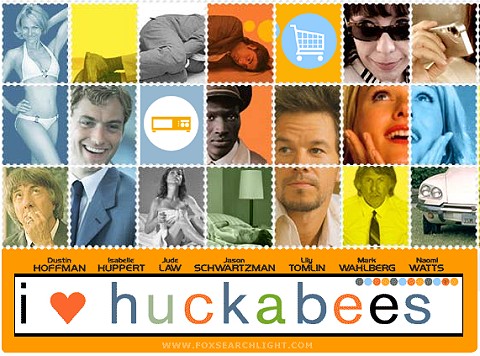
I Heart Huckabees (USA/Germany: David O' Russell, 2004: 107 minutes)
Garrett, Daniel. "Laughter and Philosophy: David Owen Russell’s I ♥ Huckabees." Offscreen (January 31, 2005)
Johnson, Mackenzie. "What Makes David O. Russell so David O. Russell." Film Stage (October 17, 2016)
Kennedy, A.L. "Sartre and the Individual." A History of Ideas (April 15, 2015) ["Writer AL Kennedy on Existentialist ideas about the individual. Jean Paul Sartre argued that, for humans, 'existence preceded essence'. This means that there is no blueprint or template from which to work - humans are free to make themselves up as they go along. Being an individual comes from the way you negotiate this freedom and the choices you make in the face of it."]
Kirby, Matt. "I Heart Huckabees: Premodern Help for Postmodern Times." Metaphilm (November 12, 2004)
Lee, Kevin B.. "The Wahlberg Effect." Keyframe (September 26, 2016)
Ng, Edwin. "The (Zen) Buddhist Heart of I ♥ Huckabees." Journal of Religion & Film 14.1 (April 2010)
Shaw, Daniel. Film and Philosophy: Taking Movies Seriously. NY: Wallflower, 2008. [In BCTC Library]
Tait, R. Colin. "'Jesus is never mad at us if we live with him in our hearts': The Dialectical View of America in David O' Russell's I Heart Huckabees." Cinephile (March 2006)
Thursday, April 4, 2013
Dario Llinares -- Adapting an Askance Perspective: Philip K. Dick on Film
Adapting an Askance Perspective: Philip K. Dick on Film
by Dario Llinares
Alternate Takes

This summer’s remake of Total Recall extends the list of films inspired by the writing of Philip K. Dick. His novels and short stories offer some of the most eccentric and imaginative conceits in American literature, and are designed to question the fundamental metaphysical realities upon which our perception of the world is based. To define PKD as merely a science-fiction writer fails to capture the intricacy of thought and unlimited possibilities that his stories evoke.
Flow my Tears, the Policeman Said, like many of his novels, envisages a technologically advanced dystopia where genetic engineering is the main tool of a repressive police state. Ubik and Valis display PKD’s interest in the transcendental mind and the human interpretation of God, and the classic The Man in the High Castle re-imagines a post-World War II era if the Nazis had been triumphant. The very strangeness of his titles reflect an author who looked at the world askance. It is not over-praising to mention him in the same breadth as Orwell, Huxley, Bradbury and Burgess; but while those authors are ostensibly influenced by the tumultuous events of the first half of the 20th century, PKD was more an évocateur-du-jour of the cultural turn of the 1960s and what has come to be termed postmodernism.
PKD’s somewhat tortured life contained episodes of paranoia and psychological uncertainty, which played out in the characters he created and the ephemeral situations they inhabited. His own experiences of drug use, religion, romantic relationships (he was married five times), and the tumult of the Nixon administration helped him to capture the dissolving vicissitudes of a shifting cultural zeitgeist. Loss of identity in an increasingly schizophrenic, technologically-led, drug-infused, media-saturated world underpins his allegorical stories, with protagonists searching for ‘truths’ that seem diffuse and ineffable. If there is one central theme running through his oeuvre it is the constant questioning of what constitutes a human being.
Although he was lauded in the esoteric sci-fi world, his books never achieved mainstream success and, in an almost conspiratorial twist of ‘fate’, he died of a stroke in March 1982, three months before the release of Blade Runner. PKD’s cinematic legacy is found not only in specific adaptations, but a wider saturation of his ideas through contemporary postmodern film aesthetics. David Cronenburg, The Wachowskis, David Fincher, Spike Jonze, Michel Gondry and Christopher Nolan are just a few directors clearly influenced by the author’s writing.
In exalting such a visionary mind and its influence on contemporary cinema, however, a cautioning question somewhat inconveniently comes to mind. Why do so many PKD adaptations fail to live up to the intelligence, acerbic wit, strange imaginativeness or political insight of his original texts? For it is my contention that, even in the best examples of PKD-inspired cinema, much of the heteroclite themes, astute social representations and ambivalent outcomes are at best smoothed out, at worse omitted.
Of course, in the era of the CGI-laden blockbuster the futuristic speculative fictions of PKD are easily co-opted into the testosterone infused visual spectacle of event cinema. For example, John Woo’s Paycheck (2003) and Lee Tamahori’s Next (2007) would be highly contemptuous if they weren’t so forgettable. Both films, like most PKD stories, have the seed of an interesting scenario which links allegorically to contemporary issues. The former deals with intellectual property rights and industrial espionage, with corporations protecting knowledge by wiping the memory of employees who work for them. The latter deals with a staple PKD trope: the ability to see into the future and its consequences for free will and moral decision-making. Yet the ideas behind both films, rather than being explored with any philosophical imagination, are simply used as the skeleton for a premise, largely overlooked in favour of a series of formulaic and largely uninvolving action scenes.
Minority Report (2002), directed by Steven Spielberg and starring Tom Cruise, does fall into a similar category in reducing its interesting premise into formulaic action/chase movie. However, there is a subtle evocation of mood here, with the cool washed-out palette imbuing a neo-noir atmosphere, which fits well with the conspiratorial vision of the original short story. The film also works on the level of future prognosis regarding the impact of foreseeable technological advances. Yet the final morality tale invokes a notion that free will wins, with Jon Anderton (Cruise) making the existential decision not to execute the murderer of his son. In the short story there is a sense that the protagonist’s journey is a complex, morally relative maze, where free will’s relationship to morality is wholly arbitrary and contingent. This Hollywood adaptation prefers the security of Manichean heroism underpinned by physical action and easy use of violence, thus eliding any real sense of danger or weakness. PKD protagonists are often weak (in PKD's Minority Report Jon Anderton is a fat, balding 50-year-old), uncertain and insecure. This is often tied to the shadowy conspiratorial milieu that is woven around them, where agents of the state, sinister scientists and androids with artificial intelligence inhabit an often surreal external world. Such an environment feeds into the internal psychosis of his characters, often leading them (and the reader) to the point of asking “do I really exist”? You never get the sense that Cruise’s Jon Anderton suffers from such existential angst.
To Read the Rest of the Essay

by Dario Llinares
Alternate Takes
This summer’s remake of Total Recall extends the list of films inspired by the writing of Philip K. Dick. His novels and short stories offer some of the most eccentric and imaginative conceits in American literature, and are designed to question the fundamental metaphysical realities upon which our perception of the world is based. To define PKD as merely a science-fiction writer fails to capture the intricacy of thought and unlimited possibilities that his stories evoke.
Flow my Tears, the Policeman Said, like many of his novels, envisages a technologically advanced dystopia where genetic engineering is the main tool of a repressive police state. Ubik and Valis display PKD’s interest in the transcendental mind and the human interpretation of God, and the classic The Man in the High Castle re-imagines a post-World War II era if the Nazis had been triumphant. The very strangeness of his titles reflect an author who looked at the world askance. It is not over-praising to mention him in the same breadth as Orwell, Huxley, Bradbury and Burgess; but while those authors are ostensibly influenced by the tumultuous events of the first half of the 20th century, PKD was more an évocateur-du-jour of the cultural turn of the 1960s and what has come to be termed postmodernism.
PKD’s somewhat tortured life contained episodes of paranoia and psychological uncertainty, which played out in the characters he created and the ephemeral situations they inhabited. His own experiences of drug use, religion, romantic relationships (he was married five times), and the tumult of the Nixon administration helped him to capture the dissolving vicissitudes of a shifting cultural zeitgeist. Loss of identity in an increasingly schizophrenic, technologically-led, drug-infused, media-saturated world underpins his allegorical stories, with protagonists searching for ‘truths’ that seem diffuse and ineffable. If there is one central theme running through his oeuvre it is the constant questioning of what constitutes a human being.
Although he was lauded in the esoteric sci-fi world, his books never achieved mainstream success and, in an almost conspiratorial twist of ‘fate’, he died of a stroke in March 1982, three months before the release of Blade Runner. PKD’s cinematic legacy is found not only in specific adaptations, but a wider saturation of his ideas through contemporary postmodern film aesthetics. David Cronenburg, The Wachowskis, David Fincher, Spike Jonze, Michel Gondry and Christopher Nolan are just a few directors clearly influenced by the author’s writing.
In exalting such a visionary mind and its influence on contemporary cinema, however, a cautioning question somewhat inconveniently comes to mind. Why do so many PKD adaptations fail to live up to the intelligence, acerbic wit, strange imaginativeness or political insight of his original texts? For it is my contention that, even in the best examples of PKD-inspired cinema, much of the heteroclite themes, astute social representations and ambivalent outcomes are at best smoothed out, at worse omitted.
Of course, in the era of the CGI-laden blockbuster the futuristic speculative fictions of PKD are easily co-opted into the testosterone infused visual spectacle of event cinema. For example, John Woo’s Paycheck (2003) and Lee Tamahori’s Next (2007) would be highly contemptuous if they weren’t so forgettable. Both films, like most PKD stories, have the seed of an interesting scenario which links allegorically to contemporary issues. The former deals with intellectual property rights and industrial espionage, with corporations protecting knowledge by wiping the memory of employees who work for them. The latter deals with a staple PKD trope: the ability to see into the future and its consequences for free will and moral decision-making. Yet the ideas behind both films, rather than being explored with any philosophical imagination, are simply used as the skeleton for a premise, largely overlooked in favour of a series of formulaic and largely uninvolving action scenes.
Minority Report (2002), directed by Steven Spielberg and starring Tom Cruise, does fall into a similar category in reducing its interesting premise into formulaic action/chase movie. However, there is a subtle evocation of mood here, with the cool washed-out palette imbuing a neo-noir atmosphere, which fits well with the conspiratorial vision of the original short story. The film also works on the level of future prognosis regarding the impact of foreseeable technological advances. Yet the final morality tale invokes a notion that free will wins, with Jon Anderton (Cruise) making the existential decision not to execute the murderer of his son. In the short story there is a sense that the protagonist’s journey is a complex, morally relative maze, where free will’s relationship to morality is wholly arbitrary and contingent. This Hollywood adaptation prefers the security of Manichean heroism underpinned by physical action and easy use of violence, thus eliding any real sense of danger or weakness. PKD protagonists are often weak (in PKD's Minority Report Jon Anderton is a fat, balding 50-year-old), uncertain and insecure. This is often tied to the shadowy conspiratorial milieu that is woven around them, where agents of the state, sinister scientists and androids with artificial intelligence inhabit an often surreal external world. Such an environment feeds into the internal psychosis of his characters, often leading them (and the reader) to the point of asking “do I really exist”? You never get the sense that Cruise’s Jon Anderton suffers from such existential angst.
To Read the Rest of the Essay
Tuesday, February 26, 2013
Films We Want to See #25: Let Fury Have the Hour (USA: Antonio D'Ambrosio, 2012)
Film Website
“Let fury have the hour/
Anger can be power/
Do you know that you can use it?”
– “The Clampdown,” The Clash
Rough, raw and unapologetically inspirational, LET FURY HAVE THE HOUR is a charged journey into the heart of the creative counter-culture in 2012. In a time of global challenges, big questions and by-the-numbers politics, this upbeat, outspoken film tracks the story of the artists, writers, thinkers and musicians who have gone underground to re-imagine the world – honing in on equality, community and engaged creativity – in exuberantly paradigm-busting ways.
Writer/director Antonino D’Ambrosio unites 50 powerful, of-the-moment voices –from street artist Shepard Fairey to rapper Chuck D to playwright Eve Ensler to musicians Tom Morello and Billy Bragg to novelist Edwidge Danticat to filmmaker John Sayles to comic Lewis Black – who share personal and powerful tales of how they transformed anger and angst into provocative art and ideas. Mix-mastered with historical footage, animation and performances, D’Ambrosio presents a visceral portrait of a generation looking to re-jigger a system that has failed to address the most pressing problems of our times . . . or human potential.
The story begins in the 1980s with the rise of Reagan and Thatcher — and a cultural shift towards fierce individualism and rampant consumerism. Coming of age in a world seemingly gone mad or at least gone shopping, some kids started searching for something more authentic. This was the start of a renegade movement D’Ambrosio calls “creative-response.” It was a hybrid, haphazard collective of skateboarders, punk rockers, rappers, street poets, feminists and graffitists whose reaction to this brave new world was not to turn away, but to turn up the volume and have their say.
Now that generation is coming to the fore, sparking a global movement focused not just on pushing the boundaries with guitars, paint, dance, storytelling, graphics and subcultural style – but on coming together around real reasons for hope.
Set to a stirring soundtrack from the film’s artists – including Rage Against The Machine, Public Enemy, Billy Bragg, Gogol Bordello, MC5, DJ Spooky and Sean Hayes – LET FURY HAVE THE HOUR is a fast and furious trip into the grass roots of art and activism, 21st Century style. The film is written and directed by author and visual artist Antonino D’Ambrosio in his feature debut. The producers are D’Ambrosio and James L. Reid and the executive producers are Jonathan Gray, Brian Devine, Rob McKay, Mark Urman and Chaz Zelus. The film features original music from composer and MC5 guitarist Wayne Kramer. A CAVU Pictures release.
“Let fury have the hour/
Anger can be power/
Do you know that you can use it?”
– “The Clampdown,” The Clash
Rough, raw and unapologetically inspirational, LET FURY HAVE THE HOUR is a charged journey into the heart of the creative counter-culture in 2012. In a time of global challenges, big questions and by-the-numbers politics, this upbeat, outspoken film tracks the story of the artists, writers, thinkers and musicians who have gone underground to re-imagine the world – honing in on equality, community and engaged creativity – in exuberantly paradigm-busting ways.
Writer/director Antonino D’Ambrosio unites 50 powerful, of-the-moment voices –from street artist Shepard Fairey to rapper Chuck D to playwright Eve Ensler to musicians Tom Morello and Billy Bragg to novelist Edwidge Danticat to filmmaker John Sayles to comic Lewis Black – who share personal and powerful tales of how they transformed anger and angst into provocative art and ideas. Mix-mastered with historical footage, animation and performances, D’Ambrosio presents a visceral portrait of a generation looking to re-jigger a system that has failed to address the most pressing problems of our times . . . or human potential.
The story begins in the 1980s with the rise of Reagan and Thatcher — and a cultural shift towards fierce individualism and rampant consumerism. Coming of age in a world seemingly gone mad or at least gone shopping, some kids started searching for something more authentic. This was the start of a renegade movement D’Ambrosio calls “creative-response.” It was a hybrid, haphazard collective of skateboarders, punk rockers, rappers, street poets, feminists and graffitists whose reaction to this brave new world was not to turn away, but to turn up the volume and have their say.
Now that generation is coming to the fore, sparking a global movement focused not just on pushing the boundaries with guitars, paint, dance, storytelling, graphics and subcultural style – but on coming together around real reasons for hope.
Set to a stirring soundtrack from the film’s artists – including Rage Against The Machine, Public Enemy, Billy Bragg, Gogol Bordello, MC5, DJ Spooky and Sean Hayes – LET FURY HAVE THE HOUR is a fast and furious trip into the grass roots of art and activism, 21st Century style. The film is written and directed by author and visual artist Antonino D’Ambrosio in his feature debut. The producers are D’Ambrosio and James L. Reid and the executive producers are Jonathan Gray, Brian Devine, Rob McKay, Mark Urman and Chaz Zelus. The film features original music from composer and MC5 guitarist Wayne Kramer. A CAVU Pictures release.
Sunday, December 9, 2012
Charles McGrath: Abe Lincoln as You’ve Never Heard Him
Abe Lincoln as You’ve Never Heard Him
By Charles McGrath
The New York Times
“Now he belongs to the ages,” Edwin Stanton, Abraham Lincoln’s secretary of war, said at the president’s deathbed. “And to the studios,” he could have added.
The latest in a long parade of screen Abes, coming right on the heels of Benjamin Walker’s ax-swinging, martial arts version in “Abraham Lincoln: Vampire Hunter,” is Daniel Day-Lewis, who, though he grew up in England and Ireland and had to learn about Lincoln almost from scratch, plays the lead in Steven Spielberg’s “Lincoln,” which opens Friday.
Mr. Day-Lewis, 55, has already won two best actor Oscars, and his performance here, tender and soulful, convincingly weary and stoop-shouldered, will almost certainly earn him a nomination. He’s neither as zombified as Walter Huston in D. W. Griffith’s 1930 biopic “Abraham Lincoln,” nor as brash and self-assured as Henry Fonda in John Ford’s “Young Mr. Lincoln” (1939), nor as stagy and ponderous as Raymond Massey, a year later, in “Abe Lincoln in Illinois,” in which he sounds, during the Lincoln-Douglas debates, a lot like the television evangelist Harold Camping proclaiming the end of the world once more.
Tall and thin, with big hands and a long neck, Mr. Day-Lewis physically resembles Lincoln more nearly than many of his predecessors — more, certainly, than Kris Kristofferson, who in the 1995 television movie “Tad” had to wear platform shoes to boost him to Lincolnesque stature. Yet the first time Mr. Day-Lewis opens his mouth in the movie, he’s also a little startling. His Lincoln speaks not in Massey’s stentorian baritone, or in the echoing, ballpark-announcer tones of the Disneyland animatronic Lincoln first heard at the 1964 World’s Fair, but in a voice that is high, earnest and folksy.
Mr. Day-Lewis is famously fussy about what parts he takes, sometimes waiting years between films while spending time in both Ireland and America with his wife, Rebecca Miller (the daughter of Arthur Miller, whom he met while filming “The Crucible”), and their two sons. (He has a third, older son with the actress Isabelle Adjani.) For a while he seemed to give up movies altogether and apprenticed himself to a cabinetmaker and a cobbler.
Mr. Day-Lewis is even fussier about what he calls “the work”: his process of preparing and then inhabiting a part. For “The Last of the Mohicans” he taught himself to build a canoe, shoot a flintlock and trap and skin animals. For the opening scene of “My Left Foot,” about Christy Brown, an artist with cerebral palsy, he taught himself to put a record on a turntable with his toes; he also insisted on remaining in a wheelchair between takes and being fed by the crew.
He learned to box, naturally, for “The Boxer,” in which he played a prizefighter and former member of the Irish Republican Army and in the process broke his nose and damaged his back. To play the gang leader Bill the Butcher in “Gangs of New York,” he took butchering lessons, and to play Abraham Lincoln he half-convinced himself that he was Abraham Lincoln.
Mr. Day-Lewis, who has a deep voice and a British accent, not in the least Lincoln-like, prefers not to talk much about his method of acting. He doesn’t entirely understand it himself, he says, and doesn’t want to. “There’s a tendency now to deconstruct and analyze everything,” he said during a recent interview in New York, “and I think that’s a self-defeating part of the enterprise.”
He added: “It sounds pretentious, I know. I recognize all the practical work that needs to be done, the dirty work, which I love: the work in the soil, the rooting around in the hope that you might find a gem. But I need to believe that there is a cohesive mystery that ties all these things together, and I try not to separate them.”
To Read the Rest of the Profile
By Charles McGrath
The New York Times
“Now he belongs to the ages,” Edwin Stanton, Abraham Lincoln’s secretary of war, said at the president’s deathbed. “And to the studios,” he could have added.
The latest in a long parade of screen Abes, coming right on the heels of Benjamin Walker’s ax-swinging, martial arts version in “Abraham Lincoln: Vampire Hunter,” is Daniel Day-Lewis, who, though he grew up in England and Ireland and had to learn about Lincoln almost from scratch, plays the lead in Steven Spielberg’s “Lincoln,” which opens Friday.
Mr. Day-Lewis, 55, has already won two best actor Oscars, and his performance here, tender and soulful, convincingly weary and stoop-shouldered, will almost certainly earn him a nomination. He’s neither as zombified as Walter Huston in D. W. Griffith’s 1930 biopic “Abraham Lincoln,” nor as brash and self-assured as Henry Fonda in John Ford’s “Young Mr. Lincoln” (1939), nor as stagy and ponderous as Raymond Massey, a year later, in “Abe Lincoln in Illinois,” in which he sounds, during the Lincoln-Douglas debates, a lot like the television evangelist Harold Camping proclaiming the end of the world once more.
Tall and thin, with big hands and a long neck, Mr. Day-Lewis physically resembles Lincoln more nearly than many of his predecessors — more, certainly, than Kris Kristofferson, who in the 1995 television movie “Tad” had to wear platform shoes to boost him to Lincolnesque stature. Yet the first time Mr. Day-Lewis opens his mouth in the movie, he’s also a little startling. His Lincoln speaks not in Massey’s stentorian baritone, or in the echoing, ballpark-announcer tones of the Disneyland animatronic Lincoln first heard at the 1964 World’s Fair, but in a voice that is high, earnest and folksy.
Mr. Day-Lewis is famously fussy about what parts he takes, sometimes waiting years between films while spending time in both Ireland and America with his wife, Rebecca Miller (the daughter of Arthur Miller, whom he met while filming “The Crucible”), and their two sons. (He has a third, older son with the actress Isabelle Adjani.) For a while he seemed to give up movies altogether and apprenticed himself to a cabinetmaker and a cobbler.
Mr. Day-Lewis is even fussier about what he calls “the work”: his process of preparing and then inhabiting a part. For “The Last of the Mohicans” he taught himself to build a canoe, shoot a flintlock and trap and skin animals. For the opening scene of “My Left Foot,” about Christy Brown, an artist with cerebral palsy, he taught himself to put a record on a turntable with his toes; he also insisted on remaining in a wheelchair between takes and being fed by the crew.
He learned to box, naturally, for “The Boxer,” in which he played a prizefighter and former member of the Irish Republican Army and in the process broke his nose and damaged his back. To play the gang leader Bill the Butcher in “Gangs of New York,” he took butchering lessons, and to play Abraham Lincoln he half-convinced himself that he was Abraham Lincoln.
Mr. Day-Lewis, who has a deep voice and a British accent, not in the least Lincoln-like, prefers not to talk much about his method of acting. He doesn’t entirely understand it himself, he says, and doesn’t want to. “There’s a tendency now to deconstruct and analyze everything,” he said during a recent interview in New York, “and I think that’s a self-defeating part of the enterprise.”
He added: “It sounds pretentious, I know. I recognize all the practical work that needs to be done, the dirty work, which I love: the work in the soil, the rooting around in the hope that you might find a gem. But I need to believe that there is a cohesive mystery that ties all these things together, and I try not to separate them.”
To Read the Rest of the Profile
Friday, November 30, 2012
Connor Kilpatrick: The Night They Drove Old Dixie Down
The Night They Drove Old Dixie Down
by Connor Kilpatrick
Jacobin
Whatever Spielberg says — there’s no comparing an empty-suit like Obama to a radical like Lincoln.
I thought about writing a critique of Aaron Bady’s mostly very good review of Lincoln for a long time this morning. It was a tough call: I do have some enamel left on my teeth and I can think of nothing else that could threaten to grind it all down to dust than publicly saying anything —anything at all — that could be construed as a defense of either Steven Spielberg’s politics or Barack Obama.
So I don’t want to defend the movie, which I thought was fine for what it was. Actually, by the standards of Hollywood history flicks, I thought it was more than fine.
Bady’s right to call out Kushner and Spielberg as card-carrying Obamaphiles. And it’s more than clear, particularly through interviews, that Kushner and Spielberg want us to connect the dots they’ve carefully laid out between Abe and Barack. Obama himself has done everything possible to encourage the comparison—even being sworn into office on Lincoln’s very own bible.
In their shared liberal revisionism, the Thirteenth Amendment becomes ObamaCare. The Emancipation Proclamation becomes a return to the marginal tax rates of the Clinton era. Thaddeus Stevens morphs into a fantasy of Bernie Sanders “doing the right thing” and sitting down with the prez to cut healthcare for the poor and elderly.
It’s laughable. But instead of calling them out, too many leftists concede this characterization of Lincoln and the Republicans to the Obamaphiles. They seem to believe that the first crop of Republicans did little more than press an official rubber stamp on “history from below” which had already delivered its verdict across the land.
The argument seems to be: “Spielberg says Lincoln and Obama are rubber-stampers. They are. But he’s wrong when he says that such men are the true makers of history.” Then they go looking elsewhere for the real revolutionaries, who can’t possibly have anything to do with these mere ‘stampers.
The question is why are we letting Spielberg, Kushner, and Obama get away with this?
Abraham Lincoln and the early Republicans (to say nothing of the Liberty Party or Free Soilers before them) shared a vision of a radically different society. Wiping out slavery — either through immediate abolition or through the “cordon of freedom” policy of the Republican Party — was hardly a technocratic reform.
And when it became clear that the only way to get there would be through revolutionary means, they took it without flinching: slaves were being emancipated as “contraband” by the summer of 1861, with the first Confiscation Act — written and debated in Congress explicitly as an emancipation act — signed into law that August, less than four months after the start of the war. The endgame of military emancipation had long been on the minds of antislavery politicians, all the way back to John Quincy Adams who first laid out such a scenario in 1836.
To Read the Rest of the Essay
by Connor Kilpatrick
Jacobin
Whatever Spielberg says — there’s no comparing an empty-suit like Obama to a radical like Lincoln.
I thought about writing a critique of Aaron Bady’s mostly very good review of Lincoln for a long time this morning. It was a tough call: I do have some enamel left on my teeth and I can think of nothing else that could threaten to grind it all down to dust than publicly saying anything —anything at all — that could be construed as a defense of either Steven Spielberg’s politics or Barack Obama.
So I don’t want to defend the movie, which I thought was fine for what it was. Actually, by the standards of Hollywood history flicks, I thought it was more than fine.
Bady’s right to call out Kushner and Spielberg as card-carrying Obamaphiles. And it’s more than clear, particularly through interviews, that Kushner and Spielberg want us to connect the dots they’ve carefully laid out between Abe and Barack. Obama himself has done everything possible to encourage the comparison—even being sworn into office on Lincoln’s very own bible.
In their shared liberal revisionism, the Thirteenth Amendment becomes ObamaCare. The Emancipation Proclamation becomes a return to the marginal tax rates of the Clinton era. Thaddeus Stevens morphs into a fantasy of Bernie Sanders “doing the right thing” and sitting down with the prez to cut healthcare for the poor and elderly.
It’s laughable. But instead of calling them out, too many leftists concede this characterization of Lincoln and the Republicans to the Obamaphiles. They seem to believe that the first crop of Republicans did little more than press an official rubber stamp on “history from below” which had already delivered its verdict across the land.
The argument seems to be: “Spielberg says Lincoln and Obama are rubber-stampers. They are. But he’s wrong when he says that such men are the true makers of history.” Then they go looking elsewhere for the real revolutionaries, who can’t possibly have anything to do with these mere ‘stampers.
The question is why are we letting Spielberg, Kushner, and Obama get away with this?
Abraham Lincoln and the early Republicans (to say nothing of the Liberty Party or Free Soilers before them) shared a vision of a radically different society. Wiping out slavery — either through immediate abolition or through the “cordon of freedom” policy of the Republican Party — was hardly a technocratic reform.
And when it became clear that the only way to get there would be through revolutionary means, they took it without flinching: slaves were being emancipated as “contraband” by the summer of 1861, with the first Confiscation Act — written and debated in Congress explicitly as an emancipation act — signed into law that August, less than four months after the start of the war. The endgame of military emancipation had long been on the minds of antislavery politicians, all the way back to John Quincy Adams who first laid out such a scenario in 1836.
To Read the Rest of the Essay
Wednesday, November 28, 2012
Aaron Bady: Lincoln Against the Radicals
Lincoln Against the Radicals
by Aaron Bady
Jacobin

...
In short, if you widen your field of view, you will discover that W.E.B. Du Bois argued a century ago—and as the historical scholarship has increasingly come to agree—that slavery was already all but dead by the time Lincoln got around to declaring himself an abolitionist, far less because the North gave slaves their legal freedom than because they had already effectively taken it, because it had become the new status quo that would have required force to dislodge. At the end of the Civil War, with the South defeated, the choice for the north was not to end slavery or leave it; the choice was to ratify the fact that it was already dead or to re-impose it by military force.
In short, the idea that the white north “gave” freedom to the slaves draws from and reinforces an attractively simple and flattering myth, one which formed around the old historiography of the period like a noose cutting off oxygen to the brain: the myth that black slaves were rendered passive by their condition, and that—absent an outside force interrupting their state of un-freedom—they would simply have continued, as slaves, indefinitely. It’s only in this narrative that freedom can be a thing which is given to them: because they are essentially passive and inert, they require someone else—say, a great emancipator—to step in and raise them up.
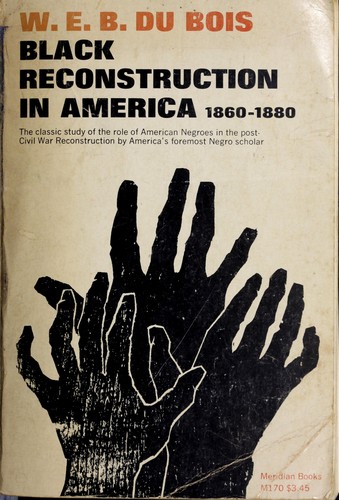
W.E.B. Du Bois was already chipping away at this myth in 1909, but when scholars in the post-Civil Rights era started taking him and his 1935 Black Reconstruction seriously, the historiographic mainstream turned this myth on its head. Slaves were not and could not be “given” their freedom because they had always had it: it had required a great deal of violent force and political work to keep them enslaved, and when that force was removed—as the South collapsed politically and militarily—they began to act like the human beings they always already were, organizing, moving, and seizing their destinies in their own hands. At this point, the game was up; just as the institution of slavery had always depended on substantial governmental enforcement and support, it would have taken a substantial amount of violent force to re-impose it, a concerted project to re-establish slavery that no one in the north had any particular stomach for. At the end of the Civil War, to put it simply, the North had a simple choice: re-imposing slavery by force or accept the new reality. They chose the latter.
If you read these books, however, you’d gain a sense of perspective that the film works to make impossible. Spielberg and Kushner are interested in a kind of scrupulous (almost farcical) accuracy about things that do not matter, while working very hard to place everything else that was going on in the period—and everything else Lincoln was responding to—off camera. “The nation’s capital was transformed by the migration of fugitive slaves from the South during the war, but you’d never know it from this film,” as Kate Masur points out, and Lincoln’s own servants were leaders and organizers in this community, something of which Lincoln simply could not have been unaware. But the film makes a point of not showing any of this: while the vast majority of the movie takes place in cramped and smoky rooms, even the exterior shots (usually of conversations in moving wagons) show us very little of what was going on in the streets and neighborhoods of Washington (much less what was going on in the South). Which is to say: they give us the illusion of perspective without giving us its substance. They show you the elephant’s tail quite accurately, and then they declare, on that basis, that the entire beast is a snake.
In the big picture, the Thirteenth Amendment, on its own, just isn’t that important, and much of the forced suspense of the movie—will they pass it?—comes from an artificial sense that more is at stake in a single congressional bill than there actually was. As Eric Foner pointed out when he was asked about the movie, if it hadn’t passed when it did, Lincoln had pledged to call Congress into special session in March; “[a]nd there, the Republicans had a two-thirds majority and would ratify in a minute…It’s not this giant crisis in the way that the film’s portraying it.” This is important because the small picture is not the big picture in miniature, and taking it to be—taking the passage of the Thirteenth Amendment to be 19th centuries democratic turning point, as this movie clearly does—will cause us to subordinate the big picture to the small picture.
To Read the Entire Essay
by Aaron Bady
Jacobin
...
In short, if you widen your field of view, you will discover that W.E.B. Du Bois argued a century ago—and as the historical scholarship has increasingly come to agree—that slavery was already all but dead by the time Lincoln got around to declaring himself an abolitionist, far less because the North gave slaves their legal freedom than because they had already effectively taken it, because it had become the new status quo that would have required force to dislodge. At the end of the Civil War, with the South defeated, the choice for the north was not to end slavery or leave it; the choice was to ratify the fact that it was already dead or to re-impose it by military force.
In short, the idea that the white north “gave” freedom to the slaves draws from and reinforces an attractively simple and flattering myth, one which formed around the old historiography of the period like a noose cutting off oxygen to the brain: the myth that black slaves were rendered passive by their condition, and that—absent an outside force interrupting their state of un-freedom—they would simply have continued, as slaves, indefinitely. It’s only in this narrative that freedom can be a thing which is given to them: because they are essentially passive and inert, they require someone else—say, a great emancipator—to step in and raise them up.
W.E.B. Du Bois was already chipping away at this myth in 1909, but when scholars in the post-Civil Rights era started taking him and his 1935 Black Reconstruction seriously, the historiographic mainstream turned this myth on its head. Slaves were not and could not be “given” their freedom because they had always had it: it had required a great deal of violent force and political work to keep them enslaved, and when that force was removed—as the South collapsed politically and militarily—they began to act like the human beings they always already were, organizing, moving, and seizing their destinies in their own hands. At this point, the game was up; just as the institution of slavery had always depended on substantial governmental enforcement and support, it would have taken a substantial amount of violent force to re-impose it, a concerted project to re-establish slavery that no one in the north had any particular stomach for. At the end of the Civil War, to put it simply, the North had a simple choice: re-imposing slavery by force or accept the new reality. They chose the latter.
If you read these books, however, you’d gain a sense of perspective that the film works to make impossible. Spielberg and Kushner are interested in a kind of scrupulous (almost farcical) accuracy about things that do not matter, while working very hard to place everything else that was going on in the period—and everything else Lincoln was responding to—off camera. “The nation’s capital was transformed by the migration of fugitive slaves from the South during the war, but you’d never know it from this film,” as Kate Masur points out, and Lincoln’s own servants were leaders and organizers in this community, something of which Lincoln simply could not have been unaware. But the film makes a point of not showing any of this: while the vast majority of the movie takes place in cramped and smoky rooms, even the exterior shots (usually of conversations in moving wagons) show us very little of what was going on in the streets and neighborhoods of Washington (much less what was going on in the South). Which is to say: they give us the illusion of perspective without giving us its substance. They show you the elephant’s tail quite accurately, and then they declare, on that basis, that the entire beast is a snake.
In the big picture, the Thirteenth Amendment, on its own, just isn’t that important, and much of the forced suspense of the movie—will they pass it?—comes from an artificial sense that more is at stake in a single congressional bill than there actually was. As Eric Foner pointed out when he was asked about the movie, if it hadn’t passed when it did, Lincoln had pledged to call Congress into special session in March; “[a]nd there, the Republicans had a two-thirds majority and would ratify in a minute…It’s not this giant crisis in the way that the film’s portraying it.” This is important because the small picture is not the big picture in miniature, and taking it to be—taking the passage of the Thirteenth Amendment to be 19th centuries democratic turning point, as this movie clearly does—will cause us to subordinate the big picture to the small picture.
To Read the Entire Essay
Tuesday, November 27, 2012
Norman Ball: The Power of Auteurs and the Last Man Standing -- Adam Curtis' Documentary Nightmares
The Power of Auteurs and the Last Man Standing: Adam Curtis' Documentary Nightmares
by Norman Ball
Bright Lights Film Journal

Before this essay interrogates Adam Curtis' hidden vestibules, gimpy tripods, and grassy knolls, I'd like to say that any book or film that keeps me thinking a year after I encounter it passes my substantiality test. The Power of Nightmares and The Century of the Self easily fit this category. (I saw All Watched Over by Machines of Loving Grace, The Living Dead, and bits of The Trap only last week.) To survive the immediate frame of the modern attention span is to escape the charge of empty spectacle. You can't fake sustained recollection.
Substance need not equate to wholesale affirmation, however. A good polemic dusts off the thinking caps even of its opponents. Curtis' films provide, at the very least, dialectical lightning rods for alternate narrative threads. Can the same be said for (insert any American TV show)?
In recent weeks Curtis has been arguing for television (BBC being the originating medium for his documentary films, though an American audience can view them on Youtube and Vimeo) to refashion its storytelling techniques ("Adam Curtis Argues TV Needs 'New Tools' to Tell Its Stories," The Guardian, August 22, 2012). It should be fascinating to see where Curtis' films conduct television in the coming months and years. Now, if we could only get American TV to mosey on over to where Curtis has already been, that would be advancement indeed. Right now, stateside viewers are All Kvetched Over by Whole Reams of Will and Grace, but only on DVD due to some contractual disputes that preclude syndication and broadcast. Curtis offers many of his films for free on the Internet. Need I kvetch more?
The award-winning The Century of the Self (2002) offers a devastating critique of our subliminal cooptation from a lifetime's exposure to "father of public relations" Eddie Bernays' propaganda techniques. Whoops, did I just say propaganda? Bernays' most diligent pupil, Josef Goebbels, is rolling over in his hell-pit right now. Let's leave it at public relations. I'm particularly fond of Bernays' quote (very crudely paraphrased here) that democracy is a wonderful system so long as he, Bernays, exerted final subliminal pull over the lever pulled inside the voting booth. Historian Carroll Quigley (mentor of a certain Rhodes Scholar, Bill Clinton), upon being made privy to the papers of the American elite, realized that nothing was left to chance, not even 50-50 propositions. In what's often referred to as the Quigley Principle, this Georgetown professor torpedoed the notion of a vigorous two-party system. Both levers are vetted and fixed. Here he is paraphrasing the mindset of the government behind the government: "The argument that the two parties should represent opposed ideals and policies, one, perhaps, of the Right and the other of the Left, is a foolish idea acceptable only to the doctrinaire and academic thinkers. Instead, the two parties should be almost identical, so that the American people can 'throw the rascals out' at any election without leading to any profound or extreme shifts in policy" (Carroll Quigley, from Tragedy and Hope).
This is not a call to embrace monolithic conspiracy theories. There often is, as Quigley went on to suggest, dissension at the highest levels of power. Jealousy is after all a facet of power. Bernays too saw the value of ostensible choice in a democratic-capitalist system where everything boils down to packaging anyway. A typical Bernays adBy the end of WWII, needs in America had, by and large, been put to bed. Desire was the ultimate lever, a grail of incalculable dual potential. Freud's irrational man, with his limitless storehouse of appetites and anxieties, would furnish economic growth ad infinitum. Never mind that natural resources such as oil and copper are ultimately finite. For the moment, sustainment models such as that proposed by Jay Forrester and the Club of Rome's 1972 Limits to Growth (covered extensively in All Watched Over by Machines of Loving Grace) loomed in the near-distance.
To Read the Rest of the Essay
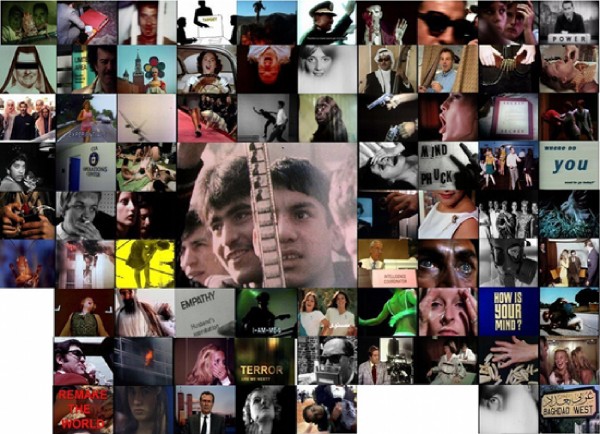
More Resources on Adam Curtis:
The Guardian: Adam Curtis argues TV needs 'new tools' to tell its stories
by Norman Ball
Bright Lights Film Journal
Before this essay interrogates Adam Curtis' hidden vestibules, gimpy tripods, and grassy knolls, I'd like to say that any book or film that keeps me thinking a year after I encounter it passes my substantiality test. The Power of Nightmares and The Century of the Self easily fit this category. (I saw All Watched Over by Machines of Loving Grace, The Living Dead, and bits of The Trap only last week.) To survive the immediate frame of the modern attention span is to escape the charge of empty spectacle. You can't fake sustained recollection.
Substance need not equate to wholesale affirmation, however. A good polemic dusts off the thinking caps even of its opponents. Curtis' films provide, at the very least, dialectical lightning rods for alternate narrative threads. Can the same be said for (insert any American TV show)?
In recent weeks Curtis has been arguing for television (BBC being the originating medium for his documentary films, though an American audience can view them on Youtube and Vimeo) to refashion its storytelling techniques ("Adam Curtis Argues TV Needs 'New Tools' to Tell Its Stories," The Guardian, August 22, 2012). It should be fascinating to see where Curtis' films conduct television in the coming months and years. Now, if we could only get American TV to mosey on over to where Curtis has already been, that would be advancement indeed. Right now, stateside viewers are All Kvetched Over by Whole Reams of Will and Grace, but only on DVD due to some contractual disputes that preclude syndication and broadcast. Curtis offers many of his films for free on the Internet. Need I kvetch more?
The award-winning The Century of the Self (2002) offers a devastating critique of our subliminal cooptation from a lifetime's exposure to "father of public relations" Eddie Bernays' propaganda techniques. Whoops, did I just say propaganda? Bernays' most diligent pupil, Josef Goebbels, is rolling over in his hell-pit right now. Let's leave it at public relations. I'm particularly fond of Bernays' quote (very crudely paraphrased here) that democracy is a wonderful system so long as he, Bernays, exerted final subliminal pull over the lever pulled inside the voting booth. Historian Carroll Quigley (mentor of a certain Rhodes Scholar, Bill Clinton), upon being made privy to the papers of the American elite, realized that nothing was left to chance, not even 50-50 propositions. In what's often referred to as the Quigley Principle, this Georgetown professor torpedoed the notion of a vigorous two-party system. Both levers are vetted and fixed. Here he is paraphrasing the mindset of the government behind the government: "The argument that the two parties should represent opposed ideals and policies, one, perhaps, of the Right and the other of the Left, is a foolish idea acceptable only to the doctrinaire and academic thinkers. Instead, the two parties should be almost identical, so that the American people can 'throw the rascals out' at any election without leading to any profound or extreme shifts in policy" (Carroll Quigley, from Tragedy and Hope).
This is not a call to embrace monolithic conspiracy theories. There often is, as Quigley went on to suggest, dissension at the highest levels of power. Jealousy is after all a facet of power. Bernays too saw the value of ostensible choice in a democratic-capitalist system where everything boils down to packaging anyway. A typical Bernays adBy the end of WWII, needs in America had, by and large, been put to bed. Desire was the ultimate lever, a grail of incalculable dual potential. Freud's irrational man, with his limitless storehouse of appetites and anxieties, would furnish economic growth ad infinitum. Never mind that natural resources such as oil and copper are ultimately finite. For the moment, sustainment models such as that proposed by Jay Forrester and the Club of Rome's 1972 Limits to Growth (covered extensively in All Watched Over by Machines of Loving Grace) loomed in the near-distance.
To Read the Rest of the Essay
More Resources on Adam Curtis:
The Guardian: Adam Curtis argues TV needs 'new tools' to tell its stories
Wednesday, October 3, 2012
Dennis Lim: Time Has Been Kind to Heaven's Gate
Time Has Been Kind to Heaven's Gate
by Dennis Lim
The New York Times

...
Lee Kline, the technical director at Criterion, said, “It wasn’t an option to go back to the original negative because that was what was cut down to the short version.” The original 70-millimeter prints were also in poor shape. So in a costly, complicated process, the restoration team scanned each color separation negative individually and recombined them.
“Heaven’s Gate” may be a subject Mr. Cimino has avoided for years, but once he gets going, the floodgates open. He spoke fondly of the performances of Kris Kristofferson, Christopher Walken and Isabelle Huppert, which he feels have never gotten their due. And he recalled the genesis of the project: Researching the history of barbed wire and the cattle industry, he came upon an incident known as the Johnson County War involving cattlemen, hired killers and local ranchers. He described the epilogue — the weary hero, James Averill (Mr. Kristofferson), on a yacht off the New England coast — as “a prelude to ‘The Great Gatsby,’ ” with Averill as the mogul awaiting the arrival of the young James Gatz.
Mr. Cimino also recalled his obsessive quest for authenticity that led many to characterize “Heaven’s Gate” as a runaway production. (First budgeted at less than $10 million, the film grew to a cost of $35 million, or $44 million including promotional costs, according to Mr. Bach’s book. Mr. Cimino maintains that it was “all in $32 million.”) As he put it, “Everything was problematical”: the locomotive that had to be transported to the Montana location from a Denver museum; a horse-drawn buggy whose spokes and upholstery had to be made in different states. “The movie could not be made today, even if you threw $300 million at it,” he said. “All of that is being lost. The wagons don’t exist, the skills are gone.”
Present-day viewers may well find that time has been kind to “Heaven’s Gate,” which plays more than ever like a fittingly bleak apotheosis of the New Hollywood, an eccentric yet elegiac rethinking of the myths of the West and the western, with an uncommonly blunt take on class in America. (“It’s getting dangerous to be poor in this country,” someone says. The rejoinder: “It always was.”) But this defiant last gasp of the downbeat ’70s, opening two weeks after Ronald Reagan was elected president, was plainly a movie at odds with its time.
Reached at his home in Hawaii, Mr. Kristofferson said he believes the themes of the film, with its grim view of American capitalism, were what made it so unpalatable. “It was a political assassination,” he said. He recalled getting word that Reagan’s first attorney general, William French Smith, had told studio heads that “there should be no more pictures made with a negative view of American history.”
Mr. Kristofferson, sounding more rueful than bitter, said that the reception to “Heaven’s Gate” knocked him off the Hollywood A-list for good. “I never really recovered from that,” he said, but he acknowledged that it was worse for Mr. Cimino. “It completely destroyed him.”
Mr. Cimino continued to work, albeit infrequently; he has made four features since “Heaven’s Gate,” the last one, “Sunchaser,” in 1996. A painter who began his directing career in advertising, he said that at home in Los Angeles he rarely watches movies now (and prefers to reread Pushkin and Flaubert). But he does have a film project in mind, which he hopes to shoot in digital soon.
Ms. Carelli, who was with Mr. Cimino in Venice, said that while there remain misconceptions about the making of “Heaven’s Gate,” “I don’t want to revisit old erroneous stories and try to correct them.” She added, “Now the film finally speaks for itself, and it has the final word.”
To Read the Entire Article
More Resources:
The Making and Unmaking of Heaven's Gate

by Dennis Lim
The New York Times
...
Lee Kline, the technical director at Criterion, said, “It wasn’t an option to go back to the original negative because that was what was cut down to the short version.” The original 70-millimeter prints were also in poor shape. So in a costly, complicated process, the restoration team scanned each color separation negative individually and recombined them.
“Heaven’s Gate” may be a subject Mr. Cimino has avoided for years, but once he gets going, the floodgates open. He spoke fondly of the performances of Kris Kristofferson, Christopher Walken and Isabelle Huppert, which he feels have never gotten their due. And he recalled the genesis of the project: Researching the history of barbed wire and the cattle industry, he came upon an incident known as the Johnson County War involving cattlemen, hired killers and local ranchers. He described the epilogue — the weary hero, James Averill (Mr. Kristofferson), on a yacht off the New England coast — as “a prelude to ‘The Great Gatsby,’ ” with Averill as the mogul awaiting the arrival of the young James Gatz.
Mr. Cimino also recalled his obsessive quest for authenticity that led many to characterize “Heaven’s Gate” as a runaway production. (First budgeted at less than $10 million, the film grew to a cost of $35 million, or $44 million including promotional costs, according to Mr. Bach’s book. Mr. Cimino maintains that it was “all in $32 million.”) As he put it, “Everything was problematical”: the locomotive that had to be transported to the Montana location from a Denver museum; a horse-drawn buggy whose spokes and upholstery had to be made in different states. “The movie could not be made today, even if you threw $300 million at it,” he said. “All of that is being lost. The wagons don’t exist, the skills are gone.”
Present-day viewers may well find that time has been kind to “Heaven’s Gate,” which plays more than ever like a fittingly bleak apotheosis of the New Hollywood, an eccentric yet elegiac rethinking of the myths of the West and the western, with an uncommonly blunt take on class in America. (“It’s getting dangerous to be poor in this country,” someone says. The rejoinder: “It always was.”) But this defiant last gasp of the downbeat ’70s, opening two weeks after Ronald Reagan was elected president, was plainly a movie at odds with its time.
Reached at his home in Hawaii, Mr. Kristofferson said he believes the themes of the film, with its grim view of American capitalism, were what made it so unpalatable. “It was a political assassination,” he said. He recalled getting word that Reagan’s first attorney general, William French Smith, had told studio heads that “there should be no more pictures made with a negative view of American history.”
Mr. Kristofferson, sounding more rueful than bitter, said that the reception to “Heaven’s Gate” knocked him off the Hollywood A-list for good. “I never really recovered from that,” he said, but he acknowledged that it was worse for Mr. Cimino. “It completely destroyed him.”
Mr. Cimino continued to work, albeit infrequently; he has made four features since “Heaven’s Gate,” the last one, “Sunchaser,” in 1996. A painter who began his directing career in advertising, he said that at home in Los Angeles he rarely watches movies now (and prefers to reread Pushkin and Flaubert). But he does have a film project in mind, which he hopes to shoot in digital soon.
Ms. Carelli, who was with Mr. Cimino in Venice, said that while there remain misconceptions about the making of “Heaven’s Gate,” “I don’t want to revisit old erroneous stories and try to correct them.” She added, “Now the film finally speaks for itself, and it has the final word.”
To Read the Entire Article
More Resources:
The Making and Unmaking of Heaven's Gate
Saturday, July 21, 2012
Robert Farrow: The Wicker Man -- Games of truth, anthropology, and the death of ‘man’
The Wicker Man: Games of truth, anthropology, and the death of ‘man’
by Robert Farrow
Metaphilm

The Wicker Man, a cult classic of 1970s British cinema, portrays the investigation of an authoritarian police officer (played by Edward Woodward) into the mysterious disappearance of a young girl in the remote Scottish island of Summerisle. It becomes apparent that the islanders observe various ancient pagan traditions, and Sgt. Howie—a committed Christian—becomes increasingly suspicious of them. Eventually, he comes to suspect that she is somewhere imprisoned, earmarked as a human sacrifice for the Mayday festival of Beltane.
As the mystery unfolds, Howie comes to realizes the awful truth: the missing girl was a mystery fabricated in order to lure him to Summerisle, and it is in fact he who is to be burnt alive in the Wicker Man as an offering to the renewed cult of the old gods. This sinister ending has ensured this film a place in the annals of horror despite its divergence from the tropes of most horror films of the 1970s. The Wicker Man presents no bogeymen, no vampires, and no sinister music; its ending is all the more shocking, in fact, for the twee charm of the villagers and the folk-music score, which lead the audience into a false state of complacency that mirrors Sgt. Howie’s own vulnerability. And in a further departure from other examples of the genre, the antagonists are in no way demonized.
So, if The Wicker Man breaks so many of the genre rules, why is it such an unsettling film? One answer is illuminated by the complex matrices of truth, power, and knowledge made familiar by the French historian and philosopher, Michel Foucault: The Wicker Man presents us with an alarm call to wake us from “anthropological sleep,” and to tear down and burn our own false conceptions of “man.”
Foucault, a noted critic of the social sciences, rejected all positive notions of objectivity and human nature. For Foucault, we exist trapped within a kind of postmodern labyrinth (or “archive”), where truths are relative to the societies and practices that develop them. This is not a facile cultural relativism. Instead, we are invited to understand truths as problematized, colored by the contexts and subjects that produce them. The power structures that (so to speak) restrain us are also what makes our freedom possible, conditioning our thought at a collective, unconscious level.
Foucault’s own diagnosis of the present took the form of investigations into (often obscure) historical documents that aimed at exposing the implicit “truths” that underlie social practices and norms, thereby supporting his position as a thinker of social and historical relativity. As his work developed, it became clear that the driving force behind his work was an interest in how senses of identity are formed when the self is essentially a product of certain power/knowledge relationships, discourses, and games of truth.
Foucault’s early works—and The Wicker Man—offer this message: identity is best understood as an amorphous, shifting fiction, an “anthropology” that is to be exposed. When the full import of this becomes understood, the effect is rather more unsettling than the fraternity gorefests that typify many later horror films.
To Read the Rest of the Essay
by Robert Farrow
Metaphilm
The Wicker Man, a cult classic of 1970s British cinema, portrays the investigation of an authoritarian police officer (played by Edward Woodward) into the mysterious disappearance of a young girl in the remote Scottish island of Summerisle. It becomes apparent that the islanders observe various ancient pagan traditions, and Sgt. Howie—a committed Christian—becomes increasingly suspicious of them. Eventually, he comes to suspect that she is somewhere imprisoned, earmarked as a human sacrifice for the Mayday festival of Beltane.
As the mystery unfolds, Howie comes to realizes the awful truth: the missing girl was a mystery fabricated in order to lure him to Summerisle, and it is in fact he who is to be burnt alive in the Wicker Man as an offering to the renewed cult of the old gods. This sinister ending has ensured this film a place in the annals of horror despite its divergence from the tropes of most horror films of the 1970s. The Wicker Man presents no bogeymen, no vampires, and no sinister music; its ending is all the more shocking, in fact, for the twee charm of the villagers and the folk-music score, which lead the audience into a false state of complacency that mirrors Sgt. Howie’s own vulnerability. And in a further departure from other examples of the genre, the antagonists are in no way demonized.
So, if The Wicker Man breaks so many of the genre rules, why is it such an unsettling film? One answer is illuminated by the complex matrices of truth, power, and knowledge made familiar by the French historian and philosopher, Michel Foucault: The Wicker Man presents us with an alarm call to wake us from “anthropological sleep,” and to tear down and burn our own false conceptions of “man.”
Foucault, a noted critic of the social sciences, rejected all positive notions of objectivity and human nature. For Foucault, we exist trapped within a kind of postmodern labyrinth (or “archive”), where truths are relative to the societies and practices that develop them. This is not a facile cultural relativism. Instead, we are invited to understand truths as problematized, colored by the contexts and subjects that produce them. The power structures that (so to speak) restrain us are also what makes our freedom possible, conditioning our thought at a collective, unconscious level.
Foucault’s own diagnosis of the present took the form of investigations into (often obscure) historical documents that aimed at exposing the implicit “truths” that underlie social practices and norms, thereby supporting his position as a thinker of social and historical relativity. As his work developed, it became clear that the driving force behind his work was an interest in how senses of identity are formed when the self is essentially a product of certain power/knowledge relationships, discourses, and games of truth.
Foucault’s early works—and The Wicker Man—offer this message: identity is best understood as an amorphous, shifting fiction, an “anthropology” that is to be exposed. When the full import of this becomes understood, the effect is rather more unsettling than the fraternity gorefests that typify many later horror films.
To Read the Rest of the Essay
Wednesday, January 18, 2012
Andrew C. Billings: Biographical Omissions - The Case of A Beautiful Mind and the Search For Authenticity
Biographical Omissions: The Case of A Beautiful Mind and the Search For Authenticity
By Andrew C. Billings
The Film Journal

On March 24, 2002, the Academy Awards concluded with a Best Picture statuette awarded to Ron Howard's A Beautiful Mind, a biopic of the schizophrenic mathematician John Forbes Nash. While Nash's real-life story is remarkable, another story of "overcoming the odds" has been built: the story of how A Beautiful Mind survived a whirlwind of negative publicity to gain the Best Picture award. The controversy stemmed from perceptions that Nash's life has been whitewashed for the silver screen, including the omission of (a) Nash's alleged anti-Semitism, (b) his homosexual leanings, and (c) his divorce and ultimate remarriage to current-wife Alicia Nash (Bunbury, 2002; Lyman, 2002; Mcginty, 2002). Detractors argued that A Beautiful Mind was being irresponsible to omit such large issues, yet Universal Pictures stood behind the film, arguing that no one's life can be portrayed in its entirety and that A Beautiful Mind had been as accurate as possible. The studio went on to say that there was clear evidence of an "orchestrated campaign" against the film that had more to do with winning an Oscar than achieving authenticity (Seiler, 2002, p. 4D). Film historian Pete Hammond argued that this was one of the nastiest campaigns in recent memory, stating that "to accuse the subject of a film of being Anti-Semitic when you know that a lot of the people who will be voting on the Oscars are Jewish, well, that's really down and dirty" (Lyman, 2002, p. 1A).
Within the entire battle over A Beautiful Mind, one can extract a larger question prevalent within the debate concerning the responsibility of a film to portray a historical person or event in an accurate way. How far must a director go to ensure authenticity? In the case of Howard's film, the questions became quite complex. Take, for instance, Nash's homosexual leanings. Giltz (2002b) writes that Nash was frequently referred to as a "homo" in college and also was arrested for public indecency in a men's restroom, ultimately losing his job at the Rand think tank because of the arrest. In fact, the book in which screenwriter Akiva Goldman adapted the movie contained over thirty references to homosexuality, yet all thirty instances were omitted for the movie (Giltz, 2002a). Thus, while no one was arguing that A Beautiful Mind was telling outright lies, they did argue the film was guilty by omission. Contrast this with the equally ugly controversy surrounding the 1996 film Ghosts of Mississippi, chronicling the murder of civil rights leader Medgar Evers and the subsequent trial to exact justice thirty years later. Critics all agreed that Ghosts of Mississippi was "85 to 90 percent true", but, as Medgar Evers' brother Charles states, "the bigger problem is that other 'true' facts are shunted to the background" (Wiltz, 1997). In the case of A Beautiful Mind, some were even arguing that the film was 100% true, but that the majority of the whole truth was left out. In the case of Nash's homosexuality, it was not even an overt choice, as Brian Grazer and Ron Howard were forced to sign a contract that guaranteed the omission of such leanings. Thus, A Beautiful Mind becomes not a case of a director making choices of what to keep and what to leave on the cutting room floor; instead, A Beautiful Mind can be equated with the television journalist who agrees to requests to keep certain topics "off-limits" before interviewing a major public figure.
Hardt (1993) states that the "question of authenticity remains one of the major issues underlying the critique of contemporary social thought" (p. 49). Yet, one must wonder: could anyone, even Nash himself or his wife Alicia, tell a story that is 100 percent true? More succinctly, is authenticity attainable? The latter question must be answered in the negative, as authenticity is an ideal that is unreachable and that American society should implement a new standard for measuring the "accuracy" of historical film narratives. A Beautiful Mind is just the most recent in a long line of films criticized for not being "accurate enough." The debate has been waged for decades.
It is a common notion within academia that nothing we ever say is truly authentic; everything is borrowed directly or indirectly from someone else. In essence, every story we tell is someone else's depiction or at least someone else's language that has been instilled within us through maturation. For instance, if a person were to tell the story of how their first day of school was, it would be their own story, yet their language would be influenced by their background and through other students' perceptions. Clearly, it is likely that a thousand people could each live the exact same day and still render a thousand different authentic stories. Thus, the moral contact with self that Trilling (1969) describes does not really make a story authentic, but it can make a story true. For instance, people who were present at the assassination of John F. Kennedy would all have a true story to tell that would depict their version of the true happenings. Still, as evidenced in the past 30 years, there were many different sides to the same "Truth", making absolute authenticity impossible, even for eyewitnesses of the assassination.
As a result, Visker (1995) argues that the "subject" of any story should be dropped from any argument pertaining to authenticity; the only important aspect of the story is the author/storyteller's ability to recall or retell the story to the best of his or her collective memory. So, in response to the question proposed in the introduction, Visker would argue that who tells the story in Schindler's List is not important; what is of vital importance is that the person telling the story has the ability to tell the story as closely as possible to collective memory found from witnesses and research. In the case of Spielberg's Holocaust epic, this proved to have obstacles of its own, as critics subsequently learned that key scenes, such as Liam Neeson's great "one more person" monologue, were inserted for dramatic effect rather than for historic accuracy.
Yet, beyond the question of the "right to tell a story" comes the larger question of the need to tell the story accurately, another historical Holy Grail. As previously argued, there is no way any director or film producer can tell a story that somehow is or becomes a historical event. Three hundred factually accurate films about the JFK assassination could be made; still they would have three hundred different contexts, equating to three hundred different stories.
To Read the Rest of the Essay
By Andrew C. Billings
The Film Journal
On March 24, 2002, the Academy Awards concluded with a Best Picture statuette awarded to Ron Howard's A Beautiful Mind, a biopic of the schizophrenic mathematician John Forbes Nash. While Nash's real-life story is remarkable, another story of "overcoming the odds" has been built: the story of how A Beautiful Mind survived a whirlwind of negative publicity to gain the Best Picture award. The controversy stemmed from perceptions that Nash's life has been whitewashed for the silver screen, including the omission of (a) Nash's alleged anti-Semitism, (b) his homosexual leanings, and (c) his divorce and ultimate remarriage to current-wife Alicia Nash (Bunbury, 2002; Lyman, 2002; Mcginty, 2002). Detractors argued that A Beautiful Mind was being irresponsible to omit such large issues, yet Universal Pictures stood behind the film, arguing that no one's life can be portrayed in its entirety and that A Beautiful Mind had been as accurate as possible. The studio went on to say that there was clear evidence of an "orchestrated campaign" against the film that had more to do with winning an Oscar than achieving authenticity (Seiler, 2002, p. 4D). Film historian Pete Hammond argued that this was one of the nastiest campaigns in recent memory, stating that "to accuse the subject of a film of being Anti-Semitic when you know that a lot of the people who will be voting on the Oscars are Jewish, well, that's really down and dirty" (Lyman, 2002, p. 1A).
Within the entire battle over A Beautiful Mind, one can extract a larger question prevalent within the debate concerning the responsibility of a film to portray a historical person or event in an accurate way. How far must a director go to ensure authenticity? In the case of Howard's film, the questions became quite complex. Take, for instance, Nash's homosexual leanings. Giltz (2002b) writes that Nash was frequently referred to as a "homo" in college and also was arrested for public indecency in a men's restroom, ultimately losing his job at the Rand think tank because of the arrest. In fact, the book in which screenwriter Akiva Goldman adapted the movie contained over thirty references to homosexuality, yet all thirty instances were omitted for the movie (Giltz, 2002a). Thus, while no one was arguing that A Beautiful Mind was telling outright lies, they did argue the film was guilty by omission. Contrast this with the equally ugly controversy surrounding the 1996 film Ghosts of Mississippi, chronicling the murder of civil rights leader Medgar Evers and the subsequent trial to exact justice thirty years later. Critics all agreed that Ghosts of Mississippi was "85 to 90 percent true", but, as Medgar Evers' brother Charles states, "the bigger problem is that other 'true' facts are shunted to the background" (Wiltz, 1997). In the case of A Beautiful Mind, some were even arguing that the film was 100% true, but that the majority of the whole truth was left out. In the case of Nash's homosexuality, it was not even an overt choice, as Brian Grazer and Ron Howard were forced to sign a contract that guaranteed the omission of such leanings. Thus, A Beautiful Mind becomes not a case of a director making choices of what to keep and what to leave on the cutting room floor; instead, A Beautiful Mind can be equated with the television journalist who agrees to requests to keep certain topics "off-limits" before interviewing a major public figure.
Hardt (1993) states that the "question of authenticity remains one of the major issues underlying the critique of contemporary social thought" (p. 49). Yet, one must wonder: could anyone, even Nash himself or his wife Alicia, tell a story that is 100 percent true? More succinctly, is authenticity attainable? The latter question must be answered in the negative, as authenticity is an ideal that is unreachable and that American society should implement a new standard for measuring the "accuracy" of historical film narratives. A Beautiful Mind is just the most recent in a long line of films criticized for not being "accurate enough." The debate has been waged for decades.
It is a common notion within academia that nothing we ever say is truly authentic; everything is borrowed directly or indirectly from someone else. In essence, every story we tell is someone else's depiction or at least someone else's language that has been instilled within us through maturation. For instance, if a person were to tell the story of how their first day of school was, it would be their own story, yet their language would be influenced by their background and through other students' perceptions. Clearly, it is likely that a thousand people could each live the exact same day and still render a thousand different authentic stories. Thus, the moral contact with self that Trilling (1969) describes does not really make a story authentic, but it can make a story true. For instance, people who were present at the assassination of John F. Kennedy would all have a true story to tell that would depict their version of the true happenings. Still, as evidenced in the past 30 years, there were many different sides to the same "Truth", making absolute authenticity impossible, even for eyewitnesses of the assassination.
As a result, Visker (1995) argues that the "subject" of any story should be dropped from any argument pertaining to authenticity; the only important aspect of the story is the author/storyteller's ability to recall or retell the story to the best of his or her collective memory. So, in response to the question proposed in the introduction, Visker would argue that who tells the story in Schindler's List is not important; what is of vital importance is that the person telling the story has the ability to tell the story as closely as possible to collective memory found from witnesses and research. In the case of Spielberg's Holocaust epic, this proved to have obstacles of its own, as critics subsequently learned that key scenes, such as Liam Neeson's great "one more person" monologue, were inserted for dramatic effect rather than for historic accuracy.
Yet, beyond the question of the "right to tell a story" comes the larger question of the need to tell the story accurately, another historical Holy Grail. As previously argued, there is no way any director or film producer can tell a story that somehow is or becomes a historical event. Three hundred factually accurate films about the JFK assassination could be made; still they would have three hundred different contexts, equating to three hundred different stories.
To Read the Rest of the Essay
Subscribe to:
Posts (Atom)