Showing posts with label Comedy. Show all posts
Showing posts with label Comedy. Show all posts
Tuesday, October 29, 2013

Thursday, October 24, 2013
Cemetery Man (Italy/France/Germany: Michele Soavi, 1994)

Cemetery Man (Italy/France/Germany: Michele Soavi, 1994: 105 mins)
The excellently named Francesco Dellamorte (Rupert Everett, never better) is the moody caretaker of a small-town Italian cemetery where the dead just keep coming back to life, much to his annoyance. His everyday tedium of reading phone books and killing zombies is broken when he falls madly in love with a nameless beautiful widow. Unfortunately, she too perishes and returns as a zombie. A strange and entertaining erotic-horror-comedy, Cemetery Man (titled Dellamorte Dellamore in Italian) is required viewing for anyone of the sadboi persuasion. – Anna BogutskayaDumas, Andre. "Cemetery Man: By Keeping Things the Same, We Can Change More Effectively." Horror Digest (March 30, 2011)
Kuersten, Erich. "The Shrouds of Soavi: Cemetery Man, The Devil's Daughter." Acidemic (September 8, 2016)
Seda, Alex. "Dellamorte Dellamore (a.k.a. Cemetery Man) Review." Midnight Showing (July 10, 2009)
"TGIF #5: CEMETERY MAN (aka DELLAMORTE DELLAMORE)" Adamantium Bullet (July 24, 2009)
Thursday, June 13, 2013
I Heart Huckabees (USA/Germany: David O' Russell, 2004)

I Heart Huckabees (USA/Germany: David O' Russell, 2004: 107 minutes)
Garrett, Daniel. "Laughter and Philosophy: David Owen Russell’s I ♥ Huckabees." Offscreen (January 31, 2005)
Johnson, Mackenzie. "What Makes David O. Russell so David O. Russell." Film Stage (October 17, 2016)
Kennedy, A.L. "Sartre and the Individual." A History of Ideas (April 15, 2015) ["Writer AL Kennedy on Existentialist ideas about the individual. Jean Paul Sartre argued that, for humans, 'existence preceded essence'. This means that there is no blueprint or template from which to work - humans are free to make themselves up as they go along. Being an individual comes from the way you negotiate this freedom and the choices you make in the face of it."]
Kirby, Matt. "I Heart Huckabees: Premodern Help for Postmodern Times." Metaphilm (November 12, 2004)
Lee, Kevin B.. "The Wahlberg Effect." Keyframe (September 26, 2016)
Ng, Edwin. "The (Zen) Buddhist Heart of I ♥ Huckabees." Journal of Religion & Film 14.1 (April 2010)
Shaw, Daniel. Film and Philosophy: Taking Movies Seriously. NY: Wallflower, 2008. [In BCTC Library]
Tait, R. Colin. "'Jesus is never mad at us if we live with him in our hearts': The Dialectical View of America in David O' Russell's I Heart Huckabees." Cinephile (March 2006)
Monday, May 13, 2013
John Engle -- August and Everything After: A Half-Century of Surfing in Cinema
August and Everything After: A Half-Century of Surfing in Cinema
by John Engle
Bright Lights Film Journal
...
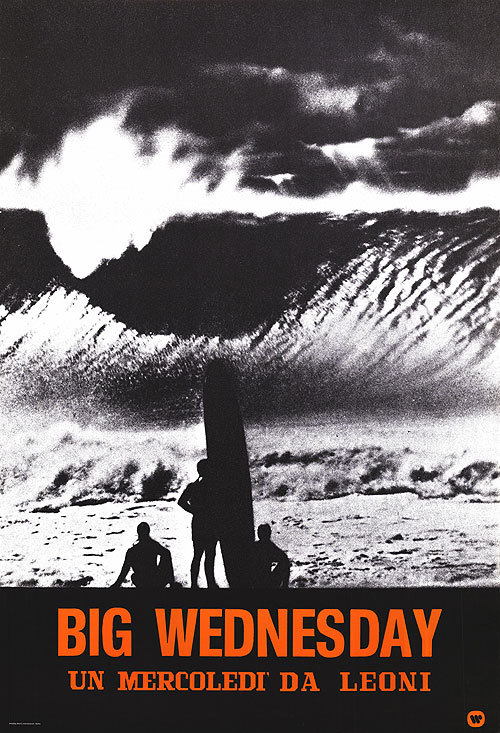
The tensions of these real and screen lives have in large part remained those of the film genre Gidget engendered. In the half-century since, from the Beach Party franchise and its early '60s spin-offs, through Big Wednesday, Point Break, Blue Crush, and many others, and on to Chasing Mavericks in 2012, filmmakers have gone to the sand a couple dozen times to produce narratives either focused expressively on surfing as sport or obsessive life choice, or at least as significant background informing and directing the film's meaning. The result has been movies that are often more incisively pertinent in their treatment of growing up, family tensions, a world of dizzying social change, race and class, and the seductive lure of commerce and appearance than their wicked barrels, great tans, and dudespeak might presage. With an eye to the meanings behind their attractive surfaces, I'll be looking at a handful of these, at least one from each decade, for the most part relatively high-profile examples of a film type that, if rarely the source of smash hits, has generally met with commercial success. Hardening firmly in place by the 1970s, a highly restrictive formula thereafter rules the near totality of these films: given their interest in young people on the cusp of adult life, it's not without a certain logic that they return repeatedly to such story elements as the wise mentor, the temptation to sell out, the preparation sequence, and the concluding challenge or competition. The remarks to follow will examine the genre's creation in the beach-craze '60s, then turn to its elaboration in what one might consider the main line of "classic" surf films, with their reliably formulaic focus on childhood's end; the conclusion will explore how, while remaining generally faithful to established patterns, certain films have brought within their widened purview broader social and political issues. With the exception of Bruce Brown's The Endless Summer (1966) — a documentary but vaguely story-centered and, in any case, so iconic as to be compulsory — all of the films under discussion are pure narratives. As such, they should be distinguished from the grainy collections of hot rides Greg Noll brought to stoked kids in countless multipurpose halls and their often lyrical or thrilling cinematic descendants. Whether big deals like Riding Giants and Step into Liquid, or smaller, edgier efforts like BS!, these documentaries are absolutely central to the surfing subculture and merit separate study, with their specialist target audience, their shared values, and visual assumptions.
Unsurprisingly perhaps, the first treatments of waveriding were documentary in nature and aimed at the widest possible audience. Like les Pathé-Frères, who put together 100 minutes on Le Surfing: Sport national des iles Hawaii in 1911, filmmakers in the first half of the century responded periodically to a curious public's hunger for images of exotic locales and practices that, even in the era of grand liners and early aviation, remained largely inaccessible. By the thirties, in any case, the word on surfing was getting out, if Hawaiian Holiday, the first cinematic narrative treatment of the sport, is any indication. In this 1937 Mickey Mouse featurette, Goofy recklessly challenges waves that, with the typical extraordinary range of Disney's animation teams, manage at once to be dumb funny, anthropomorphically nasty, and possessed of a frothy, sculpted loveliness drawn straight from Hokusai. While the cartoon is (somewhat speciously) considered the source of the term goofy-footed for surfers who, like its hero, lead with their right foot, its variation on the timeless theme of the arrogant individual chastised by a recalcitrant natural world in fact says little more about surfing than that it was just edging into the public consciousness. It would take the '50s and early '60s and the sport's headlong drop into popular culture before filmmakers would begin to recognize and exploit its rich visual and thematic possibilities.
And what visuals, for there is something basically unbelievable about human beings standing up on a tumbling wave, not to mention carving sleek sweeps and tight reverses back up its face. Cinematically, what's not to like about good-looking kids in a dream locale practicing a potentially dangerous sport that, even straight-on from a fixed shore location in black and white, films like a million bucks? Considered a moment, however, the scene is much more than its very pretty pictures, in large part because of the richly conflicting signals it emits. As sport, identity definer, and style locus, the surfing we have come to know these last decades is a space of, variously, big-money competition, reverent communication with the natural world, heavy partying, one-to-one confrontation with appalling physical force, proprietary localism of the ugliest sort, New Age self-discovery. It is a counterculture and a culture, a way to rebel and a way to grow up, and some live an entire adult life, work and all, still somehow rhythmed by the daily wave report. Surfing is the Beach Boys sweet in their striped Kingston Trio short-sleeve button-downs, and it's Dora dive-bombing kooks and bouncing checks. It's the garden and the salesmen who slither into it. Let's go surfin' now, everybody's learnin' how, we are joyfully urged, but to paddle out as the new guy is in fact to try entering the most closed of societies. Surfing can seem like an ocean of style, posing, and attitude, but out in the impact zone and beyond, the superficial abruptly washes off. To choose a short board or long, three fins or one, can be no less than to define different selves and value systems.
The very physical space offers an equally rich palette of thematic opportunity. From knee-high kids' stuff to Fukushima, pure fluid energy rears in defiance at sudden, solid resistance. The arriving swell is pattern and endless variety, or as Laird Hamilton says of the big ones in The Wave, "it's never the same mountain" (72). Proceeding in stately sequence, breakers seem all ruler-edged order, but of course they are also sites of chaos and fear. There the simple can become "in practice immediately complex," writes Woolf in To the Lighthouse, "as the waves shape themselves symmetrically from the cliff top, but to the swimmer among them are divided by steep gulfs, and foaming crests." Wild swings of perspective rule the sand as well, for what place is more one for sun-drenched, thought-free lotus-eating than the beach. Yet on that thin strip of dry land the tragic drama of our collective addiction to fossil fuels will play out first. And even carefree Waikiki lies hard by an ocean's unfathomable mass with its troubling, timeless reach of myth and suggestion. It is on the shore after all that Wordsworth rejects that world that is too much with us, yearning seaward to affirm the deeper truths of Proteus and Triton. The beach is just the beach, and it is much more than that. The greatest of the wavewriters, Daniel Duane, recognizes the way the surf scene can encode paradox, locate that sweet spot where the deeply complex and the unreflective simple both somehow find their footing.
...
To Read the Entire Essay

by John Engle
Bright Lights Film Journal
...
The tensions of these real and screen lives have in large part remained those of the film genre Gidget engendered. In the half-century since, from the Beach Party franchise and its early '60s spin-offs, through Big Wednesday, Point Break, Blue Crush, and many others, and on to Chasing Mavericks in 2012, filmmakers have gone to the sand a couple dozen times to produce narratives either focused expressively on surfing as sport or obsessive life choice, or at least as significant background informing and directing the film's meaning. The result has been movies that are often more incisively pertinent in their treatment of growing up, family tensions, a world of dizzying social change, race and class, and the seductive lure of commerce and appearance than their wicked barrels, great tans, and dudespeak might presage. With an eye to the meanings behind their attractive surfaces, I'll be looking at a handful of these, at least one from each decade, for the most part relatively high-profile examples of a film type that, if rarely the source of smash hits, has generally met with commercial success. Hardening firmly in place by the 1970s, a highly restrictive formula thereafter rules the near totality of these films: given their interest in young people on the cusp of adult life, it's not without a certain logic that they return repeatedly to such story elements as the wise mentor, the temptation to sell out, the preparation sequence, and the concluding challenge or competition. The remarks to follow will examine the genre's creation in the beach-craze '60s, then turn to its elaboration in what one might consider the main line of "classic" surf films, with their reliably formulaic focus on childhood's end; the conclusion will explore how, while remaining generally faithful to established patterns, certain films have brought within their widened purview broader social and political issues. With the exception of Bruce Brown's The Endless Summer (1966) — a documentary but vaguely story-centered and, in any case, so iconic as to be compulsory — all of the films under discussion are pure narratives. As such, they should be distinguished from the grainy collections of hot rides Greg Noll brought to stoked kids in countless multipurpose halls and their often lyrical or thrilling cinematic descendants. Whether big deals like Riding Giants and Step into Liquid, or smaller, edgier efforts like BS!, these documentaries are absolutely central to the surfing subculture and merit separate study, with their specialist target audience, their shared values, and visual assumptions.
Unsurprisingly perhaps, the first treatments of waveriding were documentary in nature and aimed at the widest possible audience. Like les Pathé-Frères, who put together 100 minutes on Le Surfing: Sport national des iles Hawaii in 1911, filmmakers in the first half of the century responded periodically to a curious public's hunger for images of exotic locales and practices that, even in the era of grand liners and early aviation, remained largely inaccessible. By the thirties, in any case, the word on surfing was getting out, if Hawaiian Holiday, the first cinematic narrative treatment of the sport, is any indication. In this 1937 Mickey Mouse featurette, Goofy recklessly challenges waves that, with the typical extraordinary range of Disney's animation teams, manage at once to be dumb funny, anthropomorphically nasty, and possessed of a frothy, sculpted loveliness drawn straight from Hokusai. While the cartoon is (somewhat speciously) considered the source of the term goofy-footed for surfers who, like its hero, lead with their right foot, its variation on the timeless theme of the arrogant individual chastised by a recalcitrant natural world in fact says little more about surfing than that it was just edging into the public consciousness. It would take the '50s and early '60s and the sport's headlong drop into popular culture before filmmakers would begin to recognize and exploit its rich visual and thematic possibilities.
And what visuals, for there is something basically unbelievable about human beings standing up on a tumbling wave, not to mention carving sleek sweeps and tight reverses back up its face. Cinematically, what's not to like about good-looking kids in a dream locale practicing a potentially dangerous sport that, even straight-on from a fixed shore location in black and white, films like a million bucks? Considered a moment, however, the scene is much more than its very pretty pictures, in large part because of the richly conflicting signals it emits. As sport, identity definer, and style locus, the surfing we have come to know these last decades is a space of, variously, big-money competition, reverent communication with the natural world, heavy partying, one-to-one confrontation with appalling physical force, proprietary localism of the ugliest sort, New Age self-discovery. It is a counterculture and a culture, a way to rebel and a way to grow up, and some live an entire adult life, work and all, still somehow rhythmed by the daily wave report. Surfing is the Beach Boys sweet in their striped Kingston Trio short-sleeve button-downs, and it's Dora dive-bombing kooks and bouncing checks. It's the garden and the salesmen who slither into it. Let's go surfin' now, everybody's learnin' how, we are joyfully urged, but to paddle out as the new guy is in fact to try entering the most closed of societies. Surfing can seem like an ocean of style, posing, and attitude, but out in the impact zone and beyond, the superficial abruptly washes off. To choose a short board or long, three fins or one, can be no less than to define different selves and value systems.
The very physical space offers an equally rich palette of thematic opportunity. From knee-high kids' stuff to Fukushima, pure fluid energy rears in defiance at sudden, solid resistance. The arriving swell is pattern and endless variety, or as Laird Hamilton says of the big ones in The Wave, "it's never the same mountain" (72). Proceeding in stately sequence, breakers seem all ruler-edged order, but of course they are also sites of chaos and fear. There the simple can become "in practice immediately complex," writes Woolf in To the Lighthouse, "as the waves shape themselves symmetrically from the cliff top, but to the swimmer among them are divided by steep gulfs, and foaming crests." Wild swings of perspective rule the sand as well, for what place is more one for sun-drenched, thought-free lotus-eating than the beach. Yet on that thin strip of dry land the tragic drama of our collective addiction to fossil fuels will play out first. And even carefree Waikiki lies hard by an ocean's unfathomable mass with its troubling, timeless reach of myth and suggestion. It is on the shore after all that Wordsworth rejects that world that is too much with us, yearning seaward to affirm the deeper truths of Proteus and Triton. The beach is just the beach, and it is much more than that. The greatest of the wavewriters, Daniel Duane, recognizes the way the surf scene can encode paradox, locate that sweet spot where the deeply complex and the unreflective simple both somehow find their footing.
...
To Read the Entire Essay
Saturday, April 6, 2013
Sound on Sight: Spotlight + Interview – Director Whit Stillman (‘Damsels In Distress,’ ‘The Last Days of Disco’)
Spotlight + Interview – Director Whit Stillman (‘Damsels In Distress,’ ‘The Last Days of Disco’)
Sound on Sight Podcast #319
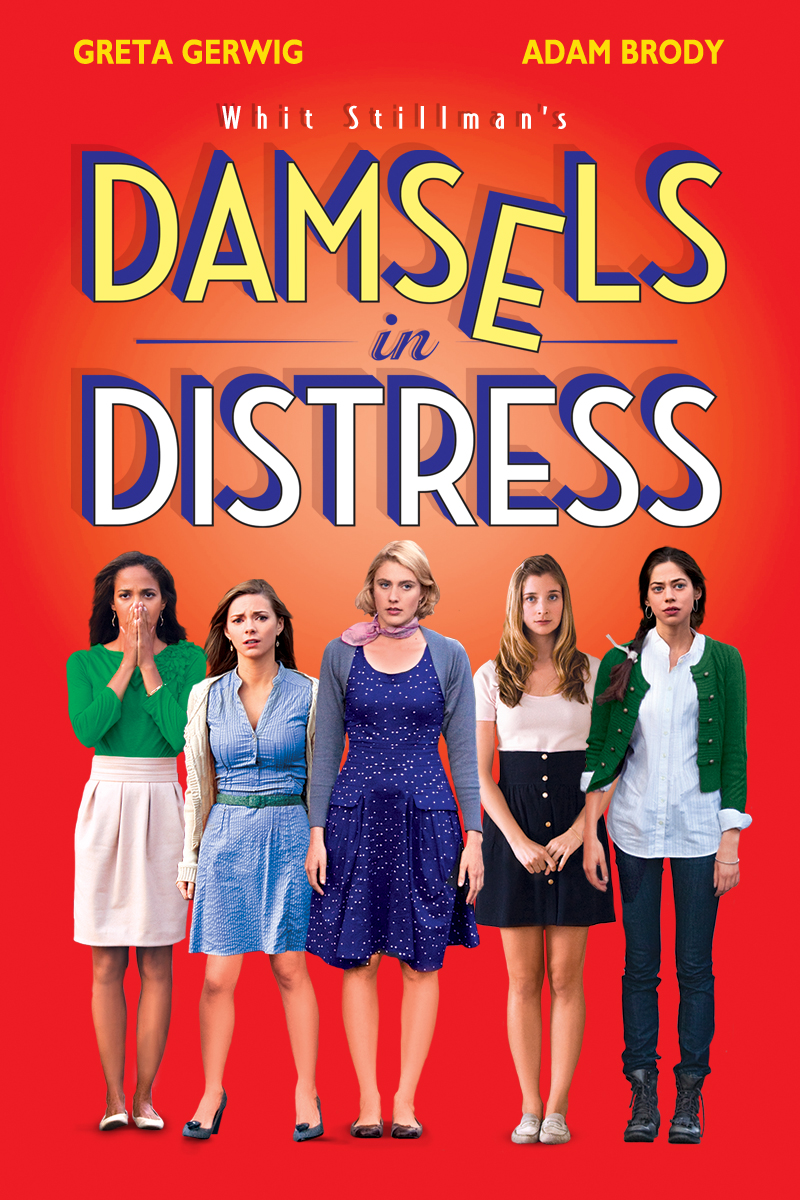
Writer-director Whit Stillman was once one of the most buzzed-about American filmmakers around – that is, until he took almost a decade to make another film. Damsels in Distress, his new, delightfully screwy pseudo-romantic comedy, finally breaks his extended period of silence, and our own Justine Smith got to talk to him about it. She, Simon Howell and special guest Rudie Obias of The AuteurCast review the new movie, along with his previous film, 1998′s The Last Days of Disco.
To Listen to the Episode

Sound on Sight Podcast #319
Writer-director Whit Stillman was once one of the most buzzed-about American filmmakers around – that is, until he took almost a decade to make another film. Damsels in Distress, his new, delightfully screwy pseudo-romantic comedy, finally breaks his extended period of silence, and our own Justine Smith got to talk to him about it. She, Simon Howell and special guest Rudie Obias of The AuteurCast review the new movie, along with his previous film, 1998′s The Last Days of Disco.
To Listen to the Episode
Thursday, April 4, 2013
J. Hoberman -- The Organizer: Description of a Struggle
The Organizer: Description of a Struggle
By J. Hoberman
Current

An unverifiable, if heartfelt, assertion: For the quarter century between 1945 and 1970 (or from Rome Open City to Fellini Satyricon), the world’s greatest popular cinema was produced in Italy—a realm of glamorous superstars, sensational comedians, and great genre flicks. A half dozen maestros were backed by a remarkably deep bench, including writer-director Mario Monicelli (1915–2010), whose 1963 strike drama I compagni (The Comrades), released in the U.S. as The Organizer, is popular cinema in the best sense.
The son of a political journalist who moved from socialism to anarcho-syndicalism to fascism (briefly) to antifascism, and who also founded Italy’s first film journal, Monicelli is best known for his socially aware tragicomedies. Still, his oeuvre is not easily synopsized. He directed some sixty films and wrote or cowrote more than seventy over the course of a career that began in 1935 with a precocious 16 mm feature based (like Frank Borzage’s No Greater Glory, 1934) on Ferenc Molnár’s novel The Paul Street Boys and ended seven decades later, when he was ninety-one, with The Roses of the Desert (2006), a comedy about an Italian medical unit sent to Libya in 1940.
Monicelli characterized his first studio features, made in the early fifties and mainly starring the great sad-faced clown Totó, as “neorealist farce”—shot on location and affectionately satirizing the struggles of the urban poor. (“The themes that make one laugh always stem from poverty, hunger, misery, old age, sickness, and death,” the director maintained. “These are the themes that make Italians laugh, anyway.”) With the genially caustic A Hero of Our Times (1955), featuring the young Alberto Sordi as a craven lower-middle-class schemer, and Big Deal on Madonna Street (1958), an enormous international hit, not least in the U.S., Monicelli pioneered what would be called commedia all’italiana—tales of hapless schemers, in Big Deal played against type by matinee idols Vittorio Gassman and Marcello Mastroianni.
However cowardly or amoral, Monicelli’s protagonists are essentially sympathetic in their ineptitude—and their privation. The Great War (1959), cowritten, like Big Deal, with the team of Age-Scarpelli (Agenore Incrocci and Furio Scarpelli), paired Sordi and Gassman as dim-witted crooks dragooned into the Italian Army during World War I. Not simply antimilitarist but antipatriotic, it shared the Golden Lion with Rossellini’s World War II drama Il generale della Rovere at the 1959 Venice Film Festival. The Passionate Thief (1960), with Anna Magnani as a would-be con artist, followed, along with a contribution to the anthology film Boccaccio ’70, a frothy yet piquant comedy about the oppression, sexual and otherwise, of two young factory workers.
Monicelli always had an ambivalent relationship with engaged cinema. One of his last works documented the protests around the 2001 G8 summit in Genoa; late in his life, he thanked Prime Minister Silvio Berlusconi “for making me feel young again by joining in protests against him who has all the makings of a modern tyrant.” At the same time, his movies are characterized by a marked skepticism: “I always look at a group of people who want to attempt an enterprise greater than their means. They begin this enterprise, and they fail.” The bumbling burglars and botched heist of Big Deal on Madonna Street offer the purest example of such collective failure. The Organizer, a French-Italian coproduction made soon after Monicelli started his own production company, is a more complex dramatization of defeat.
Inspired, according to its director, by the revolutionary ghosts of Paris’s no longer extant Bastille and set in the slums of late-nineteenth-century Turin, The Organizer accepts what the influential Italian Marxist leader Antonio Gramsci saw as “the challenge of modernity,” namely, “to live without illusions and without becoming disillusioned.” Life is struggle, and to struggle against one’s lot is to flirt with futility. To that end, The Organizer is variously (and, for some, disconcertingly) jaunty, sentimental, comic, and baffling, as Monicelli applies the tonal shifts associated with the French New Wave to a straightforward saga of working-class solidarity. Stanley Kauffmann, who reviewed the movie for the New Republic when it opened in the U.S. in May 1964, found The Organizer “very interesting and very odd”—by which he meant anachronistic. Other critics who, like Kauffmann, had lived through the 1930s also saw The Organizer as a peculiar throwback to the socially significant movies of that period. “What prompted Mario Monicelli . . . to make this picture just now?” Kauffmann wondered. Hadn’t the struggle for workers’ rights long since been won?
Kauffmann was likely unaware of the convulsive autoworkers’ strike that had shaken Turin—and Fiat—in 1962, and yet his puzzlement is understandable. Notable for its period detail and Giuseppe Rotunno’s accomplished faux-daguerreotype cinematography, The Organizer is not so much a call to action as to recollection—both a historical monument and a taboo-breaking depiction of a specific moment. Monicelli meant to remind contemporary viewers that decent working conditions and wages were gained over time and at considerable cost. The Organizer, which had its Italian premiere at the 35th Congress of the Italian Socialist Party, is, above all, a movie about how difficult it is to organize collective action, set in a period when Italian unions barely existed.
To Read the Rest
By J. Hoberman
Current
An unverifiable, if heartfelt, assertion: For the quarter century between 1945 and 1970 (or from Rome Open City to Fellini Satyricon), the world’s greatest popular cinema was produced in Italy—a realm of glamorous superstars, sensational comedians, and great genre flicks. A half dozen maestros were backed by a remarkably deep bench, including writer-director Mario Monicelli (1915–2010), whose 1963 strike drama I compagni (The Comrades), released in the U.S. as The Organizer, is popular cinema in the best sense.
The son of a political journalist who moved from socialism to anarcho-syndicalism to fascism (briefly) to antifascism, and who also founded Italy’s first film journal, Monicelli is best known for his socially aware tragicomedies. Still, his oeuvre is not easily synopsized. He directed some sixty films and wrote or cowrote more than seventy over the course of a career that began in 1935 with a precocious 16 mm feature based (like Frank Borzage’s No Greater Glory, 1934) on Ferenc Molnár’s novel The Paul Street Boys and ended seven decades later, when he was ninety-one, with The Roses of the Desert (2006), a comedy about an Italian medical unit sent to Libya in 1940.
Monicelli characterized his first studio features, made in the early fifties and mainly starring the great sad-faced clown Totó, as “neorealist farce”—shot on location and affectionately satirizing the struggles of the urban poor. (“The themes that make one laugh always stem from poverty, hunger, misery, old age, sickness, and death,” the director maintained. “These are the themes that make Italians laugh, anyway.”) With the genially caustic A Hero of Our Times (1955), featuring the young Alberto Sordi as a craven lower-middle-class schemer, and Big Deal on Madonna Street (1958), an enormous international hit, not least in the U.S., Monicelli pioneered what would be called commedia all’italiana—tales of hapless schemers, in Big Deal played against type by matinee idols Vittorio Gassman and Marcello Mastroianni.
However cowardly or amoral, Monicelli’s protagonists are essentially sympathetic in their ineptitude—and their privation. The Great War (1959), cowritten, like Big Deal, with the team of Age-Scarpelli (Agenore Incrocci and Furio Scarpelli), paired Sordi and Gassman as dim-witted crooks dragooned into the Italian Army during World War I. Not simply antimilitarist but antipatriotic, it shared the Golden Lion with Rossellini’s World War II drama Il generale della Rovere at the 1959 Venice Film Festival. The Passionate Thief (1960), with Anna Magnani as a would-be con artist, followed, along with a contribution to the anthology film Boccaccio ’70, a frothy yet piquant comedy about the oppression, sexual and otherwise, of two young factory workers.
Monicelli always had an ambivalent relationship with engaged cinema. One of his last works documented the protests around the 2001 G8 summit in Genoa; late in his life, he thanked Prime Minister Silvio Berlusconi “for making me feel young again by joining in protests against him who has all the makings of a modern tyrant.” At the same time, his movies are characterized by a marked skepticism: “I always look at a group of people who want to attempt an enterprise greater than their means. They begin this enterprise, and they fail.” The bumbling burglars and botched heist of Big Deal on Madonna Street offer the purest example of such collective failure. The Organizer, a French-Italian coproduction made soon after Monicelli started his own production company, is a more complex dramatization of defeat.
Inspired, according to its director, by the revolutionary ghosts of Paris’s no longer extant Bastille and set in the slums of late-nineteenth-century Turin, The Organizer accepts what the influential Italian Marxist leader Antonio Gramsci saw as “the challenge of modernity,” namely, “to live without illusions and without becoming disillusioned.” Life is struggle, and to struggle against one’s lot is to flirt with futility. To that end, The Organizer is variously (and, for some, disconcertingly) jaunty, sentimental, comic, and baffling, as Monicelli applies the tonal shifts associated with the French New Wave to a straightforward saga of working-class solidarity. Stanley Kauffmann, who reviewed the movie for the New Republic when it opened in the U.S. in May 1964, found The Organizer “very interesting and very odd”—by which he meant anachronistic. Other critics who, like Kauffmann, had lived through the 1930s also saw The Organizer as a peculiar throwback to the socially significant movies of that period. “What prompted Mario Monicelli . . . to make this picture just now?” Kauffmann wondered. Hadn’t the struggle for workers’ rights long since been won?
Kauffmann was likely unaware of the convulsive autoworkers’ strike that had shaken Turin—and Fiat—in 1962, and yet his puzzlement is understandable. Notable for its period detail and Giuseppe Rotunno’s accomplished faux-daguerreotype cinematography, The Organizer is not so much a call to action as to recollection—both a historical monument and a taboo-breaking depiction of a specific moment. Monicelli meant to remind contemporary viewers that decent working conditions and wages were gained over time and at considerable cost. The Organizer, which had its Italian premiere at the 35th Congress of the Italian Socialist Party, is, above all, a movie about how difficult it is to organize collective action, set in a period when Italian unions barely existed.
To Read the Rest
Monday, March 18, 2013
Matt Zoller Seitz -- Harold and Maude: Life and How to Live It
Harold and Maude: Life and How to Live It
By Matt Zoller Seitz
Current

Hal Ashby’s Harold and Maude, about the love between a suicidal young man of about twenty and an almost eighty-year-old widow, is timeless in part because it never quite belonged to its own time. Conceived in the late 1960s, at the height of the counterculture, it was released in 1971, when the political narrative of peaceful rebels versus the jackbooted establishment had lost what little mainstream appeal it had briefly enjoyed. In the popular imagination, the March on Washington and the Summer of Love had been displaced by Woodstock, Altamont, Kent State, and a string of assassinations and riots. Richard Nixon had ridden into office in 1968 on a wave of law-and-order sentiment and was about to cakewalk into a second term (and unprecedented shame). The counterculture was in retreat. As Peter Fonda’s record producer tells his young girlfriend in 1999’s The Limey, the sixties were “really . . . just ’66 and early ’67. That’s all it was.”
But the movement’s ideals lived on, in a disguised and ultimately more daring form, in Harold and Maude, which took values that had been expressed by youthful rebels and dropouts in the late 1960s—peace, love, understanding, distrust of authority, a determination to march to the beat of a different drummer—and put them in the mouth of an old woman embroiled in one of the oddest and most original love stories ever filmed. The movie’s apoplectic authority figures, dotty old-money types, poetic interludes, and trance-inducing folk-rock soundtrack (by Cat Stevens) may seem typical of earlier hippie flicks. But its two central premises—that an elderly woman could embody the most unguarded, delicate variety of Summer of Love openness and that she and a much younger man should be able to fall in love and get married without being judged, much less stopped—are anything but. Harold and Maude was shocking by the standards of 1971 Hollywood movies, even the ones that styled themselves as adventurous or hip. But it is so ideologically and emotionally consistent, and weaves such a gentle spell, that we can accept the central romance as a metaphor for beleaguered political and social sentiments even as we get to know Harold (Bud Cort) and Maude (Ruth Gordon) as individuals and root for their happiness. It’s a romance, a tragedy, a satire, a paean to eccentricity, a philosophical statement, and a “trip” film whose music montages seem to roll in like waves. Its mix of elements felt strange and new at the time, and still does, even though the film’s characters, tone, and soundtrack have been referenced and plundered by many modern directors, including Wes Anderson, who used two Stevens songs in Rushmore; P. T. Anderson, whose first four features are filled with Ashby-like innocents stumbling through cruel worlds; and David Fincher, whose Fight Club features a misfit couple flirting at self-help groups that they don’t even belong to, as Harold and Maude do at strangers’ funerals.
Ashby was a former editor and one of the staunchest exemplars of countercultural values ever to work in Hollywood. He debuted with 1970’s The Landlord, starring Beau Bridges as a white preppy who buys a brownstone in then black Park Slope, Brooklyn, alienates his stuck-up family, and learns what really matters in life: love, honesty, and spontaneity. He followed it with an impressive string of pictures that rank among the decade’s best, including Harold and Maude, The Last Detail (1973), Shampoo (1975), Coming Home (1978), and Being There (1979). The films vary widely in subject matter, style, and tone. But they all share a fascination with naive outsiders who are part of a larger system or machine, even if they don’t realize it, and who inspire others, accidentally or on purpose.
In all these movies, but especially in Harold and Maude, Ashby displays an extraordinary sensitivity to the spectrum of human experience. Both The Landlord and Harold and Maude are built around disaffected young men who act out against lives of stifling privilege and ossified values, but the latter film is simpler and more direct, and less tied to ripped-from-the-headlines issues. Building on the innovations of the landmark releases The Graduate (1967) and Easy Rider (1969), Harold and Maude explores outsider mentalities through fragmented cutting, using those music montages to embellish its themes and create a feeling of emotional suspension. But Harold and Maude is ultimately a richer, deeper movie, less measured and a lot more meandering, and also warmer, weirder, and tougher to reduce to catchphrases. It doesn’t position rebels against the establishment, or any group against any other group. It just wants people to be themselves and to be appreciated instead of judged—and to spread bliss by reaching out.
To Read the Rest of the Essay
By Matt Zoller Seitz
Current
Hal Ashby’s Harold and Maude, about the love between a suicidal young man of about twenty and an almost eighty-year-old widow, is timeless in part because it never quite belonged to its own time. Conceived in the late 1960s, at the height of the counterculture, it was released in 1971, when the political narrative of peaceful rebels versus the jackbooted establishment had lost what little mainstream appeal it had briefly enjoyed. In the popular imagination, the March on Washington and the Summer of Love had been displaced by Woodstock, Altamont, Kent State, and a string of assassinations and riots. Richard Nixon had ridden into office in 1968 on a wave of law-and-order sentiment and was about to cakewalk into a second term (and unprecedented shame). The counterculture was in retreat. As Peter Fonda’s record producer tells his young girlfriend in 1999’s The Limey, the sixties were “really . . . just ’66 and early ’67. That’s all it was.”
But the movement’s ideals lived on, in a disguised and ultimately more daring form, in Harold and Maude, which took values that had been expressed by youthful rebels and dropouts in the late 1960s—peace, love, understanding, distrust of authority, a determination to march to the beat of a different drummer—and put them in the mouth of an old woman embroiled in one of the oddest and most original love stories ever filmed. The movie’s apoplectic authority figures, dotty old-money types, poetic interludes, and trance-inducing folk-rock soundtrack (by Cat Stevens) may seem typical of earlier hippie flicks. But its two central premises—that an elderly woman could embody the most unguarded, delicate variety of Summer of Love openness and that she and a much younger man should be able to fall in love and get married without being judged, much less stopped—are anything but. Harold and Maude was shocking by the standards of 1971 Hollywood movies, even the ones that styled themselves as adventurous or hip. But it is so ideologically and emotionally consistent, and weaves such a gentle spell, that we can accept the central romance as a metaphor for beleaguered political and social sentiments even as we get to know Harold (Bud Cort) and Maude (Ruth Gordon) as individuals and root for their happiness. It’s a romance, a tragedy, a satire, a paean to eccentricity, a philosophical statement, and a “trip” film whose music montages seem to roll in like waves. Its mix of elements felt strange and new at the time, and still does, even though the film’s characters, tone, and soundtrack have been referenced and plundered by many modern directors, including Wes Anderson, who used two Stevens songs in Rushmore; P. T. Anderson, whose first four features are filled with Ashby-like innocents stumbling through cruel worlds; and David Fincher, whose Fight Club features a misfit couple flirting at self-help groups that they don’t even belong to, as Harold and Maude do at strangers’ funerals.
Ashby was a former editor and one of the staunchest exemplars of countercultural values ever to work in Hollywood. He debuted with 1970’s The Landlord, starring Beau Bridges as a white preppy who buys a brownstone in then black Park Slope, Brooklyn, alienates his stuck-up family, and learns what really matters in life: love, honesty, and spontaneity. He followed it with an impressive string of pictures that rank among the decade’s best, including Harold and Maude, The Last Detail (1973), Shampoo (1975), Coming Home (1978), and Being There (1979). The films vary widely in subject matter, style, and tone. But they all share a fascination with naive outsiders who are part of a larger system or machine, even if they don’t realize it, and who inspire others, accidentally or on purpose.
In all these movies, but especially in Harold and Maude, Ashby displays an extraordinary sensitivity to the spectrum of human experience. Both The Landlord and Harold and Maude are built around disaffected young men who act out against lives of stifling privilege and ossified values, but the latter film is simpler and more direct, and less tied to ripped-from-the-headlines issues. Building on the innovations of the landmark releases The Graduate (1967) and Easy Rider (1969), Harold and Maude explores outsider mentalities through fragmented cutting, using those music montages to embellish its themes and create a feeling of emotional suspension. But Harold and Maude is ultimately a richer, deeper movie, less measured and a lot more meandering, and also warmer, weirder, and tougher to reduce to catchphrases. It doesn’t position rebels against the establishment, or any group against any other group. It just wants people to be themselves and to be appreciated instead of judged—and to spread bliss by reaching out.
To Read the Rest of the Essay
Monday, February 18, 2013
Wednesday, January 9, 2013
Henry A. Giroux: Racism and the Aesthetic of Hyperreal Violence - Pulp Fiction and Other Visual Tragedies
Racism and the Aesthetic of Hyperreal Violence: Pulp Fiction and Other Visual Tragedies
by Henry A. Giroux
Social Identities 1:2 (1995): 333-354
...
Violence, Race, and the Politics of Realism
Extreme violence in Tarantino's films represents a central element in his cinematic style. Tarantino first generated a great deal of controversy through the comic-book style of torture in Reservoir Dogs, gruesomely played out by Michael Madsen who cuts off a hostage policeman's ear and then holds it in his hand while talking to it. Pulp Fiction continues the tradition of hyperreal violence, for example, when Jules just for effect shoots a defenseless college kid. This act of sudden violence is not aimed at some wooden, Hollywood gangsta. On the contrary, the victim is a scared kid and his random murder is senseless and disturbing. Of course, the effects are no less shocking when Vincent accidently blows off the head of a black kid who appears to be barely 17 or 18 years old. These are disturbing representations of violence, endorsed by a director who appears to have "turned murder into performance art."
Tarantino makes no attempts cinematically to rupture or contest the patterns of violence that his films produce or claim to represent. On the contrary, he empties violence of any critical social consequences, offering viewers only the immediacy of shock, humor, and irony as elements of mediation. And none of these elements get beyond the seduction of voyeuristic gazing so as to demand critical involvement. In this sense, the facile consumption of shocking images and hallucinatory delight that is provoked undercut the possibility of educating audiences to "comment on the image instead of allowing it to pass," there is virtually no space in which the audience can unsettle the "`moment of violence' [to allow it to] resonate meaningfully and demand our critical involvement."
Tarantino employs cruelty, humor, and postmodern parody to parade visually his extensive knowledge of film history and to rewrite the dynamic of repetition and difference. For example, the male rape scene in Pulp Fiction does homage to the classic film, Deliverance (1972), but in the end Tarantino's use of parody is about repetition, transgression, and a softening the face of violence by reducing it to the property of film history. In this case, aesthetics is about reordering the audience's sense of trauma through a formalism that denies any vestige of politics. This is violence with an escape hatch, one that suggests that violence is a "force over which we have no control" based on a aesthetics that promotes the false assumption that "violence can be distanced from reality through its apparent autonomy of signs." This is what Tarantino suggests when he claims that:
Tarantino's comments reveal more than a hip aesthetics that infantalizes violence by reducing it to an arid formalism and slapstick humor, it is also about a cinematic amoralism which separates the representation of violence from real life. His films offer no language for rendering ruthless violence dangerous in its ability to numb us to the senseless brutality that has become a part of everyday life, especially for children and youth. Tarantino justifies his graphic representations of violence through an appeal to realism. He argues that his violent depiction and deceleration of pain is about "stopping movie time and playing the violence out in real time. Letting nothing get in the way of it and letting it happen the way real violence does." But "real" violence comes from somewhere; it is neither innocent, nor does it emerge outside of existing historical contexts and social relationships. More fundamentally, representations of violence, regardless of how realistically they are portrayed, do not rupture or challenge automatically the dominant ideologies that often justify or celebrate violence in real life. An uncritical appeal to realism does not allow audiences to think imaginatively about ways to disrupt conventional patterns of violence. Tarantino's celebration of realism does not offer any normative grounds on which to challenge violence or to resist power that is oppressive and brutal; on the contrary, the aesthetic of realism serves pedagogically to justify abstracting the representation of violence from the ethical responsibility of both filmmakers and the audience to challenge it as an established social practice.
Tarantino's view of violence represents more than bad politics, it also breeds a dead-end cynicism. His films are filled with characters who have flimsy histories, are going no where, and live out their lives without any sense of morality or justice. In Tarantino's celluloid world, the pursuit of happiness is a bad dream and violence is one of the few options for exercising any sense of human agency. Tarantino acknowledges that his own twenty-something sense of the world was informed less by the social and political events of the `60's and `70s than by French thrillers and Hollywood gangster movies: "The attitude I grew up with was that everything you've heard is lies." In the end, violence for Tarantino submits to the demands of a publicly celebrated, stylized formalism, but the price that is exacted exceeds instant notoriety. What Tarantino ends up with are films in which ultra violence serves as a gateway to sadistic humor at everyone's expense, a chance to depict brutality while assuring the audience that its own complicity and involvement, whether in symbolic terms or in real life, can be avoided.
Tarantino's fame, in part, is due to his willingness to substitute an aesthetic radicalism for a political and moral one. For all of his technical, cinematic virtuosity, he cannot escape the surfacing of his own politics and values conveyed through his storytelling and the dialogue he gives to his characters. What betrays Tarantino's attempts to render the underbelly of society on its own terms is the overt racism that informs his films, evident on a number of registers. First, there is the racist language that streams forth from his characters in Reservoir Dogs and Pulp Fiction. Racist slurs and verbal assaults abound in these films, especially in Pulp Fiction. There is a disturbing quality to this language, especially in a film that represents a cinematic tradition that Amy Taubin calls a "new acceptable white male art form." The use of supposedly naturalist, racist language aimed largely at white audiences appears to have a jokey quality about it, a kind of porno subtext that suggest that as whites "we're saying something really nasty and really evil, and let's share this secret thrill." This form of verbal racist violence did not escape Allen and Albert Hughes, the black film directors behind Menace II Society , who challenge Tarantino's repeated use of the word "nigger" in Pulp Fiction. Tarantino has defended himself against the use of racist language in his films. He response is worth quoting at length:
What Tarantino fails to acknowledge is the history that informs the term and how the power of the word "nigger" is tied to the power of white dominant groups who traditionally control how meanings are produced, circulated, and rewarded. The point being that the term is powerful for a set of complex reasons that cannot be left unexplained. Moreover, the use of the terms by different groups of whites and blacks has different connotations. The rapper, Ice Cube, makes this clear in his comment "Look, when we call each other nigger it means no harm, in fact in Compton [CA] it is a friendly word. But if a white person uses it, it's something different, it's a racist word." Similarly, as Robin Kelly points out in Race Rebels the word "nigger" has multiple meanings in black history and in the current context of black popular culture. Unaware of the complex nuances associated with the different contextual uses of the word "nigger," Tarantino parades the term unself-consciously before audiences for whom the signifying power of the term is far from open-ended. For many whites, the word "nigger" is deeply inscribed in their memories and minds less as a term of cultural resistance than as an expression of their support for racist discourse and values. Bell hooks captures the racist implications of the use of the word nigger by white men in films such as Pulp Fiction. She writes:
Link to Read the Entire Essay
by Henry A. Giroux
Social Identities 1:2 (1995): 333-354
...
Violence, Race, and the Politics of Realism
I have no more of a problem with violence that I do with people who like bedroom comedy versus slapstick comedy. It's an aesthetic thing. -- Quentin Tarantino
Extreme violence in Tarantino's films represents a central element in his cinematic style. Tarantino first generated a great deal of controversy through the comic-book style of torture in Reservoir Dogs, gruesomely played out by Michael Madsen who cuts off a hostage policeman's ear and then holds it in his hand while talking to it. Pulp Fiction continues the tradition of hyperreal violence, for example, when Jules just for effect shoots a defenseless college kid. This act of sudden violence is not aimed at some wooden, Hollywood gangsta. On the contrary, the victim is a scared kid and his random murder is senseless and disturbing. Of course, the effects are no less shocking when Vincent accidently blows off the head of a black kid who appears to be barely 17 or 18 years old. These are disturbing representations of violence, endorsed by a director who appears to have "turned murder into performance art."
Tarantino makes no attempts cinematically to rupture or contest the patterns of violence that his films produce or claim to represent. On the contrary, he empties violence of any critical social consequences, offering viewers only the immediacy of shock, humor, and irony as elements of mediation. And none of these elements get beyond the seduction of voyeuristic gazing so as to demand critical involvement. In this sense, the facile consumption of shocking images and hallucinatory delight that is provoked undercut the possibility of educating audiences to "comment on the image instead of allowing it to pass," there is virtually no space in which the audience can unsettle the "`moment of violence' [to allow it to] resonate meaningfully and demand our critical involvement."
Tarantino employs cruelty, humor, and postmodern parody to parade visually his extensive knowledge of film history and to rewrite the dynamic of repetition and difference. For example, the male rape scene in Pulp Fiction does homage to the classic film, Deliverance (1972), but in the end Tarantino's use of parody is about repetition, transgression, and a softening the face of violence by reducing it to the property of film history. In this case, aesthetics is about reordering the audience's sense of trauma through a formalism that denies any vestige of politics. This is violence with an escape hatch, one that suggests that violence is a "force over which we have no control" based on a aesthetics that promotes the false assumption that "violence can be distanced from reality through its apparent autonomy of signs." This is what Tarantino suggests when he claims that:
Violence in real life is one of the worst aspects of America. But in movies-It's fucking fun! One of the funniest, coolest things for me to watch. I get a kick out of it-all right?
Tarantino's comments reveal more than a hip aesthetics that infantalizes violence by reducing it to an arid formalism and slapstick humor, it is also about a cinematic amoralism which separates the representation of violence from real life. His films offer no language for rendering ruthless violence dangerous in its ability to numb us to the senseless brutality that has become a part of everyday life, especially for children and youth. Tarantino justifies his graphic representations of violence through an appeal to realism. He argues that his violent depiction and deceleration of pain is about "stopping movie time and playing the violence out in real time. Letting nothing get in the way of it and letting it happen the way real violence does." But "real" violence comes from somewhere; it is neither innocent, nor does it emerge outside of existing historical contexts and social relationships. More fundamentally, representations of violence, regardless of how realistically they are portrayed, do not rupture or challenge automatically the dominant ideologies that often justify or celebrate violence in real life. An uncritical appeal to realism does not allow audiences to think imaginatively about ways to disrupt conventional patterns of violence. Tarantino's celebration of realism does not offer any normative grounds on which to challenge violence or to resist power that is oppressive and brutal; on the contrary, the aesthetic of realism serves pedagogically to justify abstracting the representation of violence from the ethical responsibility of both filmmakers and the audience to challenge it as an established social practice.
Tarantino's view of violence represents more than bad politics, it also breeds a dead-end cynicism. His films are filled with characters who have flimsy histories, are going no where, and live out their lives without any sense of morality or justice. In Tarantino's celluloid world, the pursuit of happiness is a bad dream and violence is one of the few options for exercising any sense of human agency. Tarantino acknowledges that his own twenty-something sense of the world was informed less by the social and political events of the `60's and `70s than by French thrillers and Hollywood gangster movies: "The attitude I grew up with was that everything you've heard is lies." In the end, violence for Tarantino submits to the demands of a publicly celebrated, stylized formalism, but the price that is exacted exceeds instant notoriety. What Tarantino ends up with are films in which ultra violence serves as a gateway to sadistic humor at everyone's expense, a chance to depict brutality while assuring the audience that its own complicity and involvement, whether in symbolic terms or in real life, can be avoided.
Tarantino's fame, in part, is due to his willingness to substitute an aesthetic radicalism for a political and moral one. For all of his technical, cinematic virtuosity, he cannot escape the surfacing of his own politics and values conveyed through his storytelling and the dialogue he gives to his characters. What betrays Tarantino's attempts to render the underbelly of society on its own terms is the overt racism that informs his films, evident on a number of registers. First, there is the racist language that streams forth from his characters in Reservoir Dogs and Pulp Fiction. Racist slurs and verbal assaults abound in these films, especially in Pulp Fiction. There is a disturbing quality to this language, especially in a film that represents a cinematic tradition that Amy Taubin calls a "new acceptable white male art form." The use of supposedly naturalist, racist language aimed largely at white audiences appears to have a jokey quality about it, a kind of porno subtext that suggest that as whites "we're saying something really nasty and really evil, and let's share this secret thrill." This form of verbal racist violence did not escape Allen and Albert Hughes, the black film directors behind Menace II Society , who challenge Tarantino's repeated use of the word "nigger" in Pulp Fiction. Tarantino has defended himself against the use of racist language in his films. He response is worth quoting at length:
My feeling is the word nigger is probably the most volatile word in the English language. The minute any word has that much power, as far as I'm concerned, everyone on the planet should scream it. No word deserves that much power. I'm not afraid of it. That's the only way I know how to explain it.
What Tarantino fails to acknowledge is the history that informs the term and how the power of the word "nigger" is tied to the power of white dominant groups who traditionally control how meanings are produced, circulated, and rewarded. The point being that the term is powerful for a set of complex reasons that cannot be left unexplained. Moreover, the use of the terms by different groups of whites and blacks has different connotations. The rapper, Ice Cube, makes this clear in his comment "Look, when we call each other nigger it means no harm, in fact in Compton [CA] it is a friendly word. But if a white person uses it, it's something different, it's a racist word." Similarly, as Robin Kelly points out in Race Rebels the word "nigger" has multiple meanings in black history and in the current context of black popular culture. Unaware of the complex nuances associated with the different contextual uses of the word "nigger," Tarantino parades the term unself-consciously before audiences for whom the signifying power of the term is far from open-ended. For many whites, the word "nigger" is deeply inscribed in their memories and minds less as a term of cultural resistance than as an expression of their support for racist discourse and values. Bell hooks captures the racist implications of the use of the word nigger by white men in films such as Pulp Fiction. She writes:
Yet the film (via these...white men) can also legitimate racist folks by providing a public space where suppressed racist slurs and verbal assaults can be voiced and heard. No one seemed to worry that the film would offer white folks license to verbalize racist aggression.
Link to Read the Entire Essay
Wednesday, January 2, 2013
Erin Aubry Kaplan: 'Django' an unsettling experience for many blacks
'Django' an unsettling experience for many blacks
by Erin Aubry Kaplan
LA Times
Quentin Tarantino's slave-era spaghetti western has some questioning the propriety of using a still-festering period of U.S. history as a platform for a bloody, profanely comic pop entertainment.
Tracey White's initial impression of "Django Unchained," Quentin Tarantino's new slave-era shoot-'em-up extravaganza, could be summed up in three words: smart, funny and ugly. Sitting through a recent screening in Beverly Hills, the L.A. costume designer was mostly absorbed and found herself laughing aloud at particularly outrageous moments.
But White, who is black, said her feelings evolved significantly. Two days after reflecting on the matter of slavery and Tarantino's treatment, she pronounced the movie mostly ugly.
"He [Tarantino] gets a good product out of it in terms of wit and a visual look," said White. "But when it was over I found myself wondering, 'What is he trying to do?' I enjoyed the movie when I was in there, but I still have a problem with Tarantino when he deals with our race."
White will certainly not be alone among African Americans in her ambivalence about the gleefully outrageous film. While "Django" has nabbed almost uniformly warm reviews and four NAACP Image Award nominations (including for best picture), the fact is that it is an extremely Hollywood-ized vision of a critical black American experience.
Some blacks are already calling the revenge-fantasy movie, especially its graphic and highly stylized violence, insensitive, exploitative and ahistorical. Filmmaker Spike Lee, a longtime critic of Tarantino, said this month that he refuses to see the movie, and calls his spaghetti-western approach to slave history "disrespectful."
Many moviegoers will know something of what they're getting into. Violence and the liberal use of black idioms and so-called urban culture are Tarantino hallmarks, notably in early films such as "Pulp Fiction" and "Jackie Brown," and they've always stirred controversy. But this movie is different because it mines slavery, the complicated source material for so much black culture and fountain of violence in American history.
It is an institution whose horrors need no exaggerating, yet "Django" does exactly that, either to enlighten or entertain. A white director slinging around the n-word in a homage to '70s blaxploitation à la "Jackie Brown" is one thing, but the same director turning the savageness of slavery into pulp fiction is quite another.
To Read the Rest of the Article
by Erin Aubry Kaplan
LA Times
Quentin Tarantino's slave-era spaghetti western has some questioning the propriety of using a still-festering period of U.S. history as a platform for a bloody, profanely comic pop entertainment.
Tracey White's initial impression of "Django Unchained," Quentin Tarantino's new slave-era shoot-'em-up extravaganza, could be summed up in three words: smart, funny and ugly. Sitting through a recent screening in Beverly Hills, the L.A. costume designer was mostly absorbed and found herself laughing aloud at particularly outrageous moments.
But White, who is black, said her feelings evolved significantly. Two days after reflecting on the matter of slavery and Tarantino's treatment, she pronounced the movie mostly ugly.
"He [Tarantino] gets a good product out of it in terms of wit and a visual look," said White. "But when it was over I found myself wondering, 'What is he trying to do?' I enjoyed the movie when I was in there, but I still have a problem with Tarantino when he deals with our race."
White will certainly not be alone among African Americans in her ambivalence about the gleefully outrageous film. While "Django" has nabbed almost uniformly warm reviews and four NAACP Image Award nominations (including for best picture), the fact is that it is an extremely Hollywood-ized vision of a critical black American experience.
Some blacks are already calling the revenge-fantasy movie, especially its graphic and highly stylized violence, insensitive, exploitative and ahistorical. Filmmaker Spike Lee, a longtime critic of Tarantino, said this month that he refuses to see the movie, and calls his spaghetti-western approach to slave history "disrespectful."
Many moviegoers will know something of what they're getting into. Violence and the liberal use of black idioms and so-called urban culture are Tarantino hallmarks, notably in early films such as "Pulp Fiction" and "Jackie Brown," and they've always stirred controversy. But this movie is different because it mines slavery, the complicated source material for so much black culture and fountain of violence in American history.
It is an institution whose horrors need no exaggerating, yet "Django" does exactly that, either to enlighten or entertain. A white director slinging around the n-word in a homage to '70s blaxploitation à la "Jackie Brown" is one thing, but the same director turning the savageness of slavery into pulp fiction is quite another.
To Read the Rest of the Article
Monday, November 12, 2012
Two Upcoming Zombie Films: World War Z and Warm Bodies
This one looks like a wretched horror film playing on elite fears of the "unwashed masses."
World War Z (USA: Marc Forster, 2013)
This one looks like it is coming from a different direction.
Warm Bodies (USA: Jonathan Levine, 2013)
World War Z (USA: Marc Forster, 2013)
This one looks like it is coming from a different direction.
Warm Bodies (USA: Jonathan Levine, 2013)
Thursday, April 19, 2012
Bill Mesce: Remember Me -- Ben Gazzara
Remember Me: Ben Gazzara
by Bill Mesce
Sound on Sight

...
In Husbands, Cassavetes, Gazzara, and Peter Falk play three long-time friends who react to the death of another buddy with a midlife crisis bender of booze and a jaunt to London. Think The Hangover – but serious and for grown-ups.
Like much of Cassavetes’ work, Husbands has the shapelessness and shambling pace of life, the same sense of spontaneity, the same chaotic tumbling of the comedic into the tragic. It’s a demanding watch, but a rewarding one, almost uncomfortable at times in its feel of intruding into the real.
The heart of the movie is the give-and-go between the three leading men, and it may be one of the most honest and vibrant portraits of male friendship – with all its awkward intimacy and macho bullshit – captured on film. The bond between the three seems so damned real, it’s a surprise to find out that the three hadn’t known each other before Husbands.
Watching the film, seeing how open and vulnerable the three made themselves to each other, at the obvious chemistry among them, it’s no surprise they came out of the project friends. Gazzara would act for Cassavetes twice more, in The Killing of a Chinese Bookie (1976) and Opening Night (1977), and direct several episodes of Falk’s hit TV series, Columbo, including one starring Cassavetes as a philandering orchestra conductor.
But if you really want to see how closely tied the film brought them, go to YouTube and find them on an episode of The Dick Cavett Show being interviewed about the film. It puts Danny DeVito and his limoncello hangover on The View to shame. On the one hand, it’s appalling to see three grown – and obviously half-crocked — men cackling and falling over themselves on network television like kids farting in the back pew during mass.
On the other hand, it seems almost a scene from Husbands, and shows just how right the three of them had gotten it on film. Some things you can’t create; you can only hope to capture.
Husbands, Chinese Bookie, et al was not work Gazzara or the others did for fame and fortune. These were art house films before there was much of an art house circuit. Most people didn’t hear about them, even fewer went to see them. It was work done for the sake of doing; art for art’s sake. Film actors tend to be judged by their commercial successes and their visibility; not their willingness to explore the art. In that sense, Gazzara’s artistry was bigger than his career.
To Read the Entire Essay

by Bill Mesce
Sound on Sight
...
In Husbands, Cassavetes, Gazzara, and Peter Falk play three long-time friends who react to the death of another buddy with a midlife crisis bender of booze and a jaunt to London. Think The Hangover – but serious and for grown-ups.
Like much of Cassavetes’ work, Husbands has the shapelessness and shambling pace of life, the same sense of spontaneity, the same chaotic tumbling of the comedic into the tragic. It’s a demanding watch, but a rewarding one, almost uncomfortable at times in its feel of intruding into the real.
The heart of the movie is the give-and-go between the three leading men, and it may be one of the most honest and vibrant portraits of male friendship – with all its awkward intimacy and macho bullshit – captured on film. The bond between the three seems so damned real, it’s a surprise to find out that the three hadn’t known each other before Husbands.
Watching the film, seeing how open and vulnerable the three made themselves to each other, at the obvious chemistry among them, it’s no surprise they came out of the project friends. Gazzara would act for Cassavetes twice more, in The Killing of a Chinese Bookie (1976) and Opening Night (1977), and direct several episodes of Falk’s hit TV series, Columbo, including one starring Cassavetes as a philandering orchestra conductor.
But if you really want to see how closely tied the film brought them, go to YouTube and find them on an episode of The Dick Cavett Show being interviewed about the film. It puts Danny DeVito and his limoncello hangover on The View to shame. On the one hand, it’s appalling to see three grown – and obviously half-crocked — men cackling and falling over themselves on network television like kids farting in the back pew during mass.
On the other hand, it seems almost a scene from Husbands, and shows just how right the three of them had gotten it on film. Some things you can’t create; you can only hope to capture.
Husbands, Chinese Bookie, et al was not work Gazzara or the others did for fame and fortune. These were art house films before there was much of an art house circuit. Most people didn’t hear about them, even fewer went to see them. It was work done for the sake of doing; art for art’s sake. Film actors tend to be judged by their commercial successes and their visibility; not their willingness to explore the art. In that sense, Gazzara’s artistry was bigger than his career.
To Read the Entire Essay
Tuesday, February 21, 2012
Andrew Horton: The Greek and Balkan Spirit of Comedy During the Journeys with the Films of Theo Angelopoulos
The Greek and Balkan Spirit of Comedy During the Journeys with the Films of Theo Angelopoulos
by Andrew Horton
Greek Cinema and Films About Greece
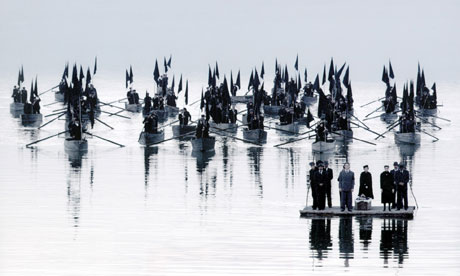
FADE IN on an old political refugee Spyros (the late Manos Katrakis) returning to his Northern Greek village after so many years of exile in the Soviet Union in Theo Angelopoulos’s Voyage to Cythera (1983) When he is near his old home, he begins chirping in what sounds like “bird talk” and soon his call is answered by what appears to be another “bird” speaking. Soon we see another old man appear and suddenly two long parted friends are united because of their “secret” language they used during the Occupation and the Civil War in Greece that followed. This surprisingly joyous moment is followed by Spyros performing a “Pontiko” dance on the grave of another friend in the village cemetery. This dance on the grave clearly strikes all viewers as a kind of triumph over death, destruction, war, exile and separation. In short, the moment is like a New Orleans “jazz funeral”: a celebration of life after death through dance and festivity.
No one would accuse Theo Angelopoulos of being a Greek Frank Capra, Jerry Lewis, Charlie Chaplin or James Carey or even a Hellenic Jacques Tati. And yet if we embrace a larger world of the “comic spirit” as it has existed through centuries of literature, song and culture in Greece and the Balkans, one can surely identify both “comic” and “humorous” as well as ironic moments throughout the many journeys Angelopoulos’s protagonists embark upon. From Suspended Step of the Stork, Ulysses’ Gaze and Voyage to Cythera to Eternity and a Day and even Traveling Players, I wish to comment on how thematically and in terms of narrative, these “comic moments” contribute to the atmosphere and overall impression these films leave us with. On a personal note, I would add that after having known Theo for more than twenty five years and written two books and many essays on his work, it is this spirit of “tragic comedy” or dark triumph that appears to be an important and reoccurring theme in his career.
My overall approach builds not only on my studies of Angelopoulos’s films, but also on my comic research in my books, COMEDY/ CINEMA/THEORY and LAUGHING OUT LOUD: WRITING THE COMEDY CENTERED SCREENPLAY (both with U of California Press). And my major point is that “comedy” is a much wider world than just jokes, laughter, slapstick. Take Dante’s DIVINE COMEDY, for instance. In the largest sense, comedy is about “triumph” in some form, thus Dante’s “comedy” was the triumph of reaching Paradise . Humor and laughter are one part of comedy, but only a part, and so I am stressing as in the opening example of Spyros’s return to his old village, a sense of personal triumph over all adversity. I wish also to see Angelopoulos’s both dark and joyous sense of the comic within a tradition that can be seen throughout the work of other Balkan filmmakers.
It is important also for this consideration of Angelopoulos’s films to remember one of the points made in Plato’s Symposium near the ending when Socrates and Aristophanes are the only remaining guests and they remark on how often comedy and tragedy cross lines into each other (Horton,Comedy/ Cinema/ Theory 3). After all, both tragedy and comedy began as ritual celebrations of Dionysos, the god of wine and drama. Furthermore, such an extended view of comedy which embraces its possible border crossing into the tragic as well helps us to appreciate George McFadden’s remark that, “The great works of comic writing (and we can add film) have extended the range of our feelings” (243).
Before exploring such dark and joyful laughter, however, a note is offered on what we mean by “Balkan”. Dina Iordinova best captures the concept as used here when she notes, “In my usage, the Balkans is not a geographical concept but one that denotes a cultural entity, widely defined by shared Byzantine, Ottoman and Austro-Hungarian legacies and by the specific marginal positioning of the region in relation to the western part of the European continent” (6). We are speaking, therefore, of cinemas from the former Yugoslavia , Bulgaria , Albania , Greece , Turkey and Rumania most specifically, even when, as Iordinova readily recognizes, these countries themselves often resist the label of “Balkan”.
I would add more specifically that what these Balkan histories represent are complicated but also fertile crossings of Christian Orthodox cultures with Muslim influences from the roughly 500 years of Turkish domination. In terms of “tragic comedy” as a concept, therefore, it is important to note that we should acknowledge the larger view of “comedy” as meaning a triumph that could be spiritual rather than physical or humorous. This sense of “comic triumph” in a spiritual vein has existed in the cultures of the Balkans and especially the former Yugoslavia . The epic poems of Serbia , for instance, celebrate the Serbian spiritual victory over the conquering Turks during the Battle of Kosovo in the 14th century. The Turks, such poems declare, only murdered and destroyed Serbs as living creatures, not as Christians and spiritual beings.
Equally important to the humor and sense of comedy of these cultures, however, is a very strong sense of irony. We know that irony thrives on drawing attention between what could or might be and what in fact is actually reality. As practiced by Balkan filmmakers, irony often calls forth both tears and laughter as we “get” the difference between ideals and harsh realities, dreams and history.
Of course such a blend of humor and horror is not limited to the Balkans as Roberto ‘Benigni’s Life Is Beautiful (1997) suggests in the tragic irony of its title and ending as the young boy sees an American tank and thinks he has “won” the contest his father (Benigni) has tried to pretend the concentration camp during WWII is instead of a death camp.
The much celebrated director Emir Kusturica’s Time of the Gypsies provides us with a clear example of such dark yet comic irony. Based on newspaper reportage of actual Yugoslav gypsies who not only worked in crime organizations throughout Italy but who also sold their own children into slavery, prostitution and crime, the film tracks one young boy’s odyssey from Yugoslavia to Italy in a Godfather-like tale (there are, in fact, many direct references to Copolla's crime trilogy). As Kusturica’s film ends, the young gypsy Mafia protagonist is murdered and at the funeral his five year old son steals the coins placed over his father’s eyes (an ancient custom) and runs out of the house. We can’t help but laugh at the son stealing from his dead father, but on the other hand, it is a “triumph” for the son has learned to follow in his father’s footsteps: to be a good thief! Such a moment is ironic, humorous, tragic and triumphant at the same time. Thus unlike many Hollywood comedies such as Dumb & Dumber(1994), Something About Mary (2001), Not Another Stupid Teen Movie (2002), and Goldmember (2002), films such as Time of the Gypsies and No Man’s Land are able to take on serious topics—the selling of gypsy children and the Bosnian War—but open them up to find laughter that is often dark and ironic and also frequently triumphant in unexpected ways.
It is, finally, also worth noting that Greece has had a tradition of satirical comedy tackling serious topics ever since Aristophanes took to the stage in the 5th century BC with his joyous and imaginative farces such as Lysistrata and Peace that were fully meant as anti-war statements.
To Read the Rest of the Essay
by Andrew Horton
Greek Cinema and Films About Greece
FADE IN on an old political refugee Spyros (the late Manos Katrakis) returning to his Northern Greek village after so many years of exile in the Soviet Union in Theo Angelopoulos’s Voyage to Cythera (1983) When he is near his old home, he begins chirping in what sounds like “bird talk” and soon his call is answered by what appears to be another “bird” speaking. Soon we see another old man appear and suddenly two long parted friends are united because of their “secret” language they used during the Occupation and the Civil War in Greece that followed. This surprisingly joyous moment is followed by Spyros performing a “Pontiko” dance on the grave of another friend in the village cemetery. This dance on the grave clearly strikes all viewers as a kind of triumph over death, destruction, war, exile and separation. In short, the moment is like a New Orleans “jazz funeral”: a celebration of life after death through dance and festivity.
No one would accuse Theo Angelopoulos of being a Greek Frank Capra, Jerry Lewis, Charlie Chaplin or James Carey or even a Hellenic Jacques Tati. And yet if we embrace a larger world of the “comic spirit” as it has existed through centuries of literature, song and culture in Greece and the Balkans, one can surely identify both “comic” and “humorous” as well as ironic moments throughout the many journeys Angelopoulos’s protagonists embark upon. From Suspended Step of the Stork, Ulysses’ Gaze and Voyage to Cythera to Eternity and a Day and even Traveling Players, I wish to comment on how thematically and in terms of narrative, these “comic moments” contribute to the atmosphere and overall impression these films leave us with. On a personal note, I would add that after having known Theo for more than twenty five years and written two books and many essays on his work, it is this spirit of “tragic comedy” or dark triumph that appears to be an important and reoccurring theme in his career.
My overall approach builds not only on my studies of Angelopoulos’s films, but also on my comic research in my books, COMEDY/ CINEMA/THEORY and LAUGHING OUT LOUD: WRITING THE COMEDY CENTERED SCREENPLAY (both with U of California Press). And my major point is that “comedy” is a much wider world than just jokes, laughter, slapstick. Take Dante’s DIVINE COMEDY, for instance. In the largest sense, comedy is about “triumph” in some form, thus Dante’s “comedy” was the triumph of reaching Paradise . Humor and laughter are one part of comedy, but only a part, and so I am stressing as in the opening example of Spyros’s return to his old village, a sense of personal triumph over all adversity. I wish also to see Angelopoulos’s both dark and joyous sense of the comic within a tradition that can be seen throughout the work of other Balkan filmmakers.
It is important also for this consideration of Angelopoulos’s films to remember one of the points made in Plato’s Symposium near the ending when Socrates and Aristophanes are the only remaining guests and they remark on how often comedy and tragedy cross lines into each other (Horton,Comedy/ Cinema/ Theory 3). After all, both tragedy and comedy began as ritual celebrations of Dionysos, the god of wine and drama. Furthermore, such an extended view of comedy which embraces its possible border crossing into the tragic as well helps us to appreciate George McFadden’s remark that, “The great works of comic writing (and we can add film) have extended the range of our feelings” (243).
Before exploring such dark and joyful laughter, however, a note is offered on what we mean by “Balkan”. Dina Iordinova best captures the concept as used here when she notes, “In my usage, the Balkans is not a geographical concept but one that denotes a cultural entity, widely defined by shared Byzantine, Ottoman and Austro-Hungarian legacies and by the specific marginal positioning of the region in relation to the western part of the European continent” (6). We are speaking, therefore, of cinemas from the former Yugoslavia , Bulgaria , Albania , Greece , Turkey and Rumania most specifically, even when, as Iordinova readily recognizes, these countries themselves often resist the label of “Balkan”.
I would add more specifically that what these Balkan histories represent are complicated but also fertile crossings of Christian Orthodox cultures with Muslim influences from the roughly 500 years of Turkish domination. In terms of “tragic comedy” as a concept, therefore, it is important to note that we should acknowledge the larger view of “comedy” as meaning a triumph that could be spiritual rather than physical or humorous. This sense of “comic triumph” in a spiritual vein has existed in the cultures of the Balkans and especially the former Yugoslavia . The epic poems of Serbia , for instance, celebrate the Serbian spiritual victory over the conquering Turks during the Battle of Kosovo in the 14th century. The Turks, such poems declare, only murdered and destroyed Serbs as living creatures, not as Christians and spiritual beings.
Equally important to the humor and sense of comedy of these cultures, however, is a very strong sense of irony. We know that irony thrives on drawing attention between what could or might be and what in fact is actually reality. As practiced by Balkan filmmakers, irony often calls forth both tears and laughter as we “get” the difference between ideals and harsh realities, dreams and history.
Of course such a blend of humor and horror is not limited to the Balkans as Roberto ‘Benigni’s Life Is Beautiful (1997) suggests in the tragic irony of its title and ending as the young boy sees an American tank and thinks he has “won” the contest his father (Benigni) has tried to pretend the concentration camp during WWII is instead of a death camp.
The much celebrated director Emir Kusturica’s Time of the Gypsies provides us with a clear example of such dark yet comic irony. Based on newspaper reportage of actual Yugoslav gypsies who not only worked in crime organizations throughout Italy but who also sold their own children into slavery, prostitution and crime, the film tracks one young boy’s odyssey from Yugoslavia to Italy in a Godfather-like tale (there are, in fact, many direct references to Copolla's crime trilogy). As Kusturica’s film ends, the young gypsy Mafia protagonist is murdered and at the funeral his five year old son steals the coins placed over his father’s eyes (an ancient custom) and runs out of the house. We can’t help but laugh at the son stealing from his dead father, but on the other hand, it is a “triumph” for the son has learned to follow in his father’s footsteps: to be a good thief! Such a moment is ironic, humorous, tragic and triumphant at the same time. Thus unlike many Hollywood comedies such as Dumb & Dumber(1994), Something About Mary (2001), Not Another Stupid Teen Movie (2002), and Goldmember (2002), films such as Time of the Gypsies and No Man’s Land are able to take on serious topics—the selling of gypsy children and the Bosnian War—but open them up to find laughter that is often dark and ironic and also frequently triumphant in unexpected ways.
It is, finally, also worth noting that Greece has had a tradition of satirical comedy tackling serious topics ever since Aristophanes took to the stage in the 5th century BC with his joyous and imaginative farces such as Lysistrata and Peace that were fully meant as anti-war statements.
To Read the Rest of the Essay
Tuesday, February 7, 2012
Felix Wilder: The Artist, The Most Emasculating Movie of the Year
[Spoiler Alert -- you should wait until after you have seen the film. I just watched this film and I have to say Felix completely misses the mark and allows his own insecurities to lead him to a gross misreading of the film.]
The Artist, the Most Emasculating Movie of the Year
by Felix Wilder
Omega Level
Though the movie industry’s year-end tradition—pummeling moviegoers every winter with “Oscar-worthy” products like some cinematic blizzard of unbearable mawkishness and half-baked messages about human nature—has thankfully come to an end, we’ve reached that unfortunate stretch when the industry congratulates itself by doling out unwarranted accolades. And the film that is getting most of the love (winning a Golden Globe for Best Picture last night) is the one that is the least understood: Michel Hazanavicius’ The Artist. Widely hailed as a feel-good comedy about a silent-movie star’s transition with the help of a good and loving lady into talking pictures, The Artist is actually a far more tragic tale about a once burly, proud, and charismatic man of few—or, rather, no—words who is methodically broken down by the women in his life, mostly by his supposed love interest who wants him to open up and talk. And by the time he finally does express himself, articulating his feelings, he has become a shell of his former (and better) self. In turn, if the film indeed warrants any accolade, it should be for the Most Emasculating Movie of the Year.
When we are first introduced to the protagonist George Valentin (Jean Dujardin), he is the center of attention, the main man, a huge star of adventure films (think Douglas Fairbanks). The Artist opens at the premiere of his new film, in which he is being tortured so that he will “talk” and divulge important information. But, like the heroic character that he is, he resists the temptation to externalize. Moreover, as The Artist’s striking symbol for all men, he remains mum about what he’s all about, because by opening up and sharing this guarded information, thus revealing what lies within, it also opens up the possibility of losing himself entirely.
In this film-within-a-film, the actor does not give up the information. Instead, with the assistance of his trusted canine companion, in and out of the movies (a constant reminder of the battle between cats and dogs), George saves his co-star played by Constance (Missi Pyle), outwits and outworks his enemies, and finally soars to freedom on the plane he pilots. The character, like the actor, wins on his own terms, and quite handily at that. He makes it look easy, and the audience at the premiere loves him (and the film) for it. They give him a long standing ovation for his performance, which he duly relishes by himself until he begrudgingly allows his co-star to bask in the overwhelming response. But make no mistake: The audience cheers for him, and him alone.
To Read the Rest of the Response
The Artist, the Most Emasculating Movie of the Year
by Felix Wilder
Omega Level
Though the movie industry’s year-end tradition—pummeling moviegoers every winter with “Oscar-worthy” products like some cinematic blizzard of unbearable mawkishness and half-baked messages about human nature—has thankfully come to an end, we’ve reached that unfortunate stretch when the industry congratulates itself by doling out unwarranted accolades. And the film that is getting most of the love (winning a Golden Globe for Best Picture last night) is the one that is the least understood: Michel Hazanavicius’ The Artist. Widely hailed as a feel-good comedy about a silent-movie star’s transition with the help of a good and loving lady into talking pictures, The Artist is actually a far more tragic tale about a once burly, proud, and charismatic man of few—or, rather, no—words who is methodically broken down by the women in his life, mostly by his supposed love interest who wants him to open up and talk. And by the time he finally does express himself, articulating his feelings, he has become a shell of his former (and better) self. In turn, if the film indeed warrants any accolade, it should be for the Most Emasculating Movie of the Year.
When we are first introduced to the protagonist George Valentin (Jean Dujardin), he is the center of attention, the main man, a huge star of adventure films (think Douglas Fairbanks). The Artist opens at the premiere of his new film, in which he is being tortured so that he will “talk” and divulge important information. But, like the heroic character that he is, he resists the temptation to externalize. Moreover, as The Artist’s striking symbol for all men, he remains mum about what he’s all about, because by opening up and sharing this guarded information, thus revealing what lies within, it also opens up the possibility of losing himself entirely.
In this film-within-a-film, the actor does not give up the information. Instead, with the assistance of his trusted canine companion, in and out of the movies (a constant reminder of the battle between cats and dogs), George saves his co-star played by Constance (Missi Pyle), outwits and outworks his enemies, and finally soars to freedom on the plane he pilots. The character, like the actor, wins on his own terms, and quite handily at that. He makes it look easy, and the audience at the premiere loves him (and the film) for it. They give him a long standing ovation for his performance, which he duly relishes by himself until he begrudgingly allows his co-star to bask in the overwhelming response. But make no mistake: The audience cheers for him, and him alone.
To Read the Rest of the Response
Wednesday, December 28, 2011
Jonathan Rosenbaum: Ohayo/Good Morning (1975 Review)
OHAYO/GOOD MORNING (1975 review)
by Jonathan Rosenbaum

Devoted to both the profound necessity and the sublime silliness of gratuitous social interchange, OHAYO is a rather subtler and grander work than might appear at first. Commonly referred to as a remake of Ozu’s silent masterpiece I WAS BORN, BUT . . . , it is as interesting for its differences as for its similarities. The focus of the earlier film is a family adapting to a new neighborhood by undergoing brutal social initiations: the father humiliates himself before his boss to get ahead while the sons are accepted by their peers only after humiliating a local bully. Shocked by the behavior of their father, who says that he has to demean himself in order to feed them, the sons retaliate by going on a hunger strike. In the lighter climate of OHAYO, twenty-seven years later, the setting is again middle-class Tokyo suburbia, but the central family is firmly settled, and serious problems — whether old age, unemployment, or ostracism — are principally reserved for their neighbors and friends. The sons’ complaint this time is that their parents won’t purchase a television set and that grown-ups talk too much; the form of their rebellion is refusing to speak. Significantly, it is the humiliations in the first film which provide much of the comedy, a subject assuming gravity only when it causes a rift between father and sons. But the more pervasive humor of OHAYO extends to the rebellion itself and all it engenders, as well as the various local intrigues surrounding it. Clearly one of Ozu’s most commercially minded movies — with its stately, innocuous muzak of xylophone and strings recalling Tati backgrounds, a similar tendency to keep repeating gags with only slight variations, and a performance of pure ham (quite rare in an Ozu film) by the delightful Masahiko Shimazu as the younger brother — its intricacy becomes apparent only when one realizes that each detail intimately links up with every other. Rhythmically, this is expressed by the alternation of simply stated (if interlocking) miniplots with complex camera setups, less bound by narrative advancement, depicting the physical layout of the neighborhood itself: the perpendicular passageways between houses and the overhead road on the embankment behind brilliantly suggesting certain structures as well as strictures in a society of interdependent yet insulated busybodies.
To Read the Rest of the Review
by Jonathan Rosenbaum
Devoted to both the profound necessity and the sublime silliness of gratuitous social interchange, OHAYO is a rather subtler and grander work than might appear at first. Commonly referred to as a remake of Ozu’s silent masterpiece I WAS BORN, BUT . . . , it is as interesting for its differences as for its similarities. The focus of the earlier film is a family adapting to a new neighborhood by undergoing brutal social initiations: the father humiliates himself before his boss to get ahead while the sons are accepted by their peers only after humiliating a local bully. Shocked by the behavior of their father, who says that he has to demean himself in order to feed them, the sons retaliate by going on a hunger strike. In the lighter climate of OHAYO, twenty-seven years later, the setting is again middle-class Tokyo suburbia, but the central family is firmly settled, and serious problems — whether old age, unemployment, or ostracism — are principally reserved for their neighbors and friends. The sons’ complaint this time is that their parents won’t purchase a television set and that grown-ups talk too much; the form of their rebellion is refusing to speak. Significantly, it is the humiliations in the first film which provide much of the comedy, a subject assuming gravity only when it causes a rift between father and sons. But the more pervasive humor of OHAYO extends to the rebellion itself and all it engenders, as well as the various local intrigues surrounding it. Clearly one of Ozu’s most commercially minded movies — with its stately, innocuous muzak of xylophone and strings recalling Tati backgrounds, a similar tendency to keep repeating gags with only slight variations, and a performance of pure ham (quite rare in an Ozu film) by the delightful Masahiko Shimazu as the younger brother — its intricacy becomes apparent only when one realizes that each detail intimately links up with every other. Rhythmically, this is expressed by the alternation of simply stated (if interlocking) miniplots with complex camera setups, less bound by narrative advancement, depicting the physical layout of the neighborhood itself: the perpendicular passageways between houses and the overhead road on the embankment behind brilliantly suggesting certain structures as well as strictures in a society of interdependent yet insulated busybodies.
To Read the Rest of the Review
Subscribe to:
Posts (Atom)