Tuesday, October 29, 2013

Wednesday, September 18, 2013
Tuesday, August 13, 2013
Christina Marie Newland -- Satirical Excess and Empty Vessels: Martin Scorsese's The King of Comedy
by Christina Marie Newland
Bright Lights Film Journal
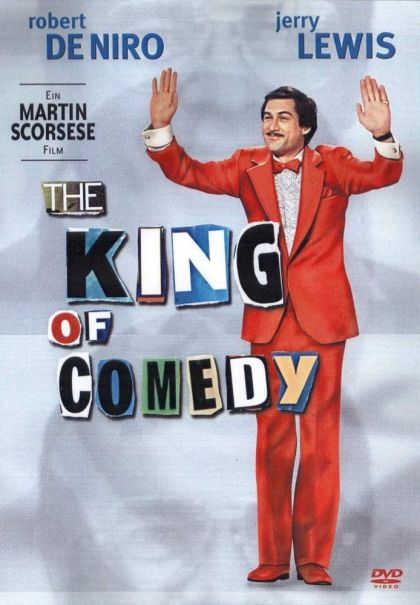
Robert De Niro as delusional acolyte to the stars, Rupert Pupkin, and Jerry Lewis as a mirror-image of his own talk-show comedian persona, Jerry Langford. Sandra Bernhard plays a supporting role as another hyperactive super-fan, Masha. The King of Comedy, written by Paul D. Zimmerman, does not resemble a typical Scorsese picture; the camera is pinned in place instead of roving around. This is seemingly to facilitate our unflinching stare into the lives and behaviour of the characters, when often we want nothing more than to look away. Scorsese's films usually teem with passion and activity, but Pupkin's world is more sedate, colder. Scorsese's go-to director of photography, Michael Chapman, turned down work on the film because of the director's choice of style: "His plan was to use largely empty sets, flat lighting, and old-fashioned box-like framing" (Rausch 102). Essentially, it was filmed to look like television.
Scorsese once again deals with an obsessional pursuit, a common theme in his work. Rupert Pupkin's obsession is particularly emblematic of the twenty-first century; it extends beyond the traditional pursuits of money and power, pursuing instead something more fleeting and all too modern: fame. More specifically, fame for fame's sake: fame predicated not on riches nor on talent but merely on the desire to be seen and idolized. This desire is what consumes De Niro's Rupert, a twitchy, perennially polite wannabe comedian who refuses to take no for answer when he meets his idol, Jerry Langford. He misunderstands Langford and his entourage's continual brush-offs, revealing his desire not merely to be around Jerry but to emulate him and eventually usurp him. He begs Langford for a guest spot on his hit television show, fantasises about Langford deferring to his ego, and eventually becomes deluded enough to appear uninvited at the celebrity's country house, only to be humiliatingly turned away in front of his crush, Rita (Diahnne Abbott). He and Masha then decide to take matters into their own hands and kidnap Jerry with a toy gun, demanding a spot on the show in exchange for Jerry's safety. Rupert is then allowed to perform his comedy routine on television. With startling irony, Rupert's bid for fame works, and although he is sentenced to prison for kidnapping, he is given a short sentence and comes out of prison famous, writing a best-selling book and receiving his own television show. The ironic conclusion to the film emphasizes its satirical look at the American obsession with empty fame, owing some debt to the 1976 Sidney Lumet film, Network.
The rise of consumerism and tabloid celebrity culture in the late 1970s and '80s is dealt with in both Network and The King of Comedy, but they become uncannily more accurate as time has passed, predicting the rise of reality television, social networking, and the disposable celebrity. Rupert simply decides, in the same aggressive manner as his Scorsesean compatriots, that his 15 minutes will be gained at any and all costs. The overnight celebrity becomes the new fixation of the American dream. The King of Comedy was poorly received, both by audiences and critics. "Unlike the context for Scorsese's earlier films, by the time of The King of Comedy, there was no longer an American film culture that encouraged or even allowed for challenging work" (Raymond 30). Considering the context of 1980s Hollywood and its "Reaganite entertainment" — escapist, often anti-intellectual blockbusters that provided happy endings and visceral enjoyment, it is easy to understand why the vulnerability and discomfort in The King of Comedy missed the mark with audiences. The overall cost of the film was recorded at $20 million; its domestic gross was roughly $2.5 million. It didn't do the film any favors that it was marketed as an outright comedy; it certainly is not that, though it has many darkly comic moments. Critics were more generous than audiences, but also offered some intriguing clues as to why the film flopped. Roger Ebert, for example (typically a Scorsese enthusiast), called the movie, "unsatisfying," "frustrating," and an "emotional desert," though he goes on to say that it is not by any means a "bad movie." Pauline Kael called it precisely that, going on to say that it gave her "cold creeps" and that it was "empty" (458). It is interesting that there seems to be a level of discomfort with both critics about the feelings the film evokes; both rightly refer to its unexpected coldness and the emotional distance of its characters, but another aspect also seems at play, one that William Ian Miller suggests: "the unfunny comedian humiliates himself and one of the sure indications that you are watching someone humiliate himself is that you will be embarrassed by the display" (329).
To Read the Rest

Friday, August 9, 2013
Adaptation (USA: Spike Jonze, 2002)
"Spike Jonze and the screenwriter Charlie Kaufman concoct an intricate, scrambled parallel universe populated by anxious, itchy people, some appearing really to exist. The hero is Mr. Kaufman himself (Cage), a screenwriter struggling to adapt THE ORCHID THIEF, Susan Orlean's nonfiction meditation on flowers, obsession and Darwinian theory. He is tormented by writer's block and by his twin brother, Donald (also Mr. Cage)… This is a remarkable, impossible movie — about itself but also about its own nonexistence — and one of the most formally audacious, intellectually charged American movies in quite some time." - A.O. Scott, The New York Times"I didn’t expect to be as taken as I was. [Michael] Fried’s books are sometimes obsessively focused on quite esoteric propositions about a specific painting or photograph, but perhaps because of that are often spellbinding. I never thought I’d sit through 45 minutes of silent footage of Zidane running across a soccer field and come away enthralled, or find myself standing in front of a wall for hours thinking about the direction a figure is facing in a seventeenth-century painting or a 21st-century photograph. Fried can get carried away: once you see the absorption-theatricality distinction, it becomes tempting to see it everywhere. But even if it is not everywhere, it is in a lot of places. And once I started rereading Houellebecq, it was there too.
Fried’s basic insight is as follows: If you look at the tradition of high European art painting (he then expands to photography and novels), you will notice that many paintings seek to show figures as if they were not aware of being looked at by an audience. This could come through absorption in work, such as artisanal craftsmanship, or immersion in sociality with others. But in any case, the figures are oriented away from the audience, and pulled into the distinct world of the painting. This “pulling in” is crucial, since it sets up the painting as somehow standing outside and beyond our own wishes, with its own inner solidity. Because it pulls them away from us and into it, the figures and their world become objects that we look at and learn from, not mere projections of our desires.
And yet, they are inescapably there to be looked at by us. This fact means that in one way or another the painting must acknowledge that its scenes were created to be part of a scene, and therefore the figures are never fully independent of some kind of performance for their imagined audience. The independence they gain through being pulled into the inner world of the painting is taken back through being drawn back to their dependence for their existence on the desires of their audience. In Fried’s interpretation, this dependence shows up in subtle indications, such as a playing card turned outward toward the viewer, or one figure who breaks the spell of the absorbing scene to look out of the painting’s scene into the eye of the beholder.
What makes this relationship between theatricality and absorption especially potent is that it is not only descriptive but dynamic. It is an engine that drives artistic creativity, and much of Fried’s criticism is devoted to examining escalating attempts to deal with it. The most important dynamic involves various efforts to defeat the threat of theatricality and mannerism. This can happen in many ways, and no doubt many more will be discovered. One variant involves representations of figures caught up in war and violence: What could be more absorbing than that? There is no time to look away in the midst of battle. This is Fried’s interpretation of Jacques-Louis David, for example. Another variant is depictions of simple peasants, lost in everyday activities such as picking crops, oblivious to anything else but the task at hand. This is Fried’s interpretation of Millet’s The Gleaners.
But that very escalating depiction of violence or simplicity is unstable, in Fried’s reading. They inevitably become cliché and overdone, oscillating between shock for shock’s sake as the demands for the intensity of violence become greater on the one hand, and the brutalization and oversimplification of uneducated lower classes or nonintellectuals becomes too overt to ignore. In this and similar cases, the artist’s independence is the one threatened by theatricality. The peasants or soldiers may be absorbed in their work in the fields or bloody battles, but only an attention-seeking artist would put them in large-format canvases in front of crowds of the bourgeois public as a surefire way to gain their applause.
The dialectic begins anew, and artists begin finding ways to defeat the impression that they are painting in order to be seen painting but are themselves absorbed in the world of the painting as it unfolds, as if on its own, beyond their will. Fried takes this thought very far and in many directions, but his book on Courbet develops it directly. Courbet, in his view, hits on a very potent technique, which involves dispersing his own artistic consciousness throughout the painting, creating an impression that he is everywhere in it, and therefore somehow has merged with each and every aspect of it. In that way, the audience sees the painting and the painter immersed in it all at once.
This too ultimately proves unstable, in ways I will not get into now, eventually leading to the undoing from within of this line of painting in Manet. The last point I do want to emphasize is that while Fried often highlights painterly concerns around how to represent absorbed figures and defeat the impression of mannerism, this concern has roots in a conviction that the desire for some kind of absorption is present in the culture. Here too he has a point. Think of Charlie Kaufman films, such as Adaptation. These are animated by the sense that “we” have lost the ability to have intense, unmediated direct experience, that we are always somehow, even in the most seemingly intimate moments, acting with a view to how it will look to somebody else: how it will play on your feed, in the article you might write, in the story you might tell at a party.
Taken far enough, this thought leads to a kind of lament with language itself and a corresponding desire for prelinguistic immersion in instincts. But we don’t have to go so far to get the point. Just think of moments when you have felt like the line between you and the world disappeared: running down a hill so fast you can’t think but just must react; working on an essay and looking up two hours later as if it were no time at all; laughing with family and friends as each says exactly the right next thing that everybody understands without having to make any inferences; escaping or inflicting violence; and, yes, orgasm. The larger point behind Fried’s project is twofold: that painters try to depict absorption because this is how to absorb audiences who crave that very absorption, but that this very act creates the self-reinforcing oscillation between victories for theatricality and momentary reclamations of absorption." - Dan Silver
Adaptation (USA: Spike Jonze, 2002: 114 mins)
Bean, Henry. "Self Made Heroes: Adaptation puts the self-obsession of the screenwriter centre stage." Sight and Sound (March 2003)
D., Margo and Margo P. "The Orchid Thief vs. Adaptation." Book vs Movie (June 30, 2017) ["The Margos are back and taking on their most interesting episode yet with a compare and contrast of the Susan Orlean novel The Orchid Thief (which began as a New Yorker article) and the hit Charlie Kaufman/Spike Jones movie Adaptation. If there has ever been a reason for this podcast to exist --this material is the one to tackle!So many differences between the book and movie here, we are not quite sure where to begin but let us give it a try."]
Edwards, Gile. "Adaptation (2002)." 366 Weird Movies (January 13, 2016)
Evans, Kim. "Charlie Kauffman, Screenwriter." To the Best of Our Knowledge (November 10, 2013)
Kozak, Oktay Ege, Erik McClanahan and Ryan Oliver. "Lost in Charlie Kaufman’s Eternal Sunshine Of The Spotless Mind & Adaptation." Over/Under Movies (June 20, 2016)
Thursday, June 13, 2013
I Heart Huckabees (USA/Germany: David O' Russell, 2004)

I Heart Huckabees (USA/Germany: David O' Russell, 2004: 107 minutes)
Garrett, Daniel. "Laughter and Philosophy: David Owen Russell’s I ♥ Huckabees." Offscreen (January 31, 2005)
Johnson, Mackenzie. "What Makes David O. Russell so David O. Russell." Film Stage (October 17, 2016)
Kennedy, A.L. "Sartre and the Individual." A History of Ideas (April 15, 2015) ["Writer AL Kennedy on Existentialist ideas about the individual. Jean Paul Sartre argued that, for humans, 'existence preceded essence'. This means that there is no blueprint or template from which to work - humans are free to make themselves up as they go along. Being an individual comes from the way you negotiate this freedom and the choices you make in the face of it."]
Kirby, Matt. "I Heart Huckabees: Premodern Help for Postmodern Times." Metaphilm (November 12, 2004)
Lee, Kevin B.. "The Wahlberg Effect." Keyframe (September 26, 2016)
Ng, Edwin. "The (Zen) Buddhist Heart of I ♥ Huckabees." Journal of Religion & Film 14.1 (April 2010)
Shaw, Daniel. Film and Philosophy: Taking Movies Seriously. NY: Wallflower, 2008. [In BCTC Library]
Tait, R. Colin. "'Jesus is never mad at us if we live with him in our hearts': The Dialectical View of America in David O' Russell's I Heart Huckabees." Cinephile (March 2006)
Thursday, May 23, 2013
Roger Leatherwood -- The Phantom Archivist and The Phantom Archives: The Amateur Online Archive of Brian De Palma's Phantom of the Paradise (1974)
by Roger Leatherwood
Bright Lights Film Journal
1. WHO CARES ABOUT NOSTALGIA ANYMORE?
Personal Archives in the Absence of a Corporate One
Prior to about 1980, Hollywood seemed perversely uninterested in its own history, inadvertently or intentionally neglecting its production materials (not to mention old film elements) that often were left rotting behind studio vault walls and taking up valuable real estate and given away or maybe dumped in the bay some foggy night. Since the advent of home video and the ever-increasing value of catalog titles, new digital (expensive to license, cheap to deliver) formats and the promise of the long tail, studios have increasingly strived to make their films and TV shows available to as wide an audience as possible for as long as possible, including offering merchandise that depicts the characters, graphics, and designs on any and all appropriate items from toys to smartphone cases. This constant upkeep of the presence of the brand of a filmed property in the culture keeps it in the public's memory, perhaps motivating sequels, spin-offs, and other ancillary revenue. And all this has to be archived and kept careful track of.
In some rare instances, producers have maintained archives, private or set up as museum spaces to display props, costumes, and other ephemera.1 But examples of industrial archival curation are sparse, and while the films themselves may enjoy an afterlife in repertory houses or at museum screenings, physical archives are seldom open and, unless they involve Stanley Kubrick or some other storied career, don't go on the road.2
Legacy production materials of motion pictures from draft scripts to set designs to production stills not intended for the public eye often end up forgotten, if they aren't purloined from under the noses of archivists who never notice them missing. The majority of productions dating from before the 1980s suffer from almost nonexistent archival profiles, and have no cultural presence. As a result they remain invisible to cultural memory. In the absence of digital or other marketing engagements now common to recent cross-platform franchise properties, marketing ephemera surrounding the releases ("collateral" to use the marketing term) gets fetishized as the proxy for favorite films, and authentic original posters for such films as King Kong (1933) to Star Wars (1977) go for thousands of dollars on auction sites,3 signifiers of the original and authentic industrial marketing impulse and of the cultural moment in which these were the only legitimate proxy outside of actual viewership.
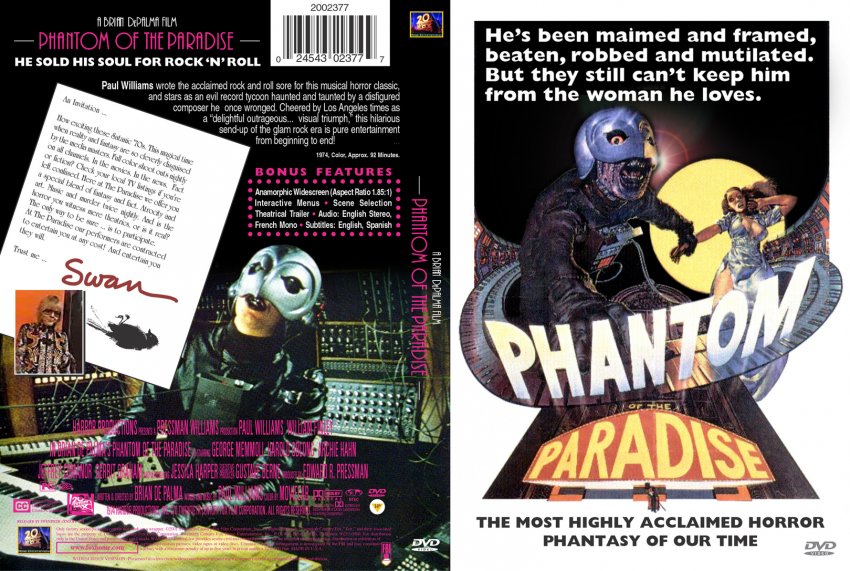
Ari Kahan's website devoted to Phantom of the Paradise (1974), The Swan Archives (www.swanarchives.org),4 has curated a collection of marketing materials that reanimates the era of this forgotten film's release. Launched in 2006 with the results of 30 years of collecting posters, stills, and other materials, the site functions not only as a resource for the film's fan community but also as its only surviving archive that creates and even defines a new audience for the film. Made up of over 400 pictures of objects, screengrabs, and detailed narratives of the film's genesis, production, marketing, and editing variants adding up to over 75,000 words, as explications of the film's themes, subtexts, and historical context it presents a comprehensive, exhaustive, and passionately rendered archive of the history and reception of the film and a film of its type in the mid-'70s cultural landscape, all in the absence of any attempts by the corporate rightsholders to do so.
2. RECORDING LIVE FOR THE SWAN ARCHIVES
Objects, Their Meanings, and the Importance of Timing
Working online, within view but beyond the traditional reach of normal gatekeepers of intellectual property, Kahan illustrates a new mode of archival behavior and engagement possible in digital environments that revivifies obsolete (in this case, intellectual) property and curates and recontextualizes it. At the same time, Kahan's efforts reflect a rather conservative and closed approach to how an archive is built and functions, in large part by taking pains to protect the assets from promiscuous sharing as well as the context in which they're viewed. By dint of his existence in a landscape that is relatively unexplored, Kahan engages the tension between how audiences and corporate rightsholders control, negotiate, and create new meanings surrounding their properties. His site allows audiences to engage with artifacts outside traditional archival walls; investigates how archival activity affects digital, personal, and other casual engagements with film texts; and points the way in which such sites create new narratives around the texts themselves.
Phantom of the Paradise, written and directed by Brian De Palma and starring Paul Williams, William Finley, and Jessica Harper, was released by 20th Century-Fox in 1974. Appearing amid the rich cultural tapestry that also included The Godfather Part II, Chinatown, The Towering Inferno, and The Texas Chainsaw Massacre, it was largely unsuccessful in finding a wide audience and was relegated to relative obscurity on the second half of double bills before being remarketed to secondary markets with a revamped ad campaign six months later.
A quirky, stylized, and fleet-footed if unwieldy blend of horror and fantasy taking place in a rock-and-roll setting, Phantom of the Paradise attracted the attention of horror film and science fiction fans rather than a teenage rock music audience. Its plot borrows predominantly from the 1943 and 1962 film versions of Gaston Leroux's The Phantom of the Opera5 as well as the German legend of Faust (the music mogul Swan played by Williams sells his soul for success). By virtue of its pop sensibilities, its fanciful critique of corporate greed, and its stylized filmmaking techniques (a harbinger of the Grand Guignol style Brian De Palma would develop to greater effect in Carrie [1976] and Scarface [1983]), the film slowly built a cult following. As a meta-narrative about popular music as well as a satire of celebrity culture that parodies the very elements that audiences might enjoy about it (flashy rock production numbers, fan worship), the film likely alienated the audiences it expected to attract, until a revised ad campaign repositioned the film as a horror/thriller as opposed to a musical (the Style C poster tagline is "He's been maimed and framed, beaten, robbed, and mutilated. But they still can't keep him from the woman he loves"). Moderately more successful, it attracted enough attention to be written up in various science fiction and film magazines.
To Read the Rest
Sunday, April 7, 2013
Tuesday, March 19, 2013
Robert W. McChesney and John Nichols - The Bull Market: Political Advertising
by Robert W. McChesney and John Nichols
Monthly Review
...
For Americans born after 1950, and for those born before 1950 but with faltering memories, the televised commercial deluge that now defines American political campaigns likely seems the natural order of things, for better or for worse.2 But American campaigns were significantly different in the 175 years before political advertising, specifically television political advertising, became the order of the day. When one reads Theodore White’s epic The Making of the President series, especially for 1960 and 1964, the emerging role of television is a recurring theme—but TV political advertising is barely present in the early 1960s volumes. By White’s account, Nixon paid virtually no attention to his Madison Avenue advisors throughout his unsuccessful 1960 presidential campaign.3 Joe Klein recounts how his research shows that in the 1950s and ‘60s candidates routinely hired advertising experts and pollsters, “But these were peripheral advisers; they didn’t run the campaigns.”4
This quickly changed. In 1969 Joe McGinniss published his groundbreaking The Selling of the President, to chronicle what he termed “a striking new phenomenon—the marketing of political candidates as if they were consumer products.” The book, which involved McGinniss spending time with Nixon’s television advertising advisors including Roger Ailes during the 1968 presidential campaign, seemed shocking and a sharp departure from the political-driven campaign narratives provided by the likes of White. McGinniss documented how Nixon came to rely upon TV political commercials, based on Madison Avenue marketing principles, as the foundation of his campaign. In the book Ailes presciently concludes immediately after the November victory, “This is the beginning of a whole new concept. This is it. This is the way they’ll be elected forevermore.”5 It is ironic that today, when one reads the book, it seems downright quaint, even homespun, in comparison to subsequent elections. The liberal McGinniss is able to wander through the corridors of power in Nixon’s campaign like a serendipitous hippie roaming around at Woodstock. The narrative reminds one of the Dr. Evil character in the Austin Powers film who returns to life in 1997 after being frozen for thirty years, and then threatens to blow up the world unless he is given his ransom demand of…one million dollars.
Consider also The Candidate, a 1972 film about a young idealistic California candidate for a U.S. Senate seat, starring Robert Redford. The film, with a screenplay by a former Eugene McCarthy speechwriter, dealt with the phoniness and superficiality that marketing and television had brought to political campaigns. It was provocative and controversial and contributed to subsequent debates about the role of money in politics. TV political advertising plays an important role in the piece and is cast in a negative light. But what is ironic is that the TV ads Redford’s character airs in the fictional campaign are closer to Lincoln’s Gettysburg address in tone and substantive content than they are to the asininity that typifies political ads of more recent vintage. Ads of that caliber today would have political scientists and pundits shouting from the mountaintops that we were free at last. But in 1972 such ads were considered highly suspect and part of the problem.
As it was, by 1972 the total amount spent for all races on television political advertising, and that so alarmed McGinniss, Redford, and the nation—from President and House and Senate to governorships, mayors, state legislatures, referenda, initiatives and city council, the works!—had increased almost fourfold from 1960 to reach $37 million.6 That would amount to approximately $200 million in 2012 dollars; so, factoring for inflation, the 1972 election spent less than 3 percent of what will be spent on TV political ads in the 2012 election cycle.
For a concrete example, in 1972, a little-known Colorado Democrat, Floyd Haskell, spent $81,000 (roughly $440,000 in 2010 dollars) on television advertising for a campaign that unseated incumbent Republican U.S. Senator Gordon Allott. The figure was dramatic enough to merit note in a New York Times article on Haskell’s upset win. Fast-forward to the 2010 Senate race, when incumbent Colorado Democrat Michael Bennet defeated Republican Ken Buck. The total spent on that campaign in 2010 (the bulk of which went to television ads) topped $40 million, more than $30 million of which was spent by Super PAC-type groups answering only to their donors. In the last month of the election, negative ads ran nearly every minute of every day. The difference in spending, factoring in inflation, approached one hundred-to-one. The 2010 Colorado Senate race is generally held up by insiders as the bellwether for 2012 and beyond. As Tim Egan puts it, “This is your democracy on meth—the post–Citizens United world.”
The total number of TV political ads for House, Senate, and Gubernatorial candidates in 2010 was 2,870,000. This was a 250 percent increase in the number of TV ads as there were for the same category of races in 2002. In terms of spending, and compared strictly to 2008, just two years earlier, House race TV ads cost 54 percent more in 2010 and the cost of Senate race TV ads was up 71 percent.7 By the end of 2011 it was already clear that 2012 would have a quantum leap in campaign spending from 2008, the greatest increase in American history, and much of this would go to TV political ads. “In 2010, it was just training wheels, and those training wheels will come off in 2012,” says Kenneth Goldstein, president of Kantar Media’s Campaign Media Analysis Group. “There will be more bigger groups spending, and not just on one side but on both sides.”8
This is not a commercial market where a speculative boom leads to an eventual bust. This is a political market and it is going in one direction, quickly. The federal and state budgets are enormous multi-trillion-dollar troughs and there is no sign that corporate interests are anywhere near their upward limit of what they will pay to have access to them and control the laws, policies, subsidies, and regulations that affect their profitability. Indeed, it is possible that 2012 may one day appear to be a democratic panacea compared to what lies ahead, much like 1968 or 1972 looks to us today.
Any way you slice it, to mix metaphors, we are not in Kansas anymore.
...
To Read the Entire Essay

Monday, March 18, 2013
Matt Zoller Seitz -- Harold and Maude: Life and How to Live It
By Matt Zoller Seitz
Current

Hal Ashby’s Harold and Maude, about the love between a suicidal young man of about twenty and an almost eighty-year-old widow, is timeless in part because it never quite belonged to its own time. Conceived in the late 1960s, at the height of the counterculture, it was released in 1971, when the political narrative of peaceful rebels versus the jackbooted establishment had lost what little mainstream appeal it had briefly enjoyed. In the popular imagination, the March on Washington and the Summer of Love had been displaced by Woodstock, Altamont, Kent State, and a string of assassinations and riots. Richard Nixon had ridden into office in 1968 on a wave of law-and-order sentiment and was about to cakewalk into a second term (and unprecedented shame). The counterculture was in retreat. As Peter Fonda’s record producer tells his young girlfriend in 1999’s The Limey, the sixties were “really . . . just ’66 and early ’67. That’s all it was.”
But the movement’s ideals lived on, in a disguised and ultimately more daring form, in Harold and Maude, which took values that had been expressed by youthful rebels and dropouts in the late 1960s—peace, love, understanding, distrust of authority, a determination to march to the beat of a different drummer—and put them in the mouth of an old woman embroiled in one of the oddest and most original love stories ever filmed. The movie’s apoplectic authority figures, dotty old-money types, poetic interludes, and trance-inducing folk-rock soundtrack (by Cat Stevens) may seem typical of earlier hippie flicks. But its two central premises—that an elderly woman could embody the most unguarded, delicate variety of Summer of Love openness and that she and a much younger man should be able to fall in love and get married without being judged, much less stopped—are anything but. Harold and Maude was shocking by the standards of 1971 Hollywood movies, even the ones that styled themselves as adventurous or hip. But it is so ideologically and emotionally consistent, and weaves such a gentle spell, that we can accept the central romance as a metaphor for beleaguered political and social sentiments even as we get to know Harold (Bud Cort) and Maude (Ruth Gordon) as individuals and root for their happiness. It’s a romance, a tragedy, a satire, a paean to eccentricity, a philosophical statement, and a “trip” film whose music montages seem to roll in like waves. Its mix of elements felt strange and new at the time, and still does, even though the film’s characters, tone, and soundtrack have been referenced and plundered by many modern directors, including Wes Anderson, who used two Stevens songs in Rushmore; P. T. Anderson, whose first four features are filled with Ashby-like innocents stumbling through cruel worlds; and David Fincher, whose Fight Club features a misfit couple flirting at self-help groups that they don’t even belong to, as Harold and Maude do at strangers’ funerals.
Ashby was a former editor and one of the staunchest exemplars of countercultural values ever to work in Hollywood. He debuted with 1970’s The Landlord, starring Beau Bridges as a white preppy who buys a brownstone in then black Park Slope, Brooklyn, alienates his stuck-up family, and learns what really matters in life: love, honesty, and spontaneity. He followed it with an impressive string of pictures that rank among the decade’s best, including Harold and Maude, The Last Detail (1973), Shampoo (1975), Coming Home (1978), and Being There (1979). The films vary widely in subject matter, style, and tone. But they all share a fascination with naive outsiders who are part of a larger system or machine, even if they don’t realize it, and who inspire others, accidentally or on purpose.
In all these movies, but especially in Harold and Maude, Ashby displays an extraordinary sensitivity to the spectrum of human experience. Both The Landlord and Harold and Maude are built around disaffected young men who act out against lives of stifling privilege and ossified values, but the latter film is simpler and more direct, and less tied to ripped-from-the-headlines issues. Building on the innovations of the landmark releases The Graduate (1967) and Easy Rider (1969), Harold and Maude explores outsider mentalities through fragmented cutting, using those music montages to embellish its themes and create a feeling of emotional suspension. But Harold and Maude is ultimately a richer, deeper movie, less measured and a lot more meandering, and also warmer, weirder, and tougher to reduce to catchphrases. It doesn’t position rebels against the establishment, or any group against any other group. It just wants people to be themselves and to be appreciated instead of judged—and to spread bliss by reaching out.
To Read the Rest of the Essay
Luke's Change: An Inside Job
Monday, February 18, 2013
Wednesday, January 2, 2013
Cecil Brown: Tarantino's Django: Unchained - Hollywood’s Nigger Joke
by Cecil Brown
Counterpunch

In order for a joke to work, Mary Douglas, the eminent British anthropologist, wrote that one had to have a social context for it to operate in. “We must ask what are the social conditions for a joke to be both perceived and permitted,” she asked in her wonderful little essay, “Jokes.”
“My hypothesis,” she writes“is that a joke is seen and allowed when it offers a symbolic pattern of a social pattern occurring at the same time.”
With Django: Unchained, the symbolic pattern–I’d call it historical context–is Hollywood itself. “If there is no joke in the social structure,” Mrs Douglas observed, “no other joke can appear.” In Hollywood, there are lots of jokes in the system!
The social pattern that allows Quentin Tarantino’s “Nigger joke” to work is set in the South, two years before the Civil War, but my point is that this is only a pretext for Hollywood itself.
Some critics, like Betsy Sharkey in the Times, think this film is a masterpiece. Sharkey calls it, “the most articulate, intriguing, provoking, appalling, hilarious, exhilarating, scathing and downright entertaining film yet.”
African American critic Wesley Morris hated it. He called it “unrelenting tastelessness — [...] exclamatory kitsch — on a subject as loaded, gruesome, and dishonorable as American slavery.”
Ishmael Reed, the novelist, pointed out how the Weinstein Company promoted an advertising campaign to get a black audience by promoting Jamie Foxx as the star. In fact, Foxx is only one of the stars, along with Christoph Waltz and Leonardo DiCaprio. As Reed points out, Foxx spends most of his time looking at Mr.Waltz and then looking at Mr. DiCaprio, with a puzzled look on his face, as if to say, What’s dese white folks, talkin ‘bout?
My aim in his essay is to examine the way in which the symbolic system is a reflection of the social system. “What are the social conditions for a joke to be both perceived and permitted,” Mrs Douglass wrote in that little essay, “Jokes.”
What are the social conditions that would permit Django to be the big howling, empty nigger joke that it is?
One of these social conditions, certainly, involves the relationship between black actors and Hollywood as a symbol of the plantation system.
In his review of the film, for example, Mr. Reed said that Sam Jackson, in the role of the conniving, omnipresent, evil slave, is “playing himself.”
If Jackson had not dominated the Hollywood system in such a sly way, then his role as Stephen, the master-worshipping house slave to Calvin Candie (Leonardo DiCaprio) would not have its loaded, edgy, uncanny realism. The plantation is called CandieLand (Candyland) and is meant to refer to Hollywood itself as a producer of entertainment (Candy). Get it?
If Jamie Foxx is not known in Hollywood as a resourceful hustler, who will play almost any role, then his part as the “bad nigger” Django would not be so compelling (and lubricous). If he was not the “New nigger on the block,” then the confrontation between him and Sam Jackson’s character, Stephen, the off-the-hook house slave, the scene would not be powerful (and dumb) at the same time.
The dramatis persona forms a homology with the enacted characters on the screen. The key that unlocks Tarantino’s sensationalistic mosaic is that it reveals the inner game of how the Hollywood studio and the plantation slave institution exploited black people.
To Read the Rest of the Essay
Monday, October 1, 2012
Joseph McBride: Political Filmmaking and America's "Poisoned Chalice" -- The Banned Gore Vidal Interview
by Joseph McBride
Bright Lights Film Journal
...
The good news is that, as a result, it is becoming easier to make movies about politics: "There is a real chance, because the country's falling apart very rapidly. Audiences are going to be drawn either toward total Spielbergism — total escape from their fear of losing their jobs, fear of walking down the street — or to things that speak to them and bother them.
"It has to be done ingeniously, because if it's done like a civics lesson, it will put people to sleep."
Looking back over the spectrum of American political filmmaking, Vidal can find little enough that's been done ingeniously: "The few I know of which are realistic — as opposed to being Frank Capra fantasies or fairy tales — are Citizen Kane for the '40s, my own The Best Man for the '60s, The Candidate for the '70s, Tanner '88 for the '80s and now Bob Roberts for the '90s."
Bob Roberts, writer-director-star Tim Robbins' scathing satire of our current political malaise, offers in Robbins' folksinger-politician the most credible portrait of an American fascist I've seen in any movie since Edward Arnold's newspaper tycoon and political boss in Capra and Robert Riskin's 1941 Meet John Doe. Though distributed by Paramount in conjunction with Miramax, the low-budget ($4 million) Bob Roberts was made independently, with half the money coming from the U.K. after Robbins shopped the script around the conventional studio route without success.
It's amazing that a mass-market film was made on this subject, since it deals with issues usually addressed only in the alternative media — issues such as the systemic corruption of the establishment media and political institutions and the cynical manipulation of public sentiment in favor of the Gulf War.
To Read the Rest of the Interview
Saturday, April 28, 2012
Adam Cook: Drew Goddard's The Cabin in the Woods
by Adam Cook
Notebook
"The horror film to end all horror films."
—Joss Whedon

The man wasn’t lying. It didn’t seem all that likely that he could deliver on that tongue-in-cheek statement, but Drew Goddard and Joss Whedon’s deconstruction of the genre is so complete and sophisticated, and the ending of The Cabin in the Woods literally shakes the foundation of the “horror film”—just before annihilating it altogether. Once the film approaches its conclusion, and the mechanics of the horror genre that have been manipulating the cabin in the woods have all been made explicit, the cine-commentary matches/exceeds that of Michael Haneke’s Funny Games, and a with sense of humor intact (“Funnier Games”). The key difference is that Goddard and Whedon do it with intelligence, wit and compassion in equal measure. The film is not condescending to its audience, but rather counts on their own knowledge, and, refreshingly, on their own playfulness. It would seem that Haneke would condemn the shameless voyeurism of the horror-viewer, whereas the filmmakers behind The Cabin in the Woods celebrate the fun of horror films while still indicting its more vapid sadistic tendencies seen in recent years. One senses a love and respect for humanity beaming through the final moments of Cabin, rather than the coldness Haneke purposefully substitutes for sincerity, in order to distance himself from his subject, even as he falls prey to the same dynamic between torturer, tortured, and viewer, that he seeks to chastise. Without the same deliberate “arthouse” tactics, Goddard and Whedon are self-reflexive at every turn, questioning the clichés and tropes the genre is built on. And they have so much fun doing it.
The film’s one central shortcoming may be its inability to work as a horror film itself. Goddard has a visual intelligence—in one sequence, he emulates J-Horror with smashing results—and successfully generates suspense, but the tension that drives the film comes from the mystery's unfolding. Cabin's strength is in its satire, and the film is too funny, too often, for its supposed scares to operate successfully. Nevertheless, if we can count it somewhere among horror films for categorical purposes it joins a shortlist of significant contemporary works in American cinema. Only Rob Zombie comes to mind (though Ti West has his supporters), whose recent Halloween films have challenged the slasher genre with doses of humanism, grotesque aesthetic beauty, and a punishing brutality not meant to satisfy sadistic desires. The inner-workings of the “horror film” are actually built into Cabin's narrative. In a secret facility, two normal looking men-in-ties, played by Richard Jenkins and Bradley Whitford, are working at some sort of control panel. They have access to actors, cameras, monsters, etc. Anything they need to reach their goal of having five twentysomethings meet their end in a cabin in the woods. These unsuspecting young people are not only lured and trapped but actually altered so as to become the stereotypes deemed necessary by the horror genre. They are stripped of their personalities, uniqueness and intelligence, which are replaced by archetypal models of “the slut”, “the athlete”, “the fool (stoner)”, “the scholar”, and, of course, “the virgin”. The so-called "slut" is, unbeknownst to her, forced to dye her hair blonde before the cabin excursion begins. The “athlete” is actually a sociology major dumbed down and costumed in a letterman jacket. The virgin is not so much a virgin, but as “The Director” (an alluring allusion, I realize) will elaborate near the film’s closing, those pulling the strings “work with what they have”. The five young people are afforded some freedom however. They unknowingly select what will kill them. Meanwhile, back at the facility, co-workers take bets on what it will be. Bradley Whitford's character hopes that it will be a Merman that will cruelly dispose of the victims. On multiple screens, these men observe as each character is killed, almost bored with what to them seems a merciless necessity.
To Read the Rest of the Response
More:
MUBI Forum discussion about The Cabin in the Woods