Showing posts with label Politics. Show all posts

Tuesday, March 19, 2013

Robert W. McChesney and John Nichols - The Bull Market: Political Advertising

The Bull Market: Political Advertising
by Robert W. McChesney and John Nichols
Monthly Review

...

For Americans born after 1950, and for those born before 1950 but with faltering memories, the televised commercial deluge that now defines American political campaigns likely seems the natural order of things, for better or for worse.2 But American campaigns were significantly different in the 175 years before political advertising, specifically television political advertising, became the order of the day. When one reads Theodore White’s epic The Making of the President series, especially for 1960 and 1964, the emerging role of television is a recurring theme—but TV political advertising is barely present in the early 1960s volumes. By White’s account, Nixon paid virtually no attention to his Madison Avenue advisors throughout his unsuccessful 1960 presidential campaign.3 Joe Klein recounts how his research shows that in the 1950s and ‘60s candidates routinely hired advertising experts and pollsters, “But these were peripheral advisers; they didn’t run the campaigns.”4

This quickly changed. In 1969 Joe McGinniss published his groundbreaking The Selling of the President, to chronicle what he termed “a striking new phenomenon—the marketing of political candidates as if they were consumer products.” The book, which involved McGinniss spending time with Nixon’s television advertising advisors including Roger Ailes during the 1968 presidential campaign, seemed shocking and a sharp departure from the political-driven campaign narratives provided by the likes of White. McGinniss documented how Nixon came to rely upon TV political commercials, based on Madison Avenue marketing principles, as the foundation of his campaign. In the book Ailes presciently concludes immediately after the November victory, “This is the beginning of a whole new concept. This is it. This is the way they’ll be elected forevermore.”5 It is ironic that today, when one reads the book, it seems downright quaint, even homespun, in comparison to subsequent elections. The liberal McGinniss is able to wander through the corridors of power in Nixon’s campaign like a serendipitous hippie roaming around at Woodstock. The narrative reminds one of the Dr. Evil character in the Austin Powers film who returns to life in 1997 after being frozen for thirty years, and then threatens to blow up the world unless he is given his ransom demand of…one million dollars.

Consider also The Candidate, a 1972 film about a young idealistic California candidate for a U.S. Senate seat, starring Robert Redford. The film, with a screenplay by a former Eugene McCarthy speechwriter, dealt with the phoniness and superficiality that marketing and television had brought to political campaigns. It was provocative and controversial and contributed to subsequent debates about the role of money in politics. TV political advertising plays an important role in the piece and is cast in a negative light. But what is ironic is that the TV ads Redford’s character airs in the fictional campaign are closer to Lincoln’s Gettysburg address in tone and substantive content than they are to the asininity that typifies political ads of more recent vintage. Ads of that caliber today would have political scientists and pundits shouting from the mountaintops that we were free at last. But in 1972 such ads were considered highly suspect and part of the problem.

As it was, by 1972 the total amount spent for all races on television political advertising, and that so alarmed McGinniss, Redford, and the nation—from President and House and Senate to governorships, mayors, state legislatures, referenda, initiatives and city council, the works!—had increased almost fourfold from 1960 to reach $37 million.6 That would amount to approximately $200 million in 2012 dollars; so, factoring for inflation, the 1972 election spent less than 3 percent of what will be spent on TV political ads in the 2012 election cycle.

For a concrete example, in 1972, a little-known Colorado Democrat, Floyd Haskell, spent $81,000 (roughly $440,000 in 2010 dollars) on television advertising for a campaign that unseated incumbent Republican U.S. Senator Gordon Allott. The figure was dramatic enough to merit note in a New York Times article on Haskell’s upset win. Fast-forward to the 2010 Senate race, when incumbent Colorado Democrat Michael Bennet defeated Republican Ken Buck. The total spent on that campaign in 2010 (the bulk of which went to television ads) topped $40 million, more than $30 million of which was spent by Super PAC-type groups answering only to their donors. In the last month of the election, negative ads ran nearly every minute of every day. The difference in spending, factoring in inflation, approached one hundred-to-one. The 2010 Colorado Senate race is generally held up by insiders as the bellwether for 2012 and beyond. As Tim Egan puts it, “This is your democracy on meth—the post–Citizens United world.”

The total number of TV political ads for House, Senate, and Gubernatorial candidates in 2010 was 2,870,000. This was a 250 percent increase in the number of TV ads as there were for the same category of races in 2002. In terms of spending, and compared strictly to 2008, just two years earlier, House race TV ads cost 54 percent more in 2010 and the cost of Senate race TV ads was up 71 percent.7 By the end of 2011 it was already clear that 2012 would have a quantum leap in campaign spending from 2008, the greatest increase in American history, and much of this would go to TV political ads. “In 2010, it was just training wheels, and those training wheels will come off in 2012,” says Kenneth Goldstein, president of Kantar Media’s Campaign Media Analysis Group. “There will be more bigger groups spending, and not just on one side but on both sides.”8

This is not a commercial market where a speculative boom leads to an eventual bust. This is a political market and it is going in one direction, quickly. The federal and state budgets are enormous multi-trillion-dollar troughs and there is no sign that corporate interests are anywhere near their upward limit of what they will pay to have access to them and control the laws, policies, subsidies, and regulations that affect their profitability. Indeed, it is possible that 2012 may one day appear to be a democratic panacea compared to what lies ahead, much like 1968 or 1972 looks to us today.

Any way you slice it, to mix metaphors, we are not in Kansas anymore.

...

To Read the Entire Essay

Wednesday, March 6, 2013

Seth Rosenfeld: A Secret History of America in the 60s

Lynum had plenty of information to share. The FBI's files on Mario Savio, the brilliant philosophy student who was the spokesman for the Free Speech Movement, were especially detailed. Savio had a debilitating stutter when speaking to people in small groups, but when standing before a crowd and condemning his administration's latest injustice he spoke with divine fire. His words had inspired students to stage what was the largest campus protest in American history. Newspapers and magazines depicted him as the archetypal "angry young man," and it was true that he embodied a student movement fueled by anger at injustice, impatience for change, and a burning desire for personal freedom. Hoover ordered his agents to gather intelligence they could use to ruin his reputation or otherwise "neutralize" him, impatiently ordering them to expedite their efforts.

Hoover's agents had also compiled a bulging dossier on the man Savio saw as his enemy: Clark Kerr. As campus dissent mounted, Hoover came to blame the university president more than anyone else for not putting an end to it. Kerr had led UC to new academic heights, and he had played a key role in establishing the system that guaranteed all Californians access to higher education, a model adopted nationally and internationally. But in Hoover's eyes, Kerr confused academic freedom with academic license, coddled Communist faculty members, and failed to crack down on "young punks" like Savio. Hoover directed his agents to undermine the esteemed educator in myriad ways. He wanted Kerr removed from his post as university president. As he bluntly put it in a memo to his top aides, Kerr was "no good."

Reagan listened intently to Lynum's presentation, but he wanted more--much more. He asked for additional information on Kerr, for reports on liberal members of the Board of Regents who might oppose his policies, and for intelligence reports about any upcoming student protests. Just the week before, he had proposed charging tuition for the first time in the university's history, setting off a new wave of protests up and down the state. He told Lynum he feared subversives and liberals would attempt to misrepresent his efforts to establish fiscal responsibility, and that he hoped the FBI would share information about any upcoming demonstrations against him, whether on campus or at his press conferences. It was Reagan's fear, according to Lynum's subsequent report, "that some of his press conferences could be stacked with 'left wingers' who might make an attempt to embarrass him and the state government."

Lynum said he understood his concerns, but following Hoover's instructions he made no promises. Then he and Harter wished the ailing governor a speedy recovery, departed the mansion, slipped into their dark four-door Ford, and drove back to the San Francisco field office, where Lynum sent an urgent report to the director.

The bedside meeting was extraordinary, but so was the relationship between Reagan and Hoover. It had begun decades earlier, when the actor became an informer in the FBI's investigation of Hollywood Communists. When Reagan was elected president of the Screen Actors Guild, he secretly continued to help the FBI purge fellow actors from the union's rolls. Reagan's informing proved helpful to the House Un-American Activities Committee as well, since the bureau covertly passed along information that could help HUAC hold the hearings that wracked Hollywood and led to the blacklisting and ruin of many people in the film industry. Reagan took great satisfaction from his work with the FBI, which gave him a sense of security and mission during a period when his marriage to Jane Wyman was failing, his acting career faltering, and his faith in the Democratic Party of his father crumbling. In the following years, Reagan and FBI officials courted each other through a series of confidential contacts. And after Reagan emerged as a leading conservative spokesman in the fifties, Hoover went beyond the bounds of his jurisdiction and secretly gave him personal and political help. He even lent Reagan a hand in keeping track of his own wayward children, Maureen and Michael. Now the long courtship between the FBI director and the former movie star would pay off for them both.

The FBI would become deeply involved in the clash over free speech at Berkeley between the social forces represented by Reagan, Kerr, and Savio. Each of these men had a transforming vision of America and exerted extraordinary and lasting influence on the nation. By tracing the bureau's involvement with these iconic figures, this book reveals a secret history of America in the sixties. It shows how the FBI's dirty tricks at Berkeley helped fuel the student movement, damaged the Democratic Party, launched Ronald Reagan's political career, and exacerbate the nation's continuing culture wars. Above all, it illustrates the dangers that the combination of secrecy and power pose to democracy, especially during turbulent times. (7-8)

Rosenfeld, Seth. Subversives: The FBI's War on Student Radicals, and Reagan's Rise to Power. Farrar, Straus and Giroux, 2012.

Sunday, March 3, 2013

David Simon on The Wire (2002-2008)


Instead of the usual good-guys-chasing-bad-guys framework, questions would be raised about the very labels of good and bad, and, indeed, whether such distinctly moral notions were really the point. The show would instead be about untethered capitalism run amok, about how power and money actually root themselves in a postmodern American city, and, ultimately, about why we as an urban people are no longer able to solve our problems or heal our wounds. (36)

The Wire depicts a world in which capital has triumphed completely, labor has been marginalized and monied interests have purchased enough political infrastructure to prevent reform. It is a world in which the rules and values of the free market and maximized profit have been mistaken for a social framework, a world where institutions themselves are paramount and every day human beings matter less. (36)

But instead of the old gods, The Wire is a Greek Tragedy in which the postmodern institutions are the Olympian forces. It's the police department, or the drug economy, or the political structures, or the school administration, or the macroeconomic forces that are throwing the lightning bolts and hitting people in the ass for no decent reason. (37)

David Simon, quoted in Watson, Garry. "The Literary Critic, the Nineteenth Century Novel and The Wire." Cineaction #84 (2011): 32-40.

Wednesday, October 3, 2012

Dennis Lim: Time Has Been Kind to Heaven's Gate

Time Has Been Kind to Heaven's Gate
by Dennis Lim
The New York Times


...

Lee Kline, the technical director at Criterion, said, “It wasn’t an option to go back to the original negative because that was what was cut down to the short version.” The original 70-millimeter prints were also in poor shape. So in a costly, complicated process, the restoration team scanned each color separation negative individually and recombined them.

“Heaven’s Gate” may be a subject Mr. Cimino has avoided for years, but once he gets going, the floodgates open. He spoke fondly of the performances of Kris Kristofferson, Christopher Walken and Isabelle Huppert, which he feels have never gotten their due. And he recalled the genesis of the project: Researching the history of barbed wire and the cattle industry, he came upon an incident known as the Johnson County War involving cattlemen, hired killers and local ranchers. He described the epilogue — the weary hero, James Averill (Mr. Kristofferson), on a yacht off the New England coast — as “a prelude to ‘The Great Gatsby,’ ” with Averill as the mogul awaiting the arrival of the young James Gatz.

Mr. Cimino also recalled his obsessive quest for authenticity that led many to characterize “Heaven’s Gate” as a runaway production. (First budgeted at less than $10 million, the film grew to a cost of $35 million, or $44 million including promotional costs, according to Mr. Bach’s book. Mr. Cimino maintains that it was “all in $32 million.”) As he put it, “Everything was problematical”: the locomotive that had to be transported to the Montana location from a Denver museum; a horse-drawn buggy whose spokes and upholstery had to be made in different states. “The movie could not be made today, even if you threw $300 million at it,” he said. “All of that is being lost. The wagons don’t exist, the skills are gone.”

Present-day viewers may well find that time has been kind to “Heaven’s Gate,” which plays more than ever like a fittingly bleak apotheosis of the New Hollywood, an eccentric yet elegiac rethinking of the myths of the West and the western, with an uncommonly blunt take on class in America. (“It’s getting dangerous to be poor in this country,” someone says. The rejoinder: “It always was.”) But this defiant last gasp of the downbeat ’70s, opening two weeks after Ronald Reagan was elected president, was plainly a movie at odds with its time.

Reached at his home in Hawaii, Mr. Kristofferson said he believes the themes of the film, with its grim view of American capitalism, were what made it so unpalatable. “It was a political assassination,” he said. He recalled getting word that Reagan’s first attorney general, William French Smith, had told studio heads that “there should be no more pictures made with a negative view of American history.”

Mr. Kristofferson, sounding more rueful than bitter, said that the reception to “Heaven’s Gate” knocked him off the Hollywood A-list for good. “I never really recovered from that,” he said, but he acknowledged that it was worse for Mr. Cimino. “It completely destroyed him.”

Mr. Cimino continued to work, albeit infrequently; he has made four features since “Heaven’s Gate,” the last one, “Sunchaser,” in 1996. A painter who began his directing career in advertising, he said that at home in Los Angeles he rarely watches movies now (and prefers to reread Pushkin and Flaubert). But he does have a film project in mind, which he hopes to shoot in digital soon.

Ms. Carelli, who was with Mr. Cimino in Venice, said that while there remain misconceptions about the making of “Heaven’s Gate,” “I don’t want to revisit old erroneous stories and try to correct them.” She added, “Now the film finally speaks for itself, and it has the final word.”

To Read the Entire Article

More Resources:

The Making and Unmaking of Heaven's Gate


Thursday, September 6, 2012

ENG 281 Ethics/Film: Week 4 -- Beyond the Standard Feature Film

Wisconsin "Budget Repair Bill" Protest from Matt Wisniewski on Vimeo.


Wikipedia: 2011 Wisconsin Protests

"Background Materials for John Bellamy Foster's "Education and the Structural Crisis of Capital" Dialogic (September 7, 2011)

Benton, Michael. "Bill O'Reilly and FOX News: Propaganda Fails Miserably." Dialogic (March 2, 2011)

Burke, Mike and Harriet Brown Rowan. "Wisconsin’s Uprising: A Guided Tour of the 11-Day Protest Encampment Inside the State Capitol in Madison." Democracy Now (February 25, 2011)

Burke, Mike and Nicole Salazar. "Walkouts, Bank Boycotts and Recalls: Wisconsin Protests Intensify as Union-Busting Legislation Pushed through State Assembly." Democracy Now (March 11, 2011)

Dennis, Brady and Peter Wallenstein. "Wisconsin governor urging others to take stands against unions." Washington Post (February 23, 2011)

Graves, Lisa. "A CMD Special Report: Scott Walker Runs on Koch Money ." PR Watch (February 19, 2011)

Hudson, Michael and Jeffrey Sommers. "Wisconsin Death Trip: The Plan to Steal Everything and Sell the People into Slavery." Counterpunch (March 11, 2011)

"Lawmakers Flee Wisconsin Capitol, State Police Pursue; Protests Swell to 30,000." AlterNet (February 17, 2011)

Meyerson, Harold. "Workers toppled a dictator in Egypt, but might be silenced in Wisconsin." The Washington post (February 15, 2011)

Nichols, John. "Why a Wisconsin Sheriff Refuses to Serve as Governor Walker's 'Palace Guard'." The Nation (March 2, 2011)

Rickman, Peter, Chris Larson and Kelda Helen Roys. "Outrage in Wisconsin: Thousands Flood Capitol After GOP Strips Public Workers of Bargaining Rights in Surprise Senate Vote." Democracy Now (March 3, 2010)

Zirin, Dave. "Wisconsin: Solidarity Among Workers … And Football Players." Yes! (February 17, 2011)


La Jetée (1962) from Augustus Brightman on Vimeo.


Bullock, Tori. "La Jetee Film Analysis." Film and History (May 4, 2011)

Christley, Jamie N. "Great Directors: Chris Marker Senses of Cinema (July 19, 2002)

Dillon, Brian. "Fade away: Chris Marker's La Jetée, a half-hour futuristic film that explores time and memory, seems to conjure an entire century's romance with the moving image." The Guardian (March 28, 2009)

"Listening to La Jetee." The Current (June 21, 2012)

Perry, Canaan. "Time, Memory and Time Travel in Chris Marker’s La Jetée." Space Zoetrope (2007)

Rowan-Legg, Shelah M. "Chris Marker, Filmmaker Behind LA JETÉE, Dies at 91." Twitch (July 30, 2012)

Schefer, Jean-Louis. "On La Jetee." Passages of the Image (1991: hosted on Paul Smith's Website)

Sellars, Simon. "Retrospecto: La Jetee." Ballardian (October 7, 2005)


The Universal Clock - The Resistance of Peter Watkins by Geoff Bowie, National Film Board of Canada


Biographical Sites and Official Websites:

Wikipedia: Peter Watkins

Peter Watkins: Filmmaker/Media Critic (Official Site)

British Film Institute: Peter Watkins


Resources by and about Peter Watkins and his films:

Estrin, Marc. "Peter Watkins' La Commune." The Rag Blog (March 29, 2010)

Keser, Robert. "Edvard Munch." Senses of Cinema (February 7, 2006)

La Commune (Paris, 1871) (France: Peter Watkins, 2000: available on Google video in multiple parts)

"Peter Watkins: La Commune." Chtodelat (October 31, 2008)

Peter Watkins: The Media Crisis Dialogic (October 3, 2007)

Rapfogel, Jared. "The Cinema of Peter Watkins." Cineaste 32.2 (Spring 2007)

Rosenbaum, Jonathan. "The Revolution Has Been Televised [Peter Watkins’ LA COMMUNE]." Chicago Reader (May 17, 2002)

Watkins, Peter. "Notes on the Making of La Commune (Paris, 1871)." Peter Watkins: Filmmaker/Critic (2000)

---. "Notes on the Media Crisis." Barcelona, Spain: Quaderns portàtils, 2010.


Wednesday, September 5, 2012

Lila Kitaeff: Three Kings -- Neocolonial Arab Representation

Three Kings: Neocolonial Arab Representation
by Lila Kitaeff
Jump Cut


...

Non-oppositional critique of the Gulf War

In general, Three Kings’ marketing and reception dwelt on its supposedly unconventional nature. By unconventional, I mean “oppositional” discourse and imagery in the sense of contrasting to those found in dominant cultural productions. Although I will argue that the film does not, in fact, deviate from a typical Hollywood film in its basic message and structure, Three Kings does occupy a somewhat tenuous position in terms of Hollywood-type unconventionality. At first glance, viewers might expect the film to be an action-packed adventure and war movie. The main actors are blockbuster action stars (with the exception of Spike Jonze, director of Being John Malkovich and several “Beastie Boys” videos). And director Russell’s previous films, Spanking the Monkey and Flirting with Disaster, were offbeat in their brand of dark comedy, if not particularly unconventional in form or plot.

Initially film reviewers considered the story original. They said this film had more to it than met the eye, that its message and structure differed from most Hollywood films. A typical review praised Three Kings for its “genre subversion, anarchic attitude and barbed political commentary… making cogent points about… America’s role as the world’s policeman.” This same reviewer even suggested that the film addressed “the amorality and lack of consistent principles in American foreign policy. No Hollywood film in memory has addressed such an issue” (McCarthy par. 4 and 18).

However, although Russell does make a certain social critique of the Gulf War, as I will explore below, it is based in mainstream rather than oppositional discourses. For example, he explained this as his goal:

Taking people’s perceptions of this war, and turning them on their head… all the assumptions that you had about this war need to be looked at and turned over, including the sense of satisfaction you had as a moral victor, as an American.


However, if one were to make an explanatory critique subverting mainstream perceptions of the Gulf War, one would have to take into account the struggle’s historical context and the economic and ideological interests behind U.S. intervention. Such an argument was made by Noam Chomsky and Michael Albert, for example, when they asserted that “the real reason for U.S. opposition to Iraqi occupation of Kuwait is… to keep Washington, Wall Street, and their allies in charge of setting oil prices” (par. 5). And as Chomsky and Albert further pointed out, the U.S. government also has an ideological interest in perpetuating militarism in order to maintain the status quo of military spending and interventionist foreign policy.

Three Kings does not offer this sort of explanatory critique. Instead, the film presents the protagonists as coming to a realization that the United States has failed to save Iraq and destroy Hussein’s regime. According to the film, the United States is mistaken not because it intervened in the Middle East but rather because it did not follow through in its mission to save the good Arabs and crush the bad Arabs, a mission perpetuating neocolonial ideals. The heroes of Three Kings, in terms of the film’s logic, right the wrongs of the United States by saving a small group of Iraqi civilians, thus reproducing “the [neo]colonialist structure of the heroes’ relation to the native… [to] sort out the problems of people who cannot sort things out for themselves” (Dyer 156).

Neocolonial themes and traditional cinematic themes

Neocolonial cinema encourages the spectator to identify with representations of the colonizing subject and, by partaking of the trajectory set up by the storyline, to posit the colonial project itself as desirable. For example, in the scene in which the U.S. soldier protagonists are shown first entering the village, the images largely present their point of view, inviting identification by literally allowing the spectator to see through their eyes. In this scene the Iraqi civilians are portrayed as dominated and submissive as they beg the Americans to stay and help them. Other Iraqis who want to fight seem incapable of acting on their own as they cry out, “The Americans are here. It’s okay to come out. We can fight Saddam!” Thus, all Iraqi civilians—those beaten down and those who are still resistant—are presented as entirely dependent on U.S. help.

As Shohat and Stam put it, such a scene functions to “mobilize” spectatorial desire to participate in the narrative line about the protagonists’successful “neo-colonial mission.” The mobilization of desire works in tandem with spectator positions. Just as the cinematic apparatus interpellates the viewer to identify with the characters and narrative, the desire for which the protagonists strive also becomes the viewer’s desire .

In its ties with other fictions, including novels, drama, and song lyrics, Three Kings integrates traditional U.S. cultural and cinematic themes, especially about the outlaw hero. The film also uses a common Hollywood script format for dealing with cultural crises, that of the “problem picture.” These script strategies further weaken the film’s critique of United States ideals. In terms of screenwriting, Robert Ray discusses narrative strategies common in Hollywood in which morally centered characters enact a drama against a background of contemporary social issues. This kind of script development is common in what Ray terms “problem pictures,” films that critique large social issues but ultimately have happy endings that belie those problems (147).

In films like these, the outlaw hero is a common character. Such a figure possesses his own moral code and works to “correct” socially unjust laws and authority figures (Ray 15). For example, as Richard Dyer describes the genre, in the Rambo movies that attempt to critique the Vietnam War, the protagonist Rambo is

doing the job… that the United States government should be doing. Thus he repeatedly upholds basic American values against the actuality of America” (Dyer 159-160).


In this way, Hollywood’s use of the outlaw hero as a solution to historical events distorts perceptions of those events as part of social history, that is, outside of their filmic portrayals (Ray 59-62).

To Read the Entire Essay

Wednesday, August 22, 2012

Ignatiy Vishnevetsky, Adam Cook, Mike Archibald and Josh Timmerman: The Big Murk - A Conversation About Christopher Nolan's The Dark Knight Rises

The Big Murk: A Conversation About Christopher Nolan's "The Dark Knight Rises"
by Ignatiy Vishnevetsky, Adam Cook, Mike Archibald and Josh Timmerman
Notebook (MUBI)

The Dark Knight Rises: a big pop-cultural event, the epicenter of a tragedy that has (unfortunately, inadvertently) become 24-hour news cycle fodder, an illustration of what is (and isn't) meant by the word "ambitious" in today's Hollywood, a much-anticipated sequel to a film that's popularly seen as the superhero-flick-to-end-all-superhero-flicks, a major talking point in the ongoing discussion of what film criticism means to audiences at large. It's easy to forget that it is, first and foremost, a movie. And as a movie, it happens to be a mess—long, loud, and full of seemingly contradictory ideas and plot threads.

In the following exchange, Adam Cook, Mike Archibald, Josh Timmermann, and I try to make sense of the film, its politics, and its director.

***

Ignatiy Vishnevetsky: Positives first. I liked the first half of the film the most. It has all of these different threads of intrigue going on: Jim Gordon hunting criminals down drainage pipes, Bane putting together his master plan, Bruce Wayne living as a doomed-romantic recluse in his mansion, Selina Kyle's burglaries, corporate skulduggery. I like the crazy-quilt way in which Nolan uses IMAX, switching aspect ratios shot to shot. I like the Revolutionary Tribunal-style courtroom scenes with Cillian Murphy's Scarecrow presiding as judge, even though the narrative context within which they appear leaves a sour taste in my mouth. I like the image—almost Monty Python material—of policemen living in sewers, huddling together, keeping their uniforms clean for the day when they can step out into the daylight again and arrest people. In other words, I like the silliest, cartooniest, most out-there things about the film. I like the detailing. The grand design is a totally different matter.

The three most common complaints about Christopher Nolan's movies that you're likely to hear are: (1) they have a shoddy grasp of space and time, despite always being centered around chronologies and intercut action; (2) they use political issues and reference-points and take contradictory stances on them (this point applies only to The Dark Knight and The Dark Knight Rises); and (3) most of them use personal traumas (more often than not, Nolan's "dead wife" motif, which appears twice in The Dark Knight Rises) and public tragedies as plot points, but have no sense of the emotional. I think Nolan's best movies are the ones that turn points 1 & 3 into strengths; to me, the appeal of The Prestige, my personal favorite of his films, rests in its which-story-within-a-story-is-being-told? spatial slipperiness and its coldness. In The Dark Knight Rises, however, all three of these points are liabilities.

Since it's specific to Nolan's Batman films, I'd like to start with point 2: the politics. I know that for some people, the ending of The Dark Knight was a big problem; it appears to celebrate surveillance and the necessity of lying to the general public for their good (through the Joker / Batman / Harvey Dent narrative thread) while at the same time preaching about the general goodness of people and the ability of a group to make the right decision (the "two boats, two detonators" dilemma).

The Dark Knight Rises is even more self-contradictory. The images of this film are constantly cancelling each other out. There is Bane's attack on the stock exchange, while plays out as an Occupy-era revenge fantasy—and yet, of course, Bane is the bad guy. Group solidarity is celebrated (the marching policemen, for example) and many jabs are taken at wealth and business, yet the hero is a lone billionaire. Batman operates outside the law, yet law enforcement is fetishized. Scarecrow's revolutionary court is presented as a sort of nightmare—yet it rightly convicts a slimy villain. You have the suggestion (which I actually think is a smart move on Nolan's part) that The Dark Knight's "print the legend" ending was a bad idea—and yet when the Joseph Gordon Levitt character essentially repeats the same "lie to give them hope" move late in the film (to a busload of orphans, no less!), it's presented as the right thing to do. Every image seems charged for maximum political impact—with references to the images and words of the French Revolution, fascist Italy, the Bush administration, the War on Terror, the Occupy movement—but there is nothing like a coherent ideology. Nolan strikes me as either apathetic—using whatever ideology fits for any given scene—or politically schizophrenic.

To Read the Rest of the Conversation

Thursday, August 9, 2012

James Zborowski: The Dark Knight Rises

The Dark Knight Rises
by James Zborowski
Alternate Takes


...

Near the beginning of The Dark Knight Rises, we learn that we are rejoining Gotham City’s storyworld eight years after the events shown in The Dark Knight (meaning that roughly twice as much time has elapsed in the world on that side of the screen as in the one on this). At the end of that film, we saw Batman (Christian Bale) vow to Commissioner Gordon (Gary Oldman) that he would take the blame for the murders committed by Harvey Dent (Aaron Eckhart), the city’s one-time ‘White Knight’ politician driven to the dark side by the Joker (Heath Ledger). Here is Batman’s justification for what he proposes:

‘They must never know what he did. Gotham needs its true hero. You either die a hero, or you live long enough to see yourself become the villain. I can do those things, because I’m not a hero, not like Dent. I killed those people. That’s what I can be. [...] Sometimes the truth isn’t good enough. Sometimes people deserve more. Sometimes people deserve to have their faith rewarded.’


In a recent feature published on this site, John Bleasdale suggests that superhero movies ‘are almost fundamentally bound to be mendacious and reactionary.’ He cites the conclusion of The Dark Knight as ‘evidence [of] a distrust in society’:

‘In The Dark Knight, Batman conspires with Commissioner Gordon to cover up Harvey Dent’s crime, laying the blame on Batman. Why? Because the people need to be protected from the truth, we are solemnly told in the film’s final moments, via a child. But, again, why?’


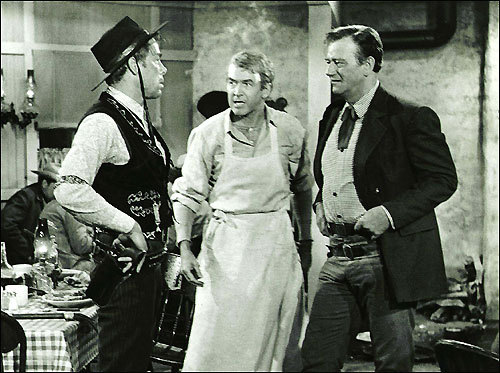
One way of answering this question is provided by an intriguing recent book written by Robert B Pippin, a professor of philosophy, entitled Hollywood Westerns and American Myth: The Importance of Howard Hawks and John Ford for Political Philosophy. One of the films that Pippin examines is John Ford’s great Western The Man Who Shot Liberty Valance (1962). In that film, John Wayne’s cowboy character Tom Doniphon shoots dead the murderous dandy Liberty Valance (Lee Marvin), but he lets the world believe that Eastern lawyer Ransom Stoddard (James Stewart) was the man who fired the fatal bullet. Ranse learns the truth shortly after the event but, with a little convincing from Tom, goes along with the story (which becomes a legend), and builds a long and successful political career on the basis of his false reputation as the man who shot Liberty Valance. When, towards the end of the film, Ranse tells the truth to the reporters at the newspaper of the town where the events occurred, the editor decides to consign the notes to the flames. Like Batman, he offers words that suggest, somewhat cryptically, what value there might be in perpetuating an untruth: ‘This is the West, sir. When the legend becomes fact, print the legend.’

Pippin’s interpretation of Liberty Valance is conscious of the fact that in most Westerns (and arguably, all great Westerns), what is at stake is never simply violence, but the meaning of violence - which is rarely simple. More important than the fact of Liberty Valance’s death is the meaning of this fact, which depends crucially on who killed him. By posing as the man who shot Liberty Valance, Ranse appears to synthesise two sets of qualities which are seen as valuable, but which are rarely found together in one person. As Dutton Peabody, Ranse’s most eloquent advocate at a political rally, tells the gathered crowd:

“He is a man who came to us not packing a gun, but carrying instead a bag of law books. Yes! He is a lawyer. And a teacher! The first west of the rosy buttes. But more important! He is a man who has come to be known throughout this territory, in the last few weeks, as a great champion of law and order!”


We see a similar thing going on in relation to Harvey Dent in The Dark Knight when (in a slightly hokey passage) he disarms a man who has managed to smuggle a gun into a criminal trial and barely stops to draw breath before continuing his display of legal brilliance. As Richard Dyer’s foundational work on film stardom demonstrates, the near-‘magical’ synthesis of the contradictory demands of a given culture is one very compelling way of explaining that elusive phenomenon called ‘charisma’.

In The Man Who Shot Liberty Valance, the death of Valance (or perhaps one should say, of Liberty) is shown to pave the way for the establishment of the rule of law and order, creating, eventually, a clean and prosperous town where, to quote another classical Hollywood Western, to which we shall return, a decent woman feels safe walking down the street. Robert Pippin has this to say about why it is crucial that it be believed that Liberty Valance was killed not by tough, self-reliant Westerner Tom Doniphon but Eastern attorney-at-law Ransom Stoddard:

‘A victory over Liberty Valance […] by Tom Doniphon would be just one more episode in a cycle of violence, revenge and intimidation. Valance must be killed by a representative of a new order; his death must mean that. So since Tom is unseen and quickly vanishes, everybody can think that Ransom Stoddard killed Valance and so can distinguish this act of violence from a personal one by associating it with Ranse’s ideals, can believe that the rule of law and democracy triumphed. Violence before there is law is unavoidably lawless, but if it is for the sake of law the paradox can be lessened if not eliminated.’


The legend of the man who shot Liberty Valance is used to help found a community based on values of property ownership, rule by law, and so on. Returning to The Dark Knight Rises: what is the legend of Harvey Dent used for? During Commissioner Gordon’s speech to mark ‘Harvey Dent Day’ (a public holiday - for Gotham City at least) he makes reference to the ‘Harvey Dent Act’. Although the details of this piece of legislation are never clarified, what does become clear is that it has extended the powers of the police, and been instrumental in ‘cleaning up the streets’ of Gotham. That is, this particular ‘champion of law and order’ is being used to shore up not liberal democracy, but something edging towards a police state.

The film’s attitude towards this (as towards many other things) is not one hundred per cent clear. Gary Oldman’s Gordon is unfailingly dignified, and his competence and fairness make it virtually impossible to imagine him arresting an innocent person. He expresses misgivings over his actions, but these misgivings seem to relate more to the lie behind the Harvey Dent Act, rather than what the Act has achieved. An analogous problem underpins another moment in the film, when Bruce attempts to justify his holding of extra-legal supergadgets and his withholding of them from others by declaring that ‘one man’s tool is another man’s weapon’. In both cases, the characters seem to believe that it is OK that these laws or weapons of mass destruction exist, as long as you have the right people in charge of them. Or the right country, perhaps: in this attitude to jurisdiction and weaponry, we can see an echo of American exceptionalism. It is a viewpoint that the film does not distance itself from, and therefore might be taken to tacitly endorse.

To Read the Rest of the Essay

Sunday, July 29, 2012

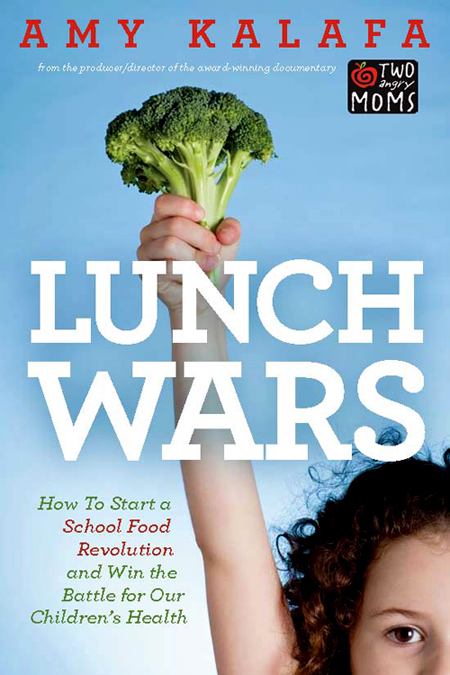
Radio West: Amy Kalafa -- Lunch Wars

Lunch Wars
Radio West (KUER: Utah Public Media)


The average American kid will have some 3,000 school lunches by the twelfth grade. But what are they eating? When filmmaker and author Amy Kalafa went into school cafeterias, she found lunch trays laden with chicken nuggets and French fries, but little in the way of healthy choices. The question she kept hearing from parents though was "What do we do about it?" Kalafa has written a book called "Lunch Wars," and ... she joins us to explain how to start a school food revolution.

To Listen to the Episode

Friday, July 20, 2012

Michael Koresky: Consider the Source -- On The Passion of the Christ

Consider the Source: On The Passion of the Christ
by Michael Koresky
Reverse Shot


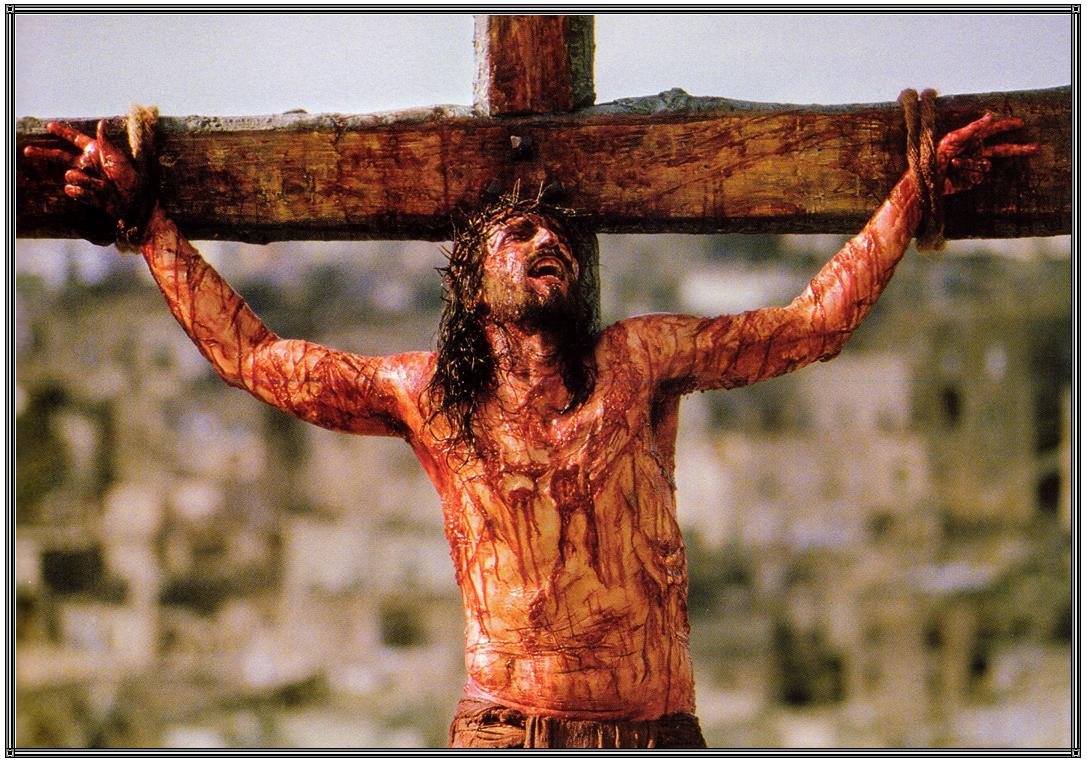
I opened my wallet for Jesus. And then, after paying the ten dollars and twenty-five cents, sitting through the ear-splitting, retina-scalding Regal Cinemas’ 2wenty (“Remember to arrive at the theater early!”), ads for Eclipse breath-freshener and Coca-Cola, bulbous oversized M&M men and a TNT “We Know Drama” sensory overload, I was ready to be saved. Lifted out of my seat, perhaps, and brought back down into my chair just in time for the beginning of lent.

Alas, in the end, it was a movie. A mere movie. Mel Gibson’s brilliantly cynical marketing strategy, buoyed by the ADL’s advance work, lured even us non-believers (sinners) into the theater; certainly we didn’t expect to emerge as right-wing Christian fundamentalist converts, but we had every right to think we would be witnessing an honest representation of human and artistic faith, a spiritual roadmap to the psyche of a filmmaker and actor who felt driven, even instructed by God, as he has claimed, to create a cinematic likeness of the divine. It’s not essential that a moviegoer agrees with the political or religious implications of the images emblazoned on the screen, but that the images translate as a response from the filmmaker’s soul, that we believe we are witnessing the gospels as Mel himself sees them. The sheer divine force offered by Pasolini, Scorsese, by Bresson and Burnett and Spielberg, by Alexanders Payne and Sokurov, manifest in images that relinquish themselves to whatever artistic means necessary, not in shameless grandiosity that wishes to pummel the viewer into submission, into terrified acceptance. Gibson may find disingenuous the earthy benevolence of Pasolini’s Christ and the psychological torment of Scorsese’s, the lyrical allegory of Bresson’s Balthazar and Spielberg’s E.T., the spiritual personification of Payne’s Warren Schmidt or Sokurov’s cancer-ravaged saint-mother; he wants a more direct address, to make you feel every thrust of the rusty nail as it’s hammered into Jesus’s palms, to clutch your own shoulders as Jesus’s arm is ripped out of its socket, to cover your eyes in gratitude when the crucified thief’s eye is plucked out by a vengeful crow, to reverently ooh, aah, and shriek when Jesus is scourged, his back torn and ripped open into a hundred fleshy strips. Apparently to Gibson, there is no metaphor in religion; faith manifests itself as a spiritual dead-end, a believe-it-or-be-damned expression of finality. Of course Gibson, progeny of his fundamentalist missionary father’s terrifyingly stubborn outmoded beliefs, ended up a Hollywood actor—that particular “dream factory” churns out endless expressions of American complacency every year, cheerless damning spectacles of moral righteousness and unambigious carnal pleasures. Of course Mel Gibson, though a self-avowed man of endless spiritual vitality, can only depict the divine through the employment of hundreds of buckets of stage-blood. With its ludicrous, Hollywood-fortified conviction (not the same thing as faith, incidentally), Passion may be the world’s first completely banal Jesus Christ film. And though it’s remarkably, hopelessly literal, it was certainly waiting to happen. It had to happen.

If 2000’s Gladiator ushered in the new Bush regime, then perhaps Gibson’s blockbuster is the new 21st-century’s first true coercively conservative “classic.” Rarely has a film with a fundamentalist core been so blatantly conceived, so forthright in its admissions. Every decade of American film, though never preoccupied with anything grander than itself, nonetheless ends up a product of its own political backdrop. First Blood and its subsequent sequels became emblematic of the Reagan era, literally winning Vietnam back from the liberals, reasserting the swaggering machismo of the American hero that Seventies Hollywood attempted to all but decimate. And just as Stallone enacted Reagan’s cloudy-headed right-wing version of recent history, Gibson’s Christ—“compassionate” Conservative, deliverer of that old-tyme religion—emerges from the tomb at just the moment of the Bush administration’s attack on civil liberties, and the attack on the Civil Rights of American gays launched by Dubya himself with full-on, unabashed old-testament condemnation. Those who speak out against Gibson’s film are automatically stigmatized as leftist rabble-rousers and hapless atheists; to deny its physical impact or so-called technical grandeur is to supposedly denounce Gibson’s personal belief system. What’s more essential is to realize that when Gibson’s savvy propaganda piece, meant to inflict a tough-love Jesus on the nation’s wayward souls, floods into 4,000 screens, another dam between Church and State begins to crumble. The youngsters of the Clintonian Nineties, finding solace in the emergence of a truly multicultural pop mainstream, need to be reclaimed by the right, shorn of their piercings and tattoos, and brought back to Sunday school; who better to do that than Jesus himself, this time, like Rambo, stripped to the waist, chained and whipped, flesh torn and limbs broken, but never down for the count?

To Read the Rest of the Essay More: Jeff Reichert: Jesus Christ Superman

Thursday, June 21, 2012

Surviving Progress (Canada: Mathieu Roy and Harold Crooks, 2011: 86 mins)

[via Documentary Heaven]

Film about the risks we pose to our own survival in the name of progress; connecting financial collapse, growing inequality and global oligarchy with the sustainability of mankind.


Wednesday, June 6, 2012

War Made Easy: How Presidents & Pundits Keep Spinning Us to Death (USA: Loretta Alper and Jeremy Earp, 2007)

War Made Easy reaches into the Orwellian memory hole to expose a 50-year pattern of government deception and media spin that has dragged the United States into one war after another from Vietnam to Iraq. Narrated by actor and activist Sean Penn, the film exhumes remarkable archival footage of official distortion and exaggeration from LBJ to George W. Bush, revealing in stunning detail how the American news media have uncritically disseminated the pro-war messages of successive presidential administrations.


Tuesday, May 29, 2012

Inside Job Director Charles Ferguson: Predator Nation: Corporate Criminals, Political Corruption, and the Hijacking of America

"Inside Job" Director Charles Ferguson: Wall Street Has Turned the U.S. into a "Predatory Nation"
Democracy Now

Two years after directing the Academy Award-winning documentary, “Inside Job,” filmmaker Charles Ferguson returns with a new book, “Predator Nation: Corporate Criminals, Political Corruption, and the Hijacking of America.” Ferguson explores why no top financial executives have been jailed for their role in the nation’s worst economic crisis since the Great Depression. We also discuss Larry Summers and the revolving door between academia and Wall Street, as well as the key role Democrats have played in deregulating the financial industry. According to Ferguson, a "predatory elite" has "taken over significant portions of economic policy and of the political system, and also, unfortunately, major portions of the economics discipline."

Guest:

Charles Ferguson, the Academy Award-winning director of Inside Job, a documentary about the financial crisis. His film on the war in Iraq, No End in Sight, was nominated for an Academy Award. His new book is called Predator Nation: Corporate Criminals, Political Corruption, and the Hijacking of America.


To Watch the Interview


Part 2: “Predator Nation: Corporate Criminals, Political Corruption, and the Hijacking of America”

We continue our conversation with Charles Ferguson, director of the Oscar award-winning documentary, “Inside Job,” about the 2008 financial crisis. In his new book, “Predator Nation,” he argues “the role of Democrats has been at least as great as the role of Republicans” in causing the crisis. Ferguson notes the Clinton administration oversaw the most important financial deregulation, and since then, “we’ve seen in the Obama administration very little reform and no criminal prosecutions, and the appointment of a very large number of Wall Street executives to senior positions in the government, including some people who were directly responsible for causing significant portions of the crisis.” Ferguson also calls for raising the salaries of senior regulators and imposing stricter rules for how soon they can lobby for the private sector after leaving the public sector.

To Watch the Interview

Trailer for Inside Job


2010 Oscar Winner for Best Documentary, 'Inside Job' provides a comprehensive analysis of the global financial crisis of 2008, which at a cost over $20 trillion, caused millions of people to lose their jobs and homes in the worst recession since the Great Depression, and nearly resulted in a global financial collapse. Through exhaustive research and extensive interviews with key financial insiders, politicians, journalists, and academics, the film traces the rise of a rogue industry which has corrupted politics, regulation, and academia. It was made on location in the United States, Iceland, England, France, Singapore, and China.


Watch Inside Job online for free at Film for Action

Wednesday, May 23, 2012

Matthew J. Iannucci: Postmodern Antihero -- Capitalism and Heroism in Taxi Driver

Postmodern Antihero: Capitalism and Heroism in Taxi Driver
by Matthew J. Iannucci
Bright Lights Film Journal


Martin Scorsese's Taxi Driver is a gritty, disturbing, nightmarish modern film classic that examines alienation in urban society. From a postmodernist's perspective, it combines the elements of noir, the Western, horror, and urban melodrama as it explores the psychological madness within an obsessed, inarticulate, lonely antihero cab driver, Travis Bickle (Robert De Niro). The plotline is simple: Travis directs his frustrated anger at the street dwellers of New York and a presidential candidate, and his unhinging assault is paired with an attempt to rescue a young prostitute, Iris (Jodie Foster), from her predatory pimp. Historically, Taxi Driver appeared after a decade of war in Vietnam (1976), and after the Watergate crisis and subsequent resignation of Nixon. Five years later, when it was linked to would-be presidential assassin John Hinckley and his obsession with Jodie Foster, it became prima facie evidence for those on the political right who believed that violence in film translates into crime in real life. It is now almost impossible to separate Taxi Driver from this debate. However, Bickle's antiheroic character is more directly related to a failure of a capitalist system that pits his working-class position as a cab driver against those who have already been disenfranchised according to socioeconomic class, gender, and/or race.

As the film opens, Travis emerges from a forgotten Midwestern form of Americana that appears as obsolete as Travis himself in a big city heterogeneously composed of corporate financiers, political patrons, gun dealers, and prostitutes. In order to survive, he wants to "become a person like other people" as he puts it, but his own disenfranchisement from this nation has left him both intellectually and emotionally bankrupt from the Vietnam War. Freedom, the very nucleus of the American dream, is dependent on individual socioeconomic choices that inform and shape one's identity. But Travis's lack of a distinct identity compels him to cut and paste together what he believes is a heroic identity from an external menu of personages such as the "gunslinger" and the Indian. In actuality, what he does is stitch together a postmodern antiheroic identity that is nostalgic and pop culture-oriented, evidenced by the Mohawk haircut that he sports in the penultimate sequences — because he possesses no internal self.

Taxi Driver implies that identity is not genuine but always synergistic, a kind of potpourri of idolatry and maxims drawn from popular culture, especially from violent movies and television news. In this vein, Robert Ray views Taxi Driver as a postmodern "corrected" Right film, the type of film generally aimed at a naïve audience. Ray explains that a "Right" film presents a traditional conservative philosophy that promotes the application of Western-style, individual solutions to complex contemporary problems. He writes, "Taxi Driver's basic story followed the right wing's loyalty to the classic Western formula: a reluctant individual, confronted by evil, acts on his own to rid society of spoilers. As played by Robert De Niro, Taxi Driver's protagonist had obvious connections with Western heroes…even his name, Travis, linked him to the defender of the Alamo."1 Ray's notion that the film is a "correction" of the right-wing concept of justice is accurate because of its odd plot twist at the conclusion. Normally, such a story would identify Travis's complicity with these criminals and thereby relegate him to some form of institutional punishment. But the film's underlying theme reveals how absurd the Western idealistic depiction of heroism is because the news media in the film not only ignores his actions but also glorifies a psychopathic killer as a noble warrior.

To Read the Rest of the Essay

Wednesday, May 16, 2012

Michael Atkinson: Archival Trouble -- The fiction-free science fiction of Adam Curtis

Archival Trouble: The fiction-free science fiction of Adam Curtis
by Michael Atkinson
Moving Image Source

...

Curtis's brand of deep politics isn't theorist Peter Dale Scott's—he's concerned less with deliberate conspiracy than with the cascade of sociopolitical dominoes, beginning somewhere mysteriously decades ago, tumbling in a semi-secret dialectical train of disaster since, and culminating in flat-out catastrophe, be it 9/11 or the world economic meltdown or merely the Reagan-era state of rampaging consumerist narcissism. Formally, Curtis manufactures his flowcharts with the simplest means available: archival footage, talking heads, calm but ominous narration, associative montage, a pervasive sense of doomsday. All Watched Over by Machines of Loving Grace is paradigmatic: Curtis begins, as his Richard Brautigan-quoting title suggests, with the familiar suspicion that the mechanization of our lives is winding inexorably toward a dystopian nightmare in which the matrix of microprocessors and A.I.'s will end up commanding us, not vice versa.

But right away it's clear that Curtis isn't hypothesizing about a terrifying future, but unearthing the hidden patterns that have created the present moment. The villains are not machines. Curtis trips backward, as is his wont, to the '50s and the rise of Ayn Rand, whose Objectivist creed in turn gave fitful birth to a spate of influential ideologies, all of which decided that both nature and human society were essentially self-sustaining, equilibrium-seeking logical mechanisms, and could be managed thus. "This is the story," Curtis intones, "of the rise of the dream of the self-organizing system, and the strange machine fantasy of nature that underpins it." The tales he tells to illustrate this harrowing and almost completely overlooked social saga all intertwine, and run from the "spaceship Earth" ideas of Buckminster Fuller, the communes that followed, the pessimistic forecasts of the Club of Rome, the rise and fall of Patrice Lumumba in the Congo, the genesis of the wholly fabricated Tutsi-Hutu dichotomy that turned Rwanda into a killing field more than once, the career of Dian Fossey, the late-century rollercoaster of economic feast and famine, and the work of theorist/geneticist George Price, who believed that humans were ultimately the slaves of their own genetic imperatives, and who demonstrated mathematically that both altruism and genocide were therefore rational acts, from "a gene's eye view" of things.

There's more, all of it reflecting back upon now; Curtis is nothing if not a staunch proselytizer for the idea of the past never being quite past. All Watched Over is more than a counter-story. Like all of Curtis's work it is approximately half well-circulated history and half "deep" background—that is, storylines and historical angles that have been pervasively and deliberately neglected by the gatekeepers of knowledge and information. The film feels something like a Craig Baldwin delusion-farce turned chillingly, menacingly factual, and the facts accrete into an interrogation of psychotic hubris. The Frankenstein monster constructed by the scientists and demagogues and politicians in All Watched Over is the last half-century or so of life on Earth, which in its ultimate tally amounts to a scoresheet of unimaginable injustice, mountains of bodies, and untold environmental ruin.

Curtis is in reality telling just one story, again and again in various threads and tangents and in dazzling three- or four-hour chunks, reaching back to the immediate postwar years and then forward to the present over and over, limning an infinitely complex genogram of our present existence. Ironically, for a history-rewriting filmmaker/producer boxing so much information into evenings of television, Curtis is fierce about the disastrous effects brought about by the artificial and intellectualized imposition of order. He began in his present mode with 1992's Pandora's Box, a massive autopsy on the worldwide cataclysms that unrolled as a result of every kind of postwar effort to systematize, organize, compel, and codify humanity, from Soviet over-industrialization to game-theory Cold War strategies to Keynesian economics to nuclear-power utopianism. Politically, this is a rocket targeted not at the Right per se, but upward, at the power elite, whose perpetual folly in trying to maximize profit and control leads ceaselessly to societal breakdown—a condition very often beside the point for the elite in question, once they've stood to benefit. The Century of the Self (2002) goes all attack-ad on this dynamic, specifically homing in on propagandist/marketing mahatma Edward Bernays, and how he used Freudian psychoanalytic insights to initiate the gold rush of institutionalized thought control—advertising, propaganda, public relations—that could be said to absolutely dominate 20th-century public discourse.

Curtis's vision seemed wholly formed at first, despite the fact that he's obviously digging up unknown connections with each new project. But it took the spiral mindquake of 9/11 for Curtis's reverse-engineered prophecies to gain a global profile. The Power of Nightmares (2004) follows the gunpowder trails from the mid-century (uniting Muslim Brotherhood messiah Sayyid Qutb and neocon pope-king Leo Strauss as complementary agents of desolation) to the attacks of 2001, and then maintains that, just as the farcical depiction of the USSR as a global spider kingdom of evil influence is destroyed by direct testimony from CIA agents and a lying Donald Rumsfeld in old news footage, the sudden postulation of Al Qaeda as a terrifying, organized worldwide threat was a manufactured myth used by Western governments and agencies to broaden and tighten their grip on international power systems and the profit to be gained therein.

To Read the Rest of the Essay

To watch Adam Curtis's documentaries online:

Pandora's Box: A Fable From the Age of Science (1992)

The Living Dead: Three Films About the Power of the Past (1995)

The Century of the Self (2002)

The Power of Nightmares: The Rise of the Politics of Fear (2004)

The Trap: What Happened to Our Dream of Freedom (2007)

All Watched Over by Machines of Loving Grace (2011)

Friday, April 20, 2012

Koch Brothers Exposed: The 1% at its Very Worst
Uprising Radio

When the Occupy Movement speaks about the 1 percent which has wreaked havoc on this country’s financial system, the billionaire Koch brothers immediately come to mind. Charles and David Koch have given hundreds of million dollars to fund a conservative agenda which promotes the interests of the richest 1 percent of Americans. Now, in Robert Greenwald’s new documentary, “Koch Brothers Exposed: The 1% at its very Worst” we get an incisive look at the tentacles of the Kochs’ influence throughout the American political and cultural landscape.

After inheriting the family oil business from their father, Charles and David Koch amassed an estimated fortune of $60 billion dollars through Koch Industries. The company has become the 2nd largest privately held multi-national corporation in the world owning companies that range from Georgia-Pacific paper company to fertilizers, chemicals, ranching, manufacturing and oil pipelines. Veteran film maker Robert Greenwald, in his film, shows how the Koch Brothers have spent their money to wield enormous power and advance an extreme right wing political agenda through massive donations to think tanks, legislators and political groups like Americans for Prosperity.

Employing more than 50,000 people in the US, Koch-funded think tanks, according to Greenwald, are working to dismantle unions, weaken social security and deregulate government to dilute environmental protections around the country. In fact, Koch Industries is one of the top ten polluters in the United States. Not satisfied with influencing the economic system within which their companies operate, the brothers also aspire to shape the cultural fabric of the country. Through groups like Americans for Prosperity, the Kochs are working to demolish the public school system by funding efforts to resegregate schools in places like Wake County North Carolina and undermine minority voting rights in dozens of states.

GUEST: Robert Greenwald, producer and director of Koch Brothers Exposed, also founder of Brave New Films, which has produced such hard-hitting documentaries as as Outfoxed: Rupert Murdoch’s War on Journalism Iraq for Sale: The War Profiteers and Wal-Mart: The High Cost of Low Price.

To Listen to the Episode and To See a Preview of the Documentary

Saturday, February 11, 2012

Jessica Livingston: Global capital’s false choices in the films of Laurent Cantet

Global capital’s false choices in the films of Laurent Cantet
by Jessica Livingston
Jump Cut


Laurent Cantet has emerged as a major film director in the last decade, writing and directing Ressources humaines/Human Resources (1999), Emploi du Temps/Time Out (2001), Vers le Sud/Heading South (2005), and Entre Les Murs/The Class (2008). His films have received both critical and popular attention in France and globally, winning numerous awards on the international and art-house festival circuits and attracting attention for the political relevance of his subject matter. Cantet describes his films as dealing with “how the nature of intimacy and private life is shaped by social issues and the way social issues are connected to private life,” which is revealed through their consistent engagement with the subjects of work, class, and leisure.[1] [open endnotes in new window]

Film scholars Martin O’Shaughnessy in The New Face of Political Cinema and Will Higbee in “The Social-Realist Melodramas of Laurent Cantet” have included Cantet within a new generation of politically committed filmmakers in France.[2] Following the massive public sector strikes in 1995, films addressing the changing socioeconomic conditions of the country began emerging in the late 1990s and 2000s.[3] The term “New Realism” is loosely used to characterize these films that explore themes such as unemployment, immigration, and cultural exclusion and give voice to marginalized minorities.[4] Unlike the films of other New Realist filmmakers, Cantet’s films portray people both at the margins and at the center of the economic system. Interestingly, each of Cantet’s four films portrays a different sector of the global economy: a working-class factory in Human Resources; a laid-off, middle-class consultant in Time Out; the tourist industry in the Third World in Heading South; and Parisian multi-ethnic immigrant students in France in The Class. A trajectory throughout all these films is their understanding of global capital—more specifically, of neoliberalism, the political and economic philosophy of free markets and free trade that dominated conventional wisdom in the late twentieth century.

Stylistically, Cantet’s films share traits with other “New Realist” films. To varying degrees in his different films, Cantet uses a naturalized mis-en-scene, shoots on location and improvises dialogue throughout the filming process. He provides basic guidelines or a rough script to the actors, they improvise, and then he re-writes the script including their improvisations.[5] All of his films include both professional and non-professional actors. He states that some roles

“can be greatly enriched by the experience of the ‘real people’ who embody them…Non-professional actors walk on to the set carrying their own past, with a block of reality around them which the film must integrate. I’m interested in capturing things rather than in fabricating them.”[6]

New Realist films, however, do more than just “capture” reality. O’ Shaugnessy addresses the new use of melodrama in the contemporary context. While melodrama has typically not been used for radical purposes because of its focus on the individual and its emphasis on emotional involvement, O’Shaugnessy argues that its use is productive in the contemporary context because it “allows both for an acerbic critique of the individual and for a dramatization of the monstrosity of the current order.”[7] Both O’Shaugnessy and Higbee highlight the elements of melodrama in Cantet’s films.

To Read the Rest of the Essay


Saturday, January 7, 2012

Selin Gulgoz: The Politics of Art -- Middle Eastern Women in Fiction and Film

The Politics of Art: Middle Eastern Women in Fiction and Film
By Selin Gulgoz
The Millions


The four-and-one-half-hour evening train ride from Ann Arbor, Mich., to Chicago marks the beginning of my occasional, brief getaways. I’ve devised my own routine: as soon as the conductor checks my ticket, I head to the food car to pick up a small bottle of Cabernet and a frozen pizza — something I’d hardly eat if it were elsewhere — to accompany the film I’ve already picked out. One time, the film I had chosen was The Stoning of Soraya M. It describes the real story of an Iranian woman named Soraya, who is stoned to death as required by the rules of Shari’a, when she is (wrongfully) accused by her husband of having committed adultery. It is a powerful and moving film — less because of its cinematography, and more due to the plot.

As I watched, I could tell that the woman sitting next to me was taking sneak peaks at the film every now and then. When I finished, she told me that she found the film to be really interesting, and asked me what the title is. At times like this, I find myself caught in a dilemma — a feeling I suspect many Middle Eastern women get. On the one hand, I too am enraged and have my feminist blood boil at how cruel certain Middle Eastern practices can be toward women. Yet, on the other hand, I worry about the tendency that people may have of succumbing all too easily to culture blaming, perceiving these practices as abstract and independent of historical and global relations. I struggle with the fine balance of condemning violations of human rights without accidentally submitting to contemporary extensions of Orientalism.

I was reminded of this dilemma during Nobel Laureate Tawakkol Karman’s speech at the University of Michigan on Nov. 14. Karman is a Yemeni feminist activist who played active roles before and during the Yemeni uprising, considered part of the Arab Spring. Throughout her speech, you could see Karman’s determination to bring democracy and gender equality to Yemen emanating from her whole being. She touched upon issues like how, during President Ali Abdullah Saleh’s rule, women were trapped in their homes under the veil of religion; whereas now, they were out on the streets, not only taking part, but leading the revolution in many aspects.

In popular culture, Middle Eastern women are rarely depicted as such — willful and agentic. Instead, we see them as a category, rather than individuals, that is surrounded by inhuman (male) oppression. We often receive depictions of Middle Eastern women as submissive and helpless, forced to hide their bodies, and we hardly ever discuss their determination as individuals. Indeed, as Turkish writer Elif Åžafak mentions in her TED Talk of July 2010, when Middle Eastern women in literature do not fit these descriptions, they are found not to be “Middle Eastern enough.” Thus, it might surprise some that Karman, who stood strong as she chanted her slogans of peace to the auditorium, with her hands forcefully shooting high up in the air, still chooses to wear the headscarf.

Craig Thompson’s latest graphic novel Habibi, and Denis Villeneuve’s 2010 film Incendies are two recent narratives that I’ve very much enjoyed, which endorse counter-stereotypical portrayals for their respective Middle Eastern female protagonists, Dodola and Nawal. Both Dodola and Nawal are illustrated as determined individuals, who survive through hardships unimaginable to most of us. And while both women are strong, at a closer glance, there are subtle differences in terms of the perspectives these two depictions provide on Middle Eastern women. This is seen most vividly in the relationships the two women have with their own bodies.

cover Thompson’s Habibi takes place in a country named Wanatolia (a somewhat cheesy play on the word Anatolia). Wanatolia is portrayed as a timeless Middle Eastern country characterized by a water crisis surrounding a spectacular dam, with contrasting skylines of modern skyscrapers and neglected shantytowns, ruled by its insatiable sultan, constantly on the lookout for new gems to be added to his harem.

Dodola is one of the women kidnapped by the sultan’s guards for the harem. Being part of the harem means giving up ownership of one’s own body, readying it for service of the sultan’s lustful urges; whenever and wherever they may emerge. In contrast to the plump and outright unattractive sultan, Dodola is beautiful and skinny. Yet, in spite of how attractive she may seem to others, Dodola feels a strong disconnect with her own body. This feeling of disconnect is further enhanced when she’s impregnated by the sultan with the heir of Wanatolia, and as her body begins to accumulate fat. While it seems here that Thompson has yielded to the contemporary pressures of the slim and tender female body image, there is many a reason for Dodola to feel a disconnect with her body. As a nine-year-old girl, Dodola is sold into marriage by her parents, in order to survive the drought. And at 12, her husband is murdered by thieves, and Dodola is sold into slavery.

To Read the Rest of the Essay

Sunday, January 1, 2012

Aryeh Kaufman: A Study of Kurosawa’s Ikiru, Part 1 ~ What it Means to Live ~

A Study of Kurosawa’s Ikiru, Part 1 ~ What it Means to Live ~
by Aryeh Kaufman
Offscreen


1. Introduction to Ikiru

Ikiru, meaning “to live” or “living,” was directed by Akira Kurosawa in 1952 under Toho Productions. Kurosawa, with the help of Hashimoto and Oguni, wrote the screenplay for the black and white film at age 42. The film, widely recognized as one of Kurosawa’s masterpieces, must be understood within its historical and cultural contexts. Ikiru emerged during Japan’s postwar reconstruction, as the country sought to adapt to its newly inherited capitalism and democracy. Calling for forms of cultural upheaval and self-scrutiny, the film may be viewed as political cinema. Specifically, Ikiru affirms the pride and power of the individual. It promotes breaking traditional ties to larger social groups, such as family and company, for the sake of personal achievement.

Kurosawa’s first postwar film, No Regrets for our Youth (1946), similarly dealt with the national process of recovery and cultural transformation. In that film, Yukie, the daughter of a professor, is groomed for marriage, studying the arts of piano and flower arrangement. Such a passive existence fails to satisfy her, however, and she seeks alternative outlets for her passions that take her beyond the bounds of class and gender associations. [1] Kurosawa’s work, therefore, seeks to prepare audiences for the spiritual process of Japan’s recovery on the individual level by promoting a more Westernized view of the self.

In general, Kurosawa draws upon numerous sources and texts to inform his films. Ikiru is no exception, combining Western elements from Dostoevsky’s works and Goethe’s Faust with Eastern visions of Zen and the samurai code of Bushido. In terms of Ikiru’s specific origins, Kurosawa explains, “Sometimes I think of my death. I think of ceasing to be…and it is from these thoughts that Ikiru came.” [2] Furthermore, Fumio Hayasaka, musical composer for several Kurosawa films and the director’s close friend, was consistently ill with tuberculosis, then considered terminal, at the time of Ikiru’s production. In a letter to Kurosawa, Hayasaka openly declared that “for a man, dying for one’s job is one way of showing one’s spirit.” [3] Such real life inspiration may have shaped Ikiru’s development.

Ikiru is the story of Kanji Watanabe, who, when facing death, finally realizes that he has led a meaningless life—that he has not lived at all. In fact, Watanabe has crafted his life to avoid passion and action. The film often depicts Watanabe, played by Takashi Shimura, in an office environment that emphasizes his physical and emotional absence. Watanabe’s death sentence, presented through an advanced stomach cancer, shocks the protagonist and leads to his despair. After disavowing his prior existence and accepting a search for means to live to the fullest, Watanabe experiments with various approaches to living, each with different moral implications. He explores the immediate fulfillment of the senses in a wild scene of night revelry. He attempts to rely on family bonds and relationships for the support and closeness he needs. And he is driven to live through a youthful coworker who appears to know the secret to his desperate search for aliveness. Finally, in a moment of enlightenment, Watanabe realizes he may in fact bring meaning to his life. By championing a proposal to build a children’s playground in a slum, and by dedicating his remaining days to its fulfillment, Watanabe finds peace and tranquility. The tragedy has turned into an uplifting model of affirmation.

The film presents a unique binary structure that utilizes multiple character perspectives and non-linear time. The first division, covering two-thirds of the film, begins with an omniscient narrator’s presentation of an X-ray of Watanabe’s stomach and the knowledge that he has terminal cancer. This part demonstrates Watanabe’s progress from the discovery of his cancer to the realization that he can proactively impart meaning to his life. The second division of Ikiru also begins with the narrator’s instruction, though this time he informs the audience that Watanabe has passed away. The remainder of this part presents the main character’s wake ceremony at which he is eulogized and remembered, often hypocritically. This second division is characterized by a unity of time and space, unlike the freer narrative structure of the first. At the wake, flashbacks serve to fill in gaps and are presented as literal reconstructions of events. Ironically, viewers are never presented with specific flashbacks in which Watanabe successfully achieves either approval or acceptance of the playground proposal—a key moment for viewers. The mourners fail to present such moments. We merely observe his dogged determination in putting pressure on colleagues, pleading with the Deputy Mayor, painfully crawling down office hallways, and quietly resisting the threats of gangsters.

In passing from the first to second divisions of the film, viewers are forced to consider why it is that the film has not ended with Watanabe’s death. Equipped with recent observation of Watanabe’s suffering, experiences, and ultimate enlightenment, we engage with the mourners of the wake scene in their deliberations. They question why Watanabe behaved the way he did, whether he knew he was approaching death, and whether he in fact brought the playground to fruition. Here we observe how he is perceived and misunderstood by others. Most importantly, through character recollections, we perceive both that Watanabe ultimately found happiness and meaning in life before death and also that his chosen actions led him to such accomplishment.

Ikiru presents infinitely more than an idealism centered on the individual as hero and agent for social change. It presents more than a prescription of “good deeds” for the sake of enlightenment and transformation in modern society. Ikiru proposes that healing one’s spirit is always possible, that a Faust-like search for meaning in earthly and spiritual realms has an answer. Kurosawa answers the existential question posed in Rashomon (1950): how should one live in a meaningless world, where death is certain, individuals are selfish and self-serving, and God does not exist? In that film, Kurosawa altered the original story of Akutagawa to present the woodcutter, also played by Shimura, as redeemer of the world through his final act of taking an orphaned baby into his home. Despite the importance of self-sacrifice and altruism in such a feat, Ikiru and Watanabe demonstrate that of primary importance to the individual, to the rebirth and empowerment of one, is the creative deed. Through the purpose and act of creation, Watanabe proves to resolve many tensions presented through the film, such as the shallowness and insufficiency of immediate satisfaction of the senses contrasted with the need to live a youthful, passionate existence, and the difficulty communicating one’s thoughts and feelings to those supposedly closest to one despite the isolation and loneliness of the individual.

To Read the Rest of Part 1

To Read Part 2