The Big Murk: A Conversation About Christopher Nolan's "The Dark Knight Rises"
by Ignatiy Vishnevetsky, Adam Cook, Mike Archibald and Josh Timmerman
Notebook (MUBI)
The Dark Knight Rises: a big pop-cultural event, the epicenter of a tragedy that has (unfortunately, inadvertently) become 24-hour news cycle fodder, an illustration of what is (and isn't) meant by the word "ambitious" in today's Hollywood, a much-anticipated sequel to a film that's popularly seen as the superhero-flick-to-end-all-superhero-flicks, a major talking point in the ongoing discussion of what film criticism means to audiences at large. It's easy to forget that it is, first and foremost, a movie. And as a movie, it happens to be a mess—long, loud, and full of seemingly contradictory ideas and plot threads.
In the following exchange, Adam Cook, Mike Archibald, Josh Timmermann, and I try to make sense of the film, its politics, and its director.
***
Ignatiy Vishnevetsky: Positives first. I liked the first half of the film the most. It has all of these different threads of intrigue going on: Jim Gordon hunting criminals down drainage pipes, Bane putting together his master plan, Bruce Wayne living as a doomed-romantic recluse in his mansion, Selina Kyle's burglaries, corporate skulduggery. I like the crazy-quilt way in which Nolan uses IMAX, switching aspect ratios shot to shot. I like the Revolutionary Tribunal-style courtroom scenes with Cillian Murphy's Scarecrow presiding as judge, even though the narrative context within which they appear leaves a sour taste in my mouth. I like the image—almost Monty Python material—of policemen living in sewers, huddling together, keeping their uniforms clean for the day when they can step out into the daylight again and arrest people. In other words, I like the silliest, cartooniest, most out-there things about the film. I like the detailing. The grand design is a totally different matter.
The three most common complaints about Christopher Nolan's movies that you're likely to hear are: (1) they have a shoddy grasp of space and time, despite always being centered around chronologies and intercut action; (2) they use political issues and reference-points and take contradictory stances on them (this point applies only to The Dark Knight and The Dark Knight Rises); and (3) most of them use personal traumas (more often than not, Nolan's "dead wife" motif, which appears twice in The Dark Knight Rises) and public tragedies as plot points, but have no sense of the emotional. I think Nolan's best movies are the ones that turn points 1 & 3 into strengths; to me, the appeal of The Prestige, my personal favorite of his films, rests in its which-story-within-a-story-is-being-told? spatial slipperiness and its coldness. In The Dark Knight Rises, however, all three of these points are liabilities.
Since it's specific to Nolan's Batman films, I'd like to start with point 2: the politics. I know that for some people, the ending of The Dark Knight was a big problem; it appears to celebrate surveillance and the necessity of lying to the general public for their good (through the Joker / Batman / Harvey Dent narrative thread) while at the same time preaching about the general goodness of people and the ability of a group to make the right decision (the "two boats, two detonators" dilemma).
The Dark Knight Rises is even more self-contradictory. The images of this film are constantly cancelling each other out. There is Bane's attack on the stock exchange, while plays out as an Occupy-era revenge fantasy—and yet, of course, Bane is the bad guy. Group solidarity is celebrated (the marching policemen, for example) and many jabs are taken at wealth and business, yet the hero is a lone billionaire. Batman operates outside the law, yet law enforcement is fetishized. Scarecrow's revolutionary court is presented as a sort of nightmare—yet it rightly convicts a slimy villain. You have the suggestion (which I actually think is a smart move on Nolan's part) that The Dark Knight's "print the legend" ending was a bad idea—and yet when the Joseph Gordon Levitt character essentially repeats the same "lie to give them hope" move late in the film (to a busload of orphans, no less!), it's presented as the right thing to do. Every image seems charged for maximum political impact—with references to the images and words of the French Revolution, fascist Italy, the Bush administration, the War on Terror, the Occupy movement—but there is nothing like a coherent ideology. Nolan strikes me as either apathetic—using whatever ideology fits for any given scene—or politically schizophrenic.
To Read the Rest of the Conversation
Showing posts with label Blockbuster. Show all posts
Showing posts with label Blockbuster. Show all posts
Wednesday, August 22, 2012

Thursday, August 9, 2012
James Zborowski: The Dark Knight Rises
The Dark Knight Rises
by James Zborowski
Alternate Takes

...
Near the beginning of The Dark Knight Rises, we learn that we are rejoining Gotham City’s storyworld eight years after the events shown in The Dark Knight (meaning that roughly twice as much time has elapsed in the world on that side of the screen as in the one on this). At the end of that film, we saw Batman (Christian Bale) vow to Commissioner Gordon (Gary Oldman) that he would take the blame for the murders committed by Harvey Dent (Aaron Eckhart), the city’s one-time ‘White Knight’ politician driven to the dark side by the Joker (Heath Ledger). Here is Batman’s justification for what he proposes:
In a recent feature published on this site, John Bleasdale suggests that superhero movies ‘are almost fundamentally bound to be mendacious and reactionary.’ He cites the conclusion of The Dark Knight as ‘evidence [of] a distrust in society’:
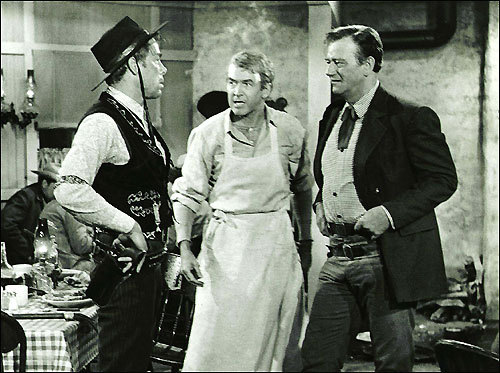
One way of answering this question is provided by an intriguing recent book written by Robert B Pippin, a professor of philosophy, entitled Hollywood Westerns and American Myth: The Importance of Howard Hawks and John Ford for Political Philosophy. One of the films that Pippin examines is John Ford’s great Western The Man Who Shot Liberty Valance (1962). In that film, John Wayne’s cowboy character Tom Doniphon shoots dead the murderous dandy Liberty Valance (Lee Marvin), but he lets the world believe that Eastern lawyer Ransom Stoddard (James Stewart) was the man who fired the fatal bullet. Ranse learns the truth shortly after the event but, with a little convincing from Tom, goes along with the story (which becomes a legend), and builds a long and successful political career on the basis of his false reputation as the man who shot Liberty Valance. When, towards the end of the film, Ranse tells the truth to the reporters at the newspaper of the town where the events occurred, the editor decides to consign the notes to the flames. Like Batman, he offers words that suggest, somewhat cryptically, what value there might be in perpetuating an untruth: ‘This is the West, sir. When the legend becomes fact, print the legend.’
Pippin’s interpretation of Liberty Valance is conscious of the fact that in most Westerns (and arguably, all great Westerns), what is at stake is never simply violence, but the meaning of violence - which is rarely simple. More important than the fact of Liberty Valance’s death is the meaning of this fact, which depends crucially on who killed him. By posing as the man who shot Liberty Valance, Ranse appears to synthesise two sets of qualities which are seen as valuable, but which are rarely found together in one person. As Dutton Peabody, Ranse’s most eloquent advocate at a political rally, tells the gathered crowd:
We see a similar thing going on in relation to Harvey Dent in The Dark Knight when (in a slightly hokey passage) he disarms a man who has managed to smuggle a gun into a criminal trial and barely stops to draw breath before continuing his display of legal brilliance. As Richard Dyer’s foundational work on film stardom demonstrates, the near-‘magical’ synthesis of the contradictory demands of a given culture is one very compelling way of explaining that elusive phenomenon called ‘charisma’.
In The Man Who Shot Liberty Valance, the death of Valance (or perhaps one should say, of Liberty) is shown to pave the way for the establishment of the rule of law and order, creating, eventually, a clean and prosperous town where, to quote another classical Hollywood Western, to which we shall return, a decent woman feels safe walking down the street. Robert Pippin has this to say about why it is crucial that it be believed that Liberty Valance was killed not by tough, self-reliant Westerner Tom Doniphon but Eastern attorney-at-law Ransom Stoddard:
The legend of the man who shot Liberty Valance is used to help found a community based on values of property ownership, rule by law, and so on. Returning to The Dark Knight Rises: what is the legend of Harvey Dent used for? During Commissioner Gordon’s speech to mark ‘Harvey Dent Day’ (a public holiday - for Gotham City at least) he makes reference to the ‘Harvey Dent Act’. Although the details of this piece of legislation are never clarified, what does become clear is that it has extended the powers of the police, and been instrumental in ‘cleaning up the streets’ of Gotham. That is, this particular ‘champion of law and order’ is being used to shore up not liberal democracy, but something edging towards a police state.
The film’s attitude towards this (as towards many other things) is not one hundred per cent clear. Gary Oldman’s Gordon is unfailingly dignified, and his competence and fairness make it virtually impossible to imagine him arresting an innocent person. He expresses misgivings over his actions, but these misgivings seem to relate more to the lie behind the Harvey Dent Act, rather than what the Act has achieved. An analogous problem underpins another moment in the film, when Bruce attempts to justify his holding of extra-legal supergadgets and his withholding of them from others by declaring that ‘one man’s tool is another man’s weapon’. In both cases, the characters seem to believe that it is OK that these laws or weapons of mass destruction exist, as long as you have the right people in charge of them. Or the right country, perhaps: in this attitude to jurisdiction and weaponry, we can see an echo of American exceptionalism. It is a viewpoint that the film does not distance itself from, and therefore might be taken to tacitly endorse.
To Read the Rest of the Essay
by James Zborowski
Alternate Takes
...
Near the beginning of The Dark Knight Rises, we learn that we are rejoining Gotham City’s storyworld eight years after the events shown in The Dark Knight (meaning that roughly twice as much time has elapsed in the world on that side of the screen as in the one on this). At the end of that film, we saw Batman (Christian Bale) vow to Commissioner Gordon (Gary Oldman) that he would take the blame for the murders committed by Harvey Dent (Aaron Eckhart), the city’s one-time ‘White Knight’ politician driven to the dark side by the Joker (Heath Ledger). Here is Batman’s justification for what he proposes:
‘They must never know what he did. Gotham needs its true hero. You either die a hero, or you live long enough to see yourself become the villain. I can do those things, because I’m not a hero, not like Dent. I killed those people. That’s what I can be. [...] Sometimes the truth isn’t good enough. Sometimes people deserve more. Sometimes people deserve to have their faith rewarded.’
In a recent feature published on this site, John Bleasdale suggests that superhero movies ‘are almost fundamentally bound to be mendacious and reactionary.’ He cites the conclusion of The Dark Knight as ‘evidence [of] a distrust in society’:
‘In The Dark Knight, Batman conspires with Commissioner Gordon to cover up Harvey Dent’s crime, laying the blame on Batman. Why? Because the people need to be protected from the truth, we are solemnly told in the film’s final moments, via a child. But, again, why?’
One way of answering this question is provided by an intriguing recent book written by Robert B Pippin, a professor of philosophy, entitled Hollywood Westerns and American Myth: The Importance of Howard Hawks and John Ford for Political Philosophy. One of the films that Pippin examines is John Ford’s great Western The Man Who Shot Liberty Valance (1962). In that film, John Wayne’s cowboy character Tom Doniphon shoots dead the murderous dandy Liberty Valance (Lee Marvin), but he lets the world believe that Eastern lawyer Ransom Stoddard (James Stewart) was the man who fired the fatal bullet. Ranse learns the truth shortly after the event but, with a little convincing from Tom, goes along with the story (which becomes a legend), and builds a long and successful political career on the basis of his false reputation as the man who shot Liberty Valance. When, towards the end of the film, Ranse tells the truth to the reporters at the newspaper of the town where the events occurred, the editor decides to consign the notes to the flames. Like Batman, he offers words that suggest, somewhat cryptically, what value there might be in perpetuating an untruth: ‘This is the West, sir. When the legend becomes fact, print the legend.’
Pippin’s interpretation of Liberty Valance is conscious of the fact that in most Westerns (and arguably, all great Westerns), what is at stake is never simply violence, but the meaning of violence - which is rarely simple. More important than the fact of Liberty Valance’s death is the meaning of this fact, which depends crucially on who killed him. By posing as the man who shot Liberty Valance, Ranse appears to synthesise two sets of qualities which are seen as valuable, but which are rarely found together in one person. As Dutton Peabody, Ranse’s most eloquent advocate at a political rally, tells the gathered crowd:
“He is a man who came to us not packing a gun, but carrying instead a bag of law books. Yes! He is a lawyer. And a teacher! The first west of the rosy buttes. But more important! He is a man who has come to be known throughout this territory, in the last few weeks, as a great champion of law and order!”
We see a similar thing going on in relation to Harvey Dent in The Dark Knight when (in a slightly hokey passage) he disarms a man who has managed to smuggle a gun into a criminal trial and barely stops to draw breath before continuing his display of legal brilliance. As Richard Dyer’s foundational work on film stardom demonstrates, the near-‘magical’ synthesis of the contradictory demands of a given culture is one very compelling way of explaining that elusive phenomenon called ‘charisma’.
In The Man Who Shot Liberty Valance, the death of Valance (or perhaps one should say, of Liberty) is shown to pave the way for the establishment of the rule of law and order, creating, eventually, a clean and prosperous town where, to quote another classical Hollywood Western, to which we shall return, a decent woman feels safe walking down the street. Robert Pippin has this to say about why it is crucial that it be believed that Liberty Valance was killed not by tough, self-reliant Westerner Tom Doniphon but Eastern attorney-at-law Ransom Stoddard:
‘A victory over Liberty Valance […] by Tom Doniphon would be just one more episode in a cycle of violence, revenge and intimidation. Valance must be killed by a representative of a new order; his death must mean that. So since Tom is unseen and quickly vanishes, everybody can think that Ransom Stoddard killed Valance and so can distinguish this act of violence from a personal one by associating it with Ranse’s ideals, can believe that the rule of law and democracy triumphed. Violence before there is law is unavoidably lawless, but if it is for the sake of law the paradox can be lessened if not eliminated.’
The legend of the man who shot Liberty Valance is used to help found a community based on values of property ownership, rule by law, and so on. Returning to The Dark Knight Rises: what is the legend of Harvey Dent used for? During Commissioner Gordon’s speech to mark ‘Harvey Dent Day’ (a public holiday - for Gotham City at least) he makes reference to the ‘Harvey Dent Act’. Although the details of this piece of legislation are never clarified, what does become clear is that it has extended the powers of the police, and been instrumental in ‘cleaning up the streets’ of Gotham. That is, this particular ‘champion of law and order’ is being used to shore up not liberal democracy, but something edging towards a police state.
The film’s attitude towards this (as towards many other things) is not one hundred per cent clear. Gary Oldman’s Gordon is unfailingly dignified, and his competence and fairness make it virtually impossible to imagine him arresting an innocent person. He expresses misgivings over his actions, but these misgivings seem to relate more to the lie behind the Harvey Dent Act, rather than what the Act has achieved. An analogous problem underpins another moment in the film, when Bruce attempts to justify his holding of extra-legal supergadgets and his withholding of them from others by declaring that ‘one man’s tool is another man’s weapon’. In both cases, the characters seem to believe that it is OK that these laws or weapons of mass destruction exist, as long as you have the right people in charge of them. Or the right country, perhaps: in this attitude to jurisdiction and weaponry, we can see an echo of American exceptionalism. It is a viewpoint that the film does not distance itself from, and therefore might be taken to tacitly endorse.
To Read the Rest of the Essay
Monday, August 6, 2012
Will Brooker: Dark Knight Revealed
Dark Knight Revealed
by Will Brooker
Alternate Takes
The key image in Christopher Nolan’s The Dark Knight Rises is not the tattered American flags or the exploding football field. It’s an image that circulated in viral marketing months before the film’s release - Bane’s ‘strike zones’, circled on a map of Gotham City. The package, sent out to key websites in December 2011, reappeared in The Dark Knight Rises, as Detective John Blake studied it for clues. ‘I don’t know anything about civil engineering,’ he protests. Jim Gordon reassures him. ‘But you know about patterns.’
The Dark Knight Rises - the entire Dark Knight trilogy - is about patterns. It’s about networks. It’s about matrices, links, dialogues, nodes on a map. It’s about echoes between those terms, and the way those terms define themselves in relation to each other, and can shift, and change places. It’s not just as a comment on capitalism that Bane’s men raid a stock exchange, and Bruce ponders the trades they were making.
Just as Batman Begins (2005) suggested that Scarecrow’s use of fear as a weapon was no different from Batman’s, and The Dark Knight (2008) ramped up the stakes by asking what, if anything, separated Batman’s counter-terror measures from Joker’s terror, so The Dark Knight Rises is about the fragility of definitions, the limits of structures, the illusion of binary oppositions.
The movie stresses conditions of birth, upbringing and social class - how characters are raised, how they rise in life - but it also suggests that they can free themselves from those structures, and fall, and change places. Bane, ‘born and raised in hell on earth’, climbs the ranks of the League of Shadows to become inheritor and leader, but is ultimately revealed as a foot-soldier, a bodyguard to Talia. Bruce, born in the Regency room of Wayne Manor, becomes imprisoned by his privilege, loses his fortune and falls (‘From Billionaire to Bum’, says the headline), and is free to remake himself as a nomad, a no-man, just as he did before becoming Batman in the first film. The chant we associate with Bane from his first appearance (as the plane falls and he rises into the sky, in an echo of The Dark Knight’s skyhook scene) is repeated for Bruce as he makes a leap of faith from the prison pit.
John Blake also rises through the ranks of the GCPD, becoming a detective and ditching his uniform. He tells the guards on the other side of Gotham’s bridge ‘I’m a cop like you’, but he also recognises the importance of transition and fluidity. ‘The situation has changed,’ he yells at his comrades as they bar his path. ‘Your orders are out of date.’ Blake realises that right and wrong can be flexible terms, and that they don’t always fit the letter of the law. Disillusioned by the police insistence on following strict instructions, he tosses his badge into the river and quits the force, telling Gordon he’s discovered that structures can become shackles. Like Bruce and Miranda, he hides his birth-name behind a disguise, but reclaims it, and discovers a new life, in the film’s closing scenes.
To Read the Rest of the Essay
by Will Brooker
Alternate Takes
The key image in Christopher Nolan’s The Dark Knight Rises is not the tattered American flags or the exploding football field. It’s an image that circulated in viral marketing months before the film’s release - Bane’s ‘strike zones’, circled on a map of Gotham City. The package, sent out to key websites in December 2011, reappeared in The Dark Knight Rises, as Detective John Blake studied it for clues. ‘I don’t know anything about civil engineering,’ he protests. Jim Gordon reassures him. ‘But you know about patterns.’
The Dark Knight Rises - the entire Dark Knight trilogy - is about patterns. It’s about networks. It’s about matrices, links, dialogues, nodes on a map. It’s about echoes between those terms, and the way those terms define themselves in relation to each other, and can shift, and change places. It’s not just as a comment on capitalism that Bane’s men raid a stock exchange, and Bruce ponders the trades they were making.
Just as Batman Begins (2005) suggested that Scarecrow’s use of fear as a weapon was no different from Batman’s, and The Dark Knight (2008) ramped up the stakes by asking what, if anything, separated Batman’s counter-terror measures from Joker’s terror, so The Dark Knight Rises is about the fragility of definitions, the limits of structures, the illusion of binary oppositions.
The movie stresses conditions of birth, upbringing and social class - how characters are raised, how they rise in life - but it also suggests that they can free themselves from those structures, and fall, and change places. Bane, ‘born and raised in hell on earth’, climbs the ranks of the League of Shadows to become inheritor and leader, but is ultimately revealed as a foot-soldier, a bodyguard to Talia. Bruce, born in the Regency room of Wayne Manor, becomes imprisoned by his privilege, loses his fortune and falls (‘From Billionaire to Bum’, says the headline), and is free to remake himself as a nomad, a no-man, just as he did before becoming Batman in the first film. The chant we associate with Bane from his first appearance (as the plane falls and he rises into the sky, in an echo of The Dark Knight’s skyhook scene) is repeated for Bruce as he makes a leap of faith from the prison pit.
John Blake also rises through the ranks of the GCPD, becoming a detective and ditching his uniform. He tells the guards on the other side of Gotham’s bridge ‘I’m a cop like you’, but he also recognises the importance of transition and fluidity. ‘The situation has changed,’ he yells at his comrades as they bar his path. ‘Your orders are out of date.’ Blake realises that right and wrong can be flexible terms, and that they don’t always fit the letter of the law. Disillusioned by the police insistence on following strict instructions, he tosses his badge into the river and quits the force, telling Gordon he’s discovered that structures can become shackles. Like Bruce and Miranda, he hides his birth-name behind a disguise, but reclaims it, and discovers a new life, in the film’s closing scenes.
To Read the Rest of the Essay
Friday, April 13, 2012
Eric Hynes: Wishing on a Starship
Wishing on a Starship
Eric Hynes on Close Encounters of the Third Kind
Reverse Shot

For a filmmaker best known for grand gestures—bringing dinosaurs back to life, orchestrating a bicycle ride across the moon, exhuming Kubrick, monumentalizing D-Day, the Holocaust, and the slave trade, even making the hair on Robin Williams’s back disappear—Steven Spielberg might be at his best when illuminating errant details. A dedicated symbolist, he can’t help but bestow import on whatever he captures (the more obvious his object, the more blunt the effect, whether it’s an American flag, a dark face, or a red coat in a black-and-white world.) His cinema telescopes and microscopes, making big what’s small, and near what’s far, and always making you feel—both physically and emotionally—the ingenious contraption at work. Rarely has his marriage of form and feeling worked as fluidly and guilelessly as it did in Close Encounters of the Third Kind, a film of colossal ambition that plays as intimate, of heart-thumping sensations that register as cosmic, of wondrous spectacle that in the end just sings.
Coming just two year’s after the director’s own Jaws jump-started the blockbuster era, and a mere six months after Star Wars raised the bar, Close Encounters still exceeded all expectations, raking in over $300 million and furthering the culture’s science-fiction craze. Yet even with its big budget and masscult appeal, it still managed to feel like a film of the American maverick era, with one foot in the future, and the other in the dusty, post-hippie, faux-wood-on-a-station-wagon present. While Lucas blasted us into a galaxy far, far away, Spielberg brought the galaxy home, shining its brilliance right through the kitchen door. A large thanks for this belongs to cinematographer Vilmos Zsigmond (McCabe & Mrs. Miller, Deliverance), who won an Oscar for visualizing a world in which spaceships and bellbottoms share the frame. He films a cluttered suburban living room with the same sensuousness as the Gobi Desert, a little boy with the same majesty as he does unlikely costar François Truffaut. The blockbuster era was at hand, but so was a global recession, so were fresh memories of the Vietnam War and Watergate. Forget the special effects: Spielberg’s most impressive trick was producing a seventies-set drama so devoid of cynicism.
It’s the small things you notice first. A blip on the radar screen; a toy robot buzzing to life; lights in the rearview; Johnny Mathis spookily summoned on the turntable; a little boy’s frown turned upside down by an off-screen marvel. These initial signs of alien life are negligible phenomenon, but they register as profound. And since they take place in private spaces—in the home, in the car—they also feel personal. When Richard Dreyfuss’s Roy Neary acquires an asymmetrically sunburned face from his first unidentified encounter, it’s more than proof of alien life—he’s been tangibly altered. Vital to the construction of the larger story, the sunburn detail is even more crucial to the development of the personal one. Whereas his wife wants to cover up or explain the burn away, Roy wears it like a badge. After all, the phenomenon happened to him.
Roy struggles to make sense of what he’s seen, and with the fact that he has no control over how he’s changed. He’s lost his job, alienated his wife, and spooked his kids, yet he can’t bring himself to care about any of it—not since the universe slipped in through the car window. While the film’s protracted middle section is its most forgettable, here Spielberg’s at least striving to ground his fantasy in everyday life (something he’d nail in E.T. ). Essential as these scenes are, Dreyfuss and Teri Garr chew more scenery than they should (watching a Cassavetian domestic meltdown in the middle of a science fiction flick isn’t as fun as it sounds), and a lot of screen time is burned without a whole lot of character development (we get it: he’s obsessed, and she’s had it up to here). Spielberg also gets a little too cute with the Devil’s Tower compulsion, belaboring Roy’s unconscious noodling, drawing, sculpting and construction of flat top mountains before he finally notices that his inspiration is right there on the TV! Then it’s a cross-country scamper to Wyoming with fellow traveler Jillian Guiler (Melinda Dillon, who’s marvelous but underexploited emotionally, especially since she plays the mom of a toddler who’s been abducted by aliens), a sit-down with fellow wide-eyed obsessive, the French scientist Claude Lacombe (Truffaut), and finally the mounting of the Tower. But the Tower is merely a location, not the destination. Not exactly a red herring, the land mass is more like a knowable entity in the midst of the unknowable, a tangible goal as the unfathomable waits right around the corner.
To Read the Rest of the Essay
Eric Hynes on Close Encounters of the Third Kind
Reverse Shot
For a filmmaker best known for grand gestures—bringing dinosaurs back to life, orchestrating a bicycle ride across the moon, exhuming Kubrick, monumentalizing D-Day, the Holocaust, and the slave trade, even making the hair on Robin Williams’s back disappear—Steven Spielberg might be at his best when illuminating errant details. A dedicated symbolist, he can’t help but bestow import on whatever he captures (the more obvious his object, the more blunt the effect, whether it’s an American flag, a dark face, or a red coat in a black-and-white world.) His cinema telescopes and microscopes, making big what’s small, and near what’s far, and always making you feel—both physically and emotionally—the ingenious contraption at work. Rarely has his marriage of form and feeling worked as fluidly and guilelessly as it did in Close Encounters of the Third Kind, a film of colossal ambition that plays as intimate, of heart-thumping sensations that register as cosmic, of wondrous spectacle that in the end just sings.
Coming just two year’s after the director’s own Jaws jump-started the blockbuster era, and a mere six months after Star Wars raised the bar, Close Encounters still exceeded all expectations, raking in over $300 million and furthering the culture’s science-fiction craze. Yet even with its big budget and masscult appeal, it still managed to feel like a film of the American maverick era, with one foot in the future, and the other in the dusty, post-hippie, faux-wood-on-a-station-wagon present. While Lucas blasted us into a galaxy far, far away, Spielberg brought the galaxy home, shining its brilliance right through the kitchen door. A large thanks for this belongs to cinematographer Vilmos Zsigmond (McCabe & Mrs. Miller, Deliverance), who won an Oscar for visualizing a world in which spaceships and bellbottoms share the frame. He films a cluttered suburban living room with the same sensuousness as the Gobi Desert, a little boy with the same majesty as he does unlikely costar François Truffaut. The blockbuster era was at hand, but so was a global recession, so were fresh memories of the Vietnam War and Watergate. Forget the special effects: Spielberg’s most impressive trick was producing a seventies-set drama so devoid of cynicism.
It’s the small things you notice first. A blip on the radar screen; a toy robot buzzing to life; lights in the rearview; Johnny Mathis spookily summoned on the turntable; a little boy’s frown turned upside down by an off-screen marvel. These initial signs of alien life are negligible phenomenon, but they register as profound. And since they take place in private spaces—in the home, in the car—they also feel personal. When Richard Dreyfuss’s Roy Neary acquires an asymmetrically sunburned face from his first unidentified encounter, it’s more than proof of alien life—he’s been tangibly altered. Vital to the construction of the larger story, the sunburn detail is even more crucial to the development of the personal one. Whereas his wife wants to cover up or explain the burn away, Roy wears it like a badge. After all, the phenomenon happened to him.
Roy struggles to make sense of what he’s seen, and with the fact that he has no control over how he’s changed. He’s lost his job, alienated his wife, and spooked his kids, yet he can’t bring himself to care about any of it—not since the universe slipped in through the car window. While the film’s protracted middle section is its most forgettable, here Spielberg’s at least striving to ground his fantasy in everyday life (something he’d nail in E.T. ). Essential as these scenes are, Dreyfuss and Teri Garr chew more scenery than they should (watching a Cassavetian domestic meltdown in the middle of a science fiction flick isn’t as fun as it sounds), and a lot of screen time is burned without a whole lot of character development (we get it: he’s obsessed, and she’s had it up to here). Spielberg also gets a little too cute with the Devil’s Tower compulsion, belaboring Roy’s unconscious noodling, drawing, sculpting and construction of flat top mountains before he finally notices that his inspiration is right there on the TV! Then it’s a cross-country scamper to Wyoming with fellow traveler Jillian Guiler (Melinda Dillon, who’s marvelous but underexploited emotionally, especially since she plays the mom of a toddler who’s been abducted by aliens), a sit-down with fellow wide-eyed obsessive, the French scientist Claude Lacombe (Truffaut), and finally the mounting of the Tower. But the Tower is merely a location, not the destination. Not exactly a red herring, the land mass is more like a knowable entity in the midst of the unknowable, a tangible goal as the unfathomable waits right around the corner.
To Read the Rest of the Essay
Subscribe to:
Posts (Atom)