Colin Stokes: How movies teach manhood
TED Talks
When Colin Stokes’ 3-year-old son caught a glimpse of Star Wars, he was instantly obsessed. But what messages did he absorb from the sci-fi classic? Stokes asks for more movies that send positive messages to boys: that cooperation is heroic, and respecting women is as manly as defeating the villain.
To Watch the Talk
Showing posts with label Heroism. Show all posts
Showing posts with label Heroism. Show all posts
Thursday, February 21, 2013

Monday, September 10, 2012
American Cinematographer: Seamus McGarvey brings the Earth’s mightiest heroes to the big screen for Joss Whedon’s The Avengers
Seamus McGarvey, ASC, BSC brings the Earth’s mightiest heroes to the big screen for Joss Whedon’s The Avengers.
by Jon D. Witmer
American Cinematographer
Dirt and soot blanket six lanes of smoldering rubble that run the length of a city block, and burned husks of cars and trucks lie atop slabs of concrete jutting skyward in front of shattered storefronts. The street signs indicate this is what’s left of Manhattan’s 42nd Street and Vanderbilt Avenue intersection, but in actuality it’s East 9th Street in Cleveland, Ohio, on the 79th day of principal photography on The Avengers.
In a nearby alleyway, Captain America (Chris Evans) stands near a row of cameras amid the bustling crew, and not far away, director Joss Whedon is consulting with cinematographer Seamus McGarvey, ASC, BSC in video village. When both filmmakers come over to greet AC, Whedon says of his director of photography, “Seamus is very fast, which I love, and his style is very particular. It’s not over-thought, but it’s just hyperbolic enough for this kind of movie, which is insanity grounded in reality.”
The Avengers builds on the foundation laid by the Marvel Studios features Iron Man (AC May ’08), Iron Man 2 (AC May ’10), The Incredible Hulk, Thor (AC June ’11) and Captain America: The First Avenger (AC Aug. ’11), and takes its cues from the long-running Avengers comic-book series, which first hit newsstands in 1963. In the film, Strategic Homeland Intervention, Enforcement and Logistics Division leader Nick Fury (Samuel L. Jackson) assembles Captain America, Thor (Chris Hemsworth), Iron Man (Robert Downey Jr.), Hulk (Mark Ruffalo), Hawkeye (Jeremy Renner) and Black Widow (Scarlett Johansson) to face the global menace posed by Thor’s nefarious brother, Loki (Tom Hiddleston), who unleashes an extraterrestrial army in a bid to rule the world.
Principal photography began in April 2011 in New Mexico, and McGarvey says his three months of preproduction were “vital in terms of getting to grips with the scale of the project, and planning how we’d achieve certain sequences.” Shooting digitally was a given because of the extensive digital effects and the producers’ original plan to capture in 3-D. But when the crew tested a 3-D workflow by shooting the “tag” that followed the end titles of Thor with Red Epic cameras and Panavision Primo lenses in an Element Technica rig, “it was not a successful day of shooting,” says McGarvey.
“Although the native 3-D looked great, each setup took too long,” he explains. “I love when a crew picks up speed and creates its own inner dynamic. Joss, too, likes to keep the momentum up on the set. Shooting 3-D is like throwing treacle bombs into that beautiful élan. It wasn’t going to afford us the impetus and dynamism we needed.”
Marvel subsequently decided to capture in 2-D and convert to 3-D in post, and McGarvey abandoned the Epic for the Arri Alexa. “I preferred the look of the Alexa in terms of its range and its ‘roundness,’” he says. “I recognize [its image] as more akin to a film look.”
In fact, McGarvey was so impressed with the Alexa’s performance in his tests that he bought his own; christened “Schatzi de Bayer,” it served as the production’s A camera. The main unit also carried three Alexas (rented from Panavision Woodland Hills), one of which “was always rigged in Steadicam mode, and the other two were in studio mode and could easily be switched for handheld,” says the cinematographer.
“We shot with Primos, predominantly primes, but we also used 19-90mm and 24-270mm zooms, and occasionally we got a 3:1 long zoom,” he continues. “[With the zooms,] we tended to stay around 21mm and 27mm, or at the longer end, like 100mm.”
McGarvey typically maintained a T4 or T5.6 for day exteriors, and T2.8½ in other situations. “I shot everything at [the Alexa’s base ISO of] 800. When I tried to rate it lower, like at 400, it seemed to build up in the shadows, and I didn’t feel it had the same range. So I simply used IR neutral-density filters to bring down the stop for exteriors.”
The production also carried 10 Canon DSLR cameras, eight EOS 5D Mark IIs and two EOS 7Ds, all fitted with Canon EF lenses. Their footage was recorded to SanDisk Extreme Pro memory cards. “I prefer the 5D to the 7D,” McGarvey notes. “I like its larger sensor and the way the depth of field falls off quicker. But we used the 7Ds for any slow-motion work [that involved DSLRs].”
To Read the Rest of the Article
by Jon D. Witmer
American Cinematographer
Dirt and soot blanket six lanes of smoldering rubble that run the length of a city block, and burned husks of cars and trucks lie atop slabs of concrete jutting skyward in front of shattered storefronts. The street signs indicate this is what’s left of Manhattan’s 42nd Street and Vanderbilt Avenue intersection, but in actuality it’s East 9th Street in Cleveland, Ohio, on the 79th day of principal photography on The Avengers.
In a nearby alleyway, Captain America (Chris Evans) stands near a row of cameras amid the bustling crew, and not far away, director Joss Whedon is consulting with cinematographer Seamus McGarvey, ASC, BSC in video village. When both filmmakers come over to greet AC, Whedon says of his director of photography, “Seamus is very fast, which I love, and his style is very particular. It’s not over-thought, but it’s just hyperbolic enough for this kind of movie, which is insanity grounded in reality.”
The Avengers builds on the foundation laid by the Marvel Studios features Iron Man (AC May ’08), Iron Man 2 (AC May ’10), The Incredible Hulk, Thor (AC June ’11) and Captain America: The First Avenger (AC Aug. ’11), and takes its cues from the long-running Avengers comic-book series, which first hit newsstands in 1963. In the film, Strategic Homeland Intervention, Enforcement and Logistics Division leader Nick Fury (Samuel L. Jackson) assembles Captain America, Thor (Chris Hemsworth), Iron Man (Robert Downey Jr.), Hulk (Mark Ruffalo), Hawkeye (Jeremy Renner) and Black Widow (Scarlett Johansson) to face the global menace posed by Thor’s nefarious brother, Loki (Tom Hiddleston), who unleashes an extraterrestrial army in a bid to rule the world.
Principal photography began in April 2011 in New Mexico, and McGarvey says his three months of preproduction were “vital in terms of getting to grips with the scale of the project, and planning how we’d achieve certain sequences.” Shooting digitally was a given because of the extensive digital effects and the producers’ original plan to capture in 3-D. But when the crew tested a 3-D workflow by shooting the “tag” that followed the end titles of Thor with Red Epic cameras and Panavision Primo lenses in an Element Technica rig, “it was not a successful day of shooting,” says McGarvey.
“Although the native 3-D looked great, each setup took too long,” he explains. “I love when a crew picks up speed and creates its own inner dynamic. Joss, too, likes to keep the momentum up on the set. Shooting 3-D is like throwing treacle bombs into that beautiful élan. It wasn’t going to afford us the impetus and dynamism we needed.”
Marvel subsequently decided to capture in 2-D and convert to 3-D in post, and McGarvey abandoned the Epic for the Arri Alexa. “I preferred the look of the Alexa in terms of its range and its ‘roundness,’” he says. “I recognize [its image] as more akin to a film look.”
In fact, McGarvey was so impressed with the Alexa’s performance in his tests that he bought his own; christened “Schatzi de Bayer,” it served as the production’s A camera. The main unit also carried three Alexas (rented from Panavision Woodland Hills), one of which “was always rigged in Steadicam mode, and the other two were in studio mode and could easily be switched for handheld,” says the cinematographer.
“We shot with Primos, predominantly primes, but we also used 19-90mm and 24-270mm zooms, and occasionally we got a 3:1 long zoom,” he continues. “[With the zooms,] we tended to stay around 21mm and 27mm, or at the longer end, like 100mm.”
McGarvey typically maintained a T4 or T5.6 for day exteriors, and T2.8½ in other situations. “I shot everything at [the Alexa’s base ISO of] 800. When I tried to rate it lower, like at 400, it seemed to build up in the shadows, and I didn’t feel it had the same range. So I simply used IR neutral-density filters to bring down the stop for exteriors.”
The production also carried 10 Canon DSLR cameras, eight EOS 5D Mark IIs and two EOS 7Ds, all fitted with Canon EF lenses. Their footage was recorded to SanDisk Extreme Pro memory cards. “I prefer the 5D to the 7D,” McGarvey notes. “I like its larger sensor and the way the depth of field falls off quicker. But we used the 7Ds for any slow-motion work [that involved DSLRs].”
To Read the Rest of the Article
Wednesday, August 22, 2012
Ignatiy Vishnevetsky, Adam Cook, Mike Archibald and Josh Timmerman: The Big Murk - A Conversation About Christopher Nolan's The Dark Knight Rises
The Big Murk: A Conversation About Christopher Nolan's "The Dark Knight Rises"
by Ignatiy Vishnevetsky, Adam Cook, Mike Archibald and Josh Timmerman
Notebook (MUBI)
The Dark Knight Rises: a big pop-cultural event, the epicenter of a tragedy that has (unfortunately, inadvertently) become 24-hour news cycle fodder, an illustration of what is (and isn't) meant by the word "ambitious" in today's Hollywood, a much-anticipated sequel to a film that's popularly seen as the superhero-flick-to-end-all-superhero-flicks, a major talking point in the ongoing discussion of what film criticism means to audiences at large. It's easy to forget that it is, first and foremost, a movie. And as a movie, it happens to be a mess—long, loud, and full of seemingly contradictory ideas and plot threads.
In the following exchange, Adam Cook, Mike Archibald, Josh Timmermann, and I try to make sense of the film, its politics, and its director.
***
Ignatiy Vishnevetsky: Positives first. I liked the first half of the film the most. It has all of these different threads of intrigue going on: Jim Gordon hunting criminals down drainage pipes, Bane putting together his master plan, Bruce Wayne living as a doomed-romantic recluse in his mansion, Selina Kyle's burglaries, corporate skulduggery. I like the crazy-quilt way in which Nolan uses IMAX, switching aspect ratios shot to shot. I like the Revolutionary Tribunal-style courtroom scenes with Cillian Murphy's Scarecrow presiding as judge, even though the narrative context within which they appear leaves a sour taste in my mouth. I like the image—almost Monty Python material—of policemen living in sewers, huddling together, keeping their uniforms clean for the day when they can step out into the daylight again and arrest people. In other words, I like the silliest, cartooniest, most out-there things about the film. I like the detailing. The grand design is a totally different matter.
The three most common complaints about Christopher Nolan's movies that you're likely to hear are: (1) they have a shoddy grasp of space and time, despite always being centered around chronologies and intercut action; (2) they use political issues and reference-points and take contradictory stances on them (this point applies only to The Dark Knight and The Dark Knight Rises); and (3) most of them use personal traumas (more often than not, Nolan's "dead wife" motif, which appears twice in The Dark Knight Rises) and public tragedies as plot points, but have no sense of the emotional. I think Nolan's best movies are the ones that turn points 1 & 3 into strengths; to me, the appeal of The Prestige, my personal favorite of his films, rests in its which-story-within-a-story-is-being-told? spatial slipperiness and its coldness. In The Dark Knight Rises, however, all three of these points are liabilities.
Since it's specific to Nolan's Batman films, I'd like to start with point 2: the politics. I know that for some people, the ending of The Dark Knight was a big problem; it appears to celebrate surveillance and the necessity of lying to the general public for their good (through the Joker / Batman / Harvey Dent narrative thread) while at the same time preaching about the general goodness of people and the ability of a group to make the right decision (the "two boats, two detonators" dilemma).
The Dark Knight Rises is even more self-contradictory. The images of this film are constantly cancelling each other out. There is Bane's attack on the stock exchange, while plays out as an Occupy-era revenge fantasy—and yet, of course, Bane is the bad guy. Group solidarity is celebrated (the marching policemen, for example) and many jabs are taken at wealth and business, yet the hero is a lone billionaire. Batman operates outside the law, yet law enforcement is fetishized. Scarecrow's revolutionary court is presented as a sort of nightmare—yet it rightly convicts a slimy villain. You have the suggestion (which I actually think is a smart move on Nolan's part) that The Dark Knight's "print the legend" ending was a bad idea—and yet when the Joseph Gordon Levitt character essentially repeats the same "lie to give them hope" move late in the film (to a busload of orphans, no less!), it's presented as the right thing to do. Every image seems charged for maximum political impact—with references to the images and words of the French Revolution, fascist Italy, the Bush administration, the War on Terror, the Occupy movement—but there is nothing like a coherent ideology. Nolan strikes me as either apathetic—using whatever ideology fits for any given scene—or politically schizophrenic.
To Read the Rest of the Conversation
by Ignatiy Vishnevetsky, Adam Cook, Mike Archibald and Josh Timmerman
Notebook (MUBI)
The Dark Knight Rises: a big pop-cultural event, the epicenter of a tragedy that has (unfortunately, inadvertently) become 24-hour news cycle fodder, an illustration of what is (and isn't) meant by the word "ambitious" in today's Hollywood, a much-anticipated sequel to a film that's popularly seen as the superhero-flick-to-end-all-superhero-flicks, a major talking point in the ongoing discussion of what film criticism means to audiences at large. It's easy to forget that it is, first and foremost, a movie. And as a movie, it happens to be a mess—long, loud, and full of seemingly contradictory ideas and plot threads.
In the following exchange, Adam Cook, Mike Archibald, Josh Timmermann, and I try to make sense of the film, its politics, and its director.
***
Ignatiy Vishnevetsky: Positives first. I liked the first half of the film the most. It has all of these different threads of intrigue going on: Jim Gordon hunting criminals down drainage pipes, Bane putting together his master plan, Bruce Wayne living as a doomed-romantic recluse in his mansion, Selina Kyle's burglaries, corporate skulduggery. I like the crazy-quilt way in which Nolan uses IMAX, switching aspect ratios shot to shot. I like the Revolutionary Tribunal-style courtroom scenes with Cillian Murphy's Scarecrow presiding as judge, even though the narrative context within which they appear leaves a sour taste in my mouth. I like the image—almost Monty Python material—of policemen living in sewers, huddling together, keeping their uniforms clean for the day when they can step out into the daylight again and arrest people. In other words, I like the silliest, cartooniest, most out-there things about the film. I like the detailing. The grand design is a totally different matter.
The three most common complaints about Christopher Nolan's movies that you're likely to hear are: (1) they have a shoddy grasp of space and time, despite always being centered around chronologies and intercut action; (2) they use political issues and reference-points and take contradictory stances on them (this point applies only to The Dark Knight and The Dark Knight Rises); and (3) most of them use personal traumas (more often than not, Nolan's "dead wife" motif, which appears twice in The Dark Knight Rises) and public tragedies as plot points, but have no sense of the emotional. I think Nolan's best movies are the ones that turn points 1 & 3 into strengths; to me, the appeal of The Prestige, my personal favorite of his films, rests in its which-story-within-a-story-is-being-told? spatial slipperiness and its coldness. In The Dark Knight Rises, however, all three of these points are liabilities.
Since it's specific to Nolan's Batman films, I'd like to start with point 2: the politics. I know that for some people, the ending of The Dark Knight was a big problem; it appears to celebrate surveillance and the necessity of lying to the general public for their good (through the Joker / Batman / Harvey Dent narrative thread) while at the same time preaching about the general goodness of people and the ability of a group to make the right decision (the "two boats, two detonators" dilemma).
The Dark Knight Rises is even more self-contradictory. The images of this film are constantly cancelling each other out. There is Bane's attack on the stock exchange, while plays out as an Occupy-era revenge fantasy—and yet, of course, Bane is the bad guy. Group solidarity is celebrated (the marching policemen, for example) and many jabs are taken at wealth and business, yet the hero is a lone billionaire. Batman operates outside the law, yet law enforcement is fetishized. Scarecrow's revolutionary court is presented as a sort of nightmare—yet it rightly convicts a slimy villain. You have the suggestion (which I actually think is a smart move on Nolan's part) that The Dark Knight's "print the legend" ending was a bad idea—and yet when the Joseph Gordon Levitt character essentially repeats the same "lie to give them hope" move late in the film (to a busload of orphans, no less!), it's presented as the right thing to do. Every image seems charged for maximum political impact—with references to the images and words of the French Revolution, fascist Italy, the Bush administration, the War on Terror, the Occupy movement—but there is nothing like a coherent ideology. Nolan strikes me as either apathetic—using whatever ideology fits for any given scene—or politically schizophrenic.
To Read the Rest of the Conversation
Thursday, August 9, 2012
James Zborowski: The Dark Knight Rises
The Dark Knight Rises
by James Zborowski
Alternate Takes

...
Near the beginning of The Dark Knight Rises, we learn that we are rejoining Gotham City’s storyworld eight years after the events shown in The Dark Knight (meaning that roughly twice as much time has elapsed in the world on that side of the screen as in the one on this). At the end of that film, we saw Batman (Christian Bale) vow to Commissioner Gordon (Gary Oldman) that he would take the blame for the murders committed by Harvey Dent (Aaron Eckhart), the city’s one-time ‘White Knight’ politician driven to the dark side by the Joker (Heath Ledger). Here is Batman’s justification for what he proposes:
In a recent feature published on this site, John Bleasdale suggests that superhero movies ‘are almost fundamentally bound to be mendacious and reactionary.’ He cites the conclusion of The Dark Knight as ‘evidence [of] a distrust in society’:
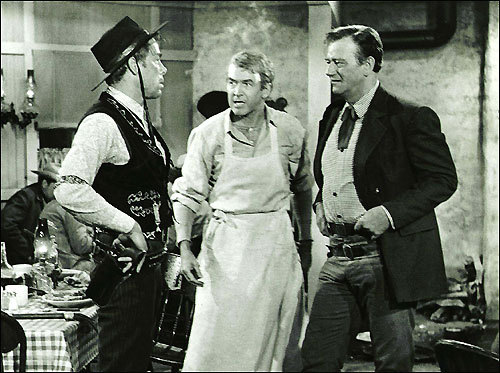
One way of answering this question is provided by an intriguing recent book written by Robert B Pippin, a professor of philosophy, entitled Hollywood Westerns and American Myth: The Importance of Howard Hawks and John Ford for Political Philosophy. One of the films that Pippin examines is John Ford’s great Western The Man Who Shot Liberty Valance (1962). In that film, John Wayne’s cowboy character Tom Doniphon shoots dead the murderous dandy Liberty Valance (Lee Marvin), but he lets the world believe that Eastern lawyer Ransom Stoddard (James Stewart) was the man who fired the fatal bullet. Ranse learns the truth shortly after the event but, with a little convincing from Tom, goes along with the story (which becomes a legend), and builds a long and successful political career on the basis of his false reputation as the man who shot Liberty Valance. When, towards the end of the film, Ranse tells the truth to the reporters at the newspaper of the town where the events occurred, the editor decides to consign the notes to the flames. Like Batman, he offers words that suggest, somewhat cryptically, what value there might be in perpetuating an untruth: ‘This is the West, sir. When the legend becomes fact, print the legend.’
Pippin’s interpretation of Liberty Valance is conscious of the fact that in most Westerns (and arguably, all great Westerns), what is at stake is never simply violence, but the meaning of violence - which is rarely simple. More important than the fact of Liberty Valance’s death is the meaning of this fact, which depends crucially on who killed him. By posing as the man who shot Liberty Valance, Ranse appears to synthesise two sets of qualities which are seen as valuable, but which are rarely found together in one person. As Dutton Peabody, Ranse’s most eloquent advocate at a political rally, tells the gathered crowd:
We see a similar thing going on in relation to Harvey Dent in The Dark Knight when (in a slightly hokey passage) he disarms a man who has managed to smuggle a gun into a criminal trial and barely stops to draw breath before continuing his display of legal brilliance. As Richard Dyer’s foundational work on film stardom demonstrates, the near-‘magical’ synthesis of the contradictory demands of a given culture is one very compelling way of explaining that elusive phenomenon called ‘charisma’.
In The Man Who Shot Liberty Valance, the death of Valance (or perhaps one should say, of Liberty) is shown to pave the way for the establishment of the rule of law and order, creating, eventually, a clean and prosperous town where, to quote another classical Hollywood Western, to which we shall return, a decent woman feels safe walking down the street. Robert Pippin has this to say about why it is crucial that it be believed that Liberty Valance was killed not by tough, self-reliant Westerner Tom Doniphon but Eastern attorney-at-law Ransom Stoddard:
The legend of the man who shot Liberty Valance is used to help found a community based on values of property ownership, rule by law, and so on. Returning to The Dark Knight Rises: what is the legend of Harvey Dent used for? During Commissioner Gordon’s speech to mark ‘Harvey Dent Day’ (a public holiday - for Gotham City at least) he makes reference to the ‘Harvey Dent Act’. Although the details of this piece of legislation are never clarified, what does become clear is that it has extended the powers of the police, and been instrumental in ‘cleaning up the streets’ of Gotham. That is, this particular ‘champion of law and order’ is being used to shore up not liberal democracy, but something edging towards a police state.
The film’s attitude towards this (as towards many other things) is not one hundred per cent clear. Gary Oldman’s Gordon is unfailingly dignified, and his competence and fairness make it virtually impossible to imagine him arresting an innocent person. He expresses misgivings over his actions, but these misgivings seem to relate more to the lie behind the Harvey Dent Act, rather than what the Act has achieved. An analogous problem underpins another moment in the film, when Bruce attempts to justify his holding of extra-legal supergadgets and his withholding of them from others by declaring that ‘one man’s tool is another man’s weapon’. In both cases, the characters seem to believe that it is OK that these laws or weapons of mass destruction exist, as long as you have the right people in charge of them. Or the right country, perhaps: in this attitude to jurisdiction and weaponry, we can see an echo of American exceptionalism. It is a viewpoint that the film does not distance itself from, and therefore might be taken to tacitly endorse.
To Read the Rest of the Essay
by James Zborowski
Alternate Takes
...
Near the beginning of The Dark Knight Rises, we learn that we are rejoining Gotham City’s storyworld eight years after the events shown in The Dark Knight (meaning that roughly twice as much time has elapsed in the world on that side of the screen as in the one on this). At the end of that film, we saw Batman (Christian Bale) vow to Commissioner Gordon (Gary Oldman) that he would take the blame for the murders committed by Harvey Dent (Aaron Eckhart), the city’s one-time ‘White Knight’ politician driven to the dark side by the Joker (Heath Ledger). Here is Batman’s justification for what he proposes:
‘They must never know what he did. Gotham needs its true hero. You either die a hero, or you live long enough to see yourself become the villain. I can do those things, because I’m not a hero, not like Dent. I killed those people. That’s what I can be. [...] Sometimes the truth isn’t good enough. Sometimes people deserve more. Sometimes people deserve to have their faith rewarded.’
In a recent feature published on this site, John Bleasdale suggests that superhero movies ‘are almost fundamentally bound to be mendacious and reactionary.’ He cites the conclusion of The Dark Knight as ‘evidence [of] a distrust in society’:
‘In The Dark Knight, Batman conspires with Commissioner Gordon to cover up Harvey Dent’s crime, laying the blame on Batman. Why? Because the people need to be protected from the truth, we are solemnly told in the film’s final moments, via a child. But, again, why?’
One way of answering this question is provided by an intriguing recent book written by Robert B Pippin, a professor of philosophy, entitled Hollywood Westerns and American Myth: The Importance of Howard Hawks and John Ford for Political Philosophy. One of the films that Pippin examines is John Ford’s great Western The Man Who Shot Liberty Valance (1962). In that film, John Wayne’s cowboy character Tom Doniphon shoots dead the murderous dandy Liberty Valance (Lee Marvin), but he lets the world believe that Eastern lawyer Ransom Stoddard (James Stewart) was the man who fired the fatal bullet. Ranse learns the truth shortly after the event but, with a little convincing from Tom, goes along with the story (which becomes a legend), and builds a long and successful political career on the basis of his false reputation as the man who shot Liberty Valance. When, towards the end of the film, Ranse tells the truth to the reporters at the newspaper of the town where the events occurred, the editor decides to consign the notes to the flames. Like Batman, he offers words that suggest, somewhat cryptically, what value there might be in perpetuating an untruth: ‘This is the West, sir. When the legend becomes fact, print the legend.’
Pippin’s interpretation of Liberty Valance is conscious of the fact that in most Westerns (and arguably, all great Westerns), what is at stake is never simply violence, but the meaning of violence - which is rarely simple. More important than the fact of Liberty Valance’s death is the meaning of this fact, which depends crucially on who killed him. By posing as the man who shot Liberty Valance, Ranse appears to synthesise two sets of qualities which are seen as valuable, but which are rarely found together in one person. As Dutton Peabody, Ranse’s most eloquent advocate at a political rally, tells the gathered crowd:
“He is a man who came to us not packing a gun, but carrying instead a bag of law books. Yes! He is a lawyer. And a teacher! The first west of the rosy buttes. But more important! He is a man who has come to be known throughout this territory, in the last few weeks, as a great champion of law and order!”
We see a similar thing going on in relation to Harvey Dent in The Dark Knight when (in a slightly hokey passage) he disarms a man who has managed to smuggle a gun into a criminal trial and barely stops to draw breath before continuing his display of legal brilliance. As Richard Dyer’s foundational work on film stardom demonstrates, the near-‘magical’ synthesis of the contradictory demands of a given culture is one very compelling way of explaining that elusive phenomenon called ‘charisma’.
In The Man Who Shot Liberty Valance, the death of Valance (or perhaps one should say, of Liberty) is shown to pave the way for the establishment of the rule of law and order, creating, eventually, a clean and prosperous town where, to quote another classical Hollywood Western, to which we shall return, a decent woman feels safe walking down the street. Robert Pippin has this to say about why it is crucial that it be believed that Liberty Valance was killed not by tough, self-reliant Westerner Tom Doniphon but Eastern attorney-at-law Ransom Stoddard:
‘A victory over Liberty Valance […] by Tom Doniphon would be just one more episode in a cycle of violence, revenge and intimidation. Valance must be killed by a representative of a new order; his death must mean that. So since Tom is unseen and quickly vanishes, everybody can think that Ransom Stoddard killed Valance and so can distinguish this act of violence from a personal one by associating it with Ranse’s ideals, can believe that the rule of law and democracy triumphed. Violence before there is law is unavoidably lawless, but if it is for the sake of law the paradox can be lessened if not eliminated.’
The legend of the man who shot Liberty Valance is used to help found a community based on values of property ownership, rule by law, and so on. Returning to The Dark Knight Rises: what is the legend of Harvey Dent used for? During Commissioner Gordon’s speech to mark ‘Harvey Dent Day’ (a public holiday - for Gotham City at least) he makes reference to the ‘Harvey Dent Act’. Although the details of this piece of legislation are never clarified, what does become clear is that it has extended the powers of the police, and been instrumental in ‘cleaning up the streets’ of Gotham. That is, this particular ‘champion of law and order’ is being used to shore up not liberal democracy, but something edging towards a police state.
The film’s attitude towards this (as towards many other things) is not one hundred per cent clear. Gary Oldman’s Gordon is unfailingly dignified, and his competence and fairness make it virtually impossible to imagine him arresting an innocent person. He expresses misgivings over his actions, but these misgivings seem to relate more to the lie behind the Harvey Dent Act, rather than what the Act has achieved. An analogous problem underpins another moment in the film, when Bruce attempts to justify his holding of extra-legal supergadgets and his withholding of them from others by declaring that ‘one man’s tool is another man’s weapon’. In both cases, the characters seem to believe that it is OK that these laws or weapons of mass destruction exist, as long as you have the right people in charge of them. Or the right country, perhaps: in this attitude to jurisdiction and weaponry, we can see an echo of American exceptionalism. It is a viewpoint that the film does not distance itself from, and therefore might be taken to tacitly endorse.
To Read the Rest of the Essay
Monday, August 6, 2012
Will Brooker: Dark Knight Revealed
Dark Knight Revealed
by Will Brooker
Alternate Takes
The key image in Christopher Nolan’s The Dark Knight Rises is not the tattered American flags or the exploding football field. It’s an image that circulated in viral marketing months before the film’s release - Bane’s ‘strike zones’, circled on a map of Gotham City. The package, sent out to key websites in December 2011, reappeared in The Dark Knight Rises, as Detective John Blake studied it for clues. ‘I don’t know anything about civil engineering,’ he protests. Jim Gordon reassures him. ‘But you know about patterns.’
The Dark Knight Rises - the entire Dark Knight trilogy - is about patterns. It’s about networks. It’s about matrices, links, dialogues, nodes on a map. It’s about echoes between those terms, and the way those terms define themselves in relation to each other, and can shift, and change places. It’s not just as a comment on capitalism that Bane’s men raid a stock exchange, and Bruce ponders the trades they were making.
Just as Batman Begins (2005) suggested that Scarecrow’s use of fear as a weapon was no different from Batman’s, and The Dark Knight (2008) ramped up the stakes by asking what, if anything, separated Batman’s counter-terror measures from Joker’s terror, so The Dark Knight Rises is about the fragility of definitions, the limits of structures, the illusion of binary oppositions.
The movie stresses conditions of birth, upbringing and social class - how characters are raised, how they rise in life - but it also suggests that they can free themselves from those structures, and fall, and change places. Bane, ‘born and raised in hell on earth’, climbs the ranks of the League of Shadows to become inheritor and leader, but is ultimately revealed as a foot-soldier, a bodyguard to Talia. Bruce, born in the Regency room of Wayne Manor, becomes imprisoned by his privilege, loses his fortune and falls (‘From Billionaire to Bum’, says the headline), and is free to remake himself as a nomad, a no-man, just as he did before becoming Batman in the first film. The chant we associate with Bane from his first appearance (as the plane falls and he rises into the sky, in an echo of The Dark Knight’s skyhook scene) is repeated for Bruce as he makes a leap of faith from the prison pit.
John Blake also rises through the ranks of the GCPD, becoming a detective and ditching his uniform. He tells the guards on the other side of Gotham’s bridge ‘I’m a cop like you’, but he also recognises the importance of transition and fluidity. ‘The situation has changed,’ he yells at his comrades as they bar his path. ‘Your orders are out of date.’ Blake realises that right and wrong can be flexible terms, and that they don’t always fit the letter of the law. Disillusioned by the police insistence on following strict instructions, he tosses his badge into the river and quits the force, telling Gordon he’s discovered that structures can become shackles. Like Bruce and Miranda, he hides his birth-name behind a disguise, but reclaims it, and discovers a new life, in the film’s closing scenes.
To Read the Rest of the Essay
by Will Brooker
Alternate Takes
The key image in Christopher Nolan’s The Dark Knight Rises is not the tattered American flags or the exploding football field. It’s an image that circulated in viral marketing months before the film’s release - Bane’s ‘strike zones’, circled on a map of Gotham City. The package, sent out to key websites in December 2011, reappeared in The Dark Knight Rises, as Detective John Blake studied it for clues. ‘I don’t know anything about civil engineering,’ he protests. Jim Gordon reassures him. ‘But you know about patterns.’
The Dark Knight Rises - the entire Dark Knight trilogy - is about patterns. It’s about networks. It’s about matrices, links, dialogues, nodes on a map. It’s about echoes between those terms, and the way those terms define themselves in relation to each other, and can shift, and change places. It’s not just as a comment on capitalism that Bane’s men raid a stock exchange, and Bruce ponders the trades they were making.
Just as Batman Begins (2005) suggested that Scarecrow’s use of fear as a weapon was no different from Batman’s, and The Dark Knight (2008) ramped up the stakes by asking what, if anything, separated Batman’s counter-terror measures from Joker’s terror, so The Dark Knight Rises is about the fragility of definitions, the limits of structures, the illusion of binary oppositions.
The movie stresses conditions of birth, upbringing and social class - how characters are raised, how they rise in life - but it also suggests that they can free themselves from those structures, and fall, and change places. Bane, ‘born and raised in hell on earth’, climbs the ranks of the League of Shadows to become inheritor and leader, but is ultimately revealed as a foot-soldier, a bodyguard to Talia. Bruce, born in the Regency room of Wayne Manor, becomes imprisoned by his privilege, loses his fortune and falls (‘From Billionaire to Bum’, says the headline), and is free to remake himself as a nomad, a no-man, just as he did before becoming Batman in the first film. The chant we associate with Bane from his first appearance (as the plane falls and he rises into the sky, in an echo of The Dark Knight’s skyhook scene) is repeated for Bruce as he makes a leap of faith from the prison pit.
John Blake also rises through the ranks of the GCPD, becoming a detective and ditching his uniform. He tells the guards on the other side of Gotham’s bridge ‘I’m a cop like you’, but he also recognises the importance of transition and fluidity. ‘The situation has changed,’ he yells at his comrades as they bar his path. ‘Your orders are out of date.’ Blake realises that right and wrong can be flexible terms, and that they don’t always fit the letter of the law. Disillusioned by the police insistence on following strict instructions, he tosses his badge into the river and quits the force, telling Gordon he’s discovered that structures can become shackles. Like Bruce and Miranda, he hides his birth-name behind a disguise, but reclaims it, and discovers a new life, in the film’s closing scenes.
To Read the Rest of the Essay
Friday, May 25, 2012
Ian Grey: Black Widow Spins Webs Around THE AVENGERS
Black Widow Spins Webs Around THE AVENGERS
by Ian Grey
Press Play
 Black Widow is the first hero seen in The Avengers, the latest entry in Joss Whedon's career-long feminist project. She does not immediately display the super powers enjoyed by the other Avengers—Captain America’s unnatural super-strength, The Hulk gamma-ray rage giant, Iron Man’s wearable rock ‘em, sock ‘em robot suit, or Thor’s hammer of the demi-gods. The only visibly super things about Black Widow are the latest in cat suit couture and a striking asymmetrical crimson bob. And yet she’s still able to trash a clutch of Russian scumbags with her hands tied behind her back. With a chair tied to her rear. While talking on her cell phone.
She’s also the sole Avenger that S.H.I.E.L.D. leader Nick Fury (Samuel Jackson) trusts to convince Bruce Banner (Mark Ruffalo) to join Thor (Chris Hemsworth), Iron Man (Robert Downey, Jr.), and Captain America (Chris Evans) in the fight against Thor’s psychotic brother Loki (Tom Hiddleston) who, having stolen the ultimate source of power in the universe, the Tesseract, plans to use an alien army to devastate the Earth. (The plot ends there.)
As egos collide, Black Widow—street name, Natasha Romanova—is the only character who does not throw a monstrous hissyfit. The only character to gather actionable intelligence against Loki from Loki. The character who not only literally kicks sense back into the brainwashed Hawkeye, but then absolves him of any sins performed while under the loony god’s spell.
You want fearless? When midtown Manhattan is swarming with thousands of robo-aliens, the dreaded Chitauri, Black Widow commandeers one of their slippery aero-sleds and flies it to steal Loki’s glowing phallic scimitar so as to save the world so Iron Man can blow up the aliens.
Oh—and the Tesseract? It’s female. I know this because everyone calls it by female pronouns—respectfully. How does that work? Well, the way all Whedon works: second viewings reveal not only layer after layer of multiple meanings, jokes piled on jokes, but seemingly random elements that are actual thematic glue. Nothing is never there without a reason.
Anyway, Black Widow! A worthy addition to Whedon’s female action bloodline, right? The flame-haired heir to Buffy, Faith, Kendra, River, Echo, Zoe, Fred, and Illyria, right?
No.
To Read the Rest of the Essay
Black Widow is the first hero seen in The Avengers, the latest entry in Joss Whedon's career-long feminist project. She does not immediately display the super powers enjoyed by the other Avengers—Captain America’s unnatural super-strength, The Hulk gamma-ray rage giant, Iron Man’s wearable rock ‘em, sock ‘em robot suit, or Thor’s hammer of the demi-gods. The only visibly super things about Black Widow are the latest in cat suit couture and a striking asymmetrical crimson bob. And yet she’s still able to trash a clutch of Russian scumbags with her hands tied behind her back. With a chair tied to her rear. While talking on her cell phone.
She’s also the sole Avenger that S.H.I.E.L.D. leader Nick Fury (Samuel Jackson) trusts to convince Bruce Banner (Mark Ruffalo) to join Thor (Chris Hemsworth), Iron Man (Robert Downey, Jr.), and Captain America (Chris Evans) in the fight against Thor’s psychotic brother Loki (Tom Hiddleston) who, having stolen the ultimate source of power in the universe, the Tesseract, plans to use an alien army to devastate the Earth. (The plot ends there.)
As egos collide, Black Widow—street name, Natasha Romanova—is the only character who does not throw a monstrous hissyfit. The only character to gather actionable intelligence against Loki from Loki. The character who not only literally kicks sense back into the brainwashed Hawkeye, but then absolves him of any sins performed while under the loony god’s spell.
You want fearless? When midtown Manhattan is swarming with thousands of robo-aliens, the dreaded Chitauri, Black Widow commandeers one of their slippery aero-sleds and flies it to steal Loki’s glowing phallic scimitar so as to save the world so Iron Man can blow up the aliens.
Oh—and the Tesseract? It’s female. I know this because everyone calls it by female pronouns—respectfully. How does that work? Well, the way all Whedon works: second viewings reveal not only layer after layer of multiple meanings, jokes piled on jokes, but seemingly random elements that are actual thematic glue. Nothing is never there without a reason.
Anyway, Black Widow! A worthy addition to Whedon’s female action bloodline, right? The flame-haired heir to Buffy, Faith, Kendra, River, Echo, Zoe, Fred, and Illyria, right?
No.
To Read the Rest of the Essay
Black Widow is the first hero seen in The Avengers, the latest entry in Joss Whedon's career-long feminist project. She does not immediately display the super powers enjoyed by the other Avengers—Captain America’s unnatural super-strength, The Hulk gamma-ray rage giant, Iron Man’s wearable rock ‘em, sock ‘em robot suit, or Thor’s hammer of the demi-gods. The only visibly super things about Black Widow are the latest in cat suit couture and a striking asymmetrical crimson bob. And yet she’s still able to trash a clutch of Russian scumbags with her hands tied behind her back. With a chair tied to her rear. While talking on her cell phone.
She’s also the sole Avenger that S.H.I.E.L.D. leader Nick Fury (Samuel Jackson) trusts to convince Bruce Banner (Mark Ruffalo) to join Thor (Chris Hemsworth), Iron Man (Robert Downey, Jr.), and Captain America (Chris Evans) in the fight against Thor’s psychotic brother Loki (Tom Hiddleston) who, having stolen the ultimate source of power in the universe, the Tesseract, plans to use an alien army to devastate the Earth. (The plot ends there.)
As egos collide, Black Widow—street name, Natasha Romanova—is the only character who does not throw a monstrous hissyfit. The only character to gather actionable intelligence against Loki from Loki. The character who not only literally kicks sense back into the brainwashed Hawkeye, but then absolves him of any sins performed while under the loony god’s spell.
You want fearless? When midtown Manhattan is swarming with thousands of robo-aliens, the dreaded Chitauri, Black Widow commandeers one of their slippery aero-sleds and flies it to steal Loki’s glowing phallic scimitar so as to save the world so Iron Man can blow up the aliens.
Oh—and the Tesseract? It’s female. I know this because everyone calls it by female pronouns—respectfully. How does that work? Well, the way all Whedon works: second viewings reveal not only layer after layer of multiple meanings, jokes piled on jokes, but seemingly random elements that are actual thematic glue. Nothing is never there without a reason.
Anyway, Black Widow! A worthy addition to Whedon’s female action bloodline, right? The flame-haired heir to Buffy, Faith, Kendra, River, Echo, Zoe, Fred, and Illyria, right?
No.
To Read the Rest of the Essay
Wednesday, May 23, 2012
Matthew J. Iannucci: Postmodern Antihero -- Capitalism and Heroism in Taxi Driver
Postmodern Antihero: Capitalism and Heroism in Taxi Driver
by Matthew J. Iannucci
Bright Lights Film Journal

Martin Scorsese's Taxi Driver is a gritty, disturbing, nightmarish modern film classic that examines alienation in urban society. From a postmodernist's perspective, it combines the elements of noir, the Western, horror, and urban melodrama as it explores the psychological madness within an obsessed, inarticulate, lonely antihero cab driver, Travis Bickle (Robert De Niro). The plotline is simple: Travis directs his frustrated anger at the street dwellers of New York and a presidential candidate, and his unhinging assault is paired with an attempt to rescue a young prostitute, Iris (Jodie Foster), from her predatory pimp. Historically, Taxi Driver appeared after a decade of war in Vietnam (1976), and after the Watergate crisis and subsequent resignation of Nixon. Five years later, when it was linked to would-be presidential assassin John Hinckley and his obsession with Jodie Foster, it became prima facie evidence for those on the political right who believed that violence in film translates into crime in real life. It is now almost impossible to separate Taxi Driver from this debate. However, Bickle's antiheroic character is more directly related to a failure of a capitalist system that pits his working-class position as a cab driver against those who have already been disenfranchised according to socioeconomic class, gender, and/or race.
As the film opens, Travis emerges from a forgotten Midwestern form of Americana that appears as obsolete as Travis himself in a big city heterogeneously composed of corporate financiers, political patrons, gun dealers, and prostitutes. In order to survive, he wants to "become a person like other people" as he puts it, but his own disenfranchisement from this nation has left him both intellectually and emotionally bankrupt from the Vietnam War. Freedom, the very nucleus of the American dream, is dependent on individual socioeconomic choices that inform and shape one's identity. But Travis's lack of a distinct identity compels him to cut and paste together what he believes is a heroic identity from an external menu of personages such as the "gunslinger" and the Indian. In actuality, what he does is stitch together a postmodern antiheroic identity that is nostalgic and pop culture-oriented, evidenced by the Mohawk haircut that he sports in the penultimate sequences — because he possesses no internal self.
Taxi Driver implies that identity is not genuine but always synergistic, a kind of potpourri of idolatry and maxims drawn from popular culture, especially from violent movies and television news. In this vein, Robert Ray views Taxi Driver as a postmodern "corrected" Right film, the type of film generally aimed at a naïve audience. Ray explains that a "Right" film presents a traditional conservative philosophy that promotes the application of Western-style, individual solutions to complex contemporary problems. He writes, "Taxi Driver's basic story followed the right wing's loyalty to the classic Western formula: a reluctant individual, confronted by evil, acts on his own to rid society of spoilers. As played by Robert De Niro, Taxi Driver's protagonist had obvious connections with Western heroes…even his name, Travis, linked him to the defender of the Alamo."1 Ray's notion that the film is a "correction" of the right-wing concept of justice is accurate because of its odd plot twist at the conclusion. Normally, such a story would identify Travis's complicity with these criminals and thereby relegate him to some form of institutional punishment. But the film's underlying theme reveals how absurd the Western idealistic depiction of heroism is because the news media in the film not only ignores his actions but also glorifies a psychopathic killer as a noble warrior.
To Read the Rest of the Essay
by Matthew J. Iannucci
Bright Lights Film Journal
Martin Scorsese's Taxi Driver is a gritty, disturbing, nightmarish modern film classic that examines alienation in urban society. From a postmodernist's perspective, it combines the elements of noir, the Western, horror, and urban melodrama as it explores the psychological madness within an obsessed, inarticulate, lonely antihero cab driver, Travis Bickle (Robert De Niro). The plotline is simple: Travis directs his frustrated anger at the street dwellers of New York and a presidential candidate, and his unhinging assault is paired with an attempt to rescue a young prostitute, Iris (Jodie Foster), from her predatory pimp. Historically, Taxi Driver appeared after a decade of war in Vietnam (1976), and after the Watergate crisis and subsequent resignation of Nixon. Five years later, when it was linked to would-be presidential assassin John Hinckley and his obsession with Jodie Foster, it became prima facie evidence for those on the political right who believed that violence in film translates into crime in real life. It is now almost impossible to separate Taxi Driver from this debate. However, Bickle's antiheroic character is more directly related to a failure of a capitalist system that pits his working-class position as a cab driver against those who have already been disenfranchised according to socioeconomic class, gender, and/or race.
As the film opens, Travis emerges from a forgotten Midwestern form of Americana that appears as obsolete as Travis himself in a big city heterogeneously composed of corporate financiers, political patrons, gun dealers, and prostitutes. In order to survive, he wants to "become a person like other people" as he puts it, but his own disenfranchisement from this nation has left him both intellectually and emotionally bankrupt from the Vietnam War. Freedom, the very nucleus of the American dream, is dependent on individual socioeconomic choices that inform and shape one's identity. But Travis's lack of a distinct identity compels him to cut and paste together what he believes is a heroic identity from an external menu of personages such as the "gunslinger" and the Indian. In actuality, what he does is stitch together a postmodern antiheroic identity that is nostalgic and pop culture-oriented, evidenced by the Mohawk haircut that he sports in the penultimate sequences — because he possesses no internal self.
Taxi Driver implies that identity is not genuine but always synergistic, a kind of potpourri of idolatry and maxims drawn from popular culture, especially from violent movies and television news. In this vein, Robert Ray views Taxi Driver as a postmodern "corrected" Right film, the type of film generally aimed at a naïve audience. Ray explains that a "Right" film presents a traditional conservative philosophy that promotes the application of Western-style, individual solutions to complex contemporary problems. He writes, "Taxi Driver's basic story followed the right wing's loyalty to the classic Western formula: a reluctant individual, confronted by evil, acts on his own to rid society of spoilers. As played by Robert De Niro, Taxi Driver's protagonist had obvious connections with Western heroes…even his name, Travis, linked him to the defender of the Alamo."1 Ray's notion that the film is a "correction" of the right-wing concept of justice is accurate because of its odd plot twist at the conclusion. Normally, such a story would identify Travis's complicity with these criminals and thereby relegate him to some form of institutional punishment. But the film's underlying theme reveals how absurd the Western idealistic depiction of heroism is because the news media in the film not only ignores his actions but also glorifies a psychopathic killer as a noble warrior.
To Read the Rest of the Essay
Sunday, April 15, 2012
Richard Koehler: Nicholas Winding Refn and the Search for a Real Hero
Nicholas Winding Refn and the Search for a Real Hero
by Robert Koehler
Cinema Scope

In the middle of Nicolas Winding Refn’s Drive, a film punctuated by extreme flourishes of violence and vengeance, there is a period of peace. It occurs when Driver (Ryan Gosling), a quietly contained guy who holds down three jobs—auto mechanic, movie stunt driver, and getaway driver-for-hire—is asked by his auto-shop boss (Bryan Cranston) to drive home customer and Driver’s neighbour Irene (Carey Mulligan) and her little boy. En route, Driver takes a surprising detour from the street down to the concrete banks of the Los Angeles River, one of the city’s most iconic images, a grand public-works project born out of vast and tragic flooding the city endured generations ago. The river, choked into a narrow canal and surrounded by an elegantly paved canyon, has been used in too many movies and TV shows to possibly count, most recently by Bruce La Bruce for daytime sequences of L.A. Zombie (2010). Driver, true to character, uses it as a racetrack and as a bit of stunt track—mildly, as a kid’s in the car, and he’s a gentleman at heart—but also as a road to get somewhere.
The typical deployment of the Los Angeles River in cinema is as a symbol of dead ends, final stops, the place where the city dies, and people along with it. Not so for Refn, for whom Los Angeles is a new city, a place of discovery. Viewed from the majestic prospect of a high angle in long-shot widescreen, Driver stops at the place where the concrete river ends and gives way to the wild river, a startling image even for native Angelenos. He knows these kinds of places, having driven everywhere (so, in reality, does Gosling, who knows the city expertly and drove Refn around town as research, inspiration, and preparation). Refn understands those many places in Los Angeles that make it fairly unique, and reverses the usual clichéd knock on the place as one long paved sprawl. Constantly, the paved cityscape surrenders to the natural world, sidewalks dissolve into dirt trails, roads simply stop, buildings reach their limit when faced with cliffsides, massive chaparral, impregnable mountain ranges that cut through the metropolitan area. Driver leads mother and son to the wild river for a Tom Sawyer afternoon under the sun, a Southern California utopia—the ultimate getaway—an idyll that defines Drive and Driver in fundamental ways.
Superficially an action movie, Drive is actually a film in search of romance, zigzagging through an obstacle course of fairy tale and myth, and a hall of mirrors in which characters can be read as fantasy projections of others while being aware of themselves as figures inside a myth. Beloved in Cannes after days of disappointing films in the competition, Drive was perhaps welcomed by some for the wrong reason: as some kind of new read on Melville’s Le samourai (1967), with Gosling processing Alain Delon’s stoic killer. For once, the director has a sound interpretation that he’s willing to share with whomever cares to listen: Refn correctly argues that Drive’s foundation is in fairy tale, particularly its thematic of a character’s discovery of his own heroism, which Driver finds through the course of nurturing and protecting Irene, who’s made paradoxically more vulnerable when her convict husband returns home from prison. The necessary elimination of dragons—in the form of Albert Brooks’ ice-cold mobster Bernie Rose and Ron Perlman’s put-upon mobster Nino, to say nothing of a few nameless hitmen along the way—doesn’t so much make Driver into a killer, although he wreaks revenge with frighteningly intelligent brutality. Rather, it transforms him into a mythical figure who satisfies the imaginings of those around him, including Irene, who can nevertheless only marvel at him while knowing she can never have him. This is vastly different from Melville’s heightened existential world of professional killers who function by a code and live like lone wolves, apparently free of the need for genuine and reciprocal human contact. Delon’s Samourai is a corporeal killing machine; Gosling’s Driver is a young man in formation, whose work comprises (per his three jobs) repair, escape, and entertainment, and who finds his self during a gauntlet that perhaps only he can survive—an accidental knight who slays the beast.
This is a far stretch from James Sallis’ novel on which Hossein Amini’s screenplay is based, and, as Refn describes it, wildly different from Amini’s previous drafts written as a potential Universal franchise for Hugh Jackman. Sallis’ superb, laconic book, hardboiled to the core, as affectionate toward its city as it is cynical about the city’s most famous (show) business, could have been adapted pretty closely, even with its obsessive (and perhaps needless) jumps in chronology. But a knowledge of the book is helpful in appreciating the grand achievement in American cinema that Drive is. Hollywood has always been open to the invasive notions of outsiders, particularly European directors with strong points of view. Lubitsch, Lang, Boorman, Preminger, Wilder, von Sternberg, Herzog, Verhoeven, and von Stroheim all managed to import their native sensibilities with little compromise into the Hollywood system, and generally thrived intact. Refn’s ambition is clearly to make big movies for large audiences by his own sometimes-radical standards, which include mixing the hyper-violent ecstasies of the Pusher trilogy (1996, 2004, 2005), highly theatrical characters like Tom Hardy’s Bronson (2008), dreamlike dances of death as in Valhalla Rising (2009), and the romance of transformation in Drive. His new film is an act of will, pulling a fine but fairly standard piece of high-class pulp into something richer and more dynamic, modern in its self-consciousness as a work of art and entertainment, and Wellesian in its capacity to astonish, shock, and tease the mind’s perceptions. The fact that Refn is soon making a re-do of Logan’s Run with Gosling is a suggestion of a large-scaled cinema that’s aware of its kinetic powers, its artistic breadth, and its ability to kick it into the fifth gear.
To Read the Interview
by Robert Koehler
Cinema Scope
In the middle of Nicolas Winding Refn’s Drive, a film punctuated by extreme flourishes of violence and vengeance, there is a period of peace. It occurs when Driver (Ryan Gosling), a quietly contained guy who holds down three jobs—auto mechanic, movie stunt driver, and getaway driver-for-hire—is asked by his auto-shop boss (Bryan Cranston) to drive home customer and Driver’s neighbour Irene (Carey Mulligan) and her little boy. En route, Driver takes a surprising detour from the street down to the concrete banks of the Los Angeles River, one of the city’s most iconic images, a grand public-works project born out of vast and tragic flooding the city endured generations ago. The river, choked into a narrow canal and surrounded by an elegantly paved canyon, has been used in too many movies and TV shows to possibly count, most recently by Bruce La Bruce for daytime sequences of L.A. Zombie (2010). Driver, true to character, uses it as a racetrack and as a bit of stunt track—mildly, as a kid’s in the car, and he’s a gentleman at heart—but also as a road to get somewhere.
The typical deployment of the Los Angeles River in cinema is as a symbol of dead ends, final stops, the place where the city dies, and people along with it. Not so for Refn, for whom Los Angeles is a new city, a place of discovery. Viewed from the majestic prospect of a high angle in long-shot widescreen, Driver stops at the place where the concrete river ends and gives way to the wild river, a startling image even for native Angelenos. He knows these kinds of places, having driven everywhere (so, in reality, does Gosling, who knows the city expertly and drove Refn around town as research, inspiration, and preparation). Refn understands those many places in Los Angeles that make it fairly unique, and reverses the usual clichéd knock on the place as one long paved sprawl. Constantly, the paved cityscape surrenders to the natural world, sidewalks dissolve into dirt trails, roads simply stop, buildings reach their limit when faced with cliffsides, massive chaparral, impregnable mountain ranges that cut through the metropolitan area. Driver leads mother and son to the wild river for a Tom Sawyer afternoon under the sun, a Southern California utopia—the ultimate getaway—an idyll that defines Drive and Driver in fundamental ways.
Superficially an action movie, Drive is actually a film in search of romance, zigzagging through an obstacle course of fairy tale and myth, and a hall of mirrors in which characters can be read as fantasy projections of others while being aware of themselves as figures inside a myth. Beloved in Cannes after days of disappointing films in the competition, Drive was perhaps welcomed by some for the wrong reason: as some kind of new read on Melville’s Le samourai (1967), with Gosling processing Alain Delon’s stoic killer. For once, the director has a sound interpretation that he’s willing to share with whomever cares to listen: Refn correctly argues that Drive’s foundation is in fairy tale, particularly its thematic of a character’s discovery of his own heroism, which Driver finds through the course of nurturing and protecting Irene, who’s made paradoxically more vulnerable when her convict husband returns home from prison. The necessary elimination of dragons—in the form of Albert Brooks’ ice-cold mobster Bernie Rose and Ron Perlman’s put-upon mobster Nino, to say nothing of a few nameless hitmen along the way—doesn’t so much make Driver into a killer, although he wreaks revenge with frighteningly intelligent brutality. Rather, it transforms him into a mythical figure who satisfies the imaginings of those around him, including Irene, who can nevertheless only marvel at him while knowing she can never have him. This is vastly different from Melville’s heightened existential world of professional killers who function by a code and live like lone wolves, apparently free of the need for genuine and reciprocal human contact. Delon’s Samourai is a corporeal killing machine; Gosling’s Driver is a young man in formation, whose work comprises (per his three jobs) repair, escape, and entertainment, and who finds his self during a gauntlet that perhaps only he can survive—an accidental knight who slays the beast.
This is a far stretch from James Sallis’ novel on which Hossein Amini’s screenplay is based, and, as Refn describes it, wildly different from Amini’s previous drafts written as a potential Universal franchise for Hugh Jackman. Sallis’ superb, laconic book, hardboiled to the core, as affectionate toward its city as it is cynical about the city’s most famous (show) business, could have been adapted pretty closely, even with its obsessive (and perhaps needless) jumps in chronology. But a knowledge of the book is helpful in appreciating the grand achievement in American cinema that Drive is. Hollywood has always been open to the invasive notions of outsiders, particularly European directors with strong points of view. Lubitsch, Lang, Boorman, Preminger, Wilder, von Sternberg, Herzog, Verhoeven, and von Stroheim all managed to import their native sensibilities with little compromise into the Hollywood system, and generally thrived intact. Refn’s ambition is clearly to make big movies for large audiences by his own sometimes-radical standards, which include mixing the hyper-violent ecstasies of the Pusher trilogy (1996, 2004, 2005), highly theatrical characters like Tom Hardy’s Bronson (2008), dreamlike dances of death as in Valhalla Rising (2009), and the romance of transformation in Drive. His new film is an act of will, pulling a fine but fairly standard piece of high-class pulp into something richer and more dynamic, modern in its self-consciousness as a work of art and entertainment, and Wellesian in its capacity to astonish, shock, and tease the mind’s perceptions. The fact that Refn is soon making a re-do of Logan’s Run with Gosling is a suggestion of a large-scaled cinema that’s aware of its kinetic powers, its artistic breadth, and its ability to kick it into the fifth gear.
To Read the Interview
Subscribe to:
Posts (Atom)