Showing posts with label Psychology. Show all posts

Monday, September 2, 2013

Jon Shenk - Playback: Errol Morris' The Thin Blue Line

Playback: Errol Morris' 'The Thin Blue Line'
by Jon Shenk
Documentary


I was a freshman in college when a friend asked me one night if I was interested in seeing a documentary film. "The director will be there," he said. "A guy named Errol Morris."

The screening was in a lecture hall, but when the lights dimmed, I immediately felt transported to another world. An electric blue line shot through the screen during the title sequence, and I remember thinking, I have no idea what this blue line is all about, but I'm drawn to it. I spent the rest of the film in a state of hypnosis.

The first lines, like so much of the interview material in The Thin Blue Line, come so effortlessly. This is America, I remember thinking, but a new kind of America where every spoken syllable is important. A man in jail tells us, "In October, my brother and I left Ohio... We arrived in Dallas on a Thursday." Another inmate begins by saying, "I ran away from home." The pace is patient and deliberate. In this alternate universe, engaging one another's stories feels like a sacred act.

At 19, I had never considered a career as a documentary filmmaker. I had never thought about what made a documentary a documentary, but with The Thin Blue Line, I was beholding a beautiful piece of art, full of drama, justice and humanity. I wondered, Could I ever be a part of something like this?

The Thin Blue Line is a study of truth. At one level, it is a collection of depositions, in life's cosmic courtroom, that serve as a giant "fuck you" to the Texas criminal justice system. During the Q&A that night, a student asked Morris how he felt about the death penalty. He responded that he never intended to make an anti-death penalty film, but that he found his subject, Randall Adams, by accident while researching a film focused on the court psychologist that assessed Adams' sanity. "However," Morris said, "if I was able to randomly uncover one innocent person on death row, I can't help but to think there might be a second one out there."

That response defines the relationship between documentaries and the potential activism around the issue that they approach. Morris is not so much an activist as he is an artist/storyteller unabashed by unimpeachable, first-hand knowledge about this particular subject matter.

To Read the Rest


Saturday, August 17, 2013

A Beautiful Mind (USA: Ron Howard, 2001)


A Beautiful Mind (USA: Ron Howard, 2001: 135 mins)

Billings, Andrew C. "Biographical Omissions: The Case of A Beautiful Mind and the Search For Authenticity." The Film Journal #1 (May 2002)

Cassey, Joe. "Mental Illness." Understanding Representation. ed. Wendy Helsby. London: BFI, 2005: 99-114. [Available in BCTC Library PN 1995 U4977 2005]

Hansen, Per Krogh. " Unreliable Narration in Cinema: Facing the Cognitive Challenge Arising from Literary Studies." Amsterdam International Electronic Journal of Narratology #5 (Autumn 2009)

Friday, August 9, 2013

Adaptation (USA: Spike Jonze, 2002)


"Spike Jonze and the screenwriter Charlie Kaufman concoct an intricate, scrambled parallel universe populated by anxious, itchy people, some appearing really to exist. The hero is Mr. Kaufman himself (Cage), a screenwriter struggling to adapt THE ORCHID THIEF, Susan Orlean's nonfiction meditation on flowers, obsession and Darwinian theory. He is tormented by writer's block and by his twin brother, Donald (also Mr. Cage)… This is a remarkable, impossible movie — about itself but also about its own nonexistence — and one of the most formally audacious, intellectually charged American movies in quite some time." - A.O. Scott, The New York Times
"I didn’t expect to be as taken as I was. [Michael] Fried’s books are sometimes obsessively focused on quite esoteric propositions about a specific painting or photograph, but perhaps because of that are often spellbinding. I never thought I’d sit through 45 minutes of silent footage of Zidane running across a soccer field and come away enthralled, or find myself standing in front of a wall for hours thinking about the direction a figure is facing in a seventeenth-century painting or a 21st-century photograph. Fried can get carried away: once you see the absorption-theatricality distinction, it becomes tempting to see it everywhere. But even if it is not everywhere, it is in a lot of places. And once I started rereading Houellebecq, it was there too.

Fried’s basic insight is as follows: If you look at the tradition of high European art painting (he then expands to photography and novels), you will notice that many paintings seek to show figures as if they were not aware of being looked at by an audience. This could come through absorption in work, such as artisanal craftsmanship, or immersion in sociality with others. But in any case, the figures are oriented away from the audience, and pulled into the distinct world of the painting. This “pulling in” is crucial, since it sets up the painting as somehow standing outside and beyond our own wishes, with its own inner solidity. Because it pulls them away from us and into it, the figures and their world become objects that we look at and learn from, not mere projections of our desires.

And yet, they are inescapably there to be looked at by us. This fact means that in one way or another the painting must acknowledge that its scenes were created to be part of a scene, and therefore the figures are never fully independent of some kind of performance for their imagined audience. The independence they gain through being pulled into the inner world of the painting is taken back through being drawn back to their dependence for their existence on the desires of their audience. In Fried’s interpretation, this dependence shows up in subtle indications, such as a playing card turned outward toward the viewer, or one figure who breaks the spell of the absorbing scene to look out of the painting’s scene into the eye of the beholder.

What makes this relationship between theatricality and absorption especially potent is that it is not only descriptive but dynamic. It is an engine that drives artistic creativity, and much of Fried’s criticism is devoted to examining escalating attempts to deal with it. The most important dynamic involves various efforts to defeat the threat of theatricality and mannerism. This can happen in many ways, and no doubt many more will be discovered. One variant involves representations of figures caught up in war and violence: What could be more absorbing than that? There is no time to look away in the midst of battle. This is Fried’s interpretation of Jacques-Louis David, for example. Another variant is depictions of simple peasants, lost in everyday activities such as picking crops, oblivious to anything else but the task at hand. This is Fried’s interpretation of Millet’s The Gleaners.

But that very escalating depiction of violence or simplicity is unstable, in Fried’s reading. They inevitably become cliché and overdone, oscillating between shock for shock’s sake as the demands for the intensity of violence become greater on the one hand, and the brutalization and oversimplification of uneducated lower classes or nonintellectuals becomes too overt to ignore. In this and similar cases, the artist’s independence is the one threatened by theatricality. The peasants or soldiers may be absorbed in their work in the fields or bloody battles, but only an attention-seeking artist would put them in large-format canvases in front of crowds of the bourgeois public as a surefire way to gain their applause.

The dialectic begins anew, and artists begin finding ways to defeat the impression that they are painting in order to be seen painting but are themselves absorbed in the world of the painting as it unfolds, as if on its own, beyond their will. Fried takes this thought very far and in many directions, but his book on Courbet develops it directly. Courbet, in his view, hits on a very potent technique, which involves dispersing his own artistic consciousness throughout the painting, creating an impression that he is everywhere in it, and therefore somehow has merged with each and every aspect of it. In that way, the audience sees the painting and the painter immersed in it all at once.

This too ultimately proves unstable, in ways I will not get into now, eventually leading to the undoing from within of this line of painting in Manet. The last point I do want to emphasize is that while Fried often highlights painterly concerns around how to represent absorbed figures and defeat the impression of mannerism, this concern has roots in a conviction that the desire for some kind of absorption is present in the culture. Here too he has a point. Think of Charlie Kaufman films, such as Adaptation. These are animated by the sense that “we” have lost the ability to have intense, unmediated direct experience, that we are always somehow, even in the most seemingly intimate moments, acting with a view to how it will look to somebody else: how it will play on your feed, in the article you might write, in the story you might tell at a party.

Taken far enough, this thought leads to a kind of lament with language itself and a corresponding desire for prelinguistic immersion in instincts. But we don’t have to go so far to get the point. Just think of moments when you have felt like the line between you and the world disappeared: running down a hill so fast you can’t think but just must react; working on an essay and looking up two hours later as if it were no time at all; laughing with family and friends as each says exactly the right next thing that everybody understands without having to make any inferences; escaping or inflicting violence; and, yes, orgasm. The larger point behind Fried’s project is twofold: that painters try to depict absorption because this is how to absorb audiences who crave that very absorption, but that this very act creates the self-reinforcing oscillation between victories for theatricality and momentary reclamations of absorption." - Dan Silver  


Adaptation (USA: Spike Jonze, 2002: 114 mins)

Bean, Henry. "Self Made Heroes: Adaptation puts the self-obsession of the screenwriter centre stage." Sight and Sound (March 2003)

D., Margo and Margo P. "The Orchid Thief vs. Adaptation." Book vs Movie (June 30, 2017) ["The Margos are back and taking on their most interesting episode yet with a compare and contrast of the Susan Orlean novel The Orchid Thief (which began as a New Yorker article) and the hit Charlie Kaufman/Spike Jones movie Adaptation. If there has ever been a reason for this podcast to exist --this material is the one to tackle!So many differences between the book and movie here, we are not quite sure where to begin but let us give it a try."]

Dzialo, Chris. "'Frustrated Time' Narration: The Screenplays of Charlie Kaufman." Puzzle Films: Complex Storytelling in Contemporary Cinema. Malden, MA: Wiley-Blackwell, 2009: 107-128. [BCTC Library: PN1995 P89 2009]

Edwards, Gile. "Adaptation (2002)." 366 Weird Movies (January 13, 2016)

Evans, Kim. "Charlie Kauffman, Screenwriter." To the Best of Our Knowledge (November 10, 2013)

Kozak, Oktay Ege, Erik McClanahan and Ryan Oliver. "Lost in Charlie Kaufman’s Eternal Sunshine Of The Spotless Mind & Adaptation." Over/Under Movies (June 20, 2016)

Koski, Genevieve, et al. "Cage Match, Pt. 1 — Adaptation." The Next Picture Show (April 26, 2022) ["We’re offering four Nicolas Cages for the price of two with this week’s pairing, inspired by Cage’s latest, THE UNBEARABLE WEIGHT OF MASSIVE TALENT, which finds the actor playing two connected versions of himself. But before entering that hall of mirrors, we’re heading back to 2002’s ADAPTATION for a different strain of meta exercise centered on another set of Nicolas Cages, this one playing the film’s screenwriter, Charlie Kaufman, as well as his twin brother/personification of his own self-loathing, Donald. The exact nature of Donald’s character and how it shapes the film’s third act is a big point of discussion this week, as is how literally we are meant to take the film’s title when it comes to its literary source material."]

---. "Cage Match, Pt. 2 — The Unbearable Weight of Massive Talent." The Next Picture Show (May 3, 2022) ["The new THE UNBEARABLE WEIGHT OF MASSIVE TALENT contains a lot of the same DNA as ADAPTATION, but instead of screenwriter Charlie Kaufman, the film’s meta energy is focused on star Nicolas Cage, once again playing two competing sides of the same tortured talent. This week we get into how the confluence of actor, persona, and screenplay works differently in each film, but first we process UNBEARABLE WEIGHT’s lighthearted excavation of its central talent, and consider whether we may have already moved past the stage of Cage’s career that the film is commenting on."]

Shaw, Daniel. Film and Philosophy: Taking Films Seriously." London: Wallflower Press, 2008. [Professor has a copy]


Wednesday, April 10, 2013

Revanche (Austria: Götz Spielmann, 2008)


Revanche (Austria: Götz Spielmann, 2008: 121 mins)

Ashbury, Roy. "Prostitution." Understanding Representation. ed. Wendy Helsby. London: BFI, 2005: 115-142. [Available in BCTC Library PN 1995 U4977 2005]

Spielman, Götz. "DVD OF THE WEEK & PODCAST: Revanche (Gotz Spielmann)." Green Cine Daily (February 18, 2009)

Totaro, Donato. "Revanche (2008, Götz Spielman)-- A Matter of Stillness." Offscreen (February 28, 2010)

White, Armond. "Revanche:
Revival of the Fittest."
The Criterion Collection (February 11, 2010)

Saturday, April 6, 2013

A Dangerous Method (UK/Canada/Switzerland: David Cronenberg, 2011)


A Dangerous Method (UK/Canada/Germany/Switzerland: David Cronenberg, 2011: 99 mins)

Bale, Miriam. "They Came From Within: Yonic symbolism in the films of David Cronenberg." Moving Image (January 20, 2012)

Bowen, Chuck. "The Films of David Cronenberg Ranked." Slant (February 24, 2015)

Chemaly, Soraya. "Virgins, Bondage and A Shameful Media Fail." Huffington Post (April 20, 2012)

"Explore the Making of ‘Cosmopolis,’ ‘Naked Lunch,’ ‘Spider,’ ‘Eastern Promises,’ and More." The Film Stage (January 13, 2016)

Flores, Steven. "The Auteurs: David Cronenberg (Part 1)." Cinema Axis (October 28, 2013)

---. "The Auteurs: David Cronenberg (Part 2)." Cinema Axis (October 30, 2013)

Heath, Roderick. "A Dangerous Method (2011)." Ferdy on Films (December 18, 2011)

"Intersubjectivity." Wikipedia (No Date)

Kuersten Erich. "CinemArchetype #6: The Intimidating Nymph." Acidemic (March 2, 2012)

Porton, Richard. "A Dangerous Method." Cinema-Scope #48 (Fall 2011)

Ratner, Megan. "David Cronenberg’s A Dangerous Method." Film Quarterly (November 2011)


Thursday, April 4, 2013

Dario Llinares -- Adapting an Askance Perspective: Philip K. Dick on Film

Adapting an Askance Perspective: Philip K. Dick on Film
by Dario Llinares
Alternate Takes


This summer’s remake of Total Recall extends the list of films inspired by the writing of Philip K. Dick. His novels and short stories offer some of the most eccentric and imaginative conceits in American literature, and are designed to question the fundamental metaphysical realities upon which our perception of the world is based. To define PKD as merely a science-fiction writer fails to capture the intricacy of thought and unlimited possibilities that his stories evoke.

Flow my Tears, the Policeman Said, like many of his novels, envisages a technologically advanced dystopia where genetic engineering is the main tool of a repressive police state. Ubik and Valis display PKD’s interest in the transcendental mind and the human interpretation of God, and the classic The Man in the High Castle re-imagines a post-World War II era if the Nazis had been triumphant. The very strangeness of his titles reflect an author who looked at the world askance. It is not over-praising to mention him in the same breadth as Orwell, Huxley, Bradbury and Burgess; but while those authors are ostensibly influenced by the tumultuous events of the first half of the 20th century, PKD was more an évocateur-du-jour of the cultural turn of the 1960s and what has come to be termed postmodernism.

PKD’s somewhat tortured life contained episodes of paranoia and psychological uncertainty, which played out in the characters he created and the ephemeral situations they inhabited. His own experiences of drug use, religion, romantic relationships (he was married five times), and the tumult of the Nixon administration helped him to capture the dissolving vicissitudes of a shifting cultural zeitgeist. Loss of identity in an increasingly schizophrenic, technologically-led, drug-infused, media-saturated world underpins his allegorical stories, with protagonists searching for ‘truths’ that seem diffuse and ineffable. If there is one central theme running through his oeuvre it is the constant questioning of what constitutes a human being.

Although he was lauded in the esoteric sci-fi world, his books never achieved mainstream success and, in an almost conspiratorial twist of ‘fate’, he died of a stroke in March 1982, three months before the release of Blade Runner. PKD’s cinematic legacy is found not only in specific adaptations, but a wider saturation of his ideas through contemporary postmodern film aesthetics. David Cronenburg, The Wachowskis, David Fincher, Spike Jonze, Michel Gondry and Christopher Nolan are just a few directors clearly influenced by the author’s writing.

In exalting such a visionary mind and its influence on contemporary cinema, however, a cautioning question somewhat inconveniently comes to mind. Why do so many PKD adaptations fail to live up to the intelligence, acerbic wit, strange imaginativeness or political insight of his original texts? For it is my contention that, even in the best examples of PKD-inspired cinema, much of the heteroclite themes, astute social representations and ambivalent outcomes are at best smoothed out, at worse omitted.

Of course, in the era of the CGI-laden blockbuster the futuristic speculative fictions of PKD are easily co-opted into the testosterone infused visual spectacle of event cinema. For example, John Woo’s Paycheck (2003) and Lee Tamahori’s Next (2007) would be highly contemptuous if they weren’t so forgettable. Both films, like most PKD stories, have the seed of an interesting scenario which links allegorically to contemporary issues. The former deals with intellectual property rights and industrial espionage, with corporations protecting knowledge by wiping the memory of employees who work for them. The latter deals with a staple PKD trope: the ability to see into the future and its consequences for free will and moral decision-making. Yet the ideas behind both films, rather than being explored with any philosophical imagination, are simply used as the skeleton for a premise, largely overlooked in favour of a series of formulaic and largely uninvolving action scenes.

Minority Report (2002), directed by Steven Spielberg and starring Tom Cruise, does fall into a similar category in reducing its interesting premise into formulaic action/chase movie. However, there is a subtle evocation of mood here, with the cool washed-out palette imbuing a neo-noir atmosphere, which fits well with the conspiratorial vision of the original short story. The film also works on the level of future prognosis regarding the impact of foreseeable technological advances. Yet the final morality tale invokes a notion that free will wins, with Jon Anderton (Cruise) making the existential decision not to execute the murderer of his son. In the short story there is a sense that the protagonist’s journey is a complex, morally relative maze, where free will’s relationship to morality is wholly arbitrary and contingent. This Hollywood adaptation prefers the security of Manichean heroism underpinned by physical action and easy use of violence, thus eliding any real sense of danger or weakness. PKD protagonists are often weak (in PKD's Minority Report Jon Anderton is a fat, balding 50-year-old), uncertain and insecure. This is often tied to the shadowy conspiratorial milieu that is woven around them, where agents of the state, sinister scientists and androids with artificial intelligence inhabit an often surreal external world. Such an environment feeds into the internal psychosis of his characters, often leading them (and the reader) to the point of asking “do I really exist”? You never get the sense that Cruise’s Jon Anderton suffers from such existential angst.

To Read the Rest of the Essay

Tuesday, November 27, 2012

Norman Ball: The Power of Auteurs and the Last Man Standing -- Adam Curtis' Documentary Nightmares

The Power of Auteurs and the Last Man Standing: Adam Curtis' Documentary Nightmares
by Norman Ball
Bright Lights Film Journal


Before this essay interrogates Adam Curtis' hidden vestibules, gimpy tripods, and grassy knolls, I'd like to say that any book or film that keeps me thinking a year after I encounter it passes my substantiality test. The Power of Nightmares and The Century of the Self easily fit this category. (I saw All Watched Over by Machines of Loving Grace, The Living Dead, and bits of The Trap only last week.) To survive the immediate frame of the modern attention span is to escape the charge of empty spectacle. You can't fake sustained recollection.

Substance need not equate to wholesale affirmation, however. A good polemic dusts off the thinking caps even of its opponents. Curtis' films provide, at the very least, dialectical lightning rods for alternate narrative threads. Can the same be said for (insert any American TV show)?

In recent weeks Curtis has been arguing for television (BBC being the originating medium for his documentary films, though an American audience can view them on Youtube and Vimeo) to refashion its storytelling techniques ("Adam Curtis Argues TV Needs 'New Tools' to Tell Its Stories," The Guardian, August 22, 2012). It should be fascinating to see where Curtis' films conduct television in the coming months and years. Now, if we could only get American TV to mosey on over to where Curtis has already been, that would be advancement indeed. Right now, stateside viewers are All Kvetched Over by Whole Reams of Will and Grace, but only on DVD due to some contractual disputes that preclude syndication and broadcast. Curtis offers many of his films for free on the Internet. Need I kvetch more?

The award-winning The Century of the Self (2002) offers a devastating critique of our subliminal cooptation from a lifetime's exposure to "father of public relations" Eddie Bernays' propaganda techniques. Whoops, did I just say propaganda? Bernays' most diligent pupil, Josef Goebbels, is rolling over in his hell-pit right now. Let's leave it at public relations. I'm particularly fond of Bernays' quote (very crudely paraphrased here) that democracy is a wonderful system so long as he, Bernays, exerted final subliminal pull over the lever pulled inside the voting booth. Historian Carroll Quigley (mentor of a certain Rhodes Scholar, Bill Clinton), upon being made privy to the papers of the American elite, realized that nothing was left to chance, not even 50-50 propositions. In what's often referred to as the Quigley Principle, this Georgetown professor torpedoed the notion of a vigorous two-party system. Both levers are vetted and fixed. Here he is paraphrasing the mindset of the government behind the government: "The argument that the two parties should represent opposed ideals and policies, one, perhaps, of the Right and the other of the Left, is a foolish idea acceptable only to the doctrinaire and academic thinkers. Instead, the two parties should be almost identical, so that the American people can 'throw the rascals out' at any election without leading to any profound or extreme shifts in policy" (Carroll Quigley, from Tragedy and Hope).

This is not a call to embrace monolithic conspiracy theories. There often is, as Quigley went on to suggest, dissension at the highest levels of power. Jealousy is after all a facet of power. Bernays too saw the value of ostensible choice in a democratic-capitalist system where everything boils down to packaging anyway. A typical Bernays adBy the end of WWII, needs in America had, by and large, been put to bed. Desire was the ultimate lever, a grail of incalculable dual potential. Freud's irrational man, with his limitless storehouse of appetites and anxieties, would furnish economic growth ad infinitum. Never mind that natural resources such as oil and copper are ultimately finite. For the moment, sustainment models such as that proposed by Jay Forrester and the Club of Rome's 1972 Limits to Growth (covered extensively in All Watched Over by Machines of Loving Grace) loomed in the near-distance.

To Read the Rest of the Essay


More Resources on Adam Curtis:

The Guardian: Adam Curtis argues TV needs 'new tools' to tell its stories

Tuesday, October 23, 2012

Richard Porton: A Dangerous Method

The Dangerous Method
by Richard Porton
Cinema Scope


The title of Russell Jacoby’s 1983 polemic, The Repression of Psychoanalysis, suggests that the radical implications of the Freudian tradition have become muddled in an era where nothing seems more safely middle-class than a session on the couch with the shrink of one’s choice. In evoking a juncture at the turn of the 20th century when psychoanalysis still seemed subversive and a riposte to bourgeois complacency, David Cronenberg’s A Dangerous Method, with its curious tone pitched between placid costume drama and the threat of domestic horror, also seeks to rehabilitate the “talking cure” as a radical, even potentially incendiary, concept.

Inspired by John Kerr’s A Most Dangerous Method, a study of the complex relationship between Carl Jung, his patient (and mistress) Sabina Spielrein, and Jung’s mentor, and eventual adversary, Sigmund Freud—and more directly based on screenwriter Christopher Hampton’s play The Talking Cure—Cronenberg tackles one of his favourite themes: the toll exacted by sexual repression and the danger, as well as frisson, of shedding the weight of such repression. Just as these themes were delineated with the aid of generic horror tropes in Shivers (1975), A Dangerous Method reveals the emotional violence that bubbles below the surface of Hampton’s witty repartee.

It’s no secret that intellectual controversies often escalate into verbal sparring that mimics actual warfare. From the outset, the theoretical challenges posed to young Dr. Jung by the beautiful and brilliant Spielrein’s bout of “hysteria” (the Victorians’ favorite diagnosis for troubled women) take on a quality that is almost as feral and uncontrollable as the effects of those notorious parasites in Shivers. When the Russian-Jewish Spielrein (Keira Knightley) arrives by coach at Dr. Jung’s (Michael Fassbender) Zurich clinic in 1904, she might as well be the reincarnation of Jane Eyre’s madwoman in the attic. Yet as we soon learn, she’s sophisticated and erudite—as well as the intellectual equal of her rather stuffy doctor and mentor.

Spielrein’s journey from apparent lunatic to autonomous woman (and eventually to a career as a distinguished analyst in her own right) encourages Cronenberg to impose a deceptively restrained classical style (large swatches of shot-reverse shot) on feverish subject matter. The film mixes genres so unobtrusively that it’s barely noticeable. As the origins of Spielrein’s physical and psychological symptoms gradually emerge, we are lulled into believing that Cronenberg is dispassionately preoccupied with an intellectual detective story: locating the source of the patient’s trauma (a struggle with painful, as well as pleasurable, memories of her father’s beatings) and moving on to a satisfyingly dramatic “abreaction.” Yet when Jung plunges into an affair with Spielrein (professional ethics were less codified in the early days of psychoanalysis), a brief shot of the besotted doctor engaging in sadomasochistic sex with his corseted patient resembles an outtake from a Liliana Cavani film. The uptight analyst’s surface rectitude is unmasked with one succinct image.

For those of us who prefer Freudian rigour to Jung’s proto-New Age wooliness, it’s heartening that Viggo Mortensen’s portrayal of Freud is endearingly complex. If Mortensen’s cigar-puffing Freud at times seems inordinately stiff (perhaps reinforced by the fact that Hampton’s script has Jung accusing him of “rigid pragmatism”), he’s at least witty. Although Freud’s initial meetings with Jung are cordial, there are certainly intimations of their epochal rupture. When Jung claims not to understand why the Viennese psychoanalysts are vulnerable to criticism because of their Jewish origins, Freud terms his friend’s demurral “an exquisitely Protestant remark.” In Cronenberg on Cronenberg, the director remarks that his parents, who celebrated Christmas, “invented their own version of what it is to be Jewish.” The same could well be said of Freud, a defiantly secular Jew, whose claustrophobic, cluttered home presents a sharp contrast to Jung’s relatively palatial digs.

To Read the Rest

Friday, September 21, 2012

Andrew O'Hehir: "I Was Just Following Orders"

“I was just following orders”: Why are we so eager to obey authority, whether the boss, the TSA or the president? A new movie has some answers
By Andrew O'Hehir
Salon


All of us believe that we possess the strength and willpower to resist evil. Perhaps we do; who is to say? Most of us are not likely to face life-or-death situations out of Holocaust movies or “Star Trek” episodes. But a more important question – not to mention a more practical and ultimately far more disturbing one — is whether we will recognize evil when we encounter it, especially when it claims to be something else. As a former research subject wrote to Yale psychologist Stanley Milgram in 1970, “Few people ever realize when they are acting according to their own beliefs and when they are meekly submitting to authority.”

Every time I take my shoes off at the airport, and permit my person and possessions to be invaded by intrusive technologies for unclear reasons – meekly submitting to authority in the name of getting on the damn plane – I think about Milgram. (I am not suggesting that the TSA is evil, exactly, although you couldn’t really call it good.) By the time he received that letter, Milgram had become one of the most famous and controversial figures in the social sciences. In the early ‘60s, he had crafted a notorious series of experiments that suggested that most people, most of the time, were willing to obey the instructions of an authority figure, even when they involved delivering electrical shocks to strangers as part of a patently ludicrous “teaching” exercise.

Various complaints have subsequently been aired about Milgram’s ethics and methodology; while the electrical shocks were fake, the distress of his research subjects was all too real. Unfortunately for the human species, his findings have been replicated many times and in many contexts, and are now generally regarded as valid. While his colleagues and students predicted that only a minuscule proportion of experimental subjects would deliver the full (if fictional) voltage, more than 60 percent of them pushed the final button as instructed. It isn’t that we lack empathy or a sense of morality; most people in the Milgram experiments felt terrible about administering the shocks, and quite a few began crying or laughing or otherwise behaving erratically. But they went ahead and did it anyway, because a guy in a white coat was telling them to. (I don’t know whether this is mostly hilarious or mostly horrifying, but one post-Milgram experiment involved having subjects deliver real electric shocks to a real puppy — and most people did that too!)

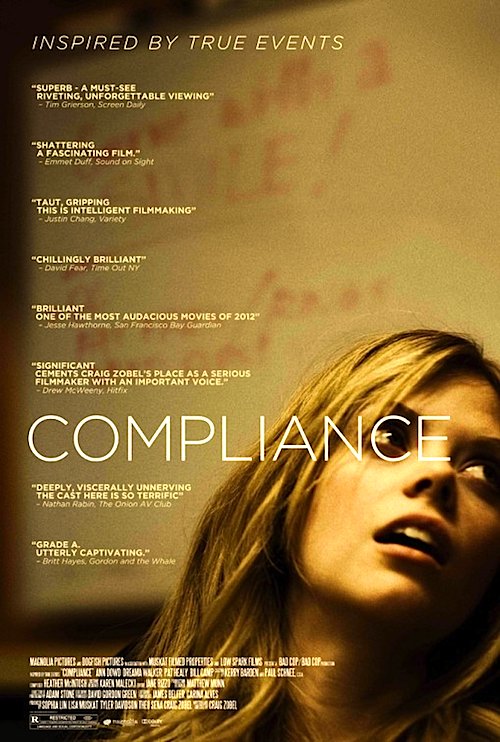
It may be impossible to exaggerate the historical and political ramifications of Milgram’s discoveries about humanity’s misplaced faith in authority, which would seem to shed light on everything from Auschwitz to Abu Ghraib to the fact that we’ve apparently all agreed in 2012 that it’s OK for the president of the United States to kill whoever he wants to without providing a reason. (Milgram was inspired by the widely publicized trial of Nazi war criminal and Holocaust engineer Adolf Eichmann, a mild-mannered fellow who claimed to have no particular antipathy for Jews.) But on an intimate level these ideas can still prove shocking or unacceptable, as they do in “Compliance,” a nail-biting thriller from indie writer-director Craig Zobel that has been dividing, energizing and alienating audiences since its Sundance premiere earlier this year.

On one level “Compliance” dramatizes a Milgram-like scenario, but more importantly it acts out a psychological experiment of its own, right there in the theater. This film is not set in Nazi Germany or Iraq or Gotham City under the rule of a supervillain. It takes place in an unidentified American suburb or exurb, almost entirely inside a fast food restaurant whose employees are cajoled and coerced by an official-sounding voice on the telephone into imprisoning, humiliating, strip-searching and finally abusing one of their co-workers. As a fictional premise that may sound outrageous, but some readers will surely remember that there was a wave of such real-life cases in the late 1990s and early 2000s. Zobel is drawing primarily on the last and most notorious of these, an April 2004 episode at a McDonald’s in Mt. Washington, Ky., where a young female employee was detained for several hours against her will and subjected to escalating and improbable levels of degradation.

To Read the Rest of the Essay

Thursday, June 28, 2012

Erich Kuersten: Sex is a Hen Decapitated -- Bluebeard and the Eroticism of Catherin Breillat

Sex is a Hen Decapitated: Bluebeard and the Eroticism of Catherine Breillat
by Erich Kuersten
Acidemic


The ancient tale of Bluebeard is rife with archetypal resonance for the budding feminine psyche: it's a rite of passage myth, a map of patriarchal oppression's mine field, an initiation into sexual maturity, where the fear of pain is enough to make actual pain a relief in contrast; a color-symbolic dream where the blood of menstruation anxiety (the redness of the clitoral "riding" hood) and the swollen purples of honeymoon savagery (the black and blueness of the groom's bristly beard) mix and match. Like many fairy tales centered on a young girl, it encodes the onset of menstruation into a Pandora's Box moment of discovery, from which innocence can never return, leading inexorably into the scary rites of the marital bed, the agonies of childbirth, and so forth. Do we not, in associating white for virginity and purity, forget that red means the alchemical opening up of that purity into the raw violence of procreation? So what does that third color of the French flag--blue--represent? Naturally, the cooling rescue of death--or rather as symbolized in the 'bloody chamber' where all the previous brides are stored, a suspended animation, a sleeping beauty status wherein the enslaving agonies of childbirth and old age are forever kept at bay, in short, the blue represents frozen death and timeless decadence, pleasure and a disruption of the natural enslavement process of patriarchy. Bluebeard postpones sexual relations in order to keep romance forever young.

The coming of age girl myth tends to focus on the moment of the first dripping eradicable red stain, one that no amount of Clorox will undo. Such a moment--loss and gain coagulated into one crimson blotch --seems to obsess French director Catherine Breillat, a female auteur as detached and horrified in her existential search for meaning as her fellow Frenchmen Gasper Noe, Jean-Paul Sartre, and Claire Denis [note from Michael Benton: Denis is a French woman]. But as Breillat is a woman, her take on femininity is free to delve much much deeper into waters too cold and dangerous to ever be known to men. Eagerly complicit with the grotesque truths of feminine sexuality, Breillat's eyes are not blurred by the glamor and beauty that hypnotize most male directors. Rather than 'fall' for the genetic con job of desire, she focuses on her gender's fascination with the gross otherness of the male body, and vice versa - she wants to explore her own body--stripped of its veils and glamor-- through male eyes. Men after all aren't as obligated to be beautiful. They're position as desirable or beautiful is seldom considered in a marriage. If a woman can't learn to love ugliness, she never gets a prince and stays forever turned off; the beast stays a beast.

For his part, when Bluebeard spots the telltale blood stain on the key to the forbidden chamber, he is sad and disappointed, once again his bride has been unable to remain 'unopened' and so must be literally opened, as in decapitated. But Breillat's crafty beauty knows to stall, to feign compliance with her impending death on certain conditions, and to seek help from the passing musketeer/woodsman(the woodsman gets all the girls because he's already 'slain' his own wolf). If she merely screams and cringes, she's devoured. This is a valuable honeymoon lesson considering the absurdly young marriage ages of our forebears, one surely told by moms of old: do not resist or cringe when your new husband advance; instead, flatter, and stall him. If he will but relent today he shall get double tomorrow, and so on until a nice woodsman can rescue her, or she can develop enough that her deflowering is less of a painful, traumatizing violation.

The patriarchal readings of these tales runs counter to this approach, flipping the beast into a prince with a magic (phallic) wand and happily ever aftering the story before the children reading can learn that the magic wand's spell fades in a matter of hours. Soon enough the hair begins to creep back on their prince and his fangs grow long with the full moon. He seems to get uglier and more ill-tempered as the marriage marches on; that's the part Disney rolls its credits over. Only Breillat dares see not just the beast, but the frog, the vile toad still dwelling behind the sparkly eyes of the prince, and only Breillat nonetheless finds a way to love the thing, proverbial warts and all.

In her fearless approach towards this taboo subject, Breillat seems to possess an ambivalent--if not outright hostile--attitude towards sex. Her liberated female characters are often accused of being masochist subjects. But we have to dig deeper for her real reaction, perhaps a way would be to see her as the French female version of Lars Von Trier. But where Lars uses the D.W. Griffith / Sirkian soap opera woman's story in his savage deconstruction of innocence, purity, deflowering and sex, Breillat eschews any direct relation with 'woman's picture' trappings, to shoot for pure myth, looking past Griffith all the way back to the dawn of the printing press. Her cinema is--in Bluebeard literally--like the pages of a storybook that shows everything the normal books do not.

To Read the Rest of the Essay
Wednesday, May 23, 2012

Matthew J. Iannucci: Postmodern Antihero -- Capitalism and Heroism in Taxi Driver

Postmodern Antihero: Capitalism and Heroism in Taxi Driver
by Matthew J. Iannucci
Bright Lights Film Journal


Martin Scorsese's Taxi Driver is a gritty, disturbing, nightmarish modern film classic that examines alienation in urban society. From a postmodernist's perspective, it combines the elements of noir, the Western, horror, and urban melodrama as it explores the psychological madness within an obsessed, inarticulate, lonely antihero cab driver, Travis Bickle (Robert De Niro). The plotline is simple: Travis directs his frustrated anger at the street dwellers of New York and a presidential candidate, and his unhinging assault is paired with an attempt to rescue a young prostitute, Iris (Jodie Foster), from her predatory pimp. Historically, Taxi Driver appeared after a decade of war in Vietnam (1976), and after the Watergate crisis and subsequent resignation of Nixon. Five years later, when it was linked to would-be presidential assassin John Hinckley and his obsession with Jodie Foster, it became prima facie evidence for those on the political right who believed that violence in film translates into crime in real life. It is now almost impossible to separate Taxi Driver from this debate. However, Bickle's antiheroic character is more directly related to a failure of a capitalist system that pits his working-class position as a cab driver against those who have already been disenfranchised according to socioeconomic class, gender, and/or race.

As the film opens, Travis emerges from a forgotten Midwestern form of Americana that appears as obsolete as Travis himself in a big city heterogeneously composed of corporate financiers, political patrons, gun dealers, and prostitutes. In order to survive, he wants to "become a person like other people" as he puts it, but his own disenfranchisement from this nation has left him both intellectually and emotionally bankrupt from the Vietnam War. Freedom, the very nucleus of the American dream, is dependent on individual socioeconomic choices that inform and shape one's identity. But Travis's lack of a distinct identity compels him to cut and paste together what he believes is a heroic identity from an external menu of personages such as the "gunslinger" and the Indian. In actuality, what he does is stitch together a postmodern antiheroic identity that is nostalgic and pop culture-oriented, evidenced by the Mohawk haircut that he sports in the penultimate sequences — because he possesses no internal self.

Taxi Driver implies that identity is not genuine but always synergistic, a kind of potpourri of idolatry and maxims drawn from popular culture, especially from violent movies and television news. In this vein, Robert Ray views Taxi Driver as a postmodern "corrected" Right film, the type of film generally aimed at a naïve audience. Ray explains that a "Right" film presents a traditional conservative philosophy that promotes the application of Western-style, individual solutions to complex contemporary problems. He writes, "Taxi Driver's basic story followed the right wing's loyalty to the classic Western formula: a reluctant individual, confronted by evil, acts on his own to rid society of spoilers. As played by Robert De Niro, Taxi Driver's protagonist had obvious connections with Western heroes…even his name, Travis, linked him to the defender of the Alamo."1 Ray's notion that the film is a "correction" of the right-wing concept of justice is accurate because of its odd plot twist at the conclusion. Normally, such a story would identify Travis's complicity with these criminals and thereby relegate him to some form of institutional punishment. But the film's underlying theme reveals how absurd the Western idealistic depiction of heroism is because the news media in the film not only ignores his actions but also glorifies a psychopathic killer as a noble warrior.

To Read the Rest of the Essay

Wednesday, May 16, 2012

Michael Atkinson: Archival Trouble -- The fiction-free science fiction of Adam Curtis

Archival Trouble: The fiction-free science fiction of Adam Curtis
by Michael Atkinson
Moving Image Source

...

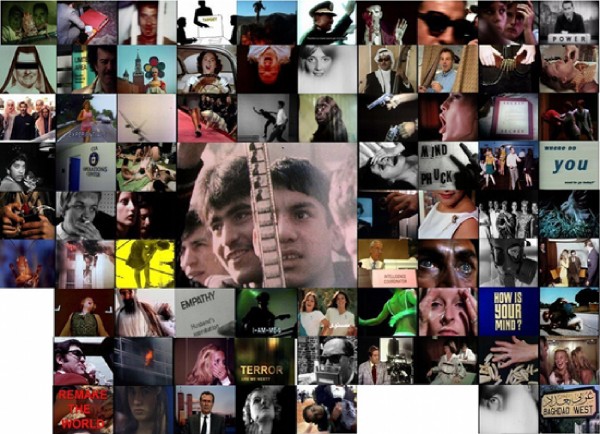
Curtis's brand of deep politics isn't theorist Peter Dale Scott's—he's concerned less with deliberate conspiracy than with the cascade of sociopolitical dominoes, beginning somewhere mysteriously decades ago, tumbling in a semi-secret dialectical train of disaster since, and culminating in flat-out catastrophe, be it 9/11 or the world economic meltdown or merely the Reagan-era state of rampaging consumerist narcissism. Formally, Curtis manufactures his flowcharts with the simplest means available: archival footage, talking heads, calm but ominous narration, associative montage, a pervasive sense of doomsday. All Watched Over by Machines of Loving Grace is paradigmatic: Curtis begins, as his Richard Brautigan-quoting title suggests, with the familiar suspicion that the mechanization of our lives is winding inexorably toward a dystopian nightmare in which the matrix of microprocessors and A.I.'s will end up commanding us, not vice versa.

But right away it's clear that Curtis isn't hypothesizing about a terrifying future, but unearthing the hidden patterns that have created the present moment. The villains are not machines. Curtis trips backward, as is his wont, to the '50s and the rise of Ayn Rand, whose Objectivist creed in turn gave fitful birth to a spate of influential ideologies, all of which decided that both nature and human society were essentially self-sustaining, equilibrium-seeking logical mechanisms, and could be managed thus. "This is the story," Curtis intones, "of the rise of the dream of the self-organizing system, and the strange machine fantasy of nature that underpins it." The tales he tells to illustrate this harrowing and almost completely overlooked social saga all intertwine, and run from the "spaceship Earth" ideas of Buckminster Fuller, the communes that followed, the pessimistic forecasts of the Club of Rome, the rise and fall of Patrice Lumumba in the Congo, the genesis of the wholly fabricated Tutsi-Hutu dichotomy that turned Rwanda into a killing field more than once, the career of Dian Fossey, the late-century rollercoaster of economic feast and famine, and the work of theorist/geneticist George Price, who believed that humans were ultimately the slaves of their own genetic imperatives, and who demonstrated mathematically that both altruism and genocide were therefore rational acts, from "a gene's eye view" of things.

There's more, all of it reflecting back upon now; Curtis is nothing if not a staunch proselytizer for the idea of the past never being quite past. All Watched Over is more than a counter-story. Like all of Curtis's work it is approximately half well-circulated history and half "deep" background—that is, storylines and historical angles that have been pervasively and deliberately neglected by the gatekeepers of knowledge and information. The film feels something like a Craig Baldwin delusion-farce turned chillingly, menacingly factual, and the facts accrete into an interrogation of psychotic hubris. The Frankenstein monster constructed by the scientists and demagogues and politicians in All Watched Over is the last half-century or so of life on Earth, which in its ultimate tally amounts to a scoresheet of unimaginable injustice, mountains of bodies, and untold environmental ruin.

Curtis is in reality telling just one story, again and again in various threads and tangents and in dazzling three- or four-hour chunks, reaching back to the immediate postwar years and then forward to the present over and over, limning an infinitely complex genogram of our present existence. Ironically, for a history-rewriting filmmaker/producer boxing so much information into evenings of television, Curtis is fierce about the disastrous effects brought about by the artificial and intellectualized imposition of order. He began in his present mode with 1992's Pandora's Box, a massive autopsy on the worldwide cataclysms that unrolled as a result of every kind of postwar effort to systematize, organize, compel, and codify humanity, from Soviet over-industrialization to game-theory Cold War strategies to Keynesian economics to nuclear-power utopianism. Politically, this is a rocket targeted not at the Right per se, but upward, at the power elite, whose perpetual folly in trying to maximize profit and control leads ceaselessly to societal breakdown—a condition very often beside the point for the elite in question, once they've stood to benefit. The Century of the Self (2002) goes all attack-ad on this dynamic, specifically homing in on propagandist/marketing mahatma Edward Bernays, and how he used Freudian psychoanalytic insights to initiate the gold rush of institutionalized thought control—advertising, propaganda, public relations—that could be said to absolutely dominate 20th-century public discourse.

Curtis's vision seemed wholly formed at first, despite the fact that he's obviously digging up unknown connections with each new project. But it took the spiral mindquake of 9/11 for Curtis's reverse-engineered prophecies to gain a global profile. The Power of Nightmares (2004) follows the gunpowder trails from the mid-century (uniting Muslim Brotherhood messiah Sayyid Qutb and neocon pope-king Leo Strauss as complementary agents of desolation) to the attacks of 2001, and then maintains that, just as the farcical depiction of the USSR as a global spider kingdom of evil influence is destroyed by direct testimony from CIA agents and a lying Donald Rumsfeld in old news footage, the sudden postulation of Al Qaeda as a terrifying, organized worldwide threat was a manufactured myth used by Western governments and agencies to broaden and tighten their grip on international power systems and the profit to be gained therein.

To Read the Rest of the Essay
To watch Adam Curtis's documentaries online:

Pandora's Box: A Fable From the Age of Science (1992)

The Living Dead: Three Films About the Power of the Past (1995)

The Century of the Self (2002)

The Power of Nightmares: The Rise of the Politics of Fear (2004)

The Trap: What Happened to Our Dream of Freedom (2007)

All Watched Over by Machines of Loving Grace (2011)

Tuesday, April 24, 2012

Tom McCormack: Laws of Desire -- What did David Cronenberg's Videodrome get right about us?

Laws of Desire: What did David Cronenberg's Videodrome get right about us?
by Tom McCormack
Moving Image Source


It can be both fun and necessary to revisit famously prescient works of art and take account of just what they got right.

In Nineteen Eighty-Four, George Orwell was right that the most successful authoritarian regimes of the future would limit dissent by using mass media to control our conceptual tools. He was wrong about how they would do it; instead of issuing messages through a unified voice, the most durable authoritarianism has flourished by dispersing control among a small set of global corporations that justify their outsized power through their success in the marketplace. In Brave New World, Aldous Huxley was right that sexual freedom and the triumph of therapy culture would develop alongside rigid class structures. The mainstream acceptance of casual sex and prescription pharmaceuticals really did happen alongside a consolidation of class power—a radical one we're still reeling from. But in Huxley this was accomplished through an exaggeration of class difference and an expanded language for class; in reality, the culture witnessed the atrophy of a language for class and an erasing of outward signs of class in terms of professed values, fashion, and manners of speech (hence "bourgeois bohemians" and "the millionaire next door").

David Cronenberg's Videodrome offered in 1983 a vision of dystopia that rivaled in ambition and sweep and foresight Orwell's and Huxley's more famous works. So what did Videodrome get right? And what, if anything, did it get wrong?

Cronenberg was right that new technologies would unleash a craving for scenes of increasingly extreme and increasingly realistic—if not just plain real—sexual violence. He was right about what this violence would look like ("No plot, no characters. Very realistic"); why the entertainment industry would turn to it ("I'm looking for something that will break through. Something tough!"); and how those in the media would talk about it ("It's absolutely brilliant. I mean look: there's almost no production cost!"). He was right that many people would experience these new products as addictive and would report a psychic bleed into the texture of their daily lives, frequently to their great concern.

Cronenberg was right, in a more subtle way, about what would cause the cultural turn to sexual violence. The movie isn't called "photodrome" or "cinemadrome"—it's not about the nature of mechanical reproduction or motion pictures but about the consequences of private access to public imagery. Professor Brian O'Blivion, Videodrome's resident philosopher, tells us that the television has become the "retina of the mind's eye"; that "the television screen is part of the physical structure of the brain." What he's talking about is what contemporary social scientists studying the Internet call—borrowing terms from psychoanalysis—"solipsistic introjection." This refers to the tendency of individuals to believe, on at least a semi-conscious level, that things happening on their electronic devices are actually happening inside their heads. Describing how this effect works in online chat rooms, John Suler writes:

Reading another person's message might be experienced as a voice within one's head, as if that person magically has been inserted or "introjected" into one's psyche... The online companion now becomes a character within our intrapsychic world, a character that is shaped partly by how the person actually presents him or herself via text communication, but also by our expectations, wishes, and needs... People fantasize about flirting, arguing with a boss, or very honestly confronting a friend about what they feel. In their imagination, where it's safe, people feel free to say and do all sorts of things that they wouldn't in reality. At that moment, reality IS one's imagination. Online text communication can become the psychological tapestry in which a person's mind weaves these fantasy role plays, usually unconsciously and with considerable disinhibition. All of cyberspace is a stage and we are merely players.


To Read the Rest of the Essay

Tuesday, January 17, 2012

Roderick Heath: A Dangerous Method (2011)

A Dangerous Method (2011)
By Roderick Heath
Ferdy on Films


I tend to blow hot and cold on David Cronenberg’s oeuvre, filled as it is with works such as Videodrome (1982), Naked Lunch (1991), and A History of Violence (2004) that strike me more as catalogues of interesting moments and ideas rather than completely coherent films. But it’s impossible to deny that the Canadian auteur has been one of modern mainstream cinema’s most consistently visceral, intelligent, and original fountainheads, and at his best, can be a fearsome artist of psychological straits and the overflowing id. Cronenberg’s reputation is still often immediately associated with his early, overtly horrifying essays in body distortion and corruption; thus, A Dangerous Method, his latest and one of his most subtle films, seems, in abstract, like an outlier. But A Dangerous Method’s guardedly realistic approach to character and historical setting revolves around some very Cronenbergian motifs, not the least of which is the strange and often perverse manner the inner self and the outer self relate.

The film’s early scenes are fixated on Keira Knightley’s unhinged performance as Sabina Spielrein, a young Russian Jewish woman who suffers from an overwhelming, physically manifest neurosis. Sabina, dragged out of the carriage that brings her to the Burghölzli Clinic in Switzerland in 1904, is placed into the care of Carl Jung (Michael Fassbender), a young, brilliant doctor at the clinic. He decides to employ Dr. Sigmund Freud’s theoretical and almost untested “talking cure” on her. Sabina, in the extremes of her disease, contorts and buckles and twists, her jaw elongating as things push about inside her, looking as if she’s about to explode like a character out of Scanners (1980) or undergo a transformation similar to Jeff Goldblum’s in The Fly (1986).

Sabina’s pathological pain and rage prove to have two sources: her hatred for her father, the kind of authoritarian who’d make her and her siblings kiss his hand after he struck them, and her powerful masochistic urges, partly imbued by that cruelty, that she can’t assimilate in any form other than as a kind demonic aberration. As Jung works with her, she slowly begins to return to a functioning state, and as part of her therapy, is encouraged to pursue her interest in studying medicine. Two male figures overtly and covertly influence her fate: Jung and his medical field’s unchallenged leader and guru, Freud (Viggo Mortensen). Not long after Sabina becomes Jung’s patient, the peculiarities of her case and Jung’s success in putting Freud’s method into practice becomes a catalyst for the two men to meet, form an initially powerful accord, and then slowly but surely break apart.

Freud, proud and fully aware of his virtually imperial position in a nascent realm of medicine, is actively searching for heirs apparent, and he soon declares Jung one. He entrusts to Jung’s care another of his potential heirs, Otto Gross (Vincent Cassell), a cocaine-sniffing libertine who begins to preach total liberation from traditional familial and social forms, and who is considered insane by his own authoritarian father. His egocentric arguments coincide with a time in Jung’s life when his rich wife Emma (Sarah Gadon) is pregnant, and their marriage is strained, leading Jung to capitulate to his attraction to Sabina.

We live in a world where the catchphrases and oversimplified versions of psychoanalytic theory have gone through phases of utter disdain, near-religious acceptance, and back again. A Dangerous Method sets out to portray a window in not-so-distant history when ideas of the self and society seemed set for a radical change, and the consequences of that change were still potentially inexhaustible, but the people offering the change were still irrevocably tethered to the world as it was. Freud and Jung are portrayed as men caged by their worldly concerns. It’s not the first film to look at the formative years of psychiatry and its figures: John Huston’s amazingly undervalued Freud (1962) pitched the tale of Freud’s speculative development as an expressionist detective story where the younger hero fights through his own neuroses to uncover experiences and epiphanies that he converts into his classic theories. Cronenberg’s film takes a calmer tack and comments wryly on the way Freud, Jung, and Spielrein each in their way turn a fierce personal intelligence in on itself with analytical daring, and yet still constantly give in to bad judgment and behaviours they would reject and criticise in others. Freud proves a fascinating mixture of wisdom, moral rectitude, and a powerful circumspection, even timidity, in the face of disrupting social assumptions and straying beyond immediate scientific rationales.

To Read the Rest of the Essay

Monday, December 26, 2011

Megan Ratner: David Cronenberg’s A Dangerous Method

David Cronenberg’s “A Dangerous Method”
by Megan Ratner
Film Quarterly


At the center of the emotional and intellectual geometry of A Dangerous Method are Carl Jung (Michael Fassbender) and his patient Sabina Spielrein (Keira Knightley), a woman so afflicted when she first consults Jung that she can only speak with effort. But she responds to Jung’s prototype of psychoanalysis, and, emboldened by his success, Jung contacts Freud (Viggo Mortensen), his mentor and (as the younger man sometimes puts it) father figure. Meanwhile Spielrein graduates from Jung’s patient to his assistant, and they embark on an affair that threatens both to cause a scandal and to discredit the psychoanalytic movement.

The actors bring an understated subtlety to the material: Mortensen is surprisingly laconic and light in the role of Freud, a far cry from the aggressive protagonists he played in previous outings with Cronenberg, A History of Violence (2005) and Eastern Promises (2007). Unhurried and assured, his portrayal of Freud reveals a man convinced of his own greatness but fretfully protective of the future of his intellectual creation. This undercurrent serves him particularly well in his single scene with Spielrein, in which their shared devotion to the movement eclipses even their shared affection for Jung.

In the role of Spielrein, Knightley is initially startling. Though her writhing and grimaces are credible, it’s her consistently spooked expression, electrified and unpredictable, that makes her performance more than bravado. Even sitting relatively still during her initial session with Jung, Spielrein seems just this side of chaos. Cronenberg explained to me that Christopher Hampton studied Jung’s own notes about Spielrein during a research trip to Geneva. Additionally, Cronenberg viewed early actuality films of women with similar symptoms. “They’re very difficult to watch,” he said, “because it’s sort of a willed deforming.” He worked with the actress to go as far as possible toward depicting such self-disfigurements without getting to the point that it would become too uncomfortable for the audience. By channeling Spielrein’s mania into keen focus, as in the scene where she and Jung measure word-association reaction times (on his wife), Knightley effects a delicate transformation from madwoman to rising analyst. From the outset, she looks for no sympathy, playing Spielrein as an experimenter, unafraid of risk to her body or mind.

To Read the Rest of the Review