Showing posts with label Biography. Show all posts

Monday, September 23, 2013

David Bordwell - The Grandmaster: Moving forward, turning back

THE GRANDMASTER: Moving forward, turning back
by David Bordwell
Observations on Film Art


The summer has brought us two major films by the two leading Hong Kong directors. I’ve discussed Johnnie To’s fine Drug War earlier. Now it’s time for some ideas about The Grandmaster. Wong Kar-wai’s film displays, in fairly straightforward ways, some of his typical artistic and commercial strategies. Here he adapts his characteristic approach to style and form to a classic genre—and to the demands of the marketplace.

On kung-fu considered as one of the fine arts

Wing Chun is the best-known and most influential Chinese martial art in the world. It owes its renown to two women and two men. In the 1700s the Buddhist nun Ng Mui developed a style called Plum Flower Fist, and a young woman named Yim Wing Chun adapted it into something requiring less strength. Bruce Lee trained in the style, revised it according to his interests, and popularized it in films that reached millions of viewers. Lee’s teacher was Ip Man, a master who settled in Hong Kong after World War II and set up a school. Ip made public a Southern fighting technique that had previously been shared among families and friends.

As both a mainlander and a Hong Konger, Ip is a good symbol of the union of two Chinas. Given the stunning rise of China’s economic and cultural power since the 1980s, it’s not surprising that someone would come up with the idea of a film about him.

Wong Kar-wai claims to have had that idea in the late 1990s. In 2002, he announced that a film about Ip was on his agenda. After finishing 2046 (2004) and an episode for the portmanteau film Eros (2004), he seemed to move forward, slating Tony Leung Chiu-wai as the star and bringing Ip’s family aboard as consultants. But other activities intervened, including an ill-fated three-picture deal with Fox Searchlight. Wong continued to occupy himself with his other businesses, including his lucrative talent-management firm and his advertising unit, for which he made commercials for Dior, Lacote, Motorola, and other companies. He also directed My Blueberry Nights (2007) and recast Ashes of Time (1994) as Ashes of Time Redux (2008).

In 2009 he got to work on the Ip Man film, eventually bringing in funding from many sources, including mainland Chinese companies, Fortissimo, The Weinstein Company, and Annapurna Pictures. Scheduled for a premiere in late 2010, then late 2012, it didn’t appear until January of 2013. It seems that he was still doing postproduction in Thailand hours before its first press screening in Beijing.

During the ten years that The Grandmaster took to reach the screen, other filmmakers had seized on the great man’s life. Two popular Donnie Yen vehicles, Ip Man (2008) and Ip Man 2 (2010), were followed by a prequel The Legend Is Born: Ip Man (2010), and this year, after Wong’s film was released, Ip Man: The Final Fight.

However much Wong fiddles with his movies, in this case he kept the title fixed: Yi Dai Zong Shi. It literally means “The Grandmaster of That Era,” or—since Chinese doesn’t mark plurals in the noun—“The Grandmasters of That Era.” It’s significant that in early publicity, the project was known as The Grandmasters. Wong says his son talked him out of that title. Now, in non-Chinese-speaking countries, it’s The Grandmaster.

The ambiguity about the title takes on special relevance because we have several Grandmasters. After the Beijing premiere, The Grandmaster was released throughout China and in Hong Kong. It did good business, earning over US $47 million in those territories. Wong made a shorter version for the European market, and that was apparently the one premiered at the Berlin Film Festival in February. A still shorter version was prepared for the U.S., with The Weinstein Company as distributor. It opened in August, to mostly good reviews, and it has currently reaped about $6 million at the American box office. So far, the film’s worldwide gross is nearly $63 million, making it by far Wong’s most commercially successful theatrical release.

To Read the Rest

Saturday, August 17, 2013

A Beautiful Mind (USA: Ron Howard, 2001)


A Beautiful Mind (USA: Ron Howard, 2001: 135 mins)

Billings, Andrew C. "Biographical Omissions: The Case of A Beautiful Mind and the Search For Authenticity." The Film Journal #1 (May 2002)

Cassey, Joe. "Mental Illness." Understanding Representation. ed. Wendy Helsby. London: BFI, 2005: 99-114. [Available in BCTC Library PN 1995 U4977 2005]

Hansen, Per Krogh. " Unreliable Narration in Cinema: Facing the Cognitive Challenge Arising from Literary Studies." Amsterdam International Electronic Journal of Narratology #5 (Autumn 2009)

Thursday, August 15, 2013

Harvard University Press Blog: Catherine MacKinnon on Lovelace

Catharine MacKinnon on Lovelace
Harvard University Press


The pornographic film Deep Throat, released in 1972, was a cultural sensation whose star, “Linda Lovelace,” was said to put a girl-next-door face on the sexual revolution. But the actual life of Linda Boreman, as depicted in the new biopic Lovelace, was one of beatings, rape, and terror. Feminist legal scholar Catharine MacKinnon, author of such works as Toward a Feminist Theory of the State and Only Words, represented Boreman after she came forward with her story, and later, with Andrea Dworkin, pursued civil rights litigation as a means to fight pornography. We asked MacKinnon about Boreman, Lovelace, and the potential impact of the film.

To Read the Interview

Monday, July 15, 2013

Films We Want to See #31: The Grandmaster (Hong Kong/China/USA: Wong Kar Wai, 2013)

Left Field Cinema -- Documentary Milestone: The Fog of War – Eleven Lessons From the Life of Robert S. McNamara

Documentary Milestone: The Fog of War – Eleven Lessons From the Life of Robert S. McNamara
Left Field Cinema


The Fog of War is Directed by Errol Morris perhaps the most celebrated American documentarian, if not as well known as Michael Moore by the public, Morris is certainly a critical darling. Roger Ebert considers Morris’s first film Gates of Heaven, a documentary about pet cemeteries, as one of his top ten films of all time. Gates of Heaven also provides an entertaining anecdote, in which Werner Herzog promised if Morris ever finished the film he would eat his shoe. Herzog’s insanity can be seen in the short film Werner Herzog Eats His Shoe. Morris’s third feature remains his best known. Thin Blue Line, which followed Vernon, Florida, remains one of the most powerful artistic statements by any filmmaker. Thin Blue Line lead to the subject of the film to have his death row sentence changed to life in prison, then subsequently the initial verdict was over turned. Morris’s documentary directly contributed to this result. The style of the film relies on interviews and re-creations. This emphasis on non-fiction as a documentary style would become Morris’s calling card. Morris went to direct a series of further documentaries including 2008’s War on Terror documentary Standard Operating Procedure. Although Standard Operating Procedure has not been received as well as the earlier documentary Taxi to the Darkside by Alex Gibney which was also released last year it remains an interesting piece of work which focuses on Morris’s typical themes of the deceptive nature of what is considered to be “true”. Morris’s friendship with Werner Herzog makes a great deal of thematic sense, both men search for the ecstatic truth within their respective subjects often at the expense of what could be considered the conventional approach.

The Fog of War presents Morris on top form, a self-proclaimed detective director (which suits him well as he previously worked as a private eye) Morris constructs The Fog of War in such a simplistic manner that it baffles the mind to witness how compelling it is. The entire film is essentially a one-hundred and five minute interview with its subject. The subject being Robert Strange McNamara the Secretary of Defense for John F. Kennedy and Lyndon B. Johnson, and previously an analyst for the Japanese bombings in World War Two and briefly the first President of Ford motors to not belong to the Ford family. He is a man who’s life begins at the end of the first World War, indeed he is adamant that his first memory was that of the victory parades, the celebrations at the end of the “War to end all Wars” following this we witness the part he played in World War II, the Cold war, and the Cuban Missile Crisis, then finally the Vietnam War. McNamara is a man who’s been surrounded by war all of his life. His contribution to the global politics over the 20th Century is a matter for speculation, by that I mean what real effect he had on events, of which McNamara himself is often uncertain. But as a witness to some of the pivotal events in recent history, you’ll be hard pressed to find a man alive who’s seen so much, witnessed such extremes of human behaviour, or gained such a vast understanding of the moral, amoral, and immoral tapestry that is war. McNamara has amazing recall for a man aged eighty-five casting his mind back more than forty years. He is charismatic figure, who sense of irony and wit cannot be denied. However, the man remains even now the consummate politician.

To Read the Rest

Saturday, April 6, 2013

Long Distance Revolutionary: A Journey with Mumia Abu-Jamal (USA: Stephen Vittoria, 2013)


Long Distance Revolutionary: A Journey with Mumia Abu-Jamal (USA: Stephen Vittoria, 2013: 120 mins)

Abu-Jamal, Mumia. "The United States Is Fast Becoming One of the Biggest Open-Air Prisons on Earth." Democracy Now (February 1, 2013)

Hanarahan, Noelle and Stephen Vittoria. "'Long Distance Revolutionary': Mumia Abu-Jamal’s Journey from Black Panthers to Prison Journalist." Democracy Now (February 1, 2013)

Hedges, Chris. The Unsilenced Voice of a 'Long-Distance Revolutionary.'" TruthDig (December 9, 2012)

A Dangerous Method (UK/Canada/Switzerland: David Cronenberg, 2011)


A Dangerous Method (UK/Canada/Germany/Switzerland: David Cronenberg, 2011: 99 mins)

Bale, Miriam. "They Came From Within: Yonic symbolism in the films of David Cronenberg." Moving Image (January 20, 2012)

Bowen, Chuck. "The Films of David Cronenberg Ranked." Slant (February 24, 2015)

Chemaly, Soraya. "Virgins, Bondage and A Shameful Media Fail." Huffington Post (April 20, 2012)

"Explore the Making of ‘Cosmopolis,’ ‘Naked Lunch,’ ‘Spider,’ ‘Eastern Promises,’ and More." The Film Stage (January 13, 2016)

Flores, Steven. "The Auteurs: David Cronenberg (Part 1)." Cinema Axis (October 28, 2013)

---. "The Auteurs: David Cronenberg (Part 2)." Cinema Axis (October 30, 2013)

Heath, Roderick. "A Dangerous Method (2011)." Ferdy on Films (December 18, 2011)

"Intersubjectivity." Wikipedia (No Date)

Kuersten Erich. "CinemArchetype #6: The Intimidating Nymph." Acidemic (March 2, 2012)

Porton, Richard. "A Dangerous Method." Cinema-Scope #48 (Fall 2011)

Ratner, Megan. "David Cronenberg’s A Dangerous Method." Film Quarterly (November 2011)


Monday, November 19, 2012

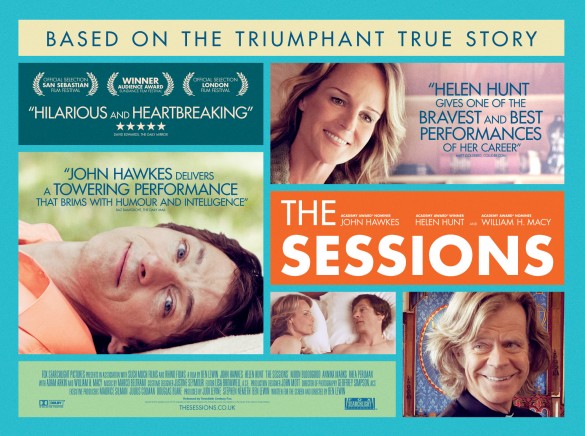
Margy Rochlin: Who’s That Man in the Iron Lung? John Hawkes Brings Years of Film Work to ‘The Sessions’

Who’s That Man in the Iron Lung? John Hawkes Brings Years of Film Work to ‘The Sessions’
By Margy Rochlin
The New York Times


EARLY last year the director Ben Lewin was looking for an actor to play the lead in “The Sessions,” a film he wrote based on the true story of Mark O’Brien, a journalist and poet who had contracted polio as a young boy and spent most of his life in an iron lung. The casting director, Ronnie Yeskel, mentioned John Hawkes. “This is your man,” she assured him.

Unfamiliar with his work, Mr. Lewin watched “Winter’s Bone,” the drug thriller set in the Ozarks that won Mr. Hawkes an Oscar nomination. In it he plays a hard-mouthed meth dealer named Teardrop, a far cry from the severely disabled man of Mr. Lewin’s film, who with equal parts terror and courage seeks out a professional sex surrogate in order to lose his virginity. “What?” Mr. Lewin remembered thinking. “That creepy guy?”

Only after Mr. Lewin decided to check out some of the actor’s other films did he catch John Hawkes fever. “I thought, this guy’s incredible, just the diversity of what he can do.”

Mr. Lewin wouldn’t be the only one to have spent years seeing Mr. Hawkes in untold film and television appearances without being able to put a name to his thin, expressive face. Mr. Hawkes has worked steadily since the mid-’80s (his TV credits include “Wings,” “24” and “Deadwood”), yet when he received his dark-horse supporting-actor Oscar nomination in 2011, one headline seemed to sum it up: “Who Is John Hawkes, Anyway?”

Today it’s a different story: on the many blogs and Web sites devoted to predicting the winners of the 2013 Academy Awards, Mr. Hawkes’s name comes up frequently in conversations about best-actor nominations along with gold-star competition like Joaquin Phoenix (“The Master”) and Daniel Day-Lewis (“Lincoln”).

Mr. Hawkes likes to think of himself as an “overpreparer,” and he certainly went the distance for “The Sessions,” in which his character spends much of the film encased in a huge metal apparatus with only his head showing. To approximate Mr. O’Brien’s condition — he had feeling in his body but was paralyzed except for one muscle in his right foot, a muscle in his neck and one in his jaw — Mr. Hawkes did everything from studying Jessica Yu’s Oscar-winning documentary short (“Breathing Lessons: The Life and Work of Mark O’ Brien”) to devoting a week stretched out on a couch teaching himself to punch in a phone number using a stick held in his mouth. Then there was the actual shoot, which required spending long days completely still with his neck craned at a 90-degree angle while co-stars like Helen Hunt and William H. Macy hovered over him. “Lying down and literally not having movement below your neck?” Mr. Hawkes said. “It was a particular challenge.” Mr. Hawkes did not see a finished version of “The Sessions” (a Fox Searchlight release) until its premiere at this year’s Sundance Film Festival, where audience members leapt to their feet at the end. But Mr. Hawkes said he was most moved by what followed the applause: the sight of Mr. Lewin, who also had survived polio, coming to the front of the house for a postscreening discussion.

To Read the Rest of the Profile

Friday, August 24, 2012

Zadie Smith: Generation Why?

Generation Why?
by Zadie Smith
The New York Review of Books

How long is a generation these days? I must be in Mark Zuckerberg’s generation—there are only nine years between us—but somehow it doesn’t feel that way. This despite the fact that I can say (like everyone else on Harvard’s campus in the fall of 2003) that “I was there” at Facebook’s inception, and remember Facemash and the fuss it caused; also that tiny, exquisite movie star trailed by fan-boys through the snow wherever she went, and the awful snow itself, turning your toes gray, destroying your spirit, bringing a bloodless end to a squirrel on my block: frozen, inanimate, perfect—like the Blaschka glass flowers. Doubtless years from now I will misremember my closeness to Zuckerberg, in the same spirit that everyone in ’60s Liverpool met John Lennon.

At the time, though, I felt distant from Zuckerberg and all the kids at Harvard. I still feel distant from them now, ever more so, as I increasingly opt out (by choice, by default) of the things they have embraced. We have different ideas about things. Specifically we have different ideas about what a person is, or should be. I often worry that my idea of personhood is nostalgic, irrational, inaccurate. Perhaps Generation Facebook have built their virtual mansions in good faith, in order to house the People 2.0 they genuinely are, and if I feel uncomfortable within them it is because I am stuck at Person 1.0. Then again, the more time I spend with the tail end of Generation Facebook (in the shape of my students) the more convinced I become that some of the software currently shaping their generation is unworthy of them. They are more interesting than it is. They deserve better.

In The Social Network Generation Facebook gets a movie almost worthy of them, and this fact, being so unexpected, makes the film feel more delightful than it probably, objectively, is. From the opening scene it’s clear that this is a movie about 2.0 people made by 1.0 people (Aaron Sorkin and David Fincher, forty-nine and forty-eight respectively). It’s a talkie, for goodness’ sake, with as many words per minute as His Girl Friday. A boy, Mark, and his girl, Erica, sit at a little table in a Harvard bar, zinging each other, in that relentless Sorkin style made famous by The West Wing (though at no point does either party say “Walk with me”—for this we should be grateful).

But something is not right with this young man: his eye contact is patchy; he doesn’t seem to understand common turns of phrase or ambiguities of language; he is literal to the point of offense, pedantic to the point of aggression. (“Final clubs,” says Mark, correcting Erica, as they discuss those exclusive Harvard entities, “Not Finals clubs.”) He doesn’t understand what’s happening as she tries to break up with him. (“Wait, wait, this is real?”) Nor does he understand why. He doesn’t get that what he may consider a statement of fact might yet have, for this other person, some personal, painful import:

ERICA: I have to go study.

MARK: You don’t have to study.

ERICA: How do you know I don’t have to study?!

MARK: Because you go to B.U.!


Simply put, he is a computer nerd, a social “autistic”: a type as recognizable to Fincher’s audience as the cynical newshound was to Howard Hawks’s. To create this Zuckerberg, Sorkin barely need brush his pen against the page. We came to the cinema expecting to meet this guy and it’s a pleasure to watch Sorkin color in what we had already confidently sketched in our minds. For sometimes the culture surmises an individual personality, collectively. Or thinks it does. Don’t we all know why nerds do what they do? To get money, which leads to popularity, which leads to girls. Sorkin, confident of his foundation myth, spins an exhilarating tale of double rejection—spurned by Erica and the Porcellian, the Finaliest of the Final Clubs, Zuckerberg begins his spite-fueled rise to the top. Cue a lot of betrayal. A lot of scenes of lawyers’ offices and miserable, character-damning depositions. (“Your best friend is suing you!”) Sorkin has swapped the military types of A Few Good Men for a different kind of all-male community in a different uniform: GAP hoodies, North Face sweats.

At my screening, blocks from NYU, the audience thrilled with intimate identification. But if the hipsters and nerds are hoping for Fincher’s usual pyrotechnics they will be disappointed: in a lawyer’s office there’s not a lot for Fincher to do. He has to content himself with excellent and rapid cutting between Harvard and the later court cases, and after that, the discreet pleasures of another, less-remarked-upon Fincher skill: great casting. It’ll be a long time before a cinema geek comes along to push Jesse Eisenberg, the actor who plays Zuckerberg, off the top of our nerd typologies. The passive-aggressive, flat-line voice. The shifty boredom when anyone, other than himself, is speaking. The barely suppressed smirk. Eisenberg even chooses the correct nerd walk: not the sideways corridor shuffle (the Don’t Hit Me!), but the puffed chest vertical march (the I’m not 5'8”, I’m 5'9”!).

With rucksack, naturally. An extended four-minute shot has him doing exactly this all the way through the Harvard campus, before he lands finally where he belongs, the only place he’s truly comfortable, in front of his laptop, with his blog:

Erica Albright’s a bitch. You think that’s because her family changed their name from Albrecht or do you think it’s because all B.U. girls are bitches?


Oh, yeah. We know this guy. Overprogrammed, furious, lonely. Around him Fincher arranges a convincing bunch of 1.0 humans, by turns betrayed and humiliated by him, and as the movie progresses they line up to sue him. If it’s a three-act movie it’s because Zuckerberg screws over more people than a two-act movie can comfortably hold: the Winklevoss twins and Divya Navendra (from whom Zuckerberg allegedly stole the Facebook concept), and then his best friend, Eduardo Saverin (the CFO he edged out of the company), and finally Sean Parker, the boy king of Napster, the music-sharing program, although he, to be fair, pretty much screws himself. It’s in Eduardo—in the actor Andrew Garfield’s animate, beautiful face—that all these betrayals seem to converge, and become personal, painful. The arbitration scenes—that should be dull, being so terribly static—get their power from the eerie opposition between Eisenberg’s unmoving countenance (his eyebrows hardly ever move; the real Zuckerberg’s eyebrows never move) and Garfield’s imploring disbelief, almost the way Spencer Tracy got all worked up opposite Frederic March’s rigidity in another courtroom epic, Inherit the Wind.

To Read the Rest of the Essay

Tuesday, July 31, 2012

Reverse Shot: Deep Red -- Joanne Nucho on The Color of Pomegranates

Deep Red: Joanne Nucho on The Color of Pomegranates
Reverse Shot

Steeped in religious iconography, The Color of Pomegranates is a deeply spiritual testament to director Sergei Parajanov’s fascination with Armenian folk art and culture. It is also a controversial work, which, coupled with another of his films, Shadows of our Forgotten Ancestors, led to his arrest and imprisonment in a Soviet Gulag for four years. The Soviets insisted he was guilty of selling gold and icons illegally and committing “homosexual acts.” In reality, his only crime was offending the tenets of socialist realism, both in his daring surrealistic form and in his choice of subject matter. While many of the popular films of this era in Soviet cinema were largely propaganda designed to serve the ideological interests of the regime, Parajanov chose to focus on the ethnography and spirituality of the Ukraine, Armenia, and Georgia.

The Color of Pomegranates is a poetic, dreamlike film that sought to portray the life of Armenian troubadour Sayat Nova through images inspired by his life and poetry. Born Haroutiun Sayakian, he is remembered as Sayat Nova or “king of songs.” Raised in the Georgian city of Tiflis (as was Sergei Parajanov himself), Sayat Nova performed in the Armenian, Azerbaijani, and Persian languages. This brought him fame beyond the Armenian community and he was summoned to serve as Court Musician and Poet by Heracle II, the 18th- century king of Georgia. After falling in love with the king’s sister, Princess Anna, he was expelled from the court. He spent the rest of his life as a monk where he continued to write poetry and music. To the Armenian people, Sayat Nova is considered a martyr because he was executed by the invading Persians for refusing to renounce his Christian faith.

Parajanov’s decision to make a film about the life of an Armenian poet and martyr was a dangerous one. Armenian national identity was not to be prioritized—it was viewed as only a part of the Soviet Union. The idea of Armenian independence and secession from the Soviet Union was still dangerous and punishable by death. The lack of a Soviet presence, or any other typical themes of the propaganda films of the time, marked The Color of Pomegranates as a subversive work.

The text of the film, the poetry of Sayat Nova, and the life of director Sergei Parajanov are all reflections of the Armenian national identity, which is itself deeply connected to the Christian faith, as they were the first “nation” in the world to adopt the religion, in the year 301. Surrounded by largely Muslim populations, they were an easy target for invasion and subjugation by their neighbors. The paradigm of Christianity, the images of the suffering of Christ and subsequent salvation—most recently exacerbated by the Armenian genocide perpetrated by Turkey at the beginning of the last century—are at the core of Armenian individuality.

So what is the color of pomegranates? As the film opens, we see thorns intercut with images of pomegranates soaking a white cloth with their juice, a deep blood red. Then we see a dagger resting upon this same, stained cloth. A voice reads from the poetry of Sayat Nova: “I am a man whose soul is tormented.” In Armenian mythology, the pomegranate was a symbol of fertility, literally fruitfulness—it is said that a ripe pomegranate contains 365 seeds, one for each day of the year. The thorns are those of the crown that Christ wore as he suffered on the cross. The two are inseparable, bound closely by the image of bloodshed, the inevitable fate of the Armenian people—here there is only sacrifice and suffering. Later in the film a priest wearing the traditional black garb of the Armenian apostolic church utters “heaven has deemed that sorrow be our lot.” With the camera set at a distance, the monks gather before him, also cloaked in black, shroud-like robes fall on their knees. Everywhere there is death, darkness, disaster—and yet, a feeling that the biggest disaster, the ultimate catastrophe is still to come.

To Read the Rest of the Essay

Tuesday, April 3, 2012

Naked Lunch Radio #7 – Transmission

Naked Lunch Radio #7 – Transmission
Sound on Sight


Reviews on the movies Control, 24 Hour Party People and a look back at the Manchester music scene of the late 70`s and early 80`s.

To Listen to the Episode

Wednesday, January 18, 2012

Robert Alpert: The Social Network: The Contemporary Pursuit of Happiness Through Social Connections

The Social Network: the contemporary pursuit of happiness through social connections
by Robert Alpert
Jump Cut


The United States’ myth of opportunity holds that those who work hard may achieve, and that history is a progressive, forward movement in which the country betters itself through such hard work. Yet such optimism has consistently been tempered by a sense that “life, liberty and the pursuit of happiness” inadequately define a satisfied life. Thus, the myth of individual success also frequently becomes a story about loss and failure. For example, based on the life of William Randolph Hearst, the owner of a nationwide chain of “yellow journalism” newspapers, Orson Welles’ Citizen Kane (1941) portrays Charles Foster Kane as having achieved material success at the cost of a life of dissatisfaction. Forcibly exiled from his childhood home, he remains consistently angry and alone as an adult. Even that champion of historical progress, John Ford, late in life enunciated the myth’s failure in The Man Who Shot Liberty Valance (1962). “When the legend becomes fact, print the legend,” grandly announces the newspaper editor. The successful lawyer, governor, senator and ambassador to Britain, played by James Stewart, is ashen-faced, however, when he realizes that the material progress he has cultivated on behalf of his country has masked the fact that Vera Miles, the love of his life whom he married, has never loved him. The myth maker Ford eulogizes instead the primitive John Wayne who has died penniless and alone in order to make way for that dream of “progress.”

This same disillusionment also runs through U.S. literature. For example, F. Scott Fitzgerald’s The Great Gatsby (1925) is the story of Jay Gatsby, who believed in the myth of achieving material success and thereby the promise of a better future only to learn the futility of his quest and his loss of a more Edenic past. Thus, the novel concludes:

“Gatsby believed in the green light, the orgastic future that year by year recedes before us. It eluded us then, but that’s no matter — tomorrow we will run faster, stretch out our arms farther…And one fine morning — So we beat on, boats against the current, borne back ceaselessly into the past.”[2]

The Social Network deals with that myth of material success and an historical shift in values in which that myth has come to be accepted as fact. It is a bleak portrayal of a male, adolescent-dominated world in which connections, not relationships, are all. The director, David Fincher, has worked with different screenwriters on all of his movies, and his movies prior to The Social Network — such as Se7en (1995), The Game (1997), Fight Club (1999), Zodiac (2007) and The Curious Case of Benjamin Button (2008) — have in common that nearly all have at their center a young man lost and wandering through a series of episodes in which he seeks to define a place for himself. For each of these characters the search is obsessively personal, and in each the character is mistakenly confident that his skills will enable him to triumph. For example, the newly married Brad Pitt as Detective David Mills in Se7en taunts killer Kevin Spacey only to become Spacey’s seventh victim. Michael Douglas, a wealthy financier in The Game, remains certain that he can outsmart those who run the Game only to “succeed” by the grace of those who control the game. Fincher’s characters are lost and angry, adolescents in the bodies of grown men. Even Panic Room (2002), whose main character is played by Jodie Foster, focuses on her illusion that she can acquire security through her ex-husband’s money. Aaron Sorkin, the creator of the TV series West Wing and the screenwriter of The Social Network, places Fincher’s central character in an historical context. As such, he elevates the individual failure of Fincher’s character to a cultural failure.

The Social Network bases its story on Mark Zuckerberg (Jesse Eisenberg), who, while an undergraduate student at Harvard University, developed Facebook. Through deposition testimony in two lawsuits brought against Mark — by Eduardo Savarin (Andrew Garfield) and by the Winkelvoss twins, Cameron and Tyler (both played by Armie Hammer) — the movie recounts how what is today a worldwide phenomenon began in Mark’s dorm room. Like other Fincher characters, Mark is no less brainy, no less confident that he can outsmart those around him, and yet he fails in the end to find any personal satisfaction in his seeming success. The Social Network is especially bleak in that Mark’s personal failure gain him financial rewards in a world in which Facebook is everywhere, including Bosnia where, as a young associate at the law firm defending Mark remarks in disbelief, there are not even any roads.

Mark’s obsessive creation of Facebook results in a worldwide network of “friending,” an exchange of electronic data by persons who are physically and emotionally at a distance from one another. As such, this kind of friending offers a parallel to Mark, who becomes increasingly isolated from those physically surrounding him. Mark Zuckerberg’s contemporary success in business, measured in billions of dollars, results in his personal failure to achieve anything of value. Ironically, it was never about the money for Mark; as a high school student, for example, he uploaded for free his idea of an application for an MP3 player, notwithstanding an offer from Microsoft. Later, in his quest for success, he is oblivious to and uncaring about the consequences to others of his commercial success. As a result, by the end of the film, his success has cost him personal growth, his friendship with his one friend, and the loss of an idealized love of his life. While inventing an online “social network,” Mark is consistently visually framed as a young man alone, whether in his law firm’s large conference room on the night that a settlement will be reached in the two lawsuits or in the loft-like space of the Facebook office on the night Facebook achieves one million members and its entire staff is out celebrating.

The Social Network deals with male adolescents, such as Mark, who should be in transition to manhood but never progress beyond their adolescence. Taught that individual achievement of “life, liberty and the pursuit of happiness” is all, they lack any genuine empathy with others and hence any sense of social obligation or responsibility for its own sake. While Harvard University has long been co-ed, the movie portrays the college as an historic relic: the exclusive domain of its male students. It equates the exclusivity of its “final clubs,” fraternity-like clubs, with the busloads of women brought in by those clubs to Animal House-like parties. Mark’s failed quest was to become a member of a final club at Harvard, which, in Mark’s view, would lead to a “better life,” the contours of which, though, were unknown to him. Likewise, both in Facebook’s early stage when housed in a rented, suburban home in Palo Alto and later when ensconced in its high tech office space, adolescent males run the organization plugged into their computers with women as sexually available and often intoxicated or drugged objects. Women exist solely for the pleasure of these male adolescents who feel nothing beyond themselves and who thereby are inevitably alone in the midst of their noisy, crowded clubs.

To Read the Rest of the Essay

Andrew C. Billings: Biographical Omissions - The Case of A Beautiful Mind and the Search For Authenticity

Biographical Omissions: The Case of A Beautiful Mind and the Search For Authenticity
By Andrew C. Billings
The Film Journal


On March 24, 2002, the Academy Awards concluded with a Best Picture statuette awarded to Ron Howard's A Beautiful Mind, a biopic of the schizophrenic mathematician John Forbes Nash. While Nash's real-life story is remarkable, another story of "overcoming the odds" has been built: the story of how A Beautiful Mind survived a whirlwind of negative publicity to gain the Best Picture award. The controversy stemmed from perceptions that Nash's life has been whitewashed for the silver screen, including the omission of (a) Nash's alleged anti-Semitism, (b) his homosexual leanings, and (c) his divorce and ultimate remarriage to current-wife Alicia Nash (Bunbury, 2002; Lyman, 2002; Mcginty, 2002). Detractors argued that A Beautiful Mind was being irresponsible to omit such large issues, yet Universal Pictures stood behind the film, arguing that no one's life can be portrayed in its entirety and that A Beautiful Mind had been as accurate as possible. The studio went on to say that there was clear evidence of an "orchestrated campaign" against the film that had more to do with winning an Oscar than achieving authenticity (Seiler, 2002, p. 4D). Film historian Pete Hammond argued that this was one of the nastiest campaigns in recent memory, stating that "to accuse the subject of a film of being Anti-Semitic when you know that a lot of the people who will be voting on the Oscars are Jewish, well, that's really down and dirty" (Lyman, 2002, p. 1A).

Within the entire battle over A Beautiful Mind, one can extract a larger question prevalent within the debate concerning the responsibility of a film to portray a historical person or event in an accurate way. How far must a director go to ensure authenticity? In the case of Howard's film, the questions became quite complex. Take, for instance, Nash's homosexual leanings. Giltz (2002b) writes that Nash was frequently referred to as a "homo" in college and also was arrested for public indecency in a men's restroom, ultimately losing his job at the Rand think tank because of the arrest. In fact, the book in which screenwriter Akiva Goldman adapted the movie contained over thirty references to homosexuality, yet all thirty instances were omitted for the movie (Giltz, 2002a). Thus, while no one was arguing that A Beautiful Mind was telling outright lies, they did argue the film was guilty by omission. Contrast this with the equally ugly controversy surrounding the 1996 film Ghosts of Mississippi, chronicling the murder of civil rights leader Medgar Evers and the subsequent trial to exact justice thirty years later. Critics all agreed that Ghosts of Mississippi was "85 to 90 percent true", but, as Medgar Evers' brother Charles states, "the bigger problem is that other 'true' facts are shunted to the background" (Wiltz, 1997). In the case of A Beautiful Mind, some were even arguing that the film was 100% true, but that the majority of the whole truth was left out. In the case of Nash's homosexuality, it was not even an overt choice, as Brian Grazer and Ron Howard were forced to sign a contract that guaranteed the omission of such leanings. Thus, A Beautiful Mind becomes not a case of a director making choices of what to keep and what to leave on the cutting room floor; instead, A Beautiful Mind can be equated with the television journalist who agrees to requests to keep certain topics "off-limits" before interviewing a major public figure.

Hardt (1993) states that the "question of authenticity remains one of the major issues underlying the critique of contemporary social thought" (p. 49). Yet, one must wonder: could anyone, even Nash himself or his wife Alicia, tell a story that is 100 percent true? More succinctly, is authenticity attainable? The latter question must be answered in the negative, as authenticity is an ideal that is unreachable and that American society should implement a new standard for measuring the "accuracy" of historical film narratives. A Beautiful Mind is just the most recent in a long line of films criticized for not being "accurate enough." The debate has been waged for decades.

It is a common notion within academia that nothing we ever say is truly authentic; everything is borrowed directly or indirectly from someone else. In essence, every story we tell is someone else's depiction or at least someone else's language that has been instilled within us through maturation. For instance, if a person were to tell the story of how their first day of school was, it would be their own story, yet their language would be influenced by their background and through other students' perceptions. Clearly, it is likely that a thousand people could each live the exact same day and still render a thousand different authentic stories. Thus, the moral contact with self that Trilling (1969) describes does not really make a story authentic, but it can make a story true. For instance, people who were present at the assassination of John F. Kennedy would all have a true story to tell that would depict their version of the true happenings. Still, as evidenced in the past 30 years, there were many different sides to the same "Truth", making absolute authenticity impossible, even for eyewitnesses of the assassination.

As a result, Visker (1995) argues that the "subject" of any story should be dropped from any argument pertaining to authenticity; the only important aspect of the story is the author/storyteller's ability to recall or retell the story to the best of his or her collective memory. So, in response to the question proposed in the introduction, Visker would argue that who tells the story in Schindler's List is not important; what is of vital importance is that the person telling the story has the ability to tell the story as closely as possible to collective memory found from witnesses and research. In the case of Spielberg's Holocaust epic, this proved to have obstacles of its own, as critics subsequently learned that key scenes, such as Liam Neeson's great "one more person" monologue, were inserted for dramatic effect rather than for historic accuracy.

Yet, beyond the question of the "right to tell a story" comes the larger question of the need to tell the story accurately, another historical Holy Grail. As previously argued, there is no way any director or film producer can tell a story that somehow is or becomes a historical event. Three hundred factually accurate films about the JFK assassination could be made; still they would have three hundred different contexts, equating to three hundred different stories.

To Read the Rest of the Essay