Showing posts with label Acting. Show all posts

Wednesday, October 16, 2013

Liza Bear: Christopher Boe on Love and Personal Identity in Reconstruction

Christopher Boe on Love and Personal Identity in "Reconstruction"
by Liza Bear
Indiewire


Inspired by a Jacques-Henri Lartigue photograph of a woman standing in a room with empty bookcases, Danish director Christoffer Boe's first feature "Reconstruction" fittingly won the prestigious Camera D'or at Cannes in 2003 and a Golden Plaque for Manuel Alberto Claro's luminous wide-screen cinematography. It brings closure to the exploration of themes of love and personal identity begun in three earlier shorts, "Obsession," "Virginity" and "Anxiety."

"They're all about a young male being obsessed by a beautiful woman and then being trapped in his own logic of what love is," says Boe, 30, a passionate still photographer as well as moviemaker. It's that logic which Boe dissects in "Reconstruction."

As its title suggests, Boe uses a fractured narrative and startling visuals to create a haunting rumination on the mysteries of desire (and the consequences of acting them out), rather than a romantic comedy. A kind of triangular square dance, "Reconstruction" sports excellent performances from its leads, with Nikolaj Lie Kaas playing Alex as a cypher and Maria Bonnevie doubling up as both Alex's steady girl-friend Simone and his new flame Aimee. It doesn't help Alex that Aimee is married to older man August (Krister Henriksson), who happens to be a writer. But it does give a few extra twists to the narrative. August is the film's narrator. There are echoes of Francois Ozon's cryptic thriller "Swimming Pool" here, though style and sensibility are poles apart. Having an attractive live-in girl-friend doesn't stop Alex from one day falling for Aimee, August's wife. A narrator who's also a character in the film naturally raises questions about what's real and what's imaginary. But then, so does being in love. The next day, Alex's world has changed, literally. His apartment has disappeared and so have his friends. An existential conundrum? Maybe. Or rather an attempt to create a metaphor for the paradigm shift that love induces.

To Read the Interview

Friday, August 23, 2013

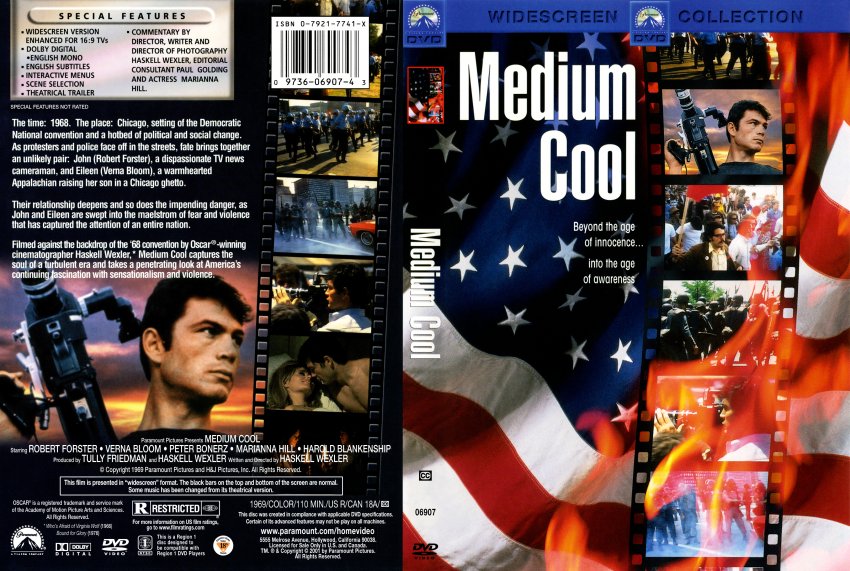
Jonathan Kirshner - The Whole World Is Watching: Haskell Wexler's Medium Cool

The Whole World Is Watching: Haskell Wexler's Medium Cool on DVD
by Jonathan Kirshner
Bright Lights Film Journal


Medium Cool (1969) was a project shadowed by the FBI, saddled with a market-inhibiting X rating, and released with tepid support from a nervous studio. Not surprisingly, despite attracting very favorable reviews, it was not big hit at the box office. But over the years its reputation rose steadily, and eventually the movie found its proper place in the pantheon of the great films of the New Hollywood era. A worthy recipient, then, of the full Criterion Treatment, with a sparkling new special edition DVD and Blu-Ray; among its many features are a new interview with writer-director-cinematographer Haskell Wexler and the very welcome inclusion of (a slightly edited version of) the valuable but obscure 2001 BBC television documentary about the film, Look Out Haskell, It's Real."

As his triple-threat credits suggest, Medium Cool was very much Wexler's project. One of the hottest cinematographers in the business — just off an academy-award winning turn for Who's Afraid of Virginia Wolf (1966) and the big hit In the Heat of the Night (1967) — and with the emergence of a New American Cinema that took low-budget chances on new talent, Wexler was given a shot at the director's chair. And to his credit, the ambitious, confident cameraman didn't play it safe but threw everything he had into a risky project that he believed in.

With a background in documentary filmmaking, Wexler was influenced by a philosophy associated with the French New Wave (many of whose participants had similar apprenticeships), that challenged the reification of a divide between "fiction" and "non-fiction" films. Documentaries, they insisted, could not show an objective truth but offered only one interpretation of events, presented as a narrative following classical storytelling rules; realities that were, moreover, altered by the presence of cameras that produced self-consciousness and performance. Conversely, fiction films, especially those made on locations and with a new wave sensibility designed to reflect the personal experiences of their creators, were in many ways also documentary records of a certain type of reality. With Medium Cool, Wexler dove headlong into the blurry intersection between the two, embedding a fictional (and often improvised) story within very real situations. Often featuring non-actors going about their unscripted business, in many scenes only the principal players are aware that a movie is being made. At times those actors were exposed to real danger — placed, for example, in the midst of what the report of a National Commission would describe a few months afterwards as a "police riot." On the streets of Chicago, Wexler's camera became one among many that were capturing the events as they unfolded — and he was among those tear gassed, and was blinded for twenty-four hours.

The politically sensitive Wexler was irresistibly drawn from Hollywood back to his home town, Chicago, and the Democratic National Convention that would be held there in August 1968. Convinced that "something" would happen there — a violent confrontation, of some type, seemed certain — he crafted a story that could be interwoven into those events, unforeseeable in their specifics, as they unfolded. Wexler was later accused of incitement, but his cameras did little more than anticipate the inevitable explosion. Nineteen sixty-eight took care of the rest.

It was a very bad year. In January, the surprise Tet Offensive fundamentally altered the trajectory of the Vietnam War. The unprecedented communist strikes failed to achieve their military goals, but they made plain that no matter how many troops it poured in, the United States was not going to achieve its political objectives in the war, despite the unceasingly optimistic reports previously proffered by the Johnson Administration. (The U.S. would suffer over 4,700 combat deaths in the first three months of 1968. And with 500,000 American troops in the country, the war was being fought — at best — to a bloody stalemate.) In March, Johnson was embarrassed in the New Hampshire democratic primary by the strong showing of anti-war candidate Eugene McCarthy; within days, Robert Kennedy dropped into the race; within weeks, LBJ shocked the nation by dropping out. In April, Martin Luther King was assassinated. Kennedy, campaigning in Indianapolis, delivered the news to a stunned, mostly black audience, and delivered a short, moving speech appealing for calm. Scores of American cities erupted in riots that night, but Indianapolis was not one of them. In June, Kennedy would be assassinated moments after celebrating victory in the crucial California primary, his final words, "on to Chicago and let's win there," still hanging in the air as the shots rang out.

To Read the Rest

Sunday, April 21, 2013

Rob White: Interview with Manuel Alberto Claro

Interview with Manuel Alberto Claro
by Rob White
Film Quarterly


Cinematographer for Lars von Trier’s Melancholia, Manuel Alberto Claro was born in Santiago, Chile in 1970. His family moved to Denmark in 1974, after the Pinochet coup. Having graduated from the European Design Institute, Milan, he worked in his twenties as a photographer’s assistant in Copenhagen and New York. At age 27, he changed tack and studied cinematography at the Danish National Film School. His second feature in his new professional capacity, Reconstruction (Christoffer Boe, 2003), gained the Caméra d’Or at Cannes, and Claro’s career has gone from strength to strength. Melancholia won the award for best film at the 2011 European Film Awards, with Claro taking the cinematography prize. He is due to collaborate again with von Trier on the director’s next project, The Nymphomaniac.

“My aim is to make images that are in love with the story and not with themselves,” Claro told Idol Magazine, adding that his professional role model is Harris Savides, whose credits include Margot at the Wedding (Noah Baumbach, 2007) and Last Days (Gus Van Sant, 2005): “If you can create poetic images, full of texture and emotional presence, out of something trivial, then you are good,” said Claro.

Melancholia has its own wedding and last day, and neither event ends in celebration. The marriage between Justine (Kirsten Dunst) and Michael (Alexander Skarsgård) goes off the rails before it can even be consummated (Justine prefers a roll in the golf-bunker sand with one of Michael’s colleagues), and Melancholia is bookended by slow-motion collisions between the eponymous renegade planet and Earth. Yet von Trier’s anti-disaster film is neither tragic nor miserable. “When I left the theater and exited out into Cannes, I felt light, rejuvenated and unconscionably happy,” wrote the Village Voice’s J. Hoberman after a festival screening. My own reaction was rather similar. Despite its chaotic nuptials and global wipeout, Melancholia does not induce melancholia, at least if Freud’s description of the state in “Mourning and Melancholia” is to be taken as gospel: “profoundly painful dejection, cessation of interest in the outside world, loss of the capacity to love.”

Von Trier’s wry DVD commentary (in conversation with University of Copenhagen professor Peter Schepelern, included on the U.K. edition published by Artificial Eye) often zeroes in on transient pleasures, such as the improvised moment when Udo Kier, in the role of the thin-skinned Wedding Planner, lumbers after a flaming paper lantern as if out of empathy for the object’s own flimsy epidermis. The director also rues small infelicities that most viewers would never notice, such as CGI complexion-smoothing (“skin fixes”) that he now considers unsatisfactory. Since he also admits to so-called Obsessive Compulsive Disorder, perhaps his focus on minutiae should be classed as pathological persnicketiness—but that would be to prefer armchair psychoanalysis to the beautiful variegation of Melancholia, to which Claro’s cinematography contributes so much.

It is an eccentric, rogue film that never obeys the usual rules of stylistic and emotional consistency. Paradoxes and incongruities abound from the start: the miniature drama of Justine opening her eyes against a background of avian rainfall is juxtaposed with a cosmic conflagration rendered as one liquescent heavenly body plunging into another. And if von Trier’s film embraces sci-fi, Wagner, uncanny tableaux, homages to Bergman and Tarkovsky, Dogme-style handheld jitteriness, there is also a long take of summer quiet as Claire (Charlotte Gainsbourg) dozes which is reminiscent, as Schepelern suggests during the commentary, of Rohmer’s bittersweet idylls. To dwell on such a detail, and to go further and think it more notable than the ensuing celestial firestorm, might after all involve a kind of melancholy, though one quite unfit for Freudianism.

To Read the Interview

Sunday, December 9, 2012

Charles McGrath: Abe Lincoln as You’ve Never Heard Him

Abe Lincoln as You’ve Never Heard Him
By Charles McGrath
The New York Times

“Now he belongs to the ages,” Edwin Stanton, Abraham Lincoln’s secretary of war, said at the president’s deathbed. “And to the studios,” he could have added.

The latest in a long parade of screen Abes, coming right on the heels of Benjamin Walker’s ax-swinging, martial arts version in “Abraham Lincoln: Vampire Hunter,” is Daniel Day-Lewis, who, though he grew up in England and Ireland and had to learn about Lincoln almost from scratch, plays the lead in Steven Spielberg’s “Lincoln,” which opens Friday.

Mr. Day-Lewis, 55, has already won two best actor Oscars, and his performance here, tender and soulful, convincingly weary and stoop-shouldered, will almost certainly earn him a nomination. He’s neither as zombified as Walter Huston in D. W. Griffith’s 1930 biopic “Abraham Lincoln,” nor as brash and self-assured as Henry Fonda in John Ford’s “Young Mr. Lincoln” (1939), nor as stagy and ponderous as Raymond Massey, a year later, in “Abe Lincoln in Illinois,” in which he sounds, during the Lincoln-Douglas debates, a lot like the television evangelist Harold Camping proclaiming the end of the world once more.

Tall and thin, with big hands and a long neck, Mr. Day-Lewis physically resembles Lincoln more nearly than many of his predecessors — more, certainly, than Kris Kristofferson, who in the 1995 television movie “Tad” had to wear platform shoes to boost him to Lincolnesque stature. Yet the first time Mr. Day-Lewis opens his mouth in the movie, he’s also a little startling. His Lincoln speaks not in Massey’s stentorian baritone, or in the echoing, ballpark-announcer tones of the Disneyland animatronic Lincoln first heard at the 1964 World’s Fair, but in a voice that is high, earnest and folksy.

Mr. Day-Lewis is famously fussy about what parts he takes, sometimes waiting years between films while spending time in both Ireland and America with his wife, Rebecca Miller (the daughter of Arthur Miller, whom he met while filming “The Crucible”), and their two sons. (He has a third, older son with the actress Isabelle Adjani.) For a while he seemed to give up movies altogether and apprenticed himself to a cabinetmaker and a cobbler.

Mr. Day-Lewis is even fussier about what he calls “the work”: his process of preparing and then inhabiting a part. For “The Last of the Mohicans” he taught himself to build a canoe, shoot a flintlock and trap and skin animals. For the opening scene of “My Left Foot,” about Christy Brown, an artist with cerebral palsy, he taught himself to put a record on a turntable with his toes; he also insisted on remaining in a wheelchair between takes and being fed by the crew.

He learned to box, naturally, for “The Boxer,” in which he played a prizefighter and former member of the Irish Republican Army and in the process broke his nose and damaged his back. To play the gang leader Bill the Butcher in “Gangs of New York,” he took butchering lessons, and to play Abraham Lincoln he half-convinced himself that he was Abraham Lincoln.

Mr. Day-Lewis, who has a deep voice and a British accent, not in the least Lincoln-like, prefers not to talk much about his method of acting. He doesn’t entirely understand it himself, he says, and doesn’t want to. “There’s a tendency now to deconstruct and analyze everything,” he said during a recent interview in New York, “and I think that’s a self-defeating part of the enterprise.”

He added: “It sounds pretentious, I know. I recognize all the practical work that needs to be done, the dirty work, which I love: the work in the soil, the rooting around in the hope that you might find a gem. But I need to believe that there is a cohesive mystery that ties all these things together, and I try not to separate them.”

To Read the Rest of the Profile

Monday, November 19, 2012

Margy Rochlin: Who’s That Man in the Iron Lung? John Hawkes Brings Years of Film Work to ‘The Sessions’

Who’s That Man in the Iron Lung? John Hawkes Brings Years of Film Work to ‘The Sessions’
By Margy Rochlin
The New York Times


EARLY last year the director Ben Lewin was looking for an actor to play the lead in “The Sessions,” a film he wrote based on the true story of Mark O’Brien, a journalist and poet who had contracted polio as a young boy and spent most of his life in an iron lung. The casting director, Ronnie Yeskel, mentioned John Hawkes. “This is your man,” she assured him.

Unfamiliar with his work, Mr. Lewin watched “Winter’s Bone,” the drug thriller set in the Ozarks that won Mr. Hawkes an Oscar nomination. In it he plays a hard-mouthed meth dealer named Teardrop, a far cry from the severely disabled man of Mr. Lewin’s film, who with equal parts terror and courage seeks out a professional sex surrogate in order to lose his virginity. “What?” Mr. Lewin remembered thinking. “That creepy guy?”

Only after Mr. Lewin decided to check out some of the actor’s other films did he catch John Hawkes fever. “I thought, this guy’s incredible, just the diversity of what he can do.”

Mr. Lewin wouldn’t be the only one to have spent years seeing Mr. Hawkes in untold film and television appearances without being able to put a name to his thin, expressive face. Mr. Hawkes has worked steadily since the mid-’80s (his TV credits include “Wings,” “24” and “Deadwood”), yet when he received his dark-horse supporting-actor Oscar nomination in 2011, one headline seemed to sum it up: “Who Is John Hawkes, Anyway?”

Today it’s a different story: on the many blogs and Web sites devoted to predicting the winners of the 2013 Academy Awards, Mr. Hawkes’s name comes up frequently in conversations about best-actor nominations along with gold-star competition like Joaquin Phoenix (“The Master”) and Daniel Day-Lewis (“Lincoln”).

Mr. Hawkes likes to think of himself as an “overpreparer,” and he certainly went the distance for “The Sessions,” in which his character spends much of the film encased in a huge metal apparatus with only his head showing. To approximate Mr. O’Brien’s condition — he had feeling in his body but was paralyzed except for one muscle in his right foot, a muscle in his neck and one in his jaw — Mr. Hawkes did everything from studying Jessica Yu’s Oscar-winning documentary short (“Breathing Lessons: The Life and Work of Mark O’ Brien”) to devoting a week stretched out on a couch teaching himself to punch in a phone number using a stick held in his mouth. Then there was the actual shoot, which required spending long days completely still with his neck craned at a 90-degree angle while co-stars like Helen Hunt and William H. Macy hovered over him. “Lying down and literally not having movement below your neck?” Mr. Hawkes said. “It was a particular challenge.” Mr. Hawkes did not see a finished version of “The Sessions” (a Fox Searchlight release) until its premiere at this year’s Sundance Film Festival, where audience members leapt to their feet at the end. But Mr. Hawkes said he was most moved by what followed the applause: the sight of Mr. Lewin, who also had survived polio, coming to the front of the house for a postscreening discussion.

To Read the Rest of the Profile

Sunday, October 28, 2012

ENG 281 First Class Trip: Cloud Atlas (Germany/USA/Hong Kong/Singapore: Tom Tykwer, Andy Wachowski and Lana Wachowski, 2012)

[Michael: I'm currently working on two guest lectures for the coming week (on the Civil Rights Movement and Biotechnology/Ethics). When I come up for air I will start collecting the wave of thoughts, associations and impressions I have about this brilliant film. In the spirit of the film please share your thoughts and engage us across time/space.]


Cloud Atlas and Bound." Sound on Sight #337 (October 28, 2012)

Hemon, Aluksander. "Beyond the Matrix: The Wachowskis travel to even more mind-bending realms." The New Yorker (September 10, 2012)

McGrath, Charles. Bending Time, Bending Minds: Cloud Atlas, as Rendered by Tom Tykwer and the Wachowskis The New York Times (October 9, 2012)

Sicinski, Michael. "Star Maps: Wachowski/Tykwer/Wachowski’s Cloud Atlas." Cinema-Scope (2012)

Wachowski, Lana. "What it Means to Be Transgendered." Women and Hollywood (October 24, 2012)

Wednesday, October 3, 2012

Dennis Lim: Time Has Been Kind to Heaven's Gate

Time Has Been Kind to Heaven's Gate
by Dennis Lim
The New York Times


...

Lee Kline, the technical director at Criterion, said, “It wasn’t an option to go back to the original negative because that was what was cut down to the short version.” The original 70-millimeter prints were also in poor shape. So in a costly, complicated process, the restoration team scanned each color separation negative individually and recombined them.

“Heaven’s Gate” may be a subject Mr. Cimino has avoided for years, but once he gets going, the floodgates open. He spoke fondly of the performances of Kris Kristofferson, Christopher Walken and Isabelle Huppert, which he feels have never gotten their due. And he recalled the genesis of the project: Researching the history of barbed wire and the cattle industry, he came upon an incident known as the Johnson County War involving cattlemen, hired killers and local ranchers. He described the epilogue — the weary hero, James Averill (Mr. Kristofferson), on a yacht off the New England coast — as “a prelude to ‘The Great Gatsby,’ ” with Averill as the mogul awaiting the arrival of the young James Gatz.

Mr. Cimino also recalled his obsessive quest for authenticity that led many to characterize “Heaven’s Gate” as a runaway production. (First budgeted at less than $10 million, the film grew to a cost of $35 million, or $44 million including promotional costs, according to Mr. Bach’s book. Mr. Cimino maintains that it was “all in $32 million.”) As he put it, “Everything was problematical”: the locomotive that had to be transported to the Montana location from a Denver museum; a horse-drawn buggy whose spokes and upholstery had to be made in different states. “The movie could not be made today, even if you threw $300 million at it,” he said. “All of that is being lost. The wagons don’t exist, the skills are gone.”

Present-day viewers may well find that time has been kind to “Heaven’s Gate,” which plays more than ever like a fittingly bleak apotheosis of the New Hollywood, an eccentric yet elegiac rethinking of the myths of the West and the western, with an uncommonly blunt take on class in America. (“It’s getting dangerous to be poor in this country,” someone says. The rejoinder: “It always was.”) But this defiant last gasp of the downbeat ’70s, opening two weeks after Ronald Reagan was elected president, was plainly a movie at odds with its time.

Reached at his home in Hawaii, Mr. Kristofferson said he believes the themes of the film, with its grim view of American capitalism, were what made it so unpalatable. “It was a political assassination,” he said. He recalled getting word that Reagan’s first attorney general, William French Smith, had told studio heads that “there should be no more pictures made with a negative view of American history.”

Mr. Kristofferson, sounding more rueful than bitter, said that the reception to “Heaven’s Gate” knocked him off the Hollywood A-list for good. “I never really recovered from that,” he said, but he acknowledged that it was worse for Mr. Cimino. “It completely destroyed him.”

Mr. Cimino continued to work, albeit infrequently; he has made four features since “Heaven’s Gate,” the last one, “Sunchaser,” in 1996. A painter who began his directing career in advertising, he said that at home in Los Angeles he rarely watches movies now (and prefers to reread Pushkin and Flaubert). But he does have a film project in mind, which he hopes to shoot in digital soon.

Ms. Carelli, who was with Mr. Cimino in Venice, said that while there remain misconceptions about the making of “Heaven’s Gate,” “I don’t want to revisit old erroneous stories and try to correct them.” She added, “Now the film finally speaks for itself, and it has the final word.”

To Read the Entire Article

More Resources:

The Making and Unmaking of Heaven's Gate


Thursday, September 27, 2012

ENG 281 Week 7: Shortbus (USA: John Cameron Mitchell, 2006)


Shortbus (USA: John Cameron Mitchell, 2006: 101 mins)

"In the old days, when you couldn't show sex on film, directors like Hitchcock had metaphors for sex (trains going into tunnels, etc). When you can show more realistic sex, the sex itself can be a metaphor for other parts of the character's lives. The way people express themselves sexually can tell you a lot about who they are. Some people ask me, 'Couldn't you have told the same story without the explicitness?'. They don't ask whether I could've done Hedwig without the songs. Why not be allowed to use every paint in the paintbox?" --John Cameron Mitchell, "How to Shoot Sex: A Docu-Primer" (2007): Shortbus Region 1 DVD release (Th!nk Film)


Adams, Tim. "Everybody's Doing It..." The Guardian (November 26, 2006)

Aftab, Kaleem. "Shortbus." Collective (November 30, 2006)

Ballard, J.G. "Car Crash"; "Sex x Technology = The Future"; "Pornography"; "How I Work." Quotes (San Francisco: Re:Search, 2004: 238-247; 277-279; 332-333.

Benton, Michael Dean. "American Sex and Sexuality 2.0" Dialogic(May 27, 2010)

---. "Gender and Sexuality at the Carnegie Center." North of Center (January 29, 2010)

---. "Getting off on John Cameron Mitchell’s Shortbus: American Sex and Sexuality." North of Center (March 30, 2011)

---. "Review of Straightlaced: How Gender’s Got Us All Tied Up." North of Center (October 13, 2010)

Browning, Barbara, et al. "The Lure and the Blur of the Real." Philoctetes (March 13, 2010)

Crowell, Steven. "Existentialism." Stanford Encyclopedia of Philosophy (Revised edition: 2010)

Dargis, Manohla. "Naughty and Nice in a Carnal Carnival." The New York Times (October 4, 2010)

Deep Throat (USA: Gerard Damiano, 1972: 61 mins)

Dubowski, Sandi. "Non-Stop Erotic Cabaret: John Cameron Mitchell pushes the sexual boundaries once again in Shortbus." Filmmaker (Fall 2006)

"Existentialism." Wikipedia

Fauth, Jürgen. "Shortbus." About (No Date)

Foucault, Michel. "Of Other Spaces." (This text, entitled "Des Espace Autres," and published by the French journal Architecture /Mouvement/ Continuité in October, 1984, was the basis of a lecture given by Michel Foucault in March 1967.)

Hudson, David. "Sex in the Movies." Green Cine (2005)

Jhally, Sut. "Codes of Gender: Identity and Performance in Popular Culture." (Media Education Foundation, 2009) [documentary--available online]

Lewis, Jon. "Real sex: aesthetics and economics of art-house porn." Jump Cut #51 (Spring 2009)

Macio. "Redefining Our Relationships: An Interview with Wendy-O Matik." Revolution By the Book (February 19, 2010)

Oshima, Nagisa. "Sexual Poverty" Cinema, Censorship, and the State: The Writings of Nagisa Oshima. The MIT Press, 1993

"Polyamory."
Wikipedia (No Date)

"Sexual Orientation." Wikipedia (No Date)

Shaw, Richard. "Are the U.S.A.'s Independent Films a Distinct National Cinema?" The Film Journal (2002)

Williams, Linda. "Film Bodies: Gender, Genre and Excess." Film Quarterly 44.4 (Summer 1991): 2-13.

---. "Hard-Core Art Film: The Contemporary Realm of the Senses." Quaderns portàtils #13 (2008)

Wypijewski, JoAnn. "Sexual Healing: Carnal Knowledge." The Nation (September 9, 2009)


Wednesday, August 29, 2012

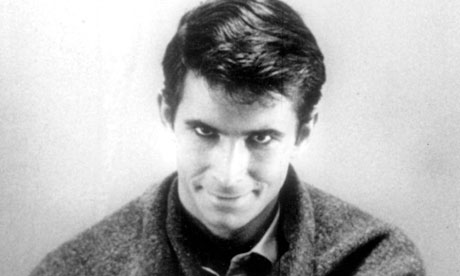
Dan Akira Nishimura: Anthony Perkins -- Forever Psycho

Anthony Perkins: Forever Psycho
by Dan Akira Nishimura
Bright Lights Film Journal


When Alfred Hitchcock wrapped Psycho (1960), it was years before the sequel became commonplace. No one expected Ben Hur (1959) or Spartacus (1960) to continue on with new adventures. "The End" meant just that, for the story and the characters. So it may have come as a surprise to Anthony Perkins when his Norman Bates character was revived thirteen years later in Psycho II (1983). In some ways, however, he had never stopped playing him.

A dreamy-eyed staple of fan magazines of the late 1950s and early '60s, Perkins was cast against type as the psychotic killer. Because of the enormous success of Psycho, he immediately became identified with the role. Although he at first resisted, Perkins returned to Norman Bates again and again, in one form or other. Norman's twitchy eccentricity seeped into many of Perkins' post-Psycho performances that preceded the run of sequels. His paranoid bank manager Joseph K. in The Trial (1962), the preppy-with-a-secret Dennis Pitt in Pretty Poison (1968), and the amnesiac sculptor Charles Van Horn in Ten Days Wonder (1971) all bear the mark of Norman Bates. In this essay, we'll look at how Perkins became indistinguishable from Norman and why he was never "finished" with him. Perkins set the stage for the emergence of the creepy but sympathetic pretty-boy psychopath next door. Without Psycho, sweet-faced Tony Curtis may have had a difficult time convincing producers he could play Albert DeSalvo in The Boston Strangler (1968). Another real-life Norman, serial killer Ted Bundy, was celebrated in books and a television miniseries. Anthony Perkins was born in 1932, the year Adolf Hitler seized power. Perkins was the son of the actor James Ripley Osgood Perkins, who died onstage when Tony was five. Growing up in the shadow of the Second World War and surviving the death of a parent must certainly have affected him. In any case, there's an unease built into his screen personae whether he's playing high-strung baseball player Jimmy Piersall in Fear Strikes Out (1957) or Norman Bates.

"Psycho begins with the normal," writes Robin Wood, "and draws us steadily deeper and deeper into the abnormal; it opens by making us aware of time, and ends with a situation in which time has ceased to exist."1 It's difficult to imagine the world before Psycho and its countless imitators. Known as the eccentric director of big-budget, wide-screen Technicolor spectacles, Hitchcock planned to make Psycho for $800,000, even then not a large sum for a major motion picture. It was shot by John L. Russell with a get-it-done-quick sensibility learned from television. From the success of Alfred Hitchcock Presents, Hitchcock sensed that movie audiences were ready for a good scare. The slashing violins of Bernard Herrmann's soundtrack were vital to creating tension in the viewer. Although cinematic innovations were few, the film was notable as a triumph of marketing and for elevating Anthony Perkins to screen immortality. It also marked a shift in attitudes about sex as the 1960s began. David Thomson writes:

The subversive secret was out — truly this medium was prepared for an outrage in which sex and violence were no longer games but were in fact everything. Psycho was so blatant that audiences had to laugh at it, to avoid the giddy swoon of evil and ordeal. That title warned that the central character was a bit of a nut, but the deeper lesson was that the audience in its self-inflicted experiment with danger might be crazy, too. Sex and violence were ready to break out, and censorship crumpled like an old lady's parasol. The orgy had arrived.2


No matter the subject matter, Hitchcock stressed the idea of "pure film" where the pictures tell the story. Perkins, with his expressive face and physical style of acting, is well suited to a Hitchcock movie. As Norman, he's full of nervous tics one moment and longing gazes toward his female co-stars the next. As such, he's the perfect foil for Hitchcock, who was known to be uncomfortable with women. Writes Robin Wood: "Hitchcock isn't interested in acting, certain actors, left to their own devices, are able to seize their chances and create their own performances independently; there is more reason to deduce that there are certain performances — or more exactly, certain roles — which arouse in Hitchcock a particular creative interest."3

As a child, Hitchcock was required to stand at the foot of his mother Emma's bed and report on his perceived transgressions, something that continued into adolescence. In Joseph Stefano's screenplay of Psycho, the mother of Norman, or at least the part of her that survives in his head, is all-powerful. "A boy's best friend is his mother," he says. Perkins plays the dual role of Norman and the deceased Mrs. Bates. The homicidal maniac as cross-dresser is another aspect of Psycho that wasn't "finished." Twenty years later, Michael Caine would put on the wig in Brian De Palma's Dressed to Kill (1980).

In the Franz Kafka source novel for the Orson Welles film The Trial, Joseph K. is an innocent man wrongly accused. Perkins plays him as a tightly coiled nervous wreck who's oddly attractive to women. His interpretation makes it appear that Joseph must be guilty of "something." Presumably to escape typecasting as Norman, Perkins fled to Europe, where Welles had also taken refuge during the years of the Hollywood blacklist.4 In The Trial (1962), Welles had creative control, and stylistically it was one of the best of his European films.5 An irrational universe with its rows of desks manned by overworked clerks is depicted in stunning black-and-white by Edmond Richard's camera. Location shooting, including what was then the Gare dOrsay train station, only adds to the surreal quality. Reflected light, something that Welles perfected with Gregg Toland shooting Citizen Kane (1941), is used extensively. At the center is Perkins as Joseph K., a man put through a trial (Le proces in French) not limited to a courtroom. Just as Norman is shocked by what he considers the outrageous accusations made against him, Joseph feels put upon and harassed by an incomprehensible bureaucracy. There are some differences, though. With Norman, the Mother is a constant presence watching his every move, whereas Joseph lives in fear of the Father as represented by the State. Welles is The Advocate, who seems more like an adversary. As portrayed by some of the most popular European actresses of the time including Jeanne Moreau and Romy Schneider, women are drawn to Joseph as to an abandoned infant. He appears to be able to consummate some of these encounters, yet he remains unsatisfied.

To Read the Rest of the Essay

Tuesday, August 21, 2012

James MacDowell: John Cazale -- Stepped Over

John Cazale: Stepped Over
by James MacDowell
Alternate Takes


John Cazale has what is probably the most impressive complete resumé in Hollywood history. He appeared in only five films before succumbing to bone cancer at the age of 42; those films, however, were The Godfather (1972), The Godfather Part 2 (1974), The Conversation (1974), Dog Day Afternoon (1975), and The Deer Hunter (1978). Whatever one may personally think of them, it is difficult to think of another actor who appeared solely in movies that have been so consistently highly praised; apart from anything, each one was nominated for the Best Picture Oscar, and three won. In 2009 a short documentary called I Knew It Was You was made about Cazale’s life and career (watch it here). It features interviews with those one would expect, including Francis Ford Coppola, Robert De Niro, Gene Hackman, Meryl Streep (whom Cazale was dating at the time of his death), and Al Pacino - who claims he learned more about acting from Cazale than from anyone else he has ever worked with. It also features testimonials from a number of younger actors equally eager to praise him for his craft, such as Steve Buscemi, Sam Rockwell, and Phillip Seymour Hoffman. The overall thrust of the documentary, hinted at in its title, is to suggest how unfair it is that Cazale is not more well known, given his talent and track record. While I certainly agree with this, I would also suggest that it is in a sense unsurprising - and even somehow perhaps sadly fitting - given both the roles he played, and his films’ treatment of his characters.

In his seminal book Stars, Richard Dyer writes that, “Stars… are the direct or indirect reflection of the needs, drives and dreams of American society.” Cazale’s career suggests that this holds both for those figures who are constructed to embody such dreams, and for those who are required to embody their lack or failure. While Cazale was emphatically not a ‘star’ in the conventional sense, this fact is in itself telling in relation to the kinds of roles he played, and holds a special significance for Cazale’s relationship to the kinds of needs and drives Dyer refers to.

All of the five films John Cazale appeared in during his short career can be seen as indicative of the well-documented sense of national malaise that was so observable in certain corners of the post-Vietnam American cinema. They are all films that, in different ways, asked demoralising questions about what it meant to achieve that form of success so often referred to in mythic terms as ‘The American Dream’. In each film he plays a supporting role to a major Hollywood star which, in pre-Vietnam cinema, could perhaps quite easily have been comic: each has the potential to be the role of the dim-witted friend or side-kick who amuses with his charming ignorance. These, however, were films of the 1970s so-called 'Hollywood Renaissance' - films that often attempted to reflect the extent to which Vietnam and had given the U.S. a sense of its own mortality, and the possibility of failure: films in which pursuit of the American Dream was a dangerous, and perhaps doomed, matter of “life and death”. I want to look briefly at how Cazale’s characters are treated in two of these films: The Godfather Part 2 and Dog Day Afternoon. (I should say, if such a warning is needed for these films, that there will be spoilers...)

In both The Godfather Part 2 and Dog Day Afternoon Cazale's characters are continually being undermined, in different ways, by the star of both films, Al Pacino. This happens on the level of plot, but it is also happening consistently stylistically. For instance, one way in which The Godfather Part 2 often communicates Cazale’s inferiority to Pacino is through framing. We can see this, for example, in the scene in which Michael disowns Fredo (watch a portion of it here). In the scene’s long shots Fredo is seen sprawled on a recliner along the bottom right-hand side of the frame while Michael towers over him, commanding the eye.

To Read the Rest of the Essay

Friday, July 13, 2012

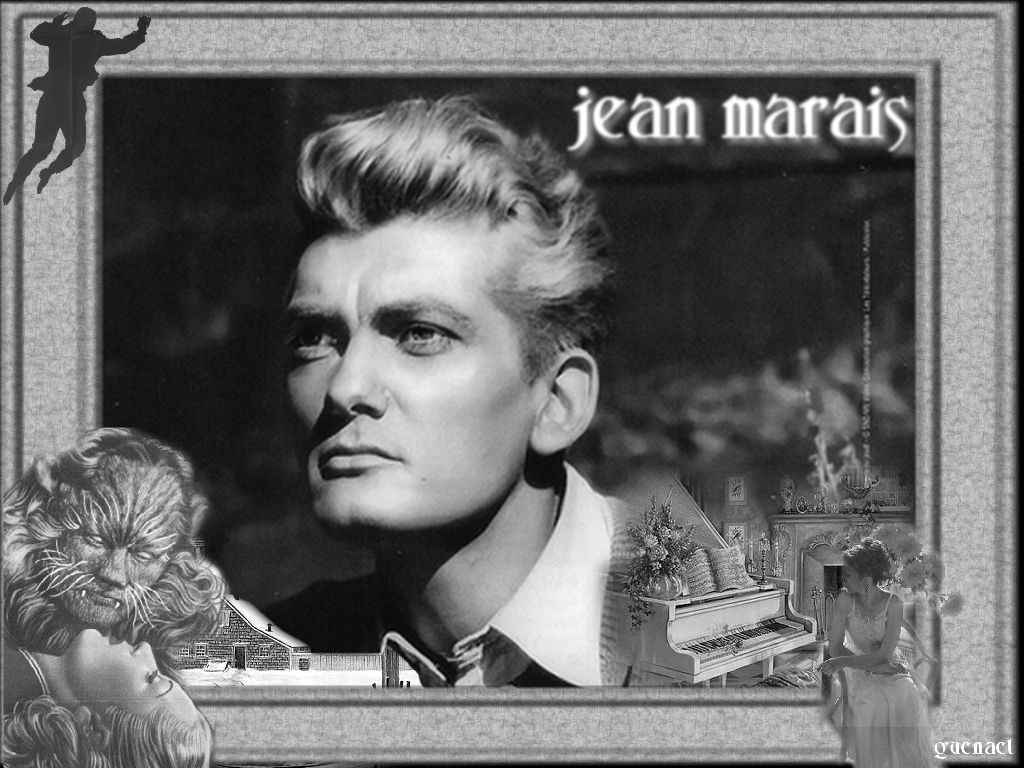
Severine Benzimra: Jean Marais -- Dream Lover

Jean Marais: Dream Lover
by Severine Benzimra
Acidemic


Jean Marais was a dream figure. An absolute hero. Americans had Kirk Douglas or Burt Lancaster, with whom to learn about history through westerns or peplums, we had a gay perfect blond male to learn about our history through swashbuckling adaptations from Alexandre Dumas or Théophile Gautier, classic theater plays by Racine, Corneille, Edmond Rostand or Victor Hugo.

Marais was une force qui va, a force that could quote Victor Hugo (Hernani). A force of nature who introduced generations of teenagers to the poetry, the ravishing quest of beauty and the incestuousness of Jean Cocteau. He became the ideal mature lover in the 50s. He incarnated the handsome, noble father, from whom young girls had to fly away to look for love, thanks to Jacques Demy.

Every French person might well have his/her own inner image of Jean Marais. He could make fun of himself. He played an evil green-skinned Fantomas, but unfortunately refused the part of the killing monk in The name of the Rose, Jean-Jacques Annaud's film. He had many faces, man/god, ancient/modern, lover/brother/father, artist/muse, actor, sculptor, etc. The fragrance the male, created by Jean-Paul Gaultier, might well be an homage to Jean Marais. He played in about 90 movies; eight TV series, 30 plays: his beauty and energy never faded, unlike Alain Delon's, like Burt Lancaster's. Like Lancaster, he played for Luchino Visconti. Lets be honest: impossible to imagine him as Il Gattopardo, Burt Lancaster imposed himself on Vischotni for that film, as well as in Gruppo di Famiglia in un interno and so did Dirk Bogarde in Death in Venice, though the role of Gustav von Aschenbach was firstly proposed to Jean Marais.

To Read the Rest of the Essay

Friday, June 22, 2012

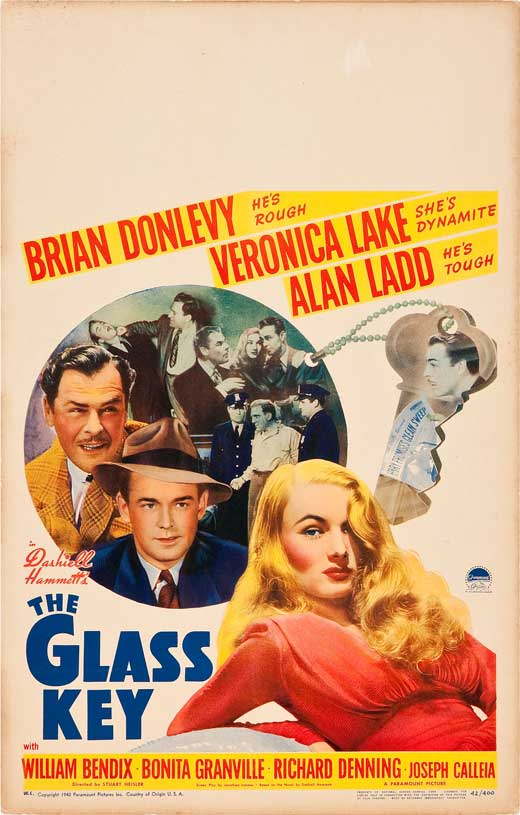
Erich Kuersten: The Veronica Lake Effect

The Veronica Lake Effect
by Erich Kuersten
Acidemic


What is it about Veronica Lake that makes her so completely unlike all the other leggy 1940s blondes of Hollywood? We know a few things: she was short, had an abusive childhood, was hell to work with, and spent her retirement years tending bar in a cheap women-only hotel. But none of that helps explain her unique, otherworldly effect, which is akin to a whisper silencing a crowded baseball stadium, or the voice you remember from dreams as you wake up late for work. Something in her gaze reflects a sweet tender concern for even the lowliest of creatures. Something in her voice always seems distant and far away as if it was dubbed by the ghost of an angel drowned years ago. Her eyes show a tenderness unbowed, a calmness around psychopathic behavior as if it reminded her of home. Hers is a warm shoulder to weep yourself to sleep into on flu-addled nights even as her aura, remoteness, impassive face, and beautiful blonde hair freeze you where you sit like a blast of Arctic air.

Women doing wartime factory work in WW2 caught their hair in the machines trying to emulate her, so with the cooperation of her studio, Lake's magnificent hair was kept locked up tight in buns and bizarre hats. One can only imagine who unbearably awesome films like The Glass Key would be if her hair could breath and fall and bounce. When Lake's hair was free it could wash all the sins of war away, as in the amazing bathrobe scene of Sullivan's Travels or any shot of her in This Gun for Hire.

She was a very heavy drinker who once noted that her co-star and fellow drunk Ladd seemed a bit of a zombie himself. Maybe that's why they were so perfect together, undead outsiders in a noir world never quite asleep enough to match them. The public sensed they had something special whenever paired, and since they were so short they matched each other the way few others could. Part of the appeal lies in Alan Ladd's stoic rejection of destiny: in Key he's meant to be with the much richer Veronica Lake (he's a political thug; she's an heiress) or in his This Gun for Hire acceptance of her affection for the cop trying to catch him, "You love that guy?" It's all okay with him, for immediately upon being accepted by her, warts and all, he's saved. Her renouncement of the 'peek-a-boo' hairstyle is a similar bit of stoicism. Like many film lovers, I've long been fascinated by the weird chemistry the pair exhibit, and how other similar pairs, such as Gene Tierney and Dana Andrews (Laura), lack that same chemistry, much as the ingredients are there. Ladd and Lake seem to be born in a different time, on a slower projection speed. They're blonde beauties used to having to look up and speak up to talk to people, who suddenly find one another and are thrilled to able to whisper and look straight into each others' eyes, like two kids in a room full of adults, but reversed: the only adults for miles. Together they were like a misfit Adam and Eve from an alien galaxy. Lake was an astonishing 4'11" which made her one of the few women who could play opposite the 5'5" Ladd but it's so much more, and bravely less, than that.

In Glass Key they have such a great sleepy chemistry it's like they're dreaming while awake and whenever they're together they're packing or leaving or otherwise hanging out in empty rooms. You just get used to seeing one or the other's leaving trunks dead center in the room whenever they're together. They both had tough childhoods and you can feel it in their shy delivery and wary glares, like two damaged souls recognizing each themselves in one another, and the aloof posturing, verbal attacks and avoidance strategies they use to keep the world at bay couldn't fool each other for a minute. In This Gun For Hire they're never even close to lovers but spend the night sleeping on each others' shoulders on a moving train, just pals who come to trust each other in a world full of duplicitous poisonous, peppermint-eating snakes which in a way makes it even sexier (and sadder). Normal sex and marriage is stale by comparison.

To Read the Rest of the Essay

Wednesday, May 23, 2012

Willie Tolliver: Postlude to a Kiss -- Will Smith's Performances of Race and Sexuality in Fred Schepisi's Six Degrees of Separation

Postlude to a Kiss: Will Smith's Performances of Race and Sexuality in Fred Schepisi's Six Degrees of Separation
by Willie Tolliver
Bright Lights Film Journal


Will Smith now occupies a position in Hollywood that is unrivaled by any other black performer. His films over the last eighteen years have grossed more than $5.3 billion, more than any other actor, with the exception of Johnny Depp (Smith 31). He commands a salary in excess of $20 million per film, which places him in the highest stratum of bankable actors. Consistently over the last decade he has been the highest ranking black star on annual lists of power figures in Hollywood.1 His success is in certain ways unprecedented. Even more than this, the meaning of his star status has historical and cultural implications that have not been fully examined. Smith's ability to reach such varied audiences, both domestic and global, is an indicator of evolving attitudes about race. The types of roles he has accepted and in which audiences are willing to accept him (savior of mankind, the last man on earth) have done interesting cultural work in terms of redefining concepts of black identity in general and of black masculinity specifically.

This discussion contributes to an examination of the Smith phenomenon by taking another look at his first major film performance in Fred Schepisi's Six Degrees of Separation (1993). Smith's casting as the hustler who impersonates the son of Sidney Poitier has a particular rightness; Smith is indeed the inheritor of Poitier's legacy in terms of breaking new ground for blacks in film.2 Poitier won visibility and dignity for black representation in Hollywood film; Smith extends and complicates this legacy as his performances engage racial representation as it intersects with class, gender, and sexuality. This complex of issues contained within Smith's screen personae sustains his iconicity, and these valances of significance find their source in his seminal performance as Paul Poitier in Six Degrees of Separation.

Based on a series of actual incidents reported in The New York Times in 1983, the story of the film and the play details the encounter of a New York power couple with a young black man who cons and charms his way into their lives for an evening by impersonating the fictional son of Sidney Poitier.3 Flan and Ouisa Kittredge (Donald Sutherland and Stockard Channing) are a private art dealer and his wife who are entertaining a possible investor in a crucial sale. They are burst in upon by the doorman and a young black man (Will Smith) who is bleeding from a knife wound to his side. It turns out that the intruder is a Harvard classmate of their children. They administer first aid, and he begins to talk. He persuades them to stay in, and he will prepare a meal. This he does and in the process dazzles them with his conversation. He discourses on The Catcher in the Rye and the death of the imagination. On top of this, it turns out that his name is "Paul," and he is the son of Sidney Poitier. It is a magical evening, and the deal is sealed. Subsequently, they discover that Paul Poitier is not who he claims to be and that several of their friends have had similar experiences with him. The path of their investigation into the real identity of this strange young man leads them to a friend of their children named Trent (Anthony Michael Hall), a student at M.I.T. He admits to befriending this Paul and sharing his knowledge of their lives with him. This seems to be the answer, but it doesn't begin to explain what has happened to them and how their lives have been profoundly affected.

Paul also seems to have had an effect on Smith as there are distinct parallels between their narratives. I argue that in his ascendant trajectory Smith replicates Paul Poitier's project of attaining celebrity and social status. Indeed it could be said that Smith learns valuable lessons about how to succeed in the mainstream from the character he portrays, and then he surpasses him. Paul insinuates himself into the white and privileged world of the Kittredges through canny and deliberate strategies to overcome the two salient aspects of his identity that might otherwise prove to be barriers: his race and his sexuality. He does so through a process of minimizing his race and sexuality while at the same time subverting conventional notions of those identities. Similarly, Smith's broad-based stardom is predicated on his choice of film characters whose racial identities are non-threatening and whose sexuality is muted or erased, especially given the hyper-sexualized stereotype of black men in film.

To Read the Rest of the Essay

Thursday, April 19, 2012

Bill Mesce: Remember Me -- Ben Gazzara

Remember Me: Ben Gazzara
by Bill Mesce
Sound on Sight


...

In Husbands, Cassavetes, Gazzara, and Peter Falk play three long-time friends who react to the death of another buddy with a midlife crisis bender of booze and a jaunt to London. Think The Hangover – but serious and for grown-ups.

Like much of Cassavetes’ work, Husbands has the shapelessness and shambling pace of life, the same sense of spontaneity, the same chaotic tumbling of the comedic into the tragic. It’s a demanding watch, but a rewarding one, almost uncomfortable at times in its feel of intruding into the real.

The heart of the movie is the give-and-go between the three leading men, and it may be one of the most honest and vibrant portraits of male friendship – with all its awkward intimacy and macho bullshit – captured on film. The bond between the three seems so damned real, it’s a surprise to find out that the three hadn’t known each other before Husbands.

Watching the film, seeing how open and vulnerable the three made themselves to each other, at the obvious chemistry among them, it’s no surprise they came out of the project friends. Gazzara would act for Cassavetes twice more, in The Killing of a Chinese Bookie (1976) and Opening Night (1977), and direct several episodes of Falk’s hit TV series, Columbo, including one starring Cassavetes as a philandering orchestra conductor.

But if you really want to see how closely tied the film brought them, go to YouTube and find them on an episode of The Dick Cavett Show being interviewed about the film. It puts Danny DeVito and his limoncello hangover on The View to shame. On the one hand, it’s appalling to see three grown – and obviously half-crocked — men cackling and falling over themselves on network television like kids farting in the back pew during mass.

On the other hand, it seems almost a scene from Husbands, and shows just how right the three of them had gotten it on film. Some things you can’t create; you can only hope to capture.

Husbands, Chinese Bookie, et al was not work Gazzara or the others did for fame and fortune. These were art house films before there was much of an art house circuit. Most people didn’t hear about them, even fewer went to see them. It was work done for the sake of doing; art for art’s sake. Film actors tend to be judged by their commercial successes and their visibility; not their willingness to explore the art. In that sense, Gazzara’s artistry was bigger than his career.

To Read the Entire Essay

Sunday, April 15, 2012

Richard Koehler: Nicholas Winding Refn and the Search for a Real Hero

Nicholas Winding Refn and the Search for a Real Hero
by Robert Koehler
Cinema Scope


In the middle of Nicolas Winding Refn’s Drive, a film punctuated by extreme flourishes of violence and vengeance, there is a period of peace. It occurs when Driver (Ryan Gosling), a quietly contained guy who holds down three jobs—auto mechanic, movie stunt driver, and getaway driver-for-hire—is asked by his auto-shop boss (Bryan Cranston) to drive home customer and Driver’s neighbour Irene (Carey Mulligan) and her little boy. En route, Driver takes a surprising detour from the street down to the concrete banks of the Los Angeles River, one of the city’s most iconic images, a grand public-works project born out of vast and tragic flooding the city endured generations ago. The river, choked into a narrow canal and surrounded by an elegantly paved canyon, has been used in too many movies and TV shows to possibly count, most recently by Bruce La Bruce for daytime sequences of L.A. Zombie (2010). Driver, true to character, uses it as a racetrack and as a bit of stunt track—mildly, as a kid’s in the car, and he’s a gentleman at heart—but also as a road to get somewhere.

The typical deployment of the Los Angeles River in cinema is as a symbol of dead ends, final stops, the place where the city dies, and people along with it. Not so for Refn, for whom Los Angeles is a new city, a place of discovery. Viewed from the majestic prospect of a high angle in long-shot widescreen, Driver stops at the place where the concrete river ends and gives way to the wild river, a startling image even for native Angelenos. He knows these kinds of places, having driven everywhere (so, in reality, does Gosling, who knows the city expertly and drove Refn around town as research, inspiration, and preparation). Refn understands those many places in Los Angeles that make it fairly unique, and reverses the usual clichéd knock on the place as one long paved sprawl. Constantly, the paved cityscape surrenders to the natural world, sidewalks dissolve into dirt trails, roads simply stop, buildings reach their limit when faced with cliffsides, massive chaparral, impregnable mountain ranges that cut through the metropolitan area. Driver leads mother and son to the wild river for a Tom Sawyer afternoon under the sun, a Southern California utopia—the ultimate getaway—an idyll that defines Drive and Driver in fundamental ways.

Superficially an action movie, Drive is actually a film in search of romance, zigzagging through an obstacle course of fairy tale and myth, and a hall of mirrors in which characters can be read as fantasy projections of others while being aware of themselves as figures inside a myth. Beloved in Cannes after days of disappointing films in the competition, Drive was perhaps welcomed by some for the wrong reason: as some kind of new read on Melville’s Le samourai (1967), with Gosling processing Alain Delon’s stoic killer. For once, the director has a sound interpretation that he’s willing to share with whomever cares to listen: Refn correctly argues that Drive’s foundation is in fairy tale, particularly its thematic of a character’s discovery of his own heroism, which Driver finds through the course of nurturing and protecting Irene, who’s made paradoxically more vulnerable when her convict husband returns home from prison. The necessary elimination of dragons—in the form of Albert Brooks’ ice-cold mobster Bernie Rose and Ron Perlman’s put-upon mobster Nino, to say nothing of a few nameless hitmen along the way—doesn’t so much make Driver into a killer, although he wreaks revenge with frighteningly intelligent brutality. Rather, it transforms him into a mythical figure who satisfies the imaginings of those around him, including Irene, who can nevertheless only marvel at him while knowing she can never have him. This is vastly different from Melville’s heightened existential world of professional killers who function by a code and live like lone wolves, apparently free of the need for genuine and reciprocal human contact. Delon’s Samourai is a corporeal killing machine; Gosling’s Driver is a young man in formation, whose work comprises (per his three jobs) repair, escape, and entertainment, and who finds his self during a gauntlet that perhaps only he can survive—an accidental knight who slays the beast.

This is a far stretch from James Sallis’ novel on which Hossein Amini’s screenplay is based, and, as Refn describes it, wildly different from Amini’s previous drafts written as a potential Universal franchise for Hugh Jackman. Sallis’ superb, laconic book, hardboiled to the core, as affectionate toward its city as it is cynical about the city’s most famous (show) business, could have been adapted pretty closely, even with its obsessive (and perhaps needless) jumps in chronology. But a knowledge of the book is helpful in appreciating the grand achievement in American cinema that Drive is. Hollywood has always been open to the invasive notions of outsiders, particularly European directors with strong points of view. Lubitsch, Lang, Boorman, Preminger, Wilder, von Sternberg, Herzog, Verhoeven, and von Stroheim all managed to import their native sensibilities with little compromise into the Hollywood system, and generally thrived intact. Refn’s ambition is clearly to make big movies for large audiences by his own sometimes-radical standards, which include mixing the hyper-violent ecstasies of the Pusher trilogy (1996, 2004, 2005), highly theatrical characters like Tom Hardy’s Bronson (2008), dreamlike dances of death as in Valhalla Rising (2009), and the romance of transformation in Drive. His new film is an act of will, pulling a fine but fairly standard piece of high-class pulp into something richer and more dynamic, modern in its self-consciousness as a work of art and entertainment, and Wellesian in its capacity to astonish, shock, and tease the mind’s perceptions. The fact that Refn is soon making a re-do of Logan’s Run with Gosling is a suggestion of a large-scaled cinema that’s aware of its kinetic powers, its artistic breadth, and its ability to kick it into the fifth gear.

To Read the Interview

Monday, March 26, 2012

Melissa Anderson: Belle de Siècle -- From jeune fille to mother superior, the many faces of Catherine Deneuve

Belle de Siècle: From jeune fille to mother superior, the many faces of Catherine Deneuve
by Melissa Anderson
Moving Image Source


...

For all the degradations Deneuve endures in these movies, it's worth remembering that in the first decade of her nearly 50-year career, she became famous by starring in films that were either captivating debasements or wholesome fantasias (and sometimes a mixture of the two). But in an oeuvre that encompasses more than 100 films, Deneuve can hardly be limited to Catherine the pure or Catherine the perverted. At times she's superseded mere celebrity and stood in for an entire nation: From 1985-89, her visage was used for Marianne, the national symbol of France. Shortly after, in 1992, she starred as a grande dame colonialist in Régis Wargnier's 1992 historical melodrama Indochine, the only role for which Deneuve has been nominated for an Academy Award. And yet Deneuve, born in 1943, has refused to calcify. Since Indochine, she has shown a fearlessness in her roles—no matter how small, as witnessed by her highly memorable motorcycle mama in Leos Carax's Pola X (1999) and her imperturbable hospital psychiatrist in Desplechin's Kings and Queen (2004).

Then again, that temerity existed from the start. Repulsion (1965), Deneuve's first English-language film, came out only a year after her breakout role as Geneviève, the melancholic jeune fille in Jacques Demy's lollipop-hued, entirely sung melodrama, The Umbrellas of Cherbourg. While certainly somber (some have likened Demy's film to a musical about the Algerian War), Umbrellas is far sunnier than Roman Polanski's horror show, which begins with an extremely tight close-up of Deneuve—several shots of her eyeball, her pupil dominating the entire screen. Despite the camera's proximity, Deneuve, the height of inscrutable blankness, remains remarkably distant—a damaged beauty hiding under a mane of luxuriant blond hair, her delicate, accented English rarely registering above a whisper. Plummeting into psychosis, she becomes glacially catatonic; her character, Carole, spends hours staring motionless at a crack in a sidewalk. Soon she's gazing at a slowly putrefying rabbit carcass; next she's seeing menacing shadows outside her bedroom door. Then viewers see Carole being raped—a violation that may be real or imagined.

In the recently published English translation of The Private Diaries of Catherine Deneuve Close Up and Personal (Pegasus Books), screenwriter Pascal Bonitzer asks the actress if she was "freaked out" by the role of Carole. "Absolutely not, I thought it was fantastic, I was very pleased," she responds. Her unflappable commitment to roles in which she is debauched must have been helpful when shooting Luis Buñuel's Belle de Jour (1967)—which, notably, was released in France less than three months after Demy's radiant, MGM-inspired musical The Young Girls of Rochefort, starring Deneuve and her real-life sister Françoise Dorléac, who died shortly after Rochefort opened. In Belle de Jour, Deneuve is Séverine, a deeply disenchanted Parisian housewife frequently trussed up and mussed up while sporting the smartest Yves Saint Laurent finery. She emits frost: "I feel this coldness from you," laments Pierre (Jean Sorel), her doting doctor husband. In an unconsummated marriage, Séverine finds liberation through byzantine psychosexual fantasies—and the 2 to 5 shift at a brothel. As in Repulsion, there are fleeting flashbacks to childhood trauma. Yet in Buñuel's film, these scenes are almost non sequiturs, presented not as psychological "explanation" but as blips in a baroque sexual surrealism. Bondage, defilement, debasement: Séverine revels in it all.

Deneuve, however, did not. "I felt they showed more of me than they'd said they were going to," she tells Bonitzer. "There were moments when I felt totally used." Yet that didn't stop her from starring three years later in Buñuel's equally bizarre Tristana, in which she plays a motherless innocent lusted after by a well-respected gentlemen (Deneuve's diary entry from October 4, 1969, while filming Tristana: "Have to toss my underwear on to my artificial leg lying on the bed, and it's a real challenge making the lace fall exactly on the shoed foot"). Curiously, eight months after Tristana's release in France, Demy's Donkey Skin—his third musical with Deneuve—came out. Based on a popular 17th-century fable by Charles Perrault, Donkey Skin has psychosexual perversions worthy of Buñuel: As the Queen (a brunette Deneuve) lies on her deathbed, her grieving king (Jean Marais) promises he will remarry only if he finds a princess more beautiful than she. And who could be more fetching than a dark-haired Deneuve? A blonde Catherine, of course, the demure royal daughter who's baffled by Dad's planned nuptials. Soon she's on the lam as a sullied, smelly scullion draped in an ass's pelt.

Just as significant as her work onscreen is Deneuve's unassailable role as sapphic idol. Although same-sex titillation is hinted at in Belle de Jour, Deneuve's status as lesbian icon was indelibly cemented with Tony Scott's The Hunger (1983), in which her vampiress, Miriam Blaylock, seduces a sweat-soaked Susan Sarandon. In André Téchiné's Thieves (1996), Deneuve is a whiskey-swilling philosophy prof shown enjoying some bathtub splashing with her decades-younger girlfriend (soft butch Laurence Côte). François Ozon, in 8 Women (2002), staged a memorable tussle and smooch between Deneuve and Fanny Ardant, the two actresses linked offscreen by their respective films and romances with François Truffaut. A San Francisco–based lesbian magazine was once called Deneuve until a trademark dispute with the actress (who was hawking her own line of perfume with her surname) led to a title change to Curve in 1995.

To Read the Entire Essay


Tuesday, February 7, 2012

Felix Wilder: The Artist, The Most Emasculating Movie of the Year

[Spoiler Alert -- you should wait until after you have seen the film. I just watched this film and I have to say Felix completely misses the mark and allows his own insecurities to lead him to a gross misreading of the film.]

The Artist, the Most Emasculating Movie of the Year
by Felix Wilder
Omega Level


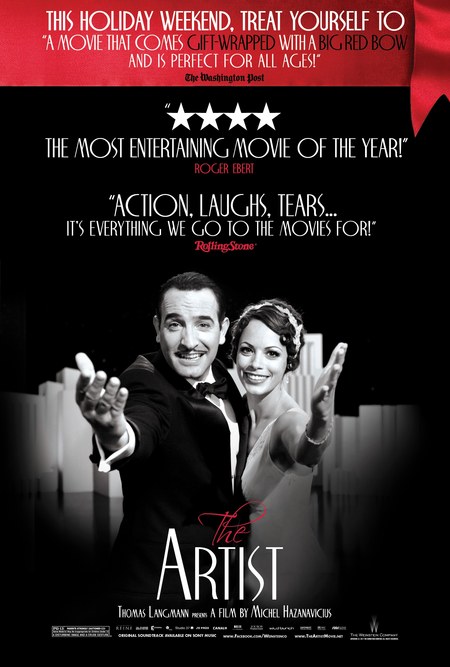
Though the movie industry’s year-end tradition—pummeling moviegoers every winter with “Oscar-worthy” products like some cinematic blizzard of unbearable mawkishness and half-baked messages about human nature—has thankfully come to an end, we’ve reached that unfortunate stretch when the industry congratulates itself by doling out unwarranted accolades. And the film that is getting most of the love (winning a Golden Globe for Best Picture last night) is the one that is the least understood: Michel Hazanavicius’ The Artist. Widely hailed as a feel-good comedy about a silent-movie star’s transition with the help of a good and loving lady into talking pictures, The Artist is actually a far more tragic tale about a once burly, proud, and charismatic man of few—or, rather, no—words who is methodically broken down by the women in his life, mostly by his supposed love interest who wants him to open up and talk. And by the time he finally does express himself, articulating his feelings, he has become a shell of his former (and better) self. In turn, if the film indeed warrants any accolade, it should be for the Most Emasculating Movie of the Year.

When we are first introduced to the protagonist George Valentin (Jean Dujardin), he is the center of attention, the main man, a huge star of adventure films (think Douglas Fairbanks). The Artist opens at the premiere of his new film, in which he is being tortured so that he will “talk” and divulge important information. But, like the heroic character that he is, he resists the temptation to externalize. Moreover, as The Artist’s striking symbol for all men, he remains mum about what he’s all about, because by opening up and sharing this guarded information, thus revealing what lies within, it also opens up the possibility of losing himself entirely.

In this film-within-a-film, the actor does not give up the information. Instead, with the assistance of his trusted canine companion, in and out of the movies (a constant reminder of the battle between cats and dogs), George saves his co-star played by Constance (Missi Pyle), outwits and outworks his enemies, and finally soars to freedom on the plane he pilots. The character, like the actor, wins on his own terms, and quite handily at that. He makes it look easy, and the audience at the premiere loves him (and the film) for it. They give him a long standing ovation for his performance, which he duly relishes by himself until he begrudgingly allows his co-star to bask in the overwhelming response. But make no mistake: The audience cheers for him, and him alone.

To Read the Rest of the Response