We live in the best of times in which we are able to learn about the world and its incredible diversity of cultures/beings/places/perspectives in a way never historically possible. We live in the worst of times when we are able to isolate ourselves completely from anything different from our own narrow view/conception of the world/reality. The choice is yours!
Christopher Boe on Love and Personal Identity in "Reconstruction"
by Liza Bear Indiewire
Inspired by a Jacques-Henri Lartigue photograph of a woman standing in a room with empty bookcases, Danish director Christoffer Boe's first feature "Reconstruction" fittingly won the prestigious Camera D'or at Cannes in 2003 and a Golden Plaque for Manuel Alberto Claro's luminous wide-screen cinematography. It brings closure to the exploration of themes of love and personal identity begun in three earlier shorts, "Obsession," "Virginity" and "Anxiety."
"They're all about a young male being obsessed by a beautiful woman and then being trapped in his own logic of what love is," says Boe, 30, a passionate still photographer as well as moviemaker. It's that logic which Boe dissects in "Reconstruction."
As its title suggests, Boe uses a fractured narrative and startling visuals to create a haunting rumination on the mysteries of desire (and the consequences of acting them out), rather than a romantic comedy. A kind of triangular square dance, "Reconstruction" sports excellent performances from its leads, with Nikolaj Lie Kaas playing Alex as a cypher and Maria Bonnevie doubling up as both Alex's steady girl-friend Simone and his new flame Aimee. It doesn't help Alex that Aimee is married to older man August (Krister Henriksson), who happens to be a writer. But it does give a few extra twists to the narrative. August is the film's narrator. There are echoes of Francois Ozon's cryptic thriller "Swimming Pool" here, though style and sensibility are poles apart. Having an attractive live-in girl-friend doesn't stop Alex from one day falling for Aimee, August's wife. A narrator who's also a character in the film naturally raises questions about what's real and what's imaginary. But then, so does being in love. The next day, Alex's world has changed, literally. His apartment has disappeared and so have his friends. An existential conundrum? Maybe. Or rather an attempt to create a metaphor for the paradigm shift that love induces.
Monsters Inc., Moslems, Inc.: The Uses of Disenchantment in the film that is set after but made before Monsters University.
by Snodgrass Metaphilm
We know that children’s films can be tools for introducing the unpleasant realities of the adult world. Witness Chicken Run, a claymation film from the creators of Wallace and Gromit, in which the World War Two story of the Jews’ imprisonment, forced labor, and then systematic destruction is told through a parallel tale of chickens’ forced imprisonment, mandatory egg laying, and then systematic destruction when the egg farm converts to a chicken pot-pie factory. It is all right there, right down to the propagandistic American hero, whose heroics are in fact very chicken-hawkish, much the way the reality of Nazi Germany’s defeat was thanks more to the Russians than the good ole U.S. of A. So if children’s cinema can be used to explain harsh political realities from a past that the children are currently unaware of but which still retains currency in living cultural memory, how far-fetched is it to imagine that a film could describe harsh political realities while they were happening, so as to soothe the psychic feathers of children as they are experiencing them? Especially if those children are, in fact, the necessary voters and taxpayers your system is going to need to sustain the fictional fantasy by which you run global politics.
The Phantom Archivist and The Phantom Archives: The Amateur Online Archive of Brian De Palma's Phantom of the Paradise (1974)
by Roger Leatherwood Bright Lights Film Journal
1. WHO CARES ABOUT NOSTALGIA ANYMORE?
Personal Archives in the Absence of a Corporate One
Prior to about 1980, Hollywood seemed perversely uninterested in its own history, inadvertently or intentionally neglecting its production materials (not to mention old film elements) that often were left rotting behind studio vault walls and taking up valuable real estate and given away or maybe dumped in the bay some foggy night. Since the advent of home video and the ever-increasing value of catalog titles, new digital (expensive to license, cheap to deliver) formats and the promise of the long tail, studios have increasingly strived to make their films and TV shows available to as wide an audience as possible for as long as possible, including offering merchandise that depicts the characters, graphics, and designs on any and all appropriate items from toys to smartphone cases. This constant upkeep of the presence of the brand of a filmed property in the culture keeps it in the public's memory, perhaps motivating sequels, spin-offs, and other ancillary revenue. And all this has to be archived and kept careful track of.
In some rare instances, producers have maintained archives, private or set up as museum spaces to display props, costumes, and other ephemera.1 But examples of industrial archival curation are sparse, and while the films themselves may enjoy an afterlife in repertory houses or at museum screenings, physical archives are seldom open and, unless they involve Stanley Kubrick or some other storied career, don't go on the road.2
Legacy production materials of motion pictures from draft scripts to set designs to production stills not intended for the public eye often end up forgotten, if they aren't purloined from under the noses of archivists who never notice them missing. The majority of productions dating from before the 1980s suffer from almost nonexistent archival profiles, and have no cultural presence. As a result they remain invisible to cultural memory. In the absence of digital or other marketing engagements now common to recent cross-platform franchise properties, marketing ephemera surrounding the releases ("collateral" to use the marketing term) gets fetishized as the proxy for favorite films, and authentic original posters for such films as King Kong (1933) to Star Wars (1977) go for thousands of dollars on auction sites,3 signifiers of the original and authentic industrial marketing impulse and of the cultural moment in which these were the only legitimate proxy outside of actual viewership.
Ari Kahan's website devoted to Phantom of the Paradise (1974), The Swan Archives (www.swanarchives.org),4 has curated a collection of marketing materials that reanimates the era of this forgotten film's release. Launched in 2006 with the results of 30 years of collecting posters, stills, and other materials, the site functions not only as a resource for the film's fan community but also as its only surviving archive that creates and even defines a new audience for the film. Made up of over 400 pictures of objects, screengrabs, and detailed narratives of the film's genesis, production, marketing, and editing variants adding up to over 75,000 words, as explications of the film's themes, subtexts, and historical context it presents a comprehensive, exhaustive, and passionately rendered archive of the history and reception of the film and a film of its type in the mid-'70s cultural landscape, all in the absence of any attempts by the corporate rightsholders to do so.
2. RECORDING LIVE FOR THE SWAN ARCHIVES
Objects, Their Meanings, and the Importance of Timing
Working online, within view but beyond the traditional reach of normal gatekeepers of intellectual property, Kahan illustrates a new mode of archival behavior and engagement possible in digital environments that revivifies obsolete (in this case, intellectual) property and curates and recontextualizes it. At the same time, Kahan's efforts reflect a rather conservative and closed approach to how an archive is built and functions, in large part by taking pains to protect the assets from promiscuous sharing as well as the context in which they're viewed. By dint of his existence in a landscape that is relatively unexplored, Kahan engages the tension between how audiences and corporate rightsholders control, negotiate, and create new meanings surrounding their properties. His site allows audiences to engage with artifacts outside traditional archival walls; investigates how archival activity affects digital, personal, and other casual engagements with film texts; and points the way in which such sites create new narratives around the texts themselves.
Phantom of the Paradise, written and directed by Brian De Palma and starring Paul Williams, William Finley, and Jessica Harper, was released by 20th Century-Fox in 1974. Appearing amid the rich cultural tapestry that also included The Godfather Part II, Chinatown, The Towering Inferno, and The Texas Chainsaw Massacre, it was largely unsuccessful in finding a wide audience and was relegated to relative obscurity on the second half of double bills before being remarketed to secondary markets with a revamped ad campaign six months later.
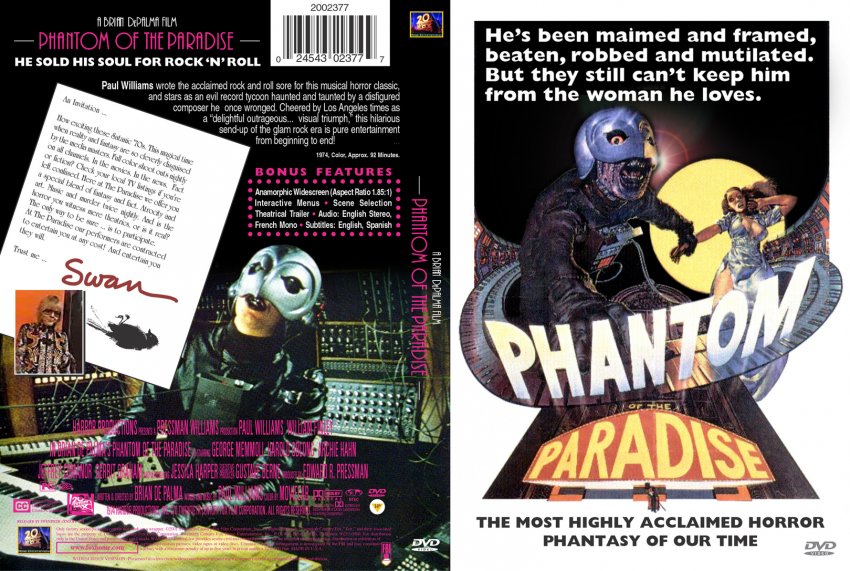
A quirky, stylized, and fleet-footed if unwieldy blend of horror and fantasy taking place in a rock-and-roll setting, Phantom of the Paradise attracted the attention of horror film and science fiction fans rather than a teenage rock music audience. Its plot borrows predominantly from the 1943 and 1962 film versions of Gaston Leroux's The Phantom of the Opera5 as well as the German legend of Faust (the music mogul Swan played by Williams sells his soul for success). By virtue of its pop sensibilities, its fanciful critique of corporate greed, and its stylized filmmaking techniques (a harbinger of the Grand Guignol style Brian De Palma would develop to greater effect in Carrie [1976] and Scarface [1983]), the film slowly built a cult following. As a meta-narrative about popular music as well as a satire of celebrity culture that parodies the very elements that audiences might enjoy about it (flashy rock production numbers, fan worship), the film likely alienated the audiences it expected to attract, until a revised ad campaign repositioned the film as a horror/thriller as opposed to a musical (the Style C poster tagline is "He's been maimed and framed, beaten, robbed, and mutilated. But they still can't keep him from the woman he loves"). Moderately more successful, it attracted enough attention to be written up in various science fiction and film magazines.
"I remember my own childhood vividly ... I knew terrible things. But I knew I mustn't let adults know I knew. It would scare them." -- Maurice Sendak in conversation with Art Spiegelman, The New Yorker (September 27, 1993)
Accord, Lance. "Where The Wild Things Are, Part 1."American Cinematographer (February 2010) ["Lance Acord, ASC, cinematographer of Spike Jonze’ adaptation of Maurice Sendak’s Where the Wild Things Are, discusses the creative underpinnings of this film and the techniques he used to tackle its artistic challenges with fellow ASC member Rodney Taylor."] ---. "Where The Wild Things Are, Part 2."American Cinematographer (February 2010) ["Lance Acord ... continues his conversation with fellow ASC member Rodney Taylor, focusing on his career and the art scene in Los Angeles and San Francisco in the 80s."]
Sicinski, Michael. "25 Songs of Innocence & Experience: Spike Jonze, Wes Anderson and the Post-Boomer."Cinema Scope #41 (2009)
"An examination of some questionable events and circumstances leading up to the destruction of the Death Star, through the eyes of an amateur investigative journalist within the Star Wars galaxy. The focus is mainly on the connections between the people who created and operated the Death Star and those responsible for destroying it. For those who don't care for the obvious, this is a satirical spoof of the 9/11 truther video Loose Change."
'Django' an unsettling experience for many blacks
by Erin Aubry Kaplan LA Times
Quentin Tarantino's slave-era spaghetti western has some questioning the propriety of using a still-festering period of U.S. history as a platform for a bloody, profanely comic pop entertainment.
Tracey White's initial impression of "Django Unchained," Quentin Tarantino's new slave-era shoot-'em-up extravaganza, could be summed up in three words: smart, funny and ugly. Sitting through a recent screening in Beverly Hills, the L.A. costume designer was mostly absorbed and found herself laughing aloud at particularly outrageous moments.
But White, who is black, said her feelings evolved significantly. Two days after reflecting on the matter of slavery and Tarantino's treatment, she pronounced the movie mostly ugly.
"He [Tarantino] gets a good product out of it in terms of wit and a visual look," said White. "But when it was over I found myself wondering, 'What is he trying to do?' I enjoyed the movie when I was in there, but I still have a problem with Tarantino when he deals with our race."
White will certainly not be alone among African Americans in her ambivalence about the gleefully outrageous film. While "Django" has nabbed almost uniformly warm reviews and four NAACP Image Award nominations (including for best picture), the fact is that it is an extremely Hollywood-ized vision of a critical black American experience.
Some blacks are already calling the revenge-fantasy movie, especially its graphic and highly stylized violence, insensitive, exploitative and ahistorical. Filmmaker Spike Lee, a longtime critic of Tarantino, said this month that he refuses to see the movie, and calls his spaghetti-western approach to slave history "disrespectful."
Many moviegoers will know something of what they're getting into. Violence and the liberal use of black idioms and so-called urban culture are Tarantino hallmarks, notably in early films such as "Pulp Fiction" and "Jackie Brown," and they've always stirred controversy. But this movie is different because it mines slavery, the complicated source material for so much black culture and fountain of violence in American history.
It is an institution whose horrors need no exaggerating, yet "Django" does exactly that, either to enlighten or entertain. A white director slinging around the n-word in a homage to '70s blaxploitation à la "Jackie Brown" is one thing, but the same director turning the savageness of slavery into pulp fiction is quite another.
Harsh Realms: 5 cinematographers contribute to the new season of HBO’s fantasy-adventure series Game of Thrones.
by Michael Goldman American Cinematographer
HBO’s series Game of Thrones documents the political, military and emotional entanglements between rival ancient kingdoms on a fictional continent. As such, it’s a period piece, a fantasy piece, an ensemble piece and a production that relies heavily on location, design and camerawork to pull off the illusion. The show is so big that it has required the efforts of multiple cinematographers; three shot season one, and five shot season two, which began airing last month.
After the production of its pilot, which involved some film capture, Game of Thrones evolved into the first hour-long HBO drama to be shot digitally. Every episode has been shot with Arri’s Alexa, and the cinematography team has relied on a state-of-the-art, data-centric workflow to shoot, process and assess imagery as the show traveled the globe from its home base in Northern Ireland to locations such as Malta, Croatia and Iceland.
“We were well into prep on season one [in the summer of 2010] before we decided to go with digital capture,” recalls co-producer Greg Spence. “After [cinematographers] Alik Sakharov [ASC] and Marco Pontecorvo [AIC] did three days of tests with 35mm, the Sony F35 and the Alexa, we chose the Alexa. Alik and Marco were impressed with its dynamic range and resolution, particularly in the highlights, and they felt it would pick up our costumes and textures nicely.”
For the show’s second season, the production switched to a file-based workflow. Footage was captured to Codex data recorders and taken to the dailies colorist and editors in the cutting room in Belfast, where most of the show was shot. (Season one was captured to HDCam-SR tape, and digital-imaging technicians did color correction on set.)
“We’ve had multiple cinematographers and DITs handling multiple units in different countries, so in season one we sometimes ended up with dailies that had divergent looks, which caused some confusion,” Spence explains. “Therefore, for season two, we brought [dailies colorist] Jon Reid to Belfast to operate alongside editorial at Yellowmoon, the post facility where the picture editors were based. Jon worked closely with our cinematographers during prep and shooting so they could get what they wanted, and we got a consistent look in the dailies.”
This season, Kramer Morgenthau, ASC shot the first two episodes and material featured in several others; P.J. Dillon shot episode three; Martin Kenzie shot episodes four through seven; and Jonathan Freeman, ASC shot episodes eight and ten. A stand-alone episode separate from the other locations (largely because of a major sea battle) became episode nine, shot by Sam McCurdy, BSC. This collection of cinematographers was necessary because extensive portions of the season were shot in Dubrovnik, Croatia, and Vatnajökull, Iceland, and that material was used for multiple episodes.
Therefore, says Morgenthau, the cinematographers did their best to “watch each other’s work and stay true to a cohesive look. No two directors of photography will shoot exactly the same way, but the material was so good, and there was such a consistent vision, that we were able to [maintain] a cohesive thread.” The cinematographers were frequently able to compare notes during prep before embarking on their separate shoots. They also used the Pix System online-dailies platform to view each other’s dailies through a secure connection, making Game of Thrones “a completely interconnected production” across the globe, in Morgenthau’s words.
The recently departed Tony Scott directed this excellent 9 min short film called Beat the Devil and starring (no kidding) James Brown, Clive Owen, Gary Oldman, Danny Trejo and Marilyn Manson. Oh yeah, and the original concept for the story is by director David Fincher (Fight Club):
Jean Vigo: Artist of the floating world
by Graham Fuller Sight and Sound
Jean Vigo’s great work about a pair of troubled newly-weds and the crusty old mate with the Hapsburg jaw and unfettered imagination who travels with them aboard the Normandy freight barge L’Atalante was based on a one-page scenario by Jean Guinée. This was the pen name of Roger de Guichen, who had been intrigued by the sight of a woman helming a barge on the Seine, and had named his fictional vessel after a frigate commanded by one of his ancestors in the Seven Years War. Following the banning of Vigo’s Zéro de conduite in 1933, the director’s supportive producer Jacques-Louis Nounez sent him Guinée’s scenario hoping it would deter him from the kind of radical experimentation that had illuminated Vigo’s scabrous 42-minute satire of boarding-school life.
“What the fuck do you want me to do with this? It’s Sunday-school stuff,” was Vigo’s response when he read the scenario. It was workaday melodrama. Juliette, the young wife, bored with the monotony and domestic drudgery of her life on the barge after the initial erotic charge of her marriage has dwindled, runs away from her conservative husband Jean, the skipper, for an afternoon of window-shopping in Paris, only to find herself stranded when he angrily takes off in the barge. Her handbag is stolen, she’s propositioned, she fears for her survival. The husband languishes, despite the kindly attempts of the mate, le père Jules, to rouse him. In Guinée’s scenario, Juliette is found by the old salt in a church. Penitent, she returns to Jean, confirming she is faithful. But Guinée pessimistically concluded in his synopsis, “Happiness has fled the vessel.”
Despite his reservations, Vigo sensed he could tell the story imaginatively. Nounez struck a deal whereby he would cover the running costs while Gaumont provided studio space, cameras and distribution. Vigo and his co-writer Albert Riéra would eliminate Guinée’s moralising, take advantage of the on-shore plight of Juliette (Dita Parlo) to show the inroads of the Depression and expose the spite of the petit bourgeois mob and the brutality of the police – and use music and magic to bring her home to Jean (Jean Dasté). The genie-like le père Jules (Michel Simon), who discovers her working in a palais de chansons instead of telling her rosary in a church, carries her out on his shoulder, as if she were one of the many cats that cling to him on the barge.
In October 1933, just before shooting, Vigo told a Belgian journalist that he was using Guinée’s scenario “merely as a loose frame allowing me to work with images of the waterways, the environment of the canal-workers, and the actors”. He was as good as his word. The connecting thread of L’Atalante is the realist footage depicting the harsh, unremitting lives of the crew and the waterfront folk as the barge heads to Paris and, minus Juliette, on to Le Havre. Contrasting with the voyage sequences, however, are exquisitely sensual flights into surrealism. Jean, believing an old wives’ tale told him by Juliette in the first days of their marriage, dives into the icy river to seek a glimpse of her underwater, whereupon she is magically superimposed over him in her wedding dress as he swims. (Vigo drew on his 1931 short about a swimming champion, Taris ou la Natation.) Then Jean and Juliette, though miles apart, ‘make love’ by dreaming erotically of each other in parallel scenes, their bodies impressionistically speckled in unifying dots of shadow.
L’Atalante.
The skin we live in: the mad, bad world of Pedro Almodóvar
Remaining spooked and preoccupied, Mhairi Guild still appreciates density and creativity of Almodovar's latest grotesque fairytale of not-only-gender identity, desire and power
We staggered out of Pedro Almodóvar's latest offering somewhat shell-shocked. There is a huge amount to get out of The Skin I Live In but goodness, is it profoundly dark. Generally well received, the film has nonetheless split critics, some seeing it as a fetishistic mess or empty stylistic exercise, others as a stunning horror of the mind. I think that your reception of the film is likely to depend on your prior relationship with Almodóvar and on how willing you are to go on this particular journey with him.
A dark alpha male Antonio Banderas plays the brooding, obsessive surgeon Robert Ledgard, bunkered in a grand Toledo mansion which offers a lush set for his initially unexplained experimentation on the beautiful captive Vera, played by the porcelain doll-like Elena Anaya. The perfection of Vera's flawless, synthetic skin and the charged secret of her relationship with Ledgard is the central riddle of a plot that weaves back and forth between earlier stages of the narrative and gradually takes us down to depths scarcely imaginable at the outset.
Despite not being familiar with Almodóvar's whole canon, his 2002 Talk To Her has long been one of my favourite films. I have also enjoyed - in different ways - All About My Mother (1999), Volver (2006) and some earlier works like 1990 Tie Me Up! Tie Me Down! (his last project with Banderas before the latter's defection to Hollywood).
One of the most striking things about The skin I live in is how it pulls together tropes and preoccupations from a number of the director's past films - being a sort of culmination of Almodóvar's body of work. A few of these themes were particularly resonant as the story developed.
Firstly, in Almodóvar's world there is normally an inherent brutality to the male sexual impulse, and it is present to such an extent that I was already squirming uncomfortably within the first half an hour of the film (little was I to know what Almodóvar had in store for me yet). The representation and frequent victory of this type of male sexuality, which is oft accompanied by casual violence, suggests that it is somehow a 'true' manifestation of male sexuality. Together with a forceful masculine possession of the female body, his male characters often exhibit an unreflective ignorance of the coercion present in their seductions. In the three central male figures in the film we get the full bleak spectrum: the boy (Vicente), the man (Ledgard) and the animal (Veco - the 'Tiger'). In this film Almodóvar more than insinuates the notion that heterosexual sex veers precipitously close to rape -, a particularly pessimistic and troubling theme.
More fundamentally, though, Almodóvar's work seems to suggest an impossibility of meaningful communication between the sexes within a certain society. This chasm between man and woman that can never be truly bridged lies at the centre of Talk To Her, where the one-sided relationship between the young coma patient Alicia and her besotted, delusional nurse Benigno is mirrored by the real relationship between Marco and injured bull-fighter Lydia. Almodóvar's men can only ever desire, fetishise and project onto their relations with women; women, in turn, in the male gaze are literally living dolls whose internal lives may be as real as theirs, but can never be truly apprehended. Women remain, as Simone de Beauvoir suggests, men's eternal 'others': an inherent mystery, in sharp distinction to the knowable Self of the male individual. This communication gap between the sexes - which after all has some undeniable, socialised roots - speaks in Almodóvar's work in dark and sometimes terrifying tones. It presents one of the most compelling and intriguing challenges posed by his films, seemingly portraying a gender dystopia we are prompted to remain ever-vigilant against.
Perfume: the Story of a Murderer: The film adaptation of Patrick Süskind's novel Perfume is a stunning indictment of society's attitude towards women.
by Leanne Bibby The F Word (United Kingdom)
A film about a killer on a mission to murder women and harvest their scents might seem like a rather obvious choice of subject for a feminist review. Nonetheless, there are two reasons why I decided to write this and why I'd like to encourage you to see Tom Tykwer's 2006 adaptation of Patrick Süskind's novel Perfume: the Story of a Murderer. First of all, it's one of the most unusual and inventive films to appear in some time, in cinemas and DVD retailers currently glutted with sequels, prequels, remakes and other somewhat unimaginative fare.
The second reason I think it deserves our attention is its graphic and unflinching yet sophisticated representation of violence towards women. This struck me as having appeared at an ideal time, as debates on this and related issues rage on. Having not read Süskind's original novel, I'm in no position to comment on it and so this review is concerned exclusively with the film.
Ben Whishaw plays Jean-Baptiste Grenouille, an orphan born in 18th century Paris and possessed of a supernatural sense of smell. The film's early scenes, as sensuously fantastical as they are grim, follow him from a childhood of unimaginable poverty and social isolation up to the day his unique talent leads him to become apprentice to struggling perfumer Giuseppe Baldini, played to the hilt by a bewigged Dustin Hoffman. Having already suffocated to death a young woman with whose scent he'd become intoxicated, Grenouille embarks on a quest to create the ultimate perfume by infusing the essences of beautiful women - that is, their scents. To everyone outside his reclusive, amoral world, of course, this is a killing spree and nothing more.
Oblivious to this, Grenouille single-mindedly preys upon women for the "sublime beauty" of their scents. Their lives, personalities and, interestingly, their sexual attractions are inconsequential to him. By way of an omniscient narration, we are made privy to his thoughts and fixations as he commits his shocking acts, but I was intrigued to find that this is only one feature of a multi-layered film experience. The restrained and largely off-camera violence is at the tale's core, but ultimately secondary to our view of the women themselves.
Tykwer's dreamlike storytelling emphasises Grenouille's reveries of smell in the presence of doll-like women with uniformly porcelain skins and shining hair. In doing this, it also shows us a culture that holds women to be just that: dolls. Lovely, guileless and almost voiceless, they appear doomed to slip into the death-destiny planned for them and remain largely unchanged afterwards: their physical appeal - the only valued part of them - captured in scent.