Showing posts with label Power. Show all posts

Tuesday, September 3, 2013

Films We Want To See #33: Under the Skin (UK: Jonathan Glazer, 2013)


I read Michael Faber's mind blowing novel Under the Skin in 2002 while traveling through Europe -- it has always stayed with me (and definitely changed the way I perceive the world). I have just found out that Jonathan Glazer has made a film loosely adapted from the novel. This is one of those stories it is best to not know to much about the plot. I didn't when I read the book because I picked it up on impulse in a London bookstore:

Monday, April 8, 2013

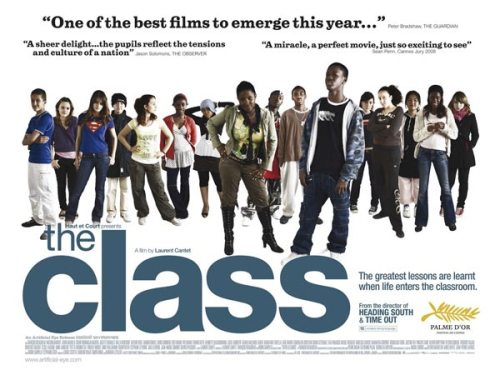
The Class (France: Laurent Cantent, 2008)


The Class (France: Laurent Cantent, 2008: 128 mins)

Ashbury, Roy. "Schools and Teachers." Understanding Representation. ed. Wendy Helsby. London: BFI, 2005: 51-74. [Available in BCTC library PN1995 U4977 2005]

Chen, Lu. "I Hate Mathematics and Racists." The Brooklyn Rail (March 2009)

Livingston, Jessica. "Global capital’s false choices in the films of Laurent Cantet." Jump Cut #53 (Summer 2012)

Sunday, March 3, 2013

David Simon on The Wire (2002-2008)


Instead of the usual good-guys-chasing-bad-guys framework, questions would be raised about the very labels of good and bad, and, indeed, whether such distinctly moral notions were really the point. The show would instead be about untethered capitalism run amok, about how power and money actually root themselves in a postmodern American city, and, ultimately, about why we as an urban people are no longer able to solve our problems or heal our wounds. (36)

The Wire depicts a world in which capital has triumphed completely, labor has been marginalized and monied interests have purchased enough political infrastructure to prevent reform. It is a world in which the rules and values of the free market and maximized profit have been mistaken for a social framework, a world where institutions themselves are paramount and every day human beings matter less. (36)

But instead of the old gods, The Wire is a Greek Tragedy in which the postmodern institutions are the Olympian forces. It's the police department, or the drug economy, or the political structures, or the school administration, or the macroeconomic forces that are throwing the lightning bolts and hitting people in the ass for no decent reason. (37)

David Simon, quoted in Watson, Garry. "The Literary Critic, the Nineteenth Century Novel and The Wire." Cineaction #84 (2011): 32-40.

Saturday, July 21, 2012

Robert Farrow: The Wicker Man -- Games of truth, anthropology, and the death of ‘man’

The Wicker Man: Games of truth, anthropology, and the death of ‘man’
by Robert Farrow
Metaphilm


The Wicker Man, a cult classic of 1970s British cinema, portrays the investigation of an authoritarian police officer (played by Edward Woodward) into the mysterious disappearance of a young girl in the remote Scottish island of Summerisle. It becomes apparent that the islanders observe various ancient pagan traditions, and Sgt. Howie—a committed Christian—becomes increasingly suspicious of them. Eventually, he comes to suspect that she is somewhere imprisoned, earmarked as a human sacrifice for the Mayday festival of Beltane.

As the mystery unfolds, Howie comes to realizes the awful truth: the missing girl was a mystery fabricated in order to lure him to Summerisle, and it is in fact he who is to be burnt alive in the Wicker Man as an offering to the renewed cult of the old gods. This sinister ending has ensured this film a place in the annals of horror despite its divergence from the tropes of most horror films of the 1970s. The Wicker Man presents no bogeymen, no vampires, and no sinister music; its ending is all the more shocking, in fact, for the twee charm of the villagers and the folk-music score, which lead the audience into a false state of complacency that mirrors Sgt. Howie’s own vulnerability. And in a further departure from other examples of the genre, the antagonists are in no way demonized.

So, if The Wicker Man breaks so many of the genre rules, why is it such an unsettling film? One answer is illuminated by the complex matrices of truth, power, and knowledge made familiar by the French historian and philosopher, Michel Foucault: The Wicker Man presents us with an alarm call to wake us from “anthropological sleep,” and to tear down and burn our own false conceptions of “man.”

Foucault, a noted critic of the social sciences, rejected all positive notions of objectivity and human nature. For Foucault, we exist trapped within a kind of postmodern labyrinth (or “archive”), where truths are relative to the societies and practices that develop them. This is not a facile cultural relativism. Instead, we are invited to understand truths as problematized, colored by the contexts and subjects that produce them. The power structures that (so to speak) restrain us are also what makes our freedom possible, conditioning our thought at a collective, unconscious level.

Foucault’s own diagnosis of the present took the form of investigations into (often obscure) historical documents that aimed at exposing the implicit “truths” that underlie social practices and norms, thereby supporting his position as a thinker of social and historical relativity. As his work developed, it became clear that the driving force behind his work was an interest in how senses of identity are formed when the self is essentially a product of certain power/knowledge relationships, discourses, and games of truth.

Foucault’s early works—and The Wicker Man—offer this message: identity is best understood as an amorphous, shifting fiction, an “anthropology” that is to be exposed. When the full import of this becomes understood, the effect is rather more unsettling than the fraternity gorefests that typify many later horror films.

To Read the Rest of the Essay

Thursday, February 2, 2012

Amy E. Borden: At the global market -- Ousmane Sembène’s Moolaadé and the economics of women’s rights

At the global market: Ousmane Sembène’s Moolaadé and the economics of women’s rights
by Amy E. Borden
Jump Cut


In Moolaadé Sembène considers how women may effect change in their communities and families if given access to the economic and cultural power that had in previous generations been reserved for men. Focusing on both Moolaadé’s narrative and its funding history, I argue that Sembène uses a narrative form that features the development from individual activist to collective force to depict the potentially liberating force of internationally defined human rights in a West African context when used by local activists. His depiction of women as collective and individual forces for change touches on questions of the libratory potential of capitalism and media as modernizing forces for a contemporary generation of African community leaders.

The depiction of modern activism within the Islamic, West African community depicted in the film is presented diegetically via the narrative construction of the film’s main character, Collé, played by renowned Malian women’s rights activist, Fatoumata Coulibaly. Collé is constructed as an individual whose personal experiences offer an interiorized psychological depiction and history of a woman now advocating for cultural change; she uses her personal experiences to change community practice and belief. In the script, Collé’s ability to assert her personal experiences and values within the community may best be understood as a staging of the drama of human rights activism. In some ways, the character exemplifies ways in which contemporary human rights declarations and proclamations issued by, for example, the United Nations; additional NGOs, such as Tostan — a Senegalese women’s rights NGO; and various African continental human rights treaties, such as the African Banjul Charter, may be translated into local action on the part of activists and grass-roots campaigns aimed at ending FGC, and, by extension, advance West African women’s rights.[10]

J. Hoberman describes the film as “diagrammatic” in its approach to women’s rights in a review prior to the film’s New York theatrical run (“Auteurs”). He particularly cites the rousing rally staged in front of the community’s male elders at the end of the film where the majority of the village women adopt Collé’s position against genital cutting. The rally is staged and shot as a public performance; it mimics events sponsored by anti-FGC NGO Tostan, which has held rallies celebrating the decision by local women to end FGC in communities throughout Senegal.[11] In the scene’s staging, the village elders occupy one third of the on-screen space, the pro-Collé supporters another third, and the salindana occupy the final third, eventually joining the community’s women creating a division between the sexes in the blocking of the sequence. The lesson of this rally is bolstered by a mother, Salba, who holds her infant godchild in the air while chanting alongside the other village women that this girl will not be “cut,” that no girls will ever be “cut” again.

In addition to the film’s conclusion, Hoberman is perhaps more correct in his reading than he imagined. As I will argue, the plot of Sembène’s final feature film strongly resonates with articles inscribed in the 1948 United Nations Universal Declaration of Human Rights as well as the 1980 establishment and 1993 strengthening of provisions for the rights of women in the UN the Convention on the Elimination of Discrimination Against Women (CEDAW).[12] The entire premise of the film — the right of protection or moolaadé — is specifically covered in the UN Universal Human Rights Declaration as the right of seeking and enjoying in other countries “asylum from persecution.”[13] If one accepts the film’s central thesis that ritual “purification” is a form of persecution, Collé is justified in creating a free space beyond the rules confining conduct in the village (Moolaadé). The sanctuary she creates via the moolaadé is akin to a nation-state with its distinct but permeable boundary — members of the community may move between it and the village at large. They may not, however, remove the young girls who have sought sanctuary from the space without Collé’s permission. Much like a sovereign authority, it is only Collé’s “word” that may release the girls from their protected space (Moolaadé). Additionally, the space Collé creates emerges from a historical tradition understood as juridical within the village because of its ability to punish or allow clemency. This tradition is substantiated in the community via the cultural memory marked in the village by the termite mound.

Sembène’s career-long critique of nation as a corrupted patriarchal institution that denies equal rights to women complicates the idea that a sovereign space akin to a nation-state may provide safety. The fact, then, that this asylum is enacted by and controlled by Collé, a woman, is significant because it asserts the ability of women to claim sovereign power from local, cultural traditions. Collé’s ability to provide asylum and to assert that ability within the community may be seen as a performance of the provision in the UN human rights’ declaration that states, “Everyone has the right freely to participate in the cultural life of the community” and guarantees “the right to…security of person.”[14] The fact that both the men and women of the community respect the sanctity of the moolaadé regardless of the gender of its enactor points to local cultural traditions on which activists may build in the pursuit of women’s rights.

Anthropologist Ellen Gruenbaum describes how asylum has become an effective means for women to remain in first world countries — “Canada, Australia, Sweden, and others” to avoid FGC in their home nation.[15] It is an increasingly useful tool for women to gain protection for themselves and for parents to gain protection for their female children. While limited, the practice has received a lot of press coverage, particularly following Togo citizen Fauziya Kassindja’s and Ghanian citizen Adelaide Abankwah’s applications for US asylum in the late-1990s and Malian Aminata Diop’s application for asylum in France in the early-1990s.[16] Citing the increased recognition of cultural practices as a basis for asylum, Gruenbaum argues,

“The use of asylum provisions for cultural, rather than strictly political, risks is a remarkable development, giving new stature to the human rights of women and children to be protected from the effects of their social and economic disempowerment. The basis for such claims to asylum is the 1951 UN Refugee Convention, on the grounds that these women would be at risk of grievous harm in the forms of FGM [female genital mutilation] if they were to return home.” (217)

By enacting a local cultural custom to create an asylum within the community, Collé effectively relocates an international anti-FGC human rights tool at the local level. This staging allows Sembène to provide an argument for local change that does not draw directly on the authority of the laws of other nations, as is the case with the asylum cases mentioned previously, nor directly on international conventions, such as the UN Refugee Convention Gruenbaum cites. Sembène’s use of asylum as a juridical form of protection indirectly draws from the discourse surrounding international efforts to end FGC, yet forcefully argues for local, community-driven actions.

To Read the Rest of the Essay

Sunday, December 18, 2011

Greg Tate: Fight for rights, will to power -- The Black Power Mixtape 1967-1975

Fight for rights, will to power: The Black Power Mixtape 1967-1975
by Greg Tate
Sight and Sound (British Film Institute)


...

The Black Power Mixtape Remixed 1967-1975 is an exotic document of this turbulent, extremely violent transitional moment in American race history. Exotic because it’s the culmination of the near-decade an intrepid Swedish TV news team spent interviewing prominent Black American radicals of the day – Stokley Carmichael, Huey Newton, Bobby Seale, Eldridge Cleaver, Elaine Brown and Angela Davis. All were dramatic, eloquent, charismatic figures of their time who, except for the still-active Davis, are today hardly household names to the average black American under 40.

Like Jimi Hendrix or Bob Dylan, they all seem incredibly well-prepared in their mid 20s to set the world aflame intellectually and dominate the media – but far less prepared than the Viet Cong or Fidel Castro to withstand the withering, brute and constitutionally illegal attacks directed at them and theirs by the US government, especially the FBI’s fascistic overlord J Edgar Hoover.

Time has not diminished their critiques of American power or racism, nor their undeniable star power – any of them and their radical histories could easily sustain a documentary or narrative feature film of its own. Mixtape captures most of them in the short period before they would be tried, convicted or exiled by Hoover’s stated and manically implemented obsession with preventing the “rise of another black prophet” after King.

The footage of Carmichael and Davis is the most poignant and illuminating. Though the film doesn’t say so, it was Carmichael who brought the phrase ‘Black Power’ into vogue, famously goading King to give it airtime near the end of the two-week-long march to Selma, Alabama. The film demands that those who don’t know these figures investigate them afterwards for more background and context. On film the jocular Carmichael proves so at ease in his own skin that he could have given Sidney Poitier competition as a leading man, and challenged Bob Marley as a lyrical protest balladeer.

Carmichael invites himself to take over an interview the news crew had wrangled with his mother in the Chicago-projects apartment in which he was raised. He then patiently extracts from her the pained admission that his Trinidadian immigrant father, a skilled carpenter, was a lifelong victim of employment discrimination.

As noted by progressive hip-hop MC Talib Kweli in his voiceover, Carmichael emerges here as a “regular guy” who also happened to be a incendiary and mesmerising speaker – one still so provocative that Kweli recalls being accosted by FBI and TSA agents at an airport after 9/11 for merely listening to a 40-year-old Carmichael speech. Some may take Kweli’s intimation of wiretaps as conspiratorial and apocryphal, but no-one familiar with Hoover’s paranoia and surveillance of black progressives will be among them. (The biggest laugh in the film comes from Hoover’s claim that the most dangerous threat to the internal security of the United States was the Black Panther party’s free breakfast program. But Hoover was not joking.)

The progress of the film is also a tacit record of the Panther’s off-screen dismantling by Nixon and Hoover’s COINTELPRO conspiracy against black leadership. The Panther’s demise by exile, imprisonment and judicial malfeasance is presented at a glance, but the Panthers expended all their political capital on the campaigns to Free Huey Newton, Bobby Seale and Angela Davis.

Davis’s prison interview here offers the most astute and moving rationale for extreme black retaliation to American racial extremists. When asked to justify the advocacy of black violence, Davis recalls her childhood experience of her Birmingham, Alabama community being routinely bombed by Klansmen at the behest of notorious county sheriff Bull Connor. Davis recalls this motherfucker using local radio to promote and direct such violence on a weekly basis. The extreme close-up of her angry, watering eyes when she speaks of the discovery of four classmates’ body parts after the infamous 1963 Birmingham church bombing provides all the justification for retribution any rational person should need.

To Read the Rest of the Commentary

Mhairi Guild: The Skin We Live In -- The Mad, Bad World of Pedro Almodóvar

The skin we live in: the mad, bad world of Pedro Almodóvar

Remaining spooked and preoccupied, Mhairi Guild still appreciates density and creativity of Almodovar's latest grotesque fairytale of not-only-gender identity, desire and power

by Mhairi Guild
The F Word


We staggered out of Pedro Almodóvar's latest offering somewhat shell-shocked. There is a huge amount to get out of The Skin I Live In but goodness, is it profoundly dark. Generally well received, the film has nonetheless split critics, some seeing it as a fetishistic mess or empty stylistic exercise, others as a stunning horror of the mind. I think that your reception of the film is likely to depend on your prior relationship with Almodóvar and on how willing you are to go on this particular journey with him.

A dark alpha male Antonio Banderas plays the brooding, obsessive surgeon Robert Ledgard, bunkered in a grand Toledo mansion which offers a lush set for his initially unexplained experimentation on the beautiful captive Vera, played by the porcelain doll-like Elena Anaya. The perfection of Vera's flawless, synthetic skin and the charged secret of her relationship with Ledgard is the central riddle of a plot that weaves back and forth between earlier stages of the narrative and gradually takes us down to depths scarcely imaginable at the outset.

Despite not being familiar with Almodóvar's whole canon, his 2002 Talk To Her has long been one of my favourite films. I have also enjoyed - in different ways - All About My Mother (1999), Volver (2006) and some earlier works like 1990 Tie Me Up! Tie Me Down! (his last project with Banderas before the latter's defection to Hollywood).

One of the most striking things about The skin I live in is how it pulls together tropes and preoccupations from a number of the director's past films - being a sort of culmination of Almodóvar's body of work. A few of these themes were particularly resonant as the story developed.

Firstly, in Almodóvar's world there is normally an inherent brutality to the male sexual impulse, and it is present to such an extent that I was already squirming uncomfortably within the first half an hour of the film (little was I to know what Almodóvar had in store for me yet). The representation and frequent victory of this type of male sexuality, which is oft accompanied by casual violence, suggests that it is somehow a 'true' manifestation of male sexuality. Together with a forceful masculine possession of the female body, his male characters often exhibit an unreflective ignorance of the coercion present in their seductions. In the three central male figures in the film we get the full bleak spectrum: the boy (Vicente), the man (Ledgard) and the animal (Veco - the 'Tiger'). In this film Almodóvar more than insinuates the notion that heterosexual sex veers precipitously close to rape -, a particularly pessimistic and troubling theme.

More fundamentally, though, Almodóvar's work seems to suggest an impossibility of meaningful communication between the sexes within a certain society. This chasm between man and woman that can never be truly bridged lies at the centre of Talk To Her, where the one-sided relationship between the young coma patient Alicia and her besotted, delusional nurse Benigno is mirrored by the real relationship between Marco and injured bull-fighter Lydia. Almodóvar's men can only ever desire, fetishise and project onto their relations with women; women, in turn, in the male gaze are literally living dolls whose internal lives may be as real as theirs, but can never be truly apprehended. Women remain, as Simone de Beauvoir suggests, men's eternal 'others': an inherent mystery, in sharp distinction to the knowable Self of the male individual. This communication gap between the sexes - which after all has some undeniable, socialised roots - speaks in Almodóvar's work in dark and sometimes terrifying tones. It presents one of the most compelling and intriguing challenges posed by his films, seemingly portraying a gender dystopia we are prompted to remain ever-vigilant against.

To Read the Rest of the Essay