Showing posts with label Horror. Show all posts
Showing posts with label Horror. Show all posts
Wednesday, October 30, 2013

The American Nightmare (USA/UK: Adam Simon, 2000: 73 mins)
I just found the documentary "The American Nightmare" for a student writing about horror films -- highly recommended look at the epic changes in the genre in the early 70s.
Thursday, October 24, 2013
Cemetery Man (Italy/France/Germany: Michele Soavi, 1994)

Cemetery Man (Italy/France/Germany: Michele Soavi, 1994: 105 mins)
The excellently named Francesco Dellamorte (Rupert Everett, never better) is the moody caretaker of a small-town Italian cemetery where the dead just keep coming back to life, much to his annoyance. His everyday tedium of reading phone books and killing zombies is broken when he falls madly in love with a nameless beautiful widow. Unfortunately, she too perishes and returns as a zombie. A strange and entertaining erotic-horror-comedy, Cemetery Man (titled Dellamorte Dellamore in Italian) is required viewing for anyone of the sadboi persuasion. – Anna BogutskayaDumas, Andre. "Cemetery Man: By Keeping Things the Same, We Can Change More Effectively." Horror Digest (March 30, 2011)
Kuersten, Erich. "The Shrouds of Soavi: Cemetery Man, The Devil's Daughter." Acidemic (September 8, 2016)
Seda, Alex. "Dellamorte Dellamore (a.k.a. Cemetery Man) Review." Midnight Showing (July 10, 2009)
"TGIF #5: CEMETERY MAN (aka DELLAMORTE DELLAMORE)" Adamantium Bullet (July 24, 2009)
Thursday, September 26, 2013
Sean Smithson: We Are What We Are, Tastefully Macabre
WE ARE WHAT WE ARE, Tastefully Macabre
by Sean Smithson
Twitch

Let's get this out of the way right off the bat: We Are What We Are is not a remake. Differing greatly from the original Jorge Michel Grau Spanish-language version, the creative team of Jim Mickle (writer/director) and Nick Damici (writer/co-star) have taken the original concept of ritual cannibalism and inverted it, switching almost every trope in the initial version, and spinning it into something completely their own.
In this Americanized take, Iris and Rose Parker (Ambyr Childers and Julia Garner) are two young girls living in a rural community who have recently lost their mother, and are now left to tend to the needs of their little brother Rory, and ailing father Frank (Jack Gore and Bill Sage). Stand-offish and a mystery to the local citizens, the Parkers have kept to themselves, labelled strange, eccentric, and a bit fanatical by their neighbors and fellow townsfolk. As an on-going storm rages, causing flooding and immobility, slowly the long standing mystery of a number of disappearances in the area begins to unravel.
A local coroner, Doc Barrow (played by scene stealer extraordinaire Michael Parks), whose daughter had gone missing the season before, slowly begins to suspect the anti-social Parker family of being involved, and tells the local sheriff (Nick Damici) of his feelings. Young Deputy Anders (Wyatt Russell, son of Kurt) meanwhile has an infatuation with the beautiful Iris, who obviously wants to return his affections but keeps her suitor at a distance because of her duty to her family. When a human finger bone is discovered, evidence starts pointing to foul play in the small community, and the tourniquet on the Parkers slowly tightens, as dark secrets (and worse) are threatened to be revealed. Plot elements are deftly juggled by Mickle, as the storm worsens, the clues amass, and tensions mount.
The raging storm brings flood waters that threaten to literally dig up long-buried secrets. Caught in the spiral is caring neighbor Marge (Kelly McGillis) a bit of an old maid who has taken to watching over the girls and their little brother, and helping them through the trial of losing their mother. Let me say here, it's so great to see McGillis become a Mickle cast regular, this being her second film with him, and proves that real screen talent elevates material (which the genre sorely needs right now).
This is a horror movie, so it goes without saying, things don't end well for many of the characters in We Are What We Are. Thankfully, director Mickle never goes for the cheap shot or easy gore, instead methodically building a tale of a family in pain and turmoil, who happen to have some very strange practices and ideas of what worship is.
The most overt change is the family structure being shifted from young teenaged boys, a little sister, and a mother trying to keep things together (as in the original) to a literal "flip," where now we have a widowed father, his two young daughters on the verge of womanhood, and their little brother. It seems a bit literal on paper, but in the context of Mickle's vision it's actually a revelation. Changing the setting from a city to a small almost Norman Rockwell-esque Any Town, America strengthens the backstory and brings it all "home," so to speak.
To Read the Rest of the Review
by Sean Smithson
Twitch
Let's get this out of the way right off the bat: We Are What We Are is not a remake. Differing greatly from the original Jorge Michel Grau Spanish-language version, the creative team of Jim Mickle (writer/director) and Nick Damici (writer/co-star) have taken the original concept of ritual cannibalism and inverted it, switching almost every trope in the initial version, and spinning it into something completely their own.
In this Americanized take, Iris and Rose Parker (Ambyr Childers and Julia Garner) are two young girls living in a rural community who have recently lost their mother, and are now left to tend to the needs of their little brother Rory, and ailing father Frank (Jack Gore and Bill Sage). Stand-offish and a mystery to the local citizens, the Parkers have kept to themselves, labelled strange, eccentric, and a bit fanatical by their neighbors and fellow townsfolk. As an on-going storm rages, causing flooding and immobility, slowly the long standing mystery of a number of disappearances in the area begins to unravel.
A local coroner, Doc Barrow (played by scene stealer extraordinaire Michael Parks), whose daughter had gone missing the season before, slowly begins to suspect the anti-social Parker family of being involved, and tells the local sheriff (Nick Damici) of his feelings. Young Deputy Anders (Wyatt Russell, son of Kurt) meanwhile has an infatuation with the beautiful Iris, who obviously wants to return his affections but keeps her suitor at a distance because of her duty to her family. When a human finger bone is discovered, evidence starts pointing to foul play in the small community, and the tourniquet on the Parkers slowly tightens, as dark secrets (and worse) are threatened to be revealed. Plot elements are deftly juggled by Mickle, as the storm worsens, the clues amass, and tensions mount.
The raging storm brings flood waters that threaten to literally dig up long-buried secrets. Caught in the spiral is caring neighbor Marge (Kelly McGillis) a bit of an old maid who has taken to watching over the girls and their little brother, and helping them through the trial of losing their mother. Let me say here, it's so great to see McGillis become a Mickle cast regular, this being her second film with him, and proves that real screen talent elevates material (which the genre sorely needs right now).
This is a horror movie, so it goes without saying, things don't end well for many of the characters in We Are What We Are. Thankfully, director Mickle never goes for the cheap shot or easy gore, instead methodically building a tale of a family in pain and turmoil, who happen to have some very strange practices and ideas of what worship is.
The most overt change is the family structure being shifted from young teenaged boys, a little sister, and a mother trying to keep things together (as in the original) to a literal "flip," where now we have a widowed father, his two young daughters on the verge of womanhood, and their little brother. It seems a bit literal on paper, but in the context of Mickle's vision it's actually a revelation. Changing the setting from a city to a small almost Norman Rockwell-esque Any Town, America strengthens the backstory and brings it all "home," so to speak.
To Read the Rest of the Review
Tuesday, September 3, 2013
Films We Want To See #33: Under the Skin (UK: Jonathan Glazer, 2013)

I read Michael Faber's mind blowing novel Under the Skin in 2002 while traveling through Europe -- it has always stayed with me (and definitely changed the way I perceive the world). I have just found out that Jonathan Glazer has made a film loosely adapted from the novel. This is one of those stories it is best to not know to much about the plot. I didn't when I read the book because I picked it up on impulse in a London bookstore:
Saturday, August 17, 2013
Thursday, May 23, 2013
Roger Leatherwood -- The Phantom Archivist and The Phantom Archives: The Amateur Online Archive of Brian De Palma's Phantom of the Paradise (1974)
The Phantom Archivist and The Phantom Archives: The Amateur Online Archive of Brian De Palma's Phantom of the Paradise (1974)
by Roger Leatherwood
Bright Lights Film Journal
1. WHO CARES ABOUT NOSTALGIA ANYMORE?
Personal Archives in the Absence of a Corporate One
Prior to about 1980, Hollywood seemed perversely uninterested in its own history, inadvertently or intentionally neglecting its production materials (not to mention old film elements) that often were left rotting behind studio vault walls and taking up valuable real estate and given away or maybe dumped in the bay some foggy night. Since the advent of home video and the ever-increasing value of catalog titles, new digital (expensive to license, cheap to deliver) formats and the promise of the long tail, studios have increasingly strived to make their films and TV shows available to as wide an audience as possible for as long as possible, including offering merchandise that depicts the characters, graphics, and designs on any and all appropriate items from toys to smartphone cases. This constant upkeep of the presence of the brand of a filmed property in the culture keeps it in the public's memory, perhaps motivating sequels, spin-offs, and other ancillary revenue. And all this has to be archived and kept careful track of.
In some rare instances, producers have maintained archives, private or set up as museum spaces to display props, costumes, and other ephemera.1 But examples of industrial archival curation are sparse, and while the films themselves may enjoy an afterlife in repertory houses or at museum screenings, physical archives are seldom open and, unless they involve Stanley Kubrick or some other storied career, don't go on the road.2
Legacy production materials of motion pictures from draft scripts to set designs to production stills not intended for the public eye often end up forgotten, if they aren't purloined from under the noses of archivists who never notice them missing. The majority of productions dating from before the 1980s suffer from almost nonexistent archival profiles, and have no cultural presence. As a result they remain invisible to cultural memory. In the absence of digital or other marketing engagements now common to recent cross-platform franchise properties, marketing ephemera surrounding the releases ("collateral" to use the marketing term) gets fetishized as the proxy for favorite films, and authentic original posters for such films as King Kong (1933) to Star Wars (1977) go for thousands of dollars on auction sites,3 signifiers of the original and authentic industrial marketing impulse and of the cultural moment in which these were the only legitimate proxy outside of actual viewership.
Ari Kahan's website devoted to Phantom of the Paradise (1974), The Swan Archives (www.swanarchives.org),4 has curated a collection of marketing materials that reanimates the era of this forgotten film's release. Launched in 2006 with the results of 30 years of collecting posters, stills, and other materials, the site functions not only as a resource for the film's fan community but also as its only surviving archive that creates and even defines a new audience for the film. Made up of over 400 pictures of objects, screengrabs, and detailed narratives of the film's genesis, production, marketing, and editing variants adding up to over 75,000 words, as explications of the film's themes, subtexts, and historical context it presents a comprehensive, exhaustive, and passionately rendered archive of the history and reception of the film and a film of its type in the mid-'70s cultural landscape, all in the absence of any attempts by the corporate rightsholders to do so.
2. RECORDING LIVE FOR THE SWAN ARCHIVES
Objects, Their Meanings, and the Importance of Timing
Working online, within view but beyond the traditional reach of normal gatekeepers of intellectual property, Kahan illustrates a new mode of archival behavior and engagement possible in digital environments that revivifies obsolete (in this case, intellectual) property and curates and recontextualizes it. At the same time, Kahan's efforts reflect a rather conservative and closed approach to how an archive is built and functions, in large part by taking pains to protect the assets from promiscuous sharing as well as the context in which they're viewed. By dint of his existence in a landscape that is relatively unexplored, Kahan engages the tension between how audiences and corporate rightsholders control, negotiate, and create new meanings surrounding their properties. His site allows audiences to engage with artifacts outside traditional archival walls; investigates how archival activity affects digital, personal, and other casual engagements with film texts; and points the way in which such sites create new narratives around the texts themselves.
Phantom of the Paradise, written and directed by Brian De Palma and starring Paul Williams, William Finley, and Jessica Harper, was released by 20th Century-Fox in 1974. Appearing amid the rich cultural tapestry that also included The Godfather Part II, Chinatown, The Towering Inferno, and The Texas Chainsaw Massacre, it was largely unsuccessful in finding a wide audience and was relegated to relative obscurity on the second half of double bills before being remarketed to secondary markets with a revamped ad campaign six months later.
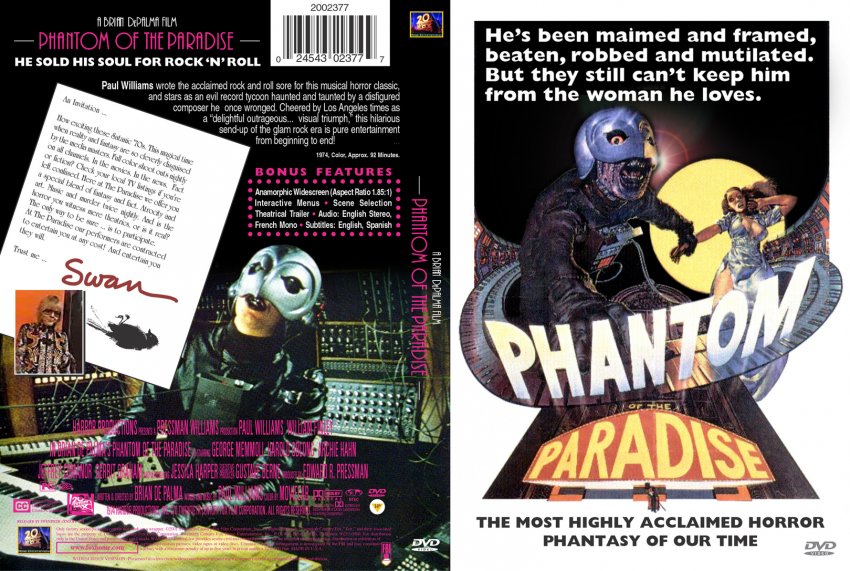
A quirky, stylized, and fleet-footed if unwieldy blend of horror and fantasy taking place in a rock-and-roll setting, Phantom of the Paradise attracted the attention of horror film and science fiction fans rather than a teenage rock music audience. Its plot borrows predominantly from the 1943 and 1962 film versions of Gaston Leroux's The Phantom of the Opera5 as well as the German legend of Faust (the music mogul Swan played by Williams sells his soul for success). By virtue of its pop sensibilities, its fanciful critique of corporate greed, and its stylized filmmaking techniques (a harbinger of the Grand Guignol style Brian De Palma would develop to greater effect in Carrie [1976] and Scarface [1983]), the film slowly built a cult following. As a meta-narrative about popular music as well as a satire of celebrity culture that parodies the very elements that audiences might enjoy about it (flashy rock production numbers, fan worship), the film likely alienated the audiences it expected to attract, until a revised ad campaign repositioned the film as a horror/thriller as opposed to a musical (the Style C poster tagline is "He's been maimed and framed, beaten, robbed, and mutilated. But they still can't keep him from the woman he loves"). Moderately more successful, it attracted enough attention to be written up in various science fiction and film magazines.
To Read the Rest
by Roger Leatherwood
Bright Lights Film Journal
1. WHO CARES ABOUT NOSTALGIA ANYMORE?
Personal Archives in the Absence of a Corporate One
Prior to about 1980, Hollywood seemed perversely uninterested in its own history, inadvertently or intentionally neglecting its production materials (not to mention old film elements) that often were left rotting behind studio vault walls and taking up valuable real estate and given away or maybe dumped in the bay some foggy night. Since the advent of home video and the ever-increasing value of catalog titles, new digital (expensive to license, cheap to deliver) formats and the promise of the long tail, studios have increasingly strived to make their films and TV shows available to as wide an audience as possible for as long as possible, including offering merchandise that depicts the characters, graphics, and designs on any and all appropriate items from toys to smartphone cases. This constant upkeep of the presence of the brand of a filmed property in the culture keeps it in the public's memory, perhaps motivating sequels, spin-offs, and other ancillary revenue. And all this has to be archived and kept careful track of.
In some rare instances, producers have maintained archives, private or set up as museum spaces to display props, costumes, and other ephemera.1 But examples of industrial archival curation are sparse, and while the films themselves may enjoy an afterlife in repertory houses or at museum screenings, physical archives are seldom open and, unless they involve Stanley Kubrick or some other storied career, don't go on the road.2
Legacy production materials of motion pictures from draft scripts to set designs to production stills not intended for the public eye often end up forgotten, if they aren't purloined from under the noses of archivists who never notice them missing. The majority of productions dating from before the 1980s suffer from almost nonexistent archival profiles, and have no cultural presence. As a result they remain invisible to cultural memory. In the absence of digital or other marketing engagements now common to recent cross-platform franchise properties, marketing ephemera surrounding the releases ("collateral" to use the marketing term) gets fetishized as the proxy for favorite films, and authentic original posters for such films as King Kong (1933) to Star Wars (1977) go for thousands of dollars on auction sites,3 signifiers of the original and authentic industrial marketing impulse and of the cultural moment in which these were the only legitimate proxy outside of actual viewership.
Ari Kahan's website devoted to Phantom of the Paradise (1974), The Swan Archives (www.swanarchives.org),4 has curated a collection of marketing materials that reanimates the era of this forgotten film's release. Launched in 2006 with the results of 30 years of collecting posters, stills, and other materials, the site functions not only as a resource for the film's fan community but also as its only surviving archive that creates and even defines a new audience for the film. Made up of over 400 pictures of objects, screengrabs, and detailed narratives of the film's genesis, production, marketing, and editing variants adding up to over 75,000 words, as explications of the film's themes, subtexts, and historical context it presents a comprehensive, exhaustive, and passionately rendered archive of the history and reception of the film and a film of its type in the mid-'70s cultural landscape, all in the absence of any attempts by the corporate rightsholders to do so.
2. RECORDING LIVE FOR THE SWAN ARCHIVES
Objects, Their Meanings, and the Importance of Timing
Working online, within view but beyond the traditional reach of normal gatekeepers of intellectual property, Kahan illustrates a new mode of archival behavior and engagement possible in digital environments that revivifies obsolete (in this case, intellectual) property and curates and recontextualizes it. At the same time, Kahan's efforts reflect a rather conservative and closed approach to how an archive is built and functions, in large part by taking pains to protect the assets from promiscuous sharing as well as the context in which they're viewed. By dint of his existence in a landscape that is relatively unexplored, Kahan engages the tension between how audiences and corporate rightsholders control, negotiate, and create new meanings surrounding their properties. His site allows audiences to engage with artifacts outside traditional archival walls; investigates how archival activity affects digital, personal, and other casual engagements with film texts; and points the way in which such sites create new narratives around the texts themselves.
Phantom of the Paradise, written and directed by Brian De Palma and starring Paul Williams, William Finley, and Jessica Harper, was released by 20th Century-Fox in 1974. Appearing amid the rich cultural tapestry that also included The Godfather Part II, Chinatown, The Towering Inferno, and The Texas Chainsaw Massacre, it was largely unsuccessful in finding a wide audience and was relegated to relative obscurity on the second half of double bills before being remarketed to secondary markets with a revamped ad campaign six months later.
A quirky, stylized, and fleet-footed if unwieldy blend of horror and fantasy taking place in a rock-and-roll setting, Phantom of the Paradise attracted the attention of horror film and science fiction fans rather than a teenage rock music audience. Its plot borrows predominantly from the 1943 and 1962 film versions of Gaston Leroux's The Phantom of the Opera5 as well as the German legend of Faust (the music mogul Swan played by Williams sells his soul for success). By virtue of its pop sensibilities, its fanciful critique of corporate greed, and its stylized filmmaking techniques (a harbinger of the Grand Guignol style Brian De Palma would develop to greater effect in Carrie [1976] and Scarface [1983]), the film slowly built a cult following. As a meta-narrative about popular music as well as a satire of celebrity culture that parodies the very elements that audiences might enjoy about it (flashy rock production numbers, fan worship), the film likely alienated the audiences it expected to attract, until a revised ad campaign repositioned the film as a horror/thriller as opposed to a musical (the Style C poster tagline is "He's been maimed and framed, beaten, robbed, and mutilated. But they still can't keep him from the woman he loves"). Moderately more successful, it attracted enough attention to be written up in various science fiction and film magazines.
To Read the Rest
Saturday, April 27, 2013
Land of the Dead (Canada/France/USA: George Romero, 2005)

Land of the Dead (Canada/France/USA: George Romero, 2005: 93 mins)
Bloom, Michael. "Reanimating the Living Dead: Uncovering the Zombie Archetype in the Works of George A. Romero." Offscreen (April 30, 2009)
Bradley, S.A. "My Ride's Here: Remembering George A. Romero." Hellbent for Horror #48 (July 27, 2017)
Read, Jason. "Zombie as Critic." Unemployed Negativity (June 11, 2007)
"Understanding the Zombie Mentality, Pt. 3." Dialogic (July 29, 2005)
Saturday, April 20, 2013
Hostel (USA: Eli Roth, 2005)
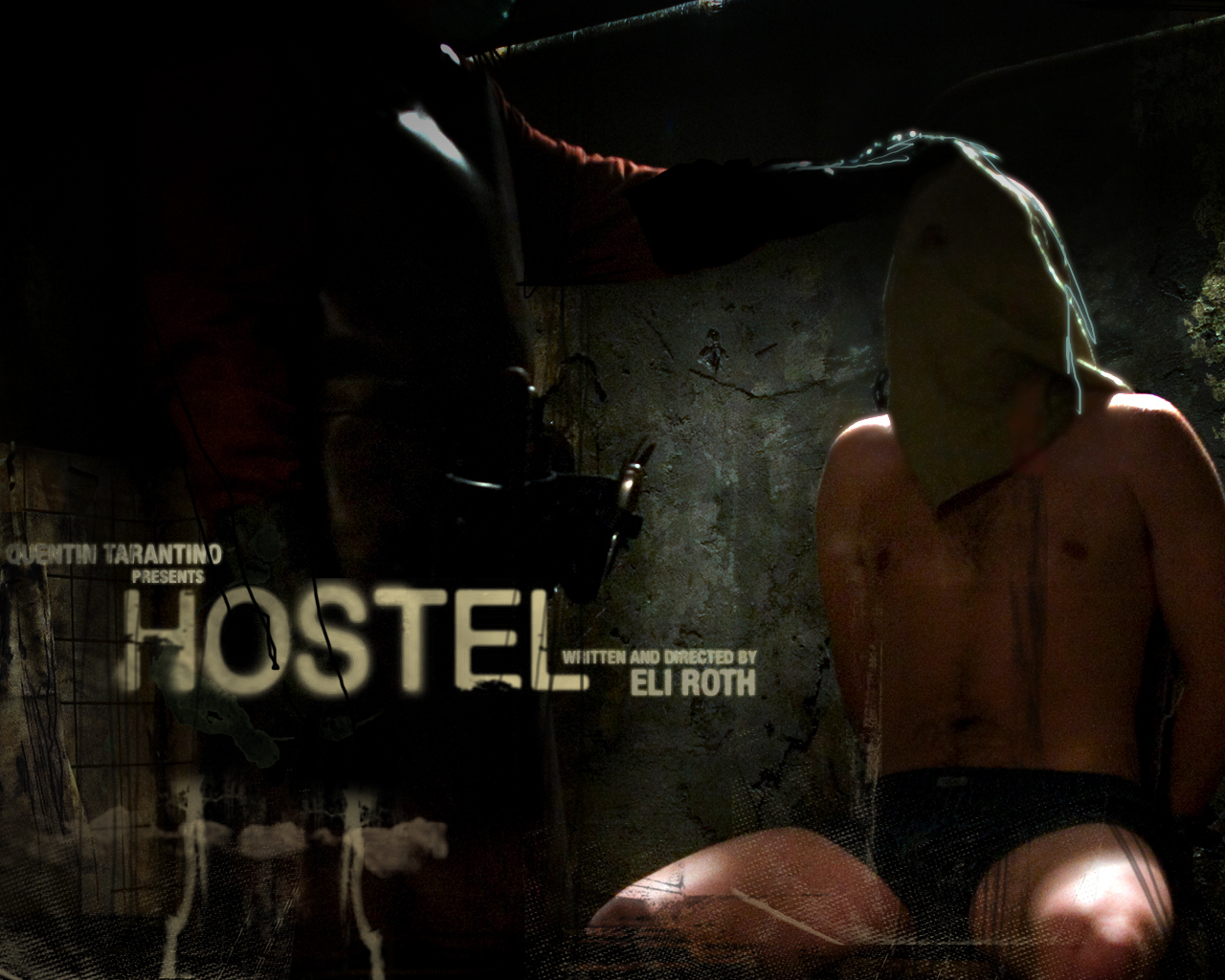
Hostel (USA: Eli Roth, 2005: 94 mins)
Burris, Gregory A. "Shocked and Awed?: Hostel and the Spectacle of Self-Mutilation." Cine-Action #80 (2010) [Available from your teacher]
Cromb, Brenda. "Gorno: Violence, Shock and Comedy." Cinephile #4 (Summer 2008)
Fletcher, Phoebe. “Fucking Americans”: Postmodern Nationalisms in the Contemporary Splatter Film #18 (December 2009)
Hilden, Julie. "Free Speech and the Concept of "Torture Porn": Why are Critics So Hostile to Hostel II?" Find Law (July 16, 2007)
Kleinhans, Chuck. "Imagining Torture." Jump Cut #51 (Spring 2009)
Kleinhans, Chuck, John Hess and Julia Lesage. "The Last Word: Torture and the National Imagination." Jump Cut #50 (Summer 2008)
Lesage, Julie. "Torture Documentaries." Jump Cut #51 (Spring 2009)
Murray, Gabrielle. "Images of Torture, Images of Terror: Post 9/11 and the Escalation of Screen Violence." Monash University Film and TV Studies (Podcast of a Lecture: March 20, 2008)
Rosler, Martha. "A Simple Case for Torture." Jump Cut #51 (Spring 2009)
Torture (Archive on Dialogic: The culture and politics of "torture.")
Sunday, April 7, 2013
Saturday, December 29, 2012
Ingrid Fernandez: Visions of the Other: The Return of the Abject in Roman Polanski's The Tenant
Visions of the Other: The Return of the Abject in Roman Polanski's The Tenant
by Ingrid Fernandez
Bright Lights Film Journal

Perhaps one of the highest achievements — and casualties — of Western philosophy lies in its complete denial of the body as a conduit for knowledge and self-discovery. The body has been excluded from discourse, always positioned as a threat to the higher instincts of the intellect. It is an unwanted part of the self: the polluted, the irrational, the animalistic that mars the path to enlightenment. It has thus been sentenced to represent the space of the abject, that which is always pushing the socially constructed subject to the edge of the abyss and hence threatens the law. However, a higher truth can be sought in the order of Nature. If we embrace the corporeal, we no longer negate death, decay, sickness — the filth burgeoning inside the self and forever constituting its powerful force. I accept my frailty, the instability of my identity, and I mourn for what I have lost when I achieved the status of subject. For that part of myself always creeps back into my existence as a shadow, a hidden desire I can never satisfy, that of life and death merging into pure being. I mourn the Other. I carry it within me but can never access it in life, for it might destroy me, I have been told; or perhaps it might complete me once it undoes all I have learned to be. Julia Kristeva describes fully experiencing the body as causing a rupture within signification, unacceptable because it eradicates the socially constructed boundaries regulating identity. She states:
It is precisely in this foreign land, in this dark continent shunned by rational thought, that we might best find ourselves. The real truth of life is most acutely revealed at a corporeal level, where primal vulnerabilities such as the fear of illness and decay, the violated body, and the body in pain constitute the essence of being human, of being a part of a larger world where "the Other" is a reflection of the self. Moreover, our very physical existence and relation to others stem from a common bond of blood that predates the social apparatus. After all, social identity is easily stripped, uncovering a universal truth — the fact we are all mortal and subject to the violation of our physical space. At its most basic, the bond between humans is forged by the organic — sinews, muscle, bones, and the burden of the body. The instability of physical existence lies in its constant metamorphosis, its ability to simultaneously enrich and destroy intellectual activity, and the presence of elusive desire and the remnants of a fear that remain locked in the moment prior to our existence as social subjects. These concepts are best illustrated in cinema because of the power of the image to enter the viscera, elide intellectual resistance, and elicit an authentic and unmediated, sometimes even involuntary, reaction. The cinematic image penetrates the space of the abject and brings it to life. It is the return of the repressed and allows us to once again inhabit "uncomfortable spaces" we thought were closed off to our senses. Starting from these premises, I propose to revisit the concept of knowledge gained through the saturation of the body by outside stimuli, in this case film images, and how this experience results in a form of transcendence, a deeper understanding of our relation to ourselves and "the Other."
Roman Polanski's 1976 film The Tenant can be seen as a meditation on the fate of the abject body and how it is marked, regulated, and finally obliterated by the social apparatus. However, it also emphasizes how the repressed eludes the symbolic law and allows us to encounter its terrifying shadow, the periphery of existence that always manages to break through. Additionally, Polanski brings in the concept of bare life as stipulated by critics like Giorgio Agamben and Judith Butler, inquiring into the way a social subject is constituted and given a voice or utterly silenced and excluded from the circle of the human. The film's main focus remains on the body as undesirable, non-ideal, open to external aggression and pollution. In typical Polanski fashion, the audience is trapped in an "uncomfortable visual space" where the concept of a stable individual identity is never a matter of choice, but instead constituted by our surroundings and forces well beyond our grasp. The Tenant's crowning achievement is its use of the subjective camera, to the extent the audience is literally involved in the action through the vision of its main character, Trelkovsky. We see what he sees, fear what he fears, and eventually become him. Through this process, we experience the frailty of subjecthood and the ability of the cinematic image to rouse in us a dialogue with the innermost recesses of ourselves, the abject within us that, when we acknowledge it, sets us on the path to enlightenment and self-discovery.
To Read the Rest of the Essay
by Ingrid Fernandez
Bright Lights Film Journal
Perhaps one of the highest achievements — and casualties — of Western philosophy lies in its complete denial of the body as a conduit for knowledge and self-discovery. The body has been excluded from discourse, always positioned as a threat to the higher instincts of the intellect. It is an unwanted part of the self: the polluted, the irrational, the animalistic that mars the path to enlightenment. It has thus been sentenced to represent the space of the abject, that which is always pushing the socially constructed subject to the edge of the abyss and hence threatens the law. However, a higher truth can be sought in the order of Nature. If we embrace the corporeal, we no longer negate death, decay, sickness — the filth burgeoning inside the self and forever constituting its powerful force. I accept my frailty, the instability of my identity, and I mourn for what I have lost when I achieved the status of subject. For that part of myself always creeps back into my existence as a shadow, a hidden desire I can never satisfy, that of life and death merging into pure being. I mourn the Other. I carry it within me but can never access it in life, for it might destroy me, I have been told; or perhaps it might complete me once it undoes all I have learned to be. Julia Kristeva describes fully experiencing the body as causing a rupture within signification, unacceptable because it eradicates the socially constructed boundaries regulating identity. She states:
A wound with blood and pus, or the sickly, acrid smell of sweat, does not signify death. In the presence of signified de'ath — a flat encephalograph, for instance — I would understand, react, or accept. No, as in true theater, without makeup or masks, refuse and corpses show me what I permanently thrust aside in order to live . . . My body extricates itself, as being alive, from that border . . . It is thus not lack of cleanliness or health that causes abjection but what disturbs identity, system, order. What does not respect borders, positions, rules. The in-between, the ambiguous, the composite. (Kristeva)
It is precisely in this foreign land, in this dark continent shunned by rational thought, that we might best find ourselves. The real truth of life is most acutely revealed at a corporeal level, where primal vulnerabilities such as the fear of illness and decay, the violated body, and the body in pain constitute the essence of being human, of being a part of a larger world where "the Other" is a reflection of the self. Moreover, our very physical existence and relation to others stem from a common bond of blood that predates the social apparatus. After all, social identity is easily stripped, uncovering a universal truth — the fact we are all mortal and subject to the violation of our physical space. At its most basic, the bond between humans is forged by the organic — sinews, muscle, bones, and the burden of the body. The instability of physical existence lies in its constant metamorphosis, its ability to simultaneously enrich and destroy intellectual activity, and the presence of elusive desire and the remnants of a fear that remain locked in the moment prior to our existence as social subjects. These concepts are best illustrated in cinema because of the power of the image to enter the viscera, elide intellectual resistance, and elicit an authentic and unmediated, sometimes even involuntary, reaction. The cinematic image penetrates the space of the abject and brings it to life. It is the return of the repressed and allows us to once again inhabit "uncomfortable spaces" we thought were closed off to our senses. Starting from these premises, I propose to revisit the concept of knowledge gained through the saturation of the body by outside stimuli, in this case film images, and how this experience results in a form of transcendence, a deeper understanding of our relation to ourselves and "the Other."
Roman Polanski's 1976 film The Tenant can be seen as a meditation on the fate of the abject body and how it is marked, regulated, and finally obliterated by the social apparatus. However, it also emphasizes how the repressed eludes the symbolic law and allows us to encounter its terrifying shadow, the periphery of existence that always manages to break through. Additionally, Polanski brings in the concept of bare life as stipulated by critics like Giorgio Agamben and Judith Butler, inquiring into the way a social subject is constituted and given a voice or utterly silenced and excluded from the circle of the human. The film's main focus remains on the body as undesirable, non-ideal, open to external aggression and pollution. In typical Polanski fashion, the audience is trapped in an "uncomfortable visual space" where the concept of a stable individual identity is never a matter of choice, but instead constituted by our surroundings and forces well beyond our grasp. The Tenant's crowning achievement is its use of the subjective camera, to the extent the audience is literally involved in the action through the vision of its main character, Trelkovsky. We see what he sees, fear what he fears, and eventually become him. Through this process, we experience the frailty of subjecthood and the ability of the cinematic image to rouse in us a dialogue with the innermost recesses of ourselves, the abject within us that, when we acknowledge it, sets us on the path to enlightenment and self-discovery.
To Read the Rest of the Essay
Friday, December 7, 2012
A. Loudermilk: Last to Leave the Theater
Last to Leave the Theater: Sissy Spectatorship of Stalker Movies and the "Final Girls" Who Survive Them
by A. Loudermilk
Bright Lights Film Journal
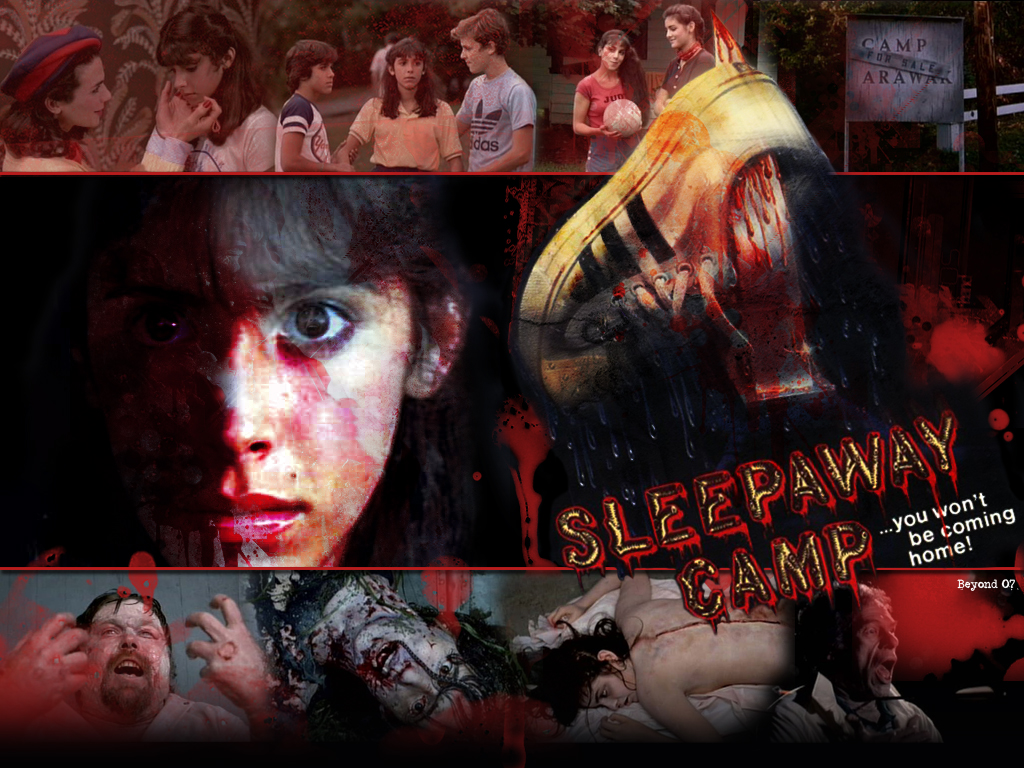
She's a virgin who won't get stoned (Sleepaway Camp II). She does get stoned and plays strip Monopoly (Friday the 13th). She's not a virgin and wears a tie (April Fool's Day). She's a pregnant sorority sister holding tight to her little gold cross (Black Christmas). She's teacher's pet and basketball star (Slumber Party Massacre). She's prom queen, head of dance club and all-around athlete (Prom Night). Yet she wasn't invited to an important party (Happy Birthday to Me). She knows how to fix a car and disparages capitalism (Hell Night). She's majoring in psychology (Friday the 13th II). She's a divorcee who writes an advice column (Schizoid). She's a naval officer with a mysterious position overseas (Graduation Day). She's the one who says, "We're supposed to be mature adults" (House on Sorority Row). She's the one who says, "We should be prepared to fight" (Hide and Go Shriek). She's the one who says, "I'll put the gun down when the police get here" (Hard to Die). In order to protect herself, she pulls the Stalker's knife from a dead friend's back (Friday the 13th III). "I don't feel any safer here with you," she weighs her options: "I can run cross-country. I'll get to the highway and call for help" (Blood Sisters). She drags herself down corridors to save herself from the Stalker (Halloween II). She saves herself and her wounded boyfriend from the Stalker (Mutilator). She's not the Stalker though she seemed to be the Stalker (Curtains; Nail Gun Massacre). She is the Stalker (Night School) and not exactly a girl (Sleepaway Camp). She's upset about forgetting her chemistry book (Halloween).
Since Tobe Hooper's The Texas Chain Saw Massacre (1974) and John Carpenter's Halloween (1978), the survivor figure in horror has been female. "We belong in the end to the Final Girl," declares film theorist Carol Clover in her groundbreaking book Men, Women, and Chainsaws (1992). Clover refers to the Final Girl as a "victim-hero," a character who shifts between these traditionally gendered roles — increasingly toward the masculine (in her argument) as the story culminates. A smart and observant girl who either fights off the killer long enough to be rescued or kills the killer herself, the Final Girl is not typically feminine in her interests/skills, experiences an apartness from other girls, and possesses an active gaze that registers signs of danger others ignore (35, 39-40, 44, 48). For instance Halloween's Laurie (Jamie Lee Curtis), teased by her sex-obsessed peers as the bookish virgin1 who doesn't date, is first to see the blankly masked man watching from the hedges.
In the opening scene of the original Night of the Living Dead (1968), one now might spot Barbara as Final Girl. Director George Romero positions us to identify with Barbara more so than her brother who jokes about the strange man in the cemetery who's "coming to get her." He is coming — to get both of them. While her paranoia saves her, her brother's flippancy gets him killed. After Barbara's initial ingenuity evading the zombie, alas, she goes catatonic and a male character assumes the hero role. For Tom Savini's 1990 remake of Night of the Living Dead, scriptwriter Romero, responding to feminist criticism of Barbara's hysterical passivity, revises her as Final Girl. She is now "an active, assertive character, not only within the diegesis but as a narrative agent as well." In other words, according to Barry Keith Grant's essay "Taking Back the Night of the Living Dead" (1992), she not only takes action to save herself in the story, those actions impact the direction, outcome, and meaning of the story (200).
At large in horror, a revision of the damsel as survivor marks a new era for the genre, and much has been written about it. What's yet to be addressed, though, is a specifically "sissy spectatorship" of the Final Girl during an era of intense homophobia and misogyny. I grew up with the Final Girl, or maybe I should say that I grew up with the genre fans who primarily witnessed the Final Girl. And I want to embrace fan subjectivity to help elucidate my own queer relationship with horror as framed by the straight audience I sat with. To come back, ultimately, to the very theater in which I sat — watching and being watched.
To Read the Rest of the Essay

by A. Loudermilk
Bright Lights Film Journal
She's a virgin who won't get stoned (Sleepaway Camp II). She does get stoned and plays strip Monopoly (Friday the 13th). She's not a virgin and wears a tie (April Fool's Day). She's a pregnant sorority sister holding tight to her little gold cross (Black Christmas). She's teacher's pet and basketball star (Slumber Party Massacre). She's prom queen, head of dance club and all-around athlete (Prom Night). Yet she wasn't invited to an important party (Happy Birthday to Me). She knows how to fix a car and disparages capitalism (Hell Night). She's majoring in psychology (Friday the 13th II). She's a divorcee who writes an advice column (Schizoid). She's a naval officer with a mysterious position overseas (Graduation Day). She's the one who says, "We're supposed to be mature adults" (House on Sorority Row). She's the one who says, "We should be prepared to fight" (Hide and Go Shriek). She's the one who says, "I'll put the gun down when the police get here" (Hard to Die). In order to protect herself, she pulls the Stalker's knife from a dead friend's back (Friday the 13th III). "I don't feel any safer here with you," she weighs her options: "I can run cross-country. I'll get to the highway and call for help" (Blood Sisters). She drags herself down corridors to save herself from the Stalker (Halloween II). She saves herself and her wounded boyfriend from the Stalker (Mutilator). She's not the Stalker though she seemed to be the Stalker (Curtains; Nail Gun Massacre). She is the Stalker (Night School) and not exactly a girl (Sleepaway Camp). She's upset about forgetting her chemistry book (Halloween).
Since Tobe Hooper's The Texas Chain Saw Massacre (1974) and John Carpenter's Halloween (1978), the survivor figure in horror has been female. "We belong in the end to the Final Girl," declares film theorist Carol Clover in her groundbreaking book Men, Women, and Chainsaws (1992). Clover refers to the Final Girl as a "victim-hero," a character who shifts between these traditionally gendered roles — increasingly toward the masculine (in her argument) as the story culminates. A smart and observant girl who either fights off the killer long enough to be rescued or kills the killer herself, the Final Girl is not typically feminine in her interests/skills, experiences an apartness from other girls, and possesses an active gaze that registers signs of danger others ignore (35, 39-40, 44, 48). For instance Halloween's Laurie (Jamie Lee Curtis), teased by her sex-obsessed peers as the bookish virgin1 who doesn't date, is first to see the blankly masked man watching from the hedges.
In the opening scene of the original Night of the Living Dead (1968), one now might spot Barbara as Final Girl. Director George Romero positions us to identify with Barbara more so than her brother who jokes about the strange man in the cemetery who's "coming to get her." He is coming — to get both of them. While her paranoia saves her, her brother's flippancy gets him killed. After Barbara's initial ingenuity evading the zombie, alas, she goes catatonic and a male character assumes the hero role. For Tom Savini's 1990 remake of Night of the Living Dead, scriptwriter Romero, responding to feminist criticism of Barbara's hysterical passivity, revises her as Final Girl. She is now "an active, assertive character, not only within the diegesis but as a narrative agent as well." In other words, according to Barry Keith Grant's essay "Taking Back the Night of the Living Dead" (1992), she not only takes action to save herself in the story, those actions impact the direction, outcome, and meaning of the story (200).
At large in horror, a revision of the damsel as survivor marks a new era for the genre, and much has been written about it. What's yet to be addressed, though, is a specifically "sissy spectatorship" of the Final Girl during an era of intense homophobia and misogyny. I grew up with the Final Girl, or maybe I should say that I grew up with the genre fans who primarily witnessed the Final Girl. And I want to embrace fan subjectivity to help elucidate my own queer relationship with horror as framed by the straight audience I sat with. To come back, ultimately, to the very theater in which I sat — watching and being watched.
To Read the Rest of the Essay
Monday, November 19, 2012
David Bordwell: Return to Paranormalcy
Return to Paranormalcy
by David Bordwell
Observations on Film Art
,,,
The broad task that Peli faced when he began work on Paranormal Activity was clear: How to make a diabolic-possession film different from the others? By then, and still, that variant of horror was pretty well-defined. And indeed the film Peli came up with wasn’t that original in outline. A couple is disturbed by mysterious noises and actions in their house. They call in experts and try to find the source of the disturbance. Eventually the woman becomes possessed and kills her lover.
Throughout, the conventions of the supernatural film rule: sudden blackouts, bone-shaking noises emitted by offscreen fiends, and characters exploring basements, closets, moonlit yards, and other scary spaces. Special effects are invoked to levitate victims or drag them by unseen hands. Occasionally we’re faked out by scares launched as pranks that some characters pull on others. As usual, normal, i.e. bourgeois American life, is devastated by supernatural forces. Cozy domestic surroundings, including an array of consumer goods, become menacing. Much of all this was pioneered by The Exorcist (1973), so the tradition has plenty of cobwebs on it.
Shooting in seven days on a small budget, Peli settled on a formal framework that borrowed from another tradition, that of the pseudo-documentary fiction film. This too goes far back, to This Is Spinal Tap (1984) and Bob Roberts (1992), and before to Stanton Kaye’s Georg (1964), Jim McBride’s David Holzman’s Diary (1967), and Mitchell Block’s No Lies (1972) , and Peter Watkins’ Culloden (1964) and The War Game (1965). More distant predecessors might be Welles’ 1938 War of the Worlds radio broadcast, or even the fake memoirs we find in the early years of the novel. Today the pseudo-documentary mode, used for comic or dramatic purposes, is familiar to us from television shows like The Office. This mode has its own conventions, such as to-camera interviews and the occasionally awkward framing, most noticeable in the recurring image of a fallen camera.
The pseudo-documentary approach had been tried in the horror film in the 1980s, but it gained attention at the end of the 1990s with The Last Broadcast (1998) and The Blair Witch Project (1999). No surprise: Horror films tend to be low-budget items, and shooting in a run-and-gun manner, with handheld shots and awkward sound, was both cheap and realistic-looking. A cycle emerged, exemplified most notably in the bigger-budget Cloverfield (2008).
The problem of the pseudo-documentary is to motivate the fact that someone is filming these dramas. Various solutions have been worked out. You might make the protagonist a filmmaker exploring a subject or creating a diary. Or you can pretend that the people being filmed are celebrities (as in Spinal Tap). Or make the act of filming an effort to document dramatic occurrences. Filmmakers face a second problem as well: motivating how the film has been made public. You can, for instance, present it as a TV or theatrical documentary, as Spinal Tap purports to be. More recently another solution has been found. You can suggest that this film has been discovered after the events were over.
Because of this rationale, the approach is sometimes called the “found-footage” treatment, or in Varietyese the “faux found-footage film.” I’m not delighted by this term because for a long time “found-footage” has referred to films like Bruce Conner’s A Movie or Christian Marclay’s The Clock, assembled out of existing footage scavenged from different sources. So I’ll call fictional movies like Blair Witch and Cloverfield “discovered footage” films.
One reason for this name is that these films hark back to an early tradition of literary fiction, that of the “topos of the discovered manuscript” or “the old oak chest.” Here a tale is presented as a manuscript found and prepared for publication by other hands. The purpose, at first blush, is to give the story an air of authenticity. The same urge prevails in the discovered-footage horror movies, which use this blatant artifice to play with the possibility that these weird happenings really took place. As the image surmounting this blog entry suggests, Peli linked his film to this tradition, even letting the all-too-real company Paramount Pictures attest to the veracity of what we’re going to see.
The development of the Paranormal series took place under the sign of rivalry. A great many horror films of the late 2000s and early 2010s used the pseudo-documentary approach, sometimes marking the footage as recovered. After the success of Peli’s original film, intense competition emerged. There was a blatant ripoff (Paranormal Entity, 2009), followed by many others, including the subtler pseudo-doc The Last Exorcism (2010), which seems to presume that we’ll take it as a found-footage item too.
Just as important, in making successors to the original film, Peli and his colleagues had to compete with themselves. So they freshened up their plots. Paranormal 2 features not a live-in couple but a family; Paranormal 3 centers on an unmarried mother, her live-in boyfriend, and her two daughters. Paranormal 4 features a family whose neighbors are a possessed mother and son.
Interestingly, the subsequent films supply relatively little mythical or doctrinal backstory. Although there are always one or two scenes in which the characters launch on some research, the plots mostly minimize exposition about the hows and whys of possession. (Contrast The Exorcist.) We get just enough hints to assume that there’s a demon who offers women worldly goods in exchange for innocent boys’ souls. Mostly the films concentrate on the characters’ responses, chiefly their quarrels about whether the weird happenings are supernaturally caused. Each film needs at least one blocking character, somebody whose skepticism, obstinacy, or cluelessness keeps the plot going and prevents the characters from simply getting the hell out.
The films also vary protagonists and the characters we’re attached to. Micah moves the plot forward in the first entry with his urge to document the weird happenings, while in the second, the father Daniel and his daughter Ali take turns probing what’s going on. In the third film, again it’s mostly a male filmmaker, Dennis, who propels the inquiry, while in the latest iteration, the narrative momentum is passed to the inquisitive teenage girl Alex.
Perhaps the most up- to-date way the filmmakers refresh the franchise is by making the various films interlock. The films set up a chronology that positions the original release as the third phase of a larger action. Paranormal 2 occurs just before the events of the first one, and Paranormal 3 flashes back eighteen years to supply some preconditions for the previous entries. Moreover, some portions of the plots overlap, so that scenes from one installment are replayed in another, explaining how the time frames mesh. This sort of shuffling with time and perspective is nowadays common both within films and across them; the second and third Bourne films offer good examples.
Above all, the filmmakers have created a new ecological niche by virtue of some initial stylistic choices Peli’s first film made. They were striking but exceptionally constraining. To produce more Paranormal films created a very specific set of problems: How to respect those initial constraints and yet rework them in unpredictable ways?
To Read the Entire Essay
by David Bordwell
Observations on Film Art
,,,
The broad task that Peli faced when he began work on Paranormal Activity was clear: How to make a diabolic-possession film different from the others? By then, and still, that variant of horror was pretty well-defined. And indeed the film Peli came up with wasn’t that original in outline. A couple is disturbed by mysterious noises and actions in their house. They call in experts and try to find the source of the disturbance. Eventually the woman becomes possessed and kills her lover.
Throughout, the conventions of the supernatural film rule: sudden blackouts, bone-shaking noises emitted by offscreen fiends, and characters exploring basements, closets, moonlit yards, and other scary spaces. Special effects are invoked to levitate victims or drag them by unseen hands. Occasionally we’re faked out by scares launched as pranks that some characters pull on others. As usual, normal, i.e. bourgeois American life, is devastated by supernatural forces. Cozy domestic surroundings, including an array of consumer goods, become menacing. Much of all this was pioneered by The Exorcist (1973), so the tradition has plenty of cobwebs on it.
Shooting in seven days on a small budget, Peli settled on a formal framework that borrowed from another tradition, that of the pseudo-documentary fiction film. This too goes far back, to This Is Spinal Tap (1984) and Bob Roberts (1992), and before to Stanton Kaye’s Georg (1964), Jim McBride’s David Holzman’s Diary (1967), and Mitchell Block’s No Lies (1972) , and Peter Watkins’ Culloden (1964) and The War Game (1965). More distant predecessors might be Welles’ 1938 War of the Worlds radio broadcast, or even the fake memoirs we find in the early years of the novel. Today the pseudo-documentary mode, used for comic or dramatic purposes, is familiar to us from television shows like The Office. This mode has its own conventions, such as to-camera interviews and the occasionally awkward framing, most noticeable in the recurring image of a fallen camera.
The pseudo-documentary approach had been tried in the horror film in the 1980s, but it gained attention at the end of the 1990s with The Last Broadcast (1998) and The Blair Witch Project (1999). No surprise: Horror films tend to be low-budget items, and shooting in a run-and-gun manner, with handheld shots and awkward sound, was both cheap and realistic-looking. A cycle emerged, exemplified most notably in the bigger-budget Cloverfield (2008).
The problem of the pseudo-documentary is to motivate the fact that someone is filming these dramas. Various solutions have been worked out. You might make the protagonist a filmmaker exploring a subject or creating a diary. Or you can pretend that the people being filmed are celebrities (as in Spinal Tap). Or make the act of filming an effort to document dramatic occurrences. Filmmakers face a second problem as well: motivating how the film has been made public. You can, for instance, present it as a TV or theatrical documentary, as Spinal Tap purports to be. More recently another solution has been found. You can suggest that this film has been discovered after the events were over.
Because of this rationale, the approach is sometimes called the “found-footage” treatment, or in Varietyese the “faux found-footage film.” I’m not delighted by this term because for a long time “found-footage” has referred to films like Bruce Conner’s A Movie or Christian Marclay’s The Clock, assembled out of existing footage scavenged from different sources. So I’ll call fictional movies like Blair Witch and Cloverfield “discovered footage” films.
One reason for this name is that these films hark back to an early tradition of literary fiction, that of the “topos of the discovered manuscript” or “the old oak chest.” Here a tale is presented as a manuscript found and prepared for publication by other hands. The purpose, at first blush, is to give the story an air of authenticity. The same urge prevails in the discovered-footage horror movies, which use this blatant artifice to play with the possibility that these weird happenings really took place. As the image surmounting this blog entry suggests, Peli linked his film to this tradition, even letting the all-too-real company Paramount Pictures attest to the veracity of what we’re going to see.
The development of the Paranormal series took place under the sign of rivalry. A great many horror films of the late 2000s and early 2010s used the pseudo-documentary approach, sometimes marking the footage as recovered. After the success of Peli’s original film, intense competition emerged. There was a blatant ripoff (Paranormal Entity, 2009), followed by many others, including the subtler pseudo-doc The Last Exorcism (2010), which seems to presume that we’ll take it as a found-footage item too.
Just as important, in making successors to the original film, Peli and his colleagues had to compete with themselves. So they freshened up their plots. Paranormal 2 features not a live-in couple but a family; Paranormal 3 centers on an unmarried mother, her live-in boyfriend, and her two daughters. Paranormal 4 features a family whose neighbors are a possessed mother and son.
Interestingly, the subsequent films supply relatively little mythical or doctrinal backstory. Although there are always one or two scenes in which the characters launch on some research, the plots mostly minimize exposition about the hows and whys of possession. (Contrast The Exorcist.) We get just enough hints to assume that there’s a demon who offers women worldly goods in exchange for innocent boys’ souls. Mostly the films concentrate on the characters’ responses, chiefly their quarrels about whether the weird happenings are supernaturally caused. Each film needs at least one blocking character, somebody whose skepticism, obstinacy, or cluelessness keeps the plot going and prevents the characters from simply getting the hell out.
The films also vary protagonists and the characters we’re attached to. Micah moves the plot forward in the first entry with his urge to document the weird happenings, while in the second, the father Daniel and his daughter Ali take turns probing what’s going on. In the third film, again it’s mostly a male filmmaker, Dennis, who propels the inquiry, while in the latest iteration, the narrative momentum is passed to the inquisitive teenage girl Alex.
Perhaps the most up- to-date way the filmmakers refresh the franchise is by making the various films interlock. The films set up a chronology that positions the original release as the third phase of a larger action. Paranormal 2 occurs just before the events of the first one, and Paranormal 3 flashes back eighteen years to supply some preconditions for the previous entries. Moreover, some portions of the plots overlap, so that scenes from one installment are replayed in another, explaining how the time frames mesh. This sort of shuffling with time and perspective is nowadays common both within films and across them; the second and third Bourne films offer good examples.
Above all, the filmmakers have created a new ecological niche by virtue of some initial stylistic choices Peli’s first film made. They were striking but exceptionally constraining. To produce more Paranormal films created a very specific set of problems: How to respect those initial constraints and yet rework them in unpredictable ways?
To Read the Entire Essay
Monday, November 12, 2012
Two Upcoming Zombie Films: World War Z and Warm Bodies
This one looks like a wretched horror film playing on elite fears of the "unwashed masses."
World War Z (USA: Marc Forster, 2013)
This one looks like it is coming from a different direction.
Warm Bodies (USA: Jonathan Levine, 2013)
World War Z (USA: Marc Forster, 2013)
This one looks like it is coming from a different direction.
Warm Bodies (USA: Jonathan Levine, 2013)
Monday, October 8, 2012
Glenn Heath Jr. on Abel Ferrara's The Addiction (1995)
Glenn Heath Jr. on Abel Ferrara's The Addiction (1995)
Not Coming to a Theater Near You

It’s all theory and philosophy until someone gets bit. Abel Ferrara’s art/vampire film The Addiction, a dense and moody examination of fear and self-loathing in 1990s New York City, takes this credo to insane heights. In the beginning, words and ideas are modes of deflection used by characters living in an academic world where hypothetical thought rules. But their wake-up call sleeks through the night, appearing suddenly and without reproach, brutally executing a primal reckoning of faith. From here, a new language emerges written in jet-black blood, caked on the lips of sirens and streaming down the contours of swan-like necks. Here, the crisp texture of film and photographic images is crucial for Ferrara. He sees the jarringly blunt stylization of death and trauma as the only way to reveal highbrow banter as dangerous contradiction, doing so within a genre primed for social critique. But is the horror film itself part of the problem? It all starts simply enough with a nighttime stroll and a sudden proposition of fate.
“Tell me to leave you alone,” demands a stunningly calm vampire seductress to a shocked grad student in a dank New York City alley crisscrossed by sharp, bleeding shadows. What a dare! These haunting words are uttered before each brazen attack in The Addiction. It’s as if the various supernatural beings walking the dark streets must defy their prey to stand up for survival before jumping on a single bit of hesitation to justify the impending blood lust. But looking evil in the eye and failing to react is just one of the many philosophical and moral conundrums recycling throughout Ferrara’s black and white masterpiece about dependency, fear, and political outrage. In fact, there are so many competing ideological threads in The Addiction that the very act of verbal expression becomes a form of sadism.
Kathleen Conklin, the aforementioned tough-minded grad student played by Lili Taylor who gets attacked by a sleek vampire named Casanova in the opening moments of Ferrara’s film, initially defines her professional and personal life by historical revisionism. War crimes are her object of study, and she spends the film’s first moment studying graphic pictures documenting the Mai Lai Massacre. Kathleen views these images with cold detachment, listening intently to the droll voiceover of a lecturer: “The conscience of an outraged society was temporarily satisfied,” he dramatically muses, referencing the American public’s faux-appeasement after obtaining national justice against the guilty soldiers. But college life is just a façade, and Ferrara has big thematic plans for Kathleen. After being attacked, the deep bite marks on her neck and the blood streaming down her face, often framed within smooth, nearly slow motion dolly shots, begin a slow transition from theoretical dependency to literal acts of horror and extreme physical addiction.
To Read the Rest of the Response
Not Coming to a Theater Near You
It’s all theory and philosophy until someone gets bit. Abel Ferrara’s art/vampire film The Addiction, a dense and moody examination of fear and self-loathing in 1990s New York City, takes this credo to insane heights. In the beginning, words and ideas are modes of deflection used by characters living in an academic world where hypothetical thought rules. But their wake-up call sleeks through the night, appearing suddenly and without reproach, brutally executing a primal reckoning of faith. From here, a new language emerges written in jet-black blood, caked on the lips of sirens and streaming down the contours of swan-like necks. Here, the crisp texture of film and photographic images is crucial for Ferrara. He sees the jarringly blunt stylization of death and trauma as the only way to reveal highbrow banter as dangerous contradiction, doing so within a genre primed for social critique. But is the horror film itself part of the problem? It all starts simply enough with a nighttime stroll and a sudden proposition of fate.
“Tell me to leave you alone,” demands a stunningly calm vampire seductress to a shocked grad student in a dank New York City alley crisscrossed by sharp, bleeding shadows. What a dare! These haunting words are uttered before each brazen attack in The Addiction. It’s as if the various supernatural beings walking the dark streets must defy their prey to stand up for survival before jumping on a single bit of hesitation to justify the impending blood lust. But looking evil in the eye and failing to react is just one of the many philosophical and moral conundrums recycling throughout Ferrara’s black and white masterpiece about dependency, fear, and political outrage. In fact, there are so many competing ideological threads in The Addiction that the very act of verbal expression becomes a form of sadism.
Kathleen Conklin, the aforementioned tough-minded grad student played by Lili Taylor who gets attacked by a sleek vampire named Casanova in the opening moments of Ferrara’s film, initially defines her professional and personal life by historical revisionism. War crimes are her object of study, and she spends the film’s first moment studying graphic pictures documenting the Mai Lai Massacre. Kathleen views these images with cold detachment, listening intently to the droll voiceover of a lecturer: “The conscience of an outraged society was temporarily satisfied,” he dramatically muses, referencing the American public’s faux-appeasement after obtaining national justice against the guilty soldiers. But college life is just a façade, and Ferrara has big thematic plans for Kathleen. After being attacked, the deep bite marks on her neck and the blood streaming down her face, often framed within smooth, nearly slow motion dolly shots, begin a slow transition from theoretical dependency to literal acts of horror and extreme physical addiction.
To Read the Rest of the Response
Friday, September 28, 2012
Sound on Sight Podcast #309: Director Alfred Hitchcock’s ‘Shadow of a Doubt’ – ‘Psycho’ – ‘The Birds’
Sound on Sight Podcast #309: Director Alfred Hitchcock’s ‘Shadow of a Doubt’ – ‘Psycho’ – ‘The Birds’
Sound on Sight
Every month the Sound On Sight staff bands together to tackle a specific filmmaker, event and/or some sort of movie related theme. This month our focus shifts towards the “Master of Suspense”, Alfred Hitchcock.
After years of us promising to get off our asses and get it done, we’ve finally gotten our long-awaited Hitchcock episode done! Special guest and all-around movie knowledge hound Bill Mesce joins Ricky D and Justine Smith to chat up three of the maestro’s most famous chillers: Shadow of a Doubt, Psycho and The Birds.
To Listen to the Episode
Sound on Sight
Every month the Sound On Sight staff bands together to tackle a specific filmmaker, event and/or some sort of movie related theme. This month our focus shifts towards the “Master of Suspense”, Alfred Hitchcock.
After years of us promising to get off our asses and get it done, we’ve finally gotten our long-awaited Hitchcock episode done! Special guest and all-around movie knowledge hound Bill Mesce joins Ricky D and Justine Smith to chat up three of the maestro’s most famous chillers: Shadow of a Doubt, Psycho and The Birds.
To Listen to the Episode
Wednesday, August 29, 2012
Dan Akira Nishimura: Anthony Perkins -- Forever Psycho
Anthony Perkins: Forever Psycho
by Dan Akira Nishimura
Bright Lights Film Journal
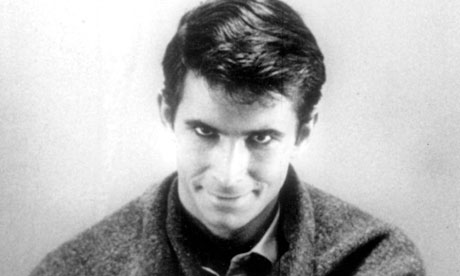
When Alfred Hitchcock wrapped Psycho (1960), it was years before the sequel became commonplace. No one expected Ben Hur (1959) or Spartacus (1960) to continue on with new adventures. "The End" meant just that, for the story and the characters. So it may have come as a surprise to Anthony Perkins when his Norman Bates character was revived thirteen years later in Psycho II (1983). In some ways, however, he had never stopped playing him.
A dreamy-eyed staple of fan magazines of the late 1950s and early '60s, Perkins was cast against type as the psychotic killer. Because of the enormous success of Psycho, he immediately became identified with the role. Although he at first resisted, Perkins returned to Norman Bates again and again, in one form or other. Norman's twitchy eccentricity seeped into many of Perkins' post-Psycho performances that preceded the run of sequels. His paranoid bank manager Joseph K. in The Trial (1962), the preppy-with-a-secret Dennis Pitt in Pretty Poison (1968), and the amnesiac sculptor Charles Van Horn in Ten Days Wonder (1971) all bear the mark of Norman Bates. In this essay, we'll look at how Perkins became indistinguishable from Norman and why he was never "finished" with him. Perkins set the stage for the emergence of the creepy but sympathetic pretty-boy psychopath next door. Without Psycho, sweet-faced Tony Curtis may have had a difficult time convincing producers he could play Albert DeSalvo in The Boston Strangler (1968). Another real-life Norman, serial killer Ted Bundy, was celebrated in books and a television miniseries. Anthony Perkins was born in 1932, the year Adolf Hitler seized power. Perkins was the son of the actor James Ripley Osgood Perkins, who died onstage when Tony was five. Growing up in the shadow of the Second World War and surviving the death of a parent must certainly have affected him. In any case, there's an unease built into his screen personae whether he's playing high-strung baseball player Jimmy Piersall in Fear Strikes Out (1957) or Norman Bates.
"Psycho begins with the normal," writes Robin Wood, "and draws us steadily deeper and deeper into the abnormal; it opens by making us aware of time, and ends with a situation in which time has ceased to exist."1 It's difficult to imagine the world before Psycho and its countless imitators. Known as the eccentric director of big-budget, wide-screen Technicolor spectacles, Hitchcock planned to make Psycho for $800,000, even then not a large sum for a major motion picture. It was shot by John L. Russell with a get-it-done-quick sensibility learned from television. From the success of Alfred Hitchcock Presents, Hitchcock sensed that movie audiences were ready for a good scare. The slashing violins of Bernard Herrmann's soundtrack were vital to creating tension in the viewer. Although cinematic innovations were few, the film was notable as a triumph of marketing and for elevating Anthony Perkins to screen immortality. It also marked a shift in attitudes about sex as the 1960s began. David Thomson writes:
No matter the subject matter, Hitchcock stressed the idea of "pure film" where the pictures tell the story. Perkins, with his expressive face and physical style of acting, is well suited to a Hitchcock movie. As Norman, he's full of nervous tics one moment and longing gazes toward his female co-stars the next. As such, he's the perfect foil for Hitchcock, who was known to be uncomfortable with women. Writes Robin Wood: "Hitchcock isn't interested in acting, certain actors, left to their own devices, are able to seize their chances and create their own performances independently; there is more reason to deduce that there are certain performances — or more exactly, certain roles — which arouse in Hitchcock a particular creative interest."3
As a child, Hitchcock was required to stand at the foot of his mother Emma's bed and report on his perceived transgressions, something that continued into adolescence. In Joseph Stefano's screenplay of Psycho, the mother of Norman, or at least the part of her that survives in his head, is all-powerful. "A boy's best friend is his mother," he says. Perkins plays the dual role of Norman and the deceased Mrs. Bates. The homicidal maniac as cross-dresser is another aspect of Psycho that wasn't "finished." Twenty years later, Michael Caine would put on the wig in Brian De Palma's Dressed to Kill (1980).
In the Franz Kafka source novel for the Orson Welles film The Trial, Joseph K. is an innocent man wrongly accused. Perkins plays him as a tightly coiled nervous wreck who's oddly attractive to women. His interpretation makes it appear that Joseph must be guilty of "something." Presumably to escape typecasting as Norman, Perkins fled to Europe, where Welles had also taken refuge during the years of the Hollywood blacklist.4 In The Trial (1962), Welles had creative control, and stylistically it was one of the best of his European films.5 An irrational universe with its rows of desks manned by overworked clerks is depicted in stunning black-and-white by Edmond Richard's camera. Location shooting, including what was then the Gare dOrsay train station, only adds to the surreal quality. Reflected light, something that Welles perfected with Gregg Toland shooting Citizen Kane (1941), is used extensively. At the center is Perkins as Joseph K., a man put through a trial (Le proces in French) not limited to a courtroom. Just as Norman is shocked by what he considers the outrageous accusations made against him, Joseph feels put upon and harassed by an incomprehensible bureaucracy. There are some differences, though. With Norman, the Mother is a constant presence watching his every move, whereas Joseph lives in fear of the Father as represented by the State. Welles is The Advocate, who seems more like an adversary. As portrayed by some of the most popular European actresses of the time including Jeanne Moreau and Romy Schneider, women are drawn to Joseph as to an abandoned infant. He appears to be able to consummate some of these encounters, yet he remains unsatisfied.
To Read the Rest of the Essay

by Dan Akira Nishimura
Bright Lights Film Journal
When Alfred Hitchcock wrapped Psycho (1960), it was years before the sequel became commonplace. No one expected Ben Hur (1959) or Spartacus (1960) to continue on with new adventures. "The End" meant just that, for the story and the characters. So it may have come as a surprise to Anthony Perkins when his Norman Bates character was revived thirteen years later in Psycho II (1983). In some ways, however, he had never stopped playing him.
A dreamy-eyed staple of fan magazines of the late 1950s and early '60s, Perkins was cast against type as the psychotic killer. Because of the enormous success of Psycho, he immediately became identified with the role. Although he at first resisted, Perkins returned to Norman Bates again and again, in one form or other. Norman's twitchy eccentricity seeped into many of Perkins' post-Psycho performances that preceded the run of sequels. His paranoid bank manager Joseph K. in The Trial (1962), the preppy-with-a-secret Dennis Pitt in Pretty Poison (1968), and the amnesiac sculptor Charles Van Horn in Ten Days Wonder (1971) all bear the mark of Norman Bates. In this essay, we'll look at how Perkins became indistinguishable from Norman and why he was never "finished" with him. Perkins set the stage for the emergence of the creepy but sympathetic pretty-boy psychopath next door. Without Psycho, sweet-faced Tony Curtis may have had a difficult time convincing producers he could play Albert DeSalvo in The Boston Strangler (1968). Another real-life Norman, serial killer Ted Bundy, was celebrated in books and a television miniseries. Anthony Perkins was born in 1932, the year Adolf Hitler seized power. Perkins was the son of the actor James Ripley Osgood Perkins, who died onstage when Tony was five. Growing up in the shadow of the Second World War and surviving the death of a parent must certainly have affected him. In any case, there's an unease built into his screen personae whether he's playing high-strung baseball player Jimmy Piersall in Fear Strikes Out (1957) or Norman Bates.
"Psycho begins with the normal," writes Robin Wood, "and draws us steadily deeper and deeper into the abnormal; it opens by making us aware of time, and ends with a situation in which time has ceased to exist."1 It's difficult to imagine the world before Psycho and its countless imitators. Known as the eccentric director of big-budget, wide-screen Technicolor spectacles, Hitchcock planned to make Psycho for $800,000, even then not a large sum for a major motion picture. It was shot by John L. Russell with a get-it-done-quick sensibility learned from television. From the success of Alfred Hitchcock Presents, Hitchcock sensed that movie audiences were ready for a good scare. The slashing violins of Bernard Herrmann's soundtrack were vital to creating tension in the viewer. Although cinematic innovations were few, the film was notable as a triumph of marketing and for elevating Anthony Perkins to screen immortality. It also marked a shift in attitudes about sex as the 1960s began. David Thomson writes:
The subversive secret was out — truly this medium was prepared for an outrage in which sex and violence were no longer games but were in fact everything. Psycho was so blatant that audiences had to laugh at it, to avoid the giddy swoon of evil and ordeal. That title warned that the central character was a bit of a nut, but the deeper lesson was that the audience in its self-inflicted experiment with danger might be crazy, too. Sex and violence were ready to break out, and censorship crumpled like an old lady's parasol. The orgy had arrived.2
No matter the subject matter, Hitchcock stressed the idea of "pure film" where the pictures tell the story. Perkins, with his expressive face and physical style of acting, is well suited to a Hitchcock movie. As Norman, he's full of nervous tics one moment and longing gazes toward his female co-stars the next. As such, he's the perfect foil for Hitchcock, who was known to be uncomfortable with women. Writes Robin Wood: "Hitchcock isn't interested in acting, certain actors, left to their own devices, are able to seize their chances and create their own performances independently; there is more reason to deduce that there are certain performances — or more exactly, certain roles — which arouse in Hitchcock a particular creative interest."3
As a child, Hitchcock was required to stand at the foot of his mother Emma's bed and report on his perceived transgressions, something that continued into adolescence. In Joseph Stefano's screenplay of Psycho, the mother of Norman, or at least the part of her that survives in his head, is all-powerful. "A boy's best friend is his mother," he says. Perkins plays the dual role of Norman and the deceased Mrs. Bates. The homicidal maniac as cross-dresser is another aspect of Psycho that wasn't "finished." Twenty years later, Michael Caine would put on the wig in Brian De Palma's Dressed to Kill (1980).
In the Franz Kafka source novel for the Orson Welles film The Trial, Joseph K. is an innocent man wrongly accused. Perkins plays him as a tightly coiled nervous wreck who's oddly attractive to women. His interpretation makes it appear that Joseph must be guilty of "something." Presumably to escape typecasting as Norman, Perkins fled to Europe, where Welles had also taken refuge during the years of the Hollywood blacklist.4 In The Trial (1962), Welles had creative control, and stylistically it was one of the best of his European films.5 An irrational universe with its rows of desks manned by overworked clerks is depicted in stunning black-and-white by Edmond Richard's camera. Location shooting, including what was then the Gare dOrsay train station, only adds to the surreal quality. Reflected light, something that Welles perfected with Gregg Toland shooting Citizen Kane (1941), is used extensively. At the center is Perkins as Joseph K., a man put through a trial (Le proces in French) not limited to a courtroom. Just as Norman is shocked by what he considers the outrageous accusations made against him, Joseph feels put upon and harassed by an incomprehensible bureaucracy. There are some differences, though. With Norman, the Mother is a constant presence watching his every move, whereas Joseph lives in fear of the Father as represented by the State. Welles is The Advocate, who seems more like an adversary. As portrayed by some of the most popular European actresses of the time including Jeanne Moreau and Romy Schneider, women are drawn to Joseph as to an abandoned infant. He appears to be able to consummate some of these encounters, yet he remains unsatisfied.
To Read the Rest of the Essay
Saturday, July 21, 2012
Robert Farrow: The Wicker Man -- Games of truth, anthropology, and the death of ‘man’
The Wicker Man: Games of truth, anthropology, and the death of ‘man’
by Robert Farrow
Metaphilm

The Wicker Man, a cult classic of 1970s British cinema, portrays the investigation of an authoritarian police officer (played by Edward Woodward) into the mysterious disappearance of a young girl in the remote Scottish island of Summerisle. It becomes apparent that the islanders observe various ancient pagan traditions, and Sgt. Howie—a committed Christian—becomes increasingly suspicious of them. Eventually, he comes to suspect that she is somewhere imprisoned, earmarked as a human sacrifice for the Mayday festival of Beltane.
As the mystery unfolds, Howie comes to realizes the awful truth: the missing girl was a mystery fabricated in order to lure him to Summerisle, and it is in fact he who is to be burnt alive in the Wicker Man as an offering to the renewed cult of the old gods. This sinister ending has ensured this film a place in the annals of horror despite its divergence from the tropes of most horror films of the 1970s. The Wicker Man presents no bogeymen, no vampires, and no sinister music; its ending is all the more shocking, in fact, for the twee charm of the villagers and the folk-music score, which lead the audience into a false state of complacency that mirrors Sgt. Howie’s own vulnerability. And in a further departure from other examples of the genre, the antagonists are in no way demonized.
So, if The Wicker Man breaks so many of the genre rules, why is it such an unsettling film? One answer is illuminated by the complex matrices of truth, power, and knowledge made familiar by the French historian and philosopher, Michel Foucault: The Wicker Man presents us with an alarm call to wake us from “anthropological sleep,” and to tear down and burn our own false conceptions of “man.”
Foucault, a noted critic of the social sciences, rejected all positive notions of objectivity and human nature. For Foucault, we exist trapped within a kind of postmodern labyrinth (or “archive”), where truths are relative to the societies and practices that develop them. This is not a facile cultural relativism. Instead, we are invited to understand truths as problematized, colored by the contexts and subjects that produce them. The power structures that (so to speak) restrain us are also what makes our freedom possible, conditioning our thought at a collective, unconscious level.
Foucault’s own diagnosis of the present took the form of investigations into (often obscure) historical documents that aimed at exposing the implicit “truths” that underlie social practices and norms, thereby supporting his position as a thinker of social and historical relativity. As his work developed, it became clear that the driving force behind his work was an interest in how senses of identity are formed when the self is essentially a product of certain power/knowledge relationships, discourses, and games of truth.
Foucault’s early works—and The Wicker Man—offer this message: identity is best understood as an amorphous, shifting fiction, an “anthropology” that is to be exposed. When the full import of this becomes understood, the effect is rather more unsettling than the fraternity gorefests that typify many later horror films.
To Read the Rest of the Essay
by Robert Farrow
Metaphilm
The Wicker Man, a cult classic of 1970s British cinema, portrays the investigation of an authoritarian police officer (played by Edward Woodward) into the mysterious disappearance of a young girl in the remote Scottish island of Summerisle. It becomes apparent that the islanders observe various ancient pagan traditions, and Sgt. Howie—a committed Christian—becomes increasingly suspicious of them. Eventually, he comes to suspect that she is somewhere imprisoned, earmarked as a human sacrifice for the Mayday festival of Beltane.
As the mystery unfolds, Howie comes to realizes the awful truth: the missing girl was a mystery fabricated in order to lure him to Summerisle, and it is in fact he who is to be burnt alive in the Wicker Man as an offering to the renewed cult of the old gods. This sinister ending has ensured this film a place in the annals of horror despite its divergence from the tropes of most horror films of the 1970s. The Wicker Man presents no bogeymen, no vampires, and no sinister music; its ending is all the more shocking, in fact, for the twee charm of the villagers and the folk-music score, which lead the audience into a false state of complacency that mirrors Sgt. Howie’s own vulnerability. And in a further departure from other examples of the genre, the antagonists are in no way demonized.
So, if The Wicker Man breaks so many of the genre rules, why is it such an unsettling film? One answer is illuminated by the complex matrices of truth, power, and knowledge made familiar by the French historian and philosopher, Michel Foucault: The Wicker Man presents us with an alarm call to wake us from “anthropological sleep,” and to tear down and burn our own false conceptions of “man.”
Foucault, a noted critic of the social sciences, rejected all positive notions of objectivity and human nature. For Foucault, we exist trapped within a kind of postmodern labyrinth (or “archive”), where truths are relative to the societies and practices that develop them. This is not a facile cultural relativism. Instead, we are invited to understand truths as problematized, colored by the contexts and subjects that produce them. The power structures that (so to speak) restrain us are also what makes our freedom possible, conditioning our thought at a collective, unconscious level.
Foucault’s own diagnosis of the present took the form of investigations into (often obscure) historical documents that aimed at exposing the implicit “truths” that underlie social practices and norms, thereby supporting his position as a thinker of social and historical relativity. As his work developed, it became clear that the driving force behind his work was an interest in how senses of identity are formed when the self is essentially a product of certain power/knowledge relationships, discourses, and games of truth.
Foucault’s early works—and The Wicker Man—offer this message: identity is best understood as an amorphous, shifting fiction, an “anthropology” that is to be exposed. When the full import of this becomes understood, the effect is rather more unsettling than the fraternity gorefests that typify many later horror films.
To Read the Rest of the Essay
Sunday, July 8, 2012
David Kalat: Ring Around J-Horror
Ring around J-Horror
by David Kalat
Movie Morlocks

J-Horror don’t get no respect. The long-haired ghosts have become a cliché to be ridiculed, and the tragedy of it is that the audiences perhaps best attuned to appreciate what J-Horror had to offer in its heyday are those least inclined to give it a chance. I know—I speak from experience. My love affair with J-Horror began, as all the best movie love affairs do, with opposition.
I grew up on horror movies—but to grow up on horror movies in the 1970s meant to grow up on a diet of gothic chillers. It’s an extinct animal these days, hounded off the earth and replaced by a coarser, ruder, more grisly genre that has changed what “horror” means.
The horror movies I fell in love with as a child were films about dread, free-floating fear, and abstract ideas. Fear of sex, fear that science was reaching hubristically too far, fear of the foreign, fear of one’s own inner demons—these were the themes underlying the best of the gothic chillers. Modern horror movies reduce it all down to the simplest element: fear of being killed.
The change in horror movies is not necessarily a bad thing—just because my tastes run one direction doesn’t mean my tastes are right. The gothic chillers I cut my teeth on were crafted in a different, more innocent age. Horror had to change, because the world in which the audience lived changed. In Peter Bogdanovich’s Targets, Boris Karloff plays himself, more or less, an aging star of monster movies whose personal appearance at a drive-in coincides with the arrival of a gun-toting madman who takes to killing the audience for no clear reason. In the 1960s and 70s, the real-life horrors of assassinations and riots and wars made it impossible to feel the same shivers from monsters of a more innocent age.
The summer after September 11, 2001 I was at a monster movie convention. The attendees, all of them fans of gothic chillers and creepy monsters, shared a dazed bewilderment at the unutterable horror the real world had too recently become. If the traumas of the late 1960s had rendered Frankenstein and Dracula obsolete, then how could Jason and Freddy and Leatherface possibly compete with real-life madmen who could vaporize thousands of innocent people in an instant?
It was at this event in 2001 that I was first introduced to The Ring.
A colleague was running a booth selling Japanese horror imports, and he tried to get me to watch Hideo Nakata’s The Ring—but I kept resisting. The problem for me was that the guy trying to convince me was running a stall selling bootlegs of various Japanese shockers such as the Guinea Pig films, and Guts of a Virgin. If you don’t recognize those titles, then you’re a happy lucky person. These are sadistic exercises in video cruelty that even gorehounds find extreme. In my mind, that’s what Japanese horror was: everything that was wrong with modern American horror films, but even more vicious, misogynistic, and depressing.
I wrongly pre-judged Ring to be something gaudy and rough. I almost missed the fact that, halfway around the world, the suspense-driven gothic thriller had been brought back from extinction.
Meanwhile, the Ring spread. At that point, Hideo Nakata’s 1998 motion picture had not yet been officially released in the United States. So it circulated instead through an underground subculture of fans who made copies for each other. “Here, ya gotta see this.” Ironically, that’s the same thing that happens in the movie: people make copies of a scary video for each other. Reportedly, if you watch this cursed videotape, exactly seven days later you drop dead. When a group of teenagers simultaneously die of unknown causes at different places around Tokyo, an investigative reporter traces their lives back to a common point when they watched a scary video together. She watches it herself, and realizes in horror she now has just one week to solve the mystery of the tape and save her own life.
One of the underground copies wound up in the hands of a man named Roy Lee, whose destiny was soon to become intertwined with Hideo Nakata’s. Lee was overwhelmed by the movie—no surprise, really, since everybody who saw it responded by a) loving the movie; b) recommending it to a friend; c) trying to make their own version; or d) some combination of the above. Since Lee worked in Hollywood, his ability to take action was substantially more advanced than the average fan. He made a copy for a development executive at Dreamworks Pictures, Mark Sourian. “Here, ya gotta see this.”
Sourian immediately phoned producers Walter F. Parkes and Laurie MacDonald: “Here, ya gotta see this.” Sourian copied the tape and sent it along to his producers. They watched it, and had the same reaction. They then copied the tape and mailed it to up-and-coming director Gore Verbinski (whose major credit at that time was Mousehunt).
And so, Dreamworks hired Verbinski to render Nakata’s film into English, with an explicit agenda of maintaining as much of Nakata’s atmosphere as possible. It arrived in theaters around Halloween-time 2002, and sported a decidedly low-key marketing campaign. Whatever I had mis-expected of the original, the remake was obviously aimed at—and attracting—a crowd of serious adults, who didn’t come out talking about the splatter FX but instead made comparisons to the early films of Luis Buñuel. My interest was piqued, and off to the theater I went.
I kept my expectations low—but as the film unspooled, I was enthralled, mystified, intrigued, and genuinely scared.
There is a moment towards the end when the entire cramped auditorium erupted in simultaneous shrieking. It’s been a long time since was genuinely shaken by a movie, and it set me out on a project of researching its history and coming to some kind of understanding of the genre.
To Read the Rest of the Essay

by David Kalat
Movie Morlocks
J-Horror don’t get no respect. The long-haired ghosts have become a cliché to be ridiculed, and the tragedy of it is that the audiences perhaps best attuned to appreciate what J-Horror had to offer in its heyday are those least inclined to give it a chance. I know—I speak from experience. My love affair with J-Horror began, as all the best movie love affairs do, with opposition.
I grew up on horror movies—but to grow up on horror movies in the 1970s meant to grow up on a diet of gothic chillers. It’s an extinct animal these days, hounded off the earth and replaced by a coarser, ruder, more grisly genre that has changed what “horror” means.
The horror movies I fell in love with as a child were films about dread, free-floating fear, and abstract ideas. Fear of sex, fear that science was reaching hubristically too far, fear of the foreign, fear of one’s own inner demons—these were the themes underlying the best of the gothic chillers. Modern horror movies reduce it all down to the simplest element: fear of being killed.
The change in horror movies is not necessarily a bad thing—just because my tastes run one direction doesn’t mean my tastes are right. The gothic chillers I cut my teeth on were crafted in a different, more innocent age. Horror had to change, because the world in which the audience lived changed. In Peter Bogdanovich’s Targets, Boris Karloff plays himself, more or less, an aging star of monster movies whose personal appearance at a drive-in coincides with the arrival of a gun-toting madman who takes to killing the audience for no clear reason. In the 1960s and 70s, the real-life horrors of assassinations and riots and wars made it impossible to feel the same shivers from monsters of a more innocent age.
The summer after September 11, 2001 I was at a monster movie convention. The attendees, all of them fans of gothic chillers and creepy monsters, shared a dazed bewilderment at the unutterable horror the real world had too recently become. If the traumas of the late 1960s had rendered Frankenstein and Dracula obsolete, then how could Jason and Freddy and Leatherface possibly compete with real-life madmen who could vaporize thousands of innocent people in an instant?
It was at this event in 2001 that I was first introduced to The Ring.
A colleague was running a booth selling Japanese horror imports, and he tried to get me to watch Hideo Nakata’s The Ring—but I kept resisting. The problem for me was that the guy trying to convince me was running a stall selling bootlegs of various Japanese shockers such as the Guinea Pig films, and Guts of a Virgin. If you don’t recognize those titles, then you’re a happy lucky person. These are sadistic exercises in video cruelty that even gorehounds find extreme. In my mind, that’s what Japanese horror was: everything that was wrong with modern American horror films, but even more vicious, misogynistic, and depressing.
I wrongly pre-judged Ring to be something gaudy and rough. I almost missed the fact that, halfway around the world, the suspense-driven gothic thriller had been brought back from extinction.
Meanwhile, the Ring spread. At that point, Hideo Nakata’s 1998 motion picture had not yet been officially released in the United States. So it circulated instead through an underground subculture of fans who made copies for each other. “Here, ya gotta see this.” Ironically, that’s the same thing that happens in the movie: people make copies of a scary video for each other. Reportedly, if you watch this cursed videotape, exactly seven days later you drop dead. When a group of teenagers simultaneously die of unknown causes at different places around Tokyo, an investigative reporter traces their lives back to a common point when they watched a scary video together. She watches it herself, and realizes in horror she now has just one week to solve the mystery of the tape and save her own life.
One of the underground copies wound up in the hands of a man named Roy Lee, whose destiny was soon to become intertwined with Hideo Nakata’s. Lee was overwhelmed by the movie—no surprise, really, since everybody who saw it responded by a) loving the movie; b) recommending it to a friend; c) trying to make their own version; or d) some combination of the above. Since Lee worked in Hollywood, his ability to take action was substantially more advanced than the average fan. He made a copy for a development executive at Dreamworks Pictures, Mark Sourian. “Here, ya gotta see this.”
Sourian immediately phoned producers Walter F. Parkes and Laurie MacDonald: “Here, ya gotta see this.” Sourian copied the tape and sent it along to his producers. They watched it, and had the same reaction. They then copied the tape and mailed it to up-and-coming director Gore Verbinski (whose major credit at that time was Mousehunt).
And so, Dreamworks hired Verbinski to render Nakata’s film into English, with an explicit agenda of maintaining as much of Nakata’s atmosphere as possible. It arrived in theaters around Halloween-time 2002, and sported a decidedly low-key marketing campaign. Whatever I had mis-expected of the original, the remake was obviously aimed at—and attracting—a crowd of serious adults, who didn’t come out talking about the splatter FX but instead made comparisons to the early films of Luis Buñuel. My interest was piqued, and off to the theater I went.
I kept my expectations low—but as the film unspooled, I was enthralled, mystified, intrigued, and genuinely scared.
There is a moment towards the end when the entire cramped auditorium erupted in simultaneous shrieking. It’s been a long time since was genuinely shaken by a movie, and it set me out on a project of researching its history and coming to some kind of understanding of the genre.
To Read the Rest of the Essay
Monday, June 18, 2012
Erich Kuersten: Swedish Death, American Style
Swedish Death, American Style
by Erich Kuersten
Acidemic

"A film by Matt Reeves" (Cloverfield), Let Me In (2010) barely even acknowledges it's a remake of a 2008 Swedish film, Let the Right One In (dir. Thomas Alfredson), which was an adaptation of a book by John Ajvide Lindqvist, also from Sweden. The American version keeps the snowy, desolate, alien mood via wintry Los Alamos, New Mexico, with Kodi Smith McPhee as the human boy, and the startling Chloe Grace Moretz as the vampire. One of the changes from the original are scenes were Moretz morphs into the CGI silhouette of a flying pit bull. In quieter moments she's startlingly ageless and we're forced to contend with the idea that she could be five or five hundred; she may have picked her young girl form the way a Venus flytrap picks its sticky sweet scent. In the book, I'm told, she's not even a real girl, but a castrated boy. She could be a thousand year old shapeshifting venus fly cactus. This mystery enhances the bizarre love story at the film's heart. It's one we all know- the old lover making way for the new - but in this case, oh man, we're talking some serious age differences.
Perhaps I mention all this to show how having a Swedish original to work from enables American filmmakers to explore the darker side of childhood, the place where empathy is easily drowned by the desire for companionship, safety, validation, power, and revenge against one's enemies. If the motivation for these remakes boils down to middle America's hatred of subtitles, the ability to depict things American films never could otherwise is surely a close, unspoken second. Ever since Spielberg's E.T. set the tone for the 1980s, movie audiences have reveled in their horror over child abuse scandals and as a result have shied away from portraying kids as anything but saints or, occasionally, evil demons... but either way beset on all sides by skeevy male abductors. Never are they allowed to be sexual and/or ignored - is neglect 'worse' than 'physical' abuse? Is there even a difference?
Having these topics come from Sweden washes the blood off our hands as nervous Yanks. We can do more dark stuff with kids, because hey, it's a remake, of a Swedish film. I have a feeling the same marker of moral responsibility exemption will accompany the sexual violence in Fincher's Girl with the Dragon Tattoo remake. Thus the Swedish cinema has re-attained its status as America's go-to taboo breaker, a status it won back in 1967 with I am Curious... Yellow, a film that dared to not just show sex, but to show realistic sex, as part of the experiences of a young leftist blonde girl and her older lover filmmaker. The protagonist's sexual openness isn't 'titillating' as much as a provocation . Americans were allowed to see it as 'art' and since it made money, the stage was set for the XXX boom. The leftist politics and new wave handheld style was forgotten but the sex was kept. The phrase 'Swedish erotica' became a redundancy, like American jazz, or Argentine tango.
The original Let the Right One In (2008) dared to assume the American art house market would abandon prurience and moral outrage over the whole child sexuality angle and remember instead the mix of loneliness and exalted terror that is being a child, those pre-empathic Lord of the Flies, Over the Edge kind of feelings from the days when we were sent to our rooms for trying to rebel, and we rolled around in bed and wished we could just kill our parents and be free to eat candy all the time; the agony of being called in by your parents, right when you were about to play a game of 'doctor' with your hot neighbor. When you ran outside after wolfing down your warm milk and yucky vegetables, she was gone.
To Read the Rest of the Essay

by Erich Kuersten
Acidemic
"A film by Matt Reeves" (Cloverfield), Let Me In (2010) barely even acknowledges it's a remake of a 2008 Swedish film, Let the Right One In (dir. Thomas Alfredson), which was an adaptation of a book by John Ajvide Lindqvist, also from Sweden. The American version keeps the snowy, desolate, alien mood via wintry Los Alamos, New Mexico, with Kodi Smith McPhee as the human boy, and the startling Chloe Grace Moretz as the vampire. One of the changes from the original are scenes were Moretz morphs into the CGI silhouette of a flying pit bull. In quieter moments she's startlingly ageless and we're forced to contend with the idea that she could be five or five hundred; she may have picked her young girl form the way a Venus flytrap picks its sticky sweet scent. In the book, I'm told, she's not even a real girl, but a castrated boy. She could be a thousand year old shapeshifting venus fly cactus. This mystery enhances the bizarre love story at the film's heart. It's one we all know- the old lover making way for the new - but in this case, oh man, we're talking some serious age differences.
Perhaps I mention all this to show how having a Swedish original to work from enables American filmmakers to explore the darker side of childhood, the place where empathy is easily drowned by the desire for companionship, safety, validation, power, and revenge against one's enemies. If the motivation for these remakes boils down to middle America's hatred of subtitles, the ability to depict things American films never could otherwise is surely a close, unspoken second. Ever since Spielberg's E.T. set the tone for the 1980s, movie audiences have reveled in their horror over child abuse scandals and as a result have shied away from portraying kids as anything but saints or, occasionally, evil demons... but either way beset on all sides by skeevy male abductors. Never are they allowed to be sexual and/or ignored - is neglect 'worse' than 'physical' abuse? Is there even a difference?
Having these topics come from Sweden washes the blood off our hands as nervous Yanks. We can do more dark stuff with kids, because hey, it's a remake, of a Swedish film. I have a feeling the same marker of moral responsibility exemption will accompany the sexual violence in Fincher's Girl with the Dragon Tattoo remake. Thus the Swedish cinema has re-attained its status as America's go-to taboo breaker, a status it won back in 1967 with I am Curious... Yellow, a film that dared to not just show sex, but to show realistic sex, as part of the experiences of a young leftist blonde girl and her older lover filmmaker. The protagonist's sexual openness isn't 'titillating' as much as a provocation . Americans were allowed to see it as 'art' and since it made money, the stage was set for the XXX boom. The leftist politics and new wave handheld style was forgotten but the sex was kept. The phrase 'Swedish erotica' became a redundancy, like American jazz, or Argentine tango.
The original Let the Right One In (2008) dared to assume the American art house market would abandon prurience and moral outrage over the whole child sexuality angle and remember instead the mix of loneliness and exalted terror that is being a child, those pre-empathic Lord of the Flies, Over the Edge kind of feelings from the days when we were sent to our rooms for trying to rebel, and we rolled around in bed and wished we could just kill our parents and be free to eat candy all the time; the agony of being called in by your parents, right when you were about to play a game of 'doctor' with your hot neighbor. When you ran outside after wolfing down your warm milk and yucky vegetables, she was gone.
To Read the Rest of the Essay
Subscribe to:
Posts (Atom)