Music: DF Tram's "Movie Mix" journey through filmspace
by David Pescovitz
Boing Boing
My favorite DJ, DF Tram -- who draws from far-out jazz, psych, experimental ambient, soundtracks, avant-garde classical, and myriad other genres -- just posted this glorious "Movie Mix" that he describes as "a "a selection of sounds from films that have inspired me, audio from scenes that I enjoy, scenes imagined, and scenes discovered along the way." What a fantastic way to lose yourself for 90 minutes.
To Listen to the Mix
Showing posts with label Music. Show all posts
Showing posts with label Music. Show all posts
Wednesday, September 18, 2013

Jayne Amara Ross and Frédéric D. Oberland: Music Compilation Tribute to Cinema
Stunning music compilation tribute to cinema
by David Pescovitz
Boing Boing
Experimental filmmaker Jayne Amara Ross and composer/sound artist Frédéric D. Oberland created an absolutely exquisite compilation of cinematic music and spoken word that inspires their art, from Bernard Hermann, Tom Waits and Crystal Gale, and John Zorn, to Maya Deren, John Cale, and Danny Elfman and Elliot Smith.
Listen to the Mix
by David Pescovitz
Boing Boing
Experimental filmmaker Jayne Amara Ross and composer/sound artist Frédéric D. Oberland created an absolutely exquisite compilation of cinematic music and spoken word that inspires their art, from Bernard Hermann, Tom Waits and Crystal Gale, and John Zorn, to Maya Deren, John Cale, and Danny Elfman and Elliot Smith.
Listen to the Mix
Monday, September 2, 2013
The Piano Teacher (Austria/France/Germany: Michael Haneke, 2001)

The Piano Teacher (Austria/France/Germany: Michael Haneke, 2001: 131 mins)
Bradley, S.A. "Killed by Death." Hellbent for Horror #33 (February 27, 2017)
Frey, Mattias. "Great Directors: Michael Haneke." Senses of Cinema #57 (2010)
Grundman, Roy. A Companion to Michael Haneke. Malden, MA: Wiley Blackwell, 2010.
"Michael Haneke Studies: Videos, Podcasts and Article Links." Film Studies for Free (June 26, 2010)
Price, Brian and John David Rhodes, ed. On Michael Haneke. Detroit, MI: Wayne State University, 2010.
Sorfa, David. "Uneasy domesticity in the films of Michael Haneke." Studies in European Cinema 3.2 (2006)
Wheatley, Catherine. Michael Haneke's Cinema: The Ethic of the Image. NY: Bergahn Books, 2009. [BCTC Library PN 1998.3 H36 W44 2009]
Sunday, August 25, 2013
Wednesday, August 14, 2013
(Not) Love and Death: On Michael Haneke's Amour
(Not) Love and Death: On Michael Haneke's Amour
by Vlad Dima
Bright Lights Film Journal

Michael Haneke's latest film begins abruptly with the police breaking down the door to the apartment of the two octogenarian protagonists, Georges and Anne. The violent intrusion is underlined by the fact that we go, with no transition effect, from complete silence and black screen to noise and color. This type of intense narrative shift is common in Haneke's films. Long periods of apparent stability and quiet are followed by sudden spurts of incredible viciousness, in The White Ribbon (2009), Funny Games (2007, and 1997), or Caché (2005). I say "apparent" because violence lurks just beneath the narrative surface of Haneke's films, its presence felt constantly. So when it does emerge, it is not just for shock value. Oddly, it soothes us, providing momentary relief from the stress accumulated throughout the film. Child beatings, shootings, throat slashing are part of the director's repertoire that may force the audience into a sadistic position, but we avoid them in Amour. Or so it seems. Make no mistake, this is a violent film, but its ferocity comes from being forced to confront our own mortality. This is not a film about love, as the title purposely misleads us. This is a film about death, and worse, our death.
The inclusion of "us," the audience, in the film's thematic concerns commences immediately following the sequence in which the police find Anne's rotted body in the apartment. We begin with a flashback to a night when the couple went out to a classical music concert given by one of Anne's old students, Alexandre. In a beautiful fixed shot, we can see the spectators in the theater as they are waiting for the show to start. After a long moment, as the shot turns into a long take, we become aware of the missing reverse shot. The stage is never shown. We, the "real" audience, are suddenly facing the diegetic audience. We are the reverse shot. So we are pulled into the narrative through a counter-cinema artifice. The lack of reverse shot also points to the impossibility of suture; thus the very beginning of the film points to breakdowns, some literal (the door), some metaphorical (the apparatus of cinema and, by extension, life).
To Read the Rest
by Vlad Dima
Bright Lights Film Journal
Michael Haneke's latest film begins abruptly with the police breaking down the door to the apartment of the two octogenarian protagonists, Georges and Anne. The violent intrusion is underlined by the fact that we go, with no transition effect, from complete silence and black screen to noise and color. This type of intense narrative shift is common in Haneke's films. Long periods of apparent stability and quiet are followed by sudden spurts of incredible viciousness, in The White Ribbon (2009), Funny Games (2007, and 1997), or Caché (2005). I say "apparent" because violence lurks just beneath the narrative surface of Haneke's films, its presence felt constantly. So when it does emerge, it is not just for shock value. Oddly, it soothes us, providing momentary relief from the stress accumulated throughout the film. Child beatings, shootings, throat slashing are part of the director's repertoire that may force the audience into a sadistic position, but we avoid them in Amour. Or so it seems. Make no mistake, this is a violent film, but its ferocity comes from being forced to confront our own mortality. This is not a film about love, as the title purposely misleads us. This is a film about death, and worse, our death.
The inclusion of "us," the audience, in the film's thematic concerns commences immediately following the sequence in which the police find Anne's rotted body in the apartment. We begin with a flashback to a night when the couple went out to a classical music concert given by one of Anne's old students, Alexandre. In a beautiful fixed shot, we can see the spectators in the theater as they are waiting for the show to start. After a long moment, as the shot turns into a long take, we become aware of the missing reverse shot. The stage is never shown. We, the "real" audience, are suddenly facing the diegetic audience. We are the reverse shot. So we are pulled into the narrative through a counter-cinema artifice. The lack of reverse shot also points to the impossibility of suture; thus the very beginning of the film points to breakdowns, some literal (the door), some metaphorical (the apparatus of cinema and, by extension, life).
To Read the Rest
Thursday, May 23, 2013
Roger Leatherwood -- The Phantom Archivist and The Phantom Archives: The Amateur Online Archive of Brian De Palma's Phantom of the Paradise (1974)
The Phantom Archivist and The Phantom Archives: The Amateur Online Archive of Brian De Palma's Phantom of the Paradise (1974)
by Roger Leatherwood
Bright Lights Film Journal
1. WHO CARES ABOUT NOSTALGIA ANYMORE?
Personal Archives in the Absence of a Corporate One
Prior to about 1980, Hollywood seemed perversely uninterested in its own history, inadvertently or intentionally neglecting its production materials (not to mention old film elements) that often were left rotting behind studio vault walls and taking up valuable real estate and given away or maybe dumped in the bay some foggy night. Since the advent of home video and the ever-increasing value of catalog titles, new digital (expensive to license, cheap to deliver) formats and the promise of the long tail, studios have increasingly strived to make their films and TV shows available to as wide an audience as possible for as long as possible, including offering merchandise that depicts the characters, graphics, and designs on any and all appropriate items from toys to smartphone cases. This constant upkeep of the presence of the brand of a filmed property in the culture keeps it in the public's memory, perhaps motivating sequels, spin-offs, and other ancillary revenue. And all this has to be archived and kept careful track of.
In some rare instances, producers have maintained archives, private or set up as museum spaces to display props, costumes, and other ephemera.1 But examples of industrial archival curation are sparse, and while the films themselves may enjoy an afterlife in repertory houses or at museum screenings, physical archives are seldom open and, unless they involve Stanley Kubrick or some other storied career, don't go on the road.2
Legacy production materials of motion pictures from draft scripts to set designs to production stills not intended for the public eye often end up forgotten, if they aren't purloined from under the noses of archivists who never notice them missing. The majority of productions dating from before the 1980s suffer from almost nonexistent archival profiles, and have no cultural presence. As a result they remain invisible to cultural memory. In the absence of digital or other marketing engagements now common to recent cross-platform franchise properties, marketing ephemera surrounding the releases ("collateral" to use the marketing term) gets fetishized as the proxy for favorite films, and authentic original posters for such films as King Kong (1933) to Star Wars (1977) go for thousands of dollars on auction sites,3 signifiers of the original and authentic industrial marketing impulse and of the cultural moment in which these were the only legitimate proxy outside of actual viewership.
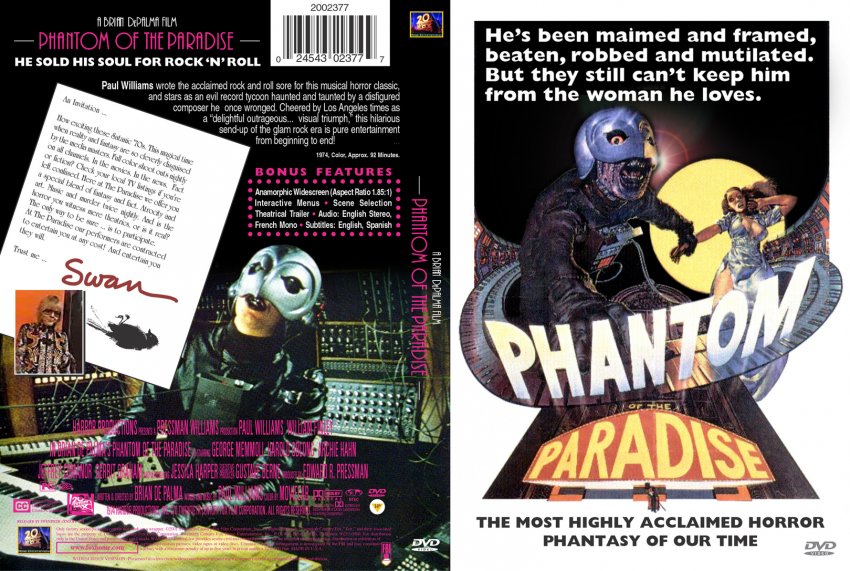
Ari Kahan's website devoted to Phantom of the Paradise (1974), The Swan Archives (www.swanarchives.org),4 has curated a collection of marketing materials that reanimates the era of this forgotten film's release. Launched in 2006 with the results of 30 years of collecting posters, stills, and other materials, the site functions not only as a resource for the film's fan community but also as its only surviving archive that creates and even defines a new audience for the film. Made up of over 400 pictures of objects, screengrabs, and detailed narratives of the film's genesis, production, marketing, and editing variants adding up to over 75,000 words, as explications of the film's themes, subtexts, and historical context it presents a comprehensive, exhaustive, and passionately rendered archive of the history and reception of the film and a film of its type in the mid-'70s cultural landscape, all in the absence of any attempts by the corporate rightsholders to do so.
2. RECORDING LIVE FOR THE SWAN ARCHIVES
Objects, Their Meanings, and the Importance of Timing
Working online, within view but beyond the traditional reach of normal gatekeepers of intellectual property, Kahan illustrates a new mode of archival behavior and engagement possible in digital environments that revivifies obsolete (in this case, intellectual) property and curates and recontextualizes it. At the same time, Kahan's efforts reflect a rather conservative and closed approach to how an archive is built and functions, in large part by taking pains to protect the assets from promiscuous sharing as well as the context in which they're viewed. By dint of his existence in a landscape that is relatively unexplored, Kahan engages the tension between how audiences and corporate rightsholders control, negotiate, and create new meanings surrounding their properties. His site allows audiences to engage with artifacts outside traditional archival walls; investigates how archival activity affects digital, personal, and other casual engagements with film texts; and points the way in which such sites create new narratives around the texts themselves.
Phantom of the Paradise, written and directed by Brian De Palma and starring Paul Williams, William Finley, and Jessica Harper, was released by 20th Century-Fox in 1974. Appearing amid the rich cultural tapestry that also included The Godfather Part II, Chinatown, The Towering Inferno, and The Texas Chainsaw Massacre, it was largely unsuccessful in finding a wide audience and was relegated to relative obscurity on the second half of double bills before being remarketed to secondary markets with a revamped ad campaign six months later.
A quirky, stylized, and fleet-footed if unwieldy blend of horror and fantasy taking place in a rock-and-roll setting, Phantom of the Paradise attracted the attention of horror film and science fiction fans rather than a teenage rock music audience. Its plot borrows predominantly from the 1943 and 1962 film versions of Gaston Leroux's The Phantom of the Opera5 as well as the German legend of Faust (the music mogul Swan played by Williams sells his soul for success). By virtue of its pop sensibilities, its fanciful critique of corporate greed, and its stylized filmmaking techniques (a harbinger of the Grand Guignol style Brian De Palma would develop to greater effect in Carrie [1976] and Scarface [1983]), the film slowly built a cult following. As a meta-narrative about popular music as well as a satire of celebrity culture that parodies the very elements that audiences might enjoy about it (flashy rock production numbers, fan worship), the film likely alienated the audiences it expected to attract, until a revised ad campaign repositioned the film as a horror/thriller as opposed to a musical (the Style C poster tagline is "He's been maimed and framed, beaten, robbed, and mutilated. But they still can't keep him from the woman he loves"). Moderately more successful, it attracted enough attention to be written up in various science fiction and film magazines.
To Read the Rest
by Roger Leatherwood
Bright Lights Film Journal
1. WHO CARES ABOUT NOSTALGIA ANYMORE?
Personal Archives in the Absence of a Corporate One
Prior to about 1980, Hollywood seemed perversely uninterested in its own history, inadvertently or intentionally neglecting its production materials (not to mention old film elements) that often were left rotting behind studio vault walls and taking up valuable real estate and given away or maybe dumped in the bay some foggy night. Since the advent of home video and the ever-increasing value of catalog titles, new digital (expensive to license, cheap to deliver) formats and the promise of the long tail, studios have increasingly strived to make their films and TV shows available to as wide an audience as possible for as long as possible, including offering merchandise that depicts the characters, graphics, and designs on any and all appropriate items from toys to smartphone cases. This constant upkeep of the presence of the brand of a filmed property in the culture keeps it in the public's memory, perhaps motivating sequels, spin-offs, and other ancillary revenue. And all this has to be archived and kept careful track of.
In some rare instances, producers have maintained archives, private or set up as museum spaces to display props, costumes, and other ephemera.1 But examples of industrial archival curation are sparse, and while the films themselves may enjoy an afterlife in repertory houses or at museum screenings, physical archives are seldom open and, unless they involve Stanley Kubrick or some other storied career, don't go on the road.2
Legacy production materials of motion pictures from draft scripts to set designs to production stills not intended for the public eye often end up forgotten, if they aren't purloined from under the noses of archivists who never notice them missing. The majority of productions dating from before the 1980s suffer from almost nonexistent archival profiles, and have no cultural presence. As a result they remain invisible to cultural memory. In the absence of digital or other marketing engagements now common to recent cross-platform franchise properties, marketing ephemera surrounding the releases ("collateral" to use the marketing term) gets fetishized as the proxy for favorite films, and authentic original posters for such films as King Kong (1933) to Star Wars (1977) go for thousands of dollars on auction sites,3 signifiers of the original and authentic industrial marketing impulse and of the cultural moment in which these were the only legitimate proxy outside of actual viewership.
Ari Kahan's website devoted to Phantom of the Paradise (1974), The Swan Archives (www.swanarchives.org),4 has curated a collection of marketing materials that reanimates the era of this forgotten film's release. Launched in 2006 with the results of 30 years of collecting posters, stills, and other materials, the site functions not only as a resource for the film's fan community but also as its only surviving archive that creates and even defines a new audience for the film. Made up of over 400 pictures of objects, screengrabs, and detailed narratives of the film's genesis, production, marketing, and editing variants adding up to over 75,000 words, as explications of the film's themes, subtexts, and historical context it presents a comprehensive, exhaustive, and passionately rendered archive of the history and reception of the film and a film of its type in the mid-'70s cultural landscape, all in the absence of any attempts by the corporate rightsholders to do so.
2. RECORDING LIVE FOR THE SWAN ARCHIVES
Objects, Their Meanings, and the Importance of Timing
Working online, within view but beyond the traditional reach of normal gatekeepers of intellectual property, Kahan illustrates a new mode of archival behavior and engagement possible in digital environments that revivifies obsolete (in this case, intellectual) property and curates and recontextualizes it. At the same time, Kahan's efforts reflect a rather conservative and closed approach to how an archive is built and functions, in large part by taking pains to protect the assets from promiscuous sharing as well as the context in which they're viewed. By dint of his existence in a landscape that is relatively unexplored, Kahan engages the tension between how audiences and corporate rightsholders control, negotiate, and create new meanings surrounding their properties. His site allows audiences to engage with artifacts outside traditional archival walls; investigates how archival activity affects digital, personal, and other casual engagements with film texts; and points the way in which such sites create new narratives around the texts themselves.
Phantom of the Paradise, written and directed by Brian De Palma and starring Paul Williams, William Finley, and Jessica Harper, was released by 20th Century-Fox in 1974. Appearing amid the rich cultural tapestry that also included The Godfather Part II, Chinatown, The Towering Inferno, and The Texas Chainsaw Massacre, it was largely unsuccessful in finding a wide audience and was relegated to relative obscurity on the second half of double bills before being remarketed to secondary markets with a revamped ad campaign six months later.
A quirky, stylized, and fleet-footed if unwieldy blend of horror and fantasy taking place in a rock-and-roll setting, Phantom of the Paradise attracted the attention of horror film and science fiction fans rather than a teenage rock music audience. Its plot borrows predominantly from the 1943 and 1962 film versions of Gaston Leroux's The Phantom of the Opera5 as well as the German legend of Faust (the music mogul Swan played by Williams sells his soul for success). By virtue of its pop sensibilities, its fanciful critique of corporate greed, and its stylized filmmaking techniques (a harbinger of the Grand Guignol style Brian De Palma would develop to greater effect in Carrie [1976] and Scarface [1983]), the film slowly built a cult following. As a meta-narrative about popular music as well as a satire of celebrity culture that parodies the very elements that audiences might enjoy about it (flashy rock production numbers, fan worship), the film likely alienated the audiences it expected to attract, until a revised ad campaign repositioned the film as a horror/thriller as opposed to a musical (the Style C poster tagline is "He's been maimed and framed, beaten, robbed, and mutilated. But they still can't keep him from the woman he loves"). Moderately more successful, it attracted enough attention to be written up in various science fiction and film magazines.
To Read the Rest
Friday, April 5, 2013
Naked Lunch #1: Divine Trash (John Waters special)
Divine Trash (John Waters special)
Naked Lunch #1

John Waters is a prolific film director, author, photographer and sometimes actor best known for his controversial films, the content of which have sometimes shocked and always entertained an international audience. Listen to the first episode of the Naked Lunch as we look over the director’s career in which nothing is sacred in his field of vision.
To Listen to the Episode

Naked Lunch #1
John Waters is a prolific film director, author, photographer and sometimes actor best known for his controversial films, the content of which have sometimes shocked and always entertained an international audience. Listen to the first episode of the Naked Lunch as we look over the director’s career in which nothing is sacred in his field of vision.
To Listen to the Episode
Tuesday, February 26, 2013
Films We Want to See #25: Let Fury Have the Hour (USA: Antonio D'Ambrosio, 2012)
Film Website
“Let fury have the hour/
Anger can be power/
Do you know that you can use it?”
– “The Clampdown,” The Clash
Rough, raw and unapologetically inspirational, LET FURY HAVE THE HOUR is a charged journey into the heart of the creative counter-culture in 2012. In a time of global challenges, big questions and by-the-numbers politics, this upbeat, outspoken film tracks the story of the artists, writers, thinkers and musicians who have gone underground to re-imagine the world – honing in on equality, community and engaged creativity – in exuberantly paradigm-busting ways.
Writer/director Antonino D’Ambrosio unites 50 powerful, of-the-moment voices –from street artist Shepard Fairey to rapper Chuck D to playwright Eve Ensler to musicians Tom Morello and Billy Bragg to novelist Edwidge Danticat to filmmaker John Sayles to comic Lewis Black – who share personal and powerful tales of how they transformed anger and angst into provocative art and ideas. Mix-mastered with historical footage, animation and performances, D’Ambrosio presents a visceral portrait of a generation looking to re-jigger a system that has failed to address the most pressing problems of our times . . . or human potential.
The story begins in the 1980s with the rise of Reagan and Thatcher — and a cultural shift towards fierce individualism and rampant consumerism. Coming of age in a world seemingly gone mad or at least gone shopping, some kids started searching for something more authentic. This was the start of a renegade movement D’Ambrosio calls “creative-response.” It was a hybrid, haphazard collective of skateboarders, punk rockers, rappers, street poets, feminists and graffitists whose reaction to this brave new world was not to turn away, but to turn up the volume and have their say.
Now that generation is coming to the fore, sparking a global movement focused not just on pushing the boundaries with guitars, paint, dance, storytelling, graphics and subcultural style – but on coming together around real reasons for hope.
Set to a stirring soundtrack from the film’s artists – including Rage Against The Machine, Public Enemy, Billy Bragg, Gogol Bordello, MC5, DJ Spooky and Sean Hayes – LET FURY HAVE THE HOUR is a fast and furious trip into the grass roots of art and activism, 21st Century style. The film is written and directed by author and visual artist Antonino D’Ambrosio in his feature debut. The producers are D’Ambrosio and James L. Reid and the executive producers are Jonathan Gray, Brian Devine, Rob McKay, Mark Urman and Chaz Zelus. The film features original music from composer and MC5 guitarist Wayne Kramer. A CAVU Pictures release.
“Let fury have the hour/
Anger can be power/
Do you know that you can use it?”
– “The Clampdown,” The Clash
Rough, raw and unapologetically inspirational, LET FURY HAVE THE HOUR is a charged journey into the heart of the creative counter-culture in 2012. In a time of global challenges, big questions and by-the-numbers politics, this upbeat, outspoken film tracks the story of the artists, writers, thinkers and musicians who have gone underground to re-imagine the world – honing in on equality, community and engaged creativity – in exuberantly paradigm-busting ways.
Writer/director Antonino D’Ambrosio unites 50 powerful, of-the-moment voices –from street artist Shepard Fairey to rapper Chuck D to playwright Eve Ensler to musicians Tom Morello and Billy Bragg to novelist Edwidge Danticat to filmmaker John Sayles to comic Lewis Black – who share personal and powerful tales of how they transformed anger and angst into provocative art and ideas. Mix-mastered with historical footage, animation and performances, D’Ambrosio presents a visceral portrait of a generation looking to re-jigger a system that has failed to address the most pressing problems of our times . . . or human potential.
The story begins in the 1980s with the rise of Reagan and Thatcher — and a cultural shift towards fierce individualism and rampant consumerism. Coming of age in a world seemingly gone mad or at least gone shopping, some kids started searching for something more authentic. This was the start of a renegade movement D’Ambrosio calls “creative-response.” It was a hybrid, haphazard collective of skateboarders, punk rockers, rappers, street poets, feminists and graffitists whose reaction to this brave new world was not to turn away, but to turn up the volume and have their say.
Now that generation is coming to the fore, sparking a global movement focused not just on pushing the boundaries with guitars, paint, dance, storytelling, graphics and subcultural style – but on coming together around real reasons for hope.
Set to a stirring soundtrack from the film’s artists – including Rage Against The Machine, Public Enemy, Billy Bragg, Gogol Bordello, MC5, DJ Spooky and Sean Hayes – LET FURY HAVE THE HOUR is a fast and furious trip into the grass roots of art and activism, 21st Century style. The film is written and directed by author and visual artist Antonino D’Ambrosio in his feature debut. The producers are D’Ambrosio and James L. Reid and the executive producers are Jonathan Gray, Brian Devine, Rob McKay, Mark Urman and Chaz Zelus. The film features original music from composer and MC5 guitarist Wayne Kramer. A CAVU Pictures release.
Monday, December 31, 2012
Julia Leyda: "Something That Is Dangerous and Arousing and Transgressive" - An Interview with Todd Haynes
"Something That Is Dangerous and Arousing and Transgressive": An Interview with Todd Haynes
by Julia Leyda
Bright Lights Film Journal
JULIA LEYDA: You've done several movies that are very clearly woman's films, but the movie that I am most fascinated with in terms of gender is Velvet Goldmine, which is not usually interpreted in that context.
TODD HAYNES: No, except it's probably gotten the strongest female fan base of any of my films. And what's wonderful for me is to see new generations of young women, even as we think we progress as a society and there are new options available to each new generation that seem to be catering to that market more acutely, still Velvet Goldmine offers that market something that they're not getting elsewhere. I always love it when girls come up to me at festivals and that's the one, that's the movie that really turned them around.
JL: I'm interested in how you use the trope of playing with dolls in Superstar and Velvet Goldmine as a way to figure gender, embodiment, desire, identification. You said in an interview that playing with dolls is what you're doing in Velvet Goldmine, using it as a metaphor for the filmmaking process, to play with the characters of the idols more than making an actual biopic about bisexual pop stars. So what about the female characters in Velvet Goldmine? Fans, rock and roll girls like Mandy — talk a bit about them.
TH: Interesting question. The character of Mandy was probably one of the hardest roles I've ever had to cast. We did a really thorough, international search for who could play Mandy. When I look back on the experience, I'm amazed at how many actresses agreed to read for the role who don't often do so. I think what was difficult about Mandy was that she, and the Angela Bowie template for that character, harkened back to a kind of performative femininity of which there are very few contemporary examples anymore. I see it as the Patti Smith divide in terms of rock and roll and public depictions of femininity, whose image emerged finally, after so many variations on the codified mannerisms that were available to women in midcentury American film, for instance, and popular music (although there have always been interesting deviations from this). I think over time a lot of the affectations associated with performing femininity had fallen away, to the point where you came to this iconic figure of Patti Smith, whom I see as similar in a way to the Jude figure in I'm Not There, a very androgynous, more masculine-identified figure. For young actresses reading the role of Mandy it became clear that recent examples of that kind of almost camp presentation of an affected, theatrical persona were very hard to locate; I think of Liza Minnelli, and maybe Parker Posey was one of the later examples, of almost a gay male idea of femininity.
One thing that was very interesting about Angela Bowie is the way she navigated the English and American influences and her accent would come and go, and that was one of the things we wanted to incorporate into the performance, but that's very tough on an actor. We wanted to make it understood that it's a mutable way of fixing into each culture with some fluidity. I mean, there's no question that Angela Bowie was a central driving engine — her autobiography is amazing, and it's supported by most of the documentation and oral histories of those years — in the transformation of David Bowie, who was experimenting with different kinds of feminine representations but ultimately fixed on this Warhol-infused figure of the Ziggy Stardust character. It was really Angela Bowie who championed these kinds of characters, part of the second-generation Warhol clan, who made their way to the UK and appeared in this play Pork in 1971. They just loved her and she loved them, and in a weird way Bowie was sort of a spectator, an observer of this love and energy. And I think, based on what she wrote in her book and other documentation, she was very interested in the gay liberation movement that was burgeoning at the time and she wanted to appropriate it, take it on, and become the spokesperson in a rock and roll vernacular for those ideas.
I don't know if this relates directly to doll-playing except that it really might be the last time that you see an active female figure freely utilizing artificial terms of self-expression and persona in an unembarrassed, unabashed, almost radical way. That was in a way the fascinating counterpart to the more aloof, silent, objectified figure that Bowie assumed as Ziggy Stardust. Of course, there was also that hardcore influence from the American music that he loved — the Stooges, the MC5, and the Velvet Underground and Lou Reed — as the final ingredient to give it that kind of duality, the cross between English musical traditions and this American hardcore, a direct assault. He needed both of those, but there was still a kind of passivity and object-ness of that figure that seemed more quiet, and more comfortable being an image, an idealized beautiful façade that people could project onto; whereas Angela Bowie was active, pulling the strings and moving the levers — in that way, I think, making him up so that he was the doll that she was playing with. So a lot of that energy and that fire and fearlessness I think could be attributed to her.
To Read the Rest of the Essay

by Julia Leyda
Bright Lights Film Journal
JULIA LEYDA: You've done several movies that are very clearly woman's films, but the movie that I am most fascinated with in terms of gender is Velvet Goldmine, which is not usually interpreted in that context.
TODD HAYNES: No, except it's probably gotten the strongest female fan base of any of my films. And what's wonderful for me is to see new generations of young women, even as we think we progress as a society and there are new options available to each new generation that seem to be catering to that market more acutely, still Velvet Goldmine offers that market something that they're not getting elsewhere. I always love it when girls come up to me at festivals and that's the one, that's the movie that really turned them around.
JL: I'm interested in how you use the trope of playing with dolls in Superstar and Velvet Goldmine as a way to figure gender, embodiment, desire, identification. You said in an interview that playing with dolls is what you're doing in Velvet Goldmine, using it as a metaphor for the filmmaking process, to play with the characters of the idols more than making an actual biopic about bisexual pop stars. So what about the female characters in Velvet Goldmine? Fans, rock and roll girls like Mandy — talk a bit about them.
TH: Interesting question. The character of Mandy was probably one of the hardest roles I've ever had to cast. We did a really thorough, international search for who could play Mandy. When I look back on the experience, I'm amazed at how many actresses agreed to read for the role who don't often do so. I think what was difficult about Mandy was that she, and the Angela Bowie template for that character, harkened back to a kind of performative femininity of which there are very few contemporary examples anymore. I see it as the Patti Smith divide in terms of rock and roll and public depictions of femininity, whose image emerged finally, after so many variations on the codified mannerisms that were available to women in midcentury American film, for instance, and popular music (although there have always been interesting deviations from this). I think over time a lot of the affectations associated with performing femininity had fallen away, to the point where you came to this iconic figure of Patti Smith, whom I see as similar in a way to the Jude figure in I'm Not There, a very androgynous, more masculine-identified figure. For young actresses reading the role of Mandy it became clear that recent examples of that kind of almost camp presentation of an affected, theatrical persona were very hard to locate; I think of Liza Minnelli, and maybe Parker Posey was one of the later examples, of almost a gay male idea of femininity.
One thing that was very interesting about Angela Bowie is the way she navigated the English and American influences and her accent would come and go, and that was one of the things we wanted to incorporate into the performance, but that's very tough on an actor. We wanted to make it understood that it's a mutable way of fixing into each culture with some fluidity. I mean, there's no question that Angela Bowie was a central driving engine — her autobiography is amazing, and it's supported by most of the documentation and oral histories of those years — in the transformation of David Bowie, who was experimenting with different kinds of feminine representations but ultimately fixed on this Warhol-infused figure of the Ziggy Stardust character. It was really Angela Bowie who championed these kinds of characters, part of the second-generation Warhol clan, who made their way to the UK and appeared in this play Pork in 1971. They just loved her and she loved them, and in a weird way Bowie was sort of a spectator, an observer of this love and energy. And I think, based on what she wrote in her book and other documentation, she was very interested in the gay liberation movement that was burgeoning at the time and she wanted to appropriate it, take it on, and become the spokesperson in a rock and roll vernacular for those ideas.
I don't know if this relates directly to doll-playing except that it really might be the last time that you see an active female figure freely utilizing artificial terms of self-expression and persona in an unembarrassed, unabashed, almost radical way. That was in a way the fascinating counterpart to the more aloof, silent, objectified figure that Bowie assumed as Ziggy Stardust. Of course, there was also that hardcore influence from the American music that he loved — the Stooges, the MC5, and the Velvet Underground and Lou Reed — as the final ingredient to give it that kind of duality, the cross between English musical traditions and this American hardcore, a direct assault. He needed both of those, but there was still a kind of passivity and object-ness of that figure that seemed more quiet, and more comfortable being an image, an idealized beautiful façade that people could project onto; whereas Angela Bowie was active, pulling the strings and moving the levers — in that way, I think, making him up so that he was the doll that she was playing with. So a lot of that energy and that fire and fearlessness I think could be attributed to her.
To Read the Rest of the Essay
Tuesday, November 20, 2012
Robert Fowler: Artifact - A musician’s struggle against a giant corporation
Artifact: A musician’s struggle against a giant corporation
By Robert Fowler
World Socialist Web Site
Jared Leto is perhaps best known to the general public for his work as a film actor, most notably in David Fincher’s Fight Club (1999) and Darren Aronofsky’s Requiem for a Dream (2000). However, in recent years he has devoted his attention to the world of music, as the lead singer of Thirty Seconds to Mars.
Artifact, directed by Leto himself, under the pseudonym Bartholomew Cubbins (of Dr. Seuss fame), revolves around major record label EMI’s decision to sue the band for $30 million in August 2008. The film was screened November 8 as part of the New York City documentary festival DOC NYC and previously, in September, at the Toronto film festival.
The “crime” committed by Leto’s group was simply wanting to excuse themselves from their existing, demonstrably illegitimate contract. EMI, however, claimed that Thirty Seconds to Mars had failed to deliver the three albums required by their agreement.
Leto and his band mates were understandably aggrieved at the fact that having sold over 2 million albums at the time of being taken to court, they had not received a penny in royalties and … were still $1.4 million in debt to EMI. This, as the film makes clear, is the standard operating procedure of the record companies, who are in the business, as one commentator notes, “of not paying musicians.”
Leto explained the predicament on the band’s web site: “We had been signed with them [EMI] for nine years. Under California law, where we lived and signed our deal one cannot be bound to a contract for more than seven years. …
“Yes, we have been sued by EMI. But NOT for failing to deliver music or for ‘quitting’. We have been sued by the corporation quite simply because roughly 45 days ago we exercised our legal right to terminate our old, out of date contract, which according to the law is null and void.
“We terminated for a number of reasons, which we won’t go into here (we’d rather not air dirty laundry) but basically our representatives could not get EMI to agree to make a fair and reasonable deal.”
Thirty Second to Mars’ struggle with EMI commenced just as the financial crisis erupted. The filming of what would become Artifact also began at that time and Leto, with a certain degree of self-importance, draws parallels between the plight of the band and global economic crisis. “As we are trying to make a deal with EMI the world is falling apart,” he comments. Nonetheless, insofar as the musician denounces the record giants and Wall Street as part of the same problem, he is on to something.
To Read the Rest of the Review
By Robert Fowler
World Socialist Web Site
Jared Leto is perhaps best known to the general public for his work as a film actor, most notably in David Fincher’s Fight Club (1999) and Darren Aronofsky’s Requiem for a Dream (2000). However, in recent years he has devoted his attention to the world of music, as the lead singer of Thirty Seconds to Mars.
Artifact, directed by Leto himself, under the pseudonym Bartholomew Cubbins (of Dr. Seuss fame), revolves around major record label EMI’s decision to sue the band for $30 million in August 2008. The film was screened November 8 as part of the New York City documentary festival DOC NYC and previously, in September, at the Toronto film festival.
The “crime” committed by Leto’s group was simply wanting to excuse themselves from their existing, demonstrably illegitimate contract. EMI, however, claimed that Thirty Seconds to Mars had failed to deliver the three albums required by their agreement.
Leto and his band mates were understandably aggrieved at the fact that having sold over 2 million albums at the time of being taken to court, they had not received a penny in royalties and … were still $1.4 million in debt to EMI. This, as the film makes clear, is the standard operating procedure of the record companies, who are in the business, as one commentator notes, “of not paying musicians.”
Leto explained the predicament on the band’s web site: “We had been signed with them [EMI] for nine years. Under California law, where we lived and signed our deal one cannot be bound to a contract for more than seven years. …
“Yes, we have been sued by EMI. But NOT for failing to deliver music or for ‘quitting’. We have been sued by the corporation quite simply because roughly 45 days ago we exercised our legal right to terminate our old, out of date contract, which according to the law is null and void.
“We terminated for a number of reasons, which we won’t go into here (we’d rather not air dirty laundry) but basically our representatives could not get EMI to agree to make a fair and reasonable deal.”
Thirty Second to Mars’ struggle with EMI commenced just as the financial crisis erupted. The filming of what would become Artifact also began at that time and Leto, with a certain degree of self-importance, draws parallels between the plight of the band and global economic crisis. “As we are trying to make a deal with EMI the world is falling apart,” he comments. Nonetheless, insofar as the musician denounces the record giants and Wall Street as part of the same problem, he is on to something.
To Read the Rest of the Review
Tuesday, October 16, 2012
Spoiler Alert Radio: Paul Rachman - Acclaimed Filmmaker and Co-Founder of the Slamdance
Paul Rachman - Acclaimed Filmmaker and Co-Founder of the Slamdance - Drive Baby Drive, Four Dogs Playing Poker, Zoe XO/Zoe Rising, American Hardcore
Spoiler Alert Radio

Paul Rachman, filmmaker and co-founder of Slamdance, began his film career making underground hardcore punk films and music videos for bands such as Bad Brains, Gang Green, Negative FX, and Mission of Burma.
Paul quickly rose to become one of the of the industry's top music video directors at Propaganda Films in Los Angeles, where he worked with such artists as: Alice in Chains, The Replacements, Pantera, Temple of the Dog, Sepultura, Roger Waters, Joan Jett, and Kiss.
Paul has directed several award-winning short films, including: Memories with Joe Frank, Drive Baby Drive, Home, and Zoe XO. Paul has also directed the narrative feature Four Dogs Playing Poker.
Paul’s seminal punk documentary American Hardcore world premiered at the Sundance Film Festival and was picked up and theatrically released by Sony Pictures Classics.
Paul is working on a new documentary with American Hardcore writer Steven Blush, Lost Rockers, about great musiciaans over the years that have been overlooked by pop culture.
To Listen to the Episode
Spoiler Alert Radio
Paul Rachman, filmmaker and co-founder of Slamdance, began his film career making underground hardcore punk films and music videos for bands such as Bad Brains, Gang Green, Negative FX, and Mission of Burma.
Paul quickly rose to become one of the of the industry's top music video directors at Propaganda Films in Los Angeles, where he worked with such artists as: Alice in Chains, The Replacements, Pantera, Temple of the Dog, Sepultura, Roger Waters, Joan Jett, and Kiss.
Paul has directed several award-winning short films, including: Memories with Joe Frank, Drive Baby Drive, Home, and Zoe XO. Paul has also directed the narrative feature Four Dogs Playing Poker.
Paul’s seminal punk documentary American Hardcore world premiered at the Sundance Film Festival and was picked up and theatrically released by Sony Pictures Classics.
Paul is working on a new documentary with American Hardcore writer Steven Blush, Lost Rockers, about great musiciaans over the years that have been overlooked by pop culture.
To Listen to the Episode
Monday, October 1, 2012
Joseph McBride: Political Filmmaking and America's "Poisoned Chalice" -- The Banned Gore Vidal Interview
Political Filmmaking and America's "Poisoned Chalice": The Banned Gore Vidal Interview
by Joseph McBride
Bright Lights Film Journal

...
The good news is that, as a result, it is becoming easier to make movies about politics: "There is a real chance, because the country's falling apart very rapidly. Audiences are going to be drawn either toward total Spielbergism — total escape from their fear of losing their jobs, fear of walking down the street — or to things that speak to them and bother them.
"It has to be done ingeniously, because if it's done like a civics lesson, it will put people to sleep."
Looking back over the spectrum of American political filmmaking, Vidal can find little enough that's been done ingeniously: "The few I know of which are realistic — as opposed to being Frank Capra fantasies or fairy tales — are Citizen Kane for the '40s, my own The Best Man for the '60s, The Candidate for the '70s, Tanner '88 for the '80s and now Bob Roberts for the '90s."
Bob Roberts, writer-director-star Tim Robbins' scathing satire of our current political malaise, offers in Robbins' folksinger-politician the most credible portrait of an American fascist I've seen in any movie since Edward Arnold's newspaper tycoon and political boss in Capra and Robert Riskin's 1941 Meet John Doe. Though distributed by Paramount in conjunction with Miramax, the low-budget ($4 million) Bob Roberts was made independently, with half the money coming from the U.K. after Robbins shopped the script around the conventional studio route without success.
It's amazing that a mass-market film was made on this subject, since it deals with issues usually addressed only in the alternative media — issues such as the systemic corruption of the establishment media and political institutions and the cynical manipulation of public sentiment in favor of the Gulf War.
To Read the Rest of the Interview
by Joseph McBride
Bright Lights Film Journal
...
The good news is that, as a result, it is becoming easier to make movies about politics: "There is a real chance, because the country's falling apart very rapidly. Audiences are going to be drawn either toward total Spielbergism — total escape from their fear of losing their jobs, fear of walking down the street — or to things that speak to them and bother them.
"It has to be done ingeniously, because if it's done like a civics lesson, it will put people to sleep."
Looking back over the spectrum of American political filmmaking, Vidal can find little enough that's been done ingeniously: "The few I know of which are realistic — as opposed to being Frank Capra fantasies or fairy tales — are Citizen Kane for the '40s, my own The Best Man for the '60s, The Candidate for the '70s, Tanner '88 for the '80s and now Bob Roberts for the '90s."
Bob Roberts, writer-director-star Tim Robbins' scathing satire of our current political malaise, offers in Robbins' folksinger-politician the most credible portrait of an American fascist I've seen in any movie since Edward Arnold's newspaper tycoon and political boss in Capra and Robert Riskin's 1941 Meet John Doe. Though distributed by Paramount in conjunction with Miramax, the low-budget ($4 million) Bob Roberts was made independently, with half the money coming from the U.K. after Robbins shopped the script around the conventional studio route without success.
It's amazing that a mass-market film was made on this subject, since it deals with issues usually addressed only in the alternative media — issues such as the systemic corruption of the establishment media and political institutions and the cynical manipulation of public sentiment in favor of the Gulf War.
To Read the Rest of the Interview
Sunday, September 23, 2012
Naked Lunch Radio #12 – Superstar! The Todd Haynes Story
Naked Lunch Radio #12 – Superstar! The Todd Haynes Story
Sound on Sight

... a very special look at director Todd Haynes and all his movies from Velvet Goldmine to his new smash hit I’m Not There. A ton of great queer related Canadian rock and enough Dylan cover songs to keep you warm under the cold winter.
Hosted by Crystina Benyo & Sic Ric!
To Listen the Episode

Sound on Sight
... a very special look at director Todd Haynes and all his movies from Velvet Goldmine to his new smash hit I’m Not There. A ton of great queer related Canadian rock and enough Dylan cover songs to keep you warm under the cold winter.
Hosted by Crystina Benyo & Sic Ric!
To Listen the Episode
Saturday, August 18, 2012
Saturday, August 11, 2012
Tuesday, July 31, 2012
Reverse Shot: Deep Red -- Joanne Nucho on The Color of Pomegranates
Deep Red: Joanne Nucho on The Color of Pomegranates
Reverse Shot
 Steeped in religious iconography, The Color of Pomegranates is a deeply spiritual testament to director Sergei Parajanov’s fascination with Armenian folk art and culture. It is also a controversial work, which, coupled with another of his films, Shadows of our Forgotten Ancestors, led to his arrest and imprisonment in a Soviet Gulag for four years. The Soviets insisted he was guilty of selling gold and icons illegally and committing “homosexual acts.” In reality, his only crime was offending the tenets of socialist realism, both in his daring surrealistic form and in his choice of subject matter. While many of the popular films of this era in Soviet cinema were largely propaganda designed to serve the ideological interests of the regime, Parajanov chose to focus on the ethnography and spirituality of the Ukraine, Armenia, and Georgia.
The Color of Pomegranates is a poetic, dreamlike film that sought to portray the life of Armenian troubadour Sayat Nova through images inspired by his life and poetry. Born Haroutiun Sayakian, he is remembered as Sayat Nova or “king of songs.” Raised in the Georgian city of Tiflis (as was Sergei Parajanov himself), Sayat Nova performed in the Armenian, Azerbaijani, and Persian languages. This brought him fame beyond the Armenian community and he was summoned to serve as Court Musician and Poet by Heracle II, the 18th- century king of Georgia. After falling in love with the king’s sister, Princess Anna, he was expelled from the court. He spent the rest of his life as a monk where he continued to write poetry and music. To the Armenian people, Sayat Nova is considered a martyr because he was executed by the invading Persians for refusing to renounce his Christian faith.
Parajanov’s decision to make a film about the life of an Armenian poet and martyr was a dangerous one. Armenian national identity was not to be prioritized—it was viewed as only a part of the Soviet Union. The idea of Armenian independence and secession from the Soviet Union was still dangerous and punishable by death. The lack of a Soviet presence, or any other typical themes of the propaganda films of the time, marked The Color of Pomegranates as a subversive work.
The text of the film, the poetry of Sayat Nova, and the life of director Sergei Parajanov are all reflections of the Armenian national identity, which is itself deeply connected to the Christian faith, as they were the first “nation” in the world to adopt the religion, in the year 301. Surrounded by largely Muslim populations, they were an easy target for invasion and subjugation by their neighbors. The paradigm of Christianity, the images of the suffering of Christ and subsequent salvation—most recently exacerbated by the Armenian genocide perpetrated by Turkey at the beginning of the last century—are at the core of Armenian individuality.
So what is the color of pomegranates? As the film opens, we see thorns intercut with images of pomegranates soaking a white cloth with their juice, a deep blood red. Then we see a dagger resting upon this same, stained cloth. A voice reads from the poetry of Sayat Nova: “I am a man whose soul is tormented.” In Armenian mythology, the pomegranate was a symbol of fertility, literally fruitfulness—it is said that a ripe pomegranate contains 365 seeds, one for each day of the year. The thorns are those of the crown that Christ wore as he suffered on the cross. The two are inseparable, bound closely by the image of bloodshed, the inevitable fate of the Armenian people—here there is only sacrifice and suffering. Later in the film a priest wearing the traditional black garb of the Armenian apostolic church utters “heaven has deemed that sorrow be our lot.” With the camera set at a distance, the monks gather before him, also cloaked in black, shroud-like robes fall on their knees. Everywhere there is death, darkness, disaster—and yet, a feeling that the biggest disaster, the ultimate catastrophe is still to come.
To Read the Rest of the Essay
Reverse Shot
Steeped in religious iconography, The Color of Pomegranates is a deeply spiritual testament to director Sergei Parajanov’s fascination with Armenian folk art and culture. It is also a controversial work, which, coupled with another of his films, Shadows of our Forgotten Ancestors, led to his arrest and imprisonment in a Soviet Gulag for four years. The Soviets insisted he was guilty of selling gold and icons illegally and committing “homosexual acts.” In reality, his only crime was offending the tenets of socialist realism, both in his daring surrealistic form and in his choice of subject matter. While many of the popular films of this era in Soviet cinema were largely propaganda designed to serve the ideological interests of the regime, Parajanov chose to focus on the ethnography and spirituality of the Ukraine, Armenia, and Georgia.The Color of Pomegranates is a poetic, dreamlike film that sought to portray the life of Armenian troubadour Sayat Nova through images inspired by his life and poetry. Born Haroutiun Sayakian, he is remembered as Sayat Nova or “king of songs.” Raised in the Georgian city of Tiflis (as was Sergei Parajanov himself), Sayat Nova performed in the Armenian, Azerbaijani, and Persian languages. This brought him fame beyond the Armenian community and he was summoned to serve as Court Musician and Poet by Heracle II, the 18th- century king of Georgia. After falling in love with the king’s sister, Princess Anna, he was expelled from the court. He spent the rest of his life as a monk where he continued to write poetry and music. To the Armenian people, Sayat Nova is considered a martyr because he was executed by the invading Persians for refusing to renounce his Christian faith.
Parajanov’s decision to make a film about the life of an Armenian poet and martyr was a dangerous one. Armenian national identity was not to be prioritized—it was viewed as only a part of the Soviet Union. The idea of Armenian independence and secession from the Soviet Union was still dangerous and punishable by death. The lack of a Soviet presence, or any other typical themes of the propaganda films of the time, marked The Color of Pomegranates as a subversive work.
The text of the film, the poetry of Sayat Nova, and the life of director Sergei Parajanov are all reflections of the Armenian national identity, which is itself deeply connected to the Christian faith, as they were the first “nation” in the world to adopt the religion, in the year 301. Surrounded by largely Muslim populations, they were an easy target for invasion and subjugation by their neighbors. The paradigm of Christianity, the images of the suffering of Christ and subsequent salvation—most recently exacerbated by the Armenian genocide perpetrated by Turkey at the beginning of the last century—are at the core of Armenian individuality.
So what is the color of pomegranates? As the film opens, we see thorns intercut with images of pomegranates soaking a white cloth with their juice, a deep blood red. Then we see a dagger resting upon this same, stained cloth. A voice reads from the poetry of Sayat Nova: “I am a man whose soul is tormented.” In Armenian mythology, the pomegranate was a symbol of fertility, literally fruitfulness—it is said that a ripe pomegranate contains 365 seeds, one for each day of the year. The thorns are those of the crown that Christ wore as he suffered on the cross. The two are inseparable, bound closely by the image of bloodshed, the inevitable fate of the Armenian people—here there is only sacrifice and suffering. Later in the film a priest wearing the traditional black garb of the Armenian apostolic church utters “heaven has deemed that sorrow be our lot.” With the camera set at a distance, the monks gather before him, also cloaked in black, shroud-like robes fall on their knees. Everywhere there is death, darkness, disaster—and yet, a feeling that the biggest disaster, the ultimate catastrophe is still to come.
To Read the Rest of the Essay
Michael J. Anderson on Moonrise Kingdom
Moonrise Kingdom (2012)
by Michael J. Anderson
Tativille

A gesamtkunstwerk or 'total art work' constructed from American folk and craft traditions much more than the classical arts, Wes Anderson's Moonrise Kingdom (2012), from an original screenplay by Anderson and Roman Coppola, builds its diegetic world of hobbyist watercolors and kitsch nautical prints, primary school literature and amateur theatrics, homemade costuming and mass-manufactured Davy Crockett coonskin, Protestant church architecture and stained glass, Hank Williams and children's records. Moonrise Kingdom, however, is also dominated by mid-century English composer Benjamin Britten, who provides the most conspicuous exception to the picture's cultivated, if still semi-fictionalized 'Americanness,' not to mention its clear preference for more popular lower forms. In fact, it is Britten's modernist art foremost that provides Anderson's film with its governing aesthetic principles and climactic subject matter.
As to the former, it is Britten, along with the name-checked Gilbert and Sullivan - Moonrise Kingdom largely is set on the fictional island of New Penzance - who offers a model for artistic synthesis in the operatic form that is presented in the in-film production of Noye's Fludde. (Britten also composed original music for that other total art, cinema, with his collaborations on Alberto Cavalcanti's 1935 Coal Face and Basil Wright and Henry Watt's 1936 Night Mail being the most notable.) Likewise, it is the diegetic presentation of Britten's pedagogical-experimental Young Person's Guide to the Orchestra, early and late in the film, which telegraphs Moonrise Kingdom's own quasi-Brechtian separation of elements, with Mainer-type Bob Balaban, for example, presenting the film's narration in omniscient, on-screen direct address rather than in the more traditional voice-over.
With respect to the film's subject, it is Noye's Fludde, a "miracle play" that the director acted in during his adolescent years - in this sense it provides a means of accessing the filmmaker's personal history; a means of conjugating the aesthetic with the autobiographic - which is refashioned in the image of Anderson's arch narrative: the broken, in one sense or another, family unit that is reaffirmed if not actually reconstituted at picture's end. In Moonrise Kingdom we have both examples - however tentatively in the case of the former - with twelve year-old runaway "khaki scout" Sam (Jared Gilman) ultimately finding a new foster father in bachelor police-captain Sharp (Bruce Willis). Anderson indeed recomposes his new family following "the region's worst meteorological disaster of the second half of the twentieth century," a 1965 hurricane of Biblical proportions that comes as the small island community is preparing for its annual production of the Britten opera. In Max Fischer lookalike Sam and the clear-rimmed spectacled Captain Sharp (see the director), Anderson seems to be replaying both his own biographical-cinematic past, while also filtering his personal experience of divorce during his childhood years through the young lead. Moonrise Kingdom certainly qualifies as a deeply psychoanalytic cinema, though a cinema that has been displaced not only onto a faux-New England setting, but also four years before the Texan Anderson's birth.
Moonrise Kingdom is no less notable as an emblematic narrative for Anderson's "Generation X," both in terms of that familial breakdown that disproportionately impacted the children of the 1970s and also of the post-modern culture that would reach its cinematic apogee amid and immediately after the peak of the VHS era. Anderson's postmodernism to be sure is ever apparent in Moonrise Kingdom's constituent combination of high art and kitsch, in his narrative taste for inventory (and letter writing) and what amounts on some level to his construction of joke diegetic worlds. In his exploration of the latter, Anderson shows a predilection for fluid, metronymic camera movements, flash pans and hard comedic cuts, whether he is mapping the dollhouse-like space in which the lead Bishop family resides at Summer's End or showcasing Camp Ivanhoe to the rhythmic beat of a snare drum. As with Rushmore (1998) and the four features that would follow it, Moonrise Kingdom emphasizes the artifice which provides the major-key for Anderson's art; there is in his latest, as ever, a very strong sense of an extrinsic narrator behind this fetishized, if still largely invented world. His is a cinema of aesthetic mediation.
To Read the Rest of the Essay
by Michael J. Anderson
Tativille
A gesamtkunstwerk or 'total art work' constructed from American folk and craft traditions much more than the classical arts, Wes Anderson's Moonrise Kingdom (2012), from an original screenplay by Anderson and Roman Coppola, builds its diegetic world of hobbyist watercolors and kitsch nautical prints, primary school literature and amateur theatrics, homemade costuming and mass-manufactured Davy Crockett coonskin, Protestant church architecture and stained glass, Hank Williams and children's records. Moonrise Kingdom, however, is also dominated by mid-century English composer Benjamin Britten, who provides the most conspicuous exception to the picture's cultivated, if still semi-fictionalized 'Americanness,' not to mention its clear preference for more popular lower forms. In fact, it is Britten's modernist art foremost that provides Anderson's film with its governing aesthetic principles and climactic subject matter.
As to the former, it is Britten, along with the name-checked Gilbert and Sullivan - Moonrise Kingdom largely is set on the fictional island of New Penzance - who offers a model for artistic synthesis in the operatic form that is presented in the in-film production of Noye's Fludde. (Britten also composed original music for that other total art, cinema, with his collaborations on Alberto Cavalcanti's 1935 Coal Face and Basil Wright and Henry Watt's 1936 Night Mail being the most notable.) Likewise, it is the diegetic presentation of Britten's pedagogical-experimental Young Person's Guide to the Orchestra, early and late in the film, which telegraphs Moonrise Kingdom's own quasi-Brechtian separation of elements, with Mainer-type Bob Balaban, for example, presenting the film's narration in omniscient, on-screen direct address rather than in the more traditional voice-over.
With respect to the film's subject, it is Noye's Fludde, a "miracle play" that the director acted in during his adolescent years - in this sense it provides a means of accessing the filmmaker's personal history; a means of conjugating the aesthetic with the autobiographic - which is refashioned in the image of Anderson's arch narrative: the broken, in one sense or another, family unit that is reaffirmed if not actually reconstituted at picture's end. In Moonrise Kingdom we have both examples - however tentatively in the case of the former - with twelve year-old runaway "khaki scout" Sam (Jared Gilman) ultimately finding a new foster father in bachelor police-captain Sharp (Bruce Willis). Anderson indeed recomposes his new family following "the region's worst meteorological disaster of the second half of the twentieth century," a 1965 hurricane of Biblical proportions that comes as the small island community is preparing for its annual production of the Britten opera. In Max Fischer lookalike Sam and the clear-rimmed spectacled Captain Sharp (see the director), Anderson seems to be replaying both his own biographical-cinematic past, while also filtering his personal experience of divorce during his childhood years through the young lead. Moonrise Kingdom certainly qualifies as a deeply psychoanalytic cinema, though a cinema that has been displaced not only onto a faux-New England setting, but also four years before the Texan Anderson's birth.
Moonrise Kingdom is no less notable as an emblematic narrative for Anderson's "Generation X," both in terms of that familial breakdown that disproportionately impacted the children of the 1970s and also of the post-modern culture that would reach its cinematic apogee amid and immediately after the peak of the VHS era. Anderson's postmodernism to be sure is ever apparent in Moonrise Kingdom's constituent combination of high art and kitsch, in his narrative taste for inventory (and letter writing) and what amounts on some level to his construction of joke diegetic worlds. In his exploration of the latter, Anderson shows a predilection for fluid, metronymic camera movements, flash pans and hard comedic cuts, whether he is mapping the dollhouse-like space in which the lead Bishop family resides at Summer's End or showcasing Camp Ivanhoe to the rhythmic beat of a snare drum. As with Rushmore (1998) and the four features that would follow it, Moonrise Kingdom emphasizes the artifice which provides the major-key for Anderson's art; there is in his latest, as ever, a very strong sense of an extrinsic narrator behind this fetishized, if still largely invented world. His is a cinema of aesthetic mediation.
To Read the Rest of the Essay
Wednesday, April 11, 2012
Naked Lunch Radio #9 – Minnesota Madness (Coen special)
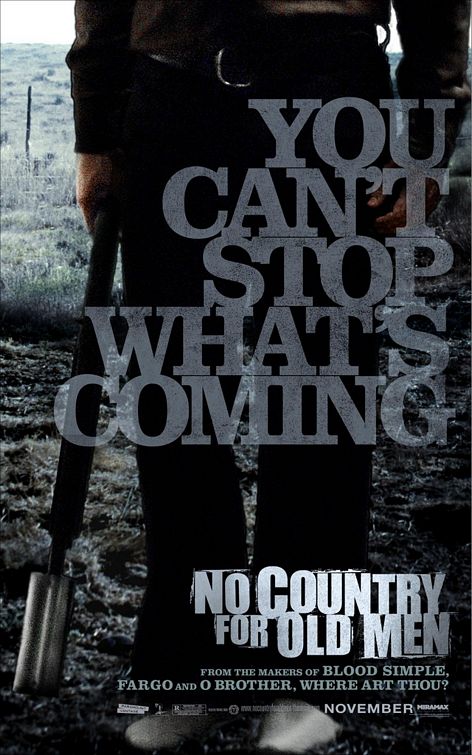
[Discussion of the Coen Brothers more serious films up to No Country for Old Men with a healthy dose of music by Minnesota musicians]
Naked Lunch Radio #9 – Minnesota Madness (Coen special)
Sound on Sight
To Listen to the Episode
Naked Lunch Radio #9 – Minnesota Madness (Coen special)
Sound on Sight
To Listen to the Episode
Tuesday, April 3, 2012
Naked Lunch Radio #7 – Transmission
Naked Lunch Radio #7 – Transmission
Sound on Sight

Reviews on the movies Control, 24 Hour Party People and a look back at the Manchester music scene of the late 70`s and early 80`s.
To Listen to the Episode

Sound on Sight
Reviews on the movies Control, 24 Hour Party People and a look back at the Manchester music scene of the late 70`s and early 80`s.
To Listen to the Episode
Tuesday, March 20, 2012
Matt Zoller Seitz: The Substance of Style (Wes Anderson)
The Substance of Style, Pt 1: Wes Anderson and his pantheon of heroes (Schulz, Welles, Truffaut)
by Matt Zoller Seitz
Moving Image Source


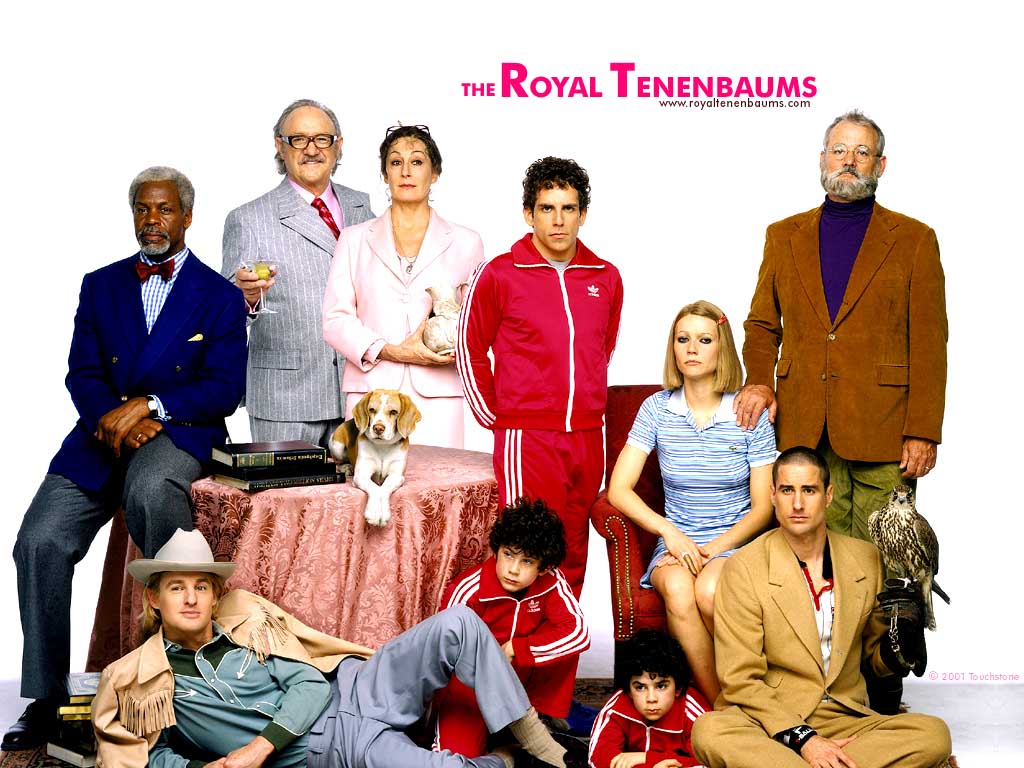
This is the first in a five-part series of video essays analyzing the key influences on Wes Anderson’s style. Part 2 covers Martin Scorsese, Richard Lester, and Mike Nichols. Part 3 covers Hal Ashby. Part 4 covers J.D. Salinger. Part 5 is an annotated version of the prologue to The Royal Tenenbaums.
With just five features in 13 years, Wes Anderson has established himself as the most influential American filmmaker of the post-Baby Boom generation. Supremely confident in his knowledge of film history and technique, he's a classic example of the sort of filmmaker that the Cahiers du cinéma critics labeled an auteur—an artist who imprints his personality and preoccupations on each work so strongly that, whatever the contributions of his collaborators, he deserves to be considered the primary author of the film. This series examines some of Anderson's many cinematic influences and his attempt to meld them into a striking, uniquely personal sensibility.
After the release of his second film, Rushmore, in 1998, it became obvious that Anderson was, love him or hate him, an idiosyncratic filmmaker worth discussing. In the decade-plus since then, dissecting Anderson's influences, and Anderson's influence on others, has become a bit of a parlor sport among cinephiles. Sight and Sound and Film Comment have been particularly rich resources. More recently, the Onion A.V. Club contributed a couple of playful, astute lists. Anderson himself has gotten into the act by paying tribute to his heroes in interviews and magazine articles.
This series will take the process a step further, juxtaposing Anderson's cultural influences against his films onscreen, the better to show how he integrates a staggeringly diverse array of source material into a recognizable, and widely imitated, whole. It will examine some, but certainly not all, of Anderson's evident inspirations. Along the way, it may incidentally illuminate why Anderson-esque movies—from Garden State to Son of Rambow—can seem, no matter what their virtues or pleasures, a weak substitute for the real thing.
Anderson’s scavenger-hunt aesthetic stands him in good company, alongside Quentin Tarantino, David Gordon Green, James Gray, and the other Anderson, P.T. But what makes Wes Anderson distinctive is the sheer range of art that has fed his imagination—not just recent American and foreign films, but films from 30, 50, even 70 years ago, plus newspaper comics, illustrations, and fiction. The spectrum of influence gives his work a diversity of tone that his imitators typically lack. It is a style of substance.
To Watch the Video Essay and Access all Five Parts

More resources:
Sound on Sight: Naked Lunch Radio #4 – Wes Anderson (The music of his films)
by Matt Zoller Seitz
Moving Image Source
This is the first in a five-part series of video essays analyzing the key influences on Wes Anderson’s style. Part 2 covers Martin Scorsese, Richard Lester, and Mike Nichols. Part 3 covers Hal Ashby. Part 4 covers J.D. Salinger. Part 5 is an annotated version of the prologue to The Royal Tenenbaums.
With just five features in 13 years, Wes Anderson has established himself as the most influential American filmmaker of the post-Baby Boom generation. Supremely confident in his knowledge of film history and technique, he's a classic example of the sort of filmmaker that the Cahiers du cinéma critics labeled an auteur—an artist who imprints his personality and preoccupations on each work so strongly that, whatever the contributions of his collaborators, he deserves to be considered the primary author of the film. This series examines some of Anderson's many cinematic influences and his attempt to meld them into a striking, uniquely personal sensibility.
After the release of his second film, Rushmore, in 1998, it became obvious that Anderson was, love him or hate him, an idiosyncratic filmmaker worth discussing. In the decade-plus since then, dissecting Anderson's influences, and Anderson's influence on others, has become a bit of a parlor sport among cinephiles. Sight and Sound and Film Comment have been particularly rich resources. More recently, the Onion A.V. Club contributed a couple of playful, astute lists. Anderson himself has gotten into the act by paying tribute to his heroes in interviews and magazine articles.
This series will take the process a step further, juxtaposing Anderson's cultural influences against his films onscreen, the better to show how he integrates a staggeringly diverse array of source material into a recognizable, and widely imitated, whole. It will examine some, but certainly not all, of Anderson's evident inspirations. Along the way, it may incidentally illuminate why Anderson-esque movies—from Garden State to Son of Rambow—can seem, no matter what their virtues or pleasures, a weak substitute for the real thing.
Anderson’s scavenger-hunt aesthetic stands him in good company, alongside Quentin Tarantino, David Gordon Green, James Gray, and the other Anderson, P.T. But what makes Wes Anderson distinctive is the sheer range of art that has fed his imagination—not just recent American and foreign films, but films from 30, 50, even 70 years ago, plus newspaper comics, illustrations, and fiction. The spectrum of influence gives his work a diversity of tone that his imitators typically lack. It is a style of substance.
To Watch the Video Essay and Access all Five Parts
More resources:
Sound on Sight: Naked Lunch Radio #4 – Wes Anderson (The music of his films)
Subscribe to:
Posts (Atom)