Showing posts with label Western. Show all posts

Wednesday, April 17, 2013

Brokeback Mountain (Canada/USA: Ang Lee, 2005)


Brokeback Mountain (Canada/USA: Ang Lee, 2005)

Benshoff, Harry M. "Brokering Brokeback Mountain — a local reception study." Jump Cut (2008)

Garrett, Daniel. "You Don't Know What Love Is." Film International #21 (2006)

Koziak, Barbara. "Shepherding Romance: Reviving the Politics of Romantic Love in Brokeback Mountain." Genders #50 (2009)

"Queer Cowboys: Alternative Space in "Brokeback Mountain." Film International (2006)

Schneider, Richard, Jr., et al. "Not Quitting Brokeback/Lost in Adaptation/The Hate Crime/Beyond the Mountain." Gay & Lesbian Review (May/June 2006): Reprinted in Annual Editions: Film 07/08 170-174 [Available in BCTC Library PN1993 A6285]

Sharrett, Christopher. "Death of the Strong, Silent Type: The Achievement of Brokeback Mountain." Film International 7.1 (February 2009)

Stamatopoulos, Irini. "Ang Lee's Cowboys: Fallen from Brokeback’s Paradise Lost." Offscreen (February 28, 2007)

Vicari, Justin. "Discovering America: Reflections on Brokeback Mountain." Jump Cut #49 (Spring 2007)

Wednesday, October 3, 2012

Dennis Lim: Time Has Been Kind to Heaven's Gate

Time Has Been Kind to Heaven's Gate
by Dennis Lim
The New York Times


...

Lee Kline, the technical director at Criterion, said, “It wasn’t an option to go back to the original negative because that was what was cut down to the short version.” The original 70-millimeter prints were also in poor shape. So in a costly, complicated process, the restoration team scanned each color separation negative individually and recombined them.

“Heaven’s Gate” may be a subject Mr. Cimino has avoided for years, but once he gets going, the floodgates open. He spoke fondly of the performances of Kris Kristofferson, Christopher Walken and Isabelle Huppert, which he feels have never gotten their due. And he recalled the genesis of the project: Researching the history of barbed wire and the cattle industry, he came upon an incident known as the Johnson County War involving cattlemen, hired killers and local ranchers. He described the epilogue — the weary hero, James Averill (Mr. Kristofferson), on a yacht off the New England coast — as “a prelude to ‘The Great Gatsby,’ ” with Averill as the mogul awaiting the arrival of the young James Gatz.

Mr. Cimino also recalled his obsessive quest for authenticity that led many to characterize “Heaven’s Gate” as a runaway production. (First budgeted at less than $10 million, the film grew to a cost of $35 million, or $44 million including promotional costs, according to Mr. Bach’s book. Mr. Cimino maintains that it was “all in $32 million.”) As he put it, “Everything was problematical”: the locomotive that had to be transported to the Montana location from a Denver museum; a horse-drawn buggy whose spokes and upholstery had to be made in different states. “The movie could not be made today, even if you threw $300 million at it,” he said. “All of that is being lost. The wagons don’t exist, the skills are gone.”

Present-day viewers may well find that time has been kind to “Heaven’s Gate,” which plays more than ever like a fittingly bleak apotheosis of the New Hollywood, an eccentric yet elegiac rethinking of the myths of the West and the western, with an uncommonly blunt take on class in America. (“It’s getting dangerous to be poor in this country,” someone says. The rejoinder: “It always was.”) But this defiant last gasp of the downbeat ’70s, opening two weeks after Ronald Reagan was elected president, was plainly a movie at odds with its time.

Reached at his home in Hawaii, Mr. Kristofferson said he believes the themes of the film, with its grim view of American capitalism, were what made it so unpalatable. “It was a political assassination,” he said. He recalled getting word that Reagan’s first attorney general, William French Smith, had told studio heads that “there should be no more pictures made with a negative view of American history.”

Mr. Kristofferson, sounding more rueful than bitter, said that the reception to “Heaven’s Gate” knocked him off the Hollywood A-list for good. “I never really recovered from that,” he said, but he acknowledged that it was worse for Mr. Cimino. “It completely destroyed him.”

Mr. Cimino continued to work, albeit infrequently; he has made four features since “Heaven’s Gate,” the last one, “Sunchaser,” in 1996. A painter who began his directing career in advertising, he said that at home in Los Angeles he rarely watches movies now (and prefers to reread Pushkin and Flaubert). But he does have a film project in mind, which he hopes to shoot in digital soon.

Ms. Carelli, who was with Mr. Cimino in Venice, said that while there remain misconceptions about the making of “Heaven’s Gate,” “I don’t want to revisit old erroneous stories and try to correct them.” She added, “Now the film finally speaks for itself, and it has the final word.”

To Read the Entire Article

More Resources:

The Making and Unmaking of Heaven's Gate


Thursday, August 9, 2012

James Zborowski: The Dark Knight Rises

The Dark Knight Rises
by James Zborowski
Alternate Takes


...

Near the beginning of The Dark Knight Rises, we learn that we are rejoining Gotham City’s storyworld eight years after the events shown in The Dark Knight (meaning that roughly twice as much time has elapsed in the world on that side of the screen as in the one on this). At the end of that film, we saw Batman (Christian Bale) vow to Commissioner Gordon (Gary Oldman) that he would take the blame for the murders committed by Harvey Dent (Aaron Eckhart), the city’s one-time ‘White Knight’ politician driven to the dark side by the Joker (Heath Ledger). Here is Batman’s justification for what he proposes:

‘They must never know what he did. Gotham needs its true hero. You either die a hero, or you live long enough to see yourself become the villain. I can do those things, because I’m not a hero, not like Dent. I killed those people. That’s what I can be. [...] Sometimes the truth isn’t good enough. Sometimes people deserve more. Sometimes people deserve to have their faith rewarded.’


In a recent feature published on this site, John Bleasdale suggests that superhero movies ‘are almost fundamentally bound to be mendacious and reactionary.’ He cites the conclusion of The Dark Knight as ‘evidence [of] a distrust in society’:

‘In The Dark Knight, Batman conspires with Commissioner Gordon to cover up Harvey Dent’s crime, laying the blame on Batman. Why? Because the people need to be protected from the truth, we are solemnly told in the film’s final moments, via a child. But, again, why?’


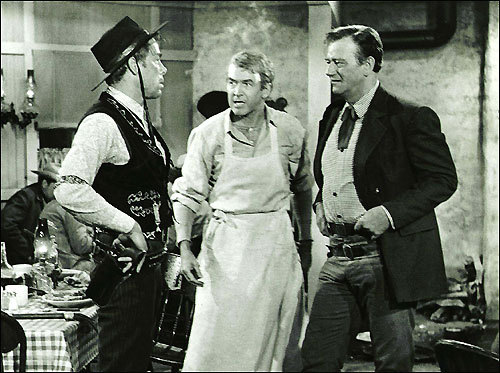
One way of answering this question is provided by an intriguing recent book written by Robert B Pippin, a professor of philosophy, entitled Hollywood Westerns and American Myth: The Importance of Howard Hawks and John Ford for Political Philosophy. One of the films that Pippin examines is John Ford’s great Western The Man Who Shot Liberty Valance (1962). In that film, John Wayne’s cowboy character Tom Doniphon shoots dead the murderous dandy Liberty Valance (Lee Marvin), but he lets the world believe that Eastern lawyer Ransom Stoddard (James Stewart) was the man who fired the fatal bullet. Ranse learns the truth shortly after the event but, with a little convincing from Tom, goes along with the story (which becomes a legend), and builds a long and successful political career on the basis of his false reputation as the man who shot Liberty Valance. When, towards the end of the film, Ranse tells the truth to the reporters at the newspaper of the town where the events occurred, the editor decides to consign the notes to the flames. Like Batman, he offers words that suggest, somewhat cryptically, what value there might be in perpetuating an untruth: ‘This is the West, sir. When the legend becomes fact, print the legend.’

Pippin’s interpretation of Liberty Valance is conscious of the fact that in most Westerns (and arguably, all great Westerns), what is at stake is never simply violence, but the meaning of violence - which is rarely simple. More important than the fact of Liberty Valance’s death is the meaning of this fact, which depends crucially on who killed him. By posing as the man who shot Liberty Valance, Ranse appears to synthesise two sets of qualities which are seen as valuable, but which are rarely found together in one person. As Dutton Peabody, Ranse’s most eloquent advocate at a political rally, tells the gathered crowd:

“He is a man who came to us not packing a gun, but carrying instead a bag of law books. Yes! He is a lawyer. And a teacher! The first west of the rosy buttes. But more important! He is a man who has come to be known throughout this territory, in the last few weeks, as a great champion of law and order!”


We see a similar thing going on in relation to Harvey Dent in The Dark Knight when (in a slightly hokey passage) he disarms a man who has managed to smuggle a gun into a criminal trial and barely stops to draw breath before continuing his display of legal brilliance. As Richard Dyer’s foundational work on film stardom demonstrates, the near-‘magical’ synthesis of the contradictory demands of a given culture is one very compelling way of explaining that elusive phenomenon called ‘charisma’.

In The Man Who Shot Liberty Valance, the death of Valance (or perhaps one should say, of Liberty) is shown to pave the way for the establishment of the rule of law and order, creating, eventually, a clean and prosperous town where, to quote another classical Hollywood Western, to which we shall return, a decent woman feels safe walking down the street. Robert Pippin has this to say about why it is crucial that it be believed that Liberty Valance was killed not by tough, self-reliant Westerner Tom Doniphon but Eastern attorney-at-law Ransom Stoddard:

‘A victory over Liberty Valance […] by Tom Doniphon would be just one more episode in a cycle of violence, revenge and intimidation. Valance must be killed by a representative of a new order; his death must mean that. So since Tom is unseen and quickly vanishes, everybody can think that Ransom Stoddard killed Valance and so can distinguish this act of violence from a personal one by associating it with Ranse’s ideals, can believe that the rule of law and democracy triumphed. Violence before there is law is unavoidably lawless, but if it is for the sake of law the paradox can be lessened if not eliminated.’


The legend of the man who shot Liberty Valance is used to help found a community based on values of property ownership, rule by law, and so on. Returning to The Dark Knight Rises: what is the legend of Harvey Dent used for? During Commissioner Gordon’s speech to mark ‘Harvey Dent Day’ (a public holiday - for Gotham City at least) he makes reference to the ‘Harvey Dent Act’. Although the details of this piece of legislation are never clarified, what does become clear is that it has extended the powers of the police, and been instrumental in ‘cleaning up the streets’ of Gotham. That is, this particular ‘champion of law and order’ is being used to shore up not liberal democracy, but something edging towards a police state.

The film’s attitude towards this (as towards many other things) is not one hundred per cent clear. Gary Oldman’s Gordon is unfailingly dignified, and his competence and fairness make it virtually impossible to imagine him arresting an innocent person. He expresses misgivings over his actions, but these misgivings seem to relate more to the lie behind the Harvey Dent Act, rather than what the Act has achieved. An analogous problem underpins another moment in the film, when Bruce attempts to justify his holding of extra-legal supergadgets and his withholding of them from others by declaring that ‘one man’s tool is another man’s weapon’. In both cases, the characters seem to believe that it is OK that these laws or weapons of mass destruction exist, as long as you have the right people in charge of them. Or the right country, perhaps: in this attitude to jurisdiction and weaponry, we can see an echo of American exceptionalism. It is a viewpoint that the film does not distance itself from, and therefore might be taken to tacitly endorse.

To Read the Rest of the Essay
Wednesday, May 30, 2012

Stephen Handzo: Going Through the Devil’s Doorway -- The Early Westerns Of Anthony Mann

Going Through the Devil’s Doorway: The Early Westerns Of Anthony Mann
by Stephen Handzo
Bright Lights Film Journal

...


Mann's 1950 threesome was the most auspicious quantum jump by an American director since John Ford's equivalent Americana triumvirate of 1939 (Stage Coach, Young Mr. Lincoln, Drums Along the Mohawk) lifted him into the major phase of his career. Yet Mann's achievements seem destined to remain unappreciated and the director himself obscure.

Those who disdain lightweight entertainment and sugary optimism usually prefer the cynical derisiveness of a Kubrick to a vision as uncompromisingly bleak and austere as Mann at his best. If people do not actually like Bresson or Dreyer at least they respect them; Mann has the generic disreputability of Westerns going against him as well.

And yet the Western was the perfect form for Mann. As George Robinson has observed, the protagonists of T-Men and Border Incident incur a moral debt while watching helplessly as their partners are murdered. In Mann's Westerns, the dual roles are combined in a hero who is both martyr and avenger.

Given Mann's own pessimism and the developing ambiguity of the post-war Western, it was perhaps inevitable that Mann's first Western (and arguably his best film) should be a tragic epitaph for the West's ultimate loser, the Indian.

Pro-Indian sentiment had appeared previously on the screen. Long before the alleged discovery of Monument Valley by John Ford, its buttes and mesas were mute witnesses to the epic silent version of The Vanishing American (1926). In both this and 1934's Massacre, the setting was contemporary and the Indian was already humiliated, displaced and long since reduced to reservation chattel. Billy Jack, Flap, The Outsider (about Ira Hayes) are later examples of this type. The other major schools of pro-Indian Westerns, such as 1970's Soldier Blue or the made-for-television Massacre at Sand Creek (1956) are set in the period of the Indian Wars and engage liberal guilt by focusing on a single spectacular atrocity.

Mann's Devil's Doorway is possibly unique in that it calls the ideal of Manifest Destiny itself into question by portraying the colonization of the West from the point of view of the defeated before the doom of the Indian was sealed.

The film opens with Robert Taylor in a Civil War uniform riding into a Wyoming town in which everything — including him — is coated with dust. He is returning from the Civil War having distinguished himself by winning the Congressional Medal of Honor at Gettysburg. Like Richard Dix in The Vanishing American, he assumes that war service will result in improved treatment for the Indian. (Devil's Doorway closely follows a cycle of contemporary racially-conscious films — Crossfire, Gentlemen's Agreement, Home of the Brave, in which members of the armed forces were subjected to discrimination. These films and President Truman's 1947 desegregation of the military reflected the obvious irony in America's fighting Nazi Master Race ideology with a Jim Crow army.) Taylor has a drink in a bar where he is greeted as a hero by the sheriff (Edgar Buchanan). "In my army, we were particular who we let in" observes cigar-smoking lawyer Verne Cooley (Louis Calhern) whose presence in the scene Mann skillfully withholds. (Calhern in this period had become MGM's all-purpose character actor — a combined replacement for Lionel Barrymore, Edward Arnold and Lewis Stone — portraying all the Establishment figures not played by Walter Pidgeon.) "Ever notice how you can always smell 'em?" asks Calhern, unheard by Taylor who walks out of the bar with Buchanan. "The Union Pacific's going to make a lot of changes," is Buchanan's prophetic parting comment.

To Read the Entire Essay


Wednesday, May 23, 2012

Matthew J. Iannucci: Postmodern Antihero -- Capitalism and Heroism in Taxi Driver

Postmodern Antihero: Capitalism and Heroism in Taxi Driver
by Matthew J. Iannucci
Bright Lights Film Journal


Martin Scorsese's Taxi Driver is a gritty, disturbing, nightmarish modern film classic that examines alienation in urban society. From a postmodernist's perspective, it combines the elements of noir, the Western, horror, and urban melodrama as it explores the psychological madness within an obsessed, inarticulate, lonely antihero cab driver, Travis Bickle (Robert De Niro). The plotline is simple: Travis directs his frustrated anger at the street dwellers of New York and a presidential candidate, and his unhinging assault is paired with an attempt to rescue a young prostitute, Iris (Jodie Foster), from her predatory pimp. Historically, Taxi Driver appeared after a decade of war in Vietnam (1976), and after the Watergate crisis and subsequent resignation of Nixon. Five years later, when it was linked to would-be presidential assassin John Hinckley and his obsession with Jodie Foster, it became prima facie evidence for those on the political right who believed that violence in film translates into crime in real life. It is now almost impossible to separate Taxi Driver from this debate. However, Bickle's antiheroic character is more directly related to a failure of a capitalist system that pits his working-class position as a cab driver against those who have already been disenfranchised according to socioeconomic class, gender, and/or race.

As the film opens, Travis emerges from a forgotten Midwestern form of Americana that appears as obsolete as Travis himself in a big city heterogeneously composed of corporate financiers, political patrons, gun dealers, and prostitutes. In order to survive, he wants to "become a person like other people" as he puts it, but his own disenfranchisement from this nation has left him both intellectually and emotionally bankrupt from the Vietnam War. Freedom, the very nucleus of the American dream, is dependent on individual socioeconomic choices that inform and shape one's identity. But Travis's lack of a distinct identity compels him to cut and paste together what he believes is a heroic identity from an external menu of personages such as the "gunslinger" and the Indian. In actuality, what he does is stitch together a postmodern antiheroic identity that is nostalgic and pop culture-oriented, evidenced by the Mohawk haircut that he sports in the penultimate sequences — because he possesses no internal self.

Taxi Driver implies that identity is not genuine but always synergistic, a kind of potpourri of idolatry and maxims drawn from popular culture, especially from violent movies and television news. In this vein, Robert Ray views Taxi Driver as a postmodern "corrected" Right film, the type of film generally aimed at a naïve audience. Ray explains that a "Right" film presents a traditional conservative philosophy that promotes the application of Western-style, individual solutions to complex contemporary problems. He writes, "Taxi Driver's basic story followed the right wing's loyalty to the classic Western formula: a reluctant individual, confronted by evil, acts on his own to rid society of spoilers. As played by Robert De Niro, Taxi Driver's protagonist had obvious connections with Western heroes…even his name, Travis, linked him to the defender of the Alamo."1 Ray's notion that the film is a "correction" of the right-wing concept of justice is accurate because of its odd plot twist at the conclusion. Normally, such a story would identify Travis's complicity with these criminals and thereby relegate him to some form of institutional punishment. But the film's underlying theme reveals how absurd the Western idealistic depiction of heroism is because the news media in the film not only ignores his actions but also glorifies a psychopathic killer as a noble warrior.

To Read the Rest of the Essay