We live in the best of times in which we are able to learn about the world and its incredible diversity of cultures/beings/places/perspectives in a way never historically possible. We live in the worst of times when we are able to isolate ourselves completely from anything different from our own narrow view/conception of the world/reality. The choice is yours!
Showing posts with label Law Enforcement. Show all posts
Showing posts with label Law Enforcement. Show all posts
Miss Bala: Nightmare State
Mexican director Gerardo Naranjo upends his filmmaking to show a country torn apart
by José Teodoro Film Comment
Most existences on earth are marginal; the majority of people live on the edges of some kind of war. That the woman and man at the center of Miss Bala swing into each other’s orbit is itself no great coincidence. She’s Laura (Stephanie Sigman), the cheerful 23-year-old daughter of a Tijuana clothing merchant, and he’s Lino (Noe Hernandez), a taciturn, hard-eyed, soft-voiced drug trafficker about whose past we glean almost nothing. Both hail from humble if not desperate backgrounds; both aspire to transcend social determinism via archetypal routes to glamour and power: just as Lino asserts himself through terror and illegal commerce, Laura, however haphazardly, hopes to embody someone’s notion of the ideal woman by entering the Miss Baja California competition. Her first, fleeting encounter with him occurs when a dance party is turned into a massacre by Lino and his confederates. They meet again when she is so naïve as to seek out the police for help. In some perverse variation on the romantic comedy, the two keep crossing paths. Laura spends much of Miss Bala in a state of shock, while Lino seems to quickly intuit how best to exploit her allure while ostentatiously exchanging favors. He can ensure she wins the Miss Baja crown; she can serve as a gorgeous decoy in his criminal dealings.
A fascinating about-face for Mexican director Gerardo Naranjo, Miss Bala—co-written by Naranjo and Mauricio Katz and loosely based on actual events—surveys the current state of play in the drug war and offers commentary through a procession of absurdities, ironies, and largely uncontextualized mayhem. The gangsters and the DEA agents are equally menacing and seem to favor the same black SUVs; a beauty contest audience bursts into wild applause for a catatonic contestant; a flaming tire rolls by during an urban shoot-out as though it has emerged from a cartoon, traversing a stretch of asphalt covered in blood, bullet casings, and gasoline. Despite an incongruous, statistics-heavy closing title card, Miss Bala can no more be reduced to a hand-wringing docudrama about the escalation of Mexico’s drug-related violence than Take Shelter can be called a treatise on overcoming mental illness. These films are personal statements about individuals ceding control to forces beyond their comprehension—personal statements that just happen to dovetail nicely with urgent social issues.
“I’d arrived at a place where I felt like I wasn’t challenging myself that much,” says Naranjo, “so I decided to do something that I really didn’t know how to do. My previous films had a little bit of social commentary, but it was from a bourgeois point of view, trying to denounce commodification or conservatism. When I started to develop Miss Bala I felt I was responding to something far more urgent that’s in the air. To the fear.” Speaking during the Toronto International Film Festival last September, by which point Miss Bala had already seen its share of plaudits and detractors, Naranjo emphasized his latest film’s conspicuous shift in both style and content from his preceding work, whether the privileged teens playing out lovers-on-the-run melodrama under a mesh of Godardian alienation techniques (the deliriously stylish and witty 2008 I’m Gonna Explode) or privileged young adults negotiating disastrous relationships (the clever but flat 2006 Drama/Mex). “The directors I admire tend to change a lot between films,” says Naranjo. “Maybe not often with regards to form, but with subject matter for sure. Before, I felt that I was a filmmaker but had yet to really show it. I trusted so deeply in the present, in improvisation. I know I’m shifting. The question now, for me, has to do with whether or not I can maintain this.”
[From 2011, Bulger still hasn't been brought to trial. A few days ago Johnny Depp agreed to star in a film directed by Barry Levinson about Whitey Bulger.]
After 16 years on the lam, James “Whitey” Bulger – a notorious Irish mobster from Boston, who was number 2 on the FBI’s most-wanted list for over 14 years – has finally been captured by the FBI.
Tonight, Mike and Mark speak with noted author Richard Stratton, who has not only researched and written about Bulger, but actually met the man face-to-face when Bulger acted to save Richard from a Mafia hit contract. We’ll talk about Bulger’s history, his turning of FBI agents, the methods used to bring him in, whether or not he’s responsible for a whole string of armed robberies as the infamous “geezer bandit” in Orange County, California…and what secrets he still may have to tell about a thoroughly corrupt FBI that aided him in murdering his rivals.
Mumia Abu-Jamal: "The United States Is Fast Becoming One of the Biggest Open-Air Prisons on Earth" Democracy Now
In a rare live interview, Mumia Abu-Jamal calls into Democracy Now! as the new film, "Long Distance Revolutionary," about his life premieres in New York City this weekend. After 29 years on death row, he is now being held in general population at the Pennsylvania State Correctional Institution – Mahanoy. "How free are we today, those who claim to be non-prisoners? Your computers are being read by others in government. Your letters, your phone calls are being intercepted," says Mumia Abu-Jamal. "We live now in a national security state, where the United States is fast becoming one of the biggest open-air prisons on earth. We can speak about freedom, and the United States has a long and distinguished history of talking about freedom, but have we exampled freedom? And I think the answer should be very clear: We have not." In 1982, Mumia was sentenced to die for killing Philadelphia police officer Daniel Faulkner. He has always maintained his innocence and is perhaps America’s most famous political prisoner. In 2011, an appeals court upheld his conviction, but also vacated his death sentence. It found jurors were given confusing instructions.
Guest:
Mumia Abu-Jamal, former death row prisoner. For decades, Abu-Jamal has argued racism by the trial judge and prosecutors led to his conviction for the killing of Philadelphia police officer Daniel Faulkner. Last year, the 3rd U.S. Circuit Court of Appeals set aside his death sentence after finding jurors were given confusing instructions that encouraged them to choose the death penalty rather than a life sentence.
"Long Distance Revolutionary": Mumia Abu-Jamal’s Journey from Black Panthers to Prison Journalist
The new documentary, "Long Distance Revolutionary: A Journey with Mumia Abu-Jamal," premieres today in New York City. We play an excerpt of the film and speak to writer, producer and director Steve Vittoria, as well as Noelle Hanrahan of Prison Radio, who has interviewed Abu-Jamal many times over the years. The film features many supporters of Mumia, including actress Ruby Dee, writer Tariq Ali, and author Michelle Alexander.
Guests:
Stephen Vittoria, longtime documentary filmmaker. Most recently, he is the writer, director, producer and editor of Long Distance Revolutionary: A Journey with Mumia Abu-Jamal. The film premiers in theaters in New York City Feb. 1-3. We recently featured his 2005 documentary, One Bright Shining Moment, about Senator George McGovern.
Noelle Hanrahan, director of Prison Radio and a producer of Long Distance Revolutionary.
The Unsilenced Voice of a "Long-Distance Revolutionary"
by Chris Hedges TruthDig
I am sitting in the visiting area of the SCI Mahanoy prison in Frackville, Pa., on a rainy, cold Friday morning with Mumia Abu-Jamal, America’s most famous political prisoner and one of its few authentic revolutionaries. He is hunched forward on the gray plastic table, his dreadlocks cascading down the sides of his face, in a room that looks like a high school cafeteria. He is talking intently about the nature of empire, which he is currently reading voraciously about, and effective forms of resistance to tyranny throughout history. Small children, visiting their fathers or brothers, race around the floor, wail or clamber on the plastic chairs. Abu-Jamal, like the other prisoners in the room, is wearing a brown jumpsuit bearing the letters DOC—for Department of Corrections.
Abu-Jamal was transferred in January to the general prison population after nearly 30 years in solitary confinement on death row and was permitted physical contact with his wife, children and other visitors for the first time in three decades. He had been sentenced to death in 1982 for the Dec. 9, 1981, killing of Philadelphia police officer Daniel Faulkner. His sentence was recently amended to life without parole. The misconduct of the judge, flagrant irregularities in his trial and tainted evidence have been criticized by numerous human rights organizations, including Amnesty International.
Abu-Jamal, who was a young activist in the Black Panthers and later one of the most important radical journalists in Philadelphia, a city that a few decades earlier produced I.F. Stone, has long been the bête noire of the state. The FBI opened a file on him when he was 15, when he started working with the local chapter of the Black Panthers. He was suspended from his Philadelphia high school when he campaigned to rename the school for Malcolm X and distributed “black revolutionary student power” literature.
Stephen Vittoria’s new film documentary about Abu-Jamal, “Long Distance Revolutionary,” rather than revisit the case, chronicles his importance and life as an American journalist, radical and intellectual under the harsh realities of Pennsylvania’s death row. Abu-Jamal has published seven books in prison, including his searing and best-selling “Live From Death Row.” The film features the voices of Cornel West, James Cone, Dick Gregory, Angela Davis, Alice Walker and others. It opens in theaters Feb. 1, starting in New York City. In the film Gregory says that Abu-Jamal has single-handedly brought “dignity to the whole death row.”
The late historian Manning Marable says in the film: “The voice of black journalism in the struggle for the liberation of African-American people has always proved to be decisive throughout black history. When you listen to Mumia Abu-Jamal you hear the echoes of David Walker, Frederick Douglass, W.E.B. Du Bois, Paul Robeson, and the sisters and brothers who kept the faith with struggle, who kept the faith with resistance.”
The authorities, as they did before he was convicted, have attempted to silence him in prison. Pennsylvania banned all recorded interviews with Abu-Jamal after 1996. In response to protests over the singling out of one inmate in the Pennsylvania correction system, the state simply banned recorded access to all its inmates. The ban is nicknamed “the Mumia rule.”
“I was punished for communicating,” Abu-Jamal says.
Cornel West says in the film: “The state is very clever in terms of keeping track, especially [of] the courageous and visionary ones, the ones that are long-distance runners. You can keep track of them, absorb ’em, dilute ’em, or outright kill ’em—you don’t have to worry about opposition to ’em.”
It goes without saying that the subject matter of Polisse is dispiriting and heartbreaking: a group of police officers working for the Child Protection Unit (or CPU) in Paris deal, on a daily basis, with cases involving rape, abuse, prostitution and organized crime. To compound this bleakness, the details of these cases were, in fact, drawn from real life: director and co-writer Maïwenn spent time following actual officers and constructed her film from events she witnessed or heard about during that time. This patina of ultra-realism coats the events in the film, making them reverberate beyond the screen and suggesting, for each unimaginable horror, a series of unseen but real-life analogues. Maïwenn wisely eschews the tedious offering of answers; her film is instead satisfied in tracing the outline of a vast problem, letting its shape impress an urgent tenseness upon us. Unable to intervene, Maïwenn’s camera can only observe, bringing us back once again to a fundamental question of cinema: to what extent can merely seeing the events of the world—bearing witness to them—actually matter?
Polisse is most interesting when it stays faithful to this ocular theme. As Carol J. Clover has noted in her study of horror films, the eye itself, despite being considered a source of domination (the gaze), is actually quite vulnerable and penetrable (the eyeball-impaling sequence from Lucio Fulci’s Zombi 2 drives this point home quite strikingly). Filmmakers have moreover understood the camera, like the eye, to be an instrument of control and even aggression—its phallic associations reached a climax in Michelangelo Antonioni’s Blow-Up, which coupled masculine ineffectuality and truth’s elusiveness: together, a lack of mastery. These associations are reversed in Polisse through the character of Mélissa (played by Maïwenn herself), a photographer tasked with documenting the work of the CPU. Mélissa embodies the eye’s vulnerability, and her camera bestows upon her the power of empathy, an uncontrollable receptivity that manifests as an openness to the plight of others. Following the CPU around, she becomes shaken by the horror she sees, the documentation of which cannot console her, but her role is to look—to look only—and take in what she sees, the camera and the eye functioning in tandem.
If a Tree Falls: Enforcing the Green Scare
by Michael Dean Benton North of Center
Curry Marshall, with a degree in Comparative Religion from Swarthmore College and experience as a senior producer at a New York multimedia design firm, got his start in filmmaking by shooting, directing and editing the 2005 documentary Street Fight. The documentary followed the grassroots, underdog candidate Cory Booker’s attempt to unseat Sharpe James, the longtime mayor of Newark, NJ. Marshall impressed audiences and critics with his dogged determination to cover the campaign despite James’ attempt to control all media coverage of his public appearances. The film, which ran as part of a series on PBS and was later recognized with both an Oscar and Emmy nomination, remains an essential document of an actual grassroots campaign running against entrenched party machine politics.
Marshall’s newest documentary, made with cinematographer and co-director Sam Cullman, If a Tree Falls: A Story of the Earth Liberation Front (2011) tells the complex story of environmental Earth Liberation Front activist Daniel McGowan, who faced life in prison for his participation in the burning of two timber facilities. The film has received Best Documentary awards at multiple film festivals, and a Best Documentary Editing Award at the Sundance Film Festival.
Just as Street Fight is essential viewing for grassroots campaigners seeking to intervene in entrenched local power structures, If a Tree Falls is a vital film for committed environmental activists. Not only does the documentary capture embattled environmental activists in the age of the Green Scare opening up to the filmmakers, but most impressive was the filmmakers’ ability to convince law enforcement officials and government lawyers to talk on-record about their perspectives. With that in mind, this is also a film that should spur all American citizens to consider the impact of our current heightened post-9/11 law enforcement policies.
The Green Scare
First introduced into the lexicon in 2003, the Green Scare is a term used by environmental activists to describe the orchestrated campaign to paint their movement as a form of domestic terrorism. With a self-conscious nod to the political repressions of the last century’s numerous “Red Scares” that swept the nation, the Green Scare describes the U.S. government’s use of legal and police tactics to suppress the radical environmental movement. The term seeks to explain why so many environmental activists appear on the FBI’s Most Wanted List, why the jail sentences of environmental activists seem disproportionately long, and how some activists end up in maximum security prisons.
Though If a Tree Falls does not mention the term Green Scare by name, the film dramatically documents the process in action. A key tactic involves using corporate media to influence public perception of environmental and animal rights activist groups as “domestic terrorists.” This designation may seem like a stretch of the imagination. After all, in the past two decades, the United States has experienced multiple assaults on the twin towers in NYC, the horrific bombing of government offices in Oklahoma by Timothy McVeigh, and an incredible increase in violent armed militias and hate groups as Barack Obama became president–none of which have been perpetrated by environmental activists. Nevertheless, starting in the 1990s both local and national news stations amazingly started to apply the loaded term “terrorists” to environmental activists who never harmed or killed a human being in their actions.
When it comes to groups advocating direct environmental actions, law enforcement tactics have likewise focused directly (and often violently) upon environmental activists, intimidating those activists peacefully protesting in the streets while discouraging any citizen attempts to confront the corporations that are destroying the environment. If a Tree Falls provides vivid, difficult-to-watch scenes of police assaulting peaceful, albeit resistant, environmental protesters with strong-arm tactics and chemical weapons. Most memorable is the scene where police officers hold the heads of young female activists who sit with their arms linked together, while other officers apply liquid pepper spray directly to their eyes with Q-Tips. Another scene captures a law enforcement officer who reports that when activists do something that he doesn’t like, it becomes personal for him. Later we hear another officer relate that, with the institution of Post-9/11 Homeland Security policies, the easiest way for law enforcement officers to rise up through the ranks and increase their pay scale is through terrorism enhancement cases. (Jules Boykoff, in Beyond Bullets: The Suppression of Dissent in the United States (AK Press, 2007), details how this intimidation of activists extended to police infiltration of groups that never committed a crime, and the unleashing of paid informants who acted as agent provocateurs–facilitating and encouraging the acceleration of activist actions while reporting back to their home agencies.)
FBI Top Ten List
The top ten list of most wanted domestic “terrorists” by the FBI remains focused on targeting contemporary environmental and animal rights activists, in addition to leftist activists from the 1960s/1970s. Currently three people on the list are environmental and animal right activists possibly involved in a series of ELF arsons in the Pacific Northwest. In a 2009 FBI listing of a new “domestic terrorist,” the FBI stated that “animal rights and environmental extremism pose a significant domestic terror threat. To date, extremists have been responsible for more than 1,800 criminal acts and more than $110 million in damages. Currently, we are investigating approximately 170 such extremist incidents across the country”
There is no doubt that there has been significant property damage, as is made clear in the documentary. However, the environmental and animal rights activists have diligently made sure that no physical harm would come to people. Looking at the FBI list one is struck by the political nature of the focus. These are people who object to corporate policies and critique capitalism. There is not one person on the FBI’s top-ten list that reflects a right-to-centrist-political perspective, despite the fact that the worst domestic mass attacks of violence against people has generally come from right-wing extremists.
In recent history, this is even more the case. Most of the dramatic acts of violent domestic terrorism have been from right-wing or fundamentalist extremists: the Jewish Defense League’s bombing attacks during the 1980s, Timothy McVeigh in 1995, Olympic Park Bomber Eric Robert Rudolph from 1996-1998, James W. von Brunn’s attack at the Holocaust Museum in 2009, and Scott Roeder’s murder of George Tiller during a Sunday morning service in a church in 2009.
Commenting in the aftermath of Andrew Joseph Stack III’s airplane attack on the IRS building in Austin, TX in 2010, in which one person was killed and many more injured, constitutional lawyer and author Glenn Greenwald noted how “terrorism” is the “single most meaningless word and the most manipulated.” As the various news networks struggled to keep Stack’s act of violence from being labeled “terrorism,” Greenwald reflected on the absurdity of newscasters’ evasions. Stack wasn’t labeled a terrorist because his written statements reflected current Tea Party concerns and complaints against the government. Greenwald goes on, stating that the “term now has virtually nothing to do with the act itself and everything to do with the identity of the actor.”
Greenwald’s specific comments referred to the discriminatory practices that target Muslims in America, but his point also applies to the way in which the term “terrorist” has been used as a political weapon against groups that may challenge and/or resist the policies and practices of corporations that devastate the environment.
Terrorism enhancement convictions
A central tenet of the Green Scare has been the pursuit of terrorism enhancement sentences against environmental and animal rights activists who commit property crimes. As documented in If a Tree Falls, Daniel McGowan participated as a lookout for one arson, and as a fully engaged participant in a second attack. For these crimes in which no person was physically harmed, he faced a sentence of 300+ years in a maximum security prison. In these cases prosecutors seek what is called a terrorism enhancement conviction. If convicted, defendants are locked in maximum security Communications Management Units. In these prisons there is no sunlight, no fresh air, no activities and extremely limited communication with the outside world.
McGowan, and other Earth Liberation Front members, were brought down by former member-turned-informer Jacob Ferguson, the main instigator in the arsons and (as evidence in the film points out) most likely the first perpetrator of an ELF arson attack. At the time of his work as a snitch gathering information for the FBI, Jules Boykoff reports in Beyond Bullets, he was a full-fledged heroin addict and “receiving between $50,000 and $100,00 for his role as a cooperative witness.” Although confessing to planning and committing numerous arsons across the Pacific Northwest, Ferguson was never charged for any crime. Later, after his role as an informer was over, he was eventually picked up in April on drug dealing charges.
These tactics of harassment, intimidation, infiltration and surveillance have increased in the supposedly heightened security of a post-9/11 America. Most of the targets are social justice, environmental, animal rights, civil liberties, religious anti-war, and anti-corporate activists. As American citizens we should be allowed to freely gather to organize, criticize and protest what we see as harmful practices and policies. These civil liberties are under assault by law enforcement practices that hearken back to the Red Scare paranoia of the McCarthy era and the legal abuses of the FBI’s COINTELPRO. All of us need to consider what this means for our democratic nation, and what the implications are when law enforcement is used as a political tool.
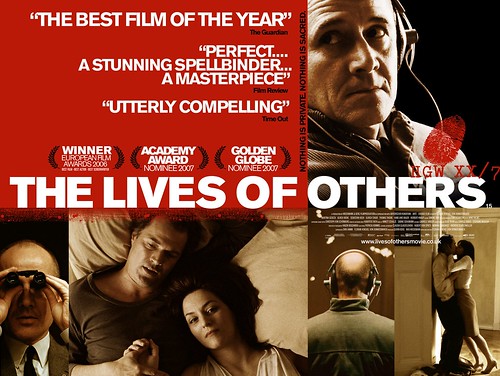
The Lives of Others
a film directed by Florian Henckel von Donnersmarck
Das Leben der anderen: Filmbuch
by Florian Henckel von Donnersmarck
Frankfurt: Suhrkamp, 216 pp., Ä8.50 (paper)
One of Germany’s most singular achievements is to have associated itself so intimately in the world’s imagination with the darkest evils of the two worst political systems of the most murderous century in human history. The words “Nazi,” “SS,” and “Auschwitz” are already global synonyms for the deepest inhumanity of fascism. Now the word “Stasi” is becoming a default global synonym for the secret police terrors of communism. The worldwide success of Florian Henckel von Donnersmarck’s deservedly Oscar- winning film The Lives of Others will strengthen that second link, building as it does on the preprogramming of our imaginations by the first. Nazi, Stasi: Germany’s festering half-rhyme.
It was not always thus. When I went to live in Berlin in the late 1970s, I was fascinated by the puzzle of how Nazi evil had engulfed this homeland of high culture. I set out to discover why the people of Weimar Berlin behaved as they did after Adolf Hitler came to power. One question above all obsessed me: What quality was it, what human strain, that made one person a dissident or resistance fighter and another a collaborator in state-organized crime, one a Claus von Stauffenberg, sacrificing his life in the attempt to assassinate Hitler, another an Albert Speer?
I soon discovered that the men and women living behind the Berlin Wall, in East Germany, were facing similar dilemmas in another German dictatorship, albeit with less physically murderous consequences. I could study that human conundrum not in dusty archives but in the history of the present. So I went to live in East Berlin and ended up writing a book about the Germans under the communist leader Erich Honecker, rather than under Adolf Hitler.1 As I traveled around the other Germany, I was again and again confronted with the fear of the Stasi. Walking back to the apartment of an actor who had just taken the lead role in a production of Goethe’s Faust, a friend whispered to me, “Watch out, Faust is working for the Stasi.” After my very critical account of communist East Germany appeared in West Germany, a British diplomat was summoned to receive an official protest from the East German foreign ministry (one of the nicest book reviews a political writer could ever hope for) and I was banned from reentering the country.
Yet this view of East Germany as another evil German dictatorship was by no means generally accepted in the West at that time. Even to suggest a Nazi–Stasi comparison was regarded in many parts of the Western left as outmoded, reactionary cold war hysteria, harmful to the spirit of détente. The Guardian journalist Jonathan Steele concluded in 1977 that the German Democratic Republic was “a presentable model of the kind of authoritarian welfare states which Eastern European nations have now become.” Even self-styled “realist” conservatives talked about communist East Germany in tones very different from those they adopt today. Back then, the word “Stasi” barely crossed their lips.
Two developments ended this chronic myopia. In 1989 the people of East Germany themselves finally rose up and denounced the Stasi as the epitome of their previous repression. That they often repressed at the same time—in the crypto-Freudian sense of the word “repression”—the memory of their own everyday compromises and personal responsibility for the stability of the communist regime was but the other side of the same coin. After 1990, the total takeover of the former East Germany by the Federal Republic meant that, unlike in all other post-communist states, there was no continuity from old to new security services and no hesitation about exposing the evils of the previous secret police state. Quite the reverse.
In the land of Martin Luther and Leopold von Ranke, driven by a distinctly Protestant passion to confront past sins, the forcefully stated wish of a few East German dissidents to expose the crimes of the regime, and the desire of many West Germans (especially those from the class of ‘68) not to repeat the mistakes made in covering up and forgetting the evils of Nazism after 1949, we saw an unprecedentedly swift, far-reaching, and systematic opening of the more than 110 miles of Stasi files. The second time around, forty years on, Germany was bent on getting its Vergangenheitsbewältigung, its past-beating, just right. Of course Russia’s KGB, the big brother of East Germany’s big brother, did nothing of the kind.
After some hesitation, I decided to go back and see if I had a Stasi file. I did. I read it and was deeply stirred by its minute-by-minute record of my past life: 325 pages of poisoned madeleine. Helped by the apparatus of historical enlightenment that Germany had erected, I was able to study in incomparable detail the apparatus of political intimidation that had produced this file. Then, working like a detective, I tracked down the acquaintances who had informed on me and the Stasi officers involved in my case. All but one agreed to talk. They told me their life stories, and explained how they had come to do what they had done. In every case, the story was understandable, all too understandable; human, all too human. I wrote a book about the whole experience, calling it The File.
It was therefore with particular interest that I recently sat down to watch The Lives of Others, this already celebrated film about the Stasi, made by a West German director who was just sixteen when the Berlin Wall came down. Set in the Orwellian year of 1984, it shows a dedicated Stasi captain, Gerd Wiesler, conducting a full-scale surveillance operation on a playwright in good standing with the regime, Georg Dreyman, and his beautiful, highly strung actress girlfriend, Christa-Maria Sieland. As the case progresses, we see the Stasi captain becoming disillusioned with his task. He realizes that the whole operation has been set up simply to allow the culture minister, who is exploiting his position to extract sexual favors from the lovely Christa, to get his playwright rival out of his way. “Was it for this we joined up?” Wiesler asks his cynical superior, Colonel Anton Grubitz.
At the same time, he becomes curiously enchanted with what he hears through his headphones, connected to the bugs concealed behind the wallpaper of the playwright’s apartment: that rich world of literature, music, friendship, and tender sex, so different from his own desiccated, solitary life in a dreary tower-block, punctuated only by brief, mechanical relief between the outsize mutton thighs of a Stasi-commissioned prostitute. In his snooper’s hideaway in the attic of the apartment building, Wiesler sits transfixed by Dreyman’s rendition of a piano piece called “The Sonata of the Good Man”—a birthday present to the playwright from a dissident theater director who, banned by the culture minister from pursuing his vocation, subsequently commits suicide. Violating all the rules that he himself teaches at the Stasi’s own university, the secret watcher slips into the apartment and steals a volume of poems by Bertolt Brecht. Then we see him lying on a sofa, entranced by one of Brecht’s more elegiac verses.
Yesterday I read this in an article in the British Guardian newspaper:
"Twelve of the last 13 people condemned to death in Harris County, Texas were black. After Texas itself, Harris County is the national leader in its number of executions.
"Over one third of Texas's 305 death row inmates - and half of the state's 121 black death row prisoners - are from Harris County.
"One of those African Americans, Duane Buck, was sentenced based on the testimony of an expert psychologist who maintained that blacks are prone to violence. In 2008, Harris County District Attorney Chuck Rosenthal resigned after sending an email message titled 'fatal overdose,' featuring a photo of a black man lying on the ground surrounded by watermelons and a bucket of chicken."
I could pause at this point, type "case closed," and consider this a blog entry. But that would be too simple. White people are also executed at an efficient pace in Texas. The odds of being given the death penalty in that state are fearsome, and the chances of having your sentence overturned on appeal are dismaying. So far in his two terms in office, Rick Perry has declined to commute the sentences of 235 condemned prisoners. During George W. Bush's time in office, Texas executed 152 prisoners, more than any other governor in modern American history before Perry.
Bush commuted the death sentence of one prisoner, Henry Lee Lucas, who had been charged with murder in 189 cases and "was once listed as America's most prolific serial killer." (Wikipedia.) His decision was recommended by the Texas Board of Pardons and Paroles, based on evidence that on the day of the specific murder Lucas was convicted of, he was not in Texas. Perry has commuted the death sentences of two prisoners, both also on the recommendation of the Board of Pardons and Paroles. It would appear that if the board rejected your appeal, your chance of having the sentence overturned by Bush or Perry was zero.
In 2000, Illinois Governor George Ryan, a Republican, declared a moratorium on the death penalty in Illinois. In one fell swoop he commuted 160 death sentences to life sentences. Ryan explained that he believed execution was appropriate in the case of "heinous crimes," but noted that during his first year in office "Thirteen people were released from jail after appealing their convictions based on new evidence." (Wikipedia) I was at a dinner party with Ryan at about that time, and he told us, "The possibility that we would be executing an innocent man made it impossible for me to sleep at night."