By Andrew O'Hehir
Salon
All of us believe that we possess the strength and willpower to resist evil. Perhaps we do; who is to say? Most of us are not likely to face life-or-death situations out of Holocaust movies or “Star Trek” episodes. But a more important question – not to mention a more practical and ultimately far more disturbing one — is whether we will recognize evil when we encounter it, especially when it claims to be something else. As a former research subject wrote to Yale psychologist Stanley Milgram in 1970, “Few people ever realize when they are acting according to their own beliefs and when they are meekly submitting to authority.”
Every time I take my shoes off at the airport, and permit my person and possessions to be invaded by intrusive technologies for unclear reasons – meekly submitting to authority in the name of getting on the damn plane – I think about Milgram. (I am not suggesting that the TSA is evil, exactly, although you couldn’t really call it good.) By the time he received that letter, Milgram had become one of the most famous and controversial figures in the social sciences. In the early ‘60s, he had crafted a notorious series of experiments that suggested that most people, most of the time, were willing to obey the instructions of an authority figure, even when they involved delivering electrical shocks to strangers as part of a patently ludicrous “teaching” exercise.
Various complaints have subsequently been aired about Milgram’s ethics and methodology; while the electrical shocks were fake, the distress of his research subjects was all too real. Unfortunately for the human species, his findings have been replicated many times and in many contexts, and are now generally regarded as valid. While his colleagues and students predicted that only a minuscule proportion of experimental subjects would deliver the full (if fictional) voltage, more than 60 percent of them pushed the final button as instructed. It isn’t that we lack empathy or a sense of morality; most people in the Milgram experiments felt terrible about administering the shocks, and quite a few began crying or laughing or otherwise behaving erratically. But they went ahead and did it anyway, because a guy in a white coat was telling them to. (I don’t know whether this is mostly hilarious or mostly horrifying, but one post-Milgram experiment involved having subjects deliver real electric shocks to a real puppy — and most people did that too!)
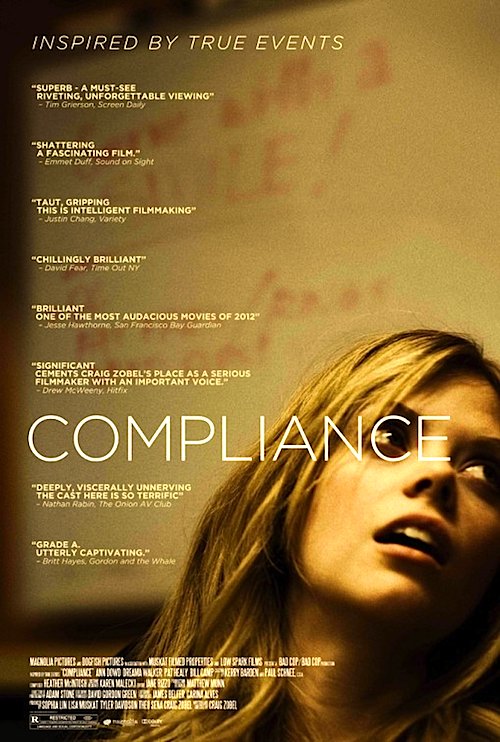
It may be impossible to exaggerate the historical and political ramifications of Milgram’s discoveries about humanity’s misplaced faith in authority, which would seem to shed light on everything from Auschwitz to Abu Ghraib to the fact that we’ve apparently all agreed in 2012 that it’s OK for the president of the United States to kill whoever he wants to without providing a reason. (Milgram was inspired by the widely publicized trial of Nazi war criminal and Holocaust engineer Adolf Eichmann, a mild-mannered fellow who claimed to have no particular antipathy for Jews.) But on an intimate level these ideas can still prove shocking or unacceptable, as they do in “Compliance,” a nail-biting thriller from indie writer-director Craig Zobel that has been dividing, energizing and alienating audiences since its Sundance premiere earlier this year.
On one level “Compliance” dramatizes a Milgram-like scenario, but more importantly it acts out a psychological experiment of its own, right there in the theater. This film is not set in Nazi Germany or Iraq or Gotham City under the rule of a supervillain. It takes place in an unidentified American suburb or exurb, almost entirely inside a fast food restaurant whose employees are cajoled and coerced by an official-sounding voice on the telephone into imprisoning, humiliating, strip-searching and finally abusing one of their co-workers. As a fictional premise that may sound outrageous, but some readers will surely remember that there was a wave of such real-life cases in the late 1990s and early 2000s. Zobel is drawing primarily on the last and most notorious of these, an April 2004 episode at a McDonald’s in Mt. Washington, Ky., where a young female employee was detained for several hours against her will and subjected to escalating and improbable levels of degradation.
To Read the Rest of the Essay

