We live in the best of times in which we are able to learn about the world and its incredible diversity of cultures/beings/places/perspectives in a way never historically possible. We live in the worst of times when we are able to isolate ourselves completely from anything different from our own narrow view/conception of the world/reality. The choice is yours!
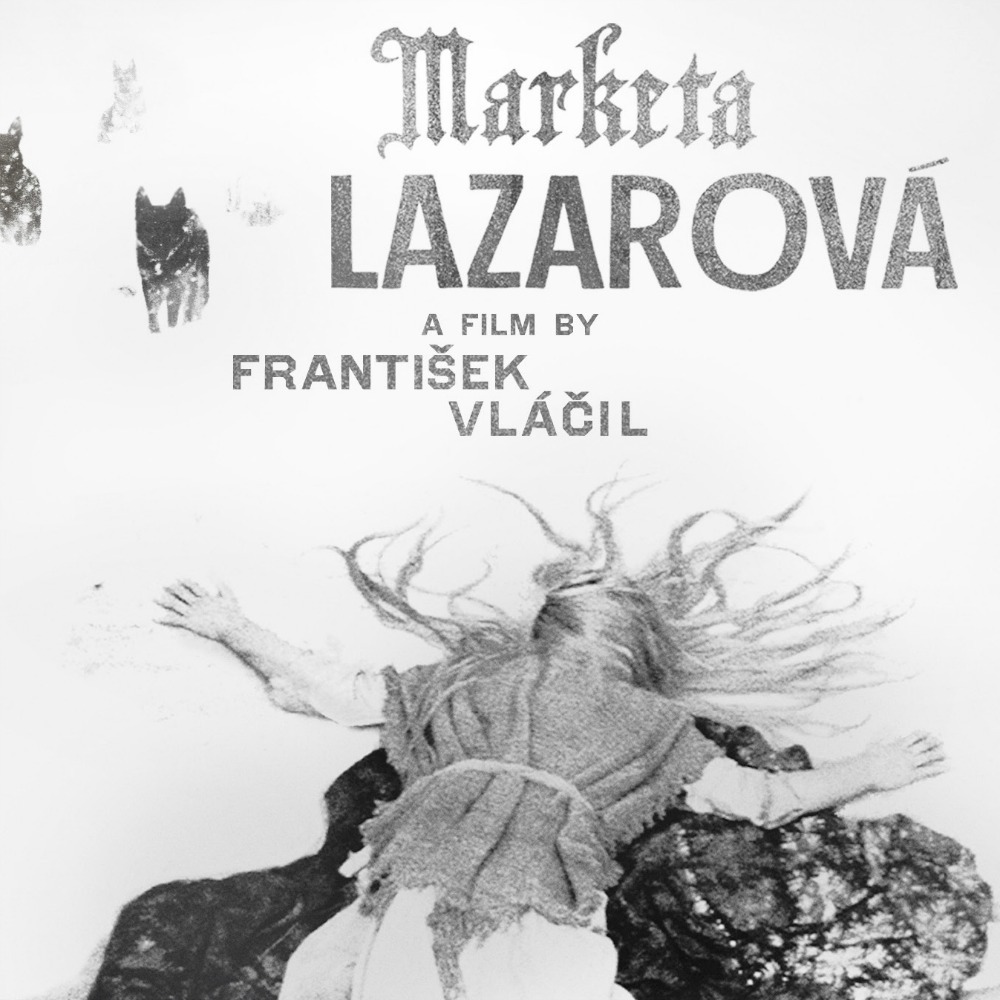
František Vláčil’s Marketa Lazarová (1967) is a virtual terra incognita. Thirty years after its release, it was named overwhelmingly by a poll of Czech critics and filmmakers as the best movie ever produced in Czechoslovakia, yet it remains little known outside its native land. Even as national epics go, Marketa Lazarová is unusually off-putting to outsiders. Violent and anti-heroic, the movie opens on a note of mordant self-deprecation (“This tale was cobbled together and hardly merits praise”) and goes on to represent thirteenth-century Bohemia as a backwater of Conan the Barbarian’s Hyperborean Age—the province of halfwits, rapists, and brutes.
Aside from repeated, if intermittent, screenings at the Brooklyn Academy of Music (and a relatively recent Vláčil retrospective at the Film Society of Lincoln Center), the movie has hardly been shown in the United States since its 1974 American release, for which it was shortened by over an hour. (Supremely unimpressed, The New York Times at the time characterized Marketa as “a colossal—and very near interminable—hodgepodge of medieval mayhem and myth, leaden symbolism and bloated piety,” featuring characters of “such unmitigated savagery that next to them the Visigoths would resemble a Red Cross mercy mission.”) Now released as a Criterion DVD in its full 165 minutes, Marketa Lazarová may finally reach a wider American audiences in all its sprawling glory.
Certainly, the film has an impressive pedigree. Vláčil adapted his labor of love from a 1931 novel by Vladislav Vančura (1891–1942), an expressionist Czech writer, avant-garde activist, independent filmmaker, and (per the movie’s credits) “people’s artist.” In addition to being a pre-war Communist (though he was expelled from the Party in 1939), Vančura was also a wartime martyr, one of many Czech partisans who were executed in reprisal for the assassination in Prague of Reichsprotektor Reinhard Heydrich.
Vančura’s Marketa Lazarová is a mock epic, depicting the savage feud between two rival brigand families, the pagan Kozlíks and nominally Christian Lazars, in the wilds of medieval Bohemia. Vančura was an almost untranslatable master of word play, and here invented a new Czech idiom, at once modernist and archaic, to create, in effect, a new shared geneology. The Czech writer and film historian Josef Škvorecký called Vančura’s lusty yarn a “novel of momentous importance in the history of Czech literature.” Evidently, the novel also had much to say to the young, multinational state that was interwar Czechoslovakia; despite its avant-garde underpinnings, it was his most popular and commercially successful work.
History or Humanity? On Lu Chuan's City of Life and Death: A Nietzschean Perspective on Nanjing
by Maximilian Yoshioka Bright Lights Film Journal
In 1937, the Imperial Japanese Army stormed into the city of Nanjing in China, causing massive physical and human devastation, in what is now known as the "Rape of Nanjing." The incident, and the broader scheme of Japanese militarism and imperialism in which it took place, is today still a constant source of political tension between the two nation-states and their respective citizens. The 2009 film City of Life and Death, by Chinese auteur Lu-Chuan, is a bold attempt to dig up and redefine the specter of Nanjing that continues to haunt the East Asian consciousness. But instead of ideologically measuring one side or the other on a Manichean scale, Lu chooses to focus on the instances of human compassion and solidarity that are able to manifest themselves even in the mindless, brutal atmosphere he so effectively creates within the cinematic world.
What one comes to grasp after seeing the film is the ultimate importance of history as first and foremost a study of the human condition, and of the art of living itself, as opposed to scientifically detached observation and categorization. The continuities of human consciousness and memory mean that our experiences of the past are necessarily intertwined with those of the present; as individuals inescapably grounded in a specific historical period, we are unable to avoid this contemporizing process. Furthermore, it is something that must be embraced, for it allows us to incorporate these historical "peaks" (and crevasses) of human experience into our future actions and values. But in this integration of the present with the past there is the danger of a selective blindness toward the past that must be understood and overcome. However, the purpose of history as a guide to the present and the future, to "life," must still be emphasized over the "neutral," "objective" study of history as "fact," "statistic," or what Nietzsche, in his essay "The Use and Abuse of History, refers to disparagingly as the "World Process" — that is, an attitude of detached passivity toward a historical narrative that is falsely seen as predetermined and unalterable.
City of Life and Death's narrative shifts between several characters on both sides of the conflict, which allows the film to largely transcend distinctions of nationality and ideology and focus on the more basic human tragedy underlying it. One is never informed of the strategic or ideological Japanese justifications for the various massacres and battles throughout the film; there is no attempt to rationalize the violence. Instead the viewer is presented with a war that is absurd, irrational, and pointless, and this nonpartisan alignment allows for the emergence of a more universal, humanistic perspective that links the various key characters in the film through their shared ethical commitments. These include Kadokawa, a Japanese soldier (Hideo Nakaizumi), Lu Jianxiong (Liu Ye), a Chinese resistance fighter, John Rabe (John Paisley), a German who ran a demilitarized safety zone within Nanjing, his assistant, Mr. Tang (Fan Wei), and several female characters of both Japanese and Chinese origin, all of whom are faced with sexual violence and slavery due to the notorious Japanese "comfort women" policies.
This humanistic impulse manifests itself in various ways, but is mostly emphasized in authentic moments of kindness, empathy, and bravery that shine through the madness. At the end of the film, Kadokawa, under orders to execute two Chinese civilians, one of whom is a young boy, instead decides to release them into the wilderness, much to the amazement but also admiration of his inferior officer. Yet even this act of compassion is insignificant in comparison to what he has previously been required to do and see; under the weight of an intolerable conscience, he kills himself. Earlier in the film he also falls in love with a Japanese prostitute brought in to satisfy the soldiers' animalistic needs; his genuine feelings of care and affection for her contrast strikingly with the objectifying and dehumanizing attitudes of the other soldiers. John Rabe, the only nonfictional character in the film, was a member of the Nazi Party, a group, like the Japanese, condemned for its role in the Second World War. Along with several other missionaries, he saved large numbers of Chinese civilians by instating a safety zone within Nanjing, and his inclusion further demonstrates the director's commitment to a study of war centered on individual human beings rather than political identities.
Auteurs in the Arena: Anthony Mann's The Fall of the Roman Empire
by Lee Weston Sabo Bright Lights Film Journal
It's difficult to think of an unpopular film by a major Hollywood auteur more ambitious or awe-inspiring than Anthony Mann's The Fall of the Roman Empire. Certainly it was one of the most ambitious films of any kind in terms of production: not only was it one of the most expensive ever made, with the largest set ever built, but it was made entirely outside the studio system. It was the penultimate achievement of Samuel Bronston's independent production company, and, today, it is more well known for bankrupting Bronston than it is for any artistic achievement. Its massive financial failure was probably inevitable, considering how difficult it would be to turn a profit on such an over-budgeted colossus under even ideal circumstances, but, after a lukewarm reception at Cannes and a handful of snarky reviews from the likes of Bosley Crowther, the film was saddled with a long-lasting reputation for being a giant turkey. It has slowly earned some status as a lost classic, but audiences and critics alike overwhelmingly prefer El Cid, the previous collaboration between Mann and Bronston. El Cid may have reached a greater apotheosis of Mann's style, but for its auteurist pleasures and smart entertainment, The Fall of the Roman Empire is an unpolished 30-carat gem.
The grandiose title bites off a fair bit more than it can chew — promising nothing less than a narrative about the downfall of an entire civilization — but Mann consistently grounds the film with his usual termite art preoccupations. The plot is expansive and has quite a few vestigial subplots, but Mann localizes the drama around the shifting psychologies of a small group of flawed people in or close to the royal family. The Stoic emperor Marcus Aurelius (Alec Guinness) decides he will pass on the crown to his beloved general Livius (Stephen Boyd) rather than his son, Commodus (Christopher Plummer), whom he loves but considers unfit for government. Livius and Commodus have been lifelong friends, and Livius is romantically involved with Commodus' sister, Lucilla (Sophia Loren), though there seems to be an unspoken consensus that things will never work out between them. Aurelius dies before he can finalize Livius' succession, and the plot bursts like a can of spring snakes when Livius hands the throne over to Commodus anyway, the characters scattering to the winds as they work their private political machinations until the final act brings them all crashing back together in a prolonged bloodbath. The opening and closing monologues by an unidentified narrator weakly frame the film as a pivotal series of events in the course of Western civilization, but Mann treats it like an isolated and incestuous Greek tragedy. During the climactic gladiator fight between Commodus and Livius in the middle of the Roman forum, soldiers form a square around them and box them in by forming a wall with their interlocking shields. The fate of the empire is on the line, but the dramatic weight of the scene is limited to this microcosm where the main thing at stake is how much pain these two friends are willing to inflict on one another. The surrounding mobs, raised up on temple stairs, clearly suggest an amphitheatre.
Mann's obsession with classical tragedy was most obvious in his fixation on King Lear as an unending source of dramatic material, and Mann used The Fall of the Roman Empire as his final experiment in formula tinkering, rearranging the iconography of Lear to see how they manifest in different environments. Even more than The Furies and Man of the West, two Mann westerns that involve aging patriarchs trying to choose their heirs, The Fall of the Roman Empire borrows and alters most of the key components of the Lear story to satisfy its own dramatic needs. The Fool, for instance, is transfigured into a Stoic philosopher named Timonides (James Mason), and Lear's descent into madness is transferred onto his son. Mann also continues his interpretation of Cordelia-like figures as avatars of Electra. The incestuous subtext between Barbara Stanwyck and Walter Huston in The Furies is more frenzied and, consequently, more interesting, but there's an air of romantic (if not outright erotic) tension between Aurelius and Lucilla that fuses Shakespearean poetic loftiness with Euripidean psychological darkness. The ending is one of Mann's most pessimistic, closer to the total tragic implosion at the end of Lear than any of his other endings: the hero lives, but he existentially disappears by abandoning the world to its own self-destructive drives. I suspect that Akira Kurosawa took inspiration from Mann when shooting his own Lear adaptation, the masterful and equally pessimistic Ran, which visually resembles the first half of The Fall of the Roman Empire in how it treats isolated fortresses in barbarian-infested wildernesses as spatial reflections of Lear himself (this is especially true regarding Mann's use of natural height variation and horizontal spaces, which seems closer to Japanese 'Scope films of the time than typical Hollywood epics).
While the level-headedness and integrity of Marcus Aurelius is almost a perfect inversion of Lee J. Cobb's apocalyptic bluster in Man of the West, Livius is cut from the same cloth as Gary Cooper's Link in the same film: a thoughtful, compassionate, and quiet man with a violent streak and dark secrets whose principal story arc involves his private struggle between personal grudges and social obligations. In other words, a typical Mann hero, a character type with no analogue in Lear that Mann frequently used to make his sources texts his own. The final confrontation between Livius and Commodus is essentially a restaging of similar showdowns between Mann's heroes and villains, wherein the hero is forced to commit an act of vengeance, which is always portrayed as ugly, infantile, and pathetic. Mann's refusal to glorify revenge as either a character motive or a plot device criticizes the popularity of revenge tragedies in classical theatre, which he seems to consider barbaric and crude compared to psychologically insightful works like King Lear. In The Fall of the Roman Empire, this specifically manifests as a partial fusion of Lear with Shakespeare's gruesome and much maligned Titus Andronicus, which Mann tries to both elevate and critique by reinterpreting some of its plot elements in terms outside the context of revenge tragedy. Livius, like Andronicus, is set to become the new emperor after fighting the Goths for a decade when the dead emperor's impetuous son claims the throne, but, unlike Andronicus, he retains enough humanity by the end both to survive his world's deterioration into violence and to be utterly repulsed by it. The mass execution of rebels in the film's final moments might technically be as bloody as the end of Titus Andronicus, but its gravity and tone completely deny the farcical nature of the play's climactic cannibal feast.