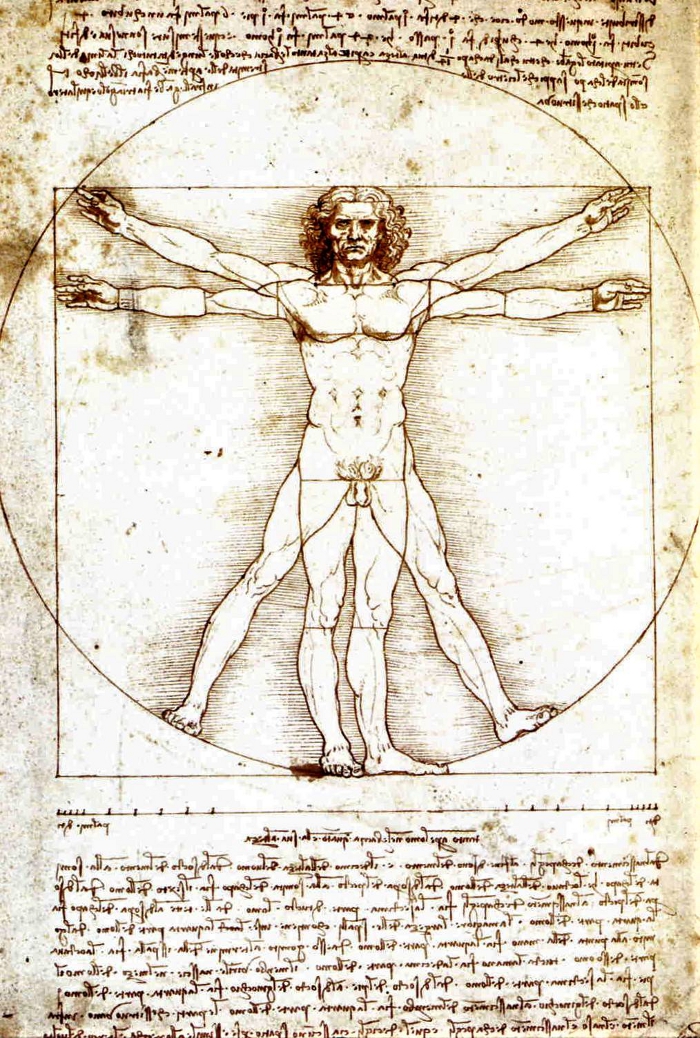
Leonardo da Vinci's (1452 - 1519) drawing of a male figue perfectly inscribed in a circle and a square, know as the Vitruvian Man (1490), illustrates what he believed to be a divine connection between the human form and the universe. Beloved for its beauty and symbolic power, it is one of the most famous images in the world.
--------------------------------------------------------------------
Babadi, Mehrdad. "Panahi's Laboratory: Ethical impasse in It Was Just an Accident." The Point (June 16, 2026) ["In Taxi (2015), Jafar Panahi stages a brief but haunting moment that, in retrospect, feels like the seed of his most recent film, It Was Just an Accident (2025). Near the end of Taxi, Panahi, playing the taxi driver, becomes visibly unsettled after picking up his friend Nasrin Sotoudeh, the prominent Iranian human rights lawyer and activist. When she asks what is wrong, he replies that he has just heard a voice he thought he recognized: the voice of his interrogator. Sotoudeh tells him that many of her clients report the same experience, a lingering effect of being blindfolded during prison interrogations. The conversation soon shifts elsewhere, almost casually. A decade later, Panahi has returned to that fleeting moment of fear and turned it into the central narrative and emotional core of It Was Just an Accident."]
Barquin, Juan. "Committing to the Bit." Notebook (July 13, 2026) ["Just like Showgirls’ Nomi Malone can be both a stripper and a dancer, art can straddle the line between high and low, between funny and tragic. That is the beauty of drag and of camp: It allows us to unabashedly embrace and play with works that are reviled as much as those that are adored. What Early and his contemporaries are doing isn’t new by any means, but it does offer us a chance to explore other material in the same vein and the myriad influences without which they would not exist. Just as drag can pull from material as varied as memes and tossed-aside quotes, and classic films and musical hits from the last century, works like Maddie’s Secret follow suit in the way they build off of an existing canon. It isn’t just about queering that canon, though certainly queerness has a lot to do with the way these texts are interpreted and remixed. Rather, what these works do is show how a long cultural history can be positively and repeatedly reshaped into fresh stories whose comedy is inextricable from their sincerity. "]
Beaupre, Mitchell. "Moments of Grace: Mike Mills reflects on his feelings-forward approach to filmmaking." Letterboxd (July 21, 2026) ["“You can’t grab onto people,” Mike Mills told me the first time we spoke, before the release of C’mon C’mon in 2021. “Maybe you can get a slice, a sliver, a piece. For a film, that piece is huge. That piece is really dense, but it’s just a piece, and there are all these other contradictory things that you’re not going to be able to get.” Across his three most recent features—Beginners, 20th Century Women and C’mon C’mon—Mills has continued to chase those pieces, mining the deep reservoir of his personal relationships to bring to the screen myriad intricacies present in the dynamics between parents and children."]
Benjamin, Ruha. "On Imagination: A Manifesto." Poured Over (January 24, 2024) ["Imagination: A Manifesto by Ruha Benjamin reminds us that our imaginations already know what a better world looks like. From education to challenging our systems of oppression and more, this insightful work shows a new place for us all to start from. Benjamin joins us to talk about the split between imagination and technology, changing our narratives to tell new stories, the importance of community and more with Miwa Messer, host of Poured Over."]
Coppins, McKay. "A Year in the World of Online Sports Betting." Radio West (July 7, 2026) ["The journalist McKay Coppins wasn’t a gambling man. But when his employer The Atlantic staked him $10,000 to bet on the 2025 NFL season, he couldn’t say no. Step one was getting permission from his bishop. Coppins is a member of the Church of Jesus Christ of Latter-day Saints, which prohibits gambling. But since it wasn’t his money and it was for work, he got the go-ahead. And so began what Coppins calls his year as a degenerate gambler — because it wasn’t long before he started feeling, well, kind of addicted. He’s joining us to talk about sports betting, how it changed him, and how it came to be that last year alone Americans bet $160 billion on touchdowns scored, yards gained, buckets made and pretty much any other outcome you could imagine in sports." Guest: McKay Coppins | Staff writer at The Atlantic and co-host of the podcast Deseret Voices. His story is called Sucker: My Year as a Degenerate Gambler.]
Cunningham, Vinson, Naomi Fry, and Alexandra Schwartz.
"The Golden Age of the American Idiot." Critics at Large (July 23, 2026) ["The new game show “Nation’s Dumbest,” flips the classic “Jeopardy!” script on its head. The format: twelve famous-ish contestants are peppered with basic logic and trivia questions. The twist is that those who perform well are sent home, with the last one standing receiving the title of “Nation’s Dumbest.” On this episode of Critics at Large, Vinson Cunningham, Naomi Fry, and Alexandra Schwartz consider how the figure of the idiot has evolved over time, from Shakespearean fools—whose position of apparent ignorance allows them to speak difficult truths—to more recent “happy fools” like Austin Powers and the goofy, stunt-obsessed heroes of the “Jackass” franchise. Once a laughingstock, the idiot has reached new heights of influence in the era of A.I. summaries and the infinite scroll. Resisting stupidity can feel like an uphill battle. “Whatever it is to be smart, I’m doing this Sisyphean thing of continuing to push it up the hill, and the rock feels heavy,” Cunningham says. “The question is: is society a wind at your back, or going in the opposite direction?”"]
---.
"How Sinners Revives the Vampire." Critics at Large (May 1, 2025) ["The vampire has long been a way to explore the shadow side of society, and “Sinners,” Ryan Coogler’s new blockbuster set in the Jim Crow-era South, is no exception. On this episode of Critics at Large, Vinson Cunningham, Naomi Fry, and Alexandra Schwartz discuss what “Sinners,” which fuses historical realism with monster-movie-style horror, illuminates about America in 2025. They trace the archetype from such nineteenth-century texts as “The Vampyre” and “Dracula” to the “Twilight” moment of the aughts, when Edward Cullen, an ethical bloodsucker committed to abstinence, turned the vampire from a predatory outsider into a Y.A. heartthrob. What do he and his ilk have to say today? “The vampire is the one who can unsettle our notions, and maybe give us new notions,” Cunningham says. “The vampire comes in and asks, ‘But have you considered this?’ ”"]
Embree, Desirae.
"Porno, Disco, and Summer of Sam: Spike Lee on Sexuality." Senses of Ciinema (July 2026) ["At the time of its release Summer of Sam (1999) was seen as a notable departure for Spike Lee, whose body of work up to that point had been predominately focused on the Black community and American race relations, but it was actually a return to the events that had formed him as an artist. In the summer of 1977, New York City was caught in a paroxysm fueled by rapid social change and the city’s fiscal crisis but ignited by the freak coincidence of a record-breaking heatwave, a massive blackout that plunged the city into anarchy, and a serial killer whose reign of terror extended from the city’s nighttime streets to the front page of the Daily News. Unable to find a summer job while home from his second year at Morehouse College, Lee took an 8 mm film camera and hit the streets, documenting a city in crisis. He returned to Morehouse in the fall determined to become a filmmaker, editing the footage from that summer into his first film, a short titled Last Hustle in Brooklyn (1979). While Last Hustle in Brooklyn is presumed lost, Lee’s twelfth feature film shows us the summer that produced one of America’s greatest filmmakers as he remembered it 22 years later. While there are many portraits one could paint of 1970s New York, in Summer of Sam, Lee depicts a sex-soaked city caught between the free love ethos of the previous decade and the sex panic that would define the next. The 1972 red-carpet premieres of Deep Throat (Gerard Damiano) and Behind the Green Door (Artie and Jim Mitchell) had heralded the beginning of a “porno chic” era in which going to see an X-rated flick was a sign of one’s sexual sophistication. As the public’s appetite for adult entertainment grew, New York’s Times Square became ground zero for what the early antipornography group, Citizens for Decent Literature (CDL), had described in 1963 as a “floodtide of filth…threatening to pervert an entire generation of American youth.”
1 The question of perversion aside, the CDL’s prediction of a rapid swell in the adult industry was on the money. In 1965, there were nine businesses within the city designated for “adult use,” but by 1977, there were 245.
2 Adult theatres and bookstores, video arcades, strip clubs, peep shows, live sex shows, massage parlours, and street-based sex work proliferated, turning Times Square into a commercial sex district that much of the city – including its burgeoning feminist antipornography movement – saw as less an indicator of sexual liberalism than of urban decay."]
Ford, Phil and J.F. Martel.
"Artworks are People Too." Weird Studies #216 (July 22, 2026) ["'Now and then, a mysterious life and potency will flicker out of an artwork and confront you.' So began "Artworks Are People Too," a talk Phil presented at the Diverse Intelligences Summer Institute earlier this summer. In this episode, JF and Phil discuss the implications of this idea that some artworks break the mould of the inanimate and act as persons in the world. Are artworks mere creations, or creatures too?"]
German, Emmaia. "The Anti-Defamation League & The Racial State." This is Hell (July 7, 20260 ["Emmaia Gelman joins This Is Hell! to talk about her new book “The Anti-Defamation League And The Racial State”, published by University of California Press. Emmaia Gelman is the founding Director of the Institute for the Critical Study of Zionism. She has taught social and cultural analysis at NYU and social sciences at Sarah Lawrence College. She is co-editor of, "The Anti-Defamation League: A Critical Reader”. Emmaia also co-hosts the podcast "Unpacking Zionism." Emmaia is also co-chair of the American Studies Association Caucus on Academic and Community Activism, and a longtime activist in New York City. Her writing appears in Jewish Currents, Boston Review, The Forward, and elsewhere."]
Hearing, David.
"We're All Mad Here." Notes From the End of Cinema (August 10, 2025) ["The children in Weapons are unsettling for their agency – they’re not running away from but towards something. This brings another quote from Minima Moralia to mind, where Adorno talks about the effect of children growing up in a culture that has rescinded the social and economic promises it made to their parents: “Today we are faced with a generation purporting to be young yet in all its reactions insufferably more grown-up than its parents ever were.” Even someone as pessimistic as Adorno didn’t foresee the horror of regular school shootings, and the way in which a lottery-like acceptance of the death of a handful of children every year is considered by the government as an acceptable price to pay for the ownership of assault weapons. It is often remarked that this generation of children carry an existential weight not felt by any since those who served in the World Wars, with the exception that rather than a worldwide monoconflict, what exists instead is a series of overlapping crises that foreclose on the very concept of the future itself. This generation of children do not have a specific conflict to renounce as much as existing in a world amid the convergence of many. In this sense, the running children at the start of Weapons also hint at something paradoxical: that these children are both inexperienced and also existentially careworn in a way beyond those who parent them – they shouldn’t be in the street, but they’re already entangled in danger before they leave the house."]
Herbert, Mark.
"This Is England: Shane Meadows's 2-Toned Look at Skins and Ska (with Jack O'Connell)." MUBI Podcast (July 16, 2026) ["Rico gets a primer on the skinhead history—and ska-fueled soundtrack—behind This Is England: The 2007 indie hit about misunderstood kids in a misunderstood subculture. Guests include stars Jack O'Connell (Sinners, 2025) and Andrew Shim (A Room for Romeo Brass, 1999), producer Mark Herbert, and Neville Staple, frontman for '80s ska legends The Specials."]
Hudson, David. "Steven Spielberg and Disclosure Day." The Current (June 10, 2026) ["For a film that suggests incontestable proof that we are not alone in the universe could move all of humanity to set aside our differences and come together as one, Steven Spielberg’s Disclosure Day has sparked a remarkably wide range of first reviews. However critical consensus takes shape in the years to come, Time’s Stephanie Zacharek finds that Spielberg’s thirty-fifth feature is “the greatest film he could have possibly made in this moment, at a time when humans worldwide are feeling bewildered and blindsided by a new order in which compassion, creativity, and respect for the natural world have become traits to be crushed, not nurtured. Disclosure Day is majestic, unnerving, and more than little wacky, though its pure unhinged quality is probably its secret sauce.”]
Iñárritu, Alejandro G. and Rodrigo Prieto. "Alejandro G. Iñárritu & Rodrigo Prieto look back on AMORES PERROS." MUBI Podcast (July 9, 2026) ["Director Alejandro G. Iñárritu (THE REVENANT) and cinematographer Rodrigo Prieto (THE WORLD OF WALL STREET) have a blast telling host Rico Gagliano about the making of their high-octane 2001 breakthrough AMORES PERROS—the story of a car crash, its victims, and their dogs. Topics include: the pair's early days as ad men, discovering star Gael García Bernal, the movie's literally toxic visual process...and where they got the cojones to pull it all off."]
Jagt, Tyler. "My Students Can't Read." The Chronicle of Higher Education (June 2, 2026) ["I came into teaching as a skeptic of the anti-smartphone argument: I had a phone in my pocket throughout high school and college in the 2010s, and I read long books anyway. I now think I was wrong, because the neuroscience has caught up. In a 2017 paper, Adrian F. Ward and colleagues at the University of Texas at Austin’s McCombs School of Business showed that the mere presence of a participant’s smartphone — whether that be face down, powered off, untouched, or across the desk out of vision — measurably reduces available working memory and fluid intelligence on cognitive tests, with the largest effects on the most phone-dependent users. A 2022 study by Motoyasu Honma and colleagues at Japan’s Showa University used near-infrared spectroscopy to compare reading on a smartphone with reading the same passage on paper, and found that smartphone reading produced overactivity in the prefrontal cortex, suppressed sigh generation, and led to general lower comprehension scores; the authors argued that the sigh inhibition and prefrontal overload were causally linked to the comprehension decline. So when a student tells me they “kept losing track” of a 20-page article, I have to acknowledge that they may be describing a measurable neurological condition. The neural pathways that support sustained attention are built by use, and they atrophy without it. Your body is a use-it-or-lose-it system, and the brain is no exception. Another reason for the decline in student reading capability is increasing reliance on generative AI. In June 2025, Nataliya Kosmyna and colleagues at the MIT Media Lab released a preprint titled “Your Brain on ChatGPT.” They divided 54 participants into three groups writing SAT-style essays — one using ChatGPT, the second group using a search engine, the last group using nothing — and monitored brain activity with a 32-channel EEG. The ChatGPT group showed the lowest neural connectivity of the three, with up to 55 percent reduced connectivity compared with the brain-only group, and “consistently underperformed at neural, linguistic, and behavioral levels.” Eighty-three percent of LLM users could not quote a single line from essays they had written minutes earlier. When the LLM group was forced to write without AI in a follow-up session, their brain activity did not bounce back to baseline; the researchers coined the term “cognitive debt” for the lingering deficit."]
Klemperer, Victor. Language of the Third Reich. Continuum, 2010. ["Victor Klemperer (1881-1960) was Professor of French Literature at Dresden University. As a Jew, he was removed from his university post in 1935, only surviving thanks to his marriage to an Aryan. First published in 1957, The Language of the Third Reich arose from Klemperer's conviction that the language of the Third Reich helped to create its culture. As Klemperer writes: 'It isn't only Nazi actions that have to vanish, but also the Nazi cast of mind, the typical Nazi way of thinking, and its breeding ground: the language of Nazism.' This brilliant book is by turns entertaining and profound, saddening and horrifying. It is deservedly one of the great twentieth-century studies of language and its engagement with history."]
Knausgård, Karl Ove. "Sentimental Value: Between Trauma and the Sublime." The Current (May 27, 2026) ["The question is, What good is this? Why should we sit there choked up watching two actors say they love each other? Because, of course, there is a difference between understanding something rationally and understanding something emotionally. Not least because we control the rational, while emotions are beyond our control. They just rise up, as if by themselves. Why? What do they want? Why did I cry when I saw the scene with the two sisters? I didn’t want to—if there’s one thing I hate, it’s losing control of my emotions, and I see crying as shameful, something I fight with everything I have. Probably because emotional outbursts were frowned upon when I was growing up. Not just in my family, but in the culture. Crying was something girls did. Emotions were not something you showed. No hugs. I have never told my brother, my mother, or my father that I love them, and they have never said it to me. So much of what went on in my family was left unsaid, unspoken, if not secret then at least well hidden. There is nothing wrong with that; it is a way of life that is as good as any other. But it was probably all this unspoken, all this unthought, that Sentimental Value circulated within and brought to life, through emotions, and that thus became clear to me, without me really wanting it to. Or in other words: Sentimental Value tries to loosen something hard, and something hard loosened in me when I saw it."]
Mecca, Dan. "Partially Devoured: Daniel Kraus on digging into Night of the Living Dead and unearthing the legacy of an undead classic." Letterboxd (May 12, 2026) ["A new book by Daniel Kraus that dives headfirst into George A. Romero’s horror-movie classic, Partially Devoured: How Night of the Living Dead Saved My Life and Changed the World opens with a quote from Romero himself: “The first time you see a movie you say ‘I like it.’ You’re not quite sure why. Watch it a second time. You will either like it again or not like it. If you like it again, you will start to look at why you like it. That’s where the understanding comes from. I tell you, I promise you, the fourth time you watch it, you weep. The fifth time you watch it, you’re analyzing. The sixth time, all of a sudden, you get it.” bThis sentiment gleefully haunts Partially Devoured, a deeply personal work by the Pulitzer Prize-winning author of Angel Down, Whalefall and The Living Dead (that last one started by Romero and completed by Kraus following his death) that both dissects and demystifies Romero’s 1968 masterpiece. Structured like a DVD commentary in text form, Partially Devoured examines every second of Night of the Living Dead while expanding upon its complicated production history and interweaving cultural commentary with a memoiristic account of Kraus’s personal relationship with the film. Kraus was recently kind enough to speak with Letterboxd about Partially Devoured, his lifelong relationship with Romero’s filmmaking and the enduring legacy of Night of the Living Dead."]
Moyn, Sam.
"Gerontocracy in America." Converging Dialogues (July 12, 2026) ["In this episode, Xavier Bonilla has a dialogue with Samuel Moyn about gerontocracy in America. They discuss how we live in a gerontocracy, coalitions, older institutions, avoiding ageism, oligarchies, elites and democracy, long term view, abundance, and many more topics. Samuel Moyn is Chancellor Kent Professor of Law and History at Yale University. He has his law degree from Harvard University and his PhD in modern European history from University of California, Berkeley. He is fellow at Quincy Institute for Responsible Statecraft and has received fellowships from the American Council of Learned Societies, the Berggruen Institute, and the John Simon Guggenheim Memorial Foundation. His main interests are in international law, human rights, and 20th century European moral and political theory. He was recently named one of Propsect Magazine’s top thinkers in the world for 2024. He is the author of numerous books including, Liberalism Against Itself: Cold War Intellectuals and the Making of our Times, and the most recent book, Gerontocracy in America: How the old are hoarding power and wealth and what to do about it."]
Pagels, Elaine.
"On the Historical Mystery of Jesus." The New Yorker Radio Hour (December 30, 2025) ["Thirty years ago, David Remnick published “The Devil Problem,” a Profile of the religion scholar Elaine Pagels—a scholar of early Christianity who had also, improbably, become a best-selling author with “The Gnostic Gospels,” from 1979. Pagels’s latest book, “Miracles and Wonder: The Historical Mystery of Jesus,” is a summation of her lifetime of research on Christianity, as it takes on some of the central historical controversies of Christianity, including the stories of immaculate conception and the resurrection. She tells Remnick how she found and lost faith in the evangelical movement, but retained a lifelong interest in religion. “I have a sense that what we think of as the invisible world,” she feels, “has deep realities to it that are quite unfathomable.”"]
Rushkoff, Douglas.
"What Camus Knew That Sam Bankman-Fried Didn't." Team Human (July 26, 2026) ["Rushkoff breaks down the intellectual hubris driving Silicon Valley: Effective Altruism (EA), Longtermism, and AI accelerationism. From Sam Bankman-Fried’s FTX collapse to the tech oligarchs attempting to optimize human presence through code, Rushkoff exposes how treating human lives as simple spreadsheet inputs creates a dangerous ends justify the means worldview. Drawing on philosophers like Albert Camus, Spinoza, and Martin Buber — and even recent statements from the Pope — Rushkoff argues that true moral action isn't calculated in hypothetical future outcomes, but lived out right now in local, face-to-face human connection."]
Schuster, Aaron. "The Ethical Dignity of Anora." E-Flux (November 20, 2024) ["Contemporary cinema might congratulate itself on having a harder-hitting approach to capitalism as compared to the saccharine fantasy of Pretty Woman. But today’s highly successful genre of anti-capitalist movies and television is above all pacifying and reassuring: the capitalists are punished, the rich get their comeuppance, and the downtrodden achieve some measure of revenge. Even when this genre displays real genius (particularly in its comedy of manners—the analytic precision with which it dissects the speech and behavior of the hyper-privileged), it still partakes of this impotent morality. Succession, White Lotus, The Menu, Triangle of Sadness, Glass Onion, Parasite, Saltburn, Industry: one can loathe the rich and love them too. This was put well by Martha Gill: 'We should recognize ‘eat the rich’ TV for what it is: not as any sort of cultural ‘reckoning’ for the prosperous and corrupt, but pure catharsis—a sort of inverted mirror of society. The more violently a culture squishes the undeserving wealthy on screen, the more it tends to valorize them in reality.' Truffaut once said that it’s impossible to make an anti-war film. What about an anti-rich film?"]
Towns, Brandon.
"Radical Whimsy: Exploring the Creative Mind of Boots Riley." Roger Ebert (June 18, 2026) ["
Boots Riley is the most dangerous man in Hollywood. He’s not a filmmaker. He is an enigma, a revolutionary fighting against capitalism with a pen and a lens. From his musical prowess as the frontman for the conscious hip-hop group The Coup to his community activism with the International Committee Against Racism (InCAR) and California’s Anti-Racist Farm Workers’ Union, Boots is the living embodiment of the phrase “artists must choose a side.” And he chose to fight for freedom. Riley is one of the few prevailing filmmakers who are deeply politically conscious, and his views ooze from script to screen. His filmography, best described as “Star Wars for Radical Politics,” focuses on helping people find the tools to change the world around them. By adopting comedy to smuggle his message past the capitalist gatekeepers and reach the masses, Boots creates his own film genre: radical whimsy. His work asks audiences how to create a movement that affects those in power."]
Tulleken, Chris van.
Ultra-Processed People: The Science Behind Food That Isn't Food. W.W. Norton, 2023. ["A manifesto to change how you eat and how you think about the human body. It’s not you, it’s the food. We have entered a new age of eating. For the first time in human history, most of our calories come from an entirely novel set of substances called Ultra-Processed Food. There’s a long, formal scientific definition, but it can be boiled down to this: if it’s wrapped in plastic and has at least one ingredient that you wouldn’t find in your kitchen, it’s UPF. These products are specifically engineered to behave as addictive substances, driving excess consumption. They are now linked to the leading cause of early death globally and the number one cause of environmental destruction. Yet almost all our staple foods are ultra-processed. UPF is our food culture and for many people it is the only available and affordable food. In this book, Chris van Tulleken, father, scientist, doctor, and award-winning BBC broadcaster, marshals the latest evidence to show how governments, scientists, and doctors have allowed transnational food companies to create a pandemic of diet-related disease. The solutions don’t lie in willpower, personal responsibility, or exercise. You’ll find no diet plan in this book—but join Chris as he undertakes a powerful self-experiment that made headlines around the world: under the supervision of colleagues at University College London he spent a month eating a diet of 80 percent UPF, typical for many children and adults in the United States. While his body became the subject of scientific scrutiny, he spoke to the world’s leading experts from academia, agriculture, and—most important—the food industry itself. But more than teaching him about the experience of the food, the diet switched off Chris’s own addiction to UPF. In a fast-paced and eye-opening narrative he explores the origins, science, and economics of UPF to reveal its catastrophic impact on our bodies and the planet. And he proposes real solutions for doctors, for policy makers, and for all of us who have to eat. A book that won’t only upend the way you shop and eat, Ultra-Processed People will open your eyes to the need for action on a global scale."]

No comments:
Post a Comment