Saturday, September 19, 2026

ENG 102 2026: Resources Archive #17

"This is the mystery we thrust ourselves into: A single neuron is not conscious of its existence. A network of billions of unconscious single neurons is. These monads living in a world without perception become a being that perceives, thinks, and acts. Consciousness lies not in neurons, but in a sophisticated pattern of connectivity (125)." - Dr. Arnkatla Minervudottr-Chan in Nayler, Ray. The Mountain in the Sea. Picador, 2022. 

-----------------------------------------------------------------

"Plate from Ernst Haeckel's visually dazzling Kunstformen der Natur, the Art Forms of Nature, published in 1904. With the assistance of Jena artist-lithographer Adolf Giltsch, Haeckel produced one hundred plates depicting the forms of animal life, mainly marine animals. With this book Haeckel wanted to create an "aesthetics of nature" and to show how the incessant struggle for existence he had learnt from Darwin was in fact producing an endless beauty and variety of forms, "Darwin and Humboldt combined together."." - Source: Public Domain Image Archive


------------------------------------------------------------------

"What is history for? What do we want it to do? In 1731, an obscure Kentish schoolmaster named Richard Spencer offered some answers. Properly to ascertain his position in geographical space, he reasoned, required not a single map, but access to a global atlas, one that would allow him to ‘see what London and the adjacent parts are in the kingdom; what the kingdom is in Europe, and what Europe is in the universe’. Much the same, he thought, applied to history. ‘Particular histories represent to you, what things have happen’d to such or such a People, with all their circumstances,’ he explained: ‘But to understand the whole clearly, you must know what relation every history can have to others.’ Only when such connected and wide-angled histories were available, might one hope to ‘see all the order of time’." -- Linda Colley, "Wide-Angled" (2013)

-------------------------------------------------------------------

"Sirat, a film by the Spanish film director Oliver Laxe, opens in the monumental setting of a rave in the Sahara, where a father and son are searching for a missing daughter. As the two make their way from party to party, news of a brewing World War-style conflict animates the background. (In Islamic scripture, “sirat” refers to a bridge that connects Paradise and Hell, and one gets a dose of each here.) Neither road film nor parable, Laxe’s film unfolds through encounters, sound, and landscape, denying narrative certainty and sitting instead with loss, belief, and endurance. As a work of art, Sirat becomes its own cosmology, loosening the grip of the rational world. Refusing the traditional arc of story, it is at once mystical and political, intimate and cosmic – offering a new vocabulary of being. Sirat gives permission for softness and strangeness. It makes me feel less existentially alone." — Sumayya Vally 


------------------------------------------------------------------------------
Bensinger, Ken, Max Lederer, and Paul Waldman. "The Pentagon is Waging War on Its Own Paper." On the Media (September 4, 2026) ["Defense secretary Pete Hegseth is demanding what he calls “more patriotic” coverage of his cabinet. On this week’s On the Media, hear how the Pentagon is cracking down on its publication, Stars and Stripes. Plus, an investigation reveals that some online content creators have taken money to endorse politicians. [01:00] Brooke Gladstone interviews Max Lederer, the publisher of Stars and Stripes, the independent, award-winning military news outlet within the Defense Department, about the Pentagon’s terminations of himself, the editor-in-chief, and the Middle East reporter, and the agency’s continued attacks on the paper’s congressionally mandated editorial independence. [13:38] Brooke speaks with Paul Waldman, writer of the Substack newsletter, The Cross Section, about how the media attention on Trump’s aide Natalie Harp, also known as “the human printer,” exploded. Plus, how she went from Fox News guest in 2019 to primary shaper of the president’s media consumption. [27:24] Micah sits down with Ken Bensinger, a New York Times media and politics reporter, to talk about his recent investigation into how hundreds of social media content creators are being paid to boost politicians ahead of elections, and not always disclosing it. Plus, Dave Jorgenson, former video producer at the Washington Post and founder of Local News International, speaks to the necessity of adopting standards around things political endorsements and AI use on social media, and how he’s using short-form videos to combat misinformation on the platforms where it flourishes."]

Blasi, Damian. "The Natural History of Linguistic Diversity." Many Minds (August 28, 2026) ["Thousands of languages are used around the world today, and this linguistic diversity is a precious part of our human heritage. But it’s also more than that. Linguistic diversity provides clues—a vast crazy quilt of clues—about how language works, about how history has unfolded, about the dynamics of culture, and about the nature of the human mind. My guest today is Dr. Damián Blasi. Damián is an ICREA Research Professor based at the Center for Brain & Cognition at the Pompeu Fabra University in Barcelona. Over the last decade or so, Damián’s emerged as one of the most innovative researchers in the study of language and linguistic diversity. He’s been widely recognized for this work, and most recently was awarded the 2026 FABSS Early Career Impact Award from the Cognitive Science Society. In this conversation, Damián and I talk about why scientists should care about linguistic diversity. We do a bit of linguistic diversity 101—how many languages there are, how we can enumerate them, how they vary. We discuss a recent paper in which Damián and his colleagues reconstructed the explosive rise and precipitous fall of human linguistic diversity over the last 12,000 years. We talk about the factors that drive language change. And we discuss how cognitive science relies too much on English and English speakers—and how this may be holding the field back. Along the way, Damián and I touch on the Tower of Babel, a golden age of linguistic diversity, the human bite configuration, scientific aesthetics, whether children shape language, polygenetic theories of language evolution, the pace of language change, schooling, linguistic inequality and behemoth languages, and why Damián thinks that the possibility space of human language might be bigger and wilder than we currently imagine."]

Blight, David W. "What if History Died by Sanctioned Ignorance?" The New Republic (August 7, 2025) ["We must mobilize now to defend our profession, not only with research and teaching but in the realm of politics and public persuasion."]

Carter, Alex.  "The Lives of the Philosopher: Albert Camus." Past Present Future (August 26, 2026) ["In our series about how twentieth-century philosophy and biography intersect, David talks to philosopher Alex Carter about the life of Albert Camus, novelist, playwright, journalist, celebrity and public intellectual. What makes Camus a philosopher as well? How was he shaped by his Algerian background? Does it make sense to call him an absurdist? How did he try to reconcile the very different parts of his extraordinary life?"]

Chomsky, Noam. "Everyday Anarchist." Modern Success (April 14, 2013) ["The New Yorker has … termed Chomsky “one of the greatest minds of the 20th Century”, while the New York Times has him as “arguably the most important intellectual alive.” But judged by the range, influence and novelty of his ideas, many argue that Chomsky is, in fact, the owner of one of the greatest minds in the history of our species. There is barely a domain of human understanding that has not been touched in some way by his thought. In the half-century since the 1960s, reverberations from his work have shaken the foundations of cognitive science, epistemology, media studies, psychobiology, computer science (to name but a few). "]

Conis, Elena. "How to Sell a Poison: The Rise, Fall, and Toxic Return of DDT (Bold Type Books, 2022)." New Books in Medicine (July 13, 2022) ["The story of DDT as you’ve never heard it before: a fresh look at the much-maligned chemical compound as a cautionary tale of how powerful corporations have stoked the flames of science denialism for their own benefit. In the 1940s, DDT helped the Allies win the Second World War by wiping out the insects that caused malaria, with seemingly no ill effects on humans. After the war, it was sprayed willy-nilly across fields, in dairy barns, and even in people's homes. Thirty years later the U.S. would ban the use of DDT—only to reverse the ban in the 1990s when calls arose to bring it back to fight West Nile and malaria. What changed? How to Sell a Poison: The Rise, Fall, and Toxic Return of DDT (Bold Type Books, 2022) traces the surprising history of DDT’s rapid rise, infamous fall, and controversial revival to reveal to show that we’ve been taking the wrong lesson from DDT’s cautionary tale. Historian Elena Conis uncovers new evidence that it was not the shift in public opinion following the publication of Rachel Carson’s Silent Spring that led to the ban but in fact the behind-the-scenes political machinations of Big Business. She makes a compelling case that the real threat was not DDT itself but the prioritization of profits over public health. ​ If we don't change the ways we make decisions about new scientific discoveries and technologies, Conis argues, we’re doomed to keep making the same mistakes and putting people at risk—both by withholding technologies that could help them and by exposing them to dangerous chemicals without their knowledge or consent. In an age when corporations and politicians are shaping our world behind closed doors and deliberately stoking misinformation around public health issues, from pesticides to vaccines to COVID-19 to climate change, we need greater transparency and a new way of communicating about science—as a discipline of discovery that's constantly evolving, rather than a finite and immutable collection of facts—in order to combat the war on facts and protect ourselves and our environment."]

Connors, Catherine. "The Pope is Officially Team Human." Team Human (September 9, 2026) ["Douglas Rushkoff is joined by storyteller and thinker Catherine Connors to explore Pope Leo XIV’s remarkable intervention into the AI debate. Together, they unpack his critique of transhumanism, technological inevitability and Silicon Valley’s vision of human progress and his radical case for the dignity, imperfection and magnificence of being human."]

Drimmer, Sonja and Christopher J. Nygren."Four Frictions: or, How to Resist AI in Education." Public Books (December 16, 2025) ["There are key differences between the 1971 protest and the growing resistance to AI today. Back then, advanced computational development was directed explicitly toward military purposes. When this research had to pass through university infrastructures, the violence of its purpose was easy to see. And this, in turn, made the potential targets of resistance clear; indeed, it was relatively easy to organize protests in front of large mainframe computers, located in very specific facilities and locations. Now, however, computation is distributed. And this makes the targets to resist so diffuse that the shape of direct action becomes difficult even to conceptualize. Another difference is who is directing the violence. Once, universities saw their computational power exploited by researchers working for the Department of Defense. Today, universities are being infiltrated by a commercial industry (albeit one that receives a staggering amount of money from defense contracts) that exploits students and faculty as data mines, test subjects, and a perpetual supply depot of future users, all for their own profit. Universities have accepted the overtures from this industry in a FOMO-driven frenzy without consulting their faculty, collecting empirical data on whether generative AI is pedagogically useful, or pausing to inquire about the long-term impact of AI on the students who have been entrusted to their care. Faculty are at best being coerced—and at worst being forced—to employ generative AI in their teaching, assessment, or advising. Moreover, with the educational mission that they thought they were signing up for undermined, students have no option to resist. In other words, we have all been left on our own to jury rig workable pedagogical scaffolds while the educational edifice is being bulldozed around us. Individual responses will not suffice; collective action is necessary."]

Ford, Phil and J.F. Martel. "David Cronenberg's Naked Lunch." Weird Studies #25 (September 12, 2018) ["JF and Phil head for Interzone in an attempt to solve the enigma of Naked Lunch, David Cronenberg's 1991 screen adaptation of William S. Burroughs' infamous 1959 novel. A treatise on addiction, a diagnosis of modern ills, a lucid portrait of the artist as cosmic transgressor, and like the book, "a frozen moment when everyone sees what is on the end of every fork," Naked Lunch is here framed in the light Cronenberg's recent speech making the case for the crime of art."]

Goldin, Hana Lee. "20 Small Acts of Media Literacy We Can Practice Every Day." Card Catalog (June 16, 2026) ["From checking the date to tracing the source: building a sharper eye for information."]

Harper, Jordan. "Manufacturing Goodness: What Administrators Really Do and Why." Public Books (September 11, 2026) ["In this essay, I want to ask what is, on the surface, a simple question: What do administrators do and why? What drove me toward this question is the sheer volume of faculty, staff, and students I talk to, informally in conversation and through formal avenues like teaching and research, in which they share wishes for administrators to do something or do something different and wonder why they don’t and won’t. This reads as an issue of consciousness and the ruse of contextual exceptionality in my estimation. Some see certain issues as tied to individuals and their lack of competence and political will. Others just believe in colleges and universities as exceptional spaces solely, or at least primarily, in the education business. ... The problem facing and debilitating the sheep owned and run by administrators is that there is a deliberate calculus that is difficult to compute, an apparatus that transcends the physical that most eyes aren’t trained to see. There is an obsession over the student outcomes of institutional higher education—escaping impoverished life circumstances and finding meaningful work—that lead most to call on administrators to improve and guard the cherished university by any means necessary, and make fashionable ideas and impulses to collaborate with administrators. “What would happen if every time people used the word ‘university,’ Harney and Moten ask, “it came out sounding like ‘factory’?” And the funny thing about factories is that its interior is often chaotic and terribly experienced, but what they produce are earmarked as good(s) always, somehow, consistently worth making and selling."]

Jones, Reece. "The Terrifying Power of the U.S. Border Patrol." Think Back (September 2, 2026) ["Reece Jones has spent his career studying borders. His 2022 book Nobody Is Protected argues that for its entire century-long existence the US Border Patrol has been writing its own rules. Jones, a geographer at the University of Hawaii, traces the agency’s lineage from antebellum slave patrols and the Texas Rangers through the 1924 Johnson-Reed Act that formally created it, showing how a little-known legal quirk puts roughly two-thirds of Americans within reach of an agency largely exempt from Fourth Amendment restrictions. In this episode of THINK BACK, Reece and I talk through the Border Patrol’s origins, the landmark Supreme Court cases that expanded the agency’s authority, and how 9/11 and the drug wars accelerated a mission creep that had been building for decades. Jones’s history is even more significant and necessary in 2026 than when it was first published. He shows that the current administration isn’t inventing new abuses of power so much as exploiting a century of legal loopholes that nobody bothered to close."]

Kemp, Ella. "Dark Side of the Loon: Coyote vs. Acme’s screenwriter Samy Burch on the journey of the Looney Tunes courtroom thriller."  Letterboxd (August 21, 2026) ["As Coyote vs. Acme arrives on the big screen after a long, complicated journey, screenwriter Samy Burch tells Ella Kemp how Wile E. Coyote finally got his day in court—and theaters—with her subversive comedy-drama."]

Muncer, Mike and Chris Newton. "The Evolution of the Vampire." The Evolution of Horror (September 3, 2026) ["Chris Newton joins Mike to discuss the sexiest, broodiest, gayest monster of them all, the vampire!."]

Rosenbaum, Jonathan. "Defending the Elusive." Notebook (September 15, 2026) ["Although it’s seldom acknowledged, one of the supreme pleasures of movies is the confusion and uncertainty often prompted by the beginning of a story, when we’re not yet fully tuned in to what’s going on. As in our sleeping dreams, a sense of infinite possibility stretches before us. That seemingly limitless vista soon disappoints once it is foreshortened into something real and recognizable, such as a place, an environment, a mood, a character, a theme, a genre, or a plot. Yet without these comfortable anchors, something that resembles prenatal bliss envelops our ignorance, and the fact that we can imagine almost anything makes the start of a film with all of its possibilities seem peculiarly and even exclusively ours. This is another way of saying that the less we know about something, the more our imaginations and expectations can come along to fill in the gaps. So the pleasure I’m talking about is a kind of shameless narcissism, albeit one that feels healthy because of its spur to our creative impulses. It’s also seldom acknowledged that cinema is interactive, becoming a collective experience even when we’re alone thanks to our phones, social media, and other tools used to convey our impressions afterwards. But because illusions of presence and motion are generated by viewers providing continuity to still frames as they’re being projected, with ourselves as the links between a projector and a screen, this means that the “movie” exists only inside us, even if we prefer to think of it being located elsewhere. A movie is expected to explain itself on some level. We agree to be nudged along by the crafty and creative individuals who make it easier for us to follow and understand. But this process also entails our unconscious filling in all the blank spots between the projector and the screen (suggesting presence) and those between individual still images (suggesting motion). This adds up to a form of collaboration we can all accept with pleasure, a creative form of acquiescence that we simply experience as moviegoing."]

Rushing, Josh. " New Doc EXPOSES Trump Murder War Crime Boat Strikes." Breaking Points (September 9, 2026) [Description of the documentary which can be viewed here: "Since September 2025, the US military has carried out more than 60 strikes on suspected drug-trafficking boats in the Caribbean and Eastern Pacific, killing more than 220 people. In a military campaign called Operation Southern Spear, President Donald Trump's administration has claimed to wage war against “narcoterrorism”. Yet the government has released little information about who was killed, the evidence against them or how targets were selected. In Killing at Sea, Fault Lines investigates the administration's claims about Operation Southern Spear by uncovering the stories of those targeted and the evidence used to justify lethal military force. Through the stories of families left searching for answers, alongside witness accounts, physical evidence and interviews with legal experts, Fault Lines asks whether the strikes are lawful, whether they have disrupted the drug trade and what accountability exists for those killed. From fishing communities in the Caribbean to Washington, DC, Killing at Sea examines a military campaign conducted largely beyond public view—and asks who is being killed in the US’s new war at sea, and why."]

Rushton, Michael. "The Moral Foundations of Public Funding for the Arts (Palgrave Macmillan 2023)." New Books in Critical Theory (November 25, 2023) ["Should governments fund the arts? In The Moral Foundations of Public Funding for the Arts (Palgrave Macmillan, 2023), Michael Rushton, Co-Director of the Center for Cultural Affairs and a Professor at the O’Neill School of Public and Environmental Affairs at Indiana University, explores a variety of frameworks for thinking about this question, from liberal and egalitarian justifications, through to communitarian, conservative, and multiculturalist ideas. The book outlines the economic method for thinking about the arts, and uses this as a starting point to understand what various political philosophies might tell policymakers and the public today. A rich and deep intervention on a pressing social and governmental question, the book is essential reading across the arts, humanities, and social sciences, as well as for anyone interested in arts and cultural policy. Prof Rushton blogs at both Substack and Artsjournal and you can read open access papers covering some of the key ideas in the book here and here."]

Silverman, Jacob. "The Pump and Dump Presidency." Know Your Enemy (September 8, 2026) ["Donald Trump is the most corrupt president in American history, and it isn't close. Between his family's crypto business — designed to enable foreign oligarchs, criminals, and state actors to bribe the administration while enriching Trump and his family — his insider trading and manipulation of the stock market, a tariff regime designed to bind business interests to Trump's personal whims, and the advent of a virtual market for criminal fraudsters to purchase pardons from the president himself, Trump and his family have accrued billions of dollars while hollowing out the rule of law and corroding what's left of our democracy. It is brazen, appalling, and poisonous. To guide us through this many-circled hell, we're joined by Jacob Silverman, author of Gilded Rage: Elon Musk and the Radicalization of Silicon Valley, who's been covering the crypto beat and the Trump-family corruption for years. Jacob helps us wrap our heads around the immensity of this problem — and what, if anything, can be done about it."]

Skiveren, Nicolai. "Cinematic Waesthetic: Wasted Worlds, Wasted Lives and Becoming-Waste in Contemporary Science Fiction Film." Revenant #10 (March 2024) ["This article explores the aesthetic, affective, and epistemological connections that bind together science fiction (SF) as a genre of cognitive estrangement, and the varied forms of waste that have come to permeate the genre’s filmic depictions of the future. Whether it be in the shadowy alleyways of Blade Runner 2049 (2017), the shantytowns of District 9 (2009), or the ravaged environments of Idiocracy (2006), waste is always there, lurking in the background, enveloping its human and nonhuman subjects with its elusive yet distinct atmosphere. And yet, it remains unclear what purpose(s), if any, waste might serve within these film-worlds. Because despite the seemingly central place that waste occupies in our cultural imaginaries of the future, no one has yet presented a systematic reflection on its affective, symbolic, and narrative significance. This article therefore brings together writings on ecological SF (Caravan 2014) and critical waste studies (Bauman 2004; Hawkins 2005; Viney 2014) to scrutinize the waste found across the above SF films. The article proposes that waste in contemporary SF film can be seen to operate mainly within three overlapping modes: ‘Wasted worlds,’ ‘Wasted lives,’ and ‘Becoming-waste.’ Drawing especially on Adrian Ivakhiv’s tripartite model for an eco-philosophy of the cinema, this article calls attention to the often subtle ways in which waste participates in (i) cinematic world-building, (ii) representations of otherness, and (iii) depictions of radical forms of change. Taken together, these three modes represent a suggestive image of how waste forms part of contemporary SF film."]

Smalley, Gregory J. "3 Women (1977)." 366 Weird Movies (February 19, 2014) ["Tucked away on the long stretch of nowhere between Persona (1966) and Lost Highway (1997) lies 3 Women, the 1970s iteration of cinema’s recurring dream about sliding identities. This film is as dry and mysterious as a bone found in the desert. Directed by Robert Altman, the miniature scope—most of the film involves only two characters—and the way dramatic naturalism is subverted into disquieting weirdness is not what we typically think of as an “Altmanseque” epic ensemble satire. This change in tone makes this pensive movie all the more of a surprise coming from an accomplished director who (besides the experimental comedy of Brewster McCloud) was not known for his surrealist tendencies. The movie has a quiet quality that honors its Mojave desert setting; you hear the wind rustling through the spaces between Pinky and Millie."]

Webster, Jamieson. "A Library of Oceanic Feelings: A Psychoanalytic History of the Sea." Pioneer Works (September 9, 2026) ["As one of those people who only feel well by the ocean, I’ve long followed the trail of oceanic feelings—that sense of eternity or limitlessness, the connection to something larger—and been perplexed by Freud’s confession that he could find none of this in himself. Oceanic feeling was as closed to him as music. He admitted this in a letter to his friend Romain Rolland, whose reflections inspired the term and prompted the opening pages of Civilization and Its Discontents, where Freud wrestles with the idea that an “oceanic feeling” binds people to religion through a lived sense of something immeasurably greater than themselves. He professes complete bewilderment, even as he speculates that such a feeling might preserve the earliest intimacies of infancy, a return to oneness with the maternal, or perhaps belong to that region beyond the ego where it brushes against the immensity of the id. But ultimately he remains suspicious, worrying that the experience has more to do with an infantile longing for a protective and omnipotent father. Poor Freud. The great explorer of the unconscious could find no feeling for that oceanic depth: its vortices of power, its vast and rhythmic flow, its unknown origins, nor for the other life it reveals beyond our paltry shores. Yet I never wanted to dismiss Freud as others have, explaining away his difficulty through character assassination, or asserting that he was simply too rigid, too enclosed, too fixated on fathers and laws and languages—land, territories, cultures—to open himself to that great engulfing maternal flow, no doubt more musical than sensible. Freud, they say, had a mother problem."]

West, Stephen. "Dewey and Lippman on Democracy. Philosophize This #130 (May 23, 2019) ["At the turn of the 20th century, a crucial debate emerged between Walter Lippmann and John Dewey over the viability of democracy in an increasingly complex world. Lippmann critiqued democracy’s reliance on public opinion, arguing that citizens construct simplified “pseudo-environments” shaped by media and stereotypes, rendering them ill-equipped to make informed decisions on vast global issues. He warned that modern democracies are driven more by emotionally charged reactions than by accurate understanding, and that media, language, and time constraints further distort reality. Dewey responded not by dismissing Lippmann’s concerns, but by reframing democracy as more than a political system—it was, to him, an ethical ideal and a form of social cooperation. Viewing society as an interconnected organism, Dewey believed individuals flourish only through participation and education. He saw democracy as a continuous process of mutual growth, where every person contributes uniquely, and where the antidote to authoritarianism lies in cultivating thoughtful, empowered citizens—not in retreating from democratic ideals, but in deepening them." Further Reading: Public Opinion – Walter Lippmann (1922)​;  Democracy and Education – John Dewey (1916)​; The Problematic Public: Lippmann, Dewey, and Democracy in the Twenty-First Century – Eds. G. Mitchell Reyes & Nathan Crick (2023)​]

---. "Simone De Beauvoir Pt. 1 - The Ethics of Ambiguity." Philosophize This! #106 (July 19, 2017) ["In this episode, the discussion builds on Sartre’s view of human existence as a constant tension between facticity—the unchangeable facts of our lives—and transcendence—the possibilities we have to shape ourselves. Simone de Beauvoir deepens this idea in The Ethics of Ambiguity by arguing that human beings do not live in just one tension but inhabit a web of overlapping dualities: subject and object, individual and collective, mind and body. Rather than simplify these contradictions, she insists we must face them honestly, embracing the inherent ambiguity of existence. De Beauvoir critiques historical philosophy and religion for offering comforting but false narratives that obscure this truth. She emphasizes that freedom—our unavoidable capacity to choose—is the foundation of any ethical life. However, she warns that many fall into “bad faith,” adopting fixed identities or nihilism to escape the discomfort of freedom. Instead, true ethical living requires not only accepting our own freedom but working to maximize the freedom of others. Through this lens, meaning is not discovered but created through action, and ethics begins with the acknowledgment that we are condemned to be free."
Further Reading:
At the Existentialist Café: Freedom, Being, and Apricot Cocktails by Sarah Bakewell (2016)​
Existentialism from Dostoevsky to Sartre edited by Walter Kaufmann (1956)​
Existentialism for Everyday Life: Finding Meaning in a Chaotic World by Aurora Koskinen (2023)​]

---. "Simone Weil - The Mathematician." Philosophize This! #174 (February 2, 2023) ["So in one of her earlier journals Simone Weil writes about a moral dilemma that ends up being a metaphor, for a situation that a lot of people might find themselves in while living in the modern world. She says to imagine a man…who lives in a society…where he is forced to solve complex math problems all day long…but the catch is that when he solves one of these math problems…any time he arrives at an answer, and that answer is an even number…he gets beaten with a stick…by the powers that be. They tell em we don’t take too kindly to even numbers round here son. Now go on…solve another one of them math problems, as he twirls the stick smiling with his dirty hands. The moral dilemma for Simone Weil was this: what should the mathematician do when he finds himself in this situation? Should he resist and fight back? Should he just refuse to solve any more of their math problems? Should he make a sign and protest about how upset he is? By the end of these two episodes released here today we’ll understand why Simone Weil came up with the particular solution that she did to this moral dilemma…and also why as the years went on…she grew in her thinking enough to realize that the answer…. might not be as simple as the one she originally came up with."]

---. "Simone Weil - Vessels of God." Philosophize This! #175 (February 2, 2023) ["This episode explores Simone Weil’s view on self-transformation, contrasting the Western emphasis on willpower and discipline with her deeper focus on cultivating attention. While will is effective for physical action and routine habit-building, Weil argues it falls short when it comes to moral clarity, inspiration, and spiritual depth. Attention, for Weil, is not passive but a disciplined openness to truth, beauty, and obligation—qualities she sees as reflections of a higher moral order, which she calls God. Crucially, Weil believes that goodness only becomes real when individuals act as vessels for this universal good, through conscious participation in the world. The episode also outlines three pathways to developing attention—love of beauty, love of neighbor, and religious or transcendent experience—and emphasizes the need for humility and lucid thought as safeguards against ego-driven moral blindness, especially in times of collective conflict." Further Reading: Waiting for God by Simone Weil (1951); Gravity and Grace by Simone Weil (1952); The Ethics of Attention: Engaging the Real with Iris Murdoch and Simone Weil by Silvia Caprioglio Panizza (2022)]


Saturday, September 12, 2026

Orange-Mint Salad with grains and lima beans

2 cups water
3/4 cup of grains (wild rice, purple rice, freekeh, bulgur, or quinoa)
1/2 cup mint leaves
1/2 cup orange juice
3 tablespoons lemon juice
1 clove garlic - diced or grated
1/2 teaspoon salt
1/2 teaspoon pepper
1/4 cup EVOO
1 cup thinly sliced fennel
1 cup of sugar snap peas - thinly sliced (use frozen if fresh isn't available - thawed)
1 cup thinly sliced radishes
2 oranges - segmented
2 cups frozen lima beans (thawed)

1) Cook grains

2) Combine mint, OJ, lemon juice, garlic, salt, and pepper. Whisk in EVOO. Put 1/4 cup of the mixture in a bowl add fennel, peas, radishes, and oranges - toss/mix.

3) add grains and lima beans to the remaining mixture - toss/mix. Serve the fennel mixture over the grain mixture.

Thursday, September 10, 2026

ENG 282: International Film Studies - Spring 2027 (Weird Studies and Monster Theory)

Weird Studies - my definition:


I classify "weird fiction" as not necessarily a genre-in-itself, instead it operates in the interstices of mainstream genres, creating through poetic prose, vivid imagery, hallucinatory experiences, existential angst, dream logic and shocking stories, a powerful effect upon the reader, provoking them to start to see the mundane world with a slant. If you look at the etymology of 'wyrd' it originates as the "power to control destiny" (no doubt in a magical or ritual sense) and morphs to the latter "weird" meaning of "unearthly" or strange. These stories stay with you, taking root deep inside your consciousness, reverberating like the ripples of a deep pond disturbed by a thrown rock and provoke you to rethink what you have always taken for granted. There is a commercial genre called "the new weird" (also an older pulp magazine "weird" usually involving cosmic horror) and some of these books/authors would be slotted into my broad genre classification here (many are not), but in the spirit of actual weirdness I include other books/films that operate under the aesthetic classification described above without being marketed as "new weird." The disturbance to perceived reality also may take place through a decoding/encoding process that challenge and restructure (exposing the myths and inconsistencies) dominant narratives/pathways (also see situationist détournement and derive). Often these weird narratives represent/present a dream logic as being just as important/relevant as our waking logic. The purpose is to expose the cracks in the foundations of controlling narratives, destabilizing them through weird narratives that shake the assured assumptions of its adherents. The concepts of carnivalesque revelry and the dialogic nature of consciousness as theorized by Mikhail Bakhtin are equally important, in that they involve the reversal of a dominant order and/or an exposure of the fantasy of the controlling order, in the process revealing the many perspectives/voices that are silenced/masked. As disturbing as these can be for many, perhaps the most problematic aspect of many weird narratives would be the decentering of humans (as the center of the universe) and explorations/recognitions of non-human perspectives. Importantly, in the context of my own American culture, this also involves narrative & theoretical displacement of our particular hegemonic way of seeing & being as the baseline for thinking about and understanding the world. In film studies there has also been a classification of Mind Fuck films which would be included here. All of these can provide a cathartic release from the anxiety/terror of the really weird situation we are living through and the twisted creatures that our at the helm of planet earth. [Editorial note: my definition was originally written during the 2020 COVID-19 Pandemic]. Under no circumstance is weird meant in a derogatory way.  Anyone who does a deep dive into science, especially theories of consciousness and reality, knows that science is seriously weird. I appreciate works that challenge our constructed reality, pushing us to see that there is not just one way. Also it should be understood that what seems weird to some may seem obvious and normal to others. One of the great benefits of learning across time and space/places is that it can, following Bertolt Brecht, "make the familiar strange." Michael Dean Benton (May 2020; revised July 2022)

My aim is multi-pronged: 1) resist the initial impulse toward criticism 2) focus on the characteristics of belief or the vision of creativity 3) treat all people as having a concrete worldview that they have thought through 4) pay attention to patterns/rituals and stay aware of inconsistencies/contradictions 5) keep my critical awareness engaged even when I stay open to different ways of seeing/being 6) seek a wide range of historical and cultural examples/histories.


Bibliography (Print Culture):

Cohen, Jeffrey Jerome.  "Monster Culture (Seven Theses)." Monster Theory: Reading Culture. ed. Jeffrey Jerome Cohen. University of Minnesota Press, 1996: 3 - 25.  

Creed, Babara. Return of the Monstrous-Feminine: Feminist New Wave Cinema. Taylor and Francis, 2022. ["This follow-up to the classic text of The Monstrous-Feminine analyses those contemporary films which explore social justice issues such as women’s equality, violence against women, queer relationships, race and the plight of the planet and its multi-species. Examining a new movement – termed by Creed as Feminist New Wave Cinema – The Return of the Monstrous-Feminine explores a significant change that has occurred over the past two decades in the representation of the monstrous-feminine in visual discourse. The Monstrous-Feminine is a figure in revolt on a journey through the dark night of abjection. Taking particular interest in women directors who create the figure of the Monstrous-Feminine, in cinema that foregrounds everyday horrors in addition to classic horror, Creed looks at a range of diverse films including The Babadook, A Girl Walks Home Alone at Night, Nomadland, Carol, Raw, Revenge, and the television series The Handmaid’s Tale. These films center on different forms of revolt, from inner revolt to social, supernatural and violent revolt, which appear in Feminist New Wave Cinema. These relate in the main to the emergence of a range of social protest movements that have gathered momentum in the new millennium and given voice to new theoretical and critical discourses. These include: third and fourth wave feminism, the #MeToo movement, queer theory, race theory, the critique of anthropocentrism and human animal theory. These theoretical discourses have played a key role in influencing Feminist New Wave Cinema whose films are distinctive, stylish and diverse. This is an essential companion to the original classic text and is ideal for students in Gender and Media, Gender and Horror, Gender and Film and Feminist Film theory courses."]

Martel, J.F. Reclaiming Art in the Age of Artifice. Basic Books, 2025. ["Reclaiming Art in the Age of Artifice is a journey into the uncanny realities revealed to us in the great works of art of the past and present. Received opinion holds that art is culturally-determined and relative. We are told that whether a picture, a movement, a text, or sound qualifies as a “work of art” largely depends on social attitudes and convention. Drawing on examples ranging from Paleolithic cave paintings to modern pop music and building on the ideas of James Joyce, Oscar Wilde, Gilles Deleuze, Carl Jung, and others, JF Martel argues that art is an inborn human phenomenon that precedes the formation of culture and even society. Art is free of politics and ideology. Paradoxically, that is what makes it a force of liberation wherever it breaks through the trance of humdrum existence. Like the act of dreaming, artistic creation is fundamentally mysterious. It is a gift from beyond the field of the human, and it connects us with realities that, although normally unseen, are crucial components of a living world. While holding this to be true of authentic art, the author acknowledges the presence—overwhelming in our media-saturated age—of a false art that seeks not to liberate but to manipulate and control. Against this anti-artistic aesthetic force, which finds some of its most virulent manifestations in modern advertising, propaganda, and pornography, true art represents an effective line of defense. Martel argues that preserving artistic expression in the face of our contemporary hyper-aestheticism is essential to our own survival. Art is more than mere ornament or entertainment; it is a way, one leading to what is most profound in us. Reclaiming Art in the Age of Artifice places art alongside languages ​​and the biosphere as a thing endangered by the onslaught of predatory capitalism, spectacle culture, and myopic technological progress. The book is essential reading for visual artists, musicians, writers, actors, dancers, filmmakers, and poets. It will also interest anyone who has ever been deeply moved by a work of art, and for all who seek a way out of the web of deception and vampiric amusement that the current world order has woven around us."]

Schneider, Kirk. Horror and the Holy: Wisdom-Teachings of the Monster Tale. Open Court, 2013. ["Throughout history, human beings have been strangely fascinated by the monstrous and the macabre. In Horror and the Holy, a study of the classic horror story, Kirk Schneider explains the compelling power of such tales as a result of our thirst for the sacred, and identifies elements of the holy in familiar blood-curdling yarns.True horror arises when the mundane becomes unexpected and when the contained breaks free of its confining chains to become unlimited. Anything boundless tends to become terrifying, argues Schneider. It is infinitude, which draws us to the unsavory, infinitude that lurks behind dread. Sheer bliss, paradise, or Nirvana therefore always has the potential to turn into horror, as limits fall away and the boundless expanses of infinity open up. While ecstasy is a glimpse of the infinite, terror is full disclosure. Drawing upon a detailed and telling analysis of eleven well-known horror stories, Dr. Schneider finds that a spiritual understanding of life can be attained through horror. Classic horror steers a middle path between fanaticism and despair: the path of wonderment. Horror teaches us that human personality is paradoxical; that revulsion and disgust are the obverse of excitement and freedom, and that both poles are vital to individual, social, and ecological well-being."]

Documentaries:

The American Nightmare (USA: Adam Simon, 2000) This is available for free on Youtube. How the horror genre changed post 1968.

Horror Noire: A History of Black Horror (USA: Xavier Burgin, 2019) Description: "Delving into a century of genre films that by turns utilized, caricatured, exploited, sidelined, and finally embraced them, this is the untold history of black Americans in Hollywood through their connection to the horror genre." Here is a collection of resources that go with the film: Horror Noire syllabus

Nightmares in Red, White, and Blue: The Evolution of Horror (USA: Andrew Monument, 2009) This is available for free on Youtube (click on the link to watch). It is a look at the socio-political context of horror films.

Woodlands Dark and Days Bewitched: A History of Folk Horror (USA: Kier-La Janisse, 2021) Description: "Explores the folk horror phenomenon from its beginnings in a trilogy of films – Witchfinder General, Blood on Satan’s Claw and The Wicker Man – through its proliferation on British television in the 1970s and its culturally specific manifestations in American, Asian, Australian and European horror, to the genre’s revival over the last decade."


Online resources: 

366 Weird Movies ["The backbone of this site is the project to create the List of the 366 Best Weird Movies of all time. Why make a list of 366 movies? That’s one for every day of the year, with a spare for leap years. As every day is associated with a Catholic saint, we believe every day should have its own weird movie. Most of the movies selected are both weird and good. Sometimes, if a movie is very weird, it will make the list ahead of a better movie. Sometimes, if a movie is very good, it does not have to be quite as weird. The key determinant is that each movie gives me that I-know-it-when-I-see-it feeling; a film that makes my skin crawl, my jaw drop, or just causes me to mutter to myself, “Now that’s weird….” We are very cautious in certifying a movie as weird—we may consider and review 4 or 5 movies for every one we decide to put on the List. But just because a movie does not make the List on the first ballot doesn’t mean it’s forever out of contention. From time to time, we’ll reconsider and promote movies that we once thought borderline to the exalted ranks of the Weirdest Movies Ever Made."]

"Earl Fontainelle: Esotericism/Religion/Philosophy." Dialogic Cinephilia (Ongoing Archive)

"Phil Ford and J.F. Martel: Weird Studies/Art/Culture/Esotericism." Dialogic Cinephilia (Online Archive)

Symbolreader [A quote used to introduce the project of the website: "The symbolist standpoint considers life to be a living book of symbols, a sacred text that can be decoded. Through applying the proper key, the patterns of the world reveal hidden resonances and levels of information overlooked in our contemporary preoccupation with literal meanings and surface interpretations." -- Ray Grasse, The Waking Dream]

Tafoya, Scout. "The Post-Punk Cinema Manifesto - Side A." (Posted on Vimeo: 2017) 

---. "The Post-Punk Cinema Manifesto - Side B." (Posted on Vimeo: 2017)


Quote file:

"Sirat, a film by the Spanish film director Oliver Laxe, opens in the monumental setting of a rave in the Sahara, where a father and son are searching for a missing daughter. As the two make their way from party to party, news of a brewing World War-style conflict animates the background. (In Islamic scripture, “sirat” refers to a bridge that connects Paradise and Hell, and one gets a dose of each here.) Neither road film nor parable, Laxe’s film unfolds through encounters, sound, and landscape, denying narrative certainty and sitting instead with loss, belief, and endurance. As a work of art, Sirat becomes its own cosmology, loosening the grip of the rational world. Refusing the traditional arc of story, it is at once mystical and political, intimate and cosmic – offering a new vocabulary of being. Sirat gives permission for softness and strangeness. It makes me feel less existentially alone." — Sumayya Vally 


"Monstrosity, for me, is always positive. It's about debunking all the normative ways of society and social life. (1)" - Julia Decournau (2021) [quoted in Creed]

"This is the mystery we thrust ourselves into: A single neuron is not conscious of its existence. A network of billions of unconscious single neurons is. These monads living in a world without perception become a being that perceives, thinks, and acts. Consciousness lies not in neurons, but in a sophisticated pattern of connectivity (125)." - Dr. Arnkatla Minervudottr-Chan in Nayler, Ray. The Mountain in the Sea. Picador, 2022. 


Wednesday, September 9, 2026

Fight Club (USA: David Fincher, 1999)


“Our great war is a spiritual war; our great depression is our lives!” - Tyler Durden

"The most strongly enforced of all known taboos is the taboo against knowing who or what you really are behind the mask of your apparently separate, independent, and isolated egos." -- Alan Watts, The Book on the Taboo Against Knowing Who You Are (1966)

Fight Club (USA: David Fincher, 1999: 139 mins)

Adkins, Ashleigh. "Fight Club: The Case of Psychological Misdirection and Bloodied Knuckles." Letterboxd (October 17, 2019)

Baker, Peter. "The Men Who Still Like Fight Club." The New Yorker (November 4, 2019)

Church, David. "Remaining Men Together: Fight Club and the (Un)pleasures of Unreliable Narration." Offscreen 10.5 (Mat 2006)

Eig, Jonathan. "A beautiful mind(fuck): Hollywood structures of identity." Jump Cut #46 (2003)

Kuersten, Erich. "CinemArchetype #7: The Shadow." Acidemic (March 8, 2012)

Graeber, David. Debt: The First 5,000 Years. Brooklyn, NY: Melville House Publishing, 2011. [Was reading the 1st chapter of this book at the same time as I was preparing for the Fall 2012 Ethics/Film screening of Fight Club -- it changed the way I conceived of the meaning of the dramatic ending of the film: "By the same token, for the last five thousand years, with remarkable regularity, popular insurrections have begun the same way: with the ritual destruction of the debt records--tablets, papyri, ledgers, whatever form they might have taken in any particular time and place. (8)"]

---. "On the phenomenon of bullshit jobs." libcom (August 20, 2013) [In regards to Tyler Durden's complaint of these types of jobs]

Koski, Genvieve, et al. "Man Up, Pt. 1 - Fight Club." The Next Picture Show #186 (July 31, 2019) ["We’re looking at two films featuring underground fight clubs, secret identities, and male protagonists trying to reclaim their self-worth through violence, beginning with David Fincher’s Fight Club, which traffics in many of the same themes as Riley Stearns’ new The Art of Self Defense, albeit with decidedly more stylistic flourish. In this half of our toxic masculinity double feature, we dig into what made Fight Club so divisive in 1999, and what makes it seem so prescient today."]

---. "Man Up, Pt. 2 - The Art of Self-Defense." The Next Picture Show #187 (August 6, 2019) ["Riley Stearns’ new dark comedy The Art of Self Defense centers on an underground scene of fighters who engage in their own version of the transgressive tactics Tyler Durden plays with in 1999’s Fight Club, but both films are ultimately about the catharsis of violence. After digging into how The Art of Self-Defense spins the “fight club” premise to its own ends, we pit these two films against each other to see which reigns supreme!…Or, to determine what each movie has to say about their shared interests in misogyny, toxic masculinity, and the dehumanization of life in corporate America."]

Like Stories of Old. "Fight Club - How (Not) to Become a Space Monkey." (Posted on Youtube: November 16, 2019) ["Video essay on Fight Club; examining how charismatic leaders like Tyler Durden turn men into Space Monkeys."]

---. "The Myth of Heroic Masculine Purpose." (Posted on Youtube: February 28, 2022) ["A critical analysis of the myth of heroic masculine purpose, and its effect on men’s perception of manhood, and on their connection to others and to the world."]

O'Connell, Max. "Men's Rights Activists, GamerGate, and Why Fight Club is Still Worth Debating 15 Years Later." IndieWire (October 15, 2014)

Palahniuk, Chuck (Interviewed by Joe Rogan). "Why Men Like Fight Club." Jer Films (Posted on Youtube: April 27, 2020)

Rushkoff, Douglas. "They Say." Coercion: Why We Listen to What 'They' Say'. (NY: Metropolitan Books, 1999: 1-26) [A question that is raised, for me, is why we so easily accept what "they say?" Here is media theorist Douglas Rushkoff's brilliant critical and self-reflective exploration of this question.]

Sevilla, Susanna. "Things Are Not What They Seem." (Posted on Vimeo: February 2015) ["A video essay on title sequences from Hitchcock and Fincher films. An exploration of motion graphic design from analog to digital."]

Szhou, Tony. "David Fincher - And the Other Way is Wrong." Every Frame a Painting (October 1, 2014)

Zavodny, John. “I Am Jack’s Wasted Life: Fight Club and Personal Identity.” Movies and the Meaning of Life: Philosophers Take on Hollywood. eds. Kimberly A. Blessing and Paul J. Tudico. Chicago: Open Court, 2005: 47-60. [Professor has copy]


Saturday, September 5, 2026

ENG 102 2026: Resources Archive #16

"Every day
I see or I hear
something
that more or less
kills me
with delight,
that leaves me
like a needle
in the haystack
of light.
It is what I was born for—
to look, to listen . . ."
Mary Oliver, "Mindful"


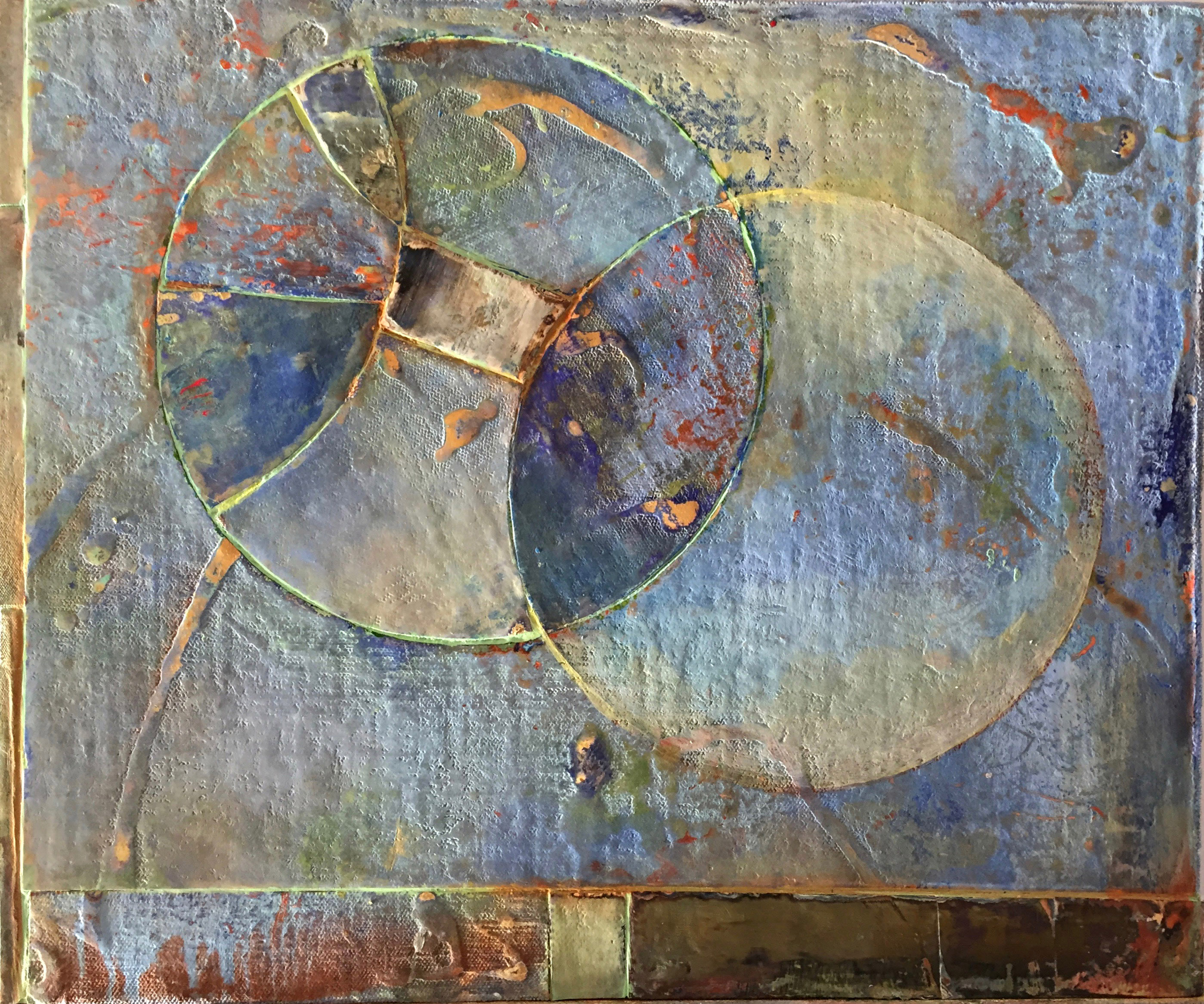
Vesica Piscis by Joe Goodwin (2015: Acrylic on canvas and board)

Presented at a conference on art and psyche in Siracusa, Italy - Vesica Piscis, by contemporary artist Joe Goodwin, is an exercise in synchronicity. The work, not then complete, was noted by the artistas having a 'glaring compositional problem,' in the form of empty space. The addition of an off-centre circle, overlapping the one already on the canvas, resulted in an important symbol of sacred geometry, representing the intersection of the world of the divine with the world of matter and also the beginning of creation. Given that the conference held an audience mostly composed of Jungian analysts, the process and experience was well understood. - Elizabeth, S. The Art of the Occult: A Visual Sourcebook for the Modern Mystic. White Lion Publishing, 2020: 24.
-----------------------------------------------------------------

Amad, Thaer, Feroze Sidhwa, and Poh Si Teng. "“American Doctor”: New Film Follows U.S. Doctors to Gaza as Israel Bombs Hospitals, Kills Staff, Patients." Democracy Now (August 14, 2026) ["The new documentary American Doctor tells the story of how the besieged hospitals of Gaza have continued to treat the sick and wounded throughout Israel’s genocidal war on the Palestinian territory, with local medical staff risking their own lives in the process. According to Palestinian officials, Israeli attacks have killed about 1,700 healthcare workers in Gaza since October 2023. The documentary follows three U.S. doctors as they volunteer in Gaza hospitals. Director Poh Si Teng says the film rose out of her “deep despair” over what was happening in Gaza, including deadly Israeli attacks on her former Al Jazeera colleagues. American Doctor is her attempt “to bring Palestine back to the United States,” Teng says. We also speak with two of the subjects of the film: trauma surgeon Dr. Feroze Sidhwa and emergency physician Dr. Thaer Ahmad, who is Palestinian American."]

Beaupre, Mitchell. "Flesh and Fluids: Jane Schoenbrun on fighting repression through Teenage Sex and Death at Camp Miasma." Letterboxd (August 6, 2026) ["Our relationship to sex as a culture is so unhealthy. So, of course we try to compartmentalize it or keep it on our browser window and never share it with another human being. I don’t think that is serving us as a people. I think that repression is the enemy, and especially the enemy of the artist, and this is a movie against repression." —⁠Jane Schoenbrun]

Berry, Wendell. "The Work of Local Culture." What Are People For? San Francisco: North Point Press, 1990: 153-169 [Excerpts posted on Dialogic with links to the entire text: July 8, 2012]

Bird, Kai. "On Roy Cohn, a Founding Father of Donald Trump’s America." The New Yorker Radio Hour (August 28, 2026) ["During the height of Roy Cohn’s friendship with Donald Trump, according to the historian Kai Bird, “they were on the phone with each other a dozen times a day.” Bird’s new book, “American Scoundrel,” details Cohn’s profound influence on Trump—whom he met as a young real-estate heir in the nineteen-seventies—and how Cohn is “haunting” politics in our time. “I had written about Roy Cohn in [previous biographies] as this nefarious, minor, awful figure who was disruptive and divisive and unethical. And I suddenly realized that the establishment that I’d been writing about for forty years is gone. Their values and culture, the politics, the bipartisanship . . . that’s all gone,” he tells David Remnick. “Roy Cohn explains something about the dark side of America that I just didn’t understand.” They discuss Cohn’s early career as a prosecutor and his role as the “mastermind” of the McCarthy purges; his service as a lawyer and fixer for Mafia members, politicians, and celebrities; and an allegation of being involved in sex trafficking."]

Bui, Kevin. "Knives Out: Johnnie To's Election." Senses of Cinema #118 (May 2026) ["The specific intricacies of triad society have formed the backbone for many of To’s most acclaimed works since the creation of his Milkyway Image production banner, with films such as Chan sam ying hung (A Hero Never Dies, 1998) and Cheung foh (The Mission, 1999) probing the ways in which gang members juggle codes of loyalty and honour in their day-to-day duties, while others like PTU (2003) and Dai si gin (Breaking News, 2004) explore the group’s inextricably parasitic relationships with the police and the media. Premiering at Cannes in the spring of 2005, the synopsis of Hak se wui (Election, 2005) places it in the same breath as To’s other crime sagas. Another two years have passed, and it’s time for the elders of the Wo Shing to place their votes on who will be the organisation’s next chairman. A significant contingent voice their support for Lok (Simon Yam), a level-headed, ‘professional’ career criminal who would likely run the business with the discretion and finesse required to stay out of the warpath of the Hong Kong Police Force. But others in the committee make it known that they would rather have Big D (Tony Leung Ka-fai) in charge; the much more volatile but otherwise effective candidate who they believe will strike fear back into the hearts of their enemies."]

Goldin, Hana Lee. "Books Have Always Been Destroyed. But Never Like This."  Card Catalog (August 25, 2026) ["Every one of these books, preserved to the letter, can now be read by no one. The scanned texts sit in Anthropic’s private collection, a library with no reading room and no public catalog. Models trained on that collection are built to avoid quoting it at length, because reproducing long passages for users is the copyright violation no court has excused. So the machines answer questions about books without ever showing the books themselves. When someone asks a model about a title that survives only in that collection, what comes back is a summary, written in the model’s words, with the original nowhere in reach. That arrangement changes something basic about how we can know things. Checking a claim against its source is the foundation of thinking for ourselves. When we can pull the book, find the page, and read the passage in context, we get to judge whether the summary was faithful and whether the quote meant what someone claims it meant. Remove the book and that judgment has nowhere to stand. We’re left taking the summary on trust, with no way to confirm and no standing to doubt. Whatever the model says the book said becomes, for all practical purposes, what the book said. That’s a transfer of authority from the page to the tool, from a source anyone could check to an answer nobody can. The transfer happens one unreachable book at a time. Maddeningly, every piece of this design is legal. Each one also removes a question that used to have an answer. The anonymous purchasing means nobody can list which books were destroyed, so nobody can rule out that some were the last copies anywhere. With the collection sealed, nobody can compare a stored text against the printed original it replaced, so even perfect fidelity can never be shown. As for whether the buying ever stopped, nobody outside knows that either, since the only reason anyone knows it started is that a piracy lawsuit dragged the records into the open. None of this took a conspiracy, only ordinary business decisions about what to disclose, all of them legal and every one of them closing a door."]

---. "The Unspoken Rules of Information Etiquette." Card Catalog (July 28, 2026) ["The rules of information etiquette can be traced by looking at where they get broken. Six come up over and over across every kind of exchange between people who know each other. Each is a norm we already follow most of the time, and every one registers as felt friction the moment it gets broken."]

Gullifer-Laurie, Isabella. "Through the Looking Glass: The Gold Diggers." Senses of Cinema #118 (May 2026) ["Sally Potter characterised her first feature, The Gold Diggers (1983), as “a musical describing a female quest.” A labyrinthine, post-punk exploration of “the connections between gold, money and women,” Potter’s film is a mischievous, magic, anti-realist countercinema. It was poorly received in some quarters. “By any reasonable earthly standard,” wrote Janet Maslin in The New York Times, “this thing – a 1983 oddity, sort of a feminist, deconstructionist, riddle-filled anti-musical, much of it set on the Icelandic tundra – is pure torture.” Indeed Potter’s film evinced a “promiscuous cross-breeding of avant-garde and mainstream” styles, mixing anti-capitalist satire with film theory about the male gaze, and Marxist conceptions of class and labour. “Perhaps,” as Sophie Mayer writes, it was the “determination to laugh in the face of power [that] upset those critics more than anything that the film says explicitly.” The Gold Diggers is challenging and erudite, a witty, ambiguous experiment resourced by inventive plans, schemes, and dreams."]

 Hinman, Ed. "The Barbarian in You: Vigor, Wonder, and Fellowship." The Personal Success Podcast #186 (August 24, 2026) ["Ed Hinman graduated from the U.S. Naval Academy, played four years of college football, served eight years in the Marine Corps, earned a master's degree in history, and has spent the last seventeen and a half years in public figure protection at Gavin de Becker & Associates. On paper that reads like a straight line. It was not. In this conversation, Ed lays out the idea behind his book, The Barbarian in You: we inherited bodies and nervous systems built for vigor, wonder, and fellowship, and almost everything about modern life pulls us away from all three. Vigor is physical effort and the state change that follows it. Wonder is the spiritual and imaginative side, the part you reach through nature, art, reading, or belief. Fellowship is the one Ed says we are losing fastest, especially men. Ed explains why he redefines barbarian as anyone who lives with those three things, which is how a book about Julius Caesar and the Battle of Hastings also has chapters on Ralph Waldo Emerson, Arnold Schwarzenegger, and David Lee Roth. The turn in the conversation comes when Ryan asks where Ed's self-trust came from. Ed describes standing at a service academy career conference, surrounded by employers who wanted to hire him, feeling like a product on a shelf. He went home and told his wife he would rather eat baloney cereal than take one of those jobs. Ryan shares his own version of that moment, finishing an MBA and realizing he had completed somebody else's checklist. They also get into the part most conversations about this skip. Ed does not tell anyone to quit. He says there is honor in doing work you do not want to do so you can provide for your family, and then moves the question to the hours you actually control. What are you doing at home? The back half turns to men, fellowship, and resistance. Ed's advice on checking in on a struggling friend is two words long, and it is the most useful thing in the episode."]

Hudson, David. "We Will Always Love Dolly Parton." The Daily (August 27, 2026) ["“I try not to get into the politics of everything,” Parton told Mesfin Fekadu in the Hollywood Reporter in 2023. “I try to get into the human element of it. I have some of everybody in my own immediate family and in my circle of employees. I’ve got transgender people. I’ve got gays. I’ve got lesbians. I’ve got drunks. I’ve got drug addicts—all within my own family. I know and love them all, and I do not judge . . . If there’s something to be judged, that is God’s business. But we are all God’s children and how we are is who we are.”"]

Huh, Minj. "Embodied allegory in Sorry to Bother You: art, performance and movement in neoliberal capitalist ruins." Jump Cut #62 (Winter 2023 - 2024) ["In this paper, I examine how Riley brings art and politics together in Sorry to Bother You, specifically through embodied allegory. Such a deployment of allegory in recovering the bodies of the marginalized—in this case racially- and gender-marked laborers—resonates with how Annabel Patterson in Fables of Power (1991) shifts our attention towards Aesop as a “philosopher of materialism and the body” (38), an essential facet of Aesop which has long been eclipsed by “the legend of the witty Aethiopian slave” (34). To be sure, many episodes in Aesopian fables function as a critique of unequal power relations. The political message of these fables grasps wage laborers’ attention to this day when the urge to liberate oneself from the social hierarchy is still founded in capitalism, whose internal mechanism has an uneasy proximity to enslaved labor in pre-capitalist societies. I propose that Sorry to Bother You is a viable fable for this day and age, alerting us to the possible subversion of official values and dominant culture, and at the same time, encouraging us to attend to another device of allegory, which is the historical situatedness of its current author."]

Moon, Alexis. "Inherit the Wind: Kiyoshi Kurosawa’s The Samurai and the Prisoner." Notebook (August 31, 2026)  ["“I think this act of taking something that we cannot typically see and then, through its movement, being able to confirm its existence—to show us and reassure us that it’s actually there—is very much akin to cinematic expression itself,” Kurosawa told The Film Stage. “So wind, to me, is not so much something that is spiritual, but I think of cinema as something that is there for us to be able to capture the wind … [it is] almost like cinematic expression itself. The finale is divorced from that which came before, seemingly standing outside of both time and space, with an ascension for the characters who have abandoned their agendas in favour of responding appropriately to the way the wind blows.”"]

Moor, Robert. "Tree Thinking." Wonder Cabinet (August 29, 2026) ['Can you imagine being a tree? Robert Moor has spent years trying—climbing into their canopies, studying their biology and learning to see trees in ways most of us don’t. He considers himself a “tree person.” Moor believes that when you spend a lot of time in trees, time slows down—and branching and pruning can become life lessons. He’s interested not just in how trees grow, but in what they might teach us about ourselves. In his book In Trees, he says his goal isn’t to anthropomorphize trees but to “arborize” humanity. Moor has taken his obsession with trees to unusual places: climbing to the tops of giant sequoias; traveling to Tokyo to meet master bonsai artists; becoming a “tree sitter” to protest an oil pipeline. He’s fascinated by “family trees” and Darwin’s Tree of Life, and by our own evolutionary history in the trees of Africa. He traveled to Ethiopia to see Lucy, the famous 3-million-year-old fossil skeleton, and to Tanzania to sleep in a chimpanzee nest. (It was a miserable experience.) He knows something about living among trees: 13 years ago, he and his husband moved from New York City to a cabin in the woods of British Columbia—and never left."]

Mrachacz, Lena. "Cinema as Commons: The Radical Act of Going to the Movies." Notebook August 24, 2026) ["A cinema as commons is not simply a different way of programming films. It is a different kind of social proposition altogether. What happens when a community gathers to watch a film it has chosen together, in a space it has collectively claimed, cannot be replicated by watching the same film alone. The film becomes a shared reference point, a starting place for conversation, a way of recognizing something in each other. The room produces a temporary public, and that public, however briefly, understands itself as one. People sit in the same room, encounter the same thing, and agree or disagree about what it means. That is very close to what democratic culture requires in order to function. It is also worth asking what those spaces are fighting against, or rather, what kind of relationship to cinema they are refusing. The dominant model of moving-image consumption today is not simply commercial; it is algorithmic. A small number of platforms now control not just distribution but also the conditions under which films get made, the data that determines what gets commissioned, the interface through which most people on earth encounter moving images. The logic is one of personalization: Every scroll, every pause, every abandoned film feeds a system designed to predict and preempt your next choice. What gets optimized, in the end, is your continued individual engagement with the platform. This is a form of enclosure of attention, of taste, of the very capacity to be surprised by something you didn’t already know you wanted. What gets lost is the condition of watching together in a room, with strangers and friends. This is why gathering matters. Streaming has made watching films easier, cheaper, and more solitary than at any point in cinema’s history. It has also made the act of gathering to watch something together feel, quietly, like a choice, one that requires a little more intention than it used to. But what the history of cinema as commons suggests is that this gathering was never incidental, that the room has always been part of the argument, as much as the film inside it. That idea is worth holding onto: a cinema that refuses to offer a service and insists on building a commons, and a public that understands itself as such. The cinemas carrying this impulse forward today are not simply alternatives to the multiplex but a response to a specific moment. It is not a coincidence that they are multiplying now, in a moment when public space is contracting, when political life feels increasingly managed from above, when the simple act of gathering together has started to feel like a position in itself. What these cinemas insist on, each in its own way, is that cinema can be more than entertainment delivered to an audience, that the room, and who fills it, and what happens after the lights come up, are themselves political questions worth taking seriously, and that those questions don’t resolve themselves once and for all. They have to be asked again and again, by every community. The cinema has always had the potential to function as a commons. In certain moments of political urgency, people have insisted on it. This is one of those moments."]   

Orleck, Annelise, et al. "Worker protections help (almost) everyone (Labor Rights)." Best of the Left #1263 (April 9, 2019) ["Today we take a look at the overwhelming benefits to society of labor, health and safety regulations and how the only people who don't come out ahead are those who have to pay for them."]

O'Sullivan, Suzanne. "The History of Bad Ideas: Overdiagnosis." Past Present Future (August 12, 2026) ["We come to the end of this series of bad ideas with a conversation with neurologist Suzanne O’Sullivan about the problems of living in an age of diagnosis, when all medical conditions need a label and new labels appear all the time. What happens when the classification criteria for conditions like autism and ADHD get broader and broader? Are doctors or patients driving this? When does predictive testing do more harm than good? Why does advocacy for sufferers get in the way of good health? Is de-diagnosis achievable? The Age of Diagnosis by Suzanne O’Sullivan is available now https://bit.ly/3U1ZwOu]

Palmquist, Ben. "The 80 Year PR Campaign That Killed Universal Healthcare." Citations Needed #134 (April 21, 2021) ["Almost every wealthy country in the world has some type of universal healthcare system--except for the United States. With over 170 million of its citizens left to fend for themselves in a sprawling and complex maze of Medicare, Medicaid, private insurance, tax credits, child care subsidies, co-pays, deductibles and cost-sharing, the U.S. has not only the largest uninsured population, but also the most expensive system on Earth per capita. Why America doesn’t have a universal healthcare system has historically been explained away with a reductionist mix of pathologizing and circular reasoning. "America hates big government," "we love choice," "Americans distrust anything that reeks of socialism." And while this is true in some limited sense, it avoids the bigger question of why has American so-called "democracy" rejected the numerous proposals to enact a single payer or other forms of universal healthcare? While there may be some innate Protestant work ethic or rugged individual mentality at work here, there’s also been a decades-long multimillion dollar campaign funded by big business, doctor, pharmaceutical and hospital industry interests, and the insurance industry to convince the public to reject universal public healthcare. Indeed, if Americans were somehow intractably opposed to the notion––if they were hardwired to reject socialized medicine––these forces would never have had to spend so much money in the first place. On this episode, we explore the 80-year long campaign by capital to convince you to not support universal health programs, how these campaigns have historically fear-mongered against Communists, immigrants and African Americans, who benefits from a precarious, employer-controlled healthcare insurance system, and how this propaganda war on the American mind is anything but over. Our guest is Ben Palmquist, Director of the Health Care and Economic Democracy Program at Partners for Dignity and Rights."]

Richardson, Heather Cox. "The Right to Run For Office." Letters from an American (August 29, 2026) ["Republican lawmakers are attempting to restrict the ability of naturalized and dual citizens to run for office, At least five Republican members of Congress want to prohibit them from holding federal judgeships, Cabinet posts, and ambassadorships as well, Americans have struggled over questions of equality and immigration for more than a century, Anti-immigrant sentiment on the East Coast over Irish immigrants and on the West Coast over Chinese immigrants led to limits to their rights and created a caste system, Abraham Lincoln understood that giving up the principle of equality is an excuse for enslaving people and that we cannot make exceptions to the Declaration of Independence, Americans added the 14th Amendment to the Constitution to ensure that these exceptions could not be made, The Constitution's requirements for officeholders are the only allowable qualifications, neither states nor the federal government can add additional qualifications, The idea of discriminating against naturalized citizens is, in the words of law professor Pamela Karlan, "ugly, stupid, and unconstitutional.""]

Scheonbrun, Jane. "On Teenage Sex and Death at Camp Miasma." Film Comment (August 6, 2026) ["Teenage Sex and Death at Camp Miasma, Jane Schoenbrun’s third narrative feature, opens in theaters tomorrow. Dizzyingly meta-textual and deliciously, well, campy, the film stars Hannah Einbinder as an emerging queer filmmaker tasked with directing a reboot of a fictional ’80s slasher franchise titled Camp Miasma. She decides to visit the final girl of the original movie who is now an eccentric middle-aged recluse, played by Gillian Anderson, who’s living on the campgrounds where the first movie was shot. What unfolds is, in the of our critic Nathan Lee, a “gore-soaked, titty-bouncing, sexploitation fever dream girded by real conceptual brio.” Meditations on the perverse riddles of desire as well as the queer subtexts of many slasher films and the kind of strange identification they invite from the spectator are rendered with perfectly pitched horror theatrics and laugh-out-loud humor. Film Comment Editor Devika Girish spoke with Schoenbrun about this very rich text, trying to unpack the film’s layers—but not too hard, because if there’s one thing you can take away from Teenage Sex and Death at Camp Miasma, it’s that analysis is a boner-killer and mystery is hot."]

Stryker, Susan. "Changing Gender." LARB Radio Hour (August 28, 2026) ["Medaya Ocher and Eric Newman speak with Susan Stryker about her new book Changing Gender. Part cultural history, part grammar lesson, and part memoir, Changing Gender confronts not only the long historical slipperiness of gender and identity in U.S. culture, but also the ways in which the very language we use to describe and understand gender becomes a cultural battleground for meaning and identity. Stryker discusses the relatively recent origins of our thinking about "gender," the ways that thinking has been misunderstood and misappropriated for political skirmishes, and the difficulty of pinning down exactly what we're talking about when we talk about gender."]

Suri, Jeremi. "American Civil War." Lex Fridman Podcast (January 25, 2023) [Jeremi Suri discussing his latest book Civil War By Other Means: America's Long and Unfinished Fight for Democracy "The Civil War may have ended on the battlefield, but the fight for equality never did. In 1865, the Confederacy was comprehensively defeated, its economy shattered, its leaders in exile or in jail. Yet in the years that followed, Lincoln’s vision of a genuinely united country never took root. Apart from a few brief months, when the presence of the Union army in the South proved liberating for newly freed Black Americans, the military victory was squandered. Old white supremacist efforts returned, more ferocious than before. In Civil War by Other Means, Jeremi Suri shows how resistance to a more equal Union began immediately. From the first postwar riots to the return of Confederate exiles, to the impeachment of Andrew Johnson, to the highly contested and consequential election of 1876, Suri explores the conflicts and questions Americans wrestled with as competing visions of democracy, race, and freedom came to a vicious breaking point. What emerges is a vivid and at times unsettling portrait of a country striving to rebuild itself, but unable to compromise on or adhere to the most basic democratic tenets. What should have been a moment of national renewal was ultimately wasted, with reverberations still felt today. The recent shocks to American democracy are rooted in this forgotten, urgent history. "]

Torchin, Leshu. "Themed Playlist: The Female Gaze." Screen Culture (April 8, 2020) ["... a female gaze. This is a term often used as counterpoint to the male gaze, a term introduced by Laura Mulvey but which has enjoyed considerable escape velocity into popular culture. Whilst the male gaze centres a male spectator to identify with an active male protagonist in stories that speak to him, and which render female figures little more than an object or narrative device, a female gaze intervenes and expands and shatters this framework. A female gaze centres women and their desires. A female gaze can willfully displace the male gaze that derives pleasure from but refuses the agency of women on screen."]

Turner, Kyle. "Why Do Movies Look Like That Now?" AV Club (August 20, 2026) ["Cinematographers, colorists, and camera operators explain how shifting technologies and business expectations are blurring modern cinema's images together."]

Uzuner, Mustafa. "Universal Language: Grief is a Thing with Feathers." Off/Screen (July 2025) ["Matthew Rankin’s filmography is a kaleidoscope of surrealism, historical revisionism, and deadpan absurdism, rooted in a deep affection for what might be termed Canadiana—the quirks, contradictions, and mythologies of Canadian identity. From his early experimental shorts to his audacious feature debut, The Twentieth Century (2019), Rankin has carved a niche as a provocateur of national introspection, blending bureaucratic satire with Freudian psychodrama and visionary set design. Yet his latest film, Universal Language (2024), marks a striking evolution: a tender, cross-cultural ode to friendship, displacement, and the transcendent power of cinema. By tracing Rankin’s journey—from Québécois prime ministers and masturbating premiers to a Persian-inflected Winnipeg dreamscape—we encounter an artist whose work now bridges Canadian eccentricity with the humanist poetics of Iranian masters like Abbas Kiarostami. This synthesis situates Universal Language within transnational cinema, framing cultural hybridity not as a point of conflict but as an ongoing dialogue."]

West, Stephen. "Socrates and the Sophists." Philosophize This! #3 (June 23, 2013) ["This episode talks about how, in ancient Athens, teachers called sophists taught people how to argue well, even if they weren’t right. They believed truth was different for everyone. Socrates disagreed—he thought there were real answers about right and wrong. He spent his life asking people tough questions to help them think more clearly. People didn’t always like this, and eventually he was put on trial and sentenced to death. But his way of thinking inspired philosophy for generations." Further Reading: Socrates and the Sophists, Plato (2011); The Dream of Reason, Anthony Gottlieb (2000); Socrates: Ironist and Moral Philosopher, Gregory Vlastos (1991)]