Ashleigh Adkins
Professor Michael Benton
English 102
Representation or Bust: Hollywood’s Struggle with Stigmatizing Mental Illnesses
It could be argued that films are perfectly accessible points of escapism, teeming in idealizations of what one would label as the “American Dream” (which can, and often does, vary from person to person) on a backdrop of perfection and self-perceived realism. Which, at its core, is the very issue Hollywood has in general – there is no ideal America, or a truly perfect life or reality in the world outside of what one person makes of it for themselves, however, an entire industry has been cultivated off of profiting off the desperation of an audience to see something as close to perfect as possible. Or, at the very least, something that can distract them from the news headlines or current political climate long enough to find peace in their existence on this Earth again. That is unless you’re part of a marginalized group – be it racially, sexually (in both orientation or gender identity), or even because of your mental health – and you often find yourself fighting for appropriate representation both on and off-screen. To the defense of the film industry, waves have been made in the way of representation, and the representation of people of color and members of the LGBTQ+ community have come a very long way from where they started.
Unfortunately, on the topic of mental health, it’s far too easy to demonize and stigmatize rather than to produce a narrative that reflects normalcy and honesty about the realities of mental illness and what those who live with them face. Hollywood sticks to the mentality that any representation is good representation so long as it is profitable, and while good representations of mental illnesses are becoming more common, there is still the undercurrent of negativity that surrounds the characters and ultimately still create this idea and notion that those who deal with mental illnesses are dangerous and violent. That the people on screen, in a fictional world and story, are honest representations of the people who live with mental illnesses every day. It’s dangerous to assume that one can watch a film with a depiction of someone living with a mental illness (be it presented properly or not) and discern reality from a fictional retelling. In fact, media often works in subtleties, pushing subconscious preconceptions into our minds throughout our viewing time that stick with us throughout our lives even if we may consciously reject the notions presented (qtd. in Beachum, 19).
The reality around mental illnesses is rooted in statistics that are very often glossed over by the film industry. In fact, according to the National Institute for Mental Health, 18.9% of adults live with a mental illness, 4.5% of them being listed as a severe mental illness. This is with the understanding that there are 46.6 million adults over the age of 18 who live with a mental illness, and an estimated 11.2 million of those are severely mentally ill (NIMH, 2019). While it is not necessary, or even being asked, to include mentally ill people in all forms of media, the number of people affected by them every day should be taken into consideration when looking to do so. The representation proffered to the public is the key detail needing to be closely considered, and a more critical look at one’s own preconceptions of mental illnesses and mental health overall to gauge whether a truly unbiased perspective can be reached in film.
While the most common instances of depictions of mental illnesses in film are inherently bad and rooted in misunderstandings of the illness they are trying to present an overarching negative stereotypes to push a specific narrative that caters towards the benefit of the protagonist (at the expense of the mentally ill antagonist), there are moments in cinematic history that truly do shine with accurate and well-researched depictions of the realities of mental illness and should be taken note of. However, despite displaying the truth behind living with mental illnesses for some, even the more successful depictions continue to fuel the flames of stigmatization that only continue to hinder the acceptance of the general public who live with mental illnesses. Joker is one example that comes to mind, a haunting showcasing of trauma and post-traumatic stress disorder coupled with psychosis and delusions that lend a hand to the strong allusion that Arthur Fleck quite possibly lives with Schizoaffective Disorder. According to the DSM-5, hallmarks of Schizoaffective disorder are symptoms of psychosis, including delusions, hallucinations, disorganized speech, abnormal psychomotor behavior, and negative symptoms along with a major mood episode (American Psychiatric Association, 2013: 106-110). The symptoms must not be attributed to the result of substance use or of a medical condition. Arthur has multiple instances throughout the film displaying each of these symptoms, most notably for the viewer the severity of his delusions when it comes to light that the relationship he had with his neighbor was a figment of his own imagination.
Phoenix is a phenomenal actor, and there was great care taken by both him and the writing team to give a very real, visceral depiction of severe mental illness in the context of an origin story without applying it strictly to a superhero genre on its own. In fact, Joker could be argued to be more of a case study and origin story rather than any specific visual depiction of the roots of one of the most iconic villains in media history. Arthur is presented as the antagonist, struggling with very obvious mental health issues that take precedence throughout the entire film, while the main antagonist being social constructs and the stigmatizations of the mentally ill that inevitably directly push Arthur to the climatic psychotic break we see towards the end of the movie.
This is partially why Arthur’s extreme acts of violence in the movie come across as so disturbing – an echo of The Joker’s intended violent nature that has been with him and all iterations of his character since his inception in 1940. Even Heath Ledger’s performance of the iconic role in The Dark Knight is firmly placed into a history of violence and psychotic behavior that became the most memorable rendition of the character in modern cinema to date. While Joker focuses on the history of mental illness in Arthur’s personal story, The Dark Knight strays away from the outright associations with any mental illnesses in favor of portraying him as the villain we all know him to be. The Joker is a media icon, often casually diagnosed with schizophrenia, post-traumatic stress disorder, and dissociative identity disorder; none of which have any real substance to the claims, only fueled by misunderstandings of each illness and the willingness of fans to attribute his behaviors to severe mental illnesses rather than anything he does of his own volition (Foulkes, 2017).
In fact, in 2006 a national survey was conducted to gauge the general American public’s perception of the mentally ill and found that 60% of people surveyed at the time believed that those living with Schizophrenia were violent by nature (while 32% believed the same for those living with major depressive disorder). American perceptions of the mentally ill are not reflections of the truth, and most people who live with a mental illness are not violent. In fact, only 18% of people who live with a psychiatric illness alone actually committed acts of violence. In a study conducted on the presence of violence within the mental health community, it was seen that there were larger numbers of those committing violence who suffered from both a psychiatric illness as well as a substance abuse problem, rather than the illness alone. The stigma is still there, though, and it shows when writers use these stereotypes as truths to their fictional characters, rather than looking into far more common cases of mental illnesses that have no history of violence or aggression (Harvard, 2011).
This, in particular, is why Ledger’s characterization is as damaging as it is – there are hints throughout the film that showcase obvious signs of mental strain in one way or another, but nothing is ever confirmed through the story to give any backbone to the assumptions the audience must make based off the performance given. Ledger had even called The Joker a “schizophrenic clown”, further playing into the stigma that severely mentally ill people tend to lend themselves to violence and irrational showcases of their emotions (Foulkes, 2017). In Mental Disorders in Film, Erin Heath discusses the unique appearance Ledger’s Joker took on as opposed to that of his predecessors – sloppy, faded white paint as his base accentuates the running black around his eyes, and the overdrawn red lips used to accentuate his scars seem to emphasize a tired and disheveled appearance. In fact, Heath notes that this use of stylistic makeup choice accentuates the idea of a “mask” used to reinforce his status as mentally ill – a level of indifference in his behavior mixed in with literally painting his illness onto his face to incite fear and chaos into the public. It is a physical presence of an unnamed mental illness that stuck with the audience and the general public. Ledger went on to give the most iconic and memorable performances of The Joker at the cost of an ever-present idea that mental illnesses have to be visual to be real; by refusing to recognize mental illnesses as they are unseen in people, we give in to the harmful narrative that because of films like The Dark Knight and Joker there is a specific look that a mentally ill person must have to be accepted by society as such, and even then it further stigmatizes them with a damaging perception of unkemptness and frazzled appearances (29-32).
The Joker was created to be a villain, sculpted over the years into an iconic image of psychotic behavior and unthinkable acts of violence. He is fictional, but to an audience who is unaware of the realities of mental illnesses, he is inherently rooted in truths that scare and disturb them. The Joker is a sensationalized representation of a psychopath with no real direction as far as his actual diagnosis is concerned, though still created to be a villain because of the illnesses he is casually associated with. Arthur Fleck is a truly rare instance of raw honesty behind the realities of mental illnesses, especially the social stigma and the mental health crisis in America that failed him in more ways than one. There was truth to the things any audience saw as they watched his story play out, however it still pushed the narrative that severely mentally ill people are dangerous – almost justifying the things that happen to him by having his psychotic break be a direct result of the treatment he received.
On the other hand, A Beautiful Mind portrays John Nash’s experience in living with schizophrenia, based on the book of the same name written by Sylvia Nassar. While not necessarily being the most faithful retelling of Nash’s life, A Beautiful Mind is triumphant in its presentation of schizophrenia as well as the devastation it can have on one’s psyche. In particular, the choice to visualize moments of delusion so fully pull the viewer into a false sense of understanding without truly realizing what is going on. Tactics like this are incredibly unique and effective ways to give someone in the audience a brief glimpse into how delusions make those affected by them feel – lost in a different reality, unaware of the truth to the world around them. It’s a humbling presentation that the National Alliance on Mental Illness’s own Richard C. Birkel, Ph.D. said that “A Beautiful Mind is a breakthrough of historic proportions. It’s authentic.” NAMI’s Xavier Amador mentions what benefits could come from the film, specifically citing a better understanding of how people living with schizophrenia may have a hard time reaching out for help, and also the effectiveness of cognitive therapy as a coping strategy (NAMI, 2002).
There is a certain amount of honesty in the film that comes with schizophrenia, specifically Nash’s struggles with medication and the effects they had on his daily functions. While medication is often suggested to treat mental illnesses (specifically ones that drive into the severe levels) it very often negatively impacts the cognitive processing of the person taking them – while medication controls the symptoms of the illness, they often treat the symptoms at the cost of one’s ability to emote. Nash even mentioned medication affected his ability to work and make any progress in his field, and while he suffered relapses into schizophrenic episodes during times where he went unmedicated, he ultimately opted to pursue treatment without the aid of any medicines (The Ohio State University). This, along with Nash’s initial reluctance to get help, are both common themes mentally ill persons see themselves facing regardless of the condition. It’s not something that Others them, rather, it humanizes and normalizes their concerns in a way that an audience can perceive it with better insight.
The realities around mental illnesses are ones often glossed over by Hollywood in favor of a written portrayal of harsh lies and misrepresentations that give way to an easy scapegoat for evilness. It’s too easy to pen misdeeds and cruelty on a marginalized group, specifically one that already has a poor reputation among the general public of already fitting the bill by the very nature of their illnesses. While films like A Beautiful Mind give truths to mental illnesses that often find themselves to be demonized in the media, instances such as Joker are more common than not and are the causation for further stigmatization of the mentally ill. Representation in itself is important, and it’s good that Hollywood is starting to be more conscious about the way they depict characterizations of the mentally ill. However, simply being better about how a character’s illness is written is not enough – Hollywood has to make an active effort to change the narrative surrounding the characters as well. When discussing the topic of mental health and film, there needs to be a dialogue about positive representations and stories. Normalization needs to be at the forefront of the minds of future authors and directors. An understanding between the mental health community and actors looking for guidance for their performances must be met. Truthfully only time and further education will tell if Hollywood can make amends to the community it has directly harmed. Perhaps at some point down the line, we will see fewer Arthur Flecks and more John Nashes.
Citations
Heath, Erin. Mental Disorders in Popular Film. The Rowman & Littlefield Publishing Group Inc., 2019.
American Psychiatric Association. DSM-5. American Psychiatric Association, 2013.
Beachum, Lauren. “The Psychopathology of Cinema: How Mental Illness and Psychotherapy are Portrayed in Film” Honors Projects. 56, Fall 2010, https://scholarworks.gvsu.edu/cgi/viewcontent.cgi?article=1036&context=honorsprojects Accessed 17 February 2020.
“A Beautiful Mind: Analyzing How Schizophrenia is Portrayed in Movies versus Reality”. The Ohio State University, https://u.osu.edu/kovacevich.9/sample-page/ Accessed 17 February 2020.
Foulkes, Sarah. “The Joker's Origin Story Should Explore Mental Illness”. Film School Rejects, 24 August 2017, https://filmschoolrejects.com/jokers-origin-story-explore-mental-illness/ Accessed on 18 February 2020.
Gabbard, Glen. “Psychotherapy in Hollywood cinema”. Australian Psychiatry, 1 December 2001. 365-369.
“Mental Illness” National Institute for Mental Health, 2019, https://www.nimh.nih.gov/health/statistics/mental-illness.shtml Accessed 17 February 2020.
“Mental illness and violence”. Harvard Health Publishing, January 2011, https://www.health.harvard.edu/newsletter_article/mental-illness-and-violence Accessed 17 February 2020.
“NAMI Calls ‘A Beautiful Mind’ A Historic, Authentic Achievement”. NAMI, 15 January 2002, https://www.nami.org/Press-Media/Press-Releases/2002/NAMI-Calls-A-Beautiful-Mind-A-Historic,-Authenti Accessed 17 February 2020.
Monday, February 24, 2020

Dialogic Cinephilia - February 24, 2020
Curtis, Mary C. "'There Is Not Some Separation Between Jesus and Justice.' How Rev. William J. Barber II Uses His Faith to Fight for the Poor." Time (February 21, 2020)
Harris, Shayla, Abdur-Rahman Muhammad and Ilyasah Shabazz. "Malcolm X’s Daughter Ilyasah Shabazz on Her Father’s Legacy & the New Series Who Killed Malcolm X?" Democracy Now (February 21, 2020) ["Fifty-five years ago today, Malcolm X was assassinated. The civil rights leader was shot to death on February 21, 1965, at the Audubon Ballroom in New York City. He was only 39 years old. Details of his assassination remain disputed to this day. Earlier this month, Manhattan District Attorney Cyrus Vance said he was considering reopening the investigation, just days after a new documentary series about the assassination was released on Netflix called “Who Killed Malcolm X?” It makes the case that two of the three men who were convicted for Malcolm X’s murder are actually innocent and that his uncaught killers were four members of a Nation of Islam mosque in Newark, New Jersey. We are joined by Ilyasah Shabazz, one of six daughters of Malcolm X, who was just 2 years old when her father was assassinated in front of her, her siblings and her mother. We also speak with award-winning author Abdur-Rahman Muhammad, independent scholar, historian, journalist, writer and activist, who is widely regarded as one of the most respected authorities on the life and legacy of Malcolm X and is featured in the new documentary series, and Shayla Harris, a producer for the series and an award-winning filmmaker and journalist."]
Johnson, Jake. "Anand Giridharadas on Sanders' Victory in Nevada: 'A Wake Up Moment for the American Power Establishment.'" Common Dreams (February 23, 2020)
Koski, Genevieve, et al. "Escapes from New York, Pt. 1 - The Warriors." The Next Picture Show #178 (May 28, 2019) ["The latest chapter in the JOHN WICK saga, the new PARABELLUM, follows its assassin hero on a long perilous journey through hostile territory, a setup that brought to mind Walter Hill’s controversial hit turned cult classic THE WARRIORS. In this half of our pairing of violent journeys through the night, we examine Hill’s film in the context of the director’s late-’70s/early-’80s hot streak, to discuss how its rain-slicked streets and stylized version of New York gang culture came to typify a certain strain of ’80s action filmmaking, and debate whether its portrayals of masculinity and romance work in the context of Hill’s bare-bones approach to storytelling."]
---. "Escapes from New York, Pt. 2 - John Wick 3: Parabellum." The Next Picture Show #179 (June 4, 2019) ["We return again to the deadly streets of the Big Apple at night to discuss Chad Stahelski’s latest entry in the JOHN WICK franchise, CHAPTER 3—PARABELLUM, and its place in the action pantheon alongside Walter Hill’s 1979 cult classic THE WARRIORS. After talking over our reactions to the latest JOHN WICK, and the series as a whole, we bring in THE WARRIORS to compare how these two films’ respective styles approach the streets of New York and action choreography, how they both embrace the trope of “honor among thieves,” and how their respective portrayals of masculinity play on the juxtaposition of vulnerability and indomitability."]
Miner, Kyle. "Ghostly trajectories: neorealism and urban movement in Ramin Bahrani's 'American Dream' trilogy." Jump Cut 59 (Fall 2019)
Stoller, Matt. "Monopoly vs. Democracy." Open Source (October 24, 2019) ["It’s new for most Americans that we’re embarrassed by our democracy. We don’t know where it went wrong, or whether it’ll survive. Matt Stoller explains it this way: we’ve come to do politics the way we do commerce, online and at the mall. Sellers are remote; critical choices are made for us. Our stuff comes from Walmart; our books, groceries, and now everything else from Amazon. Our lines on politics, news, opinion, and gossip come through Facebook. Our lives are designed and run to concentrate power and profit in the hands of a few faraway monopolists. No wonder we’re in a panic! Matt Stoller is here to tell you the fault, dear people, is not in our stars or even our selves but in these overnight monopolies that might just as well own us."]
Friday, February 21, 2020
Slurring Bee 32
Also need 15 absurd/quirky warm up questions
1st Round: warm-up question followed by a word
2nd Round: 3 words in succession for each contestant
3rd Round: Round-robin until we have a winner (keep track of last three - the order they come in)
3 mispelled words and a contestant is out
Pronouncer Information 1. Read carefully the Judges, Recorders, Spellers and Audiences information that is included in the Scripps pronouncers’ guide. 2. Familiarize yourself with all words on the confidential word list. Pronunciation is important. A meeting with the judges to insure pronunciation of words and procedures will be scheduled prior to the Bee beginning. 3. Speak clearly for contestants, judges and audience alike. Grant all requests to repeat a word until the judges agree that the word has been made reasonably clear to the speller. You may request the speller to speak more clearly or louder. 4. “Pace” yourself. You need time to focus attention on the pronunciation of the new word and the judges need a few moments between each contestant to do their tasks.
Speller’s Information 1. Each speller needs to focus on the Pronouncer, to aid his or her hearing and understanding of the context of the word. A speller may ask for the word to be repeated, for its use in a sentence, for a definition, for the part of speech, and for the language of origin. 2. Each speller should pronounce the word before and after spelling it. If the speller fails to pronounce the word after spelling it, the judge may ask if they are finished. If they say yes, the judge will remind the speller to remember to repeat the word the next time. (No speller will be eliminated for failing to pronounce a word correctly.) 3. When a speller is at the podium spelling, the next speller should be standing at a marked location ready to proceed to the podium.
650) Intercalate
651) lattice
652) savvy
653) canting
654) pious
655) pandemic
656) calumny
657) scintilla
658) rube
659) parvenu
660) macabre
661) febrifuge
662) entheogen
663) messianic
664) titular
665) cockloft
666) triangulum
667)
Go to 7th #230
Documentaries (Ongoing Archive)
Archive to help my ENG 102 students with their socio-political research/writing projects.
The Black Panthers: Vanguard of the Revolution (USA: Stanley Nelson, 2015: 115 mins) ["In the turbulent 1960s, change was coming to America and the fault lines could no longer be ignored — cities were burning, Vietnam was exploding, and disputes raged over equality and civil rights. A new revolutionary culture was emerging and it sought to drastically transform the system. The Black Panther Party for Self-Defense would, for a short time, put itself at the vanguard of that change. The Black Panthers: Vanguard of the Revolution is the first feature-length documentary to explore the Black Panther Party, its significance to the broader American culture, its cultural and political awakening for black people, and the painful lessons wrought when a movement derails. Master documentarian Stanley Nelson goes straight to the source, weaving a treasure trove of rare archival footage with the diverse group of voices of the people who were there: police, FBI informants, journalists, white supporters and detractors, and Black Panthers who remained loyal to the party and those who left it. Featuring Kathleen Cleaver, Jamal Joseph, Ericka Huggins, and dozens of others, as well as archival footage of the late Huey P. Newton and Eldridge Cleaver, The Black Panthers: Vanguard of the Revolution tells the story of a pivotal movement that gave rise to a new revolutionary culture in America. Their causes, with slogans like "power to the people" and "creating a better world" are relevant again in an era that has seen the rise of the "Black Lives Matter" movement and tense relations between African American communities and the police. The Black Panthers condemnations of injustice, oppression and brutality in the late '60s and early '70s reverberate again in one city after another." Books on the Black Panthers]Citizenfour (Germany/USA: Laura Poitras, 2014: 114 mins) ["2014’s Academy Award winning documentary CITIZENFOUR is a real life international thriller that unfolds by the minute. With unprecedented access, this gripping behind-the-scenes chronicle follows award winning director Laura Poitras (My Country, My Country) and journalist Glenn Greenwald’s remarkable encounters with whistle-blower Edward Snowden in a hotel room in Hong Kong, as he hands over classified documents that provide evidence of mass indiscriminate and illegal invasions of privacy by the National Security Agency (NSA). The documentary not only shows the dangers of governmental surveillance, but makes audiences feel them. After seeing the film, viewers will never think the same way about their phone, e-mail, credit cards, web browser or digital footprint again." Glenn Greenwald's book No Place to Hide: Edward Snowden, the NSA, and the U.S. Surveillance State would work good with this.]
We also see and hear directly from survivors of night raids and drone strikes, including the family of the first American citizen marked for death and being hunted by his own government. Dirty Wars takes viewers to remote corners of the globe to see first-hand wars fought in their name and offers a behind-the-scenes look at a high-stakes investigation. We are left with haunting questions about freedom and democracy, war and justice." Jeremy Scahill's book of the same name and an archive of resources on Jeremy Scahill.]
Documenting Hate: Charlottesville (USA: A.C. Thompson, 2018: 55 mins) ["In Documenting Hate: Charlottesville, FRONTLINE and ProPublica investigate the white supremacists and neo-Nazis involved in the 2017 Charlottesville Unite the Right rally — and reveal just how ill-prepared law enforcement was to handle an influx of white supremacists from across the country." Also see the archive of resources on A.C. Thompson: Investigative Journalist/Documentary Filmmaker/Media Studies]
Exit Through the Gift Shop (UK/USA: Banksy, 2010: 87 mins) ["The infamous, shadowy British graffiti street artist Banksy has literally left his mark on cities throughout the world. He comes in contact with Thierry Guetta, a Los Angeles-based Frenchman who videotapes various underground art escapades, and later is transformed into an art phenomenon dubbed "Mr. Brainwash." Rhys Ifans narrates an overlapping documentary where the line between what is real and what might be fake blurs, as modern art and celebrity are put under the microscope." Books by and about Banksy.]
The Internet's Own Boy: The Story of Aaron Swartz (USA: Brian Knappenberger, 2014: 105 mins) ["The Internet’s Own Boy follows the story of programming prodigy and information activist Aaron Swartz. From Swartz's help in the development of the basic internet protocol RSS to his co-founding of Reddit, his fingerprints are all over the internet. But it was Swartz's groundbreaking work in social justice and political organizing combined with his aggressive approach to information access that ensnared him in a two-year legal nightmare. It was a battle that ended with the taking of his own life at the age of 26. Aaron's story touched a nerve with people far beyond the online communities in which he was a celebrity. This film is a personal story about what we lose when we are tone deaf about technology and its relationship to our civil liberties." A list of books that could work with this project.]
The Interrupters (USA: Steve James, 2011: 125 mins) ["The Interrupters presents unforgettable profiles in courage, as three former street criminals in Chicago place themselves in the line of fire to protect their communities. The two-hour film follows the lives of these “Violence Interrupters,” who include the charismatic daughter of one of the city’s most notorious former gang leaders, the son of a murdered father, and a man haunted by a killing he committed as a teenager. As they intervene in disputes to prevent violence, they reveal their own inspired journeys of struggle and redemption."]
Long Distance Revolutionary: A Journey with Mumia Abu-Jamal (USA: Stephen Vittoria, 2013: 120 mins) ["Before he was convicted of murdering a policeman in 1981 and sentenced to die, Mumia Abu-Jamal was a gifted journalist and brilliant writer. Now after more than 30 years in prison and despite attempts to silence him, Mumia is not only still alive but continuing to report, educate, provoke and inspire. Stephen Vittoria's new feature documentary is an inspiring portrait of a man whom many consider America's most famous political prisoner - a man whose existence tests our beliefs about freedom of expression. Through prison interviews, archival footage, and dramatic readings, and aided by a potent chorus of voices including Cornel West, Alice Walker, Dick Gregory, Angela Davis, Amy Goodman and others, this riveting film explores Mumia's life before, during and after Death Row - revealing, in the words of Angela Davis, "the most eloquent and most powerful opponent of the death penalty in the world...the 21st Century Frederick Douglass." Books that could be useful to use with this documentary.]
Miller, Jonathan. "24 Lies Per Second: an Auteurist Analysis of the Documentary Films of Errol Morris." Digital Window @ Vasseur (2011) ["My aim in these pages is to examine the work of Errol Morris, a film, television, and commercial director best known for his feature-length documentaries. For this analysis, I will use the framework of auteur theory, which premises that a director has a personal, creative vision evident across his or her body of work. Though auteur theory often pervades popular film criticism, it has never been a unified doctrine, as it lacks a single progenitor or foundational text.1 Critics have interpreted (and misinterpreted) the theory in many distinct ways, and it has been irregularly, often only implicitly, extended to the producers and directors of documentary films. Thus, I will begin by laying out my specific approach to the auteur theory, my assumptions in applying this theory to documentary film, and the ways in which I hope this analysis can illuminate Morris’s work."]
Night and Fog (France: Alain Resnais, 1955: 32 mins) ["Ten years after the liberation of the Nazi concentration camps, filmmaker Alain Resnais documented the abandoned grounds of Auschwitz and Majdanek in Night and Fog (Nuit et brouillard), one of the first cinematic reflections on the Holocaust. Juxtaposing the stillness of the abandoned camps’ empty buildings with haunting wartime footage, Resnais investigates humanity’s capacity for violence, and presents the devastating suggestion that such horrors could occur again."]
Standard Operating Procedure (USA: Errol Morris, 2008: 116 mins) ["Standard Operating Procedure is a 2008 documentary film which explores the meaning of the photographs taken by U.S. military police at the Abu Ghraib prison in late 2003, the content of which revealed the torture and abuse of its prisoners by U.S. soldiers and subsequently resulted in a public scandal. The film was directed by Errol Morris. Commenting on the relationship of his film to the notorious photographs, Morris has said his intent was …not to say that these 'bad apples' were blameless… but… to say that they were scapegoats. It was easy to blame them because, after all, they were in the photographs… Photographs don’t tell us who the real culprits might be… They can also serve as a coverup, they can misdirect us… Photographs reveal and conceal, serve as [both] exposé and coverup'" American practice of torture in the Iraq War Books on the Abu Ghraib scandal/issue]
Who Killed Malcolm X? (Netflix: Rachel Dretzin and Phil Bertelsen, 2020: six 43 minute episodes) ["Activist Abdur-Rahman Muhammad begins his own investigation into the perplexing details surrounding the assassination of civil rights leader Malcolm X." Manning Marable's biography Malcolm X: A Life of Reinvention.]
Wednesday, February 19, 2020
Dialogic Cinephilia - February 19, 2020
Eggers, Robert. "The Lighthouse." The Film Comment Podcast (October 23, 2019) ["The Lighthouse is the mind-bending new movie out from Robert Eggers, a director who’s making a career out of revisiting America’s primal past in vividly imagined period films. In 2015, Eggers won the Best Directing Award at Sundance for The Witch, a chilling piece of horror set in a colonial New England settlement. In The Lighthouse, Willem Dafoe and Robert Pattinson star as two lighthouse keepers, a grizzled old-timer and his new apprentice, in 19th century Maine. For our latest Film Comment Talk at Film at Lincoln Center, FC Editor-in-Chief Nicolas Rapold spoke with Eggers about the art, craft, and angst of making the movie, fleshing out the details of its setting, and what he’d do with an unlimited budget."]
Galvani, Alison. "Yale Study Says Medicare for All Would Save U.S. $450 Billion, Prevent Nearly 70,000 Deaths a Year." Democracy Now (February 19, 2020) ["As the Democratic presidential hopefuls prepare to take to the debate stage tonight, we turn to a central issue of the campaign: Medicare for All. In a new study, Yale scholars have found that Medicare for All will save Americans more than $450 billion and prevent 68,000 deaths every year. The study in The Lancet — one of the oldest and most prestigious peer-reviewed medical journals — found that Medicare for All, supported by Bernie Sanders and Elizabeth Warren, will save money and is more cost-effective than “Medicare for All Who Want It, “a model supported by Pete Buttigieg. Sanders referenced the study at a campaign rally in Carson City, Nevada. For more, we go to New Haven, Connecticut, where we’re joined by Alison Galvani, director of the Center for Infectious Disease Modeling and Analysis at Yale’s School of Public Health. She is the lead author of the new Lancet study, “Improving the prognosis of health care in the USA.”"]
Juhyundred. "Reading Colonialism in Parasite." Tropics of Meta (February 17, 2020)
McAlevey, Jane. "It's Time to Retire the Term 'Middle-Class.'" Citations Needed #91 (October 23, 2019) ["The term “middle class” is used so much by pundits and politicians, it could easily be the Free Space in any political rhetoric Bingo card. After all, who’s opposed to strengthening, widening, and protecting the “middle class”? Like “democracy,” “freedom,” and “human rights”, “middle class” is an unimpeachable, unassailable label that evokes warm feelings and a sense of collective morality.
But the term itself, always slippery and changing based on context, has evolved from a vague aspiration marked by safety, a nice home, and a white picket fence into something more sinister, racially-coded, and deliberately obscuring. The middle class isn’t about concrete, material positive rights of good housing and economic security––it’s a capitalist carrot hovering over our heads telling us such things are possible if we Only Work Harder. More than anything, it's a way for politicians to gesture towards populism without the messiness of mentioning––much less centering––the poor and poverty. This week we are joined by Jane McAlevey, a union organizer, scholar and Senior Policy Fellow at the University of California, Berkeley’s Labor Center."]
Pan's Labyrinth (Spain/Mexico: Guillermo Del Toro, 2006) Dialogic Cinephilia (Ongoing Archive)
Check out the Contemporary World Cinema Project
Tuesday, February 18, 2020
Dialogic Cinephilia - February 18, 2020
Human life is a wild, extraordinary phenomena: elements are brewed in the center of stars and exploding supernova, spewed across the universe; they eventually clumped into a minor planet around a modest star; then after some billion of years this "stardust" becomes complex molecules with self-replicating capacities that we call life. More billions of years pass and these self-replicating molecules join together into more complex forms, evolve into organisms that gain awareness and then consciousness, and finally, eventually, consciousness of their consciousness. Stardust turned into conscious living matter aware of its own existence. And with that comes consciousness of mortality. That I, as a conscious being, will cease to exist pales in significance to the fact that I exist at all. I don't find that this robs my existence of meaning; it's what makes infusing life with meaning possible. -- Erik Olin Wright, Stardust to Stardust: Reflections on Living and Dying. (Forthcoming from Haymarket Books, 2020)
Whoever you are, now I place my hand upon you,Archer, Ina Diane and Nicolas Rapold. "Sorry to Bother You." Film Comment Podcast (July 4, 2018) ["'Audiences will enjoy Sorry to Bother You in one go, but the film invites and can stand up to multiple viewings, in much the same way that complex rap lyrics benefit from repeated plays and familiarity gained from memorization,' Ina Diane Archer writes in our July/August issue. “Boots Riley is, by his own definition, a storyteller—a socially conscious, political artist, communist, proud Oaklander, and the beloved front man of The Coup.” Riley’s scabrous satire tracks a telemarketer (Lakeith Stanfield) on the rise in a company engaged in some nefarious labor practices that bring corporate malfeasance into a surreal realm. For our latest episode of The Film Comment Podcast, Archer joined me in a discussion of the feature and the many layers she unpacks in her essay."]
that you be my poem,
I whisper with my lips close to your ear...
Walt Whitman, "Poem of You, Whoever You Are" (1856)
Chabon, Michael. "The Film Worlds of Wes Anderson." The New York Review of Books (March 7, 2013)
Goodale, James. "The Assange Indictment & The 50-Year War On Investigative Journalism." On the Media (May 24, 2019) ["... when Wikileaks founder Julian Assange was indicted for conspiring to assist leaker Chelsea Manning in the theft of government secrets, some saw the charge as but the first shoe to drop. They were right. Thursday saw an 18-count indictment against Assange under the Espionage Act, effectively charging him, the leakee, as equally criminal in an effort to spread classified information. Whether or not you consider Assange to be a "journalist," the precedent of this indictment could have disastrous implications for investigative reporters who rely on such sources. According to James Goodale, who served as General Counsel for The New York Times during the Pentagon Papers trial, the Department of Justice has been looking to expand the Espionage Act in this way for nearly half a century. He and Bob discuss how Goodale saw the charges coming, and where the trial is headed next."]
Lee, Spike. "Blackkklansman." The Film Comment Podcast (August 1, 2018) ["Spike Lee’s BlacKkKlansman—a story about incredible events in America’s past that feel well-suited to our incredible present. “In a case where the events of history improve upon the fantasies of fiction, BlacKkKlansman, the latest Spike Lee joint, is based on the 2014 memoir written by Ron Stallworth, a black undercover police officer who infiltrated the Ku Klux Klan in 1979,” Teo Bugbee writes in her feature. “However, Lee does not get lost in the details of Stallworth’s life story, and BlacKKKlansman is no straight biopic. Instead, it follows the beats of a traditional cop movie, where a man of the law is torn between allegiances in his efforts to solve a case. In this regard, the film represents the latest chapter in the underrated career of Spike Lee, genre filmmaker.” For this episode, I joined Bugbee and Ashley Clark of BAMcinématek to discuss Lee’s wide-ranging, and chronically misunderstood, career."]
Quammen, David. "Why Darwin Was Wrong About Evolution." First Draft (December 16, 2019) ["... David Quammen joins Mitzi to discuss his latest book The Tangled Tree: A Radical New History of Life, out now from Simon & Schuster."]
Questlove and Boots Riley. "Sorry to Bother You." The Film Comment Podcast (July 18, 2018) ["Boots Riley, director of the mind-altering new film Sorry to Bother You, and special guest Questlove at the Film Society of Lincoln Center. “All art is political,” said Riley, who detailed the genesis of the movie’s surreal Marxist story of a African-American telemarketer, and traded stories with Questlove about the nitty-gritty of the creative process."]
Weinstein, Adam. "Who's Behind Trump's Push to Pardon War Criminals?" On the Media (May 24, 2019) ["The New York Times reported that the Trump administration had made expedited requests for paperwork needed to pardon troops “accused or convicted of war crimes, including high-profile cases of murder, attempted murder and desecration of a corpse." Another such case includes a Blackwater contractor twice convicted in the 2007 killings of dozens of unarmed Iraqi civilians. The White House's request for case histories from the Department of Justice follows Trump's pardon earlier this month of former Army 1st Lt. Michael Behenna, who had been convicted of killing an Iraqi prisoner. Adam Weinstein is an editor for The New Republic. He’s served in the Navy and worked as a contractor in Iraq in 2008. Weinstein writes there is no natural constituency — from the upper echelons of the Department of Defense to the leadership of major veteran's groups — that would support the decision. So where is the push for pardoning war criminals coming from? Bob talks to Weinstein about the influence of Fox News and the efforts of FOX and friends co-host Pete Hegseth."]
Wissot, Lauren. "'Watching The Battle of Chile Helped Me to Have the Courage to Trust my Intuition…': Petra Costa on Her Oscar-nominated Doc The Edge of Democracy." Filmmaker (February 5, 2020)
Thursday, February 13, 2020
Dialogic Cinephilia - February 13, 2020
A fragment for my friend -
If your soul left this earth I would follow and find you
Silent, my starship suspended in the night
August in Emily St. John Mandel's novel Station Eleven (Vintage Books, 2015: 141)
Byrne, Honor Swinton, Joanna Hogg and Tilda Swinton. "The Souvenir." Film at Lincoln Center Podcast #227 (May 15, 2019) ["The Souvenir, Joanna Hogg’s much-anticipated follow-up to 2013’s Exhibition and a breakthrough from the year’s Sundance Film Festival, is an autobiographical portrait of the artist as a young woman in early 1980s London. Starring Honor Swinton Byrne, Tilda Swinton, and Tom Burke, The Souvenir is a moving bildungsroman about the ties that inexplicably bind; it is also an absorbing evocation of a time, place, and national mood."]
Coppins, McKay. "The Billion-Dollar Disinformation Campaign to Reelect the President." The Atlantic (March 2020) ["How new technologies and techniques pioneered by dictators will shape the 2020 election"]
Glenza, Jessica. "The One-Woman Lobby Machine Behind the 'Heartbeat' Bills." On the Media (May 17, 2019) ["For decades, the anti-abortion movement has tried to chip away at Roe v. Wade by putting up obstacles to abortion access through restrictions on clinics. Now the tactics seem to be shifting, as evidenced by this week's new abortion ban in Alabama and a series of so-called "heartbeat" bills passed in several states in recent months. For nearly a decade, Janet Porter has been a one-woman lobbying machine with her group Faith2Action. She's railed against gay marriage, advocated for "conversion therapy," and championed the racist birther conspiracy theory. She has also been pushing for a so-called "heartbeat" bill which would ban abortions after six weeks, a move that used to divide abortion groups. Jessica Glenza is a health reporter from The Guardian who recently profiled Porter. This week, she spoke to Bob about why the term "heartbeat" bill is misleading and what Porter's tactics and politics tell us about how anti-abortion groups are operating."]
Klein, Ezra. "Book excerpt: A better theory of identity politics." The Ezra Klein Show (January 23, 2020) ["A core argument of the book is that identity is the central driver of political polarization. But to see how it works, we need a better theory of how identities form, what happens when they activate, and where they fit into our conflicts. We’ve been taught to only see identity politics in others. We need to see it in ourselves."]
Kogonada. "Nothing at Stake." The Current (February 11, 2020) [New video essay on Alfonso Cuaron's film Roma]
Thompson, Heather Ann. "Blood in the Water." This is Not a Pipe (May 23, 2019) ["Heather Ann Thompson discusses her Pulitzer Prize-winning book Blood in the Water: The Attica Prison Uprising of 1971 and its Legacy with Chris Richardson. Thompson is a historian at the University of Michigan. Blood in the Water has won the Bancroft Prize, Ridenhour Prize, the J. Willard Hurst Prize, the Public Information Award from the New York Bar Association, the Law and Literature Prize from the New York County Bar Association, the Media for a Just Society Award from the National Council for Crime and Delinquency, and more. It also received a rarely-given Honorable Mention for the Silver Gavel Award from the American Bar Association and was long listed for the Cundill Prize in History, and was a finalist for the National Book Award as well as the Los Angeles Times Book Award. "]
West, Stephen. "Antonio Gramsci on Cultural Hegemony." Philosophize This! #131 (May 23, 2019) ["Gramsci begins his explanation by evoking and repurposing a word that had been thrown around all throughout human history but it was a word that he thought in recent years was starting to take on an entirely new meaning. The thing that was responsible for allowing a particular social class to ascend to power and then maintain a privileged status…was what he called Cultural Hegemony. This concept of hegemony is going to become massively important to the political conversation of the 20th and 21st centuries and by the end of this arc of the show we’re going to have looked at it from a lot of different perspectives. Maybe we should start from the origins of the word…the word hegemony originates in ancient Greece…the root of the word comes from the greek word meaning “to lead”, some translators say it’s closer to “to rule over”…but either way during antiquity there were things called hegemons…now in the context of ancient Greece a hegemon was typically a state that had a significant military advantage over another state…the arrangement being that if the weaker state didn’t comply with certain demands from the hegemon they would be annexed or dominated militarily or burned to the ground, take your pick. The term hegemony implied the threat of physical dominance over a population of people…this was the case all throughout human history. But Gramsci is going to say that in our modern world the definition of the word hegemony needs to evolve with the political reality we are living in. We are no longer living in a world where most political control is exercised by military dominance over a population of people. Since the advent of mass media people in positions of power have realized that a much more effective way of controlling populations is by manipulating the cultural parameters that citizens have to navigate. The general idea is this: to be a human being living a life in our modern world…you always HAVE to be living that life immersed within a particular culture. But what IS a culture other than an elaborate collection of norms, rules, structures, mores, taboos, rituals, values, symbolic gestures…these things are not exactly abstract concepts…they are acute. They are visible. This is the cultural custom of a handshake to pay deference to someone else. This is not talking with your mouth full. This is the sum total of every ritual we engage in on a daily basis that all come together to create a cohesive society. But what Gramsci is going to ask is: who exactly created all of these norms and taboos that we abide by?"]
Wuerthner, George. "The War on Wolves is Part of the Culture War." Counterpunch (February 11, 2020)
Tuesday, February 11, 2020
Dialogic Cinephilia - February 11, 2020
Britt, Lawrence. "Fascism Anyone?" Free Inquiry 23.2 (Spring 2003) [In which he outlines the 14 characteristics of fascism]
DiFilippo, Paul. "Near Future Speculator: Paul Di Filippo Reviews Unamerica, Rule of Capture, The Warehouse, and Future Tense Fiction." Locus (February 5, 2020)
Hudson, David. "Eliza Hittman's Never Rarely Sometimes Always." The Current (January 31, 2020)
Kempenaar, Adam, et al. "Top Films of 2019 (Pt. 1)." Filmspotting #758 (December 27, 2019)
---. "Top Films of 2019 (Pt. 2)." Filmspotting #759 (January 2, 2020) (Here are the hosts choices in list format)
Mason, Liliana. "The Age of 'Mega-Identity' Politics." The Ezra Klein Show (April 30, 2018) ["Yes, identity politics is breaking our country. But it’s not identity politics as we’re used to thinking about it. In Uncivil Agreement: How Politics Became Our Identity, Lilliana Mason traces the construction of our partisan “mega-identities”: identities that fuse party affiliation to ideology, race, religion, gender, sexuality, geography, and more. These mega-identities didn’t exist 50 or even 30 years ago, but now that they’re here, they change the way we see each other, the way we engage in politics, and the way politics absorbs other — previously non-political —spheres of our culture. In making her case, Mason offers one of the best primers I’ve read on how little it takes to activate a sense of group identity in human beings, and how far-reaching the cognitive and social implications are once that group identity takes hold. I don’t want to spoil our discussion here, but suffice to say that her recounting of the “minimal group paradigm” experiments is not to be missed. This is the kind of research that will change not just how you think about the world, but how you think about yourself. Mason’s book is, I think, one of the most important published this year, and this conversation gave me a lens on our political discord that I haven’t stopped thinking about since. If you want to understand the kind of identity politics that’s driving America in [2020], you should listen in."]
Smith, Jordan. "How the Supreme Court Could Gut Reproductive Rights Without Ruling on a Single Abortion Restriction." The Intercept (February 10, 2020)
Standard Operating Procedure (USA: Errol Morris, 2008) Dialogic Cinephilia (Ongoing Archive)
Monday, February 10, 2020
American Dharma (USA/UK: Errol Morris, 2018)
American Dharma (USA/UK: Errol Morris, 2018: 95 mins)
Bruck, Connie. How Hollywood Remembers Steve Bannon." The New Yorker (May 1, 2017) ["He says that, before he became a senior adviser to the President, he was a successful player in the film industry. But what did he actually do?"]
Coppins, McKay. "The Billion-Dollar Disinformation Campaign to Reelect the President." The Atlantic (March 2020) ["How new technologies and techniques pioneered by dictators will shape the 2020 election"]
Miller, Jonathan. "24 Lies Per Second: an Auteurist Analysis of the Documentary Films of Errol Morris." Digital Window @ Vasseur (2011) ["My aim in these pages is to examine the work of Errol Morris, a film, television, and commercial director best known for his feature-length documentaries. For this analysis, I will use the framework of auteur theory, which premises that a director has a personal, creative vision evident across his or her body of work. Though auteur theory often pervades popular film criticism, it has never been a unified doctrine, as it lacks a single progenitor or foundational text.1 Critics have interpreted (and misinterpreted) the theory in many distinct ways, and it has been irregularly, often only implicitly, extended to the producers and directors of documentary films. Thus, I will begin by laying out my specific approach to the auteur theory, my assumptions in applying this theory to documentary film, and the ways in which I hope this analysis can illuminate Morris’s work."]
Morris, Errol. "The Truth About Steve Bannon." The Atlantic (August 30, 2020) ["Bannon’s favorite movie scenes offer a hint of the ideology of destruction that drives him."]
Dialogic Cinephilia - February 10, 2020
Dead Man (USA/Germany/Japan: Jim Jarmusch, 1995) Dialogic Cinephilia (Ongoing Archive)
Ferrell, Jeff. "Drift." This Is Not a Pipe (May 9, 2019) ["Jeff Ferrell discusses his book Drift: Illicit Mobility and Uncertain Knowledge with Chris Richardson. Ferrell is Professor of Sociology at Texas Christian University, USA, and Visiting Professor of Criminology at the University of Kent, UK. He is author of the books Crimes of Style, Tearing Down the Streets, Empire of Scrounge, and, with Keith Hayward and Jock Young, the first and second editions of Cultural Criminology: An Invitation, winner of the 2009 Distinguished Book Award from the American Society of Criminology’s Division of International Criminology."]
Greenberg, Jonathan. "Trump's Financial House of Cards." On the Media (May 10, 2019) ["President Trump 'lost more money than nearly other individual American taxpayer' between 1985 and 1994. It was during that decade of losses that Trump published The Art of the Deal and became a fixture on the Forbes 400 list of wealthiest Americans. But if his business failures and his debts were so immense, how did he get on the list to begin with? Jonathan Greenberg, now an investigative journalist, was then the Forbes reporter whose unenviable task it was to evaluate Trump’s fabulous claims. Bob spoke with him this week about the origin myth upon which a 37-year-long con was built."]
Hail Satan! (USA: Penny Lane, 2019) Dialogic Cinephilia (Ongoing Archive)
Hudson, David. "Josephine Decker's Shirley." Current (January 30, 2020)
Miller, Jack. "Dead Man: Jarmusch and the Nineteenth Century Voice." A Place for Film (January 27, 2020)
Ocasio-Cortez, Alexandria, et al. "'Our Very Existence is the Resistance': : An Hour w/ AOC, Ayanna Pressley, Rashida Tlaib & Ilhan Omar." Democracy Now (February 10, 2020) ["On Friday, Democracy Now! co-host Nermeen Shaikh sat down for a rare joint interview with the Squad, the group of four freshmen Democratic congresswomen who have taken Capitol Hill by storm: Alexandria Ocasio-Cortez of New York, Ayanna Pressley of Massachusetts, Rashida Tlaib of Michigan and Ilhan Omar of Minnesota. Omar and Tlaib are the first Muslim women elected to Congress. Omar is a former refugee from Somalia, and Tlaib is the first female Palestinian-American member of Congress. Ayanna Pressley is the first African-American woman elected to Congress from Massachusetts. Ocasio-Cortez was just 29 years old when she took office last year, making her the youngest woman ever to serve in Congress. Born to a mother from Puerto Rico and a father from the South Bronx, Ocasio-Cortez — or AOC — has emerged as one of the most popular lawmakers in the country. Last week, Ocasio-Cortez and Pressley boycotted President Trump’s State of the Union address, Tlaib walked out during the speech, and Omar stayed for the speech, saying, “My presence tonight is resistance.” Nermeen Shaikh spoke with the four politicians at an event organized by The Rising Majority at Howard University."]
The Joe Rogan Experience #1419. Daryl Davis is an R&B and blues musician, activist, author, actor and bandleader. He also is the author of "Klan-destine Relationships: A Black Man's Odyssey in the Ku Klux Klan".
Sunday, February 9, 2020
Dead Man (USA/Germany/Japan: Jim Jarmusch, 1995)

Dead Man (USA/Germany/Japan: Jim Jarmusch, 1995: 121 mins)
Berg, Briana. "Unveiling the Spiritual Nature of Dead Man." Cinescapade (2001)
Braga, Guillermo. "Strangers of Jim Jarmusch." (Posted on Vimeo: March 2016)
Bromley, Roger. "Dead Man Tells Tale: Tongues and guns in narratives of the West." European Journal of American Culture 20.1 (April 2001): 50 - 64.
Campbell, Zach. "Dead Man." Slant (May 25, 2004)
Cheney, Matthew. "Dead Men and Ghosts, Limited." (Posted on Vimeo: 2014)
Clark, James. "Jim Jarmusch's Dead Man: "I don't know anything about poetry." Wonders in the Dark (October 5, 2016)
Curley, Melissa Anne-Marie. "Dead Men Don’t Lie: Sacred Texts in Jim Jarmusch’s Dead Man and Ghost Dog: Way of the Samurai." Journal Of Religion & Film 12.2 (October 2008)
Ebert, Roger. "Dead Man." Chicago Sun-Times (June 28, 1996)
Hall, Mary. "'Now you are a killer of white men': Jim Jarmusch's Dead Man and traditions of revisionism in the western." Journal of Film and Video 52.4 (Winter 2001): 3 - 14.
Jarmusch, Jim, Ariane Labed and Yorgos Lanthimos. "The Lobster; Dead Man." The Close-Up (May 11, 2016)
LaFrance, J.D. "Great Directors: Jim Jarmusch." Senses of Cinema #28 (October 2003)
Levich, Jacob. "Western auguries: Jim Jarmusch's 'Dead Man.'(feature film)(includes analysis of the film's references to the poetry of William Blake)." Film Comment (May/June 1996): 39-42.
McMahon, Jennifer L. "I’m Not Nobody: Dead Man, Double Negatives, and Transcending Stereotypes of Native Americans." Southeastern Oklahoma State University Native American Symposium (March 2013)
Miller, Jack. "Dead Man: Jarmusch and the Nineteenth Century Voice." A Place for Film (January 27, 2020)
O'Connell, Max. "Criticwire Classic of the Week: Jim Jarmusch's Dead Man." IndieWire (January 21, 2015)
Palmer, Landon. "Movies We Love: Dead Man." Film School Rejects (June 16, 2010)
Rice, Julian. The Jarmusch Way: Spirituality and Imagination in Dead Man, Ghost Dog, and The Limits of Control. Scarecrow Press, 2012.
Rosenbaum, Jonathan. "Acid Western." Chicago Reader (June 27, 1996)
---. "Dead Man in 2010: A Czech Preface." (February 5, 2011)
Smith, Terri C. "Dead Man: The Ultimate Viewing of William Blake." (December 20, 2007)
Hail Satan! (USA: Penny Lane, 2019)
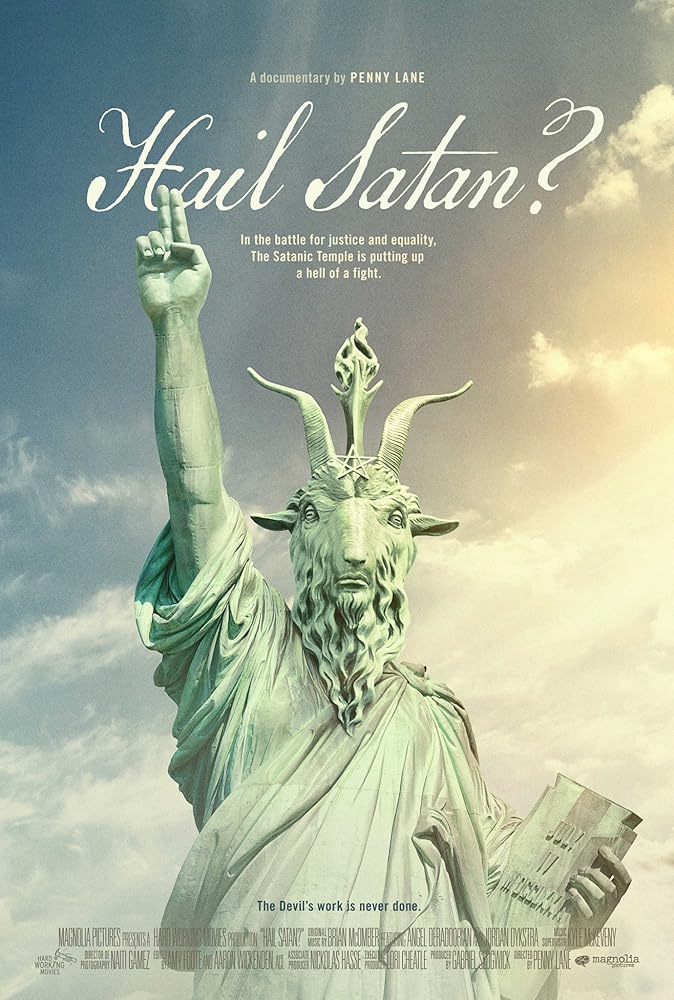
Hail Satan! (USA: Penny Lane, 2019: 95 mins)
Aguilar, Carlos. "‘Hail Satan?’ Film Review: Sly Documentary Buttresses the Wall Between Church and State." The Wrap (August 19, 2019)
Fear, David. "Hail Satan? Review: In the Dark Lord (and Religious Freedom) We Trust." Rolling Stone (April 20, 2019)
Lyden, John C. "Hail Satan?" Journal of Religion and Film 23.1 (April 2019)
Robinson, Tasha. "Hail Satan? puts the fun in Satanic fundamentalism." The Verge (April 17, 2019)
Seitz, Matt Zoller. "Hail Satan?" Roger Ebert (April 19, 2019)
Steinbach, Katherine. "‘Hail Satan?’ Review: Necessary Blasphemy." Nonfics (ND)
Yoshida, Emily. "Satanic Temple Documentary Hail Satan? Might Just Turn You Into a Satanist." Vulture (April 17, 2019)
Dialogic Cinephilia - February 9, 2020
Connelly, Matthew. "Erasing History: The National Archives Is Destroying Records About Victims of Trump’s ICE Policies." Democracy Now (February 6, 2020) ["Last month, the National Archives and Records Administration apologized for doctoring a photo of the 2017 Women’s March to remove criticisms of President Trump. The shocking revelation that the agency had altered the image was first reported in The Washington Post. In an exhibit called “Rightfully Hers: American Women and the Vote,” the National Archives had displayed a large image of the first Women’s March. But signs referencing Trump had been blurred to remove his name — including a poster reading “God Hates Trump” and another reading “Trump & GOP — Hands Off Women.” Other signs in the photo referencing female anatomy were also blurred. The National Archives initially stood by its decision to edit the photo, telling The Washington Post that the changes were made “so as not to engage in current political controversy.” For more, we turn to a historian who says this was only the latest example of “a great and growing threat to our nation’s capacity to protect and learn from history.” The National Archives reportedly is allowing millions of documents, including many related to immigrants’ rights, to be expunged. We speak with Matthew Connelly, professor of history at Columbia University and principal investigator at History Lab. His recent piece for The New York Times is headlined “Why You May Never Learn the Truth About ICE.”"]
Dunham, Robert and Kyle Pope. "The death penalty—myth, propaganda, and truth." The Kicker (November 15, 2019) ["On this week’s Kicker, Robert Dunham, executive director at the Death Penalty Information Center, and Kyle Pope, editor and publisher of Columbia Journalism Review, discuss the mistakes national and local reporters make in their coverage of the death penalty. Dunham explains the culture of fear that sustained American execution at its peak, and the importance of reporting policy over politics."]
"Forest Garden With 500 Edible Plants Requires Only a Few Hours of Work Per Month." Educate Inspire Change (November 6, 2019)
Herzog, Werner. "On Gorbachev." On the Media (May 8, 2019) ["Renowned director and documentarian Werner Herzog's latest filmmaking endeavor examines the legacy of the eighth and final leader of the Soviet Union, Mikhail Gorbachev. For the film, Herzog sat down with the 88 year-old former General Secretary for a candid conversation about his complicated legacy. In the latest installment of Bob's Docs, Herzog joins Bob to discuss his filmmaking process and the history of the man he profiled."]
Lazic, Elena. "Christian Petzold Discusses Transit." Seventh Row (March 22, 2019)
Martel, James. "Histories of Violence: Why We Should All Read Walter Benjamin Today." Los Angeles Review of Books (February 3, 2020)
Pasternack, Jesse. "Cinema of a Self: Pedro Almodóvar’s Pain and Glory." A Place for Film (February 6, 2020)
Wallis, Victor. "13th and the Culture of Surplus Punishment." Jump Cut #58 (Spring 2018)
"White Nationalism." Throughline (May 9, 2019) ["The white nationalist ideas of Madison Grant influenced Congress in the 1920s, leaders in Nazi Germany, and members of the Trump administration. This week, we share an episode we loved from It's Been A Minute with Sam Sanders that explores a throughline of white nationalism in American politics from the early 20th century to today."]
Subscribe to:
Posts (Atom)