Tuesday, October 24, 2023

Cam (USA: Daniel Goldhaber, 2018)


 Cam (USA: Daniel Goldhaber, 2018: 94 mins)


Barna, Daniel. "How Cam Flips Hollywood's View of Sex Workers." Playboy (November 20, 2018)

Bordun, Troy. "Isa Mazzei and Daniel Goldhaber discuss their debut Cam (2018)." Offscreen 23.6 (May 2019)

 Cleaver, Sarah Kathryn, et al. "Cam featuring Daniel Goldhaber & Isa Mazzei." Projections (November 21, 2018) 

Lazic, Elena. "Cam is an intelligent and positive look at sex work." Seventh Row (September 7, 2018)

Luers, Erik. "How a Filmmaking Team Found a New 'Cinematic Language' to Make Cam." No Film School (November 21, 2018)

Saito, Steven. "Isa Mazzei & Daniel Goldhaber on Shifting Perspectives with Cam." Moveable Feast (November 17, 2018)

Slater-Williams, Josh. "The sex work-positive horror written by a former camgirl." Little White Lies (October 19, 2018)

What's So Great About That? "Phantom You [Tube]: Fighting Our Digital Doubles." (Posted on Youtube: March 14, 2019) ["With our online and offline lives becoming increasingly connected, to what extent do we create our own other? And to what effect? Since the 1990s, horror and sci-fi have considered how we might create our own worst enemy - and the friendly face of this dystopian future is yours."]


The Lobster (Greece/Ireland/Netherlands/UK/France: Yorgos Lanthimos, 2015)


The Lobster (Greece/Ireland/Netherlands/UK/France: Yorgos Lanthimos, 2015: 118 mins)

Bateman, Conor. "You Can Change Your Nickname Only Twice: Identity in the films of Yorgos Lanthimos." (Posted on Youtube: August 13, 2015)

Farrell, Colin. "The Lobster." The Treatment (November 9, 2016) ["Actor Colin Farrell's childhood in Ireland is reflected in the roles he plays, many both physical and melancholic. From super-heroes to high-ranking government officials, he feeds off of characters with enough emotional depth to dissect and play with. In his new film The Lobster, his character's stillness expresses the recognition of pain and circumstance in the bizarre world he lives in. Today he joins Elvis to discuss the ways in which life itself can be purgatory and shares his thoughts on the Total Recall re-boot."]


Ganjavie, Amir. "Futureworlds: Talking with Yorgos Lanthimos about The Lobster (2015)." Bright Lights Film Journal (May 19, 2016)

Graham, Bill, Nick Newman and Brian Roan. "The Lobster." The Film Stage #191 (May 31, 2016)

Karalis, Vrasidas. "Yorgos Lanthimos' The Lobster and the Cinema of Abeyance." Film Icon (December 18, 2015)

O'Malley, Sheila. "The Lobster." Roger Ebert (May 13, 2016)

Robinson, Tasha. "The Lobster draws out an illogical world to its most logical ends." The Verge (May 17, 2016)

Talbird, John Duncan. "The Serious Humor and the Beautiful Ugliness of The Lobster." Film International (June 8, 2016)

Talu, Yonca. "The Lobster." Film Comment (March/April 2016)

Weston, Hillary. "Kitchen Conversations: Yorgos Lanthimos and Ariane Labed." Current (October 2, 2015)


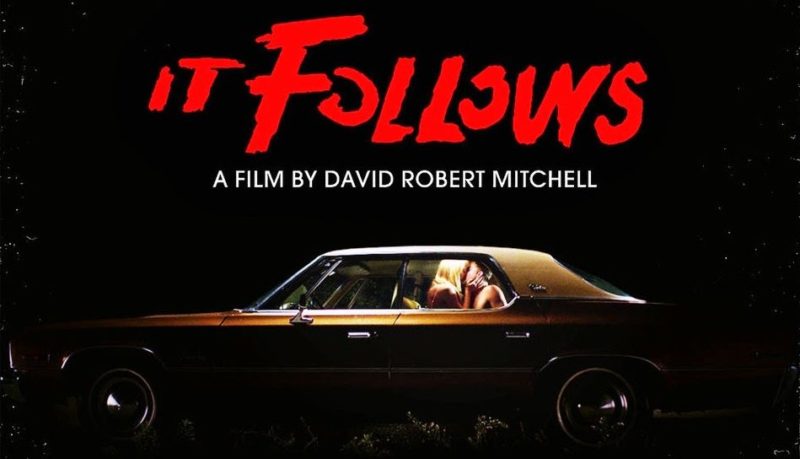
It Follows (USA: David Robert Mitchell, 2014)


It Follows (USA: David Robert Mitchell, 2014: 100 mins)

It Follows may boast a doozy of a high-concept scenario that referentially riffs on all manner of horror subgenres, but the steady hand of director David Robert Mitchell ensures no resting on conceptual gimmickry. Anonymous monsters are in solemn pursuit of suburban high-schoolers, a curse only shed – and passed on – through sex. But this is no puritanical cautionary tale, its metaphorical ambiguities enveloping the teenage experience in an all-consuming blanket of dread. The stately march of its menace coupled with Mitchell’s gliding camera instils an inexorable terror. Not for nothing does water serve as a recurring motif in a film that itself feels submerged in a pressurised state of liminal arrest. – Matthew Thrift

Abrams, Simon. "It Follows." Roger Ebert (March 13, 2015)

Barone, Matt. "TIFF: Sex Is a Scary Killer in This Early Contender for 2015's Best Horror Movie." Complex (September 9, 2014)

Crucchiola, Jordan. "What Makes the New Horror Film It Follows So Good?" Wired (March 17, 2015)

Dalton, Ben. "It Follows: Horror in a Straight Line." Intensities #8 (January 2016): 88-93.

Digging Deeper. "It Follows: The American Nightmare." (Posted on Youtube: September 23, 2015)

Drumm, Diana. "Interview: David Robert Mitchell on Making It Follows." Slant (March 19, 2015)

Eggert, Brian. "It Follows." Deep Focus Review (March 27, 2015)

Leeder, Murray. "David Robert Mitchell's It Follows (2014) - The Limits of Knowledge." Horror. ed. Simon Bacon. Peter Lang, 2019: 11-18. [Professor has copy of the book.]

McKee, Lucky. "Talks David Robert Mitchell’s It Follows." Talkhouse (January 29, 2016) ["The director of an indie horror classic shares his appreciation for a new classic – and explains why it made him want to punch a kitten in the balls."]

Muncer, Mike and Tim Robey. "Slashers Pt. 13: It Follows." The Evolution of Horror (December 8, 2017)

Prewitt, Zach. "The Best Horror Cinema of the 21st Cinema." (Posted on Vimeo: October 2016)

Renée, V. "This is What Supernatural Horror Film It Follows is Really About (Besides Scary Sex)." No Film School (February 27, 2016)

Rossi, Jason Di. "It Follows." Final Cut (April 17, 2015)

Salisbury, Brian. "Q&A: It Follows Director David Robert Mitchell On Turning Nightmare into Magic." Film School Rejects (March 30, 2015)

Samoylenko, V. "Defying STIgma in It Follows." Monstrum 1.1 (April 2018)

Visvikis, Dylan. "A Pretentious Film Student Analysis of It Follows." Flicks/Kicks/Politics (July 12, 2016)

Wethington, Nicole. "It Follows and the Power of Sex." The Artifice (May 20, 2015)

Yanick, Joseph. "It Follows from Video Gaming: An interview with Soundtrack Composer Disasterpeace." Noisey (April 7, 2015)


 IT FOLLOWS, as a Slasher Video Essay from Haylie Kohn on Vimeo.


Wednesday, October 18, 2023

Hayao Miyazaki (Online Filmmaker Archive)

 Stephanie Abramowitz's introduction to Hayao Miyazaki and Studio Gihbli


"Creating animation means creating a fictional world. That world soothes the spirit of those that are disheartened and exhausted from dealing with the sharp edges of reality." - Hayao Miyazaki

Miyazaki is one of the world's most respected and popular filmmakers, he has a unique philosophy (or politics if you prefer) that I admire, and watching this excellent documentary I realized his films & ideas have had a profound affect on the way I think.

Pay attention to the way the authors introduce outside sources into their discussion of Miyazaki's films and themes that run throughout his body of work, notice how they use these outside sources to extend their thoughts and build credibility, its a brilliant example of writing about film (or any subject)


Lupin the Third: The Castle of Cagliostro (1979)

Nausicaä of the Valley of the Wind (1984)

Castle in the Sky (1986)

My Neighbor Totoro (1988) 

Kiki's Delivery Service (1989)

Porco Rosso (1992)

Princess Mononoke (1997)

Spirited Away (2001)

Howl's Moving Castle (2004)

Ponyo (2008)

The Wind Rises (2013)


Miyazaki's are only available on HBO Max if you have that service or you would have to buy the streaming film rights for 11.99. Miyazaki's films are some of the most incredible animated films and any of them are available to you for a response (even the ones without a linked resource archive), but I understand that some of you need to keep expenses down, so I will offer some alternative animated films on other services:

Akira (Japan: Katsuhiro Otomo, 1988)

April and Extraordinary World (France/Canada/Belgium: Franck Ekinci and Christian Desmares, 2015)

Flee (Denmark: Jonas Poher Rasmussen, 2021) 

The Garden of Words (Japan: Makoto Shinkai, 2013)

Ghost in the Shell (Japan: Mamoru Oshii, 1995)

Kubo and the Two Strings (USA/Japan: Travis Knight, 2016)

Millennium Actress (Japan: Satoshi Kon, 2001)

Paprika (Japan: Satoshi Kon, 2006) 

Perfect Blue (Japan: Satoshi Kon, 1997)

Persepolis (France/USA: Vincent Paronnaud and Marjane Satrapi, 2007)

The Secret of Kells (Ireland: Tomm Moore, 2009)

Song of the Sea (Ireland: Tomm Moore, 2014)

Tekkonkinkreet (Japan: Michael Arias, 2006)

Tokyo Godfathers (Japan: Satoshi Kon, 2003)

Waking Life (USA: Richard Linklater, 2001)

Waltz with Bashir (Israel: Ari Forman, 2008)

Weathering With You (Japan: Makoto Shinkai, 2019)

Wolfwalkers (Ireland: Tomm Moore and Ross Stewart, 2020)

Your Name (Japan: Makoto Shinkai, 2017)

Tuesday, October 17, 2023

ENG 281 Week #10: Mind/Body Classic


Carrie (USA: Brian De Palma, 1976)
MB - adapted from Stephen King's first novel, it would catapult him into being the most popular, and one of the most important writers, of the late 20th Century. De Palma's adaptation ranks with Kubrick's The Shining (1980) as the best adaptation of King's work.
Film Description: "Carrie White, a shy and troubled teenage girl who is tormented by her high school peers and her fanatically religious mother, begins to use her powers of telekinesis to exact revenge upon them."
Resources for after you watch the film:

Blyth, Michael and Mike Muncer. "Mind and Body Pt. 6: Carrie (1976)." The Evolution of Horror (2021)

D, Margo and Margo P. "Carrie." Book vs. Movie (December 28, 2014)


Videodrome (Canada: David Cronenberg, 1983)
MB: David Cronenberg has had a career long fascination with body/mind horror and this was an early masterpiece. Looking at how we as biological creatures are being changed and transformed by the screen media we consume in the TV/video age, it is an even more important film now for a culture completely dominated by screens in multiple formats.
Film Description: "When Max Renn goes looking for edgy new shows for his sleazy cable TV station, he stumbles across the pirate broadcast of a hyperviolent torture show called Videodrome. As he struggles to unearth the origins of the program, he embarks on a hallucinatory journey into a shadow world of right-wing conspiracies, sadomasochistic sex games, and bodily transformation. Starring James Woods and Deborah Harry in one of her first film roles, Videodrome is one of writer/director David Cronenberg’s most original and provocative works, fusing social commentary with shocking elements of sex and violence. With groundbreaking special effects makeup by Academy Award®-winner Rick Baker, Videodrome has come to be regarded as one of the most influential and mind-bending science fiction films of the 1980s". - The Criterion Collection
Resources for After You Watch the Film


The Matrix (USA: The Wachowski Sisters, 1999)
MB: I can remember the first time I watched this film, I was floored by the rich narrative full of philosophical ideas and religious symbolism. I ended up writing a 40+ page essay for one of my graduate classes on the film. It is more overtly a Science Fiction/adventure film if you watch it on the surface level, but, if you follow the journey-lesson of the protagonist Neo and look below the surface of basic reality, it becomes simultaneously a horrific possibility with an imaginative spiritual solution.
Film description: "Neo (Keanu Reeves) believes that Morpheus (Laurence Fishburne), an elusive figure considered to be the most dangerous man alive, can answer his question -- What is the Matrix? Neo is contacted by Trinity (Carrie-Anne Moss), a beautiful stranger who leads him into an underworld where he meets Morpheus. They fight a brutal battle for their lives against a cadre of viciously intelligent secret agents. It is a truth that could cost Neo something more precious than his life."
Resources for after you watch the film


Ginger Snaps (Canada: John Forest, 2000)
Film description: "The story of two outcast sisters, Ginger (Katharine Isabelle) and Brigitte (Emily Perkins), in the mindless suburban town of Bailey Downs. On the night of Ginger's first period, she is savagely attacked by a wild creature. Ginger's wounds miraculously heal but something is not quite right. Now Brigitte must save her sister and save herself."
Resource for after you watch the film:

Final Girl Studios. "Is Ginger Snaps the Original Jennifer’s Body? | The Male Gaze, Girlhood, Female Rage, & more." Youtube (September 2022) 


Videodrome (Canada: David Cronenberg, 1983)


When Max Renn goes looking for edgy new shows for his sleazy cable TV station, he stumbles across the pirate broadcast of a hyperviolent torture show called Videodrome. As he struggles to unearth the origins of the program, he embarks on a hallucinatory journey into a shadow world of right-wing conspiracies, sadomasochistic sex games, and bodily transformation. Starring James Woods and Deborah Harry in one of her first film roles, Videodrome is one of writer/director David Cronenberg’s most original and provocative works, fusing social commentary with shocking elements of sex and violence. With groundbreaking special effects makeup by Academy Award®-winner Rick Baker, Videodrome has come to be regarded as one of the most influential and mind-bending science fiction films of the 1980s. - The Criterion Collection
Following the respectable box-office of the disreputable Scanners (1981), David Cronenberg secured $6 million for his next venture (almost double his previous budget), plus major studio backing and access to A-list stars. Lead by a typically skeezy James Woods, with support from an atypically dark-haired Debbie Harry, the body-horror pioneer’s eighth feature sees a cable TV station head stumble across a pirate transmission of an ultra-violent snuff show while hunting down new content for his X-rated channel. Bigger budgets often come with bigger expectations and thus bigger risks, but Cronenberg’s refusal to dilute his vision for mainstream palatability resulted in his most ambitious film yet. Further exploring the synergy between the physical, psychological and technological central to his 1970s work, while anticipating the eroticised technophilia of Crash (1996) and eXistenZ (1999), Videodrome is Cronenberg at his most deliciously Cronenbergian. – Michael Blyth


Videodrome (Canada: David Cronenberg, 1983: 87 mins)

Aldouby, Hava. "Virtual Reality Turns Biological: The Case of David Cronenberg’s eXistenZ." Making Reality Really Real. Ed. Roy Ascott, et al. Trondheim: 2010: 18-21.

Allinson, Ashley. "Great Directors: David Cronenberg." Senses of Cinema #22 (October 2002)

Bale, Miriam. "They Came From Within: Yonic symbolism in the films of David Cronenberg." Moving Image (January 20, 2012)

"David Cronenberg and Ron Sanders on Videodrome: Selected Bibliography." Higher Learning (September 24, 2010)

Flores, Steven. "The Auteurs: David Cronenberg (Part 1)." Cinema Axis (October 28, 2013)

---. "The Auteurs: David Cronenberg (Part 2)." Cinema Axis (October 30, 2013)

Ford, Phil and J.F. Martel. "Long Live the New Flesh: On David Cronenberg's 'Videodrome.'" Weird Studies #157 (November 8, 2023) [""Death to Videodrome! Long live the New Flesh!" It was perhaps inevitable that the modern Weird, driven as it is to swallow all things, would sooner or later veer into the realm of political sloganeering without losing any of its unknowable essence. David Cronenberg's 1983 film Videodrome is more than a masterwork of body horror: it is a study in technopolitics, a meditation on the complex weave of imagination and perception, and a prophecy of the now on-going coalescence of flesh and technology into a strange new alloy. In this episode, recorded live after a screening of the film at Indiana University Cinema in Bloomington, JF and Phil set out to interpret Cronenberg's vision... and come to dig the New Flesh."]

Glasby, Matt and Mike Muncer. "Mind and Body Pt. 10: Videodrome."  The Evolution of Horror (2021)

Indiana, Gary. "Videodrome: The Slithery Sense of Unreality." The Current (December 7, 2010)

Johnson, Annica. "Videodrome: 'I just can’t handle the freaky stuff.'" Letterboxd (September 25, 2023)

Lattimer, James. "Evolving Mantras and Restricted Vocabularies." The Notebook (February 23, 2015)

Lucas, Tim. "Medium Cruel: Reflections on Videodrome." The Current (December 7, 2010)

McCormack, Tim. "Laws of Desire: What did David Cronenberg's Videodrome get right about us?" Moving Image (January 26, 2012)

"The Movie Videodrome and the Horror of Mass Media." Vigilant Citizen (August 29, 2012)

Rickey, Carrie. "Videodrome: Make Mine Cronenberg." Current (December 7, 2010)

Sperb, Jason. "Scarring the New Flesh: Time Passing in the Simulacrum of Videodrome." InTheory #3 (February 2006)


In the final scene of Videodrome, the television set explodes and burns, but this is only part of a repetitive video loop in which Max is trapped. He shoots himself after seeing himself shoot himself on TV. The quasi-religious doctrine of ‘the new flesh’ pushes Max to a limit, but holds out no promises as to what he will encounter on the other side. The film ends with the sound of his gunshot—perhaps a finality, or perhaps a rewind to one more playback. — Steven Shaviro, The Cinematic Body (University of Minnesota Press, 1993: 142)


 The Post-Punk Cinema Manifesto - Side A from Scout Tafoya on Vimeo.


 The Post-Punk Cinema Manifesto - Side B from Scout Tafoya on Vimeo.


Thursday, October 12, 2023

Celine Sciamma (Ongoing Filmmaker Archive)

 Tomboy (2011)

""A sensitive, heartrending portrait of what it feels like to grow up different, Sciamma’s beautifully observed coming-of-age tale aches tenderly with the tangled confusion of childhood. When 10-year-old Laure’s family moves to a new neighborhood during the summer, the gender-nonconforming preteen (played by the impressively naturalistic Zoé Héran) takes the opportunity to present as Mickäel to the neighborhood kids—testing the waters of a new identity that neither friends nor family quite understand. Sciamma’s warmly empathetic tone is perfectly complemented by the soft-lit impressionism of Fournier’s glowing cinematography." - "The Female Gaze" (2018)"

Resources for after you have watched the film


Girlhood (France, 2014) 
Film description: "Girlhood - which was called "Bande De Filles" in the original French - tells the story of 16 year old Marieme (a remarkable showing by young Karidja Touré) who joins a gang of three other girls in an effort to find some status, only to discover that this is not the life she seeks."

Resources for after you have watched the film


Portrait of a Lady on Fire (2019)
"Passion brews quietly between an artist and her subject, until together they create a space in which it can briefly flourish, in this sumptuous eighteenth-century romance from Céline Sciamma, one of contemporary French cinema’s most acclaimed auteurs. Summoned to an isolated seaside estate on a secret assignment, Marianne (Noémie Merlant) must find a way to paint a wedding portrait of Héloïse (Adèle Haenel), who is resisting chattel marriage, by furtively observing her. What unfolds in exquisite tension is an exchange of sustained gazes in which the two women come to know each other’s gestures, expressions, and bodies with rapturous intimacy, ultimately forging a subversive creative collaboration as well as a delirious romance. Charged with a yearning that almost transcends time and space, Portrait of a Lady on Fire mines the emotional and artistic possibilities that emerge when women can freely live together and see one another in a world without men." - Criterion

Resources for after you have watched the film


Petite Maman (2021)
"Céline Sciamma's luminous “Petite Maman” is a once-upon-a-time tale with a twist. Set in present-day France, in an isolated hamlet made for solitude and imagination, it is a story about family ties, childhood reveries and unanswerable questions." - Manohla Dargis

Resources for after you have watched the film:

Batuman, Elif. "Céline Sciamma's Quest for a New, Feminist Grammar of Cinema." The New Yorker (January 31, 2022)

Beaupre, Mitchell. "Tiny Wonder: Céline Sciamma’s Empathetic Bonds." Letterboxd (April 28, 2022)


Crawfoed, Lillian. "Céline Sciamma: ‘I would love for someone to make this film into an anime.'" Little White Lies (November 18, 2021)

Salmon, Caspar. "The Action Cinema of Céline Sciamma." The Notebook (February 18, 2022)

Wednesday, October 11, 2023

ENG 281 Week #9: Contemporary Occult Films (16 Week)

The Witch (USA: Robert Eggers, 2015)
Film description: "In 1630 New England, panic and despair envelops a farmer, his wife and their children when youngest son Samuel suddenly vanishes. The family blames Thomasin, the oldest daughter who was watching the boy at the time of his disappearance. With suspicion and paranoia mounting, twin siblings Mercy and Jonas suspect Thomasin of witchcraft, testing the clan's faith, loyalty and love to one another."
"Witches have a long history in horror cinema but their status (feminist heroine or patriarchal monster?) continues to be the subject of critical debate. Barbara Creed’s seminal analysis notes that the witch is invariably represented as an old, ugly, crone. Elsewhere, Linda Williams’s suggestion that women and monsters share an affinity in horror film and pose a threat to vulnerable male power, has lead recent critics to consider depictions of the witch as offering a challenge to patriarchy. This article considers the genealogy of the witch in cinema through her depiction in folk horror, culminating in an analysis of Robert Eggers’s 2016 film, The Witch. Examining the debate around the feminist potential of the witch, the article concludes that she offers critics and viewers of horror cinema a troubling ambiguity that serves neither liberal nor conservative politics. The ambiguity of the witch means she can pressed in the service of competing discourses. Moreover, we cannot read the image of the witch independent of her origins in Early Modern history, nor of political and cultural contexts of these early decades of the twenty-first century. These contexts include the rise of the ‘Men’s Rights’ movement, a post-feminist backlash against women in authority, the creation of mainstream media platforms for misogynist ideas and rising economic and social inequalities that have disproportionately affected women. In these contexts, the figure of the witch looms large and ambiguity in itself is not necessarily subversion. As one reviewer of The Witch notes, the audience will see what they want to see." - Chloe Germaine Buckley (in resource archive)
Resources for after you watch the film


A Dark Song (Ireland/UK: Liam Gavin, 2016)
Film Description: "A heartbroken woman and recluse occultist perform an ancient, dark ritual to bring her child back to life – but missteps have consequences and unknown evils are unleashed."

Resources for after you watch the film:

Bulkin, Nadia. "A Dark Song." The Horror Pod Class (April 18, 2019) ["Today we are talking to one of our favorite horror and weird fiction authors, Nadia Bulkin! We discuss a really great movie that she turned us on to on Netflix called A Dark Song. Specifically, we discuss the concept of the Sublime and how it interacts with horror fiction."]

Gavin, Liam, Mike Lee-Graham, and Mike Muncer. "Occult Part 21: A Dark Song." The Evolution of Horror (March 20, 2020) ["For the final in-depth discussion of the series, Mike is joined by Mike Lee-Graham to discuss A DARK SONG in spoilerific detail. Mike also chats to the film’s writer and director, Liam Gavin, about making one of the best cult horror films of the 2010s. "]


November (Estonia/Poland/Netherlands: Rainer Sarnet, 2017)
Film Description: "In this tale of love and survival in 19th century Estonia, peasant girl Liina longs for village boy Hans, but Hans is inexplicably infatuated by the visiting German baroness that possesses all that he longs for. For Liina, winning Hans’ requited love proves incredibly complicated in this dark, harsh landscape where spirits, werewolves, plagues, and the devil himself converge, where thievery is rampant, and where souls are highly regarded, but come quite cheap. With alluring black and white cinematography, Rainer Sarnet vividly captures these motley lives as they toil to exist—is existence worth anything if it lacks a soul?"
Resources for after you watch the film:

Francis Young's response to November

Emily Buder - "How Tribeca's Best Cinematography Winner 'November' Captured Stunning B&W and Infrared with 6 Cameras."

Alci Rengifo - "Love in the Shadowland of Myth: Rainer Sarnet’s November."


Suspiria (Italy/USA: Luca Guadagnino, 2018)

Film Description: "A darkness swirls at the center of a world-renowned dance company, one that will engulf the artistic director, an ambitious young dancer, and a grieving psychotherapist. Some will succumb to the nightmare. Others will finally wake up."

Resources for after you watch the film:

Anderson, Jake. "Suspiria." Letterboxd (January 18, 2020)

Eggert, Brian. "Suspiria." Deep Focus Review (October 26, 2018)

Gross, Larry. "Love is Colder Than Death: Luca Guadagnino on Suspiria." Filmmaker (September 17, 2018)

Heller-Nicholas, Alexander. "Three Mothers Redux: Kathy Acker, Pina Bausch, Tilda Swinton and Luca Guadagnino’s Suspiria." Senses of Cinema #88 (October 2018)

Jones, Alan. "Killing the Mother: Luca Guadagnino Discusses Suspiria." Notebook (November 16, 2018)


The Empty Man (USA: David Prior, 2020)
Film description: "After a group of teens from a small Midwestern town begin to mysteriously disappear, the locals believe it is the work of an urban legend known as The Empty Man. As a retired cop investigates and struggles to make sense of the stories, he discovers a horrific secret that puts his life—and the lives of those close to him—in grave danger."

Resources for after you watch the film:

Tafoya, Scout. "The Unloved, Pt. 93: The Empty Man." Roger Ebert (September 1, 2021) ["Whatever else is true of David Prior, "The Empty Man" is one of the most promising debuts in the last several years of American cinema. I greatly look forward to what he concocts next, whether I agree with its thesis or not. I enjoyed that while watching "The Empty Man" I was guessing the entire time what would happen next, and in every case I was proven wrong. That is rare enough without factoring in his considerable formal abilities. I like this movie a lot, and I’m ready for Halloween to get here so we can all kvetch about our shared need to be scared by the unreal instead of the very real."]

Adam Nayman's Interview - "Everything Zen: David Prior on The Empty Man."


The Witch (Canada/USA: Robert Eggers, 2015)


The Witch (Canada/USA: Robert Eggers, 2015: 90 mins)

Aloi, Peg. "Watching The Witch with Two Actual Witches." A24 Films (October 27, 2020)

Bastién, Angelica Jade.  "The Feminine Grotesque #3: Something Wicked – On Robert Eggers’ The Witch." Vague Visages (March 3, 2016)

Buckley, Chloe Germaine. "Witches, 'Bitches' or Feminist Trailblazers? The Witch in Folk Horror Cinema." Revenant #4 (March 2019): 22 - 42. ["Witches have a long history in horror cinema but their status (feminist heroine or patriarchal monster?) continues to be the subject of critical debate. Barbara Creed’s seminal analysis notes that the witch is invariably represented as an old, ugly, crone. Elsewhere, Linda Williams’s suggestion that women and monsters share an affinity in horror film and pose a threat to vulnerable male power, has lead recent critics to consider depictions of the witch as offering a challenge to patriarchy. This article considers the genealogy of the witch in cinema through her depiction in folk horror, culminating in an analysis of Robert Eggers’s 2016 film, The Witch. Examining the debate around the feminist potential of the witch, the article concludes that she offers critics and viewers of horror cinema a troubling ambiguity that serves neither liberal nor conservative politics. The ambiguity of the witch means she can pressed in the service of competing discourses. Moreover, we cannot read the image of the witch independent of her origins in Early Modern history, nor of political and cultural contexts of these early decades of the twenty-first century. These contexts include the rise of the ‘Men’s Rights’ movement, a post-feminist backlash against women in authority, the creation of mainstream media platforms for misogynist ideas and rising economic and social inequalities that have disproportionately affected women. In these contexts, the figure of the witch looms large and ambiguity in itself is not necessarily subversion. As one reviewer of The Witch notes, the audience will see what they want to see."]

 Bushi, Ruth. "The Witch Explained (2015): The Horrors of True History." The Haughty Culturalist (March 23, 2022) ["Religious extremism, misogyny and madness stoke fears of the supernatural in The Witch, a folk tale rooted in horror and history."]

Fisher, Burton and Martin Kessler. "The Witch." Flixwise (January 24, 2017) ["Martin’s discussing Robert Eggers’ 2016 debut feature, The Witch, with Bay Area English Professor, Burton Fisher. Listeners will recall that The Witch was one of Martin’s favorite films of 2016. Here he gets a chance to elaborate on why this film stands apart from other recent supernatural horror flicks. Plus, he and Burton explore the various influences that helped Eggers shape The Witch’s cinematic world, including puritan folklore and the works of Andrei Tarkovsky."]

Graham, Bill, Brian Roan and Amanda Waltz. "The Witch." The Film Stage Show #176 (February 22, 2016)

Greene, Heather. "The Witch (2016)." The Wild Hunt (February 21, 2016)

Grossman, Pam. "The Witching Hour." (Posted on Vimeo: 2014)

Hall, Jacob. "An Atheist, a Catholic, and a Satanist Walk Into a Screening of The Witch." /Film (February 22, 2016)

Hauke, Alexandra. "The Wicked Witch in the Woods: Puritan Maternalism, Ecofeminism, and Folk Horror in Robert Eggers’ The VVitch: A New-England Folktale." Gothic Nature #2 (March 2021): 37-61.

Haydon, Chris. "The Witch - The Art of Terror." (Posted on Youtube: August 7, 2016)

Hollinger, Ryan. "The Witch: Explained." (Posted on Youtube: March 17, 2016)

Jones, Matthew. "Politicizing the Horrific: How American Anxieties Play Out on Screen." Philosophy in Film (March 25, 2017)

Juzwlak, Rich. "A Journey To the Center of The Witch, Salem, and Criticism." The Muse (February 26, 2016)

Koresky, Michael. "A Few Great Pumpkins X: The Witch." Reverse Shot (October 25, 2015)

"Listen to Mark Korven’s Frightening Full Score For The Witch." The Film Stage (February 26, 2016)

Sims, David. "The Witch Mines the Quiet Terror of the Unknown." The Atlantic (February 19, 2016)

Subisatti, Andrea and Alexander West. "Season of the Witch: Witches in Film Part 3, The Witch (2015) and The Autopsy of Jane Doe (2016)." The Faculty of Horror #60 (March 25, 2018) ["The past few years have seen the figure of the witch become a cultural touchstone for progressives and conservatives alike. From the resurgence of astrology, tarot, and natural healing methods to feminist rallying cry, the witch has never been more inclusive or divisive. Through analysis of two recent films, Andrea and Alex examine the witch’s new meaning in contemporary Western society, and why she remains a symbol of subversive feminism."]

Thomas, Leon. "The Witch - Renegade Cut." (Posted on Youtube: June 6, 2016)

Walsh, Brendan C. "Colonising the Devil's Territories: The Historicity of Providential New England Folklore in the VVitch." Revenant #5 (March 2020)  ["This article contextualises the historical and demonological beliefs prevalent in the early modern setting of The VVitch.[3] It argues that early modern folklore is invoked in this film to convey the experiences and worldview of the New World Puritans, illustrating how Robert Eggers has used fantastical source material to achieve a certain historical authenticity. This focus on the ‘historicity’ of the New World setting, as it was established in early modern demonological tracts, is central to the construction of The VVitch. Eggers states that he spent almost five years researching material for the film, poring over early modern texts in order to effectively recreate the historical tone of the era (Rife 2016). The closing text of the film communicates that it ‘was inspired by many folktales, fairy tales and written accounts of historical witchcraft, including journals, diaries and court records. Much of the dialogue comes directly from these period sources’. This array of sources, taken from different English, New England, and even broader Continental textual formats, are used to craft a seemingly authentic piece of Puritan folklore. As such, Eggers employs early modern folklore and English Protestant demonological traditions in The VVitch to reconstruct the formative years of the New England colony and to establish a historical window into the ‘supernatural reality’ of the Puritan worldview. Eggers clarifies that ‘because witches don’t exist today, I felt it was essential to create an utterly believable 17th century world where witches really did exist’ (Young 2016). The VVitch thus provides insight into how folklore (specifically supernatural folklore) can be adapted by writers and directors to encapsulate an authentic historical tonality within the folk horror cinematic subgenre."]

Weston, Hillary. "Into the Woods: An Interview with The Witch’s Robert Eggers." The Current (February 19, 2016)

Weston, Kelli. "The Witch: Suffer the Little Children." Reverse Shot (October 30, 2020)


Wednesday, October 4, 2023

Bong Joon-ho (Ongoing Filmmaker Archive)

 Introduction to Bong Joon-ho:


Minor spoilers in this one - if you are worried about that, wait until after you watch your film


Film Options:

Memories of Murder (South Korea, 2003)
Film Description: "In his breakthrough second feature, Bong Joon Ho explodes the conventions of the policier with thrillingly subversive, genre-defying results. Based on the true story of a string of serial killings that rocked a rural community in the 1980s, Memories of Murder stars New Korean Cinema icon Song Kang Ho as the local officer who reluctantly joins forces with a seasoned Seoul detective (Kim Sang Kyung) to investigate the crimes—leading each man on a wrenching, yearslong odyssey of failure and frustration that will drive him to the existential edge. Combining a gripping procedural with a vivid social portrait of the everyday absurdity of life under military rule, Bong fashions a haunting journey into ever-deepening darkness that begins as a black-comic satire and ends as a soul-shattering encounter with the abyss." - Criterion Collection
"Memories of Murder (2003) is based on what director Bong Joon Ho has described as “the first real case of serial murder in Korea”: between 1986 and 1991, the rural area of Hwaseong was terrorized by the killings of ten women. As he explained to critic Tony Rayns in 2004, Bong wanted his second feature film to be a crime picture because “there’s an old tradition of crime movies in Korean cinema which are rather different from plot-oriented Hollywood thrillers, and I wanted to make something of that sort. The old-style Korean movies are essentially humane and emotional—that’s what I like about them . . . I like seeing how people behave when they’re caught up in crime.” - Curtis Tsuis (in the resource file)
Resources for after you watch the film

The Host (South Korea, 2006)
Film Description: "Bong Joon-ho's The Host is a giddy revelation - an inspired and unexpectedly moving contribution to the monster movie genre. Several years ago, a crooked government official from the United States ordered the dumping of toxic substances into Seoul's River. Years later, the hapless Gang-du is working at his father's food stand along the river, caring for his bright daughter Hyun-seo. But one day, a monstrous creature emerges from the water and embarks on a murderous rampage throughout the community, swallowing Hyun-seo whole. Gang-du's bullish younger brother Park Nam-Il and sister Nam-joo condemn him for being such a failure, while their father angrily chastises them for being so cruel. But when Gang-du receives a phone call from Hyun-seo, the family must band together to reclaim her. Unfortunately, at this stage, the government has announced that the monster is the host of a dangerous virus, and anyone who has come into contact with it - namely Gang-du - must be isolated. As the monster continues to wreak havoc on Seoul, Gang-du, his father and his siblings must work together to bring Hyun-seo home."
Resources for after you watch the film

Mother (2009)

Snowpiercer (2013)

Okja (2017)

Parasite (2019)


The Host (South Korea: Bong Joon-Ho, 2006)


The Host (South Korea: Bong Joon-Ho, 2006: 119 mins)

Carvajal, Nelson. "Bong Joon-Ho: Living Images, Moving Frames." Balder & Dash (July 1, 2014)

Chung, Hye Jean. "The Host and D-War: Complex Intersections of National Imaginings and Transnational Aspirations." Spectator 29.2 (Fall 2009): 48-56.

Hsu, Hsuan L. "The dangers of biosecurity: The Host and the geopolitics of outbreak." Jump Cut #51 (Spring 2009)

Koski, Genevieve, et al. Family Matters, Pt. 1 - The Host (2006)." The Next Picture Show #199 (November 5, 2019) ["Korean director Bong Joon-ho has a long-running interest in films about family, one that’s mirrored in two of his best-known films: His international breakout THE HOST and his new film PARASITE, both of which star Song Kang-ho as a father trying to keep things together on his kids’ behalf, and both of which are about the sense of duty among protagonists who have to improv their way through unexpected situations. In this half of our pairing, we revisit Bong’s monster movie THE HOST with a focus on its human cast and their family dynamic, and consider how the film’s political and emotional elements square with Bong’s insistence that there is “realism” at the heart of this movie about a rampaging fish-monster."]

---. "Family Matters, Pt. 2 - The Parasite (2019)." The Next Picture Show #200 (November 12, 2019) ["Bong Joon-ho’s new PARASITE feels weirdly similar to his 2006 film THE HOST, even though there’s no monster in sight — unless you count entitlement, inequality, and greed as monsters, which given how they shape PARASITE’s story, maybe you should. But it also features the return of Song Kang-ho as a father figure, albeit a more capable and traditional one, and a story shaped by Bong’s obsessions with family bonds and duty. In this half of our Bong pairing, we look at all the other things these two films share, from their thematic and visual fixation on high and low spaces, to how they utilize humor ranging from the slapstick to the ultra-dark. "]

Lin, Ed. "This Side of Parasite: New Korean Cinema 1998–2009." The Current (November 2, 2020)

Lukaslak, Beata. "The Host: The Monster Emerging From the Han." Senses of Cinema (September 2013)

Prewitt, Zach. "The Best Horror Cinema of the 21st Cinema." (Posted on Vimeo: October 2016)

Turner, James Lloyd. "Monstrous Dialogues: The Host and South Korean Inverted Exile." (A thesis submitted in partial fulfillment of the requirements for the degree of Master of Liberal Arts, Department of Humanities and Cultural Studies, College of Arts and Sciences, University of South Florida: March 5, 2012)


Memories of Murder (South Korea: Bong Joon-Ho, 2003)


 Memories of Murder (South Korea: Bong Joon-Ho, 2003: 132 mins)


"Bong Joon-Ho." The Director's Club (September 4, 2017)

Carvajal, Nelson. "Bong Joon-Ho: Living Images, Moving Frames." Balder & Dash (July 1, 2014)

Flight, Thomas and Tom van der Linden. "Memories of Murder." Cinema of Meaning #41 (December 8, 2022) ["Can you tell a monster? Thomas Flight and Tom van der Linden discuss the meticulous craft of the murder mystery story, the consequences of police brutality, and the aesthetics of evil, in Bong Joon Ho’s Memories of Murder."]

Gunzburg, David. "Realistic, Like In a Movie: On Facts, Procedurals, and Memories of Murder." Photogenie (October 1, 2013)


López, Cristina Álvarez and Adrian Martin. "Imitation, Contamination, Dissolution: Bong Joon-Ho’s Memories of Murder." The Notebook (July 30, 2016)

Park, Ed. "The Bong Show: Bong Joon-Ho." Exile Cinema: Filmmakers at Work Beyond Hollywood ed. Michael Atkinson. Albany, NY: SUNY Press, 2008: 49-54. [Professor has copy]

---. "Memories of Murder: In the Killing Jar." Current (April 20, 2021)

Tsui, Curtis. "10 Things I Learned: Memories of Murder." Current (April 22, 2021)

Zhou, Tony. "Memories of Murder: Ensemble Staging." Every Frame a Painting (Posted on Vimeo: January 2016)


ENG 102: Fall 2023 Resources #14

 Buettner, Russ. "Why You Should Pay Attention to Trump's Civil Fraud Case." On the Media (October 4, 2023) ["Donald Trump is in court this week in New York City, again, for a multimillion dollar civil fraud trial. He, his sons, and the Trump organization have been accused of using false financial statements and inflating their net worth by billions. In addition to this case, Trump is facing four criminal indictments: the January 6th insurrection case in DC, the Stormy Daniels hush money case in New York, the classified documents case in Florida, and the political interference case in Georgia. It’s a lot to keep track of, but this civil trial is worth one's attention. If NY State Attorney General Letitia James succeeds, Trump could lose control of his businesses and his most valuable assets, like Trump Tower — along with whatever’s left of the public image he spent decades constructing on television and in the press. Russ Buettner is a reporter on the New York Times Investigation Desk, the team that hunted down Trump’s tax returns and other elusive financial documents, in an effort to understand how exactly the former president got his money and how he lost so much of it."]

Rosane, Olivia. "US High Schoolers Launch Green New Deal for 'Our Schools and Our Futures'." Common Dreams (September 25, 2023) ["Public schools belong to us, and we know we deserve better," said a Sunrise Movement organizer and the youngest school board member in Idaho."]

Theise, Neil. "Living at the Edge of Chaos." Tricycle Talks (May 10, 2023) ["Neil Theise is a professor of pathology at the NYU Grossman School of Medicine and a practicing Zen Buddhist. For the past twenty years, he has been fascinated by the science of complex systems from the infinitesimal level of quantum foam to the vastness of our entire universe. In his new book, "Notes on Complexity: A Scientific Theory of Connection, Consciousness, and Being," Theise provides a comprehensive introduction to complexity theory, outlining its synergies with Buddhist principles and teachings. In this episode of Tricycle Talks, Tricycle’s editor-in-chief, James Shaheen, sits down with Theise to discuss his journey to Buddhism, what it means to live at the edge of chaos, and how complexity theory can help us navigate the unpredictability of our everyday lives."]

Toole, Brianna. "Standpoint Epistemology." Overthink #84 (August 15, 2023) ["What does it mean to be marginalized? Does marginalization give some people more epistemic authority than others? And, if so, what should we all do with this information? In episode 84 of Overthink, Ellie and David talk about standpoint theory, its complex intellectual history, and its relationship to W. E. B. DuBois’ concept of double consciousness. They welcome an expert on the subject: Dr. Briana Toole, Assistant Professor of Philosophy at Claremont McKenna College. In their conversation, they chat about how standpoint theory makes sense of electoral politics, educational policy, bizarre reality TV, and much more. They also discuss Corrupt the Youth, a philosophy outreach program founded by Dr. Toole that brings philosophy to high schools in the U.S."]

Waller, Lewis. "How the Internet Was Stolen." Then & Now (Posted on Youtube: February 2023) ["... the history of the internet, from ARPANET & NSFNET, through privatization, to Tim-Berners Lee, Yahoo, Netscape, Google, eBay, and Facebook, examining Microsoft's antitrust court case and their battle against Open Source and Free Software, Bill Gate's Open Letter to Hobbyists and the leaked Halloween Documents. Then we take a look at the emergence of Surveillance Capitalism, and how platforms like AirBnb & Uber coopt the idea of the community and lobby politicians. Finally, we take a look at some alternatives."]

Weismann, Robert and Joan Claybrook. Corporate Sabotage of America's Future: And What We Can Do About It. Public Citizen, 2023. [The book is made freely available in PDF format - click on the title. Here is the Public Citizen website: "Long-time corporate accountability crusaders Robert Weissman, Public Citizen president, and Joan Claybrook, Public Citizen president emeritus, investigate how giant corporations corrupt the policy-making process to block reforms favored by overwhelming majorities of the American people, and to enrich themselves through far-reaching corporate welfare schemes. The Corporate Sabotage of America’s Future And What We Can Do About It pulls back the curtain on the hidden tactics that big corporations employ to have their way in Washington, D.C. and state capitols and city halls across the nation."]

Westervelt, Amy. "The Powerful Think Tanks Portraying Climate Protest as Dangerous." On the Media (September 22, 2023) ["For decades, a collection of think tanks known as the Atlas Network has used its influence to shape views of climate protest as extreme, unreasonable, and dangerous. The Atlas Network has hundreds of member think tanks across the world, and their members produce white papers, meet with politicos, liaise with the media, write legislation, and much more. Climate reporter Amy Westervelt is the host-producer of the podcast Drilled, whose latest series is about the criminalization of climate protest. In her latest investigation, co-reported with climate journalist Geoff Dembicki, Westervelt charts the global impact of Atlas think tanks on the perception of climate activism."]

West, Stephen. "Is Artificial Intelligence really an existential risk?" Philosophize This! #184 (August 2, 2023) 

---. "Is ChatGPT Really Intelligent?" Philosophize This! #183 (July 21, 2023) [Waiting on transcript]

The Youtube Effect (USA: Alex Winters, 2022) ["The feature documentary explores the ascension and acceleration of YouTube, a video-sharing website that started with humble origins and has gone on to change how we experience the world. With exclusive access to some of YouTube’s biggest stars, the film presents an eye-opening and troubling look at the platform now so powerfully embedded in our lives."]


Tuesday, October 3, 2023

ENG 281 Week #8: Classic Occult Films (16 Week)

Introduction to our theme:

Huckvale, David, Kevin Lyons, and Mike Muncer. "Occult Pt. 1: An Introduction." The Evolution of Horror (2021)

Film Options:

Rosemary's Baby (USA: Roman Polanski,1968)
MB: This film adaptation by Polanski of Levin's popular novel was the forerunner of an explosion of occult films. It, along with The Exorcist, can be traced as huge cinematic influences on The Satanic Panic of the 1980s.
Film description: "Horrifying and darkly comic, Rosemary’s Baby was Roman Polanski’s Hollywood debut. This wildly entertaining nightmare, faithfully adapted from Ira Levin’s best seller, stars a revelatory Mia Farrow as a young mother-to-be who grows increasingly suspicious that her overfriendly elderly neighbors (played by Sidney Blackmer and an Oscar-winning Ruth Gordon) and self-involved husband (John Cassavetes) are hatching a satanic plot against her and her baby. In the decades of occult cinema that Polanski’s ungodly masterpiece has spawned, it has never been outdone for sheer psychological terror." - The Criterion Collection
Resources for after you watch the movie:
"Stuck with Satan': Ira Levin on the Origins of Rosemary’s Baby."
Park, Ed. "Rosemary's Baby: 'It's Alive.'" Current (October 30, 2012)|
Eggert, Brian. "Rosemary's Baby." Deep Focus Review (October 7, 2018)

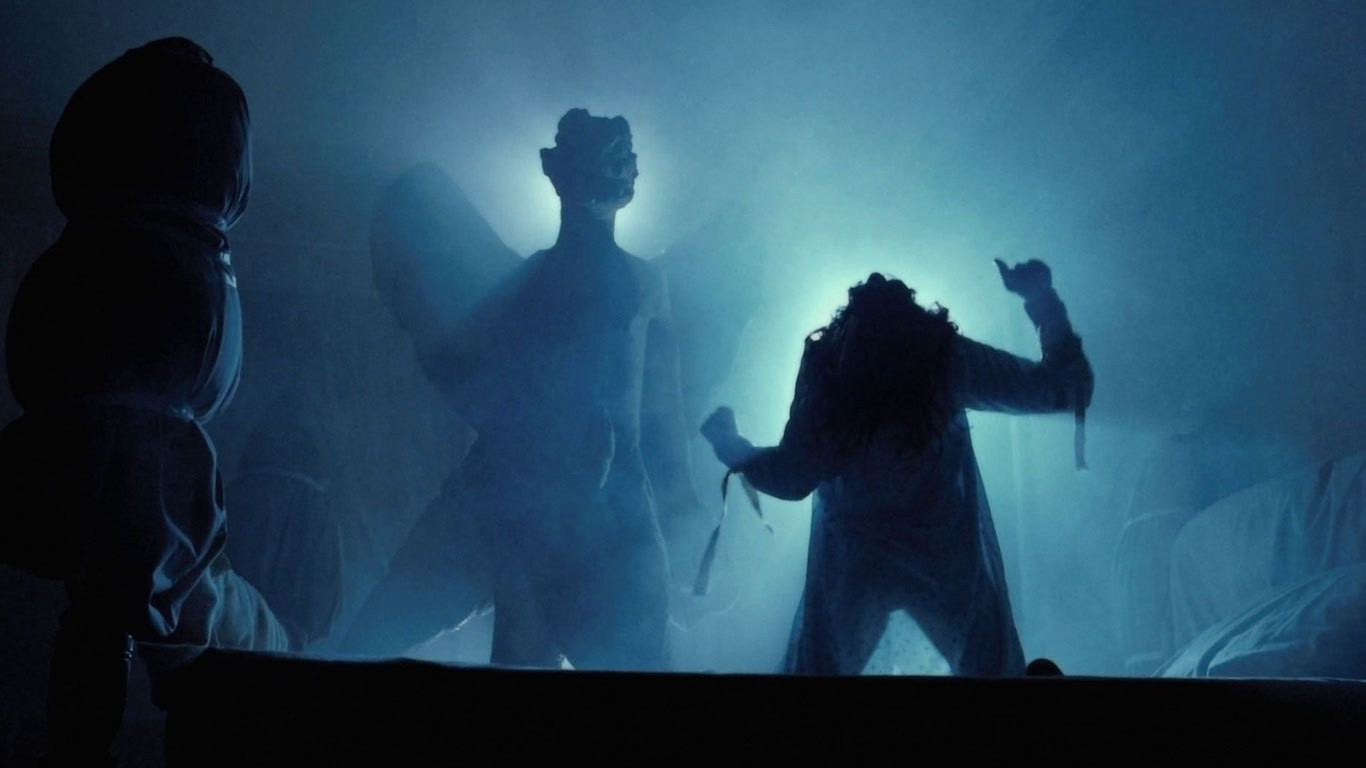
The Exorcist (USA: William Friedkin,1973)
MB: This film terrified me when I was a committed youthful Christian who had been raised by my grandparents to believe that demons were waiting for an opportunity to possess us, and, when I watched it later as a non-believing college student studying film, it still had the power to disturb and terrify me (the psychological grooves of those beliefs never leave you, even when you stop believing). This film set off a media frenzy as there were reports of grown adults passing out in the aisles of theaters and people getting physically sick. In metropolitan theaters there were long lines around the block of eager viewers willing to test their mettle. Even more than Rosemary's Baby, The Exorcist was a massive influence on The Satanic Panic of the 1980s.
Film Description: "A visiting actress in Washington, D.C., notices dramatic and dangerous changes in the behavior and physical make-up of her 12-year-old daughter. Meanwhile, a young priest at nearby Georgetown University begins to doubt his faith while dealing with his mother's terminal sickness. And a frail, elderly priest recognizes the necessity for a show-down with an old demonic enemy." - Andrew Harmon
Resources for after you watch the film

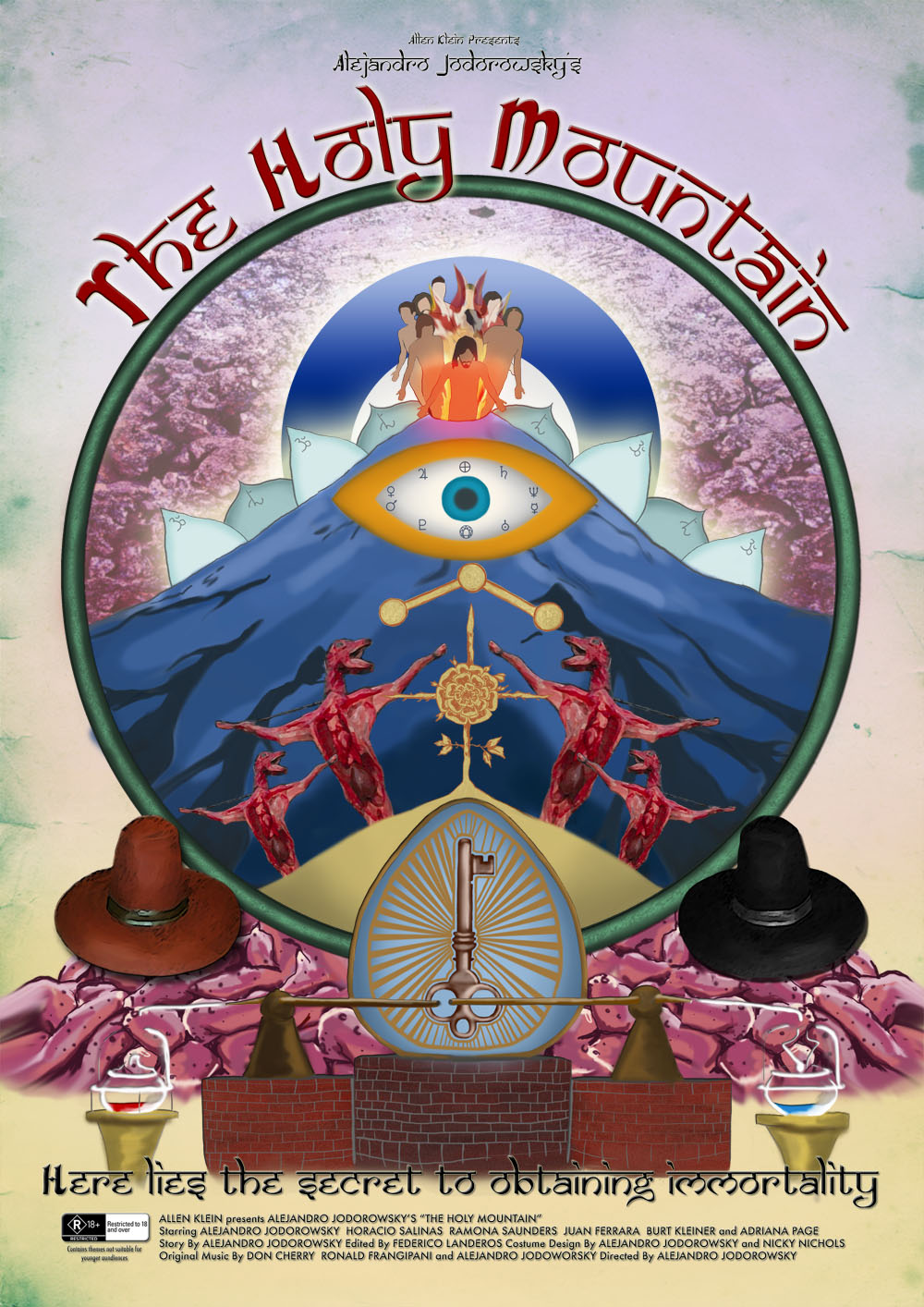
The Holy Mountain (Mexico/USA: Alejandro Jodorowsky, 1973)
MB: From the time I was first studying films as an art form, I heard whispers about the surreal, mind-blowing, nearly impossible to find films by Jodorowsky. His films were tangled up in a legal dispute with the original producer, who held the rights to them and tried to blackmail Jodorowsky into making a cash-grab soft-core erotic movie in the late 1970s. Jodorowsky, who was more interested in the artistic side (and the occult implications of art/performance) refused this commercial project, and the vengeful producer refused to allow his films to be released on video & DVD. Fans, or cult film enthusiasts wanting to see them for the first time, were relegated to terrible copies of copies until, 40 years after the producer died, Jodorowsky's films were released in new restored prints. By this time, I was a new professor at BCTC running the Bluegrass Film Society, and I decided to screen The Holy Mountain. We had the largest crowd ever (of nearly 500 screenings), and everyone animatedly discussed the film afterward. Reportedly, the premiere screening of the film in Mexico City led to a riot amongst the huge crowd, and Jodorowsky escaped through a bathroom window. John Lennon and other celebrities were fans of his films, and they were part of a trend of out-there films that led to the Midnight Movie phenomenon.  The film is loaded with occult symbolism and seemingly takes an anti-authoritarian glee in assaulting every societal institution (religion/church, capitalism, militarism, and even the authentic seeker, ...). It really is a film unto itself.  
Film description: "In a corrupt, greed-fueled world, a powerful alchemist leads a messianic character and seven materialistic figures to the Holy Mountain, where they hope to achieve enlightenment."
"Venerated by cult cinema enthusiasts while dismissed by most other critics, the films of Alejandro Jodorowsky present strange and magical visions that are not easily categorised or understood. Informed by a lifetime of spiritual journey, Jodorowsky’s cinematic output is filled with violently surreal images and a hybrid blend of mysticism and religious provocation. His completed films are few in number (only six features to date, two of which he has subsequently disowned), and are typically associated with the youth counterculture movement of the late 1960s and early 1970s, especially the “head film” subgenre and the “midnight movie” phenomenon. While canonical directors like Buñuel and Fellini were celebrated darlings of the critical establishment, Jodorowsky (who wrote, directed, scored, and often starred in his personal films) was lurking on the fringes of the film world, bringing his distinctly surreal and esoteric sensibilities to the screen in controversial films like Fando y Lis (1968), El Topo (1970) and The Holy Mountain (1973)." - David Church
Resources for after you watch the film


The Craft (USA: Andrew Fleming, 1996)
MB: This film may not reach the heights of artistic excellence, but it was a successful crowd pleaser and gained cult status on its release on video/DVD. It was an inspiration to a generation of young, alienated females to start dressing like the characters and practicing magic rituals. The cast includes Fairuza Balk, in a defining role as the angry leader Nancy Downs, and Neve Campbell (also the protagonist of Wes Craven's 1996 meta-horror film Scream - Skeet Ulrich is also in both films) as the new girl in the high school who completes the coven.
Film description: "A Catholic school newcomer falls in with a clique of teen witches who wield their powers against all who dare to cross them – be they teachers, rivals or meddlesome parents."
Resource for after you watch the film:

Gamble, Ione. "The Craft (1996)." The Final Girls (October 31, 2019) ["The Final Girls are joined by Ione Gamble to discuss witchcraft, teen girl politics, and why Nancy Downs remains a bastion of weirdness for teenage girls everywhere."]

The Holy Mountain (Mexico/USA: Alejandro Jodorowsky, 1973)


The Holy Mountain (Mexico/USA: Alejandro Jodorowsky, 1973: 115 mins)

Barton-Fumo, Margaret. "Alejandro and the Academy: Anarchy and Alchemy: The Films of Alejandro Jodorowsky by Ben Cobb." Senses of Cinema #48 (2008)

Church, David. "Great Directors: Alejandro Jodorowsky." Senses of Cinema #42 (2007)

Hilson, Jeff. "The Holy Mountain." Electric Sheep Magazine (April 5, 2007)

Jodorowsky, Alejandro. "No Attachment to Dust: Alejandro Jodorowsky on Zen and the art of filmmaking." Bluefat (No Date)

Jones, Matthew. "The Holy Mountain (1973)." Philosophy in Film (November 30, 2017)

Kan, Elianna. "Buy High, Sell Cheap: An Interview with Alejandro Jodorowsky." The Paris Review (March 8, 2018)

Pasori, Cedar and Ross Scarano. "Kanye's Holy Mountain: The Influence of Alejandro Jodorowsky on the Yeezus Tour." Complex (November 22, 2013)

Rivas, T.J. "Cinematic Responses to Fascism." Film History and Aesthetics Wiki (A Project of Film 110: Introduction to Film History and Aesthetics at Westminster College)

Smalley, G. "The Holy Mountain (1973)." 366 Weird Movies (March 30, 2011)

Tremaine, Trevor. "Mythology and Allegory in Psychedelic Cinema." Bluegrass Film Society (December 7, 2006)


The Exorcist (USA: William Friedkin, 1973)


The Exorcist (USA: William Friedkin, 1973: 122 mins)

Acolytes of Horror. "How the Exorcist Keeps Its Distance." (Posted on Youtube: 2021)

Brown, Michael. "The Demon Pazuzu as Noise in The Exorcist." Revenant #3 (March 2018) ["Against a blackened screen blood-red lettering announces the beginning of William Friedkin’s The Exorcist (1973). But it is not only what we see that unnerves us, it is what we hear. From the very first discordant strings’ sudden transition into the adhᾱn, the Muslim call to prayer, the film creates an atmosphere of uncertainty through its innovative sound design. While sound and horror share a long-established history in the production of cinematic dread, sound in The Exorcist does more than simply prompt an emotive response or mood in audiences. Rather, by listening closely to the sonic elements of the often critically unappreciated Iraq prologue, I will demonstrate that the central evil of the narrative, the demon Pazuzu, is in fact best understood as ‘noise’. By reflecting on media theory’s concept of noise as one with affective, ontological and philosophical concerns this essay will argue for a renewed critical approach to the film, one which recognises the demon’s aural association with wind, shrieking voices, garbled language and insect drone as intimately bound to its function as a disruptive and destabilising agency. Accordingly, the possessed body of the film’s adolescent protagonist Regan MacNeil’s (Linda Blair) is aurally and visually constructed as a medium, albeit one that is immersed in noise. I will argue that a sounds studies perspective is useful in identifying a more diffuse kind of horror in The Exorcist beyond its more obvious religious anxieties and visceral special effects, one that, like the presence of noise, disturbs our ability to make sense of the world as something essentially knowable and hence, meaningful. As such the climatic rite of exorcism resembles a communicative performance wherein the exorcist is called upon to expel noise and re-establish meaning through restorative acts of language."]

Graham, Jamie, et al. "Occult Pt. 10: The Exorcist (1973)." The Evolution of Horror (January 2, 2020)

Hudson, David. "Remembering William Friedkin." Current (August 11, 2023)

Kermode, Mark. The Exorcist. British Film Institute, 2020. ["Inspired by an alleged real case of demonic possession in 1949, The Exorcist became an international phenomenon on its release in 1973. A blockbusting adaptation of a best-selling novel, it was praised as 'deeply spiritual' by some sections of the Catholic Church while being picketed by the Festival of Light and branded 'Satanic' by the evangelist Billy Graham. Banned on video in the UK for nearly fifteen years, the film still retains an extraordinary power to shock and startle. Mark Kermode's compelling study of this horror classic was originally published in 1997, and then extensively updated and expanded in 2003 to incorporate the discovery of new material. This revised edition documents the deletion and reinstatement of key scenes that have now been integrated into the film to create The Exorcist: The Version You've Never Seen. Candid interviews with director William Friedkin and writer/producer William Peter Blatty reveal the behind the-scenes battles which took place during the production. In addition, exclusive stills reveal the truth about the legendary 'subliminal images' allegedly lurking within the celluloid."]

Murray, Noel. "William Friedkin and the Art of Immediacy." The Dissolve (May 1, 2014)

"Rats In the Attic: William Friedkin’s The Exorcist." Cinephilia & Beyond (ND)

Romano, Aja. "Why the Satanic Panic never really ended." Vox (March 31, 2021) 


Wiggins, Steven A. "Nightmares with the Bible: The Good Book and Cinematic Demons (Horror and Scripture, 2020)." New Books in Biblical Studies (April 27, 2022) ["Nightmares with the Bible: The Good Book and Cinematic Demons (2021) published by Fortress Academic views demons through two lenses: that of western religion and that of cinema. Sketching out the long fear of demons in western history, including the Bible, Steve A. Wiggins moves on to analyze how popular movies inform our beliefs about demonic forces. Beginning with the idea of possession, he explores the portrayal of demons from ancient Mesopotamia and the biblical world (including in select extra-biblical texts), and then examines the portrayal of demons in popular horror franchises The Conjuring, The Amityville Horror, and Paranormal Activity. In the final chapter, Wiggins looks at movies that followed The Exorcist and offers new perspectives for viewing possession and exorcism. Written in non-technical language, this book is intended for anyone interested in how demons are perceived and how popular culture informs those perceptions."]