Together with Francis Coppola and George Lucas, Murch abandoned Hollywood in 1969 and moved to San Francisco to create the Zoetrope studio. Their vision was of a new kind of cinema for a new generation of film-goers. Murch's subsequent contributions in film editing rooms and sound-mixing theatres were responsible for ground-breaking technical and creative innovations. In this book, Murch invites readers on a voyage of discovery through film, with a mixture of personal stories, meditations on his own creative tactics and strategies, and reminiscences from working on The Godfather films, Apocalypse Now, Lucas' American Grafitti, and Anthony Minghella's The English Patient and The Talented Mr Ripley. Suddenly Something Clicked is a book that will change the way you watch movies."]
We live in the best of times in which we are able to learn about the world and its incredible diversity of cultures/beings/places/perspectives in a way never historically possible. We live in the worst of times when we are able to isolate ourselves completely from anything different from our own narrow view/conception of the world/reality. The choice is yours!
Tuesday, November 11, 2025
ENG 281: Fall 2025 Resources #12
Together with Francis Coppola and George Lucas, Murch abandoned Hollywood in 1969 and moved to San Francisco to create the Zoetrope studio. Their vision was of a new kind of cinema for a new generation of film-goers. Murch's subsequent contributions in film editing rooms and sound-mixing theatres were responsible for ground-breaking technical and creative innovations. In this book, Murch invites readers on a voyage of discovery through film, with a mixture of personal stories, meditations on his own creative tactics and strategies, and reminiscences from working on The Godfather films, Apocalypse Now, Lucas' American Grafitti, and Anthony Minghella's The English Patient and The Talented Mr Ripley. Suddenly Something Clicked is a book that will change the way you watch movies."]
Uncut Gems (USA: Benny Safdie and Josh Safdie, 2019)

Uncut Gems (USA: Benny Safdie and Josh Safdie, 2019: 135 mins)
This jolt of pure cinematic adrenaline affirmed directors Josh and Benny Safdie as heirs to the gritty, heightened realism of Martin Scorsese and John Cassavetes. Adam Sandler delivers an almost maniacally embodied performance as Howard Ratner, a fast-talking New York jeweler and gambler in relentless pursuit of the next big score. When he comes into possession of a rare opal, it seems Howard’s ship has finally come in—as long as he can stay one step ahead of a wife (Idina Menzel) who hates him, a mistress (Julia Fox) who can’t quit him, and a frenzy of loan sharks and hit men closing in on him. Wrapping a vivid look at the old-school Jewish world of Manhattan’s Diamond District within a kinetic thriller, Uncut Gems gives us one of the great characters in modern cinema: a tragic hero of competing compulsions on a shoot-the-moon quest to transcend his destiny. - Criterion Collection
Hoberman, J. "Uncut Gems: Taking it to the Rack." The Current (November 23, 2021)
Monday, November 10, 2025
Past Present Future: Political History & History of Ideas Podcast (Shooting Azimuths)
Hosted by David Runciman
Amadae, S.M. "Where are We Going? Nuclear War Part 1." Past Present Future (February 15, 2026) ["For the first in a new series of conversations exploring the future that faces us all, David talks to S. M. Amadae about what nuclear weapons and the prospect of nuclear war have done to the human condition. Was 1945 the decisive watershed in the history of humanity? What made the possibility of nuclear conflict different from previous ideas of catastrophe? How did we reconcile ourselves to the horrifying consequences of what we had built?"]
Blyth, Mark. "The History of Bad Ideas: Austerity." Past Present Future (June 15, 2025) ["For the first episode in our new series about how bad ideas take hold, David talks to economist Mark Blyth about austerity, the cost-cutting idea that refuses to die. Why is it an article of faith that states need periodic purging to stop them getting too greedy? Why does this so often happen at times when it does most harm, from the 1930s to the financial crisis that began in 2008? And how is the politics of austerity playing out today, in Starmer’s Britain, in Milei’s Argentina and in the DOGE wars happening in Trump’s America?"]
Chawlisz, Claudia. " Fixing Democracy: Citizens’ Assemblies." Past Present Future (September 21, 2025) ["David talks to Claudia Chwalisz, founder and CEO of Democracy Next, about how citizens’ assemblies could help fix what’s wrong with democracy. Where does the idea of a jury of citizens chosen at random to answer political questions come from? What are the kinds of contemporary questions it could help to settle? How does it work? And what would encourage politicians to listen to citizens’ assemblies rather than to their electorates?"]
Dabhoiwala, Fara. "The History of Revolutionary Ideas: Free Speech." Past Present Future (April 6, 2025) ["Today’s revolutionary idea is one with a long history, not all of it revolutionary: David talks to the historian Fara Dabhoiwala about the idea of free speech. When did free speech first get articulated as a fundamental right? How has that right been used and abused, from the eighteenth century to the present? And what changed in the history of the idea of free speech with the publication of J. S. Mill’s On Liberty in 1859?" Fara Dabhoiwala's book What is Free Speech: The History of a Dangerous Idea.]
Douglas, Alexander. "The History of Bad Ideas: Identity." Past Present Future (July 17, 2025) ["For the final episode in our current series on the history of bad ideas, David talks to philosopher Alexander Douglas about the damage that can be done by the idea of identity. Why is the search for a distinctive personal identity such a futile quest? How does it lead to an identity politics of exclusion and violence? What can we learn from the philosopher Spinoza about having an identity without identity? And what can we glean from the experience of dementia about losing ourselves?"]
Ellison, Ian. " Politics on Trial 100th Anniversary Special: Franz Kafka’s The Trial." Past Present Future (August 25, 2025) ["Today’s episode in Politics on Trial is about the most famous trial in literature and one that never actually takes place. David talks to writer and literary scholar Ian Ellison about Franz Kafka’s The Trial, first published in 1925. What is the meaning of a book about a legal process that never happens? How was it inspired by Kafka’s failed love life? Why has it given rise to so many different understandings of what makes our world Kafkaesque? And how did a work of fiction that is full of weird and wonderful ideas get associated with mindless bureaucracy?"]
Finlayson, Alan. "The History of Bad Ideas: Behaviorism." Past Present Future (July 13, 2025) ["In today’s episode of the history of bad ideas, David talks to political philosopher Alan Finlayson about behaviourism, a theory of psychology that has penetrated to the heart of politics. How did we get from Pavlov’s Dog to a prescription for a better society? What is the relationship between behavioural utopianism and contemporary economics? How did behaviourism get turned into something called ‘Nudge’? And if we are being nudged into better behaviour, what is left for politics?"]
Lewis, Helen. "The History of Bad Ideas: Genius." Past Present Future (June 19, 2025) ["Today’s bad idea is ‘genius’, the label that has enabled all sorts of terrible behaviour through the ages. Writer and broadcaster Helen Lewis explains how and why the idea of genius gets misapplied to people and things that just aren’t. Why are geniuses meant to be tortured? Why are individual geniuses prized over the collaborations that lie behind most innovations? Why do we think that people who are brilliant at one thing will be good at everything else?"]
Runciman, David. "The Lives of the Philosopher: Albert Camus." Past Present Future (August 26, 2026) ["In our series about how twentieth-century philosophy and biography intersect, David talks to philosopher Alex Carter about the life of Albert Camus, novelist, playwright, journalist, celebrity and public intellectual. What makes Camus a philosopher as well? How was he shaped by his Algerian background? Does it make sense to call him an absurdist? How did he try to reconcile the very different parts of his extraordinary life?"]
---. "Politics on Trial: Charles I vs Parliament." Past Present Future (June 12, 2025) ["Today’s political trial is perhaps the most consequential in English history: the trial and execution of King Charles I for treason in January 1649. How could a king commit treason when treason was a crime against the king? How could a court try a king when a king has no peers? How could anyone claim to speak for the people after a civil war when so many people had been on opposite sides? The answers to these questions would cost more than one person his life – but they would also change forever the prospect of holding tyrants to account."]
---. "Politics on Trial: Galileo vs the Inquisition." Past Present Future (June 8, 2025) ["Today’s trial is one of the most notorious in history but also one of the most misremembered. Galileo’s epic confrontation with the Catholic Church over the question of whether the earth moves round the sun – culminating with his interrogation and condemnation in Rome in 1633 – was not just a matter of truth vs ignorance or science vs superstition. It was also twenty-year long struggle on the part of both sides to find a way to co-exist. Did they succeed? Not exactly, but it wasn’t for want of trying. Then – and perhaps now – science and religion needed each other."]
---. "Politics on Trial: Hitler vs Weimar." Past Present Future (August 31, 2025) ["Today’s epic political trial is the one that should have been the end of Adolf Hitler but ended up being the making of him: his treason trial in 1924 for the so-called Beer Hall Putsch. How close did Hitler’s attempted coup come to succeeding? Why was he allowed to turn the court that tried him into a platform for his poisonous politics? What were the missed opportunities to silence him once and for all?"]
---. "Politics on Trial: Mary Queen of Scots vs the Secret State." Past Present Future (June 1, 2025) ["In today’s episode an extraordinary political trial that culminated in the execution of one queen at the behest of another: Mary Queen of Scots, convicted of treason in 1586 and beheaded in 1587. But who really wanted her dead, Queen Elizabeth or Elizabeth’s powerful political servants? Why did Mary demand to be tried before parliament rather than a court of noblemen? How did she attempt to defend herself in the face of apparently overwhelming incriminating evidence against her? And who was the only person who voted for her acquittal?"]
---. "Politics on Trial: Socrates vs Democracy." Past Present Future (May 22, 2025) ["The first political trial in our new series is the one that set the template for all the others: the trial of Socrates in Athens in 399 BCE, which ended with a death sentence for the philosopher and a permanent stain on the reputation of Athenian democracy. Why, after a lifetime of philosophy, was Socrates finally prosecuted at the age of 70? Was the case motivated by private grievance or public outrage? What should Socrates have said in his own defence? Why, in the end, did he choose defiance instead?"]
---. "Politics on Trial: Thomas More vs the King." Past Present Future (May 29, 2025) ["In today’s episode another trial that forms the basis for great drama: the case of Thomas More, tried and executed in 1535, events dramatised by Robert Bolt in A Man for All Seasons and Hilary Mantel in Wolf Hall. How did More try to argue that silence was no evidence of treason? Why was his defence so legalistic? Was he really ‘the Socrates of England’? And who was the true villain in this case: Thomas Cromwell, Richard Rich or the King himself?"]
Runciman, David and Dan Snow. "The History of Bad Ideas: The Decisive Battle." Past Present Future (June 22, 2025) ["In today’s episode about the power of bad ideas, David talks to historian and podcaster Dan Snow about the myth that wars are settled on the battlefield. Why are we so drawn to the idea of the decisive military showdown? Is Napoleon to blame? What are the forces that actually settle military conflicts?"]
Sagar, Paul. "What’s Wrong with Political Philosophy? Learning from Aristotle." Past Present Future (February 1, 2026) ["Today it’s the first episode in a new series asking why contemporary political philosophy struggles to make sense of the deepest problems of politics and exploring how the history of ideas might help. David talks to political theorist Paul Sagar about why looking for justice might be the wrong place to start. Instead, Paul suggests we start with Aristotle, for whom the search for justice was the problem not the solution. So what should we do instead?"]
Sunday, November 9, 2025
Book Culture 2025 #2
Reality, considered in itself and as a whole, is a chaos so deep and immense that it exceeds any possibility of being understood or experienced. Even something as small as a pebble, if we consider it to the full extent of its existence, becomes a mystery beyond comprehension. We can detect only a fragment of this chaos, as filtered by our perceptive apparatus and cognitive limits. Through our imagination, based on our personal inclinations and on the cosmological assumptions of our society, we mould this remaining piece into one of the infinite forms that reality can take. This activity of the imagination provides us with a cosmos, a 'world': a place where we can develop those structures of sense that shelter us from the trauma of having been thrown unprepared into a mortal life. Then, spurred by the force of habit and by a desire for comfort, we become progressively convinced that the world we have constructed is an accurate picture of 'nature,' and that reality coincides with the metaphysical consensus of a particular society at a certain moment in history. We tend to forget the imaginary essence of the 'world' that we see around ourselves, and we start drawing hard distinctions between what we seen as 'truly existing' and what we set aides as 'mere fantasy.' (4)
This, too, is a timely lesson: if rational languages, such as philosophy and science, aim to offer a structure of sense for human life, they must recognize themselves, at least in part, as forms of literature. If they want to make their hard logical kernel inhabitable by living creatures, they should not overlook the need to translate into the soft substance of narrative. (10)
Since the infinite chaos of reality will always exceed the limits of any conceptual system, we should recognize that all of our attempts at reducing it to a meaningful cosmos are merely 'likely stories' - like the eikos mythos of Plato's Timaeus - at once plagued by, and endowed with, the porous quality of literature. Every conceptual world that we might devise is ultimately a story for us to live by, and the better ones are not those that reach closer to an absolute truth beyond our grasp, but those that are spacious and flexible enough to offer an imaginary home where a dignified life for all becomes possible. (10 - 11)
Campagna, Frrederico. Otherworldly: Mediterranean Lessons on Escaping History. Bloomsbury, 2025.
--------------------------------------------------------
Abrams, Nathan. "Kubrick's World: Power, Paranoia, and the Politics of the Human Condition." International Horizons (October 28, 2025) ["In this episode of International Horizons, Interim Director Eli Karetny speaks with film scholar Nathan Abrams about the enduring relevance of Stanley Kubrick and what his work can teach us about our current era. From the nuclear absurdities of Dr. Strangelove to the cosmic rebirth of 2001: A Space Odyssey, Kubrick’s films expose the fragile line between technological mastery and moral collapse. Abrams unpacks Kubrick’s fascination with war, authority, and obedience, his roots in the New York Jewish intellectual tradition, and his exploration of mystical and mythic themes—from Kabbalah to The Odyssey. Together, they reveal how Kubrick’s cinematic universe reflects our own: a world where human creativity, paranoia, and power intertwine in both terrifying and illuminating ways."]
Ford, Phil and J.F. Martel. "What a Fool Believes: On the Unnumbered Card in the Tarot." Weird Studies #77 (July 8, 2020) ["'What a fool believes he sees, no wise man can reason away.' This line from a Doobie Brothers song is probably one of the most profound in the history of rock-'n'-roll. It is profound for all the reasons (or unreasons) explored in this discussion, which lasers in on just one of the major trumps of the traditional tarot deck, that of the Fool. The Fool is integral to the world, yet stands outside it. The Fool is an idiot but also a sage. The Fool does not know; s/he intuits, improvises a path through the brambles of existence. We intend this episode on the Fool to be the first in an occasional series covering all twenty-two of the major trumps of the Tarot of Marseilles." List of books mentioned/discussed on the page.]
Together with Francis Coppola and George Lucas, Murch abandoned Hollywood in 1969 and moved to San Francisco to create the Zoetrope studio. Their vision was of a new kind of cinema for a new generation of film-goers. Murch's subsequent contributions in film editing rooms and sound-mixing theatres were responsible for ground-breaking technical and creative innovations. In this book, Murch invites readers on a voyage of discovery through film, with a mixture of personal stories, meditations on his own creative tactics and strategies, and reminiscences from working on The Godfather films, Apocalypse Now, Lucas' American Grafitti, and Anthony Minghella's The English Patient and The Talented Mr Ripley. Suddenly Something Clicked is a book that will change the way you watch movies."]
Stonebridge, Lyndsey. "Hannah Arendt's Lessons on Love and Disobedience." Recall This Book (September 4, 2025) ["Lyndsey Stonebridge discusses her widely praised 2024 We Are Free to Change the World: Hannah Arendt’s Lessons in Love and Disobedience. Lyndsey sees both radical evil and the banality of evil at work in Nazi Germany and in the causes of suffering and death in Gaza today. She compares the moral idiocy of authoritarians (like the murderous Nazis and those who are starving Gaza) to that of philosophers who cannot hear the echoes of what they are doing."]
Tuesday, November 4, 2025
ENG 281: Fall 2025 Resources #11
Irazuzta, Javier. The Prop and the Production Designer." Notebook (October 3, 2025) ["Eight industry veterans discuss a single object or piece of scenery from their work and its role in the worlds of their films."]
Nayman, Adam. "Jafar Panahi’s Revenge Road Trip Masterpiece." The New Republic (October 14, 2025) ["It Was Just An Accident reckons with cruelty and repression."]
Now, Gaspar. "“Cinema Is Connected to Dreams”: Lucile Hadžihalilović, in Conversation with Gaspar Noé." Interview (October 13, 2025) ["Lucile, best known for her hypnotic, unsettling films Innocence, Evolution, and her latest, The Ice Tower, a haunting new work starring Marion Cotillard, has built a body of films that explore transformation, awakening, and the mystery of being alive. That morning, she and Gaspar talked about the movies that shaped her. They’ve shared a life in cinema, but this was the first time they had really sat down to do something like this: a filmmaker looking back on the stories and images that formed her. What follows is not just a talk about movies, but about the process itself, the work, the obsession, the joy."]
"One Battle After Another (USA: Paul Thomas Anderson, 2025)." Dialogic Cinephilia (Ongoing Archive of Resources)
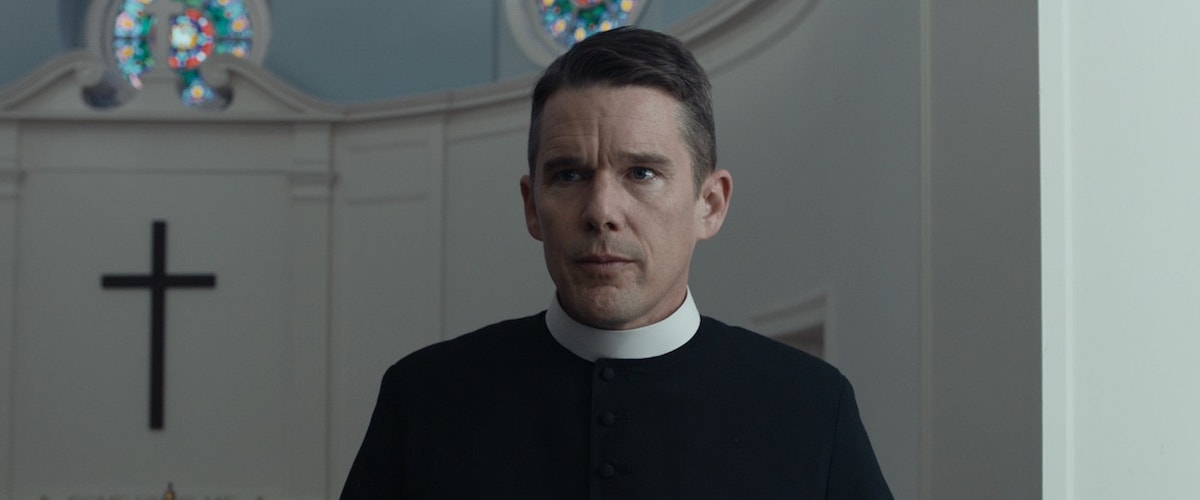
First Reformed (USA: Paul Schrader, 2017)

First Reformed (USA: Paul Schrader, 2017: 108 mins)
"Unless I miss my guess, “First Reformed” will find its least receptive audiences among those who want either a conventional psychological drama or a dogmatic exposition of spiritual themes. Neither is what Schrader’s after. From the first, style as a way of engendering spiritual consciousness has been his primary concern. In a welcome new edition of Transcendental Style, he writes of creating 'an alternate film reality—a transcendent one,” in which, “The filmmaker, rather than creating a world in which the viewer need only surrender … creates a world in which the spectator must contemplate—or reject out of hand.'
Will the film’s most appreciative viewers be those who know Schrader’s writings, his previous work and the great films whose influence he freely acknowledges? No doubt. Yet “First Reformed” leaves its large front door open to anyone who accepts its invitation to adopt a contemplative stance toward cinema. For those who do, the film’s peculiar mysteries and beauties will be evident throughout: in its restrained compositions and uses of silence and empty space, in the almost liturgical unfolding of its narrative, in a climactic scene of imaginary flight and a final scene that seems aptly designed to leave one catching one’s breath, caught in the very act of contemplating this tale of faith and its worldly opponents." - Godfrey Cheshire
"First Reformed marks a considerable turning point, a film à thèse about the struggle for grace and faith in our modern world of hyper-reality and despair, especially when the various stopgaps offered by society—organized religion, political institutions, ecological activism—seem variously counterfeit. A breathtaking, taut work possessed of an otherworldly meditative stillness, it feels at once hauntingly out of time and haltingly urgent. " - Best Films of the Decade
Ahmed, Nafees. "First Reformed (2018): Spiritual Collapse Under Crisis of Faith." High on Films (August 14, 2018)
Funk, Carolyn. "One Shot / First Reformed." Notebook (February 19, 2025)
Schrader, Paul. "First Reformed." Film Comment Podcast (June 21, 2018) ["“Although religious symbols and themes have often found their way into Schrader’s film work, First Reformed marks the first time he has applied elements of transcendental style—as extolled in his seminal book Transcendental Style in Film—to his own filmmaking. Early in his career, Schrader was occupied with exploring the pathological lure of sex and violence in narrative cinema,” Aliza Ma wrote in her review of Paul Schrader’s First Reformed for our May/June issue. As part of our Film Comment Free Talks series, Schrader joined Editor-in-Chief Nicolas Rapold for a conversation about the twists and turns and leaps in the writer-director’s career—from starting out as a critic and UCLA film student in the ’60s, to writing screenplays for Taxi Driver and Last Temptation of Christ, to directing films from Blue Collar through First Reformed."]
Monday, November 3, 2025
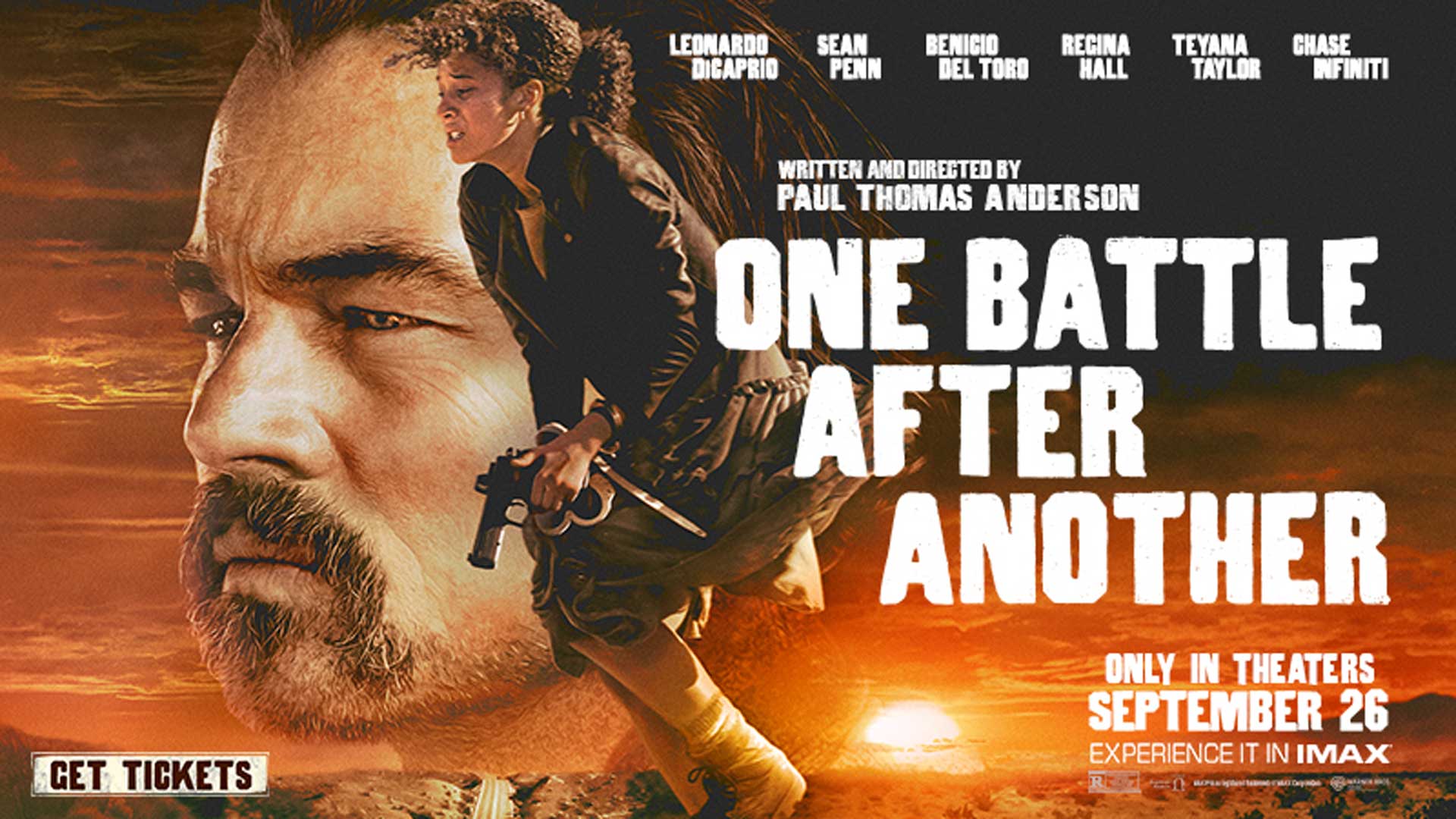
One Battle After Another (USA: Paul Thomas Anderson, 2025)

"One Battle After Another really defined 2025, a year when federal troops occupied at least 10 US cities with the goal of deporting migrants and intimidating the vulnerable. The events of the film bear an uncanny relationship to our political present, and even its internal logic of timekeeping seems strange: Between two acts that both seem set in the present, an infant grows into a teenager. It sometimes felt like Paul Thomas Anderon’s breathless epic was staging a battle with our postmodern sense of time itself, attacking the neoliberal order’s belief in “the end of history,” which is really a complacent faith in the continuity of values that can still erode before our very eyes. With a gonzo sense of humor that shuns political correctness, One Battle tried to wake people up. It’s unclear whether the film succeeded in this effort—much like the fate of the French 75, the group of militant underground leftists at the center of this movie, its political achievements are qualified at best. But its power of imagination still feels tremendous." - Nolan Kelly
"Prepared and shot before Trump’s reelection, [One Battle After Another] is something more than prescient; it seems to have won an existential gamble, on a high and devastating level, in staging scenes of a U.S. invasion of its own cities, scenes in which officials with guns occupy high schools and hospitals, all under an official pretext originating in a corrupt and insane commander’s personal vendetta.” - Jonathan Lethem
"The past doesn’t knock—it kicks the door off its hinges, then leaves your children standing in the splinters. That’s the bruising truth at the heart of Paul Thomas Anderson’s comedic action-thriller, a sprawl about sins we swear we’ve buried, only to realize they’ve been inherited—paid for by the next generation with interest. Leonardo DiCaprio plays a burnout ex-revolutionary trying to raise a child while the old cause and its enemies crawl back into frame, but the movie’s strangest sting is oddly, quietly romantic—Bob and Lockjaw (Sean Penn) both broken by Perfidia’s (Teyana Taylor) rejection, and everyone has to live with the consequences, stumbling through the wake of her choices like it’s fallout you can’t sweep up. Parenthood becomes a form of triage, ideology becomes a hangover, and love becomes the kind of bruise people build their whole lives around. Did we mention it’s also a hilarious thrill ride and idiosyncratic action spectacle about an ex-agitator and bomb expert who can’t remember a secret code to save his life? Then the performances start landing like body blows: Benicio del Toro is a scene-stealing miracle—magnetic, soulful, hilarious—so alive you want to peel him off into an entirely different movie, while Sean Penn is deliciously Kubrick-ianly absurd (and scary) as a deeply insecure psychopath whose menace is rooted in neediness, every grin reading like a plea and a threat at once. Regina Hall, Teyana Taylor, and Chase Infiniti deepen the orbit, with Infiniti grounding the moral gravity as the child forced to shoulder what adults broke. Shot by Michael Bauman and scored by Jonny Greenwood, it’s slightly tilted, as if the world can’t stay level under the weight of memory, and even the action has a thesis: a car chase that doesn’t simply get faster, it gets queasier, reinventing the form through vertiginous tension—consequence closing the distance, asphalt turning into anxiety. And when those opening riffs of Tom Petty’s “American Girl” hit, the classic gets rewired into grief—you won’t hear it again without tearing up. Ocean waves, baby, Ocean waves." – Rodrigo Perez
One Battle After Another (USA: Paul Thomas Anderson, 2025: 162 mins)
Sources:
Sam Adler-Bell, "The Fantasy of Assassination Culture," New York Magazine, Nov 1, 2025
Armond White, "There Will Be Bloodlust in One Battle After Another," National Review, Sept 26, 2025
Richard Brody, "The Real Battle of 'One Battle After Another,'" New Yorker, Oct 7, 2025]
Bianchi, Pietro. "(Female) Enjoyment as a Political Factor in One Battle After Another." e-flux (October 17, 2025) ["The novelty of One Battle After Another is that the impossible totality—which no longer seems to have a dominant register and instead disperses into a thousand fragments, digressions, comic intermissions, and dramatic closures—has never revolved so insistently around an absent center. A center that perhaps constitutes both the allegory and the singular embodiment of the impossibility of totality. That absent center consists of the character who, in Vineland, was Frenesi, and who here goes by the name of Perfidia Beverly Hills, played by Teyana Taylor."]
Cira, Mark. "One Battle After Another." Letterboxd (September 30, 2025) ["In Tarantino's revisionism, he takes aim at the bullshit liberalism the hippy counterculture curdled into. Anderson’s target is more formidable: the military industrial complex. It’s a fairer fight, or at least a more honest one. As Hollywood's collaboration with the Pentagon and intelligence agencies deepened throughout the 2000s - Zero Dark Thirty, the Marvel military partnerships, the CIA's script consultations, Gen-X irony started to look less like detachment and more like complicity. The nihilism that seemed like coked-out swagger in the '90s needed some re-evaluation."]
Coviello, Peter. "Infrastructures of Escape." Filmmaker Quarterly 79.3 (2026)
["One Battle is not, as Anderson’s Inherent Vice (2014) rather successfully was, an “adaptation” of Pynchon. It is, I think, something looser, and weirder, and altogether better: an extended riff, that is also an extended reading, that is also—and here the heart swells—something like a fan’s notes, a loving tribute executed in the idiom of film. There are plenty of things to say about its formal accomplishments and deficits—about the textured 70 mm photography, the pivot from Vineland’s 1960s/1980s setting to the calamitous present tense, the badly fumbled ending, its casting, its plotting, the astounding kinetic vivacity of a film that’s engrossing over the whole course of its nearly three-hour run.1 But most of what I mean to say is that I fucking loved it. Whatever else Anderson may do in his reading, I think he gets impeccably and upliftingly correct that Pynchon is at heart a comic humanist and a vitriolic antifascist. And then, with a grace and ingenuity all his own, Anderson translates that signature novelistic disposition—the delirious sentences, off-kilter plots, lunatic counterfacutals—into a rollicking big-screen entertainment. I don’t know that it’s the easiest thing, just now, to make a credibly antifascist piece of mass culture. Anderson has done that, and Pynchon helped him do it. I’d like to give an account of what this means."]
Everett, Cory. "One Battle After Another: Pop Culture Glossary." The Film Stage (October 30, 2025)
Goi, Leonardo. "In Sunny Southland: Paul Thomas Anderson and Thomas Pynchon’s California." Notebook (November 24, 2025) ["By 1970, when Anderson was born in Studio City, Pynchon had quit his gig writing safety articles for Boeing in Seattle and decamped to Los Angeles. He landed in a small apartment in Manhattan Beach, which would appear in his books as the fictional Gordita Beach, a last resort for bums, drifters, punks, and drop-outs determined to steer clear of the straight life. And though his novels have journeyed far and wide—from New York City (V., 1963; Bleeding Edge, 2013) to Chicago (Against the Day, 2006); from the American colonies (Mason & Dixon, 1997) to Europe, Namibia, and Siberia (Gravity’s Rainbow, 1973)—Pynchon has become closely identified with the countercultural hangover that swept through post-Manson California and serves as backdrop for the two texts Anderson would go on to adapt, Inherent Vice (2009) and now Vineland (1990). Novelist and filmmaker are unmistakably smitten with the textures of “sunny Southland,” to use a phrase popularized in the late 1800s by newspaper editor Harrison Gray Otis (who incidentally lifted it from the Confederacy). But they reserve their deepest feeling for its eccentric residents—drifters who straddle the old and the new, who have only just started to realize how the changing of the guard is leaving them behind, who have seen their turf transform to the point they can barely recognize it. Still, neither artist has ever simplistically romanticized that bygone milieu. Their characters fumble as they navigate a world rife with signs, secrets, and conspiracies, a California candied not with “identifiable cit[ies]” but with “grouping[s] of concepts,” where everyone and everything suggests “a hieroglyphic sense of concealed meaning,” per The Crying of Lot 49. That novel came out in April 1966, just a few months before Reagan was elected governor, promising to crack down on the “filthy speech movement” fueled by the student protests at Berkeley and to send “the welfare bums back to work.” The repression and censorship that would dominate Reagan-era California (and eventually all of the United States under his presidency) permeate Vineland and Inherent Vice, in which the actor-turned-politico serves as an omnipresent specter, a kind of daemon ex machina restoring fascism at home and abroad. A mood of chronic paranoia permeates Pynchon’s prose and Anderson’s cinema; what binds them isn’t just some autobiographical affair with Los Angeles but an interest in its sinister side: In the words of Inherent Vice’s Detective Lieutenant “Bigfoot” Bjornsen, “The dark forces that are always there just out of the sunlight.”"]
Hudson, David. "One Rave After Another." Current (September 25, 2025) ["The hype is real,” announces Adam Nayman in his review of One Battle After Another at the Ringer. Currently the highest-ranked film of the year at Letterboxd, Paul Thomas Anderson’s tenth feature is also riding high at Metacritic with a score of ninety-five. “There are sequences here,” writes Nayman, “so fluid and lucid—so controlled in terms of composition, cutting, and the hurtling, all-in sensation theorized by film scholar David Bordwell as ‘intensified continuity’—that remaining skeptics may feel obliged to bend the knee.”"]
Irazuzta, Javier. "The Prop and the Production Designer." Notebook (October 3, 2025) ["Eight industry veterans discuss a single object or piece of scenery from their work and its role in the worlds of their films."]
Klion, David. "How One Battle After Another Imagines an Armed Left." The New Republic (October 3, 2025) ["The rebels in Paul Thomas Anderson’s movie resemble the Weather Underground less than the right’s conspiratorial image of 'antifa supersoldiers.'"]
Lewis, Josh. "One Battle After Another." Letterboxd (September 27, 2025)
Llinares, Dario. "One Critical Battle After Another: Ideology v Aesthetics." Cinema Body/Cinema Mind (October 6, 2025) ['Emerging from the cavernous majesty of the Waterloo IMAX, I stumbled out slightly disoriented, still trying to process the sheer scale of the audiovisual spectacle I had just witnessed. The vertigo-inducing final sequence, a slow-burn car chase across the Southern California desert, is so physically and sensually intense - its suspense gradually accumulating until the dénouement arrives with a crash (literally and figuratively) - that it left me feeling exhilarated, awestruck even."]
Rubsam, Robert. "America's Cinematic Salvation." Liberties (March 2026) ["Coiled at the center of Paul Thomas Anderson’s One Battle After Another is a shadowy club committed to the “racial purification” of the American populace. Meeting in luxury hotel suites and bland office towers, these lumpy, balding men — generals, politicians, titans of industry — want to rebalance the composition of their country, and possibly the world. They call themselves the Christmas Adventurers, and they profess a creed of strict racial hygiene, inducting only “white Americans by Gentile-born,” in the hope of segregating white Americans away from the refuse of the worldwide underclass. “You want to save the planet,” says head Adventurer Virgil Throckmorton (Tony Goldwyn), “you start with immigration.” Does that sound so farfetched to you? Based on a Thomas Pynchon novel published in 1990, first conceived around the turn of the 21st century, and filmed entirely before the 2024 general election, Anderson’s film arrived in theaters last fall at a time when immigration had become the battlefield on which all of America’s domestic conflicts are being fought. In the past year, the president has signed an executive order illegally ending birthright citizenship, and has openly yearned to denaturalize, deport, and even detain abroad U.S. citizens. “Homegrowns,” he said last year, “are next.” These policies have been backed up and egged-on by a coterie of American white nationalists, among them Homeland Security Advisor Stephen Miller and Vice President J.D. Vance, who believe that America’s “cultural coherence,” established by early generations of white Anglo-Saxon immigrants, has been fatally compromised by nearly 150 years of immigration from places all across the globe. The only real Americans, they believe, are the descendants of those early settlers, a group now called “Heritage Americans.” Everyone else is, at best, a second-class citizen — though, given the pitch of their ethnonationalist rhetoric, invader would probably be the more accurate term. Miller apparently believes the country would be better off with about 100 million residents — a task that would involve removing more than 240 million people. "]
Smith, Nathaniel. "One Battle After Another is a masterful film about the melancholy of moral compromise." Premier Christianity (October 7, 2025) ["It’s the kind of art that demands attention, so by extension it’s the sort of cinema that Christians who want to engage with culture should rush to see."]