Friday, May 8, 2020

Dialogic Cinephilia - May 8, 2020

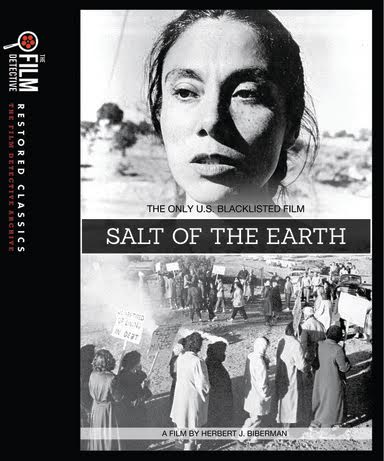
Easily one of the most radical American films. Deals with class/worker inequality, big business using race to exploit & divide, gender inequality, police brutality, police being used to unfairly evict poor people, all in a quick and powerful 92 minutes run time. Esperanza is easily on my list of one of my favorite women protagonists in a film and her along with her sister comrades should be on any list of badass women! Watching the changing dynamics of her relationship with her husband Ramon was fascinating. No wonder it wasn't shown in America till the mid 60s. This film is radical for right now - a great watch for thinking how post-pandemic we don't return to the previous "normal." A true cinematic expression of the power of solidarity across artificial divisions right up to the last scene!

Watched on MUBI


---------------------------------------------------------------------------

Bell, W. Kamau. "What an Oklahoma rancher wants you to know about America's broken food supply system." CNN (April 24, 2020)

Bulkin, Nadia, et al. "The Outer Dark Symposium 2019, Part 5: Ecstatic Weird Panel." The Outer Dark (October 10, 2019) ["In this podcast The Outer Dark presents the fifth installment of The Outer Dark Symposium on the Greater Weird 2019 including the panel ‘The Ecstatic Weird: The Weird as a Source of Transcendence and Awe’, moderated by Gordon B White and featuring Nadia Bulkin, Selena Chambers, Kurt Fawver, Orrin Grey, and Liv Rainey-Smith, as well as readings by Jeff Strand, Kurt Fawver, and Zin E Rocklyn. Also Gordon B White presents Reviews from The Weird including Spirits Unwrapped (Lethe Press), edited by Daniel Braum, and Luminous Body (Dim Shores), by Brooke Warra. The readings and panel were recorded live on Saturday March 23, 2019 at Silver Scream FX Lab in Atlanta, GA. Reviews from The Weird was recorded on Oct. 3, 2019."]

Cho, Joshua. "Corporate Looting as ‘Rescue Plan,’ Robber Barons as ‘Saviors.'" FAIR (May 1, 2020)

Dalpe, Victoria, et al. "State of the Weird 2019, A Roundtable Discussion." The Outer Dark (October 24, 2019)  ["Victoria Dalpe, Gwendolyn Kiste, John Langan and Teri.Zin (Zin E Rocklyn) join host/moderator Scott Nicolay for the most epic episode of The Outer Dark since The State of the Weird 2018. The roundtable conversation kicks off with reactions to pronouncements that the Weird Renaissance/boom is over at a time when so many talented writers from disenfranchised groups (women, PoC, LBGTQ+, disabled) are expanding and transforming Weird fiction with game-changing work. The authors discuss how more perspectives lift all writers and increase readership, the importance of having editors of color and other marginalized groups, changing the definition of agency especially in relation to mentally ill characters, the need to retool storytelling in ways that reflect diverse experiences and not just the same old archetypes, why Weird fiction is a fertile space for exploring different narrative and genre expectations, steps writers and readers can take to support new voices, recognition of Michael Kelly for the now retired award-winning Year’s Best Weird Fiction series (Undertow Publishing), Nightscape Press as an example of a risk-taking press, ‘Trojan Horsing’ diverse authors into anthologies along with the same big names, a Small Press Challenge for listeners, questions from the audience, and the future of Weird fiction."]

Freeman, Chas and Jeffrey Sachs. "COVID's Cold War." Open Source (May 7, 2020) ["The coronavirus may have arrived just in time to punctuate a 50 year turn in the grand tide of events. It could mark, that is, a fresh fixation in American minds on an external enemy. It could become the opening round even of a new Cold War, with China this time. But at what price? The hybrid giant “Chi-Merica” was the name of a partnership as well as a rivalry that grew out of Richard Nixon’s first visit to China in 1972. It was the combination that made China the workshop of the world, for better and worse. In the last decade Chi-Merica has driven a huge portion of global growth. But it’s at risk suddenly in the poisoned fallout of a pandemic. Between the pandemic still spreading, and the presidential campaign taking shape, this is tryout time in the blame game. President Trump’s contentious diplomat, Mike Pompeo, has walked back his accusation that the killer virus came out of a Chinese lab at Wuhan. Probably because US intelligence wouldn’t back him up, the Secretary of State now says there’s evidence on the point, but no certainty. Senator Tom Cotton of Arkansas is still the point man among “Blame China” Republicans. This week, he said the Chinese Communist Party is responsible for every death, every job lost, every retirement nest egg cracked by COVID-19, and he said that Xi Jinping and his comrades must be made to pay the price. Between Donald Trump and Democrat Joe Biden, meantime, the campaign videos for both sides argue the same point: that the Other Guy was chummier with China and said sweeter things about the Chinese leadership in happier times."]

Hittman, Eliza and Alexis McGill Johnson. "Never Rarely Sometimes Always: New Film Follows Teenager’s Perilous Journey to Access Abortion." Democracy Now (April 27, 2020) ["As multiple states have moved to further restrict access to abortions during the pandemic, a powerful new dramatic film follows a 17-year-old girl as she travels from her small town in Pennsylvania to New York City to get an abortion without having to notify her parents. “Never Rarely Sometimes Always” director and writer Eliza Hittman joins us to discuss the making of the film, which is being distributed online while cinemas remain closed in most states due to the pandemic."]

Kay, Jeremy. "Major film festivals partner with YouTube on free online event." Screen Daily (April 27, 2020)  ["A coalition of A-list international film festivals including Cannes, Venice, London, Toronto, Berlin, Sundance and Tokyo has partnered with YouTube on a free online spring festival produced and organised by Tribeca Enterprises to raise funds for Covid-19 relief."]

Koresky, Michael. "Queer & Now & Then: Vapors (Andy Milligan, 1965)." Film Comment (April 8, 2020)


"Weird Fiction." Horror Pod Class #2 (January 31, 2018) [Michael Benton -- What is very interesting to me is the idea that the "new weird" genre is speaking to a 21st Century dis-ease with the impossibility of truly knowing reality. Propaganda, disinformation & official lies instantaneously and repeatedly disseminated through ubiquitous screen technologies, radically transforming science/technology/theories that even leave those that devote their lives to a particular discipline overwhelmed, and a general distrust from the general population in their traditional experts/leaders. This is played out vividly in Vandermeer's trilogy and Garland's film as the main characters struggling to understand/survive the transmutating Area X/The Shimmer are scientists/soldiers.  ]

Thursday, May 7, 2020

Michael Benton: Public Education in America

If you want good public education you need to pay for it.

We need to end the corporate textbook system that caters to reactionary Texas state board of education officials (California has more buying power, but they allow their individual districts to choose their books for high school courses), that engages in the ridiculous notion that there is only one answer or one way of thinking about history, and panders to the lowest common denominator avoiding anything potentially offensive to the dominant culture.

Just as destructive is the way that corporate interests pay school districts to allow them to design and "gift" textbooks that are then taught framing subjects so they don't contradict corporate agendas.

We need to quit teaching to the test. Teaching young people and adults to take tests makes for terrible critical thinkers (which is learned from asking/framing questions, from long open ended discussions and engaging in 'what if' scenarios).

Education at this point can't compete with the propaganda being disseminated from all corners 24/7 (it takes a lot of work and you need parents to back the fuck off when you challenge cultural myths).

Adults also need to educate themselves. Education is a lifelong process. Some of the most ignorant people I know are the most educated in this messed up system we have now and have never bothered to question what they learned. Also, a major problem is that many Americans are overworked and that they are actually punished in multiple ways for critical thinking (anti-intellectualism, its a thing - even in academia).

All public education through college/university should be considered a civil right and college/university should be free for anyone that can demonstrate their willingness/responsibility to complete courses. You want to go to a private school, have your kids go to a church school, feel special at a private university - that is on you.

Wednesday, May 6, 2020

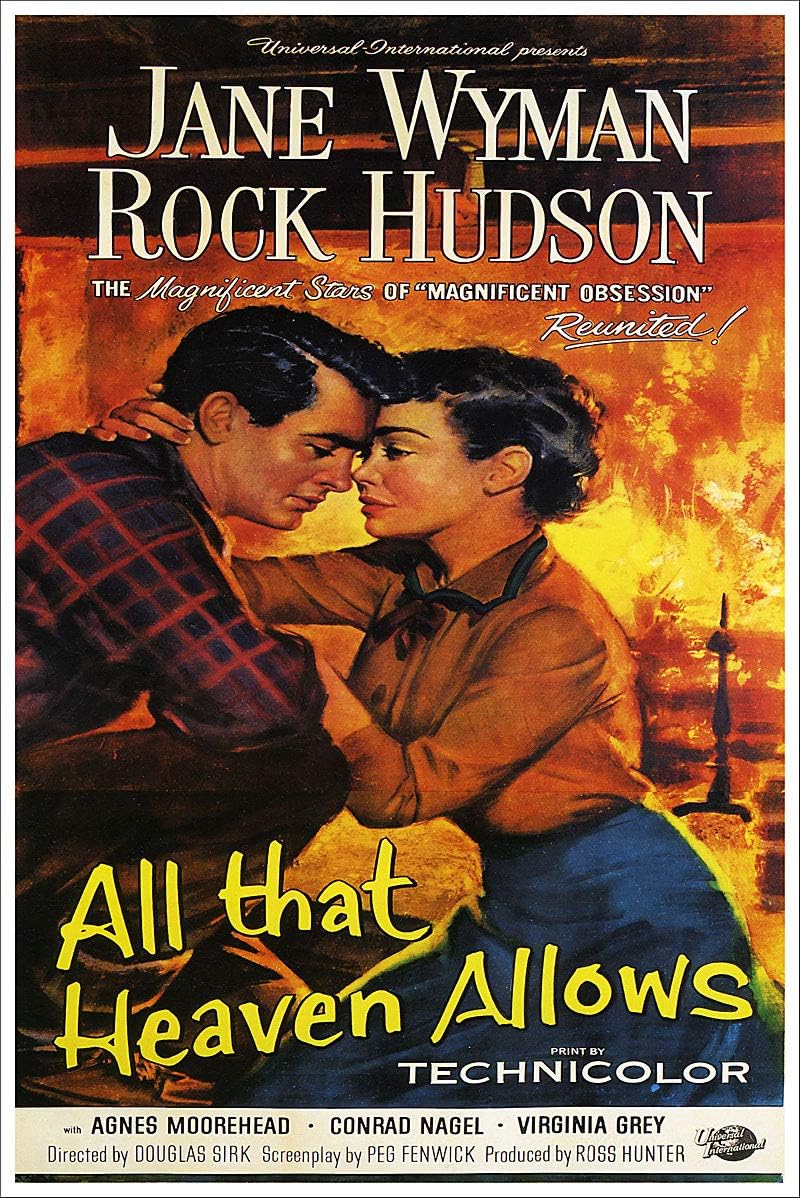
All That Heaven Allows (USA: Douglas Sirk, 1955)


All That Heaven Allows (USA: Douglas Sirk, 1955: 89 mins)

D'Angelo, Mike. "Subtext or not, All That Heaven Allows works great as straight melodrama." AV Club (June 11, 2014)

Graham, Jane. "All That Heaven Allows: #11 Most Romantic Film of All Time." The Guardian (October 16, 2010)

Halliday, Jon. "Rediscovering Douglas Sirk in 1972: All That Heaven Allows." MUBI (May 3, 2018)

Heldt, Guido. Music and Levels of Narration in Film. Intellect, 2013.["This is the first book-length study of the narratology of film music, and an indispensable resource for anyone researching or studying film music or film narratology. It surveys the so far piecemeal discussion of narratological concepts in film music studies, and tries to (cautiously) systematize them, and to expand and refine them with reference to ideas from general narratology and film narratology (including contributions from German-language literature less widely known in Anglophone scholarship). The book goes beyond the current focus of film music studies on the distinction between diegetic and nondiegetic music (music understood to be or not to be part of the storyworld of a film), and takes into account different levels of narration: from the extrafictional to ‘focalizations’ of subjectivity, and music’s many and complex movements between them."]

Koresky, Michael. "Queer Now and Then: 1955 (All That Heaven Allows)." Film Comment (March 25, 2020)

Lukas, Blake. "Douglas Sirk at Universal-International, Part 1: The Studio." Notebook (April 2, 2018) ["How the merger of Universal with International studios in 1946 set the stage for Douglas Sirk, two decades into his career, to flourish."]

---. "Douglas Sirk at Universal-International, Part 2: The Films." Notebook (April 9, 2018) ["How a great director engaged with the aesthetics, talents and desires of a Hollywood studio to produce his best work."]

Moulton, Erica. "A Cinema of Beautiful Devastation: All That Heaven Allows." Cinematheque (September 13, 2018)

Mulvey, Laura. "All That Heaven Allows: An Articulate Screen." The Current (June 10, 2014)

 Murray, Noel, et al. "Conformity, class, and color in All That Heaven Allows." The Dissolve (June 11, 2014)

Ryan, Tom. "Great Directors: Douglas Sirk." Senses of Cinema (February 2004)

Stevens, Brad. "All that mise en scène allows: Douglas Sirk’s expressive use of gesture." Sight and Sound (March 22, 2017) ["In Douglas Sirk’s famous melodrama All That Heaven Allows, the smallest hand movements of the actors speak volumes about their relationships."]


Dialogic Cinephilia - May 6, 2020

"50 films to see by age 15 – UPDATED." BFI (May 6, 2020)

Anderson, Warwick and Jim Yong Kim. "Public Health Across the Pacific." Open Source (April 30, 2020) ["There’s a shocking big truth in those coronavirus numbers – hidden in plain sight, as the saying goes. It comes down to this: China and various neighbors in East Asia beat the lethal virus to its knees months ago. It’s Europe and the US for the most part that inadvertently or not are pushing death tolls higher. Tabulate deaths per capita, and you see the new big picture: The New York State score so far would be 900 deaths per million New Yorkers; the Malaysia score would be 3. Massachusetts has lost 460 people per million; New Zealand 4. Connecticut has lost 600 people per million population. China: 3. First question to East Asia might be: why is your death-rate running roughly one percent of ours?"]

Biagetti, Samuel. "Back to the Dark Age: How People Adapted to the Fall of the Roman Empire." Historiansplaining (February 6, 2020) ["What did people do when the Roman empire fell apart around them? Recent scholarship, based on new archeological discoveries and techniques, argues that in the "dark" centuries between 450 and 750 AD, the people of western Europe, from conquering kings to ordinary peasants, improvised new political alliances, maintained law and order, improved the productivity of their land, and invented new crafts and art forms, building a resilient and inventive society on the foundations (often literally) of the old. "]

Bittencourt, Ella. "Rebellion in the Backlands." Harper's (April 8, 2020) ["With parallels to the United States’s colonial past, Backlands: The Canudos Campaign, a classic of Brazilian literature, and Bacurau, a new film, offer crucial insight into the past, present, and future of Brazil."]

Garrett, Laurie. "As Trump Claims 'Fantastic Job' on COVID, Reporter Laurie Garrett Warns Pandemic May Last 36+ Months." Democracy Now (May 6, 2020)

"Syndicalist unions and Covid-era resistance: A CIT roundup." Freedom (April 22, 2020) ["The anarcho-syndicalist international, founded in 2018, looks at workplace struggle in its branches worldwide and calls for the building of new forms of solidarity amid the lockdowns.]

Thompson, Derek. "The Post-Pandemic American Marketplace." On the Media (May 1, 2020) ["Coronavirus has prompted the shutdown of the American marketplace as we know it. Shops are boarded up, restaurants have shifted to a take-out only model, and tens of millions have been laid off. Eventually, some semblance of our economy will return — but what kind of economy will it be? Derek Thompson, staff writer at The Atlantic, expects that the pandemic will radically reshape American consumption — from the components of our diets to the composition of our cities."]


Thursday, April 30, 2020

Dialogic Cinephilia - April 30, 2020

Apple, Fiona and Eryn Wise. "In Her Own Words: Fiona Apple on New Album Fetch the Bolt Cutters & Acknowledging Indigenous Lands." Democracy Now (April 28, 2020) ["In a broadcast exclusive, world-renowned singer-songwriter Fiona Apple joins Democracy Now! for the hour to discuss her critically acclaimed new album, “Fetch the Bolt Cutters,” which was released early amid the pandemic. “I’ve heard that it’s actually making people feel free and happy,” Apple says, “and it might be helping people feel alive or feel their anger or feel creative. And that’s the best thing that I could hope for.” Her record includes an acknowledgment that the album was “Made on unceded Tongva, Mescalero Apache, and Suma territories.” We also speak with Native American activist Eryn Wise, an organizer with Seeding Sovereignty, an Indigenous-led collective that launched a rapid response initiative to help Indigenous communities affected by the outbreak."]

Biller, Anna. "75 Classic Hollywood Funnywomen." Letterboxd (April 2020) ["Here is my list of 75 of the films with the best female characters in classic Hollywood comedies from the 1930s–1960s. There are many more fantastic comedies I could have included, (and I’m sure I will kick myself for the ones I forgot), but I tried to give a sampling of the work of the great comedy actresses here. I personally find it good for my mental health to see great actresses on the screen showing off their formidable talents in uplifting, well-written films. These characters are admirable, clever, resourceful, and human. And from Shirley Temple to Barbara Stanwyck to Margaret Rutherford, they are dressed, made-up, and coiffed by the greatest designers, lit by the greatest cinematographers, scripted by the best writers, directed by the greatest directors, and playing against the greatest leading men. These movies are a testament to the indomitable spirit of women everywhere, and they speak to us especially strongly today, when there is such a paucity of great female characters in movies. "]

Gates, Bill. "Vision for Life Beyond the Coronavirus." The Ezra Klein Show (April 27, 2020)

Gostin, Lawrence. "WHO Adviser on Meat Plants: If We’re at War, the Weapons We Need Are Tests and PPE, Not Pork." Democracy Now (April 30, 2020) ["As President Trump invokes the Defense Production Act to bar local governments from closing meatpacking plants around the United States, we get response from a longtime adviser to the World Health Organization. “When Congress passed that act, it certainly did not have in mind that the president has the power or the right to put workers’ lives and health at risk,” says Lawrence Gostin, professor of global health law at Georgetown University and director of the World Health Organization Center on National and Global Health Law. Gostin also discusses why he joined 40 leading center directors in a declaration this week that urges Trump and Congress to restore and increase WHO funding."]

Koresky, Michael. "Queer Now and Then: 1955 (All That Heaven Allows)." Film Comment (March 25, 2020)

Koski, Genevieve, et al. "Home Sickness, Pt. 1 — Safe (1995)." The Next Picture Show #221 (April 7, 2020) ["We continue our shelter-in-place film series with a pair of films featuring magazine-perfect housewife archetypes struck by mysterious illnesses that are inextricably linked to their oppressive environments: Todd Haynes’ 1995 feature SAFE and Carlo Mirabella-Davis’ debut film SWALLOW. In this half we dig into the many shifting metaphors at play in SAFE, how they reflect both the film’s era and our current moment, and how they’re all held together by Julianne Moore’s remarkable central performance. And what to make of that ending? Is there any sense of optimism or closure to be drawn from Haynes’ film?"]

---. "Home Sickness, Pt. 2 — Swallow." The Next Picture Show #222 (April 14, 2020) ["Where the unsettling illness metaphor at the center of Todd Haynes’ 1995 film SAFE tendrils out in a manner that defies easy resolution, Carlo Mirabella-Davis’ newly released debut SWALLOW tracks a similarly metaphorical affliction toward a more finite ending point. But within those two very different arcs, the two films explore complementary ideas about isolation, gender roles and archetypes, and societal expectations about sickness and recovery, all of which we get into following an in-depth discussion of SWALLOW’s successes and failures as both film and metaphor."]

Mull, Amanda. "The Art of Disastertising." On the Media (April 29, 2020) ["Want to do your part in this pandemic? Why don't you try becoming a Couch Potatotriot, someone who stays home to save lives, but also eats Burger King? It's part of the company's brand pivot — one of many that companies have performed in order to keep their goods and services relevant. Another trend? Lots of somber piano music.  Despite the fact that most people are stuck at home watching Netflix, advertisers are still vying for their bucks — promising that consumers can buy what they’re selling without winding up on a ventilator. This stark change in tone and approach is what Amanda Mull, staff writer at The Atlantic, dubbed "disaster-tising" in her recent piece, "How to Advertise In a Pandemic.""]


Monday, April 27, 2020

Dialogic Cinephilia - April 27, 2020


Dakwar, Jamil, et al. "Advocate." Film at Lincoln Center Podcast (June 19, 2019) ["The Jewish Israeli lawyer Lea Tsemel and her Palestinian colleagues have been working for decades representing their clients in an increasingly conservative Israel. We meet Tsemel and the team as they prepare for their youngest defendant yet – Ahmad, a 13-year-old boy implicated in a knife attack on the streets of Jerusalem. Together, they must counter legal and public opposition and prepare Ahmad who, like other Palestinians charged with serious crimes, will face a difficult trial in a country in which the government, court system and the media are stacked against him. To many, Tsemel is a traitor who defends the indefensible. For others, she’s more than an attorney – she’s a true ally."]

Finnegan, William, et al. "A City at the Peak of Crisis." The New Yorker Radio Hour (April 24, 2020) ["Experts predicted that Wednesday, April 15th would be a peak of the COVID-19 pandemic in New York City, its epicenter. On that day, a crew of New Yorker writers talked with people all over the city, in every circumstance and walk of life, to form a portrait of a city in crisis. A group-station manager for the subway talks about keeping the transit system running for those who can’t live without it; a respiratory therapist copes with break-time conversations about death and dying; a graduating class of medical students get up the courage to confront the worst crisis in generations; and a new mother talks about giving birth on a day marked by tragedy for so many families. The hour includes contributions from writers including William Finnegan, Helen Rosner, Jia Tolentino, Kelefa Sanneh, and Adam Gopnik, who says, “One never knows whether to applaud the human insistence on continuing with some form of normal life, or look aghast at the human insistence on continuing with some form of normal life. That's the mystery of the pandemic.”"]

Glasser, Susan B. "The Coronavirus Election." The New Yorker Radio Hour (March 27, 2020) ["It’s been just over a month since Donald Trump tweeted for the first time about the coronavirus—saying, in essence, that the virus did not pose a substantial threat to the United States. Why did he so dramatically underplay the risks of COVID-19? “With Trump, sometimes the answer is pretty transparent,” The New Yorker’s Washington correspondent, Susan B. Glasser, told David Remnick, “and, in this case, I think the answer is pretty transparent. He didn’t want anything to interrupt his reĂ«lection campaign plan, which entirely hinged on the strength of the U.S. economy.” Even as the virus spreads, Trump has criticized widespread self-isolation orders and made overtures toward reopening businesses to revitalize the economy. Meanwhile, Joe Biden, Trump’s likely Democratic Presidential opponent, has refrained from openly antagonizing the President. Glasser weighs this tactic: “Do you attack Trump right now, or do you just sort of stand out of the way and let him shoot himself in the foot?”"]

Greenberg, Michael, George Packer and Nathan Robinson. "Questions of Leadership." Open Source (April 23, 2020) ["The Andrew Cuomo Daily Show has become the high ground of coronavirus talk: all kinds of numbers, trend lines, and family feeling, too. The Donald Trump Show has typically been a carnival of rage, boasting, and misinformation: some of his own people want to shut it down. Where else for light and truth? The Congress, you’d expect. But the people’s branch of government has turned its own lights out for the duration. The members have gone home. Joe Biden has a TV studio at home, but the lustre has faded some around the last Democrat standing in the presidential race when it got rained out, virused out, after Super Tuesday."]

Koski, Genevieve, et al. "Sorry to Bother You / Putney Swope (1969), Pt. 1" The Next Picture Show #138 (July 24, 2018) ["Rapper-director Boots Riley has said he hadn’t seen Robert Downey Sr.’s 1969 satirical comedy Putney Swope when he made the buzzy new Sorry to Bother Your, but the films share so much on both a surface level (white men providing the literal voices of black characters) and deeper thematic ones (concerns about capitalism, race, and what it might take to burn down an unjust system) that we had to put them in conversation with each other. In this half, we try to make sense of the fascinating mess that is Putney Swope, considering how it works as both satire and comedy, and whether Downey’s choice to overdub his black title character’s voice with his own is an asset or a liability."]

---. " Sorry To Bother You / Putney Swope (1969), Pt. 2" The Next Picture Show #139 (July 31, 2018) ["As with Robert Downey Sr.’s 1969 satirical oddity Putney Swope, there’s a lot going on in Boots Riley’s new Sorry to Bother You, which takes a similar anything-goes approach to the intersection of race and capitalism. In the second part of our “white voice” double feature, we dig into the anti-capitalist philosophy that unites Riley’s work and keeps Sorry to Bother You on the rails, then we look at how the two films compare in their views of race and capitalism, and their use of satire and surrealism."]

"Service Guarantees Citizenship [with Kino Lefter]." Hammer & Camera #26 (February 1, 2020) ["Fascism... What is it? And more importantly, is it in movies? The answers to these questions and many more can be found in our twenty-sixth episode, which features Abdul, Laura, and Evan from the Kino Lefter podcast. We talk Life is Beautiful, JoJo Rabbit, Dragged Across Concrete, and Starship Troopers as representations and depictions of fascist movements, and inquire about their function and the responsibilities of the artist."]

Thompson, Tade. "Alien Invasion, Smalltown Insurrection, and the Neverending Fight for Resources." New Books Network (March 26, 2019) ["This week on New Books in Science Fiction, Rob Wolf interviews Tade Thompson about The Rosewater Insurrection (Orbit, 2019), which explores the devastating impact on a Nigerian city of an invasion by aliens, who sweeten their assault by healing human beings of their physical afflictions. The book is the second in a planned trilogy and the follow up to Rosewater, which earned Thompson the inaugural Nommo Award for Best Novel, Africa’s first-ever prize for speculative fiction. In most tales of alien invasion, mankind and the invaders battle to the death. In Thompson’s tale, however, humans are more likely to fight with each other than with aliens, with the insurrection in the title referring to the city of Rosewater’s rebellion against greater Nigeria. Meanwhile, the invaders from outer space have their own internecine conflicts, as Wormwood—a powerful consciousness that reads minds and invades human bodies—battles for its survival against a fast-growing plant from its home planet. There are hints of Thompson’s own life in the details—as an emergency department psychiatrist, as a Londoner of African heritage, as a student of history. The book reflects a subtle grasp of war and politics with characters capable of eliciting a reader’s empathy even as they sometimes behave in less than admirable ways."]


Saturday, April 25, 2020

Dialogic Cinephilia - April 25, 2020

(Buy books from independent bookstores. My recommended books list)

John Oliver dissects one of the two major problems that are behind the recent protests against social distancing policies. What happens when a sizable part of our society follows Limbaugh's maxim to never trust the government, academics, science or the media? Buckle up, this is quite the ride: "As COVID-19 continues to dominate the news cycle, John Oliver looks at the various sources of misinformation about the disease - from televangelists and the right wing media, to President Trump himself."


-----------------------------------------------------------

Bacevich, Andrew. "The Age of Illusions." Open Source (January 30, 2020) ["Soldier and citizen, Andrew Bacevich is the overqualified expert who turns the standard take on our distress inside out. It’s not President Trump that divides us, Bacevich says. Rather, Trump got to be president because the country was worse than split: it’s in a 30-year slow-burn rage around a loss of our restraint, our reputation, our identity. Donald Trump is the loathsome cover on our confusion, he says, but the confusion comes out of Clinton, Bush, and Obama time, in the arrogance of military might, unleashed by a Cold War victory, as if we were licensed to rule the world. The reckoning Bacevich wants, with Trump or without, is about what three reckless decades have cost us abroad and at home."]


Finnegan, Lorcan. "Housing Crisis." Letterboxd News (March 25, 2020)

Gonzalez, Juan. “'Make No Mistake: This Country Is Edging Closer to Neo-Fascist Authoritarianism.'” Democracy Now (March 21, 2020) ["We get an update from Democracy Now! co-host Juan González about his mother and wife, who were infected with COVID-19, and discuss how right-wing Trump supporters are brandishing automatic weapons at protests to demand an end to coronavirus shutdowns and are being egged on by the president. “We should make no mistake, that this country is edging closer and closer to neo-fascist authoritarianism,” says González, expressing concern these actions will become normalized in the lead-up to a bitter national election in November."]

Kantor, Jodi and Megan Twohey. "OTM presents: Here's the Thing with Megan Twohey and Jodi Kantor." On the Media (January 29, 2020) ["Jodi Kantor and Megan Twohey are the New York Times reporters who broke the Harvey Weinstein story. For five months -- perpetually in danger of losing the scoop -- they cultivated and cajoled sources ranging from the Weinsteins’ accountant to Ashley Judd. The article that emerged on October 5th, 2017, was a level-headed and impeccably sourced exposĂ©, whose effects continue to be felt around the world. Their conversation with Alec Baldwin covers their reporting process, and moves on to a joint wrestling with Alec’s own early knowledge of one of the Weinstein allegations, and his ongoing friendship with accused harasser James Toback. The guests ask Alec questions about the movie industry’s ethics about sex and “the casting couch.” Over a respectful and surprising half-hour, host and guests together talk through the many dilemmas posed by the #MeToo movement that Kantor and Twohey did so much to unleash."]

Monbiot, George. "The horror films got it wrong. This virus has turned us into caring neighbours." The Guardian (March 30, 2020)

Packer, George. "We Are Living in a Failed State." The Atlantic (June 2020) ["The coronavirus didn’t break America. It revealed what was already broken."]

Wynn, Natalie. "The Trouble with Cancel Culture." On the Media (January 31, 2020) ["There’s a standard way the conversation on "cancel culture" goes: on the one side, male comedians and right-wingers saying cancel culture is out of control, you can't say anything anymore without getting dragged. On the other, progressive think piece writers saying cancel culture is blown way out of proportion, and is really just powerful people finally being held accountable for their actions. But according to YouTuber Natalie Wynn, creator of the channel ContraPoints, neither of these argument is quite correct. Wynn herself has been canceled. Many times over. For a host of offenses. And it’s given her plenty of time to reflect on all the ways the dominant conversations around cancel culture miss the particular pernicious effects of the phenomenon. In her most recent video, "Canceling," she takes an honest look at her own cancellations and its effects, and outlines a set of principles around cancel culture to help clarify what, exactly, it is — and what it can lead to. In this conversation, Wynn breaks those principles down for Brooke."]


Monday, April 20, 2020

Dialogic Cinephilia - April 20, 2020


The FishermanThe Fisherman by John Langan
My rating: 5 of 5 stars

It slowly lured me in until I took the bait and as Mr Langan set the hook he expertly reeled me in - an amazing book intertwining cosmic horror imagery, old-style layered esoteric occult mythos, filtered through poetic prose and bookended by the story of two friends overcoming separate tragedies through the mundane pleasures of outdoor adventures. Once I was a third of the way in I couldn't put the book down for very long. Highest praise for this one and perfect to distract yourself for awhile.

View all my reviews

-------------------------------------------------------------

Cullen, Art. "Editorial." Storm Lake Times (April 17, 2020) [On the desperate conditions of exploited workers in the meat processing plants in Iowa during the Coronavirus/COVID-19 epidemic.]

Delgado, David Dee. "Millions of Essential Workers Are Being Left Out of COVID-19 Safety Protections." TruthOut (April 20, 2020)

Giovanni, Nikki. "In Her Revolutionary Dream." Los Angeles Review of Books (January 10, 2019) ["Nikki Giovanni — a “queen mother of movements” — whose positions on the issues are just as potent now as they were over half a century ago. Giovanni’s first book, Black Feeling, Black Talk (1968), sold over 10 thousand copies in its first year. She has been dubbed “Poet of the Black Revolution,” and is one of the foremost authors of the Black Arts movement, influenced by the Civil Rights movement and Black Power movement. Since then, she has completed 20 books of poetry, about a dozen children’s books (from Spin a Soft Black Song [1971] to I Am Loved [2018]), and seven recording albums. She has received dozens of awards — honorary doctorates and the keys to cities — and recognition for her social impact on women and African-American communities."]

Kaiser, David. "On Science, Money and Power." Mindscape #90 (March 30, 2020) ["Science costs money. And for a brief, glorious period between the start of the Manhattan Project in 1939 and the cancellation of the Superconducting Super Collider in 1993, physics was awash in it, largely sustained by the Cold War. Things are now different, as physics — and science more broadly — has entered a funding crunch. David Kaiser, who is both a working physicist and an historian of science, talks with me about the fraught relationship between scientists and their funding sources throughout history, from Galileo and his patrons to the current rise of private foundations. It’s an interesting listen for anyone who wonders about the messy reality of how science gets done."]

McNeil, Jr., Donald G. "The Coronavirus in America: The Year Ahead."  The New York Times (April 18, 2020)

Perry, Tod. "Last month was the first March in 18 years without a single school shooting in America." Upworthy (April 15, 2020)

Wilson, Jason. "The rightwing groups behind wave of protests against Covid-19 restrictions." The Guardian (April 17, 2020) ["Protesters in Michigan and other states claim to speak for ordinary citizens, but are also supported by street-fighting far-right groups."]


Saturday, April 18, 2020

Dialogic Cinephilia - April 18, 2020

Argabright, Sachi, Bezi, and Kendra Winchester. "On Afrofuturism and Parable of the Sower." Reading Women (February 19, 2020) [MB - Octavia Butler's Parable of the Sower and Parable of the Talents are great books. I remember reading them in the late 1990s and thinking how crazy the concept of a leader rising to power with the slogan of "make America great again" was (silly me). The conception and development of Lauren Oya Olamina's Earthseed was provocative and liberating. I also highly recommend Butler's Xenogenesis trilogy which really pushed me outside my comfort zone and even led to my writing a poem on alterity.]

Atwood, Margaret. "It's the Best of Times, It's the Worst of Times. Make the Most of It." Time (April 16, 2020)

Benton, Michael. "Recommended Films of 1994." Letterboxd (Ongoing Archive)

Biagetti, Samuel. "Myth of the Month 6: Political Left and Right." Historiansplaining (January 2020) ["As new political parties -- left-populists, neo-fascists, and secessionists -- rapidly rise and fall across Europe and other Western countries, and spontaneous protests blur partisan boundaries in the streets of Paris, the old left-to-right scale of political ideology is just not working. What value does this one-dimensional model of politics have, and where did it come from? In fact, it has to do with where you sit at a formal dinner party."]


Chu, Joyce. "The All-Girl Muslim Band Smashing Their Way Through Indonesia." The Week (ND) ["They're uprooting gender and religious stereotypes along the way."]


Hungtai, Alex Zhang and Makoto Yogi. "August at Akiko's." Film at Lincoln Center Podcast #231 (June 12, 2019)

Levey, Noam. "Keeping Eyes on the Supply Chain." On the Media (April 10, 2020) ["Since the outbreak of COVID-19, the agencies and organizations tasked with facing decisions between expediency and transparency have sometimes chosen the former. Cities in California, and now Chicago, have asked their states for relief from sunshine law deadlines. Hospitals have instructed their employees to refrain from speaking to the media; some have even recommended avoiding social media altogether. And as FEMA ferries medical supplies to hot spots across the country, journalists such as Los Angeles Times national healthcare reporter Noam Levey are having a hard time getting answers to questions about its plans and practices. On April 2nd, White House advisor Peter Navarro — standing on a podium with the president, the president's son-in-law, the vice president, and others — assured Americans: "These guys up here are doing a heckuva job organizing the supply chain." But as Levey explains to Brooke in this segment, that would be news to many of the medical providers and producers that he's spoken with in recent weeks. "]


Pinazza, Natália. "Bacurau (Kleber Mendonça Filho and Juliano Dornelles, 2019): A Socio-Political Background to Cinematic Catharsis." Mediático (March 30, 2020)

Taberski, Dan. "What Running from Cops Learned from Cops." On the Media (June 12, 2019) ["The first episode of the TV show "Cops" aired thirty years ago, and in the ensuing decades it's become influential enough to mold the attitudes of new aspiring police officers. But if the show holds up a mirror to law enforcement in this country, it shows a warped reflection. In the podcast series "Running from Cops", host Dan Taberski and his team watched nearly 850 episodes of the show and tallied what they saw: roughly four times the amount of violent crime than there is in real life, three times as many drug crimes, and ten times the amount of prostitution. "Cops", as the podcast points out, makes the world seem more crime-ridden than in reality. It has also inspired copy-cat shows, like the popular "Live PD," that also warp depictions of what's appropriate (and legal) in policing. In this OTM podcast extra, Bob talks to Dan Taberski about the podcast's findings and what the popularity of these shows says about viewers."]


Friday, April 17, 2020

Watching Until the End of the World During the Coronavirus Pandemic

As a community college accounting student (10th grade dropout) who could crunch numbers with the best of them, it was slowly dawning on me that I was bored to death by accounting. I was pursuing that degree because I was told I could make "good money" as an accountant. Three pivotal moments happened in the early 1990s that led to my changing track and eventually ending up becoming a Humanities professor.

One, I had this very subversive, St Louis University Jesuit (picture Friar Tuck) teaching my History of Religion course. He would enthrall me with lectures on the world's religions and hook me with the significance of the cultures/movement/heresies surrounding a particular religion (and he didn't stick to the big three). As he would finish he would place his hands on his big belly and roar with laughter, saying "that's if you believe that story" (the first time he did it was in regards to catholicism). He shaped and honed my interest in exploring narratives, not just fictional works, but just as importantly the fictions we use to create our realities/societies.

Two, I had an ENG 102 professor who insisted we choose our own topics and that we use at least one book. I had a very controlling and rigid ENG 101 professor who nearly stamped out my interest in research /argumentative writing (we actually were assigned in 101 to write on "abortion" pro or con... and you were going to have a difficult time if you chose the position that professor didn't like). With that prior experience in mind, I asked the 102 professor what he wanted me to write on. He kind of chuckled and said that was my first task. My initial task was to experience the joy of discovery. He insisted that he couldn't tell me what to be interested in and he wasn't going to tell me what to think. His job was to help me refine my ability to express myself and explain why/how I see the world the way I do. It is no overstatement to say that this was an unleashing of my intellect & spirit. I would walk into the library and just randomly start pulling books off shelves. I actually had a librarian come up to me because I was gasping at what I was learning and we ended up in a long discussion in which she coached me on thinking critically about cultures while avoiding the pitfalls of my own cultural assumptions.

Three, I took a film studies class. My understanding of film was limited to the popular Hollywood movies. Pre-internet, and not living in a major city that had art/repertory theaters or a burgeoning critic/cinephile scene, my info on film possibilities was very limited. One film in particular crushed me with the possibilities of cinema because it tapped into my fascination with interior SF, a lifelong love of road trips, dazzling me with its powerful imagery and one of the best soundtracks I have ever heard. Unfortunately, as I learned, even though this beautiful, powerful film was available, it was but a butchered example of the filmmaker's actual vision. Obviously this class and this film gave birth to my cinephilia, but it also impressed upon me the struggle of filmmakers in a capitalist system. More importantly, it opened me up to the broader context of understanding and interpreting art (or those narratives); that it is not just a cut-and-dried, one Highlander interpretation to-rule-them-all. I learned of the dialogic nature of narratives & art through this course. I developed an appreciation of seeing the world through a range of experiences and perspectives across time and space.

So this all came to me last night as I curled up to watch the restoration of that great film in its original 287 minute cut. I entered into this new viewing with a bit of trepidation, would it have the same effect on me or would I dismiss it as just a passing interest. This film in this restored cut is one of my all-time favorites:


Until the End of the World (Wim Wenders, 1991)

Wednesday, April 15, 2020

COVID-19: April 15, 2020

Rough day: Woke up at dawn to Todd Rundgren's "Hello It's Me" and collapsed back on my bed in tears - childhood song, guess it hit a nerve... maybe its theme of separation, loss and longing, maybe I'm starting to react to being a single person in social isolation. Got up, drank coffee to focus, and worked with some of my students on their projects. Could sense their insecurity about current events combined with their anxieties about completing their classes when it shouldn't be their primary concern now and tried to help out as best as I can. Around noon my body was aching from being on a computer (I have a 120 students and all work is online now - such a luxury to roam around a classroom and interact spontaneously letting the learning environment develop organically). Took advantage of the sun and did a 4 mile route in the cemetery near my house. Came back and talked to a couple friends whose situations are very dire. Tried again to help. Afterward, I worked on my patio hanging with my two cats while watching the birds I feed in my backyard. At some point I started worrying if I might not see some of my family members again (they are all out West) - caused a mild state of panic. Started feeling weak and realized all I had eaten was an orange all day. Made some salmon and roasted brussel sprouts, felt grateful that I understand the importance of healthy eating (and have the resources to do so) and felt restored through the process of making a meal. Watched Governor Andy Beshear's daily update and was feeling good about our efforts, then was dismayed as I heard the reactionary protests. Sipped a Blue Stallion Maibock and mused on the problems with communicating to people when there are these huge buffers of distortion/misinformation in the way. Starting to wonder again how long this will last and what our world will look like on the other side. Heading out to hit that 4 mile route again - there is sun and I'm feeling anxious. I have Pink Floyd's tribute to Syd in mind - because I wish you were here with me:


Dialogic Cinephilia - April 15, 2020

Last Sunday our president, Donald Trump, in a tweet threatened the chief scientist, Dr. Fauci, involved in the national sort-of-effort to fight the COVID-19 pandemic. In the tweet he gives thanks to relatively obscure One America News Network (OAN). You should familiarize yourself with this propaganda channel - here is Mr. Oliver, properly physical distancing, providing a look at the president's new, favorite fluffer, non-news network.


"Coronavirus Readings: The Politics of COVID-19." The Syllabus (Ongoing Archive)

Deaton, Angus. "On How the Flaws in Capitalism are Fatal for America’s Working Class." Keen On (March 13, 2020) ["Over the last two hundred years, nothing has divided us more than our free-market economic system. Is it the source of every social injustice, from exploitation to alienation to inequality, or is it essential to our freedom and democracy? This debate is as relevant today in 2020 as it was in 1920 or 1820."]


Fillion-SauvĂ©, Étienne. "The Platform (2019)." Film Matters (March 23, 2020)

Gottlieb, Scott. "On how, and when, to end social distancing." The Ezra Klein Show (April 14, 2020) ["The former FDA commissioner doesn’t think the US is going to return to normal anytime soon."]

Rushkoff, Douglas. "On the Contradictory Numbers of Contemporary Capitalism." Keen On (March 27, 2020)

"Saru Jayaraman: Lawyer/Public Policy/Food Industry." Dialogic Cinephilia (Ongoing Archive)


Monday, April 13, 2020

Saru Jayaraman: Lawyer/Public Policy/Food Industry (Ongoing Archive)

Saru Jayaraman is also Co-Founder and President of the Restaurant Opportunities Centers United (ROC United) and Director of the Food Labor Research Center at University of California, Berkeley

@SaruJayaraman

Jayaraman, Saru. "All Work and No Pay." Bill Moyers and Co. (April 4, 2014) ["Did you know the federal minimum wage for millions of restaurant workers is $2.13 an hour? Advocate Saru Jayaraman says that’s not only unfair but unsafe."]

---. Forked: A New Standard for American Dining. Oxford University Press, 2016.

Jayaraman, Saru and Damani Varnado."Facing Mass Layoffs, Restaurant Workers Living 'Tip to Mouth' Demand Living Wage & Paid Sick Leave." Democracy Now (March 18, 2020) ["Mass shutdowns and layoffs due to the spread of COVID-19 are affecting millions of restaurant workers across the U.S., with bars and restaurants closing for the foreseeable future. Servers, bartenders, kitchen staff and more have been left in the lurch, many without paid sick leave, paid time off or benefits. One study estimated 4 million restaurant workers in the U.S. are at risk of losing their jobs in a matter of weeks. For more on the impacts on service workers, we speak with Saru Jayaraman, the co-founder of the Food Labor Research Center at the University of California, Berkeley, and president of One Fair Wage, which has launched an emergency fund to support workers during this time. We also speak with Damani Varnado, a restaurant worker who has worked in catering, fine dining and cocktailing for the past 20 years in New York City. He was working at the restaurant Tiny’s & The Bar Upstairs when the whole staff was let go during the coronavirus pandemic. The coronavirus outbreak is a “devastating” blow to an industry that had “severe structural inequality problems that existed long before this crisis,” Saru Jayaraman."]

Jayaraman, Saru, Ken Nash and Mimi Rosenberg. "Trumps's Sneaky Tips Theft." Building Bridges (February 13, 2018) ["The Trump Department of Labor, backed by the National Restaurant Association, is moving quickly to push a new rule that will make tips the property of restaurant owners rather than workers. It recently proposed rolling back a rule that protects workers in tipped industries, including restaurant servers and bartenders, from having their tips taken away by their employers. Under the proposal, federal law would allow restaurant owners who pay their wait staff and bartenders as little as $7.25/hour to confiscate and pocket all of the tips left by customers, without having to disclose to patrons what happens to the tips. Tips account for over half of these workers' income which even together still adds up to poverty wages. More than $5.8 billion dollars will be transferred from workers to bosses under this proposal. Nearly 80 percent of the tips that would be stolen by employers would come from female tipped workers. Many women who work for tips already face harassment and discrimination at work, and this rule adds insult to injury."]

One Fair Wage ["Every person who works in America should be paid at least a full, fair minimum wage from their employer."]

Restaurant Opportunities Centers (ROC) United  ["The Restaurant Opportunities Centers (ROC) United is a nonprofit organization fighting to improve wages and working conditions for the nation’s restaurant workforce. Founded after Sept. 11, 2001, as a worker relief center for affected restaurant workers and their families, ROC United has grown into a national organization, activating thousands of restaurant workers, employers, allies, and consumers."]

"Saru Jayaraman: How Restaurant Workers Are Inheriting a Legacy of Slavery in the U.S." Bioneers (2019)


Dialogic Cinephilia - April 13, 2020

Avishai, Tamar. "Art! What is It Good For?" The Lonely Palette (May 4, 2016)

---. "Paul Cezanne's Fruit and Jug on a Table (c. 1890-94)." The Lonely Palette #1 (May 11, 2016)

Biagetti, Samuel. "Myth of the Month 4: Secularization -- or, Send in the Nones." Historiansplaining (June 11, 2019) ["Do societies become more "secular" as they become modern? Do science, technology, or democracy weaken religious belief? We consider theories of secularization ranging from Max Weber's story of "disenchantment" to Charles Taylor's "A Secular Age." Current survey data show a dramatic rise in the number of "nones" -- those who do not adhere to any particular religious group, even though most of them still pray, read scriptures, or express belief in God."]

Dale, Austin. "Eliza Hittman on Never Rarely Sometimes Always." The Metrograph (March 11, 2020)

Ehrlich, David, et al. "The 100 Best Movies of the Decade." IndieWire (July 22, 2019)


Church of Film: Freak Orlando at Century Trailer from Church of Film on Vimeo.

Koresky, Michael. "Queer Now and Then: 1981." Film Comment (March 11, 2020) [On Freak Orlando (Ulrike Ottinger, 1981)."]

Kurlansky, Mark. "On His Most Important Environmental Writing Yet." The Literary Life (April 10, 2020) ["On this episode, Mark Kurlansky talks with Mitchell about his latest book, Salmon: A Fish, the Earth, and the History of Their Common Fate and the impact of climate change on food supplies and sea life. Kurlansky is currently social distancing with his family in New York City."]


O'Malley, Sheila. "Unbelievable: An exemplary depiction of how to investigate sexual assault." Sight and Sound (February 5, 2020)

Plouffe, David. "Campaign Strategist David Plouffe on Making a Difference in the 2020 Election." The Literary Life (March 13, 2020) ["David Plouffe, Barack Obama’s 2008 campaign mastermind, joins Mitchell to discuss his new book, A Citizen’s Guide to Beating Donald Trump and Ripples of Hope, a middle-grade nonfiction project about the United States’ election process, and shares his advice on how to defend against misinformation online, creating and spreading content, and motivating all citizens to get out and vote on November 3, 2020."]

Ribakoff, Sam. "Whose Utopia Gets to Be Built?: An Interview with Eric Nusbaum." Los Angeles Review of Books (February 6, 2020) ["The Story of Chavez Ravine, the hilltop neighborhood that was destroyed first with a promise of public housing projects, and then sold to build Dodger Stadium, is a well-known local civic shame. In his first book, Stealing Home: Los Angeles, the Dodgers, and the Lives Caught in Between, Eric Nusbaum fills in the details of the story by closely tracing the stories of the characters involved; from the ArĂ©chiga family, the last family to be evicted from their homes in Chavez Ravine, who only wanted to live in peace in their slice of utopia, to Frank Wilkinson, a Westside L.A. rich kid turned fervent public housing activist and politician who fought to build a public housing utopia in place of the communities of Chavez Ravine, to Walter O’Malley, the visionary New York owner of the Brooklyn Dodgers, who dreamed of building the perfect stadium of the future for his beloved game of baseball. Throughout the book, Nusbaum contextualizes the characters’ stories by illuminating the historical forces that put the tragedy into motion; from rising racist backlash against immigrants, to the Red Scare’s fight against leftists, to Los Angeles’s civic hysteria for the prestige of big sports games, and, of course, the history of baseball and how the Brooklyn Dodgers came to be the Los Angeles Dodgers. This chain of events still reverberates through the families involved."]

Saturday, April 11, 2020

If a Tree Falls: The Story of the Earth Liberation Front (USA/UK: Marshall Curry and Sam Cullman, 2011)


If a Tree Falls: The Story of the Earth Liberation Front (USA/UK: Marshall Curry and Sam Cullman, 2011: 85 mins)

You can watch it online for free HERE or HERE

Bedic, Tamara and Phillip Murray. "Basic Legal Rights for Animals: Activists and Advocates." Law and Disorder Radio (March 16, 2020)

Erba, Andrew, Daniel Mayers and Lauren Regan. "The Green Scare (The Federal Crusade Against Activists)." Unwelcome Guests #314 (July 9, 2006) ["This week we hear a forum on how the law has been used to suppress social movements in the past, and how it is now being used in what has been termed, the green scare. The forum was held June 26 in New York City and arranged by the National Lawyers Guild, nlg.org, which is assisting in the defense of the green scare prisoners."]

Potter, Will. "The Secret U.S. Prisons You've Never Heard of Before." TED Talks (August 2015) ["Investigative journalist Will Potter is the only reporter who has been inside a Communications Management Unit, or CMU, within a US prison. These units were opened secretly, and radically alter how prisoners are treated -- even preventing them from hugging their children. Potter, a TED Fellow, shows us who is imprisoned here, and how the government is trying to keep them hidden. "The message was clear," he says. "Don't talk about this place.""]

Proyect, Louis. "If a Tree Falls: a Story of the Earth Liberation Front." Climate & Capitalism (June 21, 2011)


Friday, April 10, 2020

Dialogic Cinephilia - April 10, 2020

"A Force Outside Myself: Citizens Over 60 Speak." McSweeney's (April 6, 2020) ["In the past few weeks, the voices and even the lives of older people have been marginalized, scapegoated, written off. Most recently, certain politicians have presented a false and horrifying choice — either we protect citizens over 60 or we save the economy. We thought it was time to hear their voices. They are living this anxious, troubled moment like no one else. Every day we will add more stories to this mosaic — some tragic, some wistful, some full of levity and hope. They will be at the top of this page every morning. Please add your voice. If you want to share your thoughts, or if you know a family member, neighbor, or friend who should be heard."]


Almeida, Bruno De and Michael Imperioli. "Cabaret Maxime." Metrograph (February 25, 2020)

Bedic, Tamara and Phillip Murray. "Basic Legal Rights for Animals: Activists and Advocates." Law and Disorder Radio (March 16, 2020)

Chomsky, Noam. "On Trump’s Disastrous Coronavirus Response, Bernie Sanders & What Gives Him Hope." Democracy Now (April 10, 2020) ["How did the United States — the richest country in the world — become the worldwide epicenter of the coronavirus outbreak, with one person dying of COVID-19 every 47 seconds? We spend the hour with Noam Chomsky, the world-renowned political dissident, linguist and author, discussing this unprecedented moment in history, and its political implications, as Senator Bernie Sanders announces he is suspending his campaign for the presidency. Chomsky also describes how frontline medical workers and progressive organizing are giving him hope."]

Koski, Genevieve, et al. "King of Monster Movies, Pt, 1 - Godzilla (1954)." The Next Picture Show (June 11, 2019) ["The new CGI spectacle GODZILLA: KING OF THE MONSTERS further extends the longest running film franchise in history, but it’s a far cry (roar?) from the 1954 film that first set this fire-breathing, city-flattening phenomenon in motion. So this week we’re looking back at Ishiro Honda’s originating film to speculate how and why its central nuclear metaphor shifted over the decades, to discuss how the film and its effects—don’t call them dated or Keith will be sad!—benefit from Godzilla’s literal and figurative weight, and debate what, if anything, the central love triangle adds to this story."]

---. "King of Monster Movies, Pt. 2 - Godzilla: King of the Monsters." The Next Picture Show (June 18, 2020) ["The new GODZILLA: KING OF THE MONSTERS looks and acts a lot more like one of the other recent entries in Warner Bros’ “Monsterverse” than it does the classic creature features inspired by the original GODZILLA, but it also consciously echoes Ishiro Honda’s 1954 film in some key ways. After airing our grievances with the frustratingly incoherent KING OF THE MONSTERS, we dig into what links this newest film to its very different predecessor, from its city-flattening monster effects to its shaky attempts to inject human drama amid the kaiju destruction."]

"The Politics of COVID-19 (Edition #1)." The Syllabus (Archive of 93 sources: March 16, 2020)


T., Susanna. "No Future! No Future!: Fruit Chan Speaks About Made in Hong Kong." Metrograph (March 4, 2020)


Monday, April 6, 2020

Dialogic Cinephilia - April 7, 2020

Bell, Emily. "The Fact-Check Industry: Has Our Investment in Debunking Worked?" Columbia Journalism Review (Fall 2019)

Bengani, Priyanjana. "Hundreds of ‘pink slime’ local news outlets are distributing algorithmic stories and conservative talking points." Columbia Journalism Review (December 18, 2019)

Cook, Jonathan. "Our Leaders are Terrified. Not of the Virus – of Us." Counterpunch (March 26, 2020)

Dowd, Sarah. "One Mask for Five 12-Hour Shifts: Harlem Hospital Nurses Demand Better Protection Amid Pandemic." Democracy Now (April 6, 2020) ["As New York state’s death toll from coronavirus passes 4,000, nurses and medical workers on the frontlines in New York City are protesting for better protections. We go to a demonstration outside Harlem Hospital to speak with Sarah Dowd, a registered nurse who works in its medical/surgical unit and has been treating COVID-19-positive patients. She is a member of the New York State Nurses Association union. “This is not a time for people to be sitting on the sidelines,” Dowd says. “We need to make big demands of the system.”"]

Macauley, Scott. "Sonic Menace: Composer Mark Korven on Scoring Robert Eggers’s The Lighthouse." Filmmaker (December 10, 2019)

Mallett, Kandist. "The Coronavirus Pandemic Demonstrates the Failures of Capitalism." Teen Vogue (March 24, 2020) ["This op-ed argues that the coronavirus outbreak has shown us how little capitalism has done for so many people in the U.S. — and that other ways of living and working are possible."]

Manokha, Ivan. "New Means of Workplace Surveillance: From the Gaze of the Supervisor to the Digitalization of Employees." Monthly Review (February 1, 2019)

Parmet, Wendy and Jay Stanley. "COVID-19 Virus And History of Quarantine; COVID-19: Public Health Experts Urge US Government To Ensure Scientifically Based Response Plan." Law and Disorder Radio (March 9, 2020)

Rushkoff, Douglas. "Survival of the Richest: The Wealthy are Plotting to Leave Us Behind." One Zero (July 5, 2018)

Sánchez, Andrea Nill. "Artificial Intelligence and Immigrant Communities." Latino Rebels (March 29, 2020) ["In this episode of Latino Rebels Radio, host Julio Ricardo Varela welcomes Andrea Nill Sánchez, Executive Director of the AI Now Institute at New York University, to talk about how artificial intelligence is being used (and misused) in immigration enforcement."]

Sunday, April 5, 2020

Dialogic Cinephilia - April 5, 2020

Ali, Wajahat and Sarah Kureshi. "COVID-19 Q & A." In the Thick (March 25, 2020) ["Maria and Julio are joined by power couple husband and wife: ITT All-Star, Wajahat Ali, contributing Op-Ed writer with The New York Times and CNN commentator, and Dr. Sarah Kureshi, physician at Georgetown Family Medicine. They talk about the medical and economic impacts of COVID-19, how their family is approaching social distancing, and what we can do to play our part in containing this outbreak."]

Barme, Geremie, Zha Jianying and Eugene Wang. "A conversation about the 1980s in China, on the 30th anniversary of the Tiananmen Square protests." Open Source (June 6, 2019) ["China in the 1980s can sound like a Paradise Lost—paradise crushed by tanks on Tiananmen Square 30 years ago, paradise erased by massacre and state propaganda ever since, an unmarked memory hole. Except that people remember: the freedom of Democracy Wall; longhair students steeped in Confucian classics but sampling Virginia Woolf and Nietzsche for the first time, and dancing to Bob Dylan. Cosmopolitanism was in: Mao was dead, and Time magazine made the new ginger man Deng Xiaoping its man-of-the-year. John Denver of Rocky Mountain High cheered China’s long march to modernization. Bob Hope cracked jokes and swung his golf club in an NBC special from Tiananmen Square—till, poof, everything changed. What we know of Tiananmen Square is mostly the tanks turned against plain people 30 years ago. What’s just as compelling in restored memory is the charged air of hope and possibility in Tiananmen, and in China of the 80s, until just days before the crackdown, the end of reform. Tiananmen Square had more and bigger Speakers’ Corners than Hyde Park in London: students, workers, artists plying agendas; musicians trying tunes, rehearsing democracy, you could have supposed. It was a romantic proving ground of blooming civic virtue and community spirit, and the American audience loved it, too."]

Boyle, T.C. "On Writing About LSD and Outside Looking In." Fiction/Non/Fiction (January 2, 2020) ["In this episode, taped live at the Miami Book Fair, writer T.C. Boyle talks to Fiction/Non/Fiction podcast co-hosts V.V. Ganeshananthan and Whitney Terrell about writing his latest novel, Outside Looking In. The novel looks at the history of LSD, and tracks the marriage of a Harvard graduate student who works with psychologist and LSD researcher Timothy Leary. Boyle offers candid insights into his research process, his own experiences with drugs, his relationship with nature, and how he writes and revises."]

Butler, Judith. "Capitalism Has Its Limits." Verso (March 20, 2020) ["One reason I voted for Sanders in the California primary along with a majority of registered Democrats is that he, along with Warren, opened up a way to re-imagine our world as if it were ordered by a collective desire for radical equality, a world in which we came together to insist that the materials that are required for life, including medical care, would be equally available no matter who we are or whether we have financial means. That policy would have established solidarity with other countries that are committed to universal health care, and so would have established a transnational health care policy committed to realizing the ideals of equality. The new polls emerge that narrow the national choice to Trump and Biden precisely as the pandemic shuts down everyday life, intensifying the precarity of the homeless, the uninsured, and the poor. The idea that we might become a people who wishes to see a world in which health policy is equally committed to all lives, to dismantling the market’s hold on health care that distinguishes among the worthy and those who can be easily abandoned to illness and death, was briefly alive. We came to understand ourselves differently as Sanders and Warren held out this other possibility. We understood that we might start to think and value outside the terms that capitalism sets for us. Even though Warren is no longer a candidate, and Sanders is unlikely to recover his momentum, we must still ask, especially now, why are we as a people still opposed to treating all lives as if they were of equal value? Why do some still thrill at the idea that Trump would seek to secure a vaccine that would safeguard American lives (as he defines them) before all others? The proposition of universal and public health reinvigorated a socialist imaginary in the US, one that must now wait to become realized as social policy and public commitment in this country. Unfortunately, in the time of the pandemic, none of us can wait. The ideal must now be kept alive in the social movements that are riveted less on the presidential campaign than the long term struggle that lies ahead of us. These courageous and compassionate visions mocked and rejected by capitalist “realists” had enough air time, compelled enough attention, to let increasing numbers – some for the first time – desire a changed world. Hopefully we can keep that desire alive, especially now when Trump proposes on Easter to lift constraints on public life and businesses and set the virus free. He wagers that the potential financial gains for the few will compensate for the increase in the number of deaths that are clearly predicted, which he accepts, and refuses to stop – in the name of national health. So now those with a social vision of universal health care have to struggle against both a moral and viral illness working in lethal tandem with one another."]
ColĂłn-Ramos, Daniel. "This Is Nothing We’ve Ever Seen Before." Latino Rebels (March 22, 2020) ["The COVID-19 outbreak is unprecedented. How do we begin to process what we are all experiencing? On this episode of Latino Rebels Radio, we welcome Daniel ColĂłn-Ramos, professor of cellular neuroscience at Yale and co-founder of Ciencia PR, to talk about what the science is saying and what we can learn about the pandemic."]

DuVernay, Ava. "When They See Us." Film at Lincoln Center Podcast (June 6, 2019)

Moulton, Jack. "Jungleland." Letterboxd News (September 26, 2019) ["'You’re in the most beautiful place you’ve ever seen, but it’s hell.' Colombian filmmaker Alejandro Landes takes us deep inside the extreme filming conditions of his acclaimed jungle thriller Monos, and the art of letting life come onto the page."]

Teutsch, Matthew. "The Problem with Confederate Monuments in Public Spaces." Black Perspectives (July 26, 2017)

Vint, Sherryl. "Don’t Let the Future Be Written For You: Sabrina Vourvoulias’s Ink." Los Angeles Review of Books (December 27, 2012) ["Set in a near future (one that perhaps seemed nearer still before the recent presidential election), the novel imagines a world in which immigration law has become overtly totalitarian, drawing an absolute line between the citizen and any “aliens” residing within the US. The title refers to a practice of border control in which one’s status is tattooed permanently onto one’s skin: naturally-born citizens are unmarked, but all others have tattoos whose distinctive colors make immediately visible their visa status, with black tattoos denoting the most despised immigrant class, temporary workers who are also fitted with GPS trackers. As the novel opens, we learn of the new legislation regarding tattoos, and it is soon revealed that an English-only ordinance has passed as well; as the plot unfolds, the legal repression of non-white subjects is further exacerbated by curfews (for those with tattoos only) and legislation regarding an infectious disease — which suspiciously seems only to target anyone with a tattoo — that is used as a pretext to strip such immigrants of their rights as legal residents, confine them to Inkatoriums for “treatment,” and eventually sterilize many without consent."]


Thursday, April 2, 2020

Dialogic Cinephilia - April 2, 2020

I first came across The Stooges music almost simultaneously as when I lost my fervent religious belief (no causal relation). The Stooges may have come from Detroit, but their music reverberated through the environment of the Southern California beaches of my youth. It whispered to me that all was not what it seemed to be and fueled a sense of being in a decaying amusement park (S. Ca, but the USA in general). The spectacle during that time was full of cracks and exposed, before it was once again locked-down during the Clintonite 90s and the rise of the corporations. My main desire was to run, swim, skateboard, bodysurf, ski and bike - constantly (and find interesting people that wanted the same). The burn of constant motion was a salve for my soul. This song, more than anything, is a distillation of what I was feeling at that time and in this video you can see the S. California beach skateboard rat culture of that time (from the documentary Dogtown and the Z-Boys). Skateboarding for miles at a time, taking the unusual routes, and seeking out abandoned places to express myself physically, alerted me to the 'derive' long before I read the Situationists. The opening guitar riff, Iggy's deep voice telling us he wanted to "feel our disease" and as he mentions the "it hits me like the ocean breeze" a background vocal yells out "hey" (so familiar, as I grew up floating up and down a miles long boardwalk - that "hey" would alert me to friendly people when I was going by). When I listen to this song I feel the rush of being bodily lifted/launched by a wave and for a moment learning to fly before plowing back into the water. In a way, the boardwalks of that period, were like Times Square in New York City of the same era, before it was locked down, sanitized, and robbed of its cultural force.


-------------------------------------------------------------

Everytime I listen to this brilliant song, I flash on the epic nights we had (my teens and early 20s) on Fiesta Island in San Diego on the weekends. No buildings, no businesses (well, no corporate businesses - underground open for business), just people having big bonfires, cars parked in dual rows, and loads of people, partying, talking and dancing. At a certain point there was so many people there on the weekends they would shut the island entrance down (one entrance in and out) from 10pm - 6am - a good thing as it was warm and if you were there you probably needed the night before you drove off.

I remember a particularly memorable 4th of July when my cousin James Benton was visiting (he was living in North Carolina at the time, we were probably 15 or 16). We went down there and thousands of people showed up to watch the Mission Bay fireworks with a local radio station musical simulcast. At a certain moment Bob Dylan's 'Rainy Day Women #12 & 35' came on and in between the dual car rows, with massive speakers all down the line, hundreds of people spontaneously lined up in two rows facing each other, arm in arm, with their arms linked chorus style, and legs kicking as if they were rockettes, singing as loud as they could, laughing our asses off and kicking our legs. At the end, I remember enveloping Jim in a big bear hug and laughingly asking him if he was having a good time.


-----------------------------------------------------------

Anderson, Katherine J. "On the Absurdity of Ethical Capitalism." Public Books (May 3, 2019) ["Some critics have categorized Riley’s film as “over-the-top-madness,” deciding that it devolves into the “preposterous” despite its strong start. What it shows us, though, is fundamentally real. The problem, as ever, is whose life gets to count as real, and whose does not. In the same way the Western literary canon defined “realism” as a tidy linear narrative about everyday middle-class white life, and dismissed the stories that didn’t fit that narrative as something else—magical realism (postcolonial literature), Afrofuturism, multiethnic literature, and so on—some have characterized this film as absurd, in the sense of “ridiculously unreasonable” or “extremely silly.” What many others have rightly noted, however, is that Sorry to Bother You should be considered in the tradition of absurdist fiction, which depicts the world as having no rational or orderly relationship to human life, often through satire. That is, though Riley’s film relies on an absurdist aesthetic, its relationship to human life is entirely rational, because it narrates the precarious reality of certain lives as a logical and very real extension of Western capitalist history."]

"Finding the Life of the Party in Cold Water." Current (September 16, 2018)

McCarthy, Tom and Ed Pilkington. "The Missing Six Weeks: How Trump Failed the Biggest Test of His Life." The Guardian (March 28, 2020)