David Bowie; Dua Lipa; Willow; St. Vincent; Kings of Leon; The Kills; Caroline Rose; The Last Dinner Party; Brimheim; English Teacher; Heart; Rilo Kiley; Habibi; The National Honor Society; Nation of Language; Jessica Hoop and John Parrish; The Rolling Stones; Wesley Dean; Jimi Hendrix; Tripping Daisy; The Polyphonic Spree; Flickerstick; [Daryl]; Big Star; Bird Streets; Ed Harcourt; Blondshell; Alt-J; Bleachers; Libertines; The Avett Brothers; Cage the Elephant; Son Lux; Shara Nova; Lily & Madeline; Crumb; Santigold; Top Drawer; Kourosh Yaghmaei; Ofege; Yeah Yeah Yeahs; Ekko Astral; Nubiyan Twist; Seun Kuti; Bnny; Chanel Beads; Raising Appalachia
Friday, May 24, 2024

Tuesday, May 14, 2024
Film Lists for David and July
(A request for film lists during my dental appointment at Monsoon Family Dentistry - they have a great attitude and they provide excellent care/service, highly recommended!)
My recent film courses at BCTC
Fall 2023: Horror (apologies for writing mistakes, most of these were produced under high stress and time constraints :)
Contemporary Vampire Films (I must have burnt out by this point, so I didn't have a post. The films were 78 - 82 on this list)
Spring 2024:
Fall 2024 (upcoming course):
My profile on Letterboxd: mdbento
Tuesday, April 16, 2024
Neptune Frost (USA/Rwanda: Saul Williams and Anisia Uzeyman, 2021)
"Multi-hyphenate, multidisciplinary artist Saul Williams brings his unique dynamism to this Afrofuturist vision, a sci-fi punk musical that’s a visually wondrous amalgamation of themes, ideas, and songs that Williams has explored in his work, notably his 2016 album MartyrLoserKing. Co-directed with the Rwandan-born artist and cinematographer Anisia Uzeyman, the film takes place in the hilltops of Burundi, where a group of escaped coltan miners form an anti-colonialist computer hacker collective. From their camp in an otherworldly e-waste dump, they attempt a takeover of the authoritarian regime exploiting the region's natural resources – and its people. When an intersex runaway and an escaped coltan miner find each other through cosmic forces, their connection sparks glitches within the greater divine circuitry. Set between states of being – past and present, dream and waking life, colonized and free, male and female, memory and prescience – Neptune Frost is an invigorating and empowering direct download to the cerebral cortex and a call to reclaim technology for progressive political ends."

Neptune Frost (USA/Rwanda: Saul Williams and Anisia Uzeyman, 2021: 110 mins)
Bruce, Delan. "Afrofuturism: From the Past to the Living Present." UCLA Magazine (September 3, 2020)
Daniels, Robert. "Neptune Frost." Roger Ebert (June 3, 2022)
Eggert, Brian. "Neptune Frost." Deep Focus Review (June 12, 2022) ["Neptune Frost fashions an identity for itself, jettisoning conventional methods and narrative structures of Western filmmaking. An Afrofuturist rallying cry crafted by two multi-hyphenated artists, the film uses Saul Williams’ fifth album MartyrLoserKing as a launchpad, propelling the viewer into the cosmos with the help of Rwandan actor-playwright Anisia Uzeyman. Songs from the album are reworked and revisited, adapted into Kinyarwanda and Kirundi by the cast, and performed in new environments and contexts—specifically, the cyber-haven Digitaria. Placing a label on the result is difficult and decidedly against the point. Instead, co-directors Williams and Uzeyman explore the destructive forces of capitalism and colonialism through a direct discourse with the viewer, using elements of musicals, political statements, and rebellion from inside a digital dreamscape. Early on, an intersex hacker named Neptune (Elvis Ngabo, then later Cheryl Isheja) looks right into the camera, confronting their audience with the reality of our participation in the systems that exploit African people and resources, and calls out to anyone across the globe who doesn’t fit into a socially constructed box."]
Uzeyman, Anisia and Saul Williams. "Neptune Frost: Cinema Intro and Q & A at TIFF." TIFF Originals (Posted on Youtube: September 15, 2021) ["Set in past-, future- and present-day Rwanda, in the afterlife of the nation’s civil war, this transdimensional sci-fi musical, created, written, and composed by Saul Williams and co-directed with Rwandan actor Anisia Uzeyman (TIFF 2016 selection Ayiti Mon Amour) defies easy decipherability. Instead, it offers an Afro-sonic portal into existence, to quote Sun Ra, “on the other side of time.” An adventure into anti-narrative as Black diasporic treatise, NEPTUNE FROST — executive produced by Ottawa-based Cayuga and Mohawk group The Halluci Nation (f.k.a. A Tribe Called Red) — tells of a generation of dreamers escaping the psycho-social wreckage of colonization, genocide, and the residual brutalities of global extractive industries. Together and apart, these dreamers journey over lush green landscapes into digital worlds, unaware of the destination they are being led to, sounding the beat of anti-colonial struggle to connect rhythms of global uprising. Against the world’s resource-rich, who mine Africa’s land and peoples to power global currency, Rwanda’s university students are in open revolt, demanding “No Authority!” Neptune (played by both Cheryl Isheja and Elvis Ngabo), an intersex hacker fleeing sexual violence, is drawn to their late mother’s home. There they awaken and encounter Matalusa (Bertrand “Kaya Free” Ninteretse), a coltan miner sent on a mission while mourning the murder of his brother. In their love they will find the key encoded. As the film itself resists the very idea of a beginning and end, it shatters any attempt at summation. Instead, it regenerates through each scene, increasing the scale of its aesthetic opposition at every turn. Williams and Uzeyman outdo themselves in this poetically reflexive expression of sound-message and grounded movement. Put differently: this is cinema as an ecological gift to the dispossessed. Generously creative and unafraid, NEPTUNE FROST is here, now."]
Williams, Saul. "NPR Music Tiny Desk Concert." (Posted on Youtube: September 26, 2016) [" In terms of sheer intensity, Saul Williams' Tiny Desk concert may be the most potent in our eight-year history. Only Kate Tempest comes to mind as its equal, which makes sense given that both mix music with bracing, truthful poetry. In Williams' opening song — "Burundi," from his album MartyrLoserKing — the main character is a computer hacker who lives in Burundi and fights for democracy:
Question your authority, genocide and poverty
Treaties don't negate the fact you're dealing stolen property
Hacker, I'm a hacker, I'm a hacker in your hard drive
Hundred thousand dollar Tesla ripping through your hard drive
Accompanied by two acoustic guitars as they pound out a beat, Williams became ever more animated, riled and firm. Then, "Think Like They Book Say" paid homage to Chelsea Manning, the soldier serving a prison sentence for leaking classified information to WikiLeaks. To close out the set, Williams cradled my James Brown doll and issued a powerful, somewhat off-the-cuff version of "Down For Some Ignorance." It brought him to tears, and you could feel his passion in every word — sharp, thoughtful, deeply powerful and utterly provocative."]
To listen to Saul Williams' album MartyrLoserKing (an inspiration for Neptune Frost) - click here
Not related to Neptune Frost, but another important artist interweaving their musical creativity with powerful imagistic storytelling:
Monday, April 15, 2024
Paul Conti: Psychology/Healthcare/Trauma/Mental Health (Shooting Azimuths)
Conti, Paul. Trauma: The Invisible Epidemic. Sounds True, 2021. ["A Journey Toward Understanding, Active Treatment, and Societal Prevention of Trauma. Imagine, if you will, a disease—one that has only subtle outward symptoms but can hijack your entire body without notice, one that transfers easily between parent and child, one that can last a lifetime if untreated. According to Dr. Paul Conti, this is exactly how society should conceptualize trauma: as an out-of-control epidemic with a potentially fatal prognosis. In Trauma: The Invisible Epidemic, Dr. Conti examines the most recent research, clinical best practices, and dozens of real-life stories to present a deeper and more urgent view of trauma. Not only does Dr. Conti explain how trauma affects the body and mind, he also demonstrates that trauma is transmissible among close family and friends, as well as across generations and within vast demographic groups. With all this in mind, Trauma: The Invisible Epidemic proposes a course of treatment for the seemingly untreatable. Here, Dr. Conti traces a step-by-step series of concrete changes that we can make both as individuals and as a society to alleviate trauma’s effects and prevent further traumatization in the future. You will discover: The different post-trauma syndromes, how they are classified, and their common symptoms. An examination of how for-profit health care systems can inhibit diagnosis and treatment of trauma. How social crises and political turmoil encourage the spread of group trauma. Methods for confronting and managing your fears as they arise in the moment. How trauma disrupts mental processes such as memory, emotional regulation, and logical decision-making. The argument for a renewed humanist social commitment to mental health and wellness. It’s only when we understand how a disease spreads and is sustained that we are able to create its ultimate cure. With Trauma: The Invisible Epidemic, Dr. Conti reveals that what we once considered a lifelong, unbeatable mental illness is both treatable and preventable."]
Conti, Paul and Andrew Huberman. "How to Build and Maintain Healthy Relationships." The Huberman Lab (October 2023) ["This is episode 3 of a 4-part special series on mental health with Dr. Paul Conti, M.D., a psychiatrist who did his medical training at Stanford School of Medicine and residency at Harvard Medical School. He is the author of the book, “Trauma: The Invisible Epidemic.” Dr. Conti explains how to find, develop and strengthen healthy relationships — including romantic relationships, work and colleague relationships, and friendships. He explains a roadmap of the conscious and unconscious mind that can allow anyone to navigate conflicts better and set healthy boundaries in relationships. We also discuss common features of unhealthy relationships and clinically supported tools for dealing with relationship insecurity, excessive anxiety, past traumas, manipulation and abuse. Dr. Conti explains how, in healthy relationships, there emerges a dynamic of the mutually generative “us” and how to continually improve that dynamic. The next episode in this special series explores true self-care, which can be cultivated through a process of building self-awareness along with other important practices."]
---. "How to Improve Your Mental Health." The Huberman Lab (September 2023) ["This is episode 2 of a 4-part special series on mental health with Dr. Paul Conti, M.D., a Stanford and Harvard-trained psychiatrist currently running a clinical practice, the Pacific Premiere Group. Dr. Conti explains specific tools for how to overcome life’s challenges using a framework of self-inquiry that explores all the key elements of self, including defense mechanisms, behaviors, self-awareness and attention. We also discuss our internal driving forces, how to align them and ultimately, how to cultivate a powerful “generative drive” of positive, aspirational pursuits. Dr. Conti also explains how to adjust your internal narratives, reduce self-limiting concepts, overcome intrusive thoughts, and how certain defense mechanisms, such as “acting out” or narcissism, show up in ourselves and others. The next episode in this special series explores how to build healthy relationships with others."]
---. "How to Understand & Assess Your Mental Health." The Huberman Lab (September 6. 2023) ["This is episode 1 of a 4-part special series on mental health with psychiatrist Dr. Paul Conti, M.D., who trained at Stanford School of Medicine and completed his residency at Harvard Medical School before founding his clinical practice, the Pacific Premiere Group. Dr. Conti defines mental health in actionable terms and describes the foundational elements of the self, including the structure and function of the unconscious and conscious mind, which give rise to all our thoughts, behaviors and emotions. He also explains how to explore and address the root causes of anxiety, low confidence, negative internal narratives, over-thinking and how our unconscious defense mechanisms operate. This episode provides a foundational roadmap to assess your sense of self and mental health. It offers tools to reshape negative emotions, thought patterns and behaviors — either through self-exploration or with a licensed professional. The subsequent three episodes in this special series explore additional tools to further understand and improve your mental health."]
---. "Therapy, Treating Trauma & Other Life Challenges." The Huberman Lab (June 5, 2022) ["My guest this episode is Dr. Paul Conti, M.D., a psychiatrist and expert in treating trauma, personality disorders and psychiatric illnesses and challenges of various kinds. Dr. Conti earned his MD at Stanford and did his residency at Harvard Medical School. He now runs the Pacific Premiere Group—a clinical practice helping people heal and grow from trauma and other life challenges. We discuss trauma: what it is and its far-reaching effects on the mind and body, as well as the best treatment approaches for trauma. We also explore how to choose a therapist and how to get the most out of therapy, as well as how to do self-directed therapy. We discuss the positive and negative effects of antidepressants, ADHD medications, alcohol, cannabis, and the therapeutic potential of psychedelics (e.g., psilocybin and LSD), ketamine and MDMA. This episode is must listen for anyone seeking or already doing therapy, processing trauma, and/or considering psychoactive medication. Both patients and practitioners ought to benefit from the information."]
---. "Tools and Protocols for Mental Health." The Huberman Lab (September 27, 2023) ["This is episode 4 of a 4-part special series on mental health with Stanford and Harvard-trained psychiatrist Dr. Paul Conti, M.D. Dr. Conti explains what true self-care is and how our mental health benefits from specific self-care and introspection practices — much in the same way that our physical health benefits from certain exercise and nutrition habits. He describes how the foundation of mental health is an understanding of one’s own mind and the specific questions to ask in order to explore the conscious and unconscious parts of ourselves. He describes how this process can be done either on our own, through journaling, meditation and structured thought, or in therapy with the help of a licensed professional. He also explains how unprocessed trauma can short-circuit the process and how to prevent that, and the role of friendships and other relational support systems in the journey of self-exploration for mental health. People of all ages and those with and without self-introspection and therapy experience ought to benefit from the information in this episode."]
Tuesday, April 9, 2024
Don't Look Up (USA: Adam McKay, 2021)

Don't Look Up (USA: Adam McKay, 2021: 143 mins)
Booker, M. Keith. "DON’T LOOK UP (2021, Directed by Adam McKay)." Comments on Culture (ND)
Drezner, Daniel W. "Taking a Hard Look at Don't Look Up." The Washington Post (January 4, 2022)
Eggert, Brian. "Don't Look Up." Deep Focus Review (May 29, 2022)
Gewertz, Daniel. "Don't Look Up - A Pitch-Dark Satire that Dares to be Impudently Pessimistic." The Arts Fuse (January 4, 2022) ["The knee-jerk, hateful reviews of Don’t Look Up possess comments so outsized, and so beside the point, that they bear a resemblance to the oblivious thinking of the movie’s anti-science ostriches."]
Gilbert, Sophie, et al. "Why Are People So Mad About Don’t Look Up?: Climate change is a tough subject for any film, let alone a satire." The Atlantic (January 14, 2022)
Grant, Catherine. "In the Nick of Time: On Cli-Fi and Ecocinema Film and Moving Image Studies." Film Studies for Free (June 7, 2022) ["Don’t Look Up (2021), a comedy about a comet on a collision course with Earth, is one of Netflix’s most-watched English-language films of all time. It sparked discussions around climate change and created a climate action platform that outlines what individuals can do against climate change. Netflix has also launched its Sustainability Collection in April 2022, with more than 170 films and series aimed at raising environmental awareness. “Entertain to Sustain” is the slogan behind the production and curation of this content and it goes hand in hand with Netflix’s Net Zero + Nature plan. But the question of what can be done, and what a movie or television series can achieve, has also led to criticism of Netflix’s greenwashing, emphasizing individual action and piecemeal corporate PR-heavy policies over politics. In our video essay “Climate Fictions, Dystopias, and Human Futures,” we take Don’t Look Up as a starting point to look back at the evolution of the concept of “cli-fi” (climate fiction) over more than a decade, reflect on shifting storytelling strategies of cli-fi films past, present, and future, and probe their possible impact -- from precursors such as Planet of the Apes (1968) and Soylent Green (1973) to the “classic” The Day after Tomorrow (2004) to recent variations on the cli-fi formula that break out of the white patriarchal mode like Fast Color (2018) and that incorporate lighter affects like Downsizing (2017). If cli-fi has a role to play in helping contemporary audiences imagine possible futures, part of its task will be to employ more diverse stories, characters, and settings. [JL and KL]"]
Like Stories of Old. "Don’t Look Up – A Problematic Metaphor For Climate Change?" (Posted on Youtube: January 26, 2022) [A video essay on Adam McKay’s film Don’t Look Up, includes discussion of the earlier films The Big Short and Vice, and a discussion of his innovative cinematic language. Book & article sources: Bruno Latour - Facing Gaia: Eight Lectures on the New Climatic Regime; Timothy Morton - Hyperobjects: Philosophy and Ecology after the End of the World; Ulrich Beck - Risk Society: Towards a New Modernity; Ulrich Beck - The Metamorphosis of the World: How Climate Change is Transforming Our Concept of the World.]
McKay, Adam. "How Don't Look Up Explains Our Times." Current Affairs #367 (February 8, 2025) ["Adam McKay is a writer and film director who has made some of the most successful comedy films of our century, including Anchorman (No. 6 on Time Out's top 100 comedy films of all time), Talladega Nights, Step Brothers, and The Other Guys. In the last decade, his more dramatic and political films like Vice and The Big Short have attracted critical acclaim and been nominated for multiple Academy Awards. He joins us today to discuss the film he released in 2021, Don't Look Up, a satirical look at the climate catastrophe that uses the analogy of an approaching deadly comet to expose how the media, corporations, and the political system are incapable of addressing a major crisis. When Don't Look Up came out, it quickly became one of the most popular movies in Netflix's history, but many critics assailed it as "heavy-handed." In Current Affairs, Nathan wrote an article arguing that these critics were missing much of the penetrating leftist analysis that makes the film a remarkably astute piece of satirical fiction.
Today Adam joins to talk about Don't Look Up: what the film was saying about our world, what Adam hopes the audience gets out of it, what critics didn't get, and why the film should get us talking about the climate crisis itself rather than just analyzing the film."]
Rich, B. Ruby. "Don't Look Up: Film's COVID Prospects." Filmmaker Quarterly 75.3 (Spring 2022): 5 - 11.
Robinson, Nathan J. "Critics of “Don’t Look Up” Are Missing the Entire Point." Current Affairs (December 26, 2021) ["It’s not about Americans being dumb sheep, but about how billionaires manipulate us into trusting them, how the reckless pursuit of profit can have catastrophic consequences, and the need to come together to fight those who prevent us from solving our problems."]
Sirota, David. "The Real Story of Don't Look Up." Vox (February 15, 2022)
Tuesday, March 26, 2024
Inception (USA/UK: Christopher Nolan, 2010)

Inception (USA/UK: Christopher Nolan, 2010: 148 mins)
Benedit, Steven. "Analysis of Inception." (Posted on Vimeo: 2012)
Beyl, Cameron. "Christopher Nolan [5.1] – The Non-Linear Neo-Noirs." The Director Series (February 13, 2017)
---. "Christopher Nolan [5.2] - The Blockbusters Begin." The Director Series (2017)
---. "Christopher Nolan [5.3] - The Colossal Cornerstones." The Director Series (2017)
---. "Christopher Nolan [5.4] - The Apocalyptic Epics." The Director Series (2018)
---. "Christopher Nolan [5.3] - The Colossal Cornerstones." The Director Series (2017)
---. "Christopher Nolan [5.4] - The Apocalyptic Epics." The Director Series (2018)
Goh, Robbie B.H. Christopher Nolan: Filmmaker and Philosopher. Bloomsbury Academic, 2021. ["Christopher Nolan is the writer and director of Hollywood blockbusters like The Dark Knight and The Dark Knight Rises, and also of arthouse films like Memento and Inception. Underlying his staggering commercial success however, is a darker sensibility that questions the veracity of human knowledge, the allure of appearance over reality and the latent disorder in contemporary society. This appreciation of the sinister owes a huge debt to philosophy and especially modern thinkers like Friedrich Nietzsche, Sigmund Freud and Jacques Derrida. Taking a thematic approach to Nolan's oeuvre, Robbie Goh examines how the director's postmodern inclinations manifest themselves in non-linearity, causal agnosticism, the threat of social anarchy and the frequent use of the mise en abyme, while running counter to these are narratives of heroism, moral responsibility and the dignity of human choice. For Goh, Nolan is a 'reluctant postmodernist'. His films reflect the cynicism of the modern world, but with their representation of heroic moral triumphs, they also resist it."]
Hirthler, Jason. "Colonizing the Western Mind." Counterpunch (March 2, 2018) ["In Christopher Nolan’s captivating and visually dazzling film Inception, a practitioner of psychic corporate espionage must plant an idea inside a CEO’s head. The process is called inception, and it represents the frontier of corporate influence, in which mind spies no longer just “extract” ideas from the dreams of others, but seed useful ideas in a target’s subconscious. Inception is a well-crafted piece of futuristic sci-fi drama, but some of the ideas it imparts are already deeply embedded in the American subconscious. The notion of inception, of hatching an idea in the mind of a man or woman without his or her knowledge, is the kernel of propaganda, a black art practiced in the States since the First World War. Today we live beneath an invisible cultural hegemony, a set of ideas implanted in the mass mind by the U.S. state and its corporate media over decades. Invisibility seems to happen when something is either obscure or ubiquitous. In a propaganda system, an overarching objective is to render the messaging invisible by universalizing it within the culture. Difference is known by contrast. If there are no contrasting views in your field of vision, it’s easier to accept the ubiquitous explanation. The good news is that the ideology is well-known to some who have, for one lucky reason or another, found themselves outside the hegemonic field and are thus able to contrast the dominant worldview with alternative opinions. On the left, the ruling ideology might be described as neoliberalism, a particularly vicious form of imperial capitalism that, as would be expected, is camouflaged in the lineaments of humanitarian aid and succor."]
Ogunnaike, Oludamini. "Inception and Ibn 'Arabi." Journal of Religion & Film 17.2 (October 2013)
Pierson, David. "Corporatizing the Unconscious: Memes, Neuromarketing, and Christopher Nolan's Inception." Media in Transition International Conference #8 (MIT: May 2013)
Winchur, Drew. "Ideology in Christopher Nolan's Inception." Cineaction #88 (2012)
Monday, March 18, 2024
ENG 102 2024: Resources #12
Matsumoto, Nancy. "How Foodies Can Understand Capitalism and Farm-to-Table Justice." Yes! (April 30, 2018) ["Our food system can be a place for systemic transformation through an alliance between the progressive and radical wings of the food movement."]
O'Connor, Rory. "Berlinale Review: Powerful West Bank Documentary No Other Land Gives Voice to the Palestinian Cause." The Film Stage (February 17, 2024) ["Some years ago, an uncle of mine traveled to Palestine with a group of volunteers. It was a time of fewer videophones, certainly in the region, and the organisation involved had asked for volunteers to visit the West Bank and document what they saw. After a few days, my uncle circulated an email in which he recounted the story of a mechanic who had had his tools and equipment arbitrarily confiscated by the Israeli army. The equipment, valued in the region of €50,000, provided for him and his fourteen employees and their families––entire livelihoods vanished with the flick of a pen. The suspicion amongst locals was that the garage, which was also frequented by settlers, was doing too well: “Part of the West Bank operation is to destroy the local economy,” my uncle wrote, before adding, “One got the feeling that the relationship between the settlers and the Palestinians also needed to be destroyed.”"]
Offerman, Nick. "Working with Wood, and the Meaning of Life." On Being (February 23, 2023) ["Nick Offerman has played many great characters, most famously Ron Swanson in Parks and Recreation, and he starred more recently in an astonishing episode of The Last of Us. But he is driven by passionate callings older and deeper than his public vocation as an actor and comedian. He works with wood, and he works with other people who work with their hands making beautiful, useful things. And this, it turns out, is also a primary source of his tethering in values. It’s a source of a spiritual thoughtfulness that runs through this conversation with Krista. So is his love and study of the farmer-poet Wendell Berry, whose audiobook The Need to Be Whole Nick just recorded. This is a moving and edifying conversation that is also, not surprisingly, a lot of fun."]
Schmalzer, Sigrid and Charles Schwarz. "Science Against the People." Darts and Letters #68 (November 14, 2022) ["Today, right-wingers attack science and liberals defend it. Science good, anti-science Republicans bad–that’s the prevailing narrative, especially so during the March for Science in 2017. However, it’s not so simple. Perhaps science should be defended from reactionary attacks, but not uncritically defended as inherently good. That’s the message of Science for the People,a radical movement of scientists and educators who argue that science has always served capitalism, patriarchy, and empire. So, science doesn’t need to be simply defended–it needs to change. We examine the group’s Vietnam-era origins, with the story of one of its founders, physicist Charles Schwartz. Schwartz’ work initially supported the US war effort, but he became a thorn in the side of the military and scientific establishment for over two decades. However, in the 1980s Science for the People went dormant. Since the mid-2010s, it’s back. We then speak to a current member, and also the historian who brought them back together. Sigrid Schmalzer is co-editor of a collection of the group’s writing, entitled Science for the People: Documents from America’s Movement of Radical Scientists, 1969-1989. We cover how the group came back together, how this incarnation is different, and how they traverse the complicated politics between pro-science liberals and anti-science reactionaries."]
Shane, Charlotte. "Stupid Human Tricks: Why animals may be smarter than we think." Bookforum (May 2021) [On the book How to Be Animal: A New History of What It Means to Be Human by Melanie Challenger: "Human are the most inquisitive, emotional, imaginative, aggressive, and baffling animals on the planet. But we are also an animal that does not think it is an animal. How well do we really know ourselves? How to Be Animal tells a remarkable story of what it means to be human and argues that at the heart of our existence is a profound struggle with being animal. We possess a psychology that seeks separation between humanity and the rest of nature, and we have invented grand ideologies to magnify this. As well as piecing together the mystery of how this mindset evolved, Challenger's book examines the wide-reaching ways in which it affects our lives, from our politics to the way we distance ourselves from other species. We travel from the origin of homo sapiens through the agrarian and industrial revolutions, the age of the internet, and on to the futures of AI and human-machine interface. Challenger examines how technology influences our sense of our own animal nature and our relationship with other species with whom we share this fragile planet. That we are separated from our own animality is a delusion, according to Challenger. Blending nature writing, history, and moral philosophy, How to Be Animal is both a fascinating reappraisal of what it means to be human, and a robust defense of what it means to be an animal."]
Shatz, Adam. "The Rebel's Clinic." Open Source (February 15, 2024) ["Frantz Fanon is our interest in this podcast. The man had charisma across the board in a short life and a long afterlife. A black man from the Caribbean, he went to France, first as a soldier to help free the French from Germany, then to become a medical doctor and a psychiatrist, and then to North Africa to serve a revolution against France in Algeria. Along the way, he wrote about politics with the touch of a poet. To this day, when the world talks about healing itself, Frantz Fanon hovers and gets quoted among the giants of modern thought about race and justice, about post-colonial wisdom, if there is such a thing. So how to draw on Fanonism anew and test it in the real emergencies of a divided world in the 2020s? Adam Shatz is our idea of a public intellectual of the widest range, and all the while, it turns out he’s been hooked on Frantz Fanon and gathering string for his big new book: The Rebel’s Clinic. Readers will feel an uncanny resonance between Frantz Fanon’s time in the 1950s and the cruel news of the 2020s: at the U.S. border with Mexico, to take one of many examples, and of course the killing field of Gaza, between Israelis and Palestinians."]
Sheldrake, Merlin and Barney Steel. "Mycelial Landscapes." Emergence (February 12, 2024) ["Mycologist and writer Merlin Sheldrake joins Marshmallow Laser Feast creative director Barney Steel and Emergence Magazine founder Emmanuel Vaughan-Lee in conversation about the mycelial webs that infiltrate and sustain the landscapes we inhabit. Tracing these underground networks, they explore how fungi challenge our traditional conceptions of individuality, intelligence, and life itself."]
Shuster, Simon. "The Showman: The Inside Story of the Invasion That Shook the World and Made a Leader of Volodymyr Zelensky (William Morrow & Company, 2023)." New Books in European Politics (January 20, 2024) ["Since Simon Shuster's November 2023 Time cover story ("Nobody believes in our victory like I do - Nobody"), anyone with an interest in the war in Ukraine has been waiting for his fly-on-the-wall study of command. Finally, The Showman: The Inside Story of the Invasion That Shook the World and Made a Leader of Volodymyr Zelensky (William Morrow, 2024) is out. Born in Moscow but raised in California, Simon Shuster has reported from Russia and Ukraine for 17 years. Before joining Time, he worked in the region for the Moscow Times, Reuters, and AP. He first met Ukraine’s leader and his entourage when Zelensky was running for president in 2019 and built enough trust to be granted sustained wartime access three years later. Based on off-and-on-the-record conversations with the Ukrainian principals – including the president, his wife, their childhood friends, his chief of staff, his defence minister, his national security advisor, and the chief of staff of the armed forces – The Showman provides a unique insight into the conduct of the war from the top."]
Slavery By Another Name (USA:Samuel D. Pollard, 2012: 90 mins) ["A documentary that recounts the many ways in which American slavery persisted as a practice many decades after its supposed abolition."]
Stephenson, Marcia. "Llamas beyond the Andes: Untold Histories of Camelids in the Modern World (University of Texas Press, 2023)." New Books in Animal Studies (January 27, 2024) ["Camelids are vital to the cultures and economies of the Andes. The animals have also been at the heart of ecological and social catastrophe: Europeans overhunted wild vicuña and guanaco and imposed husbandry and breeding practices that decimated llama and alpaca flocks that had been successfully tended by Indigenous peoples for generations. Yet the colonial encounter with these animals was not limited to the New World. Llamas Beyond the Andes: The Untold History of Camelids in the Modern World (University of Texas Press, 2023) by Dr. Marcia Stephenson tells the five-hundred-year history of animals removed from their native habitats and transported overseas. Initially Europeans prized camelids for the bezoar stones found in their guts: boluses of ingested matter that were thought to have curative powers. Then the animals themselves were shipped abroad as exotica. As Europeans and US Americans came to recognize the economic value of camelids, new questions emerged: What would these novel sources of protein and fiber mean for the sheep industry? And how best to cultivate herds? Andeans had the expertise, but knowledge sharing was rarely easy. Marcia Stephenson explores the myriad scientific, commercial, and cultural interests that have attended camelids globally, making these animals a critical meeting point for diverse groups from the North and South."]
Tuesday, March 12, 2024
San Diego Trip
The Best Sunset Spots in San Diego
Birch Aquarium at Scripps (La Jolla)
Blue Water Seafood [OB and India St]
Bombay Coast [Clairemont Dr, near the theater]
California Wolf Center (Julian)
Chaba Thai (Kearny Mesa)
Charminar Indian [Mira Mesa Blvd]
City Tacos [North Park: get the Pescado and Veracruzano]
Civico (Little Italy)
Cross Street Chicken and Beer (Korean - Convoy St)
Eastern Dynasty (Kearny Mesa)
El Pescador Fish Market (La Jolla)
El Viejon [Convoy St. Mexican seafood - take parents]
Elvira (Italian restaurant in Ocean Beach)
Et Voila (French Bistro: Adams Avenue)
Flama Lama (Convoy St)
Fort Oak (Oyster Monday: Mission Hills)
Georges at the Cove (La Jolla - spectacular view)
Golden City (Chinese: Kearny Mesa)
Herb and Sea (Encinitas)
Himalayan Kitchen (Encinitas)
Hitokuchi (Convoy St)
Indian Canyons (Palm Springs)
Jasmine Seafood (Chinese - Convoy St)
Koon Thai (Convoy St)
Oscar's Mexican Seafood (Pacific Beach)
Pacific Catch (UTC)
Puesto [Mission Valley fish tacos]
Quixote [El Cajon Blvd Mexican restaurant built in an old style Catholic Church]
San Diego Botanic Garden (Encinitas)
Shan Xi Magic Kitchen (Convoy St)
Soichi Sushi (Adams Ave)
Sushi Tadokoru (Old Town)
Szechuan Chef (Convoy St)
Three Sisters Falls (Julian)
Torrey Pines State Natural Reserve
Trans Catalina Trail (Catalina Island)
Tribute Pizza (North Park)
Yakitori Hino (Japanese: Clairemont Mesa Blvd)
Monday, March 11, 2024
Topics for the 1st Spring 2024 ENG 102 Research Essay
Leave No Trace: An Ethical Argument
Cheerleading is a Sport
Animal testing has played a crucial role in scientific research for years, but due to ethical concerns, technological advancements, and the development of alternative methods, it is outdated and unnecessary.
Discoveries have recently provided evidence of dams having a large negative impact on aquatic diversity, climate change, geologic features, and water quality.
Artificial Dyes: The Hidden Symptoms
A Gun Epidemic: The Need for Responsible Gun Ownership Requirements
Increase in Government Support for Families
Theory of multiple intelligences: What does it mean to be “intelligent” and the impact of the diverse intelligences on learning.
Poverty in America: A Call for Change and Empowerment
The Dangers of Substance Abuse: Benzodiazepines and Opioids
The Importance of Relationships
It is important to embrace technology as a catalyst for education and to shape a future where every individual can access the best education possible and thrive in the digital world.
The Effects, Causes, and Treatments of Alcoholism
Mental Depression: Causes and Treatments
Women’s Sports: The Fight and Struggle to Achieve Gender Equality
The collegiate transfer portal should be limited to a one-time entrance within an academic career as it disrupts team development by presenting challenges for recruitment, player retention, and team loyalty
The ongoing decline of our oceans threatens marine biodiversity and the balance of the entire global ecosystem
Creativity and AI
A Defense of Motorcycle Cultures
The Importance and Necessity of Fusion Power
The Dangers of Artificial Intelligence
Standardized Testing: Education’s Shackles
Climate Unveiled: Navigating the Impact of Global Change
Project MK-ULTRA: Lives of the Individuals vs. National Security
Structural Analysis of Racism
M1 Carbines have a lot of American pride in them, from design to manufacture, if you have a healthy level of patriotism or national pride, they are a neat physical representation of those ideas.
Need to Train More Students in the Trades - Benefits to The Students and Society
The Rise of Parasocial Relations in Our Networked Society: Good or Bad?
Alcohol: How It Destroys Minds, Bodies, and Lives
Video Games: The Cultural Impact of Gaming
Music: More Than Just Pretty Sounds
Alabama Parole Board Intentionally Denies “Minimum Custody” Prisoners to Sustain Work for Lease Program (Work Release)
Negative Aspects of Social Media Usage
An Exploration of Ergodic Literature
Stigma in Autistic Individuals and How One Movement Called It Out
A look into the way sound and silence in films can be used to portray femininity and masculinity.
Unveiling the Enduring Impact: Childhood Abuse, Neglect, and Men's Mental Health Trajectories
Finding the Right Solution for Trash Pollution
Psychedelic mushrooms: how microdosing can improve mental health
NIL: Fueling the Next Generation Student Athletes
Beyond Autonomy: Unraveling the Ethics of Assisted Suicide
Tongues of Fire: Conserving and Revitalizing Endangered Languages in the US and Globally
Mandatory Draft for All Americans to Serve in the Military and to address a lack of patriotism
The Abstraction of War: Animation as a Means of Staging History
The 1994 genocide in Rwanda serves as a harsh warning of the horrors that can occur when hatred and discrimination go uncontrolled, and also as an individual whose family suffered this disaster, I can provide a perspective on how significant it was
How Being a Drug Addict Can Affect the Brain
Dark Democracies: The Rise of the Modern Far Right
We need to raise awareness, change habits and create policies for a more sustainable water usage future.
The Effect of Isolation on Mental Health
Current Risks Associated with AI Development
The Problem of Declining Monarch Butterfly Populations
The study of ecology is crucial for contemporary citizens because it offers a deep understanding of the complex interactions that support life on our planet.
Negative Aspects of Social Media Usage
The Importance of Learning More Than One Language
The Influence of Social Media Sites on Pro-Anorexia Messaging
Why mushrooms are good for you
The Hubristic Age of A.I.
A Tradition of Balance: The Ethical, Conservation, and Economic Dimensions of Hunting in American Society
Animal Testing: An Ethical Argument Against It
Social Media: The Impact on Social Relationships
Bong Joon-ho's Parasite: A Story of Greed
Fake foods: The call to action for American health
The Continuing Effects of European Colonization in Oceania
Revving Up America: The Enduring Impact of Muscle Cars
Beyond Grades: Socio-Economic Forces Shaping Education
Tuesday, March 5, 2024
Sorry to Bother You (USA: Boots Riley, 2018)
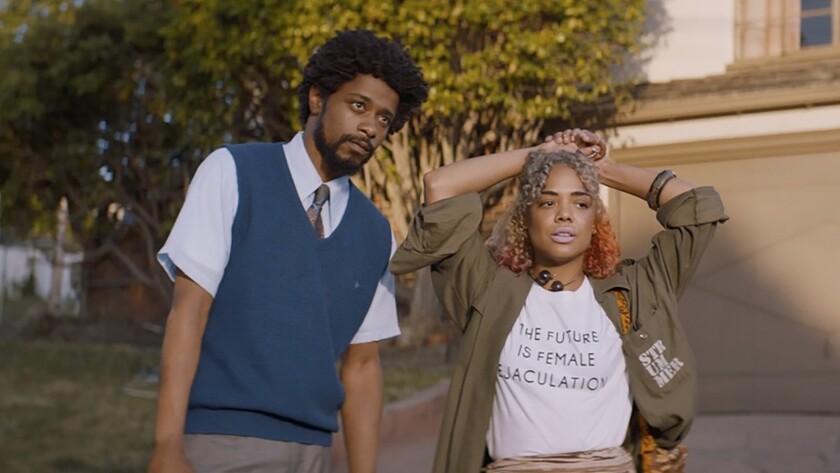
Sorry to Bother You (USA: Boots Riley, 2018: 105 mins)
Anderson, Katherine J. "On the Absurdity of Ethical Capitalism." Public Books (May 3, 2019) ["Some critics have categorized Riley’s film as “over-the-top-madness,” deciding that it devolves into the “preposterous” despite its strong start. What it shows us, though, is fundamentally real. The problem, as ever, is whose life gets to count as real, and whose does not. In the same way the Western literary canon defined “realism” as a tidy linear narrative about everyday middle-class white life, and dismissed the stories that didn’t fit that narrative as something else—magical realism (postcolonial literature), Afrofuturism, multiethnic literature, and so on—some have characterized this film as absurd, in the sense of “ridiculously unreasonable” or “extremely silly.” What many others have rightly noted, however, is that Sorry to Bother You should be considered in the tradition of absurdist fiction, which depicts the world as having no rational or orderly relationship to human life, often through satire. That is, though Riley’s film relies on an absurdist aesthetic, its relationship to human life is entirely rational, because it narrates the precarious reality of certain lives as a logical and very real extension of Western capitalist history."]
Archer, Ina Diane and Nicolas Rapold. "Sorry to Bother You." Film Comment Podcast (July 4, 2018) ["'Audiences will enjoy Sorry to Bother You in one go, but the film invites and can stand up to multiple viewings, in much the same way that complex rap lyrics benefit from repeated plays and familiarity gained from memorization,' Ina Diane Archer writes in our July/August issue. “Boots Riley is, by his own definition, a storyteller—a socially conscious, political artist, communist, proud Oaklander, and the beloved front man of The Coup.” Riley’s scabrous satire tracks a telemarketer (Lakeith Stanfield) on the rise in a company engaged in some nefarious labor practices that bring corporate malfeasance into a surreal realm. For our latest episode of The Film Comment Podcast, Archer joined me in a discussion of the feature and the many layers she unpacks in her essay."]
Austin, Thomas. "Horse-People and White Voices: Neoliberalism and Race in Sorry to Bother You." Senses of Cinema #105 (May 2023) ["The comedy drama Sorry to Bother You (2018), written and directed by Boots Riley, follows the trials and tribulations of Cassius, aka “Cash”, Green (played by Lakeith Stanfield), a new employee at RegalView, a fictional telemarketing firm based in “an alternate reality” version of Oakland, California.1 Here I consider two of the many sonic and visual devices through which the film develops its social commentary and political critique of contemporary America."]
Benton, Michael Dean. "Sorry to Bother You." Letterboxd (July 28, 2018)
Booker, M. Keith. "SORRY TO BOTHER YOU (2018): DIRECTOR BOOTS RILEY." Comments on Culture (2021)
Chang, Justin. "Boots Riley’s ‘Sorry to Bother You’ is an arrestingly surreal satire on class rage and cultural identity." Los Angeles Times (July 5, 2018)
Cummings, Janae and Jon Vickers. "Boots Riley Interview." Profiles (December 23, 2018) ["Mobilizer, instigator, and artist Boots Riley is a prolific poet, singer, songwriter, producer, humorist, and screenwriter. He is a director of films, music videos, and television. He is also a community organizer and public speaker who weaves his social activism and engagement into all of his creative work. Never afraid to speak his mind, or even to challenge his heroes, Boots Riley found politics and activism at the age of fourteen. He is heavily involved in the Occupy Oakland movement, and is one of the leaders of the activist group, The Young Comrades. His directorial debut, Sorry to Bother You, premiered at the Sundance Film Festival in early 2018, and opened in theaters nationwide in July. Boots Riley has also been recording hip-hop and funk music for over 25 years as the songwriter and lead singer of the bands The Coup, and Street Sweeper Social Club. He is also the author of the critically-acclaimed collection of his writings and lyrics, called Tell Homeland Security-We Are the Bomb."]
Enzo and Eve. "Wakanda Deferred." Hammer & Camera #16 (July 12, 2019) ["Enzo and Eve of the Marxist "propaganda circle" Unity & Struggle to discuss their article, "Black on Both Sides: Grappling with BLM in Movies", and to review the past year of Black cinema. Among the films discussed are Black Panther, Blackkklansman, Sorry to Bother You, Blindspotting, and Us."]
Goldberg, Michelle. "Pop Culture Gets Radical: Sorry to Bother You and Dietland offer something we need at this moment." The New York Times (July 27, 2018)
Gray, Briahna. "You Say You Want a Revolution? The Anti-Capitalist Film Sorry to Bother You Shows the Way." The Intercept (July 25, 2018)
Hudson, David. "Sundance 2018: Boots Riley's Sorry to Bother You." The Current (January 24, 2018)
Huh, Minj. "Embodied allegory in Sorry to Bother You: art, performance and movement in neoliberal capitalist ruins." Jump Cut #62 (Winter 2023 - 2024) ["In this paper, I examine how Riley brings art and politics together in Sorry to Bother You, specifically through embodied allegory. Such a deployment of allegory in recovering the bodies of the marginalized—in this case racially- and gender-marked laborers—resonates with how Annabel Patterson in Fables of Power (1991) shifts our attention towards Aesop as a “philosopher of materialism and the body” (38), an essential facet of Aesop which has long been eclipsed by “the legend of the witty Aethiopian slave” (34). To be sure, many episodes in Aesopian fables function as a critique of unequal power relations. The political message of these fables grasps wage laborers’ attention to this day when the urge to liberate oneself from the social hierarchy is still founded in capitalism, whose internal mechanism has an uneasy proximity to enslaved labor in pre-capitalist societies. I propose that Sorry to Bother You is a viable fable for this day and age, alerting us to the possible subversion of official values and dominant culture, and at the same time, encouraging us to attend to another device of allegory, which is the historical situatedness of its current author."]
Kelley, Robin D.G. "Sorry, Not Sorry." Boston Review (September 13, 2018)
Kelley, Robin D.G. "Sorry, Not Sorry." Boston Review (September 13, 2018)
Mooney, Shannon. "Sticking to the Script: Constructions of Sonic Whiteness in Get Out and Sorry to Bother You." Supernatural Studies 7.2 (131-154) ["This article places Jordan Peele’s Get Out (2017) into conversation with Boots Riley’s Sorry to Bother You (2018) in order to explore how both films represent whiteness as a penetrative sonic force that can be both heard and recognized. I explore how these two films challenge the popular notion that whiteness, unlike Blackness, is an empty and neutral signifier; instead, these films present whiteness as a racial category that possesses distinct sonic registers. Through their engagements with neoslavery, minstrelsy, and racial passing, these films parody the ways that Blackness has become socially and culturally constructed as “sounding” a certain way, and instead depict whiteness as something that can be aurally recognized and imitated. Through probing at their constructions of sonic whiteness, both Get Out and Sorry to Bother You problematize how popular audiences have been trained to hear (as well as see) race and respond to a longer history of the racialization of sound."]
Phillips, Maya. "Sorry to Bother You and the New Black Surrealism." Slate (July 18, 2018) ["Like Get Out and Atlanta, Boots Riley’s gonzo satire realizes the best way to depict black people’s reality is to depart from it."]
Questlove and Boots Riley. "Sorry to Bother You." The Film Comment Podcast (July 18, 2018) ["Boots Riley, director of the mind-altering new film Sorry to Bother You, and special guest Questlove at the Film Society of Lincoln Center. “All art is political,” said Riley, who detailed the genesis of the movie’s surreal Marxist story of a African-American telemarketer, and traded stories with Questlove about the nitty-gritty of the creative process."]
Rebanal, Jamie. "Sorry to Bother You." Letterboxd (July 13, 2018)
Riley, Boots. "Boots Riley on His Anti-Capitalist Film Sorry to Bother You, the Power of Strikes & Class Struggle." Democracy Now (September 3, 2018) ["In a Labor Day special, we air an extended conversation with Boots Riley, writer and director of “Sorry to Bother You,” his new film about an evil telemarketing company, a corporation making millions off of slave labor, and one Oakland man at the center of it all who discovers a secret that threatens all of humankind. His dystopian social satire is being hailed as one of the best movies of the summer. Riley is a poet, rapper, songwriter, producer, screenwriter, humorist, political organizer, community activist, lecturer and public speaker—best known as the lead vocalist of The Coup and Street Sweeper Social Club."]
---. "On Sorry to Bother You and Communism." The Dig (August 9, 2018) ["Sorry to Bother You is a hilarious film about the dead serious shitiness of life under neoliberalism's flexibilized and precarious labor regime, a system teetering upon a thin line between free labor exploitation and a form of expropriation reminiscent of full-on slave labor—all at the mercy of the thinly-veiled barbarity of Palo Alto-style techno-utopianism. It's about how capitalist society divides and conquers friends and family to claim not only our obedience but also our very souls, and about how the task of left organizing is to see through that game and fight together. Dan's guest today is Boots Riley, who wrote and directed the film and also fronts the left-wing hip hop group The Coup."]
Sweedler, Milo. "Art, activism, sales calls, and slave labor: Dialectics in Sorry to Bother You." Jump Cut #61 (Fall 2022) ["Boots Riley’s debut film, Sorry to Bother You (2018), is one of the great anti-capitalist films of the early twenty-first century. Although Riley characterizes the movie as “an absurdist dark comedy with magical realism and science fiction,” which it is, the film also provides one of the most clear-sighted accounts of grassroots class struggle to appear in mainstream North American narrative cinema in decades (“Beautiful Clutter”). As witty, playful, and delightfully quirky as it is, Riley’s tale of an ethically compromised telemarketer, his artist-activist girlfriend, and the labor organizer that unionizes their workplace sheds brilliant light on the class struggle today. I analyze here two different kinds of dialectics that Riley uses in telling his story of class conflict in an alternate present-day Oakland, California. One the one hand, a narrative technique used repeatedly in the film is dialectical in the Ancient Greek sense of staging a debate between interlocutors holding different points of view. On the other hand, numerous scenes in the film set up a contradiction that the movie momentarily resolves, often in unexpected ways, before introducing a new element that complicates the resolved contradiction. If, as Karl Marx argued more than 150 years ago, “What constitutes dialectical movement is the coexistence of two contradictory sides, their conflict and their fusion,” Sorry to Bother You is dialectical in this way, too (Poverty of Philosophy 108). This article examines how these two dialectics shape Riley’s class-conscious film."]
Tiffany, Kaitlyn. "Sorry to Bother You gets everything right about the horrors of viral fame." The Verge (July 24, 2018) ["It’s a radical statement about capitalism and the internet long before the big twists hit."]Towns, Brandon. "Radical Whimsy: Exploring the Creative Mind of Boots Riley." Roger Ebert (June 18, 2026) ["Boots Riley is the most dangerous man in Hollywood. He’s not a filmmaker. He is an enigma, a revolutionary fighting against capitalism with a pen and a lens. From his musical prowess as the frontman for the conscious hip-hop group The Coup to his community activism with the International Committee Against Racism (InCAR) and California’s Anti-Racist Farm Workers’ Union, Boots is the living embodiment of the phrase “artists must choose a side.” And he chose to fight for freedom. Riley is one of the few prevailing filmmakers who are deeply politically conscious, and his views ooze from script to screen. His filmography, best described as “Star Wars for Radical Politics,” focuses on helping people find the tools to change the world around them. By adopting comedy to smuggle his message past the capitalist gatekeepers and reach the masses, Boots creates his own film genre: radical whimsy. His work asks audiences how to create a movement that affects those in power."]
Saturday, March 2, 2024
ENG 102 2024: Resources #11
Karlawish, Jason and Aaron Kesselheim. "A Disease of Humanity: The Problem of Alzheimer's." Open Source (June 24, 2021) ["Alzheimer’s disease, the hushed nightmare version of old age, is on the wrong side of medical news again. The headline shocker this month was that the watchdog Food and Drug Administration had approved an anti-Alzheimer’s drug from the pharma giant Biogen. The treatment called aducanumab has no record of success and a first-round price-tag per patient of $55,000 per year. Our keynote guest Aaron Kesselheim has the inside story of the FDA’s retreat from regulation. Then Jason Karlawish will join us from the front line of Alzheimer’s treatment. The riddle this hour is what makes the last stage of human life so demanding and so difficult." Jason Karlawish's new book is The Problem of Alzheimer's: How Science, Culture, and Politics Turned a Rare Disease into a Crisis and What We Can Do About It."]
Latour, Bruno. Facing Gaia: Eight Lecture on the New Climatic Regime. Polity Press, 2017. ["The emergence of modern sciences in the seventeenth century profoundly renewed our understanding of nature. For the last three centuries new ideas of nature have been continually developed by theology, politics, economics, and science, especially the sciences of the material world. The situation is even more unstable today, now that we have entered an ecological mutation of unprecedented scale. Some call it the Anthropocene, but it is best described as a new climatic regime. And a new regime it certainly is, since the many unexpected connections between human activity and the natural world oblige every one of us to reopen the earlier notions of nature and redistribute what had been packed inside. So the question now arises: what will replace the old ways of looking at nature? This book explores a potential candidate proposed by James Lovelock when he chose the name 'Gaia' for the fragile, complex system through which living phenomena modify the Earth. The fact that he was immediately misunderstood proves simply that his readers have tried to fit this new notion into an older frame, transforming Gaia into a single organism, a kind of giant thermostat, some sort of New Age goddess, or even divine Providence. In this series of lectures on 'natural religion,' Bruno Latour argues that the complex and ambiguous figure of Gaia offers, on the contrary, an ideal way to disentangle the ethical, political, theological, and scientific aspects of the now obsolete notion of nature. He lays the groundwork for a future collaboration among scientists, theologians, activists, and artists as they, and we, begin to adjust to the new climatic regime."]
Lederach, John Paul. "The Art of Peace." On Being (July 8, 2010) ["What happens when people transcend violence while living in it? John Paul Lederach has spent three decades mediating peace and change in 25 countries — from Nepal to Colombia and Sierra Leone. He shifts the language and lens of the very notion of conflict resolution. He says, for example, that enduring progress takes root not with large numbers of people, but with relationships between unlikely people."]
Lesage, Julia. "The Last Word: AI Musings." Jump Cut #62 (Winter 2023 - 2024) ["Since many of my friends say they know nothing about AI, I am taking this editorial space to reflect on how I began to study AI. Early in 2023, Gary Kafer sent in a review of Kate Crawford’s The Atlas of AI: Power, Politics, and the Planetary Costs of Artificial Intelligence. [Please read Kafer’s piece alongside mine.] It led me to read Crawford’s book, which amplified my concerns about the damage caused by massive digital data gathering. I’d been thinking about AI since the year before when in November, 2022, ChatGPT was released, grew rapidly in its user base, drew many critics, and the nation saw a massive subsequent venture-capital investment in this kind of AI. On a personal level, I saw how ChatGPT suddenly reshaped the work life of many writers and teachers around me, and the strikes in Hollywood made it clear that as a media professional I had to learn more about AI."]
Loewen, James. "Teaching What Really Happened: How to Avoid the Tyranny of Textbooks and Get Students Excited About Doing History (Teachers College Press, 2018)." New Books in History (January 3, 2019) ["In an atmosphere filled with social media and fake news, history is more important than ever. But, what do you really know about history? In the second edition of his book, Teaching What Really Happened: How to Avoid the Tyranny of Textbooks and Get Students Excited About Doing History (Teachers College Press, 2018). Dr. James W. Loewen interrogates what we think we know about our past. Loewen, a sociologist and professor at the University of Vermont, shows readers that history must be reconsidered in order to avoid previously accepted misconceptions. As Loewen demonstrates throughout this valuable text, teachers must look beyond the textbook to discover what really happened and to teach their students how to "do" history. Teaching What Really Happened is an eye-opening book that reinvigorates history and empowers its readers."]
Lyonhart, Jonathan D. "Peele’s Black, Extraterrestrial, Critique of Religion." Journal of Religion & Film (October 2023) ["While Jordan Peele’s films have always held their mysteries close to the chest, they eventually granted their viewers some climactic clarity. Get Out (2017) used an 1980s style orientation video to clear up its neuroscientific twist, while Us (2019) had Lupita Nyongo’s underworld twin narratively spell out the details of the plot. Yet Nope (2022) refuses to show its hand even after the game is over, never illuminating the connection between its opening scene and the broader film, nor a myriad of other questions. As such, critics complained that it stitched together two seemingly incongruent plots without explanation; one where a chimp attacks the crew of a successful Hollywood show, the other where an alien organism haunts a small ranch in the middle of nowhere. In this paper, I will argue that a theological interpretation of Nope helps explain some of these mysteries at its center, while revealing Peele’s underlying religious critique and its place within his broader oeuvre."]
Like Stories of Old. "The Problem of Other Minds – How Cinema Explores Consciousness." (Posted on Youtube: May 31, 2018) ["How have films engaged the problem of other minds? In this video essay, I discuss cinematic explorations into consciousness in the context of the cognitive revolution that has challenged many of the basic assumptions about what was for a long time believed to be a uniquely human trait." Uses Frans de Waal's book Are We Smart Enough to Know How Smart Animals Are?: "Hailed as a classic, Are We Smart Enough to Know How Smart Animals Are? explores the oddities and complexities of animal cognition--in crows, dolphins, parrots, sheep, wasps, bats, chimpanzees, and bonobos--to reveal how smart animals really are, and how we've underestimated their abilities for too long. Did you know that octopuses use coconut shells as tools, that elephants classify humans by gender and language, and that there is a young male chimpanzee at Kyoto University whose flash memory puts that of humans to shame? Fascinating, entertaining, and deeply informed, de Waal's landmark work will convince you to rethink everything you thought you knew about animal--and human--intelligence."]
Magid, Shaul. "‘Anti-Zionism = Antisemitism’ Isn't Just Wrong, It's the Problem." Religion Dispatches (December 13, 2023) ["Let’s be honest, for anyone with basic liberal values, even if you are a Zionist, the state of Israel is presently very problematic (as the Israeli protests have shown—to say nothing of the occupation) and thus many of the criticisms are not prejudicial by definition. Some Jewish anti-Zionists argue that the nation-state is not the best or healthiest collective structure for Jews. Nation-states are, after all, pretty egregious entities, responsible for mass murder, inequality, and oppression. One can argue with that for sure, but is that statement antisemitic?"]
Marshall, Nowell. "Inverting Lovecraftian Racial and Sexual Monstrosity in Guillermo del Toro’s The Shape of Water ." Supernatural Studies 8.2 (Summer 2023) ["This essay reads Guillermo del Toro’s award-winning 2017 film The Shape of Water as a rewriting and inversion of key racial and sexual tropes about H.P. Lovecraft’s Deep Ones. Rather than abjecting interracial/interspecies and queer forms of desire as Lovecraft did in “Dagon” and The Shadow Over Innsmouth, del Toro’s film deploys an oppositional gaze to recenter the narrative on diverse characters and sexual experiences, ultimately representing Elisa as a hybrid woman who finds a place to belong."]
Taylor, Matthew D. "How the Alabama IVF Ruling Was Influenced by Christian Nationalism." On the Media (February 23, 2024) ["In the latest battle over reproductive health care, the Alabama Supreme Court ruled that frozen embryos are children. Shortly after, the state's largest hospital said it would pause IVF treatments, leaving couples with fertility problems with incredibly few options. But what made headlines in the aftermath of the ruling was the particular vocabulary used by Chief Justice Tom Parker in his concurring opinion—namely, quotes from the Bible. It's no secret that Parker is loath to separate church and state, but his preferred brand of Christian fundamentalism has mostly flown under the radar—until now. Justice Parker subscribes to the charismatic evangelical Christian leadership networks known as the New Apostolic Reformation, or the NAR, a term coined in 1996. This week, Brooke sits down with Matthew D. Taylor, scholar at the Institute for Islamic, Christian, & Jewish Studies in Baltimore and author of the forthcoming book, The Violent Take It by Force: The Christian Movement That Is Threatening Our Democracy, to talk about how a movement, once on the fringe of America’s religious landscape, is slowly emerging as a political force."]
Tuesday, February 27, 2024
Annihilation (UK/USA: Alex Garland, 2018)

Annihilation (UK/USA: Alex Garland, 2018: 115 mins)
"[T]he longer I stared at it, the less comprehensible the creature became. The more it became something alien to me, and the more I had a sense that I knew nothing at all—about nature, about ecosystems." — The biologist in the novel Annihilation by Jeff VanderMeer, 175
I classify "weird fiction" as not necessarily a genre-in-itself, instead it operates in the interstices of mainstream genres, creating through poetic prose, vivid imagery, hallucinatory experiences, existential angst, dream logic and shocking stories, a powerful effect upon the reader, provoking them to start to see the mundane world with a slant. If you look at the etymology of 'wyrd' it originates as the "power to control destiny" (no doubt in a magical or ritual sense) and morphs to the latter "weird" meaning of "unearthly" or strange. These stories stay with you, taking root deep inside your consciousness, reverberating like the ripples of a deep pond disturbed by a thrown rock and provoke you to rethink what you have always taken for granted. There is a commercial genre called "the new weird" (also an older pulp magazine "weird" usually involving cosmic horror) and some of these books/authors would be slotted into my broad genre classification here (many are not), but in the spirit of actual weirdness I include other books/films that operate under the aesthetic classification described above without being marketed as "new weird." The disturbance to perceived reality also may take place through a decoding/encoding process that challenges and restructures (exposing the myths and inconsistencies) of dominant narratives (also see situationist détournement). The purpose is to expose the cracks in the foundations of controlling narratives, destabilizing them through weird narratives that shake the assured assumptions of its adherents. The concepts of carnivalesque revelry and the dialogic nature of consciousness as developed by Mikhail Bakhtin are equally important, in that they involve the reversal of a dominant order and/or an exposure of the fantasy of the controlling order, in the process revealing the many perspectives/voices that are silenced/masked. As disturbing as these can be for many, perhaps the most problematic aspect of many weird narratives would be the decentering of humans (as the center of the universe) and explorations/recognitions of non-human perspectives. Importantly, in the context of my own American culture, this also involves narrative & theoretical displacement of our hegemonic way of seeing & being as the baseline for thinking about and understanding the world. In film studies there has also been a classification of Mind Fuck films which would be included here. All of these can provide a cathartic release from the anxiety/terror of the really fucked-up, weird situation we are living through and the twisted creatures that our at the helm of planet earth. [Editorial note: my definition was written during the COVID-19 Pandemic]. Under no circumstance is weird meant in a derogatory way. Anyone who does a deep dive into science, especially theories of consciousness and reality, knows that science is seriously weird. I appreciate works that challenge our constructed reality, pushing us to see that there is not just one way. Also it should be understood that what seems weird to some may seem obvious and normal to others. One of the great benefits of learning across time and space/places is that it can, following Bertolt Brecht, "make the familiar strange." -- Michael Dean Benton (May 2020; revised September 2021)
----------------------------------------------------------------------------------------------
Čapek, Jan. "Strange Days in the Anthropocene: The Inhuman in "The Colour out of Space" and Annihilation." Supernatural Studies 6.1 (Fall 2019) ["This article considers the different ethical effects of extra-terrestrial forces entering the milieu of the Earth in H. P. Lovecraft’s 1927 story “The Colour out of Space” and Alex Garland’s 2018 film Annihilation. The article first introduces Lovecraft’s concept of the “cosmic” and, following his proposition of the cosmic indifference toward the Human, identifies cosmic forces as “inhuman,” incompatible with the Human. It then considers the significance of anthropocentric ethics and relatively recent critiques found in É. M. Cioran’s concept of the “void” or the introduction of the spatiotemporal territory of the “Anthropocene.” The article then discusses the effects of the cosmic force in relation to Nature not as “supernatural” but as “supranatural” or “innatural.” Annihilation provides an example of inhuman yet supranatural cosmic occurrence, a proliferation of Nature. After considering the anthropocentric and cosmic significance of the motif of cancer, the article continues with a discussion of transformations of Nature, the Human, and their ethical relations. Lovecraft’s story, seen through a Marxist reading of themes of alienation, fatigue, and depletion, reveals its cosmic force to be inhuman and innatural, exemplifying the frightening materiality of capitalism itself. While both works share the premise of transformations brought by an extra-terrestrial force and exemplify how anthropocentrism affects our perception of it, each proposes vastly different effects of the intrusion."]
Booker, M. Keith. "Annihilation (Directed by Alex Garland, 2018)." Comments on Culture (ND)
Christion, Valley. "Annihilation: The Alienation of Desire." The Artifice (October 10, 2018) ["In Annihilation, novel author Jeff VanderMeer and film director Alex Garland both took special pains to avoid falling into this trope. Both the Crawler and the mimic are utterly and truly alien in the respect that they lack a projection of human desire; as the viewer, we don’t know what they want. This is a major plot point in both the movie and the film, as the ambiguity of the alien is a major piece of the immersive whole."]
Crosby, S.L., et al. "Annihilation: A Roundtable." Gothic Nature #1 (September 2019): 256 - 281. ["It is a unique and beautiful film, but it is also an important film with a resonance beyond most other ‘sci-fi classic[s]’—at least from an ecocritical perspective—which is the reason we have decided to devote a ‘roundtable’ discussion to its analysis. In an age of devastating climate change and environmental disintegration, the film brings to a popular audience a cinematic version of the mind-altering ‘ecological awareness’ that theorists such as the author of the novel Annihilation consider essential to human survival. VanderMeer, of course, is a leading figure in the recent upsurge in cosmic horror literature termed ‘The New Weird’, and the ‘weird’, he points out, draws attention to how the human is inexorably ‘entwined’ with the material, nonhuman world. It thus confronts our self-destructive amnesia, our doomed ecophobic ‘attempt to transcend our material conditions’ which has only seduced us into suicide (Morton and VanderMeer, 2016: p. 58). The film, Annihilation, in its weirdness, may evoke such entanglement and, as the following reviews demonstrate, certainly causes us to reflect upon it."]
Kjaerullf, Caroline. "The Ambiguous Portrayal of Nature in Annihilation." Leviathan #7 (2021): 127 - 138. ["This article examines how Alex Garland’s science fiction horror film Annihilation (2018) works as a form of eco-media, and how it has potential to influence its audience in a positive direction. I argue that the portrayal of nature in the film, from the different horror genres at play, to the themes of disease, destruction and renewal, and the stunning but eerie visuals, challenge the conceptions we have of the environment and climate change, and invites the audience to rethink the relationship between nature and humans."]
Eggert, Brian. "Annihilation." Deep Focus Review (February 23, 2018) ["Fission occurs when cells replicate and then divide. The process involves a single cell that splits itself in two, thereby negating its original form in service of two distinct cells. Growth and healing rely on this otherwise violent act, which signals Nature’s impulse to self-destruct in order to create. It’s a theme that prevails throughout Annihilation, writer-director Alex Garland’s film of Jeff VanderMeer’s 2014 novel. A microscopic view of cell division recurs as the film’s central motif, lovingly integrated into Garland’s visual and narrative choices. But the horrible beauty of the Kantian sublime dominates this intelligent, aesthetically wondrous production, leaving the viewer with much to contemplate about our human biases toward the essence of creation. (After all, while the rapid growth of, say, bacteria in the human body has been described as a disease, it’s a time of prosperity in the microcosm of the bacterial world.) Conceptual as such ideas may be, Garland never forgets to mirror them with human drama. Indeed, within Annihilation‘s visceral yet thoughtful science-fiction context, his characters undergo fission to either self-destruct or become something new."]
Hicks, Luke. "Making Something New: Tracing the Complex Brilliance of Annihilation." Film School Rejects (February 27, 2020) ["Do I begin down the snaking path of humanity’s obsession with the unknown and turn left at the disquieting display of self-destruction? Or should I fork right at philosophical reflections on biology? Do I start towards its status as one of the few intelligent, dignifying female-driven films to come out of Hollywood in the past decade (four of the five most significant roles held by women, known and unknown, queer and straight, and of different ethnicities, varied worldviews)? And if so, which track do I take when the trail divides into dismantling patriarchal gender norms and theories of forthcoming human evolution? I could exhaust one hundred different ways out with similar thoughts before touching on themes of ecological ethics or technological development. And if I was hospitalized in the process due to exhaustion, I’d be upset that we never breached the intersecting conversations between suicide, mimesis, interanimation, marriage, filtered vision, the metaphysical, and annihilation."]
Like Stories of Old. "The Problem of Other Minds – How Cinema Explores Consciousness." (Posted on Youtube: May 31, 2018) ["How have films engaged the problem of other minds? In this video essay, I discuss cinematic explorations into consciousness in the context of the cognitive revolution that has challenged many of the basic assumptions about what was for a long time believed to be a uniquely human trait." Uses Frans de Waal's book Are We Smart Enough to Know How Smart Animals Are?: "Hailed as a classic, Are We Smart Enough to Know How Smart Animals Are? explores the oddities and complexities of animal cognition--in crows, dolphins, parrots, sheep, wasps, bats, chimpanzees, and bonobos--to reveal how smart animals really are, and how we've underestimated their abilities for too long. Did you know that octopuses use coconut shells as tools, that elephants classify humans by gender and language, and that there is a young male chimpanzee at Kyoto University whose flash memory puts that of humans to shame? Fascinating, entertaining, and deeply informed, de Waal's landmark work will convince you to rethink everything you thought you knew about animal--and human--intelligence."]
Nicolini, Kim. "Annihilation: Alex Garland’s Bad Trip Through Dis-ease and Over-Reproduction." Counterpunch (March 2, 2018) ["There are a lot of reasons to join Garland’s journey into a shaky world where reproduction leads to destruction and where the further you go into the film the further you will find yourself separated from any known reality (just as the further the main characters delve into the ominous and alien Shimmer, the further they come unglued). At one point in the film, female scientist Dr. Ventress (Jennifer Jason Leigh) questions whether all the women who reside at the film’s center have lost their minds. After watching the film, you may very well ask yourself the same thing. But that is the power of the film. By provoking the audience to lose their minds, toss all rational thought to the wind, and deconstruct the most primal notions of stability, this sci-fi horror film unveils the fears that seep through collective humanity like a terminal illness and show the unnatural and terrifying impact of human intervention with the natural world."]
Raup, Jordan. "‘Annihilation’ is Beautiful, Horrifying Sci-Fi with a Bold Imagination." The Film Stage (February 21, 2018) ["More terrifying than any creature Hollywood could dream up is the unraveling of one’s mind—the steady loss of a consciousness as defined by the memories, motivations, and knowledge built up from decades of experience and reflection. With Annihilation, Alex Garland’s beautiful, frightening follow-up to Ex Machina, he portrays this paralyzing sensation with a sense of vivid imagination, and also delivers a cadre of horrifying creatures to boot."]
Robinson, Tasha. "Annihilation is the most thoughtful science fiction movie since Arrival." The Verge (February 23, 2018) ["But it’s a mark of success for the film that even knowing the outcome doesn’t disperse the tension. Annihilation is a portentous movie, and a cerebral one. It’s gorgeous and immersive, but distancing. It’s exciting more in its sheer ambition and its distinctiveness than in its actual action. And by giving away so many details about the ending up front, writer-director Alex Garland (Ex Machina) seems to be emphasizing that Annihilation isn’t about who-will-live dynamics, or the fast mechanics of action scenes. It’s about the slow, subdued journey Lena and the others take into the unknown, and how it affects them emotionally."]
Statt, Nick. "How Annihilation changed Jeff VanderMeer’s weird novel into a new life-form." The Verge (February 28, 2018) ["Alex Garland’s Annihilation, the mind-bending science fiction journey into the world of Jeff VanderMeer’s Southern Reach books, is an astounding film. It’s smart and daring and almost as satisfying to talk about as it is to experience firsthand. It’s even more astonishing considering its source, a seemingly unadaptable, utterly bizarre novel. But Garland found a way to make the film into its own creature. His version is simultaneously faithful in spirit and shockingly bold in its departures in plot and theme."]
Michael Benton -- What is very interesting to me is the idea that the "new weird" genre is speaking to a 21st Century dis-ease sparked by an awareness of the impossibility of truly knowing reality. Propaganda, disinformation & official lies instantaneously and repeatedly disseminated through ubiquitous screen technologies, radically transforming science/technology/theories that even leave those that devote their lives to a particular discipline overwhelmed, and a general distrust from the general population in their traditional experts/leaders. This is played out vividly in Vandermeer's trilogy and Garland's film as the main characters struggling to understand/survive the transmutating Area X/The Shimmer are scientists/soldiers.
VIDEO ESSAY | Annihilation / Solaris: Refractions of the Self from Mike Odmark on Vimeo.
The Unloved - Annihilation from Scout Tafoya on Vimeo.
Subscribe to:
Posts (Atom)