Monday, June 5, 2017
Slurring Bee 2
Also need 15 absurd/quirky warm up questions
Pronouncer Information 1. Read carefully the Judges, Recorders, Spellers and Audiences information that is included in the Scripps pronouncers’ guide. 2. Familiarize yourself with all words on the confidential word list. Pronunciation is important. A meeting with the judges to insure pronunciation of words and procedures will be scheduled prior to the Bee beginning. 3. Speak clearly for contestants, judges and audience alike. Grant all requests to repeat a word until the judges agree that the word has been made reasonably clear to the speller. You may request the speller to speak more clearly or louder. 4. “Pace” yourself. You need time to focus attention on the pronunciation of the new word and the judges need a few moments between each contestant to do their tasks.
Speller’s Information 1. Each speller needs to focus on the Pronouncer, to aid his or her hearing and understanding of the context of the word. A speller may ask for the word to be repeated, for its use in a sentence, for a definition, for the part of speech, and for the language of origin. 2. Each speller should pronounce the word before and after spelling it. If the speller fails to pronounce the word after spelling it, the judge may ask if they are finished. If they say yes, the judge will remind the speller to remember to repeat the word the next time. (No speller will be eliminated for failing to pronounce a word.) 3. When a speller is at the podium spelling, the next speller should be standing at a marked location ready to proceed to the podium.
47) burgeon
48) traipse
49) penchant
50) sapiosexual
51) salmagundi
52) threnody
53) frangipani
54) pasteurization
55) contemporaneous
56) potpourri
57) oriflamme
58) philippic
59) pirouette
60) inveigh
61) ascetic
62) fuchsia
63) tourniquet
64) pergola
65) restaurateur
66) wainscoting
67) marjoram
68) avoirdupois
69) questionnaire
70) phlegm
71) dirigible
72) milieu
73) liqueur
74) acrimonious
75) chrysalis
76) myrrh
77) prepossessing
78) mayonnaise
79) hacienda
80) geranium
81) aesthetics
82) peregrinate
83) periphrasis
84) exegesis
85) hermeneutics
86) rebus
87) brachiate
88) baroque
89) lithotripsy
90) ekphrasis
91) cacography
92) hoodlum
93) syncretism

Tuesday, May 23, 2017
White (France/Poland/Switzerland: Krzysztof Kieslowski, 1994)

White (France/Poland/Switzerland: Krzysztof Kieslowski, 1994: 91 mins)
Bradshaw, Peter. "Three Colours Trilogy: Decoding the Blue, White and Red." The Guardian (November 10, 2011)
Cummings, Doug. "Great Directors: Krzysztof Kieslowski." Senses of Cinema #27 (July 2003)
Hancock, James and Aaron West. "Krzysztof Kieslowski’s Three Colors Trilogy." Wrong Reel (June 8, 2016)
Kehr, Dave. "To Save the World: Kieslowski's Three Colours Trilogy." Film Comment (November/December 1994)
Kiefer, Jonathan. "Kieslowski’s “Three Colors”: Just when it seemed that European cinema had become fossilized, the great Polish director created the slickest -- and loveliest -- concept album in art-film history." Salon (June 10, 2002)
Klawans, Stuart. "White: The Nonpolitical Reunifications of Karol Karol." Current (November 15, 2011)
Kois, Dan. "The White Stuff." Slate (November 15, 2011)
MacCabe, Colin. "Three Colors: A Hymn to European Cinema." Current (November 15, 2011)
Mooney, Darren. "Non-Review Review: Three Colours White." The m0vie blog (November 30, 2011)
Overstreet, Jeffrey. "#14: Three Colors Trilogy." Arts and Faith Top 100 Films (2011)
Reyland, Nicholas. "Three Colours: Shades of greatness to listen out for in Zbigniew Preisner's musical score." The Guardian (November 14, 2011)
"The Sonic World of Zbigniew Preisner and Krzysztof Kieślowski." Current (October 3, 2016)
Trinkle, Matt. "The Many Colors of Fate in Krzysztof Kieslowki's Three Colors Trilogy." Cinemablography (ND)
Wednesday, May 17, 2017
The Deer Hunter (USA: Michael Cimino, 1978)
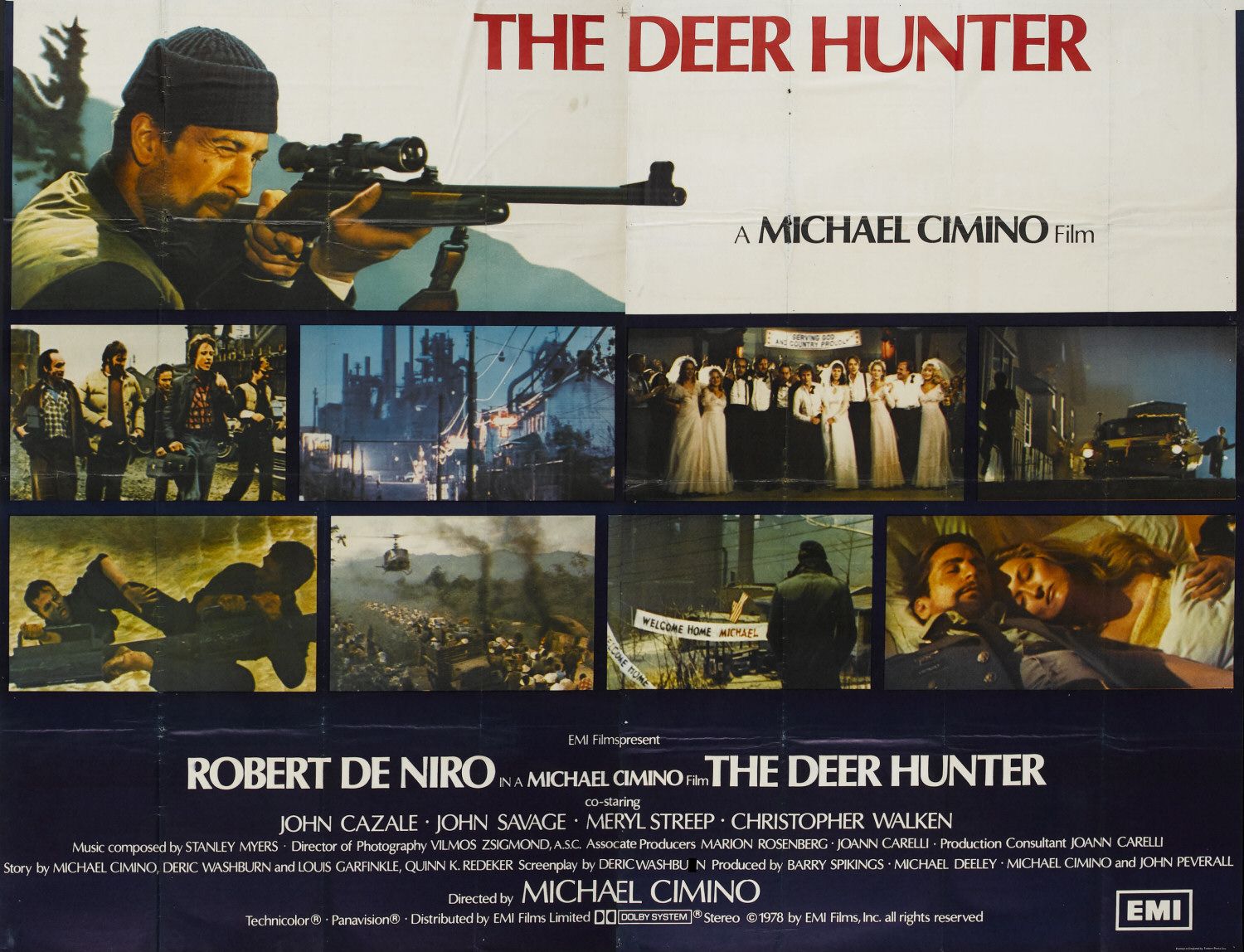
The Deer Hunter (USA: Michael Cimino, 1978: 182 mins)
Biel, Steven. "The Deer Hunter Debate: Artistic License and the Vietnam War Remembrance." Bright Lights Film Journal (July 7, 2016)
Corruzolo, Louie. "The Legacy of The Deer Hunter." Chasing Cinema (November 11, 2012)
The Deer Hunter Critics Round Up (Ongoing Archive)
Dirks, Tim. "The Deer Hunter (1978)." Film-Site (ND)
Ebert, Roger. "Deer Hunter." Chicago Sun-Times (March 9, 1979)
Flores, Julian. "The Auteurs: Michael Cimino." Cinema Axis (July 24, 2014)
Horsley, Carter B. "The Deer Hunter." The City Review (ND)
Hunter, Melissa. "The Deer Hunter." The Soul of the Plot (February 4, 2014)
Kinder, Bill. "When Soldiers Come Home in the Movies: The post-war experience as told in tropes." Keyframe (November 11, 2015)
Krantz, Rachel C. "Apocalypse Now and The Deer Hunter: The Lies Aren't Over." Jump Cut #23 (October 1980): 18-20.
Rushing, Janice Hocker and Thomas S. Frentz. "The Deer Hunter: Rhetoric of the Warrior." The Quarterly Journal of Speech #66 (1980): 392-406.
Monday, May 15, 2017
ENG 102 Summer 2017 Resources
Archives of Individual Films Dialogic Cinephilia (Ongoing Archive)
Archives of the Films, By Decade, That Do Not Have an Individual Post Dialogic Cinephilia (Ongoing Archive)
BCTC Lib Guides
Benton, Michael. Letterboxd Profile (Ongoing film viewing diary)
Dialogic Cinephilia (Course Website)
Dialogic Cinephilia Theory
ENG 102: Essay 2 - Ethical Reasoning
ENG 102 Essay Examples
ENG 102 - Stories We Tell: Ways of Seeing
Fall 2017 ENG 281 Women Filmmakers and Women in Film
Friedlander, John. "Abstract, Concrete, General and Specific Terms." Guide to Grammar & Writing (ND)
Grammarist (Website)
The Stories We Tell: Quote File Dialogic Cinephilia (Ongoing Archive)
Video Essays Dialogic Cinephilia (Ongoing Archive)
Words and Phrases Grammarist (Ongoing Archive)
Wordy Phrases Grammarist (Ongoing Archive)
Saturday, May 13, 2017
Slurring Bee 1: May 14, 2017
Also need 15 absurd/quirky warm up questions
Pronouncer Information 1. Read carefully the Judges, Recorders, Spellers and Audiences information that is included in the Scripps pronouncers’ guide. 2. Familiarize yourself with all words on the confidential word list. Pronunciation is important. A meeting with the judges to insure pronunciation of words and procedures will be scheduled prior to the Bee beginning. 3. Speak clearly for contestants, judges and audience alike. Grant all requests to repeat a word until the judges agree that the word has been made reasonably clear to the speller. You may request the speller to speak more clearly or louder. 4. “Pace” yourself. You need time to focus attention on the pronunciation of the new word and the judges need a few moments between each contestant to do their tasks.
Speller’s Information 1. Each speller needs to focus on the Pronouncer, to aid his or her hearing and understanding of the context of the word. A speller may ask for the word to be repeated, for its use in a sentence, for a definition, for the part of speech, and for the language of origin. 2. Each speller should pronounce the word before and after spelling it. If the speller fails to pronounce the word after spelling it, the judge may ask if they are finished. If they say yes, the judge will remind the speller to remember to repeat the word the next time. (No speller will be eliminated for failing to pronounce a word.) 3. When a speller is at the podium spelling, the next speller should be standing at a marked location ready to proceed to the podium.
1) maenad
2) menstruation
3) grok
Grok may be the only English word that derives from Martian. Yes, we do mean the language of the planet Mars. No, we're not getting spacey; we've just ventured into the realm of science fiction. Grok was introduced in Robert A. Heinlein's 1961 science fiction novel Stranger in a Strange Land. The book's main character, Valentine Michael Smith, is a Martian-raised human who comes to earth as an adult, bringing with him words from his native tongue and a unique perspective on the strange ways of earthlings. Grok was quickly adopted by the youth culture of America and has since peppered the vernacular of those who grok it.
4) hierarchy
5) femininity
6) harassment
7) misogyny
8) patriarchy
9) doula
10) innocuous
11) dystopia
12) ostracism
13) cacophony
14) imbecile
15) incongruity
16) oscillation
17) bouyant
18) resilience
19) transience
20) cinephile
21) abhorrent
22) asymmetrical
23) corporeal
24) palette
25) demagogue
26) anthophilous
27) banausic
28) abecedarian
29) carnassial
30) vinaceous
31) obstinacy
32) impuissance
33) catachresis
34) gnosis
35) finagle
36) sexploitation
37) satori
38) calisthenics
39) tintinnabulation
40) dentifrice
41) microcosm
42) pandemonium
43) supposititious
44) obsolescence
45) lanuginous
46) louche
Tuesday, May 9, 2017
Philip K. Dick: "If you can control the meaning of words, you can control the people who use the words"

How to Build a Universe That Doesn't Fall Apart Two Days Later
by Philip K. Dick, 1978
Well, I will tell you what interests me, what I consider important. I can't claim to be an authority on anything, but I can honestly say that certain matters absolutely fascinate me, and that I write about them all the time. The two basic topics which fascinate me are "What is reality?" and "What constitutes the authentic human being?" Over the twenty-seven years in which I have published novels and stories I have investigated these two interrelated topics over and over again. I consider them important topics. What are we? What is it which surrounds us, that we call the not-me, or the empirical or phenomenal world?
...
In 1951, when I sold my first story, I had no idea that such fundamental issues could be pursued in the science fiction field. I began to pursue them unconsciously. My first story had to do with a dog who imagined that the garbagemen who came every Friday morning were stealing valuable food which the family had carefully stored away in a safe metal container. Every day, members of the family carried out paper sacks of nice ripe food, stuffed them into the metal container, shut the lid tightly—and when the container was full, these dreadful-looking creatures came and stole everything but the can.
Finally, in the story, the dog begins to imagine that someday the garbagemen will eat the people in the house, as well as stealing their food. Of course, the dog is wrong about this. We all know that garbagemen do not eat people. But the dog's extrapolation was in a sense logical—given the facts at his disposal. The story was about a real dog, and I used to watch him and try to get inside his head and imagine how he saw the world. Certainly, I decided, that dog sees the world quite differently than I do, or any humans do. And then I began to think, Maybe each human being lives in a unique world, a private world, a world different from those inhabited and experienced by all other humans. And that led me to wonder, if reality differs from person to person, can we speak of reality singular, or shouldn't we really be talking about plural realities? And if there are plural realities, are some more true (more real) than others? What about the world of a schizophrenic? Maybe, it's as real as our world. Maybe we cannot say that we are in touch with reality and he is not, but should instead say, his reality is so different from ours that he can't explain his to us, and we can't explain ours to him. The problem, then, is that if subjective worlds are experienced too differently, there occurs a breakdown of communication... and there is the real illness.
...
It was always my hope, in writing novels and stories which asked the question "What is reality?", to someday get an answer. This was the hope of most of my readers, too. Years passed. I wrote over thirty novels and over a hundred stories, and still I could not figure out what was real. One day a girl college student in Canada asked me to define reality for her, for a paper she was writing for her philosophy class. She wanted a one-sentence answer. I thought about it and finally said, "Reality is that which, when you stop believing in it, doesn't go away." That's all I could come up with. That was back in 1972. Since then I haven't been able to define reality any more lucidly.
But the problem is a real one, not a mere intellectual game. Because today we live in a society in which spurious realities are manufactured by the media, by governments, by big corporations, by religious groups, political groups—and the electronic hardware exists by which to deliver these pseudo-worlds right into the heads of the reader, the viewer, the listener. Sometimes when I watch my eleven-year-old daughter watch TV, I wonder what she is being taught. The problem of miscuing; consider that. A TV program produced for adults is viewed by a small child. Half of what is said and done in the TV drama is probably misunderstood by the child. Maybe it's all misunderstood. And the thing is, Just how authentic is the information anyhow, even if the child correctly understood it? What is the relationship between the average TV situation comedy to reality? What about the cop shows? Cars are continually swerving out of control, crashing, and catching fire. The police are always good and they always win. Do not ignore that point: The police always win. What a lesson that is. You should not fight authority, and even if you do, you will lose. The message here is, be passive. And—cooperate. If Officer Baretta asks you for information, give it to him, because Officer Beratta is a good man and to be trusted. He loves you, and you should love him.
So I ask, in my writing, What is real? Because unceasingly we are bombarded with pseudo-realities manufactured by very sophisticated people using very sophisticated electronic mechanisms. I do not distrust their motives; I distrust their power. They have a lot of it. And it is an astonishing power: that of creating whole universes, universes of the mind. I ought to know. I do the same thing. It is my job to create universes, as the basis of one novel after another. And I have to build them in such a way that they do not fall apart two days later. Or at least that is what my editors hope. However, I will reveal a secret to you: I like to build universes which do fall apart. I like to see them come unglued, and I like to see how the characters in the novels cope with this problem. I have a secret love of chaos. There should be more of it. Do not believe—and I am dead serious when I say this—do not assume that order and stability are always good, in a society or in a universe. The old, the ossified, must always give way to new life and the birth of new things. Before the new things can be born the old must perish. This is a dangerous realization, because it tells us that we must eventually part with much of what is familiar to us. And that hurts. But that is part of the script of life. Unless we can psychologically accommodate change, we ourselves begin to die, inwardly. What I am saying is that objects, customs, habits, and ways of life must perish so that the authentic human being can live. And it is the authentic human being who matters most, the viable, elastic organism which can bounce back, absorb, and deal with the new.
...
The basic tool for the manipulation of reality is the manipulation of words. If you can control the meaning of words, you can control the people who must use the words. George Orwell made this clear in his novel 1984. But another way to control the minds of people is to control their perceptions. If you can get them to see the world as you do, they will think as you do. Comprehension follows perception. How do you get them to see the reality you see? After all, it is only one reality out of many. Images are a basic constituent: pictures. This is why the power of TV to influence young minds is so staggeringly vast. Words and pictures are synchronized. The possibility of total control of the viewer exists, especially the young viewer. TV viewing is a kind of sleep-learning. An EEG of a person watching TV shows that after about half an hour the brain decides that nothing is happening, and it goes into a hypnoidal twilight state, emitting alpha waves. This is because there is such little eye motion. In addition, much of the information is graphic and therefore passes into the right hemisphere of the brain, rather than being processed by the left, where the conscious personality is located. Recent experiments indicate that much of what we see on the TV screen is received on a subliminal basis. We only imagine that we consciously see what is there. The bulk of the messages elude our attention; literally, after a few hours of TV watching, we do not know what we have seen. Our memories are spurious, like our memories of dreams; the blank are filled in retrospectively. And falsified. We have participated unknowingly in the creation of a spurious reality, and then we have obligingly fed it to ourselves. We have colluded in our own doom.
And—and I say this as a professional fiction writer—the producers, scriptwriters, and directors who create these video/audio worlds do not know how much of their content is true. In other words, they are victims of their own product, along with us. Speaking for myself, I do not know how much of my writing is true, or which parts (if any) are true. This is a potentially lethal situation. We have fiction mimicking truth, and truth mimicking fiction. We have a dangerous overlap, a dangerous blur. And in all probability it is not deliberate. In fact, that is part of the problem. You cannot legislate an author into correctly labelling his product, like a can of pudding whose ingredients are listed on the label... you cannot compel him to declare what part is true and what isn't if he himself does not know.
...

If any of you have read my novel Ubik, you know that the mysterious entity or mind or force called Ubik starts out as a series of cheap and vulgar commercials and winds up saying:
I am Ubik. Before the universe was I am. I made the suns. I made the worlds. I created the lives and the places they inhabit; I move them here, I put them there. They go as I say, they do as I tell them. I am the word and my name is never spoken, the name which no one knows. I am called Ubik but that is not my name. I am. I shall always be.
It is obvious from this who and what Ubik is; it specifically says that it is the word, which is to say, the Logos. In the German translation, there is one of the most wonderful lapses of correct understanding that I have ever come across; God help us if the man who translated my novel Ubik into German were to do a translation from the koine Greek into German of the New Testament. He did all right until he got to the sentence "I am the word." That puzzled him. What can the author mean by that? he must have asked himself, obviously never having come across the Logos doctrine. So he did as good a job of translation as possible. In the German edition, the Absolute Entity which made the suns, made the worlds, created the lives and the places they inhabit, says of itself:
I am the brand name.
Had he translated the Gospel according to Saint John, I suppose it would have come out as:
When all things began, the brand name already was. The brand name dwelt with God, and what God was, the brand name was.
...
Such is the fate of an author who hoped to include theological themes in his writing. "The brand name, then, was with God at the beginning, and through him all things came to be; no single thing was created without him." So it goes with noble ambitions. Let's hope God has a sense of humor.
Or should I say, Let's hope the brand name has a sense of humor.
Link to Read the Entire Speech
More:
Check out Philip K. Dick Fansite
Tuesday, May 2, 2017
Interstellar (USA/UK/Canada/Ireland: Christopher Nolan, 2014)

Interstellar (USA/UK/Canada/Ireland: Christopher Nolan, 2014: 169 mins)
Dalton, Stephen. "Critic's Notebook: The Case Against Interstellar." The Hollywood Reporter (November 8, 2014)
Goh, Robbie B.H. Christopher Nolan: Filmmaker and Philosopher. Bloomsbury Academic, 2021. ["Christopher Nolan is the writer and director of Hollywood blockbusters like The Dark Knight and The Dark Knight Rises, and also of arthouse films like Memento and Inception. Underlying his staggering commercial success however, is a darker sensibility that questions the veracity of human knowledge, the allure of appearance over reality and the latent disorder in contemporary society. This appreciation of the sinister owes a huge debt to philosophy and especially modern thinkers like Friedrich Nietzsche, Sigmund Freud and Jacques Derrida. Taking a thematic approach to Nolan's oeuvre, Robbie Goh examines how the director's postmodern inclinations manifest themselves in non-linearity, causal agnosticism, the threat of social anarchy and the frequent use of the mise en abyme, while running counter to these are narratives of heroism, moral responsibility and the dignity of human choice. For Goh, Nolan is a 'reluctant postmodernist'. His films reflect the cynicism of the modern world, but with their representation of heroic moral triumphs, they also resist it."]
Hayes, James. "How Does Christopher Nolan Tell a Story?" (Posted on Youtube: July 19, 2016)
Interstellar Critics Round Up (Ongoing Archive)
"Interstellar." Literary Analysis (November 6, 2014)
Lang, Nico. "The 7 Biggest Problems with Interstellar." Salon (November 11, 2014)
Like Stories of Old. "The Problem of Other Minds – How Cinema Explores Consciousness." (Posted on Youtube: May 31, 2018) ["How have films engaged the problem of other minds? In this video essay, I discuss cinematic explorations into consciousness in the context of the cognitive revolution that has challenged many of the basic assumptions about what was for a long time believed to be a uniquely human trait." Uses Frans de Waal's book Are We Smart Enough to Know How Smart Animals Are?: "Hailed as a classic, Are We Smart Enough to Know How Smart Animals Are? explores the oddities and complexities of animal cognition--in crows, dolphins, parrots, sheep, wasps, bats, chimpanzees, and bonobos--to reveal how smart animals really are, and how we've underestimated their abilities for too long. Did you know that octopuses use coconut shells as tools, that elephants classify humans by gender and language, and that there is a young male chimpanzee at Kyoto University whose flash memory puts that of humans to shame? Fascinating, entertaining, and deeply informed, de Waal's landmark work will convince you to rethink everything you thought you knew about animal--and human--intelligence."]
McGowan, Todd. "Anti-gravity: Interstellar and the fictional betrayal of place." Jump Cut #57 (Fall 2016)
Plait, Phil. "Follow Up: Interstellar Mea Culpa." Slate (November 9, 2014)
---. "Interstellar Science." Slate (November 6, 2014)
Puschak, Evan. "Interstellar: When Spectacle Eclipses Story." Nerdwriter (Posted on Youtube: October 21, 2015)
Ruiz, Jorge Luengo. "2001: An Interstellar Odyssey." (Posted on Vimeo: 2015)
Stewart-Ahn, Aaron."On Interstellar, Love, Time and the Limitless Prison of Our Cosmos." Medium (November 17, 2014)
Thompson, J.D. "Christopher Nolan: Creativity in Mystery." (Posted on Youtube: May 29, 2016)
Voegtle, Grant and Sole Porpoise. "OTH: Detailed Analysis of Interstellar." (Posted on Youtube: June 1, 2015)
Wardlow, Ciara. "Time/Conflict: Interstellar." (Posted on Youtube: December 23, 2015)
The Directors Series - Christopher Nolan [5.4] from Cameron Beyl on Vimeo.
Wednesday, April 26, 2017
The World's End (UK/USA/Japan: Edgar Wright, 2013)

The World's End (UK/USA/Japan: Edgar Wright, 2013: 109 mins)
Brand, Scott. "Aftermath: A Few Thoughts on The World’s End as Imagined by Simon Pegg and Edgar Wright." Sequart (February 25, 2016)
---. "The End is Nigh!!!: A Few Thoughts on The World’s End as Imagined by Simon Pegg and Edgar Wright." Sequart (February 18, 2016)
Chen, David. "Edgar Wright and the Art of Close Ups." (Posted on Vimeo: 2014)
Hancock, James and Kyle Reardon. "Edgar Wright's Cornetto Trilogy." Wrong Reel #142 (June 6, 2016)
Jameson, A.D. "25 More Pints: Revisiting The World's End." HTML Giant (September 2, 2013)
Seitz, Matt Zoller. "The World's End." Roger Ebert (August 23, 2013)
Singer, Matt. "The World's End." The Dissolve (August 22, 2013)
The World's End Critics Round Up (Ongoing Archive)
Monday, April 17, 2017
The Neon Demon (France/USA/Denmark: Nicholas Refn Winding, 2016)

"Like a 21st-century Showgirls meets Suspiria, Nicolas Winding Refn’s delirious plunge into the fake plastic horror of the image-obsessed fashion industry trafficks in both high-camp excess and kaleidoscopically stylized splatter. Elle Fanning is the guileless recent L.A. transplant whose fresh-faced youth and beauty almost instantly land her a high-profile modeling contract. Whatever “it” is, she has it. And a coterie of monstrously jealous, flavor-of-last-month Hollyweird burnouts will stop at nothing to get it. Working in a supersaturated, electric day-glo palette, Braier fashions a sleek, freaky-seductive vision of L.A.’s dark side." - The Female Gaze (2018)
The Neon Demon (France/USA/Denmark: Nicholas Refn Winding, 2016: 110 mins)
Bradley, S.A. "Shut Up and Watch the Movie (Part Two)." Hellbent for Horror #44 (June 19, 2017)
Cassidy, Brendan and J.D. Duran. "The Neon Demon, Dr. Strangelove - Extra Film." In Session (July 1, 2016)
Cleaver, Sarah Kathryn and Mary Wild. "Fashion Films Episode 4: Corruption & Consumption." Projections (March 6, 2019) ["Mary and Sarah discuss the darkness and destruction of American Vogue documentary The September Issue (2009) and Nicolas Winding Refn’s The Neon Demon (2016)."]
Complex, Valerie. "Stanning the Ancients." Letterboxd (June 20, 2020) ["Valerie Complex probes the intersection of Greco-Roman mythology and queer experience in Portrait of a Lady on Fire, The Neon Demon, Jumbo and Midsommar."]
Graham, Bill, Brian Roane and Ethan Vestby. "The Neon Demon." The Film Stage #196 (June 28, 2016)
Hancock, James. "The Neon Demon." The Wrong Reel (June 24, 2016)
Harvey, Dennis. "The Neon Demon and the Fear of Women." Keyframe (June 24, 2016)
Hudson, David. "Nicolas Winding Refn's The Neon Demon; 'Nervy feminist provocation or misogynist freakshow?'” Keyframe (May 19, 2016)
Kacprzak, Mikolaj. "The Silent Gaze." (Posted on Vimeo: September 2016)
Kermode, Mark. "The Neon Demon: Beauty as the Beast." The Guardian (July 10, 2016)
Koski, Genevieve, et al. "The Neon Demon/Suspiria, Pt. 1." The Next Picture Show #35 (July 12, 2016) ["Nicholas Winding Refn’s new THE NEON DEMON inspired us to look back at another tale of female rivalry that plays out in lurid colors and more than a little violence: Dario Argento’s classic 1977 horror movie SUSPIRIA. In this half, we explore the specific, lurid style in which Argento works, and consider how it functions as both cinema and horror. "]
---. "The Neon Demon/Suspiria, Pt. 2." The Next Picture Show #36 (July 14, 2016) ["We move our conversation of Dario Argento's 1977 film SUSPIRIA to Nicholas Winding Refn’s THE NEON DEMON, which works as a contemporary companion piece. In this half, we talk over the two films' respective uses of color, violence, and female competition."]
Leszkewicz, Anna. "Is Nicolas Winding Refn’s ultra-violent The Neon Demon brilliant, degrading, or both?" The New Statesman (July 12, 2016)
The Neon Demon Critics Round Up (Ongoing Archive)
"Nicolas Winding Refn." The Close-Up #90 (June 29, 2016)
Paul, Jacob. "The Current Debate: Seeing and Believing in The Neon Demon." Notebook (June 29, 2016)
Refn, Nicholas Winding. "The Neon Demon." The Cinema Show (July 8, 2016)
Stark, Clinton. "The Neon Demon: Critic wants to ban Nicolas Winding Refn’s film, protect England from 'depravity." Stark Insider (June 7, 2016)
Swinney, Jacob T. "12 Essential Women Cinematographers." Keyframe (August 10, 2016)
Friday, April 7, 2017
Monday, April 3, 2017
Elle (France/Germany/Belgium: Paul Verhoeven, 2016)
This summary is not available. Please
click here to view the post.
Friday, March 17, 2017
Michael Benton: My Understanding of Anarchism 5.0
[I was asked to explain my understanding of anarchism -- so I have revised this earlier statement]
This started out as a response to Sara P. on the Occupy Education email list in the winter of 2011 and I was reading scott crow's book at the time. Sara asked me to define in greater detail my understanding of Anarchism. There is a lot of confusion about the political philosophy of anarchism, mostly because of the disinformation propagated by corporate media, but also because there is no "one" Anarchism, instead it is a diverse, evolving part of global autonomous movements and participatory economics. Of course this is just my perspective, others no doubt will provide different views and even disagree. I think that is a good thing!
PM Press link for the book
'Black Flags and Windmills' TRAILER from Louisiana Lucy on Vimeo.
also a full presentation by scott crow on the ideas and experiences in the book
Sara, it is important that we each set down our understandings of anarchism and initiate broader discussions/debates about anarchism:
You asked about the confusion in regards to the many uses of the words libertarian/libertarianism.
First, the political concept of "libertarianism" has many meanings/uses in American political discussions. Because of our corporate media's focus on conservative politicians most Americans are familiar with right-libertarians (also known as individualistic/economic libertarians)? This is the Tea Party's or Ron/Rand Paul's American version of libertarianism that wants to limit government and privatize everything.
On the other hand, there are the left-libertarians (also known as communal/socialist libertarians). These are the traditional anarchists developing from earlier European versions that branched off from socialism (rejecting its authoritarian impulses) and sought to bring more autonomy into individual/collective lives while realizing the potential of liberated communities.
In the discussion below, I will be discussing the left-libertarian branch of anarchism.
There are many more types of anarchism, but let me lay out some basics (I would also encourage you to watch scott crow's presentation in the video I provided -- he/Common Grounds is a great example of anarchist direct action. I would suggest going to see the upcoming screening of Howard Zinn's The People Speak (based on his landmark history The People's History of the United States:
For the record Howard Zinn and Noam Chomsky both claim they are left-libertarians.
Short descriptions:
Anarchists do not seek complete absence of government. There is a need for basic communal structures to provide everyone with the necessary staples of life, for instance, a good example would be the provision of water for a large community. What anarchists do want is leadership, not leaders; in other words a society in which we cultivate the ability of all to step up and work for the greater collective good. They also demand, yes demand, transparency of actions/processes (the Occupy Movement's general assembly and decision making processes are partly inspired by anarchist principles) and that leadership should always be held accountable. Most anarchists are also opposed to privatization of basic necessities (at the least) under the control of a corporatocracy. These types of monopoly relations rest upon the infantilization of dependent populations, as well as the creation of a plutocracy that dominates all aspects of our state/government/society/culture. This is the belief that democracy doesn't come from a small group of people at the top of society, instead, democratic processes depend on the full involvement of informed/engaged citizens from all sections of a society. This can be seen in the AK Press statement:
Anarchists do not believe in complete freedom for the individual -- as in free from any responsibility to anything. I have a problem with the word "freedom" which has its origins in slave societies. A master granted freedom to a slave for exemplary service and to hold out hope to the rest of the slaves that one day they might be "freed." With this in mind, we can see the correlation to our current system, were the many toil endlessly in the desperate hope that they might someday be granted "freedom" from want and need (by becoming one of the elites). Former President Bush defined our limited freedom in the aftermath of 9/11 when he exhorted Americans to respond to the attacks on their "freedom" by going about their daily lives of "working and shopping and playing." Is this what it means to be a "free" person in a democracy? Instead anarchists seek autonomy for individuals and communities through participatory economics and consensus decision making.
For me, I think of autonomy in this way: autonomy = individual responsibility + consensus decision making + cooperative learning + participatory economics. At every step of this formula is the development of individual liberty in tandem with collective responsibility. I believe that communities are best served by free-thinking, autonomous individuals (and this is the polar opposite of the "radical individualism" of consumer capitalism and economic libertarians) and that autonomous individuals are best cultivated in liberated, participatory collectives/communities. If anything, Anarchists are truly the most concerned with community because they struggle with the individual's role in communities. Responsibility can only be cultivated through individuals that have the ability to respond. The reason why anarchists hold such value on the creative development of autonomous individuals is because self-direction is a necessary step for the cultivation of individual responsibility to the community. Consumer capitalism seeks fragmented, alienated, anxious individuals/communities because these are people that are the most easily exploited for profits. Furthermore, anxious, detached and fragmented people are incapable of response-ability to anything beyond their basic addictive appetites.
Anarchists are not opposed to profits. There is nothing wrong with co-ops, local markets, exchange of goods with ones neighbors. We just don't want to worship at the altar of profits or genuflect to a mythical corporate free market (lets face it, America has a massive corporate welfare system in place). Instead of our current economic system that values things over people and profits over places, anarchists value people/places over profits. Money is an illusion, a powerful one that has real effects in the world, but an illusion nonetheless.
I view anarchism as a personal philosophy (the personal is political and vice versa). Here is my take on it as my personal philosophy:
Anarchism is a person-centered philosophy. Its focus is on autonomy amidst the social and economic pressures of mass society for superficiality and conformism. It is our responsibility, as free and conscious beings, to create meaning out of life and to develop an authentic existence. It is also, in my opinion, in this regard, our duty to help others develop their response-ability to do the same (for me as a teacher this is the core of an anarchist pedagogy). In this anarchism is radically collective in orientation. We are cultivating autonomous, ethical and responsible individuals who care about their community. Anarchism does not discount other beings in this world, it is holistic, in the sense of recognizing that humans are just one set of beings that live and share in the development and continuation of the broader environment.
Anarchism is a philosophy of autonomy. Autonomy requires a sense of responsibility. It requires that we step back and reflect/reassess on what we have been doing and what effect our thoughts/actions have on the world. In this sense we are more than just individuals, we are members of larger collectives and our personal ethics always extend beyond ourselves (this anarchism is not vulgar egotism). In this we can only be as "responsible" as we are "autonomous." Response-ability, the ability for people to respond to the problems of their society and the impetus for them to care beyond themselves, is only realized by liberated, authentic, free thinking and ethical beings. Where there is mindless conformism, shallow consumerism, or brutal oppression, you will see a breakdown in the development of response-ability (both in the ruled/rulers... or, manipulated/manipulators).
Ethical considerations are the primary questions. We all understand ethics and liberty differently, this is a given, and thus we must bring each of our understandings into play and sharpen our ideas through open/free public discourse. In this we, as individuals, as a community, as a society, and as a global ecosystem, should consider ethical questions as primary steps to building a better world. An autonomous individual is responsible to develop and consider the authenticity of their own personal lives in relation to their society. My authenticity should not be at the expense of your opportunity to realize yourself (for example, we are not bloated ticks that feed off the misery of others in order to realize some twisted sense of self).
-------------------------------------------------------------------------
I realize I am a flawed and difficult person. This is always a work in progress and I struggle as an individual.
To realize true liberty as autonomous citizens through participatory economics developed in cooperative communities .... that is all I have ever dreamed of since I was a little kid.... seriously -- it is all summed up in the usage of the word: "solidarity"
and once again to circle back again to scott crow -- why does the government/media/corporations fear anarchist so much?
NY Times: For Anarchist, Details of Life as F.B.I. Target
Potter, Will. "FBI Agents Raid Homes in Search of “Anarchist Literature” Green Is the New Red (July 30, 2012)
This started out as a response to Sara P. on the Occupy Education email list in the winter of 2011 and I was reading scott crow's book at the time. Sara asked me to define in greater detail my understanding of Anarchism. There is a lot of confusion about the political philosophy of anarchism, mostly because of the disinformation propagated by corporate media, but also because there is no "one" Anarchism, instead it is a diverse, evolving part of global autonomous movements and participatory economics. Of course this is just my perspective, others no doubt will provide different views and even disagree. I think that is a good thing!
PM Press link for the book
'Black Flags and Windmills' TRAILER from Louisiana Lucy on Vimeo.
also a full presentation by scott crow on the ideas and experiences in the book
Sara, it is important that we each set down our understandings of anarchism and initiate broader discussions/debates about anarchism:
You asked about the confusion in regards to the many uses of the words libertarian/libertarianism.
First, the political concept of "libertarianism" has many meanings/uses in American political discussions. Because of our corporate media's focus on conservative politicians most Americans are familiar with right-libertarians (also known as individualistic/economic libertarians)? This is the Tea Party's or Ron/Rand Paul's American version of libertarianism that wants to limit government and privatize everything.
On the other hand, there are the left-libertarians (also known as communal/socialist libertarians). These are the traditional anarchists developing from earlier European versions that branched off from socialism (rejecting its authoritarian impulses) and sought to bring more autonomy into individual/collective lives while realizing the potential of liberated communities.
In the discussion below, I will be discussing the left-libertarian branch of anarchism.
There are many more types of anarchism, but let me lay out some basics (I would also encourage you to watch scott crow's presentation in the video I provided -- he/Common Grounds is a great example of anarchist direct action. I would suggest going to see the upcoming screening of Howard Zinn's The People Speak (based on his landmark history The People's History of the United States:
For the record Howard Zinn and Noam Chomsky both claim they are left-libertarians.
Short descriptions:
Anarchists do not seek complete absence of government. There is a need for basic communal structures to provide everyone with the necessary staples of life, for instance, a good example would be the provision of water for a large community. What anarchists do want is leadership, not leaders; in other words a society in which we cultivate the ability of all to step up and work for the greater collective good. They also demand, yes demand, transparency of actions/processes (the Occupy Movement's general assembly and decision making processes are partly inspired by anarchist principles) and that leadership should always be held accountable. Most anarchists are also opposed to privatization of basic necessities (at the least) under the control of a corporatocracy. These types of monopoly relations rest upon the infantilization of dependent populations, as well as the creation of a plutocracy that dominates all aspects of our state/government/society/culture. This is the belief that democracy doesn't come from a small group of people at the top of society, instead, democratic processes depend on the full involvement of informed/engaged citizens from all sections of a society. This can be seen in the AK Press statement:
We don’t advocate “no control,” but insist on asking “control by whom?” We work to destroy arbitrary power (political, economic, and social), to take decision-making power away from “officials,” while developing our ability to fill that void and provide for ourselves. “People's governments” invariably become calcified and abandon the struggle for human freedom. This is why we identify with the liberatory strains within the history of socialism—the unbroken thread of impassioned resistance against both the terrors of capitalism and the tyranny of government.
Anarchism doesn't tell people what to do. It tells them that they have the ability to make decisions about the issues that affect them. Anarchism, and the anarchist movement, is about emancipation, empowerment, and agency. Ask yourself this: what would your ideal transportation system, agricultural system, neighborhood, school, or workplace look like? Now ask yourself how much influence you and the people around you have over these issues? Can we afford to leave these decisions to the same people who have been screwing up our lives thus far?
Anarchists do not believe in complete freedom for the individual -- as in free from any responsibility to anything. I have a problem with the word "freedom" which has its origins in slave societies. A master granted freedom to a slave for exemplary service and to hold out hope to the rest of the slaves that one day they might be "freed." With this in mind, we can see the correlation to our current system, were the many toil endlessly in the desperate hope that they might someday be granted "freedom" from want and need (by becoming one of the elites). Former President Bush defined our limited freedom in the aftermath of 9/11 when he exhorted Americans to respond to the attacks on their "freedom" by going about their daily lives of "working and shopping and playing." Is this what it means to be a "free" person in a democracy? Instead anarchists seek autonomy for individuals and communities through participatory economics and consensus decision making.
For me, I think of autonomy in this way: autonomy = individual responsibility + consensus decision making + cooperative learning + participatory economics. At every step of this formula is the development of individual liberty in tandem with collective responsibility. I believe that communities are best served by free-thinking, autonomous individuals (and this is the polar opposite of the "radical individualism" of consumer capitalism and economic libertarians) and that autonomous individuals are best cultivated in liberated, participatory collectives/communities. If anything, Anarchists are truly the most concerned with community because they struggle with the individual's role in communities. Responsibility can only be cultivated through individuals that have the ability to respond. The reason why anarchists hold such value on the creative development of autonomous individuals is because self-direction is a necessary step for the cultivation of individual responsibility to the community. Consumer capitalism seeks fragmented, alienated, anxious individuals/communities because these are people that are the most easily exploited for profits. Furthermore, anxious, detached and fragmented people are incapable of response-ability to anything beyond their basic addictive appetites.
Anarchists are not opposed to profits. There is nothing wrong with co-ops, local markets, exchange of goods with ones neighbors. We just don't want to worship at the altar of profits or genuflect to a mythical corporate free market (lets face it, America has a massive corporate welfare system in place). Instead of our current economic system that values things over people and profits over places, anarchists value people/places over profits. Money is an illusion, a powerful one that has real effects in the world, but an illusion nonetheless.
I view anarchism as a personal philosophy (the personal is political and vice versa). Here is my take on it as my personal philosophy:
Anarchism is a person-centered philosophy. Its focus is on autonomy amidst the social and economic pressures of mass society for superficiality and conformism. It is our responsibility, as free and conscious beings, to create meaning out of life and to develop an authentic existence. It is also, in my opinion, in this regard, our duty to help others develop their response-ability to do the same (for me as a teacher this is the core of an anarchist pedagogy). In this anarchism is radically collective in orientation. We are cultivating autonomous, ethical and responsible individuals who care about their community. Anarchism does not discount other beings in this world, it is holistic, in the sense of recognizing that humans are just one set of beings that live and share in the development and continuation of the broader environment.
Anarchism is a philosophy of autonomy. Autonomy requires a sense of responsibility. It requires that we step back and reflect/reassess on what we have been doing and what effect our thoughts/actions have on the world. In this sense we are more than just individuals, we are members of larger collectives and our personal ethics always extend beyond ourselves (this anarchism is not vulgar egotism). In this we can only be as "responsible" as we are "autonomous." Response-ability, the ability for people to respond to the problems of their society and the impetus for them to care beyond themselves, is only realized by liberated, authentic, free thinking and ethical beings. Where there is mindless conformism, shallow consumerism, or brutal oppression, you will see a breakdown in the development of response-ability (both in the ruled/rulers... or, manipulated/manipulators).
Ethical considerations are the primary questions. We all understand ethics and liberty differently, this is a given, and thus we must bring each of our understandings into play and sharpen our ideas through open/free public discourse. In this we, as individuals, as a community, as a society, and as a global ecosystem, should consider ethical questions as primary steps to building a better world. An autonomous individual is responsible to develop and consider the authenticity of their own personal lives in relation to their society. My authenticity should not be at the expense of your opportunity to realize yourself (for example, we are not bloated ticks that feed off the misery of others in order to realize some twisted sense of self).
-------------------------------------------------------------------------
I realize I am a flawed and difficult person. This is always a work in progress and I struggle as an individual.
To realize true liberty as autonomous citizens through participatory economics developed in cooperative communities .... that is all I have ever dreamed of since I was a little kid.... seriously -- it is all summed up in the usage of the word: "solidarity"
and once again to circle back again to scott crow -- why does the government/media/corporations fear anarchist so much?
NY Times: For Anarchist, Details of Life as F.B.I. Target
Potter, Will. "FBI Agents Raid Homes in Search of “Anarchist Literature” Green Is the New Red (July 30, 2012)
Wednesday, March 15, 2017
Michael Benton: Brief Biographical Interjection (A Humanities Apologia)
"Brief Biographical Interjection" (A Humanities Apologia)
Michael Benton
I believe that it is important to fully state my background in order to politically and socially situate myself in regards to my writings and teaching. My background is that of a Southern Californian, blue-collar, working-class family. While my family faced economic difficulties during the 70s, we never starved or lost our house. During the 80s and 90s my family saw their economic status jump into the middle-class and to a relatively comfortable lifestyle. My religious background has ranged from a fundamentalist Baptist faith in my youth to anti-theism in my 20s/30s. As I grew older my reactionary rationalism began to harm my soul and I have once again begun to explore many of the worlds spiritual traditions with the idea that all of us have fragmented understandings and that the best route to spirituality is to try out as many trails as possible.
I have attempted to remain independent in my political affiliations due to a growing skepticism about the goals of popular political organizations. The closest I come to a political belief is in the value of small groups of people coming together to effect change over a small period of time. I have direct experience of many of our country's institutions from private to public to reform schools, honor societies and volunteer programs, probation departments and social workers, city jails and mental institutions, community colleges and state universities, and over 30 different jobs before settling down as a writer/professor/editor. I've also long been interested in subcultural societies, exploring and associating with a wide assortment of groups from Christian fundamentalists/faith healers to Wiccans, gangs to surfers, punks to heavy metal headbangers, academics to activists, drug dealers to Alcoholic/Narcotic Anonymous groups, to wealthy thrill-seekers and homeless street-kids. Throughout all of these experiences I have come into contact with thinkers of the profoundest levels, each with their own completely rationalized worldviews and the theories to explain why they believe what they believe. This has led to a deeper comprehension of how we, as humans, construct rules that govern our group actions and how discourse communities operate. I have seen and experienced much wisdom outside the confines of the academy and this has led to a desire to continuously expand the boundaries of what is considered learning and knowledge. Lets face it, from the moment our mothers gave birth to us we were learning about the world.
Some of the experiences in my life have left me deeply scarred, hurt and cynical, yet I embrace a fierce optimism, and, perhaps, even an illusionary romantic belief in the essential possibilities of humanity. Many people view me as having a definite leftist slant and I would identify myself politically as an anarchist, yet even though I pursue a policy of live and let live, I sometimes surprise myself with some of my conservative moral stances.
As a result of my experiences my philosophical/pedagogical outlook is based on the assumption that most humans have the basic tools necessary to enter into discourse communities. As an educator I believe that it is my responsibility to develop a practical methodology designed to facilitate student-based writing assignments in which they will explore their own social and political stances, begin to explore their environments, and learn to compare/contrast their own positions with those of other individuals, groups, and cultures. I believe that an important route to critical self-awareness and civic response-ability is the questioning and defining of one's own beliefs. For me, this involves writing about them. Once one has gained a conscious understanding of their own self (and this must be the first step) then they can begin to use this base as a launching pad to written (and research) explorations of the outer-world of "other" individuals, groups, and cultures. It is essential that students, instructors, and theorists begin to resist the pigeonholing process of dogmatic (monologic, closed, fearful, unchanging) thinking and learn to range across all boundaries/borders, raiding disciplines/movements/systems for useful techniques, using what is at hand when needed, and never fearing (loss of 'face', respect, position) to change one's mind when situations and environments prove the present methods inadequate. What better environment, an educational setting (or social situation) that operates as a catalyzing enteron, producing self-aware, questioning, critical, responsible, relational and communal citizens. My stance is essentially a call for an openness to the potentials of many different possibilities of living in this world in order to develop more insights into a constantly changing and complex era.
In this I have begun to explore knowledge that is outside the realm of proven science. This exploration is not essentially a journey into “truth” as Western society perceives it, but a journey into “perceiving,” the many routes of seeing, knowing and perceiving are my goal. For me magic is in patterns and meanings--a seeker, however we want to define this role, seeks the patterns and makes them meaningful, communicating this recognition into the world and community. We make them meaningful in our recognition of the patterns and our understanding of the way they shape our conception of reality. Of course, our acceptance of them, or our closing off to their possibilities, plays a big role in the potential of our seeking/journey in life.
Lastly, I believe that 'reality,' 'truth,' and 'knowledge' are socially constructed and often support oppressive power structures. Paradoxically, at the same time, I retain a fierce humanist belief in an individual's abilities to seek out particular truths that satisfy their requirements, or to live quite happily according to the dictates of universal/absolute truths. I believe, though, ultimately, that a critical consciousness requires one to weigh their own beliefs and challenge them constantly through interaction and dialogue with other theories and belief systems. Implicit in my stance is a combination of a humanistic belief in the power of intellectual efforts and a pessimism concerning the motives of those who have the power to re-present 'truths' and 'reality.' I am a bundle of contradictions, but I am OK with that… I am but seeking… really I don’t know anything… do you? Can you help me...
My life-experiences infiltrate and color my theories. They direct me towards certain lines of thought and direct my intellectual activities. There is no way for me to completely escape my cultural background, or, its influence on my worldview. I believe fully that the best course of action is to be completely honest about my experiences and my beliefs. I have set this self-description down in this public manner in order to reflect on the conditions of how I have come to be in the year 2017.
This is not my last statement as being is a process of becoming!
"Stop the Trump Administration From Defunding the Humanities."
If you are wondering why you should support the funding of the Humanities, it is because we ask (im)proper questions, we cultivate/celebrate/critique creativity, and can you imagine a world/people bereft of this (un)necessary perspective/attitude/stance.
We teach you to see the world askew - no wonder authoritarians/dictators hate us and want to eliminate us.
"Stop the Trump Administration From Defunding the Humanities."
Monday, March 13, 2017
Saturday, March 11, 2017
Subscribe to:
Posts (Atom)